Day #197 in lockdown in Mumbai, India hotel…Seven years ago today…


This is a Topi, only found in the Maasai Mara.

Today’s photos are from the post on this date in 2013 while on our first safari experiences in the Maasai Mara, Kenya. For more on this date, please click here.

Please bear with us as we share repeated photos as we work our way through October 2013. It was that single experience while on safari many times in the Maasai Mara, Kenya, living in a luxury tent (photos of the tent will follow in a few days), that everything changed for us.

We could sit for hours and watch the antics of the hippos. Their sluggish movement and playful personalities are a pleasure to behold.

In tomorrow’s fourth 2000 word post (only one more to go), we’ll explain this further regarding taking photos of wildlife. It’s a long post to which we’ll be adding more repeated images but will illustrate how being amateur photographers have enhanced our world journey.

It was seven years ago today that we were entrenched in the splendid glory of being on safari twice a day while never disappointed. Throughout my life, I swooned over photos of animals in the wild, wondering when and if I’d ever had a good fortune or be brave enough to embark on such a journey.
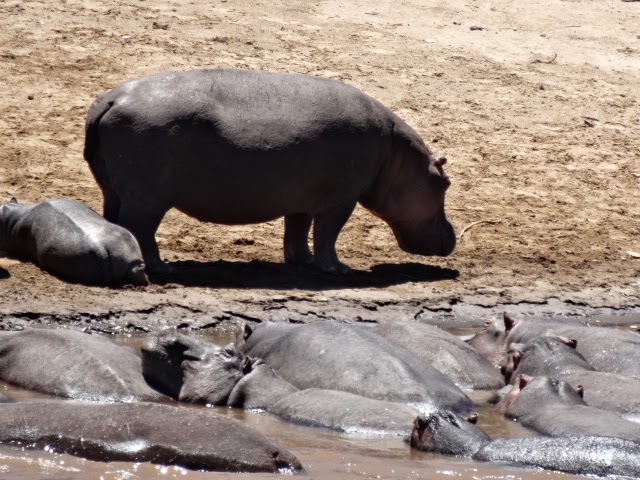
A lone hippo was searching for a morsel on the ground.

Little did I know at the time that bravery wasn’t a necessary element in experiencing the joys of safari. Instead, it is a sense of adventure, which with a professional guide and later on, as our guides, presented little risk with a multitude of thrills. At one point in our posts, I equated it to having an “E” ticket at Disneyland (remember, old-timers, like me?), and the thrills were seemingly never-ending.

Looking back at the photos now, primarily while outrageously confined in lockdown in a hotel in India for 6½ months, these photos still send a rush of endorphins through my bloodstream, making me realize how addicted I’ve become to this incredible rush after all of these years.

We realize that this gruesome photo may be difficult for some to see. But, it’s a part of the food chain which we decided we would accept on such scenes as a reality of the life cycle in the wild. This crocodile was consuming either an impala or gazelle.

Each day on Facebook, I peruse dozens of photos from various safaris in Africa and countless wildlife photos in Marloth Park from the many friends we left behind. Many of us belong to different Marloth Park FB groups, and the photos make me long to return in a way I can barely describe.

I think that perhaps someday soon, we can return to see our animal and human friends, shop in a grocery store, cook our meals, savor a glass of red wine or cocktail at happy hour, and move about freely in open spaces. My heart skips a beat.

The Mara River. Our tent was located on the shore, where sounds of hippos filled the air beginning around 4:00 am as they awoke.

On top of that, at any time we’d like, we can make the 20-minute drive to the Crocodile Gate to enter Kruger National Park to search for the next big rush excitedly; elephants, lions, cape buffalos, cheetahs, leopards, rhinos, most of which we don’t see as readily in Marloth Park.

The well-rounded experiences of that location are all we could ever dream of and, without a doubt, were where we had the most exciting, enduring, and blissful experiences in our almost eight years of world travel (as of October 31). Whether it was dinner at Jabula Lodge & Restaurant or dinner at our table or theirs, with friends, sitting by the braai (bonfire), or even those special times alone on the veranda, just the two of us, reveling in every visitor that graced our garden during the day or evening, it all was extraordinary.
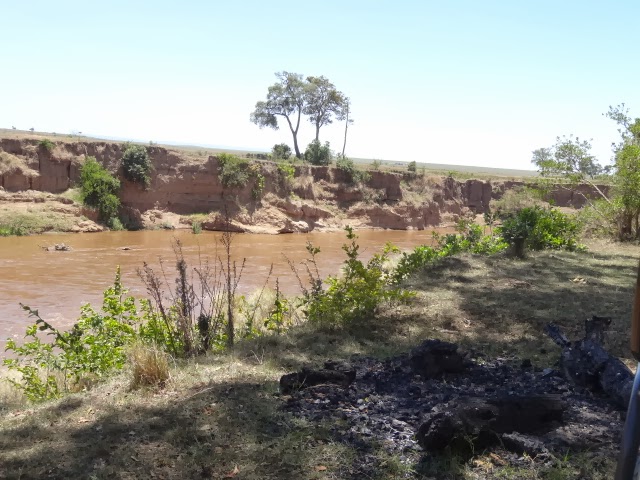
No swimming in this river!

Will we appreciate it more now than we did then, during the entire 18 months we spent in Marloth Park in 2013, 2018, 2019? I don’t think so. We treasured every single day and night, just like we’ll do once again, sometime in the future. When? We don’t have a clue. But, we wait patiently for news on the horizon when borders open, and we can be on our way.

It won’t be easy getting there. It’s a long flight, and most likely with COVID-19 protocols, it will be 35 hours or more from airport to airport and then a five-hour drive from Johannesburg to Marloth Park. The closer (one hour drive) airport of Mpumalanga/Nelspruit/Kruger won’t be opening for some time. Time will tell.

“Please pinch me,” I told Tom at that time. “I must be dreaming!”

Right now, our biggest concern is getting that package delivered. The hotel manager is helping us and working directly with FedEx. Hopefully, today, we’ll hear something. In the meantime, it’s the status quo, same old, same old.

Have a peaceful day, and please stay safe and healthy.

Photo from one year ago today, October 6, 2019:

A goose with a knot on her head on the farm in Devon, England. For more photos, please click here.

Day #182 in lockdown in Mumbai, India hotel…Making decisions…

Yes, I know. Photos of us in 2013 often show us wearing the same clothes over and over. After ditching most of our clothing to lighten our load, we have no choice but to do so. We try to wear the same items frequently in order to wear them out for disposal, saving the newer items for the future. So far, nothing has worn out. With no clothes dryers available, the thinnest tee shirts seem to “live” forever.

Today’s photos are from the post on this date in 2013, while we were living in Diani Beach, Kenya. For more on this date, please click here.

We laughed over the night depicted in today’s historic photos of the night on this date seven years ago that we went out to dinner in Kenya and were the only diners in the entire restaurant.

Ah, moonlight!

It was a beautiful moonlit night and we recall it as if it was only yesterday. We made a reservation at the Blue Marlin Restaurant located on the beach on the Indian Ocean. It was a long walk from the security entrance to the actual restaurant on uneven pavers and we were grateful for our LED flashlights to guide us along the way.

This spot was ideal for relaxing after a guest drank too many Margaritas!

We arrived at 7:30 pm at TripAdvisor’s highly rated restaurant, surprised to find we were the only guests on the premises. The staff was plentiful and the service and food was excellent. At the time we couldn’t recall ever being the only guests in a restaurant during dinner hours, but we shrugged it off, assuming sooner or later, other guests would appear. It never happened, much to our surprise after experiencing the delicious meals, drinks and service.

The chalkboard at the Blue Marlin listed the daily specials.

As a result, we had an opportunity to take some photos with the staff who were thrilled to oblige. We handed out several of our business cards knowing full-well they’d be searching for their photos on the next day’s post, perhaps making them feel a little like celebrities. It was endearing.

We had a chance to interact with their two “house dogs” who couldn’t have been more friendly. Of course, when we returned back to our holiday home, Han’s two dogs, Gucci and Jessie, were waiting for our return. It’s always been a treat to be able to adopt a dog or two that resided near our vacation homes at the time.

The Blue Marlin offered a relaxed, comfortable outdoor environment for diners.Notice an actual blue marlin on the wall.

It was hot, humid and windy, when we returned to the house. By the time we reached our outdoor living room, the veranda, we both decided to change into as minimal clothes as possible, covering ourselves with repellent and staying outdoors until bedtime. It was another good night.

Zaa Zaa, our friendly companion for the evening, lying at our feet as we dined.

On another note, yesterday’s post was the first of the five 2000 word posts I wrote, to which our web developers will be editing in the background for purposes of website optimization. Yesterday, I wrote the second of five posts and that should be ready to post tomorrow. I apologize for any redundancy in these long posts since its imperative they contain the content represented in the keywords.

Tom drank two bottles of this local Tusker beer.

There’s only five such posts and we should be done with them within a few weeks. Otherwise, on all other days, our regular less-wordy posts will appear as usual. No worries. No impact on your regular reading. Thanks for your patience.

Over the past few days, there’s been a lot of skuttlebutt online about the possibility of South Africa’s borders opening soon. At this point, it appears US citizens and anyone entering from India will not be allowed to enter. Another reality is that the Kruger Mpumalanga Nelspruit Airport we usually fly to, won’t be open for some time.

The chef insisted we take a photo together!

When we can travel to South Africa, we’ll fly into Johannesburg, rent a car and drive for five hours to make our way to Marloth Park. None of this concerns us. What concerns us is when the borders of both South Africa and India open enabling us to leave.

Tom’s appetizer of bacon wrapped jumbo prawns. I pointed out the bulging eyes. He asked, “Why’d you tell me that?”

Yesterday, we had a much needed discussion, considering these facts and both have agreed we are willing to “wait it out’ here at this hotel in Mumbai, India. There’s no point in adding more COVID-19 exposure in flying to the US to wait it out, nor is hovering around various airports, as they are just beginning to open, many soon.

My appetizer was a delicious creamy crab salad.

By the time we’re allowed to leave, protocols for COVID-19 will be firmly in place, after more experience, and we’ll have a better chance of avoiding infection. Of course, if India opens to other countries we’d be willing to travel to, and South Africa isn’t open for us, we may opt to head somewhere else to wait, as long as its to a location we’d find worthwhile and interesting. Otherwise, we’ll stay put.

Tom’s dinner consisted of a sizable portion of Swahili Fish, most likely a type of snapper. Bone free and lightly seasoned with a rich buttery coconut sauce, he had no trouble devouring every morsel.

Nothing much has changed around here. The corridors are a little less crowded now. The staff is working on reducing the noise at night from our next door neighbors (ugh!). And, we’re fine. As I write here now, Tom is watching the Minnesota Vikings football game on the TV using the HDMI and his laptop. As usual, they aren’t doing well. So it goes.

Look at the size of these calamari rings! I, too, savored every morsel on my plate.

Be well.

____________________________________________

Photo from one year ago today, September 21, 2019:

An otter lounging in the sun in Tiverton, Cornwall, UK. For more photos, please click here.

Day #177 in lockdown in Mumbai, India hotel…Two spaces or one at the end of sentence?…

Hans invited us up to his third-level veranda in Kenya for “happy hour” and to watch the sunset. As we enjoyed the view from up high, we all noticed this animal’s butt sitting inside a window of a thatched roof. Not a monkey with this type of tail, we anxiously waited for it to turn around. By the time it was dark, it hadn’t moved, leaving us all without a clue as to what type of animal it had been.

Today’s photos are from the post in 2013, while we lived in Diani Beach, Kenya, for three months. For more details from that post, please click here.

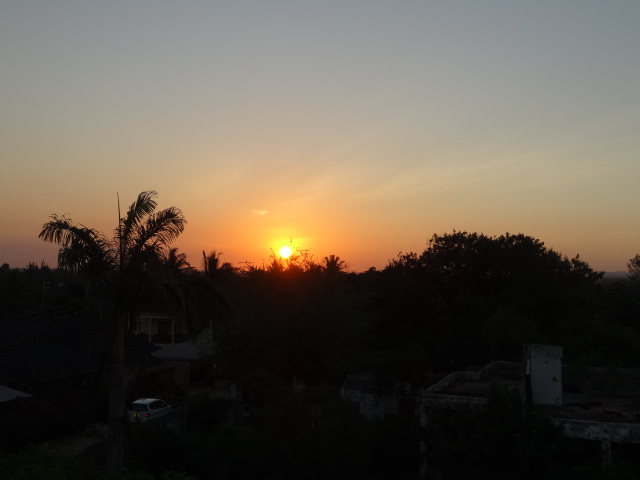
The sunset is beautiful everywhere. From the third floor of Hans’ house, we were thrilled to take photos of the progression of the sun’s setting on the horizon.

As I muddle through our almost 3,000 archived posts to make corrections, I continue to stumble across a dilemma. Do I remove two spaces after each sentence/paragraph and change it to one space or leave it as is, at two spaces? For us old-timers who learned to type on an old-fashioned typewriter, two spaces were the correct procedure.

Today, with the advent of digital means of typing, this simple dilemma may have changed. Subsequently, as I labor through post after post, barely able to get through 20 posts a day, I realize that the bulk of the corrections I am making in tightening up the space between two sentences.

Hans made Tom one of his unique local concoctions while I sipped on my usual ice tea while chatting with Hans’ lovely wife, Jerie.

Of course, I searched online for the answer, hoping to find a definitive solution. But, like many topics, the variations in opinions are overwhelming. Some dictionary sites say “one space,” and others say “two-spaces,” making the text easier to read. Oh, good grief. I’ve already spent hours correcting thousands of these.

At sunset, the lush greenery appeared brighter than during the day’s sun.

Here’s some information I found on this topic:

“Why should you or shouldn’t put two spaces after a period?
Hence the adoption of the twospace rule—on a typewriter, an extra space after a sentence makes text easier to read. … Because we’ve all switched to modern fonts, adding two spaces after a period no longer enhances readability, typographers say. It diminishes it.”
Or,

“There was a time when every period, question mark, or exclamation point was followed by two spaces. These days, depending on what you’re reading, you can find either one or two spaces between the end of one sentence and the beginning of another.”

Look at these lush ferns, abundant in Kenya’s humid weather.

After reading further, I concluded that in today’s world, one space after a sentence should be one, not two. I’ve opted for one space, thus doubling its time to correct errors on each page. So, how does this impact my corrections on almost 3,000 posts in the future?

And, what types of other errors am I encountering?

  1. Spelling: (I am using Grammarly and Ginger for assistance)
  2. Font size: Which I’ve decided to leave as is since it takes so long to correct.
  3. Punctuation
  4. Grammar: Many comma placement errors and sentence structure (I am using Grammarly and Ginger, two apps, for assistance)
  5. Paragraph and line spacing
  6. Missing or inadequate links
  7. Verbiage errors, restructuring sentences, etc.
  8. Photo placement/positioning
  9. Caption errors on all of the above
  10. Issues with headings
  11. Repetitive words reduction
    The haze, a result of both humidity and fires burning, leaves an eerie view over the horizon.

Well, as you can see, making these corrections is a lot more complicated than one might expect. Why am I doing this when most of our readers don’t care one way or another? (Thanks for that!). Many of our posts were completed under time constraints or days when I wasn’t as attentive as I should have been. Many other posts were achieved when the WiFi signal was poor. Making corrections was nearly impossible, let alone typing the text.

From high up on the veranda, these coconuts caught my eye. They are everywhere!

Excuses aside. Human nature. We make errors, especially me when 365 days a year I write the equivalent of an essay from 700 to 1000 words, mostly with photos which is a breeding ground for human error.

Now, as I go back through each post, one by one, I am certainly missing some corrections or making new errors in the process. Also, I am making new errors in the new posts I am doing now. It’s not perfect, nor am I, nor is Tom’s daily proofreading. But, we continue to strive every day to get this message to our loyal readers/friends/family to let you know what we’re doing, feeling, and thinking.

Soon, the sun would set, and darkness would fall as the sounds of the nocturnal wildlife rang through the air throughout the night.

Hopefully, shortly, we’ll have more to discuss than mere “dots.”

Be well.

Photo from one year ago today, September 16, 2019:

As we approached St, Michaels and All Angels, Church of England in Michaelstone, Cornwall, we were in awe of its beauty. For more photos, please click here.

Day #175 in lockdown in Mumbai, India hotel…Amazing memories in frustrating times…

The lodge at Sanctuary Olonana, where we’ll experience our first safari in October 2013.

Today’s photos are from the post in 2013, while we lived in Diani Beach, Kenya, for three months. For more details from that post, please click here.

Recalling the day we booked our first safari while sitting on the veranda/living room outdoors in Kenya’s holiday home is as easy as if it was yesterday. Our enthusiasm, coupled with a tinge of fear, made our hearts race. One never knew what to expect going on safari. And watching YouTube videos wouldn’t be helpful when so many consists of dangers encountered while on safari.

We hoped to see The Great Migration, but once we arrived in Tanzania, the bulk of it had moved on, although we did see the tail end.

Seven years later, we’ve been on more safaris than we can count in several African countries, including Kenya, South Africa, Botswana, Tanzania, Zimbabwe, Zambia, and Morocco, and now, in India at three different national parks. We’re not trying to break any safari expedition’s count or race. We revel in the vast experiences we’ve had over the years.

Our first safari in the Maasai Mara National Reserve in  Kenya remains our favorite of all the other experiences. A few times, we’ve been asked how many times we’ve been on safari and counting all the self-drives we’d done in Kruger National Park. Most likely, we’re well over 100 safaris.

We went on two game drives each day, one in the morning from 6:30 am until lunchtime and another in the early evening from 4:00 pm to 6:30 pm. Often, meals will be served in the bush as the other guests and feast their eyes on the surrounding wildlife.

The bouncing, the dust flying in our faces, the jolts, and fast turns make a safari an unusual adventure requiring a but of stamina and endurance. After each several hour-long safaris in the jeep-type vehicles with open sides, we felt as if we’d been exercising for hours.

Oddly, with my newer Fitbit, when we were on safari over 12 times in India, my readings showed I’d walked almost 30,000 steps each day from the mere rough ride in the vehicle. This made us laugh when we’d spent the majority of the day sitting in the car.

Most of these photos were from the Sanctuary Olonana website.

Getting in and out of a safari jeep can be challenging for those with mobility issues and instability. While we were on safari in India, it was only 11 months after my open-heart surgery. My legs weren’t stable after two surgeries only nine months earlier, and my breastbone felt as if it hadn’t entirely healed.

Riding in the vehicle was challenging when holding on tight, which was imperative in many situations as our guide worked their way around rough roads, potholes, and uneven terrain. Even my arms were still weak and guarded. Somehow, the prospect of spotting tigers in the wild was sufficiently exciting to keep me from thinking of any potential discomfort.

In the event of rain or if we were able to be inside air-conditioned comfort, the lodge at the camp provides indoor activities, a bar, and a restaurant, although as it turned out, we were on safari for the bulk of the day. Our living quarters were lavish private tents on the banks of the Mara River, overlooking families of hippos splashing and snorting in the water. We could hear the hippo sounds starting around 3:00 am each morning.

Now, after walking 5 miles a day (8 km) for so many months, I know I’d do a whole lot better. I continue to work my arms while walking to build strength and resilience and stay mindful of good posture and stance.

As for the Maasai Mara, named after the Maasai people of Kenya, a tribe known for their colorful red garb and an unusual diet consisting primarily of cow’s blood, it is also known for the Mara River, which millions of wild animals, mainly wildebeest cross each year on their annual migration.

This is a typical interior of permanent tents, full bathrooms, electricity, free WiFi, and mosquito nets. We always share one bed when there are two, using the other for our “stuff.” We brought our laptops, two cameras, binoculars, and other digital equipment, writing here each day with many photos.

Ah, my heart aches for such an experience now. The dust in my face, the jarring ride, and the challenge of getting in and out of the jeep are insignificant compared to the joy of being witness to this world of wonder once again.

As we continue over the next several weeks, sharing photos from that incredible expedition, we’ll be reminded once again of this exceptional adventure, unlike anything we’d ever done in our old lives. And now, who knows what the future has in store for us in months or years to come? We hold our breath in anticipation of leaving India to head to other lands with other joys, many of which are almost impossible to describe.

We were fortunate to see many Mr. or Ms. Rhino while in the Maasai Mara.

Be well.

Photo from one year ago today, September 14, 2019:

The Towne Centre Theatre in Wakebridge, Cornwall, watched the Downton Abbey movie when released in the UK. For more details, please click here.
Day #169 in lockdown in Mumbai, India hotel…Part 1…A necessary change in diet…

Day #169 in lockdown in Mumbai, India hotel…Part 1…A necessary change in diet…

Although most of the items on the menu at Sails Restaurant at the Almanara Resort in Diani Beach, Kenya, were seafood related, most of which Tom doesn’t enjoy.  He was thrilled to find some options that would be pleasing to his limited palate.

Note; We are seeing more and more readers signing up to receive our new daily posts in their inbox by clicking the link at the top right of our homepage, “SIGN UP TO NEWSLETTER.” As mentioned earlier, we will never use your email address for any purpose other than replying to any inquiry you may make of us directly to our email. This way, you don’t have to search for the link each day and can simply see it in the inbox. Thank you for staying with us during this challenging time, including the transition to the new site and the COVID-19 lockdown.

Today’s photos are from the post on this date in 2013, while living for three months in Diani Beach, Kenya. Please click here for the full post from that date.

For me, the menu was purely delightful. It was difficult to decide when every option was suitable for me.

On to today’s story..

For those of you who’ve been following us from the beginning of our world travels, you may be aware that a factor contributing to our decision to travel the world came about when after years of suffering with full-body severe inflammation, due to heredity, I began an extremely low carb, grain-free, starch-free, sugar-free diet, now often referred to as the Keto diet.

The Keto diet consists of very low carbohydrate intake, no more than 20 grams per day, excludes all wheat, grains, starches, fruits and sugar with a moderate amount of protein and high amount of healthy fats only (as per the Mediterranean diet). What does this leave to eat: grass-fed meats, free-range chicken and eggs, quality hard cheeses, and many non-starchy vegetables.

This photo, from the Almanara Resort’s website is the lounge area adjoining the dining area. Our photo didn’t turn out so well in the dark. This area was empty when we arrived but full by the time we left a few hours later.

My typical meals would include:

  • Protein source: chicken, fish, beef or pork – moderate portions
  • Carbohydrates: a salad with a side of vegetables to include such vegetables as leafy greens, broccoli, cauliflower, spinach (no potatoes, rice, beans, peas winter squash, carrots (too much sugar), small amounts of dairy including cheese and whole cream. Yogurt is to be avoided due to its high sugar content.
  • Fats: Coconut oil, grass-fed butter, high quality olive oil, and fresh avocados. (Vegetable and seed oils are known to be toxic and must be completely avoided.
    These complimentary appetizers presented by the chef were out of the question for me. It was fried seaweed and stuffed puff pastries, all made with flour. However, much to my surprise, Tom ate all of it, finding it very tasty.  I think his limited taste buds “song and dance” is purely psychological when I see him enjoy new items.

Once I began eating this way, beginning in August, 2011, I saw no impact on the level of pain I was experiencing, until three months later when one morning I awoke to being 100% pain free. For the first time in 15 years I had no pain and my life changed exponentially.

Within a few months, with our enthusiasm and hopefulness over my improved ability to move about without pain. I’d worked out for years in hopes of allaying the hereditary factors prevalent in my family, including heart disease, diabetes, obesity and auto-immune diseases. (Working out provided me with endorphins, which relieved the pain for a few hours each day).

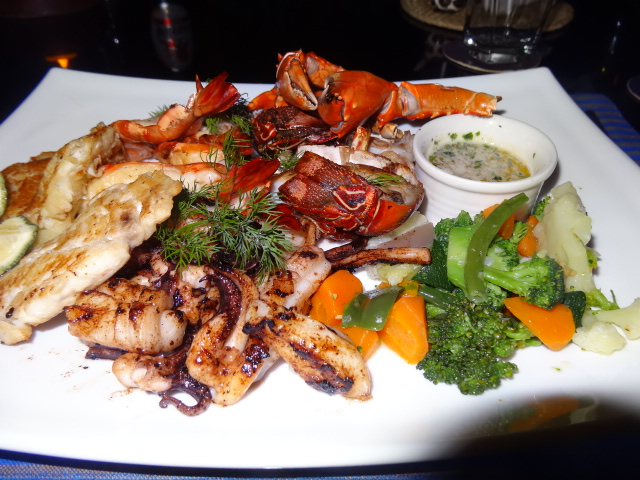
This amazing array of seafood was all grilled and seasoned to perfection. It contained lobster, prawns, octopus, squid, snapper and a few  chewy wormy looking items I didn’t recognize but ate anyway. Need I say that I cleaned this plate as well?

At this point, I should mention for those naysayers, I was told when I had open heart surgery, my diet and exercise may have saved my life. The hereditary cardiovascular disease I am plagued with, had been brewing for 20 or 30 years long before I changed my diet. (I could have had a heart attack at 40 years old instead of cardiac bypass surgery at 71). Prior to that change of diet, I’d stayed on a low-fat, high carb, near vegan, way of eating for most of my adult life in an attempt to avoid diabetes and heart disease. Little did I know…

Both the surgeon and cardiologist that performed the surgery, approved of my low carb way of eating to reduce inflammation and advised me to continue. Not all doctors agree with this way of eating, but  imagine in 10 years, that will all change.

Anyway, I continued my way of eating diligently all of these years of world travel, never experiencing the awful pain from the past. That’s not to say that pain from an injury, a shoulder or knee might not hurt from time to time. They did. But, once the injury resolved, once again, I’d be back to my pain-free way of living, continuing to follow my diet diligently. A few years ago I was able to include a moderate amount of red wine in my diet without incident.

 Tom’s dinner consisted of Fillet Mignon, fries, grilled vegetables. He kept insisting that I try a taste of his steak, finally taking a bite of tender well seasoned meat. He also ate every morsel.

And then, COVID-19 hit and we were struck in this hotel room with a menu and food options that included too many carbs for my way of eating. I decided to see how I’d do eating lots more vegetables and the red sauces associated with curry and Makhani, which included tons of tomato sauce, which is loaded with sugar and extra carbs, although free of any grains.

Night after night, I ate the same meals; either chicken curry, paneer Makhani or chicken Makhani (most recently) all of which are swimming in the tasty, spicy, red sauce along with an over-sized portion of vegetables sauteed in butter. The chicken was fine. The vegetable portion was too large and the amount of carbs I’ve been eating  via the sauces far exceeded the 20 grams a day I was meant to follow.

Over the past few months, keeping in mind, we’ve been eating here for almost 6 months with no avail meat other than chicken and tiny portions of expensive salmon, which I’ve ordered once a week, there was nothing I could do. The pain returned. Walking has become almost unbearable with horrible pain in my arms, legs, shoulders and back.

We borrowed this daylight photo from the resort’s website. It was dark as we were seated at this table. Our photo didn’t do it justice.

I finally accepted the fact that the pain has returned as it had been in 2011 and was due to the food I’ve been eating. This knowledge hit me over the head two days ago. I had to figure out something else to eat or give up dinners entirely. Sitting in this room, between walking each hour, is way too boring to only subsist on an omelet and two thin slices of bacon each morning. And, I couldn’t see how this meager amount of food would be healthful with all this walking I’m struggling to do.

Today, finally, I figured out what to eat for dinner. Tomorrow, I’ll share my newly revised menu. It’s not easy to change anything with the chefs with a distinct language barrier, and their lack of knowledge of micro-nutrients, more commonly understood by chefs in the US and other countries.

Also, last time I started eating this way in 2011, it took a full three months to see any improvement. Hopefully, now, it won’t take so long.

No, I don’t particularly enjoy spewing my health problems over and over again. But, let face it, many of us seniors, (and others) have chronic health conditions that impact our everyday life. Finding solutions is always utmost in our minds. Some of us are fortunate enough to make lifestyle changes that can improve our health.

We’ll be back with “the rest of the story” tomorrow.

Be well.

P.S. A month after we left Kenya on December 1, 2013, this restaurant, Sails, was bombed by terrorists on a Saturday night. We always dined there on Saturday nights.

____________________________________________

Photo from one year ago today, September 8, 2019:

Many towns, villages, and countries throughout the world have these colorful buildings lining the streets in St. Ives, Cornwall, England. For more photos, please click here.

A step in the right direction…Domestic flights in India beginning on May 25…

Playful elephants on the Sabie River in Kruger National Park.


Note: To all of our readers visiting our site via a smartphone, please click the “View web version” tab under the word “Home” at the bottom of the page to access the web version enabling you to access all of our archives on the right side of the page. We’ll be updating our site in a few months, making these extra steps unnecessary. Thank you.

Today’s photos are from May 21, 2019, from Connemara, Ireland. Please click here for more details.

This morning’s news announced the reopening of some airports in India for domestic flights. This is a step in the direction for the same for international flights sometime down the road.

We love the reflection of clouds in the water as we drive through the countryside.

However, it’s impossible to predict when this may occur based on the original transmission of Covid-19 traced to passengers entering the country from other countries.

The US has allowed some domestic flights from the onset of the lockdown, but here again, it could be many months before international flights will begin. As for South Africa, our preferred next destination, there is no indication of its borders opening anytime soon.

As for Madagascar, it appears they may reopen their borders in the next 60 days. Tanzania will be opening its borders for international travelers within a week. This leaves us with a good option for staying in one of these countries, enjoying its vast array of wildlife while we await the reopening of borders in South Africa.

Yellow irises were growing wild in the countryside.  Please click here for information on the wild yellow irises in Ireland that often grow along the road. 

Madagascar and Tanzania allow a 90-day visa on arrival. Suppose South Africa’s borders aren’t open after 90-days or 180-days in these two countries (and others). In that case, we can visit other islands near Africa’s eastern border or other countries within Africa such as Namibia, Botswana, and Uganda, depending upon the degree of outbreaks in those countries.

In the interim, liquor shops have reopened in some areas in India for “home delivery” only. No pubs will be open, nor will bars available in hotels. Since we’ve gone so long without a drink, at this point, we won’t bother. 

Besides, having beer and wine delivered to the hotel in lockdown with a guard at a distant gate would be cumbersome. We’ve decided we’ll wait until we get to our following location, which could be many months from now. 

A little sheep family was resting near the road.

It’s interesting to read the comments our readers have sent. As we’ve mentioned in past posts, the most common word we receive is, “Why don’t you seek repatriation to the US and get out of this odd situation?”
We appreciate your comments and suggestions.

Another question we received yesterday was, “Can you fly to another city in India” while you wait?”

There would be no point in us considering either of these scenarios. No city in India would offer a safer, more comfortable environment than where we are staying now in this quality hotel. It would make no sense to fly any more than necessary to leave India when it’s allowed ultimately.

We anticipate the flight out of here with a certain sense of dread, as grateful as we’ll be to be on the move. The required five or six-hour early arrival at the airport, wearing a mask and gloves for such an extended period, the medical checks, the luggage fees, and of course, the long and laborious flight.

As we approached the town of Clifden, we noticed several apartments and townhouses on the inlet.  Clifden, our area to shop, only has a population of 1,597. “Clifden is a coastal town in County Galway, Ireland, in the region of Connemara, located on the Owenglin River where it flows into Clifden Bay. As the largest town in the region, it is often referred to as “the Capital of Connemara.” Frequented by tourists, Clifden is linked to Galway city by the N59.”

But, there doesn’t appear there will be any other options. We’ve got into the possibility of an upcoming cruise on a small ship sailing out of Mumbai at some point, but only if it brings us closer to a destination we prefer. This is highly unlikely.

It’s not as if we are overly picky about where we choose to go from here. The country has to have open borders, adequate incoming international flights, and not be a hotbed of Covid-19 at the time. 

We accept the reality that we may be required to be quarantined for 14-days (or more) once we arrive in any country significantly since India’s number of cases is rising rapidly and…we are US citizens, the biggest hotbed in the world.

Ah, by no means is this situation manageable, nor will it be when we have some serious decisions to make. But, the one thing we know for sure, it would have made no sense for us to return to the US when flights were offered for stranded citizens.

This precious photo was my favorite of the day.

Where would we have gone? We have no home. Many holiday homeowners are refusing to rent their properties during the times of Covid-19. Hotels and meals are twice as expensive as we’re paying here or will pay in other parts of the world.

I’m high risk. We have no insurance in the US except Part A Medicare, which isn’t nearly enough to cover costs if either of us were to become infected. Our international insurance covers everything with only a $250 deductible.

The reasons are apparent. But, we thank everyone who has taken the time to write and offer suggestions and will continue to respond to your requests.

Yesterday, we crossed this single-lane bridge on the way to Clifden. We can take a few different routes from here to Clifden and will change it up each week.

The weeks seem to fly by quickly, especially from weekend to weekend. Often, when we comment on what day of the week it is, we’re both surprised it’s Friday or Saturday once again.

Regardless of all of this, we continue to have hope for the world, India, our own country, fur readers/family/friends, and for ourselves that eventually this too shall pass and a new world will begin to emerge.

Stay safe. Stay hopeful.

Photo from one year ago today, May 21, 2019:

Donkeys are highly regarded in Ireland to the point there are special programs available to adopt and a specialized Donkey Sanctuary in Cork, Ireland. For more photos, please click here.

Conspiracy theories…Alarming news…

From the rooftop of our riad in Marrakesh, Morocco, in 2014. 

Note: To all of our readers visiting our site via a smartphone, please click the “View web version” tab under the word “Home” at the bottom of the page to access the web version enabling you to access all of our archives on the right side of the page. We’ll be updating our site in a few months, making these extra steps unnecessary. Thank you.

I made an error in yesterday’s post. The photos included were actually from today’s date one year ago. Since it would take me to make the adjustments, I will leave them in place. No big deal, right?

Today’s photos are from our post on April 24, 2014, while we lived in a riad (a three-story house with a substantial open-air courtyard) in the souk in the Medina, known as The Big Square Marrakesh, Morocco. It was quite an adventure. We hope you enjoy the photos.

As we walked the souks deciding where to dine, these varying roof lines of a courtyard caught my eye. For this post from April 24, 2014, please click here.

As for today’s heading, I must admit, as an information junkie, I am somewhat obsessed with reading information on COVID-19, which also includes opinions from health professionals, universities, medical institutes, and individuals with expertise from over the world.

Realizing that exploitation is the name of the game when it comes to the news media, it’s a challenge to fetter out the truth from lies and exaggerations. When I hear or read something that rattles my cage, I do my research, often for hours, seeking the reality of a claim that may sound farfetched.

We were curious about what lies behind the many doors like this, similar to ours, in the Medina.
Today, I intend not to express my personal views on any of the wide array of conspiracy theories that are flooding the news and social media. Some may include a few morsels of truth with a lot of “spin” on it, and some may be accurate or false, which may frighten and increase fears of what has transpired and what is yet to come in light of COVID-19.

My truth which I willingly share today, is that censorship of our opinions, however farfetched they may be at times, violates our civil rights and freedom of speech. 

There are endless styles of rooflines throughout the Medina.

No, I don’t advocate rioting and toxic vitriol spewed out at random by vehement individuals with little knowledge or expertise. But, we are interested in hearing the opinions of those who may be qualified to espouse their views and have firsthand knowledge and exposure to truths being discovered at this time.

This morning, while on the first of my hourly walks, I was listening to a podcast by an individual I trust to gather and share information.  What I heard made me walk faster to return to our room so I could verify the facts.

This kitten was tiny, no more than 60 days old, on its own to search for food and shelter. The locals are fond of cats so most likely someone was feeding her.

Effective immediately, YouTube will no longer allow videos by anyone, regardless of their expertise and affiliation, to express views contrary to those stated by WHO, the World Health Organization. Please see this video here from YouTube’s CEO stating this restriction.

Like most of us as Facebook users, we’ll be seeing fewer and fewer posts on varying views on COVID-19 (and other topics) that don’t concur with their (Facebook’s) ideas, as mentioned in this article.

After hundreds of years of wear and tear, the stones crumble in certain areas, leaving an open spot for trash and debris.  Overall, the souks are very clean.

On the other hand, Tom has told me for years this was coming…censorship by social media of what we can and can’t see. This infuriates me. When we see information such as this, we can easily fall prey to conspiracy theories. In essence, deciding what we can and can’t say, hear and read may appear as a conspiracy theory in itself.

If those who weren’t aware of this censorship heard about this, they might say, “Hogwash. We have our constitution to protect us!” 

To this, I say “hogwash!” As COVID-19 proliferates throughout the world, we see more and more governments dictating our actions, thoughts, and right to voice our opinions.

Shades of pink and orange are seen throughout the Medina and souks.

Lockdown is a tough situation for all of us. We understand the necessity of this, and most of us have willingly complied. We hope that doing so has ultimately reduced the number of deaths worldwide. 

But now, people need to get back to work, exercising extreme cautions, or our countries as we knew them would be changed forever, while our freedoms may be significantly impacted in the process.

I could take out my soapbox and go on a rant about all of this for months to come. But I won’t. I can only encourage those interested in knowing more to conduct their research (as long as we can) to determine where you stand on these matters. Perhaps, sometime in the future, the collective will “have a voice.”

In the interim, please stay safe.

Photo from one year ago today, April 24, 2019:

This same time the prior year, our little friend, this female toad, (or perhaps another) came to live on this light fixture on the veranda wall.  For months, every night, she ate many flying insects to fatten up. We’d leave the light on for a while to ensure she’d have plenty of options.  In the spring, a small male joined her on the fixture, and they stayed there together for a few weeks and left, not to be seen again until she’s returned this week. Yet, another cycle of life in the bush. For the post from one year ago, please click here.

Sitting Kills…Moving helps with health and stress…

While living in Atenas, Costa Rica, in October 2017, we experienced quite a tropical storm. Please click here for that day’s post.
 
Note: To all of our readers visiting our site via a smartphone, please click the “View web version” tab under the word “Home” at the bottom of the page to access the web version enabling you to access all of our archives on the right side of the page. We’ll be updating our site in a few months, making these extra steps unnecessary. Thank you.
A waterbuck at the Crocodile River.

Today’s photos were all from our post from one year ago on this date. Again, we’re disappointed to be posting many photos we’ve already posted in the past, but right now, we have no other options when we never step out the door to take photos.

It would be nice to get some fresh air, but now the temperature in India is rising, and humidity is high and uncomfortable. At the moment, with our room being cleaned, we’re situated in the lobby on comfortable furniture, but it’s scorching in this area.
 

The ceilings in the lobby and dining room are very high, and to keep costs down during the lockdown, the aircon is turned off in all the common areas, including the corridors. We aren’t complaining. We are just happy to be here.

Hippos in the Crocodile River.

After sitting here in the lobby and the hot dining room during breakfast and dinner, we’re both hot and sweaty, looking forward to returning to our fabulous room. Our room bakes with the curtains open, and we often consider keeping the sun-blocking drapes shut during daylight hours.

But, it’s imperative to have sunlight in our eyes during the daylight hours to maintain our circadian rhythm to allow for a good night’s sleep. Thus, we keep the darkening drapes open until darkness falls.

A female lion on the prowl.

As I walk through the corridors once an hour, the warmth and humidity hit me the minute I exit the room. I’ve adjusted to this situation by walking once an hour instead of over long stretches. 

Besides, it’s beneficial to get out of a seated position once an hour, strongly impacting our health. Many years ago, I wrote a post about a book I’d read entitled Sitting Kills. Here’s the link to that story and information on the book, in case you’re interested in reading it. 

A parade of elephants kicking up a lot of dust in Chobe National Park in Botswana. Todays’ photos are from a year ago post. See here for details.

During this disastrous time of COVID-19, it may be of particular interest to those of you who are feeling a little guilty for sitting so many hours a day. Before I started walking, I felt angst each time I thought of walking but didn’t feel motivated.

Now that I am doing it, I can’t express how much better I feel and what a stress reliever it is during these challenging days of lockdown. Now that parks and walking paths are opening up worldwide as some restrictions are lessening, it may be the perfect time for many to start walking.

Unfortunately, due to ongoing lockdown restrictions in India, we can’t be seen walking outdoors, besides the fact that it’s too hot and humid. Also, we aren’t in an exceptionally safe neighborhood in the center of Mumbai.

These knobs on the head of giraffes are ossicones. Females have hair on theirs. Males have lost part of their hair from headbutting when vying for dominance.

I’ve promised to continue walking once we eventually leave here, whether it’s safe or allowed to do so outdoors. Walking is walking. Where one does, it is irrelevant, as long as it’s a secure location. Indoors is fine with me if that’s necessary. The steps are still tracked on my FitBit, and I continue to experience the benefits.

Yesterday’s post wasn’t my best effort. After days and days of writing with little to no new fodder, the content has been challenging. Thank you, dear readers, for staying with us during these boring times.

I’ve run out of sci-fi movies and Married at First Sight episodes, and I’m scrounging for some new content to watch during the quiet afternoon hours when Tom is busy on his laptop. He doesn’t care to watch shows during the day while I can easily get outside my head with a good series or movie. 

Mongooses were standing at attention while awaiting eggs. So cute! Note the little “arm” holding onto her friend.

I try not to watch any shows he may like to save those for in the evenings when we watch together. Yesterday, I signed up for Acorn TV on Amazon, a compilation of great British TV series, some of which we’ve already seen. 

We’re now watching a few suggestions from our friend Liz in Bristol, UK. She always makes great recommendations. Thanks, Liz! If any of our British readers have any suggestions for TV series they’ve liked, please let us know.

So here we are… another day without a huge amount of optimism. But, somehow, we’ll all get through this, regardless of how long it takes for some semblance of our former lives. It will never be the same. I believe we’ve all resigned ourselves to this reality.

Ken, Tom, and Don are having a good time, as usual.  We’d planned to all be together again soon before we left in May 2019.

The more we can do to use our time in lockdown for our benefit, both health-wise and emotionally, the better off we’ll be when it does come to an end, of one sort or another.

Hang tight, dear friends. We’re thinking of all of you, along with our family and friends.

Photo from one year ago today, April 23, 2019:

 
A mating pair of hornbills stayed around our garden each day, most likely a mating pair. When they wanted seeds, they sure let us know. For more photos, please click here.

Five years ago photos…Moholoholo Rehabilitation Center…

A visit to a pig farm in Penguin Tasmania. See the original post here with some fun “pigs in the mud” photos.

Note: To all of our readers visiting our site via a smartphone, please click the “View web version” tab under the word “Home” at the bottom of the page to access the web version enabling you to access all of our archives on the right side of the page. We’ll be updating our site in a few months, making these extra steps unnecessary. Thank you.

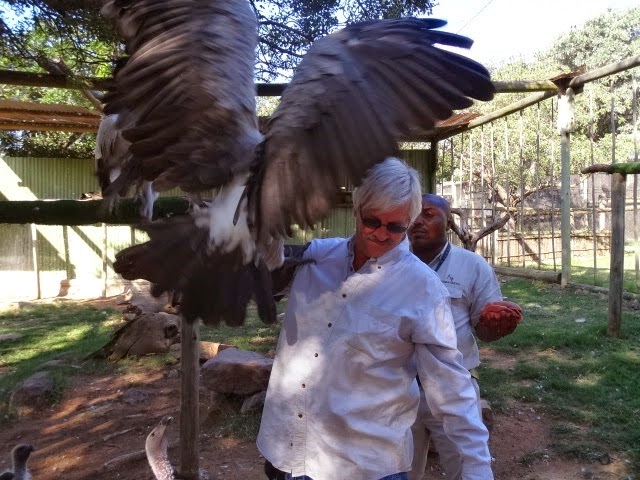
At the Moholoholo Rehabilitation Centre, Tom donned a huge leather hand and arm protector and was handed a massive chunk of fresh meat to feed this vulture at the rehabilitation center.  It was quite a thrill to get this photo.  I love the look on Tom’s face!  As their injuries healed, these vultures would soon be returned to the wild. Photos today are from this post on this date in 2015, which included some past-posted photos.

Today, while deciding on which past photos to post, I started with the post we wrote five years ago while still living in Princeville, in Kauai, Hawaii.

Then, we’d posted so many photos of Kauai. We were running low on new photos to post, so we reached back to these photos from 2014/2015 since we found them to be of particular interest to us and, hopefully, to our newer readers who may not have seen them in the past.

We apologize for the repeats if you have seen these photos in the past, perhaps even a few times. We aren’t taking any photos during the lockdown and, based on recovery from four surgeries a year ago. The pickings were also slim at that time.

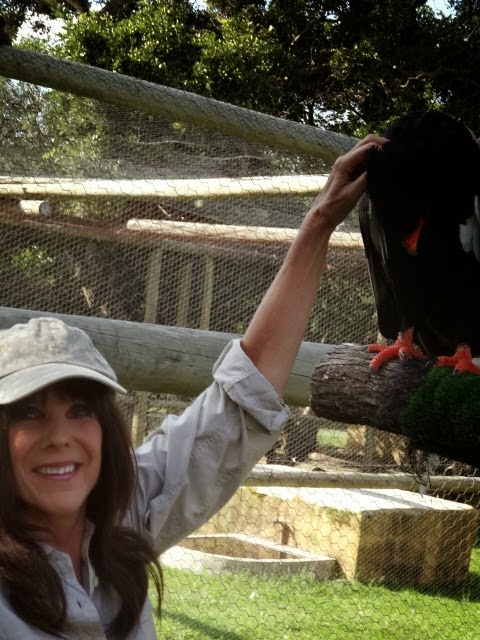
It was exciting to touch the vultures.  We were told to keep moving while around the vultures.  They only eat what appears to be dead meat.

For us, seeing these photos again is comparable to watching a favorite movie a second time, especially one that makes us smile. It only reminds us how anxious we are to get back out into the world again, sometime in the future.

In actuality it was on January 19, 2014, we visited the Moholoholo Rehabilitation Centrewhich may be found at our link here. We were so enthralled at the experience of making the tour of the well-known Panorama Route in South Africa. The photos have been fascinating.

If you ever can visit South Africa, this road trip is well worth the effort. The Panorama Route is a series of sites to see while driving along the highway, veering off periodically to stop at yet another stunning point of interest during the self-drive tour. For more on the Panorama Route, please click here.,

An eagle on the mend at the rehabilitation center.

Hmm… Do we ever get to visit South Africa? If we ever get to see South Africa again??? That’s the proverbial question for us. At this point, it’s hard to imagine when the airports and borders of both countries will open again. 

The number of cases in India is growing, not diminishing as expected from the lockdown, with 16,345 cases and 521 deaths. But, this was to be expected when many were not able or willing to honor the lockdown. Protests in the streets, in massive crowds, wanting businesses to open immediately, as is the case in parts of the US, significantly contributing to the added new cases each day.

Poverty is an enormous factor in the public’s response to lockdowns. On the other hand, South Africa, making it a crime to be out and about, has 3034 cases with 52 deaths. But, there, too, protesting workers are angry and anxious to get back to work to support their families.

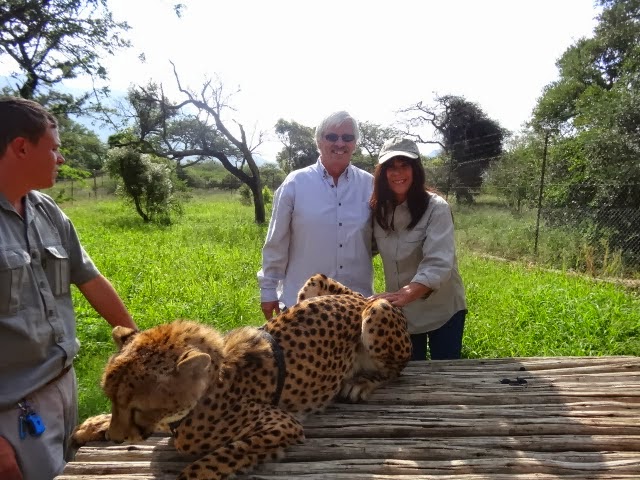
We had an opportunity to interact with a cheetah at the wildlife rehabilitation center. The particular cheetah wouldn’t ever be able to return to the wild due to injuries sustained in the wild for which he was rescued.

All of these statistics can change dramatically in a day, in a week. We’ll continue to watch and see. In any case, we are continuing to feel safe here in India with virtually no need to go out.
In the interim, we’re accumulating supplies we need now and will be shipped here to us in Mumbai over the next year. Imagine you could never go to a Target, Walmart, or Walgreen store. Of course, over time, one’s list of needed items would grow. We don’t purchase anything unnecessary. 

Recently, I ordered such items as large bottles of Tylenol, Tums, contact lens solution, toothpaste, and many more. If we went out to a tiny roadside pharmacy here in Mumbai, we’d have no say in the products we’d like since the little lean-to shops have a minimal inventory of such items, if they have them at all.

A Vervet Monkey and her baby were peering at us one morning while we were sitting at the table on the veranda.  Check out that thin pink ear of the baby.

All of our purchases are sent to our mailing service in Nevada (free shipping on most), and then all will be packed into one box and shipped to us soon. Daily I cross-reference the items I’ve ordered with those that have been received by our mailing service. Once everything has arrived, we’ll order the shipment.

Cargo planes are flying into Mumbai, and we should receive our shipment within 10-days of ordering utilizing the fastest possible service. Our only fear is that the hotel will close while we’re awaiting the shipment. But, they continue to assure us they will be staying open through the lockdown and beyond.

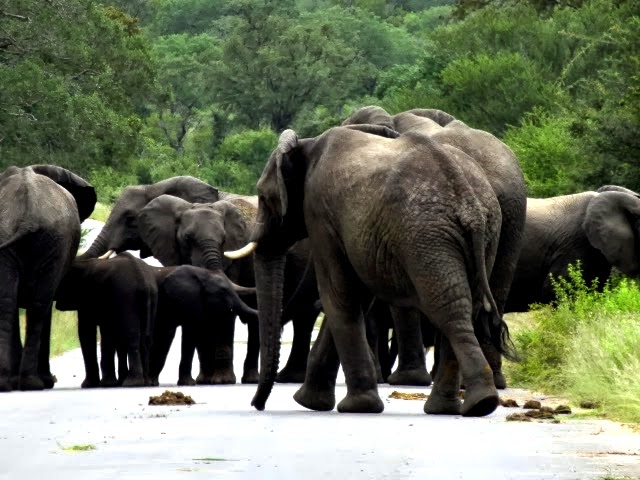
The fifth animal in the Big 5 (Leopard, Cape Buffalo, Rhino, Elephant, and Lion) this herd of elephants blocked the road as we drove through Kruger National Park.  Notice the babies are kept protected in the middle of the herd.  The most giant elephant, the Matriarch is often twice as large as the other adult females, holds up the rear with a keen sense ensuring their safety.  Seldom are elephants attacked in the wild based on their pack mentality of safety in numbers and their massive size.

So, today, after completing this post, we’re back to our usual routine; me walking once an hour while listening to podcasts, playing online Scrabble on my phone, and streaming shows while I play using my earbuds. Tom listens to Garage Logic and other podcasts while researching his favorite historical topics and, of course, ancestry.com.

How we manage to stay busy enough to keep from going crazy baffles me, but we’re doing it. We hope you’re doing the same.

Stay healthy. Stay safe.

Photo from one year ago today, April 19, 2019:

Duikers are incredibly cautious around warthogs, especially when there’s food being offered.  Tom makes a special effort to ensure the smallest of the antelope in Marloth Park is given pellets when no pigs are in close proximity. For more photos, please click here.

Photos from past adventures…Prescription challenges while in lockdown…Improvising…

A lone female lion was stopping for a drink.  The edge of the open vehicle is shown in this photo, illustrating how close we were to her.

Note: To all of our readers visiting our site via a smartphone, please click the “View web version” tab under the word “Home” at the bottom of the page to access the web version enabling you to access all of our archives on the right side of the page. We’ll be updating our site in a few months, making these extra steps unnecessary. Thank you.

This playful baby elephant we spotted in Kruger hangs on to her mom.

Since we were focused on today’s photos, we haven’t included a video today or any Kauai photos. Instead, here is a combination of images we posted five years ago on April 18, 2015, at this link and also last year on this date on April 18, 2019, at this link. We hope you enjoy some of these favorites that many of our readers may have seen in past posts.

Hippos along the Mara River while we were on safari in the Masai Mara.

Of course, being in lockdown right now prevent us from taking photos. We can’t go outdoors, and most wouldn’t be enlightened by seeing photos of a hotel, however appealing it may be. If, by chance, you are curious about where we’re holding out, please click here

As you can see, if you click the above link, it’s a charming hotel, but most areas are closed during this time. We only have access to the restaurant, the corridors on the fourth floor, and our standard room. Only one lift is in use which we never enter when occupied by others. 
Crocodiles sunning along the Mara River in Kenya.

Not only does being in lockdown in India present its challenges, but also there is the harsh reality that we may not have everything we need on hand.
For example, once every four weeks, I refill my pill case with three prescriptions I take each morning along with a handful of vitamins. 

Spread out through during the day, we each take 1000 mg of Vitamin C and an extra dose of Vitamin D3, both of which may improve the immune system’s ability to fight off colds and flu (so they say).

As shown here, the cheetah and leopard are distinguishable by the cheetah’s tear lines running down her face.

As I was refilling the pill case, I noticed I was running out of a proper dose of blood pressure medication which is Lisinopril 12.5/10. Amid the recent COVID-19 mayhem, I’d forgotten I needed to head to a pharmacy while in India, where prescriptions aren’t required for non-narcotic medications.

Many of us have heard that India produces a huge portion of the drugs used in the US and other countries with all the news lately. Thus, I wasn’t concerned about purchasing any medication while here from any popular pharmacy.

In the first 10 hours on safari, we saw the Big 5.  The black rhino is one of the Big 5.

Before lockdown, while on tour, we stopped at a pharmacy and explained exactly what I needed. The above described Lisinopril, which included 12.5 mg of HCTZ (hydrochlorothiazide) and 10 mg of Zestril in a combination pill. 

Unfortunately, they only gave me Lisinopril with 12.5 mg HCTZ)/5 mg Zestril. I need 10 mg Zestril. At the time, I requested additional tablets containing 5 mg Zestril to make up the shortfall. 

The pharmacist left for a while and returned with a handful of tinfoil-packed tablets with what I thought was the 5 mg Zestril. Foolish me, when I couldn’t read the tiny print on the tinfoil, I assumed it was the correct add-on. As I said, foolish me.

We couldn’t resist posting this contented lion who was, at the time, engaged in a mating ritual with the female about 15 feet from him, leaning on another tree.

I didn’t notice this error until yesterday when I started filling the pill case, running out of my old 12.5/10, and started including what I’d purchased here. I discovered using a magnifying glass that when the pharmacist took off for 10 minutes, all he collected was more of the same. I now have 100’s of 12.5/5.

They were a meager cost, so that I won’t complain too much. Besides, it was my error in not checking diligently enough for something so crucial in the long run. I don’t think the pharmacist did this on purpose. I believe he also thought this was the correct item when he, too, couldn’t read the small print on the tinfoil-wrapped tablets.

So now, the dilemma. It is legal to go out to a pharmacy here and straight back. But, with the escalating cases of the virus in Mumbai, the new India hotspot, there’s no way we’re going to stand in line at an outdoor pharmacy with sick people. I had to figure out a better solution.

Closeup of hippo face. Charming.

With the single pill at 12.5/5, there was no way to double up and then cut part of a pill. It would result in a really peculiar dose. I looked online to see dosing instructions for this drug at a few reliable US pharmaceutical sites but found no answer.

The question became, “Could I take two tablets resulting in a dose of 25mg HCTZ/10 mg Zestril? What would be the consequence of doubling the amount of HCTZ, which is a diuretic I need to control blood pressure, especially important in light of ongoing coronary arterial disease? 

A female lion looking for the next meal.  The lion is the second of the Big 5.

An idea popped into my head. I still had Dr. Theo’s email address I’d used when sending him updated photos on the healing of my legs before and after the two surgeries one year ago. I’d send him an email.

Within hours I had a response, and kindly Dr. Theo told me I could double up on the drug and take two for the total dose of 25/10, but it was imperative to check my blood pressure daily to ensure it didn’t go too low.

Fortunately, we have a sphygmomanometer, which we purchased as part of our medical supplies. I used it frequently after I had surgery, but seldom did it seem under control over the past few months, and I was feeling so much better.

Males lions are always on the lookout for a female making a kill.  Why?  So he can steal the kill from her.

I’ll start checking and charting my blood pressure before taking the higher dose (for a baseline). If my blood pressure gets too low, I can alternate between the higher and lower doses every other day to hopefully stabilize it enough until we get out of here and I can get the proper dose, hopefully in South Africa in a few months.

Oh dear, there are other items we need, but we’ll improvise to the best of our ability in the interim. We don’t want to risk going out in public. And, we hope you feel the same way too. Please avoid going out unless it’s absolutely imperative or life-saving. 
Stay safe. Improvise.

Photo from one year ago today, April 18, 2019:

Female lion showing off her tongue. For more photos, please click here.