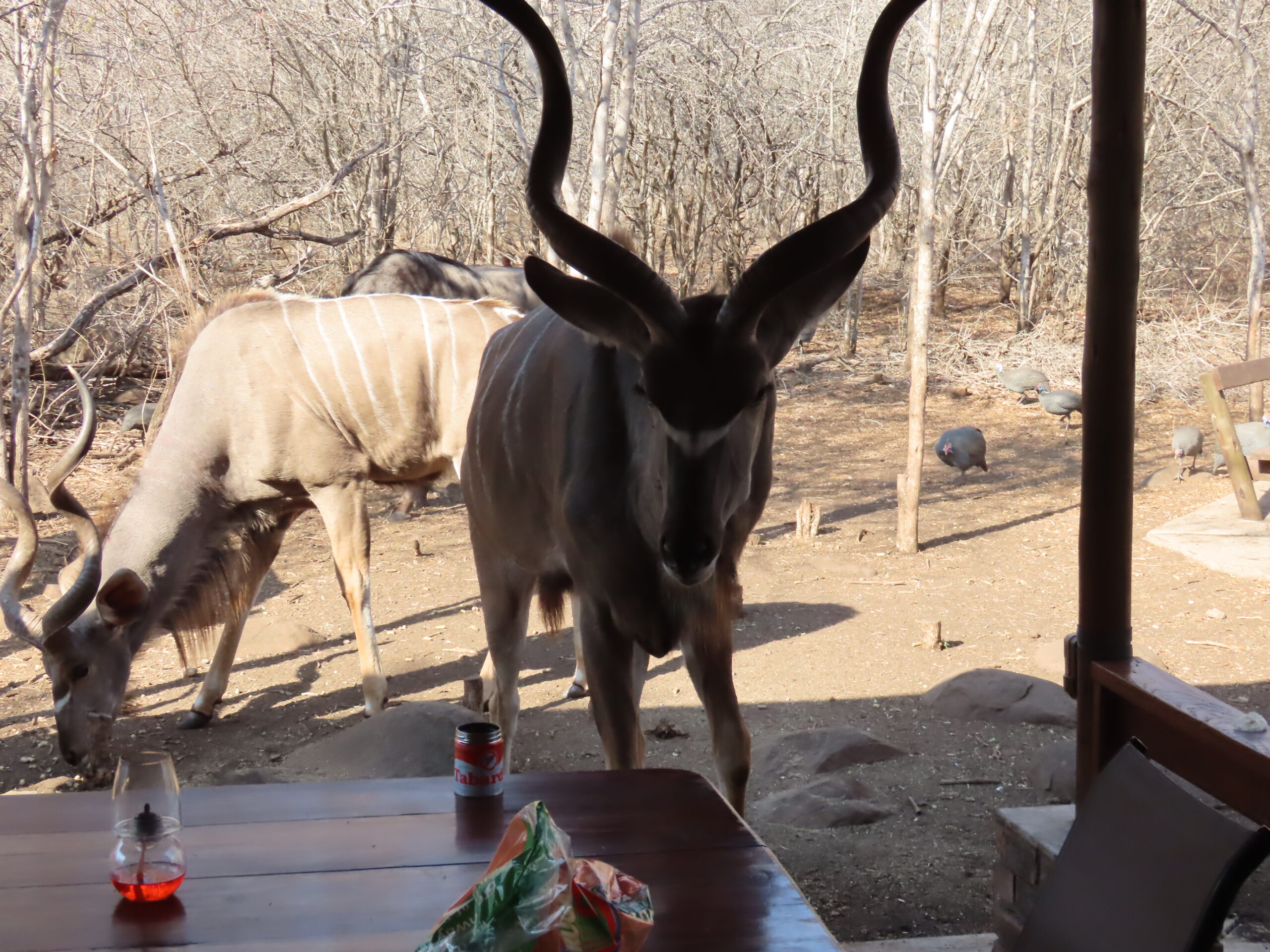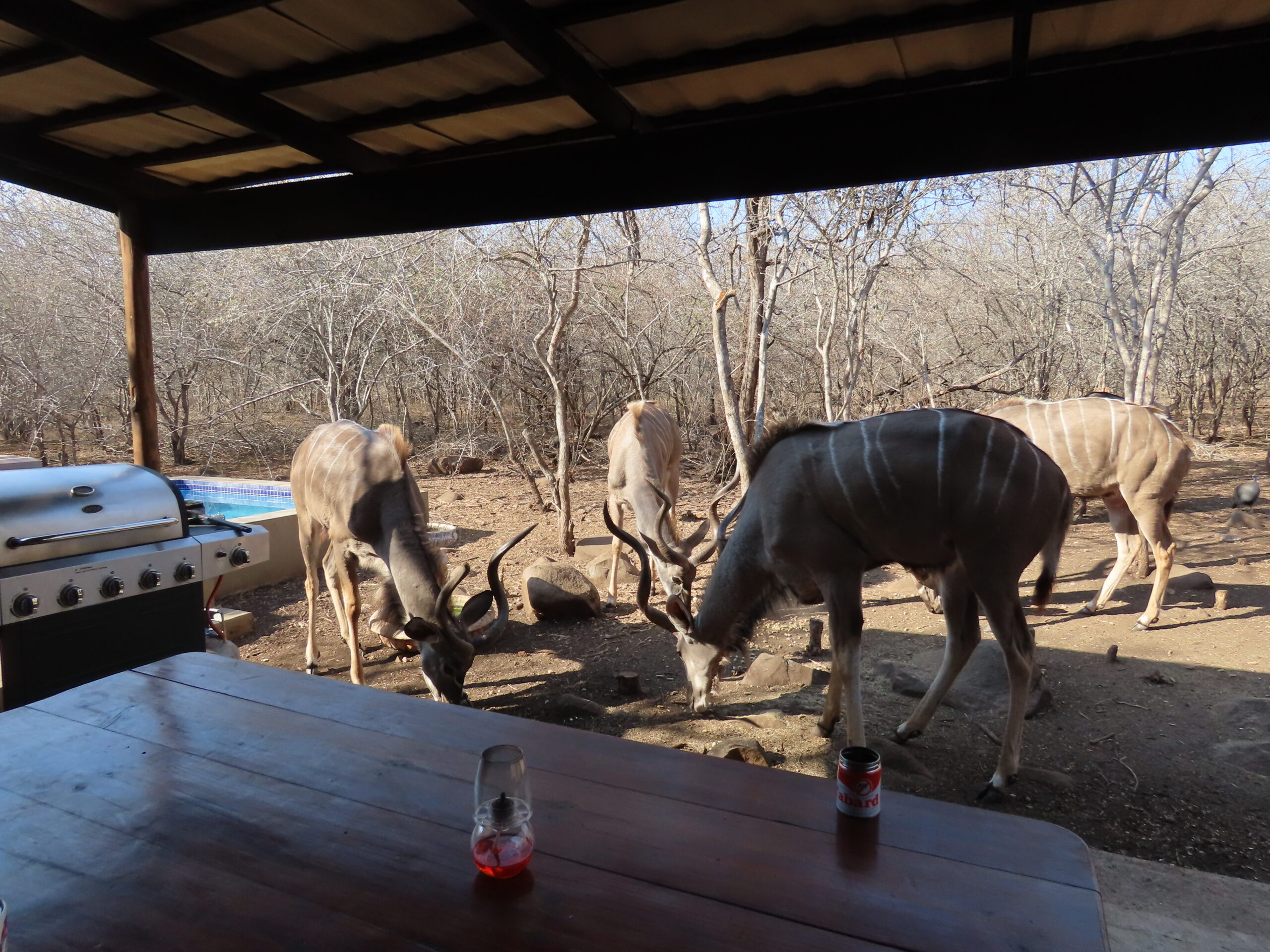
Thirty or forty of these infrequent visitors came to call…A pleasant soaking rain has started greening the bush!…A speedy resolution for a painful situation…

Impalas are fantastic jumpers. We watched this female jump into the air when she was startled by Broken Horn.

Yesterday afternoon, Tom beaconed me outdoors while I rested in the bedroom after another stormy night’s sleep due to this darned painful tooth socket to say we had 30 to 40 visitors of the same species. I assumed they were impalas since they are the only animals, other than birds and mongoose, where we’ve had such numbers in the garden.

Impalas are the most prolific antelopes in Marloth Park and also in Kruger National Park. They can give birth twice in one year and are healthy and sturdy animals. As mentioned in a prior post, over 100 impalas were relocated from Marloth Park to Lionspruit, providing more hunting opportunities for Desi and Fluffy, the only two lions in that game reserve located within the borders of Marloth Park.

I couldn’t believe how many impalas were in our garden and the surrounding bush when I stepped outside. It reminded me of a similar invasion we had in 2014 while living in the Hornbill house Rita and Gerhard currently occupy.

On that particular day, there were many more impalas, hundreds, much to our surprise. What an experience that was! But, yesterday, we were as thrilled as we’d been way back then. With many impalas recently moved to Liosnpruit and the possibility many were culled, it’s unlikely we’ll see hundreds of them in the garden anytime soon.
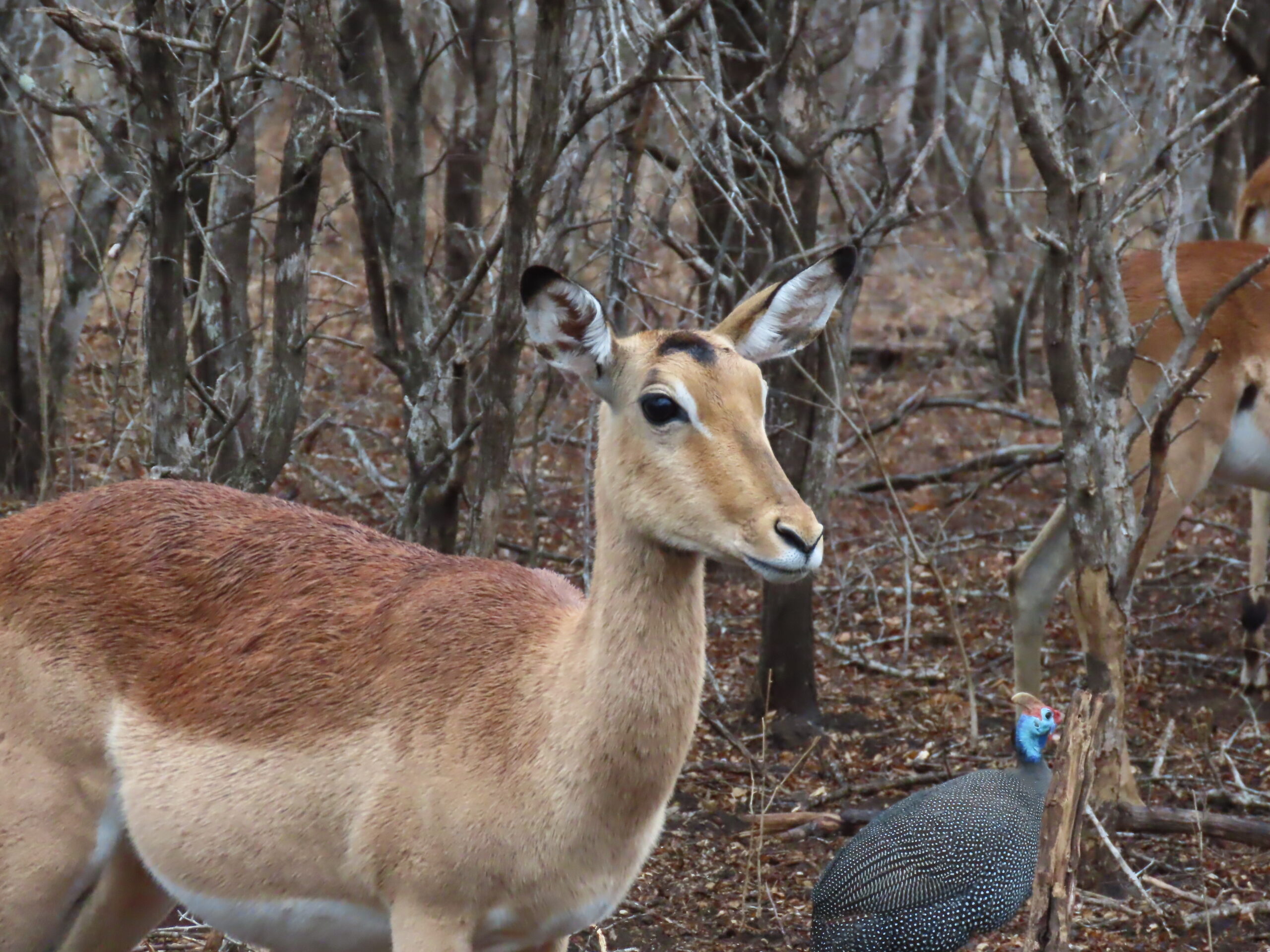
Impalas have such pretty faces and markings. A helmeted guinea-fowl manages to “photo-bomb.”

Here are some interesting facts about impalas from this site, you may find enjoyable:

“Impalas are medium-sized antelopes that look like a mix between a goat and a deer. They have long legs and necks and black, twisted horns. As members of the Bovidae family, they are related to goats, cattle, and sheep.

Size

Impalas weigh around the same amount as a large dog at 88 to 165 lbs. (40 to 75 kilograms). According to National Geographic, they grow to 33 to 39 inches (84 to 99 centimeters) long by adulthood and typically come up to the chest of an average-sized adult man. The male’s horns grow to 18 to 37 inches (46 to 94 cm) long.

Habitat

The impala is native to Africa and ranges from Angola, Namibia to northeast South Africa and north through Botswana, Zimbabwe, Mozambique, Zambia, Tanzania, and Kenya. According to the University of Michigan’s Animal Diversity Web (ADW), it lives in woodlands with little undergrowth and low to medium-high grassland. They also live in savannas.

Habits

Impala is diurnal, which means they are most active in the early morning and right before sunset. During the rainy season, impalas gather in groups of hundreds. In the dry season, the herds roam together to look for food. During the rainy season, males can be territorial and will herd females around a territorial area.

Groups of young impalas are called creches. According to ADW, these offspring groups are like nursery schools for the young, and they play together and groom each other.

Diet

Impalas are herbivores, which means they only eat vegetation. Their diets consist of bark, leaves, wood, and stems.

Offspring

Before giving birth, a female will leave the herd. After a gestation period of six to seven months, she will give birth, usually to only one offspring at a time. After a day or two, the mother impala will bring her calf back to the herd. Baby impalas are called calves. Calves are weaned at four to seven months, and at 12 to 18 months, the calf is mature enough to have its offspring. Impalas usually live to around 13 years in the wild.

Conservation status

According to the International Union for Conservation of Nature (IUCN), impalas are not endangered. Currently, the population is estimated at almost 2 million. Fifty percent of the population is found on private land, and another 25 percent of the population lives in protected areas. As a result, for the most part, the population is stable or increasing.

Other facts

Impalas are fantastic jumpers. According to National Geographic, they can leap as far as 33 feet (10 meters) and as high as 10 feet (3 meters). If impalas are running from predators, they are known to jump over obstacles in their way, such as large bushes or stumps, instead of going around them.

Impalas have reddish-brown hair with white fur on the underside of the chin, inside ears, on the belly and lips, over the eyes, and on the tail.

They also have black stripes down the forehead, tail, thighs, and ear tips. According to the University of Michigan, some scientists think they use these black stripes to identify each other. ”
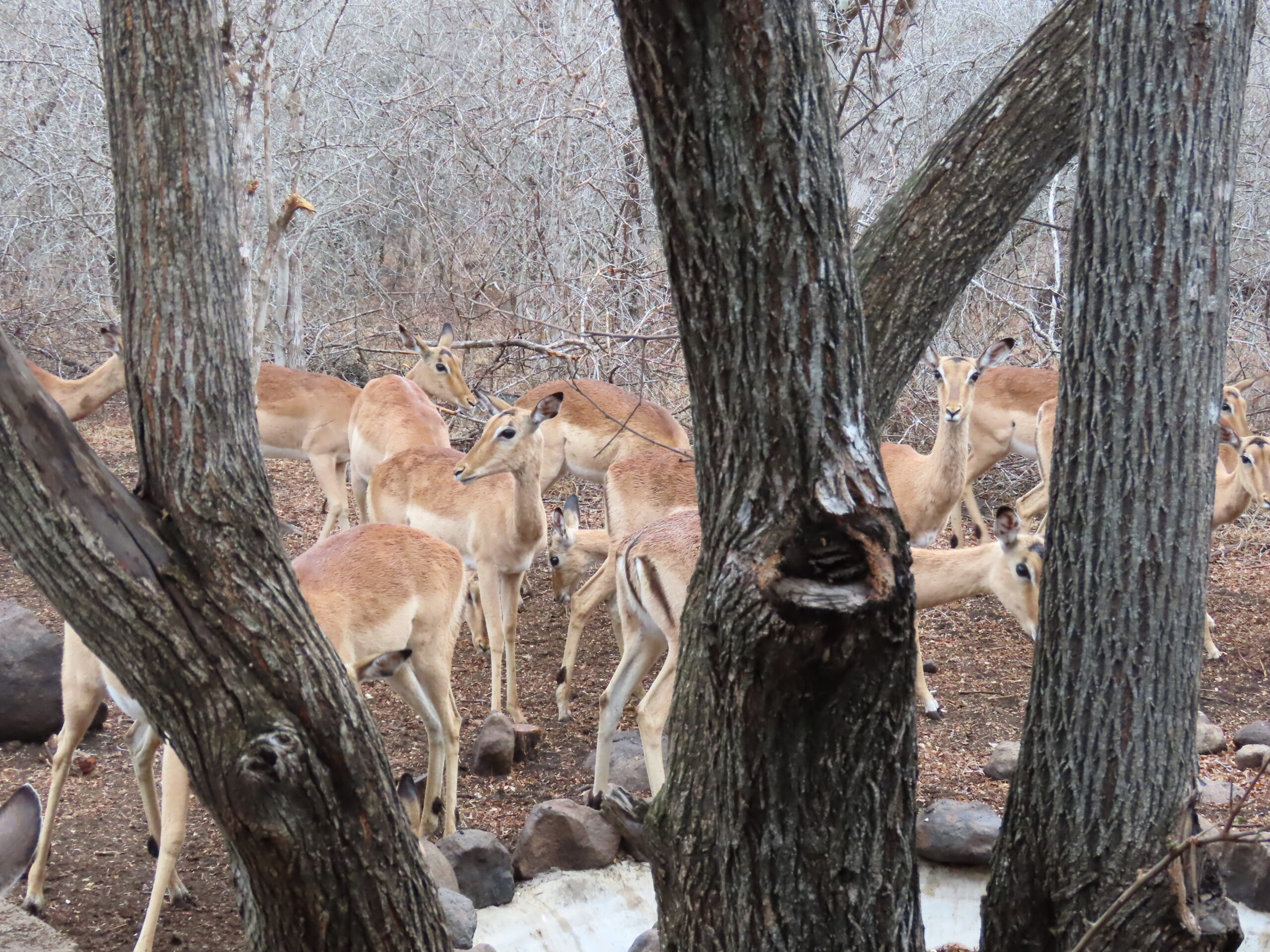
They were all over the garden, close to the house, which is unusual for them.

Excitedly, I scurried about the veranda attempting to get good photos. However, impalas are very shy and cautious. Every motion I made sent them running into the bush. Instead, I decided to stay in one spot with the camera to ensure the best possible shots. They even reacted to the sound of the click when taking a photo. I have since turned off this feature.

As for today, I had booked a 10:00 am appointment with the dentist at the clinic in Marloth Park. Dr. Singh was off this week, and I couldn’t wait another day. The pain in the socket was excruciating, with no improvement over the past week. It has been nine days since the extraction.

With little sleep due to the pain, I had no choice but to seek help from another dentist in Dr. Singh’s absence. Fortunately, I was able to get an appointment for this morning with Dr. Lizannie, a 10-minute drive down Olifant Road, the only paved road in Marloth Park.

Tom waited for me in the car, playing with his phone, while I entered the medical clinic, fully masked, as always. After a 20 minute wait, I was escorted into the dental suite, where the dentist was waiting while filling out a health history form.

It took her exactly 30 seconds to diagnose my painful situation as a “dry socket,” I’d expected this after reading considerable information on pain after tooth extraction. In almost every case, I continued pain a week after the extraction due to a dry socket.
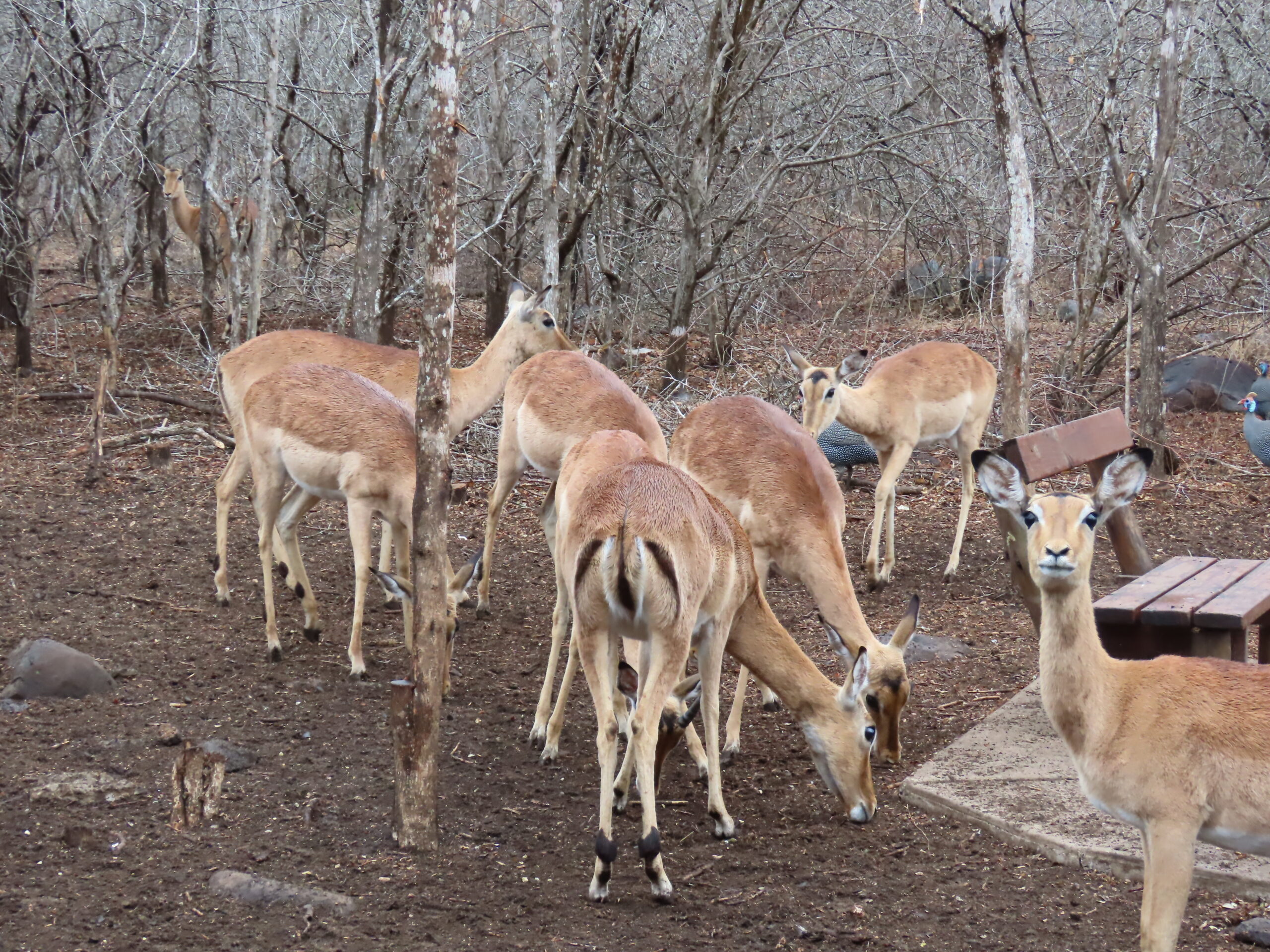
Every so often, one of the impalas would pick up their head and look at me.

A dry socket (alveolar osteitis) is a painful dental condition that sometimes happens after a permanent adult tooth is extracted. A dry socket is when the blood clot at the tooth extraction site fails to develop, or it dislodges or dissolves before the wound has healed. From the Mayo Clinic in the US, a dry socket is described as follows:

Typically, a blood clot forms at the site of tooth extraction. This blood clot is a protective layer over the underlying bone and nerve endings in the empty tooth socket. The chunk also provides the foundation for the growth of new bone and the development of soft tissue over the clot.

Exposure of the underlying bone and nerves results in intense pain, not only in the socket but also along the nerves radiating to the side of your face. The socket becomes inflamed and may fill with food debris, adding to the pain. If you develop a dry socket, the pain usually begins one to three days after your tooth is removed.

Dry socket is the most common complication following tooth extractions, such as removing third molars (wisdom teeth). Over-the-counter medications alone won’t be enough to treat dry socket pain. Your dentist or oral surgeon can offer treatments to relieve your pain.”

Dr. Lisannie explained precisely how she was going to resolve it. She would numb the area of the socket with several injections. With the gums so sore from the past nine days, I was hesitant about those long needles, but surely whatever she would do would be more painful than the injections.

In no time at all, I was numb, and she began scraping off the layers of the socket to reveal fresh blood, which is intended to form a new blood clot to start the healing process all over again. The first clot never stayed in place.

Back home by 11:00 am, I didn’t take any more pain medication when I wanted to see how it feels when everything wears off. Now, at almost 3:00 om (1500 hrs), the pain is back, but it is nowhere near as painful as it had been before the procedure.

It’s expected I will be pain-free within a day or two. In the interim, no coffee, acidic foods, chunky foods, or wine until I am pain-free. Of course, I never felt like any of my light wine with this degree of pain, plus it’s not a good idea while taking any pain medication.
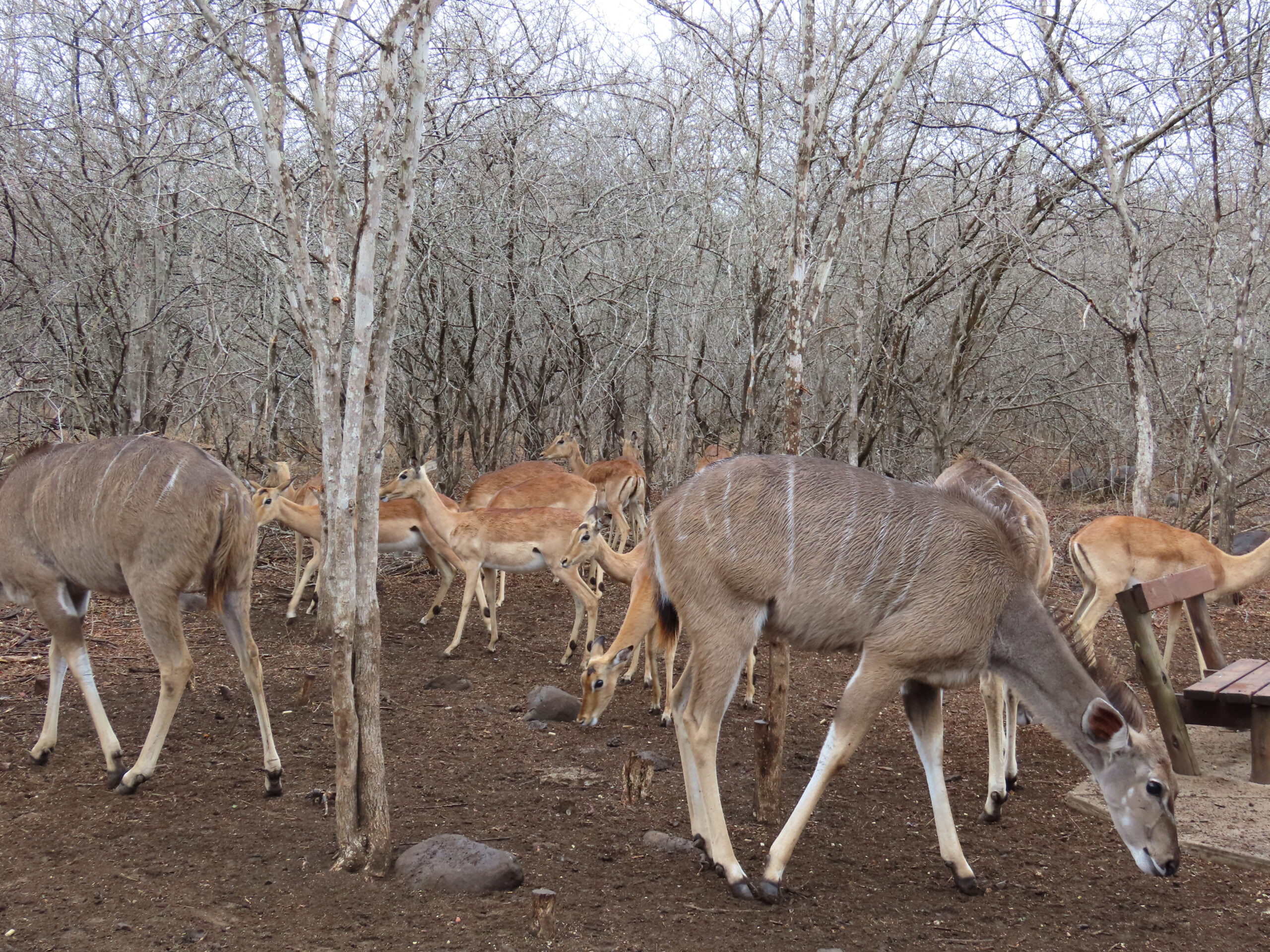
Impalas were getting along well with the kudus while they shared pellets.

I already made our dinner tonight. Italian mozzarella stuffed meatballs with sauce and cheese for Tom, and finely chopped chicken salad, using chicken breasts we’d cooked yesterday. I may try to add a small finely chopped lettuce salad on the side.

Hopefully, by this time tomorrow, I’ll feel much better when we head to Rita and Gerhard’s house for sundowners. If I’m still not 100%, I’ll drink room temperature iced tea instead of the wine I am drinking now and throughout the evening.

Sorry for the late post! Have a lovely evening!

Photo from one year ago today, September 22, 2020:

This photo was posted one year ago today while in lockdown in a hotel in Mumbai, India, on day #183. Hans, our landlord and next-door neighbor, invited us for dinner outdoors in their garden. He built a roaring fire to which he later added a grate to cook an entire beef tenderloin without charcoal or lighter fluid. Check out that moon smiling down on us! For more photos, please click here.

Funny little mongoose story with photos…

This morning, the mongoose’s fur got wet, and they looked spikey!

Mongoose are funny little characters. Having been around humans in Marloth Park for all of their lives, they’ve become quite used to us. We take special care to avoid getting too close to them, but they wait at the screen door to the veranda for us almost every day. They carry several diseases, and their bite may cause a severe infection.

As carnivores, known for killing snakes and being immune to the venom, they always welcome visitors as the snake season is fast approaching. Snakes don’t necessarily hibernate, but their system slows down during cool weather. Thus, we’re less likely to see snakes during the cooler winter months.

The minute we put down the prawn scraps, a mongoose arrived and alerted the others with her cackling that treats were being served. They all came running so fast. I didn’t have time to take more photos.

Don’t get me wrong. I don’t condone killing snakes, scorpions, and other venomous reptiles and insects. They are all a vital part of the ecosystem of the bush. Add that we see no less than a dozen, often as many as 50 or 60, of the little furry creatures almost daily. We feel at ease knowing they’re keeping an eye out for venomous snakes and insects.

But, if it’s a choice of “them” or us, we let the mongooses do their thing with respect and admiration for their determination,  skill, and immunity to toxins. Subsequently, we don’t hesitate to feed them daily, inspiring them to come around as often as possible, usually two or three times in one day, then miss a day or two, only to return with considerable enthusiasm to see what’s on the menu today.

One after another came cackling toward the prawns, grabbing as much as they could fit into their mouths. We couldn’t stop laughing.

Here are some exciting facts on mongooses from this site:

“Mongooses are long, furry creatures with pointed faces and bushy tails. Despite popular belief, mongooses are not rodents. They are members of the Herpestidae family, which also includes civets and meerkats.

Size

There are 34 species of mongoose in 20 genera, according to the University of Michigan’s Animal Diversity Web (ADW). With so many different types of mongoose, sizes vary greatly. According to National Geographic, their bodies range from the dwarf mongoose at 7 inches (18 centimeters) long to the Egyptian mongoose, 2 feet (60 cm) long.

Habitat

According to National Geographic, most species of mongoose are found in Africa, but some also live in southern Asia and the Iberian Peninsula. Some species of mongoose have been introduced into other areas of the world, such as the Caribbean and Hawaiian islands.

It happened so quickly; they were all gone in about two minutes.

Mongooses live in caves made of complex tunnels or trees in many different landscapes, including deserts and tropical forests. The bushy-tailed mongoose, for example, lives in lowland forests near rivers. The Gambian mongoose lives in areas with grasslands, coastal scrub, and forests.

Habits

Some species of mongoose are very social and live in large groups called colonies. Colonies can have as many as 50 members, according to ADW. Other species of mongoose like to live alone. Banded mongoose colonies live, travel, and fight together as a team. According to Animal Planet, they stay in one area for around a week, then move in a wave to another location, much like a flock of birds when they migrate.

Mongooses are active during the day and sleep at night. Throughout the day, they chatter incessantly to each other and combine discrete units of the sound somewhat like human speech, using vowel and syllable combinations to possibly coordinate group movements, foraging information, and other essential messages.

Diet

Mongooses are omnivores, which means they eat both meat and vegetation. Typically, they prefer to eat small animals such as birds, reptiles, fish, snakes, crabs, rodents, frogs, insects, and worms. They will also supplement their diet with eggs, nuts, fruits, roots, berries, and seeds. To get into eggs, mongooses are known to crack the eggs against complex objects, according to National Geographic.

The pile of prawn scraps was dwindling fast.

Conservation status

According to the International Union for Conservation of Nature (IUCN), most mongoose species are threatened but not extinct. Ironically, in the 1800s, mongooses were introduced to Hawaii and the West Indies to control rodent populations at sugarcane plantations. This introduction, in turn, caused many species of birds and other animals to almost become extinct.  The small Asian mongoose is listed as one of the world’s 100 worst invasive alien species.”

We enjoy visits from these humorous little animals. Their endless chatter amongst themselves truly sounds like conversations in the form of a high and low-pitched cackle. When they visit us, standing on the veranda, that cackle is different from those when they’re issuing a warning, such as when another band is approaching or an eagle or hawk is flying overhead. The variations are impressive, and if we listen carefully, we can detect the various tones. It’s pretty entertaining and fascinating.

So on to our little mongoose story. On Friday night, while out to dinner at Jabula with Kathy and Don and Rita and Gerhard, I asked Kathy if we could share in some of the leftover prawn shells and tails from both hers and Don’s dinner. They laughed when we suggested this. “Why in the world would you want our leftover prawn tails that always go into the garbage at the restaurant?”

And then…they were gone, gone, gone. That slight scarp that fell onto the veranda was taken a few moments later.

We explained how we brought them home from their last dinner with us at Jabula when they didn’t have any interest in saving them in a “doggy bag.” I said it would be fun to see if the mongoose would like them. After all, they eat crusty snakeskin, crunchy scorpions, and spiny centipedes. Perhaps prawn (shrimp) tails and shells would be equally appealing.

When we had dogs in our old life, they loved the shrimp tails but not the shells. When Ben and Wille smelled shrimp cooking, they twirled around in circles, hoping to get the uneaten seats. We always laughed over their interest in them. Why would mongoose be much different?

So, last Friday night, Don gave us his leftover spicy peri-peri seasoned prawn parts, and Kathy, who agreed to give it a try as well, took her lemon-garlic shrimp tails in a doggy bag.  We added Tom’s leftover rib bones to the plastic bag. The last time we brought the scraps home and served them to the mongoose, they ate every morsel, every tiny prawn leg, and every little scrap.

On Saturday morning, I received a text from Kathy saying, “Jessie, you’re nuts! My mongoose hated them, and now I have prawn parts stinking up my garden.” Tom and I laughed out loud. Were we lucky the last time they ate them?

Over the busy weekend with holidaymakers in the park, we never saw our band of mongoose again until Sunday afternoon when they arrived, looking into our eyes with their beady little eyes, wondering, “What’s on the menu today?”

I took this photo a few minutes ago. Mongooses piled up on each other on the veranda since it was raining. Too cute for words.

We grabbed the bag of shells and bones from the fridge and proceeded to first dump only the prawn scraps onto the pavement at the edge of the veranda so they wouldn’t be covered in dirt on the ground. Immediately, while cackling with fervor, they went after them, grabbing a chunk and running off a little way into the bush to avoid sharing their bounty with the others, kind of like a dog does when they get a special treat.

Well, leave it to me to take a before and after photo to send to Kathy. In a few minutes, the prawn shells, tails, and heads were gone, gone, gone.

After Tom noticed them drinking from Frank’s litter water dish, he said, “Those were Don’s peri-peri seasoned prawn parts. Maybe they liked them better than Kathy’s lemon garlic seasonings.” We couldn’t stop laughing. They were thirsty from the spicy prawns.

After they finished the prawns, we dumped the rib bones, and once again, they got busy, grabbing bones and heading to the bush to avoid having to share. More cackling ensued. It was pretty fun.

Again, this morning, they arrived looking like oversized hedgehogs with their wet hair standing up from the gentle rain falling in the bush. This time, with no leftovers, we cut up some paloney (a huge round loaf of meat) for them, and they were as content as they could be.

Cackle. Cackle. Cackle. It was a fun morning in the bush. Hmm…that reminds me. Soon it will be Halloween, our ninth anniversary of traveling the world. Time to celebrate.

Happy day!

Photo from one year ago today, September 21, 2020:

This photo was posted one year ago in lockdown in a hotel in Mumbai, India, on day #182. The chef at the Blue Moon Cafe in Kenya in 2013 insisted we take a photo together! For more photos, please click here.

It’s a new day and a new dawn…

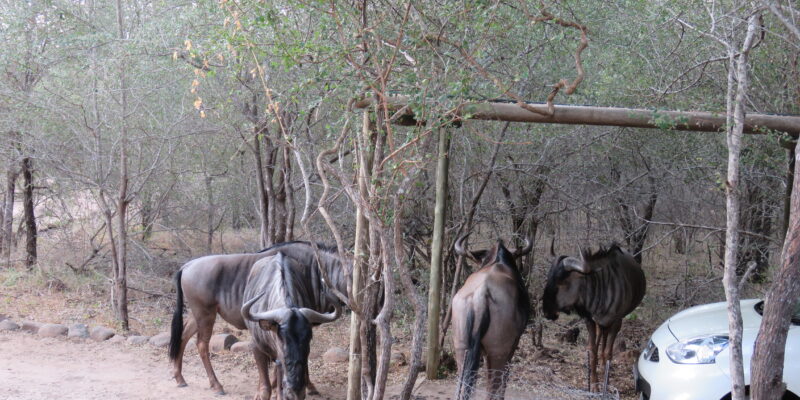
Wildebeests in the driveway. They eventually headed to the back garden for pellets,

To awaken this morning with considerably less pain in my mouth, I texted Kathy and said I could go with her and Rita to coffee at Stoep Cafe and later shop at Spar Supermarket. Last night, in awful pain, I’d written to her saying I doubted I’d be able to go since today when we needed to head back to Malalane to see Dr. Singh. Last night, the pain in the socket was awful.

As soon as I awoke this morning, I was excited when the Advil and Tylenol (Paracetamol) I’d taken before bed had worn off, and I was in minimal pain this morning. I jumped out of bed, letting Kathy know I would go with them after all. I showered and dressed for the day and tidied up the house, folded the laundry from the rack, and settled down with my laptop to start today’s post. I took one Tylenol to get me through the morning with the “girls,” which once it kicks in, I am almost pain-free for a few hours.

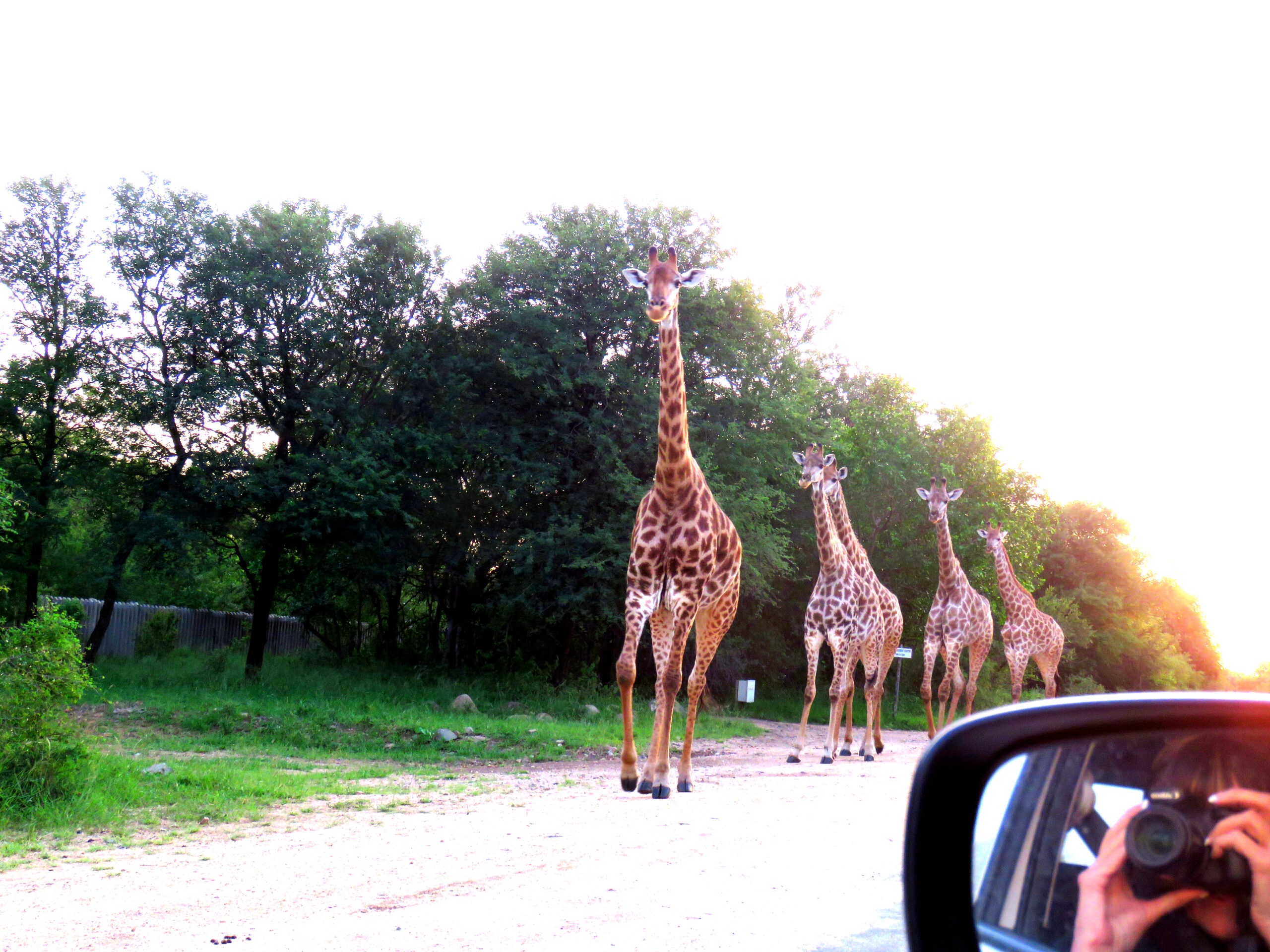
A photo from a few months ago when everything was green and giraffes were walking along the paved road in Marloth Park. My photo-taking appeared in the rearview mirror.

It helps to start the post before heading out, so when I return and put away all the groceries, it won’t take me too long to finish and work on the corrections. I am now down to 42 pages of 20 posts, attempting to do one page per day. There’s no way I’ll be done by the time we leave in one month. But I’ll only have about 10 or 12 pages of 20 posts left when we arrive in Arizona, taking less than two weeks to complete.

Once completed, I’ll take a short break and then begin doing the three significant stories for SEO (Search Engine Optimization), something I have to do once a year going forward. I’ll do one a week and then be done, after which my afternoons will be free at last. What a great feeling that will be, after over a year of corrections on over 3400 posts and the time I’d spent in India working on the new site!

Torn Ear is such an adorable boy, even with his healed left ear injury.

With only one month left until we depart for the US, it’s time to start thinking about packing. We will go one big plastic tote with clothes we won’t need until we return 14 months later. In reality, since I need so many new items, it may not make sense to leave much behind. Once we start packing, we will know.

I just returned from the trip to Komatipoort with Kathy and Rita. We had a great time at Stoep Cafe while they had breakfast, and I had decaf coffee with the “crema” and real cream. What a treat! I didn’t eat for two reasons; one, I wasn’t hungry, and I always strive to avoid eating when not hungry: and two, there was no way I could rinse out my mouth after eating, which I do now, to clear any food particles from the sore tooth socket. I know, TMI, but it’s essential to do when recovering from an extraction.

Although the nearby birdbath was a better option with clean water, Tom adds daily. A mongoose was drinking from the pool. There’s not a lot of chlorine in the splash pools in the park since animals often drink from them. We never use the pool.

With two weeks of groceries needed, Tom suggested he’d come to Komati to pick me up after shopping so Kathy and Rita wouldn’t have to wait for me. This only made sense since Rita didn’t need any groceries and Kathy only needed a few items. I felt rushed and concerned about them waiting for me when it usually takes about 40 minutes to shop for two weeks. It proved to be a perfect plan.

Only minutes after I left the market with my trolley filled to the brim, Tom was there and loaded the boot of the little car with our bounty, and off we went back to Marloth Park. We had everything put away in no time at all, and I could get back to today’s post and hopefully get it uploaded before too long.

A mongoose was contemplating her next move, taken a few months ago when the grass was green.

When we returned, several bushbucks were waiting for us as well as no less than 20 mongooses peering into the veranda door, wondering where we’d gone. We had some treats for them, resulting in a funny story we’ll share with photos in tomorrow’s post.

I cleaned three bunches of celery, saving all the ends and leaves for the bushbucks. They love the crispy and moist celery tops and will enthusiastically devour the batches we’ll toss out every few hours or so. When we clean vegetables, we share the miscellaneous stems and pieces with the animals providing them with much-needed nutrients. Of course, we always check to ensure nothing we toss is toxic for them and that the veggie scraps are cut to size and are easily digestible for them.

Tonight, we’ll stay in. We have several fun social gatherings planned for the upcoming week and weekend, which we’ll share as they occur. May you have a lovely week!

Photo from one year ago today, September 20, 2020:

Ironically, after Friday’s story on our first visit by a giraffe since we arrived here in January 2021, this photo popped up from the post one year ago, while in lockdown in a hotel in Mumbai, India, on day #180, On a Thursday morning in Marloth Park in 2013, as I stepped outside onto the veranda, camera in hand, this was the first thing I saw. Quietly alerting Tom, who was still inside the house, he rushed out to witness this same sight. And then, in minutes, they were everywhere, a dozen total. No words can describe our joy. For more, click here.

Two fun nights out on the town…Now, a quiet Sunday dinner…

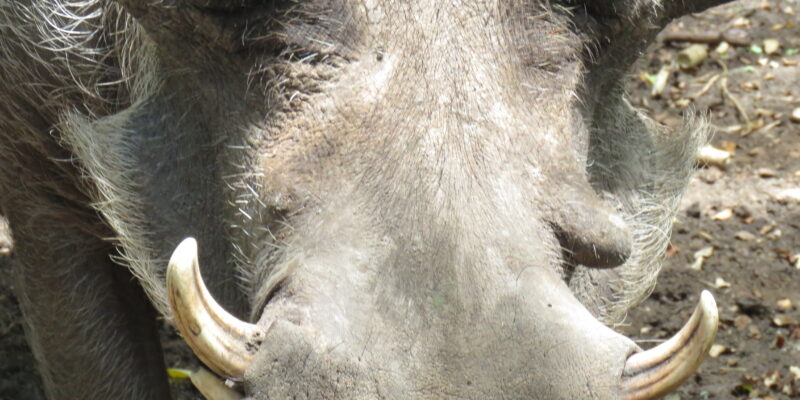
One Wart is a frequent visitor.

In yesterday’s post, we were so excited by the visit of the three giraffes. I failed to mention the delightful evening we had Friday evening at Jabula with friends Rita and Gerhard, who’d just returned from a trip to Germany for two weeks, and Kathy and Don. The place was jumping with dinner guests, a “hen” party, and enthusiastic drinkers at the bar.

As always, we arrived at Jabula at 5:00 pm (1700 hrs), as did Rita and Gerhard. Kathy and Don always arrive at 6:00 pm (1800 hrs), after which we immediately took our table for six on the veranda. It was a chilly night, but everyone had dressed accordingly, and the conversations, excellent food, and drinks flowed with ease.

Mom and baby bushbuck stop by several times a day.

It was interesting to hear about Rita and Gerhard’s trip to Germany for his mother’s 98th birthday, the motivation behind their trip back to their birthplace for this special event. But, like us, being away from the bush for any length of time creates a longing we all share that is hard to describe.

The six of us together is a non-stop chat-fest. The girls sat at one end of the table and the boys, the other. It’s always fun to have some “girl talk,” something I’ve missed being away from girlfriends for so long. And, of course, it’s great for the guys to talk about “guy things.”  Not to differentiate the sexes, but let’s face it, sometimes women and men favor specific conversations over others.

Yesterday afternoon, Medium Daddy came to visit for quite a while. We kept the carrots and pellets coming, which he enjoyed.

The six of us have plenty of opportunities as a group to converse about a wide array of topics. With similar interests in travel, wildlife and nature, we never find lulls in conversations. We’ll attend a braai at Kathy and Don’s home on Wednesday evening, overlooking the Crocodile River. I suggested we each bring our meat, along with our drinks. That way, it’s so much easier for our thoughtful hosts.

Typically, we’ll bring a side dish to share, making it easier for the hosts than spending all day in the kitchen. We’ll arrive at 5:30 pm (1750 hrs), in time to watch and take photos of the sunset. No doubt it will be another lovely evening in the bush.

Last night, Tom and I returned to Jabula Lodge and Restaurant on our own. We feel it’s essential to support the restaurant in any way we can. Dawn and Leon, the owners, have become special friends over the years. Dining there a few times a week, during times of Covid-19, is a small part we can play during these lean times for restaurant and shop owners.

Medium Daddy has a handsome face but hasn’t quite gained the confidence to chase away the warthogs when they steal his treats.

Besides, we always have so much fun there sitting at the bar. Tom sips on his brandy and Sprite Zero while I consume on my usual few glasses of low-alcohol, “extra-light” wine. There’s a steady flow of locals and visitors, and the conversations are always entertaining.

Last night for the first time since we’ve been in Marloth Park, we met three guys from the state of Texas in the US. It was unusual to speak to traveling Americans here for the first time in years, besides our friends, as mentioned above (Kathy, Don, Rita, and Gerhard), are Americans. It was the three guys’ first time here. We enjoyed hearing about how much they’ve enjoyed seeing the wildlife in Kruger and Marloth Park. They, like us, couldn’t believe such a place existed.

By 9:00 pm, we were back home to settle in our bedroom to watch a show on my laptop and eventually settle down for the night. After having loaded up on Advil and Tylenol (Paracetamol) before I went to sleep this morning, I found the socket still painful after the meds had worn off. Tomorrow, I will contact the dentist to find out why it’s been hurting for so long and what to do. I may have a dry socket.

Broken Horn, what a guy!

Tomorrow morning, I’m going with Kathy and Rita to Stoep Cafe in Komatipoort for breakfast, and then we’ll all go grocery shopping. Most likely, I’ll head back to the dentist on Tuesday if the socket is still painful. We’ll see how it goes.

As for today, I didn’t feel up to going anywhere with this painful situation. Instead, I am making one of Tom’s favorite low-carb dinners; mozzarella stuffed meatballs with homemade pasta sauce, topped with hand-grated mozzarella, a side of white rice along with a big green salad. I’ll skip the rice and have the meat, the sauce, and a salad. Of course, neither of us eats the starchy, carb-laden noodles that usually accompany this dish, but it’s so good, it doesn’t need them.

That’s it for today, folks. We hope you have a pleasant Sunday!

Photo from one year ago today, September 20, 2020:

This photo was posted one year ago while in lockdown in a hotel in Mumbai, India, on day #180. This photo was taken at our landlord, Hans’ construction site in Diani Beach, Kenya, in 2013, where branches were used as supports. For more photos, please click here.

Finally, they came to call, eight months later!!!…

When peering out the kitchen window, we saw this image in the front of our house.

Yesterday was quite eventful in our garden. While stopping in the kitchen to refresh his iced tea, Tom said, “Hurry, get the camera! There’s a giraffe in the driveway!”

We hadn’t seen a giraffe in the driveway since we arrived in Marloth Park in January when we moved into this holiday home. Six or seven giraffes were at the end of the driveway on the road, and we took several photos, hoping at some point they’d come to our garden for a visit. Now, eight months later, they finally came to call.

Not only were they in the driveway, but they were standing close to the house. The tricky part was taking photos since giraffes don’t interact with humans for food, like the other wildlife. They eat the leaves at the top of trees and don’t bend down for pellets or other food offerings from humans.

There were a total of three giraffes, two that stayed in the bush and the one that dared to get close to the house for the tree he found worthy of the risk.

Subsequently, they are as shy here in Marloth Park as they are in Kruger National Park. They tolerate cars passing but don’t care to interact with humans on foot. When we opened the front door, I could barely get a quick photo when they thundered off, kicking up dust on our dirt driveway.

We decided to leave the front door open since it makes noise upon opening and be patient and wait. They were obviously after the lush green vegetation at the top of a tree close to the kitchen window. We waited patiently. Although we couldn’t get good photos based on their hesitancy around us, we managed to get the few we’re sharing here today.

After all, being within three or four meters of the giant animals is exciting in itself. Where in the world is that possible in the wild? Where in the world is that possible, close to your front door? Nowhere that we know, other than Marloth Park or another game reserve in Africa.

It’s hard to believe we can be so close to these majestic animals.

Once they’ve discovered such an “edible” tree, we feel confident they will return at some point. The question becomes: will we happen to be looking out the kitchen window to spot them when they do? In the future, we’ll make a unique point of looking out the front of the house, as opposed to the usual back garden where most of the animals visit. With the dense brush, it may be hard for them to navigate their way back there.

This holiday home consists of the dense bush surrounding the property lines. It’s an excellent factor for privacy and noise reduction but less appealing for giraffes and zebras who seem to avoid getting tangled in the low-lying branches, which warthogs, bushbucks, wildebeests, and kudus, who don’t seem to mind.  They’ll maneuver through any dense bush to get to some pellets.

We’d hoped they’d stay around longer. But, in their typical manner, they ate and moved on in search of more vegetation.

Whereas giraffes don’t bend to the ground to eat, although they bend to drink. Here’s exciting information about giraffe’s eating habits from this site:

“Four facts about giraffe’s eating habits:

The giraffe is the world’s tallest terrestrial animal and thrives on a diet of fresh greens. These curious creatures tower above the bushveld and, despite their gangly appearance and awkward gait, they move with ease through their environment. They survive in arid landscapes, savanna, and open plains; and vary in size and color depending on their region.

The next time you’re in a game viewer and come across a giraffe devouring greenery, take a moment to observe their eating habits. Here are four facts about a giraffe’s eating habits that will ensure you have a deeper understanding of their dietary habits.

1. Giraffes don’t need to compete for food.

Giraffes are browsers that feed off fresh shoots and leaves, and their height advantage means they have access to plenty of foliage that other herbivores cannot reach. The only other animal that can reach into the giraffe feeding zone is the elephant. The pachyderms stretch upwards and reach branches with their trunks, allowing them to grapple lush greens outside of the zone of other browsers. The male giraffe is always in an enviable position, given that they are almost always taller than their female counterparts! There’s not much competition for food sources with these delightfully curious terrestrial animals.

2. Giraffes eat old bones.

When herbivore animals eat bones, it is commonly referred to as osteophagia. The reason for digesting such unpalatable items is purely to supplement their diet with calcium and phosphorus. If their diet lacks nutrients, giraffes will bend down to the ground to scrounge for old bones. They will then chew/twirl the bones in their mouth to extract as many minerals as possible.

Goodbye giraffes! It was great to see you here!

3. Giraffe’s favorite food is acacia. But acacia trees talk. 

The bushveld is dotted with African acacia trees, which have juicy leaves and a thorny spine. Giraffes use their prehensile tongue to grip the leaves and extract the greenery without disturbing the thorny bits. Because this is their favorite meal, it means that our tall creatures tend to journey towards belts of acacia. Acacia will release an excess of tannins when under threat from overfeeding, and this compound leaves the greenery tasting incredibly bitter. The other trees will recognize the tannin release as an alarm system and follow suit. Giraffes activate the natural alarm system in acacia trees – a truly fascinating fact!

4. When a giraffe drinks water, it’s quite a process. 

Giraffes only drink every few days and gain most of their moisture from their herbivorous diet. When they do drink, they approach their water source with caution. They scan their environment for potential threats, hesitate, stand for a while, and then decide to drink. The giraffe will open its legs quite wide, bend its knees and lower its neck to lap up water, which leaves them in quite a vulnerable position and at the mercy of predators.”

In any case, we are thrilled they stopped by, and we’ll make every effort to spot them again when and if they stop by to munch on the green trees in the front garden.

Have a lovely day!

Photo from one year ago today, September 18, 2020:

This photo was posted one year ago while in lockdown in a hotel in Mumbai, India, on day #179. Our glass table was set and ready for our dinner guests in Kenya’s outdoor living/dining room in 2013.  The landlord, Hans, and his wife, Jeri, were coming for dinner. With no Windex or glass cleaner in the grocery stores, I’ve had a heck of a time cleaning the glass tabletop. I asked Hesborn, our houseman, how he could clean it so well with no streaks. He said he uses soap and water on a rag, drying it with a dry towel. I tried this method, only to end up with streaks. For more photos, please click here.

Sad sighting in the bush…Oh, good grief!…Tooth extraction socket is infected…

This morning, when we spotted this injured kudu in the garden, we immediately contacted the rangers. Hopefully, soon, they will find her and have the vet help her out. It’s heartbreaking to see such an injury.

This morning, after a painful and fitful night due to pain in my extracted tooth socket (more on that below), I did what I always do upon awakening, say good morning to Tom, who is always up before me, and then check the action in the garden. There were the usual bushbucks, including Stringy, Thick Neck/Bad Leg, Spikey, and Holey Moley, and the frequently visiting four adult female kudus, including my favorite Bossy.

Immediately, they approached the veranda when they saw me as I thought about the big bags of carrots on the kitchen counter. I asked Tom to toss some pellets while I got the carrots. Before I turned on my heels, I noticed something unusual about one of the kudus. Her right eye was bleeding.

Her eyelid is hanging there. It is heartbreaking to see. We’re hoping the ranges will get here soon. We’ve done everything we could to keep her here with the other female, but sooner or later, they wander off.

To keep them around long enough so I could take a photo and send it to Jaco, the head ranger in the park, I grabbed the bag of carrots, and we both started tossing chunks to them. I grabbed the camera while Tom continued sending carrots their way but struggled to get a good shot of the injured eye.

After waiting patiently, I managed to get the photos we’re sharing here today. I sent them to Jaco via Facebook Messenger, and within a few minutes, he acknowledged my message in which I’d included two photos and our address. Hopefully, sometime today, they will find her since they hang out in specific areas, and the vet can treat her. I imagine he’d clean it, try to sew it back in place and treat her with antibiotics. They dart the animals to provide such medical care.

This is what we saw upon first spotting her. Upon closer inspection, we took the above photos.

We may never hear back regarding the outcome, but we can only hope she’ll be found and treated somehow. It was heartbreaking to see. They are such sweet and gentle animals, and it’s hard to see them suffering for any reason. It’s hard enough right now that they constantly search for tidbits of food when the bush is so dry.

Surprisingly, most of the wildlife looks healthy, with few ribs protruding from lack of food. Thank goodness, so many of us feed regularly. The only nature we see looking too lean are those with some illness, injury, or impediment of some sort that prevents them from foraging. If this poor injured kudu isn’t treated, this may happen to her if she gets an infection.

Yesterday, four wildebeest, none of them Broken Horn, who’s a loner, came to call, coming right up onto the veranda to the door, looking for us.

Speaking of infections, the socket where my tooth was pulled on Monday has become infected. The second day after the procedure, I was feeling pretty good. But, on Wednesday, the pain escalated, and I began to be concerned. I contacted Dr. Singh, and he ordered antibiotics, Z-Pack, the 3-day 500 mg dose. I started them yesterday afternoon, at 3:00 pm. I’m also taking prescribed probiotics several hours after the one pill dose.

But last night was unbearable. I hurt so much my ear was hot and red, and my face was swollen. It came on suddenly, in a matter of 24 hours. Dr. Singh had suggested I take antibiotics on the day of the procedure but after taking them for five days a few weeks ago, in a feeble attempt to heal the pain in the tooth after the root canal had been done in that same tooth. But, I said, “Let’s try it without antibiotics.”

We didn’t dare go outside. Wildebeest horns can be deadly.

It continued to hurt when I chewed on that side and brushed my teeth. In the past year, I’ve taken antibiotics four times due to issues with two teeth. When the antibiotics didn’t work this last time, resulting in the tooth being extracted along with all the pins in place from the recent root canal, done in June before we left for the US, I hesitated to take antibiotics. Of course, I hesitated over another round.

This time my decision was wrong. I should have taken the antibiotics on Monday. I was in deep trouble in excruciating pain by Wednesday night that kept me awake for the past two nights. On Thursday, I contacted Dr. Singh’s office, and he prescribed the Z-Pack, which I took promptly at 3:00 pm (1500 hrs). After a horrible sleepless night taking several Paracetamol and Advil spread over several hours, a cold pack on my face, frequent salt water rinses, I finally drifted off.

We’ve never seen them be aggressive to us, but we are cautious. On many occasions, we’ve seen them go after other animals when competing for pellets or carrots. Otherwise, they leave others and humans alone unless threatened.

This morning, I awoke to a 50% improvement in the pain and can’t wait to take the next dose this afternoon, followed by several probiotic hours later.

Tonight, with Rita and Gerhard back from a two-week trip to Germany to see family, we’re scheduled for dinner at Jabula with them and Kathy and Don.. I will spend the majority of today resting and taking it easy. Besides, with the current Covid-19 curfew, we usually leave Jabula by 8:30 pm (2030 hrs) and will be back home hoping for a restful night.

So, folks, there’s our past 24 hours which were challenging to say the least. Hopefully, my situation will continue to improve over the weekend, and Ms. Kudu will get the treatment she needs.

Have a pleasant weekend.

Photo from one year ago today, September 17, 2020:

This photo was posted one year ago while in lockdown in a hotel in Mumbai, India, on day #178. In Fiji in 2015, our neighbor Sewak drove us up this outrageously steep hill in his truck for this view. For more photos, please click here.

Busy weekend in the bush…

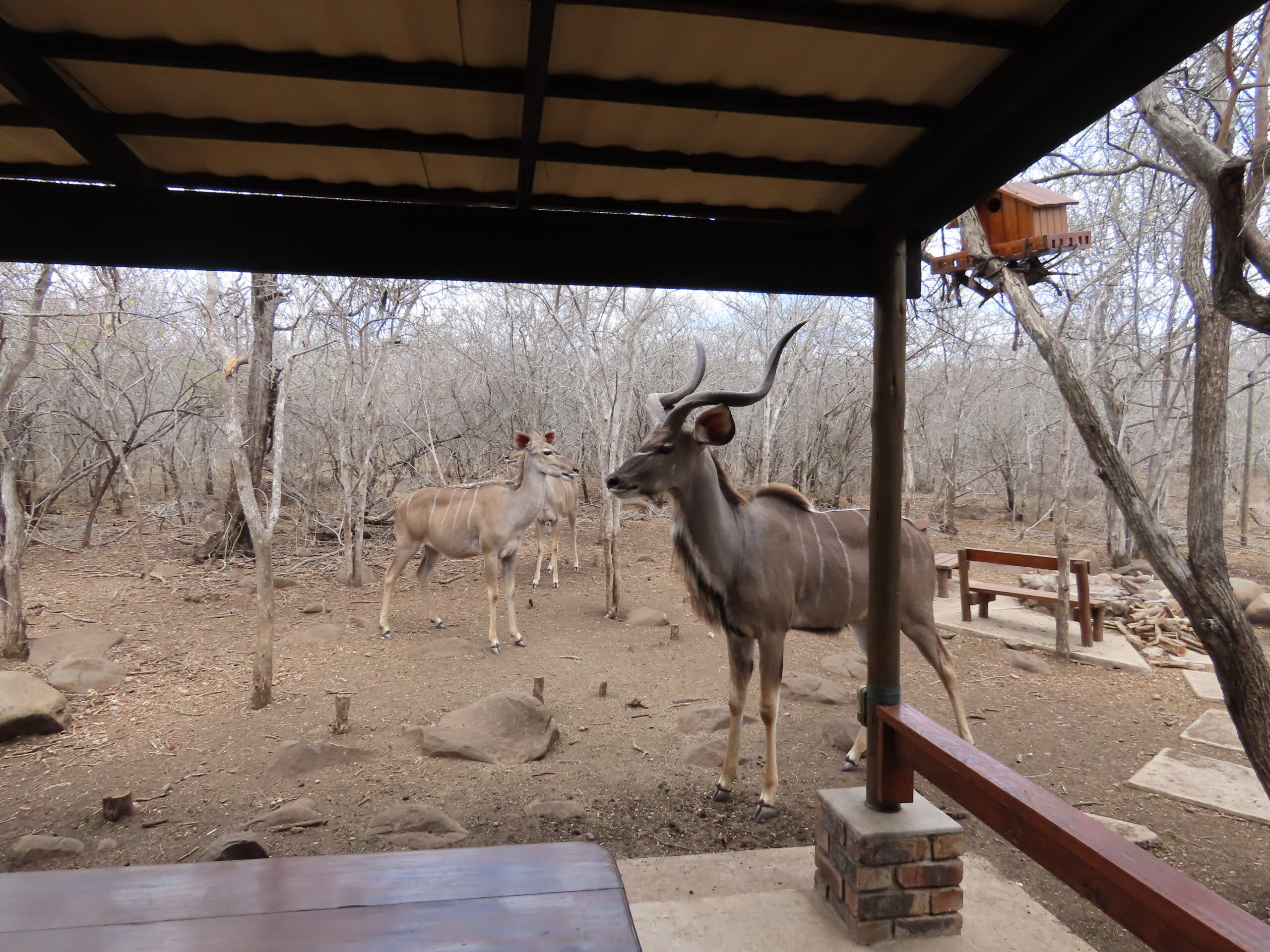
Tom was tossing pellets to Broken Horn and a young male kudu we call Medium Daddy.

This morning, we awoke to our usual band of mongoose looking for meat and fat, which we’d cut up into bite-sized pieces after last night’s beef roast Tom had for dinner. I have been eating soft foods until the loose temporary crown gets replaced on Monday when we return to Dr. Singh in Malalane.

Moments later, Broken Horn arrived in his ceremonious manner, scooting every other animal in his path to leave a clear spot in the garden for “his” pellets and carrots. A mongoose grabbed a big chunk of carrot, carrying it to the cement on the side of the pool, banging it over and over again, assuming he could crack it open to see what was inside. This always makes us laugh.

There are about 24 helmeted guinea-fowls that occupy our garden most days and in the early evening until they take off to hunker down for the night.

After a while, a warthog approached him and snatched the chunk of carrot, eating it while making loud crunching noises. It’s a laugh and fun fest every hour of every day. Now, as the days dwindle to our departure, I can avoid feeling sad about leaving, knowing we’ll return 14 months later.

Now, with this peace of mind, I can allow myself to embrace our upcoming trip to Arizona while we stay put for three months in Apache Junction until we fly to Florida in February for Karen and Rich’s wedding.

There were nine kudus in the garden, certainly not the most we’ve seen at once but enjoyable to see.

While we are in Arizona,  I plan to meet up with my sister Julie (who lives in LA) to spend a few days in Scottsdale. We will drive to the airport to pick her up when she arrives, head to our planned hotel where he’ll drop us off. He’ll return to Apache Junction to spend time with his sisters while I am away and then pick me up when it’s time to drop Julie at the airport to return to LA. Julie and I hadn’t had much alone time together except when she came to visit us in Kauai in 2015.

We wish we could go to Minnesota, but it will be the worst of the winter there while in the US, so we may not head there this time. However, we may be returning to the US at the end of the booked cruise from Tokyo to Seattle in the spring, a much better time to go to Minnesota. As always, we have to wait and see what happens with Covid-19.

This “forkl” of kudus consisted of eight females and one young male shown in the forefront.

While cases of Covid-19 escalate to some of the highest-ever levels, we’ll be somewhat isolated in Arizona in the retirement community. Few “snow-birds” will have arrived while we’re there, and many, with fears of Covid-19, may stay away during the upcoming winter. There are still many cases of Covid-19 in Arizona, which is in the #10 position of the most cases of all states in the USA.

Of course, while in Arizona,  we’ll avoid crowds and large gatherings and wear our masks anytime we go shopping or to public places. We hope to be able to get vaccine boosters while in Arizona at some point, based on the fact we had the one-jab Johnson & Johnson on the first of July, which means six months will have passed since the original jab by the end of December while we’re still in Arizona. Such a booster for J & J has yet to be determined.

Kudus are gentle and relatively non-aggressive, but caution must be exercised. They are wild animals and rather large, with males possessing massive, dangerous horns.

Tonight, as always, we’re heading to Jabula Lodge and Restaurant for dinner. We usually arrive at 5:00 pm (1700 hours) and hang around at the bar, chatting with owners Dawn and Leon and any other guests who happen to stop in. We are careful to maintain safe distances from other guests, particularly those we don’t know who may not have been vaccinated. A few hours later, we head out to the veranda to sit at a table for our meal at dinner-time. On occasion, we may eat at the bar.

Tomorrow night, Kathy and Don will join us for yet another evening at Jabula. Again, we’ll arrive at 5:00 pm, but they usually arrive at 6:00 pm. They are less inclined to sit at the bar and prefer having drinks and food at a table on the veranda. This works fine for us, giving us a little schmoozing time at the bar ahead of their arrival.

After most of the females wandered off, this lone young male and Broken Horn hung around for a while.

Sunday will be a low-key day.  We’ll stay in, make Sunday dinner while I’ll continue to spend the better part of the day working on corrections. I am on a roll right now, getting through a full page of 20 posts each day or more. At this rate, I have 48 pages of 20 posts to complete. As of today, there are 41 days until we leave for Arizona. I am hoping to be done by the time we go here on October 21st. It’s a lofty goal but doable.

Well, folks, not much excitement around here right now, but we are content. We have power, WiFi, lots of visitors, lots of friends, and the weather will be cool, up until next Tuesday, according to the 10-day forecast. I have a few itching mozzie bites at this time, and we haven’t seen any snakes or many venomous insects in the house. What more could we ask for, living in the bush?

Oops, I have to go! Frank is back looking for his seeds, and Broken Horn is barking from the garden, looking for pellets and carrots! I’d better get this show on the road!

Happy day!

Photo from one year ago today, September 10, 2020:

This photo was posted one year ago while in hotel lockdown for ten months in Mumbai, India, on day #171. As we wandered through the busy local farmer’s market, open daily, it was hard to decide which vendor to choose for our purchases. We purchased the following for FJD 22, $10.12: two red bell peppers (also called capsicum here); six medium-sized aubergines (eggplant); three heads of cabbage; and eight large carrots. For more photos, please click here.

This morning’s first ever event in the bush with photos!!!…Wow!…

We scurried indoors when this Big Daddy came right up to the door from the house to the veranda.

To all of our friends/readers in the US, we wish all of you a safe and pleasurable Labor Day weekend. Please drive safely, observe local Covid-19 restrictions and enjoy time with family and friends, cooking outdoors, fishing, boating, or whatever you choose to do during the long holiday weekend.

It was shocking to see how brave they were in approaching us. We stayed clearly out of range the entire time they were here.

As for the weekend here in the bush, Marloth Park is relatively quiet with some holidaymakers, mainly from South Africa, who have come to escape life in the big city and relax peacefully in the bush. Nowhere in the world have we’ve ever been offered the depth of serenity and peace than Marloth Park.

There wasn’t a lot we could do when he approached us, other than getting behind the door. If we tried to scare him off, he could have used his massive horns on us.

Although from time to time that may vary due to visit by those select few who see this magical place as a “party town” where there is minimal police presence with many opportunities to go wild, drinking, to drive fast, and to have little regard for others seeking the peacefulness of living among the wildlife.

I accidentally dropped a carrot which he couldn’t quite reach. He came around to the other side to get it.

Fortunately, where we are located, the property backing up to Lionspruit, we rarely hear any noise other than the weekday construction work on a house across the road. In Marloth Park, there are strict regulations about weekend and evening construction noises to avoid disturbing visitors and the wildlife. Most comply or face fines.

He was contemplating how to get the carrot before he came onto the veranda.

This morning, as I struggled to get out of bed after staying up until after midnight with only about 5 hours’ sleep, Tom came to the bedroom, hoping I hadn’t gone back to sleep to tell me to hurry and come outside. He didn’t want to awaken me if I dozed back off. But, I was wide awake playing a fun word game on my phone.

Such beautiful and majestic creatures! See how he was checking out the bag of carrots.

I bolted out of bed to head directly to the veranda, and there they were…four mature Big Daddy kudus, seeing what we had for breakfast. We couldn’t have been more thrilled. Sure, we get one or two Big Daddies from time to time. But, four was something we’d never seen.

There they were, the four adult male kudus munching on pellets we tossed into the garden.

Quickly, I ran to the kitchen for the remaining carrots from the considerable bag we’d purchased at the market last week, and we both started tossing thick, whole carrots in their direction. They gobble them up in minutes, leaving us grabbing for pellets to throw onto the ground. As always, we never feed wildlife by hand, especially not Big Daddies with their enormous horns that could easily eviscerate a human in seconds.

Kudus are not violent animals, but they can startle easily, push one another, or lunge unintentionally. Besides leopards, the occasional lion, or warthogs with razor-sharp tusks, they are the most dangerous wildlife in Marloth Park. Even the adorable male bushbucks who visit us all day and night are extremely dangerous with sharp and long horns. One can never be too careful around any wild animal.

Broken Horn was in the background, but he seemed to get along well with the Big Daddies.

It was quite a delightful experience to be among them. We felt very fortunate to be privy to this amazing visit. And even if they never return together again, we are grateful for the opportunity to witness such magnificence.

Last night, our friends Fiona and Alan came for dinner. Alan is a prolific writer of outstanding published books on Marloth Park. He is a wealth of stories and information about this magical place after living here for 20 years, and the time spent with the two of them is rife with fantastic wildlife and human stories.

They rarely picked up their heads for full-face photos.

We had a lovely evening on the veranda with them, with our new speaker spewing out music to highlight the evening. We kept the speaker indoors (not too loud) to avoid making too much noise in the bush. The dinner turned out well, and the evening flowed with ease. As always, I was glad I’d prepared so much of the meal in advance.

We had various visitors while they were here, primarily warthogs, bushbucks, and many mongooses, who’ve been hanging around with us for days. Once they arrived, we savored the starters. We then put the meat on the braai, cooked the rice, reheated the roast vegetables, and tossed the salad with the homemade dressing. We sent them home with a “doggy bag” of leftovers.

Hmm…another lovely weekend here in Marloth Park. Tomorrow morning, I have an appointment with Dr. Singh to have that problematic tooth pulled. If we haven’t posted before leaving here at 10:15 for the long drive, hopefully, I’ll feel well enough to wrap it up when we return.

Have a fantastic day!

Photo from one year ago today. September 5, 2020:

DSC03486
We posted this photo one year ago while in lockdown in Mumbai, India, on day #166. We visited Blarney Castle as a port of call on a cruise in 2015. For more, please click here.

Short post today…Tomorrow, an exciting new booking!…

Franks gives us both so much joy every single day.

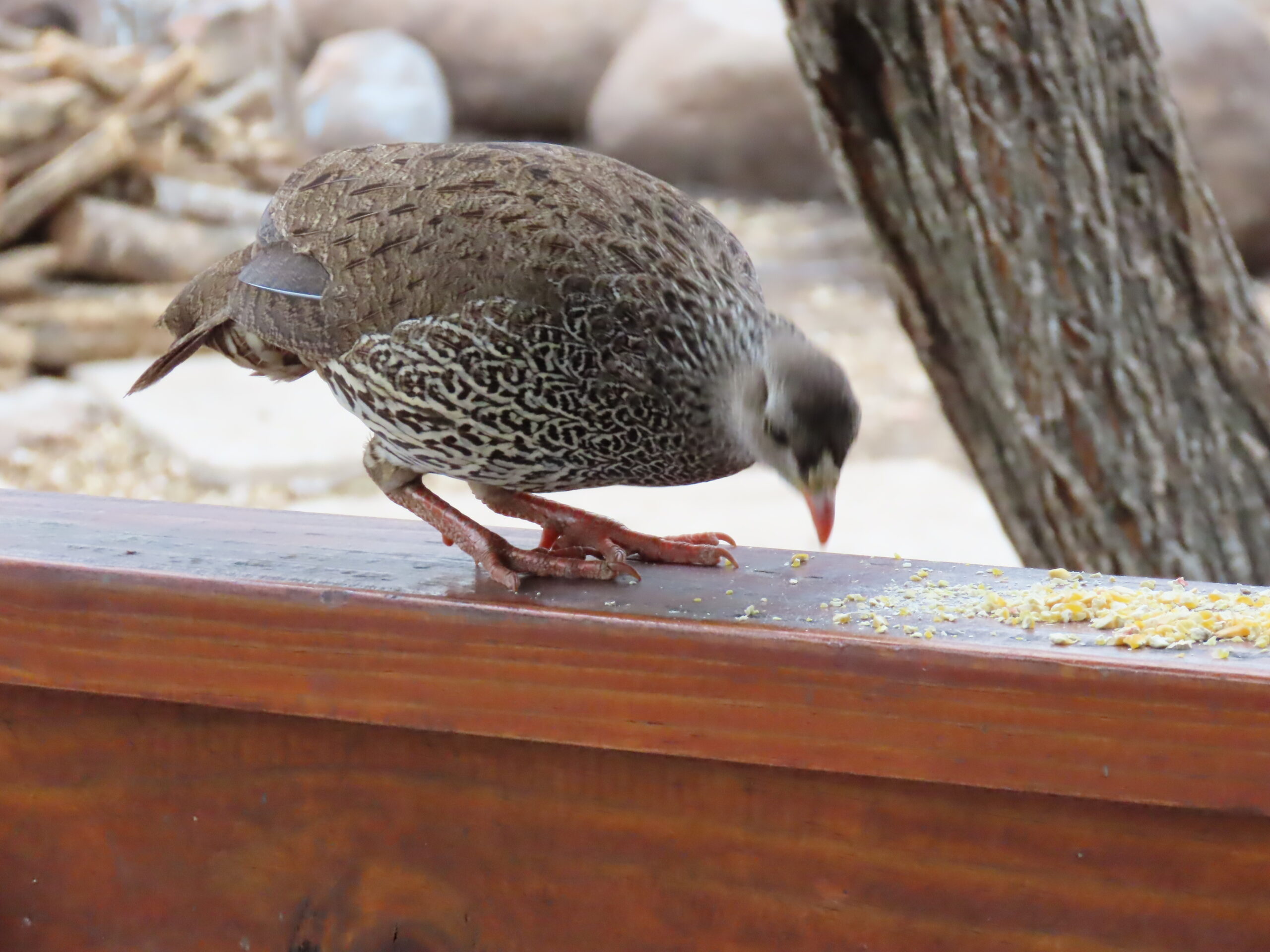
I just want to mention that I posted this main photo of Frank eating seeds off of the veranda railing, taken several days ago.

But, today when there were no seeds outside this morning and we were both busy inside the house, the door slightly ajar, was enough for him to push it open and come inside.

Tom was in the living room on the sofa working on his laptop, getting ready to go outside for the day. I was putting away folded laundry on the bedroom shelves. Tom yelled out to me, “You have a visitor in the bedroom.”

I looked down to the floor and saw Frank standing there looking at me, “Hey, I want some seeds!”

We only put seeds on the veranda when Frank arrives since if left there, the warthogs and bushbucks come onto the veranda and eat the seeds. They aren’t a good food source for them. We always pick them up and either put them on the table or back into the house.

Frank arrives by himself half of the time and with The Misses the other half, usually three times a day, oddly during human mealtimes. There are other Franks but we can easily tell them from our regular Frank. Also, they seldom stop by, compared to our regular Frank who will start a fight with the others if they dare to attempt to partake.

The noise four or five Franks make during an altercation is earsplitting and often leaves us in stitches. They don’t physically fight. Here is an audio clip of the noise made by francolins in the wild:

https://www.youtube.com/watch?v=Se_VSY1RjQ4

We both had a great laugh as Frank then escorted Tom out the door to put his seeds on the veranda floor. Frank then went about voraciously eating his seeds, making his usual mess on the veranda floor. We couldn’t stop laughing.

Last night, after returning from a fun gathering at Flo and JiJi’s home, for some odd reason, I didn’t sleep more than a few hours. I couldn’t shut my brain off and only dozed off a few times. Today, I am exhausted, but I managed a one-hour nap this morning after going back to bed after showering and dressing.

I texted Louise, asking her to have Zef and Vusi skip the housecleaning today. I need to nap more than having the house cleaned. Thus, today’s short and relatively uneventful post is all I can manage.

However, we’ll be back tomorrow with more new photos and information about a brand new booking Tom arranged yesterday that we are both quite excited about. Maybe the time has come that we can start planning for the future.

Be well.

Photo from one year ago today, September 2, 2020:

This photo is from the year-ago post while in lockdown in Mumbai, India on day #163. The full moon rising as it made its way through the clouds above Yorkeys Knob, Australia in 2015. For more photos, please click here.

Flight problems…Crocodile River photos…

This photo was taken from the veranda at Buckler’s Africa Restaurant with several waterbucks in the Crocodile River.

When we booked our flights to the USA a few months ago using a company called, Fareboom, we had nothing but trouble. The various flights along the way were canceled, and we ended up in a scuffle with Fareboom to get our money back. Finally, after a week of back and forth and several pricey phone calls with hours of frustration while on hold for hours, we got it resolved.

Waterbucks, like much other wildlife, huddle close to one another.

This time, a few weeks ago, we found reasonable pricing at the site, eDreams, and alas, we experienced similar frustration. We booked the three flights to Phoenix: Nelspruit to Johannesburg; Johannesburg to Atlanta; Atlanta to Phoenix, and all seemed to be okay. We received confirmation from eDreams and attempted to book our seats.

Waterbucks were lounging in the sand at sunset.

When seats weren’t offered as “available at this time,” we didn’t give it much of a thought. We kept checking back. There have been occasions when we’ve traveled internationally that we haven’t been able to book our seats in advance and had to wait until we arrived at the check-in counter.

After a week passed, we became concerned when we noticed our credit card hadn’t been charged. Last night, at bedtime, I received an email from eDreams stating our flight had been canceled. When checking during this period, we saw their site showed, Your flight is processing.”

More waterbucks on the banks of the river.

During the worst of Covid, everything to do with travel was a mess (and sometimes, still is). Tired and ready to go to sleep, we both decided to wait until morning to rebook using the link on our site for Expedia, a company we’ve trusted and used on many occasions. The only difficulty we’ve had with Expedia was getting a refund from them for a canceled flight (by the airline, not by us), requiring we go to the airline directly to get the refund.

This morning, we rebooked the same flight at the same price, and all went well. We’ve booked our seats for two of the legs of the flights, but we’re never able to book seats in advance for South Africa AirLink, which we’ll fly from Nelspruit to Joburg, a very short flight. These are only obtained at the check-in counter at the time of the flight.

Locals say, “The waterbuck’s behind looks like they just sat on a freshly painted white toilet seat.” Note the two cattle egrets who often hang out with wildlife.

Right now, when verifying our flights with Delta, it appears, the “ticket is processing. We’ll have to keep an eye on this to ensure our flights are booked. Weird, to say the least.

This morning, Tom went to the salon to see about getting in for a haircut, but they were booked, and he’ll return tomorrow morning for his appointment. Tonight, we are heading to Flo and JiJi’s home in Komatipoort for sundowners, which will surely be another fun social evening. Soon, I’ll make an appetizer to bring.

The four of us thoroughly enjoyed the scene before our eyes.

Once again, this morning, the garden was packed with bushbucks looking for “breakfast.” Tom was busy serving them while I showered and dressed for the day. The weather is mild today. Yesterday was 90F, 32C, but today’s high will only be 72F, 22C, for a pleasant balmy day. It’s slightly overcast, with a 0% chance of precipitation, a perfect spring day in the bush.

A gregarious animal, the waterbuck may form herds consisting of six to 30 individuals. The various groups are the nursery herds, bachelor herds, and territorial males.

It’s hard to believe it’s September 1st already how the time has flown since we arrived last January. By the time we leave in October, we’ll have been here for a total of nine months. Without a doubt, we’ll return at some point. For now, we watch and wait to see what happens with our five booked cruises, scheduled over the next almost 11 months. Once we know more about these cruises, we’ll be able to plan for the future.

Have a pleasant “hump day,” everyone, and be healthy.

Photo from one year ago today, September 1, 2020:

This photo was posted one year ago while in lockdown in Mumbai, India, on day #162. This is the Normandy American Cemetery and Memorial. For more photos, please click here.