After 18 weeks of NFL regular season games and three rounds of grueling playoff action, Super Bowl LVIII is set.
The Kansas City Chiefs will face the San Francisco 49ers on February 11 to crown the 2023 season’s champion.
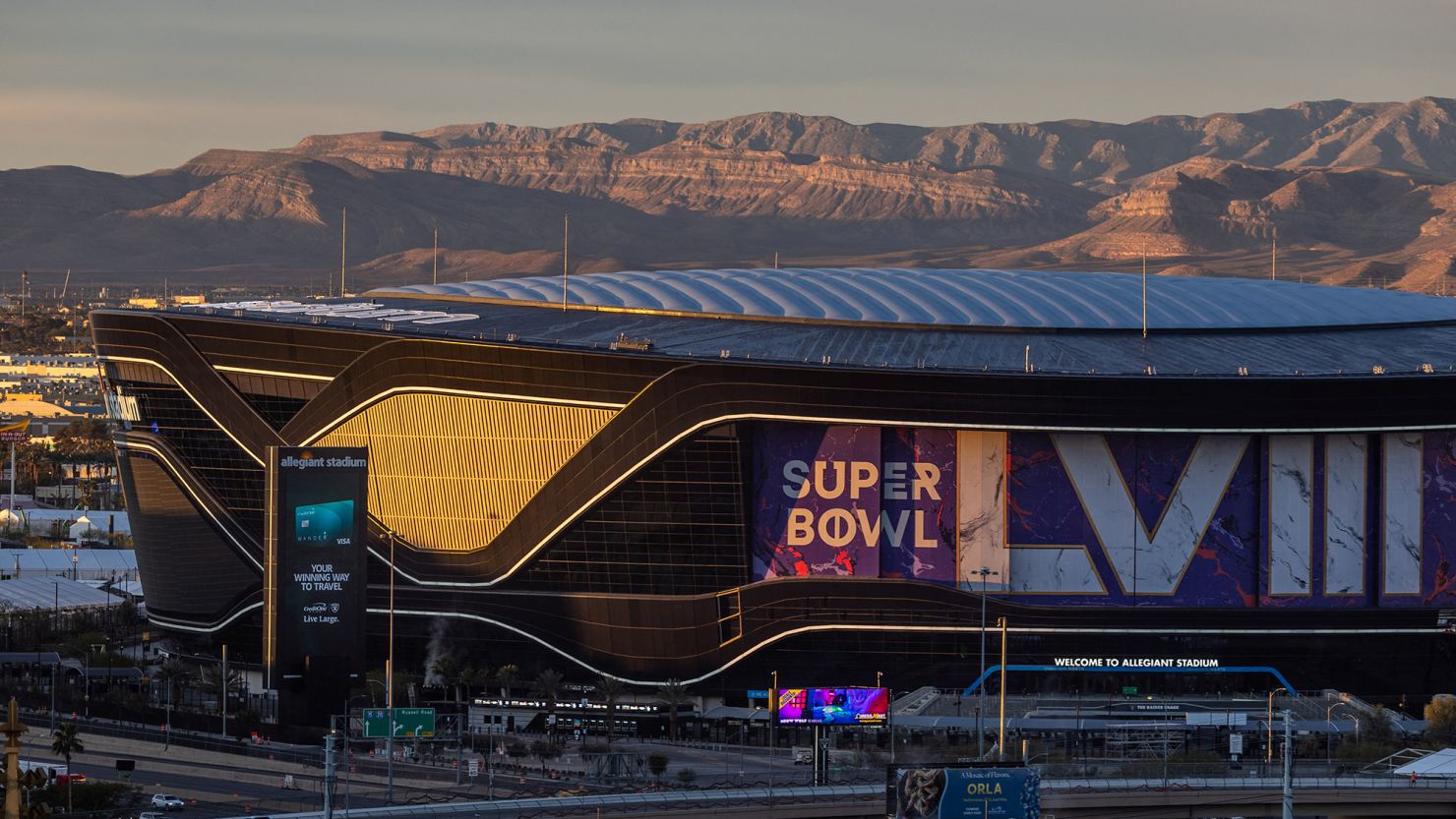
The game will be played in Las Vegas at the Raiders’ state-of-the-art Allegiant Stadium, aka the “Death Star,” the first time the venue – and Nevada – has hosted the NFL’s championship game.
Here’s everything you need to know about the host venue for this year’s Super Bowl.
Opened in 2020, Allegiant Stadium was part of a monumental project spearheaded by Raiders owner Mark Davis.
He was the driving force behind the relocation of the Raiders organization – historically located in Oakland, California – to the Silver State, a move announced in 2017 to the disgruntlement of many Bay Area-based fans.
The Raiders’ new 65,000-capacity stadium was built next to the Las Vegas Strip to accommodate the team; fittingly, it is located on Al Davis Way, a street named after the team’s former owner and Mark Davis’s father.
Sports Illustrated said the stadium was built with a domed roof and $1.9 billion to construct.
The stadium brings around $620 million annually to the local area while creating 6,000 permanent jobs in Southern Nevada.
The turf field can be moved depending on the event being hosted in the stadium. The stadium’s official website says it hosts Raiders games and “world-class entertainment including concerts and special sporting events such as the Pac-12 Championship Game and Las Vegas Bowl.”
The sliding field tray weighs 19 million pounds, similar to the Eiffel Tower, per the official website, and is moved by 72 individual motors.
Roughly 105,000 cubic yards of concrete – akin to 257 miles of sidewalk from Las Vegas to Los Angeles – were used in construction, and 425 trees were planted around the stadium. A total of 28,000 tons of structural steel was used, heavier than the Statue of Liberty.
The stadium includes 75,000 square feet of video boards to keep fans up to date with what’s happening on the field and over 2,300 televisions.
Hosting the Super Bowl is estimated to bring in around $500 million for Las Vegas “through direct spending, additional tax dollar generation, increased room occupancy and job creation.”
“Welcome to the Death Star, where our opponents’ dreams come to die,” Mark Davis proclaimed ahead of the team’s first scrimmage at the stadium in 2020.
The name has stuck despite not looking anything like the doomed Death Star – a giant planet-destroying space station that is twice blown up in the original Star Wars trilogy.
Meanwhile, others have noted on social media that the stadium resembles a giant Roomba vacuum, which is undoubtedly a more accurate description than the Death Star.
Whichever nickname it becomes most known by, the jokes for both write themselves.
However, in 2020, Davis was confident his Death Star would be more successful than its ill-fated namesake.
“That was THEIR Death Star. Not ours. Ours was built to sustain,” he told ESPN.
Former Raiders head coach Jon Gruden concurred with Davis, telling the Las Vegas Review-Journal in September 2020: “I think it’s a cool name for our stadium. I don’t give a damn about Star Wars. That’s what we call our stadium, and I don’t care what anybody else thinks.
“It’s a cool stadium, a great name, and we just have to play good when we’re in there.”
Like the Oakland Coliseum, where the team previously played games, the Raiders constructed a large torch in Allegiant Stadium in memory of Al Davis following his death in 2011.
The initial idea for the torch was in recognition of Davis’ enduring vision that “the fire that burns brightest in the Raiders’ organization is the will to win.”
Before each Raiders home game, legends of the organization, celebrities, or fans light the torch in memory of the former owner.
The first to light the torch at Oakland Coliseum in 2011 was the organization’s long-time head coach, John Madden, who was hired by Davis in the 1960s and won two Super Bowls with the team.
At the Allegiant Stadium, a 92-foot tall torch resides in the venue, with Carol Davis – Al Davis’ former wife and mother of current owner Mark – the first person to light it in 2020.
With the Raiders playing home games in 2020 without fans due to the COVID-19 pandemic, various community factions were thanked for their service and were allowed to light the torch.
During that season, some groups who lit the torch included frontline medical workers, local cancer survivors, Allegiant Stadium construction workers, Southern Nevada law enforcement agencies, and food bank volunteers.”