Part 2, An unexpected cultural experience…Rich in content…Profound in its core…

 
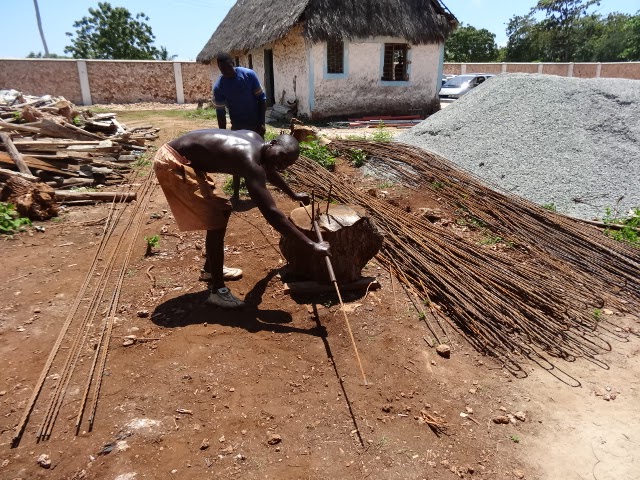
This worker was making the smaller rebar pieces to be used in the ongoing construction.
Little did we know that we’d receive a valuable education on life in Kenya when visiting Hans‘ construction site only a 12 minutes fast drive down the road. Feeling like school aged children on a field trip, we reveled in each aspect of the hard work and construction methods used by the creative and hard working people of Kenya, including Hans, his supervisors and more than 50 workers.
 
The pricing on the two bedrooms units, fully completed:  Kenya Shillings $9,900,000 (US $113,298) and for the penthouse:  Kenya Shillings $15,000,000
(US $171,664). 
 
A Maasi guard at the property.  Often the Maasia are the subject of photos taken by tourists.  This can be annoying for them.  Some tourists may offer a smalltoken of cash for the opportunity to take their photos. This guard had no exception to the photo since he was on duty working for Hans.  As Hans’ guests he made no objection.
 
 A quote from Hans‘ Flametree Beach Homes
Brochure (photos too large to load):
“It’s like living in paradise. Be enchanted by the
white beaches, the palm trees and the African way of life. The holiday resort
is situated on the Indian Ocean in Diani Beach, 30km south of Mombasa. The
proximity to the beach makes this property extremely desirable. On a beautiful
5000 sqm big plot in the heart of Diani Beach this apartment resort is
developing.”
 
Mining the coral from the property’s ground by hammer and chisel method is backbreaking work in the heat but a necessary method to keep costs down.
For additional information about these fine properties, feel free to contact Hans at this link and he’ll be delighted to answer any questions.
On the second level, we shot this photo of the future verandas, again supported by tree trunks and branches derived from the land when it was cleared for construction. This wood won’t be destroyed at completion of the project but re-used in a multitude of ways.

The raw materials for making the rebar needed during construction.
The workers were enthusiastic to show us how they make the rebar, ensuring they were in proper position as we took the photos. Check out that smile!


Pride in their work was evident in every aspect of the construction site.
Notice the bar was straight in the prior photo, now bent to accommodate the use of the bar in the construction.  Brute strength was employed as is evidenced in these photos.
 
 
One of many final rebar structures, carefully crafted by hand.
The beginning of the future septic system.  It was much larger than it appeared in this photo.  There is no city sewer and water in Kenya


Tom bent over this hole for the future well while I stood cautiously behind him.  In a prior post, I’d mentioned a shortage of water incorrectly.  Hans explained that Kenya is rich in an underground water supply which homeowners and business owners are able to tap into.  Apparently, the private well water is drinkable, although salty from the sea.  Thus, we’ve chosen to use bottled water for drinking, cooking and brushing our teeth.  The  well water is clear and clean for showering, laundry and washing dishes.


This long narrow building will house security personnel,  a spa with private massage and treatment rooms and various storage areas for maintenance.
The septic system.
As a few details near completion we were able to see this partially completed window. Every aspect of building, results in higher costs due to added security features.


As we pulled away from the project, Tom alerted to me to grab the camera.  The battery almost dead, I was able to get this parting shot of cows walking along the road, a common occurrence in Kenya, new to us.
We’d hope to have included architectural renderings of the units but with their huge data size, we were unable to upload them.  In any case, our experience gave us an opportunity to observe first hand the work ethic of many of the local citizens, eager to provide for their families and to build a life for themselves.
 
Unfortunately, the unemployment rate in Kenya exceeds 25%, the majority of which is young people. These stats may  be higher due to the unreliable nature of determining the stats of tribes that provide for themselves living off the land. 

To see firsthand that one person, such as Hans, has the ability to create a work opportunity for the lives of 50 or more local workers, although small, reaches out to the lives when including their family members.

 
Wages are low but its obvious that the Kenyan people, when given an opportunity, are creative and resourceful.
 
Thanks Hans, for sharing this day with us and ultimately, our readers.
 
 Busy weekend upcoming.  We’ll be back with more stories and photos.
 
 Thanks for reading!

Part 1…An unexpected cultural experience…Rich in content…Profound in its core…

This is a rendition of Hans‘ new construction project  (The pool is not illustrated in this rendition.)
As we entered the multi-unit building under construction, we were amazed by all of the handmade ladders, made from materials on the site. 
Still, on the main floor, we walked from room to room, envisioning the future appeal.
We couldn’t stop smiling over this creative means of supporting the ceilings.
This is why we’re in Kenya, its culture, its people, its wildlife, its vegetation, and its natural wonders all of which never cease to amaze us.
The expected completion of the first of 4 buildings on this particular site is by the end of 2013.
Seemingly fearless workers worked atop the highest levels of the building utilizing their handmade ladders.

There are a few historic buildings to sustain its tourism business.No ruins to attract visitors from afar. Buildings are made of locally handmade materials, indigenous to the parched soil; the coral, the stone, and the wood of myriad trees.

As we exited the car we were amazed by the piles of products to be used in the construction with little waste. Hans built this neighboring house.

Hans, originally from Germany, our landlord, neighbor, and now new friend, discovered Kenya in 1978, finding its richness and culture a lure he couldn’t resist. With a passion for construction and a desire to be a part of the development of his favored Diani Beach, Hans has provided much-needed jobs for the locals, making his roots firmly entrenched in the coral soil. 

This is the area where the pool is being constructed.  Rather than “pour” a pool as familiar to us, every inch of the interior and exterior are hand-engineered, one stone at a time.
These coral rocks for both the pool and the buildings are hand-dug on the premises.
The tall pile of pale blue stone is used to give the walls of the pool a blue color.
Coral and mortar, placed by hand, to build a swimming pool.
View of the future pool from the penthouse level.

Moving to Diana Beach permanently over two years ago, he and his lovely wife Jeri, from Nairobi, Kenya, have made Diani Beach their home as well as offering thoughtfully maintained vacation rentals along with the construction of future properties for sale.

These solid cement blocks are made on site in one of the future bedrooms!
This woman is working with the cement blocks.

Yesterday morning, Hans drove us to see one of his construction sites where no less than 50 local workers were deeply engrossed in completing this phase of the building project by the end of 2013. 

The water lines positioned within the walls of the units.
More branches, used as supports.

For us to see to the workers laboring in the hot morning sun, smiles on their faces, quick to offer an enthusiastic “jambo” greeting as we toured the huge project, our hearts skipped a beat. 

This is the stairway we took, albeit carefully, to the 3rd level to see the penthouse, also still under construction. We’ll be long gone by the time this project is completed, but Hans agreed to send us photos.
More coral and mortar used to build the walls on the interior and exterior of the building.
A future bathroom in one of the 2 bedroom units.
This method of securing the support for the ceilings was evident in almost every room, a sight neither of us had seen on a construction site.

This was life in Kenya surrounding us: the Maasai in their colorful robes; the young. athletic muscular men wearing long pants, no shirts, sweat glistening on their ebony skin;  the women, many mothers working to feed their families, wearing handcrafted tool belts while lifting heavy materials; and the older men, a lifetime of hard work etched into their deeply lined faces accentuated with a wide smile, the brightness of perfect white teeth a contrast against the rich dark skin.

Another view of the neighboring property from the penthouse level.

Walking over uneven ground through coral, stone, and rock, we followed Hans as we worked our way through the partially completed first of four large buildings to be built, each containing four large units, plus an elaborate penthouse. Once the four buildings are sold, Hans will begin building a comparable complex on an adjacent parcel of land, keeping these 50 workers and more in jobs for years to come.

“Jambo” yelled the workers as they smiled and waved to us.

Gingerly climbing up railing free cement stairways we worked our way throughout the entire structure, in awe of how different the construction was from that in the US. 

An archway being built on the penthouse level.  Here again, tree branches are used, in this case holding up the wooden mold in order to build the archway.

Literally, every major material used (except plumbing pipes and electrical lines), was made on-site by the hands of the workers: coral for the walls, hand-dug from the property’s grounds; the ladders, constructed with wood from fallen trees during the preparation of the land; the rebar made by hand as we watched up close; the solid cement blocks made in one of the future bedrooms, as we watched. 

Creative, economical use of land surrounding the building site to grow plants for future use.  How amazing is this!

A gardener tended a garden growing the future trees, plants, and shrubs, left our mouths agape in pure wonder over the sensible use of that which the environment so freely provides in abundance in Kenya. We couldn’t believe our eyes.

The beginnings of the garden that will supply the property’s landscaping.

The sun beating on us as we walked the massive uneven grounds, sweat pouring from us with nary a complaint, slightly overdressed in discrete clothing in respect for the Muslim way of life, prominent in Kenya, we didn’t want our exploration to end. 

The gardener was proud of his work.

Finally, we made our way back to the car to sip on our water-filled mugs to wait for Hans as he spoke to his foreman and workers. By noon, we were back on the road for the 12 minutes fast drive back to stop and pick up Jeri from her teaching job, heading back to our respective homes.

After stopping to pick up Jeri at the well guarded private home, she suggested lunch at a local Kenyan restaurant on the side on the road, where there was a row of tiny open-air thatched structures, where locals stopped to dine, day and night. 

The hut where locals dine on delicious food made without chemicals, with all ingredients locally grown.  Photos of foods follow below.

We giggled as we described it as Kenya’s “fast food” restaurants; low priced, fast, and delicious, the difference being healthfully made local foods, as opposed to the processed fast-food restaurants that we’re used to seeing in the US and around the world, none of which we’ve seen so far in Kenya.

When we returned from our outing, we walked over to Hans” and Jeri’s home to take photos of the local food they purchased for lunch at a total cost of Kenya Schillings $150, US $1.77. Yep, $1.77!  When was the last time any of us purchased a meal for 2 for under $1.00 each?
Ugali, a cornmeal staple is commonly enjoyed as a side dish is made entirely with flour and water, boiled to perfection.  Apparently, the flavor is fabulous.  None for either of us. In my old days, I sure would have gobbled this up, maybe adding butter and syrup.

Hans and Jeri suggested we try the food.  Most certainly, I would have had many of the items had they not been prepared with flour and starches. Tom, on the other hand, would hardly have enjoyed the seasoned, vegetable-laden items. Too bad. What a fine experience that would have been! However, we took photos of the food to share with our readers. Notice the total cost of the 2 meals under the photo.

Kenya stew may consist of beef, chicken or goat.

For more information about the foods of Kenya, click here. Tomorrow, in Part 2, we’ll share more details about the buildings, the hand made the making of rebar, the units for sale, drawings, plans, pricing of the units, and more photos. 

This is a chapatti, a flatbread comparable to a tortilla. This was especially hard to resist, soft, warm, and flexible, easy to fill with whatever one likes.

Over the upcoming weekend, we’ll be dining out twice, sharing those details and photos.  Our story of Kenya continues on…

Booked our flight to Mpumalanga, South Africa for November 30th plus required one night hotel stay…

OK, we get it. Pronouncing Mpumalanga is challenging. Here’s a link to a site that will pronounce it using a computer-generated voice. Tom and I practiced using this app several times and I believe we now have it down.

How annoying when travelers are unable (or unwilling to take the time to figure out) as to how to pronounce where they are or where they’re intending to go. As we’ve traveled, we’ve made an effort to familiarize ourselves with the names of local cities, establishments, and basic greetings.

Here in Kenya, “jambo,” a Swahili word, is the standard greeting with many meanings as indicated in this link. It’s so easy to go overboard using a certain local word, hoping to endear ourselves to the locals.  From our humble perspective, moderation is the key, as is the case in many aspects of life, not always easy to accomplish.

(At the moment, as I’m writing in our outdoor living room, there is a peculiar sound in the ceiling above my head. It sounds as if a creature is biting into the wood beams, but we’re unable to see it. This has been occurring over the past 30 minutes. Hmm…).

Today will be a busy day for us. Soon, our driver Alfred will appear to take us to a local G4S/DHL store to inquire in person as to their willingness to accept a package of supplies we’re shipping from our mailing service in Nevada.  

Hans kindly offered to have us ship the box of supplies to his PO Box. But, with the high risk of theft throughout the local postal system, we’d prefer having the package sent to an actual package shipping service, where more security will be in place. 

Once we meet with the staff at the nearby G4S/DHL location, our minds will be at ease. It will be interesting to see how much we’ll be charged for them to hold the box for less than one day. When we’re notified by email that it has arrived, we’ll immediately contact Alfred to take us to pick it up. 

In order to arrive in Mpumalanga, Kruger National Park, South Africa, the route was tricky. Here’s what we settled on which was the least amount of waiting and flying time at the best possible price.

11/30/2013 – Departure   1 stop
Total travel time: 8 h 55 m
custom air icon
Mombasa
Nairobi
1 h 0 m 
MBA  11:25am
Terminal 1
NBO  12:25pm
 
Kenya
Airways 
Economy/Coach
Layover: 3 h 35 m
custom air icon
Nairobi
Johannesburg
4 h 20 m 
NBO  4:00pm
JNB  7:20pm
Terminal A
 
South African
Airways
Economy/Coach (W)
12/01/2013 – Return   Nonstop
Total travel time: 0 h 45 m
custom air icon
Johannesburg
Kruger National
Park
0 h 45 m 
JNB  11:10am
Terminal B
MQP  11:55am
 
South African
Airways  Operated by 4Z/SOUTH AFRICAN AIRLINK
Economy/Coach (L)

With the 7:20 pm arrival in Johannesburg, South Africa at 7:20 pm, and the next day departure to Mpumalanga, Kruger National Park, we could either hang around the airport for almost 16 hours or stay overnight in a nearby hotel.  We opted for the hotel, taking the complimentary airport shuttle in the morning. 

The one-way fare for both of us on all 3 flights is a total as follows:

Traveler
1: Adult
 
$613.67
Flight
 
$375.00
Taxes & Fees
 
$238.67
Traveler
2: Senior

 
$613.67
Flight
 
$375.00
Taxes & Fees
 
$238.67
Expedia Booking
Fee
 
$14.00
Total: $1,241.34

(By the way, I am the above referenced “Senior” being 5 years older than Tom. Obviously, I wasn’t awarded any benefit by disclosing this fact.)

Our seat assignments, not stated here, were established when we were directed to the airline’s website.  Luckily, we’re able to sit together. This trip will be considerably shorter than the long flight from Venice, Italy to Mombasa a mere two weeks ago today. How the time flies (no pun intended)!

The cost for the one night’s stay in a highly rated hotel was US $117.66 after a 50% discount provided to us from Expedia.com. Add another US $125 for meals and tips for a grand total US $1484.00.

Considering the distance is over 2300 miles from Diani Beach, Kenya to our destination, this fare is not unreasonable. We’d actually budgeted US $1500 for this leg of our journey.

Soon, we’ll make further arrangements for a driver to pick us up at the Kruger Park/Mpumalanga airport to be on our way to our new home in Marloth Park, located on the edge of Kruger Park. 

At times, we’ve been asked, how we can begin planning the next leg of our travels when we recently arrived at a particular location?  It’s actually quite easy for several reasons:
1.  It takes our minds off of it, freeing us up to fully enjoy our current location.
2.  It ultimately saves us money, when the lowest fares usually sell out first.
3.  It allows us to sit together.
4.  It enables us to select flights in time frames that are most appealing to us.  Some of the options for these flights required a 5:30 am departure.  With the International requirement for arriving at the airport no less than 2 hours before the flight, choosing such a flight would result in our losing an entire night’s sleep.  Also, we consider the check-in time for the upcoming location to avoid waiting for hours to get into the property.

Overall, advance planning translates into “stress reduction.”  With the situations that occur for which we have no advance warning, we’ve avoided creating chaos, of which Tom and I are adamantly opposed.  Chaos avoidance is the crux of making our worldwide travels as seamless and stress-free as possible.

And still, regardless of our best efforts and intentions, stuff happens.

Off we go on our stop at the package store after which we’ll grocery shop. We’re having Hans and his lovely wife Jeri over for dinner tonight. Gee, I wish I had some linen napkins!

Hot, humid…Stay off the grass after the rain….Observations on daily life…

Hans invited us up to his 3rd level veranda for “happy hour” and to watch the sunset. As we enjoyed the view from up high, we all noticed this animal’s butt sitting inside a window. Definitely not a monkey with this type of tail, we anxiously waited for it to turn around.  y the time it was totally dark, it hadn’t moved, leaving us all without a clue as to what it was.

Hesborn, our trusty houseman, suggested that we stay off the grass, especially in bare feet after the rains.   Apparently, the rains draw out the creepy crawlies. There are certain small worms in regions of Africa, that enter the bottom of one’s feet, eventually working their way to the brain. Yikes.

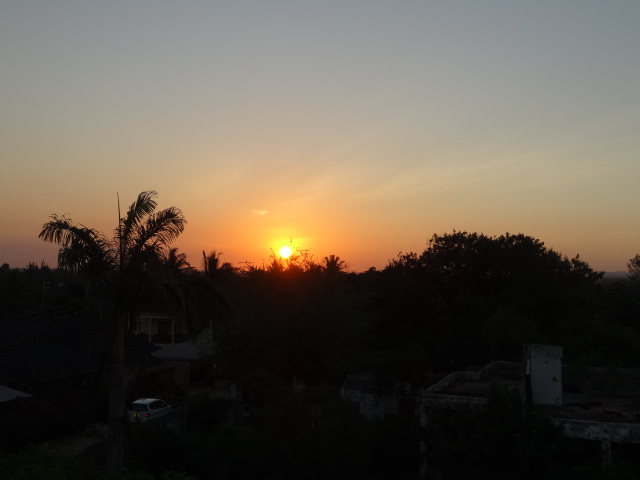
The sunset is beautiful everywhere. From the 3rd floor of Hans’ house, we were thrilled to take the progression of the sun’s setting in the horizon

It’s too warm to wear shoes.  Unfortunately, neither of us wears flip flops.  We couldn’t seem to ever get used to the intrusion between our toes. Barefoot the entire time we were in Tuscany, except for walks and road trips, it’s nearly impossible for me to tolerate wearing shoes.

Thus, we don’t step off the stone floor of our mostly outdoor lifestyle without wearing enclosed shoes. Last night, with the mosquitoes on a frenzy at dusk, I bit the bullet wearing not only shoes inside but also a pair of socks. It’s been hot and humid. My feet were steaming in the heat.

Hans made Tom one of his special local concoctions while I sipped on my usual ice tea while chatting with Hans’ lovely wife Jerie (not sure on spelling).

This morning while preparing to take a shower, two things occurred; One, a 6″ lizard ran up the wall of the bathroom to eventually run to the screened window and disappear and two, it rained in buckets. I laughed about the lizard, didn’t scream, and grumbled about the rain. Rain equals more humidity and subsequently more mosquitoes.

My usual one cup of coffee made me feel too hot to drink it. No usual morning tea after my usual coffee for me today either. For Tom, sitting around with no shirt on, he’s able to stay cool. There is no cotton bra or tee shirt that I own in which I can feel cool. Topless is not an option.

As the sun set, the lush greenery appeared brighter than during the day’s sun.

Amazingly, after two weeks in Kenya, we’ve been able to sleep at night. The overhead fan, the top sheet with no blanket has been all that we’ve needed. The temperature during the day is usually in the 80s with humidity to match. At night it drops to a humid high 70s. Plain and simple, uncomfortable. I’m working on getting used to it.

In movies about travelers to various countries in Africa, I recall the women holding a handheld fan made of dried palm leaves. Where’s mine? I don’t see it anywhere. It would have come in handy yesterday and again today.

Look at these lush ferns, abundant in Kenya’s humid weather.

With no clothes washer at our disposal and laundry done only once a week, the zillion dishtowels I formerly used when cooking are long forgotten. The three towels I do have at my disposal end up soaking in the sink overnight, taking two days to dry when I hang them on the window sill. The only paper towels available in the grocery store tear apart easily, are flimsy and relatively useless.

Having disposed of much of our clothing, hand washing is a necessity almost everyday. My lightweight underwear takes two to three days to dry left hanging on the rack in the bathroom. Tom’s takes longer so he doesn’t bother, instead waiting for the weekly wash. He’s capable of wearing the same pair twice if necessary. Not I.

The haze, a result of both humidity and fires burning, leaves an eerie view over the horizon.

With the shortage of water and the high cost of power in Kenya, my days of daily laundered clothes are over. I tell myself to “get used to it.” In time, I will. Tom’s oblivious to all this. I’ve yet to see him hand washing anything, by no complaint from me. He’s willing to “live without” more readily than I. 

Tonight we’ll use bath towels as napkins with dinner. The dishtowels won’t be dry by then. Small annoyances. Luckily, we’re having leftovers tonight requiring less towel use.

From high up on the veranda, these coconuts caught my eye.  They are everywhere!

Am I whining? Perhaps, maybe a little. Am I unhappy or distraught? No, not at all. It’s all a part of the adventure, of letting go of the easy, the familiar, and the convenient while embracing a different lifestyle. It won’t always be like this. We won’t always be living outdoors.

When the rain poured in buckets this morning as I dressed for the day, Tom wandered around our outdoor living quarters, wondering where we’d park ourselves, if the wind continued to pelt the rain inside at us. Our only option would be to go back to bed. Luckily, by the time I got outside, the rain had stopped, the sun was shining and a new day had begun.

Soon, it would be set and darkness would fall as the sounds of the nocturnal wildlife rings through the air throughout the night.

Now, sitting here as the sun burns off a little of the humidity and a slightly cooler breeze wafts in from the ocean across the road, I can hear the sounds of the goats conducting their usual morning “baa fest.”

The neighboring roosters are crowing with their determined call welcoming the new day while the morning doves are joyfully engaged in their gentle “hoot, hoot, hoot, hoot, hoot hoot” and dozens of birds of varying species are chirping almost in unison. It will be a good day, after all, especially since “I’m working on it.”

Finally, the sun went down and we wandered back to our house next door.  It was after 7:00 pm and time to make our dinner as we reveled in the good time we’d had next door at happy hour.

Dinner in a cave?…Yep!…Last night we dined in a cave…

I thought Tom looked great in this photo, but I reminded myself of Morticia wearing all black or, of the day in Abu Dhabi when we entered the famed White Mosque, requiring that I wore the black abaya in the 100+ degree weather while I was sick. I’ll never forget that day or, that photo which my sister Julie gets hysterical over every time she looks at it! (See the post in the archives for May 30, 2013).

As we continue on our mission of trying a different Diani Beach restaurant each Saturday night, we enjoyed on our second outing at the locally acclaimed Ali Barbour’s Cave Restaurant


The ambiance, in a natural cave, was formed by the sea over 400,000 years ago while the restaurant itself is thought to be between 120 to 180 years old, renovated in the 1980s with the intent of maintaining its original integrity.

Standing at the top of the stairway leading down to the natural cave, we were able to look down at the bar below. Every effort was made to maintain the original integrity of this environment when it became a restaurant over 100 years ago, renovated in the 1980s

This was accomplished with the most finite details, using only a minimum of modern-day amenities such as; candles as opposed electricity; few electric wires discretely placed to allow for small fans for movement of the humid air as opposed to air conditioning; an open ceiling as nature had created allowing a view of the stars in the night sky while dining.

During dinner, Tom mentioned that it reminded him of a “man-made attraction one might find at Disneyland where the walls we made of molded resin as opposed to the natural stone.” 

The lounge in the bar where we had our drinks while waiting for our table. The restaurant didn’t open until 7:30 pm with most diners not appearing until 8:30 or later. I guess us folks from the US are early diners.  We’ve found that dinner is typically served at 8:00, often 9:00 pm as we travel the world.

Adding to the ease of making online reservations for dinner, Ali Barbour Cave Restaurant provides complimentary driver service to and from the restaurant. At promptly 7:00 pm, the driver arrived as we waited with the guard at the main gate to our complex.

As the older van pulled up, I asked, “Where are you from?” as a safety precaution. When Joseph replied, “Ali Barbour Cave Restaurant” my mind was at ease.

Another view the seating areas in the bar, depicting somewhat of a Moroccan theme, of which we’ll see plenty when we live in Marrakesh Morocco, a mere six months from now.  My, how the time is flying by!

Based on the restaurant’s proximity to our home on Google Maps, I’d anticipated a short two or three-minute drive. Once on the dark, narrow, bumpy unlit road, as cars drive on the left side, I began to worry after more than 10 minutes had elapsed. 

Joseph reassured me it was down the road a short distance. As we pulled into a narrower rocky unpaved, unmarked road, Tom and I squeezed each other’s hand, wondering why there was no sign on the road and where we were going.

View of the walls in the bar. All lighting in the walls and at the table was a result of candles, creating a warm atmosphere, romantic to say the least.

Later, when we left the restaurant, we noticed a glaring sign on the opposite side of the highway that we missed when turning in. Perhaps, we were foolish to give it a thought.  But, living in Kenya one cannot be too cautious.

The seating across from us as we lounged on the love seat in the bar.

For the first time in our travels, with all the bumpy and scary roads we’ve traveled, last night was the first time I felt a little carsick. The weaving back and forth along the busy highway, the lack of air conditioning, the smell of toxic fires in the air, my stomach revolted in queasiness. Luckily, once we arrived, the feeling quickly passed.

To our surprise, no security was in place at the entrance to the restaurant, although a Maasai guard/greeter wearing traditional African red robes warmly welcomed us, graciously opening the car door and offering a hand to assist us out of the back seat.

The story about the cave.  Excuse the flash.  In the dark cave, it was unavoidable.

Upon entering the unique space, we both were instantly in awe of yet another of nature’s creations that humans had so carefully maintained.

The air, thick and humid, cooled by numerous quiet, well-hidden fans, took a few minutes to become adapted. After all, we were in a cave.  I’d expected to find a few bats flying about or perhaps evidence of guano. There was no evidence of either.

In Kenya, living, and dining all of our meals outdoors, I feel sticky and grimy at all times. Also, the necessity of re-applying mosquito repellent (DEET free is working well, but requires reapplication every few hours) during all waking hours (we’re protected by the mosquito netting in bed) invariably attracts the soot and sand in the area at all times, only adding to the feeling of being dirty.

Showering every morning leaves me at my worst by the end of the day. With the water restrictions, we choose to only shower once a day. Having to dress in more “evening out” clothing as is typical in finer restaurants in the area (no shorts allowed), it’s difficult to make myself change into other clothing, as the mosquitoes are in a full frenzy around 6:30 pm each night. 

Diners began to filter in around 8:00 pm, filling all tables by the time we were ready to leave around 9:45 pm.  We’d be warned not to rush the servers for the check-in our travels. Many countries’ servers are accustomed to taking their time in delivering the bill. Most often, as is the case here in Kenya, tips are only allowed to be paid in cash, not added to the credit card slip.  Of course, this requires us to keep adequate change on hand.

When staying in, we both change into our BugsAway clothing provided considerable protection from the mosquitoes except for exposed skin. Each night before dinner, I lather my arms, hands, and ankles with the stinky lotion.

Going out to dinner changes the entire scenario.  With no BugsAway clothing acceptable for dining in finer restaurants to protect me, I have no alternative but to fully coat myself with the lotion before putting on the evening clothes. 

Talk about feeling hot and sticky! Of course, I bring the lotion with us, often requiring an additional application during dinner, as the mosquitoes swarm around me. 

This is the natural opening in the ceiling, allowing a view of the night sky. It would interesting to visit during the day to look down into the hole in the main dining area.

Perusing the dinner menu, we were at a loss as to what we’d order. With their chef familiar with gluten-free cooking, I felt reasonably at ease, especially after explaining that he need also consider my avoidance of sugar, grain, and starches.

Twice, the waitress came to our table graciously inquiring as to our readiness to order, and twice we still hadn’t decided. Tom, beef lover than he is, coupled with his finicky taste buds, ended up choosing double Fillet Mignon once again, one of which was veal with Bearnaise sauce and the other regular beef with a peppercorn sauce. 

Only a few tables had guests when we entered the dining room around 7:45 pm. Within an hour, it was fully booked, mostly with non-English speaking tourists.

He didn’t find either of the sauces offensive in any manner but said the steak was less tender than he’d had the prior Saturday night at the Sails Restaurant at the Almanara Resort. 

Compliments of the chef, we were both served this tangy GF marinated salad.  Tom took one bite turning his serving over to me, both of which I thoroughly enjoyed.

My dinner was similar to a pesto cheesy chicken recipe I’d concocted while living in Italy using the fresh herbs from our patio garden. The portion at The Cave was small leaving me hungry after dinner. Upon returning home, I ate a large handful of Macadamia nuts, which took care of that issue.

The dining room extending beyond where we were seated.
Most likely, we were the oldest diners in the restaurant all evening.  We noticed that the majority of the diners were younger couples, mostly in the late ’20s and ’30s. As we’d also observed in Italy when out and about, we seldom encountered any “old-timers” like us, causing us to wonder where all the retirees have gone for vacations or “ex-pat” living.
With the cost of living escalating in Kenya over the past several years and, with tourism down considerably, few retirees are making Kenya their home.  Also, the negative press regarding the crime rate in Kenya has deterred many travelers from coming this way.
This was the view to my right as we sat at a cozy, not too small table against one of the walls. We always prefer a wall, table as opposed to one positioned in the center of the room.
Candlelight accentuates the natural holes in the cave, adding to the ambiance.

For my dinner, as shown, I ordered the Cheesy Chicken atop a pesto sauce, all gluten-free, with a side of sautéed vegetables. Tom, as always, scooted his vegetables onto my plate, a common occurrence due to his distaste for “green things.”

My dinner, Cheesy Chicken atop a pesto sauce was well seasoned and pleasing to the palate, although the serving size was small. Rather than a chicken breast, this serving was a small single thigh. 
Realizing that my dinner may not satisfy my now ravenous appetite I’d considered a side salad.  Unfortunately, they didn’t have a salad dressing befitting my way of eating (low or no sugar and gluten-free) plus, we assumed that the raw vegetables weren’t washed in purified water, adding to the risk of disease or illness.
Tom’s dinner of two small Filet Mignon, each with a different sauce.  He was disappointed in his meal, having higher expectations after reading many five star reviews.

Would we recommend the Ali Barbour’s Cave Restaurant? Yes. The interesting and unusual atmosphere is well worth the visit, although we’d consider the food to be average. The service was flawless. Over the top!

Overall, including VAT tax, Tom’s two huge bottles of beer, my full liter of sparkling water, the service charge, tips for the servers, and the shuttle driver, we spent a total of US $68.09.

The stairway going up and out of Ali Barbour’s Cave Restaurant. Gee, we’ve gone up and down a number of stone stairs in these past months!

Currently, with taxes, we’re spending approximately US $40 per day for groceries. It’s certainly worth spending an extra US $28 for us to get out of our outdoor living room for an evening and to dine at the hands of a local chef.

Our safari decision is made…Details tomorrow with photos!…More visitors to our house…

At dusk, Tom shot this Kenya sky.  Rather impressive for the infrequent photographer.

Over a period of several days, we’ve read reviews, viewed photos and perused dozens of websites searching for what hopefully will be the perfect safari for us.

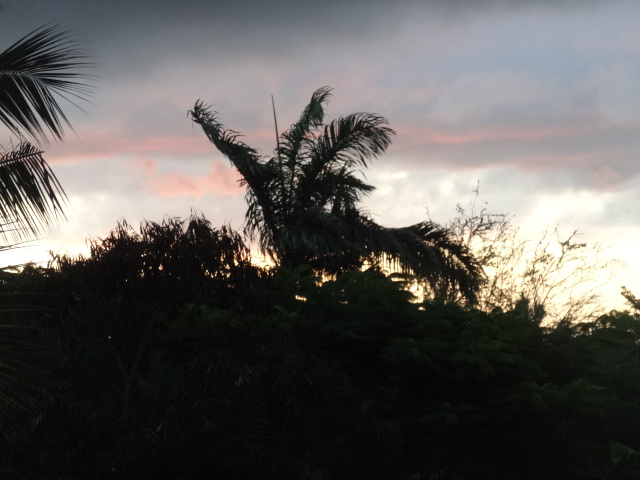
Yesterday afternoon, I pulled up a chair close to the open wrought iron weaving (to keep us safe from the monkeys or other larger animals) surrounding our outdoor living room to take photos of the many birds singing in the yard.  In my impatience, I was unable to capture many birds instead focusing on items that caught my attention such as these branches in the shadows.

The prices for anything other than a basic tent in the bush are more than one would ever anticipate. If seeing The Great Migration wasn’t what brought us to Kenya, most likely we’d have waited to see the Big Five when we get to South Africa on December 1st, living on the edge of Kruger National Park.

The red in the background is a bunch of flowers on the bush behind this palm.

But, the Great Migration has been one of the first items on our “must-see” list inspiring us to come to Kenya.  And, see it, we will! 

The tall pointed thatched roof of the house next door to us.

After narrowing our choices down to two separate camps in the Masai Mara where the herds are right now, we continue to weigh our options.  Realizing there was no way we would be able to experience this magical wonder of the world without literally spending US $1000’s, our search has been intense and goal orientated.

Hidden in the fronts of the palm tree, this little yellow bird, the Golden Weaver, the male of the species is noisy and feisty, providing much entertainment flitting about frantically. The male makes the nest and if the female doesn’t like it, she goes on to mate with another more nest building worthy colorful male.
This is the very noisy and particular female of the yellow bird, the African Golden Weaver, less colorful.  They are elusive, sensitive to movement, making photo taking a near impossibility for a novice such as I.  She seeks the colorful yellow male capable of building a satisfactory nest. She landed in our outdoor living room, enabling me to get this lopsided shot.

The criteria we’ve searched:
1.  Close as possible to the Masai Mara where the massive herds of wildebeest will be grazing after their journey over the river.
2.  An option to have breakfast overlooking the “hippo pool” on the river.
3.  All-inclusive: meals and beverages (including cocktails for Tom)
4.  Two daily game drives
5.  Meals optional in the dining room or in the bush, day or night
6.  Complimentary WiFi throughout
7.  Electricity (needed to recharge our digital equipment)
8.  Availability for dates in early October for a better opportunity to see the Great Migration in the Masai Mara
9.  Entrance fees to the reserve to be included (cost at almost US $100 per person/per day for a three-night stay)
10. Round trip airfare included from the local Diani Beach airport, a short distance from here.
11. Affordable based on our budget

Hesborn offered to open a coconut that had just fallen from a tree.  They seem to fall throughout the day.  We have to be careful when we walk under the coconut trees, they cover the entire yard, leaving only a few safe spots for sunning without a risk of being clobbered on the head.

The camps we’ve narrowed it down to meet all of our criteria. At first, the cost of such a three-day event has been shocking. After reviewing the inclusions, the cost at other camps, we’ve resigned ourselves that when it comes to safaris, you get exactly what you pay for and, if not careful, it could be much less.

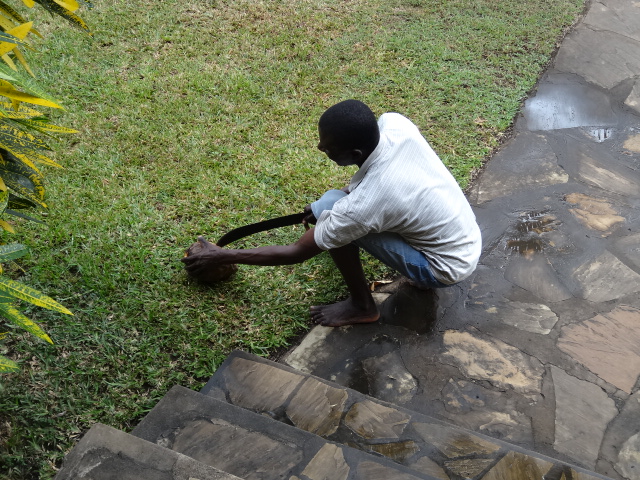
Hesborn with his machete preparing to cut this thick stringy exterior off of the coconut before releasing the stringy brown interior that we see for sale at the grocery store.

Choosing either of these two options will put our minds at ease, both being highly rated by many booking sites including Trip Advisor, Booking.com, Hotels.com, and more, along with 100’s of positive reviews, ensuring us that in either case, we’ll make the correct decision. We’ll decide today, posting details tomorrow.

This coconut meat was exceptional, the best I’ve had. Tom has no interest in eating this without sugar so he passed it up. What a treat!

With all bookings sold out for September, our only possibilities haven been for October, still in the peak season, still at higher prices. If we waited until November, we’d increase the risk of not being able to see the Great Migration, a risk we just don’t want to take.

As we’re sitting in our outdoor living room this morning while writing, seven goats jumped over their stone wall behind our yard directly in our yard only a few feet from us. Waking up early such as we do, they decided to jump over the stone wall separating us to dine on the lush leaves of the hibiscus bushes in our yard.
I wasn’t able to get a photo of the seven of them together as they were jockeying for space at the lush bushes in our yard. They were a little unnerved by my enthusiastic chatter.
They were in goat heaven munching on the flavorful leaves when they usually dine on boring grass. For them, this was a gourmet meal.

It’s hard to believe it’s Friday again, the time passing so quickly these days. We’re waiting for a confirmation for our dinner reservation in a cave for Saturday night which we’ll excitedly share on Sunday with photos.  Dining in a cave sounds interesting.

Notice the white two front legs on this young goat along with the white tip on the left rear foot. Cute, eh? Hesborn came running into the yard shooing them back up over the wall when he’d realized they were missing from their yard when he brought them water this morning. We all laughed!

Hope all of our readers enjoy today’s mishmash of photos we’ve taken over the past few days.  he number of surprises we continue to experience just “hanging around” makes each day rewarding and unique unto itself. 

BTW, as we wrote this morning, we received information that has prompted us to make a decision on our safari in early October. We’ll post photos and information tomorrow. We’re excited, to say the least!

Be well. Be happy. Check back!

Critters…some scary…some not. Plus, photos all the way to the end of the post…

Hesborn, our houseman, stopped by Wednesday morning, after a full night of rain,  to
show us this carnivorous, stinging, dangerous creature which actually has less than 100 legs, and yet is still referred to as a centipede.  He warned us not to walkin the grass after a rain.  A sting from this ugly creature will require a trip to an emergency room.  These not only walk but also climb up bedposts.  Oh.

The past few days have been interesting. On Tuesday morning our XCom Global MiFi wasn’t working, leaving us unable to post. Normally posting in the morning, the planned 10 am cab ride to grocery shop gave me no choice but to write in the early afternoon when we returned only at that point to have no connection.

Frustrated, we decided to stop at the Safari Com cellphone store, conveniently located above the grocery store, to see what options were available to purchase a global GSM unlocked HotSpot, comparable to that which Hans loaned to us.  Although less powerful than the MiFi, a portable hotspot requiring SIM cards, can at least provide us with connectivity.
Once past the armed guards (as mentioned in Wednesday’s post), the response to our question,  “Do you have a Global GSM Hotspot that will work for us after we leave Africa?”
This good-sized lizard came to call as we lounged in our outdoor living room.  Thanks for the nice pose, Ms. or Mr. Lizard.

The emphatic answer from the representative was a resounding “Yes!” as he pointed to a device, similar to that which we’d borrowed from Hans which we’d brought along with us in the event of a language barrier. He turned us over to a sales woman, who spoke very softly with a thick accent, difficult to hear and understand. Attentive and determined to be helpful we appreciated her efforts, continually thanking her for her efforts.

An hour later, Hans’ Hotspot no longer worked after the rep had removed the SIM card, disabling the device until Hans could late re-enter his PIN # which we didn’t have with us. Oh, good grief.

Hesborn referred to this as a millipede.  We didn’t bother to count the number of legs. Apparently, these are harmless, although if walking on a person, they leave a trail of “itchy liquid.”
Then, as we’re ready to pay after “being approved” by their system, once again I asked, “Are you sure this is a worldwide device?”
A millipede in relation to the tip of my shoe.  One wouldn’t want to snuff this out with their foot if discovered in the bathroom in the middle of the night“Wait

“Let me ask,” the rep helping us stated, moments later to return with an emphatic, “No, it works only in Kenya.”

As Alfred drove us to the stores, we passed many similar buildings.
That does us no good whatsoever. We’ll use Hans’ device while in Kenya which he so kindly offered to us, for which we ended up purchasing additional gigabytes, most likely to last for a month.
We left the store with only the extra “scratch offs,” used to reload the gigs on a phone or hotspot. We purchased US $72 of SIM cards, hoping they’d last long enough for us to continue recording our favorite shows on Graboid and, for Tom watching the Minnesota Vikings game.  
Wednesday, we ordered a new device online as we’re gathering supplies for a box to be shipped to us via DHL hopefully within a month. (We’ll share details of our inclusions once the box arrives).
Its these run down lean-to type shacks that depict the aspect of a third world country, many without running water and electricity.  And here we are,in the upscale resort community of Diani Beach.
Next, we attempted to visit the recommended travel agency in the same two story mall as the grocery store to determine which safari options were available during our three month stay.  They’d gone out of business. 
Next, we grocery shopped, spending yet another US $300, after shopping only a week ago, spending slightly more at that time. 
However, included in our grocery bill was a case of beer for Tom; US $4.85 for the 24 empty bottles, US $34.33 for the liquid in the bottles and US $3.83 for the crate holding the bottles with the liquid in it, for a grand total for the beer of $43.03.  Of course, we’ll eventually return the empties for a refund of US $8.68.
Few of us can relate to the hardships of daily life in these sparse habitat.

Next, we purchased two 18.9 liters of bottled water, the liquid at US $8.24, the empty returnable bottles at a total of US $23.79. All is all, we spent US $75.06 for beer and water out of the total bill US $301.12.

In a prior post I mistakenly stated that the VAT tax on groceries was 21% when in fact its 16%, the 21% applying to dining in a restaurant. Please excuse the misquote. Thus, the tax for our groceries according to the receipt was Kenya Shillings $3062 for US $35.04.

The Nakumatt grocery store is guarded with armed security who, for security reasons refused to be photographed.
Individually, no single food item was outrageously priced except for my medium sized bags of unshelled pistachio nuts for US $16.25. Add the tax for a total of US $18.85, not worth the price.  There are other less expensive nuts I’m happy to munch on such as Macadamia nuts at US $3.94 for a large bag. Many items in the grocery store weren’t clearly marked, making buying decisions difficult.
A good sized container  of “natural” insect repellent lotion was US $1.66. You get the drift.  Most products are inexpensive. Taxes and “extras” are high. Going forward, our goal is to be more mindful of the cost of items as we become more aware of the pricing while finding a comfort level with the exchange rate as we shop.
The parking lot as we waited the few minutes for Alfred to return to pick us up with our groceries.

In almost every grocery aisle is an employee, friendly and anxious to assist with purchases and, as mentioned last week, good little salespeople, pushing certain products. With their warmth and attentiveness, it’s difficult although at times necessary, to turn down their often pricier suggestions.

Our cab driver, was on the spot when we called to say we were ready to leave.  He insisted on loading and later unloading all of our heavy groceries. Once they were inside on the garage floor, Hesborn jumped in to help bring the boxes and bottles inside (no grocery bags here, only used cardboard boxes). Tom, with nary a lazy bone in his body, insisted on helping.
This mother baboon was carefully watching us with her babies in the background as we stopped for a photo. Tom quickly shut the window when she approached the car to peer inside.

Putting away the groceries was once again challenging in the small galley kitchen. I threw Tom out to tackle this on my own, having found a place for everything a short time later.

The kitchen door must be shut in order to open the refrigerator door. In essence, this is probably a good thing since monkeys have been known to race into a kitchen to begin grabbing food out of an open refrigerator door. Having a habit of leaving the door wide open while unloading perishable groceries, this reality is especially motivating for me to remember to shut the door.
Baby baboon searching for morsels of food in the grass.

With our shopping completed and put away, we had to begin figuring out why the MiFi wasn’t working and to find Hans to help us with his hotspot. A few hours later, now close to dinnertime, Hans arrived, easily getting the hotspot up and running. 

As for the MiFi,  I sent XCom Global a request to give the device a “hit” after listing multiple codes, serial numbers and device information into a lengthy email. With the time difference, we never heard back.  
The second baby baboon we excitedly observed as we stopped along the road on the return drive from shopping on Tuesday.
Wednesday morning, it was working again.  Apparently, the hit worked enabling us to switch back and forth between the two devices based on the amount of data we’ll be using for larger downloads. 
Technology issues in a primarily third world country can be frustrating, as we’ve so well experienced. The more we’re able to figure out solutions for our technology, the more time we’ll have to experience the reasons we choose to visit countries such as Kenya, as illustrated in these and other photos we’ve included here.
Mama baboon as she lost interest in us and returned to her children.  Oh.
We chose to experience Africa to witness its people, its wildlife and its vegetation, all of which we’ve already richly enjoyed with a modicum of effort while staying relatively close to home.  Soon, we’ll expand our horizons for the life changing thrills of a safari. If we get excited over seeing an unfamiliar insect, can you imagine our reaction to an elephant? A zebra? A lion?
Gucci, one of Hans’ two small dogs, came by for a few scratches this morning which we’re delighted to provide.  We love dogs.

Ah…Technology fails us…Life goes on…

Tom engaged is power lounging in our outdoor screen-less living room while searching for future cruises.Tom’s not naked. He’s actually wearing shorts.

We were unable to post yesterday.  Neither of our MiFi devices were working (weird coincidence). Now with one back up, and continuing to work on the other, we have a connection. 

Refusing to further bore our readers with ongoing Internet connectivity issues, we’ll share our other experiences since our last post on Monday. 

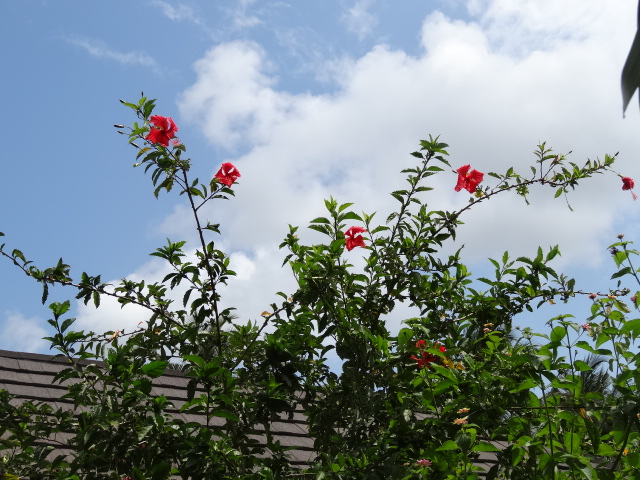
Although very hot and humid, these flowers against the blue sky was refreshing.

On Monday, Tom was able to watch the Minnesota Vikings game airing on Sunday, using the separate WiFi device we borrowed from Hans, our kindly landlord, who recently also loaned us a cellphone in order to be able to call for cabs. Thanks to Hans for his ongoing assistance in many ways.

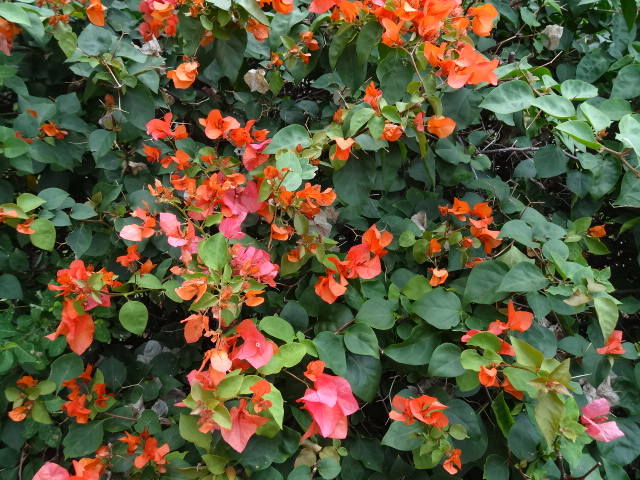
If I recall correctly, these flowers also grow in Hawaii, where we’ll be in 15 months.

As it turned out, watching the game on his laptop with a relatively clear connection resulted in the use of approximately one gigabyte out of eight gigs installed into the alternate WiFi device. 

At the cost of US $45 for eight gigs of data, each game will cost US $5.63 in addition to the US $169 he paid NFL.com for the football season at an average cost of US $16.25 per game.

The small white flowers grow within these larger bougainvillea.

As much as he enjoys  watching the Vikings, we surely don’t flinch at the cost. But lately, we’ve seen a number of “must have” expenses increase, making us a little wary of how much it may cost us after all is said and done after living in Africa.  We may have to cut back on a few things.

Shards of glass are embedded into the top edge of this stone wall protecting our property from intruders climbing over the wall.  Surprisingly, this enchantingly noisy bird lighted atop the glass seemingly comfortable.

Finally, on Monday the final bill arrived in my inbox (along with charges on a credit card) for the rental car in Italy. We’d read reviews warning us of possible “up” charges and surprises when renting a car in Italy, making us skeptical to rent cars in the future, preferring the much less expensive option of using cabs.

Aren’t these breathtaking?

Brace yourself for the total for two and a half months of the smallest and one of the cheapest cars Budget Rental had available at US $3294.47!  With the addition of the unanticipated 21.5% VAT tax and service fees, it proved to be almost US $1000 more than we’d anticipated!  Ouch!

The wide array of colors of the flowers in our yard in Kenya is a feast for the eyes.

If we called a cab as many as 3 times a week at US $12 including tip per trip for our remaining 11 weeks in Kenya, the grand total would be US $396, almost 1/10th of that which we paid in Italy  It’s a no brainer. There again, live and learn. We’re learning not to feel trapped without transportation.

To think that the blooming season has just begun is exciting.  With rain off and on these past few days we expect more blossoms to appear shortly.

Also, taking a cab reduces the risk of carjacking, which apparently, is of a serious concern in Kenya, less so in Diani Beach but not unheard of.  In the US, only 30 minutes from our old home, driving was also dangerous at night in certain areas with possible carjacking and the risk of stray bullets. Is there anywhere in the world free from risk?

Could Mother Nature be more perfect in creating this well shaped Hibiscus, a common flower in many warmer parts of the world.

Yesterday, as we visited the local Internet store to purchase more data for the SIM cards, armed guards manned the doors, letting us in after thoroughly checking us out. Passports are required to enter. Also, armed guards wander inside and out of the local grocery store where we shopped once more. Plus, armed guards are situated at the entrance to the little strip mall where the grocery store is located. Passports are also required in order to purchase grocery items.

The brightness of the yellow in these flowers is not a shade I’ve seen before.

Last night, happy to stay in, we made a fabulous dinner of boneless chicken breast sautéed in olive oil and butter, breaded using egg, cream and coconut flour. With side dishes of fresh green beans, slices of a huge, perfectly ripened avocado (US $.30) with a giant salad, it couldn’t have tasted better.

We fired up an episode of one of Tom favorite shows that we’d download, “Who Do You Thank You Are?” to watch during dinner, dining at the huge glass and burl table in our outdoor living room. Later, we moved to the sofa to watch another show while munching on nuts. A perfect evening to say the least.

All these flower photos were taken in our yard.t

At night, here in Kenya, we both wear our Africa clothes from sunset on. With food on the table at dusk, the mossies love joining us for dinner, us being the best thing on the menu. By wearing our BugsAway pants and recently added BugsAway short sleeve shirts, adding a pair of closed shoes, its only necessary to use bugs spray on my hands, arms and ankles. Tom, seldom gets bitten.What’s the deal with that?

Tomorrow, more about the trip to the stores with a variety of exciting critter photos we were lucky to shoot!

Out on the town…A feast to be had…

Although most of the items on the menu were seafood related, most of which Tom doesn’t enjoy, he was thrilled to find some options that would be pleasing to his limited palate.

When asking locals as to best the restaurants in an area to try, thoughtfully they will suggest their familiar haunts, in their preferred price range and with the food that satisfies their own palate.  Although, we take suggestions to heart, we have our limitations to consider; my food restrictions and Tom’s somewhat limited taste buds.

For me, the menu was purely delightful.  It was difficult to decide when not a single option would be undesirable for me.

As a result, we have to be more creative.  With Tom’s mindset that he likes “all-American food” with minimal spices, he never ceases to amaze me when he tries new items when dining out or in the past, aboard ship.

In Kenya and as is typical all over Africa, many of the meals are heavily seasoned, fried, barbecued and with ingredients unsuitable for either of us.  Thus, being a little more creative, researching local restaurants and their often posted menus gives us a better idea to avoid disappointment.

This photo, from the Almanara Resort’s website is the lounge area adjoining the dining area.  Our photo didn’t turn out so well in the dark.  This area was emptywhen we arrived but full by the time we left a few hours later.

Of course, there’s a higher cost to more “continental cuisine,” an expense we are willing to bear in order to be able to enjoy a night out.  After the glorious experience of Saturday night, we’ve officially decided on Saturday nights as our official date night to try the suitable restaurants in the area. 

Many of the establishments are within walking distance. However, as the sun goes down by 6:30, the dangers of walking on the highway in the dark are many. A local cab driver, Chris, picked us up at 7:00, waiting for the restaurant to call him for our return, picking us up later in the evening. The cost for the round trip cab ride was KES $1100, US $12.59 which includes the tip. Not too bad.

This complimentary appetizers presented by the chef was out of the question for me. It was fried seaweed and stuff puff pastries, all made with flour.  However, much to my surprise, Tom ate all of it, finding it very tasty.  I think his limited taste buds “song and dance” is purely psychological when I see him enjoy new items.

With no phone we could use Skype to call the cab.  But as we inquired to our nighttime security guard, Jeremiah, he immediately called a programmed number in his phone and shortly later cab driver Chris arrived to take us to Sails Restaurant at the Almanara Resort.  

Both Chris and Jeremiah seemed excited that we wanted to go to the Almanara Resort when recently, the Kenyan president stayed in one of their luxurious suites. After dining at their own Sails Restaurant we understood why. The property was exquisite, the food amazing, the service impeccable and the security, over the top.

After Tom ate the seaweed, he didn’t want to spoil his dinner with another appetizer.  I ordered this salad, gluten free and the chef made the sauce without flour using a homemade mayonnaise base. There were no less than 8 large prawns in this salad.  In reality, this could easily have been my entire meal and I’d have been satisfied.  Look below for the huge entrée I also consumed in it entirety.  Piglet.

As Chris drove up to the massive gates at the Almanara Resort, we were impressed by the crisp uniforms, muscular build and confidence of the guards. Approaching the cab, he asked our names and nature of our visit.  Having luckily made a reservation online for 7:00 PM, he carefully reviewed his list of reservations and waved us through, opening the massive gates by hand.

Once we entered the property, another guard approached and directed Chris where to stop to drop us off. Chris had begun to walk us toward the restaurant area, only to be dismissed by the new guard to stay put, while he would escort us to the restaurant, a short two minute walk, on a well lit but uneven road. Thank goodness, I was wearing flat sandals. 

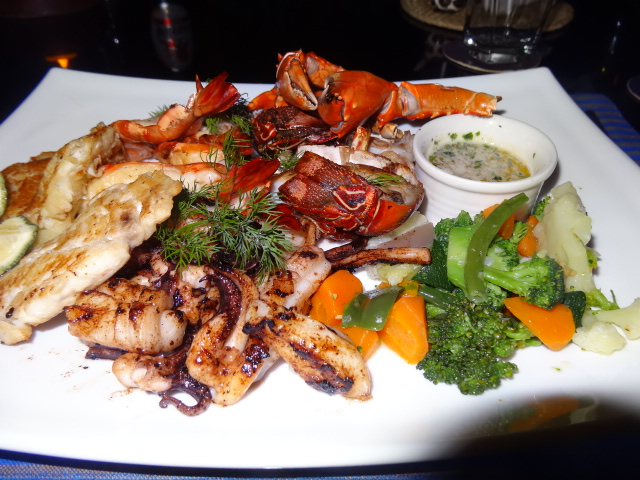
This amazing array of seafood was all grilled and seasoned to perfection. It contained lobster, prawns, octopus, squid, snapper and a few  chewy wormy looking items I didn’t recognize but ate anyway.  Need I say that I cleaned this plate as well?

Based on the road, neither of us was expecting much.  In the dark with the soft lighting surrounding the resort, we could only see lush vegetation and the outline of several substantial bungalows. Apparently, their rentals are “house sized suites” at varying costs of $1000’s per night. 

If the water stops running here, as it did in our first house in Belize, we won’t be moving to Almanara Resort as we did to LaruBeya where we stayed for over two months (see posts from end of February, 2013 to April 9, 2013 for photos and details).

Once seated, at this exact table as depicted in the daylight photo below from their website, we couldn’t have been more content, as shown by our lavish plates of epicurean delights.

 Tom’s dinner consisted of Fillet Mignon, fries, grilled vegetables.  He kept insisting that I try a taste of his steak, finally taking a bite of tender well seasoned meat.  He also, ate every morsel.

A few hours later, stuffed “to the gills,” we were ready to head back to our home to watch a movie on my laptop in bed under the mosquito netting. 

Apparently, we were told, our cab driver Chris waited for us in his original parking spot during our entire dinner. We tipped him well appreciating the great service for this short cab ride.

Our bill for dinner? Much less than one would pay in the US and other countries for fine food and service. Tom had a US $10 marguerite and a giant bottle of Pilsner beer while I had two bottles of fizzy mineral water. Add my appetizer and our two lavish entrees, the total bill was KES $5400, US $61.80, included VAT tax and 18% service charge (built in tip). 

We borrowed this daylight photo from the resort’s website.  It was dark as we were seated at this table.  Our photo didn’t do it justice.

Based on the quality of the service and Tom’s lack of change, we gave the waiter an additional KES $1000, US $11.44. Dinner, cab fare, tax and tips totaled KES $7500, US $85.83.  Having budgeted US $100 per week for dining out, we were on target. If, we find other restaurants at a lower cost, we’ll use the difference to offset the extra SIM cards we must purchase to be able to download our TV shows.

It was adult son’s birthday prompting us to call him on Skype. The cost for the call is free but the data use is huge which now is monitored. He and the grandkids were in their pool in their yard.  Daughter-in-law Camille turned on the speakerphone enabling us to speak with both of them and the 3 grandkids.  

Of course, we miss all four of our children, their significant others and our six precious grandchildren. In fifteen months, we’ll all be together again. 

Daughter Tammy’s birthday was Sunday but we were unable to reach her last night and will try again soon. 

Later watching Ironman 3, we drifted off to sleep, safely tucked away in our comfy bed with the secure mosquito netting, the fan at full speed above the bed for yet another restorative night’s sleep to arm us for the next day at home, batting off the mosquito.

We’d intended to write about the restaurant experience on Saturday night for Sunday’s post.  When the monkeys ran through the yard, we couldn’t wait one day to share that story so we flip flopped them. Makes sense, right

Part 2…Internet solutions…Photos of our neighborhood…Monkeys came to call…

This is a mother Colobus monkey and baby, a photo we borrowed from this link.  How we’d love to find a Colobus Monkey to photograph!
This is a young Colobus Monkey, the endangered species that ran through our yard this morning.  They ran so quickly that we were unable to get our own photo and borrowed this photo from this site.

OMG! OMG! Two monkeys just ran through our yard!!! With the camera several steps away, we missed the opportunity to get a shot! From now on, it will be at my side. 

Researching online, we both found the species of the monkeys as shown above, the endangered Colobus Monkey.  This site is quite interesting, if you have a moment to read it.

Now, on to the rest of our story…

Yesterday, as we exited the main gate to our area, we were on the main road, on a mission to locate the vegetable stand we’d heard was nearby.

Upon awakening this morning, the humidity hangs as a heavy drape over the horizon along with the smoke of fires burning around us. With no ban on burning in Kenya, the acrid smell of toxic smoke frequently wafts through the air.

Cloudy today, the mosquitoes seek refuse by nibbling on our flesh. I killed 3 of them this morning, buzzing around my head as I quickly lathered on the foamy insect repellent after taking a shower. I never feel clean. The bottoms of our feet become black again after a short time causing me to wonder, if perhaps, the black on the floors is actually the soot from the nearby fires.

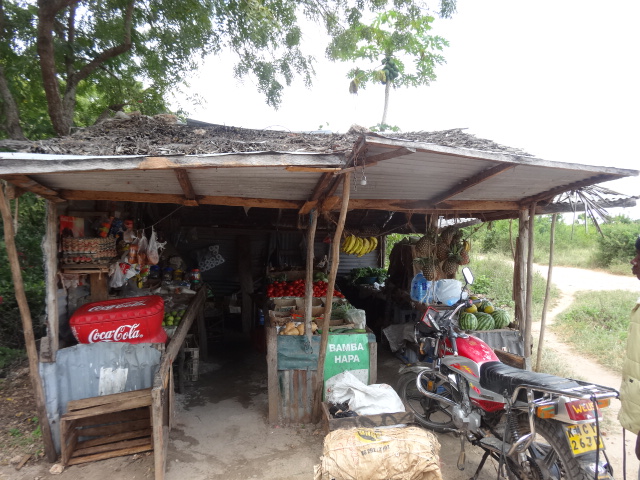
Our new vegetable stand is a short walk from our home.  Notice the motorcycle.  The produce is delivered by motorcycle each day!

Any of our family and friends reading this may scratch their heads wondering how, Mr. & Mrs. Comfort Freaks, are possibly surviving the hardships of the last several months; the flies, the bees, the scary road, the remote existence in Boveglio, Italy and now…the challenges of Africa, living in the first of three countries on the continent.

Somehow, we are OK, more than OK. Tom particularly surprises me, less than myself. After all, it was my idea to come to Africa. I’d better not complain. In reality, I don’t feel a desire to complain. The annoyances only flutter through my mind momentarily from time to time. 

This is Gabriel, our new vegetable guy, who runs the vegetable stand, a mere two minute walk after exiting the main gate to our complex.  He said he will order produce for us at any time, arriving the next day, fresh from the fields.

Then again, living in extreme comforts in our old lives prompted me to be annoyed from time to time. It’s the human element. We always want better, different or more.

As I sit here in our outdoor living room at 9:00 am on a Sunday morning, when in the past we may have been watching CBS’s show Sunday Morning, with no TV here and little ability to stream videos any longer, we find ourselves somehow at peace.

At the moment, the hoot of morning doves, myriad birds, the occasional howl of a monkey, this mornings two monkeys running past us, the frequent baa of the goats in our yard and the crow of the nearby roosters brings us comfort. 

The anticipated rain has begun to fall creating a pleasing sound of the raindrops on the palms and fronds of the many trees and over sized plants in our yard as they welcome the much needed water. After all, its almost spring here. The full bloom of the flowers is yet to come.

A bee just swarmed my coffee mug. Tom laughed and said “Humm…in the US we worry about the African killer bees. Now we’re in Africa.” I laughed, moving my mug to another spot as the bee flew back out of our screen free outdoor living room.

Without pesticides and chemicals, the produce can wilt quickly and maybe infested with bugs.  These tomatoes had just arrived, actually looking quite good. Notice the molding cauliflower and the brown lettuce.  Gabriel told us his fresh deliveries arrive in each day around 11 am by the guy on the motorcycle in this photo.

As I replaced my coffee for hot tea, I decided to clean a few of the green beans  we’d purchased yesterday as shown in the photo below.  Wrapped around two separate beans were the most outrageous worms I’ve ever seen, black, hairy.  I didn’t scream.  I tossed those beans into the trash. Guess they don’t use pesticides on the veggies from the neighboring produce stand. That’s comforting.

Tom brought up the point to mention the raw cabbage and carrots we enjoy in our daily dose of coleslaw being exposed to the non-purified water when washing.  We’re using bottled water for all of our beverages and cooking.  As for cleaning the cabbage, I tear off the first several leaves leaving the interior leaves for slicing, unwashed.  If I see a bug, toss it out.  We’ve done this everywhere we’ve lived outside the US.

The carrots on the other hand, are more challenging. Without washing them, I peel the carrots after removing the stems. Then, I place the raw peeled carrots in a bowl of purified water to rinse them thoroughly. Then, I wipe them dry with a clean paper towel, promptly storing them in the refrigerator. 

This batch of vegetables was KES (Kenya Shillings) $150, US $1.72.  The more we travel, the more we are amazed by the lower cost of food in other countries as compared to the US.

So far, so good, no illness.  Of course, we brush our teeth using a fresh glass of purified water kept in the bathroom, rinsing our mouths and the toothbrush using our water. Washing dishes is another matter, with no dishwasher (no microwave, either), we used the hottest local water, leaving the dishes to completely dry overnight. No problem doing this either.

Hans, our landlord, explained that the water is safe to drink here in Diani Beach and that many past guests have not used bottled water, without incident. For us, we choose the conservative side, to do the very best we can to protect ourselves. 

The local restaurants use purified water, enabling me to have a salad last night when we dined out.  We’ll write and post photos from our amazing dining out experience on Saturday night in Monday’s post. Too much to tell all at once!

Still reveling in the excitement of seeing the monkeys this morning, the sights and the sounds, the wonderful local people we’ve met thus far further affirms why we don’t complain and…why, our friends, we are in Africa.