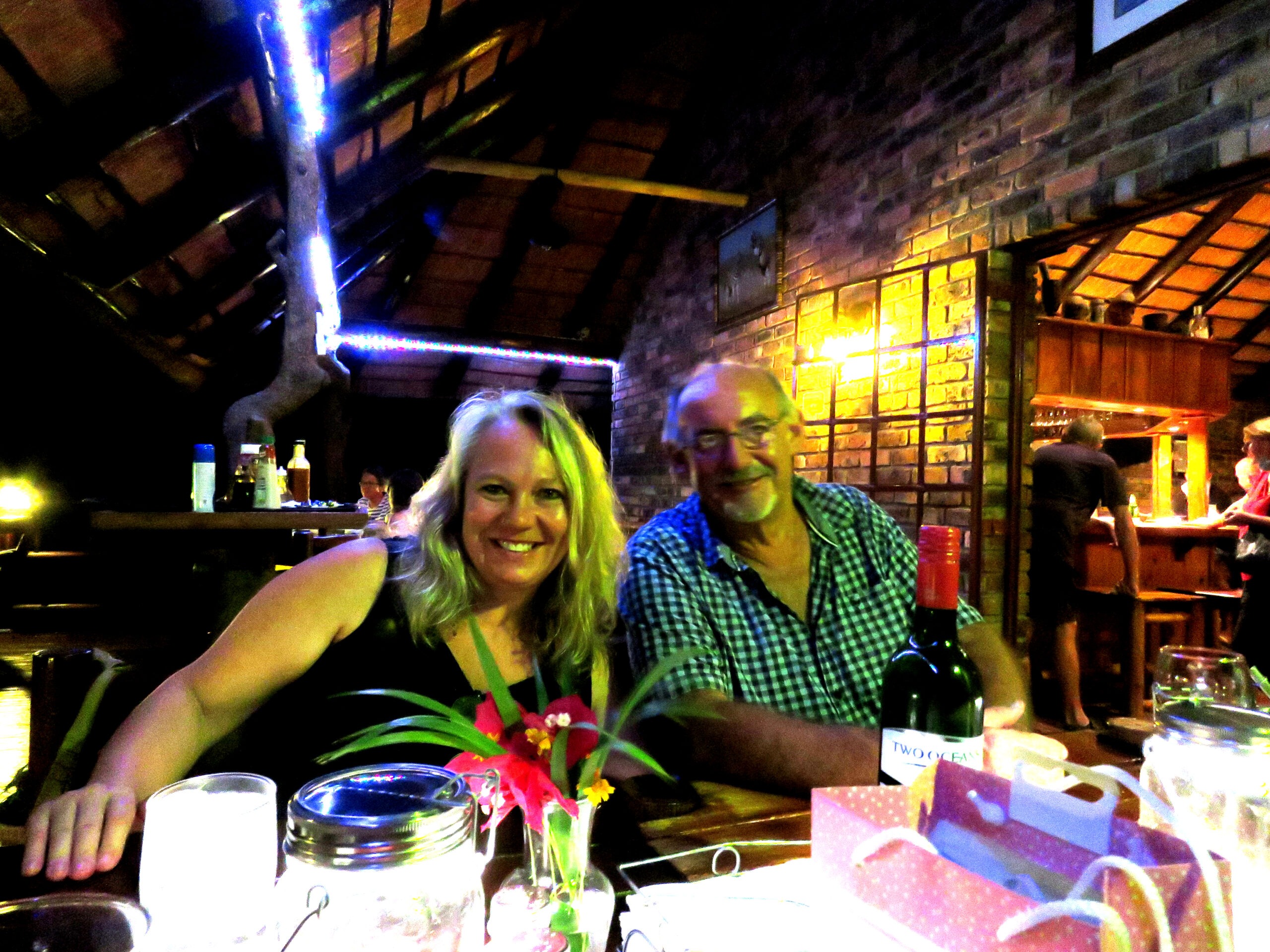
Birthday festivities have ended…Back to pleasure in the bush with friends and animals…

Today is a busy day, so I’ll need to hurry through today’s post and be on my way. At 11:30 am, Rita is picking me up, and we’re heading to Malalane for her chiropractic appointment, and then we’ll head to lunch at a popular restaurant, The Deck. I can’t remember the last time I attended a “girl’s lunch” although I’ve had several “girl’s breakfasts” at Stoep Cafe with Kathy and Rita.

Tom and Gerhard are driving to Nelspruit to drop off the rental car for Tom to pick up another, which will be the last car we’ll need until we depart four weeks from today, on March 23. Time flies by quickly as we savor every last moment in the bush.
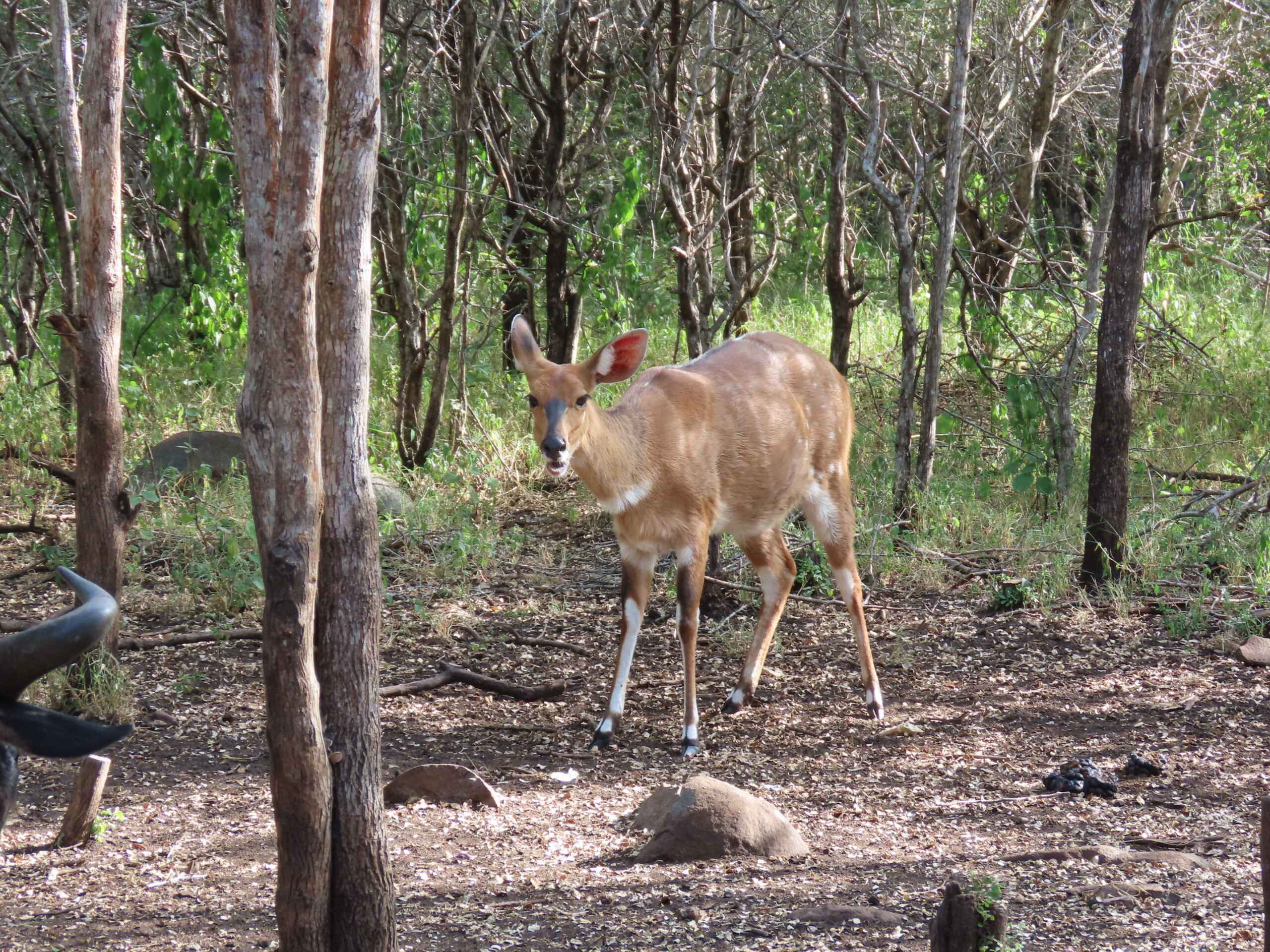
We hadn’t seen Slyvia for a while, and now she’s also returned. Could they have been off giving birth to their young? We’ll find out soon if they return with little ones.

Most likely, when we return in December, we won’t be staying at this house. The animals we know and love most likely won’t find us at the next house, a few miles, km, from here. But Little found me when we arrived here after a two-year absence, so maybe, he’ll find us again.

The animals can wander an area of a few kilometers each day, so we never know who we may see again when we return in December to a house we hope to rent, owned by Louise and Danie and recently remodeled.

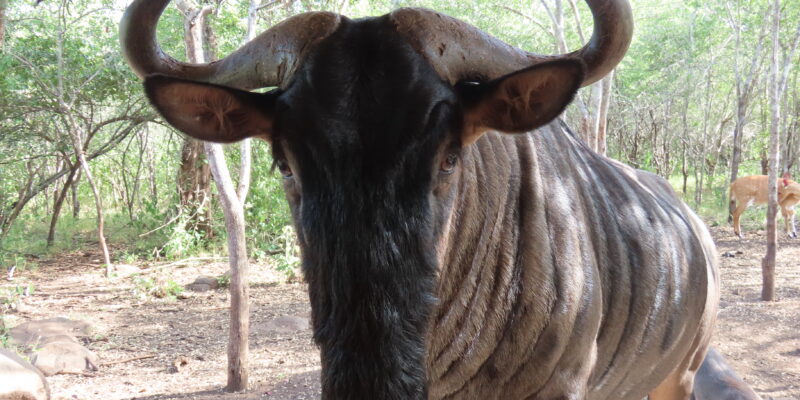
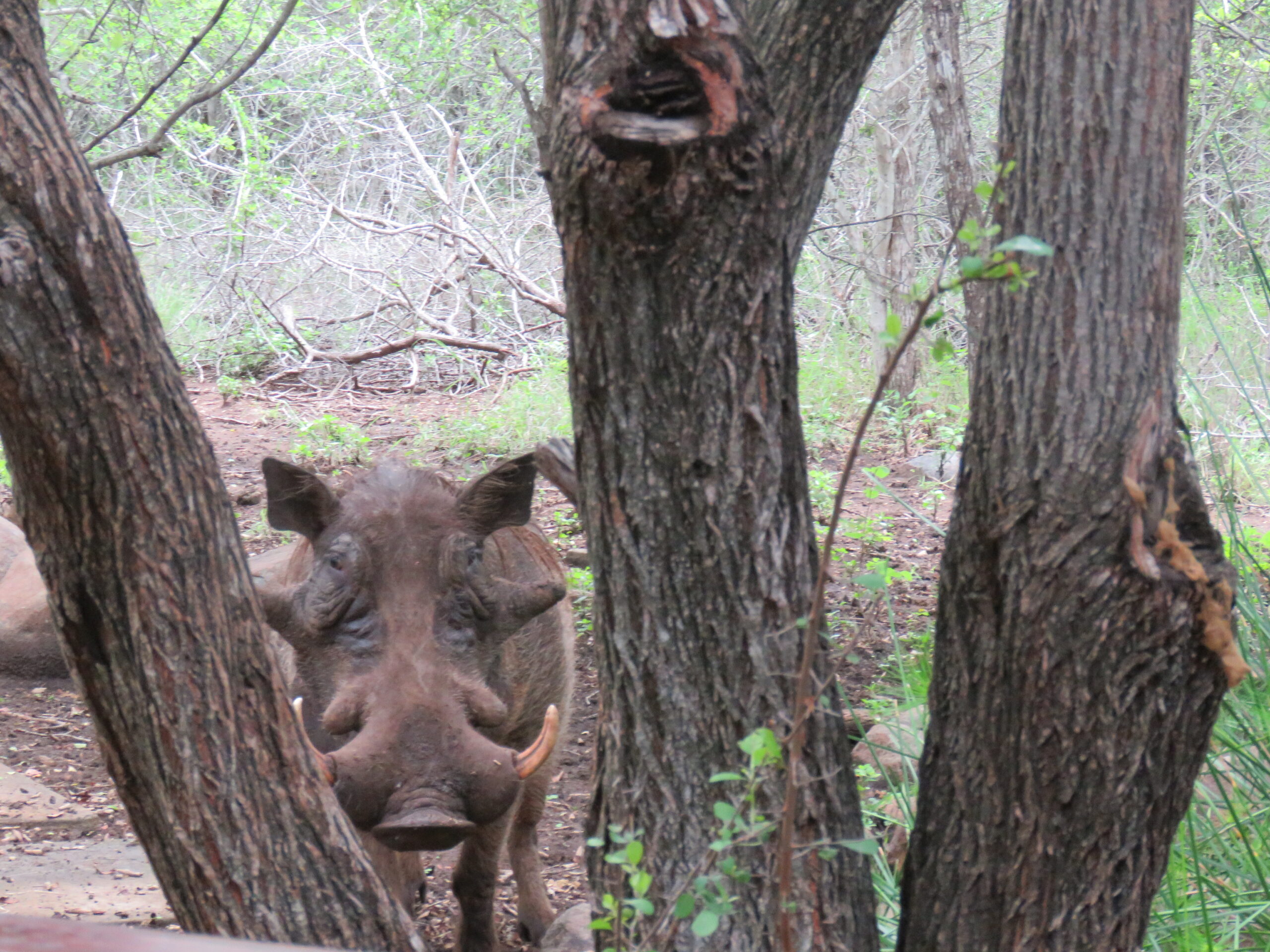
Broken Horn’s face is muddy from digging for roots.

Lately, Hal and Broken Horn have become quite a source of delight for both of us. Although they may appear simultaneously, most often, it’s one, then the other, as was the case this morning. Their personalities and demeanor are uniquely different. Hal is more easy-going with the piglets and moms, while Broken Horn doesn’t hesitate to show them his horns.

He never hurts them, but an injury could happen. We often see mature warthogs with severe injuries from messing with wildebeests and kudus. The bushbucks back off entirely when a larger animal is near. We’ve never seen a bushbuck with one of those gaping holes due to an angry larger animal. Overall, the animals get along well.

Broken Horn also steps up onto the veranda and can stand there for an hour waiting for us to “do something.”

We are cautious when tossing pellets to ensure no unnecessary competition between species occurs. Of course, there are occasional scuffles within each species, mainly just chasing one another off. We humans need to avoid inciting any disharmony between the wildlife. Their lives are hard enough to have humans making it worse.

This morning, I am on a more frequent walking schedule, hoping to get in as many steps as possible before Rita gets here. I haven’t missed a day since I began, shortly after the start of the new year. I’ve managed to meet or beat my prior week’s number of steps each week. At this point, 8000 to 10000 steps per day seems to be the number that works best for our lifestyle and available time.

This band of mongooses has been hanging out for hours each day, staying in the shade when it’s been so hot.

When we get to Florida, I will be able to walk outdoors. There are plenty of birds and marine life photos I’ll be able to take since we’ll be situated right on the water. Of course, I’ll be taking my phone or camera if I see any alligators. It has been over two years since we’ve been close to the sea in India in 2020/2021.

So that’s it for today, folks. I have to get a few things done before heading out, including some photos to this post and wrapping it up.

It’s good to see Holey Moley once again. She’s been busy elsewhere lately.

I hope you have a great day wherever you may be in the world.

Photo from one year ago today, February 23, 2021:
Frank and The Misses were trotting over to the veranda for some seeds. For more photos, please click here.

Part 2…Exciting birthday plans revealed…Please watch our video!!!..This is the fifth time my birthday was spent in the bush!…

Let me start with this. I’d planned on doing a comprehensive post on our elephant interaction yesterday morning at Kwa Madwala, with photos and stories from earlier days when it was open to the public. Today is a brutally hot and humid day with around 90F, 32C, but the dew point is 73. The air is so thick it’s almost hard to breathe, and I’m struggling to get motivated, a rarity for me.

Based on hard times over the past few years and the financial ravages of Covid-19, the formerly famous game reserve has been closed for almost two years. It has become rundown, requiring a massive renovation and restoration. Plans are in the works to bring this magical place back to life next year.

Tom touched the soft velvet-like skin on the back of the elephant’s ear while Louise waited to do the same.

Online is it described as follows:

“This unique hilltop camp is without a doubt the true pride of the Kruger Park south area. In 2000 the neighboring farms abandoned hunting which was very much in vogue and joined the vision in terms of eco-tourism, and the name was changed to Kwa Madwala, meaning ‘the place of the rock’ in Swazi.”

I’d hoped to find a website for the reserve, but unfortunately, their site is no longer active, and there was very little information online to aid in the preparation of today’s post. The guide at the property, one of two that introduced us to the two wild elephants, told a story about the property while I was engrossed in taking photos and watching the magnificent beasts.

Tom filled me in on the details today to help me share the remarkable story of the elephants and how they came to become such an integral part of the property.

Rita was sitting on his leg after he lay down.

There are seven elephants in the herd. Yesterday, we met two of them, a female and a larger male, brother and sister. Two calves were born in the past few years, a few years apart. Years ago, the plan in the area was to cull the elephants due to some economic reasons.

The elephants were rescued and moved to the bush near the reserve and placed in a boma while they were cared for and fed in an attempt to get them used to be around humans. It took over 18 months of loving and gentle care to watch the elephants change from hostile wild animals to gentle giant beasts, suitable to being around visitors and guests of the reserve.

Danie and Louise were hanging onto our elephant’s tusks.

No ropes, chains, or disciplinary instruments were used on the animals at any point. A thoughtful food reward program was instituted from the start, and in time, they associated humans with kindness and tasty fruits, vegetables, and pellets.

The female elephant, the first one shown, is 34 years old, and the male, her brother, is 30 years old. We couldn’t have enjoyed the experience more. When the elephants had enough of us, they wandered off after the handler jumped off and returned to grazing in the bush. They are not fenced or chained. What a fantastic experience!

Gerhard and Rita interact with the friendly and gentle elephant.

After the elephants left, Louise and Danie set up a fabulous brunch for us and Rita and Gerhard. There, at the picnic table on the resort’s veranda, the enjoyment of the special day continued with great food, drinks, and conversation. A special thanks to Louise and Danie for managing a way for us to get into this now-closed venue and be a part of this extraordinary experience. The elephants were happy to interact with humans and show off their skills once again. Such amazing animals. Such a fantastic day.

Louise and Danie served a delicious platter of low-carb treats. Even the crackers were low carb!

Wow! It was a fabulous birthday! Tomorrow, we’ll share Part 3 of my birthday celebrations when our group dined at Jabula and had one heck of a good time.

Thanks to our readers, family, and friends who sent me countless birthday wishes. It meant the world to me!

Photo from one year ago today, February 21, 2021:
My birthday last year was also at Jabule with our dear friends Louise and Danie. They have a magical way of making every get-together special. For more, please click here.

Part 1…Exciting birthday plans yet to be revealed…This is the fifth time my birthday was spent in the bush!…

We couldn’t believe we could be so close and interact with the two elephants who freely roam in the wild.

As I write this at 8:30 am, soon at 9;15, Louise and Danie are picking us up in their vehicle to take us to a surprise for my birthday. I have no clue what it is, nor does Tom. When we return in the early afternoon, I will finish this post and share with you what we did.

Tonight is my birthday dinner at Jabula, which undoubtedly will be another great time spent with friends. We decided to host the dinner and tell guests, “no gifts” since I don’t have room in my luggage for anything new. When we arrive at Karen and Rich’s house on March 24, a box from our mailing service will be waiting with some new clothes for me, suitable for the upcoming cruise.

The elephant was managed by the handler sitting on top of her. But, these are wild animals, not ridden by guests or managed with any ropes or chains. Once we were gone, the handler got off her, and she wandered back into the bush, returning only when she wanted treats and attention.

I’d ordered jeans, bras, and tops but still have to purchase a few items while we are in Florida. I need a good pair of walking shoes and dressy shoes for the cruise. The shoes I am walking in now don’t provide the necessary support. Tom needs several items as well.

Well, we’re off for the surprise adventure. Of course, I am taking the camera and hope to be posting interesting photos of what we’ve seen and done.

We’re back. It’s 1:45 pm, 1345 hrs, and we had a most extraordinary time. Louise and Danie outdid themselves, and much to our delight, Rita and Gerhard surprised us and met us at the game reserve. We drove for about 45 minutes in their four-wheel-drive vehicle on a pot-hole-ridden road to Jeppe’s Reef to the currently closed game reserve, KWA Madwala.

On my 74th birthday, I was gifted with an opportunity to interact with elephants in the wild. What an extraordinary gift! Thank you, Louise and Danie.

Several reasons resulted in this game reserve being closed. Still, mainly Covid-19 seemed to have the most significant impact when foreigners weren’t flying into South Africa for such an extended period. It’s only now that the possibility of a grand re-opening has presented itself, as more and more flights are coming into the country packed with holidaymakers looking for safari adventures.

The reserve appeared quiet and like a ghost town. But according to the managers who took the time to come and meet us, they will be re-opening sometime in the next three to six months when it will again become a thriving establishment.

The magic of this exceptional property is that a herd of seven elephants, who roam free in the wild, come into the grounds of the reserve and greet visitors after years of doing so, accepting apples and pellets as treats, allowing the guests to interact with them.

The path we walked in hopes that the elephants would be coming to see us. They enjoy playing with visitors!

Getting the elephants accustomed to humans under these circumstances took years of loving and gentle persuasion, all accomplished with food rewards. There are no ropes, chains, or sharp objects needed to entice the elephants to interact with visiting guests.

Based on the fact that Louise and Danie know the managers well, they were able to gain access to the property and see if the elephants would willingly come to an open area to meet us, accepting apples and pellets while allowing us to be close to them, to touch them and be up close and personal. No doubt, it was a remarkable experience, especially knowing they did so of their own volition.

Based on the festivities of my birthday continuing today in a few hours and my need to get my walking done, I will be writing more about this adventure in tomorrow’s post with many more photos. Tonight, we’ll take more photos of my small dinner gathering at Jabula and look forward to sharing more.

Thank you to many of our readers/family/friends who have sent me heartfelt birthday wishes. I wish there were time to write back personally to everyone for the messages I’ve received in my inbox. But, I assure you, I will be reading each message with appreciation.

Have a fabulous day!

Photo from one year ago today, February 20, 2021:

We wrote in the caption of this photo, on my 70th birthday in 2018, at my party at Jabula with friends: “We’ll always remember this birthday as a special event for both of us; celebrating life, health, our experiences, and the fine friends we’ve made along the way.” For more from that date, please click here.

A precious gift from Mother Nature…

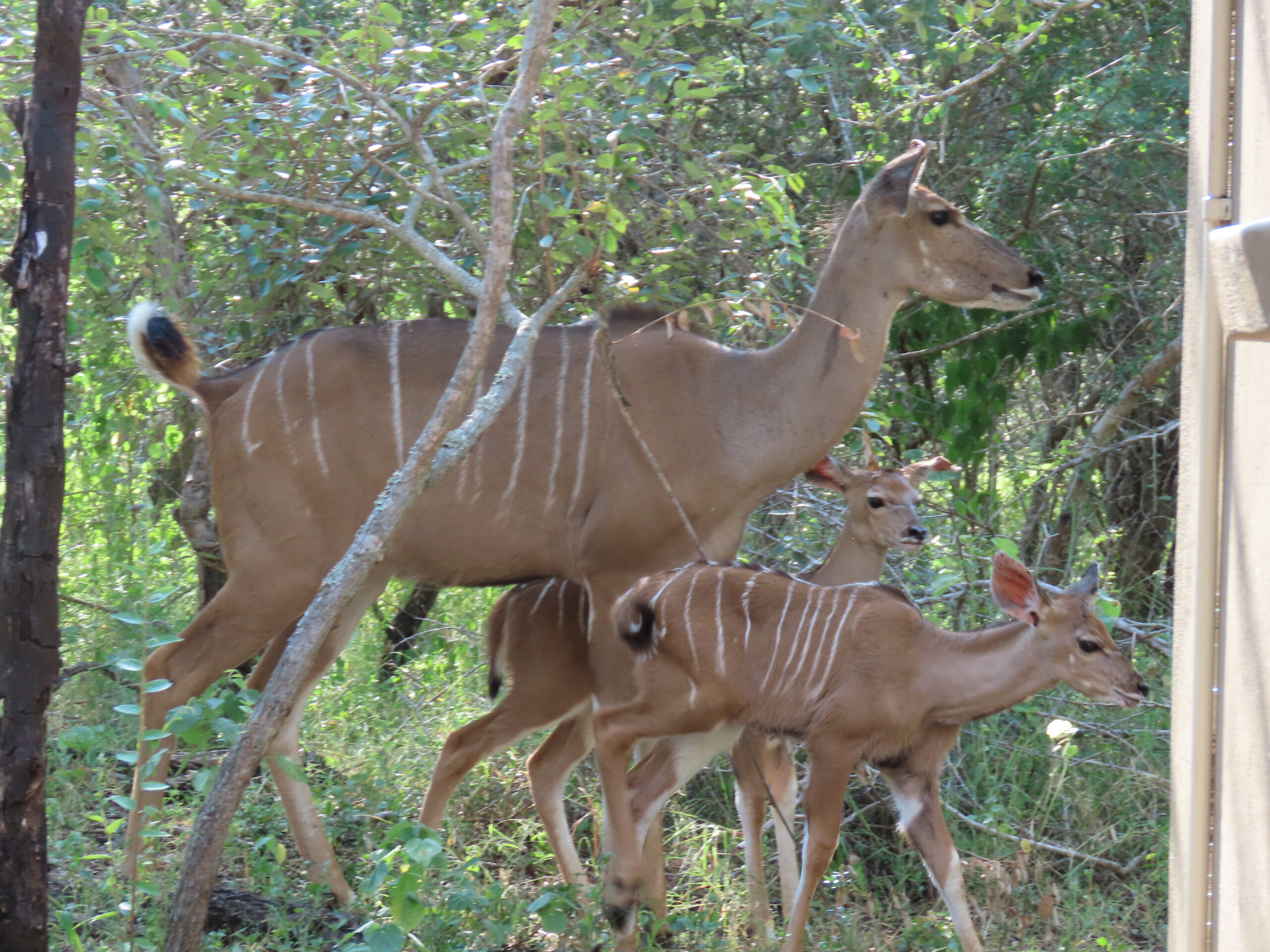
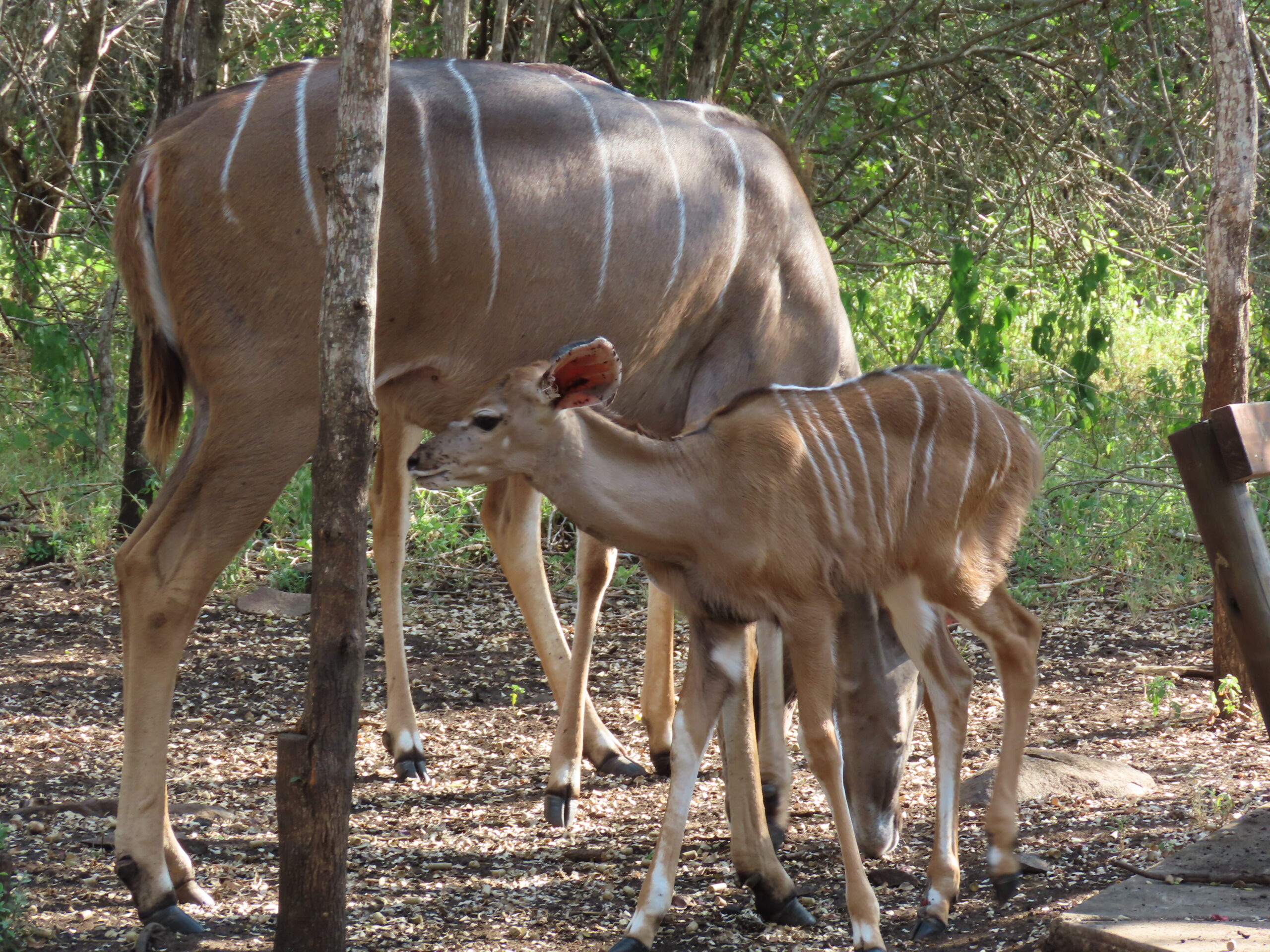
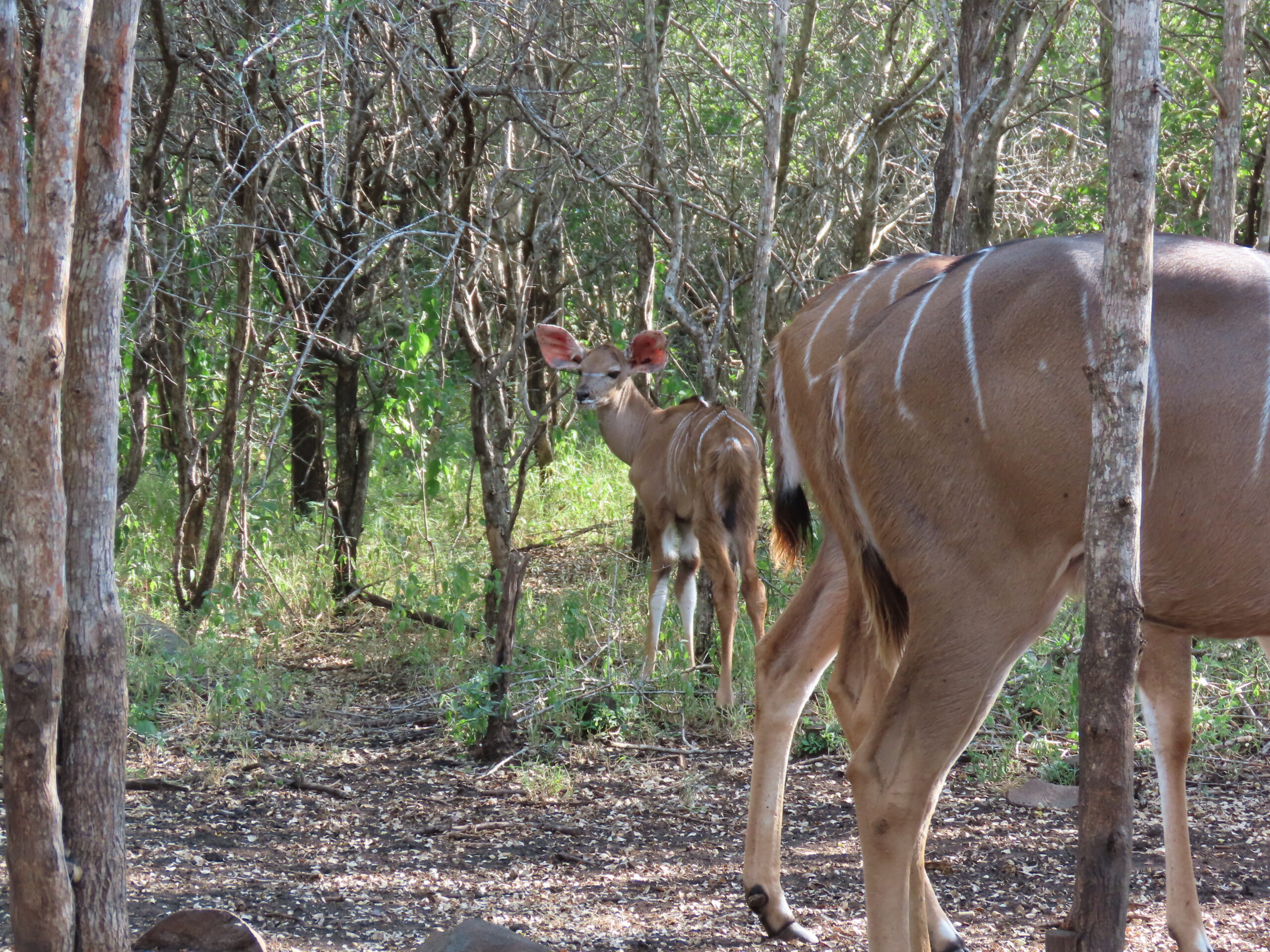
Bossy arrived with her baby and another mom and baby. We couldn’t have been happier to see her young one.

Last evening, when seated at the table on the veranda, as we chatted while listening to music using our excellent JBL Flip Essential speaker, suddenly we saw Bossy in the garden. I can tell it’s her due to many of her markings I’ve come to know, along with the ease with which she approaches the veranda.

The baby is quite young and skinny. Soon she/he will fill out from suckling from Bossy over the next few months. Before too long, she/he will start eating vegetation and even some pellets.

Bossy has been visiting us since the first week we were back in Marloth Park in January 2021. Over the months, we noticed she was pregnant as her belly grew month after month. Most recently, we were amazed by how huge she’s become and how hungry she seems to be. The gestation period for kudus is 240 days, about eight months.

She appeared healthy and well-fed. Surely, we aren’t the only house she visits in the bush and is well fed from grazing and generous offerings of pellets and suitable vegetables. Most residents in Marloth Park that feed the animals offer considerably fewer pellets during the summer months, like now, when the bush is rife with natural food sources befitting their diet.

Once we can determine its gender, we will come up with a name. Right now, it’s hard to see

But, once we start feeding, it’s hard to stop due to their and our enjoyment in the animal’s frequent visit. Perhaps, it’s selfish of us to offer pellets when there’s plenty of vegetation available to them in the bush, which we’ll admit we are. But, we’ve cut down from going through three bags of pellets per week in the winter months when food is scarce when they nearly starve to less than one bag a week now.

Most likely, the majority of our pellets go to warthogs like Little and his friends and wildebeests Broken Horn and Hal, who all visit many times a day. Of course, a “pig is a pig,” and they, along with many of the larger mammals, consume volumes of food per day, far beyond what we’d imagine.

Kudus are such beautiful animals with their markings, stature, and grace.

Undoubtedly, our frequent offerings of pellets impact the number of animals that visit us year-round. Certainly, this may have precipitated Bossy’s interest in returning several times a day, especially over the past few months when surely, she must have been ravenous so close to the birth of her young.

“Typically, kudus only give birth to one offspring, although there have been cases of twins as indicated here: Most commonly one calf is born though on rare occasions twins may be born. … Male calves remain with the mother in the maternal herd till they are 1½ years of age. Females will remain for longer than this. Sexual maturity is reached by the greater kudu at 1 to 3 years of age.”

When she arrived last evening, with her baby after we hadn’t seen her in a few days, we were shocked at first. Most kudus keep their young hidden in the bush for 4 to 5 weeks before bringing them out to graze. However, we believe that Bossy lives in our garden in the bush, hidden away in the dense vegetation, simply because we often see her.

The baby was very skittish around us.

It is entirely possible she brought the baby out from hiding to show it off. This morning, she arrived on her own, without the baby. Perhaps, she tucked away the little one, once again for protection. We wonder if the animals are aware of the nearby lions in Marloth Park. Most likely, they are and may have become extra cautious. These animals are more intelligent than we think.

In any case, we know it’s Bossy based on her distinct markings, the fact her huge belly is no more, and the addition of the precious little kudu following her around last evening, for a short period they were here. What a sight to behold!

It’s a quiet day at the house today, although we’ve had many visitors in the garden, including Gordy, Thick-Neck, Little, Hal, Frank, and the Misses, Duiker Couple, Chevy, and a sweet impala mom and baby whose photos we’ll share in tomorrow’s post.

Tonight, we’re off to Jabula for dinner with Rita and Gerhard, with the festivities for my birthday beginning on Sunday.

Happy day!

Photo from one year ago today, February 18, 2021:

Warthogs and kudus were generally getting along while eating pellets. For more photos, please click here.

Results regarding our cell service…Google Fi…

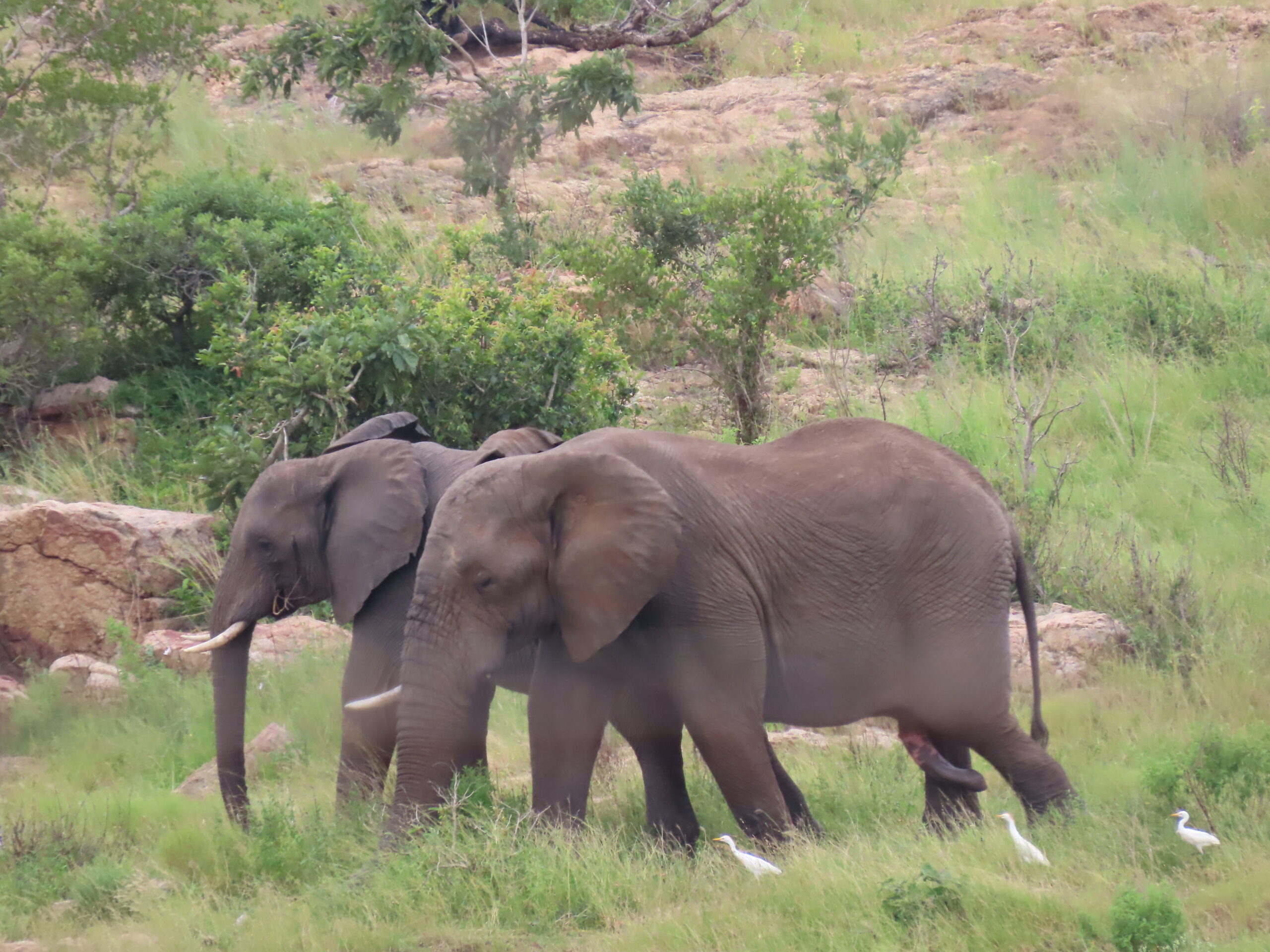
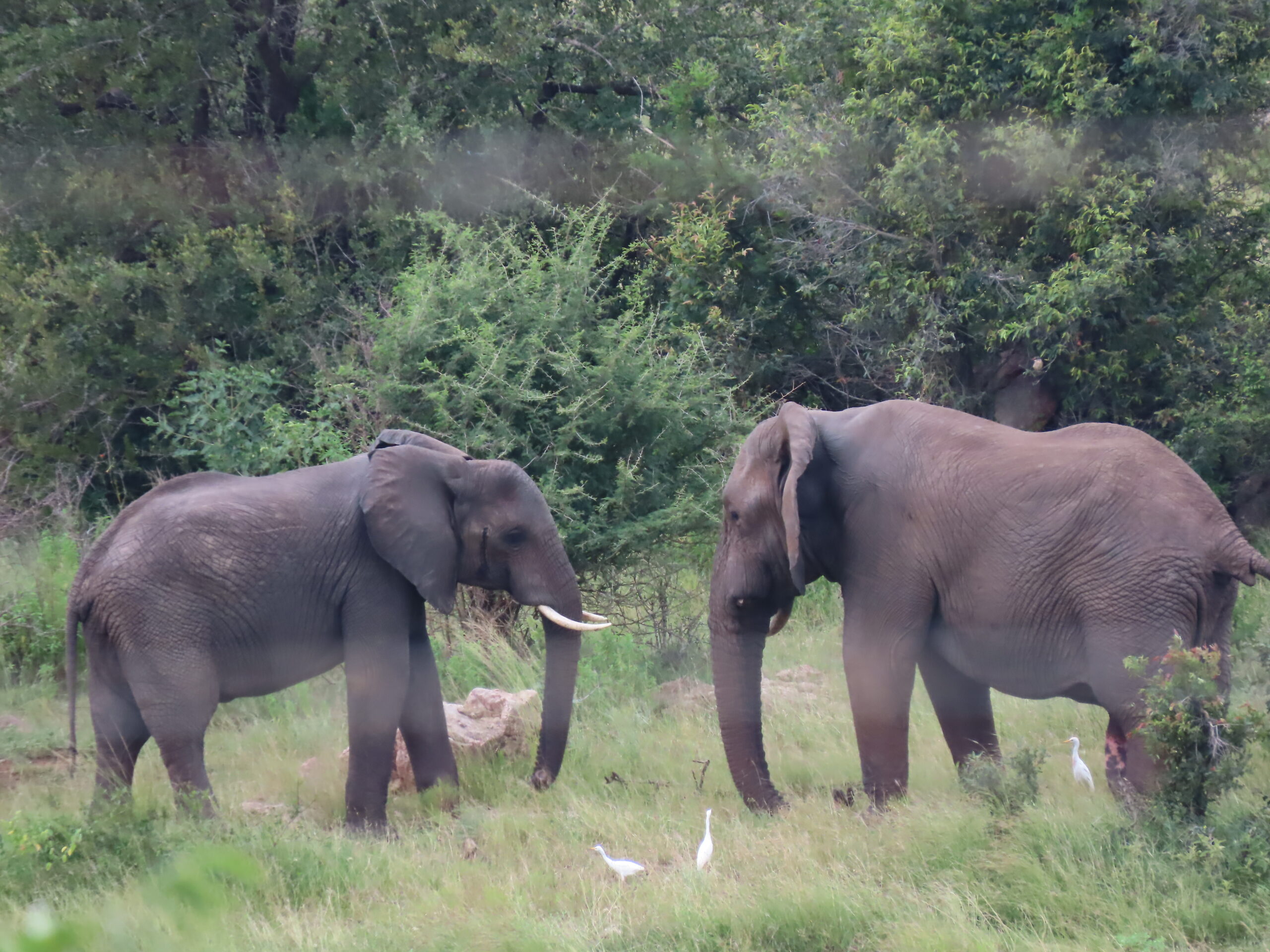
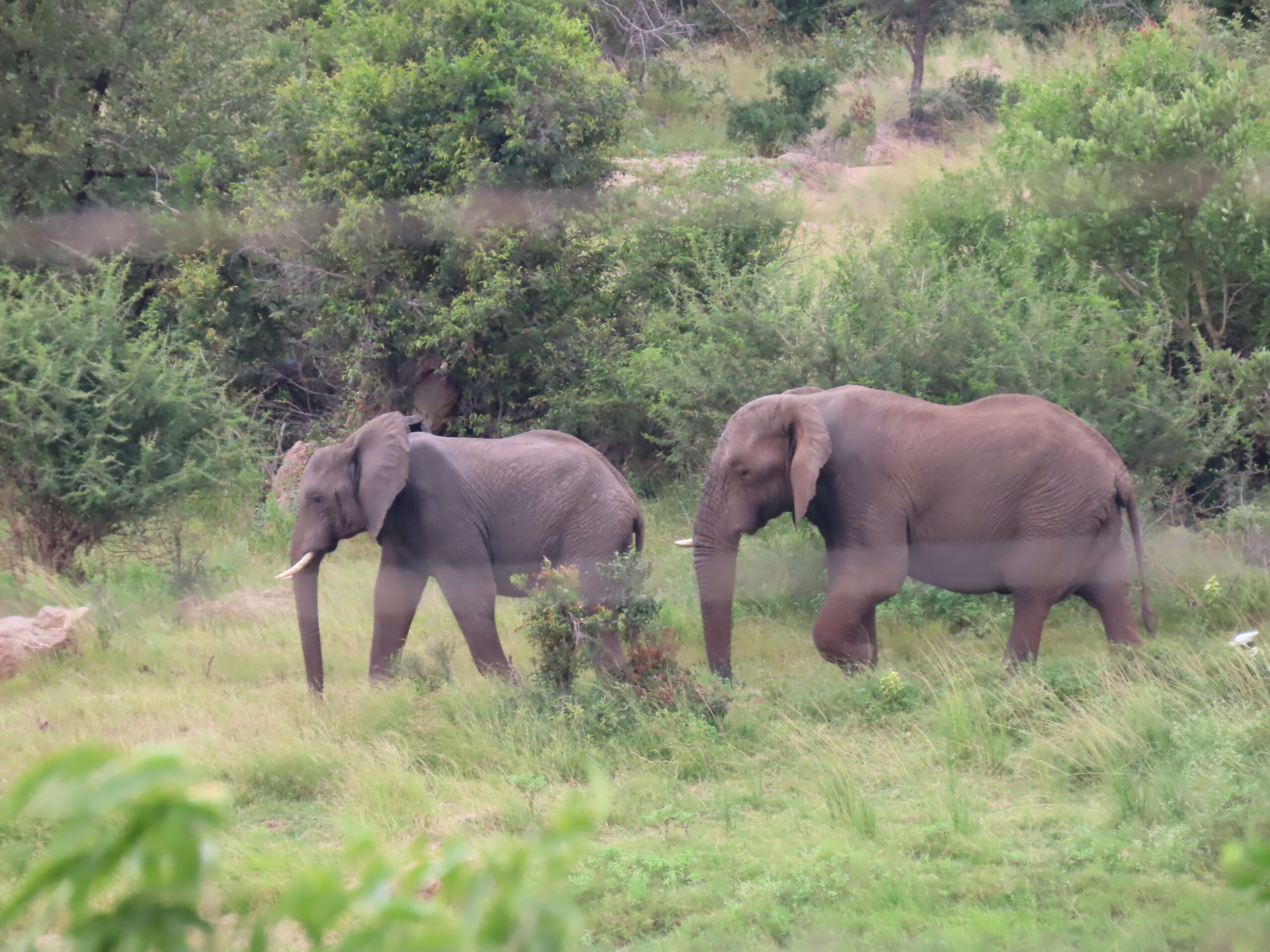
Two male elephants, one missing a tusk, walked along the river back, followed by several cattle egrets.

This morning I awoke to two annoying email messages. One was from Google Fi as follows:

“Hi, Jessica,

Thanks for contacting Google Fi support!

I see that you’ve contacted us to request an exception for international roaming. Let me look into this.

After reviewing your account, it shows that you are not verified via Sheer ID. Eligible users include Military statuses other than active duty or reservists, like retired.

Military or State Department employees who are in the US and don’t serve abroad
People that work on a military base but aren’t in the military, like contractors
Dependents who aren’t in the same group as the eligible military or State Department employee
If you fall under one of the above categories, please submit documentation through goo.gle/fi-sheerid. If your military status or branch isn’t listed as an option on the verification form, you’re not eligible for an exception. I hope this helps!

If you have any further concerns and questions, please reply to this email or contact us over Chat or phone (available with a limited team). We’re here to support you 24/7.

Thanks,

Sai

Google Fi Support”

When they were facing one another, it appeared they were communicating.

Subsequently, we will have to research a suitable alternative and set it up when we’re in the US at the beginning of April. This is frustrating. We purchased expensive Google phones for this purpose. Our phones will work with other providers, but the costs for data and calls will be outrageous on a roaming basis. We’ll update what we find here in the next week or so.

Secondly, we received an email from one of our credit cards:

“Thomas,

We’re writing to inform you of an upcoming account review scheduled for April 2022. Over the last several months, the highest balance on this account has been significantly lower than your credit limit. Because of this, your credit limit could be decreased following this review.

If your credit limit is decreased as a result of this review, we’ll notify you and make sure to keep your credit limit significantly above your highest balance from the previous two years.”

We have excellent credit. But now, when we haven’t used this particular card over the past year, why do they want to lower the credit line? That’s ridiculous! We called the company, opted out of the “review,” and tried to use this card regularly to avoid losing the good credit limit.

With these two things on our minds, we felt frustrated this morning. As soon as I’ve uploaded today’s post, I’ll get to work on researching a new cell provider, so we don’t have to spend a lot of time on this when we get to Florida. In any case, whichever company we choose will cost us a lot more than we’ve been paying. Our monthly bill with calls and data hasn’t ever been over US $80, ZAR 1206.

They walked in single file close to one another.

Many such issues exist for world travelers, including health insurance challenges. We will be in the US for about eight days. During that time, the only coverage we’ll have in the basic included Medicare plan, certainly not enough to cover in the event of a medical emergency. Our current health insurance with United Healthcare Global, SafeTrip, doesn’t provide any coverage in the US.

You may ask, “With these inconveniences, is it all worth it?”

We aren’t letting various agencies and organizations prevent us from our freedom of traveling as we choose. We often think of people in countries where they aren’t allowed to travel at their leisure. As US citizens, we are grateful that we can but never allow any company or provider to dictate what we can and can’t do.

If all else fails with cell service, we can always return to buying SIM cards in every country we visit. We did this for the first seven years of our world travel journey, and if we have to do it again, we will. It just seems illogical to go backward in technology based on some arbitrary regulations to make companies more money.

The larger male only had one tusk. There could be many reasons for this, including fighting with other elephants or animals or natural causes.

Anyway, on a lighter note, yesterday afternoon, we met Rita and Gerhard at Two Trees overlooking the Crocodile River. We didn’t see much. Many animals have access to water holes throughout Kruger National Park with the recent rains and may not venture down the steep ravine to the river to drink and cool off.

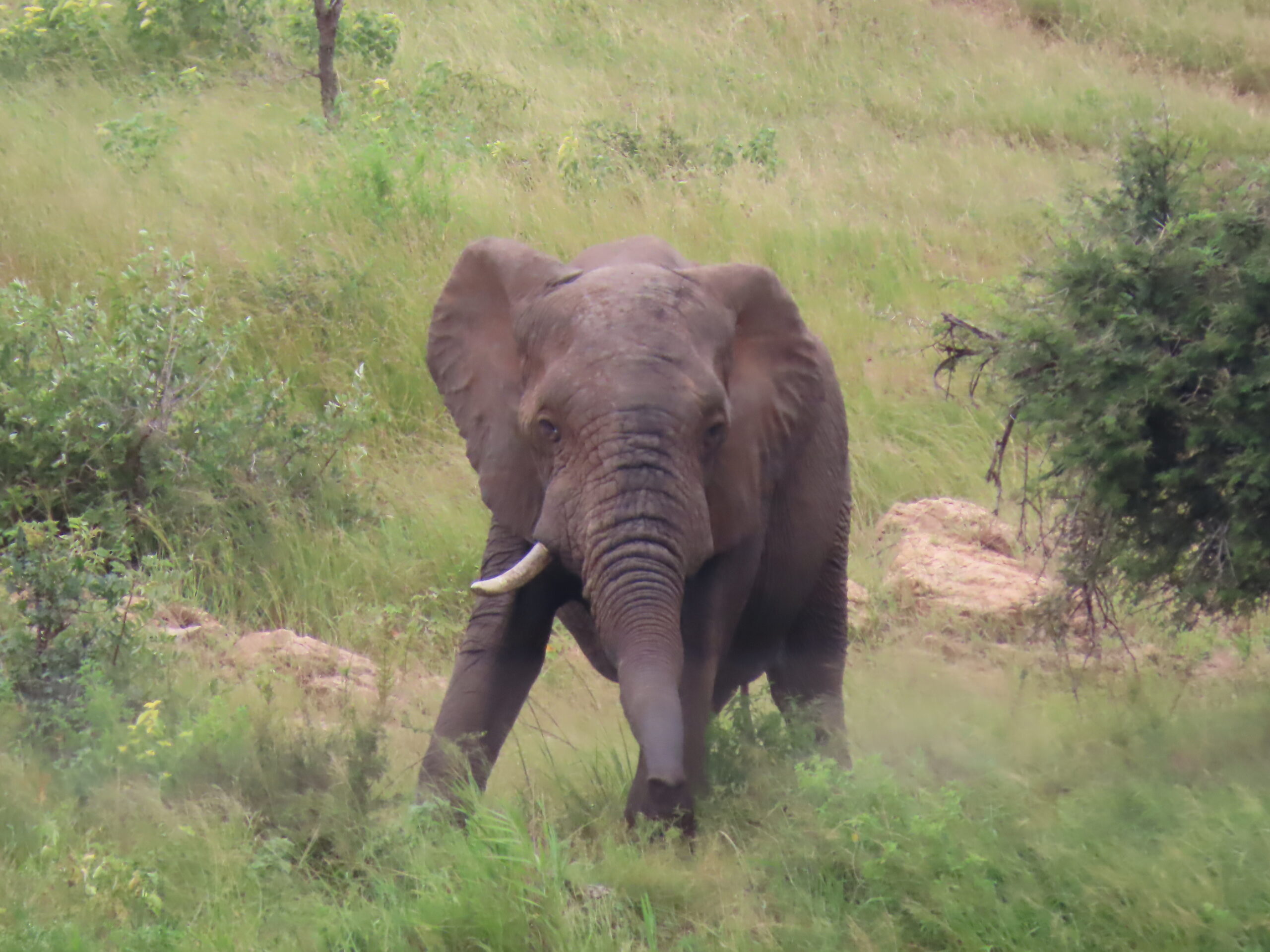
Fortunately, we took photos of these two elephants from afar. The photos aren’t as clear as we’d like, but they were across the river from us up a steep hill. They never came down to the river, although they stayed nearby. They appeared to be two males, one much larger than the other. They may have been “kicked out” of the main herd based on their ages.

Once an elephant reaches puberty and can impregnate females, they are banned from participating with the larger herd, usually by the matriarch. She intends to preserve the “family line” integrity by preventing young males from mating with their sisters and other family members. This makes so much sense. These wild beasts are so intelligent!

That’s it for today, folks. Tomorrow is another day, and hopefully, we’ll have found a resolution for our cell phone needs by then.

Be well.

Photo from one year ago today, February 16, 2021:
There was no post one year ago on this date due to a power and WiFi outage resulting from storms.

Vision and dental costs in South Africa…An amazing find on a veranda…

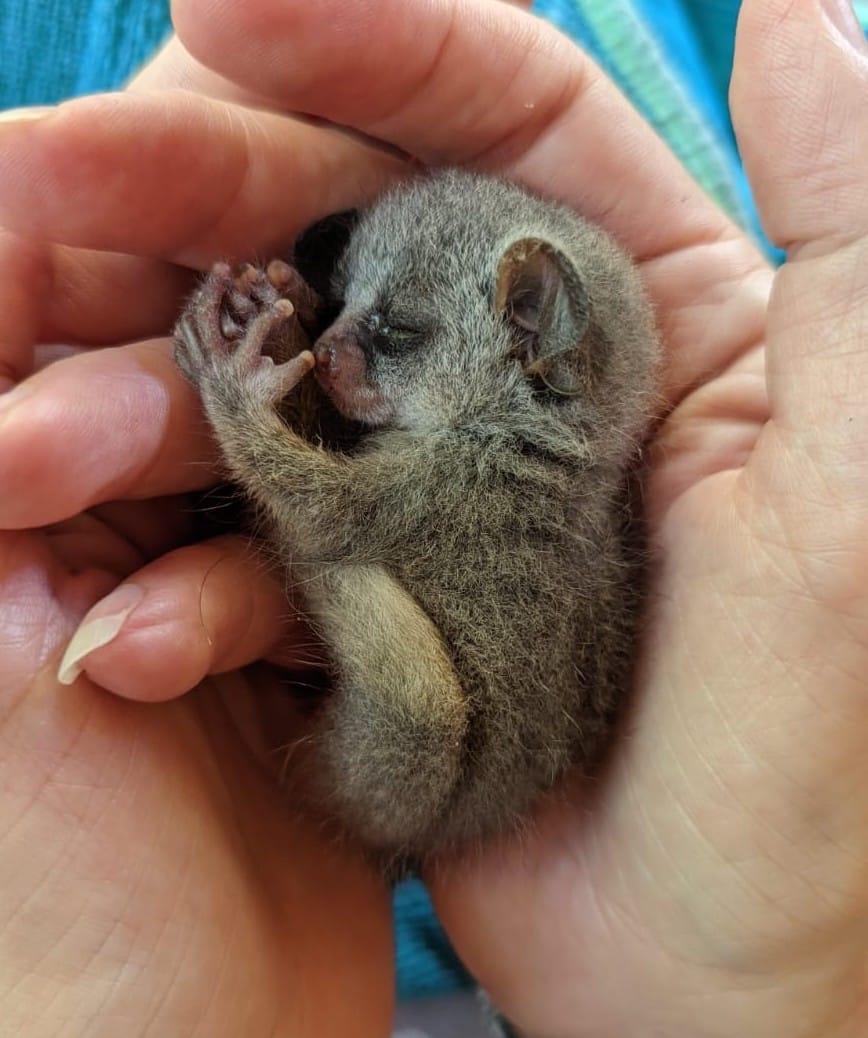
While shopping at the Spar Market in Komatopoort, Rita sent me this photo on Whatsapp of a tiny newborn bushbaby they found on the veranda.

This morning Rita and I are headed to Stoep Cafe for breakfast and girl talk. Our veggie omelets were delicious, only topped by the delightful conversation. As mentioned in yesterday’s post, afterward, I will walk to the dentist’s office for my and Tom’s teeth cleaning appointments at 11:00, one after the other. Then, shopping and back home by 1:30 or so.

Today, I got up early to do some steps, but I won’t finish until we return in the afternoon and put the groceries away. Tomorrow’s upcoming trip to Nelspruit will be tricky to get them done when we get home as I upload the post. It will be a busy few days.

We made a reservation for Valentine’s celebration at Jabula on Saturday night, actually the 12th, for just the two of us. Rita, Gerhard, Lynne, Mick, Janet, and Steve will join us on Friday evening for dinner at Jabula. We don’t mind going there two nights in a row since we always have such a great time and the food is consistently spectacular.

We just returned from Komati. We had our teeth cleaned but couldn’t pay our bill. There’s load shedding, and their credit card machine wouldn’t work. We’ll stop by when we shop next week and pay the bill at that time. They were pretty fine with that.

Several providers here ask us to do wire transfers for various services. Our bank charges a lot for these and we are concerned about security. Plus, if a refund is needed for any reason, there is no way to get a refund from a wire transfer. We decided we wouldn’t do wire transfers from our US bank in the US to any foreign countries long ago.

Suppose we are unhappy with a service or product. In that case, our credit card companies are excellent at helping us recover refunds, especially in times of Covid when flights and rentals are necessary to change. We keep detailed communication between the provider and us, which the credit card company may ask us to provide. We’ve had no issues that weren’t resolved with their help.

While Tom was getting his teeth cleaned, I walked next door to the optometrist’s office and paid for Tom’s glasses. His prescription sunglasses had arrived but not the clear glasses, which will be here within a week. It feels good to get these ancillary services out of the way while in South Africa. Costs are considerably less here, but the quality of the services and the products is equal to that in the US.

We had our teeth cleaned for under ZAR 1000, US $66. In the US, we paid at least six times this amount for both of us, if not more. The savings on eye exams and eyeglasses were around 30% less than in the US. My contact lenses were about the same price as in the US, but my eye exam was 50% less.

From there, we headed to the pharmacy for a few toiletries, and then we were off to Spar market. Tom pushes the cart while I run around, filling it with the items on the free grocery app on my phone, called “Bring,” which you can easily find on your app store. It takes a few minutes to get familiar with the app, but it’s easy to use once you get used to it. I create the grocery list during the week and check off the items I found while in the market.

While checking off the last few items, I noticed a Whatsapp message from Rita. The above photo was included in her message. They found this tiny bushbaby on the floor of the upper-level veranda at the house on Hornbill. Oh, my gosh! I swooned when I saw this and couldn’t resist sharing it with all of you today.

One of the Honorary Rangers, Nadine, came by after Rita contacted her and picked up the helpless newborn bushbaby. She’ll take it to Wild and Free Wildlife Rescue, Rehabilitate and Release, where it will be hand-fed and cared for until it’s able to be returned to the wild along with other newborns’ bushbabies discovered in the past few days. What an amazing service provided for the vulnerable wildlife in Marloth Park and the surrounding areas!

By the time we were home, put away groceries, and got back to work on today’s post, I also got back to work on my walking with enthusiasm. I set my alarm every 15 minutes to stand up and get to work. It looks like today; I’ll be able to accomplish my usual goal of 7500 steps.

It’s another scorcher today. Last evening, we sat on the veranda at 100F, 38C. As the sun went down, it cooled down considerably. Luckily, there is no load shedding over the next few days.

Have a pleasant evening!

Photo from one year ago, February 19, 2021:

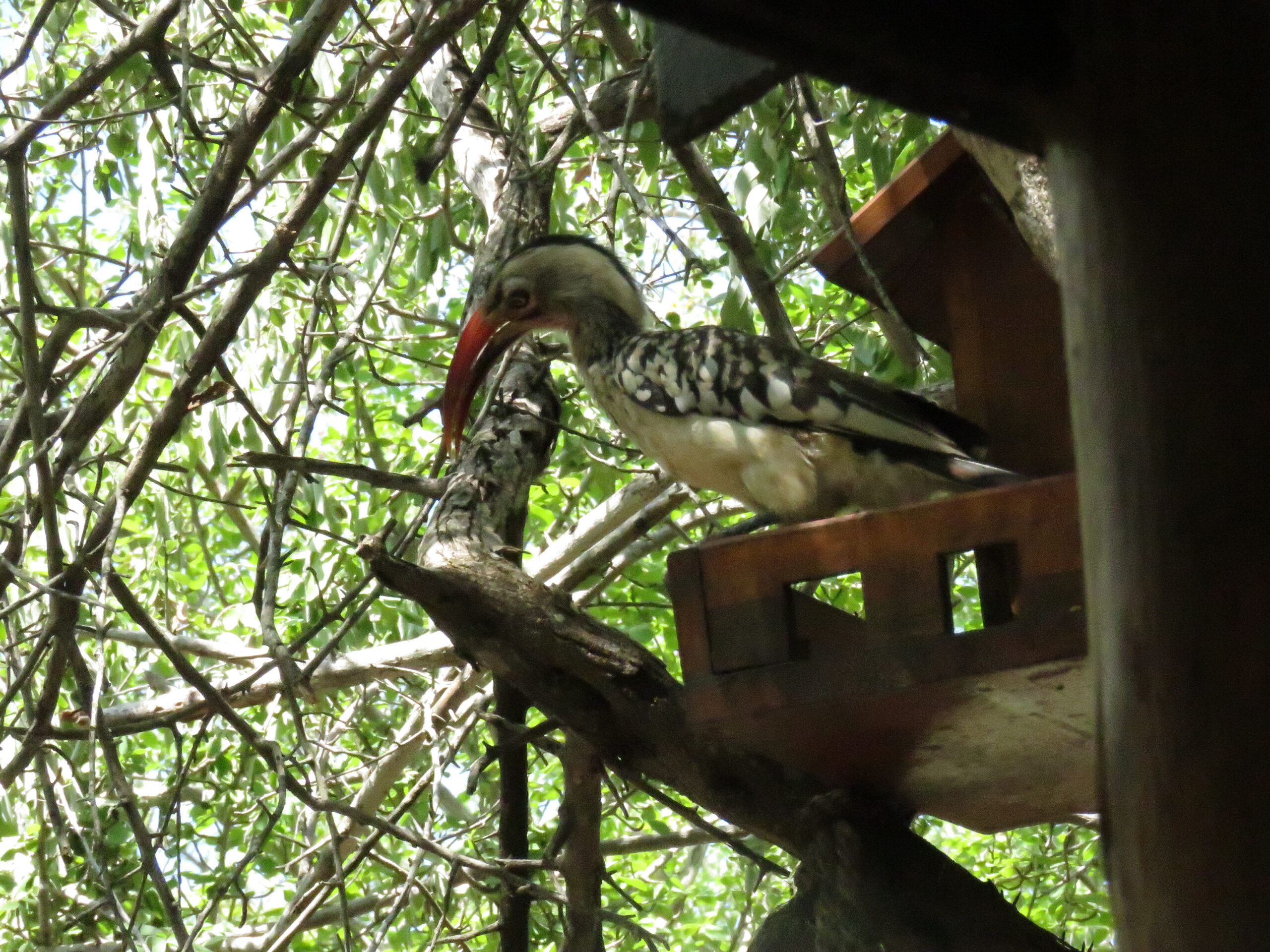
Mr. Hornbill was sitting on the veranda of his “stolen” bushbaby house, where he and the Misses are waiting for their eggs to hatch. For more photos, please click here.

Party day…Starting soon…Lots of visitors last night!…

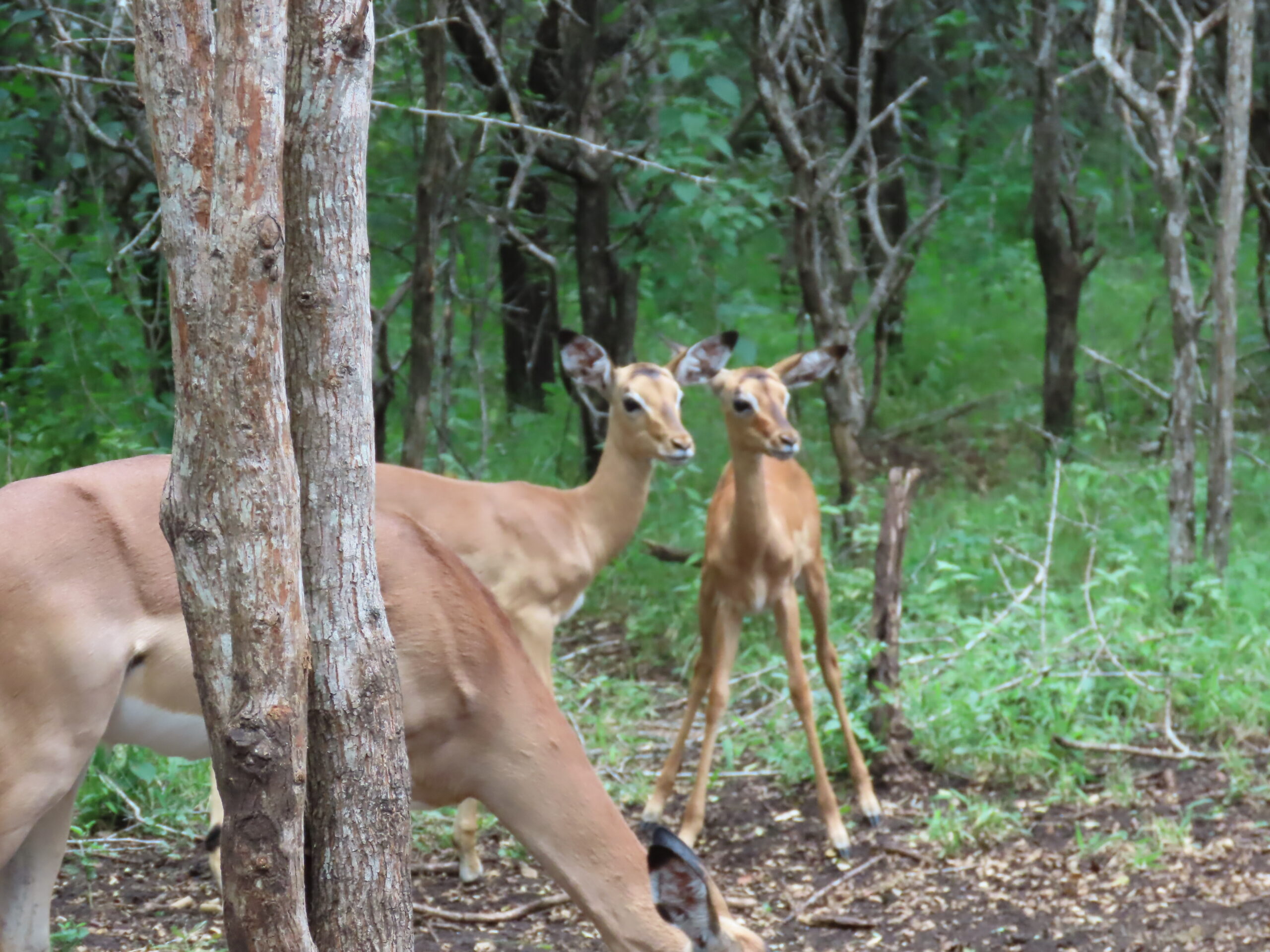
Two adorable young impalas arrived with their family and herd members in the garden.    

Today, I am rushing to get the post done and uploaded. Leon’s birthday party starts at 10:00 am and ends at 6:00 pm, 1800 hrs. We don’t plan to get there until 1:00 pm, 1300 hrs. However, I need to get my walking done before we leave. I’ve set my timer for every ten minutes when I jump up and do 500 steps in the bedroom with the fan turned on its highest setting.

I may not accomplish my 7500 steps today, but I am working on it now and may have to make up for the shortfall tomorrow. Last week, I finished at 53,458 steps, approximately 28 miles, 45 km. I broke my previous week’s record by about 10%. I am happy with that, especially when walking inside a two-bedroom house.

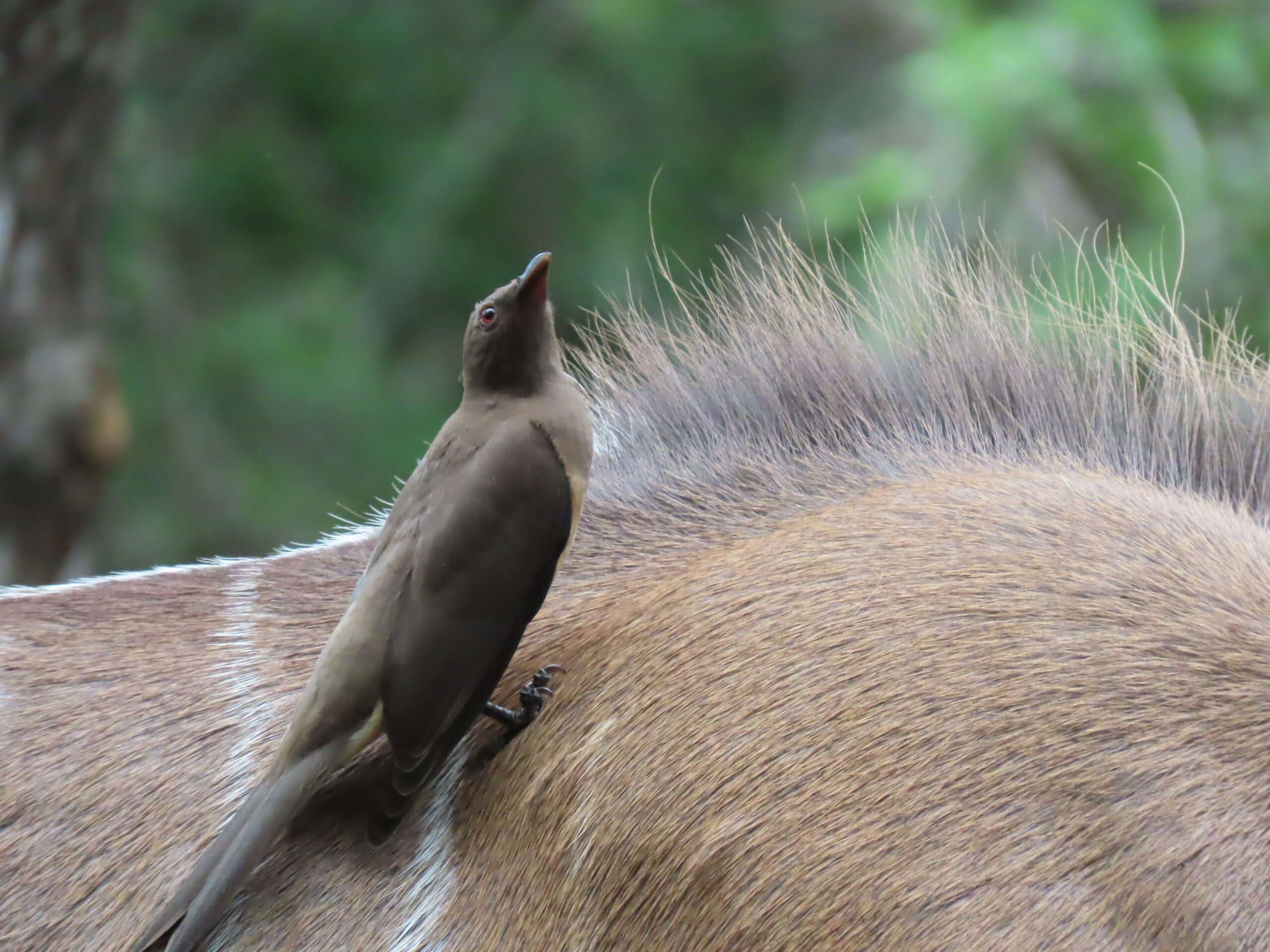
Bossy with a different species of oxpecker without the usual orange beak.

Once we get to Leon’s party, we’ll be sitting all day long, not getting any exercise. I’ll get up every half hour or so and walk around a little. I made a prawn salad to bring since Leon explained that none of the food he was serving would suit my eating style.

Leon offered to make me a meal in the kitchen, but I declined. I didn’t want them to bother doing that just for me. Besides, I may decide to eat the mackerel I have left from yesterday’s breakfast before we leave and then won’t need to eat again until we return home after 6:00 pm.

Close-up of the dark billed oxpecker. It was the first time we’d seen one without the orange beak.

Neither of us cares to eat much during the day. I may end up making dinner when we return to the house. We’ll play by ear and see what we feel like at that time.

Last evening was one of the most pleasant times we spent on the veranda. The weather was cooler than the prior evening and pleasantly breezy. From the time we sat down at the big table, the garden began to fill up with wildlife in a matter of minutes. Little started it off, precisely at 4:00 pm, 1500 hrs.

The tiny and delicate impala babies are a delight to see.

Moments later, they started strolling in, one after another. Our visitors included Bossy, Thick Neck, Gordy, Sigfried and Roy, Broken Horn (whom we hadn’t seen in days), two Big Daddies (male kudus with massive horns), Mom and Babies (warthogs and bushbucks), helmeted guinea fowl, and no less than a dozen impalas including some little ones who leaped through the air with sheer joy.

We couldn’t stop smiling and laughing over the menagerie in our garden. At one point, we counted over 20 animals in the garden, five different species. It was enjoyable to see the little impalas who we usually only see on the side of the road when we’re driving through the park.

During the pelting rain, the animals took shelter in the bush. They returned to the garden as soon as the rain stopped. Please zoom in to see some of them.

Suddenly, the wind picked up with dark clouds rolling in, and there was an unexpected downpour. The animals quickly scattered for shelter in the bush under trees. For the first time in a while, we had to go indoors. The wind was blowing the rain in our faces. Five minutes later, the storm ended, and we went right back outside, along with most of the animals hidden undercover. It was quite a treasure of an experience.

I’ve got to wrap it up now. So far this morning, amid doing this post, I’ve managed to do 6000 steps. I will have to complete the balance while we’re at the party, walking around the grounds to Jabula Lodge & Restaurant as we celebrate Leon’s birthday. Happy birthday, Leon! I know you read this, so I wanted to say it here as well.

Have a pleasing Sunday, wherever you may be!

Photo from one year ago today, February 6, 2021:

Tiny worked with me during his photoshoot to ensure his poses appeal to most of our readers. Sadly, we haven’t seen him since we returned from the US in July. For more photos, please click here.

A worrisome situation with Gordy…

Zoom in to see this round bone stuck on Gordy’s right hoof.

Yesterday morning, while wildlife watching, we noticed a terrible sight. One of our precious two favorite bushbucks, Gordy Thick Neck, is the other) came up to the veranda closer than usual, looking at us with sorrowful eyes. He leaned toward us as if asking for help. His right hoof was stuck inside what appeared to be a beef or pork an “O” bone, as shown in the main photo.

We were horrified to see this. A seemingly simple situation such as this could result in the death of an animal as the pain worsens, and he’d be unable to move about to roam to feed. He was limping each time he tried to move. Besides, he could have been long gone by the time anyone would show up to help him. We contacted the rangers but never heard back.

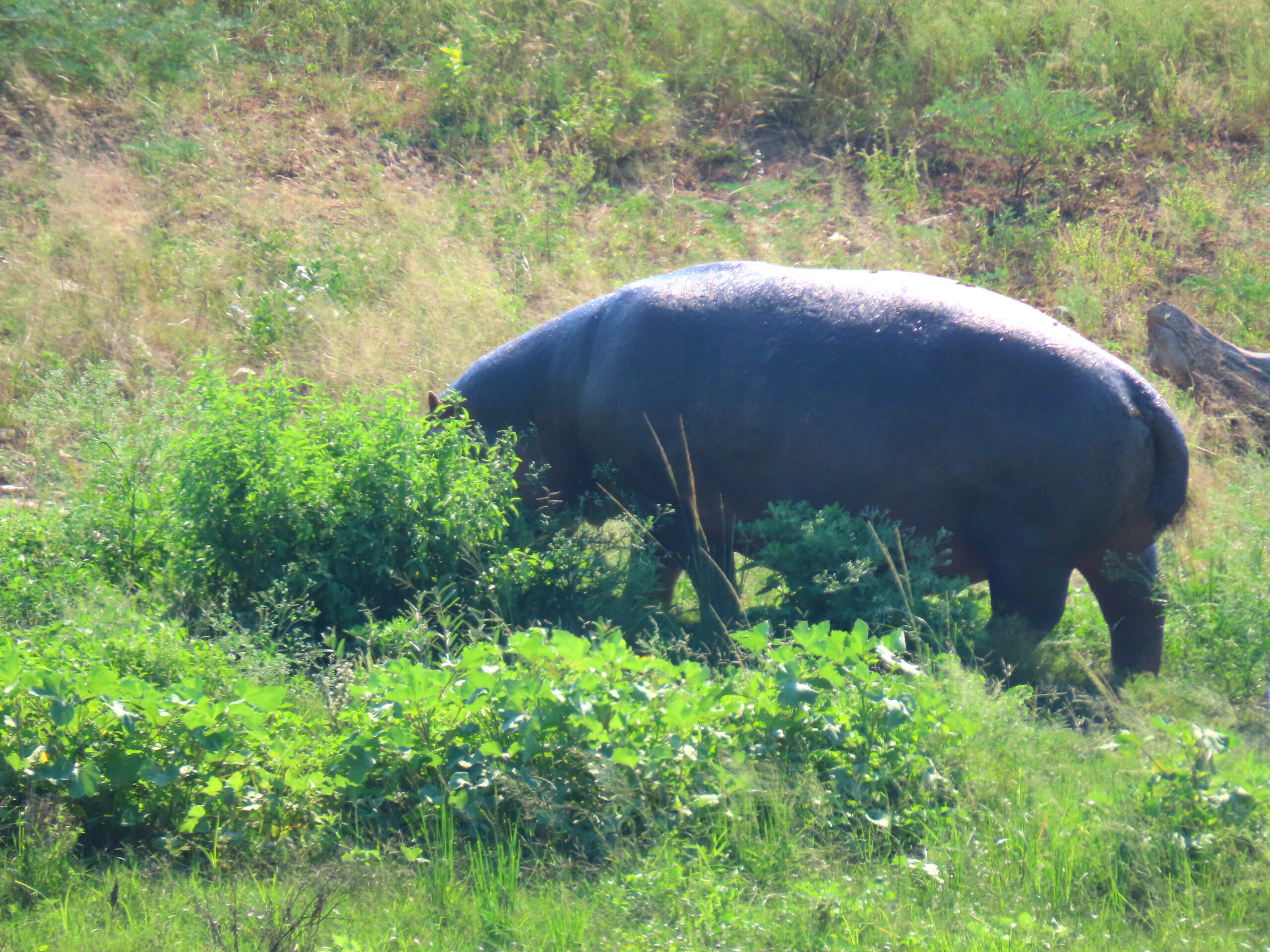
We spotted a hippo by the Crocodile River at Amazing Kruger View on Thursday evening while out with Rita and Gerhard.

The vet would have to dart him to remove the bone to remedy this situation. With the number of bushbucks in Marloth Park right now, the expense may have been prohibitive to save one bushbuck.

There was nothing we could do. His massive horns could easily, even if unintentionally, eviscerate a human if he was frightened or startled if we tried to help. All we could do was feed him, comfort him with our soothing voices, and hope that somehow the bone would fall off.

I was especially worried about the lions that have been seen so close to us this past week. Gordy could have easily fallen prey to a lion attack. He could barely walk, let alone run from a predator such as the mighty lion.

A single elephant grazed by the river.

Miracle of all miracles, this morning, Gordy showed up in the garden without the bone. It must have fallen, or he may have been able to coax it off. However, it happened. It was a stroke of good luck. This morning I could see a little indention above his right hoof where the bone must have been cutting into him. But, he seemed like his usual self, and we couldn’t have been more thrilled.

Last night while out to dinner with Rita and Gerhard at Jabula, I couldn’t stop thinking of him. I worried that he’d go off into the bush somewhere and die. But, these animals are very resilient and resourceful, more than we can imagine. They suffer during the dry winter months with little food and water and survive yearly.

Carcasses of various wildlife are found in the bush with building materials, fence parts, and wires wrapped around a part of their body, eventually causing their demise. Sure, many don’t make it through these types of situations. As is the case worldwide, human carelessness and lack of concern for the world’s wildlife rapidly decline the number of various species.

Waterbucks and a hippo at a distance.

We often watch videos on Facebook and Youtube with kind humans making every effort to release wildlife trapped in human garbage, fishing lines, fences, and other materials that can easily result in the extinction of a species. A simple little bone is a perfect example of how much destruction a thoughtless human can perpetrate when tossing out human food to the animals.

Yes, some wildlife consume bones to get to the nutritious bone marrow. But, we overseers of the wildlife in Marloth Park, but be cautious and think twice before tossing out a human food product into the garden. Many say it’s best not to feed at all for this very reason. But, there’s always a reliable and thoughtful means of helping out the wildlife. The best options are pellets, fruit, and vegetables they can easily digest.

It’s always a joy to see elephants and hippos.

Tomorrow we are going to a party by the pool at Jabula to celebrate Leon’s 61st birthday, starting at 10:00 am, ending at 6:00 pm. He’s doing a pig (not a warthog) on a spit and side dishes for the group of about 40, including us and Rita and Gerhard. I will bring my food since I’ve lost interest in eating pigs lately. Humm…I wonder why…

Have a lovely day, everyone.

Photo from one year ago today, February 5, 2021:
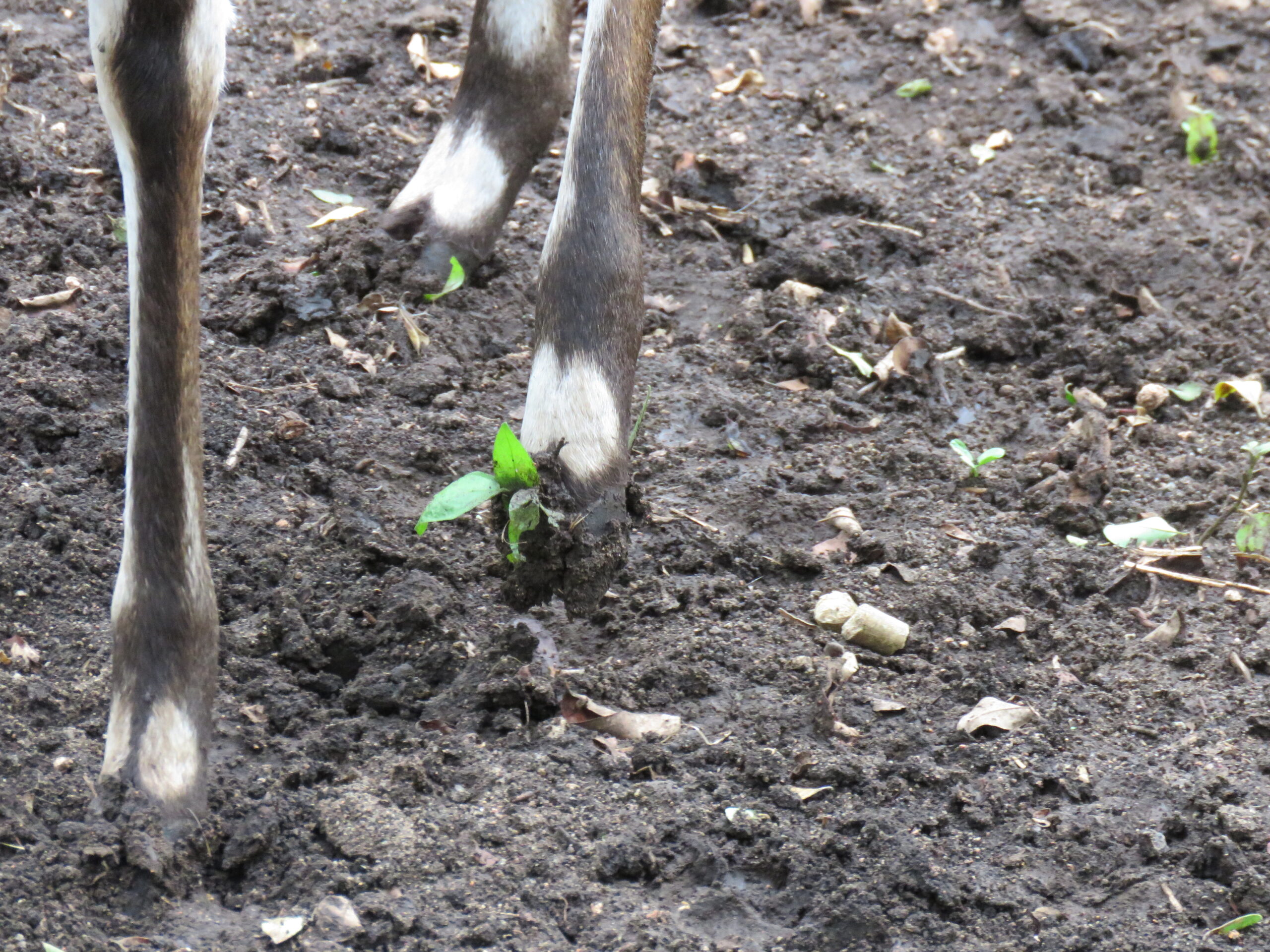
A little plant growing on the muddy foot of a bushbuck made us laugh. For more photos, please click here.

How many snakes did Juan’s Reptile Rescue capture in January, 2022?…Unbelievable!…

Juan de Beer is an expert snake handler in Marloth Park and the surrounding area. He now has a team of snake handlers working with him when many sightings have been reported, especially this time of yearg.

Yesterday, when Tom spotted the following information on Facebook, I knew I had to post a story about this crucial skill required in this and many areas of South Africa. Snakes come out of hiding, although they don’t specifically hibernate, as stated here from this site:

“Hibernation has been described as an inherent, regular and prolonged period of inactivity during winter. Hibernation is associated with warm-blooded animals (endotherms) such as mammals. It refers to a period of inactivity and a shut down in the metabolic system to save energy. On the other hand, Reptiles are said to brumate – become less active but do not shut down and will be active with a slight increase in temperature. The term brumate was coined by Wilbur Waldo Mayhen back in 1965 and referred to research he was doing on Flat-tailed Horn Lizards – he found that even if he heated these lizards in winter, unlike other lizards, they would still not feed and become lethargic. Strangely, Mayhen’s term does not technically apply to the standard period of inactivity in our reptiles as our reptiles will become active with a slight increase in temperature on a warm winter day.

Snakes in cold regions of the world go into a state of torpor (inactivity) for long periods, up to 8 months, and often in dens where hundreds or even thousands of snakes may share the same winter shelter.

In Southern Africa, it rarely gets cold enough for snakes to truly go into torpor, and although they are far less active in winter, snakes may emerge from their winter hide-outs on a warm winter day to bask in the sun and drink water.”

It’s astounding how much we can learn about snakes. They aren’t simply slithery, dangerous, venomous creatures roaming in the bush to bite and frighten unsuspecting humans. Most snakes prefer to stay away from human interaction and only bite when threatened.

Sure, there are cases where a human accidentally steps on or runs into a snake and is bitten. But, when reading about most snake bites, it appears they could have been prevented. But snakes are not all about our fear and trepidation. They are a vital part of the ecosystem and must be revered for their role in our environment. Well, volumes have been written on this topic which is more than we present today.

But, the value of safe snake and reptile rescue and relocation is an art in itself. We’ve been impressed by the quality of the work done by Juan and his team. Of course, there are other expert handlers in Marloth Park, but, in most cases, we’ve interacted with Juan, and thus he is highlighted in today’s story.

Both of us were shocked to see how many snakes and reptiles Juan and his team rescued.

January 2022🐍🦎 🦂🐊
Rescue’s for this month from the Unit⚠️☠⚠️
1.Black mamba= 16
2.Puff Adder= 7
3.Mozambique Spitting cobra= 19
4.Rock Monitor= 14
5. Spotted bush snake= 13
6. Olive grass snake= 4
7.Eastern Tiger snake= 1
8. Herald snake= 4
9. Brown house snake= 9
10.Boomslang= 2
11. Western yellow-bellied sand snake= 1
12. Southern African python= 3
13. Marbled tree snake= 4
14. East African shovel-snout= 1
Rescue’s in total ~98
Juan’s Reptile Rescue Unit 🐍🐊🦎🦂🕷
Safe removal and release of all Reptile’s❗❗
(Marloth Park, Kruger National Park, Komatipoort, Hectorspruit, and surrounding areas)
Juan’s Reptile Rescue Unit:
060 665 5000📲
Available 24/7
No charge for a call-out❗❗
May be an image of snake and text that says 'Juan's Reptile Rescue 060 665 5000'
“According to Professor Harry Greene, snakes consume between 6 – 30 meals per year, which is in summer. During winter, they do not eat at all or, if they do, very little. Most mammals will die within a few days if they are deprived of food, but some snakes are known to have survived for more than a year without a meal. Because snakes are ectotherms and require no food for their heat requirements, they can survive with very little food, and a large Puff Adder probably consumes less than 1 kg of food per year.”
The world around us continues to nourish our quest for knowledge. Living in the bush in Marloth Park has been a rich source of education, leaving us in awe at every turn. We thank Juan and his support staff, Marloth Park rangers, Honorary Rangers, and wildlife rescue professionals who help to make this a magical place.
Now, it’s up to all of us, blessed to be here, to honor and respect the wildlife, their habitat, and the people that make being here possible.
Be well.
Photo from one year ago today, February 4, 2021:
Bushbucks only like the banana peel. They are experts at removing the banana to be left with the peel to eat. It’s hysterical to watch how they manage to peel the banana with their mouths. Nature is amazing! For more photos, please click here.

Giraffe falls into an open cesspool…Amazing video!…

Last night, when Tom showed me this video he’d seen on Facebook, I knew the moment I saw it, we needed to share it here today. Peter and Mary Craig-Cooper, the people who took this video, are popular photographers in Marloth Park whose photos and videos we’ve enjoyed over the past year. All other photos shown today are those we’ve taken.

The story that unfolds in the video is fascinating, leaving the viewer holding their breath while attempts are made to rescue this huge male, with their weight information listed below:

“Male giraffes are 16-18 feet (4.8-5.5 m) tall; females are 14-16 feet (4.2-4.8 m) tall. Males can weigh up to 4,200 pounds (1,900 kg), and females weigh up to 2,600 pounds (1,180 kg).”
It’s easy to take giraffes for granted when we always see them roaming around Marloth Park all the time. But these enormous animals are genuinely fascinating. Here are some facts about giraffes from this site:
“With such a massive body, it makes sense that the giraffes’ organs and other body parts are equally massive. Their tongues are a substantial 21 inches (53 centimeters) long, and their feet are 12 inches (30.5 cm) across. According to the San Diego Zoo, a giraffe’s heart is 2 feet (0.6 m) long and weighs about 25 lbs. (11 kg). Their lungs can hold 12 gallons (55 liters) of air. In comparison, the average total lung capacity for a human is 1.59 gallons (6 liters).
Mom appeared to want to show her offspring how to drink from the river.

Habitat

Giraffes live in savannas throughout Africa. They like semi-arid, open woodlands with scattered trees and bushes, making the savannas perfect for these animals. According to the World Atlas, the tall creatures are native to Kenya, Cameroon, Chad, Niger, Uganda, Namibia, Botswana, Zimbabwe, Zambia, Tanzania, Angola, and South Africa.

Habits

Giraffes are so social that they don’t have territories. According to the U.S. Geological Survey, a group of giraffes is aptly called a tower. Towers typically have 10 to 20 members. Who lives in the tower can vary. Some towers consist of all females and young, or all-male or mixed genders. According to the Animal Diversity Web, members are free to come and go as they please.

Giraffes only sleep around 20 minutes or less per day, according to PBS Nature. They usually get their sleep in quick power naps that last just a couple of minutes. Staying awake most of the time allows them to be constantly on alert for predators.

Every giraffe has two hair-covered horns called ossicones. Male giraffes use their horns to fight with one another playfully. They also spar by swinging their heads at one another and entwining their necks, called “necking.” [Images: Animals’ Dazzling Headgear]

Down they went, in an awkward pose, to drink from the river.

Diet

Giraffes are herbivores, which means they eat only plants. According to National Geographic, they can eat hundreds of pounds of leaves per week. Their long necks allow them to reach leaves, seeds, fruits, buds, and branches high up in mimosa and acacia trees.

Though these animals eat a lot, giraffes can go without drinking for weeks at a time. They get most of their moisture from the vegetation they eat.

Offspring

As in cattle, female giraffes are called cows, while the males are called bulls. After mating, the cow will have a gestation period of around 14 months. Baby giraffes are called calves. The calf will drop to the ground during birth since mother giraffes give birth standing up. According to National Geographic, the fall can be as far as 5 feet (1.5 m).

According to the San Diego Zoo, new calves are quite large, at 6 feet tall (1.8 m), 100 to 150 lbs. (45 to 68 kg). They are also agile. They can stand up and walk around just an hour after birth. Giraffe mothers often take turns watching over the calves. Sometimes, though, the mother giraffe will leave the calf by itself. When this happens, the infant will lie down and wait for its mother to return.

This lovely girl (determined by the hair on her ossicones) posed for a face shot.

According to the University of Michigan, calves are weaned at around 12 months. At 3 to 6 years old, calves are fully mature. The animals can live 10 to 15 years in the wild and 20 to 25 years in captivity.

Other facts

You will often see giraffes walking around with birds on their backs. These birds are called tick birds or oxpecker birds (Buphagus africanus). They eat bugs that live in the giraffe’s coat and alert the animals to danger by chirping loudly.

Even if you spent a lot of time with giraffes, you would never hear them make a noise. This is because giraffes communicate using noises that are too low for humans to hear, according to PBS Nature.

This giraffe had five oxpeckers on its hide.

Thanks to their long legs, giraffes are very fast. According to National Geographic, they can run 35 mph (56 km/h) in short bursts and run for longer stretches at ten mph (16 km/h).

Giraffes are even-toed ungulates, which means they have two weight-bearing hooves on each foot and are in the order Artiodactyla, which also includes antelopes, cattle, goats, sheep, caribou, moose, hippos, and pigs.”

Each time we encounter a giraffe, whether it’s in Marloth Park, Kruger National Park, or other wildlife parks in Africa that we’ve visited in the past over nine years, we are always in awe of their beauty, their gentle gait, their size, and their uniqueness. We are blessed to live among them!

Be well.

Photo from one year ago today, February 2, 2021:

Farmers and sellers were offering produce at an open market in Komatipoort, the village where we shop. For more photos, please click here.