
Fake policemen/fake security officers…It’s happened to us!…No one is exempt!..
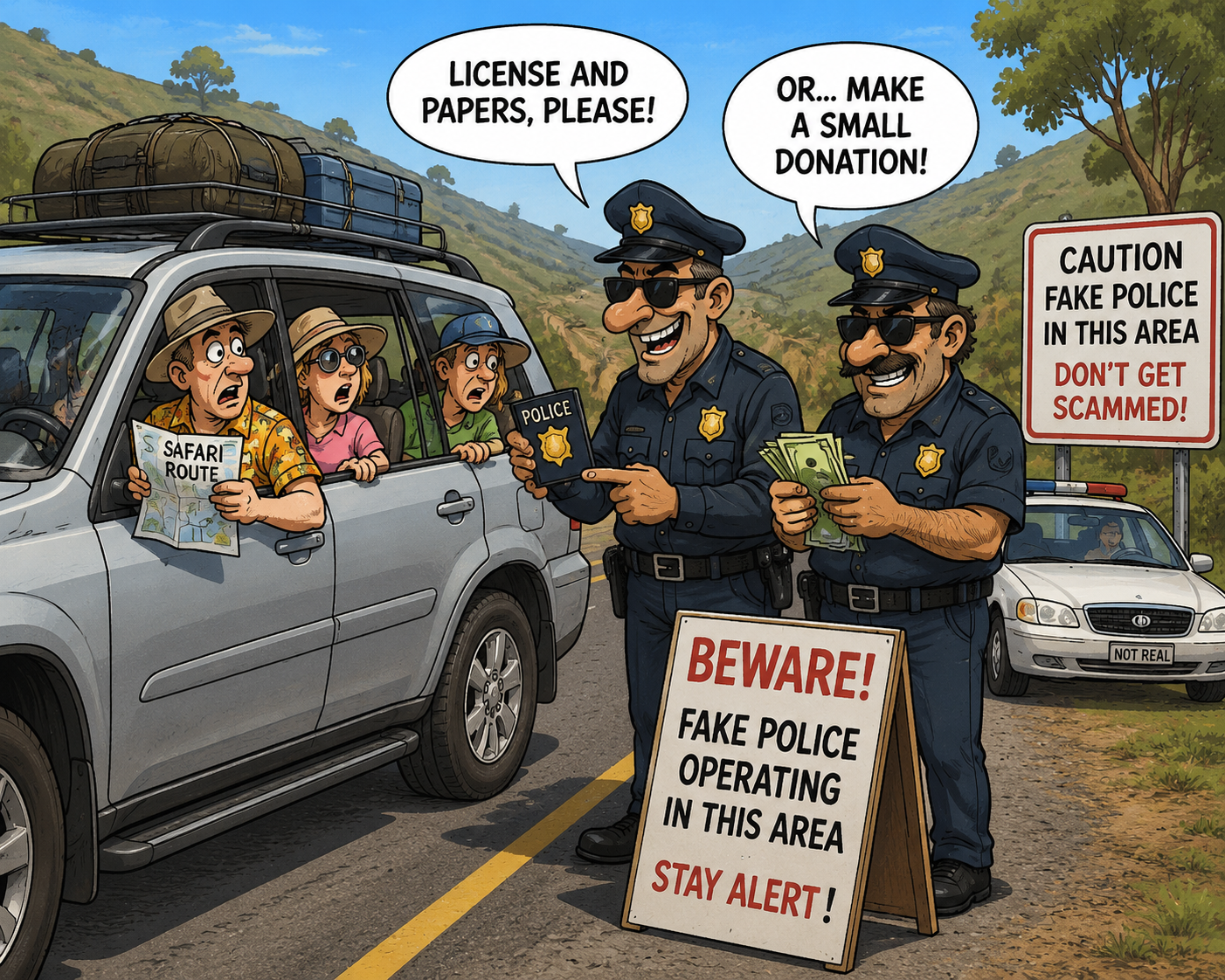
We have encountered fake police and fake security officers in several countries, including South Africa, with the worst incident described in our post from May 25, 2025, found here. Although we consider ourselves cautious travelers and certainly not naive after all these years on the road, it is still possible for any of us to be caught off guard by someone pretending to be an authority figure. Please keep in mind that legitimate police may also be involved in scams to take money from travelers.
We encourage our readers to read the following article, along with our previous post, to understand just how vulnerable travelers can be in these situations. It is easy to assume we would immediately recognize a scam. Still, when someone is wearing what appears to be a legitimate uniform, carrying identification, and speaking with confidence, the situation can become confusing and intimidating.
In 2013, while traveling through South Africa on a road trip, we were stopped by individuals claiming to be police officers. Then, again in 2023, as we were leaving Ecuador for the airport, we experienced another similar situation. In both cases, the individuals claimed Tom had violated traffic laws and insisted we needed to pay a fine in cash. Fortunately, Tom had been driving carefully and obeying all traffic regulations, but that did not stop these individuals from making their accusations. We had no choice but to pay.
It’s a good thing we had some cash available at the time. We still wonder what might have happened if we hadn’t been able to pay what they demanded. Would the situation have escalated? Would we have been delayed on our way to catch a flight? These are difficult questions to answer.
The reality is that we may never be entirely certain whether someone is a legitimate police officer in some countries when they appear to have all the expected signs of authority. This is why staying alert, trusting our instincts, and knowing local procedures is so important when traveling. Even after many years of worldwide travel, we continue to learn that awareness is one of the most valuable tools we carry with us.
Please read below as well as our post from 2025, found here.
From today’s issue of Travel + Leisure online magazine here.
“Fake Police Officers Are Targeting Travelers—Here’s How to Spot the Scam Before It’s Too Late
A security expert provides insight into how to avoid (and deal with) an impostor law enforcement scenario. By Lydia Mansel
Published on July 20, 2026
Travel scams, unfortunately, come in all forms—from pickpocket tactics to QR phishing. According to the Federal Trade Commission (and a Reddit thread detailing users’ personal experiences), there’s another type of scam to look out for: impostor police and law enforcement.
This may come in the form of a phone call, with someone claiming to be law enforcement and requesting you send them money through various channels. But the U.S. Department of State also points out you can come across “someone posing as a police officer” while traveling.
To ensure you’re aware of this potential situation, how to spot it, and how to deal with it, Travel + Leisure spoke with Philip Farina, founder and chief advisor at Risky Business Security and Safety Advisors.
“Some of the most common tactics used by phony police are document or passport checks, or counterfeit currency investigations. These can occur just about anywhere, even steps away from an airport or a real police station,” Farina told T+L. “If given the opportunity, these criminals will run away with your valuables in tow. Additionally, unmarked or fake police vehicles may attempt to pull you over and, again, steal your belongings and valuables.”
Before you even leave for your trip, research the destination. “Start with the U.S. Department of State’s Travel Advisories, which can provide a wealth of safety and security information. You can always contact the U.S. embassy in that country and ask them about impostor police and any recommendations,” he said. “Your hotels want you to be safe as well, so you can speak with the general manager or other property leader about any incidents or trends in the area and what to watch out for.”
Farina also suggested doing a quick internet search to see what “real police uniforms and vehicles look like,” and jotting down direct numbers for local offices and precincts. “Going to the International Criminal Police Organization’s (Interpol) website can also be a solid resource for information and critical phone numbers,” he added.
Farina also gave us one more tip on how travelers can stay safe if they find themselves dealing with this type of scam. “If traveling to an area where there may be a possible encounter with an imposter, it’s a good idea to have an additional ‘throwaway’ wallet that contains old, unused identification like membership cards, an expired credit card and/or ID, and a few $20 bills,” he said. “If someone pulls a firearm or weapon and demands your money, don’t be a hero. Simply hand over the throwaway wallet, then drive away, or, if walking, get to a well-lit public area quickly.”
So how can you spot the difference between a legitimate police officer and someone posing as law enforcement? Farina said there can be a few giveaways, starting with appearance. “Their uniform may be incorrect and unkempt,” he said, adding they may “act nervous and paranoid, looking in many directions in the event that a real police officer may show up.” If they’re driving a car, he added, it “may not have proper decals or signage.” Farina recommends asking to see identification or requesting the name and telephone number of a supervisor or commanding officer.”
Be well.
Photo from ten years ago today, July 21, 2016:


About Jess & Tom
We are travel writers, photographers, and slow travelers exploring the world one meaningful experience at a time.
Read More