
Massive impact for visitors to Australia…
We felt it was imperative to share this article with Australians and other travelers during this period, rather than our daily personal stories.
From the following Australian news story found here:
“Tourism Economics forecasts a massive number of trips to Australia at risk, which could cost billions by Chantelle Francis
Economists forecast a massive number of trips to Australia will be at risk this year amid the Iran war, which would be bad news for the $39 billion industry.
It’s not just Australian travelers’ plans being put at risk by the war in the Middle East, but also international tourists traveling Down Under.
More than one million visits to Australia are at risk this year amid war in the Middle East, according to forecasts from Oxford Economics’ company Tourism Economics.
While a small number of outbound trips from the Middle East contribute to that number, the overwhelming majority of trips at risk are those from nations that travel to Australia via Middle Eastern transit hubs such as Dubai, Abu Dhabi, and Doha.
“The vast majority of these are visitors travelling from European source markets – a very small portion is from source markets in Asia Pacific and North America but these are negligible,” Tourism Economics’ director of global forecasting Helen McDermott told news.com.au.
Inbound tourism contributes significantly to Australia’s economy. International visitors spent $39.2 billion in Australia in 2025 across 8.3 million trips.
Visitors from the UK alone spent $2.87 billion.
Tourism and Transport Forum Australia CEO Margy Osmond said there had, of course, already been noticeable impacts when airspace in the Middle East closed unexpectedly, but she believed it was too early to tell how significant the longer-term impacts would be.
“Certainly, there will be some kind of impact. How big that is and what it looks like is a bit difficult to put firm figures around,” Ms Osmond told news.com.au.
She said, for example, there may be an increase in travelers using Asian-based airlines, such as Japanese and Chinese airlines, that don’t fly via the Middle East. These airlines may increase their flights and seating capacity in Australia.
“What you might see is a shift in consumer human behavior, as opposed to people stopping traveling,” she said, pointing to the fact Australians seem to still be traveling for Easter amid high fuel prices, but some are just choosing shorter trips that are closer to home.
However, Ms Osmond noted that while domestic travel in Australia is likely to increase, it would not offset the loss of international visitation, as overseas visitors spend “infinitely more” than domestic tourists.
“The other thing from an Australian point of view is we’re normally a destination that people plan to come to, so they plan well in advance,” she said.
“I think the bigger impacts we’re likely to see may be in the second half of the year as opposed to right now – beyond the obvious things that relate to Middle Eastern carriers.”
Ms Osmond added: “But there’s no doubt that governments at both state and federal level will have to be thinking about increasing their investment in marketing.
“The destination agencies are going to need an extra lick of cash to compensate and to encourage people to be coming back to Australia.”
Both traditional and non-traditional source markets would need to be targeted, she said.
Tourism Australia, the government agency responsible for promoting the country, conducted a survey of the Aussie industry and overseas travel partners and found that, while there have been some cancellations due to flight disruptions, there is still strong interest in traveling here.
The agency has increased marketing in Southeast Asia and China and is encouraging more businesses in China, Southeast Asia, and North America to consider hosting their events in Australia.
“We are closely monitoring the situation as it is unfolding and engaging with our network of people and partners internationally, along with the industry here, to understand any impacts on tourism to Australia,” Tourism Australia managing director Robin Mack told news.com.au.
“We continue to support the industry through our marketing activities around the world to build demand for Australia’s tourism experiences, and to remind tourists that Australia is friendly, welcoming, and most of all open for business.”

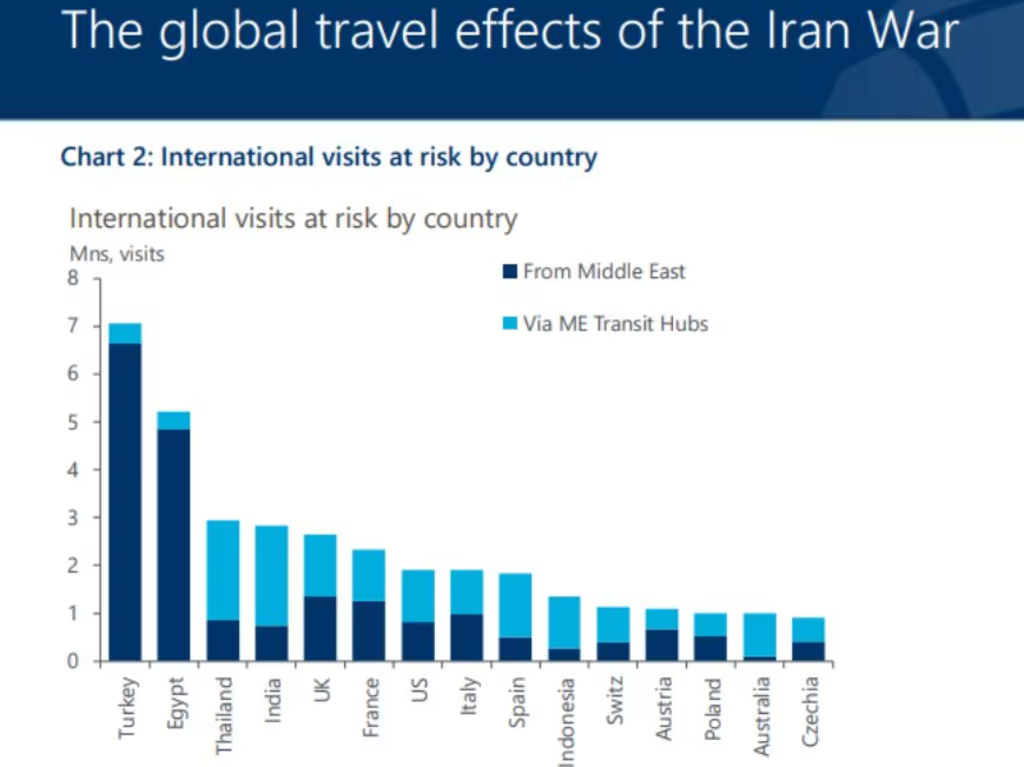
International visits at risk by region—picture: Tourism Economics.
Global travel effects of the Iran war
With ongoing air travel disruption and economic impacts, Tourism Economics expects 28 million outbound trips from the Middle East to global destinations to be at risk this year, mostly affecting Europe – particularly Turkey, France, and the UK – but destinations in Africa and Asia-Pacific are also vulnerable. There were three million trips from the Middle East to the Asia-Pacific last year.
The report noted Middle East visitors tend to be higher spenders, “meaning a loss in visits will deliver a disproportionately larger economic impact”.
A further 28 million annual visitors who usually transit through the region are at risk (43 percent of those to Asia-Pacific), and, from these same countries, an additional 60 million visits are at risk – not from passing through the Middle East but from other factors like higher travel costs as capacity is tightened.
“Reduced flight capacity, rerouting and airspace constraints are already impacting long-haul connectivity between Europe, Asia-Pacific and Africa, resulting in increased journey times and airfares on flights between these regions,” Ms McDermott and senior economist Jessie Smith said.
As jet fuel supply risks grow, especially if there is continued Iranian disruption in the Strait of Hormuz, their report warned there will be further route reductions and capacity adjustments, and increased operational costs will lead to higher airfares.
“Low-cost carriers tend to see more impact, as jet fuel costs are a higher share of total costs,” the report noted.
Australia’s national carrier, Qantas, has cut some of Jetstar’s flights from Australia to New Zealand and within New Zealand.
“We have made some temporary changes to our schedule, including due to a rise in jet fuel prices as a result of the conflict in the Middle East and other rising costs,” Jetstar said.
Qantas, which does not fly to the Middle East, also increased international fares by about 5 percent in early March to offset fuel costs – and planned to review its airfares every fortnight.
The airline will ramp up capacity on flights between Australia and Europe from mid-April through to late July by redeploying aircraft from US and domestic routes.
There will be daily flights between Perth and Rome (previously four times a week), and flights to Paris will increase from three to five a week – departing Sydney via Singapore instead of Perth. Flights between Perth and Singapore will be boosted and timed to connect with Qantas’ Singapore-Paris services.
The Perth-London route continues, but with a fuel stop in Singapore on the return flight due to adjustments required to flight paths.
The Australian Financial Review reported on March 26 that Qantas’ former chief economist had forecast that earnings from flying could slump by more than $500 million if the war in the Middle East and rising fuel costs continued.
Virgin Australia, which was forced to cancel all its Qatar Airways-operated flights to Doha, has seen its share price plunge. Qatar Airways owns a 25 percent share of Virgin Australia.
The airline increased its domestic fares by about 5 percent on March 23.
“Costs across the aviation sector continue to rise, now significantly exacerbated by the situation in the Middle East,” a Virgin Australia spokesperson said. “We are making necessary fare adjustments to reflect these cost pressures.”
This week, the Spirit of Tasmania announced a 15 percent fuel surcharge to all new bookings.
Ms Osmond said fuel levies were also being added to boat and reef tour ticket prices up north.
She said her advice for travelers was to double-check this before their holiday so they can consider it in their budget.”
Be well.
Photo from ten years ago today, April 4, 2016:


About Jess & Tom
We are travel writers, photographers, and slow travelers exploring the world one meaningful experience at a time.
Read More