Zebra day!…A delightful visit by nine of these wonderful animals…

A little cuddle among the dazzle of zebras.

Almost daily, warthogs, bushbucks, kudus, mongoose, francolins, and other birds stop by for a visit. However, zebras are less frequent visitors. Since arriving here over 3½ months ago, zebras have only graced us with their presence on two occasions. Yesterday was one of those occasions, and we couldn’t have been more thrilled.

When Tom happened to look out the kitchen window, he saw the zebras in the driveway. He tossed them some pellets. In no time at all, they came around to the back garden.

“Zebras are one of the many beautiful creatures inhabiting Africa. Many people know them for their iconic stripes and the never-ending riddle about them being black with white stripes or white with black stripes. From this site, here are 25 amazing facts about zebras:

Here are a handful of facts you might or might not know about these striped horses.

  1. The zebra is mainly white and striped with black or dark brown stripes, but black skin underneath their coat.
  2. There are different types of zebra, each with a different stripe pattern. The mountain zebra typically has vertical stripes on its neck and across its torso while horizontal lines cover its legs.
  3. Zebras run in a zig-zag pattern when being chased by a predator making it more difficult for them to run after them.
  4. The pattern of zebras stripes is different for each zebra, making them each unique snowflake!
  5. Their coats’ black & white striped pattern is a good bug repellant, keeping horseflies and other bloodsuckers at bay.
  6. A group of zebras is called a ‘zeal” or “dazzle.”

    It was fun to see two zebras drinking simultaneously.

  7. The Native American culture refers to the zebra as a symbol of balance and the sureness of the path.
  8. The Swahili name for the zebra is ‘Punda Milia.’
  9. Romans used Grévy’s zebras to pull two-wheeled carts for their circuses.
  10. In Roman Circuses, the zebra was usually called a ‘Tiger-Horse’ or a ‘Horse-Tiger.’
  11. When predators face, zebras will form a semi-circle and bit, nip or attack the predators if they come too close to them. They will also encircle an injured family member to protect it from further attack if the need arises.
  12. A mother zebra will keep her foal away from all other zebras for two or three days until the colt can recognize her scent, voice, and appearance.

    There were nine zebras in the garden, staying for over an hour.

  13. Zebras form hierarchies with a Stallion (male) in the lead, followed by his Harem (group of females) behind him.
  14. When traveling with his harem, the stallion will lead them with his head low and ears laid back.
  15. Zebra’s bunch together to confuse colorblind predators, such as lions, which mistake the pattern as grass.
  16. Zebras are one of the few mammals that we believe can see in color.
  17. Zebras are pretty short and can be 3.5-5 feet tall.
  18. The Grévy’s zebra is named after Jules Grévy, president of France (in 1882), who received a zebra as a present from the emperor of Abyssinia.
  19. Another name for Grévy’s Zebras is Imperial Zebras.
  20. A zebra can run up to 65 km/h or 40 mph.
  21. To sleep, generally, zebras don’t lie down – instead, they usually sleep standing up.

    We’re so enjoying seeing wildlife drinking from the birdbath, where we continue to add fresh water.

  22. Zebras can rotate their ears in almost any direction; this ability can communicate their mood with other zebras.
  23. Zebras have one toe on each foot.
  24. Zebras cannot see the color orange.
  25. A zebra species are called ‘Asinus Burchelli’ after a conflict between William John Burchell and John Edward Gray sparked. Burchell brought specimens from Africa to The British Museum, and the specimens died. Gray felt the need to Embarrass Burchell because of the incident; the name means “Burchelli’s Ass.”

    They drink from the top section and often drop down and drink from the bottom section as well.

We’ve researched several facts about zebras over the years, and each source provides new and exciting information about these stunning animals.

The sounds of their hooves pounding on the ground, the whinnying amongst themselves over pellets and jockeying for position in the garden, leave us smiling over their demeanor, rambunctious and determined. Each time we drive on Olifant Road, the only paved road in Marloth Park, we are in awe when spotting them at the side of the road or crossing.

They waited in a queue, taking turns drinking the freshwater.

We seldom see a solitary zebra. They are social animals who travel together, covering many kilometers in a single day. Even here in Marloth Park, which is only 3000 hectares, 6.7 square miles, they find plenty of space to wander. Whether in the parklands or the sparsely occupied residential areas, zebras may be seen running fast together or casually grazing on the grass and vegetation.

Residents of Marloth Park certainly appreciate the zebras offering them carrots, apples, and pellets when they stop by for a visit.

We haven’t been offering apples and carrots at this point, but once the winter comes, when the vegetation is sparse, we’ll begin offering these to our friendly visitors.

They were busy eating pellets for quite some time.

Today, we’ll be working on some research for the future and afterward head over to Louise and Danie‘s Info Centre for a short visit. The school holiday period has ended, and now, they have more time for a little social interaction. It will be good to see them once again.

If all goes as planned over the next 24 hours, we’ll be off to Kruger National Park tomorrow for a much-desired self-drive, hopefully returning with many good photos to share here.

A pretty female profile.

Happy day!

Photo from one year ago today, May 3, 2020:
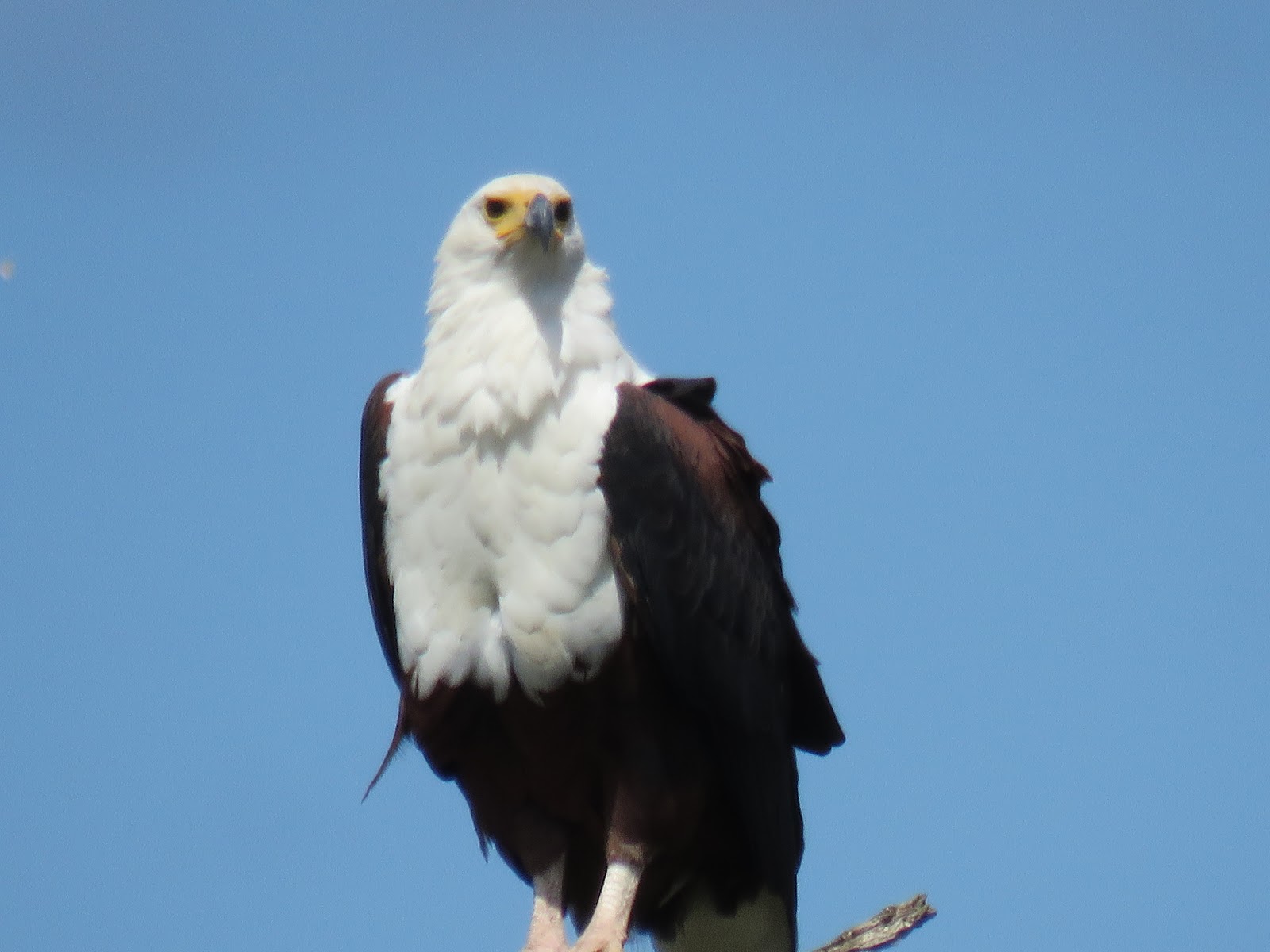
A fish eagle, one of the most prolific eagles in Kruger National Park. For more photos, please click here.

Fantastic evening with friends…Little annoyances with credit cards…

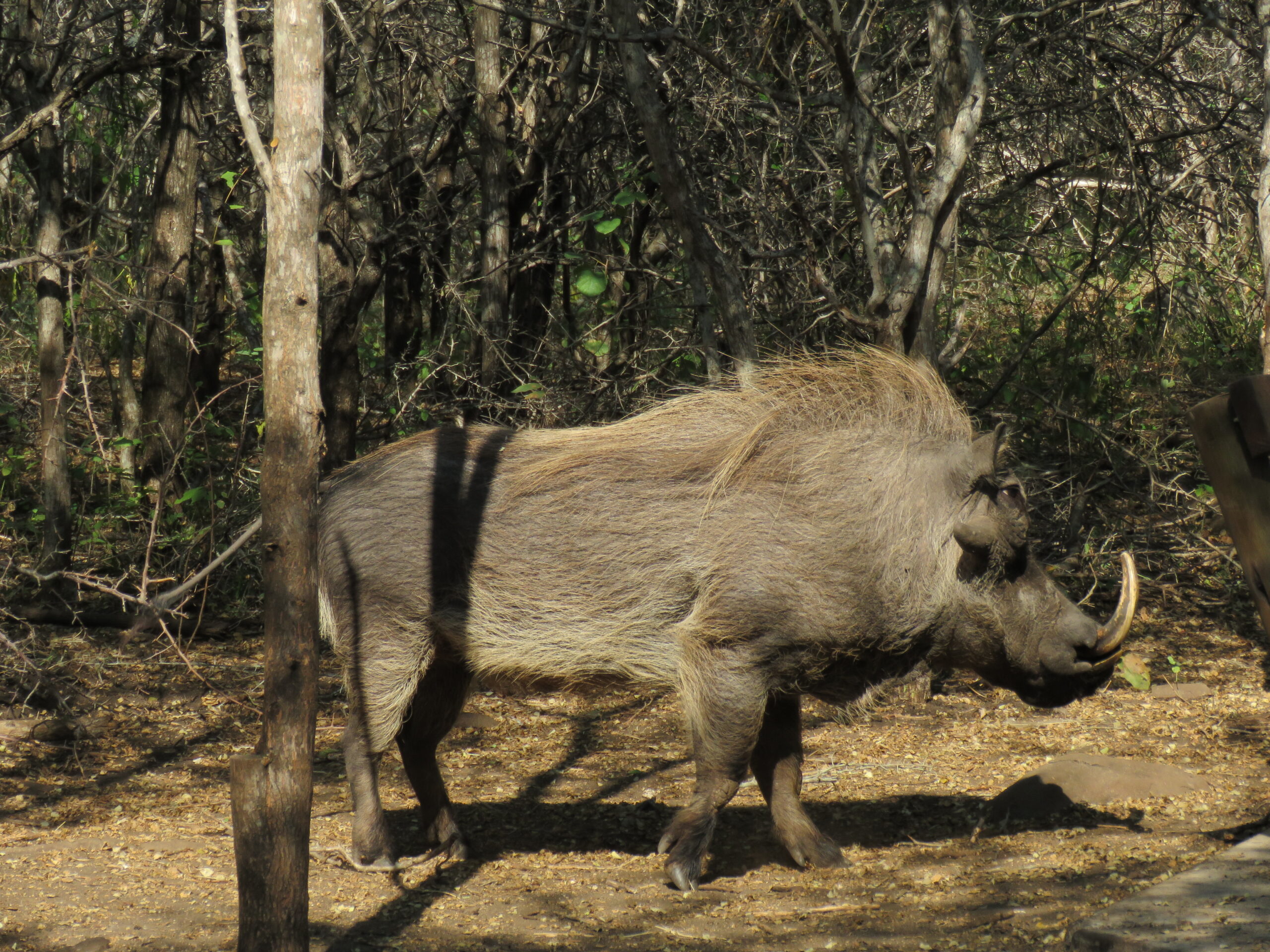
One Tusk with his hair all fluffed up during the rutting reason.

On Friday night, when we had dinner with Linda and Ken, Tom asked me to bring my credit card that has substantial credit on it as a result of refunds for trips we’d canceled due to Covid-19 issues we mentioned prior posts. Unusual for me, I forgot to bring my “phone/wallet,” Since I’d planned to pay, Tom didn’t get his wallet.

As a result, this morning, Tom drove to Jabula to pay our bill using my credit card to reduce its credit further. Dawn, knowing we’d undoubtedly return to pay our bill, didn’t hesitate to let us out the door without paying. This morning, Tom drove to Jabula and paid the bill, using my card with the credit on it.

The four babies will soon be on their own, often staying together until they find a mate. Once they mate, they have no involvement with the piglets and wander about on their own, on occasion in same-sex groups called sounders.

When there’s an enormous credit on a credit card, we’ve found that most credit card companies eventually send a check to the address on file. They don’t like customers having credits on a card. I suppose it means they don’t make any money from us, unable to charge us interest on debit balances. We pay off our credit cards every month to prepare for any possible travel-related expenses which may arise.

This wouldn’t work for us. Our billing address is in Nevada. If a check were sent to our mailing service in Nevada, we’d have to pay extra fees to have it sent to our bank in the US. We called the credit card company and asked them to keep the credit on file for three months while we’ll use the card as often as possible to reduce the credit to zero.

Big Daddy and Bossy are hanging out together.

We prefer not to use that particular card in local shops, a favorite card offering many travel benefits and rewards. When out and about, the card had been used fraudulently in the past, requiring canceling the card and ordering a new one. To get a replacement credit card here to use in South Africa could take upwards of three months since they send them via USPS snail mail which is a disaster on the receiving end in SA.

During Covid-19, we’ve hardly been on the move, incurring new charges other than rental fees, car rental, food, and entertainment. In the pre-Covid past, we’d have considerable sums to charge on credit cards when we were often cruising, flying, and staying in hotels. We often accumulated many rewards points. It’s certainly not so much now.

Big Daddy has been enjoying lounging in the garden.

There are often “little things” like this that we must pay attention to, often by-products of this extraordinary life we live. Indeed, most of you experience similar issues from time to time, and they can be frustrating, however small. We try to stay on top of such things to ensure they “don’t get away from us.”

In our old lives, we frequently had to call utility companies, cable TV, and other services for errors in billing or service. Now, with our relatively simple lives, with no bills to pay other than credit cards and insurance, it’s considerably more manageable.

Two boys in the bush engaged in a bit of a scuffle

Last night, we had another fantastic evening with Linda and Ken. We didn’t get to bed until almost midnight but managed to get a good night’s sleep. I couldn’t help but linger for a while when Tom was up and already outdoors this morning. But finally, always afraid I’d miss something, I bolted out of bed to begin my day.

Recently, I signed up for a free week of AMC to watch season 10 of The Walking Dead. I can’t believe I love this zombie show. Zombies have never been on my radar. Tom had watched seasons one through nine with me in India but finally lost interest in the snarling. I wondered how I’d manage to watch 20 episodes in one week. But I came up with a plan.

Mom and four babies are soon to be set off on their own without their mom.

If I could multi-task and do old-post corrections on one screen on my laptop and have the show running on a spit screen, I could get the 20 episodes completed by the end of the seven days. I have until midnight tomorrow, May 3rd. So each afternoon, while I worked on the corrections, I found I had no trouble doing both. By the end of today, I should be able to complete and season and then cancel AMC.

Based on the above scenario, I’ve discovered that doing the corrections is made more accessible if simultaneously, I watch something on the split-screen. Tom made fun of me for two reasons; my love of the show and my weird ability to do both activities simultaneously. He always says, “I don’t multi-task, like you.”

Two impalas in the garden. They are timid, and we’re always surprised to see them stop by.

So there’s our past 24 hours, nothing earth-shattering but quite enjoyable. At the moment, we’re both sitting at the table on the veranda on a blissfully cool and sunny day, watching Mother Nature present one of her precious beasts after another to bring us more joy.

Photo from one year ago today, May 2, 2020:

A mom and her calf cooling off in the river. For more year-ago photos, please click here.

Adults only, please…Rutting season in full bloom in Marloth Park…Love is in the air!…

The above video is intended for “adults only.” We consider it a part of the wonder of nature, offering us a front-row seat on how wildlife finds their mates, court their potential mates, and ultimately propagate in the wild. Certainly, some may feel that this is inappropriate. We kindly ask you not to write to us in this regard.

This is nature at its finest, and for us, it is fascinating to provide us with an opportunity to witness the relationships among wildlife as they seek to preserve their species. Although warthogs do not appear on the list of endangered species, like all wild species, they have their place and their raison d’être on this beautiful Earth.

Whether it’s love or pure instinct of the more intelligent animals, like warthogs, is irrelevant. Watching them interact during this busy mating season in Africa is educational, and we must admit, at times, highly entertaining, when their behaviors are so unlike our own as humans, with some similarities regarding “the chase.”

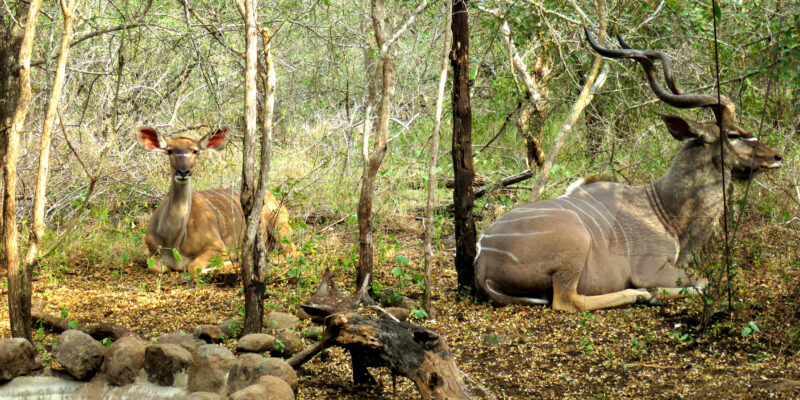
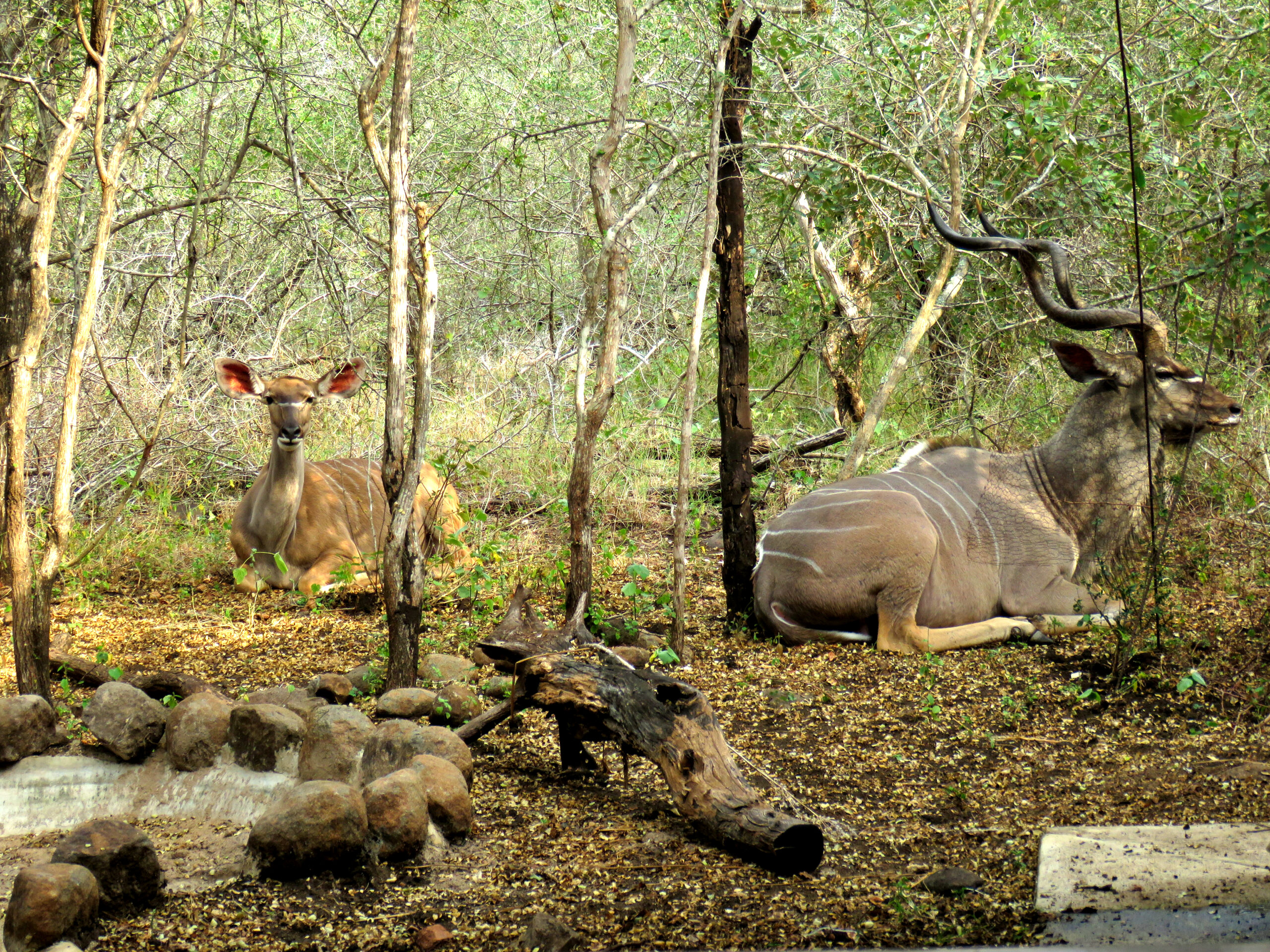
Big Daddy Kudu is resting in the bush, awaiting the arrival of a female.

No, most of us weren’t courted by our significant others making “train noises.” But, it’s easy for most of us in relationships to recall the methods that members of our species implemented to express an interest. Whether it was a feature of one’s appearance, their scent, often referred to as pheromones, words spoken, or a plethora of other signals humans utilize, knowingly or not, to let the other person become aware of their interest and intent,

Animals in the wild are no different. Their language among one another may not be known to us in most cases, but it’s easy to detect, as we observe them in the wild, that they have no difficulty communicating with one another. Today’s video and a few photos illustrate this point.

Shortly after that, this female arrived, sitting a short distance away, an example of a subtle and gentle approach.

Who are we to say it’s purely instinctual when the process can be so complex, as we currently observe each day? Living in the bush, day after day, we are gifted with the opportunity to observe these interactions, often subtle and gentle, and at other times, bold and forthright, as shown in the above warthog video.

We hope in many months to come, we’ll see the “fruits of their labor” and be able to revel in the newborn nature has born to these precious animals. Only time will tell if we will be able to stay. The warthog gestation period is from 152 to 183 days; the kudu is 240 days, and the bushbuck is 182 days.

Last night, we had dinner with Linda and Ken at Jabula Lodge and Restaurant and had a fantastic evening. The food, as usual, was delicious, the service was beyond reproach, and the four of us, as always, never had a lull in delightful conversation. Tom and I often arrive an hour before a planned meeting time with friends to have fun sitting at the bar, chatting with Dawn and Leon and their trusty, warm and efficient manager, Lyn.

This is The Imposter, rubbing his scent on a tree. We’ve seen a lot of this “marking” on a few chosen trees in the garden.

There were few guests when we arrived at 5:00 pm, 1700 hours, but after we took our table an hour later when Linda and Ken arrived, more and more diners filtered in. It feels safe there with the employees well masked and the tables sensibly socially distanced. Hand sanitizer is readily available in all areas.

Tonight, Linda and Ken are coming for dinner with sundowners with snacks at 4:00 pm, 1600 hours. Dinner, suitable for all of our “ways of eating,” will be served a few hours later. Today, it’s surprisingly cool and windy. If it becomes any cooler and stays this breezy, we may have to dine indoors at the dining room table, which we did on another occasion when they were here, when it was raining in buckets.

The reason we’ve recently seen two Big Daddies certainly has to do with the fact that several females frequent our garden.

We’ll be back with more tomorrow as the adventures in the bush, nature at its finest, continue.

Have a fabulous weekend!

Photo from one year ago today, May 1, 2020:

A parade of elephants crossing a dirt road in Kruger. For more photos, please click here.

A most exciting trail cam photo!!!…

Last night’s trail cam photos picked up this porcupine! We are so excited to see this! The prospect of getting this photo prompted us to purchase the trail cam.

Each night since we received the trail cam a week ago, we have been hopeful that somehow one night, it would take a photo of the porcupine that Tom has seen six times and me, once. When I got up after Tom, I asked the new question I’ve been asking him each morning, “Did you look at the trail cam photos? Anything exciting, honey?” He’s said each day, “Nothing unusual.” This morning he said, “You’ll have to see for yourself.” It was at that moment I knew. The porcupine showed up in the trail cam photos. I couldn’t shower and get dressed quickly enough.

Holding my breath, I inserted the card reader with the camera data card into my laptop, a fresh cup of coffee in hand, and quickly scrolled through the photos to find the photo above. No, it’s not as straightforward as we would have liked. I did my best editing it a little to enhance the image. But, in the dark, at night, it was the best photo the trail cam could get. Nonetheless, we’re thrilled. Based on how often Tom has seen it, this porcupine may be a regular in our garden. In the past month, collectively, we’ve seen it seven times. Sure, there’s a possibility it could be more than one porcupine, but most likely, it’s the same one over and over. Porcupines are not territorial as per this statement:

“Social system – Porcupines are solitary during much of their lives. Exceptions occur during the winter when as many as 12 may den communally and during courtship. Porcupines are not territorial, although an individual may drive others from a tree in which it is feeding during the winter.”

Warthog’s wiry hair on their backs stands up when confronted and during mating activities.

Facts about porcupines from this site:

“Porcupines are large, slow-moving rodents with sharp quills on their backs. They are found on every continent except Antarctica. Scientists group porcupines into two groups: Old World porcupines, which are found in Africa, Europe, and Asia; and New World porcupines, which are found in North, Central, and South America. The North American porcupine is the only species found in the United States and Canada.

Sharp quills

All porcupines have a few traits in common. The most noticeable trait is the long, sharp quills that cover their bodies. According to National Geographic, some quills can get up to a foot (30 centimeters) long, like those on Africa’s crested porcupine. 

Porcupines use the quills as a defense. They may shake them, which makes them rattle, as a warning to potential predators. If that doesn’t work, they may charge backward into the predator. According to the Animal Diversity Web, the quills are loosely attached but cannot be thrown or projected. Some quills have scales or barbs that make them very hard to remove. Once a quill is lost, it isn’t lost forever. They grow back over time. A North American porcupine can have 30,000 or more quills, according to National Geographic.

In his full glory, One Tusk is ready to protect “his new territory,” our garden in Marloth Park.

Size

The largest porcupine is the North African crested porcupine. It grows up to 36 inches (90 centimeters) long. The smallest is the Bahia hairy dwarf porcupine. It grows up to 15 inches (38 cm) long. Porcupines weigh 2.5 to 77 lbs. (1.2 to 35 kilograms), depending on species, and their tails can grow up to 8 to 12 inches (20 to 30 cm).”

When and if we’ll ever get a daylight photo of a porcupine remains to be seen. We’ll continue to check out the trail cam photos every day to see what other treasures we can see that enter the garden in the evening. With winter approaching and darkness falling earlier each evening, we look forward to many more exciting trail cam photos, along with the photos we take daily from the veranda and when driving in the park.

There are glands around the warthog’s eyes that produce a secretion during mating seasons and social interactions.

Next week, when the ten-day school holiday period ends, and it’s no longer necessary to make an appointment to enter, we’ll be heading back to Kruger National Park for more stunning wildlife sightings, which we look forward to sharing here. Our permanent Wild Card (year-long entrance pass) has arrived, and we’re chomping at the bit to get back out there.

Tonight, we’re heading to Jabula for dinner with dear friends Linda and Ken, who are here in Marloth Park right now. It’s been several weeks since they’ve been here, and we have plenty of catching up to do!

Have a pleasant weekend filled with exciting surprises!

Photo from one year ago today, April 30, 2020:

Female lions lounging in the shade, re-posted one year ago while in lockdown in India. For more photos, please click here.

This morning’s events in the bush…Mating season is in full bloom…

Tom noticed this dung beetle rolling his ball in the garden at quite a distance. We were thrilled to get these shots.

We only need to pay close attention to what’s transpiring around us to witness the behavior of the wildlife that is not only funny but astounding at times. This morning was no exception after we finally finished our tasks and were able to sit outdoors on the veranda with our coffee.

This morning around 7:00 am, I got out of bed to open the rolling shade in the bedroom to peek at what was transpiring in the garden. When I didn’t see any visitors, I rolled back into bed, figuring I could read the daily news on my phone before getting up.

A few minutes later, I heard a sound on the window’s glass. Bossy, my favorite female kudu, was nudging the window in an attempt to get me up to deliver her some pellets. Of course, I bolted out of the bedroom to ensure she had plenty of her morning pellets. As Tom always says, “They have “us” trained.”

Moments later, he was on top of his dung ball.

Once I’m up, showered, and dressed for the day, the time seems to get away from me. I can’t believe how busy I am sometimes, considering I don’t have to clean the house. My mornings are full of folding and putting away laundry from the portable rack, prepping a few items for dinner, and tidying up before Zef and Vusi arrive to clean.

It’s no different for Tom. First, he empties the dishwasher and puts everything away. Next, he fills the four ice cube trays placing the ice into freezer Ziplock bags, and then into two drawers in the tiny freezer and serves two pitchers of water from the water machine, which is a slow process, and then refills the trays with the purified water. He does this two or three times a day. We use a lot of ice.

When I think back to those ten months in lockdown in India, we didn’t use any ice. It would have cost us a fortune in tips to get a sufficient amount of ice delivered to our room each day in their tiny ice buckets when there was no available ice machine for the guests to use.  We gave it up along with other familiar comforts during that period.

Two hungry hornbills were pecking at the kitchen window, hoping for some seeds. We complied.

Then, he makes a big pitcher of Crystal Lite Iced Tea which arrived in our recent DHL package from the US, just days before we ran out. Louise loaned us a giant spouted jug for the ice tea, so he doesn’t have to make the iced tea more often than every three days. That helps.

After most of our tasks are completed, finally, we can sit outdoors. At the same time, I manage photos, prepare the post, and handle financial matters, keeping track of our spending, often requiring daily attention. Amid all of this, we’re continually watching what’s happening in the bush. Recently, I’ve been back at work on the corrections on old posts and have diligently stuck to my schedule, which takes about two hours a day.

Tom grabs the garden hose and refills the water in the birdfeeder. It’s become a daily task when “everyone” is drinking from it now, including birds and Big Daddies. This morning, Tom had yet to refill the birdfeeder with water. Tiny was busy chasing Lonely Girl around the garden, making the mating “train noise” during a series of intermittent advances on this female warthog.

Ms. Duiker has one tiny horn in the center of her head instead of the male’s two horns.

He wore himself out and walked over to the birdfeeder for a drink of water. When he couldn’t access the remaining water with his giant tusks, he looked at us, and then, in a frustrated flurry of activity, he tried to topple over the huge ceramic feeder. It teetered back and forth but thankfully didn’t fall over. He was mad there wasn’t enough water in there for him to reach.

Tom waited until Tiny moved away and refilled the bird feeder with fresh water. Moments later, Tiny returned for a series of generous gulps. Caution must always prevail when wild animals are unpredictable, and humans can easily be injured.  We always exercise the utmost caution, coupled with common sense.

Big Daddy was in and out of the garden this morning chasing after the “girls.” Right now, rutting season is in full bloom! Mating pairs are everywhere. We will be sharing some of the mating antics as the days roll on, including a few interesting videos. We’re hoping none of our readers are offended by our photos and videos.

This male duiker has been accompanying her for days.

This is “life,” regenerating in the bush. It’s all a part of the magic and wonder of the wild animals surrounding us each day. When we post some mating photos or videos, we will note this in the post’s heading as “Adults only please,” leaving you to decide if you’ll share the post with children and grandchildren. It’s entirely up to you.

Big Daddy, wondering what’s on the menu.

Later this afternoon, we’ll be heading to Komatipoort to shop for groceries. With Linda and Ken coming for dinner on Saturday night and the school holidays not ending until Sunday, we decided to shop today instead of waiting until tomorrow. It will be even more crowded as the last day of the month. We’ll be well masked, gloved, and I’ll be wearing a face shield as an added precaution.

Be well. Be safe. Be happy.

Photo from one year ago today, April 29, 2020:

Tree frog foam nest, made overnight above the cement pond. For more photos, please click here.

Off on a social visit today…Girls only…Busy morning in the bush…New visitor…

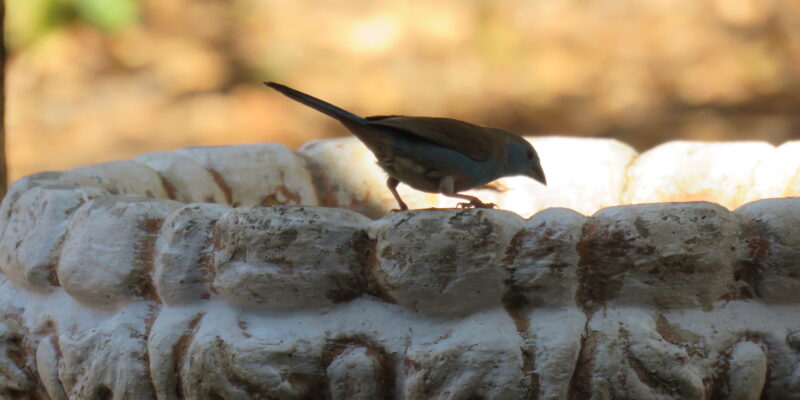
We are so excited to see birds finally stopping by the birdbath for a drink or a splash. Tom keeps it filled with fresh water each day. This appears to be a Blue Waxbill. Please correct me if I’m wrong.

I wish I felt comfortable driving a car in South Africa. However, after not driving a stick shift vehicle for 35 years, I don’t trust myself. Also, driving on the opposite side of the road while shifting with my useless left hand only adds to the potential hazards.

Since having open heart surgery over two years ago, I am less coordinated than I used to be. I’ve read that others have experienced the same phenomenon. Perhaps it’s a result of what is referred to as “pump head” from losing some brain cells after being on the heart bypass machine for several hours during the surgery. Luckily, doing so didn’t impact my memory as it has for many others.

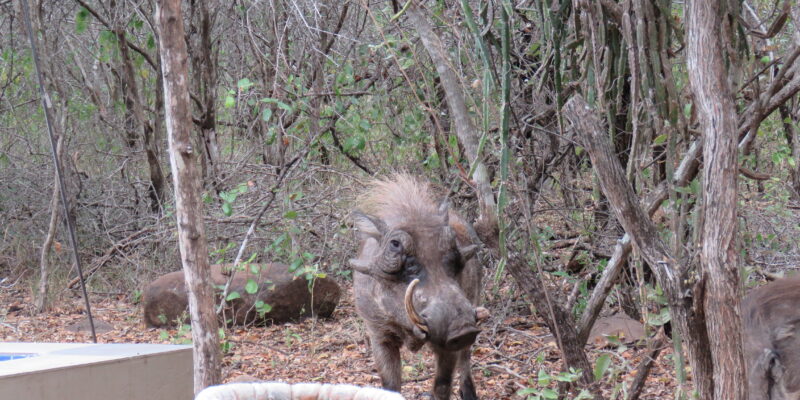
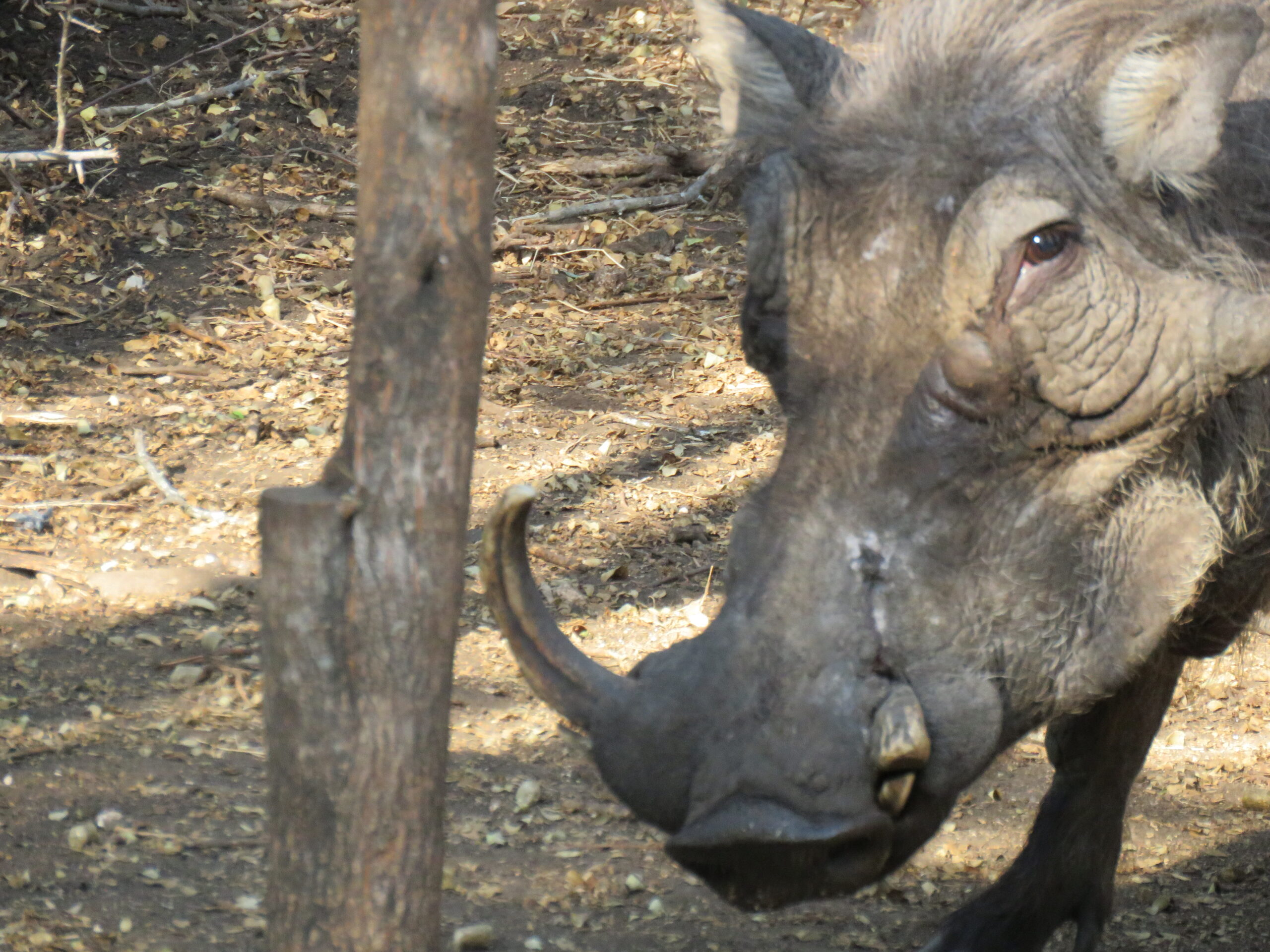
New warthog visitor missing a tusk and both face warts. It appears he suffered an injury resulting in the loss of his left tusk. Face warts may be missing due to inbreeding anomaly. Guess we’ll name him, the obvious, One Tusk.

If there were a choice between memory loss and lack of coordination, I’d opt for the latter. My memory is as clear and concise as it was in my youth, for which I am very grateful. On the other hand, my coordination is only worse than it had been a few years ago when even then, it was lacking.

That’s not to say I won’t ever drive again in countries with driving on the side of the road I’m most familiar with, the right side. Most rental cars in the US, for example, are not manual transmissions. As mentioned in the past, I am not a good driver anyway and have never been.

Duikers in our garden have become braver and braver as they come to trust us while tossing pellets.

At some point in my old age, I will have to face the fact that driving is not safe for me, as is the case for many seniors as their coordination and adeptness fail. I’m always sad to hear when an aging or ill friend has had to give up driving for the safety of themselves and others.

What brought up this driving thing is that today before 1:00 pm, 1300 hours, I’m heading out to visit a local friend, Debbie, in Marloth Park. She didn’t have access to a vehicle to visit us here, so I offered to come to her home, and today was the day. Tom will drop me off at her home and pick me up a few hours later. It will be great to have some “girl talk,” something I’ve missed off and on in our travels.

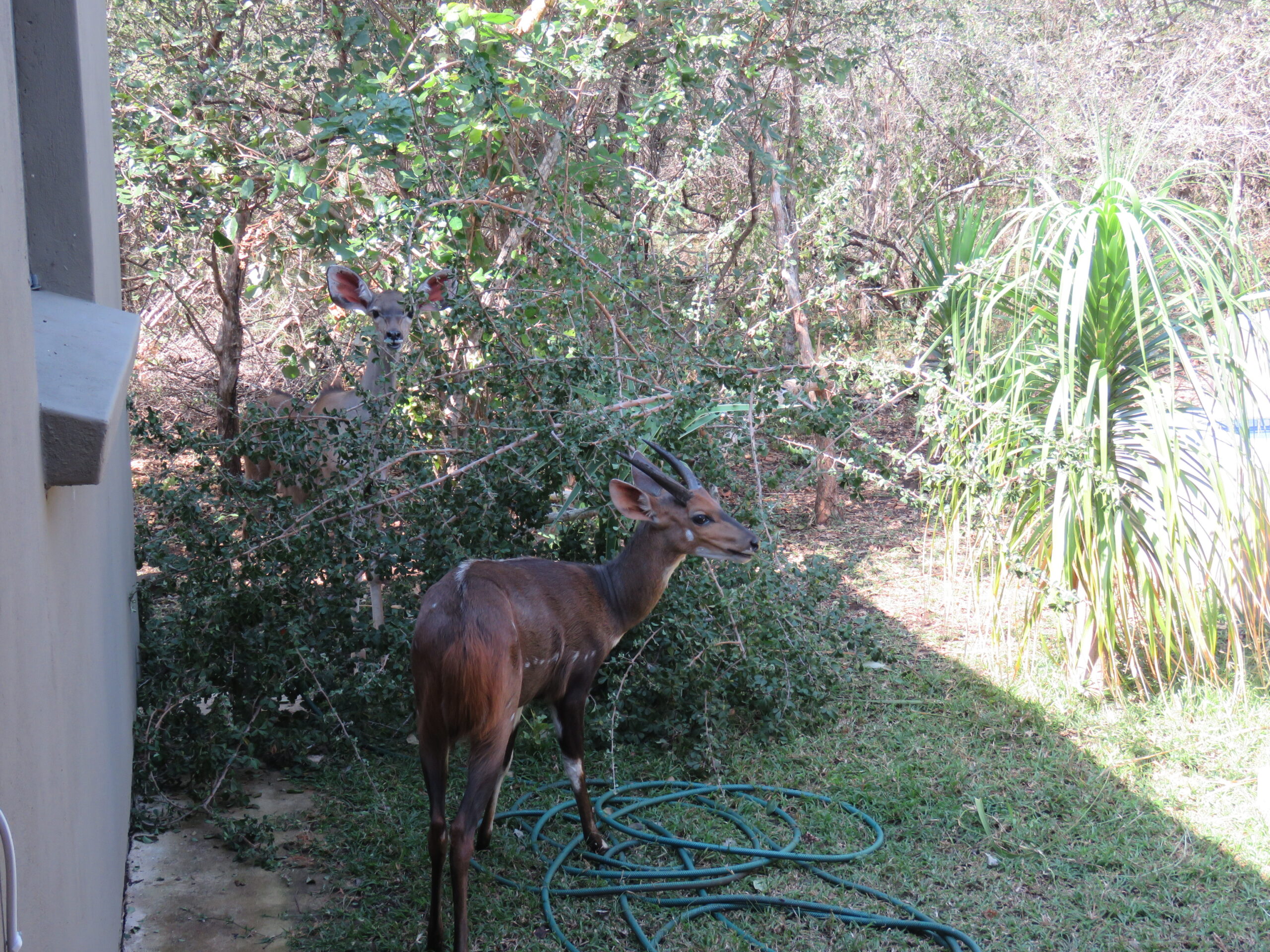
This bushbuck visits for hours each day.

Most get-togethers we’ve experienced since getting to Marloth Park months ago have been as couples, which undoubtedly we thoroughly enjoy. But, those special one-on-one conversations with friends are something both of us had to forgo in our life of world travels.

Fortunately, I’ve stayed in touch with most of my old friends in Minnesota and have an opportunity to see them when we return to the US for visits every few years. And, from time to time, I speak on the phone, on Skype, or Messenger to my dear friends. from my “old life” and also those new friends I’ve made in our travels.

We’ve named this male bushbuck. Thick Neck, when we observed his neck is considerably more significant than the other males.

This Saturday night, our dear friends Linda and Ken, headed to Marloth Park from Johannesburg in a few days, will be coming for dinner. It’s always fun to hang out with the two of them. When dear friends Kathy and Don arrive from Hawaii in June and July, we girls will certainly arrange some “girl time” as we’d done in the past.

Also, our dear friends Rita and Gerhard will be arriving in the next few weeks and surely Rita and I will have some girl time during the almost two months they will be here. It’s comforting to know that social interactions will increase down the road, adding to the pleasure of our time in Marloth Park.

Thick Neck rested in the garden for hours.

This morning, it was busy in the bush. We saw several “new” (to us) warthogs, some with exciting characteristics that make it easy to identify them when they return. Each morning, we’ve been checking the photos from the trail cam’s overnight photos. So far, no porcupine or unusual visitors. As soon as we see any less frequent or nocturnal animals, we’ll certainly share them here. In the interim, it is fun anticipating and checking out the photos each morning.

While Zef is washing the veranda, we are inside the bedroom, waiting for it to dry so we can go back outdoors. Big Daddy is looking at us through the bedroom window, wondering when we’ll come out to toss him some pellets. Hold onto your shorts Big Daddy! We’ll be there soon!

We’ll be back with more tomorrow. Have a fantastic day!

Photo from one year ago today, April 28, 2020:

Mr. & Mrs. Hornbill was eating seeds off the veranda table. We weren’t able to put up the birdfeeder with monkeys nearby and placed the seeds on the table after they’d banged at the window with their beaks to remind us to feed them. For more photos, please click here.

An important message from a dear reader…

This is One Wart. As shown, he only has one wart on the left side of his face and none on the right. Hence, his name.

Pam, a longtime reader of our site, wrote:

“Was thinking of you and Tom today after watching the tragic news on the Covid-19 situation in India. I’m so glad you were able to leave when you did! I was just amazed at your skill in arranging those flights just at the right time while there was that small window of opportunity. I attached a brief news clip showing the 5-star hotels in Mumbai used for Covid patients. Who knows if the hotel you were in would have been next? What an unsettling thought, but thankfully that is all behind you now.”

Here is the link to the video Pam attached to her email message https://youtu.be/FmqFTIJ-Uxk.

Wildebeest Willie in the garden.

Undoubtedly, the Covid-19 news from India, which we’ve followed since we left over three months ago, is disheartening and alarming, not only for the Indian people but also for all of the world. Will this hotbed of Covid keep the world from ever recovering? It’s hard to say. Even scientific and medical experts aren’t able to predict!

Thank you, Pam, for writing and your kind and thoughtful message. It wasn’t so much skill that got us out of India when we did. It was based on the sheer terror of what was yet to come, which proved to be a huge motivator. When each day we spotted dozens of guests in the corridors, talking loudly in nearby groups, not wearing masks or social distancing while continuing to have parties and weddings at the hotel, we knew India was in big trouble.

Several impalas stopped by, all the while “barking” over the pellets.

When I left the hotel midway through our stay to go to an ATM with the hotel’s driver, the numbers of people in the streets, in crowds, in groups and entering shops without masks or social distancing, it was easy to see, there was no way, their previously low numbers of cases and deaths would ultimately last.

Statistics, such as those shown in the Covid-19 world tracker, Worldometer, found here with over 319,000 new cases yesterday, far surpassing any country’s number of cases in one day, are alarming. Sure, India has almost 1.4 billion people, four times the population of the US, for example, which had 47,456 new cases yesterday, still an outrageously high number.

Impalas are skittish around humans. Thus, I took this photo while seated, or they’d have run off if I’d stood.

It’s also easy to surmise that India’s numbers aren’t as accurate as many other countries, with their medical infrastructure rapidly failing due to a severe lack of support equipment, staff, and space for victims. Now, they are housing non-ICU patients in hotels when hospitals are full of ICU patients dying from a lack of available sources of oxygen and medicines.

Yes, this is morbid and surely considered to be less than ideal fodder for our post. But, as upbeat as we strive to be, we can’t and won’t put our heads in the sand and deny what is transpiring in the country from whence we came only a few months ago where we spent over one year of our eight years of world travel. Our hearts are breaking for those patients, their families, and the overwhelmed medical professionals.

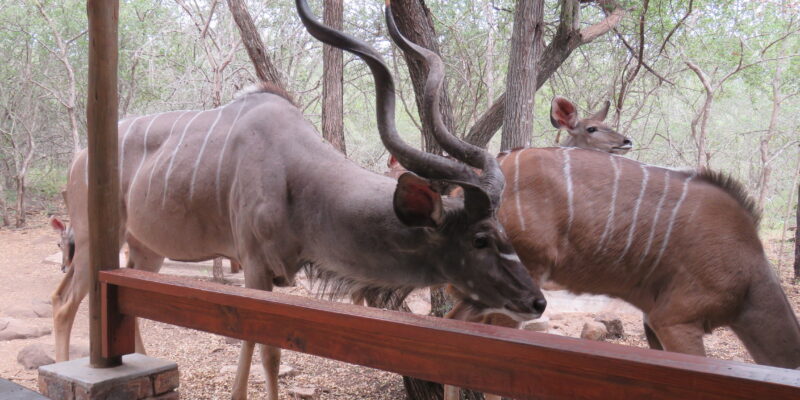
Kudus are used to hanging around with impalas, and they all get along well.

We can only hope that other countries with surplus supplies can continue to step in and help. We read this article regarding participation by other countries in providing supplies and aid to India. How do you vaccinate 1.4 billion people? How many cases aren’t being reported? How do you treat millions currently in the throes of the virus? It’s heartwrenching.

Yes, dear reader Jan, thank you for writing to us. No words can express how grateful we are to have been able to leave India and now be in this paradise-like environment, relatively safe from the virus if we remain diligent. We are on a list of 500,000 in South Africa who have signed up for the vaccine. But, with a population of 58.6 million, that half-million is only the tip of the iceberg. It’s less than 1%.

There’s a warthog in almost every shot, hoping to steal pellets from others.

They were deluding themselves, any speculation by “experts” that this pandemic may be over in 2022 or 2023. All of us can choose to take responsibility for doing our part to stay safe as we possibly can, even after receiving a vaccine, even after having had the virus, even after taking every possible precaution we can muster.

Stay safe, stay healthy, and pray along with us for the world’s recovery.

Photo from one year ago today, April 27, 2020:

These tropical island musicians and dancers greeted us in Noumea, New Caledonia. For more from the year-ago post, please click here.

Is this enough?…

Big Daddies in the garden, getting along well with a female while they eat pellets.

A few days ago, Tom asked me, “Are you bored or antsy?” Is this enough?”

I giggled when I answered. “With the world still in some form of lockdown or another, there is nowhere I’d rather be.”

Without question, I have a short attention span and can easily become bored or antsy. Throughout my life, I’ve learned to find ways to entertain myself to avoid boredom or discontent. As Tom and I have discussed on many occasions, if we were living in a condo somewhere right now, waiting out the hopeful end of the pandemic, I could easily be climbing the walls in search of mental stimulation. He doesn’t experience such an issue.

Helmeted Guinea-fowls stopped for another visit. Their chicks are getting big, but no blue heads quite yet.

How in the world did I ever maintain my sanity during the ten months in that awful lockdown in India? The only way it was possible was to develop a consistent routine and stick to it. This may sound counterproductive. But, in that particular situation, the routine saved me; the daily posts, the 8 km walk in the corridors, working on the new website, along with endless hours in research on many of my favorite topics.

Another shot of guinea-fowls and chicks.

Tom was content to be on his laptop researching ancestry.com and other websites that appeal to him. We both enjoyed it when it was 3:00 pm when we began streaming favorite series with multiple seasons. That time wrapped in mindless drivel helped us both so much. We don’t need to do that now, although we may stream a few shows when we go to bed.

Of course, being with Tom helps me considerably. He constantly makes me laugh and brings up topics he knows I’ll enjoy contemplating and discussing. We never run out of conversation. Even here in Marloth Park, we’ve developed a routine that only adds to our sense of fulfillment and lack of boredom.

Mongoose is waiting for Tom to come out with a pan of scrambled eggs.

As it turns out, we do most of our chatting in the late afternoon when we may decide to have a beverage, referred to as “sundowners” here in South Africa. These may be iced tea, hot tea, or a glass of wine for me or a cocktail for Tom, depending on what feels right at the moment.

Tom lights the various citronella candles and coils to keep the mosquitos at bay while I put last-minute touches on what we’ll be having for dinner. Then, for the first time all day, we relax and unwind, engaged in lively chatter, sharing thoughts, dreams, and hopes for the future.

This is our boy, Torn Ear. Enlarge the photo to see his left ear is torn.

Often, we relive travel experiences of the past almost nine years of world travel. At times, we look at old posts and recall the magic moments along the way. It’s never dull. It’s never boring. At other times, we discuss plans for the future. Right now, we are considering where we’ll go when our visa stamps are needed by June 30th. At times, we grab my phone and look up the Covid-19 restrictions for various countries, which may change daily.

Little and guinea-fowl, getting along nicely.

Then, of course, we have the exquisite opportunity to engage with the wildlife that enters the garden throughout the evening. Although most wildlife comes to visit us for the pellets or whatever species-appropriate morsels we may have to offer, we can’t help but consider they may be seen since it’s “fun” here. We can dream, can’t we?

We can’t help but embrace both of these. The concept of living in the moment and dreaming of the future seems to work for us. It was that belief that got us both through those challenges ten months in India, and now, more than ever, we appreciate our sheer determination to get out of India, just in time when Covid-19 has grown to horrific levels.

Big Daddy politely shares pellets with the girls.

Need I say how grateful we are? Never a day passes that we don’t take time to reiterate how happy we are to be here, leaving no thoughts or time for boredom.

It’s always wonderful to see them all sharing the pellets as opposed to headbutting.

Stay safe and continue to protect yourselves and your loved ones.

Photo from one year ago today, April 26, 2020:

Two Big Daddies head butting for dominance. For more year-ago photos, please click here.

Photos from our new trail cam…What we’ve learned…

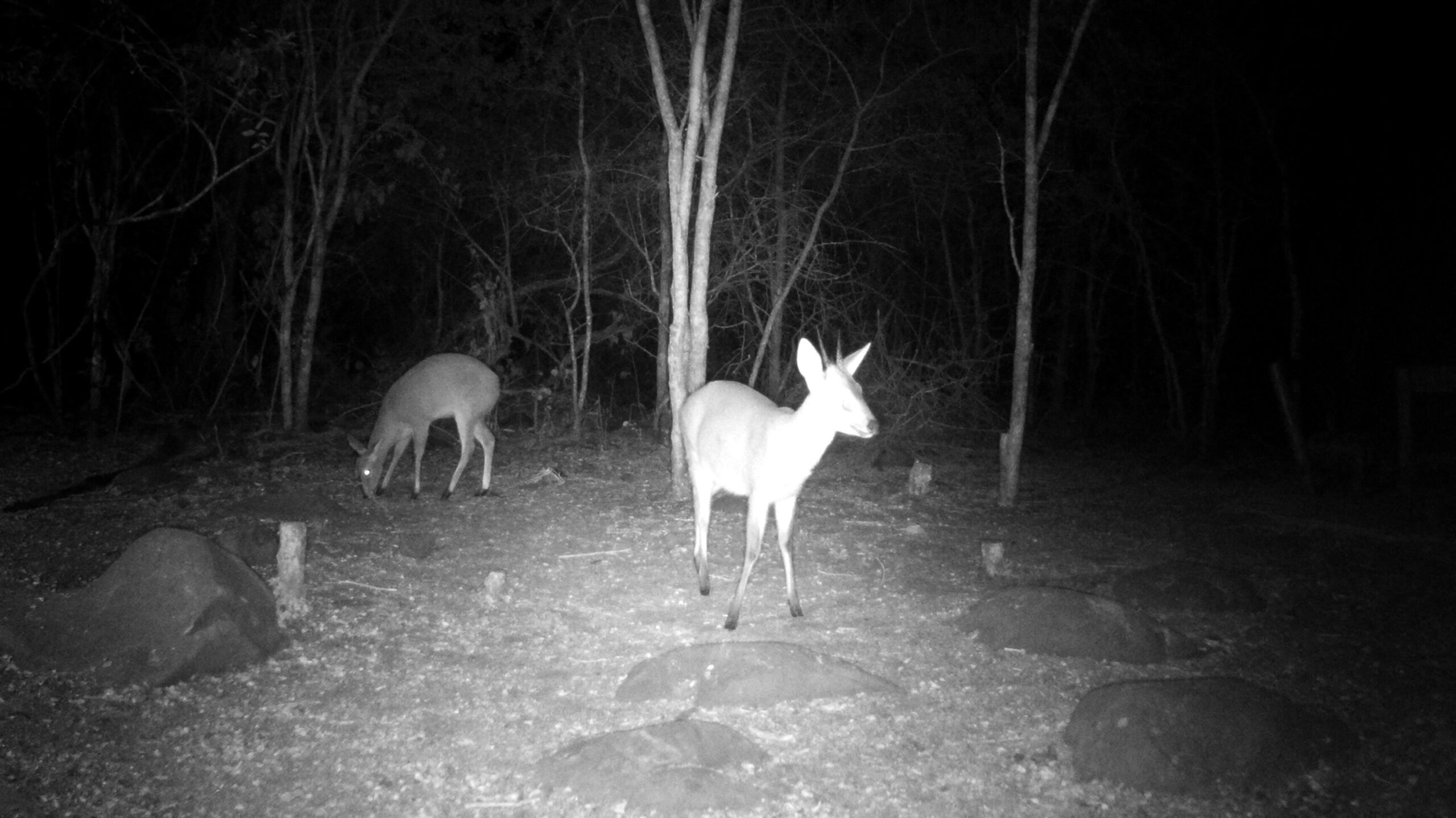
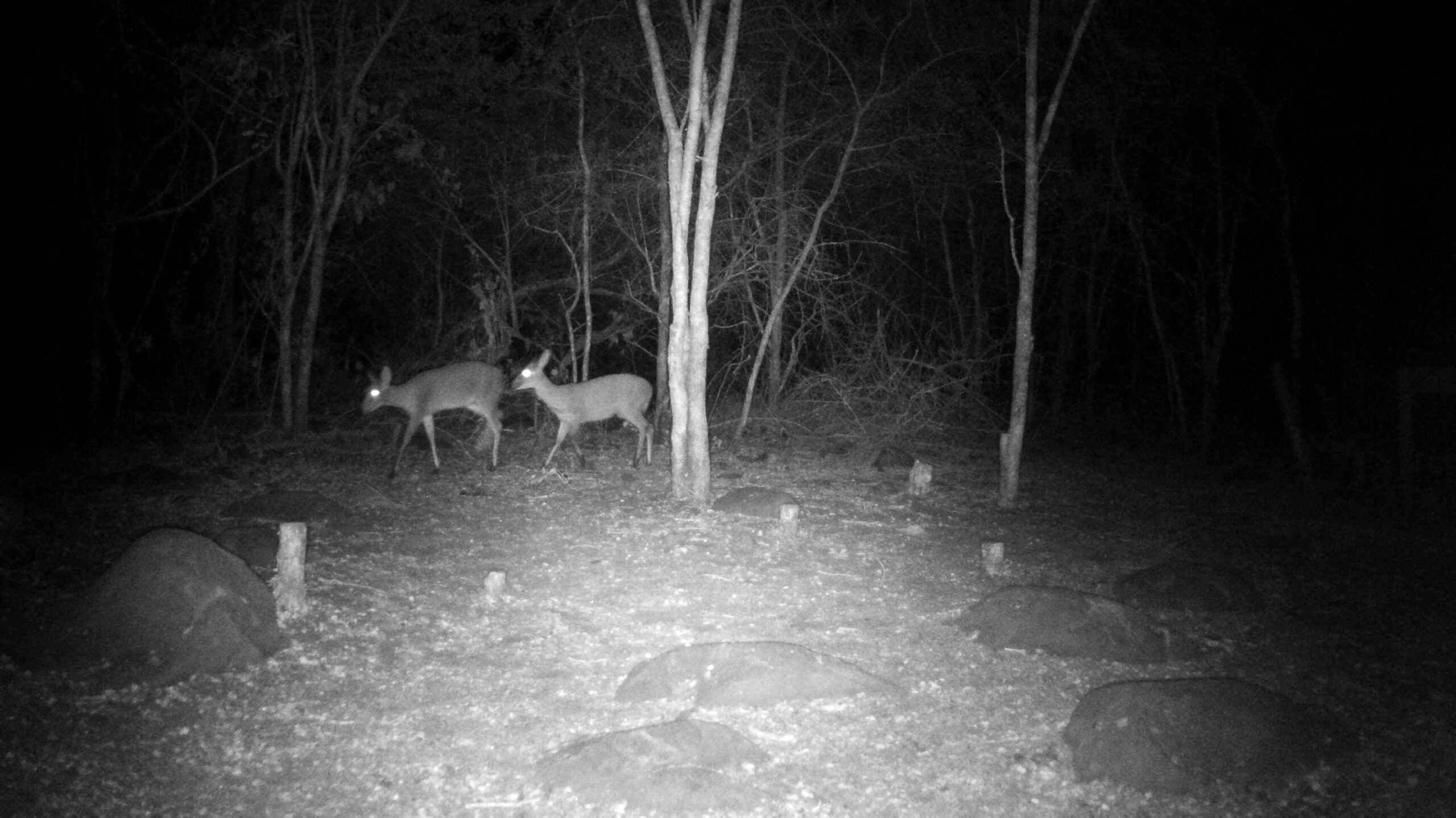
Two duikers at night.

When our package arrived from the US through DHL a few days ago, we were excited that the trail cam we’d ordered from Amazon was inside. Also, my new Fitbit Sense was in the box. We decided Tom would set up the trail cam while I worked on setting up the latest Fitbit, both of which presented a few typical set-up challenges.

Finally, we had both pieces of equipment working, and I was able to do my first ECG using the Fitbit, which had been approved as a reliable device for this purpose by the US FDA (that’s not to say I trust everything they recommend). With a typical result, it did provide me with a bit of peace of mind, knowing at any time, I can check this on my own.

Most likely, a mating pair.

As for the Campark T-75 trail cam, that setup was a little more time-consuming and still requires some adjustments, which we’ll tackle today. After using the trail cam for the first time last night, we realized the first thing we’ll do today is reduce the number of shots it takes in one night. We ended up with over 5000 photos, way too many to go through each day.

We managed to go through all the shots and have included a few of them today, not necessarily anything unusual from those we see during the day.  No porcupine yet! But we’re committed to getting a night photo of her and other nocturnal visitors we may not see during the day. We won’t be using the trail cam during daylight hours; instead, we will stick to using our camera and posting those photos in most posts. We’ll post the more interesting trail cam photos.

The same two duikers in the garden at night.

We’d assumed that photo ops would be at a minimum during the busy school holiday week. But, as we sit here now on Sunday close to 1:00 pm, 1300 hours, we’re in awe of how many animals have been here this morning, including two Big Daddies, once of whom stood at the edge of the veranda and barked at us, forcing us to gingerly make our way indoors to give him the space he needed.

This was a first for us. We’re cautious around the Big Daddies. They are vast and dangerous, and we take no risks whatsoever. As I write this, he has wandered off into the bush, ducking his massive horns as he makes his way through the dense trees and bushes.

We weren’t able to determine which warthog this was.

He ‘tipped” his horns a few times at two young warthogs who seemed determined to torment him for pellets. But, they squealed off when he reminded them of his power and strength. A few days ago, the tree he tore down had been eaten by a wide array of antelopes and was beginning to look sparse. He meandered over to it this morning but didn’t seem interested in any of the remaining leaves.

It’s amazing how almost every day, something new and exciting transpires in the bush. Yesterday, we had a dung beetle rolling a nice-sized ball of dung right next to us on the veranda. The ball got stuck against the edge of the grass and the pool, and Tom, using a mop handle, released it for him. Soon, he’s back on his way, happily rolling his ball of dung, hoping to encounter a female in his travels.

We knew warthogs visit during the night.

We only need to sit here long enough for yet another magical event to take place, all the while relishing in the regulars who come to call consistently. Sometimes, when it’s hushed, I begin to wonder if they’ll ever return. Then, to our delight, there they are again, gracing us with their presence in exchange for a tasty morsel or two.

As I write here now, 20 or more mongoose have returned after we’ve already fed them this morning, only a few hours or so ago. We gave them scrambled eggs and bits of meat and bones we’d saved for them. They’ll circle the house a few times and return, perhaps thinking we “forgot” we already gave them treats suitable for their diet as omnivores with a propensity for meat. Fortunately, today, we’ve saved a little meat for their second visit.

We are always searching for pellets.

Today will be another quiet day. So far, the only noise we’ve heard from holidaymakers was the sounds of adults and kids talking loud and screaming in a pool. Blissful! After a short while, the noises ended, and we were able to enjoy another quiet evening in the bush, only occasionally interrupted by the sound of the roars by lions Dezi and Fluffy nearby.

Another shot of the two mating duikers whom we rarely see during daylight hours. They are timid.

Have a fantastic day!

Photo from one year ago today, April 25, 2020:

Happy caterpillar dancing across the floor! Later on, we learned these caterpillars cause a nasty itch that lasts for days when coming in contact with their venom. We also learned these are Processionary Caterpillars who form a train and crawl up walls, verandas and form a train across the garden. Not so cute, after all. For more from the year-ago post, please click here.

A tree pulled down!!!..Poop in the bush?…

Everybody was busy munching on Big Daddy’s fallen tree.

The only animal in our garden right now is The Imposter, this time, without his little buddy, Narrow Earlier, we had visits from warthog Lonely Girl, Wildebeest Wille, and bushbuck Torn Ear, Since it’s Saturday, the first weekend day of the 10-day school holiday, here in South Africa, we feel fortunate to see any wildlife at all. Yesterday, an unusual event occurred in our garden. Big Daddy (kudu) tore down, using his enormous horns, the main branch of a tree, to gain access to its tasty leaves. As the low-lying bush dries out as winter approaches, male kudus can easily knock down a tree with their massive size and strength.

I was in the second bedroom, putting away laundry when I heard a vast sound hitting the house. Tom was taking a shower and didn’t hear a thing. I ran outside to see what was going on to find Big Daddy happily munching on the moist, lush green leaves on the downed tree. I wish we had seen this happen.

He came in for a few nibbles this morning but moved away when the others came.

But, we managed to take a few photos of the result, which doesn’t do the event justice. Since that transpired, several other kudus and bushbucks have stopped by to partake of Big Daddy’s rambunctious event. We doubt that he and others will stop by to participate over the next week or two while the leaves are still green.

It doesn’t appear that there was any damage to the house when the tree was felled by Big Daddy. Thank goodness for that. Few of the low-lying trees in the bush are sizable enough to cause damage if they are brought down by wildlife. We’ve seen such an event by elephants in Kruger National Park but never here in Marloth Park. When Tom came out to see what had happened during his shower, he too was in awe of the strength of this substantial wild animal. It was rather exciting.

On another note, one of our dear long time readers wrote a comment on yesterday’s post as follows:

“I have to ask, with all of the animals visiting, how do you handle their poo and pee? Thanks for writing, Jan! I keep busy cleaning with our two teacup dogs and can’t imagine the odor and waste from the many large animals that visit you.”

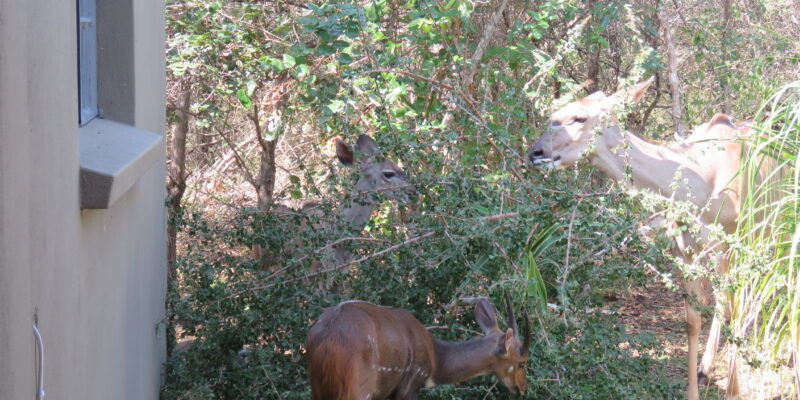
Miss Kudu in the backside of the tree and Mr. Bushbuck were enjoying the fruits of Big Daddy’s labor.

I don’t recall that we’ve ever posted anything on this topic. One would think the sight and smell of poop and pee would permeate the air in Marloth Park. It does not. Nor is it a factor of visitors or residents getting “used to it.” There is no smell and rarely, and I mean rarely, do we ever see an animal poop in the garden.

Most often, they head out to the bush to “do their business” Perhaps it has something to do with the fact that most animals won’t poop where they eat, or they prefer the deep bush setting as more suitable for them. Yes, on occasion, we may see a warthog or a kudu pee, but we’ve never seen a warthog, bushbuck, or kudu poop in our garden. Even then, there’s no smell. I know this sounds hard to believe, but it’s true.

Even Frank and The Misses, who spend considerable time on the veranda each day, never leave a telltale sign of their visits, other than their messy piles of birdseed.

Wildebeest Willie stopped by this morning with a friend.

Before we came to Marloth Park for the first time in 2013, we had wondered the same thing. In no time at all, we realized this wasn’t an issue. That’s not to say we never see wildlife poop when out and about. It’s easy to determine the massive poops of wildebeest. Most locals chuckle when they see it since it’s such an oddity to encounter.

With wildlife only eating vegetation, there’s less of a likelihood of smell. So there it is, folks, the answer to the question that may have left many of our readers curious as to how we can manage to sit outside, day after day, night after night, with animals surrounding us.

That’s it for today! We hope you have a lovely weekend.

Photo from one year ago today, April 24, 2020:

This photo is from the repeated photos one year ago while in India in the lockdown. As we walked the souk, deciding where to dine, these varying roof lines of a courtyard caught my eye. For this post from April 24, 2014, please click here. For the year-ago post with more Marrakesh, Morocco photos, please click here.