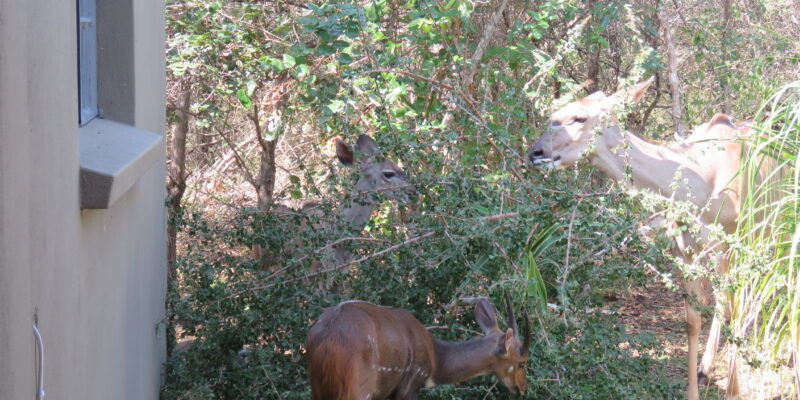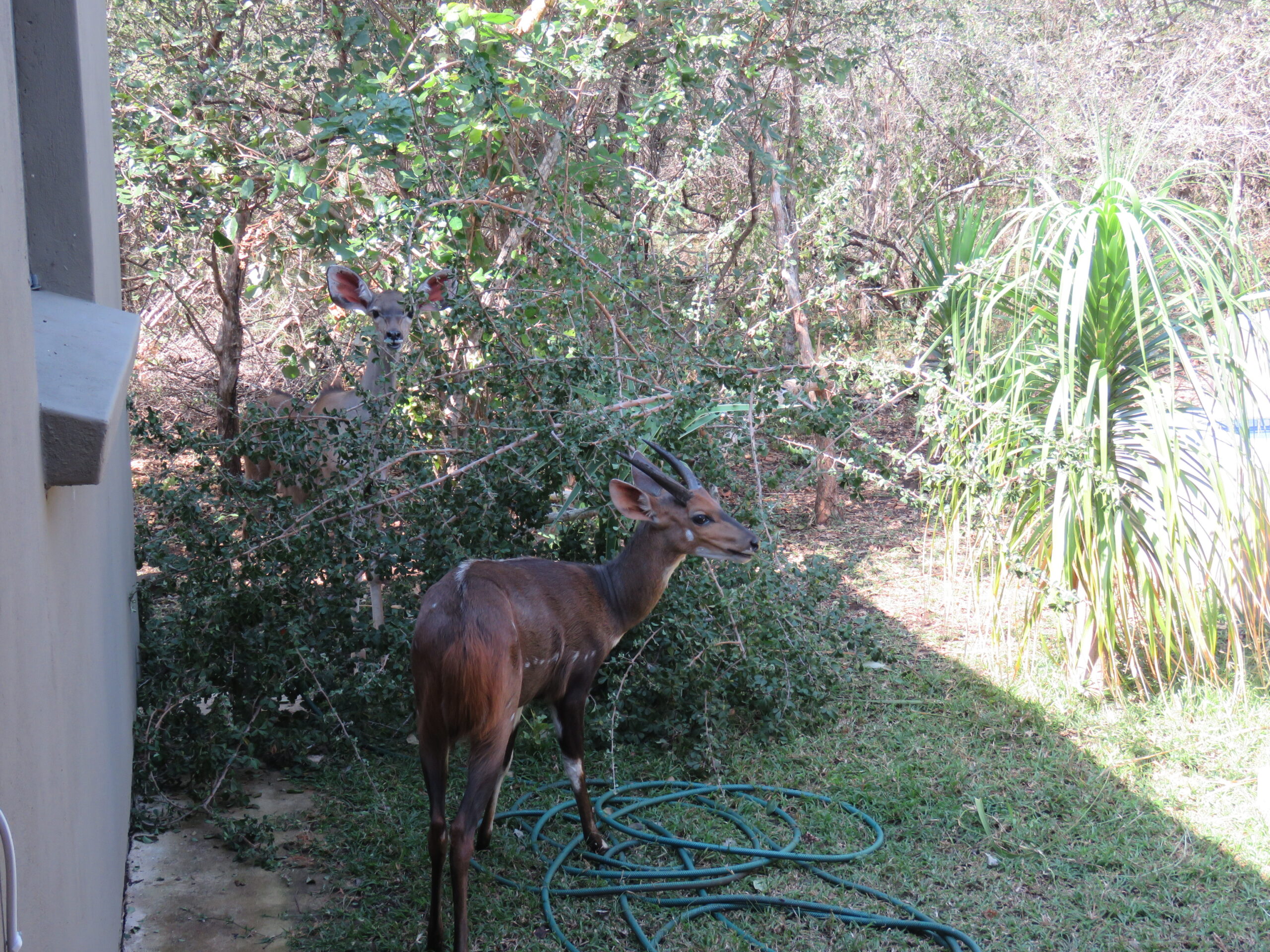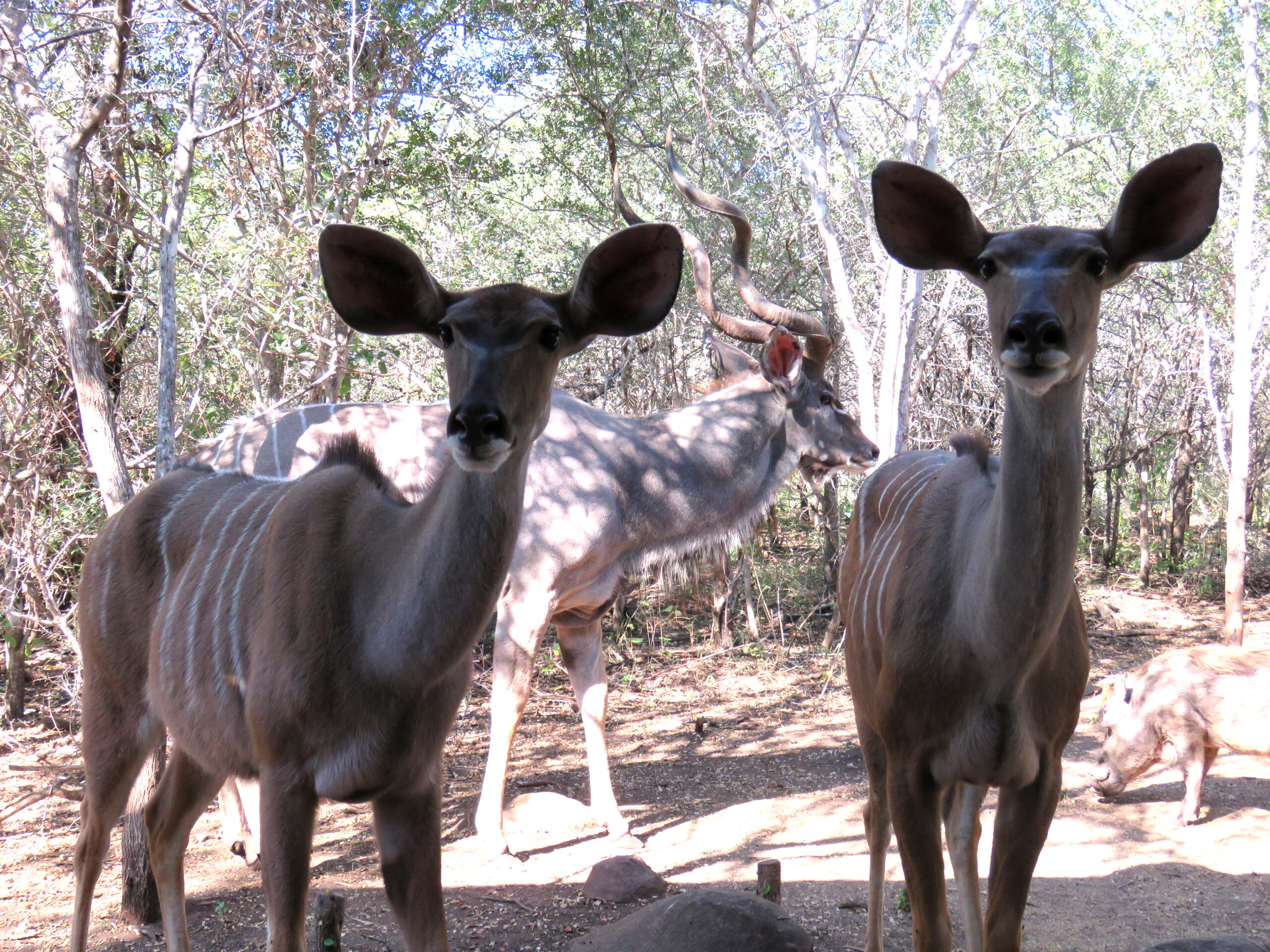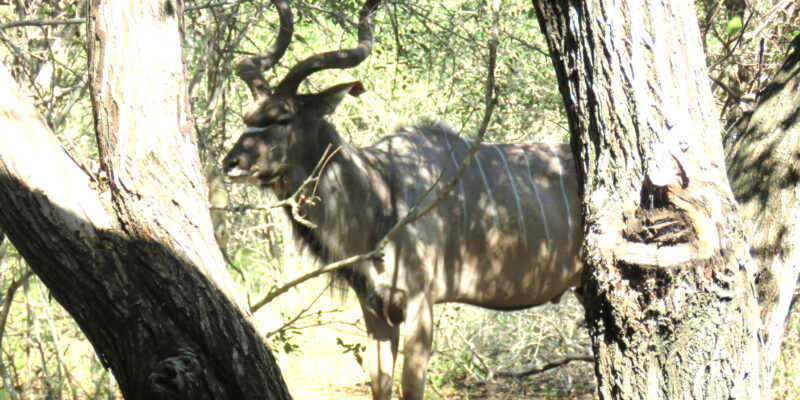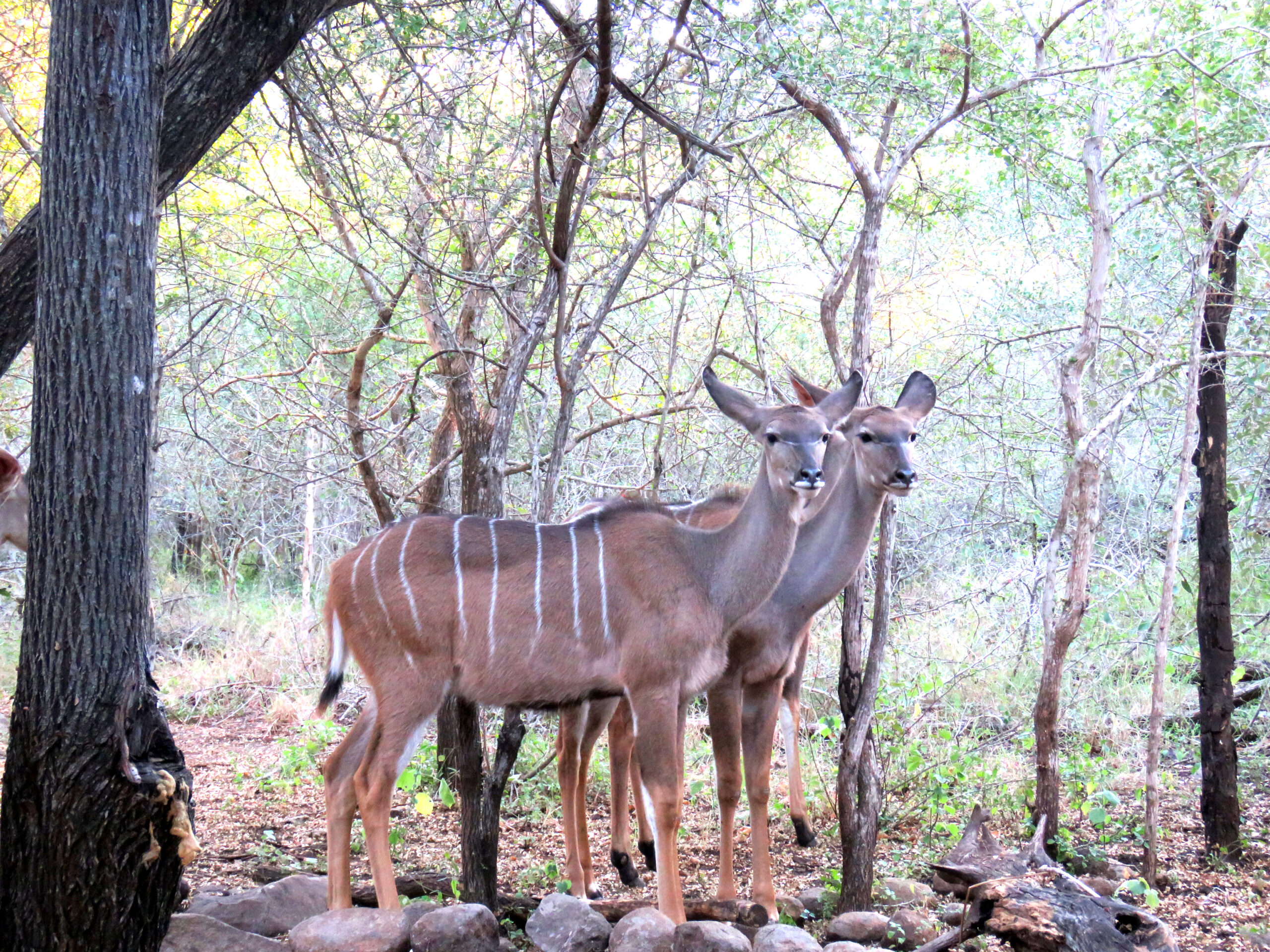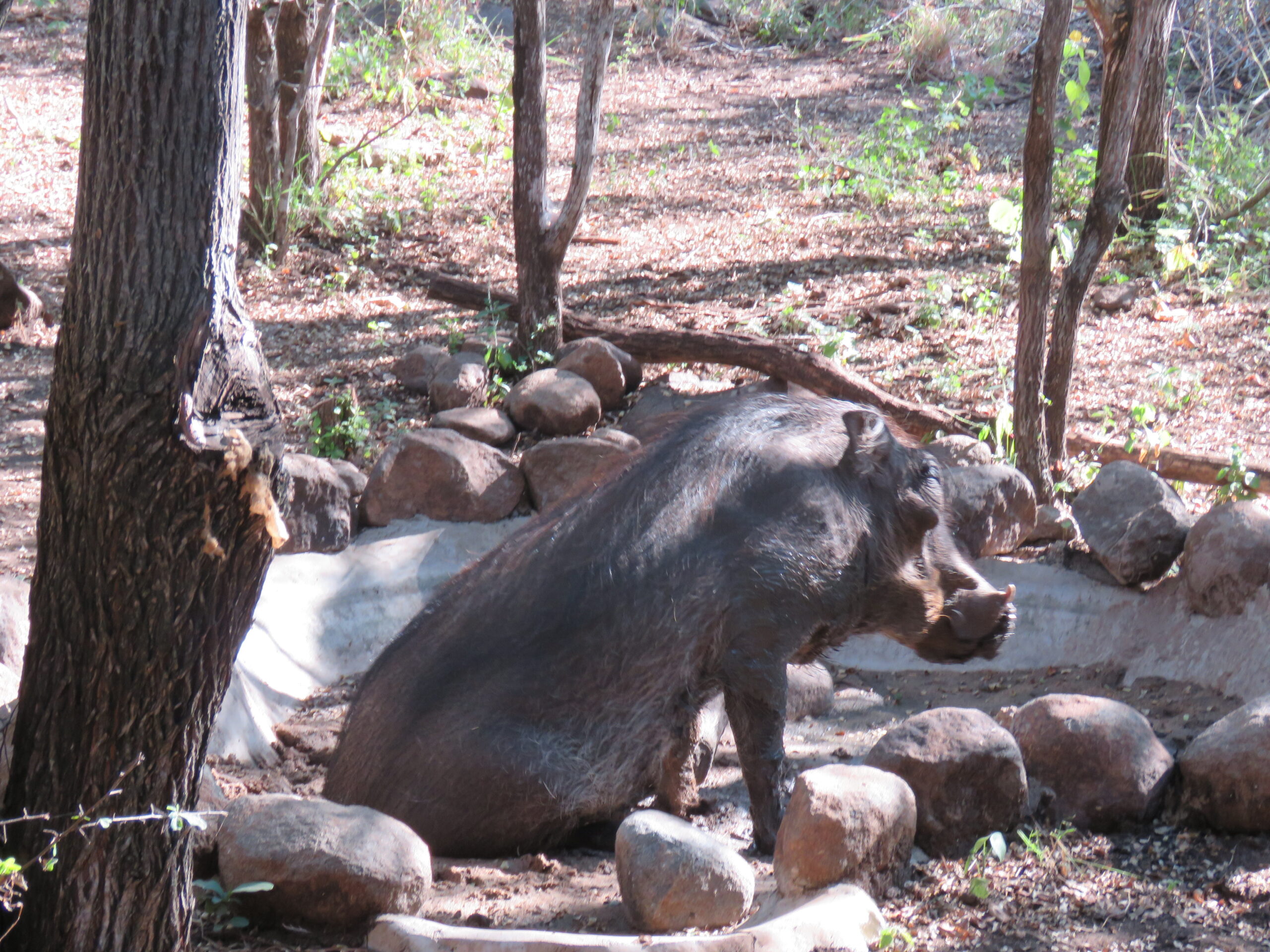
Off on a social visit today…Girls only…Busy morning in the bush…New visitor…

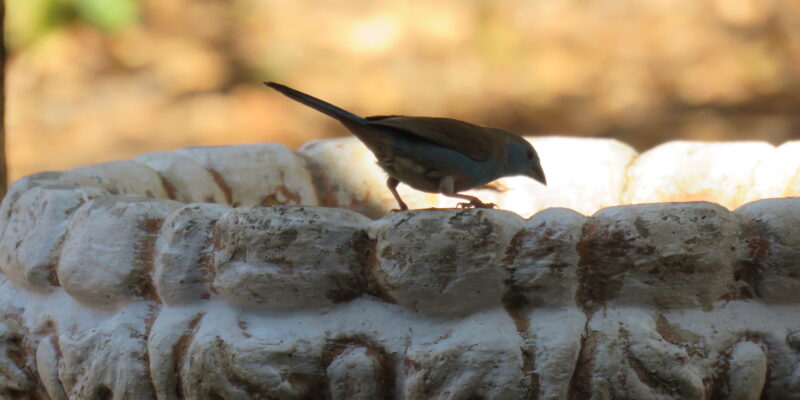
We are so excited to see birds finally stopping by the birdbath for a drink or a splash. Tom keeps it filled with fresh water each day. This appears to be a Blue Waxbill. Please correct me if I’m wrong.

I wish I felt comfortable driving a car in South Africa. However, after not driving a stick shift vehicle for 35 years, I don’t trust myself. Also, driving on the opposite side of the road while shifting with my useless left hand only adds to the potential hazards.

Since having open heart surgery over two years ago, I am less coordinated than I used to be. I’ve read that others have experienced the same phenomenon. Perhaps it’s a result of what is referred to as “pump head” from losing some brain cells after being on the heart bypass machine for several hours during the surgery. Luckily, doing so didn’t impact my memory as it has for many others.
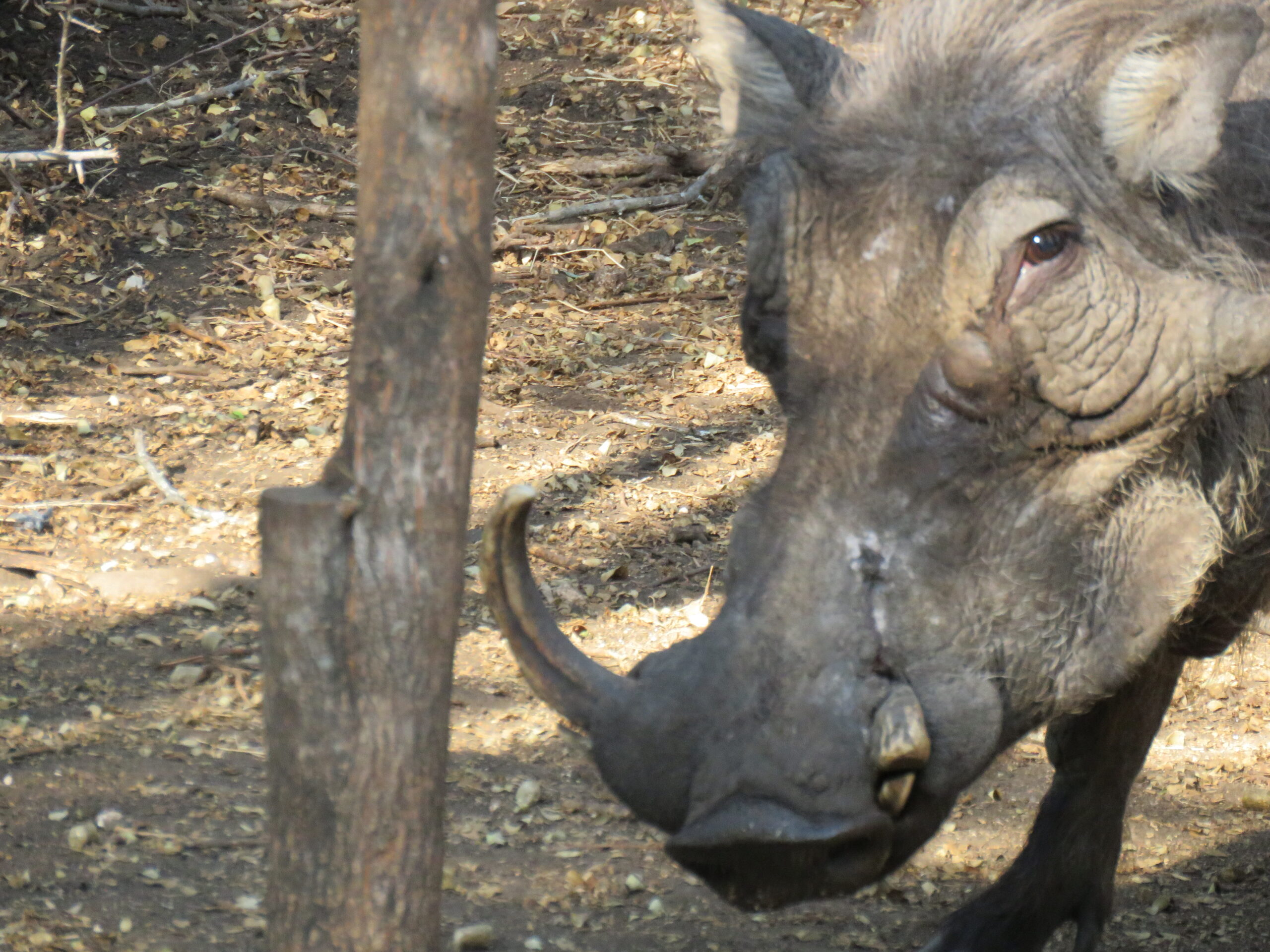
New warthog visitor missing a tusk and both face warts. It appears he suffered an injury resulting in the loss of his left tusk. Face warts may be missing due to inbreeding anomaly. Guess we’ll name him, the obvious, One Tusk.

If there were a choice between memory loss and lack of coordination, I’d opt for the latter. My memory is as clear and concise as it was in my youth, for which I am very grateful. On the other hand, my coordination is only worse than it had been a few years ago when even then, it was lacking.

That’s not to say I won’t ever drive again in countries with driving on the side of the road I’m most familiar with, the right side. Most rental cars in the US, for example, are not manual transmissions. As mentioned in the past, I am not a good driver anyway and have never been.

Duikers in our garden have become braver and braver as they come to trust us while tossing pellets.

At some point in my old age, I will have to face the fact that driving is not safe for me, as is the case for many seniors as their coordination and adeptness fail. I’m always sad to hear when an aging or ill friend has had to give up driving for the safety of themselves and others.

What brought up this driving thing is that today before 1:00 pm, 1300 hours, I’m heading out to visit a local friend, Debbie, in Marloth Park. She didn’t have access to a vehicle to visit us here, so I offered to come to her home, and today was the day. Tom will drop me off at her home and pick me up a few hours later. It will be great to have some “girl talk,” something I’ve missed off and on in our travels.

This bushbuck visits for hours each day.

Most get-togethers we’ve experienced since getting to Marloth Park months ago have been as couples, which undoubtedly we thoroughly enjoy. But, those special one-on-one conversations with friends are something both of us had to forgo in our life of world travels.

Fortunately, I’ve stayed in touch with most of my old friends in Minnesota and have an opportunity to see them when we return to the US for visits every few years. And, from time to time, I speak on the phone, on Skype, or Messenger to my dear friends. from my “old life” and also those new friends I’ve made in our travels.

We’ve named this male bushbuck. Thick Neck, when we observed his neck is considerably more significant than the other males.

This Saturday night, our dear friends Linda and Ken, headed to Marloth Park from Johannesburg in a few days, will be coming for dinner. It’s always fun to hang out with the two of them. When dear friends Kathy and Don arrive from Hawaii in June and July, we girls will certainly arrange some “girl time” as we’d done in the past.

Also, our dear friends Rita and Gerhard will be arriving in the next few weeks and surely Rita and I will have some girl time during the almost two months they will be here. It’s comforting to know that social interactions will increase down the road, adding to the pleasure of our time in Marloth Park.

Thick Neck rested in the garden for hours.

This morning, it was busy in the bush. We saw several “new” (to us) warthogs, some with exciting characteristics that make it easy to identify them when they return. Each morning, we’ve been checking the photos from the trail cam’s overnight photos. So far, no porcupine or unusual visitors. As soon as we see any less frequent or nocturnal animals, we’ll certainly share them here. In the interim, it is fun anticipating and checking out the photos each morning.

While Zef is washing the veranda, we are inside the bedroom, waiting for it to dry so we can go back outdoors. Big Daddy is looking at us through the bedroom window, wondering when we’ll come out to toss him some pellets. Hold onto your shorts Big Daddy! We’ll be there soon!

We’ll be back with more tomorrow. Have a fantastic day!

Photo from one year ago today, April 28, 2020:

Mr. & Mrs. Hornbill was eating seeds off the veranda table. We weren’t able to put up the birdfeeder with monkeys nearby and placed the seeds on the table after they’d banged at the window with their beaks to remind us to feed them. For more photos, please click here.

A tree pulled down!!!..Poop in the bush?…

Everybody was busy munching on Big Daddy’s fallen tree.

The only animal in our garden right now is The Imposter, this time, without his little buddy, Narrow Earlier, we had visits from warthog Lonely Girl, Wildebeest Wille, and bushbuck Torn Ear, Since it’s Saturday, the first weekend day of the 10-day school holiday, here in South Africa, we feel fortunate to see any wildlife at all. Yesterday, an unusual event occurred in our garden. Big Daddy (kudu) tore down, using his enormous horns, the main branch of a tree, to gain access to its tasty leaves. As the low-lying bush dries out as winter approaches, male kudus can easily knock down a tree with their massive size and strength.

I was in the second bedroom, putting away laundry when I heard a vast sound hitting the house. Tom was taking a shower and didn’t hear a thing. I ran outside to see what was going on to find Big Daddy happily munching on the moist, lush green leaves on the downed tree. I wish we had seen this happen.

He came in for a few nibbles this morning but moved away when the others came.

But, we managed to take a few photos of the result, which doesn’t do the event justice. Since that transpired, several other kudus and bushbucks have stopped by to partake of Big Daddy’s rambunctious event. We doubt that he and others will stop by to participate over the next week or two while the leaves are still green.

It doesn’t appear that there was any damage to the house when the tree was felled by Big Daddy. Thank goodness for that. Few of the low-lying trees in the bush are sizable enough to cause damage if they are brought down by wildlife. We’ve seen such an event by elephants in Kruger National Park but never here in Marloth Park. When Tom came out to see what had happened during his shower, he too was in awe of the strength of this substantial wild animal. It was rather exciting.

On another note, one of our dear long time readers wrote a comment on yesterday’s post as follows:

“I have to ask, with all of the animals visiting, how do you handle their poo and pee? Thanks for writing, Jan! I keep busy cleaning with our two teacup dogs and can’t imagine the odor and waste from the many large animals that visit you.”

Miss Kudu in the backside of the tree and Mr. Bushbuck were enjoying the fruits of Big Daddy’s labor.

I don’t recall that we’ve ever posted anything on this topic. One would think the sight and smell of poop and pee would permeate the air in Marloth Park. It does not. Nor is it a factor of visitors or residents getting “used to it.” There is no smell and rarely, and I mean rarely, do we ever see an animal poop in the garden.

Most often, they head out to the bush to “do their business” Perhaps it has something to do with the fact that most animals won’t poop where they eat, or they prefer the deep bush setting as more suitable for them. Yes, on occasion, we may see a warthog or a kudu pee, but we’ve never seen a warthog, bushbuck, or kudu poop in our garden. Even then, there’s no smell. I know this sounds hard to believe, but it’s true.

Even Frank and The Misses, who spend considerable time on the veranda each day, never leave a telltale sign of their visits, other than their messy piles of birdseed.

Wildebeest Willie stopped by this morning with a friend.

Before we came to Marloth Park for the first time in 2013, we had wondered the same thing. In no time at all, we realized this wasn’t an issue. That’s not to say we never see wildlife poop when out and about. It’s easy to determine the massive poops of wildebeest. Most locals chuckle when they see it since it’s such an oddity to encounter.

With wildlife only eating vegetation, there’s less of a likelihood of smell. So there it is, folks, the answer to the question that may have left many of our readers curious as to how we can manage to sit outside, day after day, night after night, with animals surrounding us.

That’s it for today! We hope you have a lovely weekend.

Photo from one year ago today, April 24, 2020:

This photo is from the repeated photos one year ago while in India in the lockdown. As we walked the souk, deciding where to dine, these varying roof lines of a courtyard caught my eye. For this post from April 24, 2014, please click here. For the year-ago post with more Marrakesh, Morocco photos, please click here.
Holiday makers arriving in the park starting today…Noisy weekend in the bush?…

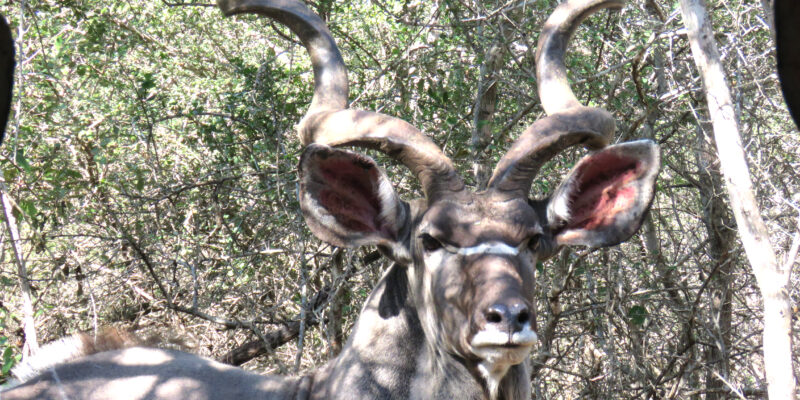
Big Daddy is such a handsome animal.

We are located on the borders of Lionspruit, the wildlife conservancy within a wildlife conservancy. From our front yard or back garden, we cannot see another house. The only human noise we hear from time to time is the sound of children laughing while in a splash pool, which we can easily handle, the distant sound of a generator when the power is out and the occasional sound of trucks passing with supplies for a house being built in the area.

Other than those sounds, the only sounds we hear consistently is the blissful sounds of wildlife; whether it birds, mongoose making their chittering sounds, warthogs snorting and grunting, impalas barking like a dog, various chirping insects and frogs, the lion’s roar, and the difficult to describe occasional sounds made by kudus, zebra, and wildebeest. It’s all music to our ears.

Big Daddy was posing for a photo.

One of our favorite sounds is made by Frank and The Misses, a loud bird call like none other, at sunrise and sunset, and occasionally during the day, and the gentle chirp when they happily eat their seeds and drink water from the little containers, both of which we refill several times a day.

Otherwise, the quiet is profound. No traffic sounds, no loud music, with no yelling and loud voices. When we lived at the Orange House in 2018/2019, the human sounds were deafening at times. We could easily see three or four-holiday homes from the garden and hear the rambunctious sounds of holidaymakers during the endless stream of holidays in South Africa.

Marloth Park has distinct rules available to every visitor in regards to noise. This is a place to come to unwind, relax and revel in the wonders of nature and wildlife. Loud noise is prohibited and may result in steep fines. But, many tourists pay little attention to the rules.

He stood quietly for a few hours, watching the action around him with many other animals in the garden.

Not only did we hear screaming, yelling, and “drunk talk,” but loud music permeated the air. It wasn’t unusual to hear swearing and name-calling from that location. Here, nothing. At most, we’ll listen to the children’s sounds and an occasional car driving past. This house is set back far from the road, making passing vehicle noises barely detectable.

Upcoming this weekend is yet another South Africa holiday, called a “school holiday,” which may be found at this link. For the regular government holidays, please click here.

This upcoming school holiday, of course, meaning kids are out of school, impacts tourism in Marloth Park beginning on April 23 and continues until May 3 for a total of 10 days. During these several long stretches throughout the year, Marloth Park is rife with tourists, with considerable fast driving on the paved road Olifant and all the dirt roads, which often results in the killing of many animals.

Big Daddy is in the background with two females ready for more pellets.

As mentioned over Easter weekend, seven of our beloved animals were killed by hit-and-run drivers, some of which were killed instantly and others who had to be euthanized. Each time we don’t see some of our favorites in the garden over days, we end up wondering if they were one of the victims of these ruthless drivers, until once again they grace us with their presence, filling us with a sense of relief.

Likely, we won’t see much wildlife during the ten days when often, they are hiding in the bush away from the commotion or being fed inappropriate foods that they, like humans, can’t help but like. During these periods, we seldom see many of our wildlife friends. In actuality, that has already begun when, this morning, we only saw a few warthogs, bushbucks, and of course, Frank and The Misses, who we’ll continue to see since Francolins are territorial. It’s doubtful they leave the property.

Also, beginning this weekend, it’s necessary to make an appointment to enter Kruger National Park. Visitors may use this site to book their appointments. Due to the crowds in Kruger, we won’t be visiting any time during the holiday period. Also, our usual drives in search of photo ops in Marloth Park will cease during this period.

Young Mr. Bushbuck is hoping for some pellets when the warthogs take over. We always find a way to get some to him and the other gentle bushbucks.

We hope we’ll continue to have good photos during the next ten days for our daily posts. We’ll do our best to ensure we can post new photos. Fortunately, we have enough groceries and bags of pellets to avoid the necessity of driving to Komatipoort to shop, where it will also be hectic.

Oops, I spoke too soon! Nine kudus just arrived in the garden, including some youngsters and Big Daddy. The camera is clicking non-stop! A grouping of kudus like this is called a forkl.

Little, in the side garden, searching for any leftover pellets we’d tossed to the bushbucks.

May your days and nights be pleasant and fulfilling.

Photo from one year ago today, April 22, 2020:

A distant elephant across the Crocodile River. For more from the year-ago post, please click here.

Fantastic night in the bush…A human and animal kind of night…

Big Daddy was lurking in the bush, staring at the females.

Last evening when friends Alan and Fiona stopped by for sundowners, we all experienced a night we’ll never forget. Not only was the conversation, wine, cocktails, and food freely flowing, but we were all “gifted” with visits by dozens of wildlife. They came, not only before sunset, but once it was dark, when we turned on the garden light, one species graced us with their presence after another.

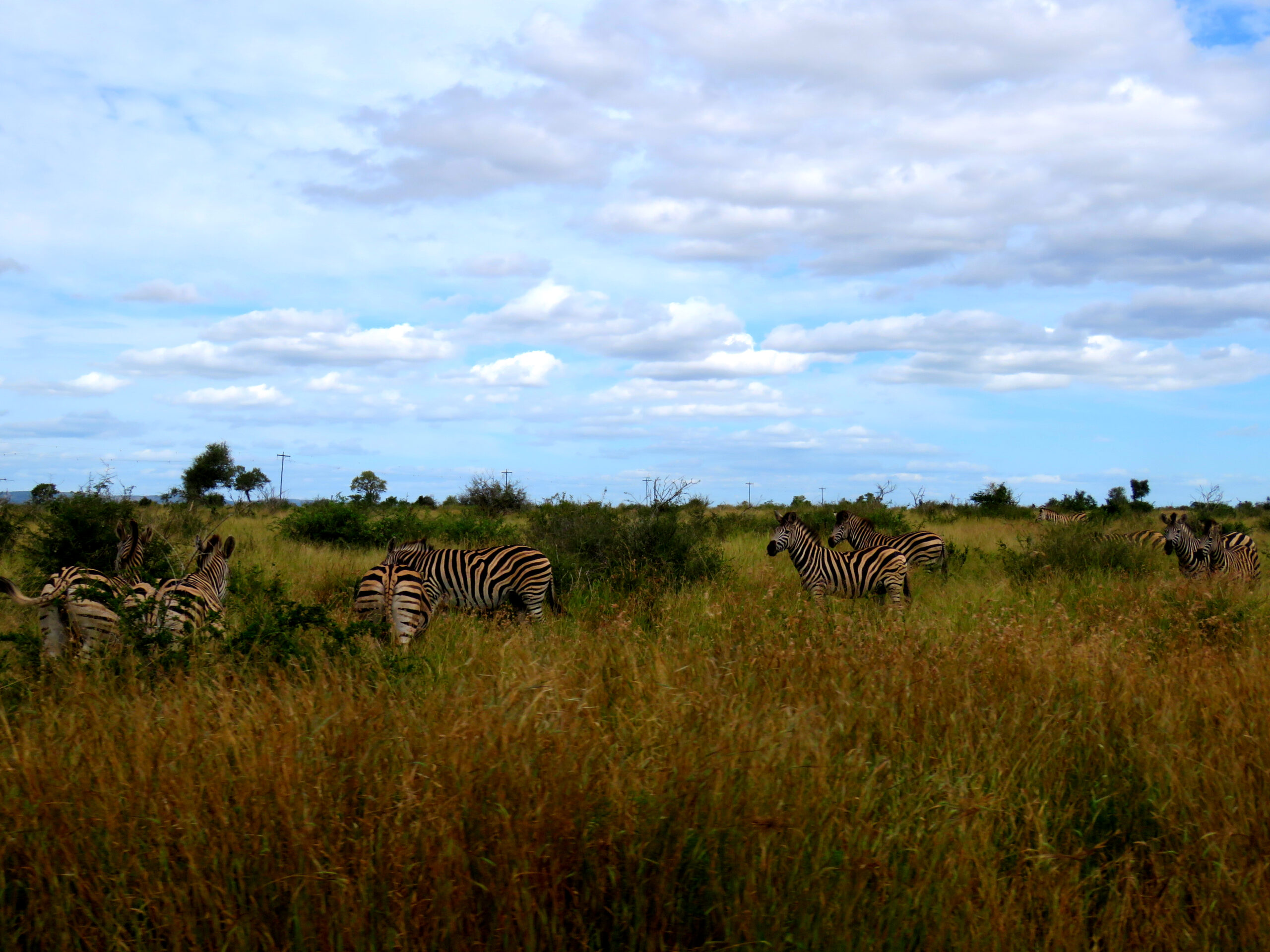
Many zebra butts were facing us this morning as they clamored over the pellets Tom tossed into the garden.

It was as if we’d arranged this menagerie for our guests, and none of us could take our eyes off the garden. Amid all the enjoyment of seeing so many wild animals, the conversation flowed with ease and good humor. Tom and I joked that the word got out that we currently have five remaining 40 kg, 88 pounds, bags of pellets in a corner in the second bedroom.

It’s not natural for kudus to bend over to eat when they’re used to eating vegetation on trees. But, they do turn for the pellets.

Then, again this morning, even more, came to call, including wildebeests (gnus), zebras, bushbucks, warthogs, kudus, including one Big Daddy (the first we’ve had visit) who’d somehow managed to maneuver his way through the dense bush to make his way to our garden.

As I write this now, the Big Daddy stands tall in his majestic wonder, as shown in today’s photos. To us, no animal living in Marloth Park commands more reverence and respect than these unique massive males. Sadly, on occasion, a foolhardy tourist will not respect their strength and girth and may become injured when getting too close.

One of the two wildebeest hung around with us all evening, well after dark.

Recently, we posted a video we’d seen on Facebook where a man touched the head of a Big Daddy, which resulted in an injury to the man’s face. We were appalled by how idiotic the man was to think he could “pet” the massive animal. We never touch any of the wildlife, nor do we hand-feed any of them.

See the Facebook link here: https://www.facebook.com/groups/377035355798904/permalink/1901623916673366/

The second wildebeest that hung around last night and returned this morning.

A highlight of the evening we all especially savored was when on four occasions, we heard Dezi and Fluffy roaring in Lionspruit. What a fantastic sound! As it turned out, Alan and Fiona stayed until 11:00 pm, 2300 hours, when suddenly we all realized how late it was.

The evening flew by. Shortly after they left and we were situated in bed with our laptops, I got to work to complete the day’s corrections I’d never finished during the day.  It wasn’t until after midnight that I finally gave up and decided to finish the task this morning.

It was almost dark when we took this photo.

Well, this morning with six zebras, four warthogs, two bushbucks, and the returning two wildebeest from last night, it took me a while to finally get to the remaining corrections from yesterday. Now I am caught up and can work on today’s ten posts before the day’s end.

Today will be an easy day. I’ve already done two loads of laundry and prepared a few items for tonight’s dinner, a well-seasoned chicken flattie to be cooked on the braai. Most flatties are already seasoned with some spices we don’t use in our way of eating. Soon, I’ll soak the chicken in purified water in the big metal bowl to remove all those spices off and then re-season it to our liking.

Such a handsome male kudu.

Tomorrow, we’ll make the second flattie implement the same process when we didn’t have room in the small freezer for either flatties. Today is yet another gorgeous day, cool and slightly overcast. We love every moment of this cool weather.

Enjoy today’s photos along with us. Happy day to all.

Photo from one year ago today, April 21, 2020:

Taking photos through the fence in Marloth Park was tricky, so we got what shots we could.  At times, we were pleasantly surprised at the finished product. For more photos reposted one year ago, please click here.

Busy day with much to do…

Two heads are better than one when assessing the pellet situation.

It was a good thing it wasn’t hot last night. Sunday night, the power was out for almost 12 hours, and we couldn’t use the air-con in the bedroom. On Saturday, in the middle of the night, I awoke Tom from a deep sleep and asked him why he was clapping. He wasn’t clapping. The air-con was making a clapping sound every 10 to 20 minutes. What was that about? We shut it off, knowing the sound would keep waking us up.

We didn’t want to disturb Louise over the weekend, so we tried it again last night, Monday, to discover the clapping continued. With a cool night, we used the fan instead, and that worked out fine. Today, Louise set up an afternoon appointment with Chris, the air-con guy, to come out this afternoon. It certainly is better to get air-con repairs handled on cool days like today. Next week it will be hot again when it is tough to get an appointment for a repair person to come out.

Soon, we’ll be heading to Komatipoort to grocery shop and stop at the pharmacy for a few items. On our way, we’ll stop at the home of the woman from whom we’re renting the treadmill. The following payment for the upcoming three months is due now. I am so grateful I’ve had the treadmill to keep me in shape during these many lazy days in the bush.

Narrow and The Imposter, resting in the garden.

Late in the afternoon, our friend and local author, Alan, and his girlfriend Fiona come for sundowners. When we return from the market, I’ll get to work to make a few appetizers to serve during their visit. I’ll make enough items, some of which I can eat, and thus, we won’t be making dinner tonight.

Usually, happy hour continues until 8:00 pm, 2000 hours, or later, or when the mosquitoes and other insects are at their worst. It varies every evening, so we’ll play it by ear and wrap up the evening when nature dictates. In any case, we’re sure it will be another lovely evening with friends.

Socializing in Marloth Park has been kept to a minimum with Covid-19. Many are afraid to get together, even in small groups, especially after a few deaths from the dreaded virus here in the park. We only socialize with others whom we know are being careful like us.

Mr. Bushbuck, one of many bushbucks that stop by each day.

Speaking of Covid-19, this morning, after applying for the vaccine four times, Louise finally got the SMS message stating my application was finally accepted. Now, we are waiting for a date and time for both of us. We hope this all works out with the timing before leaving South Africa on June 30th for our visa stamps.

Here again, we’ll play it by ear. Our ultimate hope is that President Cyril Ramaphosa will extend visitor visas for yet another 90 days. That would be wonderful! If not, we’ll make a plan, last minute, to fly out for a few days and then return.

I’ve already started making the appetizers for this evening. Right now, as I prepare this post, we have to leave to bring the money for the treadmill to the owner, and then we’re off to Komatipoort. When we return, I’ll finish this post.

Maturing male kudu, admiring himself in the glass of the bedroom windows.

We stopped at the home of the lovely woman who loaned us the treadmill, and we hit it off so well, we hope to socialize soon. We paid her the ZAR 1800, US $126, for the next 90 days.  It’s been so helpful to me to have this piece of exercise equipment easily at my disposal.

We just returned from Komati after grocery shopping, a visit to the pharmacy and the liquor store. We have everything we’ll need for the next few weeks. Everything has been put away. A few plates of the treats for tonight have been prepped. Soon, we’ll set up the table. The house is clean and tidy after Vusi did another fantastic job this morning.

Now, Frank and The Misses are drinking water from the little container we set down for them with fresh water a few times each day. I’d forgotten to put the container down on the floor when we returned, and he made his funny noise at me to let me know he and The Misses wanted to drink.  The Imposter is here by himself, without his buddy, Narrow. Mom and Babies just left the garden after eating pellets.

These two young kudus were very friendly.

Last night, just before going to sleep, I came out of the bedroom to fill a glass of water for my bedside table. I happened to turn on the outside light to take a peek to see if anyone was there. And there she was, Bossy (kudu) and one of her offspring, a handsome young male. Of course, they were staring at me through the glass door, wondering if pellets were served so late at night.

Sadly, I declined to offer pellets since the alarm had already been set, and I didn’t want them coming around at night in the dark with expectations. I kept an eye out for them, and a short time later, they left. This morning they were back, and we tossed plenty of pellets their way. We often wonder where and when they hunker down at night and how long they sleep.

Most wild animals sleep in short bursts and for very few hours a day, from what we’ve read. It’s ingrained in their DNA to keep out a watchful eye for predators. Here is Marloth Park. Few predators exist for most of the wildlife. But, still, they remain alert and diligent to protect themselves and their young.

At the far end of our garden, Lionspruit begins where lions Dezi and Fluffy live.  There are hundreds of other animals in Lionspruit, many possible meals for these two lions. It’s an entirely different situation in Kruger National Park than here in peaceful and less-threatening Marloth Park.

Have a fantastic day!

Photo from one year ago today, April 20, 2020:

Hand-feeding Kookaburras in the garden, re-posted one year ago from Australia in 2017. They are carnivores, so I fed them raw, grass-fed ground beef. For more photos, please click here.

Repeating the vaccine registration process…Stats on the majestic maturing male kudu…

He stood there for quite a while, but we stayed inside the house until he backed off.

When we didn’t receive a confirmation text expected within 24 hours of both of us registering for South Africa’s Covid-19 vaccine, I searched online for possible reasons. When the site went live yesterday, we were two of the first 126,000 that registered. I found a mention that we may need to re-register again today due to traffic on the site.

If you didn’t see yesterday’s post, here is the link to register for the Covid-19 vaccine in South Africa.

Also, when I entered our US phone number with a “1” in front of the area code, I needed to use +1, but there weren’t enough spaces in the field to enter the +1, which is the US country code. Today, as soon as I’ve uploaded this post, I will re-register both of us, using Louise’s South Africa phone number for her to receive the texts to notify us that our application has been received and where and when to go for the vaccine sometime in May or later.

I don’t like inconveniencing her like this, but she is always willing to help in any way she can. We are assuming the South African vaccine portal didn’t accept our US phone number. We will see how that goes.

These male kudus, when fully grown, may weigh 190 kg to 270 kg, 419 pounds to 595 pounds.

It’s a busy Saturday morning in the bush. There must not be as many holidaymakers here this weekend. This morning, we’ve had a steady stream of visitors, including the first “Big Daddy” kudu who visited our garden since we arrived in January.

His horns weren’t as massive as a more mature Big Daddy, but in time they will be. His massive muscular body was a treat to behold.

From this site:

“The kudu’s horns do not begin to grow until the bull reaches 6–12 months, twisting once at around two years of age and not getting the full two-and-a-half twists until the age of six.
Not quite full-grown with horns yet to grow, this Big Daddy stopped by early this morning.

Greater Kudu facts

  1. Kudu are highly alert and notoriously hard to approach. When they detect danger – often using their large, radar-like ears – they give a hoarse alarm bark, then flee with a distinctive, rocking-horse running motion, the male laying back his horns to avoid overhead obstructions.
  2. The common name kudu is derived from the indigenous Khoikhoi language of Southern Africa. The scientific name is Greek: Tragos denotes a he-goat and elaphos a deer; Strephis means ‘twisting,’ and Keras means ‘horn.’
  3. The horns of a mature bull kudu have two and a half twists and, if straightened, would reach an average length of 120cm. However, they may occasionally have three full twists, and the record length is a whopping 187.64cm. The horns do not begin to grow until the bull reaches 6–12 months, twisting once at around two years of age and not getting the full two-and-a-half twists until six. They have long served different traditional communities as both embellishment and musical instruments, including the shofar, a Jewish ritual horn blown at Rosh Hashanah.
  4. Male kudus are rarely physically aggressive but may spar during the courtship season, shoving one another with their horns. Occasionally, during these contests, their horns become interlocked and, if unable to free themselves, both males may die.
  5. The traditional sport of Kudu dung-spitting (Bokdrol Spoeg in Afrikaans) is practiced in the South African Afrikaner community. The winner is the contestant who can spit one of the antelope’s small, hard dung pellets the furthest – with the distance measured to where it comes to rest. An annual world championship was launched in 1994, with contests held at community events, game festivals, and tourism shows. The world record stands at 15.56m, set in 2006 by Shaun van Rensburg Addo.

Greater Kudu Conservation Status

According to the African Wildlife Foundation, with only 118,000 kudus remaining in the wild, kudus have a ‘near threatened conservation status.’ Hunters shoot them for their hides and meat, and their horns are a much-wanted collector’s item. Local people use their horns in rituals, store honey, or make instruments out of them. Habitat loss is another threat to the kudu population. Awareness and responsible travel are essential to preserving the kudu population.”

Based on today’s visiting kudu, we’re surmising he is approximately four years old. It was quite a treat to see him early this morning. I was still in bed when Tom quietly came to get me to see the kudu and take a few photos. I was awake, reading news on my phone, and couldn’t bolt out of bed fast enough.

We went indoors when he began to approach us on the veranda.

As it turned out, this particular male was somewhat bold, coming up onto the veranda without hesitancy in search of pellets. Tom and I stayed inside, watching him through the screen door. Unintentionally (or not), kudus have been known to injure humans who get too close, some fatally. We weren’t about to take such a risk.

Once he backed off, Tom tossed out some pellets for him into the garden, which he was content to eat with enthusiasm. Once he was done, he wandered away toward the driveway. There was no way, with those big horns, he could make his way out through the dense bush, the reason we haven’t seen any Big Daddies in our garden during the past three months. However, we have seen fully grown males driving through Marloth Park or visiting friends with more miniature dense bush surrounding their property.

Today is another sunny, cool day with low humidity. It feels wonderful with the gentle breeze wafting through the bush, the sight and the sound of the leaves falling to the ground, and our ability to see further into the bush. But, with winter (upcoming on June 21st) on the horizon, this is a tough time for the wildlife. No doubt, we’ll do our part to feed the wildlife as much as we can afford.
We hope all of our readers have a fantastic weekend.
Photo from one year ago today, April 17, 2020:
Spotting these yellow-tipped stamen on these Anthuriums in Kauai was a first for us. For more photos, please click here.

Gentle musing on a quiet day…I’m often wrong…

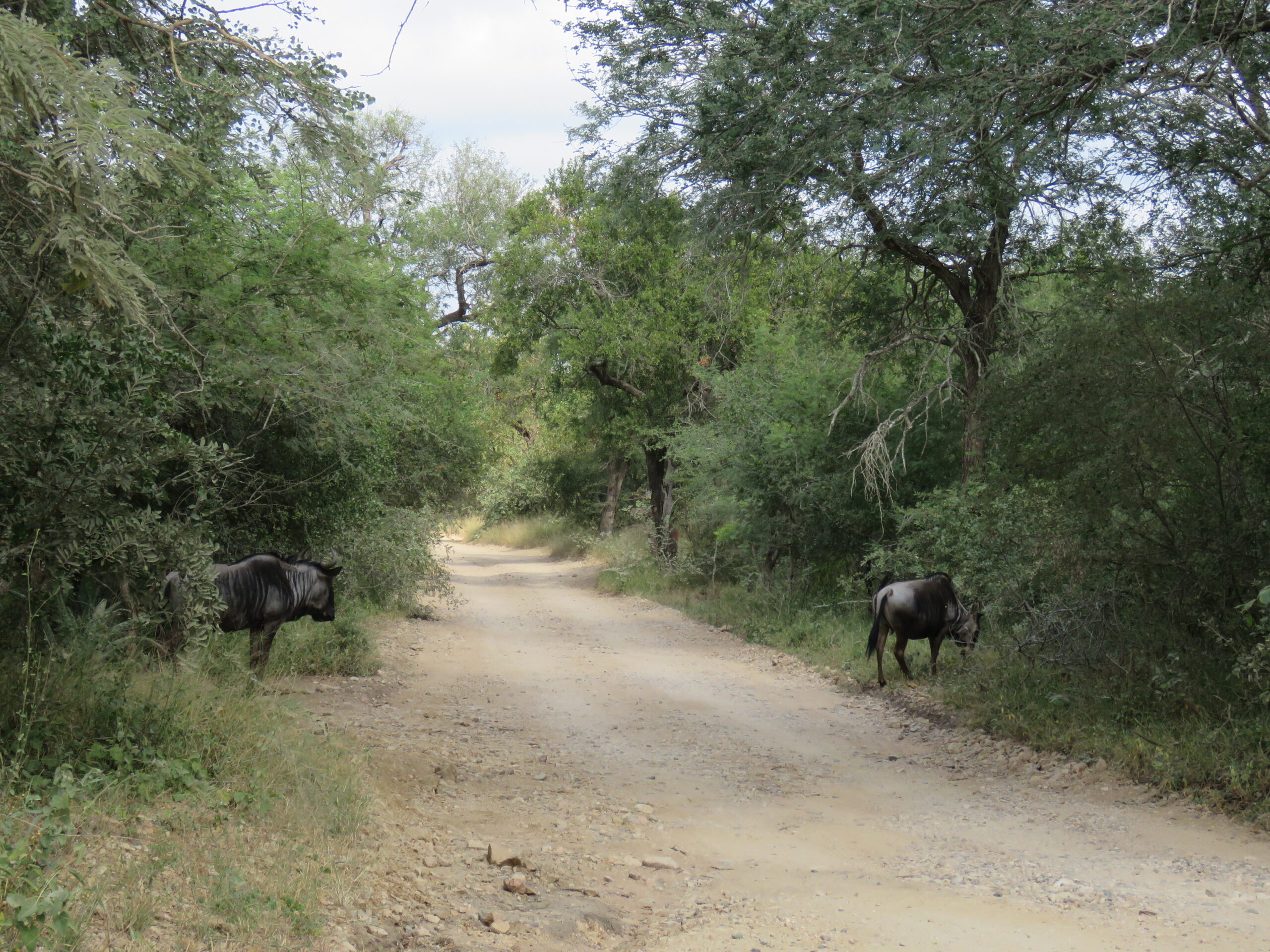
This wildebeest looked angry and ready to charge. But, generally, they aren’t aggressive to humans who keep their distance.

At times, my thoughts run wild as to the topic we’ll cover in our post on any particular day. Let’s face it, after over 3100 new posts. The subjects may be thin and repetitive. I don’t deny this. How we manage to hold the attention of our worldwide readers often baffles us, a topic Tom and I often discuss based on the sheer wonder of it all.

Although I don’t spend more than a few minutes each morning contemplating the day’s topic, at times, I’m left staring into space, wondering what’s on the agenda today. But, this dilemma is short-lived. I press my fingers onto the keyboard and let them, as “they” said, “do the talking.”

The wildebeest was curious about us stopping by.

No doubt, the redundancy is glaring at times. Even I recall a topic I may have written about 2000 posts ago. Somehow they are all decorated in my mind, popping into the forefront, the minutes I start to type. Oddly, today’s very topic didn’t precipitate or surface any recall of a former post. But I could be wrong. I’m often wrong.

Being wrong is the “nature of the beast.” It’s impossible to avoid errors, misuse of the English language, for which I often zealously assume I have a reasonable mastery. That may be wrong also.

Oh, my. Certainly, I’m known to use the same adjectives, pronouns, prepositions, and so forth, as described here ad nauseam. It would help if you got sick of me from time to time. Even the few “haters” who read our posts, one of which refers to us as a “train wreck,” continue to read for whatever perverse satisfaction she may glean from coming back over and over again.

A group of wildebeest is called a “confusion.” Go figure.

Tom, a railroad man for 42½ years, knows what a train wreck is, and it is not us. But, perception is everything. I ask the universe if you hate something and have the option to avoid it without consequence, then, by all means, avoid it without effect. Does she think that her hateful dissertations in an email or “comments” are going to change how we do this?

Yesterday, I received a thoughtful message from a reader reminding me that I misuse the word “alas.” She included the definitions from a reliable online dictionary source, and I thoroughly agreed with her. Her message was kind and considerate. I took no offense. As we advance, I will be more mindful of my use of the word “alas,” thanks to her well-written and well-intentioned interjection in a private email.

Wildebeest crossing the road.

Would I continually appreciate comments and observations regarding words I may use incorrectly or in a slang manner? Probably not. After all, this is not an essay contest. This is a log of our daily lives, both perfect and imperfect and mostly somewhere in between. I dare anyone to write daily, over 3000 times, over eight years and not make verbiage, punctuation, and spelling errors.

At one time in my life, I was a perfectionist. I gave that up when we began this journey, knowing full well that being perfect in this year’s long world journey would not serve me well, only resulting in frustration and stress. Now, I wear the same shirt for two days, misspell words in posts and texts, and haphazardly draw on a disappearing eyebrow, a byproduct of old age,

We spotted these giraffes at quite a distance.

Over the years, I’ve learned that no one will say they were glad to be a perfectionist on one’s deathbed. They will espouse love, life, adventures, and contentment, of which we’ll have plenty.

Be happy. Be well. Thanks for being here.

Photo from one year ago today, April 15, 2020:

Beach view in Kapaa, Kauai six years ago today at this link. For the year-ago post, please click here.

Hit and run…Wildlife killed on the road…Where’s Tiny?…Back to corrections again…

Benny, Henny, Lenny, and Penny were in the garden. These two males of the foursome decided to snuggle. Too cute.

When we read that seven animals were killed on local paved Olifant Road during the long Easter weekend and we hadn’t seen Tiny in days, I was worried. What if he was one of the victims of hit and ran on the busy long weekend. Over the past several days, we watched for him day and night.

Usually, he’d show up in the garden between 4:00 pm, 1600 hours, and 4:30 pm, 1630 hours, while we were seated at the big table on the veranda. But, he never arrived. Day after day passed, and no Tiny. I’ve become so attached to him and his former daily visits, I’d be lost without him.

Alas, this morning while I was showering and dressing for the day, Tom came in to inform me that Tiny was in the garden, looking for pellets, and perhaps, me? Whew! I couldn’t have been more thrilled to see him, his giant warts, his massive tusks, and his somewhat shy demeanor.

Benny, Henny, Lennie, with Penny in the background.

But, it’s sad to know that seven of the precious animals in Marloth Park are no more. Either they died when hit by careless drivers speeding on the road, or they were injured to a point where the rangers had no choice but to euthanize them. This is sad for all of us in Marloth Park.

We’re not the only people in Marloth Park who build relationships with the wildlife from a safe distance. When we get together, we frequently discuss our favorites using the different names we’ve created for them. It’s funny to think that other residents have different names for the same wildlife we’ve named to our liking and preference.

Who knows? Tiny may be called “Jumbo” by another long-term visitor or homeowner. What names do others have for warthogs Narrow and The Imposter or their resident francolins instead of our Frank and The Misses? It makes us laugh out loud.

When I accidentally dropped the container of pellets on the veranda floor, it took no time at all for Little to come up to partake.

On another note, a few days ago, I mentioned that I hadn’t done any corrections on past posts since we arrived in Marloth Park three months ago. This stuck in my mind, prompting me to start again but with a less lofty goal of only correcting ten posts a day instead of 20 as I’d done while we were in the hotel room in India for ten months. I had more time during that long haul than I do now.

This morning before starting today’s new post, I managed to complete two of the 10. Every few hours, I’ll do two more until the ten are completed. At this rate, I will be done in about 190 days. That’s a long time from now, but I think I can manage this. If I stick to this routine, I should be done by the end of the year, considering travel days, busy days when we visit Kruger National Park, and days I can’t force myself to do it. We’ll see how it goes.

IB, aka Itchy Butt, returned for another itching session in the cement pond. Unfortunately, the water had evaporated, and he didn’t get the expected result. Poor IB!

Today will be a low-key day, which we thoroughly enjoy when the wildlife comes to call. We just served up some raw scrambled eggs for about 50 mongooses (I’ve recently discovered the plural of mongoose is mongoose) who’d stopped by. We always love seeing them and feeding them when it’s their presence that can keep the snakes at bay.

Now, I’m off to do my HIIT (high-intensity interval training) workout on the treadmill and then head to the kitchen to prep for tonight’s dinner. Life is simple. Life is good. We like it this way.

IB looks worried as he sits there, contemplating his next move.

Have a wonderful day. Stay safe and be well.

Photo from one year ago today, April 14, 2020:

A gorgeous sunset in Kauai, Hawaii, from the veranda of our condo in Princeville. For more photos from that date, six years ago, please click here. For the year-ago post, please click here.

On the road again…

Female kudu resting in our garden.

Note; Due to the time required to add photos to our post. We’ll be back tomorrow with more.

We’re not “on the move” again, but we are “on the road again” as we make our way to Nelspruit today to return the rental car, pick up another vehicle and do some shopping in the “big” (more significant) city. With Nelspruit’s population of over 110,000, it’s undoubtedly the most large city near us, approximately 75 minutes from Marloth Park.

I still experience a little angst going to Nelspruit since it’s the small town where I had open-heart surgery 26 months ago. Although it is also where the tiny airport is located, we’ve been many times over the past eight years since we began visiting Marloth Park in 2013.

At the moment, as I hurriedly write here (we’re leaving in an hour), Tom is at the car wash at the Marlothi Shopping Center, getting the rental car a thorough cleaning. I am seated at the big table on the veranda with three warthogs in the garden; Fred and Ethel, and surprisingly, Little, not Tiny, who seldom visits with so many other pigs as permanent fixtures here in the garden.

Little never liked the competition of other warthogs around him and can make quite a fuss. On the other hand, Tiny is gentle and relatively tolerant of sharing pellets with the other regulars. We’re often in awe of the unique personality traits and demeanor of the various wildlife that visit us frequently. It’s easy for us to detect who is who when we spend most days observing their behavior.

Not only does each animal have its physical characteristics, but its unique behavior also alerts us to those we see frequently, even when there are ten or more animals in the garden simultaneously. Frank and The Misses, three couples, easily determine which of the trio is eating the seeds. The main Frank is a messy eater, and the seeds fly everywhere when he stops to eat and drink several times a day.

All of the females are shy, and if I stand, they run off for a moment to return once I sit back down. But, the main Frank, who must be the dominant male in this territory of our garden, never moves when I put down the seeds and the little container of water which most of them drink from. Also, he will stand right next to me when the others are shy and prefer to stay back at least a meter from where I’m seated on the veranda.

We thought the Francolins would drink from the birdbath, and yet it has never happened when we’re outdoors. They either drink from the short-sided container I put on the ground with fresh water daily or sip from the outdoor drainage hose from the air conditioner in our bedroom, getting only a few drops a day. The main Frank loves the little cup of water and the other cup of seeds, chirping happily when he drinks and eats.

When the seed or water containers are empty, he makes his loud squawk while standing at the screen door to the veranda to alert us more is needed. This occurs frequently. It’s not unusual for us to see him standing at the screen door when we get up in the morning or at other times when we’re busy indoors.

Yesterday afternoon, while we were in the bedroom for a short rest, my favorite kudu, Bossy, came up to the bedroom window peering inside, wondering why we weren’t outdoors offering pellets. Of course, we jumped up to comply. We laugh so hard over all of these scenarios. Tom says they have us trained. So true.

Well, it’s time for me to wrap this up. We’ll be back tomorrow with more, including details of our little road trip to Nelspruit, and we probably won’t be returning late afternoon, and I am seldom motivated to do a post close to dinner time.

Happy day!

Photo from one year ago today, April 12, 2020:

This morning, this adorable Easter display was at our regular table at the hotel in Mumbai. A short time later, the restaurant closed. For more photos, please click here.
First trip to Kruger National Park in 2021!!!…New photos!…

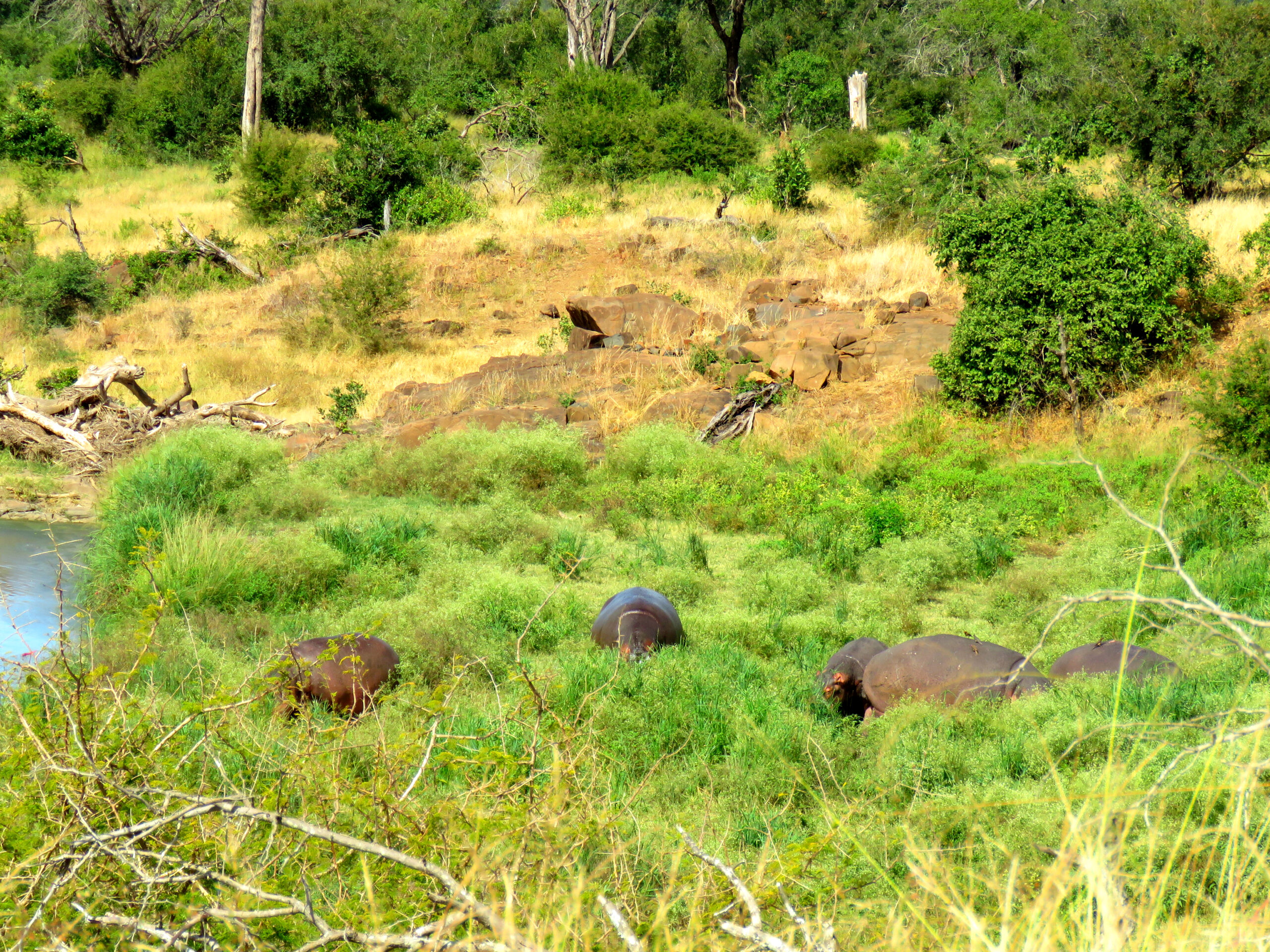
It’s estimated an aggressive hippo’s sharp teeth kill 500 people a year in Africa. Hippos can crush a human to death, with their weight ranging anywhere from 3,000 to 9,000 pounds. But they are fantastic to see in the wild. Note the oxpeckers on the hide of the hippo on the right.  After uploading the post, I suggested to Tom that we head to Kruger National Park and purchase our year-long Wild Card, which allows us to enter Kruger as often as we’d like for the next 12 months. With most Easter weekend visitors and holidaymakers gone, we figured it would be an excellent time to go.

We could have applied online, but the website was cumbersome, so we decided “the old way” and appeared in person. It proved to be a good decision. We were the only applicants in the Crocodile Gate office, resulting in no waiting. We were well masked, gloved, and brought our pen to fill out documents or signatures.

At the Verhami Dam, we spotted this “bloat” of hippos munching on the tall grass.

Although we were the only visitors in the office, it took at least 30 minutes for the purchase to be completed and for us to head back to our car finally. Of course, with a temporary pass in hand, we decided to go into the park right away. It was midday, and we were well aware the sightings could be minimal.

We hadn’t been in the park since January 2019, before I had open-heart surgery. There was no way I could have been bouncing around on the bumpy roads after the surgery when we finally left South Africa after three months of recovery in May 2019. We’d missed it.

We wanted to yell out, “Pick up your head,” but were satisfied when the hippo in the main photo did so.

Generally, early morning can be the best time to do a game drive, in our case, what is referred to as a self-drive. However, in the car, we weren’t as high up as one would be on a professional game drive vehicle with a guide. We kept a watchful eye as we meandered down the roads to see what we could find. As usual, we weren’t disappointed.

Not every tourist that enters the park is determined to see the “Big Five.” Sure, it’s great to spot a leopard, lion, cape buffalo, elephant, and rhino. But, for us, we never focus on such a lofty goal. We’ve seen the Big Five more times than we can count. At this point, although fun to see, it’s not a priority for us.

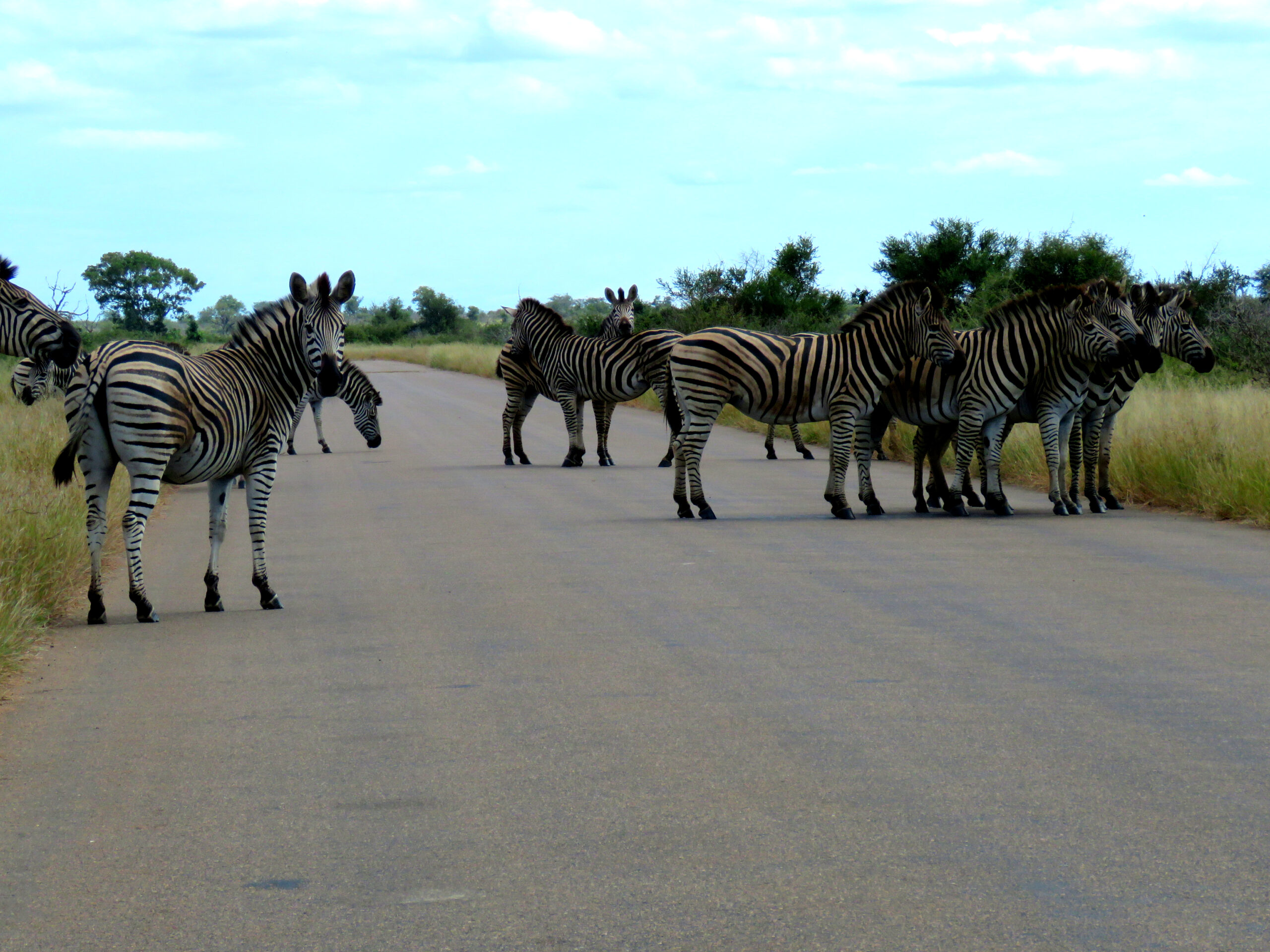
Zebra traffic on the main road.

We’re always looking for good photo ops, regardless of the species, and for us, it proved to be as productive a day as any. Over the next several days, we’ll be posting our photos and, of course, returning to the park regularly over the following months.

As for the application for the Wild Card, which resulted in a cost of US $352, ZAR 5100, for foreign nationals, the application process had to be completed once back at the house, requiring we call a phone number, speak to a representative and give them the code we got on the receipt.

We waited patiently until they moved over into the grass.

We won’t receive a card. Instead, this morning shortly after I spoke to the representative, we received an email with a confirmation letter that we must carry to enter the park. Plus, each time we go, we have to fill out another form with personal and passport information. Lots of steps.

In any case, we certainly enjoyed driving through the park. Deciding to go on short notice, we didn’t eat lunch at the popular Mugg & Bean, located in Lower Sabi on the Sabi River, although we stopped for a bathroom break and checked out the action on the Sabi River from the restaurant.

It was quite a day for zebra sightings.

We’d already defrosted and prepared bacon-wrapped fillet mignon for dinner and knew, if we ate lunch, we’d never be hungry by dinnertime. We only eat one meal a day, only because our way of eating diminishes our appetites until 24 hours later.

Long ago, we both decided that we wouldn’t eat unless we were hungry. Thirty days before leaving India, Tom began losing weight he gained stuck in that hotel room, eating four bananas, toast, and pasta, day after day.  He has since lost 25 pounds, 11.3 kg, and I, too, had lost 25 pounds, 11.3 kg, while in India, after changing our diets further.

Crocodiles are always scary-looking, in the water and out.

It’s hard for us to believe that combined, we’ve lost 50 pounds, 22.7 kg, of unnecessary weight in the past several months, significantly improving our health. We both feel committed to maintaining our current eating, weight, and better health with the new changes. We both feel great and love fitting into our minimal wardrobes.

Soon, we’re off for Komatipoort for grocery shopping and to purchase some pellets. Now that the Easter alcohol ban has lifted, we’ll restock a few items.

More photos from Kruger will be posted tomorrow.

I hope you have a pleasant day and that all is well your way!

Photo from one year ago today, April 8, 2020:

A Brown Gecko is hanging out in this plant with sharp thorns, a safe hiding spot for sure. For more year-ago photos, please click here.