A little Little in the morning…What a great way to start the day!…

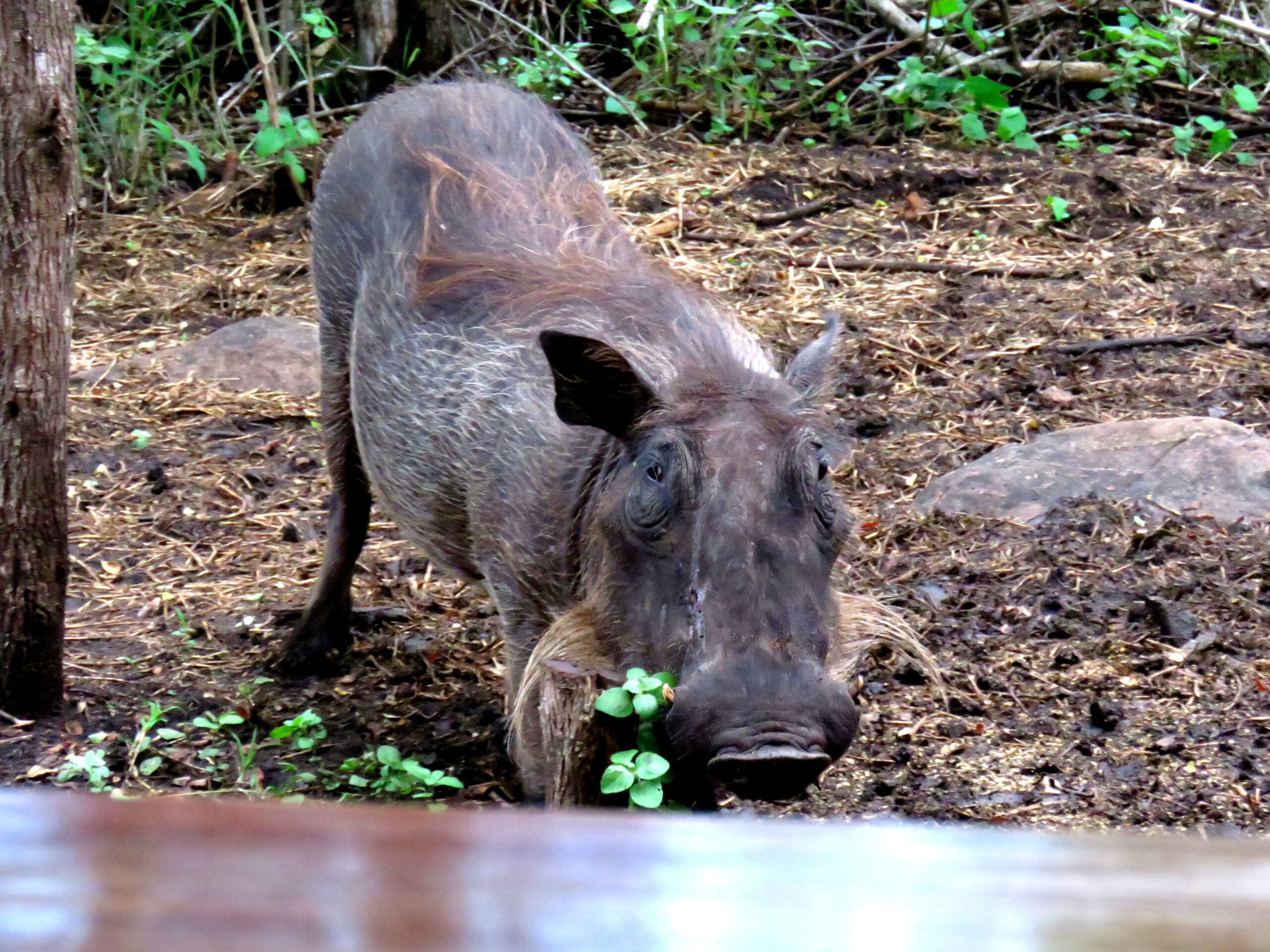
Less than three feet, one meter, from me, Little settled in this spot at the edge of the veranda, napping from time to time.

This morning, only minutes after Tom stepped out onto the veranda, he called out to me, “Little is here!” We hadn’t seen him in a week.

With holidaymakers coming to Marloth Park over the past holiday weekend (Women’s Day in South Africa), the influx of humans kept many of our favorite animals away. An exception to that has been Tiny, who visits each evening within minutes of 4:30 pm, 1600 hours, regardless of what’s transpiring in the park.

Occasionally, he’d get up onto his knees or stand when he’d hear a noise or see something moving in the bush.

As for Little, he’d last visited about a week ago. Tom is not as attached to him as I am when he considers that Little is like a “bull in a China shop.” but Tom shooed him away from eating Frank’s bird seeds, and we hadn’t seen him until today. I genuinely believe he decided to let go of feeling rebuffed and return to see me.

Little came into the living/lounge room in the Orange house last time we were there. After all, Little tore the screen to the lounge door, which has since been repaired. It was Little who languished in the cement pond on hot days. Little precipitated our post entitled, “Pig on the Porch, Pig in the Parlor, Pig in the Pond.” See here for the post.

He rested his chin on the ground or the edge of the veranda.

Little brought a friend into the house to share in his bounty of pellets, as seen in this link. The laughter and amazement we experienced in 2018/2019 are now repeated in 2021 by the intelligence of this bossy and yet charming warthog who continues to bring us great moments of awe and wonder over his ability as a wild animal to communicate with us humans to this degree.

This morning, was it love he exhibited when he nestled on the ground only three feet, one meter, from me after having his fill of pellets and the forbidden birdseed, as I sat in my usual chair at the table on the veranda? He couldn’t take his eyes off of me. I couldn’t help but laugh in sheer wonder.
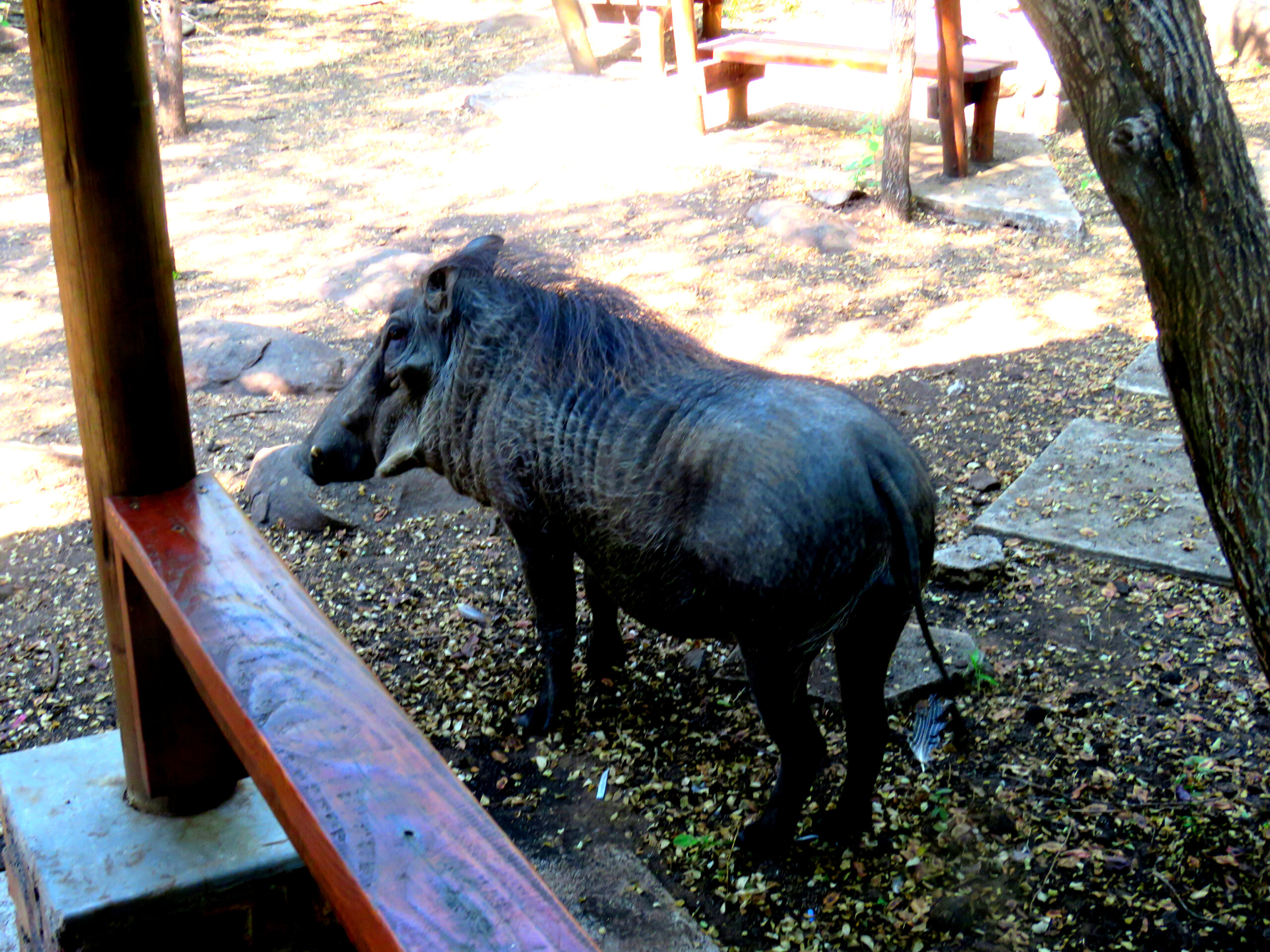
When Zef and Vusi arrived to clean the house, Little stood up, checking out the visitors. Moments later, he settled back down to his former position, lying down next to the veranda.

Some may say he was looking at me to give him more pellets. But it’s been Tom who’s tossed him the pellets when he’s better at throwing them into the garden than I am. But, even Tom is amazed by how Little responds to my voice and interacts with me. We always loved our dogs and their ability to communicate in loving ways with us. Pigs, much more intelligent than dogs, certainly can do the same. It’s not always about “the food.”

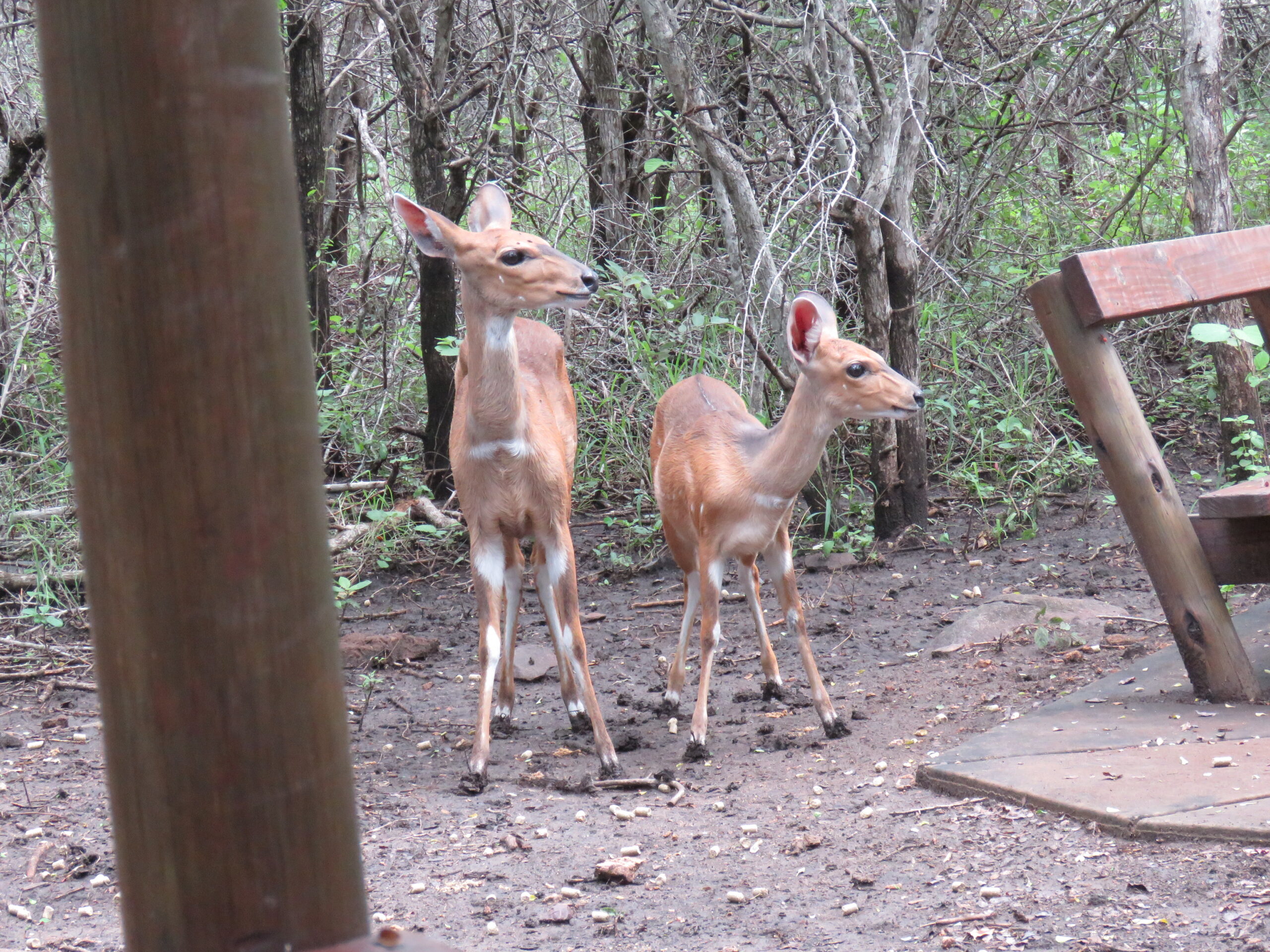
We see a tremendous amount of loving behaviors in the bush. The moms and babies of most species exhibit an enormous amount of love toward one another. We often see friendly and loving behavior among the kudus, giraffes, warthogs, zebras, bushbucks, and other species. Why would it be so unusual that a wild animal could, under certain circumstances, express caring behavior for us human animals?
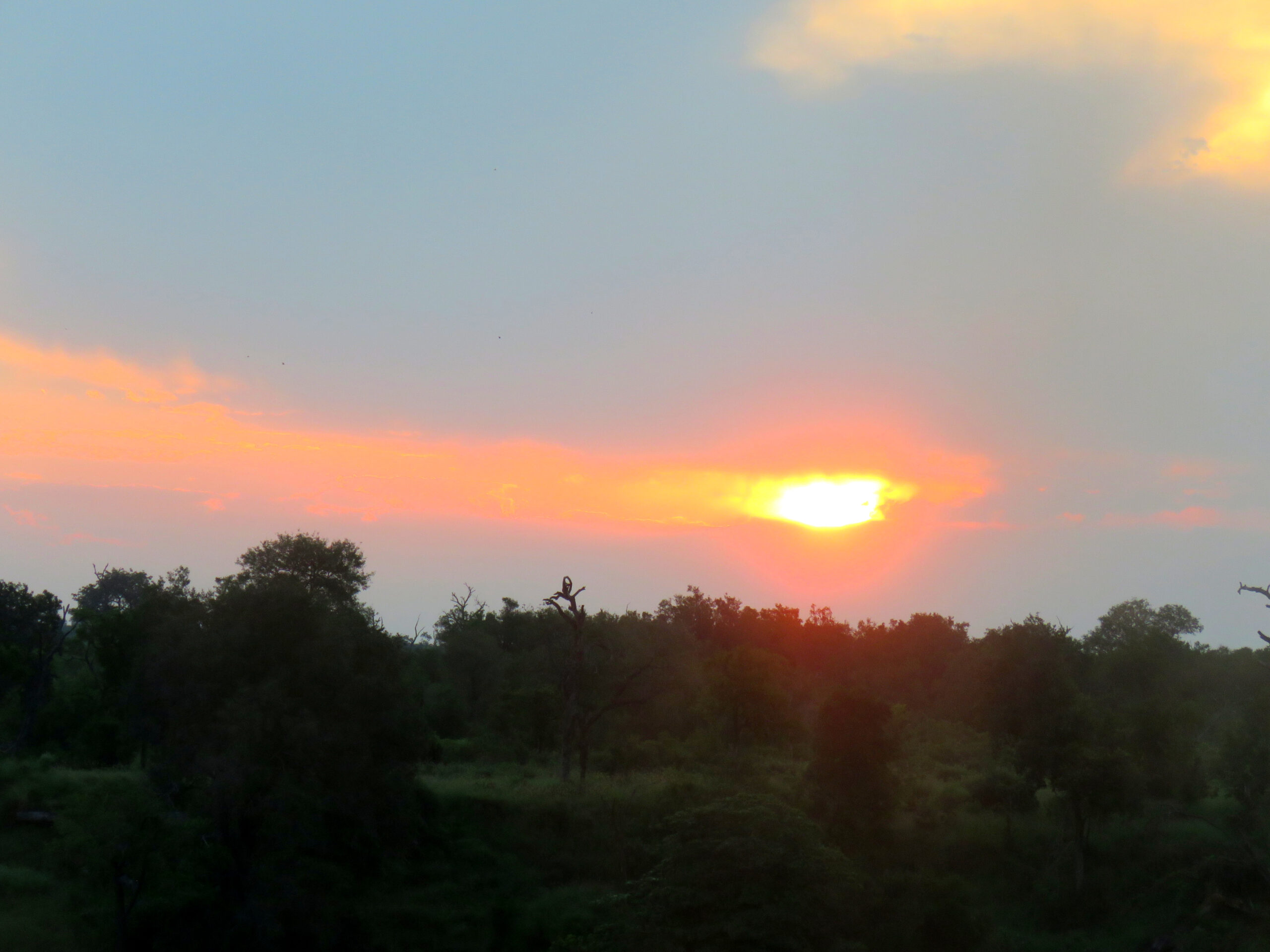
Last night’s sunset from the deck at the Amazing Kruger View Restaurant, we dined with Linda and Ken, who left today to return to Johannesburg.

As far as wild animals are concerned, most likely, we are simply another species they encounter in the wild with whom they may choose to interact or not. We often find ourselves gifted with a response that warms our hearts and fills us with great joy for those of us passionate observers who choose to interact with the wildlife in subtle ways, such as through eye contact, voice tones, and appropriate food offerings.

Yes, we know. That’s not our intent. They are wild animals, and we shouldn’t attempt to domesticate wild animals. Instead, we find ourselves in a state of awe and appreciation over the gifts of life so blissfully bestowed upon us by Mother Nature to enable all of us to live in harmony on this earth.

Yes, Little, and now also Tiny, each in their way, teaches us the importance of their existence and how to cohabitate in this unique environment. For this, we are grateful, as we spend every day living in the bush continually reveling in their very existence, let alone in an opportunity to somehow communicate with them.

We’d intended to post this photo from Friday evening’s sundowner party on our veranda, but WiFi issues prevented us from doing so at that time. We had a great evening, which ended when the mozzies came out with a vengeance.

Tonight, after spending five evenings celebrating life with local friends, we’re staying in. The heat and humidity continue to be outrageously uncomfortable. But, we’re managing well, especially when the air-con in the bedroom allows us to get restorative sleep at night. We sweat on the veranda during the daylight hours, occasionally taking a break to come into the bedroom to turn on the AC for a short reprieve. Knowing we can do this helps tremendously.

We’ve had several days without WiFi or power outages which have been delightful. But, as we discussed with Linda and Ken last night at the Amazing Kruger View Restaurant, after all, this is Africa. It’s a hot, dusty, humid, bug-infested continent with snakes, wild beasts, and dangers in many directions. If one cannot adapt to these conditions, visiting Africa may not be for them.

For us, with all its challenges, we feel right at home while continuing to stay on guard for any potential risks. By the way, in 30 days, we’ll be on our way to Kenya.

Be well.

Photo from one year ago today, March 9, 2020:

Sundowners on the beach at the Ideal Beach Resort located in Mahabalipuram, India. For more, please click here.

Stars in our eyes…Stripes in our garden…It’s our 26th wedding anniversary today…What does it cost us for food in South Africa?…

As of today, we’ve been married for 26 years. Last year in India, we celebrated our 25th, but now, that seems so long ago. We are blessed to have this great union, two people of opposites that somehow meet in the middle to find love, companionship, friendship, and harmony. Who knew we’d be able to travel the world together for over eight years and see so much joy in our everyday lives, regardless of where we may be at any given time?

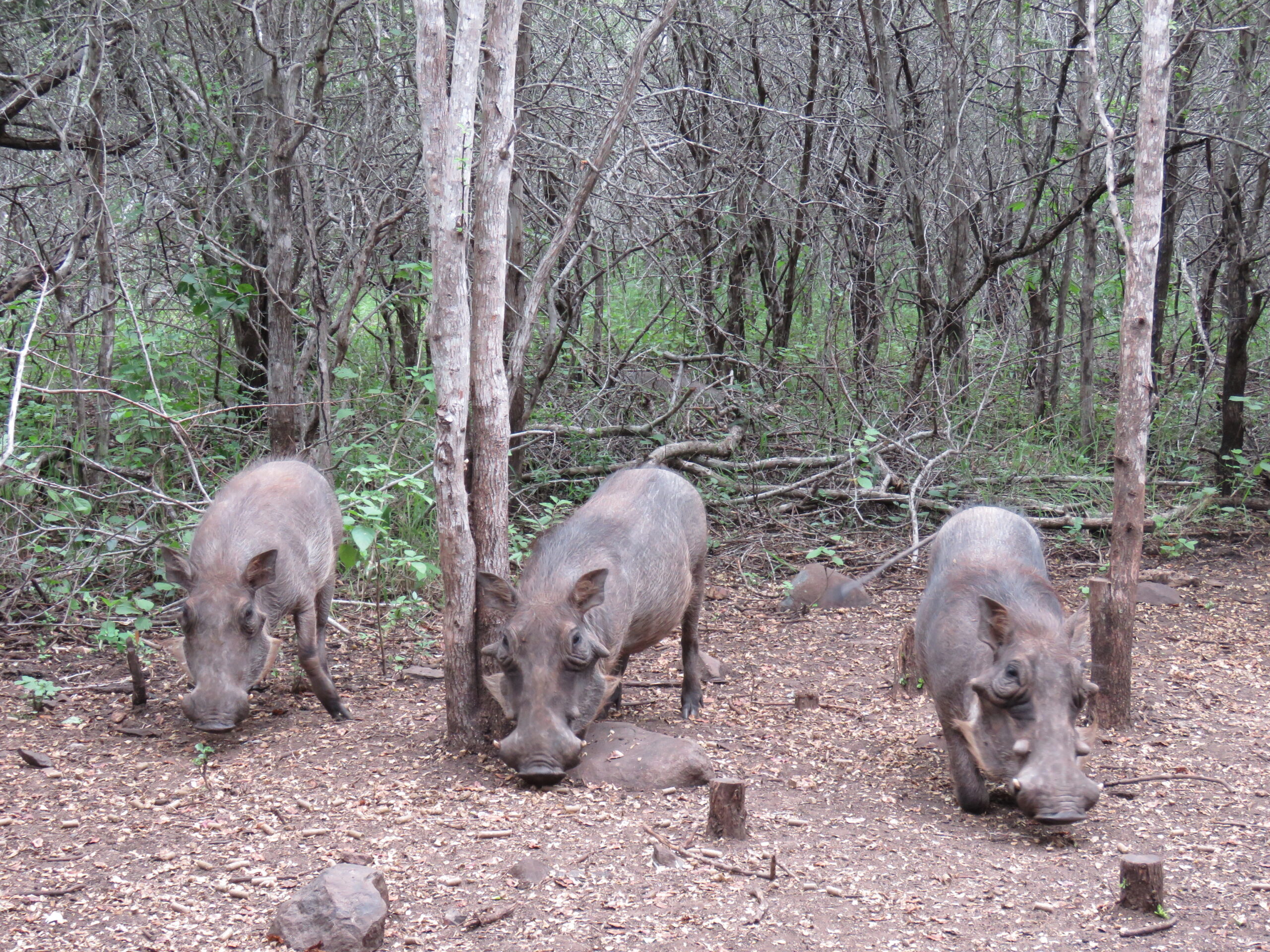
We waited quite a while to pick up their heads for a photo, but they were preoccupied.

If anyone had asked if we could spend ten months in lockdown in a hotel room in Mumbai, India, we may have laughed, uncertain if our usual state of harmony and love would survive. And, it did. Not only did we survive, emotionally intact, but all the stronger for it. Happy anniversary, Tom Lyman! May our lives together continue to be enriched in years to come.

They often head-butt one another when the pellets get low.

Last night, we headed to Jabula Lodge & Restaurant for our anniversary dinner, dining outside on the veranda and enjoying, as usual, a fine meal. It’s often surprising to us how affordable it is to dine out in Marloth Park. We dined at Jabula twice this week, on Thursday with Linda and Ken, and again last night.

The cost for each evening was approximately US $40, ZAR $615, which included taxes, tips, cocktails for Tom, and a bottle of my favorite Four Cousins Skinny Red Wine which I drank from on both occasions, with another glass or two left in the bottle that we brought home last night. There is nowhere in the world we’ve been able to enjoy such good food at such reasonable prices.

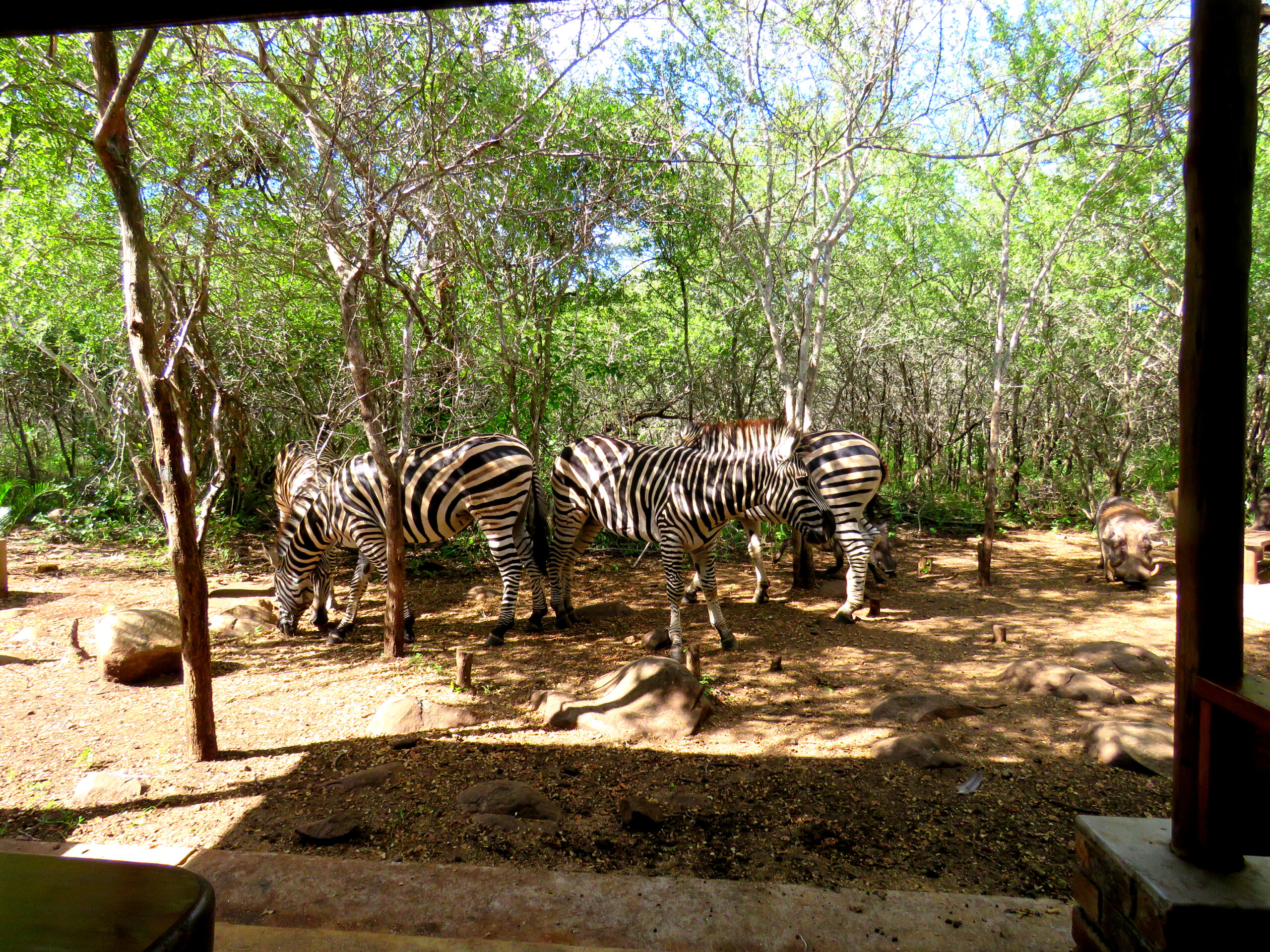
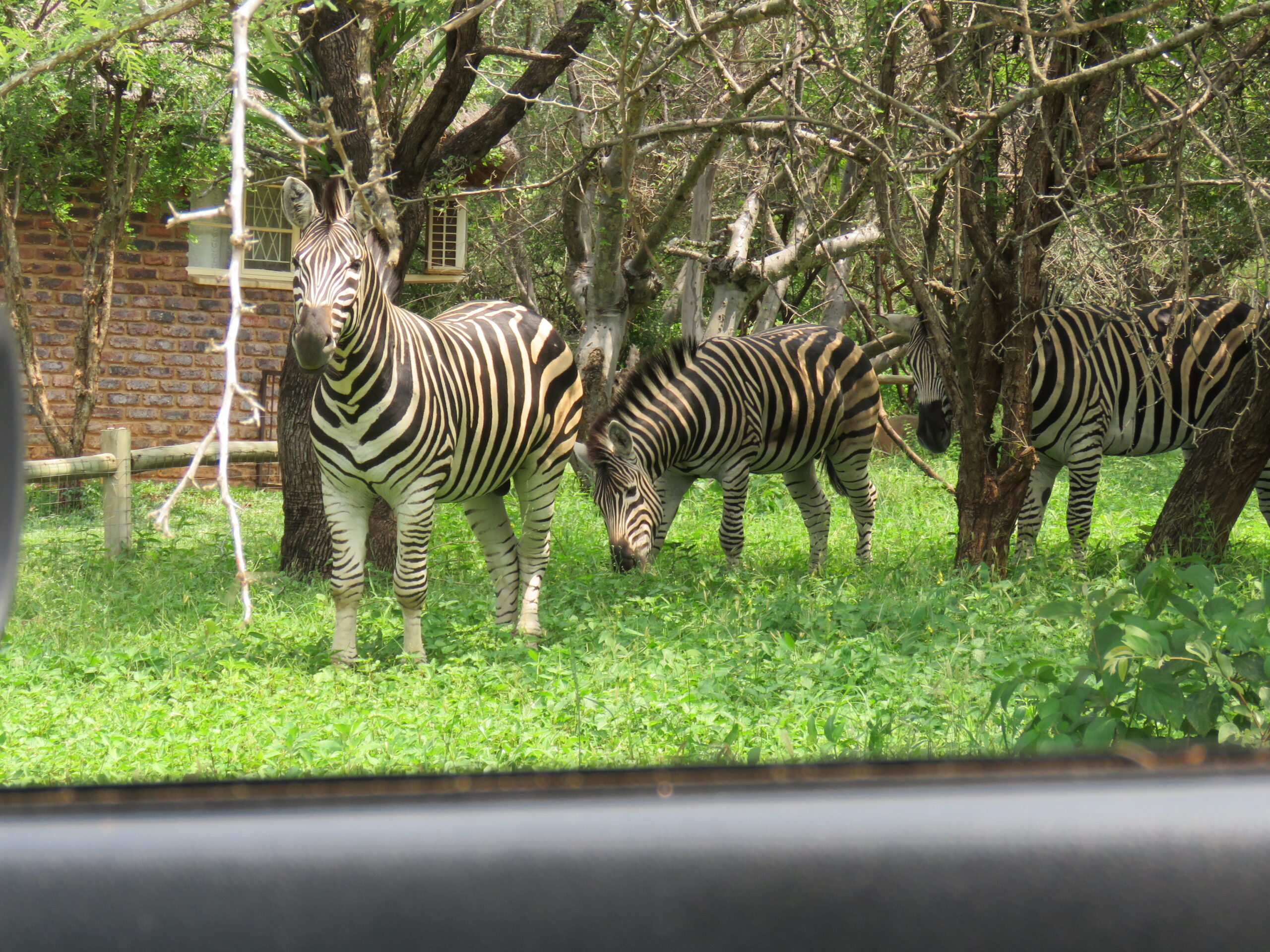
Zebras with their heads down only interested in the pellets.

Our total grocery bill since we arrived here on January 13th with enough food to last us for another week was US $1081, ZAR 16609. This averaged US $136, ZAR 2074 per week. Our entire dining out bill for these eight weeks was US $251, ZAR 3856. The total for food thus far was US 1332, ZAR 20465, averaged US $167, ZAR 2566 per week.

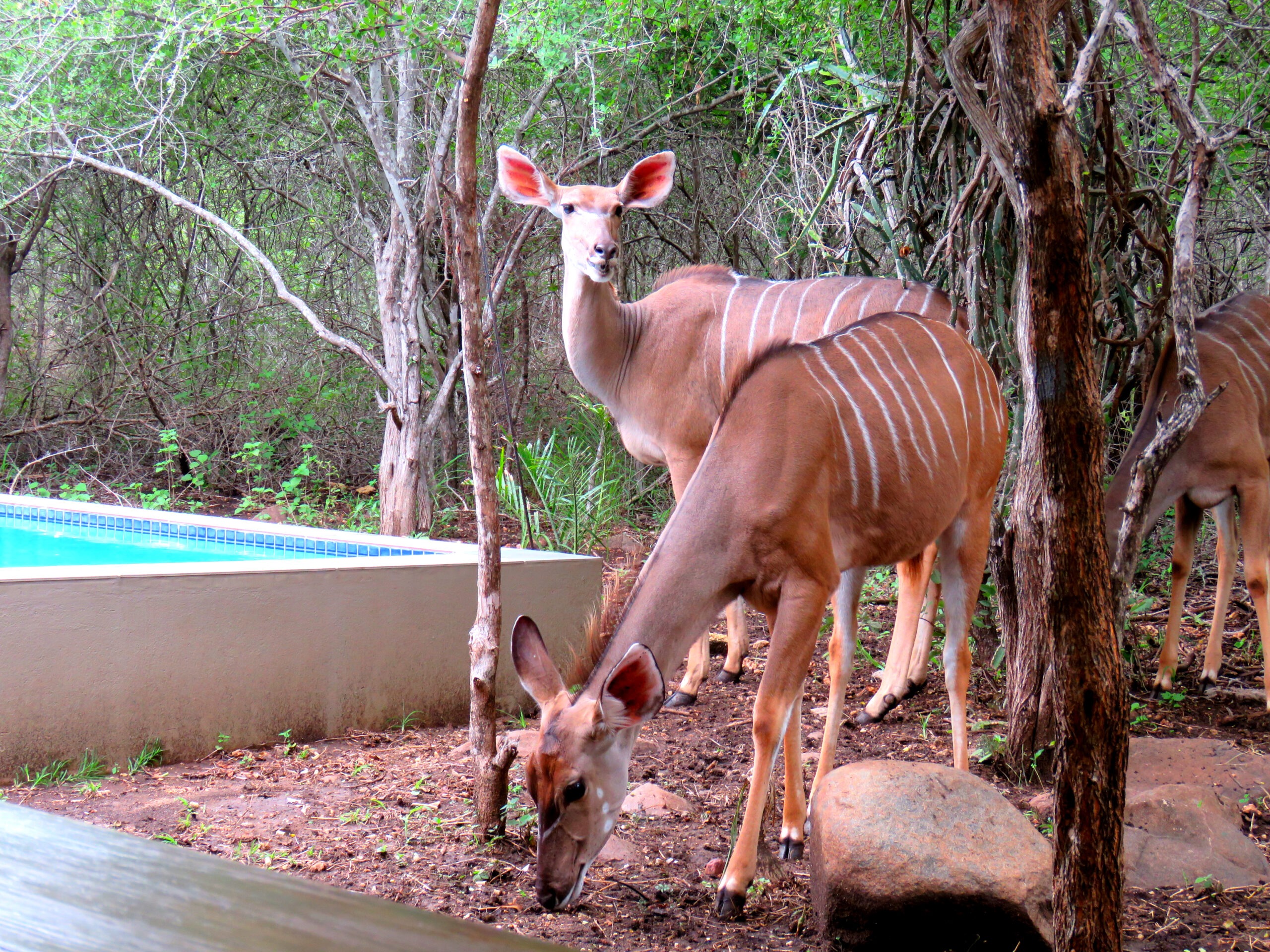
This was the first of the zebras to take a drink from the pool, and the others followed suit.

When we lived in Minnesota, shopping for groceries in 2012, we spent an average of US $225, ZAR 3457 per week. Dining out typically was US $100, ZAR 1536, and thus we didn’t go out to eat in the US as readily as we do here. As we’ve always said, it’s good for our budget to be living in South Africa, let alone all the other beautiful reasons.

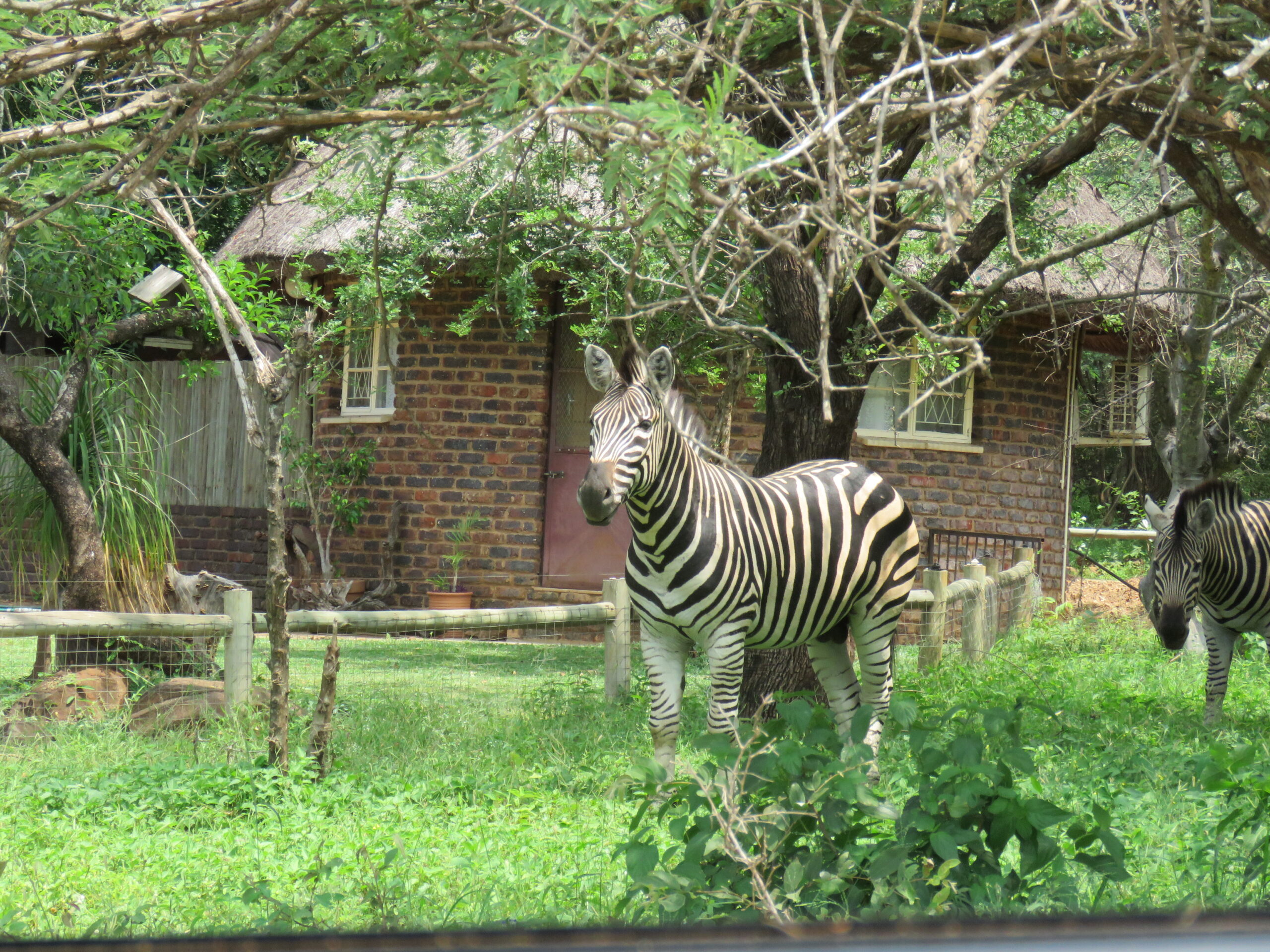
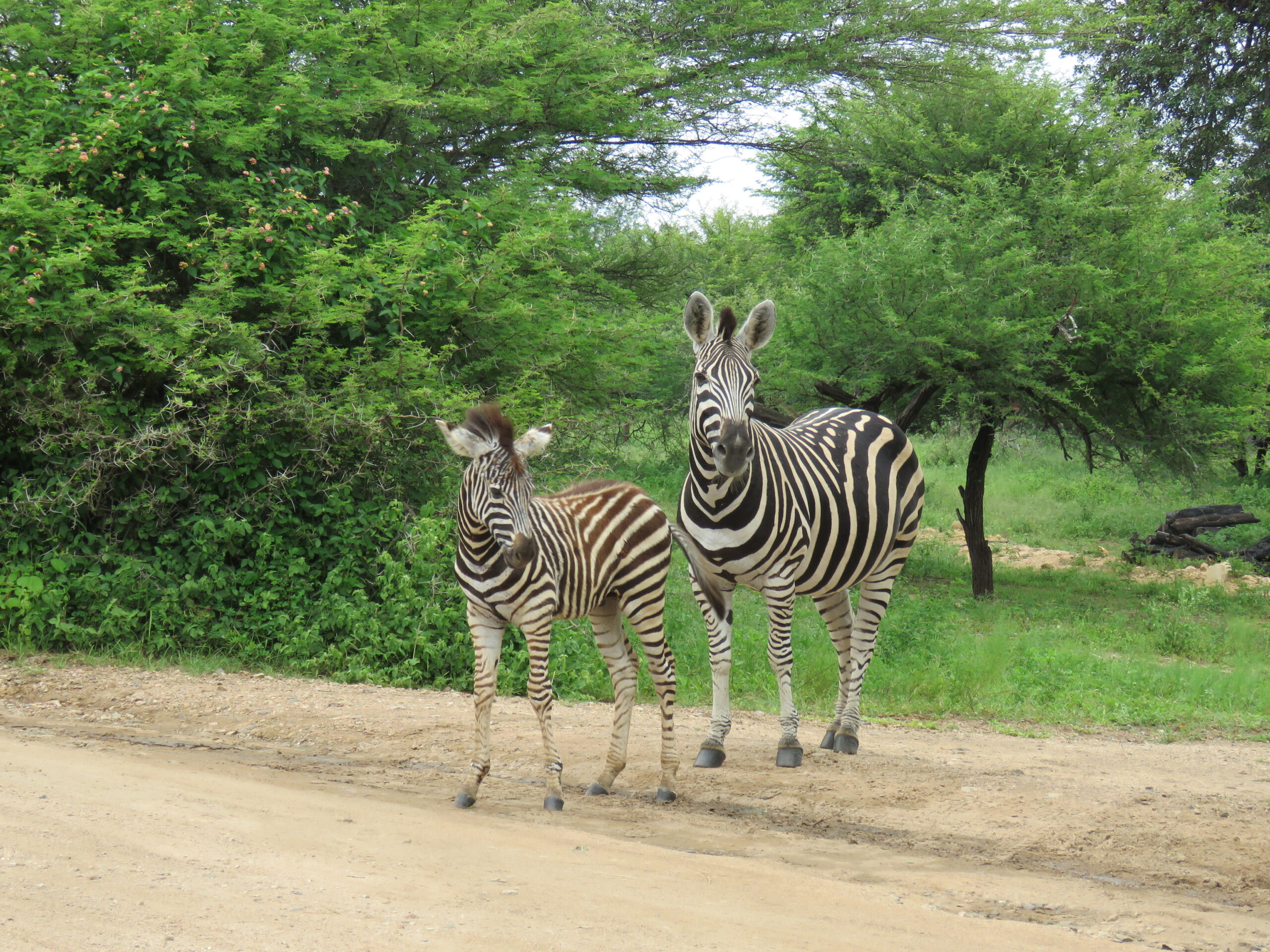
As you can see from today’s photos, we were thrilled to see zebras in the garden finally. It was funny how it happened. One of the four zebras snuck up from the side of the house and peered out at us on the veranda, checking out the situation. Moments later, the four of them were busy munching on pellets, rarely taking a second to look up.

They seem to copy one another’s activities.

Zebras aren’t like kudus, wildebeest, warthogs, and bushbucks, who make eye contact and respond to our voices. They never look us in the eye. Although it’s pretty enjoyable to watch them interact with one another, pushing and shoving one moment and cuddling the next, they have little interest in us humans. Nonetheless, a visit from them is always welcomed.

Tonight, we are getting together with Linda and Ken to celebrate our anniversary. And, tomorrow night, their last night in MP, we’re meeting for dinner at the Amazing Kruger View Restaurant, formerly known as AAmazing River View. The restaurant overlooks the Crocodile River for some often exciting views. Bubbly is on the menu for sure.

Although there is chlorine in the pool, here, they use so little. It’s not harmful to the animals to drink from the pool.

Today, it is sweltering and humid. It’s so much so that I decided to stay inside in the bedroom to cool off for a bit while I finish today’s post.

We hope you’ve been having a good weekend. We certainly have enjoyed this four-day run of social activities with our special friends in Marloth Park. We never tire of the people or the wildlife and can’t imagine, we ever will.

Be well.

Photo from one year ago today, March 7, 2020:

In an old vehicle located at the Best Exotic Marigold  Hotel, Us is referred to as a Willy/Jeep. For that post, please click here.

Finally, we found the ostrich family of many…

Only a few members of the large ostrich family we’ve been longing to see.

Every few days since we arrived, we’ve driven around Marloth Park looking for the ostriches. We’d heard the chicks were huge already but still glued at the hip to their parents.  Here’s some information on ostriches from this site:

“Ostrich Facts: The World’s Largest Bird

Ostriches are large, flightless birds that have long legs and a long neck that protrudes from a round body. Males have bold black-and-white coloring that they use to attract females. Females, on the other hand, are light brown.

Ostriches are bigger than any other bird in the world. They can grow up to 9 feet (2.7 meters) tall and can weigh up to 320 lbs. (145 kilograms), according to the African Wildlife Foundation, and an ostrich’s eye is 2 inches (5 centimeters) in diameter — the largest of any land animal. The ostrich is the only bird that has two toes on each foot. All other birds have three or four toes, according to the American Ostrich Association.

Several fast-growing chicks close to a house in the bush.

Where do ostriches live?

Wild ostriches live in the dry, hot savannas and woodlands of Africa. They once roamed all over Asia, Africa, and the Arabian Peninsula, but because they have been hunted so extensively, wild ostriches’ range has been reduced to sub-Saharan Africa. However, ostriches can be found in captivity all over the world.

What do ostriches eat?

Ostriches are omnivores, which means they eat both vegetation and meat. Although they prefer plants — especially roots, seeds, and leaves — they also eat locusts, lizards, snakes, and rodents. They also eat sand and pebbles, to help grind up their food in their gizzard, which is a small pouch where food is crushed and ripped up before it reaches the stomach.

It’s difficult to get preferred photos with ostriches with their heads up when they are constantly pecking on the ground. These are two of the dozen or more chicks.

Mating habits

Male ostriches are called cocks or roosters, and females are called hens. A group of ostriches is called a flock. Flocks can consist of up to 100 birds, though most have 10 members, according to the San Diego Zoo. The group has a dominant male and a dominant female and several other females. Lone males come and go during mating season.

To get a female’s attention, males bow and flap their wings outward to display their plumage. When they are ready to mate, the male’s beak and shins will turn bright red. Sometimes, his neck will change to a red color to match. Females also change color when they are ready to mate. Their feathers will turn a silvery color, according to the American Ostrich Association.

The larger dark feathered ostrich on the right may be the dad. Females have lighter-colored feathers.

Ostrich eggs & baby ostriches

Ostrich eggs are 6 inches (15 cm) in diameter and can weigh up to 3 lbs. (1.3 kg). Eggs are laid in a communal nest called a dump nest, which can hold about 60 eggs at one time. Males, as well as females, sit on the eggs until they hatch, which can take 42 to 46 days.

Other facts

It may seem amazing that an ostrich’s thin legs can keep its large body upright. Their legs are perfectly placed so that the body’s center of gravity balances on top of its legs.  Their thin legs give them great speed and maneuverability, too. They can run up to 40 mph (64.3 km/h) for sustained periods of time, according to the American Ostrich Association.

Contrary to popular belief, ostriches don’t bury their heads in the sand, but they do lie down with their heads against the ground when they feel threatened. It only looks like the ostrich has buried its head because its head and neck blend in with the color of the sand.

Ostriches fight with their feet. They kick forward because that’s the direction in which their legs bend, according to the American Ostrich Association. A solid kick can kill a lion.

Ostrich feathers look shaggy because they hang loosely and don’t hook together like feathers on other types of birds.”

It’s such an oddity, that an ostrich’s eye is the largest of any land animal in the world. We often notice their large eyes when we get up close and personal with these peculiar birds which are abundant in Marloth Park, Kruger National Park, and other areas of Africa where they flourish in the wild.

There’s always one or two on the lookout to ensure their safety from predators.

Yesterday afternoon, when the ceiling in our bedroom was being repaired along with the screen door to the veranda, that “Little” had damaged on a recent visit, we decided to embark on what proved to be a two-hour drive over bumpy dirt roads, recently made more difficult to navigate due to the weeks of heavy rains. Now that the skies seemed to have cleared and the road graders have been working on the dirt roads, the roads are better than they’d been a few weeks ago.

It’s hard for us to believe we’ve been here for 50 days so far. Somehow, the time flies so quickly when we’re here, enjoying the many amazing aspects of this wildlife conservancy along with the blissful social aspects. Speaking of which, we have a few busy upcoming social events in a row over the next several days.

Tonight, Thursday, we’re heading to Jabula Lodge & Restaurant for dinner with friends Linda and Ken, who will be returning to their home in Johannesburg next Tuesday. Tomorrow night, Friday, we’re hosting sundowners at our house, for eight of us for which we’ll set up another table on the veranda to ensure social distancing. Included in that group are Linda and Ken, Andrew and Lesley, Louise and Manie (a different Louise), and the two of us.

On Saturday night, we’ll be going to Amazing Kruger View Restaurant, formerly known as Aamazing River View, for sundowners to celebrate our 26th wedding anniversary, which is actually on Sunday, March 7th.  After enjoying the views of the Crocodile River, we’ll again head to Jabula Lodge & Restaurant. On Sunday, the actual day of our anniversary, Linda and Ken invited us for some “bubbly” and a nice meal cooked on the braai.

  • As a result of all of these social plans, we’ll be busy over the next four nights. By Monday, once again, we’ll prepare our dinner on the braai and revel in the beauty and magic of the bush, as we spend each day and evening on the veranda watching stunning wildlife in the garden. Life is good.

We hope life is good for you!

Photo from one year ago today, March 4, 2020:

The entrance to the Raaj Bagh Restaurant, which facilitates guests of the hotel and is located across the street. For more photos, please click here.

formerlyat a previous timeMore (Definitions, Synonyms, Translation)

Part 2 …An exciting opportunity in the bush…Postponed until tomorrow…Great evening with friends…

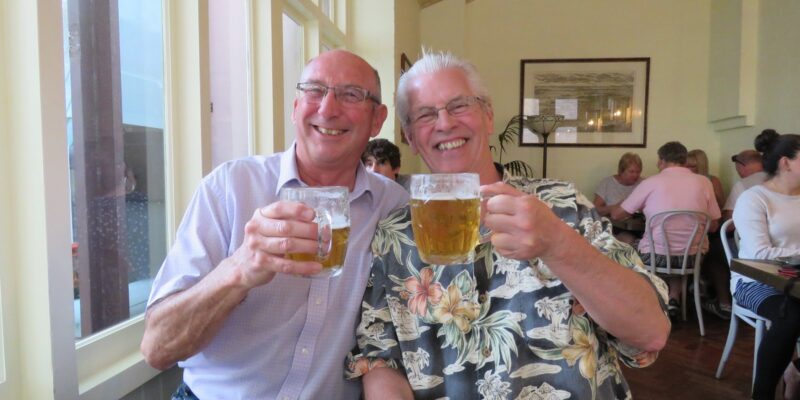
In Sydney, Ken and Tom toasting “James Squire, the Swindler” summer ale in the pub!

We won’t be posting Part 2 from yesterday’s radio broadcast. The stream won’t be available until Monday. The broadcast was live, but apparently, the stream hasn’t been set up yet. Tomorrow when we return from Malalane after my dental surgeon appointment and some grocery shopping, we’ll be preparing that post, providing the stream will be available online by that time.

In Sydney, Linda and I toasted to the special occasion.

Sorry for the incorrect information in yesterday’s post here. This is South Africa, not the US. Things move a little slower here. For some reason, I assumed once the live broadcast was presented, the stream would be available.

As for last night’s first dinner party for four since we arrived in Marloth Park, we had a fabulous time with Linda and Ken. It was astonishing to see our old friends. The last time we were together was in 2019 in Wales, UK, when we all explored the ruins of famous castles. See the photo below. See that post here.

In Wales, Ken set up our camera timers for this photo.

Before that time, we saw them many times in 2018/2019 while we were in Marloth Park. And, before that, we got together in Sydney. Australia and met up at the Fortune of War Pub, the oldest pub in the city, had a few drinks, and walked around the fabulous city, and ended up having lunch at a cozy restaurant. See that post here. They, too, like to travel and are feeling disappointed about travel restrictions at this time due to Covid-19.

Tom and I and Ken and Linda, great friends from Marloth Park who happened to be in Sydney at the same time as us! Small world!

We felt comfortable being with them in light of Covid-19. They, like us, are cautious in avoiding contact with possible exposure to the virus. Still, we did our best to be socially distanced as much as we could, until finally, we went indoors to have dinner at the round dining room table to escape the enthusiasm of the awful mosquitoes who have been on a rampage since the recent rains.

One can never be too cautious, whether it’s concerned about getting the virus or possibly contracting malaria from mosquito bites, even when covered with repellent 24/7. I have found it necessary to spend each day indoors to reduce my exposure to the bites. At night, it’s even worse, so we end up going indoors shortly after darkness falls when it becomes even worse. Every four hours, I load up on the DEET repellent to no avail.

In Sydney, friends Linda and Ken, whom we met in Marloth Park in 2013.

In a few months, as it continues to cool down as winter approaches in June, there won’t be as many mosquitoes. Plus, the cool weather is delightful when sitting outdoors or sleeping. In any case, we’re still enjoying every moment of our time in Marloth Park.

The socialization, the wildlife, the scenery, the people, and the unique environment we’ve ever lived in our years of world travel. In a perfect world, the visa situation wouldn’t be such an issue. Soon, we’ll need to start looking again for some options for a new visa stamp. We have to leave here in only 43 days.

Today, we’ll lay low. The weather is ideal, not too humid and cooler than usual. The Wifi and power are working.  Tonight, I hope for a night of better sleep than last night when I tossed and turned, awakening for hours during the night. I want to be well-rested for the unknown of what is yet to come for tomorrow’s dental appointment at 9:00 am.

Tomorrow’s post will be later than usual since we don’t expect to be back in Marloth Park until 1:00 or 2:00 pm. Have an excellent Sunday!

Photo from one year ago today, February 28, 2020:

The spacious veranda outside the door to our lovely suite at Tuli Tiger Resort in Kanha Tiger Reserve in India. For more, please click here.

Part 1…An exciting opportunity in the bush…

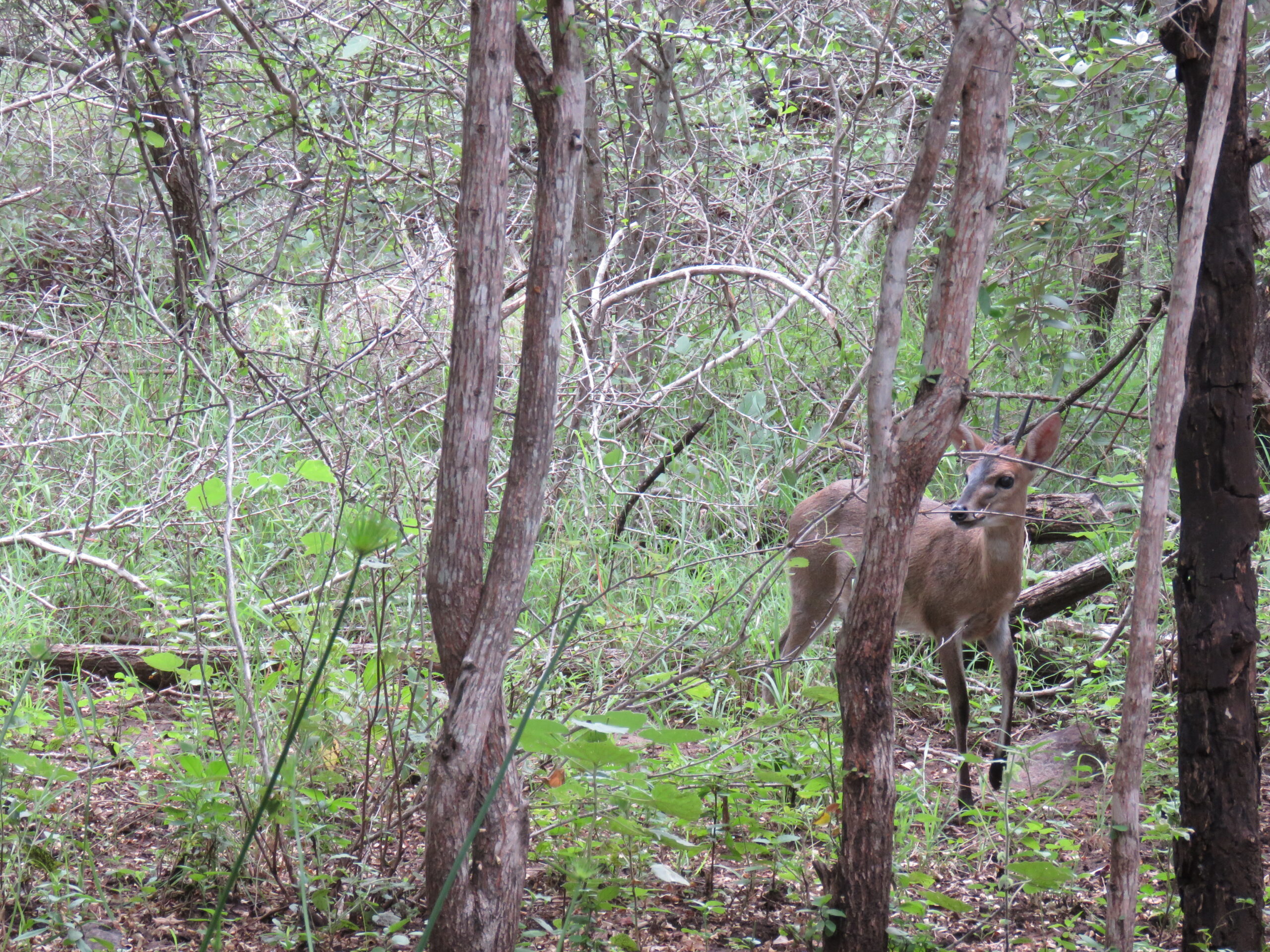
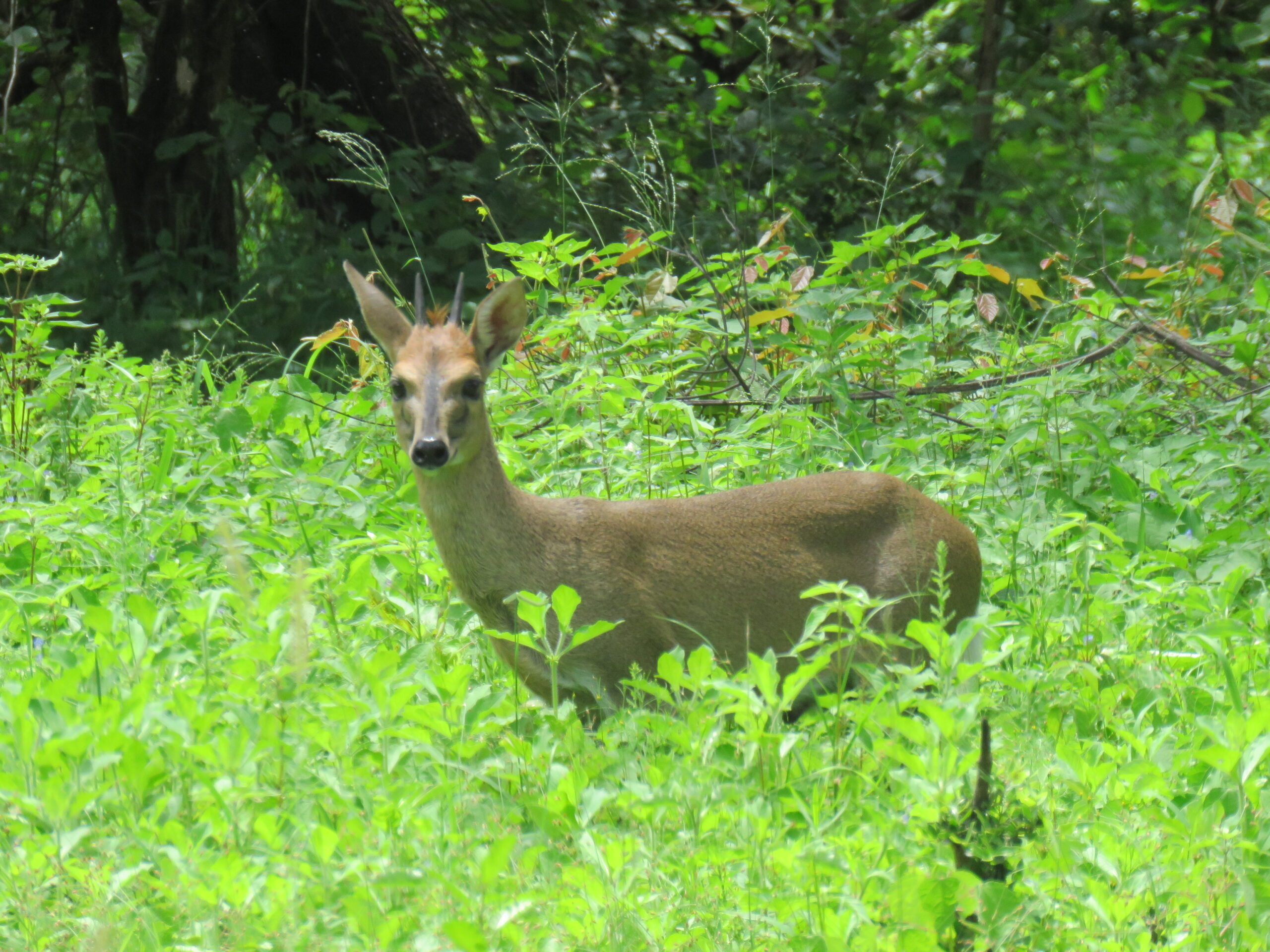
Duikers are shy and elusive, rarely coming close for pellets. This adorable male has stopped by a few times, checking us out but not quite ready to partake of the pellets.

Last night, while out to dinner at Jabula Lodge and Restaurant in Marloth Park, while laughing and chatting with owners, Dawn and Leon, Leon got a call on his phone from Louise, who had been trying to call me my phone but I failed to answer. For some reason, I’d turned off the ringer. But, knowing Louise, she knew where to find us.

She told Leon she had an urgent message for us. We couldn’t imagine what it could be. Quickly, we listened to what she had to say and were surprised when she asked us to come to their Marloth Park Info Centre at 7:30 am tomorrow, Saturday, to be interviewed for a radio station in Nelspruit, Radio Lowveld, 100.5 FM.

When Louise and Danie, who provide a fantastic resource for tourists at their Marloth Park Info Centre located at 3043 Olifant Drive, asked us to come to the center at 7:30 this morning to interview Radio Lowveld, at first, we hesitated. It was early to get up, shower, dress, and be out the door.

This is newly named Peter, Paul, and Mary. They have become quite regular visitors to our garden.

But, when Louise explained that the purpose of us being interviewed was to promote tourism in Marloth Park, we jumped at the chance. The early morning time would work fine for us if we managed to leave Jabula early enough to get back to our bush house and get a good night’s sleep after getting to be at a decent hour.

We continued schmoozing with Dawn and Leon, ate our usual delicious dinner, and left before 8:00 pm, with me even leaving an unfinished full glass of red wine, something I’d rarely do. More on my mind was being fresh and sharp for the early morning interview. As it turned out later in the evening, Louise texted saying we could arrive at 8:15 am instead of 7:30. That helped.

This photo was taken from the car window when we drove along the Crocodile River yesterday afternoon.

Once back at the house, we settled in, watched a Netflix series on my laptop, and by 10:30 pm, I was asleep, Tom shortly after that. With no time to prepare an agenda for the interview, we realized we’d have no choice but to “wing it,” focusing on the reasons why we continue to return to Marloth Park, now for the fourth time, for a total of 20 months, when repeat stays anywhere in the world weren’t on our radar when we decided to travel the world, beginning on October 31, 2012.

Early on, Tom and I made a pact that we’d never return to the exact location, other than to visit family in the USA, to ensure we continually expanded our horizons by seeing more and more countries and points of interest along the way. After all, the world is a vast place.

Hopefully, soon, zebras will come to see us in the garden.

Anytime one does a broadcast interview or a public speech, it’s easy to think back, wishing we’d said “this or that.” In this case, I wished I had focused more on promoting tourism to Marloth Park than on our reasons for coming here again and again.

But, perhaps, that’s what listeners want to hear…why a typical couple, like us, keeps returning to a favorite vacation/holiday spot, regardless of travel goals and aspirations, simply because they want to, as opposed to what one “should do” when traveling. For us, the reasons we love Marloth Park are uncomplicated:

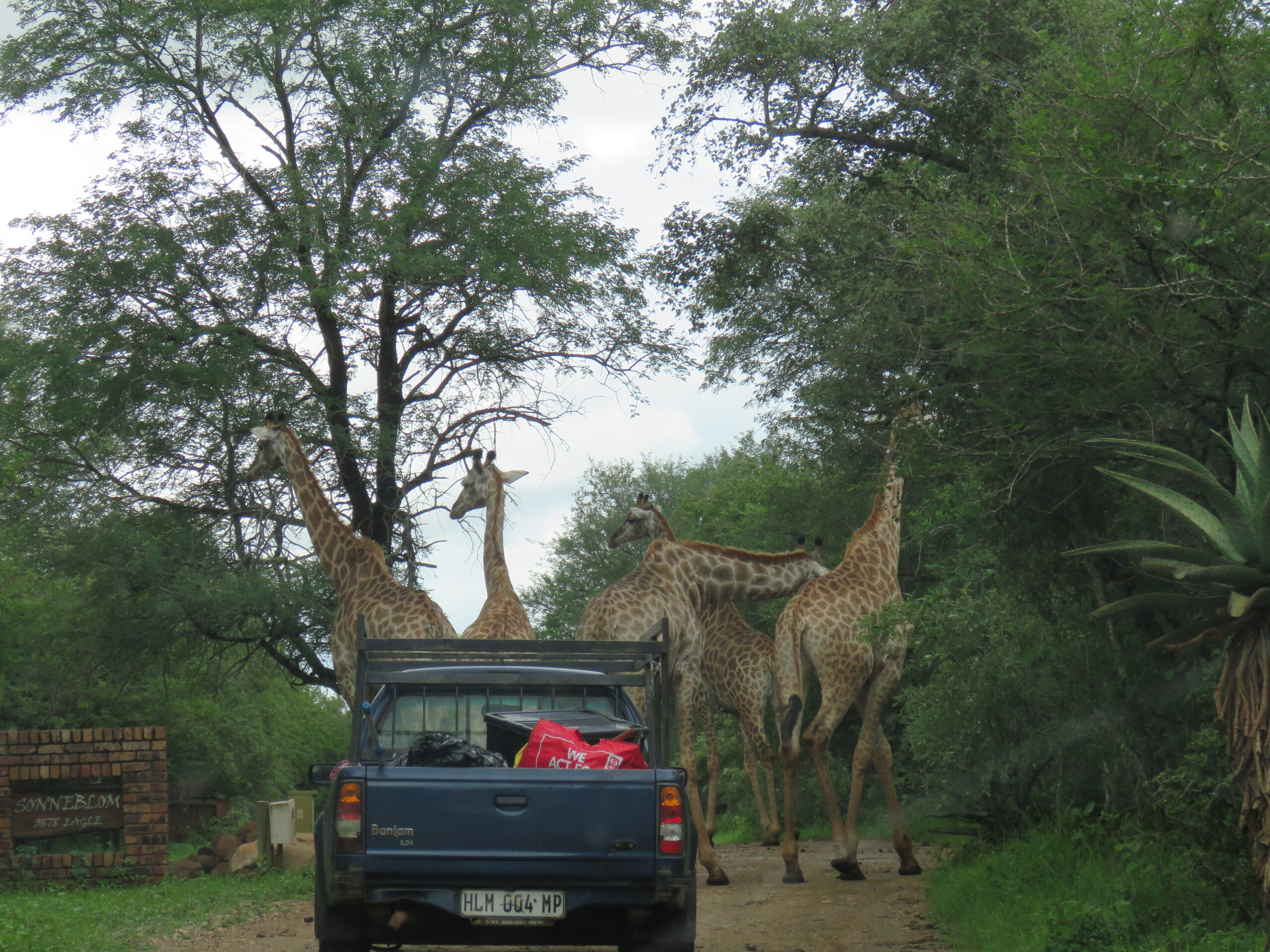
  1. The access to viewing animals in the wild, up close and personal, is a rare experience in this world. Who wouldn’t love a traffic jam with six or more giraffes blocking the road? When have you ever had a zebra, kudu, warthog or wildebeest, in your backyard or garden? Who wouldn’t love some of the best bird watching in the world while sitting on your holiday home’s veranda?
  2. Meeting some of the friendliest and most welcoming locals on the planet, based on our past worldwide experiences which provide us with an extensive social life.
  3. Easy access to the Big Five in a short 25-minute drive to enter the massive Kruger National Park at the Crocodile Bridge entrance gate, which covers an area of 19,485 km2 (7,523 sq mi) in the provinces of Limpopo and Mpumalanga in northeastern South Africa, and extends 360 km (220 mi) from north to south and 65 km (40 mi) from east to west.”
  4. Conveniently located to many other stunning tourist activities, too many to mention here. But Louise and Danie have tons of information available at the Info Centre, conveniently located in the center of Marloth Park on the main paved road.
  5. Fantastic restaurants with great food, conversation, and warm, welcoming
  6. Local shops for supplies, food, biltong, liquor, with a post office, hair salons, ATMs, hardware, feed shop, fantastic water park ideal for kids and families, and so much more, contained in two easy to access shopping centers
  7. A short minute drive from any direction to see the Crocodile River, which separates Marloth Park and Kruger National Park with viewings of lions, elephants, cape buffalo
  8. Endless options for holiday rentals, including private houses, lodges, resorts, and hostels with prices suitable for all budgets, all right within the borders of Marloth Park. For us, Louise and Danie are our chosen hosts for the holiday homes we’ve rented during our four visits over the years providing exemplary services and properties. There are countless other properties you may choose offered by other property owners and managers.
  9. Visiting a game reserve, Lionspruit, located within Marloth Park with lions, whose roars often fill the air at night, music to our ears.
  10. A leisurely-paced, quiet environment offered the utmost of holiday options in a unique setting unlike anywhere else in the world. This magical place leaves every visitor with stories and photos to share for a lifetime.
Kudus were stopping by for some treats and a drink from the pool.

The above reasons are why we chose to return again and again to Marloth Park for some of the finest experiences we’ve had in over eight years of world travel. This visit right now is by no means our last. We will continue to break our pact of not repeating locations in our worldwide travels and return to Marloth Park over and over again.

Please check back tomorrow when we’ll share a link to our interview with Radio Lowveld, 100.5 FM. We’re excited to share it with all of you.

Now I need to get back to work preparing tonight’s dinner for friends Linda and Ken, who will be arriving in about four hours.

Have a safe and pleasing day!

Photo from one year ago today, February 27, 2020:

The photo was taken while on a road trip to our following location on our private tour of India. Please click here for more photos.

Busy weekend plans in the bush…

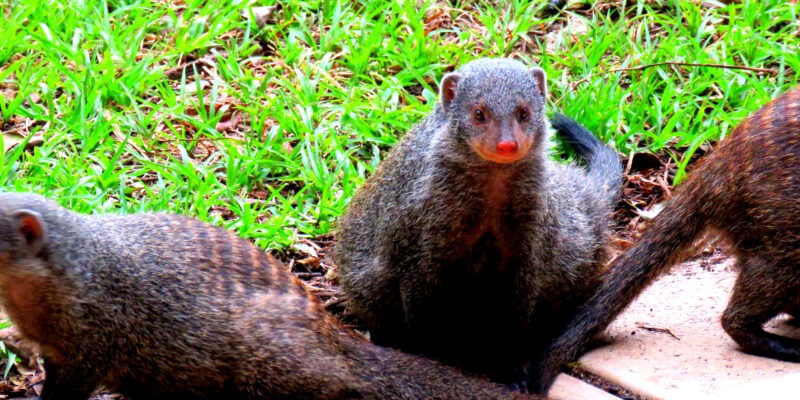
Ms. Mongoose is expecting. Note her wide girth.

It’s another late start to the day. It’s almost 1:00 pm, and we’ve been busy this morning, leaving little time to post. Now that we have power, once again, and I am feeling better, I’ve been able to resume working out on the borrowed/rented treadmill. It feels good to be working out.

Another post from pregnant mama mongoose. She proved to be fast on her feet when we offered her a few whole eggs. She had no trouble ensuring no one else would grab them.

Each hour, I set my phone’s timer to remind me that it’s time to go into the second bedroom, turn on the AC five minutes in advance and get back to work. It’s comparable to the walking I did in Mumbai during those ten long months, striving for 10,000 steps, 5 miles, 8 km, per day.

Tiny never fails to stop for a visit, pellets, and a rest.

Unfortunately, my Fitbit doesn’t read how many steps I have been doing on the machine since I don’t swing my arms. I keep my hands on the rails to record my heart rate to ensure it doesn’t go too high. The reading seems fairly accurate when I compare it to the reading on the Fitbit.

We call this male bushbuck Torn Ear. His left ear had an injury, leaving a flap of hair and skin. He often visits several times a day.

Another reason to keep my arms on the rails is for safety. Since the two operations on my legs 22 months ago, I am not as steady on my feet as I used to be. It’s for that reason we don’t walk on the dirt roads in Marloth Park. They are uneven, rocky, and riddled with potholes that could easily result in a fall.

Mongoose is attempting to drink from the swimming pool. There’s a pond in our garden that most animals use for drinking. But, some insist on drinking the chlorinated pool water. After a few gulps, they realize it’s not an ideal water source.

Then, this morning we headed out to the little market in Marloth Park for a few items for tomorrow night’s dinner when Linda and Ken will be joining us. Before we made our way to the market, we drove around the park, searching for wildlife sightings. We were able to spot only a few and jumped at the opportunity for a few new photos.

A dung beetle with his ball of dung, rolling it across the garden.

A short time later, gingerly, I made my way around the crowded little market, trying desperately to avoid getting too close to other shoppers. They didn’t have a few items on my list, so I had to do what they had on hand. One of the items I was looking for was toothpicks for the few bite-sized starters I’m serving with our sundowners.

Appetizers, called “starters” here in South Africa, are traditionally served with cocktails before dinner to avoid drinking alcohol on an empty stomach. I suppose this is the reason. This is also a common practice in the US. Tom and I, when it’s just the two of us, never have starters, fearful we’d get “full” even before the main meal is served.

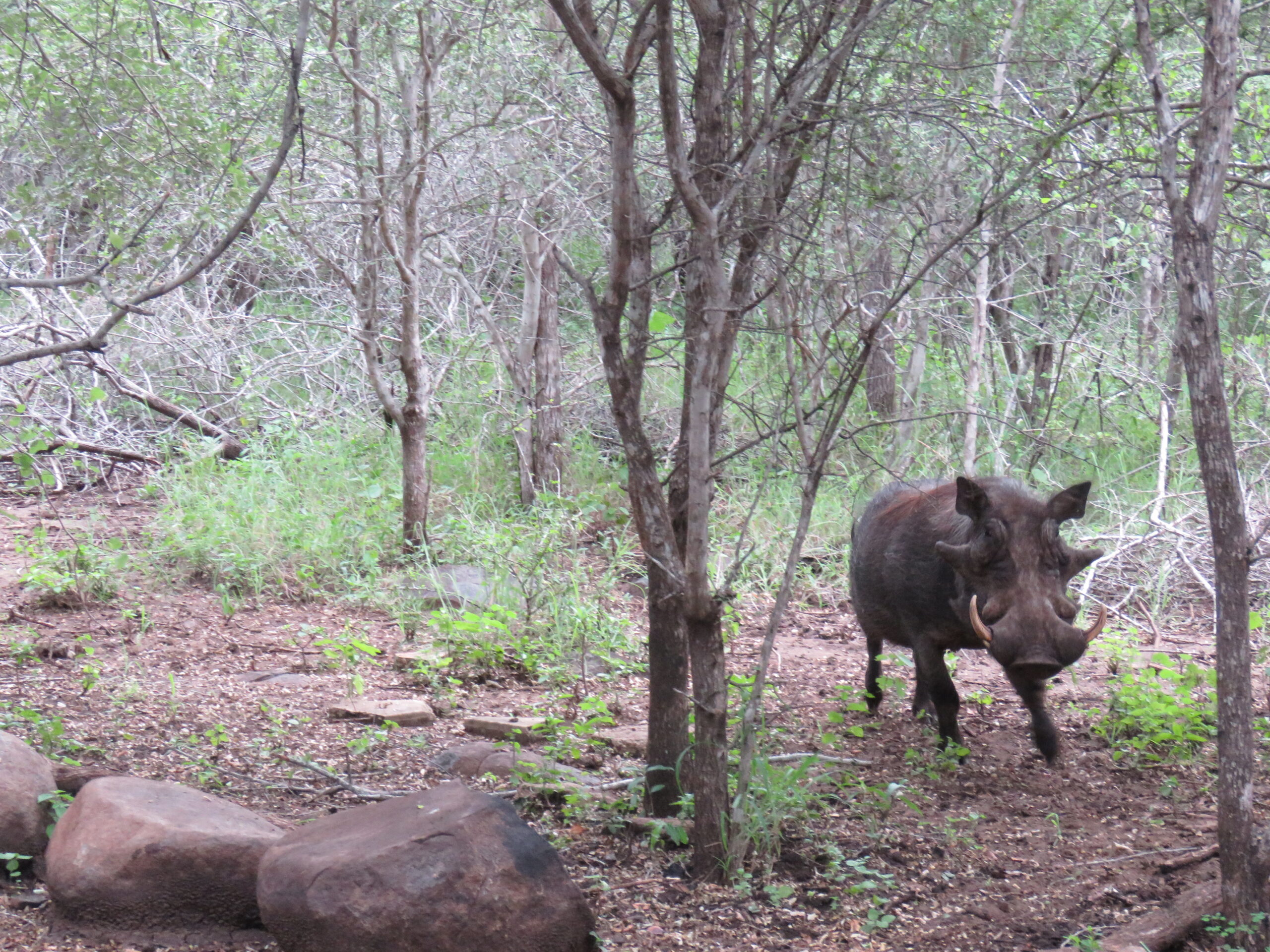
One Wart has become a regular visitor, although he and Tiny don’t necessarily get along.

But, over the years, we’ve made an effort to repeat this tradition with our dinner or sundowners/happy hour guests. Also, for just the two of us, we didn’t/dodon’t need to consume any more food than what we had on the night’s menu, which would ultimately result in added weight we always struggled to avoid.

This morning, Tom weighed the same as he had when we were in Belize in early 2013. We’ve both been striving to take extra care of ourselves and to drop some unnecessary poundage. It’s been going well. I’d still like to level 2 or 3 more kg, five to six pounds, and this last bit is going very slowly. The number on the scale won’t budge for me, but my clothes fit, so I’m not complaining.

A yet-to-be-named female we’ve only seen a few times.

Tonight, the two of us are returning to Jabula Lodge and Restaurant for another dinner after last Saturday night’s birthday dinner. When we saw how careful they are regarding Covid-19, we felt comfortable returning so soon. We’ll sit outdoors on the main veranda and avoid spending any time sitting at our favorite spot, the bar.

Those days of gabbing while standing or sitting at a bar may be long gone, not only for us but for others all over the world, at their favorite pubs and dining establishments. We’ve always found bars a great place to commiserate with the locals in any giver town or city. It’s no different here in Marloth Park. Sadly Covid-19 has changed many forms of entertainment for all of us.

That’s it for today, folks. We’ll be back with more tomorrow. Stay safe.

Photo from one year ago today, February 26, 2020:

This baby elephant was being prepped for humans to ride him in search of tigers. Riding an elephant is a custom in India, but as most of our readers know, we wouldn’t ride one, nor do we approve of elephants in captivity (or other animals, for that matter). For more, please click here.

Out! Out! and out some more!!!…We’re back up!!…

During the night, our water cooler leaked all the water from a fresh bottle onto the floor. No big deal. Zef was here this morning and fixed the issue. No big deal. This morning at about 7:30 am, the power went out. A big deal. Eskom, the unreliable electric company, is supposedly working on it. I won’t blame the workers. They seem to work hard to resolve issues as they occur.

Several hours ago, the WiFi went down. A big deal for us. It most likely doesn’t have anything to do with the power outage since often, when the power is down, we still have WiFi. The service provider is working on it. We shall see how this goes. In the worst case, I will upload a short post from my phone using its pricey data plan through Google Fi. (As I prepare to upload this post, the power is back on!)

It is so hot and humid today. It isn’t easy to breathe. We’ve been sweating like crazy. An occasional respite in the bedroom with the air-con on wouldn’t have been possible without power. However, our almost fully charged inverter allowed the fan in the bedroom to work until it ran out of juice. Not knowing when the power would be restored,  we avoided using the fan. We saved the inverter power for recharging our phones and laptops.

I have to wear clothes with a lot of coverage due to the mozzies. Right now, I am wearing a tee-shirt, jeans, and heavy socks. The mosquitoes love to bite my ankles, bare arms, neck, and hands, regardless of how many repellents I add to my bare skin several times a day. I am covered in bites from the past several days.

Tiny came to call.

Yes, I know. I promised not to whinge (to complain about these things) once we got out of that hotel room in India. Overall, we are fine. Tom and I don’t complain to one another about any of these issues. It doesn’t make it any easier if we do. Instead, we find ways to busy ourselves, playing games on our phones, which I’ll do when I’m done preparing the day’s post while offline, to which I won’t be able to add photos and eventually upload until the WiFi returns some point.

Yesterday, we used the oven to roast a beef brisket that was very fatty and boney, but the meat turned out delicious. With the fridge not working due to the power outage, we reheated the meat on the braai to eat it before it spoils. After lunch, we tossed dozens of bones to a 60 member band of mongooses. They love the little bones, eating the marrow and the scrapes of meat and fat. They bang to bones against the wall of the swimming pool in an attempt to “crack them open” for better access to the marrow. It was fun to watch.

A lone frequent warthog visitor, whom we’ve aptly named “Lonely Boy,” stopped by for a few hours. He’s easy to identify when one of his warts on the left side of his head is droopy and larger than the wart on the right side. We make a point of remembering little odd markings on the different species, making it easy to identify our regulars. We call them by the names we’ve given them, knowing full well at the bush house down the road, they are called by different names, not ours.

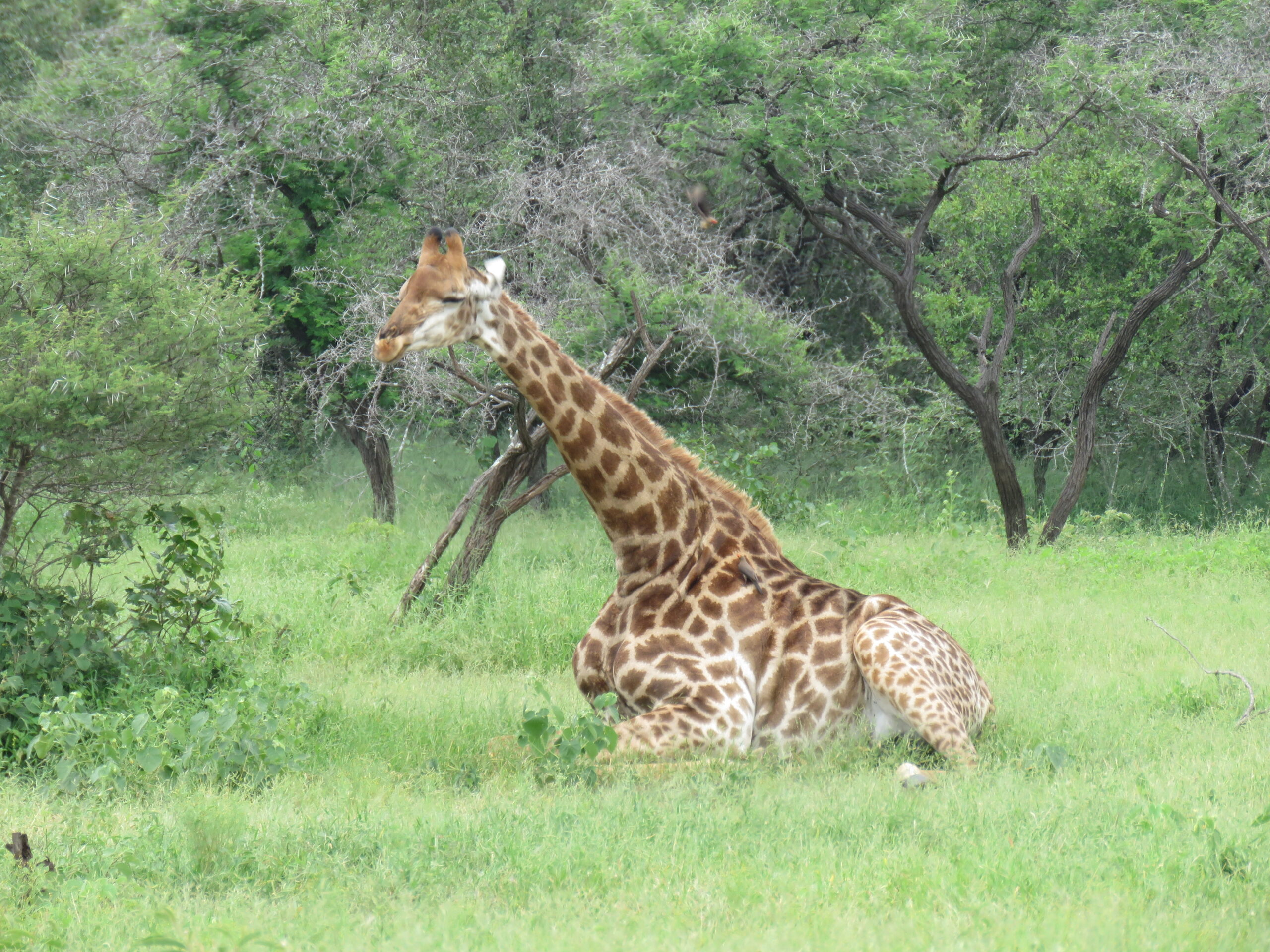
No doubt, giraffes like to get a load off their feet from time to time. Giraffes are the tallest land animals. “Female giraffes are up to 4.2 meters, 14 feet tall, and weigh up to 680 kg, 1,500 pounds. Meanwhile, males are up to 5.5 meters, 18 feet tall, and can weigh 1361 kg, 3,000 pounds.”

Any animal could have dozens of names as they wander through their preferred territory. But, oddly, once we’ve called them by a specific name a dozen times or so, they respond. Whether it’s the response to my high-pitched voice or the reputation we’ve bestowed upon them, remains to be seen. In any case, it’s great for us to see their ears perk up and see them look into our eyes when we mention their names. It’s all a part of the joy of being in Marloth Park.

Yesterday, we headed to Daisy’s Den, the feed store, to purchase a 5 kg, 11 pounds bag of birdseed. Frank and The Family have been enjoying the seeds, stopping by several times a day, squealing, making his loud Francolin noise to let us know he wants more. We appreciate it every time he stops by. Even if we’re indoors, we know he is, thereby the sounds he makes.

While we were out and about, we drove for a while in the park, looking for photo ops, and found only a few, which we’re sharing in today’s new photos. We’ve yet to see the ostrich family, we’ve heard so much about but continue on a mission to meet up with them at some point soon.

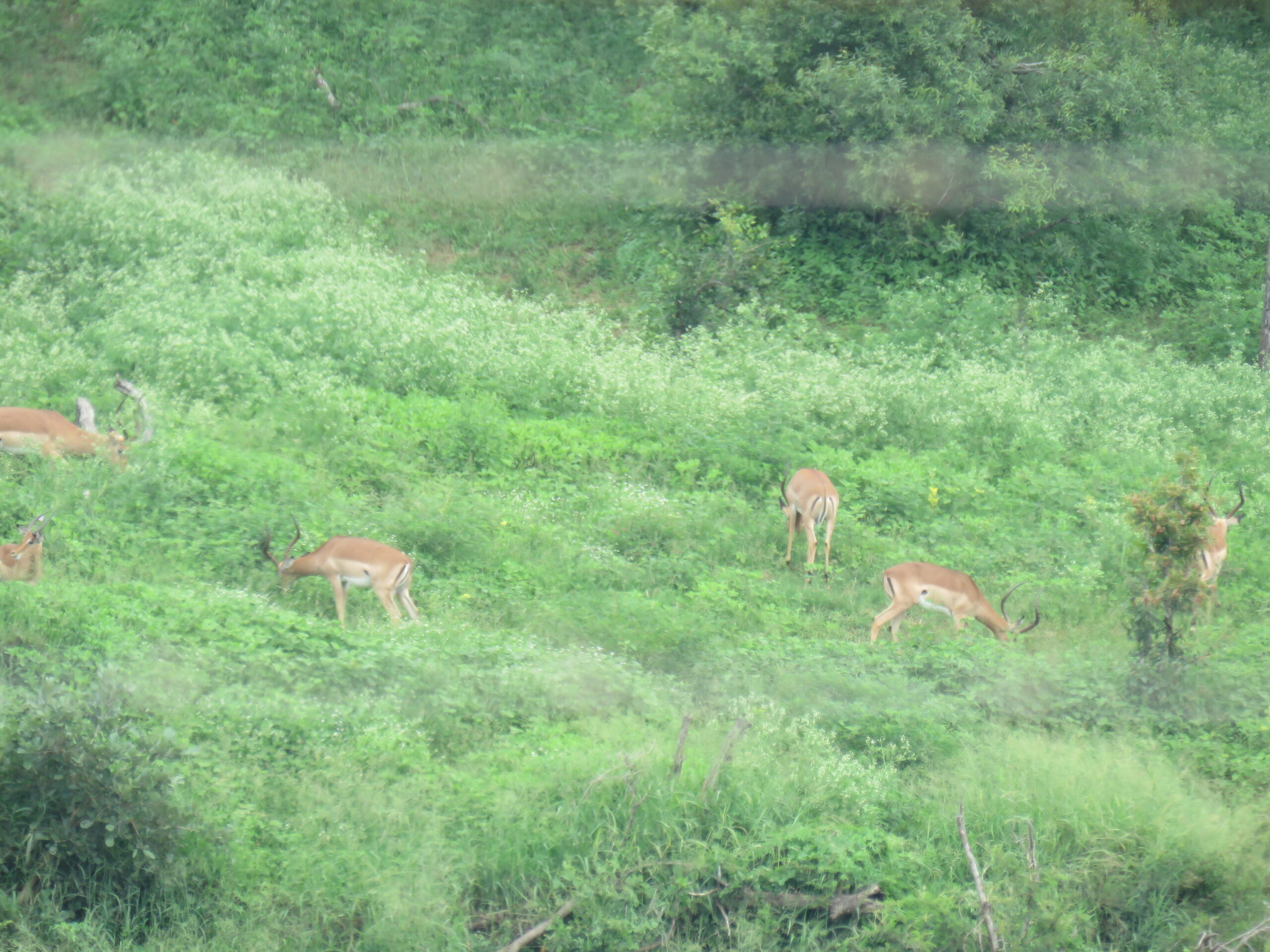
Impalas as seen across the Crocodile River.

We’re never disappointed to see giraffes and zebras. Oddly, since our arrival, no zebras have entered our garden. We believe it’s due to the low-lying brush surrounding the property that makes it difficult for them to get through. Nor have we seen any Big Daddies in our garden, the huge fully horned kudu bulls, again perhaps for the same reason.

Driving around Marloth Park provides us with an opportunity to see even more wildlife. The municipality road workers are busy grading the rough dirt roads to make it easier for cars to pass. It will take a while for this job to be completed. In the interim, it’s really risky to drive the roads with many dangerous ravines, deep trenches, and potholes. When we drive, we often have to turn around, unable to go forward without risking damage to the rental car or even getting stuck, neither of which we’re willing to risk.

Yes, it would be more sensible to rent a car with a 4-wheel drive, but based on how long we stay, the cost of such a vehicle is prohibitive. We make this sacrifice to keep our costs under control, something we always consider in our world travels.

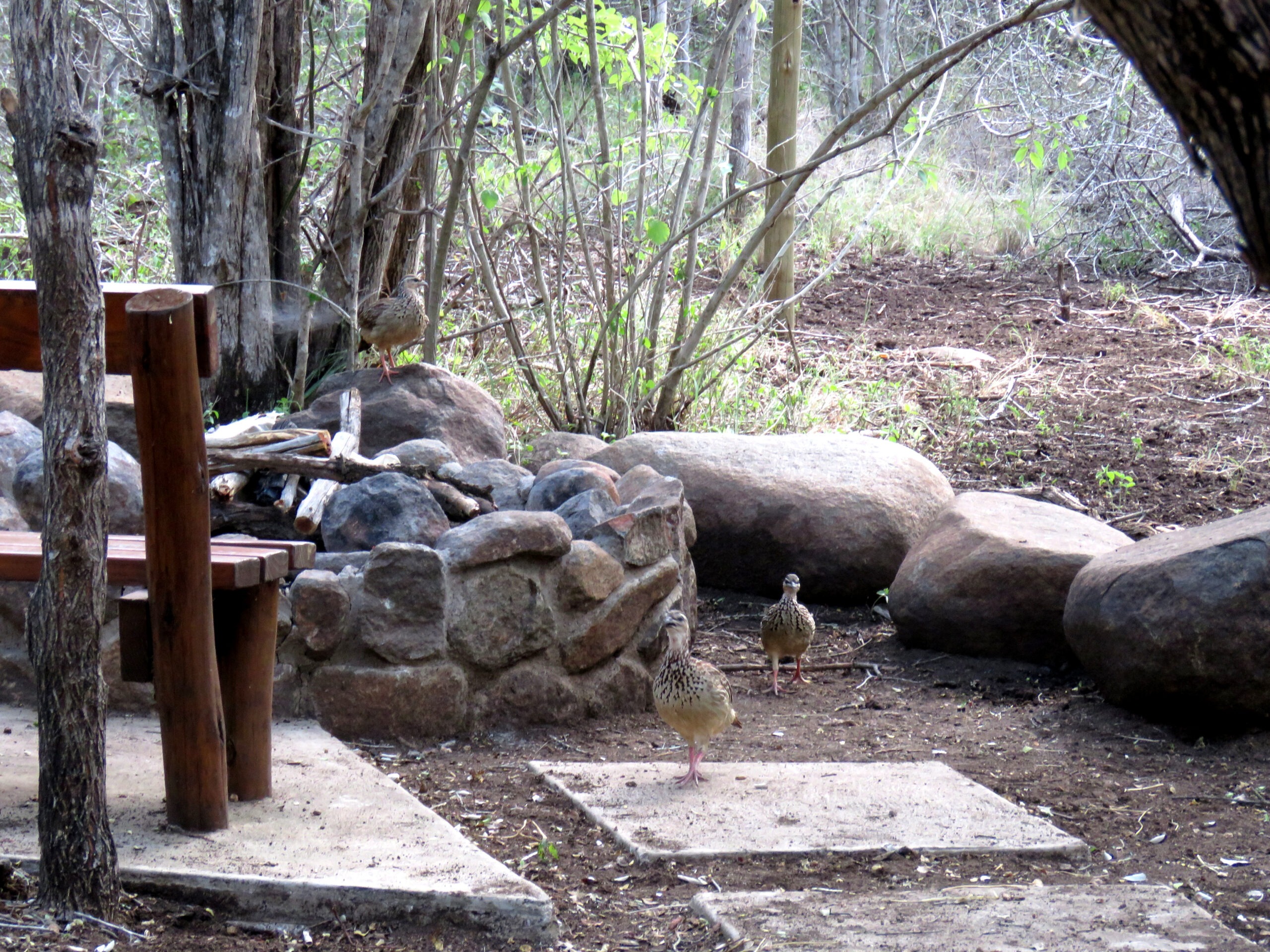
We can’t resist taking photos of the growing Helmeted Guinea-fowl chicks with Mom or Dad.

Our friends, Linda and Ken, will arrive in Marloth Park sometime tomorrow. We’re excited to see them over the weekend. They will be staying at friends Kathy and Don’s home in the bush along the Crocodile River. Kathy and Don are waiting to get their Covid vaccines in Hawaii, their other home, until they head this way. That makes sense. It will be fantastic when we all can be together again, along with other friends who may arrive over the next several months.

I just heard from Louise. The power outage is a result of Vervet Monkeys climbing up an electric pole. Sadly, they were electrocuted, resulting in a power outage. They were high up on the pole; It could have been all day before the power was restored. What a relief! But, as I finish up this post, the power and WiFi are both back on.

Have a great day!

Photo from one year ago today, February 25, 2020:

Perfection! A painting from a local artist we met at the resort at the Kanha National Park. For more, please click here.

A nighttime, dream-like sighting for Tom…I missed it!…The responsibilities of living in the bush…

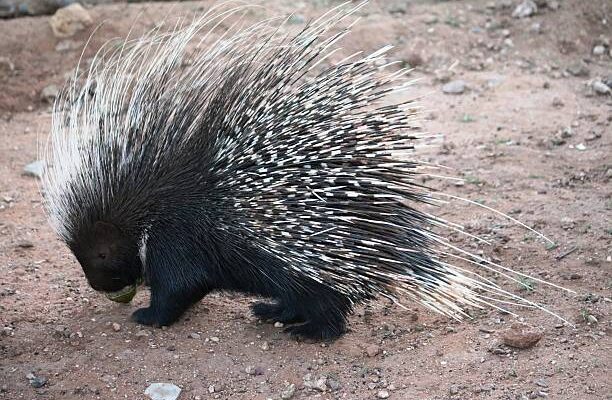
100 African Porcupine Stock Photos, Pictures & Royalty-Free Images - iStock
Cape Porcupine. Not our photos. I wish it were!

Last night, Tom was standing at the veranda sliding doors looking out into the garden. He spotted a porcupine, which, the moment he quietly opened the door, dashed into the bush, gone from sight. Of course, the sound of the door scared them away. Tom couldn’t have been more excited, as was I, but sorely disappointed I didn’t see it, even yet, get a photo. The likelihood of taking a photo of a porcupine at night, their preferred foraging time, is rather slim.

In 2018, dear friends Rita and Gerhard, who will soon return to Marloth Park while we’re here, managed to get a photo of a porcupine walking across their veranda late at night. We were so excited for them as they celebrated the unusual sighting. Last night before bed, I must have looked outside 20 times, hoping it would make another appearance. No such safari luck last night.

I went to bed with a smile on my face, thinking sometime down the road, we may be able to see it again. Louise mentioned that holes dug into the ground, porcupine shelters may have been flooded during the massive rainstorms over the past many weeks, bringing them out into the open more frequently than usual.

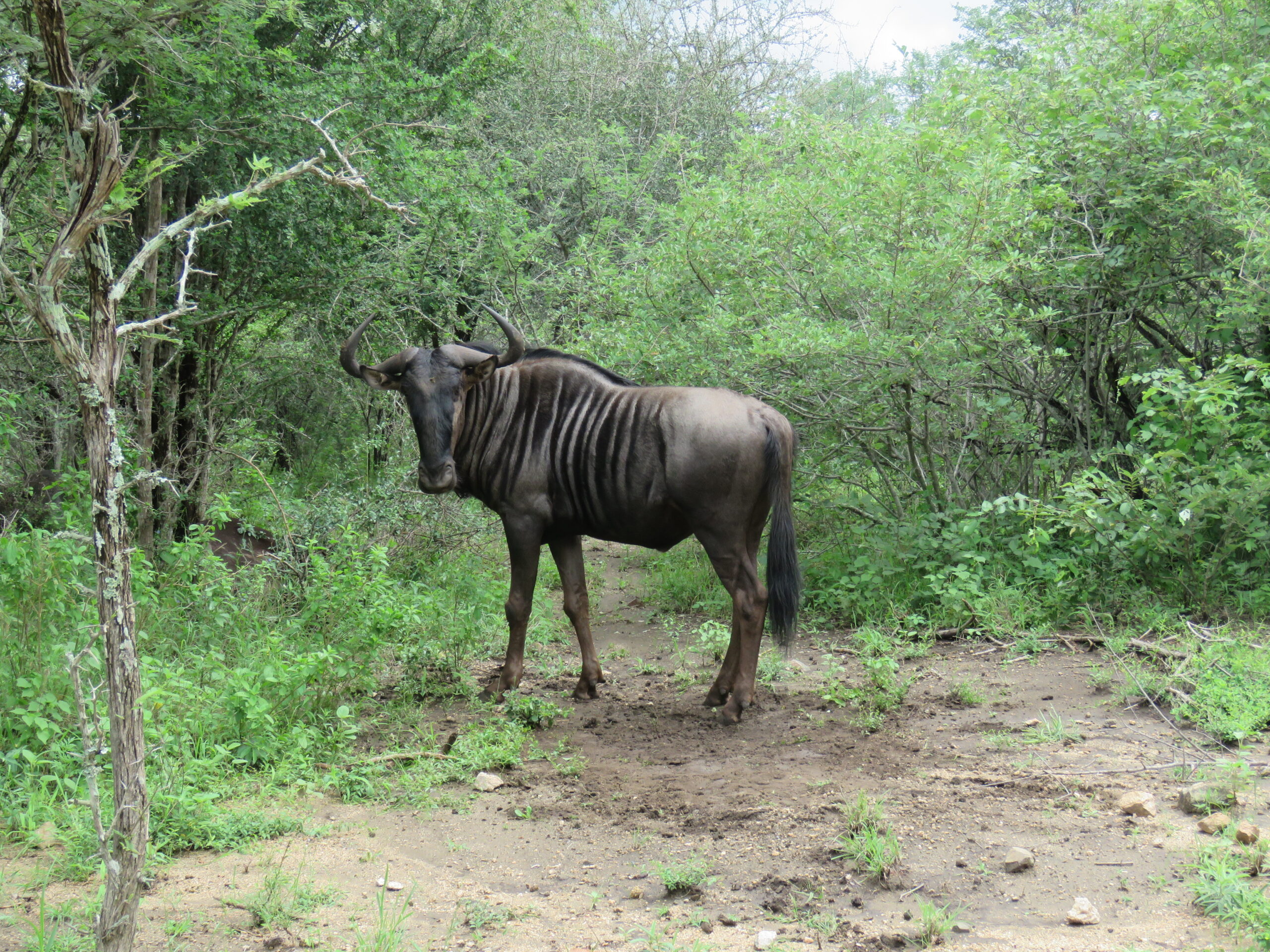
Wildebeest Willie can’t help himself. He loves to stop by.

We’ve had minimal visitors in the past few days with the regular weekend influx of tourists, who often feed the wildlife pellets and leftover human food. There’s no doubt the animals love eating chips, bread, corn, bagged snacks, sweets, and other such foods that may be toxic. This may result in them visiting those tourists as opposed to us. This has been the case over the time we’ve spent in Marloth Park. Weekends are typically quieter than weekdays.

But when unfamiliar and uneducated tourists come to this special area, they may not have the innate desire to keep the wildlife healthy and free from harm, as do those of us who have enjoyed the bush respecting the imperative balance of the wildlife’s diet. They aren’t like us, able to consume unhealthy foods and yet survive. The pellets are made entirely without chemicals and consist of the nutrients and vegetation found in their natural habitat.

Frank and The Misses were trotting over to the veranda for some pellets.

When the wildlife doesn’t have access to pellets, they continue to forage on the vegetation the rains have so blissfully provided to ensure a healthy diet for them. We only feed small amounts of pellets to anyone visiting species at a time and often see them revert to their usual sources of vegetation the moment the pellets we’ve tossed are consumed.

Other aspects of impairing the quality of life for the wildlife are loud music, loud talking and partying, teasing the animals, and most horrifying, speeding, and careless driving on the roads. Often during the many annual South African holidays, when usually the park is packed with tourists, an animal will be killed on the road. (Although Covid-19 has reduced the number of tourists during the past year).

Young Mr. Kudu was checking out the pellet situation in our garden.

Sure, wildlife often darts out into traffic onto a road with little notice of vehicles on the move. After all, they are animals, not humans, who’ve learned to look both ways before they cross. In these infrequent cases, an animal can be hit and fatally injured or killed.

Then, it is up to the rangers to determine if the animal must be euthanized or treated. Most often, the result has been euthanasia. It’s heartbreaking to read about these situations, whether from thoughtless, carelessness, or truly an accident. It’s hard to determine which was the case. If everyone were to drive slowly as posted on the road signs, 90% of these “accidents” would never transpire.

That’s not to say that all tourists fall into this category. There are many, like us, who arrive here with a passion for the care and treatment of wildlife, respecting their way of life and the fact that we humans are intruding upon their habitat, not the other way around.

Handsome kudu.

Also, it’s imperative to respect the many homeowners here, many of whom have used their life savings to own a home in this wildlife paradise and struggle to make ends meet while living on a fixed income as costs rise in the unstable economy in this country.

At times, tourists dump their garbage on the homeowner’s property, leaving for the monkeys to scavenge and litter the mess throughout the property and the bush neighborhood. At other times, we hear of burglaries in which TVs, computers, and other digital equipment, bedding, and household goods are taken. Most homeowners have security systems monitored by security companies located within Marloth Park but making sure it is engaged at all times is the responsibility of the owners and occupants.

We take the house keys in the bedroom at night with the red emergency button connected to a local security company. If there were an invasion or issue during the night, we’d need only push the button to set off the alarm. In minutes, the security people would arrive. But, if the keys are in another room, there would be no immediate recourse.

A herd or “clan” of impalas stopped by to check out the situation. They are very skittish, and if we make a move, they take off.

Another concern in Marloth Park is the risk of fire. Usually, the bush is arid, and it’s particularly susceptible to an outrageous, fast-moving fire. When visitors come, they must be educated on this matter and all of the items mentioned above, that yes, bonfires are fun and traditional in South Africa. Still, extreme care must be taken to ensure they are carefully and adequately observed during use and appropriately doused and put out after use.

Life here in the bush is not as simple as sitting back and enjoying the wildlife. There’s a huge responsibility that goes along with it. We can only hope and pray that this wildlife paradise will still be here in years to come, only possible with the love and support of those who visit and those who live here.

Have a great Tuesday, folks. It’s another hot and humid day here. The mozzies are on a rampage after me, so I may need to spend the better part of the day indoors. They are still biting even when loaded up with repellent. Go figure. Why they like me so much remains.

Photo from one year ago today, February 23, 2020:

Our first photo of the elusive Bengal Tiger in Kanha National Park in India. There she was. We couldn’t have asked for a better vantage point. For more photos, please click here.

Lovely bushbucks…Persistent pig on a mission…Oh, oh, damage done!…

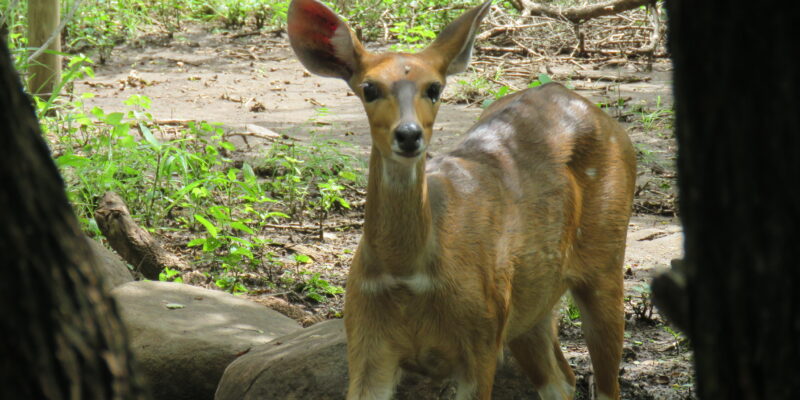
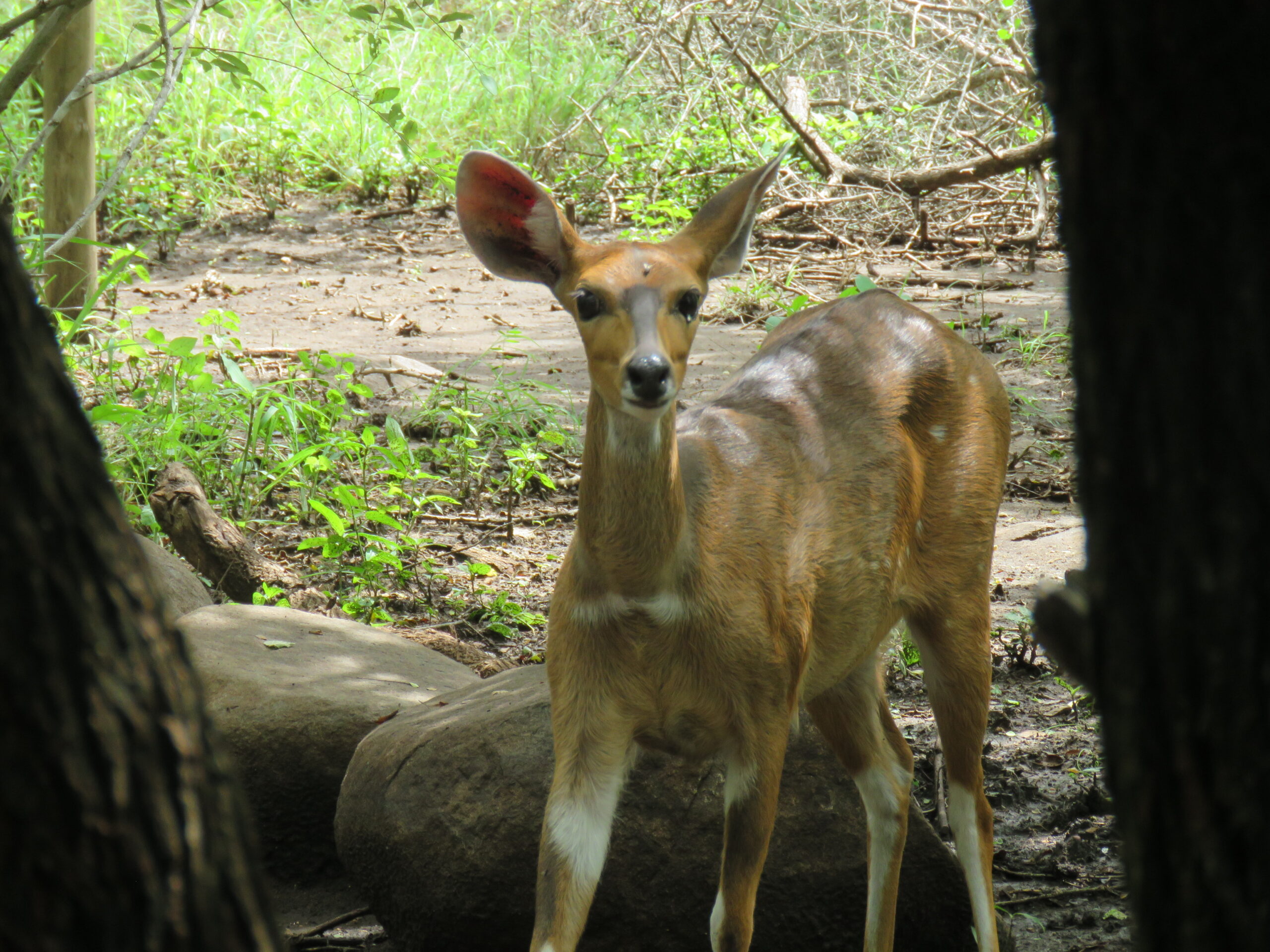
  • Adorable female bushbuck.

Yesterday, while I was indoors, a persistent pig, albeit a warthog, identity unknown at this point, came up onto the veranda and tore a sizable hole in the sliding screen door. I was indoors at the time, but Tom caught the tail-end of his persistence. Was he looking for me or merely looking for me to offer him some pellets? Pigs are clever and, by some scientific observers, purported to be the 5th or 6th most intelligent animal on the planet. But, most likely, he was looking for pellets. I flatter myself in thinking it was otherwise.

We were disappointed to see the damage to the screen but relieved to know that Vusi will repair it soon using a roll of screening material Louise and Danie have on hand. Whew! If I were a warthog and wanted something, surely I’d forge ahead, using my most valuable weapon, the sharp-razor blade-like tusks nature provided to use for protection against apex predators and for digging up roots for food.

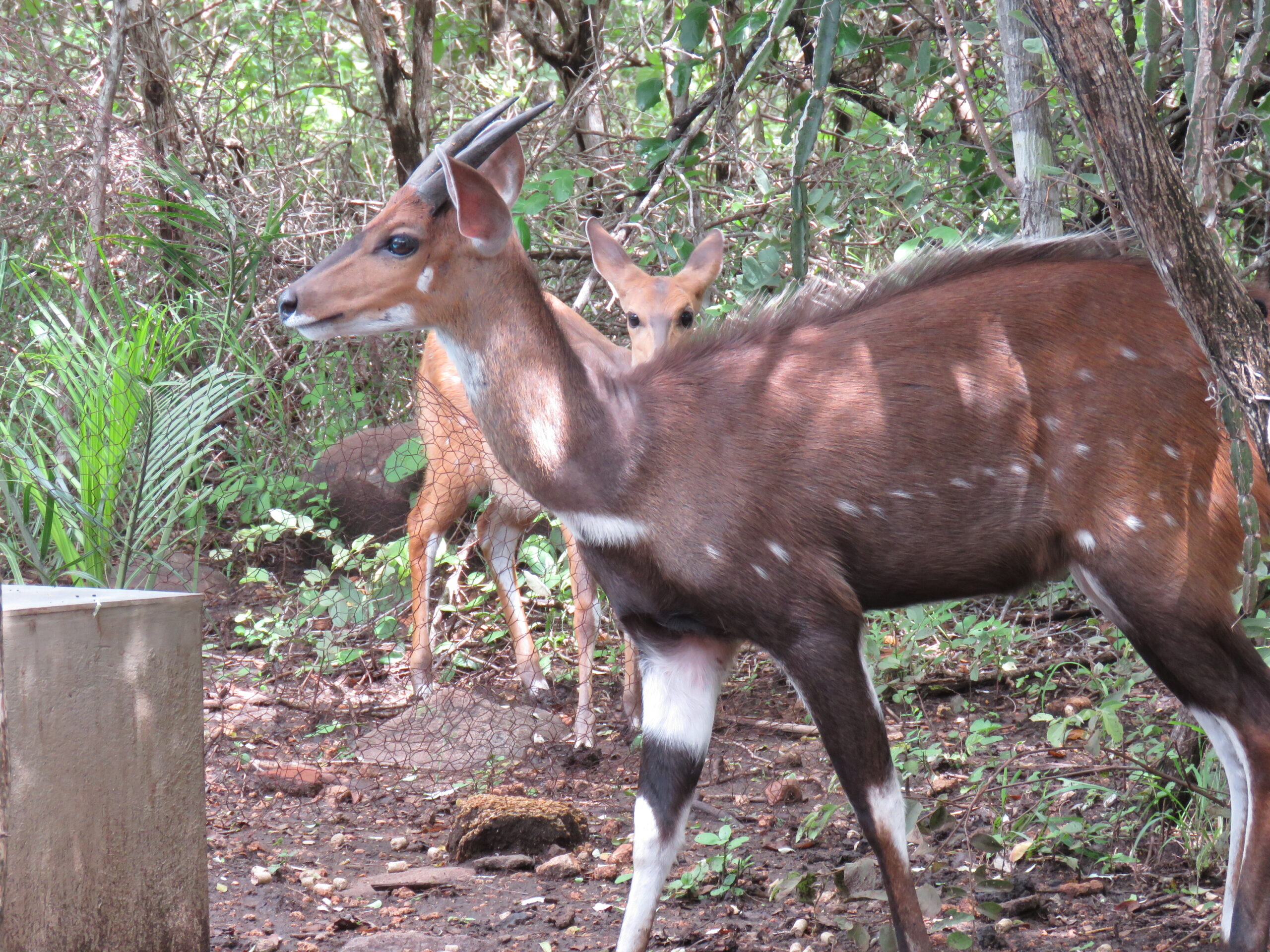
Handsome Mr. Bushbuck, maybe her mate.

A few minutes ago, when I got up to get more coffee, Frank (Francolin) followed me into the house. I had to shoo him out since birds can panic when they feel trapped in a house. Of course, this was another laugh-fest for us. It’s surprising how quickly the wildlife feels comfortable enough with us to be so persistent.

Of course, immediately, I gathered up a container of seeds for him and The Misses and placed them on the cement edge of the veranda instead of on the muddy dirt in the garden. They didn’t flinch when I was right next to them. It’s so endearing, even though their acceptance of us took over a month to achieve.

Mom and Baby Bushbuck strike a pose.

When I put seeds down for Frank and his various family members, if any are left after they are done eating, once the warthogs arrive, they immediately go after the seeds, the minute they’ve cleaned out the supply of pellets we’ve provided. In every case, I put up my hand in a “no” signal and say, in a high-pitched voice, “Don’t eat the seeds.” They’ve already learned the hand signal, and I no longer need to say a thing, just put up my hand. With their little beady eyes, they know what I mean. It’s not unlike training a dog, whose intellect ranks in the following position of intelligent animals, behind all pig breeds.

Kudus are also known to eat bird seeds at our old house in Marloth Park in 2018/2019. We’d placed a bird feeder in a tree. Invariably certain kudus would practically stand on their tiptoes to eat the seeds out of the feeder. Now, they seem less interested in the sources on the ground that Frank leaves behind. Pellets are their priority.

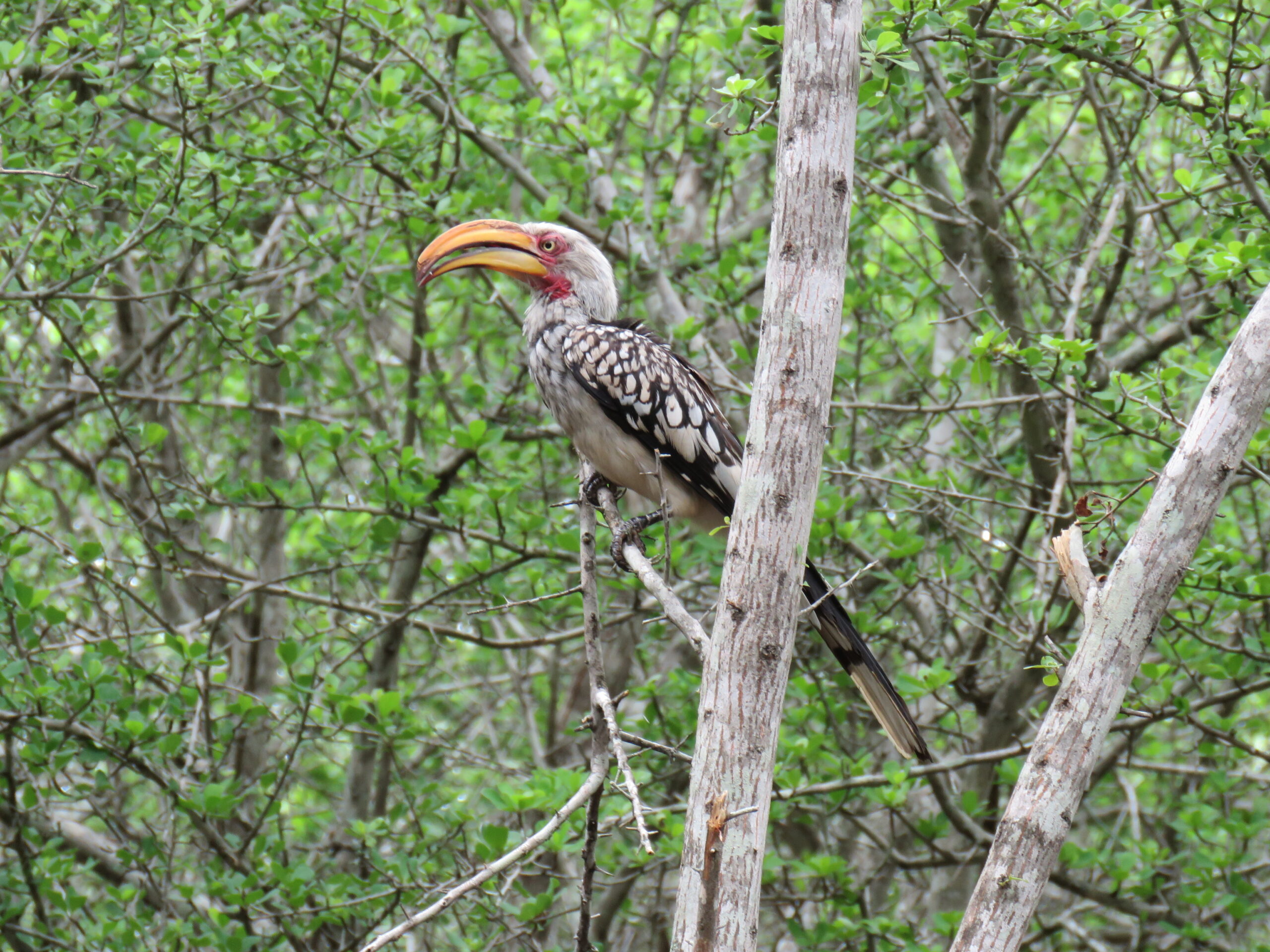
We can always count on Mr. Hornbill making an appearance.

By nature, kudus, wildebeest, zebras, and others are inclined to be “reaching up”  to eat greenery on trees and plants.  Giraffes don’t bend down to eat the pellets but will do so to drink water. Thus, there is no food source the residents of Marloth Park can provide for the giraffes.

Over the years, these other species in Marloth Park have learned that pellets placed on the ground are also a good and tasty source of nutrition. Now, after all the rains, with the lush greenery in the bush providing them with abundant food sources, they still like the ease and convenience of eating pellets off the ground from any sources offered.

Wildebeest Willie, always available for a photo op.

By far, pellets are healthier than “fast food,” but, maybe in a sense, they are the fast food savored by the various wildlife, particularly zebras, kudus, warthogs, and wildebeest. If no pellets are available, they will consume the leaves on the trees. However, in most cases, when pellets are available, they’ll eat them first and then go after the vegetation.

Thus, not offering them pellets doesn’t cause them to starve, except in times of severe drought during which periods, the homeowners and residents ramp up in offering pellets, carrots, apples, sweet potatoes, and Lucerne (hay). It is this effort that has ultimately saved many of the animals in Marloth Park over the years.

Warthogs and kudus were generally getting along while eating pellets.

Of course, there is the controversial theory that when there is a drought, let “nature takes its course” and let starvation prevail. This is what happens in Kruger National Park during a drought. Many animals die from starvation and lack of water. But, it’s just about impossible for us animal-lovers in Marloth Park to sit back and let this happen. After all, isn’t that why we’re here in this hot, humid, insect, and snake-infested area with some of the worst dirt roads on the planet?  It is.

So, folks, that’s it for today. Enjoy our new photos. We’ll be back with more tomorrow!

Photo from one year ago today, February 18, 2020:

A lovely Indian couple we met at the airport on our way to Varanasi. For more, please click here.

Out and about in the park…Fabulous sightings, even on a rainy day…Odd ossicones…

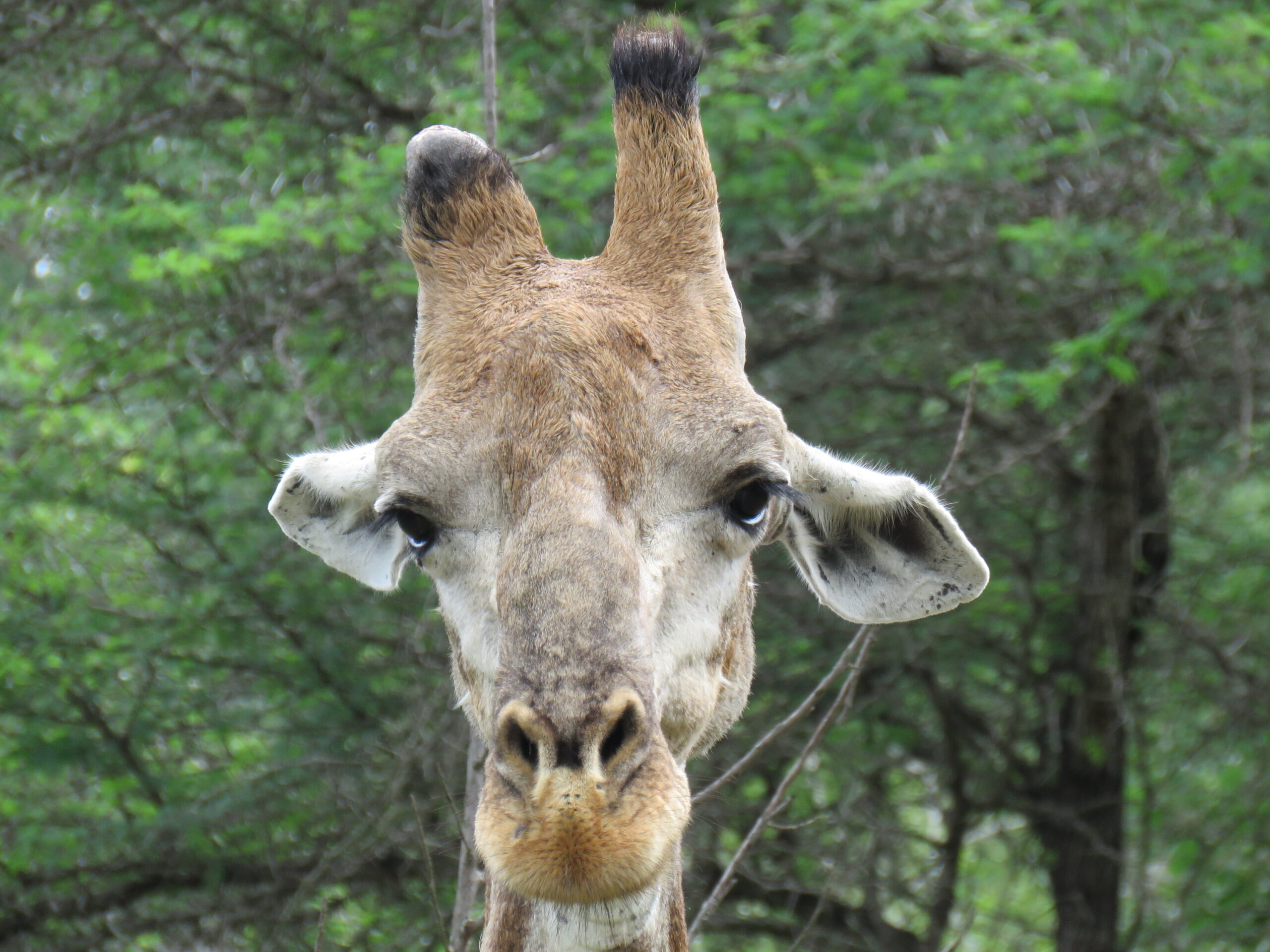
What’s with the uneven ossicones? We couldn’t stop laughing!

It’s been a week since we shopped, and as much as we preferred to wait until the following Monday with the roads so bad, we needed a few vital ingredients. Instead of driving to Komatipoort in the rain, we decided to stop at one of the two local markets for the items we needed now, including eggs, cheese, tea bags, and sparkling water.

As has been the case every night over the past many weeks, it rained all night long and is pouring now as I write this, only minutes after our return from the trip to the local market. Our garden is still muddy, but it rained so hard, the uneven clumps of mud have smoothed out, creating a better base for the wildlife.

While returning to our house, we spotted Vusi’s truck trying to maneuver his way past the giraffes on the way to our house!

Yesterday, while peering out the kitchen window to the end of our long driveway, for the first time, we saw the ostrich family walking past, and an hour later, four or five giraffes. There was no way we could have put on our shoes and made it down the muddy driveway in time for photos. Nor could we have driven the car down there in time, scaring them off in the process.

Regardless of what some naysayers may acknowledge about Marloth Park’s wildlife being tame, they are ill-advised. Although an animal may tentatively engage with a human in the park, they are still wild, and when we are not there to feed them, they care for themselves, foraging for food, shelter, and comfort in this wild bush environment.

Lounging in the grass. I’d imagine giraffe’s joints might be painful in such awful humidity.

The fear that many homeowners and park enthusiasts like us possess is that, eventually, all the empty stands (lots) will be built upon, leaving fewer wildlife areas for the animals to forage and live in the actual wild freely. That could transpire in the next 10 to 20 years or even sooner.

The reality for us is that most likely in the years to come, should we be fortunate to live long lives, we may not be able to return to the park for the enjoyment we are deriving at this time.  Only the unknown future will present such options as time goes by.

Safari luck! Love seeing the giraffes!

No one knows what the future holds once they reach 80 years old or older (or any age for that matter). We can only hope to maintain a level of fitness, health, and well-being that will allow us to continue to travel as far out as seven years from now when I reach 80. Gosh, I have a hard time digesting this reality when in a mere five days, on February 20th, I’ll reach my 73rd birthday.

The past 30 years seem to have flown by. That in itself is mind-boggling. Only yesterday, I was 30 years old, or even 43 years old, when I met Tom in 1991. In June, we’ll have been together for 30 years. In itself, that’s hard to wrap our brains around. But, regardless of how much time any of us may have left on this earth, we still strive to make each day meaningful and worthwhile.

Could giraffes be any more adorable?

I know it may seem easy for us to say about living enriched lives when all we do is continue to travel and immerse ourselves in our immediate surroundings. But, even in that hotel room for ten months in Mumbai, India, we had many moments of meaning and purpose. And, of course, even our old lives were rich in experiences, love, and purpose from which we derived great joy.

Why did we choose to change it? And, why don’t we return to that life?

Handsome male duiker in the bush this morning.

We chose to travel the world for two simple reasons: that we could and wanted to. We could step outside the box of the  “expected” lifestyle for most seniors to embrace a lifestyle so far removed from our familiar reality, with adventure, excitement and challenge, all the while sharing the story with readers throughout the world.

The second question, “Why don’t we return to that life?” We don’t want to return to the hustle and bustle of a busy life in the US, the traffic, the cold weather and snow, the negativity in the news, the constant pressure of having to live a life commensurate with what is “expected of us.” This way, we live life on our terms, all the while sharing our story, exciting or mundane, with all of you.

Bending down for a morsel.

If and when we return to that life, based on who we know we are, we will make the best of it and once again find joy, love, and purpose in whatever may come our way. The tricky part would be continuing to write here, with content that would appeal to our worldwide readers. That, dear friends, will always be the dilemma. I don’t want this part to end.

Happy day!

Photo from one year ago today, February 15, 2020:

This giant 108-feet-high idol of Hanuman was unveiled at Jakhoo Hanuman temple in Shimla on November 4, 2010. For more, please click here.