Is it safe to travel to Saudi Arabia?…What are restrictions travelers must observe?…

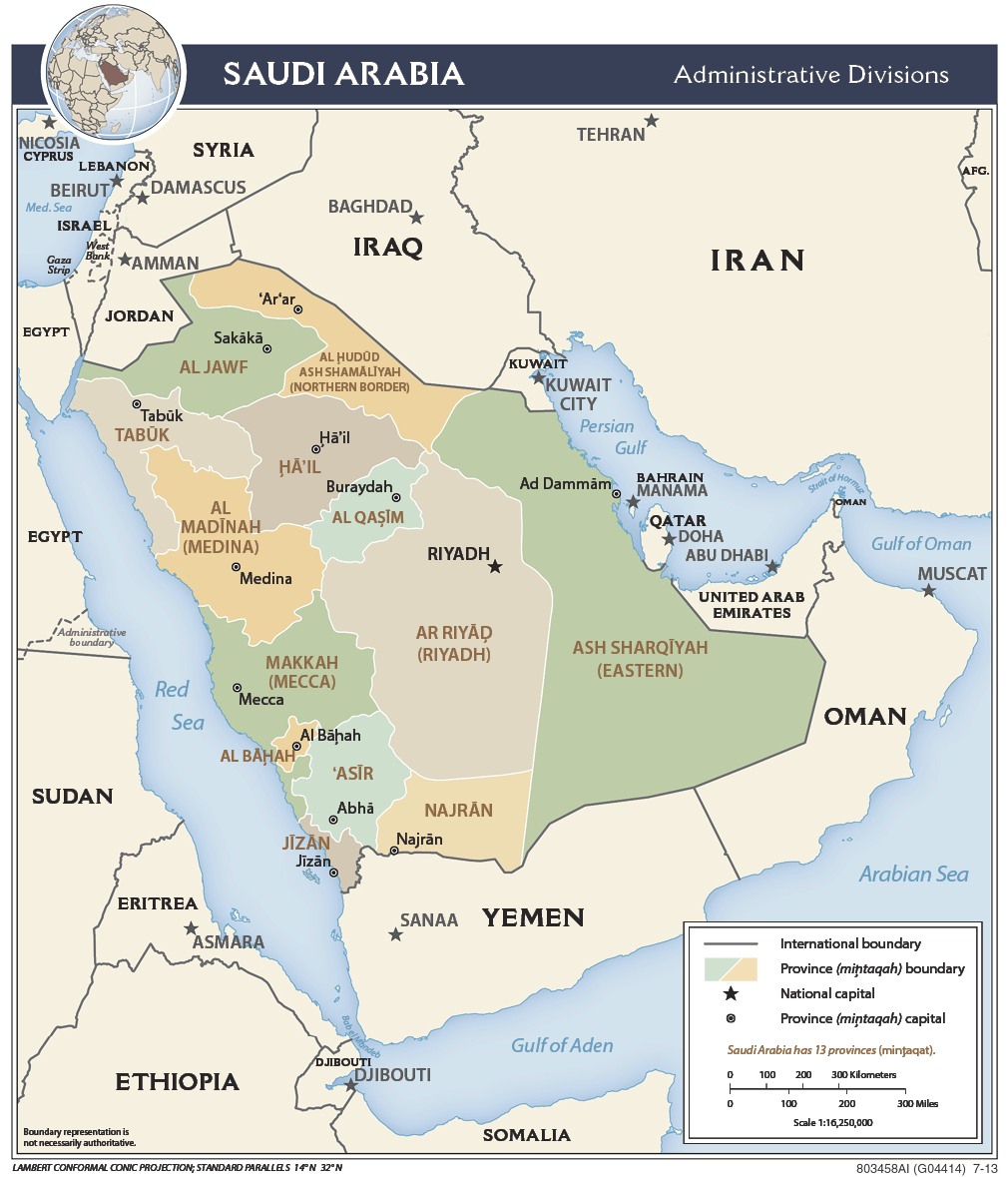
Saudi Arabia is located in various colors on this map.

When considering travel to countries that are vastly different from our own, questions of safety and restrictions naturally arise. Saudi Arabia is one of those places that many travelers are curious about, yet also hesitant to visit. In recent years, the country has made a noticeable push to attract more tourists. This effort, known as Vision 2030, is designed to diversify Saudi Arabia’s economy and showcase its rich cultural heritage, modern cities, and vast desert landscapes. But as travelers, we can’t simply look at glossy brochures or enticing Instagram photos. We need to weigh safety, cultural restrictions, and practical realities before deciding whether it’s a destination for us.

From a safety standpoint, Saudi Arabia is generally considered secure for tourists. The country has a strong police presence and strict laws that help maintain order. Major cities such as Riyadh, Jeddah, and Dammam have the infrastructure to support visitors, and crimes against tourists are rare. Terrorism concerns that once dominated headlines have been significantly reduced in recent years, thanks to the government’s firm measures to protect both its citizens and visitors. Travelers often report feeling physically safe walking around, even at night, which is reassuring.

Yet, while violent crime is not usually a concern, the greater risks for travelers come from cultural misunderstandings and breaking laws—many of which are enforced with much greater severity than in Western countries. This is where restrictions come into play, and where we need to be well-informed before we step off the plane.

The most noticeable restrictions are tied to Saudi Arabia’s conservative interpretation of Islamic law. For instance, alcohol is strictly prohibited. There are no bars, no happy hours, and certainly no bringing your own wine tucked away in your suitcase. Attempting to do so could result in harsh penalties. For those of us who enjoy sundowners or a glass of wine with dinner, this is a significant adjustment. It’s a reminder that when we travel, we are guests in another culture, and respecting the rules is essential.

Dress codes also remain an important part of Saudi society, though they’ve eased in recent years. Women are no longer required to wear the abaya (the long black cloak) in public, nor is it mandatory to cover their hair. However, modest clothing is still expected—long skirts or pants, sleeves covering the arms, and high necklines. Men, too, should avoid shorts and sleeveless shirts in public settings. While visitors might not face fines for showing too much skin, they could attract unwanted attention or disapproval. Out of respect, it’s wise to err on the side of modesty.

Social behavior carries restrictions as well. Public displays of affection, such as kissing or hugging, are frowned upon and can result in reprimand or worse. Unmarried couples traveling together may still face scrutiny, though rules have relaxed in recent years, especially in tourist areas. Still, travelers should be mindful of how they present themselves in public spaces.

Then there are digital restrictions—something not everyone thinks about before traveling. Internet usage in Saudi Arabia is monitored, and some websites and apps may be blocked. Social media is widely used, but critical comments about the government or religion can carry severe consequences. It’s a reminder that freedom of expression, something many of us take for granted, does not carry over when we travel to the Kingdom.

On the positive side, Saudi Arabia is opening up in ways that would have been unimaginable a decade ago. Tourist visas are now available online, making access easier. Women can travel without a male guardian, a significant step toward independence for both Saudi women and female visitors. Large-scale events, such as music festivals, art exhibitions, and sports competitions, are being promoted to draw global interest. Travelers who approach the Saudi people with an open mind often find themselves pleasantly surprised by their hospitality, which is a testament to the country’s rich culture.

Health and safety precautions should also be taken into consideration. The desert climate is harsh, with extreme heat in the summer that can be dangerous without proper preparation. Travelers should drink plenty of water, dress appropriately for the heat, and limit exposure to the midday sun. Road safety is another concern, as driving standards can be erratic compared to what many of us are used to. For visitors, hiring a driver or using ride-hailing apps is often the best option.

So, is it safe to travel to Saudi Arabia? Yes, if you approach it with respect, awareness, and preparation. Physically, the risks are low, but culturally, the potential for missteps is high if you arrive uninformed. Unlike destinations where rules are looser and forgiving, Saudi Arabia requires mindfulness from the moment you land. For those willing to adapt, it can be an enriching experience. You can marvel at UNESCO World Heritage sites like Al-Ula, explore the cosmopolitan waterfront of Jeddah, or witness the blend of old and new in Riyadh. The rewards of travel there are unique precisely because the country has been closed to the outside world for so long.

Ultimately, traveling to Saudi Arabia may not be suitable for everyone. It requires a certain flexibility, a willingness to accept restrictions that may feel uncomfortable, and an understanding that we, as visitors, do not set the terms. But for those who embrace it, the trip can offer extraordinary insights into a part of the world that few outsiders truly know.

For us, as global wanderers, the decision to visit Saudi Arabia would depend on weighing our desire for cultural exploration against our comfort with restrictions. It is not about whether the country is safe in the traditional sense…it is. It’s about whether we are prepared to travel within the boundaries it sets, and to see safety not just as freedom from crime, but as the reassurance that rules are enforced to preserve order.

Would we consider visiting Saudi Arabia? If we were in the Middle East at any given time, we might consider it. However, making a special trip from a distant location would deter us.

Be well.

Photo from ten years ago today, October 1, 2015:

This is actually a dine-in restaurant located in Savusavu, Fiji, in a strip mall, featuring two tiny tables for diners and minimal cooking space for the cook. For more photos, please click here.

Most affordable countries for digital nomads…

Penguin Beach in Tasmania, where we’ll be in five months.

From Travel and Leisure Magazine:

“This Country Was Just Named the Most Affordable Destination for Digital Nomads

India tops the 2025 ranking thanks to low living costs, vibrant culture, and thriving tech hubs. By Katie Nadworny, Published on September 10, 2025

If you’ve ever been tempted to become a digital nomad, one global destination is officially the most affordable choice.

That honor belongs to India, according to a report from Global Citizen Solutions, a firm that specializes in residency and citizenship by investment. The company’s Global Digital Nomad Report 2025shared with Travel + Leisure, examined the cost of living, the cost of co-working, and the cost of a hot desk to compile its list. Factors taken into account included housing, groceries, transportation, and other essential living costs.

Delhi and Mumbai are popular destinations in India, renowned for their vibrant and bustling culture and affordable cost of living. Goa can also be an appealing destination thanks to its fantastic beachesUNESCO-recognized churches, and unique Portuguese-influenced cuisine.

“The digital nomad phenomenon has evolved from a niche lifestyle choice to a mainstream economic driver,” Laura Madrid Sartoretto, the lead researcher at Global Citizen Solutions’ Intelligence Unit, said in a statement shared with T+L.

In fact, the report examined digital nomad visa programs in 64 different countries and found that 91 percent of these programs have been launched since 2020.

India was followed by Ecuador, Malaysia, Indonesia, and Colombia, rounding out the top five most affordable destinations for living and working remotely.

On the other end of the spectrum were countries like Iceland and Norway, which ranked very high in quality of life metrics, but were expensive to live and work in.

The Netherlands actually took the top spot in quality of life, which is assessed by a combination of public infrastructure, safety, and cultural appeal.

Overall, the most extensive collection of digital nomad programs is concentrated in the Americas, accounting for 36 percent of the analyzed programs, followed by Europe, which comprises 33 percent of the programs, and Asia, which has 9 percent of the programs.

Many digital nomad programs encourage temporary stays, but a few offer long-term opportunities to remain in the country. Of the countries analyzed, Global Citizen Solutions found 14 that offer a path to permanent residency and three that offer a direct path to citizenship.

“Over the past two decades, the growing availability of high-speed internet, mobile technologies, and the normalization of remote work have transformed this once niche concept into a global movement,” Patricia Casaburi, the CEO of Global Citizen Solutions, said in a statement shared with T+L, adding the “digital revolution” and the pandemic “propelled it into the mainstream.”

These are the top 10 most affordable destinations for digital nomads, according to Global Citizen Solutions.

  1. India
  2. Ecuador
  3. Malaysia
  4. Indonesia
  5. Colombia
  6. Namibia
  7. South Africa
  8. Armenia
  9. Mauritius
  10. Serbia”
By the end of our upcoming 47-night cruise, we will have visited eight of the above-listed ten countries (excluding Armenia and Serbia). Of course, the only country we’d consider living in for extended periods is South Africa, mainly because we have spent a considerable amount of time there and are familiar with the lifestyle on a broader scale than those we may have visited for shorter periods.
Based on our prior visits and experiences in other countries, we have no interest in extended stays or revisiting the above countries in the future. However, this is due to personal preferences which may be very different than ours. At no point would we consider acquiring citizenship in another country.
We’re hoping the property management company sends a plumber today to fix the clogged toilet. The weekend has been challenging!
Be well.

Photo from ten years ago today, September 22,015:

Flowers are blooming profusely due to the excessive rainfall. For more photos, please click here.

Another stunning day in the bush with friends…WiFi security at airports…

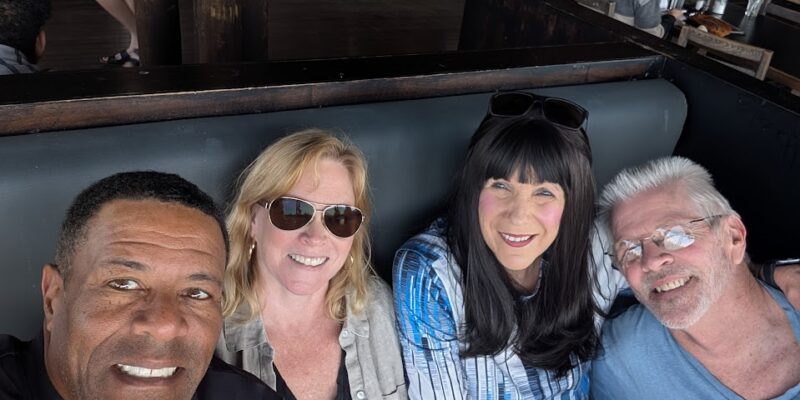
Rich took a selfie of us.

Last night, the four of us went to Jabula for Kady and Rich’s first experience at our favorite restaurant. They loved the environment, the bustling crowds, and, of course, the food. We had another fine evening together in the bush.

The following article appeared in my search results this morning, which I found imperative to share with our readers.

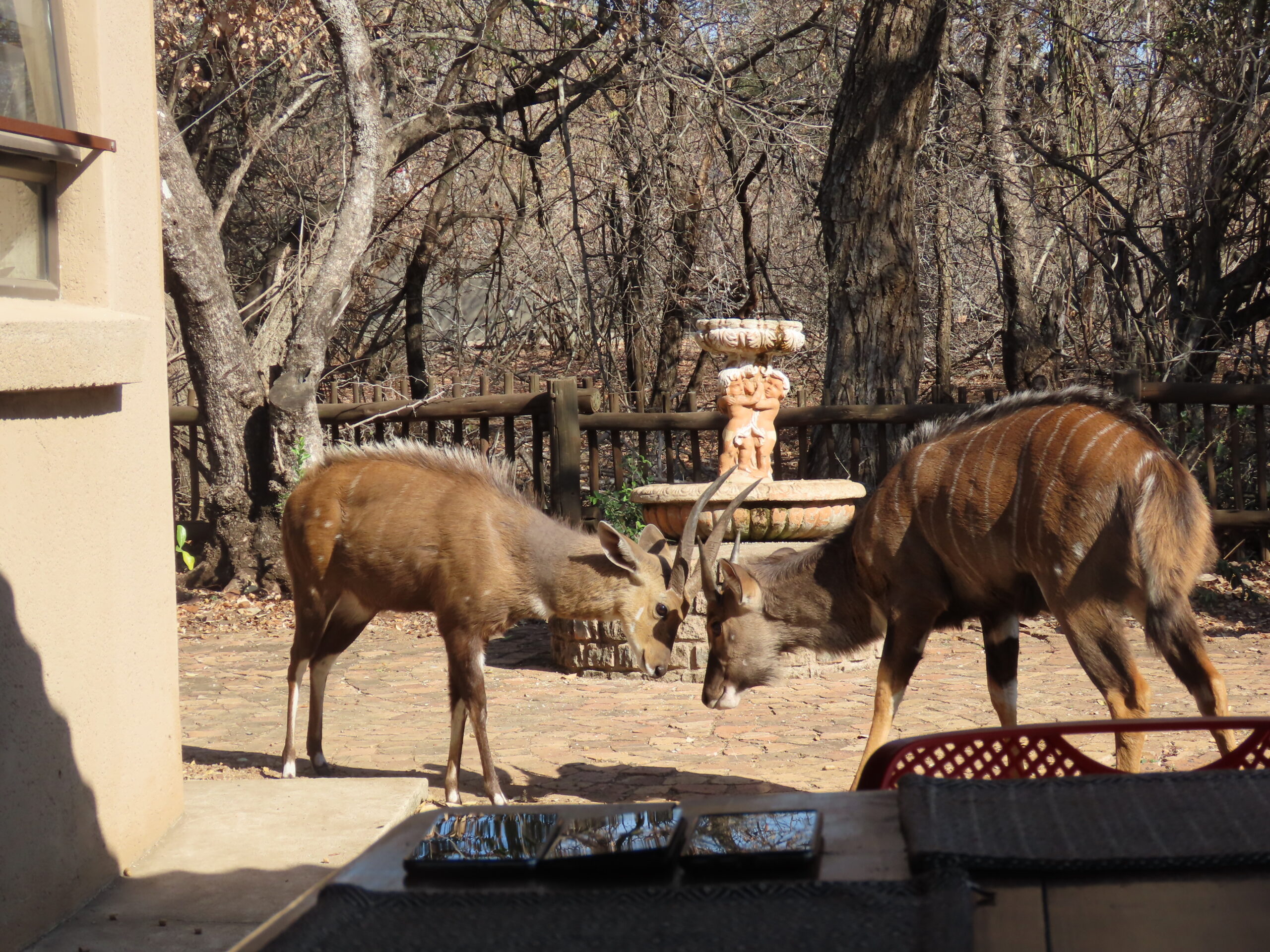
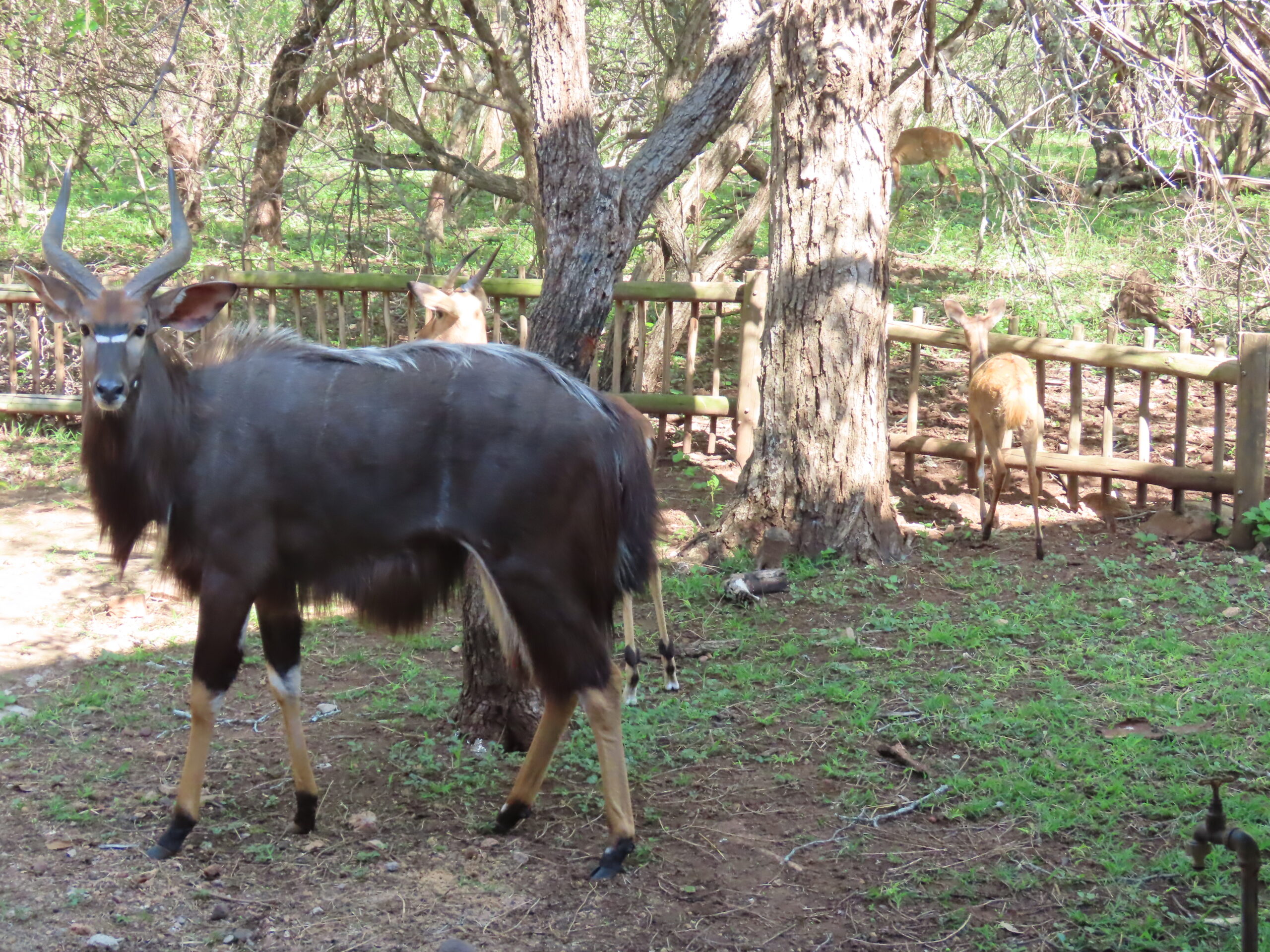
Mr. Bushbuck and Nathan, Norman’s son, got into a little scuffle in the garden.

From Travel & Leisure Magazine:

“This Is One of the Biggest Cybersecurity Mistakes You Can Make at an Airport, Experts Warn

Travelers may want to think twice before connecting to free airport Wi-Fi. By  Published on June 17, 2025

Cybersecurity experts are aligned that travelers should avoid public Wi-Fi at airports. Please continue reading to learn why it’s such a significant risk and how to access the Internet safely while traveling.

While cruising an airport’s public internet network may feel like a convenience, criminals can easily exploit those networks to steal sensitive data from unsuspecting travelers, experts warn.

“It’s definitely among the worst things you can do at an airport,” Matthew Hicks, a cybersecurity expert and associate professor of computer science at Virginia Tech, told Travel + Leisure.

We had offered them food, but they were at odds about the territory.

Public Wi-Fi is a shared internet connection, often over an unsecured network. Users are therefore vulnerable to hackers, who can intercept data like credit card details or account passwords, and install malware onto consumers’ devices, according to experts.

About 40 percent of Americans have had their data compromised while using a public Wi-Fi network, according to a recent Forbes Advisor survey of 2,000 workers who regularly use public internet. Yet, 23 percent of users said they think public Wi-Fi is entirely safe, and another 43 percent said it’s somewhat secure, the Forbes survey found.

Anything you do on airport Wi-Fi should be something you’d be comfortable with the rest of the world knowing about.

— John Breyault

Because travelers often have ample downtime before flights—and may be in an area without cellular connection—airports are a common access point for public Wi-Fi, Hicks said.

Consumers reported losing more than $16 billion to internet crime overall in 2024, a record high and a 33 percent increase from 2023, according to data from the Federal Bureau of Investigation.

A zebra is taking a rest in the garden.

Personal data breaches were among the top three most common complaints received by the FBI, it said. “As nearly all aspects of our lives have become digitally connected, the attack surface for cyber actors has grown exponentially,” B. Chad Yarbrough, operations director for the FBI’s criminal and cyber unit, wrote in the Bureau’s annual internet crime report. “Scammers are increasingly using the Internet to steal Americans’ hard-earned savings.”

Be careful of fake Wi-Fi networks.

Scammers also often try to trick travelers into logging onto fake Wi-Fi networks, John Breyault, vice president of public policy, telecommunications, and fraud at the National Consumers League, a consumer advocacy group, told T+L.

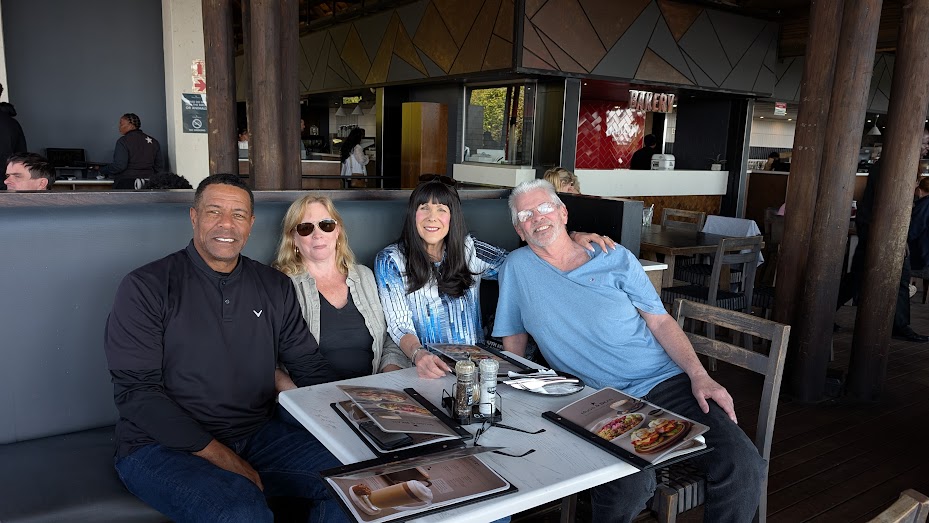
The four of us at Mugg & Bean, including our friends Rich and Kady, in Lower Sabie, when another diner offered to take our photo.

Someone trying to connect to the O’Hare Guest Wi-Fi network may unknowingly access another—perhaps “O’Hare Guest 2” or “Chicago Airport Wi-Fi”—controlled by a criminal. “Make sure [the network] is the one run by the airport, and not someone setting up a honeypot,” Breyault said.

In 2024, the Australian Federal Police charged a man for allegedly establishing one of these so-called “evil twin” networks to steal people’s personal data. He did this at airports in Perth, Melbourne, and Adelaide, among other places, AFP reported.

Accessing the correct network will “eliminate most of the real attackers,” Hicks said, adding that travelers can ask airport personnel if they’re unsure.

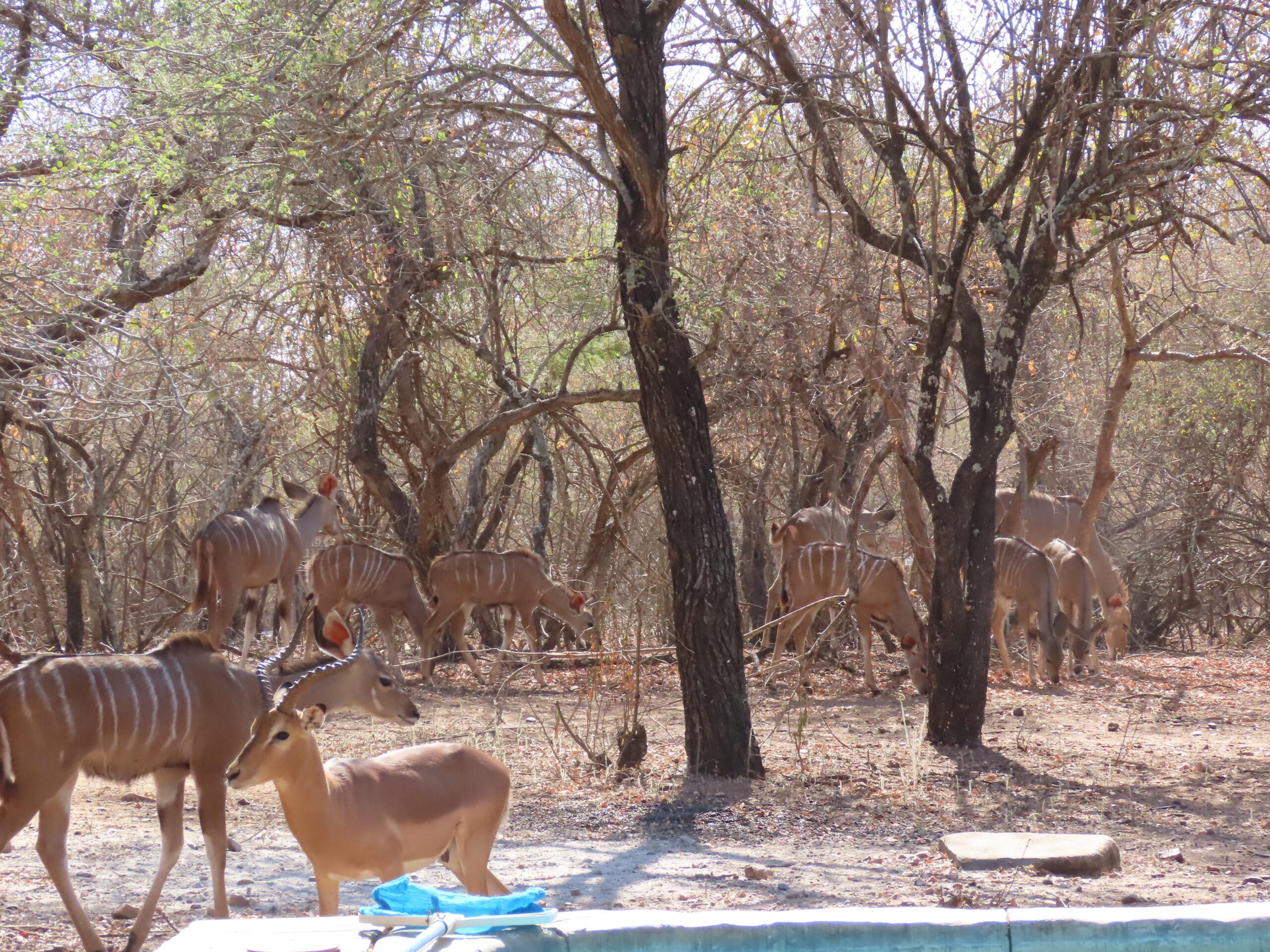
Many kudus and impalas were in the garden, including Mac, our resident impala.

How to safely use Wi-Fi at the airport

Using your cell phone to establish a personal internet hotspot is among the safest ways to access the web in an airport. This simple step will reduce the number of attackers to “near zero,” according to Hicks. That’s because it’s a private cellular connection instead of an open Wi-Fi network. “You’re not sharing that connection with everyone else in the airport,” Breyault said. “Your data will be much safer in transit.”

If that’s not available, experts recommend using a device with a “virtual private network” or VPN, which is an encrypted connection that offers an additional layer of security. Hicks’ best advice is to buy one from a reputable, U.S.-based company.

Travelers should ultimately avoid logging into financial, email, social media, or other sensitive accounts over airport Wi-Fi, Breyault noted. “If you’re just checking the weather, that’s one thing,” Breyault said. “If you’re checking your bank account balance, that’s something different.”

“Anything you do on airport Wi-Fi should be something you’d be comfortable with the rest of the world knowing about,” he said.”

Be well.

Photo from ten years ago today, July 5, 2015:

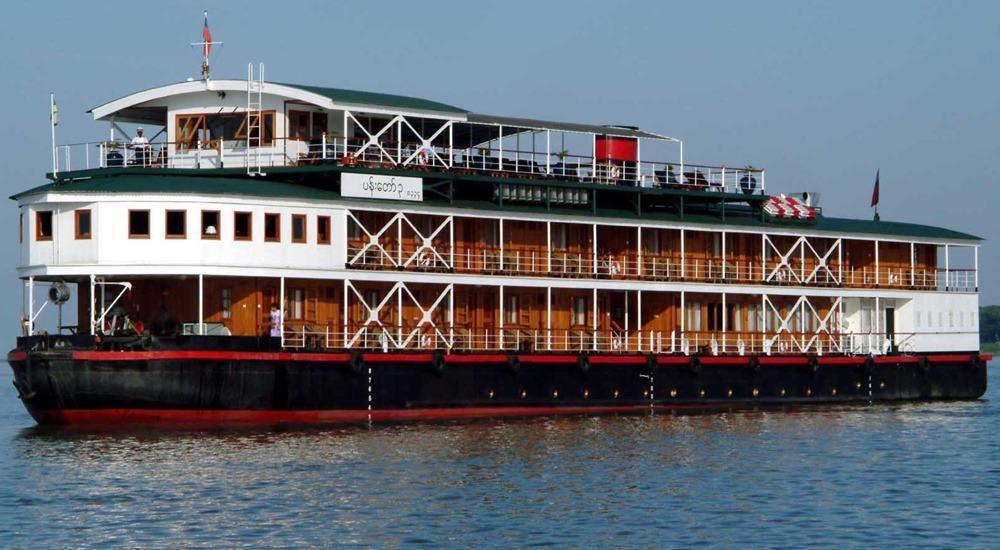
Viking Mekong Itinerary, Current Position, Ship Review | CruiseMapper
We booked the Viking Mekong, the river cruise, to tour Vietnam and Cambodia in 2017. For more, please click here.

A great place to cook!…Preferred features in vacation/holiday homes…

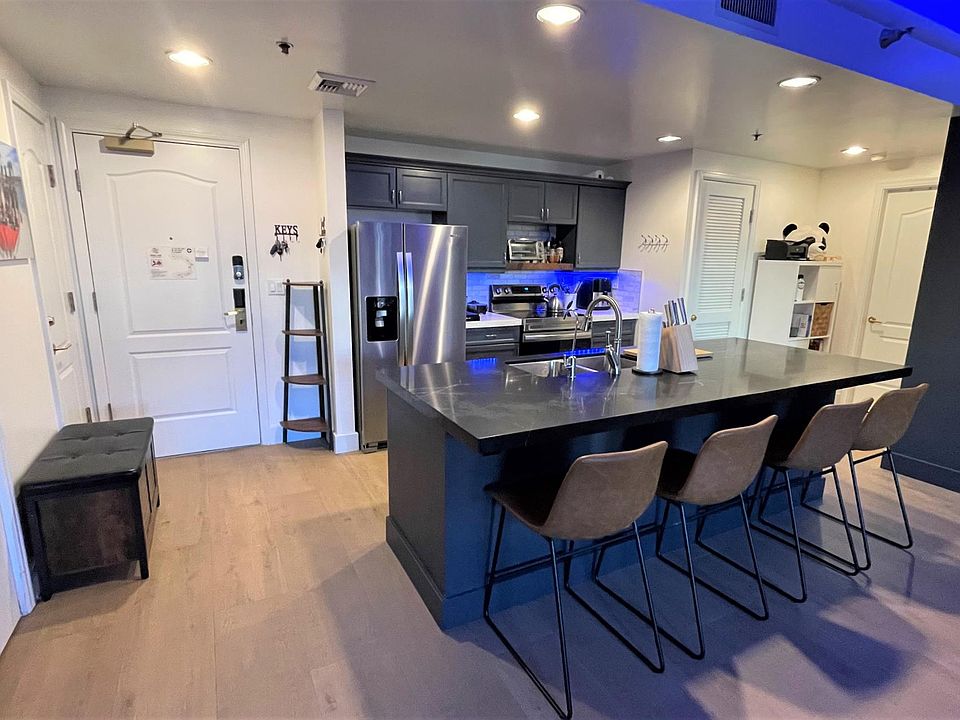
This kitchen is much larger than it looks in this photo. We enjoy preparing meals here.

Nothing is more important to me while living in a holiday home than a good kitchen, fully stocked with ample space for prepping ingredients, cooking meals, and cleaning up. Most often, about 30% of the properties we rent don’t have what we’d consider a “good working kitchen,” while the others range from adequate to exceptional.

The kitchen at the condo here in Lake Las Vegas is, without a doubt, exceptional. Its two working areas, including the space near the stove and refrigerator, provide a good working area, and the center island where the sink and dishwasher are located, with the comfortable space between them, couldn’t be more perfect.

I spend most of my prep time using the heavy wooden cutting board on the island, close to the sink, and less time at the stove, actually cooking. Most meals we make are cooked in the oven or on the top of the stove using the amazing skillet I purchased from Amazon last year. That skillet will be joining my luggage, even at the cost of dumping clothing to remain in the allowed baggage weight.

I told Tom I’d give up clothes for that pan and my big sharp knife (and its sharpener), which means more to me than anything I might wear.

Over the years of world travel, we’ve learned what means the most to us is when we rent a holiday home. Here is the list of features that we and most travelers seek. When travelers look for vacation homes, their needs and preferences often vary depending on the purpose of their trip, the group they’re traveling with, and their style. However, there are several standard features that most travelers value:

1. Location, Location, Location

  • Proximity to Attractions: Near beaches, city centers, mountains, or other major attractions.
  • Safe and Walkable Areas: Walking safely to local cafes, shops, or markets is essential.
  • Scenic Views: Homes with stunning views of nature or cityscapes are always a draw.

2. Comfortable Living Spaces

  • Spacious Layouts: Space for everyone to spread out is key for families or groups.
  • Cleanliness and Hygiene: A spotless home is non-negotiable.
  • Quality Furnishings: Comfortable beds, cozy sofas, and appealing decor enhance the stay.

3. Well-Equipped Kitchens

  • Travelers often prefer to cook meals to save money or accommodate dietary preferences. A kitchen stocked with essentials is a big plus.

4. Reliable Wi-Fi and Connectivity

  • High-speed internet is crucial for remote workers, digital nomads, or families with tech-savvy kids.

5. Entertainment Options

  • Streaming services, smart TVs, board games, books, or even gaming consoles for indoor fun.

6. Outdoor Spaces

  • Balcony, Patio, or Garden: Ideal for morning coffee, evening relaxation, or outdoor dining.
  • Pool or Hot Tub: A luxurious touch many travelers seek.

7. Laundry Facilities

  • Long-term travelers or families especially appreciate a washer and dryer.

8. Family-Friendly Features

  • Amenities like cribs, high chairs, toys, or safety gates are highly valued for families with kids.

9. Pet-Friendly Options

  • Increasingly, travelers are bringing their pets along, so homes that allow pets and have fenced yards are in demand.

10. Transportation Convenience

  • Access to parking or proximity to public transportation.

11. Sustainability Features

  • Eco-conscious travelers may look for homes with solar panels, recycling facilities, or energy-efficient appliances.

12. Local Recommendations

  • Hosts providing a guidebook with tips on local attractions, dining, and activities add a personal touch.

13. Safety and Security

  • Features like secure locks, alarms, or a safe for valuables give peace of mind.

14. Unique Experiences

  • Unique architecture, historic charm, or a quirky theme can make the stay memorable.

Travelers want a home-away-from-home that enhances their experience, offering comfort, convenience, and a touch of luxury or local charm. The order of preference may change for us depending on the uniqueness of any given property, allowing us to forego some requirements.

Be well

Photo from ten years ago today, January 2, 2015:

A picnic area in Lava Tree Park on the Big Island wasn’t busy. For more photos, please click here.

Today is our 12 year world travel anniversary. Happy Halloween!

A gnome sitting on a pumpkin with Thanksgiving decorations clipart, cozy autumn vibes, digital painting, isolated on white background
Happy Halloween!

It was 12 years ago today, Tom retired from Burlington Northern Santa Fe Railroad, and we left Minnesota. We loaded up his SUV with way too much stuff to drive to Arizona for a two-month stay to wrap up some paperwork, buy new laptops and smartphones, and work on visas for upcoming cruises and travels.

Everything we’d owned was sold and gone, albeit with a modicum of tears that flowed freely after saying goodbye to our loved ones. We knew we’d miss family, but with easy Facetime access online, it wouldn’t be as challenging to be away as it might have been decades ago, before the internet.

We chose to stay in Arizona for a few months to see if we’d like to live there when we eventually settled down. The two months in Scottsdale convinced us that Arizona was unsuitable for us. The summer heat was unappealing, and somehow, we never acquired a connection to the state.

While there, we enjoyed spending time with Tom’s sisters in Apache Junction, but again, we couldn’t see ourselves living in a retirement community in Arizona or anywhere. In time, that may change our minds about living in a retirement community, but not now.

Here we are now, after 12 years of the most exciting and adventurous times of our lives, seeking the medical care we knew would eventually come to pass. Nothing we’ve discovered about my health thus far requires us to stop traveling. In our travels over the past 12 years, we’ve met many seniors with heart conditions similar to mine who continue to travel regularly, some even full-time, like us.

We’re not done yet. We still have plenty of world left to see and feel no urgency to make any permanent decisions. It’s funny, isn’t it, that we feel totally at ease with that uncertainty? Many have said that not having a home would make them uncomfortable and unsettled. For us, it’s not an issue at all.

I suppose this lifestyle has reshaped our needs, and we no longer feel compelled to have a place we call “home.” We’ve learned that such a decision can be made whenever we are ready from wherever we may be at any given time.

What are we doing to celebrate today? Without a rental car, there are no exceptional restaurants nearby that warrant an Uber ride, and the fact that we’ve already ordered takeaway meals from the best nearby restaurants, we see no reason to venture out. We considered having cocktails tonight since I have one unopened bottle of white wine, and Tom has a bottle of brandy. But it’s been two months since we’ve had a drink, and we don’t need to do so today.

Today is special to both of us, and neither food nor drink is required to revel in the memories we created over the past 12 years, let alone the 4448 posts we’ve uploaded since March 2012, (see the first post here) months before we left Minnesota, when we wrote our first post. At any moment, we can enjoy the memories of the past 12 years with only a few clicks in our archives.

When we look back at any of those posts, we are immediately transported back to those precious times, memories flooding our minds, with smiles on our faces and feelings of warmth in our hearts. We are grateful for the experiences, the times we spent together, the people we met along the way, and the people and places we have yet to see. We are grateful for the safety in our travels, although, at times, we encountered challenging situations.

And now, as we near the end of our time at Cleveland Clinic (four months to go), we are again grateful for the exceptional medical care and upcoming peace of mind we’ll carry with us when we leave.

Happy Halloween to all.

Be well.

Photo from ten years ago today, October 31, 2014:
This rooster was strutting around, showing off his pretty plumage at a vegetable stand in Maui. For more photos, please click here.

Part 1…Pros and cons of retiring on a cruise ship…

Could you retire on a cruise ship?

Over our years of world travel, we’ve been asked countless times if we’d ever consider living full-time on a cruise ship. In each case, we’ve always said “no.” The novelty and excitement of cruising would soon diminish due to the cons, as listed below, when, over time, it became less and less of a novelty.

We don’t have a problem living in a small space, so that wouldn’t be an issue, as we’ve proven to ourselves repeatedly staying in hotels long-term, as we have most recently as we’ve faced my medical issues.

However, living on a cruise ship as a long-term lifestyle choice has unique advantages and challenges. Here’s a look at some of the main pros and cons:

Pros

  1. All-Inclusive Lifestyle:
    Many cruise packages include accommodation, meals, and entertainment. This makes budgeting easier since many living expenses are bundled into one price. You won’t have to worry about utility bills, grocery shopping, or routine house maintenance.
  2. Travel Without Packing:
    One of the biggest perks of living on a cruise ship is the ability to travel the world without the hassle of constantly packing and unpacking. Your room becomes your home base as you explore different destinations.
  3. Access to Unique Destinations:
    Cruise ships visit ports that might be difficult or expensive to access otherwise. You can wake up one morning in the Caribbean and the next in a European city, all while maintaining a consistent place to sleep and eat.
  4. Built-In Social Life:
    Living on a cruise ship means being surrounded by other passengers and crew, creating an environment ripe for social interaction. With communal dining areas, events, and activities, there’s always the potential to meet new people worldwide.
  5. Entertainment and Amenities:
    Cruise ships have various amenities like pools, gyms, theaters, and spas. There are also frequent shows, live music, classes, and other activities, so boredom is rarely an issue.
  6. No Need to Cook or Clean:
    With restaurants on board and staff to take care of your room, your daily chores are significantly reduced. This frees up time to relax or engage in other activities.
  7. Health Services on Board:
    Most ships have medical services available, so there’s some peace of mind in knowing healthcare is just steps away, especially for those with chronic health concerns.

Cons

  1. Limited Space:
    Cabins on cruise ships are often small compared to typical apartments or homes. Living in tight quarters can feel cramped, and lacking personal space can become challenging over time, primarily if you’re used to a larger living area.
  2. Limited Internet and Connectivity:
    While most ships offer Wi-Fi, it’s often slow and expensive. This can be frustrating if you need reliable internet for work or staying in touch with loved ones.
  3. Constant Movement:
    There’s a slight sense of movement even on the most stable ships. This can lead to seasickness or discomfort for some, particularly during rough seas.
  4. Lack of Personalization:
    Cruise ship cabins are standardized, unlike a home or apartment where you can personalize your space. You might miss the ability to create a space that feels like yours.
  5. Long-Term Friendships and Connections:
    While meeting people is easy, cruise passengers are often transient, and the crew has strict work schedules. Maintaining long-term relationships or forming deeper connections can be challenging, especially if people are only on board for a week or two.
  6. Health and Wellness Concerns:
    Although ships have medical services, if a severe health issue arises, getting advanced care could require being airlifted or evacuated to the nearest port. Living in a somewhat enclosed environment can increase the risk of spreading infectious diseases quickly, as seen during the COVID-19 pandemic.
  7. Missing Life on Land:
    While traveling by ship can be exciting, it may also lead to feelings of disconnection from the routine pleasures of life on land—like access to familiar places, walking to a favorite café, or attending events in a community you’re invested in.
  8. Cost:
    While cruising offers an all-inclusive lifestyle, the cost can vary depending on the ship and route. Luxury cruises, in particular, can be expensive, and not all extras (like premium dining, excursions, or specific activities) are included in the base price.

Living on a cruise ship can be a dream for those who crave constant travel, minimal responsibility, and adventure. However, it’s also a confined, somewhat isolating lifestyle that may require certain sacrifices and adjustments to feel at home. It’s a unique experience that works beautifully for some but might not be sustainable for everyone.

In tomorrow’s post, Part 2, we’ll share the varying costs of retiring on a cruise ship.

Be well.

Photo from ten years ago today, September 18, 2014:

While awaiting a cruise to Hawaii, we stayed in Vancouver, British Columbia, for a few days. This was the view from our beautiful condo in downtown Vancouver. For more photos, please click here.

Medical care in Ecuador…

Attractive cactus tree in the Galapagos Islands.

Many travelers often mention that Ecuador has good medicalcare, especially when many expats settle in the country for that reason, along with the lower cost of living than many other countries. Today, we’re sharing information about this topic, coupled with a smidgen of information from our recent experience.

From the US Embassy site on medical care in Ecuador:

“Medical Assistance

The Embassy cannot provide health care or medical facilities for private U.S. citizens in Ecuador. We can, however, provide a list of names and addresses of doctors and facilities for you to choose from. Should you be injured or become seriously ill while in Ecuador, the Consular Section can assist you by providing a list of medical practitioners and hospitals and informing family and friends, at your request, of your well-being.

Health Insurance Overseas

We strongly recommend acquiring Overseas health insurance before traveling to Ecuador. If you have Medicare, we advise you that Medicare does not cover health coverage outside the U.S. In addition, we also recommend looking for a Health Insurance plan with Medical Evacuation coverage since evacuations may be expensive, from $ 10,000.00 and up.

Prescription Medications

While you travel, we always recommend that you take enough medication, if required to take any, at least for the length of your trip. If you happen to run out of your medication, unfortunately, the U.S. Embassy or Consulate can’t help you by receiving any medication.

Also, please note that special laws and regulations might be in force for sending medication to Ecuador. It does not matter if the package was sent with a courier company, cargo company, or regular mail. Some medications may even need a written import permit issued by the Ecuadorian Ministry of Health or may be restricted by the Ecuadorian National Council of Control Substances. Packages detained by Ecuadorian Customs can’t be released by having someone from the Embassy or Consulate call in. We recommend you research what local options you can get for your prescription medication in case of emergency before traveling.”

International Living Magazine published an article regarding medical care in Ecuador, inspiring many foreigners to visit the country for care and procedures. Here is the article in part from this site:

“One of the great perks for foreign residents living in Ecuador is high-quality, low-cost healthcare. Bloomberg recently rated Ecuador as having the 20th most efficient healthcare system among advanced economies, while the U.S. ranked near the bottom in 46th place.

An internet comparison of healthcare costs worldwide found that Ecuador’s costs are the lowest—lower than those in China, Malaysia, India, Mexico, and Panama. Generally, you can expect to pay 10% to 25% of what you would in the U.S. For major surgery, we’ve seen several cases in which costs were even less than 10% of comparable procedures in the U.S. You will find similar savings for dental care.

Lots of iguanas on the walkway. (Repost).

Although Ecuador is a developing country, you will find first-rate medical care here, particularly in the major cities. Many doctors are educated in the U.S., Europe, Argentina, Chile, and Cuba and continue to train around the world. In many respects, the medical system is reminiscent of that in the U.S. in the 1950s or 1960s. House calls are still possible; most doctors do not have nurses, and the average office visit is 30 to 45 minutes. Another throwback is that Ecuadorian doctors don’t expect to become instant millionaires, and the average income for doctors, according to a Quito medical association, is about $65,000 a year.

A visit to a general practitioner costs $20 to $35, while a visit to a specialist runs anywhere from $40 to $80. For follow-up visits, there is usually no charge at all. A psychiatrist will charge $40 to $50 for a half-hour session. Simple, ambulatory procedures are equally inexpensive. For example, the removal of a small lump (under local anesthesia) and a biopsy cost about $125. Brand name medicines usually cost less than in the U.S. Generics, which are widely available and are much cheaper.

Health Insurance in Ecuador

In 2017, Ecuador passed new laws making some type of health insurance mandatory for all citizens under 65 years of age and all residents under 65 who had their visas registered after February 6, 2017. However, laws were also passed, making it illegal for private insurance companies to exclude clients based on age, sex, or pre-existing conditions.

Health insurance remains a bargain in Ecuador. A review of comparable insurance policies for a 60-year-old man in the U.S. and Ecuador tells the story. In the U.S., the man would pay a monthly premium of $1,200; in Ecuador, he may pay as little as $70. A woman aged 50 to 60 would pay $72 for the same policy in Ecuador, while coverage for a dependent child between two and 17 years of age costs $15.69 monthly.

Turtles at Cerro Colorado Tortoise Reserve in San Cristobal Island in the Galapagos

The policy cited is offered by Salud S.A. (website: https://www.saludsa.com), Latin America’s largest health insurance company, and pays 80% of doctor’s visits, 60% of medication costs, and 100% of hospitalizations. It also offers extra coverage for walk-in procedures and accidents.

Although international health insurance is available from several local companies, costs can be considerably higher than Ecuadorian policies. Remember that international policies must cover high-priced countries like the U.S.

The Social Security Healthcare Option

Ecuador has invested hundreds of millions of dollars to upgrade its national social security healthcare system (Instituto Ecuatoriano de Seguridad Social, or IESS) and, as of January 2014, allowed foreign residents of any age a “buy-in” option. Following a change in 2017, expats now must provide proof of income for the rate of their IESS insurance to be set. That figure will be used if your visa is based on your pension. For other types of visas, you will need to provide documentation to verify your income.

The rates for IESS coverage are based on the income claimed. The primary enrollee (or spouse) will pay a monthly fee equal to 17.6% of their income. A spouse and other family members may be added for an additional 3.41% per month. So, if you have a pensioner’s visa for the minimum amount ($800 + $100 for dependents), your monthly fee as a couple would be $168.08. Remember that you don’t need to disclose all of your income, just what you are claiming to participate.

This is still a bargain, as the public healthcare system covers in-hospital care, outpatient care, extended care, home care, prescription drugs, dental care, and eye care. Again, please note that the healthcare regulations are still under debate and could change anytime. Keep up with International Living for up-to-date information as this develops.

Dental Care in Ecuador

Dental care in Ecuador is also a bargain, costing 80% to 90% less than similar care in the United States. As with physicians, you will find that most dentists are well-trained and have access to the latest technology. Many of them also speak English.

Checking prices for dental care, a cleaning costs $30 to $45. Cavity repairs and fillings cost $25 to $35. Partial plates cost $325, and a complete set of dentures costs about $900, including office visits, fittings, lab work, and impressions.”

For the balance of this article, please click here and scroll down.

Baby turtle enjoying the water at the sanctuary.

As for our personal experience with medical care thus far, although very limited, with only one visit to the cardiologist in Manta (returning for a second visit next Wednesday), the office, his staff, and the doctor were all very professional. The doctor spoke no English, but one of his staff members spoke excellent English and was my translator.

The office was impeccably clean and organized and appeared to have the latest equipment and supplies from what I could determine. Nothing in the office or building was in ill repair, as one may expect. A guard greeted patients at reception, and we were asked to wait in the lobby before heading up the elevator to the office facility. Once in the doctor’s reception area, I was taken in to see the doctor immediately.

There are countless articles on healthcare in Ecuador, and if you are interested, please type “medical care Ecuador” in a Google or other search engine to read further.

As for our current location, we would advise staying closer to a big city for medical care rather than staying at a remote location such as Guayaquil, Cuenca, etc. See this list of population statistics for Ecuador here. (Scroll down the page).

We’ll report back after my next cardiology appointment.

Be well.

Photo from ten years ago today, November 16, 2013:

Flying from country to country in Africa is no simple task. Check out this map illustrating the size of the African continent compared to the US and other countries. For more, please click here.

A warm and friendly visitor this morning…Social media benefits…More photos from Kruger National Park….

The baby elephant just discovered his trunk.

This morning while I was lounging in bed at 7:00 am (Tom was already up and outside as usual), I received a text from the lovely woman, Agnes, who’d delivered both of our lost duffle bags. Over the period when both bags were found, after being missing for two months, she and I texted back and forth on WhatsApp, building a warm and friendly relationship.

When she texted this morning that she’d be dropping off a bag in Marloth Park and wanted to meet up face to face after all of our interactions. She met Tom last week at Louise’s office when she dropped off his lost bag but had not met me at that time

I was flattered that Agnes wanted to take the time out of her busy day to stop by our house. It was lovely to meet this exceptional woman who has been through so much in her life but was a wealth of love, faith, and kindness that was a treasure to behold. How lucky we are to meet such fine people as we travel the world!

“I love this thing,” he says.

After Agnes left, I had difficulty wiping the smile off my face. Each day brings some unique experiences we will never forget. Whether it is an encounter in Kruger National Park, on the road in Marloth Park or out to dinner at Jabula, or shopping in Komatipoort, we never take for granted the people, the wildlife, and the scenery that surrounds us everywhere we go.

It would be easy to assume that special situations are a normal part of daily life, but the moment we’d start doing that, we could stop traveling the world. The little things and simple experiences make this lifestyle meaningful to us. Whether it’s a tiny, noisy frog on the edge of the splash pool, a rambunctious piglet in the garden, or a colorful flower blooming in the parkland, it is all a part of the bigger picture of nature at its finest.

We spotted this small family of elephants with a few babies.

Then, add all the warm and loving people; we couldn’t ask for more. That’s not to say our friends and experiences in our old lives were less meaningful. They were not. And it’s not unusual for us to reminisce about many treasured memories with family, friends, wildlife, and nature.

Our friends in the US remain a big part of our lives when we easily stay in touch via social media, email, texts, and phone calls. Calls on Facebook, Skype, and WhatsApp are free when both parties use the apps. Many don’t know that calls using Facebook’s Messenger are totally free of cost if both parties are talking on the app simultaneously. This also includes calls made from anywhere where Facebook is allowed. (Believe it or not, some countries don’t let their citizens use Facebook. See below:

“Many countries have banned or temporarily limited access to Facebook. The website has also been restricted in various ways in other countries. As of July 2022, the only countries to continually ban access to the social networking site are China, Iran, North Korea, Uganda, and Russia.”

A mom and her baby.

Most South Africans use WhatsApp for “free” communication, although it does require an internet connection. We feel fortunate we have access to social media, which has become an integral part of our ability to stay in touch with family and friends. Also, we frequently use social media to keep in touch with local friends here in Marloth Park.

In the US, WhatsApp is used less frequently, from what we could ascertain while there, although everyone seems to know about it. I suppose this is because most Americans have a monthly cell service that may or may not have an unlimited country-wide WiFi service, calling, and text plan.

An elephant on his own.

Here in South Africa, few use a monthly cell service plan, instead finding it less costly to use a SIM card to which data and calling are added regularly. That’s why we have the South African phone with a SIM card installed for making local calls. Our Google phones don’t have an extra slot for an additional SIM card other than the one provided with Google Fi, our pay-as-you-go WiFi, calling, and text plan. When we are at the house, with WiFi, we can use WhatsApp at no charge, eliminating the need for using data on the South African phone.

That’s it for today, folks. We’re staying in today with excellent leftovers for dinner. It’s not very hot, but the humidity is awful, with a dew point of 73, nine points above “tropical.”

Be well.

Photo from one year ago today, February 7, 2022:

An orange-billed and a black-billed oxpecker peeking out over a kudu’s back. For more photos, please click here.

The greening of the bush…WiFi working perfectly now…Interesting and unusual electrical situation…

The trees and bush are turning green providing food for the wildlife. Today, we had our last bale of lucerne delivered for the season and will feed carrots, apples, and pellets.

When I’d mentioned to the internet service provider that the router was bad, it proved so, and they replaced the “dead” router with a newer, higher, powered device. When Louise and I insisted the router needed to be moved downstairs to our bedroom for a good enough signal, yesterday, they moved it.

It took a lot of work to run the lines to the bedroom. But when two Tech Connect installers arrived, who were here for several hours yesterday, figured it out. They managed to move the new router to our bedroom, which was plugged into the inverter outlet on my side of the bed after wrapping the cable along the corners of the ceiling to gain access to the inverter outlet.

Norman stopped by for the third time today for his “lunch.” There is one bushbuck and one impala in the background.

Fortunately, we wouldn’t have to walk over any additional cables over those we walk over now. When I go to bed, I have to maneuver my feet around several wires, one for my laptop, one for my phone, and another from the fan across the room that needs to be plugged into the single inverter outlet in the house.  I am cautious every time, remaining grateful we have this area for charging equipment using the inverter.

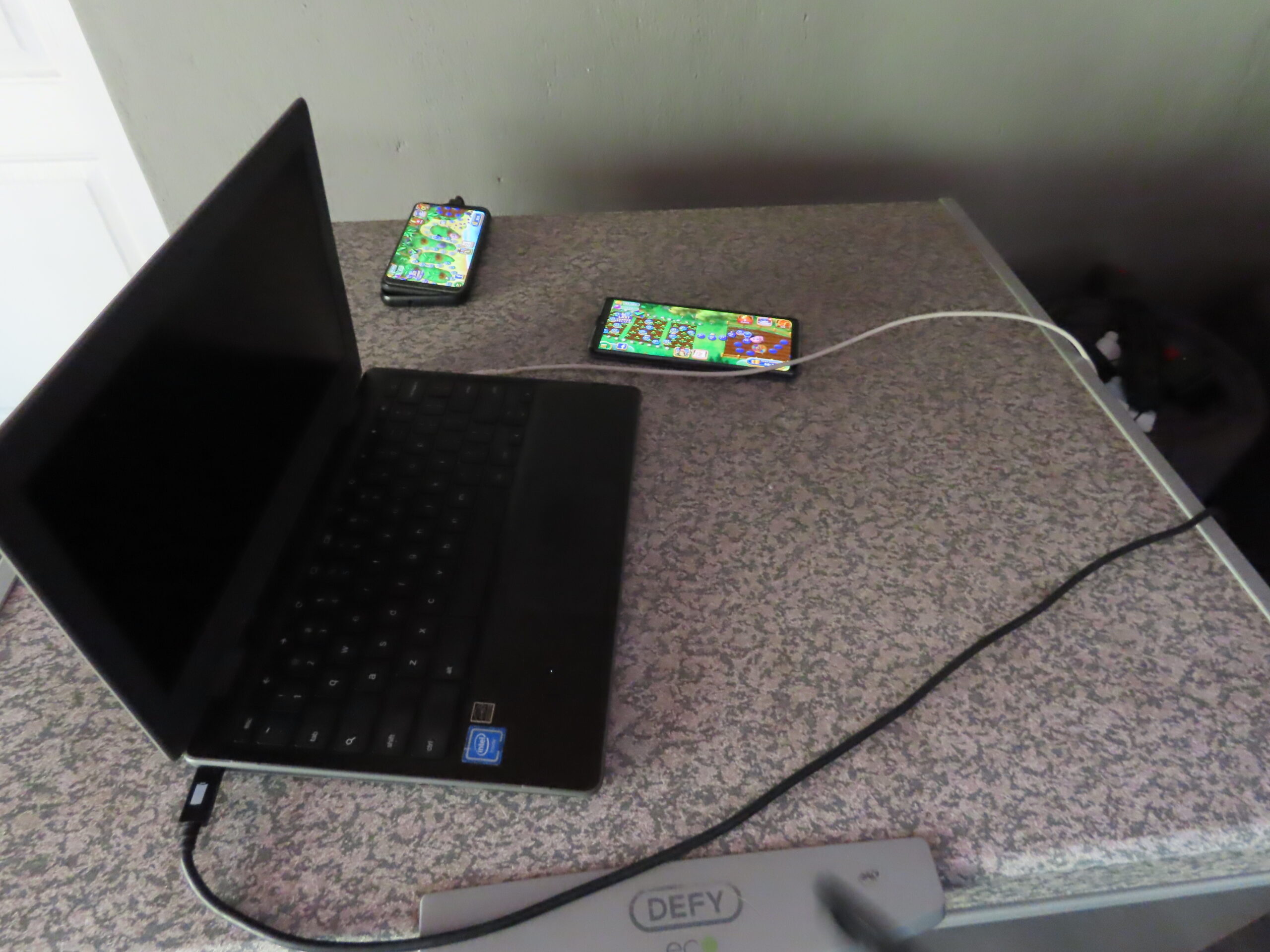
Tom’s Chromebook laptop will stay charged almost all day, but my newer Lenovo Windows 11 unit’s battery lasts only half a day without a charge. As a result, by about 1:00 pm, 1300 hrs., I must plug it in each day for a charge. Usually, I go into the bedroom to finish what I’m doing with the high-powered fan while I recharge my laptop. This takes about an hour.

To recharge my laptop, I have to sit on the bed, which isn’t comfortable even propped up with pillows, although it’s very comfortable for sleeping. I could charge it at Tom’s charging station (see photos below) on the top of the chest freezer in the dining room. But there’s nowhere to sit to continue working when it’s in that location. TIA.

Tom’s charging station on top of the chest freezer doesn’t work during load shedding or other power outages. Plus, every time we want to take something out of the freezer, we have to move everything.
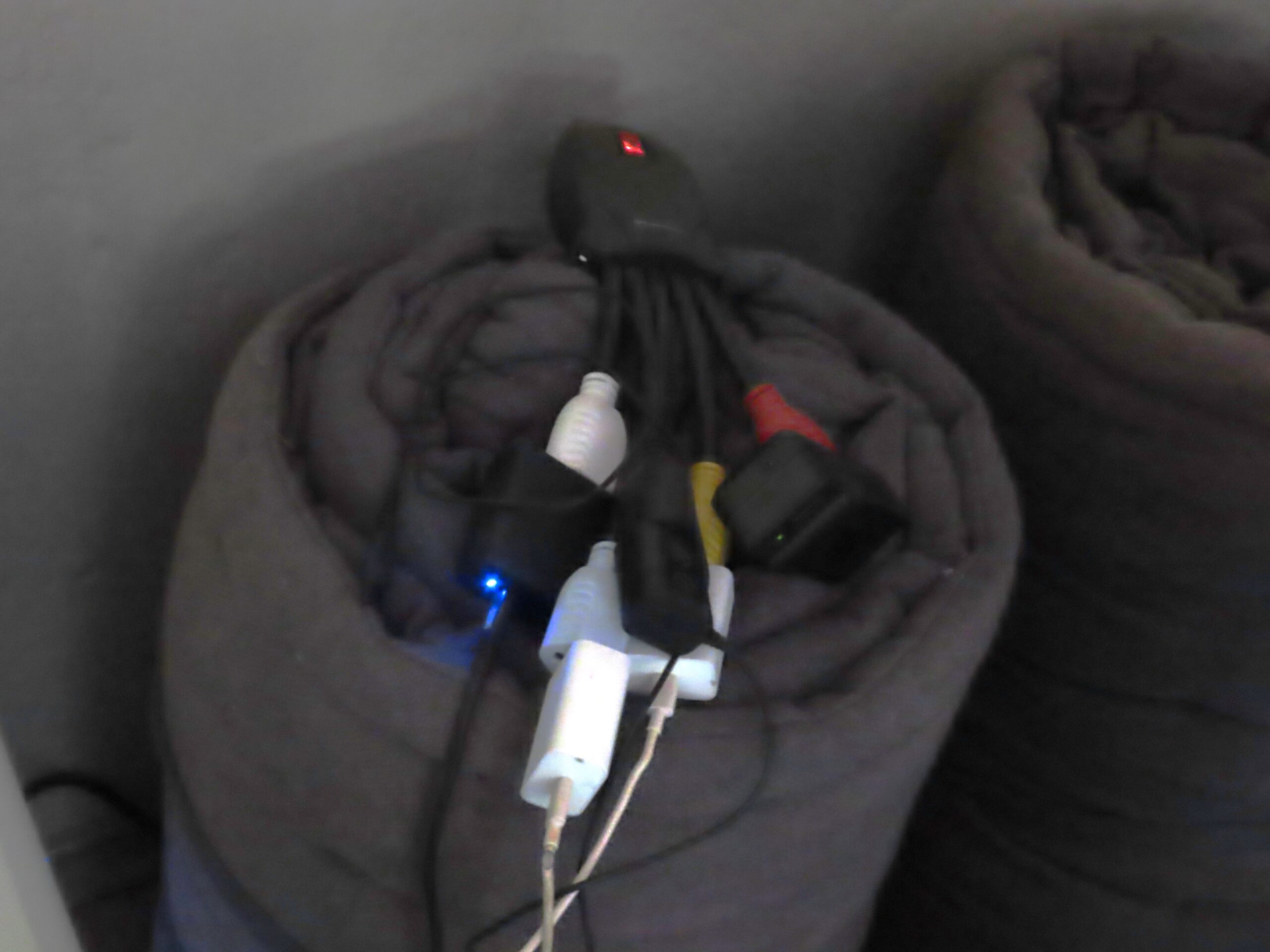
The octopus-type power adapter Tom uses for his charging station atop the chest freezer.

There are no regulations here that require so many electric outlets are installed when building or renovating a house, as stated below from this site:

“There is no legal requirement to have a set number of sockets in each room in a rental property

Answered by Sarah, an Electrical Safety Expert

There is no legal requirement to have a set number of sockets in each room in a rental property. 

But with increased use of electrical appliances, older homes often do not have enough sockets to allow modern households to use them all without relying on adaptors, which is not ideal.”

It’s a very different scenario in the US when a certain number of electric outlets must be installed in each room, according to local building codes as follows below from this site:

“The US National Electrical Code, Section 210.52, states that there should be an electrical outlet in every kitchen, bedroom, living room, family room, and any other room with dedicated living space. They must be positioned at least every twelve feet measured along the floor line.”

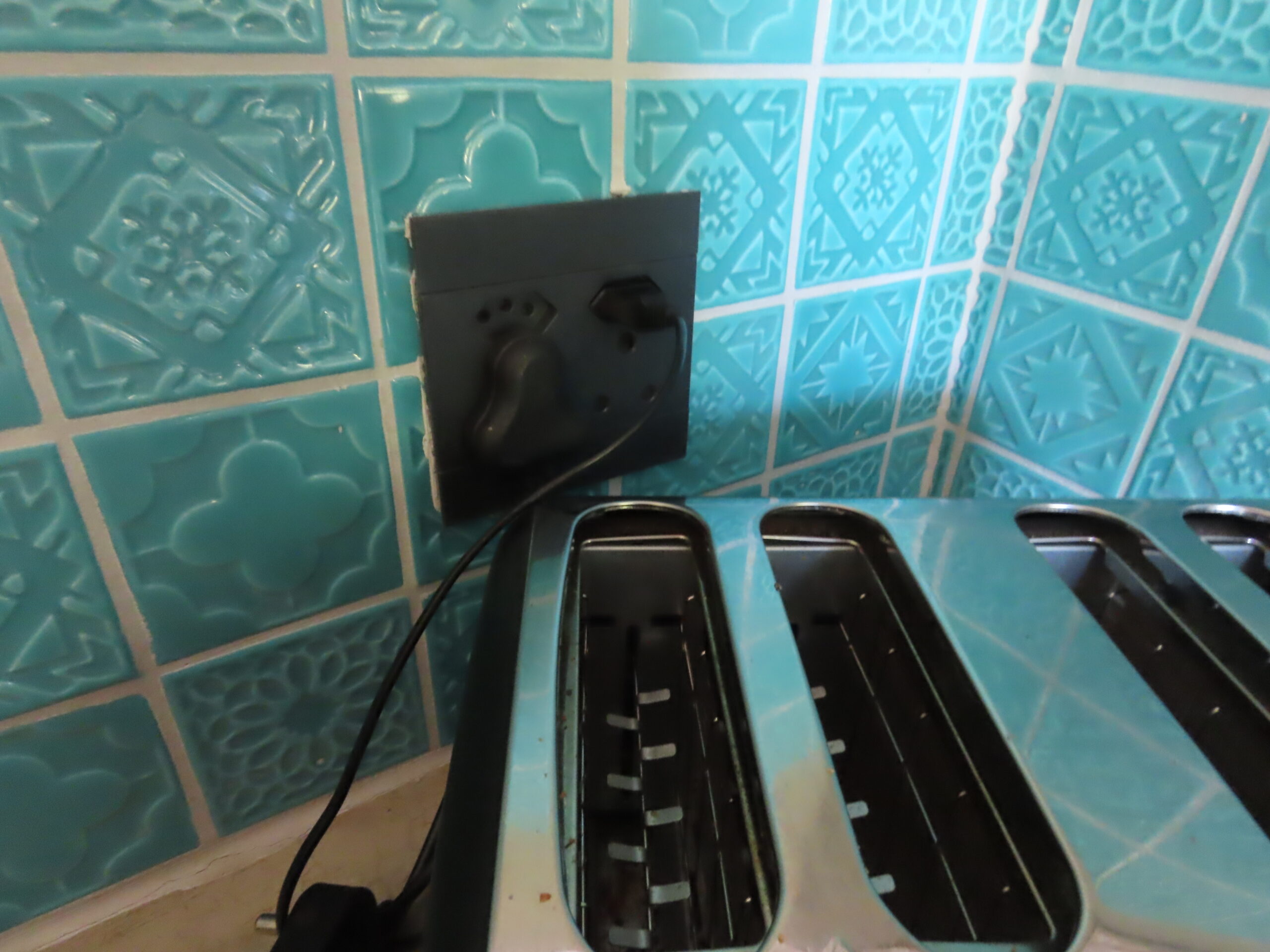
As a result, in many countries in Africa where electricity is provided to a house, including South Africa, a single out may be used to accommodate all needs in a room. Our kitchen here has two outlets; one behind the refrigerator and another by the coffee station. When I toast my low-carb bread each morning, I have to unplug the evening-time small lamp to gain access to the plug for the toaster. Here is a photo of that outlet.

The kettle stays plugged in on the left of this outlet since we use it often throughout the day. The two outlets on the right require plugging the appliances in and out since the two types don’t fit simultaneously. They are difficult to plug in and out. When we use any other small kitchen appliances, it is more complex than plugging them in. TIA.

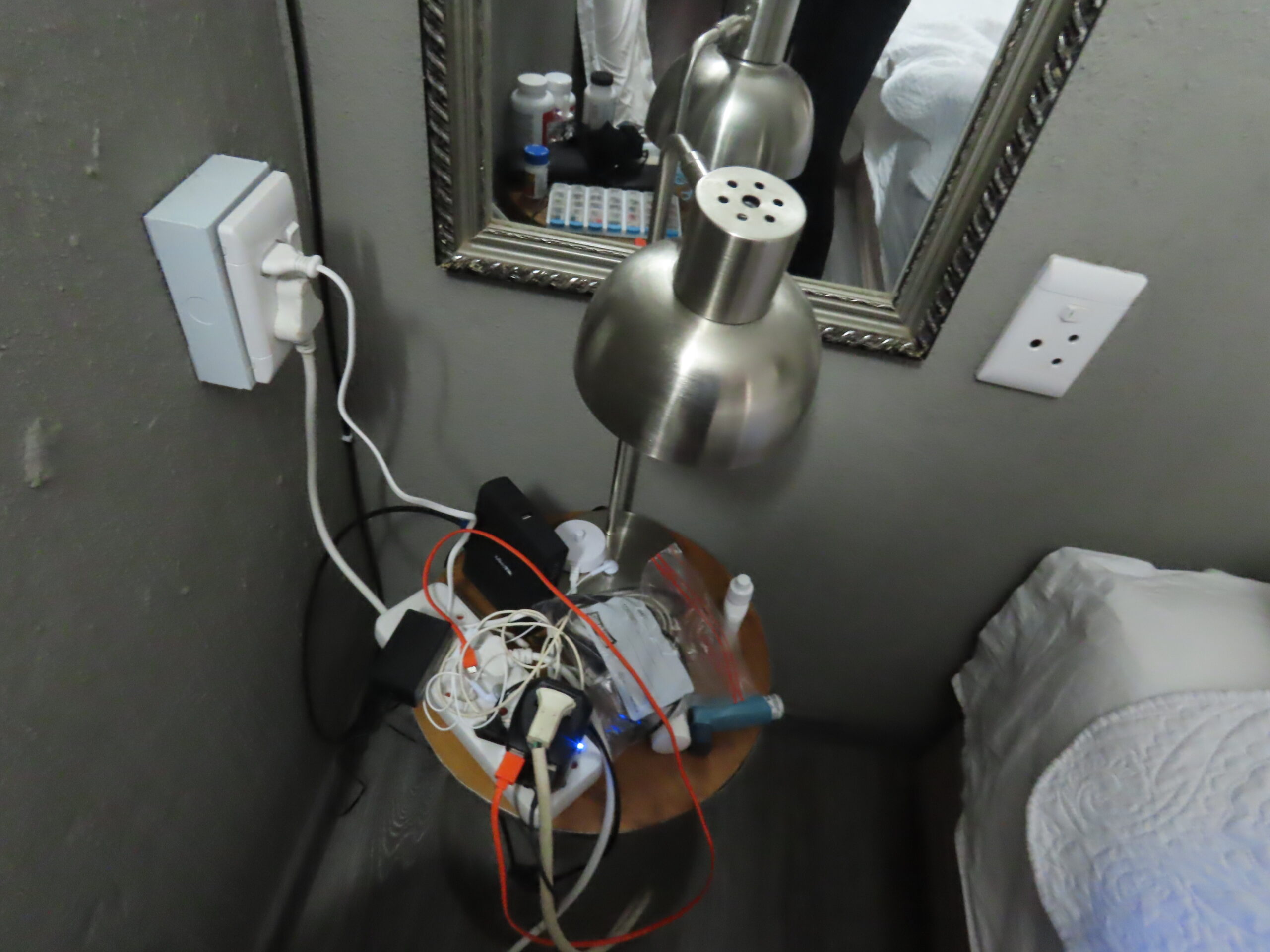
The bedroom has three outlets, but only one is connected to the inverter. With the daily power outages from load shedding, we only use one outlet, as shown in the photo below. The other outlets are useless to us when they each require access to the inverter and the use of our own converter/adapter.

This is the quagmire of cords plugged into the inverter outlet, along with our converter/adapter, and now the new router leaves no room for anything else. TIA.

As for today, a very hot and humid day with abundant sunshine, we are staying close to home. Tomorrow, I have a dentist’s appointment to have my teeth cleaned which is long overdue. Afterward, we’ll shop at the pharmacy for a few toiletries for our upcoming cruise and then at Spar Market one last time before we depart in two weeks for our cruise in Seychelles.

Tonight, bacon burgers on the braai with cheddar cheese, purple onion, tomatoes, rice for Tom, and salad for both of us.

Have a fantastic day!

Photo from one year ago today, November 9, 2021:

Gordon Ramsay, our newest bushbuck visitor, visits daily after discovering the goodies we offer. He visits us at this house regularly, finding his way from a few kilometers away. For more photos, please click here.

No power!…No Water!…Our road washed out…Huge storm with 100+ mm, 4″ rain during the night…Crazy night!…

  • A handsome male duiker in the garden.

This morning this message was on Facebook regarding access to our house:

“Good morning.
“Spruit”* in Bird: washed away the road. Impassible.
Eagle: VERY bad: no sedans can drive there.
Keep safe.”

*Definition of spruit:: a small, often dry tributary stream in southern Africa.
Bird and Eagle are the two roads that provide access to our house. I guess we won’t be going anywhere today. We needed to go to the little market for lettuce for our taco salads. But with the meat in the fridge and the power out, it will be spoiled by dinnertime, and we won’t dare to eat it.
Tom put the metal bowl filled with ice in the refrigerator during the night. The ice will be a good indicator that the fridge’s contents will be safe to eat. The freezer should keep the contents frozen for a few days. With the storm’s intensity, we could be out of power for days. But, as we always say, TIA, This is Africa, and occurrences such as this are common.
When the power is out, the pumps for the water supply don’t function. Subsequently, the only water we have right now is left in the house’s lines. Miraculously, I was able to take a quick shower this morning. Soon, Tom will bring buckets of water from the pool to the bathrooms in the house to flush the toilets.
Duikers, the smallest of the antelopes in South Africa, are very shy and don’t come close to the house.
Of course, we use bottled water in a water machine for drinking water. The water is included in our rent. We do not purchase small bottles of water. Why use all those plastic bottles?
The electric inverter provides us with WiFi, able to supply power to the router. Without that, we’d have no access to the Internet. The inverter will run out in less than a day. If we could go out, let’s say, and go to Kruger, we could turn off the inverter and save the remaining power to use later. But, with the road washed out, that’s not possible.
The little rental car won’t make it on the washed-out road. Besides, the Crocodile Bridge may also be covered in water and debris, preventing access to Kruger National Park, even if we could go. As a result of all of this, we’ll stay put and wait it out, until the power returns, until the water returns, and until the road dries out sufficiently to pass.
Stringy and Gordy, preferring not to get close to one another. Bushbucks are solitary animals and rarely travel in pairs or more.
With all the rain, the only wildlife we’ve seen so far today is a few bushbucks, Spikey and Gordy, and Barbara, Lori, their mom, and the two piglets and a female duiker, who all came for some pellets this morning. It will be a quiet day.
We can only imagine how frustrating it is for holidaymakers who are still in the park on what may be their only annual vacation. For us, it’s a lot easier.
This morning, Rita and Gerhard invited us for breakfast at Stoep Cafe in Komatipoort. If we had been able to go with them, they’d have had to pick us up in the big four-wheeled truck. But, after being awake the majority of the night with little sleep, we were still in bed at 8:00 am. By 8:30, we got up to begin our day.
We hope you have a pleasant day!

Photo from one year ago today, January 6, 2020:

This photo was posted one-year ago while in lockdown in a hotel in Mumbai, India, on day #287. A Marwari horse with curly ears at the Best Exotic Marigold Hotel in India. For more photos, please click here.