It’s happening tonight!!!…We’re crossing back over the International Date Line..We’ll have two May 1sts!
worldwide-admin May 1, 2017 No Comments
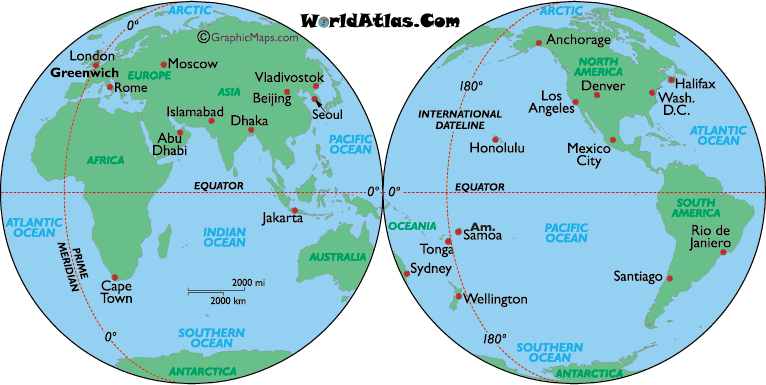
Map of the world illustrating how the International Date Line affects each side of the line.
Tonight at midnight, we’ll conceptually turn our clocks back 24 hours as we cross the International Date Line. Here in this part of the world, it’s May 1st today, May Day for many people worldwide who celebrate, and tomorrow it will be May Day, May 1st, once again. Also, we’ll experience two Mondays in a row.
As for May Day itself, it’s described as follows for those who celebrate aboard the ship. How unusual they’ll celebrate two days in a row:
“May Dayis a public holiday usually celebrated on May 1. It is an ancientnorthern hemispherespringfestival.It is also a traditional spring holiday in many cultures. Dances, singing, and cake are usually part of the celebrations that the day includes.
As we cross the International Date Line tonight, we’re reminded of when we crossed into this part of the world so long ago. On June 4, 2015, we went to bed on the ship one night, awakening the next morning having missed an entire day/date. That was peculiar to us. So now we’ll do the opposite.
We officially arrived in the South Pacific on May 30, 2015, and are leaving as we enter the Pacific Ocean after crossing the equator on May 3, 2017, a few days from now. Nevertheless, we’ve spent considerable time in the South Pacific, as indicated below from the app we use to calculate between two dates:
“From and including Monday, May 25, 2015
To, but not including Monday, May 1, 2017
Result: 707 days
It is 707 days from the start date to the end date, but not including the end date. Or 1 year, 11 months, 6 days excluding the end date.”
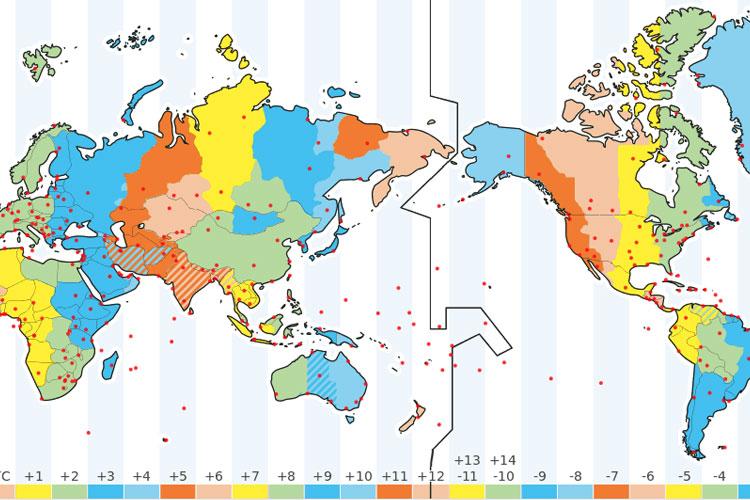
The International Date Line on another map.
How intriguing that we’ll finally be in the same date range and day of the week of our friends and family members in our home country, the USA.
Going forward, as we “go back,” we’ll have to redo our thinking when we communicate with family and friends when mentioning the day or date. Not only have we had to consider the date and day of the week, but we’ll experience many times changes as this cruise continues to North America.
Wondering why and how the International Date Line came to be, after some research, we found the following at this site:
“The International Date Line, established in 1884, passes through the mid-Pacific Ocean and roughly follows a 180 degrees longitude north-south line on the Earth. It is located halfway around the world from the prime meridian—the zero degrees longitude established in Greenwich, England, in 1852.
The International Date Line functions as a “line of demarcation” separating two consecutive calendar dates. When you cross the dateline, you become a time traveler of sorts! Cross to the west, and it’s one day later; cross back, and you’ve “gone back in time.”
Despite its name, the International Date Line has no legal international status, and countries are free to choose the dates they observe. While the dateline generally runs north to south from pole to pole, it zigzags around political borders such as eastern Russia and Alaska’s, the Aleutian Islands.”
By perusing the map as shown in today’s main photo, one can better understand how this line cuts the globe in half. Thus, when we prepare tomorrow’s post about cannibalism in the South Pacific over the ages, we’ll be back on May 1st.
Funny, eh?
Photo from one year ago today, May 1, 2016:
Had we not been traveling the highway in Bali at such a clip, we’d have been able to take dozens of photos such as this of famous Balinese gods, kings, and queens. For more details, please click here.
Websites store cookies to enhance functionality and personalise your experience. You can manage your preferences, but blocking some cookies may impact site performance and services.
Essential cookies enable basic functions and are necessary for the proper function of the website.
Name
Description
Duration
Cookie Preferences
This cookie is used to store the user's cookie consent preferences.