Day #176 in lockdown in Mumbai, India hotel…The adventures in Kenya continue…Dining in a cave…

Dinner in a cave at Diani Beach, Kenya, seven years ago today. I thought Tom looked great in this photo, but I reminded myself of Morticia wearing all black or, on the day in Abu Dhabi, UAE, when we entered the famed White Mosque, requiring that I wore the black abaya in the 100+ degree weather.

Today’s photos are from the post in 2013, while we lived in Diani Beach, Kenya, for three months. For more details from that post, please click here.

Standing at the top of the stairway leading down to the natural cave, we were able to look down at the bar below. Every effort was made to maintain the original integrity of this environment when it became a restaurant over 100 years ago, renovated in the 1980s.

As we recall the photos and story from seven years ago today, we are reminded of how we may have taken our “freedom” for granted. To dine out, be outdoors, see wildlife, flowers, plants, and trees, and people were always a delight, but, perhaps, it will be all the more meaningful from now on.

The lounge in the bar where we had our drinks while waiting for our table. The restaurant didn’t open until 7:30 pm, with most diners not appearing until 8:30 or later. I guess us old folks from the US are early diners. We’ve found that dinner is typically served at 8:00, often 9:00 pm or later as we’ve traveled the world.

As mentioned in a prior post, we’re attempting to determine a lesson or purpose that will serve us in years to come from these many months in lockdown. Will a greater sense of freedom be the answer to this question? For our regular readers, it’s been evident all these years that we’ve been grateful and appreciative of our surroundings, never taking anything for granted. Should a sense of freedom become the focal point for our past and future appreciation and gratitude?

Another view of the seating areas in the bar, depicting somewhat of a Moroccan theme, which was ahead for us at this point when we’d booked a holiday home in Marrakesh, Morocco, a mere six months later.

Today, as we see how much enjoyment we derived from yet another evening’s foray in sampling Kenya’s dining various establishments in Diani Beach, my heart did a flutter thinking how much fun that would be now. The variety of food options, the ambiance, and the possibility of a cocktail or glass of wine, send my taste buds and brain into a frenzy of hopefulness and excitement.

View of the walls in the bar. All lighting in the walls and at the table resulted from candles, creating a warm atmosphere, romantic to say the least.

This extraordinary experience in Kenya on this date seven years ago, dining in a cave, was memorable, so much so we returned a second time. The ambiance was over-the-top, as shown in today’s photos, the food was fresh and delicious, and the service was exemplary.

Diners began to filter in around 8:00 pm, filling all tables when we were ready to leave around 9:45 pm. We’d been warned not to rush the servers in Africa. Many countries’ servers are accustomed to taking their time in delivering the bill. As is the case in Kenya and many other countries, most often, tips are only allowed to be paid in cash, not added to the credit card slip. That required us to keep adequate money on hand.

The ambiance of any venue is a  factor in enjoying a meal. Whether it be in a pleasant holiday home, comfortably situated at a dining room or kitchen table, dining out in a lively atmosphere of a popular everyday dining establishment or a cozy, romantic spot such as illustrated in today’s photos, it all adds to the enjoyment of the meal and of course, the companionship.

Compliments of the chef, we were both served this tangy GF marinated salad. Tom took one bite turning his serving over to me, which I thoroughly enjoyed.

In this case, in Diani Beach, we couldn’t have enjoyed it more. The unique decor, lighting, and service added another element to our meals. We’d expected it to be more expensive. We were pleasantly surprised by the reasonable bill, which, with the cost of the driver (who waited for us in the parking lot), the food, tax, tips, and beverages, the total was only US $68, INR 4999, for the entire evening. I didn’t order alcohol, only a Perrier, my drink of choice at that time.

This was the view to my right as we sat at a cozy, not too small table against one of the walls. We always prefer a wall table as opposed to one positioned in the center of the room.

As mentioned in the past, I didn’t drink any alcohol for about 20 years. I didn’t have a “drinking” problem but just decided to stop for health reasons, thinking it was “better for me.” Ultimately, it seemed to make no difference in my health whether I drank wine or not.

My dinner, Cheesy Chicken atop a pesto sauce, was well seasoned and pleasing to the palate, although the serving size was small. Rather than a chicken breast, this serving was a small single thigh that proved to be sufficient with the vegetables.

After open-heart surgery, the cardiologist and surgeon suggested that drinking red wine in moderation was good for the heart. I’m still not sure if that’s been proven inconclusive, but for now, I’ll go with that theory. Good grief, one has to enjoy life, too! Then again, there’s undoubtedly no wine in my life at this point, and it won’t be until we leave here someday.

Tom’s dinner of two small Filet Mignon, each with a different sauce.

When looking online, it appears that Ali Barbour’s Cave Restaurant is still open, even during this time of COVID-19. If we ever return to Diani Beach, Kenya, which we may, we’ll visit this fine restaurant once again to renew the experiences we had in 2013.

The stairway was going up and out of Ali Barbour’s Cave Restaurant. Gee, we’ve gone up and down several stone stairs in those past months!

For now, we have what we have; safety, relative comfort, air-con, a comfortable bed, housekeeping, shows to stream in the evenings, and good WiFi. All of you are beside us, encouraging us with your positive feedback every day.

May your day bring you comfort and peace of mind amid all this madness.                                                                                                                                                                                        Photo from one year ago today, September 15, 2019:

The driveway from our house in St. Teath, Cornwall, England, to the narrow road. For more photos, please click here.

Day #175 in lockdown in Mumbai, India hotel…Amazing memories in frustrating times…

The lodge at Sanctuary Olonana, where we’ll experience our first safari in October 2013.

Today’s photos are from the post in 2013, while we lived in Diani Beach, Kenya, for three months. For more details from that post, please click here.

Recalling the day we booked our first safari while sitting on the veranda/living room outdoors in Kenya’s holiday home is as easy as if it was yesterday. Our enthusiasm, coupled with a tinge of fear, made our hearts race. One never knew what to expect going on safari. And watching YouTube videos wouldn’t be helpful when so many consists of dangers encountered while on safari.

We hoped to see The Great Migration, but once we arrived in Tanzania, the bulk of it had moved on, although we did see the tail end.

Seven years later, we’ve been on more safaris than we can count in several African countries, including Kenya, South Africa, Botswana, Tanzania, Zimbabwe, Zambia, and Morocco, and now, in India at three different national parks. We’re not trying to break any safari expedition’s count or race. We revel in the vast experiences we’ve had over the years.

Our first safari in the Maasai Mara National Reserve in  Kenya remains our favorite of all the other experiences. A few times, we’ve been asked how many times we’ve been on safari and counting all the self-drives we’d done in Kruger National Park. Most likely, we’re well over 100 safaris.

We went on two game drives each day, one in the morning from 6:30 am until lunchtime and another in the early evening from 4:00 pm to 6:30 pm. Often, meals will be served in the bush as the other guests and feast their eyes on the surrounding wildlife.

The bouncing, the dust flying in our faces, the jolts, and fast turns make a safari an unusual adventure requiring a but of stamina and endurance. After each several hour-long safaris in the jeep-type vehicles with open sides, we felt as if we’d been exercising for hours.

Oddly, with my newer Fitbit, when we were on safari over 12 times in India, my readings showed I’d walked almost 30,000 steps each day from the mere rough ride in the vehicle. This made us laugh when we’d spent the majority of the day sitting in the car.

Most of these photos were from the Sanctuary Olonana website.

Getting in and out of a safari jeep can be challenging for those with mobility issues and instability. While we were on safari in India, it was only 11 months after my open-heart surgery. My legs weren’t stable after two surgeries only nine months earlier, and my breastbone felt as if it hadn’t entirely healed.

Riding in the vehicle was challenging when holding on tight, which was imperative in many situations as our guide worked their way around rough roads, potholes, and uneven terrain. Even my arms were still weak and guarded. Somehow, the prospect of spotting tigers in the wild was sufficiently exciting to keep me from thinking of any potential discomfort.

In the event of rain or if we were able to be inside air-conditioned comfort, the lodge at the camp provides indoor activities, a bar, and a restaurant, although as it turned out, we were on safari for the bulk of the day. Our living quarters were lavish private tents on the banks of the Mara River, overlooking families of hippos splashing and snorting in the water. We could hear the hippo sounds starting around 3:00 am each morning.

Now, after walking 5 miles a day (8 km) for so many months, I know I’d do a whole lot better. I continue to work my arms while walking to build strength and resilience and stay mindful of good posture and stance.

As for the Maasai Mara, named after the Maasai people of Kenya, a tribe known for their colorful red garb and an unusual diet consisting primarily of cow’s blood, it is also known for the Mara River, which millions of wild animals, mainly wildebeest cross each year on their annual migration.

This is a typical interior of permanent tents, full bathrooms, electricity, free WiFi, and mosquito nets. We always share one bed when there are two, using the other for our “stuff.” We brought our laptops, two cameras, binoculars, and other digital equipment, writing here each day with many photos.

Ah, my heart aches for such an experience now. The dust in my face, the jarring ride, and the challenge of getting in and out of the jeep are insignificant compared to the joy of being witness to this world of wonder once again.

As we continue over the next several weeks, sharing photos from that incredible expedition, we’ll be reminded once again of this exceptional adventure, unlike anything we’d ever done in our old lives. And now, who knows what the future has in store for us in months or years to come? We hold our breath in anticipation of leaving India to head to other lands with other joys, many of which are almost impossible to describe.

We were fortunate to see many Mr. or Ms. Rhino while in the Maasai Mara.

Be well.

Photo from one year ago today, September 14, 2019:

The Towne Centre Theatre in Wakebridge, Cornwall, watched the Downton Abbey movie when released in the UK. For more details, please click here.

Day #174 in lockdown in Mumbai, India hotel…Waiting for two items from FedEx for months……

Hesborn, our houseman in Kenya, with his machete preparing to cut this thick stringy exterior off of the coconut before releasing the stringy brown interior that we’ve seen for sale at the grocery store. He willingly cut these for us whenever we requested.

Today’s photos are from the post in 2013, while we lived in Diani Beach, Kenya, for three months. For more details from that post, please click here.

This morning I ventured downstairs to the reception desk to pay our food bill for the past 12 days (we’d already paid for the hotel for this period using priority points from Hotels.com on our site) and allow the hotel to put a hold on our credit card for the following number of days we have booked until October 3.

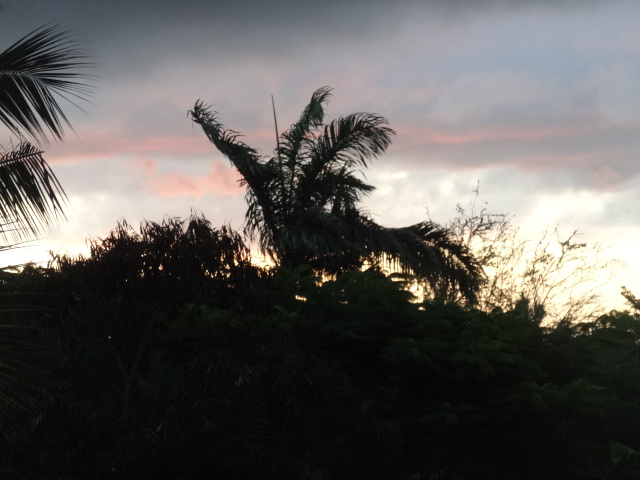
At dusk, Tom shot this Kenya sky. Rather impressive for the infrequent photographer.

You’d think after living here for almost six months. They would dispense with the “hold” and charge our card for actual charges when it was time to pay again. I suppose they have rules and regulations preventing them from doing it any other way.

With little to no future travel booked, we have plenty of room on our credit cards which all have been at a zero balance due to paying them off quickly when the new hotel charges are posted. I guess it doesn’t matter since we don’t pay interest on holds, nor do we have to pay the amount of the delay.

In Kenya, I pulled up a chair close to the open wrought iron weaving (to keep us safe from the monkeys or other larger animals) surrounding our outdoor living room to take photos of the many birds singing in the yard. Instead, I could not capture many birds in my impatience, focusing on items that caught my attention, such as these branches in the shadows.

Holds are there for security for the hotel that we don’t bail in the middle of the night without paying. That’s unlikely, let alone bailing at all, after spending the current bill. The security here is tight, not only for potential thieves who might try to escape without paying but to prevent the potential spread of COVID-19.

Speaking of credit cards, in July, one of Tom’s card numbers was stolen while we’ve been in lockdown in India for an unauthorized purchase in the US. The credit card was immediately canceled, and a new one was mailed to us in mid-July via FedEx. Also, in July, we ordered a package from our mailing service that included our new second passports, among other much-needed items. Neither of these two packages has yet to arrive, although they arrived in India a few days after they were sent. They are just sitting in Delhi.

The red in the background is a bunch of flowers on the bush behind this palm.

We’ve called FedEx. We’ve emailed FedEx. Each time, they say they are working on it. I am going to call again tomorrow, but now I need to get “mean.” I don’t particularly appreciate threatening and being forceful, but I can do this while staying calm, whereas Tom would flip his lid. Thumbing one’s lid never works.

We need these items. We need to receive these items before we leave here, or we’re in big trouble. We knew it could take four to six weeks to receive the packages but two months is ridiculous. We’ve often had such problems receiving boxes in various countries in the past and, in the future, we will try to figure out ways to avoid the necessity of receiving packages from the US, if possible.

The tall pointed thatched roof of the house next door to us.

As for my recent change in diet, eliminating the carbs in my dinner each night, I am managing without the carb-laden meals instead of eating smaller portions of protein and healthy fats, such as eggs, salmon, and cheese. It will take quite a while for me to reap the benefits of a much lower-carb diet, potentially as long as two to three months. In the interim, I am experiencing what they call the “keto flu,” when your body starts burning its fat stores for fuel instead of those derived from card-laden foods.

The boisterous female of the yellow bird, the African Golden Weaver, is less colorful. They are elusive and sensitive to movement, making photo-taking a near impossibility for a novice like me. She seeks the bright yellow male capable of building a suitable nest. She landed in our outdoor living room, enabling me to get this crooked shot.

It was this way of eating nine years ago that eliminated the pain I’d been suffering for years. Now, I am hoping my strict return to this manner of eating will serve me well once again. As a result of the diet change, the “keto flu” leaves me sluggish with a lack of energy. This will pass within a few weeks. After all, I have all the time in the world.

This coconut meat Hesborn prepared for us was exceptional, the best I’ve had. What a treat! Tom has no interest in eating this without sugar, so he passed it up.

As hard as it’s been to continue walking right now, every 30 minutes, I force myself to get up and get out into the corridor to walk for yet another ½ mile until I reach 5 miles per day (8 km). With convention guests still here, we can walk only a short portion of the corridor (Tom walks, too). Hopefully, soon we’ll have access to the entire passage making the walks less boring.

As we were sitting in our outdoor living room that morning while writing, seven goats jumped over their stone wall behind our yard, directly into our yard only a few feet from us. They decided to dine on the lush leaves of the hibiscus bushes in our yard.

I am still working on the edits/corrections for all past posts. Today, I’m on page #128 or #149 (I’m working backward. There are 20 posts per page), which means I’ll be done in approximately four months, 28 days. I hope by then, I’ll be finishing this considerable project from some other location. Good grief!

Photo from one year ago today, September 13, 2019:

A gorgeous countryside view as we drove toward Port Isaac from St. Teath (pronounced “breath”). For more photos, please click here.

Day #173 in lockdown in Mumbai, India hotel…A learning experience in Kenya…

Hesborn, our houseman, in Kenya stopped by Wednesday morning, after a whole night of rain, showed us this carnivorous, stinging, dangerous creature with less than 100 legs, yet is still referred to as a centipede.  He warned us not to walk in the grass after rain. A sting from this ugly creature will require a trip to an emergency room. These not only walk but also are known to climb up bedposts. Oh.

Today’s photos are from the post on this date in 2013, while we lived in Diani Beach, Kenya, for three months. For more details from that post, please click here.

Living in Kenya for three months beginning in September 2013 was the best possible introduction we could have asked for to adapt to life in Africa. As many of us know, Africa is an entirely different and unique environment from what we were used to, spending most of our lives living in the US. This may well be the case for many citizens living in modern-day, developed countries with infrastructure and lifestyles proportional to that in the US.

Non-venomous. This good-sized lizard came to call as we lounged in our outdoor living room. Thanks for the nice pose, Ms. or Mr. Lizard.

Arriving in Kenya on September 2, 2013, we were in for a rude awakening and culture shock while we were riding for an hour in a well-worn van from the Mombasa Airport to Diani Beach, the location of our holiday home we’d booked for three months. We chose to visit Kenya to eventually make our way to the Maasai Mara National Reserve to embark on our first of many wildlife photography safaris.

In the next several days, we’ll share the photos and the stories of how and where we decided to stay for this big adventure, one I’d dreamed of all my life. Of course, the exciting photos of our many safaris in the Maasai Mara, an experience we’ll never forget, will be re-posted soon as we continue to share our past experiences while in lockdown.

Mildly venomous. Hesborn referred to this as a millipede. We didn’t bother to count the number of legs. These are harmless, although if walking on a person, they leave a trail of “itchy liquid.”

During that hour-long drive to the holiday home, I was practically hanging out the window of the vehicle in the sheer wonder of what my eyes beheld, scenes of which neither of us had ever witnessed in the past. The people, the cows, the buffalo, the goats, the pigs, and the chickens walking along the crowded pot-hole-ridden highway, sent me into an awe-stricken state unlike any other in my life.

Often tourists comment that they felt uncomfortable seeing the poverty, the way of life, the commotion, and the traffic in what was formerly referred to as “third world countries.” Witnessing these scenes sent me into a jaw-dropping state of curiosity and wonder. Oh, don’t get me wrong. It’s heartbreaking to see the poverty up close and personal.

A millipede about the tip of my shoe: one wouldn’t want to snuff this out with their foot if discovered in the bathroom in the middle of the night.

For me, it represented the strength and resiliency of a people who were making the best of a seemingly impossible situation with many thriving in the best manner possible. Perhaps, that was my overly optimistic viewpoint. Still, it served me well when over these past eight years, we experienced many similar scenarios, not unlike much of which we’d seen in India during the two-month tour.

On that day, the shutter on the camera was clicking nonstop. I shot hundreds of photos in that first hour and thousands more during the three months we spent in the country, along with the precious time spent in the fantastic Maasai Mara National Reserve, one of the most pristine and wildlife-rich places in the world. I’d go there again if we could.

As Alfred, our driver for the three months, drove us to the stores. We passed many similar buildings.

Those challenging days and nights in Diani Beach primed us for the harsh realities of Africa along with its life-changing wonders we beheld in one way or another almost every day. Whether it was the curious facts about a venomous insect shown in today’s main photo or the exquisite heart-pounding experience of taking a photo of a lion enjoying his zebra lunch a mere 3 meters from our vehicle, it had it all.

These run-down lean-to-type shacks depict the aspect of a third-world country, many without running water and electricity. And there we were in what was considered an upscale resort community of Diani Beach.

It is hard to shake once a person gets Africa in their blood, especially those deeply moved by its magic. And now, as we remain in lockdown, just eight days short of six months, the only place I long to be is, back there in Africa, amid the wildlife, the vegetation, and its amazing people.

The Nakumatt grocery store is guarded by armed military security, who, for security reasons, refused to be photographed. Armed guards thoroughly examined the car, including a mirror on the long pole to search for explosives. We were searched and wanded before entering the market. This was the day I tossed my handbag, never to be used again in Kenya. From that day, Tom carried my lipstick and passport in his pockets.

Perhaps, in time, we’ll be able to return to the heat, the bugs, the snakes, the excitement interspersed with a tinge of danger in the wild, and the blissful experience of seeing nature in its most acceptable form, both human and animal.

Stay safe. Stay healthy and have hope.

Photo from one year ago today, September 12, 2019:

Blue sky, blue sea, and craggy cliffs in Port Isaac, known as Port Wen in the TV series Doc Martin. For more photos, please click here.

Day #172 in lockdown in Mumbai, India hotel…Kenya in 2013…Seems like a lifetime ago…

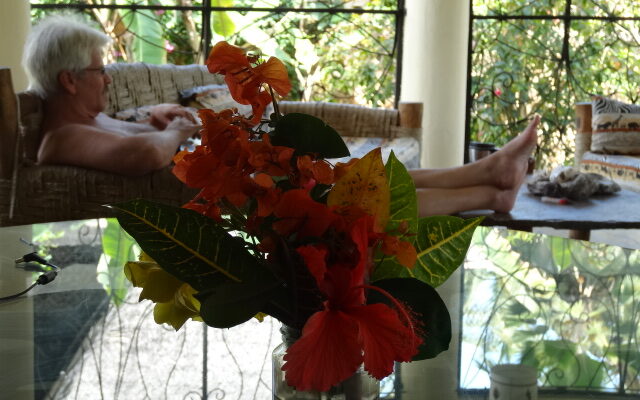
Tom engaged in power lounging in our outdoor living room in Diani Beach, Kenya, in 2013 while searching for future cruises. Tom wasn’t naked. He was wearing shorts.

Today’s photos are from the post in 2013 while spending three months in Diani Beach, Kenya. For more, please click here.

The more time we spend in lockdown, the more distant our recent travel memories become. Even the almost two months we spent touring India from January 31 to March 24, 2020, feels as if it happened a long ago. COVID-19 became more and more of a concern in early March, causing us to lose interest in visiting crowded venues.

Although very hot and humid, these flowers against the blue sky were refreshing.

What was planned as a 55-night tour of India, after our seven-day expedition on the Maharajas Express train beginning on February 2, 2020, we ended up being cut short by no less than three weeks. We knew then that it wouldn’t be safe to continue a day longer than we did.

In essence, we’ve been “locked down” since around March 12, which is 12 more days than we’ve been in lockdown in this hotel since March 24. In total, we’ve been locked down for a total of 184 days. To keep it simple, we count the total days in lockdown from the date we arrived here at the Courtyard by Marriott, Mumbai Airport, the exact date India officially locked down.

These flowers, known as Plumeria, also known as Frangipani, also grow in Hawaii, where we were 15 months later.

Ironically, when we review our three months spent in Kenya in 2013, a full seven years ago, those memories are more at the forefront of our minds. Perhaps, like for so many of you, the time we’ve all spent in confinement has been but a blur of days and nights rife with worry, concern, and confusion over what is yet to come.

More ironically, most of the world has felt this same anxiety and worry about what the future holds for themselves and their loved ones. Will COVID-19 impact not only their financial security and, for many, their ability to put food on the table, as well as the risks of being impacted by the virus itself and the possibility of losing loved ones and friends?

The small white flowers grow within these larger Bougainvilleas.

We continue to hear that many have not personally known a single person with COVID-19, not a relative, friend, or neighbor. In the realm of the total of the world’s population, 7.8 billion souls, to the number of total cases, as of today at 28,328,131, it is less than .03% of the entire world’s population.

With these numbers, it’s not surprising that many do not know a single person who either had the virus or had the virus and sadly lost their lives. No doubt, these numbers are considerably lower than have been reported. Imagine how many people have had the virus and didn’t report it, didn’t take a test, and went through the process at home (or not) independently. Imagine how many have been carriers, never testing, with their cases unreported.

Shards of glass are embedded into the top edge of this stone wall protecting the property from intruders climbing over the wall. Surprisingly, this enchantingly noisy bird lighted atop the glass, seemingly comfortable.

Anyway, on to Kenya, which, as mentioned, is as prevalent in our minds as if it happened a few months ago. Those three months were some of the most challenging living we experienced in our eight years of world travel. The heat, the humidity, the lack of air-con, the venomous insects, placing our shoes in the bed with us each night, having no indoor place to sit and lounge at night, the mosquitos, the risk of crime, and constant need for security with a red panic button next to the bed, being searched at the grocery store and on and on.

But, somehow, that challenging time primed us for the almost two more years we later spent in Africa, making us stronger and less inclined to fuss over uncomfortable situations. Accomplishing this early on in our travel journey made all the difference in the world. We became seasoned travelers.

Aren’t these breathtaking?

And now? What lessons do we learn here in lockdown all of these days and nights? I wish I could say it made us more grateful. But, we were already thankful for our lives, for space, room to breath, friends in our midst, readily available food, dining in a restaurant, cooking our meals, enjoying “happy hour,” reveling in the scenery and wildlife surrounding us, and having the opportunity to see more and more of the world.

So, what will we take away from here? At this point, I’m not sure. We already felt blessed for every day of our lives. We already appreciated the treasures that Mother Nature and God (or whatever your faith beholds) bestowed upon us. Our enthusiasm level was already “over the top.” when stumbling across a fascinating insect, an animal in the wild, a pretty flower, a kindly person, or an ocean scene.

Could Mother Nature be more perfect in creating this well-shaped hibiscus, a common flower in many warmer parts of the world?

I know this for sure…at some point, we’ll see this answer, and if the only solution is that we avoided becoming another COVID-19 statistic, the time will have been well-spent. There is no way either of us was ready to “throw in the towel” and end this usually exciting life, whether it was a life of world travel or not. We carry on.

Stay healthy.                                                                                                                                              Photo from one year ago today, September 11, 2019:

We visited the popular town of Port Isaac, Cornwall, England, known as Port Wen in the British TV series Doc Martin. This was one of our favorite ocean views in Port Isaac. For more photos, please click here.
Day #171 in lockdown in Mumbai, India hotel…Is a donut a fair trade-off?

Day #171 in lockdown in Mumbai, India hotel…Is a donut a fair trade-off?…

The ferry docked at the edge of Savusavu, Fiji, makes a daily trip to Viti Levu, the largest island in the Fiji chain. It’s an overnight journey, arriving at 4 or 5 am. Since we’ll spend our last month on that island, we saw no reason to take the ferry and will again fly on the commuter plane when it’s time to leave.

Note: I started out doing the edits, starting at the oldest of almost 3,000 at page #148, with 20 posts per page. I noticed a number of the posts had varying font sizes in the text. This resulted during the conversion from Blogger to WordPress as my operating platform. The extra time it would take for me to change the font to a universal size would be doubled.

This is a daunting task in itself, and I have no interest in doubling the time it takes to do the other necessary edits. As a result, I will be leaving them as they are. Sure, I’d like every one of the 3,000 posts to be perfect. But, for the sake of time spent, I decided I must leave it as is. Today, I am on page #131, completing one page each day, taking a bulk of my free time.

The dock is available for the use of boats in this small harbor.

Today’s photos were from this date in 2015, when there was no post on this date in 2013. When we first landed in Fiji on the small island of Vanua Levu in the village of Savusavu. See the link here.

On to today…

As the proverbial optimist, I try to maintain a positive attitude throughout the day and spend little time thinking about our difficult situation. Yesterday was a hard day for Tom. I couldn’t avoid feeling frustrated when I saw and heard how frustrated he was. He’s tired of this. I am so busy with tasks, I think about it less.

As we wandered through the busy local farmer’s market, open daily, it was hard to decide which vendor to choose for our purchases. We purchased the following for $22, US $10.12;  two red bell peppers (also called capsicum here); six medium-sized aubergines (eggplant); three heads of cabbage; and eight large carrots.

For me, if we were living in a house overlooking the sea, right now, I’d be wrapped up in the necessary edits on the old posts that would take up most of my days and parts of my evenings. I might stop from time to time to savor our surroundings, take walks on the beach, do laundry, and prepare meals.

Every few days, we’d head out to the grocery shop and go sightseeing, taking endless photos along the way. As is the case when handling hundreds of photos, a tremendous amount of time is required to sort, edit, and manage the photos. In reality, I’m probably better off not taking new photos right now while I’m busy with the seemingly endless revisions.

These are breadfruit often used in curry dishes, popular in Fiji.

As a result, this time in lockdown is not so bad for me. That’s not to say it isn’t boring. Especially the walks and the repetitive meals for Tom, who spends most of his day on his laptop researching ancestry, reading social media posts, and listening to podcasts. He’s bored.

He wants a doughnut. India is not known for its donuts. He’d tried a few Indian donuts before the lockdown, but after a few bites, he stopped eating them, preferring the taste of a good donut from SuperAmerica in the US (if they even exist these days). He’d liked the freshly baked donuts from the baked goods case or bakery in any supermarket on occasion in other countries. His donut days are non-existence, and he’s feeling frustrated. Oddly, he prefers plain donuts without frosting or filling.

These are the sizes of the aubergine we purchased. These adjoining bowls contain a variety of hot peppers, which I’d love to try, but Tom doesn’t care for spicy food.

If I could eat a donut, it would be creamy, sticky, nutty, and oozing with something in the middle. I haven’t eaten a donut in over nine years. Right now, I’d be happy with a piece of meat with fat on it instead of a dry chicken breast which I never liked anyway, unless it was cooked on the grill with the skin and bone.

No, this isn’t easy. But, without a doubt, it’s easier for me than for Tom, and on a rare occasion, he expresses his frustration, and I listen with caring and compassion. Two weeks from today, we’ll have been in this hotel room for a full six months. I wonder how long we can last before we “give up” and return to the US until this COVID-19 disaster passes.

These are some types of sweet potatoes.

Our risk of infection is almost zero in this hotel. Returning to the US, flying on several flights through several airports, and finding a place to stay, live, and shop while we “wait it out” is risky, particularly for me. Would we end up sitting in a chair all day, occasionally walking and not being any better off than we are now? We’d have to be very careful and avoid being around others, not unlike what we’re doing now. Those are the questions we ask ourselves now.

We’d pay thousands of dollars more a month to live, to rent a car, to grocery shop, and our risks of COVID-19 would be exponentially higher. But, one reality remains. Tom could eat a donut.

Coconuts with peeled outer shells were readily available in the market. If we had a machete, we’d buy a coconut for the delicious meat inside.

Stay safe. Stay healthy.

____________________________________________

Photo from one year ago today, September 10, 2019:

The first animals we encountered in the paddock in Treddarup, Cornwall, England, were pigs. As our readers know, I love pigs. However, as cute as they are, they can’t match the appeal of a handsome warthog. For more photos, please click here.
Day #170 in lockdown in Mumbai, India hotel…Last night’s menu…

Day #170 in lockdown in Mumbai, India hotel…Last night’s menu…

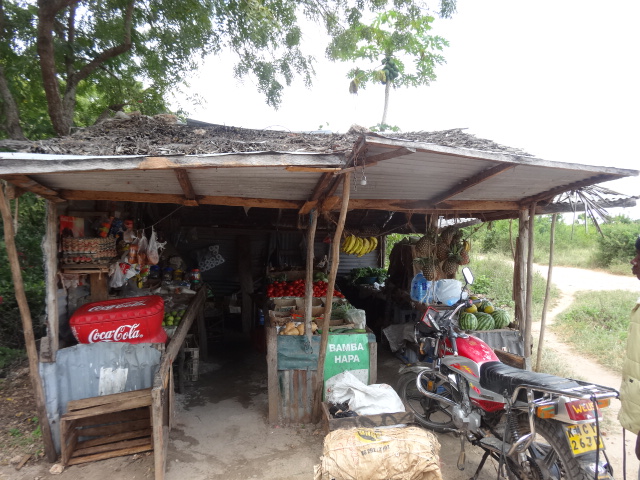
A vegetable stand was a short walk from our home in Diani Beach, Kenya, in 2013. The produce was delivered by motorcycle each day! Notice the motorcycle.

Note; Yesterday, in my haste to get the post uploaded, I accidentally included the historical post’s photos from September 9, 2013. Subsequently, due to my error, I am adding photos today from our post from September 8, 2013. Tomorrow, I’ll be back on track. Sorry for the confusion. Here’s the link to that post.

Hello, readers/friends! We hope our friends in the USA had a pleasant and safe Labor Day weekend. We thought of you, wishing you were having a great time while maintaining safety measures to avoid contracting COVID-19.

We exited the main guarded gate to our area, to the main road, on a mission to locate the vegetable standwe’dd heard was nearby.

On that topic, India has now moved into the #2 position globally for the most number of cases. Here are the comparative stats as of yesterday’s tally:

These numbers are very discouraging, giving us little hope of being able to leave India anytime soon. Nor, based on the worst-case scenario, would we be inspired to return to the USA to wait this out. We’re a lot better off stuck here in this hotel if avoiding the virus is our priority and, it is, at all costs or inconveniences.

This was Gabriel, the vegetable guy who runs the vegetable stand, a mere two-minute walk after exiting the main gate to our gated community. He said he would order produce for us at any time, arriving the next day, fresh from the fields.

It is possible, soon, that India will top the US numbers. But, everything is relative. The population in the USA is 328 million and India’s 1,353 billion, over four times higher.  It’s no wonder India’s numbers are high. Indian officials are in somewhat panic about their numbers as they keep a close eye on keeping foreigners out of their country who may bring in more cases. I don’t blame them.

I’m experiencing here in the hotel with limited protein sources yesterday’s post discussing the food issue. Last night, I ordered the following:

  1. Two small chicken breasts (I prefer dark meat for it added fat and taste)
  2. Two hard-boiled eggs
  3. A small dish with plain yellow mustard for dipping the dry chicken
  4. A small plate of cheese
Without pesticides and chemicals, the produce can wilt quickly and may be infested with bugs. These tomatoes had just arrived, actually looking quite good. Notice the molding cauliflower and the brown lettuce. Gabriel told us his fresh deliveries come each day around 11 am by the guy on the motorcycle in this photo.

The chicken breasts were so tough I could hardly cut them with the butter knife and ended up tearing off pieces with my hands to dip into the mustard. The hard-boiled eggs were OK, as was the little plate of cheese I consumed as a dessert. I had asked them to leave out any vegetables since those they served contained high carbohydrate counts, which only added to my current condition of returning pain due to excess carbohydrates.

I don’t think I can eat those chicken breasts one more time. Tonight, I will remind them to leave out the vegetables and if they have any lamb, chicken livers, or dark chicken meat that I could have in place of the chicken breasts. They say they have no dark meat, but I wonder what they’re doing with the rest of the whole chickens they are cooking.

No doubt, they want to please us. They are kind and caring people dedicated to customer service. But, the language barrier makes ordering items not included in their menu difficult for them to understand. I may end up ordering the salmon every night, hoping that eating salmon daily is not a problem due to mercury and other toxins found in the sea. I have no idea if their salmon is wild-caught or farmed.

This batch of vegetables was KES (Kenya Shillings) $150, US $1.72. The more we travel, the more we are amazed by, the lower cost of food in other countries compared to the US.

Under normal circumstances, I only eat fresh-caught fish. Under these circumstances, I can’t be so picky. Hopefully, in months to come, we’ll be living in a location where we can cook our meals after carefully shopping for ingredients. My mouth waters, thinking about a big salad with prawns and avocados. I love celery and haven’t had a morsel in the past eight months since I last prepared a meal in Arizona before leaving for India. The same with beef, pork, and wine. I miss them all. So does Tom (not the wine but his Sprite Zero and Courvoisier with lots of ice).

Of course, we’ll eat chicken when we can cook again. At this point, a chicken” flattie” (a whole chicken cut in such a way to lay flat on the grill) would even be a treat, cooked to perfection on the braai (the grill) in South Africa, along with a fresh green salad with homemade dressing, and sauteed buttered green beans, with garlic and bacon bits.

I need to stop talking and thinking about food and wine. Speaking of drinks with ice, wehaven’tt had any ice in six months.It’ss too much trouble to get it here especially whenit’ss delivered in a teenie, tiny ice bucket with 10 ice cubes.It’ss not worth the bother. Tom keeps his Crystal Lite Iced Tea in the little fridge and drinks it without ice. (We have our ice cube trays but the fridge isn’tt cold enough to freeze the water)

OK, enough whinging. I’m now heading back out for another walk in the shortened corridor with the hotel guests still here. (Oops, more whinging!) I can’t think about any of this now. I’ll think about it tomorrow.

Happy day!

Photo from one year ago today, September 9, 2019:

On Friday, this is the sign we spotted on our way to the property, asking our property owners if they’d recommend purchasing meat at this location. They enthusiastically explained they buy all their meat at Button Butchers in Tredarupp, Cornwall, England, and it was well worth a visit. For more photos, please click here.

Day #169 in lockdown in Mumbai, India hotel…Part 1…A necessary change in diet…

Day #169 in lockdown in Mumbai, India hotel…Part 1…A necessary change in diet…

Although most of the items on the menu at Sails Restaurant at the Almanara Resort in Diani Beach, Kenya, were seafood related, most of which Tom doesn’t enjoy.  He was thrilled to find some options that would be pleasing to his limited palate.

Note; We are seeing more and more readers signing up to receive our new daily posts in their inbox by clicking the link at the top right of our homepage, “SIGN UP TO NEWSLETTER.” As mentioned earlier, we will never use your email address for any purpose other than replying to any inquiry you may make of us directly to our email. This way, you don’t have to search for the link each day and can simply see it in the inbox. Thank you for staying with us during this challenging time, including the transition to the new site and the COVID-19 lockdown.

Today’s photos are from the post on this date in 2013, while living for three months in Diani Beach, Kenya. Please click here for the full post from that date.

For me, the menu was purely delightful. It was difficult to decide when every option was suitable for me.

On to today’s story..

For those of you who’ve been following us from the beginning of our world travels, you may be aware that a factor contributing to our decision to travel the world came about when after years of suffering with full-body severe inflammation, due to heredity, I began an extremely low carb, grain-free, starch-free, sugar-free diet, now often referred to as the Keto diet.

The Keto diet consists of very low carbohydrate intake, no more than 20 grams per day, excludes all wheat, grains, starches, fruits and sugar with a moderate amount of protein and high amount of healthy fats only (as per the Mediterranean diet). What does this leave to eat: grass-fed meats, free-range chicken and eggs, quality hard cheeses, and many non-starchy vegetables.

This photo, from the Almanara Resort’s website is the lounge area adjoining the dining area. Our photo didn’t turn out so well in the dark. This area was empty when we arrived but full by the time we left a few hours later.

My typical meals would include:

  • Protein source: chicken, fish, beef or pork – moderate portions
  • Carbohydrates: a salad with a side of vegetables to include such vegetables as leafy greens, broccoli, cauliflower, spinach (no potatoes, rice, beans, peas winter squash, carrots (too much sugar), small amounts of dairy including cheese and whole cream. Yogurt is to be avoided due to its high sugar content.
  • Fats: Coconut oil, grass-fed butter, high quality olive oil, and fresh avocados. (Vegetable and seed oils are known to be toxic and must be completely avoided.
    These complimentary appetizers presented by the chef were out of the question for me. It was fried seaweed and stuffed puff pastries, all made with flour. However, much to my surprise, Tom ate all of it, finding it very tasty.  I think his limited taste buds “song and dance” is purely psychological when I see him enjoy new items.

Once I began eating this way, beginning in August, 2011, I saw no impact on the level of pain I was experiencing, until three months later when one morning I awoke to being 100% pain free. For the first time in 15 years I had no pain and my life changed exponentially.

Within a few months, with our enthusiasm and hopefulness over my improved ability to move about without pain. I’d worked out for years in hopes of allaying the hereditary factors prevalent in my family, including heart disease, diabetes, obesity and auto-immune diseases. (Working out provided me with endorphins, which relieved the pain for a few hours each day).

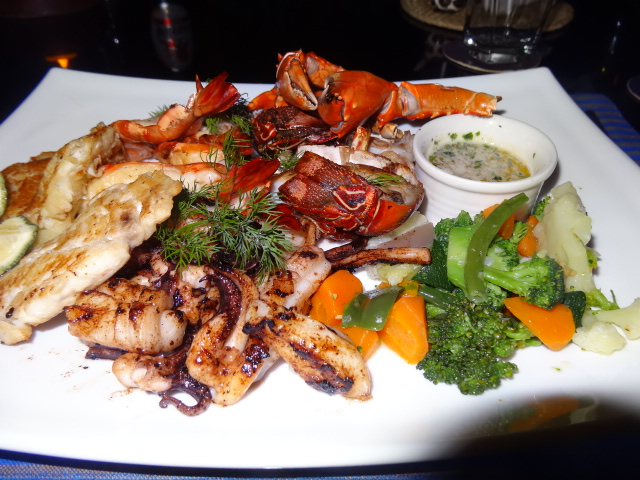
This amazing array of seafood was all grilled and seasoned to perfection. It contained lobster, prawns, octopus, squid, snapper and a few  chewy wormy looking items I didn’t recognize but ate anyway. Need I say that I cleaned this plate as well?

At this point, I should mention for those naysayers, I was told when I had open heart surgery, my diet and exercise may have saved my life. The hereditary cardiovascular disease I am plagued with, had been brewing for 20 or 30 years long before I changed my diet. (I could have had a heart attack at 40 years old instead of cardiac bypass surgery at 71). Prior to that change of diet, I’d stayed on a low-fat, high carb, near vegan, way of eating for most of my adult life in an attempt to avoid diabetes and heart disease. Little did I know…

Both the surgeon and cardiologist that performed the surgery, approved of my low carb way of eating to reduce inflammation and advised me to continue. Not all doctors agree with this way of eating, but  imagine in 10 years, that will all change.

Anyway, I continued my way of eating diligently all of these years of world travel, never experiencing the awful pain from the past. That’s not to say that pain from an injury, a shoulder or knee might not hurt from time to time. They did. But, once the injury resolved, once again, I’d be back to my pain-free way of living, continuing to follow my diet diligently. A few years ago I was able to include a moderate amount of red wine in my diet without incident.

 Tom’s dinner consisted of Fillet Mignon, fries, grilled vegetables. He kept insisting that I try a taste of his steak, finally taking a bite of tender well seasoned meat. He also ate every morsel.

And then, COVID-19 hit and we were struck in this hotel room with a menu and food options that included too many carbs for my way of eating. I decided to see how I’d do eating lots more vegetables and the red sauces associated with curry and Makhani, which included tons of tomato sauce, which is loaded with sugar and extra carbs, although free of any grains.

Night after night, I ate the same meals; either chicken curry, paneer Makhani or chicken Makhani (most recently) all of which are swimming in the tasty, spicy, red sauce along with an over-sized portion of vegetables sauteed in butter. The chicken was fine. The vegetable portion was too large and the amount of carbs I’ve been eating  via the sauces far exceeded the 20 grams a day I was meant to follow.

Over the past few months, keeping in mind, we’ve been eating here for almost 6 months with no avail meat other than chicken and tiny portions of expensive salmon, which I’ve ordered once a week, there was nothing I could do. The pain returned. Walking has become almost unbearable with horrible pain in my arms, legs, shoulders and back.

We borrowed this daylight photo from the resort’s website. It was dark as we were seated at this table. Our photo didn’t do it justice.

I finally accepted the fact that the pain has returned as it had been in 2011 and was due to the food I’ve been eating. This knowledge hit me over the head two days ago. I had to figure out something else to eat or give up dinners entirely. Sitting in this room, between walking each hour, is way too boring to only subsist on an omelet and two thin slices of bacon each morning. And, I couldn’t see how this meager amount of food would be healthful with all this walking I’m struggling to do.

Today, finally, I figured out what to eat for dinner. Tomorrow, I’ll share my newly revised menu. It’s not easy to change anything with the chefs with a distinct language barrier, and their lack of knowledge of micro-nutrients, more commonly understood by chefs in the US and other countries.

Also, last time I started eating this way in 2011, it took a full three months to see any improvement. Hopefully, now, it won’t take so long.

No, I don’t particularly enjoy spewing my health problems over and over again. But, let face it, many of us seniors, (and others) have chronic health conditions that impact our everyday life. Finding solutions is always utmost in our minds. Some of us are fortunate enough to make lifestyle changes that can improve our health.

We’ll be back with “the rest of the story” tomorrow.

Be well.

P.S. A month after we left Kenya on December 1, 2013, this restaurant, Sails, was bombed by terrorists on a Saturday night. We always dined there on Saturday nights.

____________________________________________

Photo from one year ago today, September 8, 2019:

Many towns, villages, and countries throughout the world have these colorful buildings lining the streets in St. Ives, Cornwall, England. For more photos, please click here.
Day #168 in lockdown in Mumbai, India hotel…Labor Day weekend in the US…Please stay safe!…

Day #168 in lockdown in Mumbai, India hotel…Labor Day weekend in the US…Please stay safe!…

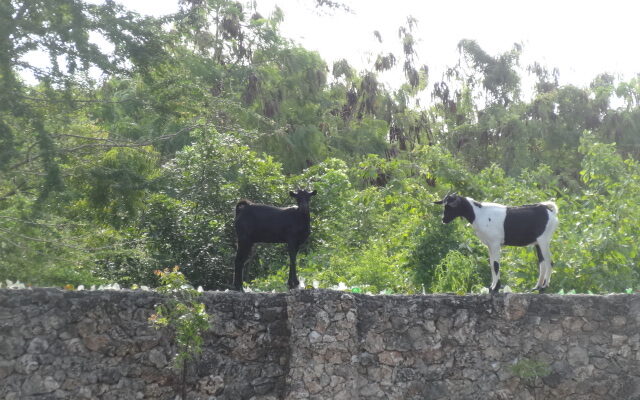
To entertain us in Diani Beach, Kenya, two of the several goats in the backyard jumped up on the stone wall.

Note; We’re seeing more and more readers signing up to receive the daily email in their inbox as opposed to clicking a saved link each day. Please be assured that if you decide to click on “Sign Up to Newsletter” to receive our new daily post, you will not receive any other email from us or our sponsors. We do not offer or sell the list to any sources whatsoever. It takes 24 hours for you to receive the first new post and if you’ve missed reading a few posts, a few more will be included for an easy click.

Today’s photos are from this date in 2013, while living in the village of Diani Beach, Kenya. For more photos, please click here.

The Indian Ocean view from the rooftop. We walked to the desolate beach with the utmost of caution when often, crimes were perpetrated upon tourists.

It’s Monday morning here in Mumbai and the evening of Sunday, September 6th in the US. Americans are in the midst of Labor Day weekend, surely involved in barbecues, parties, and various types of gatherings, often centering around good food, drinks and entertainment of one source or another.

We don’t celebrate most US holidays anymore and haven’t done so for the past eight years since we began our journey (our eight year travel anniversary is upcoming on October 31st). Without family and friends nearby, celebrating such holidays is pointless.

The goats in the rear yard of this property posed for us when Hans‘ two small dogs, Gucci and Jessie, chased them into their goat house.

In South Africa in 2018, we celebrated Thanksgiving in Marloth Park, including several of our friends, a few of which are Americans and traditionally celebrate this popular holiday on the last Thursday in November. Last November, 2019, we celebrated with son Richard in Henderson, the day we arrived in Nevada in the early evening, too late for me to cook the usual turkey dinner. Instead, we dined out.

The kingpin goat nuzzled up to Hans when we entered the gate remembering his early days when Hans fed him with a baby bottle.

Of course, here in lockdown in India, there will be no Labor Day celebration, impossible under these circumstances. We’ll follow our usual routine, dine on our usual (same) meals and go about our day as always. Nothing will be different. And, as it turns out, we may actually still be in this hotel for Thanksgiving, Christmas and New Year’s. We shall see.

The colors of the flowers in the garden were so pleasing to the senses

In regard to today’s photos, these were taken the first few days we spent (of three months) in a thatched-roof limestone house in a gated neighborhood with 18 houses in Diani Beach, Kenya. As mentioned in the post from a few days ago, security was a big concern, but with the owner living next door on shared grounds with tight security we felt fairly safe.

There were some features of the property that we dearly loved, particularly, the goats living in a walled backyard. The wall was constructed of stone and for security reasons the top edge of the wall was covered with broken glass embedded into mortar to discourage humans from climbing over it.

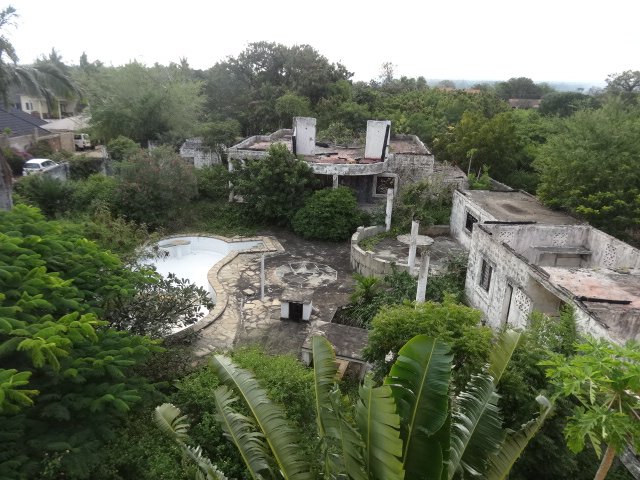
  • In 2009 a fire destroyed 18 homes in this neighborhood, this property next door, yet to be renovated after a new owner took over a few years ago. Hans, a builder, and our landlord wasted no time in rebuilding these two houses.

But, the broken shards of glass, mainly from bottles, didn’t discourage the goats from jumping up on the edge to peer over at us, often on a daily basis. From time to time, we visited them through a secure gate and howled over their antics. Baby goats are hysterical in their jumps and antics and it was delightful to watch them.

Overlooking the stone wall from the goat’s yard. To avoid cutting grass, Hans preferred to go the natural way with the goats grazing on  the grass.  Much to our delight, he didn’t slaughter the goats, as is the practice of many local residents.

The area in which we lived had many monkeys, birds, rodents and insects, but little other wildlife. We saw plenty of farm animals in the streets; cows, sheep, goats, pigs and chickens. So, why did we go to Diani Beach? Our goal was singular…to fly from the local Diani Beach Airport to the Masaii Mara National Reserve in a small plane to land on a dirt runway to spend days on safari while staying at a luxury camp. And that we did. More will follow on that in the days to come as we work our way through these old posts.

View of our house as we basked in the chaise lounges in the hot sun, lasting only 45 minutes due to the close proximity to the equator.

I’d return to Kenya in a minute, but Tom is less so inclined. We’ll see what options are available to us when international flights resume in India. If South Africa’s borders aren’t open, other countries in Africa may be excellent options while we wait for South Africa to open.

Spring is in the air, here in Kenya, seasons being opposite from the US and Europe.  With the close proximity to the equator, the weather is tropical year-round.

That’s it for today folks. Not much is transpiring with the hotel guests that moved onto our floor yesterday. We no longer walk down those corridors and haven’t seen more than a few while walking in the new confined space. Hum… More confinement. Oh well, so it goes.

Photo from one year ago today, September 7, 2019:

The main living area in the house in Tredarupp, Cornwall, England, included a den through the door at the far left end of this open area, which is spacious and comfortable with every possible amenity including Netflix on the new high-quality, high-def TV. The kitchen was beautiful, modern and well-equipped. We loved our time there. For more photos, please click here.
Day #167 in lockdown in Mumbai, India hotel…Lots of commotion around here today…

Day #167 in lockdown in Mumbai, India hotel…Lots of commotion around here today…

The first day we met Nancy, one of the daytime support staff at our guarded gate. She was so sweet, holding my hand the entire time we chatted with her. She kindly took the photo of Tom and me. We love being able to talk to the locals.

Today’s photos are from our first stay in Africa in Diani Beach, Kenya, in 2013. For more photos, please click here.

When I commenced my first walk of the day, I found that a huge section of the corridor was roped off by one of the three elevators (lifts). I walked up to that point, curious as to why it was roped off. It took me seven times up and back from that point to our door to walk ½ the distance I usually walk each hour.

There we were at last,  in Kenya, Africa, hot and sweaty as we embarked on our first walk outside the gated complex, onto the main road, definitely a daytime event only.

Respecting the ropes, I continued back and forth until I completed my first mile (1.6 km) for the day, knowing I had four more such rounds to go to do my usual five miles (8 km). It was more boring than ever. The usual full walk in the corridors is boring enough, returning to our room to await the next hour’s walk.

Thus today, instead of walking non-stop for the entire mile each hour, I’d walk twice an hour for the entire mile, every 30-minutes, setting the timer on my phone as a reminder. This way, I am getting up and moving around more frequently rather than sitting in one position for the hour. Who knows? I might go back to the old way soon enough. But, boredom is dictating that I mix it up as well as increase my hourly mobility.

The dirt road we walked in our gated community.

But, today, the shorter distance made the walk all the more tedious. While walking, a manager dressed in a crisp white shirt, tie, and black suit approached, telling me he’d called our room, but we hadn’t answered. I explained Tom was in the shower while I was out walking.

As we began our walk within the gated complex, we saw and heard many local workers working on the house destroyed by a fire in 2009. Hans, our landlord, told us that insurance companies didn’t pay fair claims for the losses, so many homeowners endured, ultimately paying out of their own pockets for repairs that often took years to complete.

He’d come looking for us to let us know that the area beyond the theater-type red ropes with the brass stands is intended as a marker to prevent us from going further into the corridor. He explained that 20 guests from the outside world, all from various locations in India, would be staying on our floor in the rooms beyond the ropes. All of the hotel’s other floors are booked with guests.

This wall was on our right as we walked along the dirt road within the gated community. Most houses were tucked away behind large stone walls, making it difficult to see the homes in the neighborhood.

As it turns out, these 20 guests will be staying on our floor for five or six nights. I just returned from one of my ten daily walks to see some of those guests arriving, wheeling their bags, all wearing masks. From what I could see from my vantage point, several cleaning staff members were down the corridor, along with several well-masked uniformed sanitization workers carrying stainless steel tanks with sprayers to sanitize the rooms.

A protected entrance to a neighboring home.

Of course, we’ll proceed with caution, but this scenario raises a few concerns, such as how safe will our cleaner be when he arrives to clean our room around 10:40 each morning? And, how safe will our food and room service server be when our food arrives twice a day?

Perhaps, I’m overly cautious, but I keep hearing stories of people we know and family members who’ve exercised the utmost caution and still contracted the virus. We could stay in our room for the next six days and nights, no longer walking the halls, but we haven’t worked this hard to lose some of our stamina from not working out for almost a week.

This statue was in the entryway of the neighboring home.

Also, as of late, I’ve been getting so tired of the dinners, I am considering going to one meal a day, just having breakfast. But, I can’t imagine missing those 30 minutes of dining around 6:00 pm each day. The routine is more important to me than the food. I know I’m eating way too many carbs with the red sauce with my chicken each night. But, without the sauce, the chicken is rubbery and dry.

This massive home was burned out, sold, and yet to be repaired, now almost four years later.

Whew! We sure could go for a big juicy steak on the grill, cooked rare for me and medium rare for Tom. I can’t wait for that first meal, along with a huge salad of fresh greens and other diced vegetables, let alone a glass of dry red wine to savor along with it!  We haven’t had anything but chicken (and occasionally salmon for me) in almost nine months! I haven’t cooked a meal in nearly nine months!

The dense thatched rooftops, typical in Africa, can easily be seen as a fire hazard.
These would never be allowed in the US or many other countries.

I need a salad! (Not safe to eat here!) tonight, I’ll order the salmon, which I do about once a week, but it’s only a tiny portion with cooked vegetables on the side, which doesn’t fill me up.

I wonder what those 20 guests will be eating? The last time they had a group here, a few months ago, they all dined in one of the conference rooms. They were all Indian people, so most likely, they consisted of items we didn’t eat. Tom is still ordering his penne pasta with chicken with a side of roasted potatoes, not a very healthy meal. We’ll worry about that later when once again, we can cook our meals.

Oh, this looks refreshing on the shared property between our holiday rental and the owner’s home. We never used it. We’ll have our private pool in the next house in South Africa, where we’ll be in 3 months.

This article popped up online last night, implying that South Africa may open their borders sooner than we’d thought. Still, that won’t do us any good unless India resumes international flights.

Stay safe and healthy. Please wear a mask and social distance so we all can get out of this predicament!

Photo from one year ago today, September 6, 2019:

This had been our view for the past two weeks in Falmouth, Cornwall, England. This has been an excellent place to stay! For more photos, please click here. (Please excuse incorrect paragraph spacing, which is being resolved).