
The leopard tortoise…
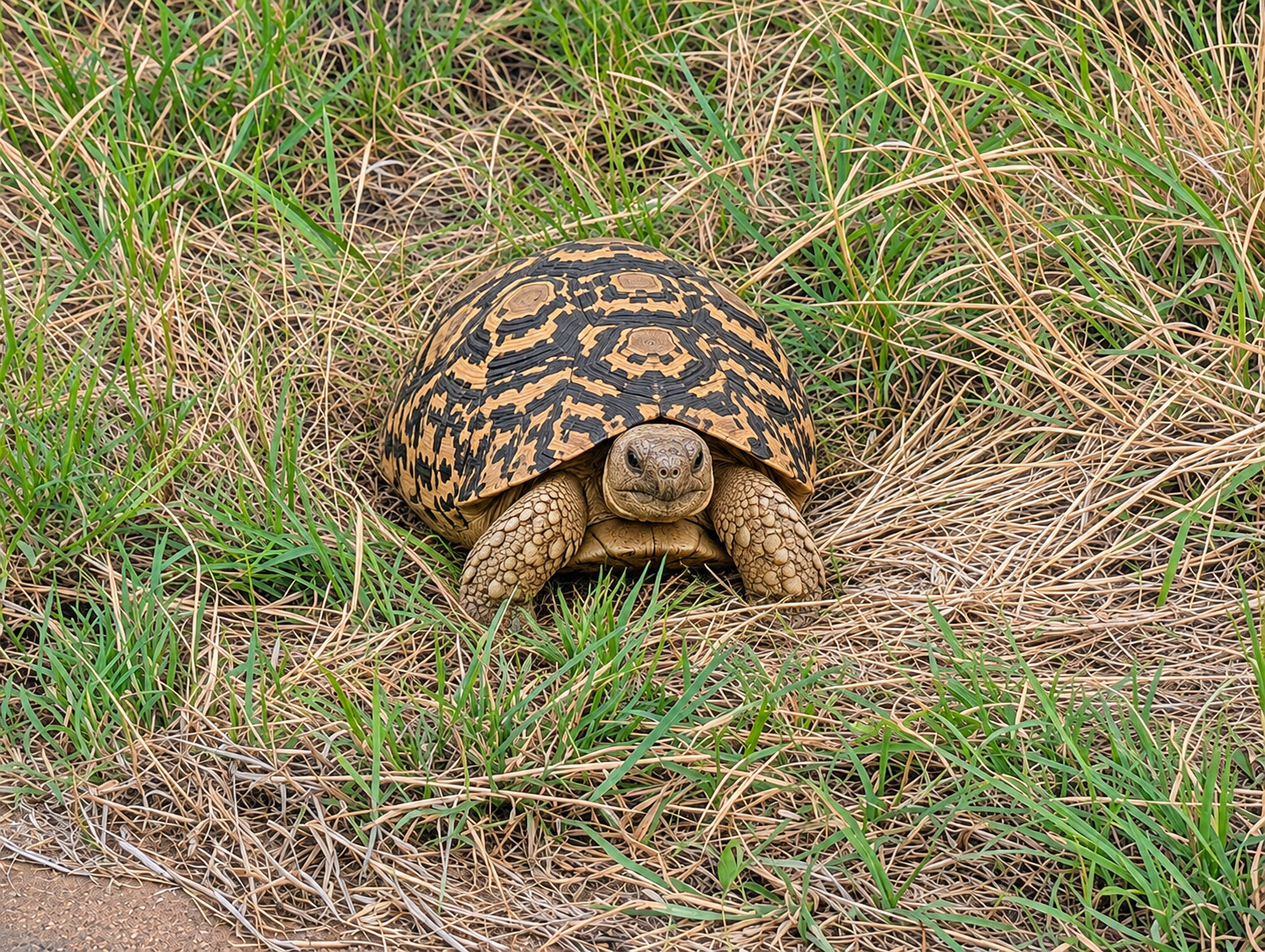
A leopard tortoise (Stigmochelys pardalis), one of the most distinctive tortoise species found in eastern and southern Africa.
Its highly domed shell, with irregular black and golden-brown markings resembling a leopard’s spots, is characteristic of this species. These markings provide excellent camouflage in dry grass and African bushveld, as this photo beautifully demonstrates.
A few interesting facts about leopard tortoises:
-
They are the fourth-largest tortoise species in the world.
-
Adults typically reach 16 to 18 inches (40 to 46 cm) in length, although some grow considerably larger.
-
They can live for 50 to 100 years.
-
They are herbivores, feeding primarily on grasses, succulents, and other vegetation.
-
Unlike many other tortoise species, they generally do not dig their own burrows.
-
They are commonly found in savannas, grasslands, and semi-arid regions throughout eastern and southern Africa.
When we encounter wildlife in Africa, it’s often the larger animals that attract the most attention. But, over the years, we’ve come to appreciate the smaller creatures, many of whom have equally fascinating lifestyles. Such is the case with the leopard tortoise, with its beautifully patterned shell and seemingly endless patience as it makes its way through the bush.
The leopard tortoise is native to eastern and southern Africa and is considered one of the largest tortoise species in the world. Its distinctive black and golden-brown markings resemble those of a leopard, hence its name. Interestingly, these markings often become less pronounced as the tortoise ages.
Imagine spending one’s entire life carrying one’s house around! In some respects, we can relate to this concept, considering our nomadic lifestyle, although we’re certainly grateful we don’t have to carry all our few worldly possessions on our backs.
Leopard tortoises lead predominantly solitary lives, wandering through grasslands, savannas, and the bush in search of food. Their diet consists primarily of grasses, leaves, succulents, and occasionally fallen fruit. Much of their moisture comes from the vegetation they consume, enabling them to survive during periods when water is scarce.
During the hottest part of the day, they often seek shelter beneath bushes or in shaded areas, emerging when temperatures are more comfortable. With a potential lifespan of 50 years or considerably longer, these fascinating creatures may spend decades wandering through the African bush.
Perhaps one of the more interesting aspects of the leopard tortoise’s lifestyle is its mating behavior. For an animal that appears so peaceful and unassuming, the males can be surprisingly aggressive when competing for a female. Rival males may ram one another with their shells, sometimes attempting to overturn their competitors.
During courtship, the male follows the female, nudging and bumping her shell, occasionally biting at her legs. There certainly isn’t much romance in this ritual, at least not by human standards! During mating, the male may make surprisingly loud grunting sounds, quite unexpected from an otherwise relatively quiet creature.
Following mating, the female uses her powerful hind legs to excavate a hole in the ground, where she deposits her eggs. A clutch may contain anywhere from five to 30 eggs, and she may produce several clutches during a breeding season. Once she’s finished laying her eggs, she carefully covers the nest with soil and continues on her way.
Depending on environmental conditions, the eggs may take many months to hatch. The tiny hatchlings emerge entirely on their own, receiving no parental care. Sadly, many fall prey to birds, monitor lizards, mongooses, and other predators before reaching adulthood.
Whenever we see a mature leopard tortoise in the wild, it’s worth considering how many challenges it has overcome to reach that size. Between predators, droughts, bushfires, and human encroachment, its survival is no small accomplishment.
There’s something particularly endearing about watching these creatures slowly navigate their surroundings, seemingly oblivious to the hurried pace of life around them. Perhaps there’s a lesson for us humans in their unhurried existence, reminding us that there’s much to be appreciated along the way, regardless of how long it takes us to reach our destination.
Tonight is Quiz Night and we’re both looking forward to anther fun evening. We’ll be back tomorrow with details on where our team placed.
Be well.
Photo from ten years ago today, November 24, 2016:


About Jess & Tom
We are travel writers, photographers, and slow travelers exploring the world one meaningful experience at a time.
Read More