Part 1…Sightseeing with friends in Vancouver, Washington and Oregon…Happy Mother’s Day to all the moms in the world…

Mount Hood, an active stratovolcano located about 50 miles east of Portland, is Oregon’s highest peak at 11,249 feet. It is a premier year-round destination for skiing, climbing, and hiking, featuring the historic Timberline Lodge and 11 glaciers. The surrounding 1.1-million-acre Mt. Hood National Forest offers extensive outdoor recreation, including popular spots like Trillium Lake.

Yesterday morning began with one of those unexpected moments that add a special layer to our travels, the kind we never could have planned. Janice, one of our longtime readers, joined me for coffee at the hotel restaurant after discovering we would be in Vancouver. There is something uniquely heartwarming about meeting someone who has followed along with our journey across continents, oceans, and countless temporary homes. Sitting together over steaming cups of coffee, we slipped easily into conversation as if we had known one another for years. She shared what she remembered from our stories, certain places we had written about, moments that had stayed with her. Hearing her perspective felt like looking at our own lives through a different lens, one filled with kindness and connection.

After that lovely start to the day, Gerhard and Rita arrived to pick us up, their familiar smiles setting the tone for what would become an unforgettable outing. Having lived in this area for 40 years, they carry a depth of knowledge that no guidebook could ever match. What followed was not just a sightseeing tour, but an intimate introduction to a place they clearly love. Fortunately, it was a perfectly beautiful sunny day!

The beautiful Columbia River.

Our first destination was the breathtaking Columbia River Gorge. No matter how many photos one may have seen, nothing prepares one for the scale and beauty of this natural wonder. The mighty Columbia River carves its way through towering cliffs that rise dramatically on either side, creating a scene that feels almost cinematic. The air itself seemed different there, fresh and alive, carrying the scent of water and evergreens. As we stood at various overlooks overlooking the vast expanse, I found myself quietly reflecting on how places like this remind us of how small we are in the grand scheme of things, yet how fortunate we are to witness such beauty.

From there, we made our way to the iconic Vista House, perched high above the gorge. This elegant structure, built in the early twentieth century, feels both historic and timeless. Its stone exterior and intricate details speak to an era when craftsmanship was an art form. Inside, the circular design and windows offer sweeping views in every direction. Standing there, gazing out over the river far below, it felt as though we had stepped into a postcard. The wind was brisk at that elevation, tugging gently at our clothing, as if reminding us of the powerful forces that shaped this landscape over thousands of years.

Vista House.

As we walked along the overlook, I couldn’t help but notice how the light danced across the water, reflecting the sky in soft shades of blue and gray. There was a sense of calm there, a reminder that not all beauty demands grandeur. Sometimes, it is found in the corners of nature, in the laughter of friends, or in the simple pleasure of being present.

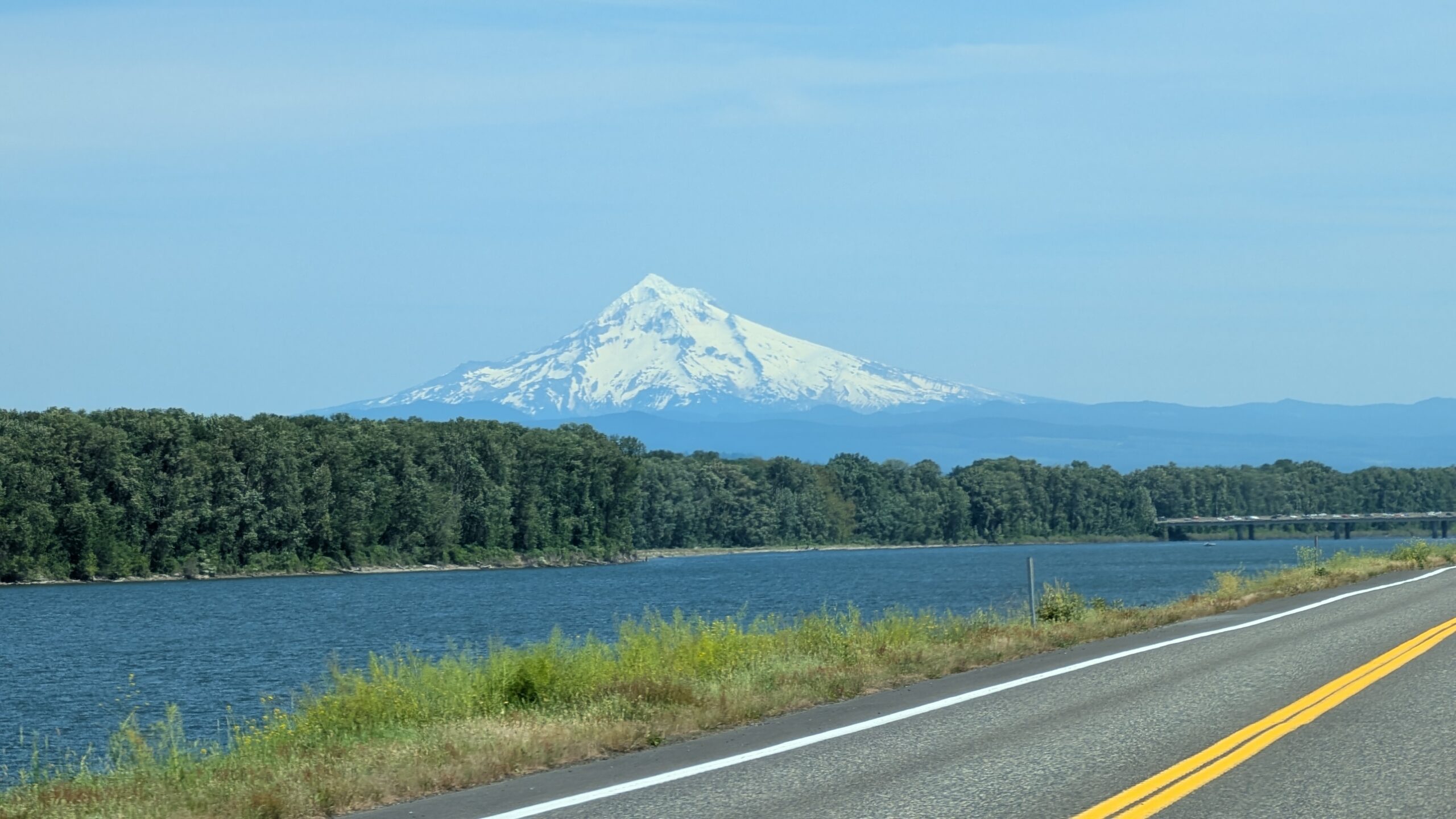
Perhaps the highlight of the day was our drive along the stunning Mount Hood Scenic Byway. This route winds its way through forests, valleys, and open vistas, each turn revealing something new and captivating. Towering evergreens lined the road, their deep green hues contrasting beautifully with the sky above. As we continued, the majestic presence of Mount Hood gradually came into view, its snow-capped peak standing proudly against the horizon.

Distant view of Vista House.

There is something deeply stirring about seeing a mountain of such magnitude. It commands attention without asking for it, simply existing in its quiet strength. We stopped at several points along the way, stepping out to take photos and to take it all in. The air felt cooler there, carrying a crispness that hinted at the elevation. Each stop brought a slightly different perspective, as though the mountain was revealing itself in layers.

This morning, Gerhard thoughtfully sent me the ending scene from the film Wild, featuring the unforgettable Bridge of the Gods. As I watched, I felt an immediate connection to that powerful moment, knowing we had crossed that very bridge during our journey. Seeing it portrayed on screen gave the experience deeper meaning, as if our own travels had intersected with a story of perseverance and self-discovery. It reminded me how certain places carry emotion, memory, and meaning far beyond the moment we first encounter them.

Check out these rock walls!

Throughout the day, Gerhard and Rita shared bits of history, personal stories, and local insights that brought each location to life in a way that no sign or brochure ever could. Their familiarity with the area transformed what might have been a typical tour into something far more meaningful. It felt personal, thoughtful, and filled with genuine enthusiasm.

As the day came to an end and we made our way back, I found myself reflecting on how much we had seen in just a few hours. From the dramatic cliffs of the gorge and the awe-inspiring presence of Mount Hood, it was a day filled with contrasts and discoveries.

More stunning view of the Columbia River.

More than anything, it was a reminder that travel is not only about the places we visit but also about the people we share those experiences with. Yesterday, we were not just visitors passing through. We were guests, guided by dear friends who opened a window into their world, allowing us to see this remarkable region through their eyes.

We ended our day at a lively restaurant, settling in comfortably as conversation flowed with ease. Over a tasty meal, we found ourselves revisiting the day’s highlights, laughing over small moments, and marveling at the beauty we had witnessed. It felt natural to drift into memories of other places we have shared over the years, each story adding another layer to our friendship. There is something deeply comforting about these evenings, when time seems to slow just enough for reflection. Surrounded by dear friends, we celebrated not only the day but also the many extraordinary experiences we have enjoyed together around the world. More will follow in tomorrow’s post. Please check back.

We spotted several waterfalls along the drive.

Today at 3:00 pm, we are heading to Rita and Gerhard’s home for a special Mother’s Day dinner. It means a lot to be invited into their home here in Washington, to meet their two adult kids, and to share laughter, stories, and a home-cooked meal.

Be well.

Photo from ten years ago today, May 10, 2016:

I was in the pool in Bali, waving at Tom when he insisted on a photo. We spend lots of time in the pool, especially on days like today, hot, humid, and with many flies after last night’s heavy rain. For more photos, please click here.

Sleep patterns of wildlife in the bush…

Wildebeests near a water hole in Kruger National Park.

When people visit Kruger National Park, or other African national parks, they often imagine the animals roaming endlessly across the savanna, always on the move, always visible. Yet, much like us, the wild creatures of Kruger have their own rhythms of rest. Sleep in the bush is not about luxury or indulgence. It is about survival, when to let down one’s guard, when to recharge, and when to be hyper-alert. The way animals in Kruger sleep is as varied as their shapes and sizes, each adapted to the demands of predator and prey, day and night.

Lions, for instance…If you’ve ever spent a full day on a game drive, you may have noticed lions doing what they are most famous for: lying around. They can sleep anywhere from 16 to 20 hours a day, sprawled out under a shady knobthorn tree or flopped on a patch of cool sand along a riverbank. For them, conserving energy is essential. Hunting takes tremendous bursts of power, and since they don’t need to forage constantly, they can afford these long naps. Visitors sometimes chuckle at the sight of the “lazy lion,” but there is wisdom in that idleness. Every ounce of strength is stored for the night, when hunting parties set out under the cover of darkness.

In contrast, antelopes such as impala barely dare to rest for long. They snatch short bouts of sleep, often standing up, and rarely for more than a few minutes at a time. Always alert, constantly scanning, they live in a world where slumber could mean becoming a lion’s dinner. Impala may accumulate just a few hours of fragmented rest in 24, relying on the safety of the herd and the advantage of many eyes and ears. There is no luxury of sinking into deep sleep—only a constant balancing act between the need to rest and the need to survive.

Elephant mom and youngster.

Elephants, surprisingly, sleep very little compared to their massive size. They average only about 2 to 4 hours of sleep per day. Most of this happens in the early morning hours, often while standing, though occasionally an elephant will lie down for a deeper stretch of rest. Because they must consume hundreds of pounds of vegetation daily, much of their time is spent walking, browsing, and searching for water. And yet, even in such short windows of rest, elephants are remarkably efficient. Watching a massive bull gently doze, trunk dangling loosely, is a reminder that rest need not be extended to be restorative.

Giraffes take this minimal sleep to another level. Once thought to rarely sleep at all, scientists have discovered they do rest, but usually no more than 30 minutes to 2 hours per day, often in very short intervals. Their awkward height makes lying down risky—they need precious seconds to scramble to their feet if danger approaches. Sometimes, a giraffe will curl its long neck back and rest its head on its body, a sight that seems almost improbable. These fleeting naps are enough to keep them functioning, their survival strategy rooted in vigilance more than comfort.

Zebras share a similar pattern with impalas. They rest standing up, catching light naps throughout the day and night. But when they do lie down for deeper sleep, they rely heavily on the herd. One zebra may doze while another stands guard, an unspoken agreement that safety lies in numbers. It’s humbling to think that such iconic, sturdy animals rarely surrender themselves entirely to rest, their lives a perpetual dance between fatigue and alertness.

Crocodile resting at Sunset Dam.

Predators, in general, can afford longer sleep. Leopards, being solitary and masters of stealth, often rest in the crooks of trees where few can disturb them. They may spend 12 or more hours a day lounging, their spotted coats blending with the dappled light of marula leaves. Hyenas, despite their reputation for chaos, also enjoy a decent amount of rest, though their active social lives and long-distance scavenging keep them more on the move than lions.

And then, there are the smaller creatures of Kruger—bushbabies, mongooses, and genets. These animals often follow nocturnal rhythms, sleeping during the heat of the day and becoming lively when the sun sets. A bushbaby tucked into the hollow of a tree can easily sleep 10 to 12 hours, waiting for the cool evening when insects abound. Sleep, for them, is both a shield against the harsh sun and a preparation for their busy nights.

What ties all these varied sleep habits together is the deep thread of adaptation. In the human world, we often take sleep for granted, imagining it as a nightly necessity and nothing more. But in the wild, sleep is a finely tuned balance between vulnerability and survival. A lion dozing for half the day is no lazier than a giraffe snatching mere minutes. Both are living exactly as evolution has taught them—resting just enough, in just the right way, to keep them alive in a place where danger and beauty coexist so intimately.

As visitors, we sometimes long to see animals in motion, expecting every sighting to be a chase or a dramatic encounter. But in truth, watching them sleep is just as telling. It shows us the quieter side of the bush—the rhythm of nature that pulses beyond the human clock. Sitting in a vehicle, gazing at a pride of lions piled together in the shade, or watching an elephant drift into stillness, we are reminded that rest is not wasted time. It is a strategy, a necessity, and sometimes, a luxury.

Hippos seem to require a lot of rest, often sleeping from 10 to 16 hours a day.

Sleep looks different for each creature, but its purpose is the same: survival. Whether it’s two hours or twenty, light naps or deep slumber, every heartbeat of rest allows the wild to continue its endless story. And perhaps, as travelers, we can take a little wisdom from that, learning to rest in our ways, in our times, without guilt or hurry, simply because it is essential.

Even here in Marloth Park, where predators are few, the instinct of the wildlife is to always be on guard for their safety and sleep no more than that of the animals in the national parks. We often wonder where the animals hide to hunker down at night. However, based on the number of daytime animals we see on the trail cam at night, only mongoose, warthogs, monkeys, baboons, and birds appear to hide away at night to sleep.

Last night, we had another fantastic evening at Jabula, enjoying the ambiance, the food, and the lively banter with Dawn, Leon, Corine, and the multitude of customers that wandered in and out. Tonight, we take our same seats at the bar, which Dawn is saving for us, while the bar fills with sports enthusiasts to watch the South African team, the Springboks, play another exciting game of rugby. They are in first place in the international league.

Be well.

Photo from ten years ago today, August 16, 2015:

In Trinity Beach, Australia, dozens of cockatoos have been swarming the yard over several of the past late afternoons, stopping to check out the pool. For more photos, please click here.