US airlines with the longest customs wait times…

Crowd of travelers standing in line at airport passport control
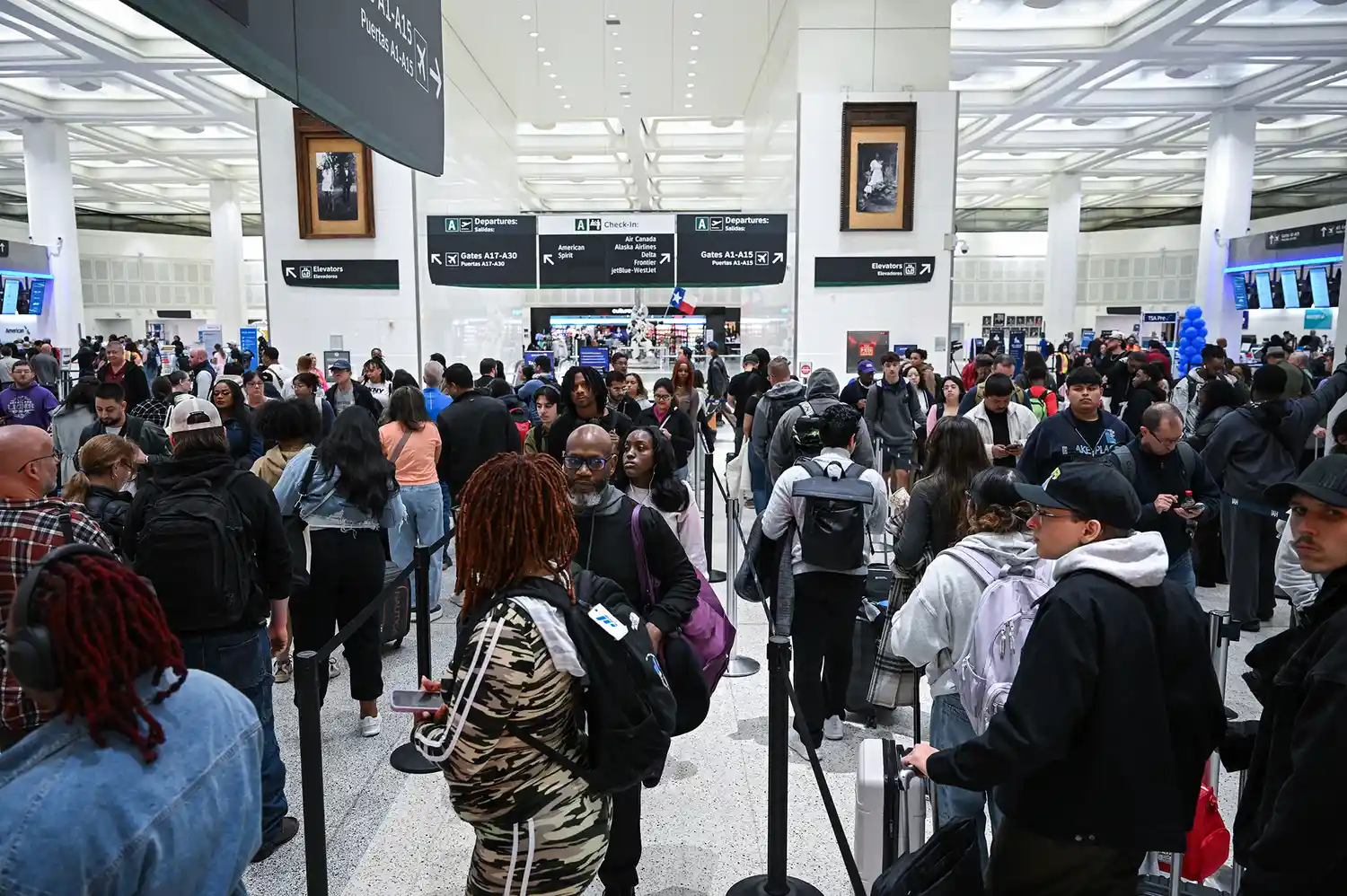
Travelers wait in line at a TSA security checkpoint at George Bush Intercontinental Airport in Houston, Texas, on March 20, 2026. Wait times vary due to flight schedules, making some airports consistently slower than others. Credit: Ronaldo Schemidt/Getty Images

From Travel + Leisure online magazine, found here.

“These US Airports Have the Longest Customs Wait Times Right Now—Some Stretching Over 2 Hours

Landing at an airport after an international flight can be a drawn-out experience, but some airports are worse than others when it comes to lengthy customs wait times.

In analyzing wait times for some of the busiest airports in the country, Travel + Leisure found average Customs and Border Protection (CBP) maximum wait times that often stretched beyond 30 minutes and even extended to over two hours in rare instances. For this report, T+L examined data from the CBP’s Airport Wait Times site over a 28-day period between Feb. 22 and March 22.

As the second-busiest airport in the United States, according to aviation analytics company OAGDallas-Fort Worth International Airport (DFW) had an average maximum wait time of 37 minutes for US citizens and 41 minutes for non-U.S. citizens. On March 17, that even stretched to a whopping 185 minutes at one point.

The busiest airport in the country, Hartsfield-Jackson Atlanta International Airport (ATL), had lower average maximum wait times of just over 20 minutes for both US citizens and non-U.S. citizens.

Average maximum CBP wait times at New York’s John F. Kennedy International Airport (JFK) regularly reached beyond an hour for both US and non-U.S. citizens. At the same time, Chicago O’Hare International Airport (ORD)—the third busiest airport in the US—had average maximum wait times of about 40 minutes or less, and more than one day in which the maximum wait time exceeded two hours.

On the West Coast, average maximum wait times at Los Angeles International Airport (LAX) reached up to 51 minutes and regularly exceeded an hour. Fellow California airport San Francisco International Airport (SFO) had slightly lower CBP average maximum wait times of 43 minutes or less.

CBP monitors wait times at the busiest international airports around the country, but noted: “flight arrival patterns can vary considerably by time of year and day of week, as well as by time of day.”

To help get through customers faster, travelers have several time-saving tools at their disposal. Signing up for the trusted traveler program Global Entry can mean shorter lines thanks to an expedited kiosk process. The program costs $120 to apply and, if approved, is valid for five years.

Another option is the Mobile Passport Control app, a free program available at most major U.S. airports that passengers can fill out up to four hours before landing. With that, groups up to 12 can be processed together.”

TSA issues at US airports…Please allow extra time when arriving for flights….

The issues at US airports in TSA queues are staggering.

There was a time, not so long ago, when passing through airport security in the United States felt like a predictable inconvenience. You took off your shoes, placed your liquids in a clear plastic bag, shuffled forward with quiet patience, and within a reasonable span of time, you were through. It wasn’t pleasant, but it was known. These days, that sense of predictability has slipped away.

Right now, the experience of going through TSA at US airports feels less like a routine step in a journey and more like a gamble.

The core of the issue comes down to staffing. The Transportation Security Administration is operating under significant strain, with tens of thousands of officers working without pay due to an ongoing funding lapse. That alone creates a quiet but powerful ripple effect. People still show up, still put on their uniforms, still stand at the scanners, but the emotional weight of that reality lingers in the background.

And not everyone is showing up.

Absenteeism has climbed noticeably, with some airports reporting large portions of their screening staff calling out. Others have left their jobs altogether, choosing financial stability over uncertainty. It’s not hard to understand. When your role is essential, but your paycheck is not guaranteed, something begins to fracture.

For travelers, that fracture shows up as lines.

Long ones.

Unpredictable ones.

The kind where you arrive early, thinking you’ve given yourself plenty of time, only to find a slow-moving queue snaking through the terminal. In some airports, wait times stretch to three hours or more. In others, they can exceed four hours on particularly difficult days. And then, almost strangely, at a different airport or even a different terminal, you might walk straight through in under ten minutes.

That inconsistency is what unsettles people the most.

There is no longer a reliable baseline.

Airports like those in Houston, Atlanta, and New Orleans have been hit especially hard, with travelers missing flights not because of weather or mechanical delays, but because they couldn’t get through security in time. Imagine standing in line, watching the minutes tick by, knowing your plane is boarding without you, and there is nothing you can do to move faster.

It changes the emotional tone of travel.

Instead of anticipation, there is diligent calculation.

Instead of excitement, there is a quiet anxiety that begins the moment you leave for the airport. People are now being advised to arrive three, four, or even five hours before their flights. That kind of buffer reshapes the entire day, turning what used to be a simple departure into something that requires strategy and endurance.

There are also subtle operational changes happening behind the scenes. Fewer screening lanes are open. Some airports have stopped providing accurate wait-time estimates because conditions shift too quickly to measure. Even seasoned travelers, the ones who pride themselves on efficiency and timing, are finding themselves caught off guard.

And then there is the human side of it all.

TSA officers, often the quiet background figures in the travel experience, are now at its center. Many are under financial strain, working long hours without a paycheck. Travelers, sensing this, sometimes respond with empathy, sometimes with frustration, depending on how their own journey is going that day.

It creates a strange, shared tension in those security lines. Everyone is waiting. Everyone is affected. No one quite knows how long it will take.

What makes this time particularly challenging is that it’s happening during a busy travel period. Spring break crowds are filling airports, adding to the volume on a system already stretched thin. Under normal circumstances, that surge would be manageable. Now, it feels like too much weight on an already fragile system.

And yet, travel continues.

Planes still take off. People still arrive at their destinations. Vacations begin, reunions happen, and business trips move forward. But the journey to get there has become heavier, less certain, and more emotionally charged than it used to be.

If there’s one thing travelers are learning right now, it’s patience, not by choice, but by necessity.

Standing in those long lines, inching forward, watching the clock, you begin to understand that travel is no longer just about where you’re going. It’s about what it takes to get there, and lately, that first step through security has become the hardest part of all.

For now, we can take a deep breath, knowing we won’t be stepping into that uncertainty just yet. Our next US flight isn’t until June, when we depart from Minneapolis–Saint Paul International Airport for Kruger Mpumalanga International Airport. It feels far enough away to hope that the current challenges will be settled, that the long lines and uneasy waiting will ease back into the familiar. Travel always carries its unknowns, but this time, we’re wishing for a smoother start to that long journey ahead.

Please plan ahead, dear readers, when flying in the US!

Be well.

Photo from ten years ago today, March 25, 2016:

In New Zealand, at the alpaca farm, little Mont Blanc, dirty from days of rain, is still small and fragile. Eventually, he had to be euthanized, which was so sad. For more photos, please click here.