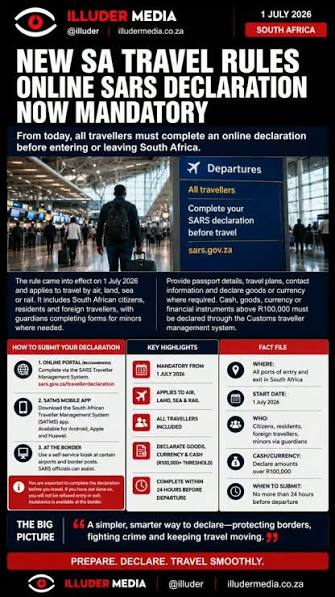
Click this link to access the required entry and departure form for South Africa.
There is something about crossing a border that has always felt quietly ceremonial to us. Whether arriving somewhere new or returning to a place that feels like a second home, there has always been that brief pause, that in-between moment. It was never perfect, of course. Standing in line, juggling passports, searching for a pen that worked, filling out those small paper forms that always seemed slightly outdated. Still, there was something simple about it.
Now, in South Africa, that moment has changed, and not necessarily for the better. As of July 1, 2026, every traveler entering or leaving the country is required to complete an online traveler declaration before they travel. What used to be a quick task handled at the border has now been pushed back into our personal time, becoming yet another thing to remember before a journey even begins.
The system applies to nearly everyone. It does not matter if you are a returning resident, a first-time visitor, or simply crossing a land border for a short trip. Air, land, sea, and rail travelers are all expected to comply. There are very few exceptions. It feels broad, almost overly so, as if no distinction is made between a seasoned traveler carrying little more than a suitcase and someone transporting goods of real concern.
At its core, the form is about declaration. You are asked to list what you are bringing in, what you are taking out, and what you are carrying in terms of goods or currency. On paper, that sounds reasonable. In practice, it introduces a level of overthinking that did not exist before. Suddenly, you find yourself second-guessing what matters, wondering if you have missed something, questioning whether a simple oversight could cause delays later.
Then there is the timing. The declaration must be completed within 24 hours before departure. That might not sound like much, but for those of us who travel often, who are already managing flights, documents, accommodations, and the general unpredictability of movement, it becomes one more obligation layered onto an already full process. It is not difficult, but it is inconvenient, and that difference is felt.
What makes it more frustrating is the shift in where this responsibility now sits. Instead of handling it at the border, where it naturally belongs, we must remember to do it in advance. Forgetting is not an option. There is no friendly reminder handed to you as you wait in line. It is entirely on you, quietly waiting in the background until you either complete it or realize too late that you have not.
The intention behind the system is clear enough. It is meant to modernize the process, to create efficiency, and to allow authorities to understand movement before it happens. In theory, that sounds like progress. But in reality, it feels like a trade-off, where convenience for the system has become an inconvenience for the traveler.
Sitting here now, thinking about the next time we cross a border, I do not picture that familiar scene of filling out a form while waiting our turn. Instead, I imagine opening a laptop or phone, trying to remember login details, double-checking entries, and hoping everything has been submitted correctly. It feels less like a simple step in the journey and more like a small administrative hurdle that cannot be ignored.
There is no doubt that, over time, this will become just another part of travel. We will adapt, as we always do. But that does not mean it will feel any less frustrating. Travel already comes with its fair share of logistics, and this is simply one more layer added to the process.
And perhaps that is what stands out the most. Not that the system exists, but that it takes something that was once quick and contained, and stretches it into something that lingers. Another reminder that even the smallest parts of travel are becoming more structured, more controlled, and just a little less effortless than they used to be.
We never have any customs declarations since we don’t purchase anything significant that would require customs duties while we are in South Africa. Nor do we carry much cash when entering or departing the country. ATMs worldwide provide us wth all the local currency we need.
Be well.
Photo from ten years ago today, July 5, 2016:

