Finally, a wildlife fix in Tamania…Today is our 14th anniversary of posting…
worldwide-admin March 14, 2026 No Comments
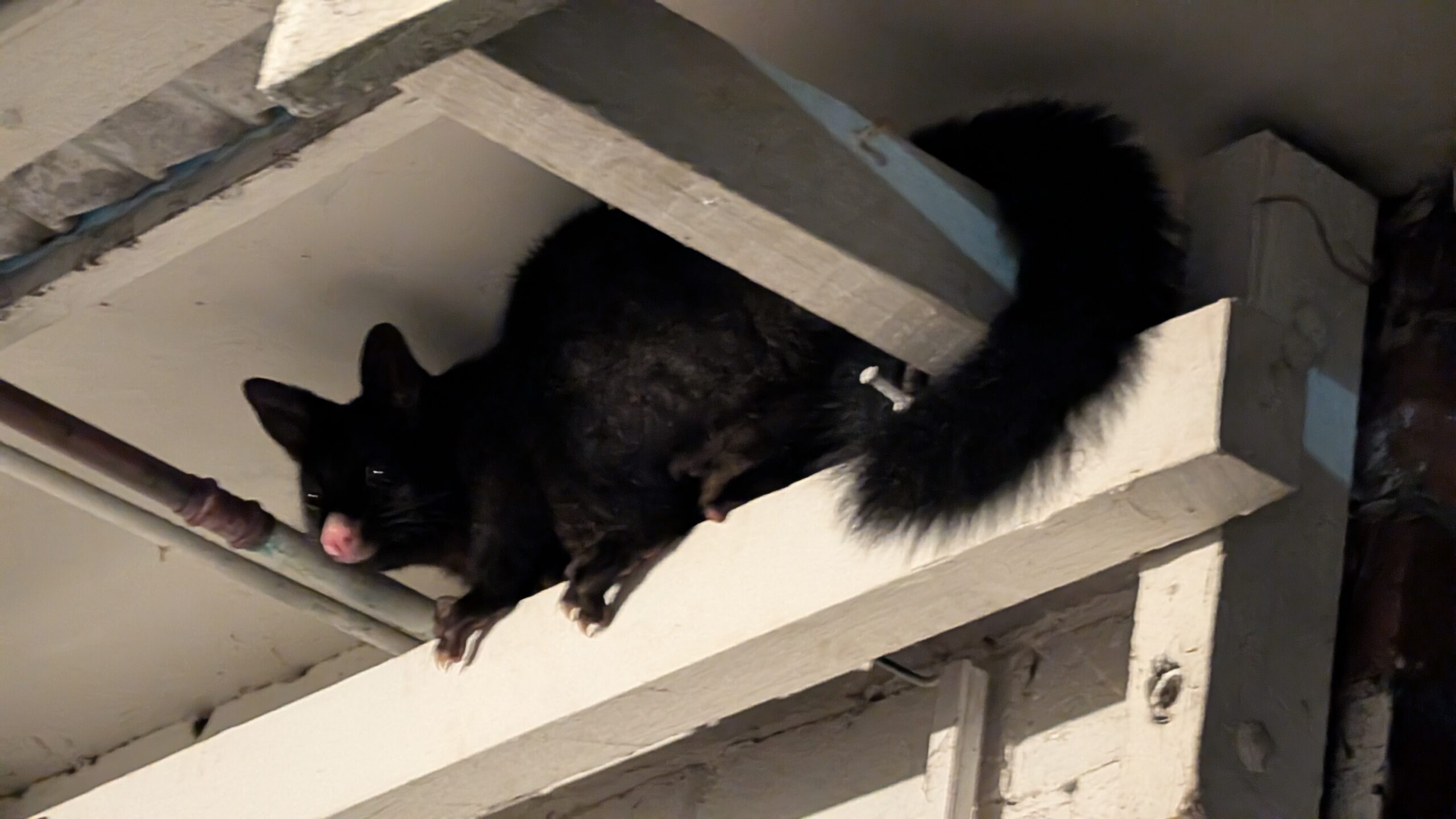
At first, I thought this was a Tasmanian Devil, but I was so wrong. This is a Tasmanian Brushtail Possum that greeted us when we returned from dining out.
When we returned from dinner on Friday evening around 8:30, the night was quiet, as small coastal towns often are after dark. The streets around us were nearly empty, the air cool and still, and the sound of waves from the nearby shoreline drifted through the darkness. As soon as we pulled into the drive and I opened the car door, I heard something scrambling across the roof of the house. The sound was quick and purposeful, the unmistakable scurry of an animal moving across the metal roofing above us.
I froze halfway out of the car and looked up.
Within seconds, I spotted the creature clinging to the eaves of the house. Its body was stretched along the edge of the roofline, its long tail wrapped around a beam, as it paused to observe us below. In the dim outdoor light, I could see its round eyes reflecting toward us, alert and curious.
Tom came around the front of the car and followed my gaze upward.
“Back away carefully,” he said in a calm but serious voice. “If it’s a Tasmanian Devil, it could be dangerous.”
I understood his concern. After all, we are visitors here, still learning which animals are harmless and which ones deserve a little distance. The wild creatures of Tasmania are fascinating but unfamiliar to us, and caution always seems wise.
Still, curiosity got the better of me.
The animal wasn’t moving much now, simply watching us as if we were the unusual ones. I could feel that familiar pull that comes whenever we encounter a new creature, unexpected while traveling. These are the moments that stay with you long after the suitcases are unpacked and the photographs are sorted.
I slowly stepped back just enough to get a clearer view while reaching for my phone.
Tom watched carefully, clearly prepared to remind me again to keep my distance if the animal decided to climb down or come closer. But it stayed right where it was, balanced comfortably along the edge of the roof as though it had spent many evenings there observing the humans below.
I managed to snap a few photos before it shifted slightly and disappeared along the roofline, moving with surprising grace.
Inside the house, still talking and excited about our unexpected visitor, I posted one of the photos on Facebook. Living and traveling abroad has created a wonderful community of people who are always eager to share knowledge, especially when it comes to local wildlife. I suspected someone would quickly identify our mysterious rooftop guest.
Sure enough, the responses began arriving almost immediately.
Several Australians wrote to tell me that the animal in the photo was not a Tasmanian Devil at all. Instead, they explained that it was a Tasmanian Brushtail Possum described as follows:
At first glance, a brushtail possum looks a bit like a cross between a small raccoon and an oversized squirrel. Its body is about the size of a house cat, though the thick fur and full tail make it appear larger, especially when seen unexpectedly in the dark. The possum’s coat is soft and dense, usually a mix of grey, brown, or charcoal tones that blend perfectly with tree bark and rooftops at night.
Its most noticeable feature is the tail. True to its name, the brushtail possum has a long, bushy tail that can be nearly as long as its body. The tail serves as a useful balancing tool when the animal moves along branches, fences, and, apparently, rooftops. When we saw ours, the tail stretched out behind it along the eaves, giving it a silhouette that was both graceful and slightly comical.
The face of the possum is surprisingly expressive. Rounded ears sit upright on its head, while a small pink nose and large dark eyes give it an alert, curious look. Those eyes are especially striking at night. When they catch the light from a porch lamp or flashlight, they reflect brightly, which is exactly what caught my attention when I first looked up toward the roof.
Brushtail possums are marsupials, meaning the females carry their young in a pouch. A tiny baby, called a joey, spends its earliest months tucked safely inside the mother’s pouch before eventually emerging and riding on her back as it grows stronger.
Although they may appear slow or clumsy when you hear them thumping across a roof, they are actually excellent climbers. Strong limbs and sharp claws allow them to scale trees with ease and move confidently through branches high above the ground.
For locals here in Tasmania, the brushtail possum is simply part of everyday life. For us, seeing one staring down at us from the roof felt like a small introduction to the wildlife that quietly shares the neighborhood once the sun goes down. As it turns out, these possums are quite common throughout Tasmania and much of Australia. They are nocturnal creatures, which explains why our encounter happened well after sunset. During the day, they typically sleep in hollow trees, roof spaces, or other sheltered spots, emerging at night to forage. Their diet includes leaves, fruits, flowers, and occasionally small insects.
Apparently, rooftops are one of their favorite nighttime highways. The more I learned, the more the experience made sense. The quick footsteps across the roof, the calm confidence with which the animal perched along the eaves, and its curious stare down at us all fit the description perfectly. What began as a slightly startling moment in the driveway turned into yet another small but memorable encounter with the wildlife that makes Tasmania so unique.
Travel has taught us that sometimes the most interesting sightings happen when you are simply returning home from dinner and opening the car door. You never quite know who might be waiting on the roof. As mentioned in today’s heading, today is the 14-year anniversary of posting. More on that tomorrow.
Be well.
Photo from ten years ago today, March 15, 2016:
These unusual New Zealand mushrooms appear translucent. For more photos, please click here.
Websites store cookies to enhance functionality and personalise your experience. You can manage your preferences, but blocking some cookies may impact site performance and services.
Essential cookies enable basic functions and are necessary for the proper function of the website.
Name
Description
Duration
Cookie Preferences
This cookie is used to store the user's cookie consent preferences.