Day 24…Transpacific Cruise…One day and counting…Port of Victoria, British Columbia…

Little pansy faces.

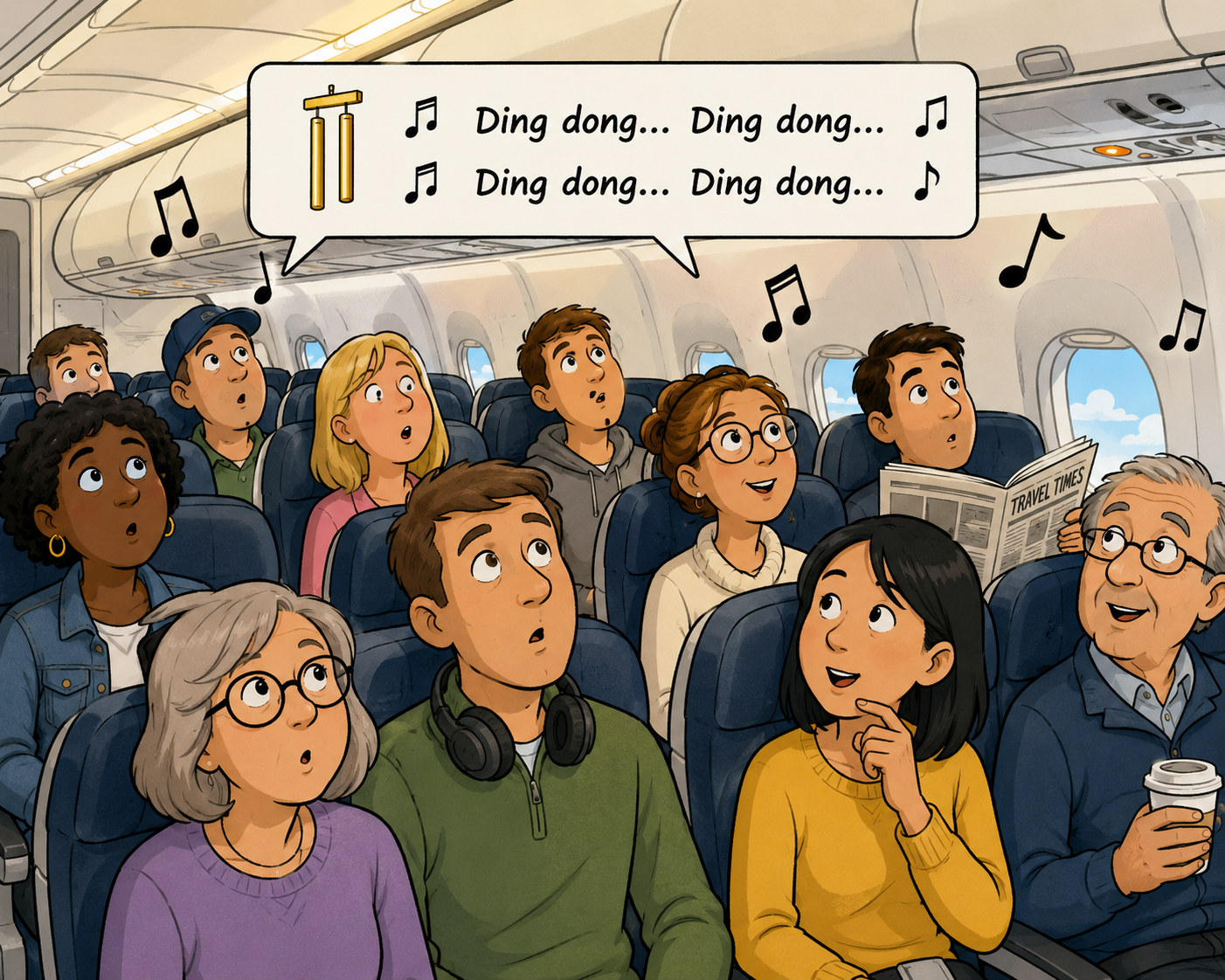
Day 23…Transpacific Cruise…Two days and counting until disembarkation…What are the chimes we hear udring flights?…

From Travel + Leisure online magazine, found here.

“Those Beeps You Hear on a Flight Actually Mean Something—Here’s What Airplane Chimes Signal

A pilot weighs in on what one, two, and three chimes mean on a plane. By Lydia Mansel Published on May 4, 2026

The more often you fly, the more the entire process starts to feel routine. It becomes second nature to scan your boarding pass, settle into your row, buckle your seatbelt, and zone out—whether that means getting some work done or listening to your music—until it’s time to deplane. But if you take a moment to actually look at (and listen to) what’s going on around you, you may start to notice the subtle details that ensure your entire in-air experience runs seamlessly. One of those details is the beeps, or chimes, you hear during a flight.

To the untrained ear, these chimes are easy to ignore; they don’t register as anything urgent or noteworthy. And that’s precisely the point—they aren’t intended for passengers. “These sounds are meant for the flight crew (pilots and flight attendants) in order to keep everyone informed [and] standardize the flying experience, and [they] are standard operating procedures,” says Kolin Jones, a pilot and the founder and CEO of the private aviation company Amalfi Jets.

You’ll likely hear a few different versions of the dings or chimes. “Individual dings while at cruising altitude are the noises of another passenger ringing their flight attendant call button,” says Jones. They may be in need of a drink, assistance with their entertainment system, or something else that requires direct interaction with the crew.

Now what if you hear two chimes? “The double chimes you hear… indicate to the cabin crew that the aircraft is passing through 10,000 feet, which is usually when they will start to prepare the cabin for service, and enable passengers to get up and walk around,” says Jones. At the same time, you might also hear an announcement that you’re now able to use your electronic devices.

There may also come a time when you hear three chimes, although this tends to be rare. “Hearing three chimes is ‘priority communication,’ so usually the flight deck is calling the flight attendants with an urgent message or an emergency situation,” says Jones. Still, as a passenger, it’s important to remain calm and stay in your seat. If there is anything that needs to be communicated to you and your fellow passengers following the three chimes, the air crew will make an announcement.

While Jones says these sounds are “usually standard across all airlines/aircraft (commercially),” they can “vary per each individual airline’s standard operating procedures (SOPs).”

Continuing on…In just forty eight hours, this chapter of our sea journey to the US will come to a close. It’s hard to believe how quickly the days at sea have slipped through our fingers, each one filled with new faces, routines, and the comfort of life afloat. Soon, we’ll disembark, stepping off the ship with our luggage in hand and hearts full of memories we didn’t even know we were collecting.

Waiting for us will be our dear friends Rita and Gerhard, whose familiar smiles will mark the beginning of our next adventure. There’s something deeply comforting about being greeted by people who know you well, especially after weeks surrounded by strangers who, in their own way, became part of the story too.

The drive to Vancouver, Washington will feel like a transition between worlds. From the vast openness of the ocean to the beauty of the Pacific Northwest, it’s a shift we welcome with curiosity and gratitude. Four nights there lie ahead, offering us time to settle, reflect, and simply be before we begin our next journey across the northern states of the US, on our way to Minnesota.

As always, we move forward with open hearts, never quite knowing what each new place will bring, but trusting it will be exactly as expected.

Be well.

Photo from ten years ago today, May 6, 2016:

In Bali, a Hindu temple on the road into town. For more photos, please click here.

Day 22…Transpacific Cruise…Three days and counting…How to Save in Summer Travel Amid Jet Fuel Price Increases

From Travel + Leisure online magazine here.

“We Asked 5 Pros How to Save on Summer Travel Amid Jet Fuel Increases—These Are Their 6 Tips

With airfare up as much as 20 percent, flexibility and smart booking strategies can help cut costs. By Alison Fox, published on April 28, 2026

Summer travel is heating up, but rising fuel prices threaten to put a damper on warm-weather getaways. The ongoing war in Iran and closure of the Strait of Hormuz has forced airlines to cancel flights and fuel prices to soar. In fact, jet fuel prices have more than doubled over the last year, according to the airline trade group Airlines for America, and AAA noted that pump prices are the highest they’ve been at this time of year since 2022.

Flight prices are also up as a result: summer domestic airfare has increased by 10 to 15 percent, and prices for European trips from the United States are up by around 20 percent, according to data from Dollar Flight Club shared with Travel + Leisure.

But that doesn’t mean a dream summer vacation is out of the question. It just means American travelers have to be a bit more creative. “The core message for travelers is flexibility has never been more valuable,” Jesse Neugarten, the founder of Dollar Flight Club, told T+L. “In a normal year, being flexible with your dates and destinations can save 10 to 20 percent. But in this market, it has really escalated. If you can do that, there’s a ton of value still to be found.”

T+L tapped experts from across the travel industry to ask how to save money and navigate summer travel this year. These are their best tips.

Be flexible.
Flexibility is the keyword for summer: flexible with dates, destinations, and airports travelers fly in and out of. “Destination flexibility is the biggest lever, date flexibility is next, and airport flexibility comes in third,” Neugarten said. Considering alternative airports when booking may also translate to big savings, he added.

That could mean flying out of Philadelphia instead of one of the major New York City airports, for example, or choosing John Wayne Airport (SNA) in California instead of Los Angeles International Airport (LAX). Think about the Caribbean, Mexico, and staying closer to home.

to places like Europe may be experiencing unusually high price increases, but some destinations have more price stability.“If you’re just looking to go away and you haven’t made any plans, the predictably affordable places are going to be your best bet: the Southeast, the Caribbean, and coastal Mexico. We’re still seeing a healthy amount of cheap flights,” said Katy Nastro, a travel expert for Going. “It is further down the list for travelers because these areas tend to be really hot in the summer, really humid, and there is the threat of worse weather and hurricanes.”

Neugarten said prices on these routes may be holding because they tend to be shorter, burn less fuel, and have a lot of competition from low-cost carriers.

Don’t wait to book.
It’s always tempting to wait and see if flight prices go down, but experts say this is not the time to play that game. In fact, they said prices will likely just keep rising.

However, there is often a way to recoup money if prices do drop—as long as you don’t book basic economy, Nastro said. That is because many major U.S. airlines eliminated change fees for non-basic economy tickets.

“I would highly recommend booking that main economy ticket even if it’s going to take a bigger bite out of your wallet,” she said. “That main economy ticket is going to allow you if you have to make any changes and to take advantage of price drops. This year, any savings are major savings.”Set price alerts.

The only way to take advantage of price drops is to know when they happen. And setting price alerts on sites like Google Flights or Skyscanner is a sure way to do that.

But they can also be used to help plan a trip, said James Byers, a group product manager at Google Search.

“If your heart is set on a specific destination, but you’re flexible about when you fly, you can use price tracking for ‘Any dates’ and get an email about price drops for flights departing in the next three to six months,” Byers said.

Be strategic about road trips
Like jet fuel, gas prices have also been affected by global events. However, Nastro said the price at the pump is “more reactive to the market” and could “come down more suddenly than jet fuel.”

Travelers opting to stay closer to home and rent a car may want to start their trip earlier in the week, as this can lead to greater availability and lower rates, said Adnan Manzur, the senior vice president for North America customer operations at Hertz. Thursdays and Fridays are typically the busiest days for renting a car at an airport.

“Being a smart traveler isn’t about cutting corners, it’s about making a few thoughtful choices that save time and money upfront so you’re not paying a premium for it later,” Manzur said. “Travelers today are looking for experiences that feel seamless and are a good value. A little foresight … can stretch a travel budget much further.”Be prepared for changes

Airlines may be cutting flights, but experts said they tend to focus on less-profitable routes, off-peak times, routes with multiple daily flights, and smaller markets. In the U.S., Nastro said carriers are “making cuts at the margins.”

“They’re looking at where they make razor cuts,” she said. “I’m sure airlines are hedging their bets. It’s easier for them to add flights back… and they’re trying to be as cautious, but as surgical as possible.”

But in Europe, Nastro added, this could make hopping between countries by plane more difficult. Instead, she recommended travelers use trains or “keep your trip centralized, sticking to one country, sticking to destinations that don’t rely on short-haul flights.”Investing in travel insurance can also help with uncertainty. And travelers are taking advantage: last year, Berkshire Hathaway Travel Protection reported a 12 percent increase in total policies purchased. And they’ve seen a 7 percent increase in the first quarter of this year.

“Our position is always safety and security while traveling,” said Carol Mueller, a VP at Berkshire Hathaway Travel Protection. “And we want to make sure, no matter where people choose to go and what their budget is, that they feel comfortable and can find the right travel insurance for that type of trip.”

In a mere three days, we will step off the ship once again, trading the gentle sway of the sea for the steady ground beneath our feet. There is always something bittersweet about that moment. This floating world that has carried us across miles of ocean becomes a memory almost overnight. Yet, waiting for us at the port will be something just as meaningful, the warm smiles of our dear friends Rita and Gerhard.

The thought of that 2.5-hour drive together feels like a continuation of the journey rather than an end. Conversation, laughter, and familiar connection will fill the space between destinations. Our four nights in Vancouver, Washington, will offer a chance to settle, to breathe, and to spend time with our dear friends.

Then, onward again to Minnesota, with hopes of passing through Yellowstone National Park, where nature reminds us how small and fortunate we truly are.

Be well.

Photo from ten years ago today, May 5, 2016:

Two teenage boys walked this young white horse down the beach to play in the river next to our holiday house in Bali. He seemed to love cooling off in the water. For more photos, please click here.

Day 21…Transpacific Cruise…Horror at sea…

Illness at sea can be life-threatening, as explained in today’s story.

As we travel the world, often aboard ships that become small floating communities, it’s easy to forget how fragile that sense of safety can be. A few days ago, somewhere far out in the vast Atlantic Ocean, that illusion was quietly broken aboard the MV Hondius, where three lives were lost to a rare and unsettling illness.

The virus, known as Hantavirus, is not something most travelers ever think about. It isn’t spread through casual contact or shared meals, but rather through exposure to infected rodent droppings or urine. Even so, in the confined and interconnected world of a cruise ship, its presence felt deeply unsettling.

The three individuals who died were not just passengers on a voyage. They were people, each with their own stories, plans, and loved ones waiting somewhere across the globe.

Among them was an elderly Dutch man, believed to be one of the first to fall ill. His symptoms began quietly, like so many illnesses do at sea, perhaps mistaken at first for fatigue or a passing bug. But his condition worsened quickly, and he died during the journey, far from home.

Not long after, his wife also became ill. One can only imagine the fear she must have felt, not only battling her own symptoms but grieving her husband at the same time. She was evacuated to a hospital in South Africa, where she later passed away. Their shared journey, which likely began with excitement and anticipation, ended in a way no one could have foreseen.

The third victim was another older passenger, identified in reports as either British or German, depending on early or updated accounts as authorities worked to confirm identities. He too succumbed to the illness after developing severe symptoms, part of a cluster of cases that left others on board sick, and one person fighting for life in intensive care.

There is something especially sobering about loss at sea. On land, tragedy is grounded. There are familiar places, routines, and support systems. But on a ship, surrounded by endless water, everything feels both closer and more distant at once. News travels quickly, yet answers come slowly.

Health officials, including the World Health Organization, have been careful to point out that this virus is rare and not easily spread from person to person. In fact, only one confirmed case has been verified so far, with several others still under investigation.

Even so, the emotional impact ripples far beyond those directly affected. Fellow passengers, likely strangers just days before, now share a bond shaped by uncertainty and concern. Conversations shift. Awareness sharpens. Every cough, every moment of fatigue carries a different weight.

As travelers, we often embrace the unknown with a sense of adventure. But moments like this remind us that the unknown carries many forms. Some are breathtaking. Others are humbling, even frightening.

And yet, life aboard continues. Meals are served. The ocean stretches on. People gather, talk softly, and try to make sense of something that feels both distant and deeply personal.

In the end, these three individuals were more than headlines. They were part of a fleeting community at sea, one that changed forever in the span of a few days. And as the ship moves forward, as all journeys do, their stories travel with it.

May we all be well.

Photo from ten years ago today, May 4, 2016:

Gede, our houseman in Bali, stopped at the side of the road when he spotted this monkey and baby. We had no idea we’d see much wildlife there. Of course, we were thrilled! For more photos, please click here.

Day 20…Transpacific Cruise…Sea day…The world’s best cities for living to 100…

We are still unable to post new photos while out to sea.

from this site:

“These Are the World’s 10 Best Cities for Living to 100, Study Finds—and No. 1 Ranks for Quality of Life

Researchers analyzed quality-of-life, environmental, and health metrics to rank global longevity hotspots. By Kristine Hansen, Published on April 28, 2026

There’s a lot of talk these days about longevity with spas and wellness retreats rising in popularity. But some destinations are more deeply tied to the principles of living a long and healthy life than others.

The Norwegian city of Bergen rose to the top as the place where people have the best chance of living to 100, according to a new study by World Depopulation, a global demographics analytics tool. The community, which hugs Norway’s southwestern coast, received the study’s highest longevity score thanks to its top environmental conditions and quality of life (ranked 4th worldwide). The national life expectancy in Bergen was 83.76 years, according to the study, with low national smoking rates.

The Australian city of Canberra ranked No. 2 globally in quality of life, with a national life expectancy of 84.34 years.

That was followed by Nantes, France, in third place, with fellow French city Grenoble in the fourth overall spot (and No. 1 for global quality of life). France had a national life expectancy of 83.7 years, according to the study.

In the United States, the highest-ranked city was San Jose, California, at No. 36 overall. Part of the San Francisco Bay Area, San Jose ranked relatively high in environmental factors at 53. Still, he was hampered by high nationwide obesity rates of 42.74 percent and a nationwide life expectancy of 79.76 years.

“One thing that didn’t surprise us at all was how poorly American cities performed,” a longevity researcher from World Depopulation said in a statement shared with Travel + Leisure. “The problem is the broader national context. Americans have a 42 percent obesity rate and a much shorter life expectancy than Europeans or Australians. Even if you live in the healthiest American city, you’re still part of a food culture and healthcare system that makes going past 80 and 90 much harder than it would be in Europe.”

To compile its list, World Depopulation examined 100 cities worldwide, using a predetermined list from Oxford Economics’ Global Cities Index. The study examined each city’s rankings in quality of life and environmental conditions, life expectancy, smoking rates, obesity levels, food quality and safety standards, and physical inactivity among adults over the age of 70.

This is the full list of the top 10 cities ranked for longevity, according to World Population.

  1. Bergen, Norway
  2. Canberra, Australia
  3. Nantes, France
  4. Grenoble, France
  5. Bern, Switzerland
  6. Reykjavik, Iceland
  7. Lausanne, Switzerland
  8. Zurich, Switzerland
  9. Basel, Switzerland
  10. Quebec City, Canada”

As we continue wandering from one corner of the world to another, we often find ourselves asking, where will we land when the journey slows? It is a curious thought, one without urgency, yet it lingers in the background of our days. We have no clear answer, no place calling us home just yet. Perhaps it will be somewhere with fresh air, gentle weather, and a sense of peace that settles deep within us. Until then, we move forward, grateful for each new horizon, trusting that when the time comes, the right place will somehow find us.

Be well.

Photo from ten years ago today, May 3, 2016:

Reclining Buddha. 80% of Bali’s population is Hindu. This restful pose reminds us of the pace here: calm, relaxed, and stress-free. For more photos, please click here.

Day 19…Transpacific cruise…Out to sea…Repost from ten years ago today…

Note: Today’s story is a report from ten years ago today that we thought might be enjoyable for our readers who may not have seen it then.

Our new home in Bali…The story begins to unfold…Many more photos to come…

The Buddha statue by the pool is a fountain that runs continually.

In the dark, at the culmination of the harrowing four-hour drive, our driver made the ascent down a narrow single-lane road toward the sea. The road was so narrow that he had to get out to ask a neighbor to move a vehicle to allow us access.

As soon as we exited the van, both Ketuts greeted us with this tray with ice-cold washcloths, fresh flowers, a lit candle, and two glasses of sweet tea.

Moments later, he pulled up to the house, lights illuminating an exquisite scene, and for the next two months, we were home. With a sense of trepidation, I exited the car, legs cramped from sitting for so long, took a deep breath, and smelled the fresh ocean air as relief washed over me.

Greeted by two lovely Balinese women, coincidentally, both named Ketut, one held a tray with fresh flowers, ice-cold washcloths, and two wine glasses filled with sweet tea. Sadly, I declined the sweet tea but instead requested water. The spring water is safe to drink here.

The infinity pool is more beautiful than we imagined, the surface like glass, clear and cleaned daily.

During the four-hour drive, we never stopped for water or a bathroom break, both of which were of immediate concern to me, although I graciously held back to allow them their usual ritual of showing off the house.

We’ll continue to have our coffee here on these chaise lounges each morning.

Our house man, Gede, (sounds like ga-day, the popular Australian greeting over which we all giggled when he explained) wanted to ensure we had a full tour including the opportunity to decide which of the two floors we preferred for our primary living quarters. There were four bedrooms to choose from, two on each level.

It wasn’t the easiest decision, even after we narrowed it down to two of the four, each with ocean views, all with en suite bathrooms. The only question, when the upstairs was slightly more appealing than the main level, was, “Did we want to manage the oversized risers for the flight of stairs to the upper level?”

The covered huts and cabana poolside.

After careful consideration, we decided to stay on the main floor in the bedroom with the pool and ocean views.  With no railing on the open side of the staircase and only partial railing for the remainder, these factors contributed to our decision to opt for safety (old-timers that we are) to stay in the master bedroom on the main floor.

Doing so was no sacrifice, by any means. The sound of the surf, the views of the pool, Jacuzzi, and raging surf are hardly a sacrifice. Both floors have separate living rooms, and although it is a single house, we are free to use the other living room at any time if we so choose. There’s AC in that living room, which, when it’s especially hot at night, we may use.

We considered using the Jacuzzi last night, but it was raining. We have plenty of clear nights ahead of us.

After the tour and room decision, dinner was served by both Ketuts, including a small whole roasted chicken coated in delicious gluten/starch/sugar-free seasonings and a platter of the most delicious vegetable dish either of us had ever eaten. We asked for the same veggies at each dinner.

They cleared and washed the dishes, leaving us to unpack and settle in. In no time at all, we were mostly unpacked, saving the remainder for the morning since we were anxious to let the family know we’d arrived.

Peering across the pool to the ocean is a breathtaking scene.

As expected in this remote area, the Wi-Fi is slow and unpredictable, though nowhere near as inconsistent as on the ship. In the next few days, we’ll decide whether we do, in fact, have to order a hotspot device, which we investigated months ago.

The rest? Heavenly. Oh, I know, I’ve said this in the past. And yes, we’ve lived in some magical places, each with its own unique offerings. But, I must admit, this may be the most beautiful vacation home we’ve rented to date. and the setting…directly on the ocean with an infinity pool as the preface to the sprawling sea only steps from our door.

We’re located in the following area, as described in Wikipedia.

“Bali Strait is a stretch of water separating Java and Bali while connecting the Indian Ocean and the Bali Sea. At its narrowest, it is 2.4 kilometers (1.5 mi) wide. The Bali Strait is one of the five bodies of water surrounding the island of Bali: Lombok Strait to the east, the Badung Strait to the southeast, the Bali …”

Tom’s foot as we had a short stint in the sun yesterday afternoon. No sunburns for either of us.  We’ll move over to the cabana for shade.

At night, we can see the lights of Java, Indonesia, across the bay. On a clear night in the near future, we’ll share photos of that view. Amazing.

The household staff includes four: two Ketuts, Gede, Ribud (the pool guy), plus a driver on call (for a small fee). With several beautifully prepared instruction booklets available, we have most of the answers to our questions. Yesterday, we made a list of questions for Gede, who helped us in every way.

No, it’s not perfect. As is the case for each property, there are nuances to which we’ve already begun to adapt including; no English speaking news or any channels on the TV; Ketuts don’t speak much English (one, only a little); it’s hot and humid during the day (no AC in the main floor living areas except in the bedroom); there are ants, spiders, mozzies, flies with no screens (we keep doors wide open all day) and again, no coffee pot.

The cabana is quite appealing, and we’ll surely spend time reading and relaxing there while in Bali.

Thank goodness for that silly little coffee filter we purchased long ago and had yet to use. Tom, as always, is masterful in ensuring we have the perfect coffee each morning.

After dinner, we’ll use the Jacuzzi, swim in the lighted pool, and lounge for the rest of the evening to watch our favorite downloaded shows on the TV via our HDMI cable while relaxing on the comfy leather sectional, with an appropriate coffee table to set our beverages on.

There are endless nuances that we’ll continue to share in days to come, including the monetary exchange, which requires a bit of a learning curve. Tomorrow, we’ll share a funny story of our first foray to an ATM in Indonesia and a trip to a grocery store in Denpasar. There’s always a learning curve to some extent, most of which makes us smile.

May your day find you learning something new that makes you smile!

Tomorrow, we’ll be starting a new feature to our site that we can hardly wait to share, all about our Bali experience. Please check back!

Photo from ten years ago today, May 2, 2016:

The covered huts and cabana poolside at our new holiday home in Bali. For more photos, please click here.

Day 18…Transpacific cruise…Kauai, the Nā Pali Coast…

In 2015, I took this photo of a monk seal resting at Nā Pali Beach in Kauai, thrilled to capture this rarely seen animal. Not wanting to awaken the sleeping monk seal, I kept my distance, although I’d have loved to see more. “Known to native Hawaiians as ʻIlio-holo-i-ka-uaua, or “dog that runs in rough water”, its scientific name is from Hugo Hermann Schauinsland, a German scientist who discovered a skull on Laysan Island in 1899. Its common name comes from short hairs on its head, and it is said to resemble a monk. The Hawaiian monk seals are adopted as Hawaii’s state mammal.”

Yesterday, late in the afternoon, we sailed past the breathtaking Nā Pali Coast, its rugged cliffs glowing in the fading light, a place we could admire only from afar. It stirred a memory from 2015, during our four-month stay on Kauai, when my sister Julie, who visited for a short stay, and I made the long, winding drive to that remote shoreline. The journey felt endless until it gifted us something unforgettable, a serene moment when we spotted a rare Hawaiian monk seal resting peacefully on the sand, as if it had been waiting just for us.

There are places in the world that feel as if they have been shaped over time, not only by the elements but by the persistence of life itself. The Nā Pali Coast is one of those places. 15 to 17 miles long. It is not simply a stretch of rugged shoreline on the northwestern edge of Kauai. It feels more like a living story, written in layers of emerald cliffs, hidden valleys, and the endless conversation between land and sea.

The name “Nā Pali” translates to “the cliffs,” and that simple description hardly prepares you for the sight. Towering ridges rise sharply from the Pacific Ocean, some reaching heights of over 4,000 feet. These dramatic formations were carved over millions of years by volcanic activity and relentless erosion. Long before the island took its present shape, Kauaʻi was born from a hotspot in the Earth’s crust, much like the other Hawaiian Islands. But unlike its younger neighbors, Kauaʻi has had far more time to weather, soften, and transform. The Nā Pali Coast is what remains after centuries of wind, rain, and crashing surf sculpting the land into something almost otherworldly.

As we think about those cliffs today, it’s easy to focus only on their beauty. But long before visitors arrived with cameras and wide-eyed wonder, this coastline was home. Early Polynesian settlers made their way to Kauai around 1,000 years ago, navigating vast distances of open ocean with an understanding of the stars and currents that still feels astonishing. They found fertile valleys tucked between the towering pali, where freshwater streams flowed down from the mountains. In places like Kalalau Valley, communities thrived.

View of the Nā Pali Coast in Kauai, Hawaii.

Life along the Nā Pali Coast was not easy, but it was deeply connected to the land. The Hawaiians built terraces for farming, cultivating taro in the rich soil, and fishing in the abundant offshore waters. Trails were carved into the cliffs, linking one valley to the next. Today, remnants of these ancient pathways still exist, most famously the Kalalau Trail, which winds its way along the coastline for 11 miles. Walking even a portion of that trail offers a glimpse into what life must have been like, where every step required awareness, respect, and a quiet kind of resilience.

Over time, the isolation that once sustained these communities also became a challenge. By the 19th century, many residents began to leave the Nā Pali Coast, moving toward other parts of the island where access to trade, education, and modern conveniences was easier. The coastline gradually returned to a more untouched state, its valleys growing wild again, its cliffs standing as they always had, indifferent to the passage of human generations.

Today, the Nā Pali Coast is protected as part of the Nā Pali Coast State Wilderness Park, preserving both its natural beauty and its cultural significance. There are no roads that lead into this region. You cannot simply drive up and arrive. Instead, reaching the coast requires intention. Some come by boat, watching the cliffs rise from the water in a slow reveal. Others arrive by helicopter, hovering above the ridges and waterfalls that seem to spill endlessly into the valleys below. And then some hike, step by careful step, along the narrow trail that connects past and present.

There is something about that inaccessibility that feels meaningful. It keeps the Nā Pali Coast from becoming just another destination. It asks something of you—time, effort, patience. And in return, it offers something that feels increasingly rare, a sense of stillness, of perspective, of being part of something far older and far more enduring than ourselves.

The Nā Pali Coast is enchanting.

Rainfall here is among the highest in the world, feeding countless waterfalls that appear and disappear depending on the season. The cliffs are draped in shades of green that seem almost unreal, a result of constant moisture and a thriving ecosystem. Native plants cling to the steep slopes, and seabirds circle overhead, their calls echoing against the rock faces. Offshore, spinner dolphins and sea turtles often glide through the waters, as if they, too, are part of the story being told.

And perhaps that is what stays with you most when you think about the Nā Pali Coast. It is not just the scale or the beauty, though both are undeniable. It is the feeling that this place has remained true to itself despite everything. It has seen the arrival of voyagers, the rise and movement of communities, and the steady flow of visitors who come in search of something they cannot quite name.

Standing before it, or even imagining it from afar, you begin to understand that the Nā Pali Coast is not something to be conquered or even fully understood. It is something to be experienced, slowly and with care, like a story that reveals itself only to those willing to listen.

Be well.

Photo from ten years ago today, May 1, 2016:

Had we not been traveling the highway at such a clip, we’d have been able to take dozens of photos like this of famous Balinese gods, kings, and queens. For more photos, please click here.