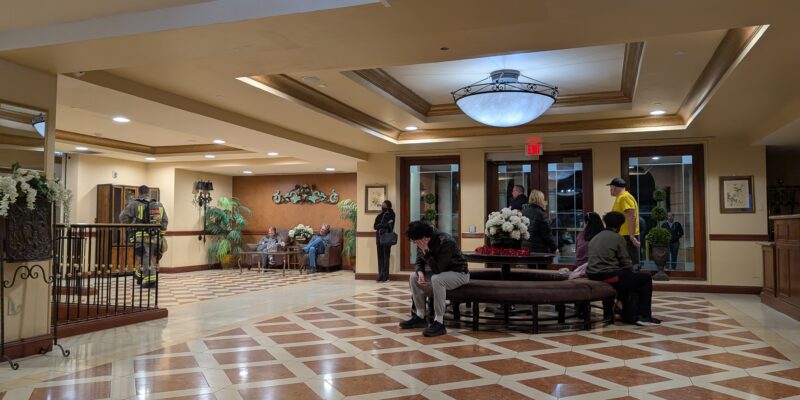
Scary emergency in the middle of the night!…See our video!…

The above video is from last night, around 3:15 am, when a loud announcement and evacuation warning came over the loudspeakers in the condos and hallways.

We were startled out of bed when we heard the sirens going off in the middle of the night.I heard the alarms before Tom since he doesn’t wear his hearing aids to bed. When I heard the sirens, I immediately woke him up while we each scrambled to get out the door.

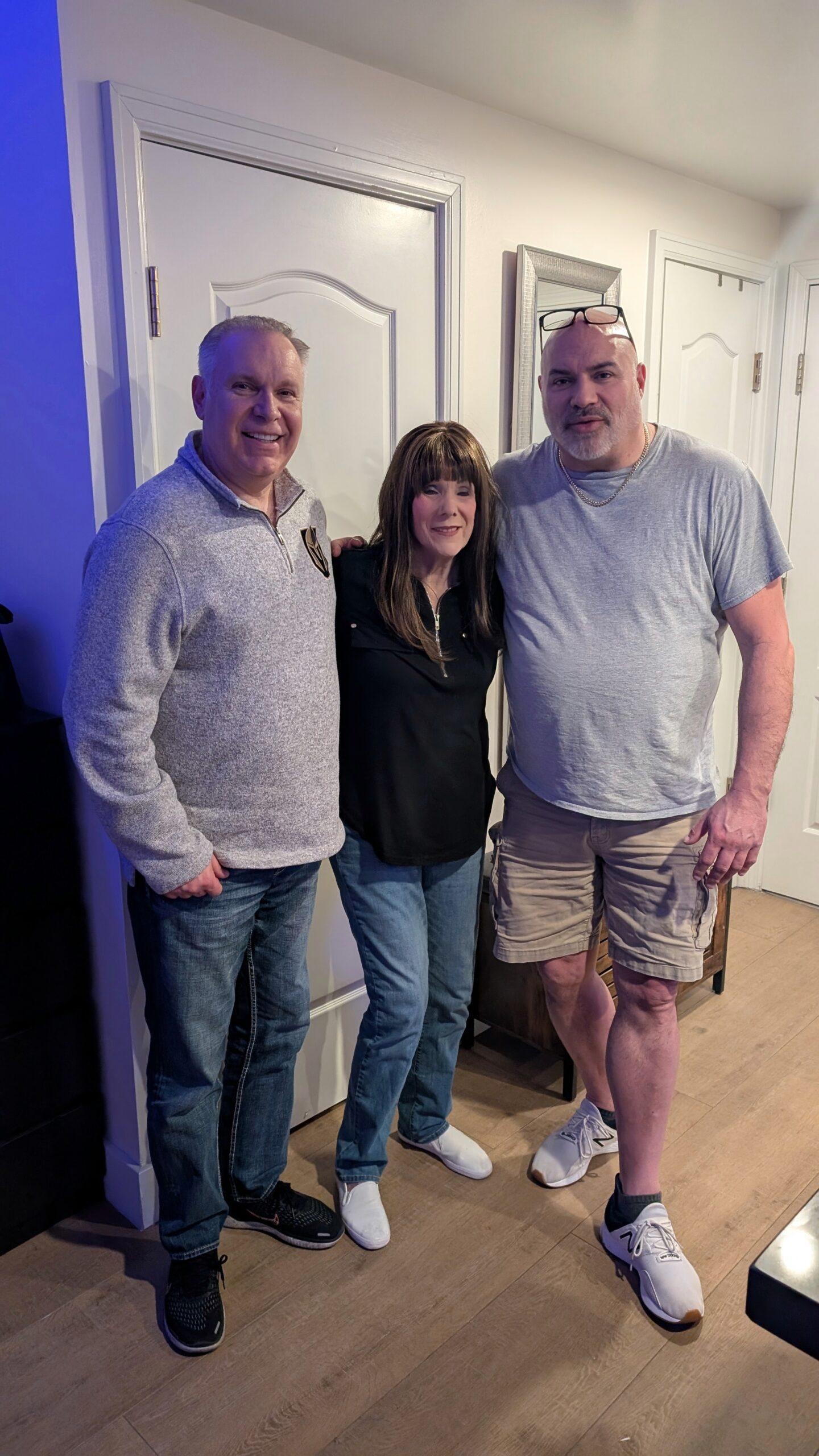
Before opening the door, we felt it for warmth and then bolted down the hallway to the stairway leading to the building’s lobby. When we arrived, a few dozen residents, many with their dogs, were gathered in the lobby, as shown in the above photo.

I felt exceptionally safe since Tom is a former volunteer fireman. I couldn’t have been in better hands. Unable to find my zippered sweatshirt, I put on my shoes and head to the lobby with Tom, wearing my full-coverage pajamas. There was no time for fashion conscientiousness.

Once in the lobby, when we hadn’t seen or smelled smoke, we felt comfortable staying indoors to wait for the fire department staff to arrive. We waited only about 30 feet from the front door. At least two dozen people had the same idea, waiting indoors when it was cold outside, around 50F, 10 C.

Another few dozen residents waited outdoors wearing heavy coats and jackets. Previously, we had no idea how many people were staying in this condo complex in Lake Las Vegas. There may have been under 40 people, not very many, for this good-sized, 178-unit building, many of which are privately owned by many who only live here part-time.

After about 45 minutes passed and no fire trucks had arrived, I decided to call 911. (The building is not overseen by staff during the night.) As soon as I connected to the 911 operator and she saw where I was calling from, she explained that the fire trucks would arrive any minute.

As soon as I hung up, the fire trucks pulled into the driveway, and several firemen scoured the building for about 20 minutes, checking every floor and every condo for specific issues. Apparently, none were found, and eventually, they turned off the alarms and gave us the “all clear” to return to our units.

By the time we returned to bed, it was about 4:30 am. Being awake like that during the night made it challenging to fall back asleep. It wasn’t until after 5:30 am that I finally drifted off, awakening at 9:30 and feeling sluggish. Tom was up and about by 9:00 am and I entered the kitchen to make breakfast at 10:00 am, showered and dressed for the day, finally feeling energized to tackle another day.

We had a tasty breakfast of bacon, eggs, and toast for Tom, and bacon and eggs (topped with guacamole and Picante sauce) and Greek yogurt with ground flaxseeds for me. I’ve already completed my exercise routine, talked to our friend Lisa on the phone, and am just about to complete today’s post.

We are grateful to have caught up on sleep, ultimately been safe after the false alarm, and grateful for another day in the life…

Be well.

Photo from ten years ago today, February 13, 2015:

As we approached this unusual plant, we were reminded of sweet corn, which appears to be covered in a velvety cloth. It is called Zamia Furfuracea. For more photos, please click here.

Today is my six-year “heartaversary”…What is life expectancy after open heart surgery?…

Kauai is rich with colorful vegetation.

It was six years ago today that I had emergency open-heart coronary bypass surgery in Nelspruit, South Africa. Although it was a long and painful recovery, no words can describe how grateful I am to have come out on the other side now feeling well and thriving.

One might say, why celebrate such a dreadful experience? But, the celebration isn’t over the procedure itself but more about having survived and, in my case, the ability to continue to travel the world now, six years later. Sure, there have been some setbacks, most recently requiring the visit to the Cleveland Clinic with excellent results after three previous misdiagnoses in three countries by three cardiologists. There, I had many tests and the elimination of a dangerous drug.

After this extensive surgery, one can’t help but wonder about potential life expectancy. Here’s some information in that regard:

The life expectancy after coronary artery bypass graft (CABG) surgery varies depending on several factors, including the patient’s age, overall health, lifestyle, and the presence of other conditions like diabetes or high blood pressure. However, here are some general trends:

  • Average Survival: Many patients live 10 to 20 years after bypass surgery, especially if they adopt heart-healthy habits.
  • 10-Year Survival Rate: Around 70-80% of patients live 10 years post-surgery.
  • 15-Year Survival Rate: About 50-60% of patients live beyond 15 years.
  • 20-Year Survival Rate: Some studies show that about 25-30% of patients reach the 20-year mark.

Factors That Influence Lifespan After CABG:

  1. Lifestyle Changes: Patients who eat a heart-healthy diet, exercise, quit smoking, and control their blood pressure and cholesterol tend to live longer. (My lifestyle is ideal in this regard).
  2. Underlying Health Conditions: Diabetes, kidney disease, and severe heart failure can shorten life expectancy. (I have none of these).
  3. Age at Surgery: Younger patients have longer survival rates than older patients undergoing the procedure. (I was 70 at the time of this surgery).
  4. Success of the Surgery: If the grafts remain open and blood flow is maintained, the heart can function well for decades. (One of my grafts has failed, but my heart is functioning well without that graft based on a recent angiogram at Cleveland Clinic).

CABG is not a cure for heart disease, but it significantly improves the quality of life and survival by reducing the risk of heart attacks and other complications. Regular follow-ups with a cardiologist are crucial for long-term success.

After the complete workup at the Cleveland Clinic, I feel comfortable waiting a few years for another review while we’re visiting family in Minnesota. At that time, I’ll go to the more conveniently located Mayo Clinic in Rochester, Minnesota, 90 minutes from where we’ll be staying.

In the interim and the future, I will continue with my healthy lifestyle: a healthy low carb unprocessed-foods diet, daily exercise, quality sleep, low stress, frequent socialization, and positive relationships. Of course, being with Tom Lyman is always a boost for good health with his upbeat demeanor, loving support, and playful nature.

For me, I’ve found that the fewer prescription drugs I take, the better I feel. For my age and history, I only take a few medications and supplements that support heart health.

Be well.

Photo from ten years ago today, February 12, 2015:

The Kauai Path was a lot longer than it appeared when we first started walking. For more photos, please click here.

Fantastic evening with family…Gosh, I’ve missed this!…

My two sons and I were together for the first time in years, with Richard (left) living in Las Vegas and Greg in Minneapolis. (I should have opened my eyes!)

It was a lovely evening with my two sons and their girlfriends. The last time I was together with both of my sons, as mentioned, was in 2009 at Greg’s 40th birthday party.

Of course, I wanted the dinner to be perfect and the dessert they requested, bread pudding, to be equally delicious. I was pleased to know they all liked the food. It was the first dinner party we’d had in almost two years, and as an experienced cook and foodie, it was easy to do, although time-consuming.

I’m glad I prepped the food as much as possible the prior day, making yesterday relatively easy. I don’t stress when preparing meals for guests. Instead I focus on getting everything done on time, seasoned well, and cooked to perfection. Even Tom, a picky eater, loved the bread pudding.

Fortunately, I made an extra pan of bread pudding for dessert, which he’ll savor over the next few evenings. As for the pot pie, enough servings are left for the next few nights, when I’ll have barramundi, scallops, and salad, making the next few days easy. The fish and scallops will be cooked together and seasoned well in my excellent skillet. The heavy pan I’m insisting on will accompany us to Africa in my luggage.

At the moment, I’m doing laundry to hang on the indoor rack. Tom cleaned the kitchen after breakfast, which he especially enjoyed with two pieces of toast, bacon, and eggs. It’s a rarity that we ever have bread on hand, but when we do, such as this occasion, leftover from making the bread pudding, he’s on Cloud 9.

Speaking of Tom, he was so helpful with all the dishes last night. After everyone left, I wiped down the island’s granite countertop. This morning, we did a little more cleanup, and we’re back to our usual tidy and organized household.

As for the evening, the conversation was lively and animated, telling stories from my son’s childhood and many current stories and experiences. Tom and the two lovely girlfriends were easily included in the conversation. It couldn’t have been more fun and filled with laughter.

With Greg and Heather’s early morning flight, they all left by 9:00 pm. We’ll see them in less than four months, and we’ll see Richard and his girlfriend for dinner on my birthday, February 20.

A few minutes ago, I booked a Valentine’s Day dinner reservation at Luna Rosa, a gourmet Italian restaurant in the Village in Lake Las Vegas.

Our 30th wedding anniversary is on Friday, March 7, which we will celebrate at Jabula in Marloth Park. How fun that will be. We have many celebrations ahead of us, but most of all, we celebrate good health, which enables us to continue our travels. We are so grateful.

Be well.

Photo from ten years ago today, February 11, 2015:

We visited an open house for which we’ve included several photos. This is the fabulous view of Hanalei Bay. from the lanai. For more photos, please click here.

Busy day!…Family coming for dinner!…First time we’ve had a dinner party in almost two years…

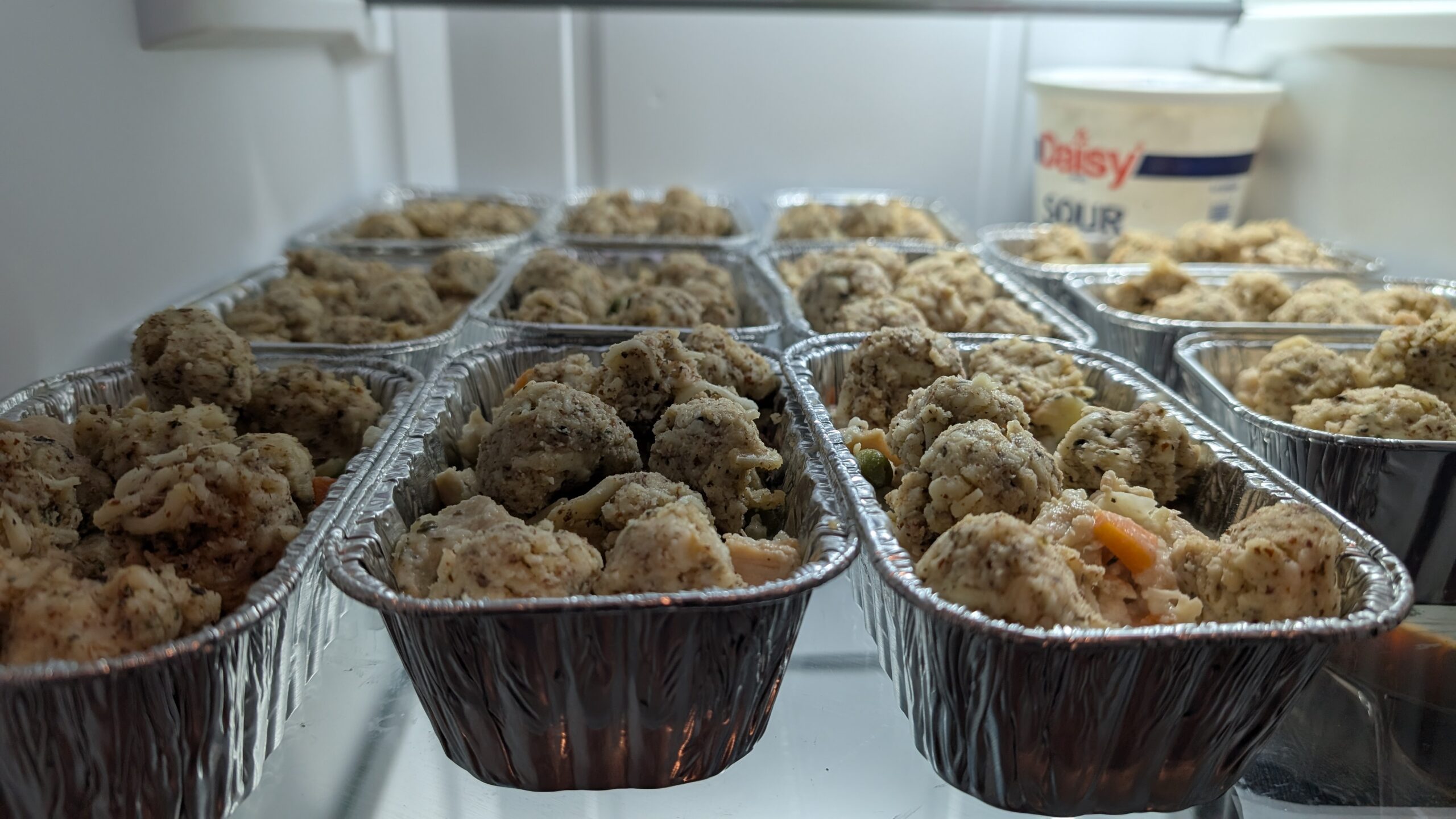
The individual keto chicken pot pies we are serving today.

We last had a dinner party in Marloth Park almost two years ago. My entertaining skills are a little rusty, especially since we didn’t have proper serving dishes, linen napkins, or placemats. Thank goodness family is coming since the expectations aren’t quite the same as if friends entertained us with an abundance of housewares and cooking supplies.

I doubt any of our friends would mind if we weren’t fully equipped to entertain, as experienced in Marloth Park when we had as many as 14 dinner gusts and improvised with what we had on hand. It always worked out well.

Since I am feeling so much better, I can tackle this, especially since both of my sons and their girlfriends provide me with plenty of enthusiasm and motivation. We haven’t been together since Greg’s 40th birthday party in 2009, over 15 years ago. Wow, how time flies. It seems like yesterday.

Our menu isn’t elaborate. I am making keto chicken pot pies in individual servings (small tin foil loaf pans, see the above photos, with a side of rice and salad and, for dessert, Martha Stewart’s Bread Pudding (which the kids suggested). I won’t be eating the dessert, but it will be fun to watch them enjoy it.

Tom asked me to save some of the leftover bread so he could have toast for the next few days. That’s my guy…the breadman!

We’ve had a fun time with Greg and Heather here, but they leave for Minneapolis tomorrow. We will see them again in June at Granddaughter Maisie’s graduation. In the past few years, we’ve spent a lot of time with family. We won’t return to the US until June 2026 for Grandson Mile’s graduation.

Health provided, after that, we may not return to the US until 2028 for Granddaughter Madighan’s graduation, at that point being away for two years. But, at this point in life, predicting the future is difficult. We are very grateful for every single day, let alone years.

All I have left to do today is make the dessert, cook the rice, and cook the pot pies in the oven. I’m glad I did so much yesterday, making today a more leisurely day.  Although my health is greatly improved, my legs tire easily while standing for extended periods. I always pace myself when making meals and doing household tasks.

Once I upload this post, I will do my exercises, then set the dinner places on the island where we’ll have plenty of room.

Be well.

Photo from ten years ago today,  February 10, 2015:

Finally, the Laysan Albatross chicks hatched, all within a 24-hour period. It wasn’t easy getting a good photo of the chick when it was busy preening itself almost continuously. How quickly they learn to manicure their beautiful array of feathers. For more photos, please click here.

What’s the deal with a “REAL ID?”…Can I use a passport instead?…

The precious Laysan Albatross chicks began to hatch in early February. We visited the site almost daily to savor the exciting events.

A few of our readers have asked about the requirements for US residents to provide a “READ ID” to travel domestically. As a result, the inquiries have prompted us to write about REAL IDs today to help clarify this US requirement.

How to Get a REAL ID

To obtain a REAL ID, follow these steps:

  1. Visit Your State’s DMV Website
    • Each state has slightly different requirements, so check your local Department of Motor Vehicles (DMV) website for specific details.
  2. Gather Required Documents (Original or Certified Copies)
    You’ll typically need:
    • Proof of Identity: U.S. passport or birth certificate
    • Social Security Number: SSN card, W-2, or 1099 form
    • Proof of Residency (2 documents): Utility bill, bank statement, lease/mortgage agreement
    • Proof of Name Change (if applicable): Marriage certificate, divorce decree, or court order
  3. Go to the DMV in Person
    • REAL IDs cannot be obtained online. You must visit a DMV office in person.
    • Bring all required documents.
    • Pass any necessary tests (vision test, for example).
    • Pay the fee (varies by state, typically $10–$50).
  4. Receive Your REAL ID
    • You’ll get a temporary paper ID immediately. The official REAL ID will be mailed to you within a few weeks.

How to Use a REAL ID

  • Domestic Air Travel (Starting May 7, 2025): Use it to board flights within the U.S.
  • Federal Buildings & Military Bases: Present it for entry where REAL ID is required.
  • Driving: If it’s a REAL ID-compliant driver’s license, you can use it just like a regular license.

Alternatives to REAL ID

If you don’t want a REAL ID, you can use:

  • U.S. Passport or Passport Card (Works for domestic & international travel)
  • Military ID
  • DHS Trusted Traveler Cards (Global Entry, NEXUS, SENTRI)

Is a REAL ID required in countries other than the US?

No, the REAL ID is a U.S.-specific requirement. Other countries do not require or recognize REAL ID for travel.

If you’re traveling outside the U.S., a passport is the primary document you’ll need. Depending on your destination and nationality, some countries may also require a visa.

If you’re driving in another country, you may need:

  • Your U.S. driver’s license (REAL ID or not, depending on the country)
  • An International Driving Permit (IDP) (required in some places)

So, while REAL ID is essential for domestic travel within the U.S., it does not impact international travel.

We won’t be applying for a REAL ID anytime soon since we cannot provide residence verification as mentioned above. We are doing fine using our passports.

Be well.

Photo from ten years ago today, February 8, 2015:

An early evening from our lanai in Kauai, Hawaii. For more photos, please click here.

75F, 24C, warm day in Lake Las Vegas today…

There are roughly 450,000 feral chickens on Kauai, Hawaii, more than the island’s human population. Chickens are the unofficial mascot of Kauai.

We couldn’t ask for nicer weather today. As always, the sun is shining, and the temperature is fast approaching 75F, 24C, today. It isn’t always this warm in Las Vegas in the winter months when we’ve seen it as cold as 30F, -1.11C in the past almost two months since we arrived here. There have even been a few days when it’s been colder here than in Minnesota.

It’s not as if we’re spending much time outdoors. Occasionally, we head out for a walk in the Village during the day. But, most often, we’re outdoors when we walk the short distances to dinner every Friday and Saturday night.

In 25 days, when we arrive in Marloth Park, it should start cooling off from the hot summer season. Coincidentally, it was also 25F, and 24C in Marloth Park today. But on Saturday, it will be 94F. 34C. In March, the high is usually under 90F, 32C, which is easy to take for Africa. As time passes, during our first 90-day stay, the temps will continue to drop, keeping in mind the seasons in the Southern Hemisphere are opposite the Northern Hemisphere. Winter is from June to August.

Since we’re returning to Minnesota for granddaughter Maisie’s graduation in June 2025, by the time we return to Marloth Park in June, winter will be at its coldest with a high of 81F, 27C. We love winter in the bush, but other than that, there’s a lack of vegetation for the wildlife in the winter months when the residents ramp up feeding the wildlife pellets, lucerne (hay), and various fruits and vegetables.

In those winter months, I’ve often spent a few hours each day cutting fruits and vegetables into bite-size pieces, befitting the size of the animals we’re feeding (never by hand…they are wild animals). Many disagree with humans feeding the wildlife and prefer to “let nature take its course,” but turning away starving animals is pretty tough. We often order hay bales to spread in the garden and the animals come in droves to dine on the fresh lucerne.

For us and many other residents in the bush, the cost of feeding the animals is merely a related expense in enjoying the conservancy and its endless stream of wildlife to our gardens. Plus, the cost of fruits, vegetables, and lucerne is about 80% less than those items in the US.

A 50-pound bag of carrots costs only a few dollars, and apples aren’t much more.  We often drive to Lobombo, about 30 minutes from Marloth Park, to buy giant bags of carrots, pears, and apples at ridiculously low prices. There’s no doubt that inflation has increased the cost of food products in the past two years since we’ve been gone. We’ll report back as to what we pay when we shop.

Greg and Heather arrive today, but we told them to enjoy their first night without us since the two brothers hadn’t seen each other in quite a while, although they’ve stayed in close touch. The six of us will have fun together tomorrow night and the other nights while they are here.

Today will be another pleasant day as we go about a day’s typical tasks and pleasures in Lake Las Vegas. Soon, I’ll have to start preparing 2024 tax info for our accountant, lightening our load, and start packing. After all, we leave three weeks from tomorrow. Wow…the time has flown by!

Be well.

Photo from ten years ago today, February 6, 2015:

We spotted a cattle egret while out and about in Princeville, Kauai. For more photos, please click here.

Easy life with an easy appetizer recipe for Super Bowl Sunday…

Tom was sitting with a scarecrow at the Kauai Coffee Company, which we toured ten years ago.

It’s exciting that son Greg and his girlfriend Heather will be here in two days. I can hardly wait to see them and for all of us to be together for the first time in years. I am not planning anything and leaving the planning to them. I am so happy that I feel great after finally recovering from the three-week flu, leaving only an occasional cough.

It was fantastic going out to dinner on Friday and Saturday nights. We had a great time each evening. It’s disappointing that we can’t get out the door for under $100, regardless of how casual a restaurant may be. We don’t order more than a few drinks each, no appetizers or desserts. It’s not because we are “cheap.” We just don’t care to eat that much.

Even when preparing our meals, we don’t bother with appetizers (starters) or desserts since we are committed to losing a few pounds. In the past, we’d enjoy a little something after dinner, but we have stopped that bad habit since the first of the year. There’s no need to eat between meals or after dinner. Doing so only adds weight and certainly doesn’t improve our health.

Of course, treats may be on the menu for special occasions, such as the delicious recipe I listed below instead of a photo in the “Photo from ten years ago today.” However, I don’t eat that appetizer because the sweet jam contains lots of sugar. Lately, I’ve tightened my belt and lost some weight by reducing my daily carbs. I feel so much better doing so.

My exercise program is back in full swing as of last Monday, and now, a week later, I’m back to where I left off before I got sick four weeks ago. It feels good to vigorously exercise after being relatively immobile over the past 18 months.

This morning, I chatted with my dear friend Chere from Minnesota. Her busy, semi-retired lifestyle brings her much joy, but I cringe when I hear how much she has to do daily with ten balls in the air at any given time. That used to be me, but not now. How I spend my free time is totally up to me, and my freedom without many obligations is ideal for our unusual lifestyle. We love it this way.

That doesn’t mean we don’t love spending time with family and friends. We do. But, as we travel, our social life is simple and uncomplicated, and our free time is truly treasured. I suppose, in part, the fact we enjoy being together is a huge factor. Neither of us is ever bored with one another or when engaged in our preferred individual activities.

All I have yet to do today is finish prepping for tonight’s dinner and do my exercises. The condo is tidy, and the bedding and other laundry are done. We had bacon and eggs for breakfast and won’t eat again until dinner. Tom is seated at the kitchen island, listening to Garage Logic. We love this easy life.

We hope you have a lovely week, and we will continue to stay in touch even after Greg and Heather arrive.

Be well.

Photo from ten years ago today, February 4, 2015:

Ten years ago today, we posted the following easy recipe: a great dish to bring to a party or serve on Superbowl Sunday. This recipe is from our dear friend Sue (husband Chip, who has since passed away), our beloved neighbor in our old lives.

Sue’s Lone Star Grill Salsa Dip

8 oz. cream cheese

1 jar Lone Star Grill Raspberry or Pineapple Salsa (or any other sweet salsa)

 3/4 C. cheddar cheese, grated

3/4 C. Monterey Jack Cheese, grated

2 green onions, sliced

1/2 C. sliced black olives

Spread cream cheese in a baking dish or 8″ pie plate. Spread salsa over the cream cheese. Combine the grated cheeses and sprinkle over the salsa. Top with onions and olives. Bake at 350 degrees for 12 – 15 minutes.

Serve with taco chips or crackers.

We’re back…Busy days…Exquisite trees and flowers…

A Rainbow Eucalyptus tree found in Hawaii. What a fantastic tree trunk!

Rainbow eucalyptus trees (Eucalyptus deglupta) are some of the most strikingly colorful trees in the world, and Hawaii is one of the few places in the U.S. where you can see them in all their vibrant glory. These trees, native to the Philippines, Indonesia, and Papua New Guinea, are known for their unique multicolored bark, which naturally peels away in strips to reveal layers of green, blue, purple, orange, and red underneath.

Rainbow eucalyptus trees thrive in Hawaii’s warm, humid climate, particularly on Maui and the Big Island. One of the best places to see them is along the Road to Hana on Maui, especially near mile marker 7 in the Ke‘anae Arboretum. Some groves are near Hana, where the damp environment helps the trees maintain their vivid colors. The Big Island also has scattered rainbow eucalyptus groves, often found in botanical gardens and private lands.

In their native environment, these trees can grow up to 250 feet tall, but in Hawaii, they typically reach around 100-125 feet. Although they were initially planted for paper production, they’re mostly admired for their beauty and serve as popular photo stops for travelers.

The bark’s colors appear as the tree sheds layers at different times throughout the year, creating an ever-changing natural masterpiece. The bright green inner bark is newly exposed, and as it matures, it transitions through shades of blue, purple, orange, and eventually brown before peeling again.

Because they are non-native, some environmentalists monitor their spread, but unlike other eucalyptus species, they aren’t considered invasive in Hawaii. If you visit, remember to appreciate them without damaging the delicate bark—taking pictures is highly encouraged, but taking pieces of the bark is not!

As for orchids, as shown below in the “Photo from ten years ago today,”…

Orchids are a stunning and diverse part of Hawaii’s flora, thriving in the tropical climate and lush landscapes. While orchids are not native to Hawaii, they have become deeply intertwined with the islands’ culture, gardens, and even leis. With thousands of varieties growing across the state, orchids are found everywhere—from botanical gardens and forests to roadside stands and hotel lobbies.

A Brief History

European botanists and plant collectors introduced orchids to Hawaii in the 1800s. The warm, humid environment proved perfect for many species, and orchids quickly became a beloved part of Hawaiian horticulture. Over time, the islands developed a thriving orchid industry, with many local growers cultivating unique hybrids.

Where to See Orchids in Hawaii

  • Hawai’i Tropical Bioreserve & Garden (Big Island): This lush botanical garden is a paradise for plant lovers. It features a variety of orchids growing in their natural rainforest setting.
  • Akatsuka Orchid Gardens (Big Island): A famous orchid nursery near Volcanoes National Park, where you can see (and even buy) rare orchids, including the high-priced and fragrant volcano mist orchids.
  • Foster Botanical Garden (Oahu): One of Honolulu’s hidden gems, featuring a stunning collection of tropical plants, including native and exotic orchids.
  • Maui and Kauai Botanical Gardens: Various gardens, such as the National Tropical Botanical Garden on Kauai, showcase rare orchid species in beautifully curated environments.

Notable Orchid Varieties in Hawaii

  • Dendrobium Orchids: These are commonly used in Hawaiian leis and have delicate, vibrant petals in shades of purple, pink, and white.
  • Cattleya Orchids are large, fragrant, and bold in color. They are often associated with classic tropical orchid beauty.
  • Vanda Orchids: Known for their bright blues and purples, these orchids thrive in Hawaii’s warm climate.
  • Oncidium Orchids (“Dancing Ladies”) flourish in Hawaii’s humidity. Their small, intricate blooms resemble dancing figures.

Orchids and Hawaiian Culture

Though orchids are not as profoundly tied to Hawaiian traditions as native plants like maile or plumeria, they have become a favorite for leis, floral arrangements, and even weddings. Purple dendrobium leis are most commonly given to visitors and at celebrations.

Orchid Growing in Hawaii

If you love orchids, Hawaii is an ideal place to grow them. Many local nurseries sell plants, and some even provide shipping services. The key to growing orchids successfully in Hawaii is good air circulation, filtered sunlight, and the right amount of humidity.

Orchids in Hawaii are more than just flowers—they symbolize the islands’ natural beauty and resilience and how different cultures have influenced the landscape.

We are grateful for our experiences in Hawaii and other countries, where we have visited countless botanical gardens worldwide. Now, we look forward to taking photos of unusual flowers that bloom in the bush in South Africa when we arrive in a mere 28 days.

Be well.

Photo from ten years ago today, February 3, 2015:

What’s more beautiful than an orchid? This photo was taken at the Kauai Botanical Garden. For more photos, please click here.

Finally out to dinner last night…What the heck have we been doing since we left Marloth Park 23 months ago?….

Here was the sunset we spotted while outside of our Kauai condo. Wow!

It had been almost three weeks since we went out for dinner after I’d been sick for 2½ weeks. It feels great to be back to myself exercising again, feeling well, and finally able to go out to dinner last night at the Speakeasy.

Although we spent every day and evening together, there’s something magical about dressing up a little and getting out of our usual environment. Without any distractions from podcasts, TV news, and streaming, we had each other’s undivided attention and, surprisingly, found ourselves catching up as if we had been apart.

It’s not as if we don’t chat all day and evening. We frequently engage in conversation and with little snippets throughout the day. But based on our together-all-the-time lifestyle, we often give one another “space” to engage in activities during the day that we each enjoy on our own.

For Tom, this may be updating Ancestry, watching sports, listening to podcasts, and researching topics he enjoys, which may not appeal to me. Once I finish the daily posts, I exercise, prepare the evening meals, and work on financial matters. Before I know it, the day is more than half over. In the evenings, we spend our time together streaming movies and TV series we mutually enjoy. We just finished a new favorite on Netflix, the astounding “Shogun,” a memorable series.

Lately, I’ve been awakening at 3:00 am, staying awake for an hour or two, and then falling back to sleep for a total of eight or more hours. I used to get by with six or seven hours at most, but in the past few years, I’ve found I function better with eight hours. Thus, I may not get up at 6:00 or 7:00 am, like Tom.

Getting up late is no problem. There certainly is no specific necessity to get up early most days. I guess this is a part of enjoying retirement. When we fly out on March 1, our flight isn’t until after 10:00 pm so that no rushing will be required. Of course, we won’t sleep for almost 54 hours from the time we awake on March 1 until we go to bed in Marloth Park on March 3,

That’s the most challenging part about getting there: it’s far away, well over 10,000 flight miles. We’ve learned not to dread the flight and to accept it as part of the opportunity to be in this magical place. I can’t believe we’re leaving in a month!

Initially, we’d planned to be away from Marloth Park for 13 months. Now, after my health issues, it will be 23 months since we left in April 2023. It’s been a long haul over these past 23 months interspersed with great experiences and some not so much. Here’s the breakdown of where we’ve been in the past 23 months:

  • April 2023: left South Africa
  • April 2023 – July 2023: The Villages, Florida
  • July 2023 – Scotland
  • August 2023: Cruise, Norway to Amsterdam
  • August 2023: Cruise Iceland, Greenland, Canada, to Boston, then back to the US
  • September 2023: Boston to Las Vegas, Nevada (we needed to renew our driver’s licenses)
  • September 2023: Las Vegas, Nevada to Minneapolis, Minnesota
  • October 2023: Minneapolis, Minnesota, to Quito, Ecuador
  • October 2023: Quito to cruise The Galapagos Islands back to Quito, Ecuador
  • October, November, December 2023: Holiday rental in Ecuador
  • December 2023 to April 2024: Ecuador to Lake Las Vegas, Nevada
  • April 2024: Lake Las Vegas, Nevada to Apache Junction, Arizona
  • May 2024: Drove from Apache Junction to Los Angeles, California, to Minneapolis, Minnesota
  • May, June, July, and August 2024: Minneapolis, Minnesota, waiting for appointments at Cleveland Clinic
  • August, September, October, November, and December 2024: Cleveland Clinic, Cleveland, Ohio
  • December 2024, March 2025: Lake Las Vegas. Nevada
  • March 1, 2025: Fly from Las Vegas to Nelspruit/Mpumalanga/Kruger Airport
  • March 3, 2025: Drive from Nelspruit/Mpumalanga/Kruger Airport to Marloth Park

Wow! After seeing this in writing, we realize how much travel we’ve done in the past almost two years. It’s exhausting just reading this! We had a lot of fun in some ways, but it was tedious and stressful in other ways. But, in any case, we are excited to be on the move again in one month!

Thanks to all of our readers for spending these long months with us. In a short time, the excitement will begin again. We are very grateful.

Be well.

Photo from ten years ago today, February 1, 2015:

Suddenly, while driving, we stopped in Kauai for such a scene as this. For more photos, please click here.

How to travel worldwide without a credit card….Credit and travel…

Another unusual fruit for sale jn Kauai…a soursop. Soursop is the fruit of Annona muricata, a broadleaf, flowering, evergreen tree. It is native to the tropical regions of the Americas and the Caribbean and is widely propagated. It is in the same genus, Annona, as Cherimoya and is in the Annonaceae family.

As all travelers know, having a few credit cards, especially with reward programs, is a big boon, if not a must, for travelers. However, there are times in life when circumstances beyond one’s control severely impact one’s credit score, along with the ability to maintain the use of credit cards.

Credit scores have gone down in the past year. The average FICO score in the United States fell for the first time in over a decade due to the following reasons: 

  • High interest ratesHigh interest rates have made it more difficult for consumers to keep up with payments. 
  • InflationInflation has hit lower-income households harder, causing them to spend down their savings. 
  • Missed paymentsMore people have missed payments on their credit cards and other debts. 
  • Debt levelsConsumer debt levels have risen. 
  • Closed accountsClosed accounts or lower credit limits can also lower your score. 
  • Other factors include inaccurate information on your credit report and identity theft. 

With lowered credit scores, obtaining credit cards with travel-worthy credit limits, terms, and conditions may not be easy. Once this happens, when the need for travel arises, one can be in a quandary of paying for flights, hotels, and other travel venues and services.

Here are some suggestions as to how to handle such a situation when faced with booking travel:

Traveling without a credit card is entirely possible with the right preparation and mindset. While credit cards offer convenience, rewards, and security, you can still explore the world using alternative payment methods. Here’s how to make it work:

1. Use a Debit Card with No Foreign Transaction Fees

A good debit card can serve as your primary payment method. Look for one that:

  • Has low or no foreign transaction fees (Charles Schwab and Wise are good options).
  • Offers fee-free ATM withdrawals or reimburses ATM fees.
  • Has fraud protection similar to credit cards.

2. Carry a Mix of Cash in Different Currencies

  • Always have some local currency for emergencies, especially in countries where cash is king.
  • Exchange money at banks or reputable exchange offices rather than airports for better rates.
  • Use money belts or hidden pouches to keep cash secure.

3. Use Prepaid Travel Cards

  • These functions are like debit cards but allow you to load multiple currencies in advance.
  • Providers like Revolut, Wise, and Travelex offer competitive exchange rates.
  • Useful for budgeting since you can’t overspend.

4. Rely on Mobile Payment Apps

  • Many countries accept Apple Pay, Google Pay, Venmo, PayPal, and WeChat Pay.
  • Some mobile banking apps offer virtual debit cards for safer transactions.

5. Book Hotels and Flights with Debit or Alternative Methods

  • Many airlines and hotels accept PayPal, direct bank transfers, or debit cards.
  • Use booking sites like Airbnb, Booking.com, and Expedia, which often allow debit payments.
  • Consider prepaid hotel reservations to avoid deposit holds on your card.

6. Rent Cars Without a Credit Card (Tricky but Possible)

  • Some rental companies allow debit card payments with a hefty deposit and additional paperwork.
  • Renting from local agencies rather than big chains may be more straightforward.
  • An alternative is to rely on public transport, taxis, or rideshares like Uber and Lyft.

7. Use Budget-Friendly Travel Hacks

  • Overland travel (buses, trains) usually accept cash or debit cards.
  • Hostels, guesthouses, and Couchsurfing can reduce the need for deposits.
  • Meal planning avoids constant ATM withdrawals.

8. Emergency Backup Plan

  • It helps if you have a trusted friend or family member who can send you money via Western Union, MoneyGram, or PayPal.
  • Keep a small stash of USD or Euros as emergency backup cash.

Traveling without a credit card requires more planning, a mix of payment methods, and financial discipline. But it’s doable! With the right debit card, mobile payment apps, and emergency cash, you can explore the world as freely as ever.

Is worldwide travel possible without a credit card? It would be difficult and require considerable time to figure out how to pay for travel services. In those cases, obtaining a prepaid credit card to add funds from a bank account as needed would be worthwhile. A prepaid credit card A prepaid credit card (often called a prepaid debit card or prepaid travel card) is a payment card that you load with money before using it. Unlike a regular credit card, it does not offer a credit line—you can only spend the amount you’ve preloaded onto the card.

During our travels, we use credit cards to pay for almost everything. However, from time to time, as in the case of booking directly through an owner we already know and trust, we may need to use a bank transfer or other means of transferring money outside the US.

Be well.

Photo from ten years ago today, January 30, 2015:

This fruit is red rambutan, also known as hairy lychee. The rambutan is a medium-sized tropical tree in the family Sapindaceae. The name also refers to the edible fruit produced by this tree. The rambutan is native to Southeast Asia. It is closely related to several other edible tropical fruits, including the lychee, longan, pulasan, and quenepa. For more photos, please click here.