Safari luck prevails in India…The elusive Bengal Tiger…How lucky could we be?…

There she was. We couldn’t have asked for a better vantage point.

We never expected to see a tiger in India. However, we’re scheduled for six whole days on safari in two different national parks. We are now at Tiger’s Den Resort in Bandhavgarh National Park and upcoming on the 26th, Tuli Tiger Resort in Kanha National Park.

We were up bright and early at 5:00 am and having coffee tea (as they call morning beverages here in India) by 5:30 am in the dining room of our lovely resort. Both of us were still tired but also pumped for our first-morning game drive that began at 6:00 am while it was still dark.

Our hearts were pounding with excitement while we attempted to take photos.

We were bundled up with blankets on a chilly morning as we headed to Gate 1 of 3. Our diligent travel agent for India planned for us, a driver and a naturalist, alone in a small open-sided vehicle Jeep with elevated seats.

The naturalist sat in behind us on the seats usually reserved for additional guests to ensure we could easily hear him and provide him with an elevated view.

After the first hour and a half without seeing more than some spotted deer, monkeys, and bush chickens, we resigned ourselves to the fact that spotting the elusive tiger may be more of a dream than a reality. 

Such a beautiful animal!

And then, around 8:00 am, it happened. Our guides were able to predict a tiger in the area when varying antelopes were rapidly on the move, monkeys and birds were particularly noisy.

Suddenly, we were hopeful but still kept our enthusiasm in check. And that, she caused no less than ten other safari vehicles to jockey for position to get a glimpse of her majesty.

She was walking perpendicular to the road, and as shown in our photos, she bravely crossed the road at one point. Our guide explained the tigers weren’t as intimated by safari vehicles as one might think. They grew up in the park, a popular destination for many wildlife enthusiasts for decades.

Oh, yes, I wish we could have been able to get better photos with more closeups. But, since my new laptop arrived, I sadly discovered it didn’t have a slot for a camera data card. I tried to Bluetooth the camera to the laptop, but that didn’t work.

She didn’t seem to be disturbed by all the gawkers. 

The only option for the future is to purchase an adapter to fit Chromebook, but for now, we’re sadly stuck using our phones. And, although the photos are adequate, they surely aren’t the closeups we’d have been able to get with the camera.

Right now, using my phone as a hotspot, since there’s no WiFi in the rooms at the resort (not good), I was having trouble gaining access to the photos in a timely fashion. Hopefully, by dinnertime, the images were in my cloud, ready to be uploaded to this post. 

A pretty scene we spotted in the national park.

Hopefully, as you are reading this, we’ll have plenty of photos we could upload.

This afternoon at 2:30 pm, after the 1:00 pm lunch, we’ll go out on our second game drive of the day. After seeing this morning’s tiger, we can sit back and relax and enjoy nature, and whatever may come our way.

Happy day to all. We’ll be back with more soon.

Travel day…We’ve arrived in Bandhavgarh National Park…Here we go eight days of safari in India…

 
“The Khajuraho Group of Monuments is a group of Hindu temples and Jain temples in Chhatarpur district, Madhya Pradesh India, about 175 kilometers southeast of Jhansi. They are a UNESCO World Heritage Site. The temples are famous for their nagara-style architectural symbolism and their erotic sculptures.”

These five or six-hour road trips teach us a lot more about India than any other tourist venues we’ve been visiting day after day. Traveling through the countryside of this country with a population of over 1.3 billion is, without a doubt, eye-opening.

Today on our way to the Tiger’s Den Resort in Bandhavgarh National Park, we acquired yet another perspective of life in India away from the big cities we’ve visited date.

We couldn’t have been more thrilled with our private tour guide, Dr. Anand Tiwari, who had a doctor’s degree in Hindu idols. He explained he’d done a tour the previous day with guests on the Maharajas Express! What a coincidence and an honor for us! He can be reached here for tours.

The distance between towns is often as little as two to three kilometers. Then suddenly, we were caught in yet another dilemma of honking horn traffic, tuk-tuks, trucks, motorbikes, bicycles, cows, goats, and dogs in the streets.

Again, vendor lean-tos line every possible surface with impoverished sellers soliciting passersby, mainly tourists like ourselves. The amount of poverty before our eyes is unbelievable, yet these cheerful people seem to take their circumstances in their stride. 

It’s ironic, but we visited this historic site on a particular day, the wedding anniversary of the revered Lord Shiva, as part of an annual festival. This stairway to his temple was packed with visitors coming from all over India to honor him.

Sure, there are apparent homeless beggars in the street, but overall the people seem to be preoccupied with their work and tasks at hand, often with a smile on their faces. We are the “odd-man-out,” and they may look at us in a state of sheer wonder and curiosity. F

The carvings on the temple resulted in many years of work by skilled artists.

Our India travel agency and rep Rajiv didn’t let us down. Upon arrival at the beautiful upscale safari camp, Tiger’s Den Resort, we were escorted to our beautifully appointed “luxury accommodation” (as they described our room) to find it to be perfect. 

It’s not a tent. It’s a series of rooms, each with its small veranda connected as duplexes might be by a common wall, each with direct access to the outdoors. The furnishes remind us of India in the 1920’s such as the former retail shop in the US, Bombay Trading Company.

The various temples are breathtaking.

As soon as we arrived and explained my special diet, our reception host brought my food list to the chef, who met with me to discuss options. I made it easy for him. Prepare chicken or fish in butter (not harmful oils) with a side of steamed vegetables without starch. Add two hard-boiled eggs at breakfast and lunch, not dinner. Easy peasy.

Visitors climbed these steep, uneven steps, but we opted to observe rather than rise.

We had a nice lunch in the nearby dining room, and now we’re situated in our room or outdoors on the veranda until dinner at 7:30 pm. Perhaps we’ll order a glass of wine for me and a beer for Tom to enjoy on the veranda. Humm…sound familiar…just like South Africa.

Tomorrow at 6:00 am, we’ll experience the first of six safaris we’re scheduled for during our four days at this camp. Our travel agent booked us for “private” safaris each time, with a driver and a naturalist on board in the vehicle. We didn’t expect this but are delighted. It was included in our package. 

We’re posting only two Kamasutra photos etched into the temples here, but they are a part of the history and needed to be represented.

Unfortunately, there’s no WiFi in the rooms, so at the moment, I’m using my Google World phone as a hotspot, and although the signal isn’t great in this area, it’s working. It will cost us quite a lot for the data we expect to use, but sometimes, we have to bear such expenses.

Most likely, when we head to our next location on the 26th, there will be more of the same. The only expenses we’ll incur at either of these safari camps will be tips and beverages. Three meals a day are included in the package. A picnic breakfast will be provided when we go on safari in the morning. Nice.

Another hand-carved representation of Kamasutra as it was practiced centuries ago. It is no longer accepted based on the polyamory (multiple partners) premise frowned upon by the Hindu people.

So now, I must get to the photos of the fantastic tour we had yesterday in Khajuraho to some of the most stunning temples we’ve seen to date. Again, we don’t have much time until dinner, so I need to wrap this up quickly.

This is a goddess surrounded by servants and admirers.

Gosh, I’m excited to be here. It reminds me of Africa, and nothing warms my heart more than that! Will we see a tiger? Maybe, maybe not. But whatever we see, we’ll share here with all of you.
Happy day.

Last post with Varanasi photos…Visit to a textile company…King of Brocade Weaving Centre…

                           Exquisite handmade silk brocade made on-site at Tiwari International.

 
We are experiencing awful Wi-Fi issues at the Ramada Hotel in Khajuraho, India. The town is considerably smaller than many we’ve visited over the past three weeks and without a doubt, this is the worse signal we’ve experienced.
The quality of the work is evident in every piece.

For the past several hours, I have been trying, off and on, to complete and upload today’s post about a fantastic silk-weaving facility we visited on our last day in Varanasi.

Neatly arranged shelves with countless fabrics in varying designs and colors.

From time to time, over the past seven-plus years we’ve been traveling, we’ve had an opportunity to describe and subsequently promote a small business we encounter along the way. 

Whether it is a barbershop, gift shop, street vendor, or luxury shop as we describe today, we’ve always enjoyed sharing details with our many worldwide readers.

Shelves are lined with stunning fabrics suitable for the wardrobe for Indian women and men, tourists, and many household goods such as draperies, furniture, bedspreads, pillows, etc.

Should any of you decide to visit Varanasi in the future, the stunning shop is worth a visit. I drooled over the gorgeous Pashmina shawls and scarves and only wished I’d had room in my luggage for one or two.

The staff was busy working with customers.

Unfortunately, after recently paying the airlines for overweight baggage, there was no way I could purchase even the lightest item and have it make sense. Plus, I cannot wear scarves often when I attempt to keep my clothing accessories to a minimum.

But, as we travel throughout India, we find most women, Indians, and tourists wearing scarves and shawls. Once women arrive in India from other countries, they immediately adopt the scarf concept to blend in with the population.

The shop also offered a wide array of ready-made clothing, including scarves and Pashmina shawls.

On the Maharajas Express, we all received no less than eight scarves as gifts at various stations as welcome gifts. I will have no choice but to give them away along the way. No doubt they contributed to my bag being overweight when some of them were pretty heavy.

But, few travelers have the same issue of “traveling light,” and many tourists come to India for shopping which is exceptionally exciting in this land of diversity and color.

The owner escorted us to the fabricating area, where a diligent weaver was hard at work.

Tiwari International appears to be a family-owned business. With the shop so busy when we arrived, we had little time to speak to the owner/manager Keshav Tiwari who was extremely kind and welcoming, even knowing we were “lookers,” not “shoppers.”

He was excited to share that actress Goldie Hawn had recently visited the shop, as he pointed to the framed photo on the wall as shown here in our photo. They were so proud to have a celebrity visit but equally enthused to welcome us.

This photo of actress Goldie Hawn hung on the wall in the shop. The staff was proud she’d come to visit and purchase several products.

We told Keshav about our visit to India and our site and promised him a story with today’s photos as a thank you for showing us around. He couldn’t have been more pleased, as were we.

The quality of their products is breathtaking, and we reveled in every category of cloth he showed us. Of course, we were in awe of the artistry he showed us by one of his workers, diligently at work on a loom. 

The finest of detail went into this lovely brocade, almost completed.

When he explained how time-consuming and deliberate the work is, we were all the more in awe of his massive inventory. Prices are reasonable, and support staff is available to assist in selections.

From their website, the following:


“Banarasi Brocades, as the world knows it, is called by the name kinkab in Varanasi. A high-quality weaving is done using gold and silver threads. Silk Threads are also used as well. The most common motifs include scroll patterns and butidars designs. The other designs are Jewelry designs, birds, animals, flowers, creepers, paisley motifs. Hindu religious and Mughal motifs also influenced brocade designs. When a Gold embellishment is done on a silver background, it is called Ganga-Jamuna in the local language.
This elderly weaver spent long days working at these looms.

The designs are first drawn on paper. The person who draws the layout is called Naqshbandi. The main weaver is assisted by a helper. This design is then woven on a small wooden frame to form a grid of warp and weft. 

The process is slow and painstaking, requiring intense concentration and expertise.

The requisite number of warp threads and the extra weft threads are woven on the loom. The famous tissue sari of Varanasi is unbelievably delicate, combining the use of gold and silver metallic threads.”

It was fascinating to observe the complicated and time-consuming process.
Finally, attention from Keshav was required, and we bid him thanks and good day with a typical Indian hands-together-bow, and we were on our way back out into the crazy traffic of Varanasi.
We had an opportunity to handle this finest of silk made by worms and of great value.

It was delightful, as always, to see how local products are made, adding even more substance and interest to sightseeing outings.

That’s it for today. Now, the challenge of uploading this post. Tomorrow, we’re embarking on an exciting road trip which begins at 8:30 am, taking us to one of our most sought-after adventures in India…eight days of safari in two distinct national parks where we’ll live in camps. Yeah!

Artistic design, coupled with great skill, produces such fine works as this.

Thanks to all of you for the many birthday wishes. Your kindness means the world to me!

Varanasi…Adaptation, once again…

Yesterday we met this lovely Indian couple at the airport.

In a perfect world, of which there is no such thing, every travel day, every tour, and every hotel would be to our liking. But, as we so well know, the world is an imperfect place, and our world travels are no different.

Last night we checked into a hotel, Ganges Grand Hotel, located in midtown Varanasi, that wasn’t of the caliber of the hotels we’ve stayed in during the first ten days following the Maharajas Express week-long train excursion.

When we arrived at the hotel by our assigned driver Ojuh, the hotel staff met us a few blocks away to collect our bags. No parking or stopping was allowed in the direct vicinity of the hotel. 
Last night during dinner, we noticed this cow entering a dress shop.

Fortunately, we only had a five-minute walk through the excessive honking of horns from tuk-tuks, cars, trucks, and motorbikes as we darted in and out of the traffic on uneven ground in an attempt to avoid getting hit or tripping and falling. This was the most traffic we’d seen in India thus far.
Finally, we reached the hotel to climb a steep set of uneven stairs to enter the lobby. The small reception area reminded me of “motels” from many decades ago when I traveled across the country with my parents as a child. 

We were welcomed and handed the box from Amazon India containing my new laptop, which had arrived earlier in the day. I am preparing today’s post using it, and so far, I’m pretty impressed. 

We were escorted to our room on the second floor. As soon as the door was opened, our hearts sank. This couldn’t hold a candle to the other hotel rooms of days (or years) past.

Lanterns and fabrics were carried on the heads of locals in preparation for a wedding.

The bed is hard as a rock; the room shows considerable wear and tear; the bathroom and shower are all-in-ones. In other words, the bathroom sink is in the same spot as the shower. 

Water covers the floor and doesn’t drain well, leaving the bathroom a slippery danger zone with the potential for falling on the marble floor. We asked for extra towels to cover the bottom to prevent falls while in the bathroom and when stepping outside the bathroom. 

After getting settled as best as possible in the room, we headed to the dining room for dinner. We hadn’t eaten a thing in over 12 hours. We giggled when we commented that it felt as if we were in a movie centered around international intrigue and espionage in the 1930s.

In our situation, I must be able to get food befitting my way of eating. There was nothing on the menu I could order. I asked for the chef (cook), and he kindly prepared a roast chicken and vegetable dish that met my criteria and tasted fine. 

Bleary-eyed and tired from a long travel day, we shared a few beers (no wine available). Since alcohol isn’t allowed in many Indian cities, this restaurant covers its beers with tin foil. Go figure.

Once again, Tom had chicken and egg-fried rice. It looks like we’ll repeat these same items over the next two nights until we leave for our following location that online appears to be more suitable for our desires and expectations.

Yes, I know, this is India, and yes, we’re adaptable and accepting of cultural differences, but we paid a lot of money for this tour and didn’t expect to stay in this particular type of hotel.

We looked up all the hotels booked over the next few weeks, and it appears this particular hotel was out of character for our 55-night tour of India. We breathed a sigh of relief and settled back into the reality we so often pursue, “love the one you’re with.” We’ll be fine.

I suppose our tour guide selected this hotel due to its convenient location to the Ganges River and other points of interest. This morning at 6:00 am, we met with our Varanasi tour guide, Avi, and proceeded on a tour of one of the most exciting and unusual tours we’ve done to date… a rowboat ride on the Ganges River at sunrise.

Need I say, we have some stunning photos to share tomorrow while today, in the short time we have left until our next outing, to continue to set up my new laptop with all the apps and files I typically use.

We’ll be back with more tomorrow. Have a peaceful day and evening.

Thursday’s missed photos from Shimla and Kufri…Jakhoo Temple…

This giant 108-feet-high idol of Hanuman was unveiled at Jakhoo Hanuman temple in Shimla on November 4, 2010.

“Jakhoo Temple is an ancient temple in Shimla, India, dedicated to the Hindu deity Hanuman. It is situated on Jakhoo Hill, Shimla’s highest peak, 2.5 km east of the Ridge, at the height of 2,455 m above sea level. Each year, a festival is held in Dussehra. Before 1972 the festival was held at Annadale.  

According to the Ramayana, Hanuman stopped at the location to rest while searching for the Sanjivni Booti to revive Lakshmana. A giant 108-feet-high idol of Hanuman was unveiled at Jakhoo Hanuman temple on 4 November 2010. 

The temple is accessible by foot, horse, taxi, or rope way. At 108 feet, it surpasses the statue of Christ the Redeemer, which measures at 98 feet, in Rio de Janeiro, Brazil. The cost of construction was Rs 1.5 crores (US $209,711.31). The public unveiling was officiated by Abhishek Bachchan. 
The great statue of Hanuman is more extensive than Christ the Redeemer in Rio.

The Jakhu Ropeway is an aerial lift that links a point near the centre of Shimla to the temple. It was developed by Jagson International Limited and opened in 2017.”

Based on my computer crash and a poor Wi-Fi signal in Shimla, owe realized that your posts are a little out of sequential order. Now that we have a better signal in Amritsar, we’ll attempt to get a caught up as much as possible.
 
With all we’d experienced on the Maharajas Express, it could take several more weeks to get caught up. With the lack of time with so many daily activities and a weak signal on the train, we’ve yet to share many essential and exciting experiences from the past few weeks.
The grounds at the temple are neatly kept but surrounded by monkeys. Tom had to wait in the car since monkeys in this area are known to tear glasses and sunglasses off the faces of visitors. Since Tom can’t see without his glasses, it made no sense for him to join me and Prince on the tour.

Over this next 47 days of touring in India, we’ll occasionally have an opportunity to share some of these missed events, all of which is important to us to have documented along with sharing it with all of you.

AMynew Chromebook will be awaiting me when we arrive on Monday (on a flight from Amritsar). It will take a few days to set everything up which I will do in between our arranged tours. But, I’m confident it will all work out.

The exterior of the steep walkway to the statue. I stayed behind and batted off the monkeys while Prince made the hike to take the photos of the statue.

OOurguide Prince picked us up at the Radisson Hotel Shimla for a day’s outing. On Thursday morning, The plan was to drive the the mountain town of Kufri to check out the scenery and head back to Shimla or more sites.

The drive to Kufri was again on treacherous mountain roads filled with trucks, motorbikes, and cars honking their horns simultaneously. Following any expected passing courtesies was out of the question. Everyone just took crazy chances.

There were monkeys everywhere at the Jakhoo Temple, most likely waiting for possible tidbits of food from tourists.

Prince, our highly competent driver, made us both feel as much at ease as possible under the circumstances. What a wild ride! That’s India, for you! One exciting moment after another while not only driving on the narrows road but also when walking.

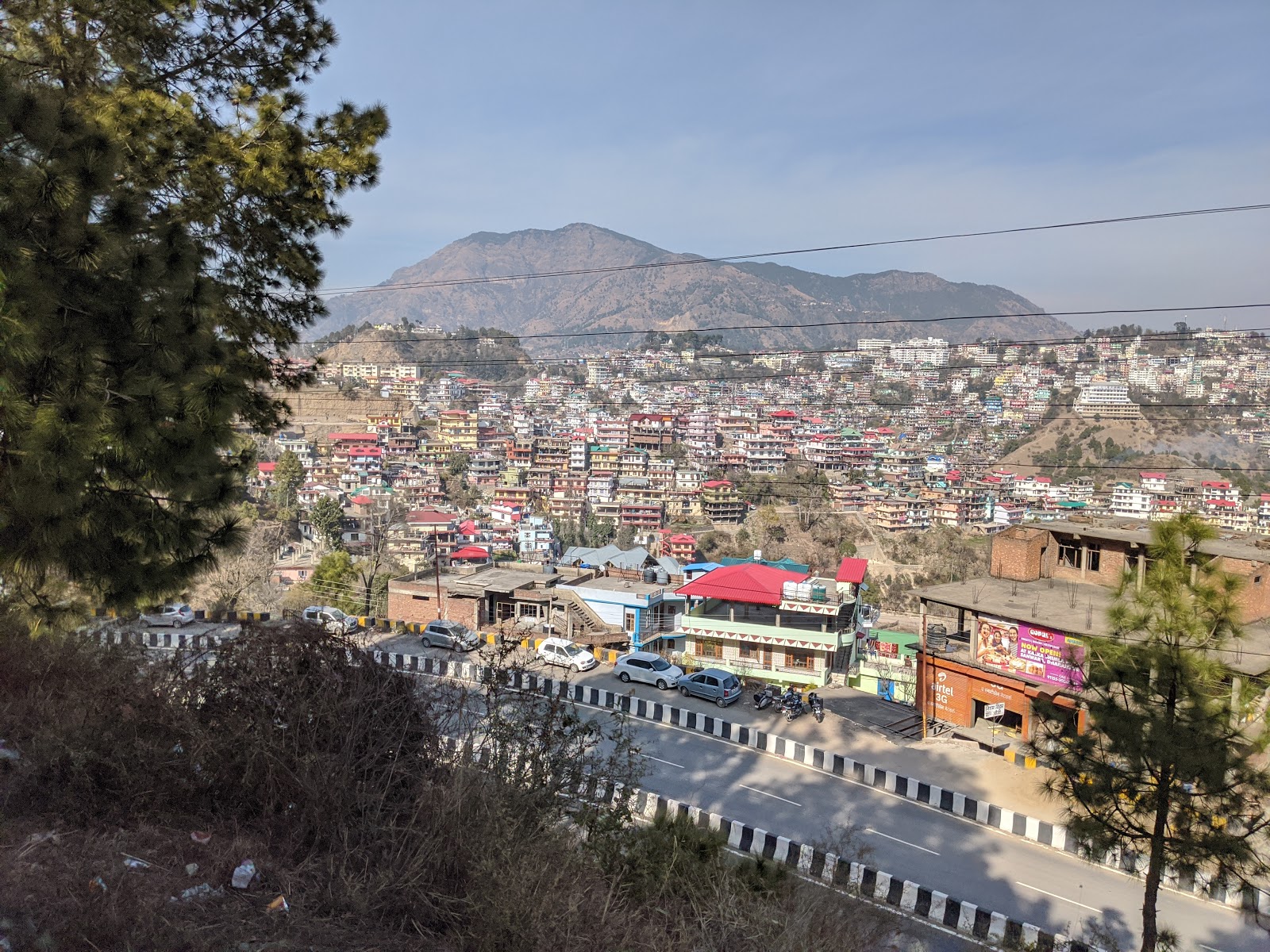
Kufri was relatively uneventful other than the drive, with the exception of a few scenic overlook spots. We enjoyed people watching along the way as well as seeing the surprising amount of snow.

Even newer buildings maintain the integrity of the varying cultures of India.

On the return drive, we stopped to visit the above mentioned Jakhoo Temple and a few other temples in Shimla. As the day came to an end, we were happy to return to our hotel, freshen up and head to dinner in the restaurant. 

We’d both found items on the menu that appealed to us but nothing as spectacular as last night’s dinner here at the Ramada in Amritsar. Most certainly, we’ll have these same meals this evening, again with no cocktails since they are forbidden anywhere near the Golden Temple. 
The roads on the way to Kufri often included shops with colorful items for sale.

But the lack of a glass of wine or cocktail with dinner was a small sacrifice based on that beautiful meal shown in yesterday’s post here. Tom equally enjoyed his chicken fried rice.

That’s exciting! We’ll be back!! E is looking forward to sharing tomorrow’s post after an indescribable day of touring here in Amritsar and tonight’s special ceremony taking place at the India/Pakistan border. 

Happy day to all!

Eight hour car ride from Shimla to Amritsar…No delusions, rose coloured glasses…

My spectacular dinner was made by the thoughtful chef at the Amritsar Ramada, where we’ll stay for three nights.

It was quite a day. Our good driver Prince drove perfectly on the treacherous roads as we made our way down the Himalayas. The traffic, the horn honking, the weaving in and out between cars, trucks, and motorbikes was quite a sight to see as well as many other stunning scenes along the way.

As we entered Amritsar after an eight-hour car ride.

India is known for its pollution, skinny stray dogs, and rundown structures as a part of life in many parts.

A herd of sheep moving on down the road.

Sure, we tend to sugarcoat these rampant realities with often rose-colored glasses in an attempt to paint a colorful view of our nonstop world travels. But what shall we do? Whinge about the fact we’ve yet to see a bright blue sky or a totally clear day? Hardly.

A historic building as we drove through crowded town after another.

This country of over 1.3 billion people belongs to its people, and they are proud and grateful for what they do have instead of what they don’t. We are humbled by their acceptance and kindness, not by everyone, but by most.

It’s easy to see how India had 1.3 billion people. They are everywhere, and little land is reserved for the countryside or farming.

And, what do we gain by exposing ourselves to these challenges? Exactly what we intended seven years and almost four months ago when we left Minnesota to explore the world.

Color is everywhere.

It was never about hedonistic pleasures pumping our veins with luxurious comforts. It was always about filling out hearts and minds with a new appreciation, a unique perspective of life outside the box we so freely occupied all of our lives.

Every area, every town is congested with people and “stuff.”

The meaning, the purpose, and the scope of our past experiences were limited to a tight circle around us. Today, it’s the world.

Shops are packed with colorful dresses worn by Hindu women.

Why, “they” may ask? Originally, curiosity. Now, this blissful opportunity has become about sharing this adventure with all of you, for those who traveled, for those who dreamed of travel, and for those who continue with their own goals of exploring the world.

People, cars and more shops.

Every day we plot, plan, and share the peculiarities, the nuances, the joys, and the challenges we encounter along the way. Not always pretty. Not always heartwarming and enchanting. But always, as real and concise as we can be from this long acquired perspective.

On a rare occasion did we encounter a more modern building.

Yes, in time, it will come to a close. In six days, I will be 72 years old with a precarious heart condition. Tom, five years younger, will only be able to haul the bags for so many years to come.

As we came down the mountains, we encountered snow.

But we’ll carry on, slipping on those rose-colored glasses from time to time to soften the blows of the many harsh realities we encounter in the world to share each perspective with all of you.

Dirty snow piled up on the side of the road.

We just returned from a fantastic dinner on Valentine’s night sans alcohol. No alcoholic beverages are served in Amritsar in the proximity of the golden temple, which we’ll see tomorrow morning with our new guide. We don’t mind forgoing happy hour for three nights to savor the local treasures of Amritsar.

Town after the town became a picturesque view as we wound our way down the mountains.

Tomorrow evening holds quite an adventure. We’ll share the following day.

Thank you, dear reader/friends, for your inspiration and your loyalty. You are always with us.

Happy Valentine’s Day to all the lovers out there…

India pleasures continue, minus a few glitches along the way…

With my laptop crashing and the dreadfully bad WiFi signal at this hotel, I cannot upload any photos today. The hotel is fully booked for Valentine’s Day, and with so many guests sharing the connection, we’re unable to upload any images.

Once I get my new Chromebook in within a week, I’ll get caught up, especially if we have a better WiFi signal when we’re not so high above sea level and in a hotel with such a poor signal.No doubt, we anticipated WiFi issues when visiting somewhat remote locations along the way. But, what did we expect? We didn’t anticipate that Tom’s old computer, which I’d carefully reformatted only a few weeks ago, would essentially crash for good, leaving me in difficulty attempting to post.

We’ve been a bit frustrated with the hotel we’re currently in while staying in Shimla for three nights. In the remodeling process, numerous steep stone outdoor stairways are required to navigate from the make-shift temporary lobby to find our room.

Tom counted that we had to navigate 96 steps (10 flights of stairs) each time we need to access the main entrance to the hotel. There aren’t adequate elevators (lifts) to get from one level/location to another. Had we known this, we’d never booked this hotel.

The hotel room is spacious and quite lovely, as is the restaurant. But there is no bar/lounge to relax or work before dining or anywhere in the entire hotel where we can sit other than in our hotel room when we have work to do. This is ridiculous, especially for a usually quite convenient Radisson Hotel.

Subsequently, we’re looking forward to moving on tomorrow.  At 10:00 am, we’ll be on the move again when Prince drives us the required seven hours to our next stop in Amritsar, another famous city many tourists come to India to see.

Don’t get me wrong; we’re enjoying India. It’s a fascinating country rich in culture and history with an overall kindly and gentle population. But, like life itself, sometimes travel isn’t as convenient and as easy as we’d like it to be. 

These few glitches will soon be resolved, leaving us more at ease and in our element. Or, we may continue to experience WiFi issues that make posting difficult each day. In any case, we’ll make every effort to figure all of this out as we continue.

We’re managing with the food, which is predominately Indian flavored, using considerable starch and sugar. The only dishes I can count on working for me are simple curries. For Tom, it’s a little more challenging, but we’re both managing to find foods suitable for both of our needs and taste buds. 

The easiest meal is breakfast which is included in our hotel fare at most locations. We’ve been able to have eggs, omelets, and bacon. Dinners are a little more challenging, but here again, we’re able to make it work while still savoring some Indian flavors in our meals.

Last night, we had a good meal in the dining room while celebrating my first anniversary of open-heart surgery. These minor issues remind us of how lucky and grateful we are to be able to continue on in our travels after what transpired in the past year.

May your day and evening leave you feeling grateful.

Arrived in chilly but gorgeous Shimla, 7400 feet above sea level, at the foot of the Himalayas…

*Note: there are no photo captions today due to poor WiFi connection.

Yesterday consisted of a full day of travel. We started the day by meeting our Delhi guide in the hotel lobby at 6:45 am after we’d grabbed a quick bite to eat, We knew we wouldn’t have access to food until 12 hours later.
After a harrowing ride to one of 46 train stations in Delhi our guide and a porter known as a “coolie” in India helped with our bags escorting us to our train car. Our guide showed us to our seats.

Our heavy bags were tossed onto the overhead compartment while we got settled in our assigned seats. The legroom was adequate. No doubt, this train from New Delhi to Kalka wasn’t anything like the Maharajas Express but we were reasonably comfortable and at ease. 
Once the train departed the station we were served a variety of items in stages: bottled water,  juice cartons, tea, cookies, bread, and a hot fried vegetarian dish. Tom nibbled on the cookies and bread while I sipped on the hot tea. The four-hour ride to Kalka was uneventful. With the heavy fog and smog, we weren’t able to see much of the passing scenery


We played with our phones while the time passed quickly. At 12:00 pm, we had to make our connection. Tom was worried about getting our bags moved to the other train. But, as expected, a steward helped us and we easily found our train, appropriate car and seats, and an easy spot for our luggage. No worries.

On what is referred to as the Himalayan Queen Toy Train we made our way to the historic town of Shimla, at the foothills of the Himalayan Mountains. Shimla is known as the summer capital of British rulers. 

As a matter of fact, the British TV series Indian Summers, which we thoroughly enjoyed, was filmed in Shimla.
The scenic five-hour train ride made its way through 103 tunnels, 800 bridges, and an incredible 900 curves.  We took many photos, but in parts, the smog and scratched windows impeded the view.

The distance to Shimla is a paltry 58 miles (93 km) but based on information we discovered, the winding mountain tracks and slow speed resulted in the over five-hour train ride.
Upon arrival in Shimla we had no idea how our driver would find us when there were dozens of cars pinned in the tiny parking lot. Magically, he appeared and helped load our bags and we were on our way to a tucked-in-the-hills Indian influenced Radisson Hotel.

Once we arrived at the hotel after quite a delay checking in, we were escorted to our room. When I attempted to begin the missed post due to travel day, my computer’s blue screen prevented me from starting Windows 10. I tried every possible fix, but it was so severely corrupted, I was unable to get it started.

I hardly slept all night while worrying about a fix. This morning I spent another three hours trying to resolve the issues to no avail. The only alternative was to start over with a new laptop.
Today, I ordered a new Chromebook from Amazon India, which will be delivered to the hotel where we’ll be from February 17th to the 20th. In the interim, I’ll be using Tom’s laptop which is a bit cumbersome for me since his keyboard was different from mine.

Today, we’re hanging out at the hotel. Tomorrow, we’ll be touring Shimla with our newest guide, Prince. We’ll continue to take photos, but it will be easier for me when I have my own laptop.

Since today is the one year anniversary of my open heart surgery (referred to as a “heartaversary” during which we didn’t post for two weeks, I won’t be adding “Photo from one year ago” for the next few weeks. Thanks for your patience and we’ll do our best with the photos.
Be well.

The first day of our 55-day tour itinerary…Delhi and New Delhi…The burial site of Mahatma Gandhi’s ashes…

From this site: “Indian Statesman and Spiritual Leader. Mohandas Gandhi, who came to be popularly known as “Mahatma” (Great Soul), was born a colonial subject of the British Empire. He studied law at University College in London and was admitted to the bar in 1891. In 1893, Gandhi became a legal advisor for an Indian law firm in Durban, South Africa (then also a British colony). Appalled at the racism against South Asians there, Gandhi became an activist for equal rights. However, Gandhi disdained the violent tactics often employed by socialist and anarchist activists and advocated new forms of nonviolent resistance, collectively known as “Satyagraha” (truth and firmness). Influenced by traditional Hinduism and the works of Jesus, Leo Tolstoy, and Henry David Thoreau, Gandhi’s methods stressed change by noncooperation with the colonial authorities, including disruptive (though nonviolent) demonstrations and general strikes and boycotts.

Yesterday morning, our Delhi tour guide, Subi, appeared in the hotel lobby a half-hour earlier than anticipated. Since we were ready for the day, we joined him to begin the first day of the 55-day.

Crowds of tourists and local visitors filled the walkways.

The same driver from the previous day would be responsible for transporting us from place to place, and Subi would be our tour guide. The concept of not having other tourists with us proved to be a good decision.

“Raj Ghat is a memorial dedicated to Mahatma Gandhi in Delhi, India. Originally it was the name of a historic ghat of Old Delhi. Close to it, and east of Daryaganj was Raj Ghat Gate of the walled city, opening at Raj Ghat to the west bank of the Yamuna River. Later the memorial area was also called Raj ghat.”

At no point were we subject to the pace, shopping, dining, and restroom breaks. We could go at our own pace, which is mainly of importance to me when at times, I may walk a little slower than others.

The grounds of the burial site of Gandhi are meticulously manicured with exquisite flowers and gardens.

With this pressure non-existence for our 55-day private tour, we can decide exactly which venues appeal to us and which do not. For example, after visiting no less than six forts during the tours during the Maharajas Express train, we’re somewhat “forted out.

“Through his position on nonviolence was not absolute (he would later be a British Army recruiter during World War I), Gandhi would willingly take beatings from British police throughout his career and would require his supporters to do the same. In 1914, the newly autonomous South African government recognized Indian marriages and abolished the Indian poll tax, and Gandhi returned to India. After World War I, Gandhi became a major advocate for Indian home rule, again applying the methods of Satyagraha. In 1919, the British Army opened fire on demonstrators in Amritsar, killing nearly 400 people, including several children. In response, Gandhi stepped up his campaign of non-cooperation. Indian officeholders resigned, British courts and schools were boycotted, and demonstrators blocked streets all over the country. When this movement escalated to violent extremes, however, Gandhi called the demonstrations off. Gandhi also advocated the revival of the Indian cottage industry for economic independence from Britain, especially in textiles; he would wear only simple homespun clothes to illustrate this point. He was jailed from 1922 to 1924 but would return to his position in the Indian National Congress and call for a tax revolt in 1930.”

We informed our guide on what appealed to us and proceeded accordingly. Keeping in mind we’ve seen an endless array of churches, mosques, and historical buildings, at this point, after over seven years of world travel, we’re relatively picky about the installations we see as we continue.

The words of the great leader.

He seemed disappointed when we explained we weren’t interested in buying jewelry and other goods. Most certainly, he’d receive a commission from any purchases we made or expensive items. We weren’t about to make such purchases for that purpose. We tipped him well at the end of the tour.

Gandhi was revered for his depth and his great wisdom.

With a bit of research, we’re able to pin down what appeals to us most. How do we explain this to a tour guide? We did as follows:

1. No jewelry stores
2. No shopping for souvenirs or trinkets
3. No shopping in general, except for showing us spectacular open/local markets with local foods and handmade crafts, in essence, cultural markets.
4. No need to eat during the tours
5. No typical overly crowded tourist venues

Flowers are a big part of Indian culture.

Where does that leave us? The unique, the unusual, the quirky, the nuances of a culture far removed from our reality. The guide suggested we visit a local shopping mall with well-known designer stores. No thanks. That’s not for us.

“Several other samādhis or cremation spots of other famous leaders can be found in the vicinity of Raj Ghat.” Click here for more details.

As a result, although many venues during this 55-day tour are pre-set. At this point, we’ll always have the option to request changes in the itinerary. However, we will honor any venues whereby fees have been paid in advance for our attendance. We’re not foolhardy.

The flowers are breathtaking.

One of the reasons we generally don’t care for big cities is the repetitious nature of seeing similar buildings over and over again. In remote areas, we have a more ample opportunity to see what we’d like to see, the local culture, scenery and nature along with a smidgen of wildlife and farm animals here and there… Ultimately the more simple life appeals to us the most.

The symmetry of design is imperative in India’s structures.

India may not appear to be the ideal country for our normal vision, but we’ve decided to temper our motives and embrace as much of this country as possible.

Nothing was spared in the meticulous detail in the memorial.

In the interim, amid our preferences, we’re thoroughly enjoying what we’ve seen thus far and have no doubt these next many days and nights will be satisfying, educational, and fulfilling.

Street food in Delhi. 

You’ll be able to “travel along with us” if you choose this extensive journey through India. Tomorrow, beginning at 6:30 am, we’re starting a long travel day, which includes trips on two trains with only a 25-minute layover in between. We’ll have to arrange to move our luggage from the first to the second train during this short layover.

Jama Masjid Mosque in Delhi. “The Masjid e Jahan Numa, commonly known as the Jama Masjid of Delhi, is one of the largest mosques in India. It was built by the Mughal Emperor Shah Jahan between 1650 and 1656 at one million rupees. It was inaugurated by Imam Syed Abdul Ghafoor Shah Bukhari from Bukhara, present-day Uzbekistan. The mosque was completed in 1656 AD with three great gates and two 40 meters high minarets constructed with strips of red sandstone and white marble. There are three domes on the terrace, which are surrounded by the two minarets. On the floor, a total of 899 black borders is marked for worshippers. The courtyard can accommodate more than 25,000 people. The architectural plan of Badshahi Masjid, built by Shah Jahan’s son Aurangzeb in Lahore, Pakistan, is similar to the Jama Masjid.”

Hopefully, we’ll be able to find a porter to assist us. The hotel is packing a breakfast for us since we won’t arrive at our next hotel in Shimla until around 6:00 pm tomorrow.

Us, with the Jama Masjid Mosque in Delhi in the background. It was horrible pollution that impeded a clear photo.

Most likely, I’ll be preparing tomorrow’s post while on the train and, hopefully, wrap up the visit to Delhi to continue posting in the sequence of our experiences.

Be well. Be happy.

Photo from one year ago today, February 10, 2019:
No photos were posted one year ago today as we were wrapping up our entries for a week or more as I prepared for open-heart surgery on February 12, 2019. For the second to last post before the surgery, please click here.