Tom’s unique podcast story…Check out this video!…

Listen to the above video with a mention of Tom and his daily participation on the most popular podcast in the Midwest, Garage Logic.

Tom has been listening to a radio show, Garage Logic, directly from Minneapolis/St in the US. Paul, Minnesota, his birthplace. In the early 90s, he started listening to the shows when, at that time, radio broadcasts couldn’t necessarily be streamed hours after a live broadcast. If he were working during the broadcast, he’d missed out entirely. Episodes may be found here.

A few years ago, Garage Logic was no longer associated with KSTP 1500 radio and began to conduct their podcasts, available on several podcast apps. A few years later, as the internet became enhanced, he could stream the past broadcasts, listening at his leisure to the two to three-hour broadcasts. There was no charge to listen to the shows.

During our years of world travel, Tom rarely missed an episode. It was easy to catch up once we were settled in our following location if we were on a cruise or during travel days. In most cases, the WiFi signal was sufficient to be able to stream the shows. Over the years, I started listening to it in the background while I was preparing a post. You know, we girls can multitask! But, as Joe says, about wives, girlfriends, and significant others, the CP, the Chief Procurer.

Also, over the years, I found the show to be quite entertaining, often leaving us both laughing out loud over the host’s unfiltered opinions and attitudes. Although we don’t always agree with their viewpoint, it’s entertaining listening, as with many podcasts. It’s those differences that often add to the entertainment factor.

Joe Soucheray is the show’s host, accompanied by his sidekicks who cover social media, news, traffic, and production, including Chris Reuvers,  Matt Michalski, John Heidt, Kenny Olson, and more. The show is newsworthy, funny, and ultimately entertaining. They can present information that doesn’t offend anyone and yet is rich in content and views.

Over the years, Tom would email them tidbits from “On This Date in Minnesota History,” which they often read on the show mentioning Tom’s name. However, while we were in lockdown in Mumbai, India, Tom began sending Joe Soucheray an email with daily updates from the site for ten months.

Instead of Joe using the site himself directly, he chose to mention Tom’s name every day when Tom sent in the information, rarely missing a day. When Joe mentioned this in each podcast, he always said, “Only because they come from Mumbai, India, from our friend Tom Lyman, it was on this day… And then, Joe reads the information Tom sent in, “On This Date in Minnesota History.”

Now that we’re in South Africa, as Tom continues to send Joe the newest updates, “On this Date in Minnesota History,” Joe says, “Only because they come from Marloth Park, Mpumalanga, South Africa, from our friend Tom Lyman, it was on this day…And then Joe continues with the story.

If you were to click on the February 23rd podcast here and scroll forward to precisely one hour, 18 minutes, 39 seconds, you’d hear Joe’s mention of Tom. We must admit, we get a massive kick out of this. In addition, they have invited both of us to their studio to record a podcast with them the next time we are in Minnesota, which will be May 2022. It will be our pleasure. No doubt, we don’t mind a little “press” from time to time.

Have a fantastic day, and continue to stay safe.

Photo from one year ago today, February 24, 2020:

There was no post on this date one year ago, based on the poor WiFi signal we experienced while on safari in Kanha National Park in India.
A nighttime, dream-like sighting for Tom…I missed it!…The responsibilities of living in the bush…

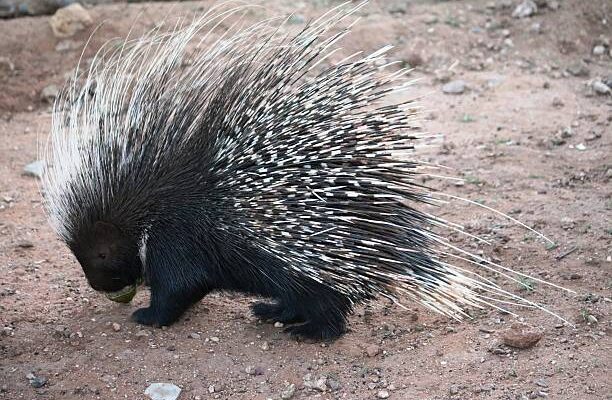
100 African Porcupine Stock Photos, Pictures & Royalty-Free Images - iStock
Cape Porcupine. Not our photos. I wish it were!

Last night, Tom was standing at the veranda sliding doors looking out into the garden. He spotted a porcupine, which, the moment he quietly opened the door, dashed into the bush, gone from sight. Of course, the sound of the door scared them away. Tom couldn’t have been more excited, as was I, but sorely disappointed I didn’t see it, even yet, get a photo. The likelihood of taking a photo of a porcupine at night, their preferred foraging time, is rather slim.

In 2018, dear friends Rita and Gerhard, who will soon return to Marloth Park while we’re here, managed to get a photo of a porcupine walking across their veranda late at night. We were so excited for them as they celebrated the unusual sighting. Last night before bed, I must have looked outside 20 times, hoping it would make another appearance. No such safari luck last night.

I went to bed with a smile on my face, thinking sometime down the road, we may be able to see it again. Louise mentioned that holes dug into the ground, porcupine shelters may have been flooded during the massive rainstorms over the past many weeks, bringing them out into the open more frequently than usual.

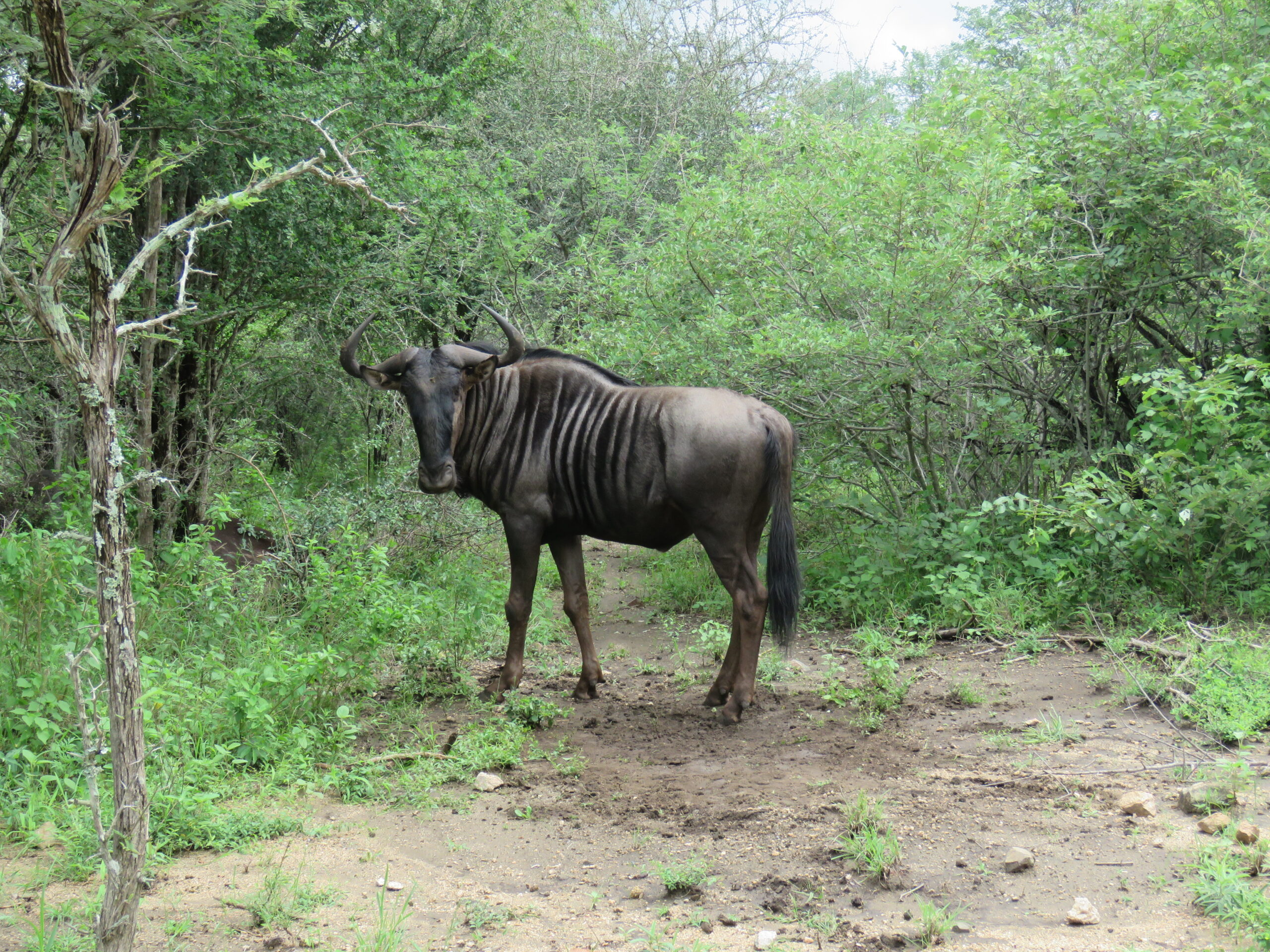
Wildebeest Willie can’t help himself. He loves to stop by.

We’ve had minimal visitors in the past few days with the regular weekend influx of tourists, who often feed the wildlife pellets and leftover human food. There’s no doubt the animals love eating chips, bread, corn, bagged snacks, sweets, and other such foods that may be toxic. This may result in them visiting those tourists as opposed to us. This has been the case over the time we’ve spent in Marloth Park. Weekends are typically quieter than weekdays.

But when unfamiliar and uneducated tourists come to this special area, they may not have the innate desire to keep the wildlife healthy and free from harm, as do those of us who have enjoyed the bush respecting the imperative balance of the wildlife’s diet. They aren’t like us, able to consume unhealthy foods and yet survive. The pellets are made entirely without chemicals and consist of the nutrients and vegetation found in their natural habitat.

Frank and The Misses were trotting over to the veranda for some pellets.

When the wildlife doesn’t have access to pellets, they continue to forage on the vegetation the rains have so blissfully provided to ensure a healthy diet for them. We only feed small amounts of pellets to anyone visiting species at a time and often see them revert to their usual sources of vegetation the moment the pellets we’ve tossed are consumed.

Other aspects of impairing the quality of life for the wildlife are loud music, loud talking and partying, teasing the animals, and most horrifying, speeding, and careless driving on the roads. Often during the many annual South African holidays, when usually the park is packed with tourists, an animal will be killed on the road. (Although Covid-19 has reduced the number of tourists during the past year).

Young Mr. Kudu was checking out the pellet situation in our garden.

Sure, wildlife often darts out into traffic onto a road with little notice of vehicles on the move. After all, they are animals, not humans, who’ve learned to look both ways before they cross. In these infrequent cases, an animal can be hit and fatally injured or killed.

Then, it is up to the rangers to determine if the animal must be euthanized or treated. Most often, the result has been euthanasia. It’s heartbreaking to read about these situations, whether from thoughtless, carelessness, or truly an accident. It’s hard to determine which was the case. If everyone were to drive slowly as posted on the road signs, 90% of these “accidents” would never transpire.

That’s not to say that all tourists fall into this category. There are many, like us, who arrive here with a passion for the care and treatment of wildlife, respecting their way of life and the fact that we humans are intruding upon their habitat, not the other way around.

Handsome kudu.

Also, it’s imperative to respect the many homeowners here, many of whom have used their life savings to own a home in this wildlife paradise and struggle to make ends meet while living on a fixed income as costs rise in the unstable economy in this country.

At times, tourists dump their garbage on the homeowner’s property, leaving for the monkeys to scavenge and litter the mess throughout the property and the bush neighborhood. At other times, we hear of burglaries in which TVs, computers, and other digital equipment, bedding, and household goods are taken. Most homeowners have security systems monitored by security companies located within Marloth Park but making sure it is engaged at all times is the responsibility of the owners and occupants.

We take the house keys in the bedroom at night with the red emergency button connected to a local security company. If there were an invasion or issue during the night, we’d need only push the button to set off the alarm. In minutes, the security people would arrive. But, if the keys are in another room, there would be no immediate recourse.

A herd or “clan” of impalas stopped by to check out the situation. They are very skittish, and if we make a move, they take off.

Another concern in Marloth Park is the risk of fire. Usually, the bush is arid, and it’s particularly susceptible to an outrageous, fast-moving fire. When visitors come, they must be educated on this matter and all of the items mentioned above, that yes, bonfires are fun and traditional in South Africa. Still, extreme care must be taken to ensure they are carefully and adequately observed during use and appropriately doused and put out after use.

Life here in the bush is not as simple as sitting back and enjoying the wildlife. There’s a huge responsibility that goes along with it. We can only hope and pray that this wildlife paradise will still be here in years to come, only possible with the love and support of those who visit and those who live here.

Have a great Tuesday, folks. It’s another hot and humid day here. The mozzies are on a rampage after me, so I may need to spend the better part of the day indoors. They are still biting even when loaded up with repellent. Go figure. Why they like me so much remains.

Photo from one year ago today, February 23, 2020:

Our first photo of the elusive Bengal Tiger in Kanha National Park in India. There she was. We couldn’t have asked for a better vantage point. For more photos, please click here.

Late start to post…Busy day in town…What did we spend?…

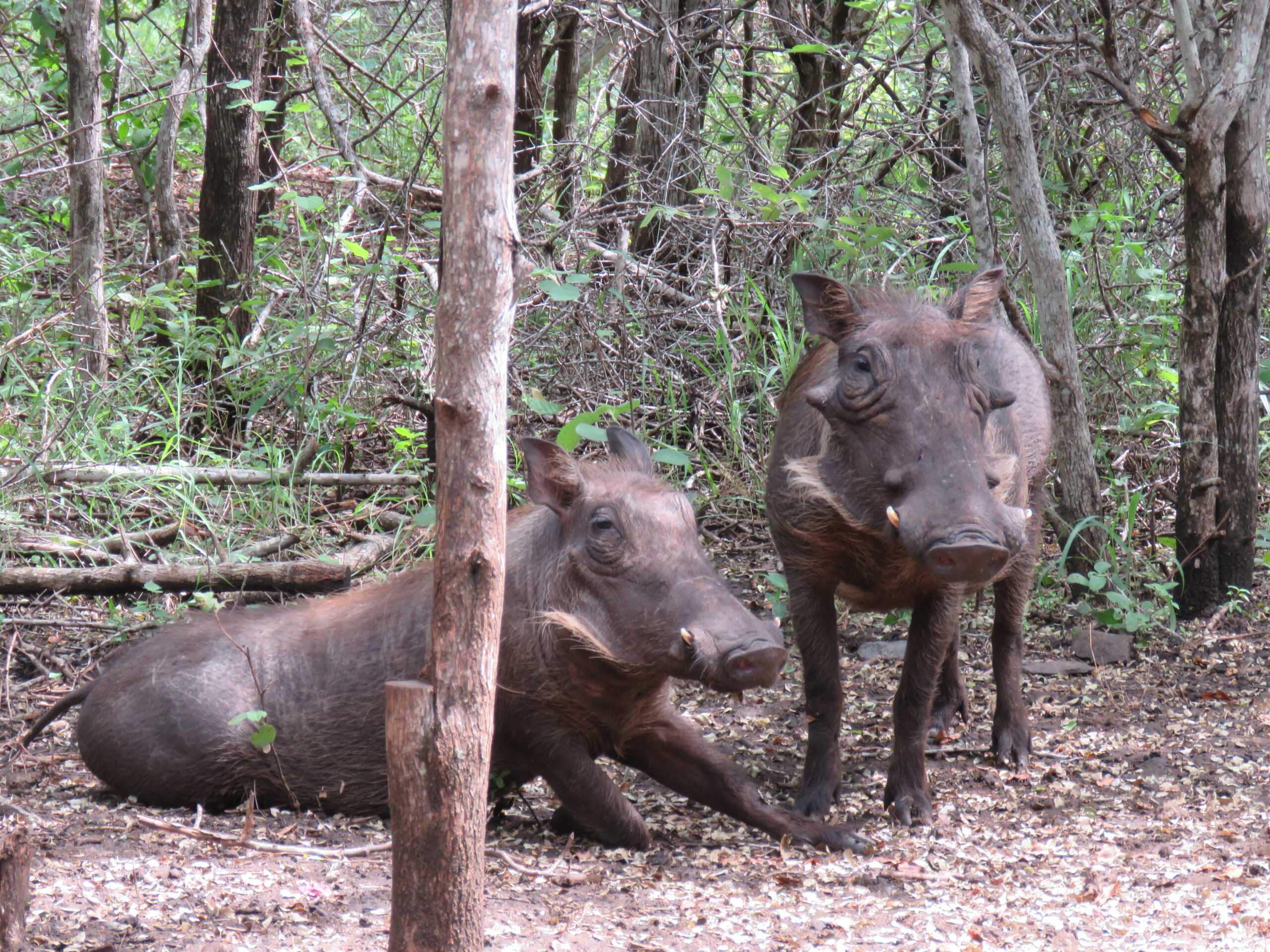
Fred and Ethel. Fred is lying down. Notice warts on his face, and Ethel is standing behind him. She had no facial warts, typical for females.

It’s after 2:00 pm on Monday, and we have a later start than usual in preparing the daily post. Most likely, I will be breezing through this to be done by 4:00 pm, the time of day that I like to focus on making dinner, relaxing, hanging out with Tom, and watching the animals in the garden. Right now, the only visitors we have here are warthogs, Fred and Ethel.

It was a busy morning. First, we had a 9:00 am appointment at Dr. Luzaan’s dental office. We had our teeth cleaned after a two-year hiatus, and she conducted a full head x-ray to see if the tooth abscess was improved and hopefully gone. No such luck. Although it had improved a little, it wasn’t good enough to “wait and see.”

On Monday, March 1st, we have an appointment with Dr. Singh, the dental surgeon in Malalane, when he will decide what needs to be done, most likely the removal of the crown, a comprehensive laser treatment, followed by a new crown. In the worst case, the tooth will have to be removed, and since it’s forward in my mouth, I will need some replacement tooth.

Due to having heart disease, I will have to take a mega dose of more antibiotics one hour before the procedure, whatever and whenever it will be. Yuck. I wouldn’t say I like any of this. But, who does? Dental work is not pleasant for anyone. Fortunately, my remaining teeth and gums are in excellent condition.

They posed for another photo with Ethel lying down and Fred standing.

Afterward the dentist appointment, we headed to Dr. Theo’s office for the results of some blood work and another exam. He feels my heart is good for now, but there were a few issues with my blood results which we’ll be working on going forward, too complicated to get into here now, which perhaps I’ll address here in the future, none of which are too problematic at this point. As we age, we often encounter such issues.

Dr. Theo was confident we’d be able to get the Covid-19 vaccine within a few months. This will give us the peace of mind many of us have been seeking during these challenging times. Of course, getting the vaccine doesn’t mean we won’t have to wear masks, social distance, wash our hands and take precautions from now on. It simply means that we may not become as sick as we may have without it if we do get infected. That’s what we’re reading so far.

After the doctor, we headed to the pharmacy for a few items and then to Spar Supermarket for a few weeks of groceries. It’s not that we count out each day’s meals when we shop. It’s just that after all these years of shopping for the two of us, we have been able to gauge how much we need to purchase for a specific period. Today, we spent ZAR 3462.46, US $233.22, enough to last until we easily shop again in two weeks.

We’d expected the bill to be so much more when our trolley was brimming with three bottles of wine, a box of light white wine, laundry soap, a lighter for outdoor insect repellent candles, and groceries. All of this would have been twice as much in the US.

They were exhausted after the photoshoot and from dining on pellets.

Our dental bill, including cleanings and more x-rays, totaled ZAR $1265, US $85,21. The two appointments with Dr. Theo, including an ECG/EKG and two exams, totaled ZAR 1471.40, US $99.11. Amazing! Not only do we love South Africa for its wildlife and people, but prices on most services and products are considerably lower than in many counties in which we’ve lived over the years, including the US.

At the moment, we’re cooking a pork roast on the braai with dinner planned for about 5:00 pm. We’ve found that eating dinner earlier is more beneficial to our health when the entire meal is fully digested before bed, preventing any potential intestinal distress or acid reflux before lying down. We rarely eat anything after dinner.

Yesterday was a scorcher when the humidity, combined with the temperature, was unbearable. Today, it’s much more comfortable, and we’re having no problem enjoying the outdoors. If we can keep the mosquitoes at bay, I imagine we’ll be on the veranda well into the evening.

That’s it for today, folks. I’m about to go indoors to work on a few side dishes for dinner. All is well. We’re content.

We hope you are content, too.

Photo from one year ago today, February 22, 2020:

We couldn’t have been more thrilled with our private tour guide, Dr. Anand Tiwari, who had a doctor’s degree in Hindu idols. He explained he’d done a tour the previous day with guests on the Maharajas Express! What a coincidence and an honor for us! He can be reached here for tours. For the year-ago post, please click here.

A birthday celebration to remember…

Dawn, Leon, and Lyn set up a unique birthday table at Jabula for my birthday, including decorations and gifts. They are so thoughtful!

After a relatively quiet day, partially spent indoors to escape the mosquitoes, who hover over me, we lathered up with repellent from head to toe to venture out to an evening of festivities celebrating my birthday. It couldn’t have been more fun. As shown in the photo below, we started at Louise and Danie’s fabulous custom-made bar in their home for drinks and a delightful setup.

Louise had set up the bar with delicious starters appropriate for our way of eating, decorated with gifts, candlelight, flowers, and more.

Weeks ago, they presented me with an early birthday gift, as soon as the alcohol ban ended, with 11 bottles (all that was available in the liquor store at the time) my favorite light red wine, Four Cousins Skinny Red with only 8.5% alcohol. “The alcohol content of red wine usually falls between 12% and 15%, with an average of 13.5% ABV.”

The table was set beautifully for my birthday, but when the power went out, we had to move to the veranda off of the indoor part of the restaurant. Shortly later, Leon restored the power, and we stayed put on the veranda.

This lower alcohol content is perfect for me and was my favorite when we were here in 2018/2019. I was shocked by their generous gift, and we offered to pay them for it, but they flatly refused. It was for my birthday, they insisted! I have savored the wine very frugally and was relieved to find it available at the grocery store and the liquor store, now that supplies have been replenished since the ban ended. But, I still have many unopened bottles left. Thank you, Louise and Danie, for this generous gift!

Our dear friends Louise and Danie have a magical way of making every get-together special.

With the possibility of another alcohol ban in the future, tomorrow, when we head to Komatipoorrt to the dentist and shop, we’ll purchase a few more bottles for me, brandy for Tom, and a few other wines for visiting guests. Prices on locally grown wines are as much as 70% – 80% lower cost in South Africa than the same wines would be in the USA. It’s no wonder South Africans enjoy their wine, some of the best in the world.

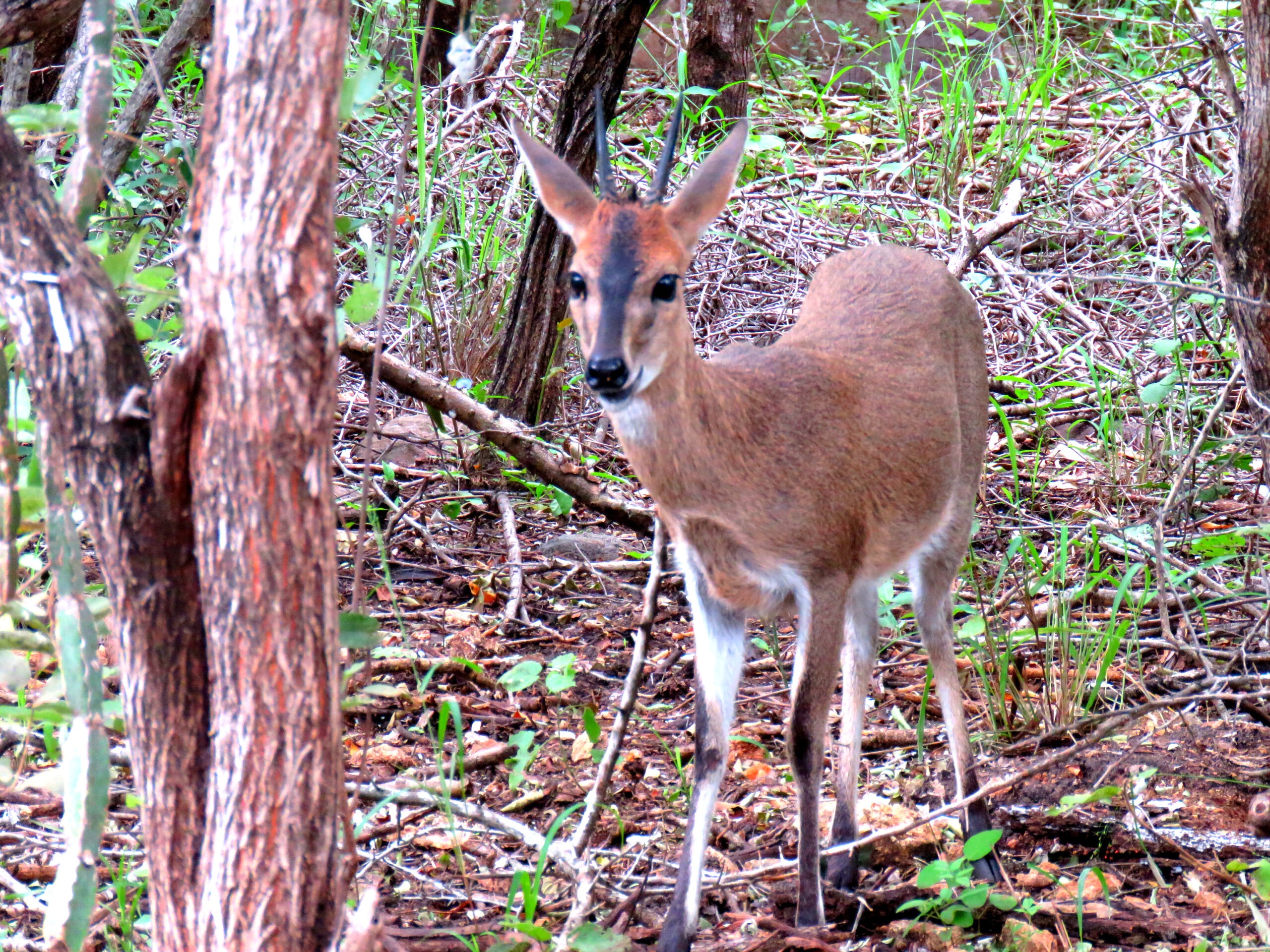
Our first duiker visitor stopped by on my birthday. They are so tiny and delicate.

We’d made a reservation for Jabula at 6:00 pm but, the time at their bar flew by so quickly. It was well past 6:00 when we realized it was time to go. I sent Lyn a text message to say we were on our way. We each drove our vehicles to the restaurant for social distancing purposes and were seated appropriately at the table.

He couldn’t have been more adorable. “The common name “duiker” comes from the Afrikaans word duck, or Dutch duiken – both mean “to dive,” which refers to the practice of the animals to frequently dive into vegetation for cover. … The Ruwenzori duiker is generally considered to be a subspecies of the black-fronted duiker (C. nigrifrons).”

Contrary to our former visits to Jabula, we avoided the indoor bar area. We felt safe there with reasonable precautions taken by Dawn, Leon, Lyn, and the other staff. Having nibbled on the delicious starters at Louise and Danie’s home, I had little appetite. I ended up ordering the peri-peri chicken livers, a favorite dish of mine that fits into my way of eating.

A young male kudu sheltered in the shade to cool off in the heat.

On the other hand, Tom ordered his favorite barbecue baby back ribs, chips (fries), and a Greek salad (which he never ate). I gave him my bread that came along with the chicken livers, which he generously slathered with butter. He certainly deserved the treat with his health good and weight at the lowest in over seven years. Danie also had chicken livers, and since they eat the same as we do, he also gave Tom his bread.

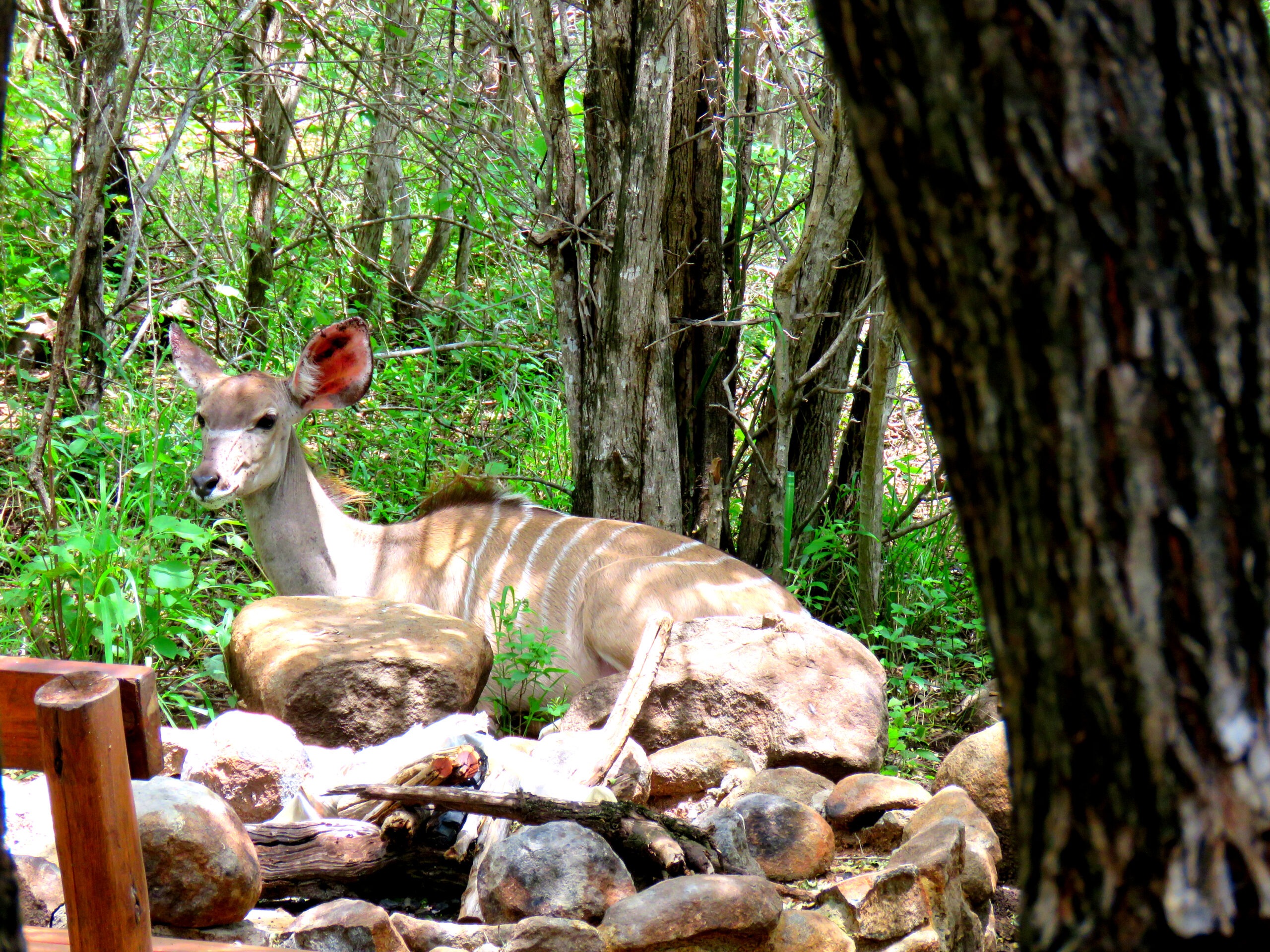
A young female kudu did the same.

Not only did we thoroughly enjoy the lively conversation at our table, but people stopped by to say hello, including Dawn and Leon, who celebrated along with us. It couldn’t have been a more delightful evening. By 9:00 pm, we made our way down the dark stairway to the parking lot to head back to our place, appreciating the loud sounds of frogs croaking in the pond along the way.

Two zebras, playing on the road on our way to Jabula.

Adding to the evening’s festivities, six giraffes were blocking the road on our way back. Back at our house, we hunkered down for the remainder of the evening while I spent no less than two hours thanking friends and family for the birthday wishes. It meant so much to hear from our readers, family members, old and new friends, and Facebook friends. I am truly blessed. If I missed saying thank you, I apologize. I tried to contact every sender with a heartfelt thank you.

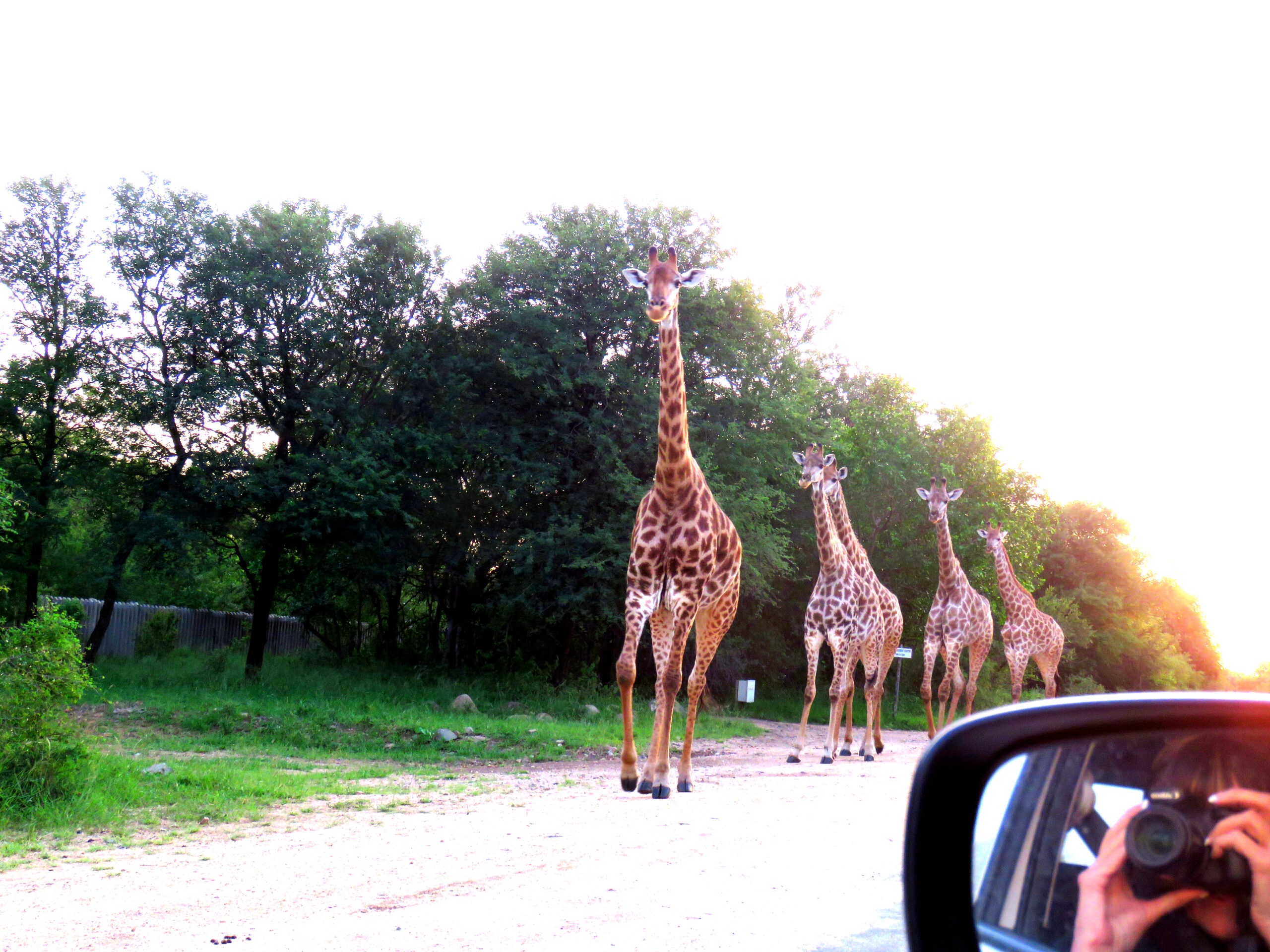
Here are five giraffes we spotted on the way to my birthday celebration. When we left Jabula hours later, six giraffes were blocking the road in the dark,  but with no street lights and not wanting to scare them with the flash, we didn’t take a photo. Thank you, giraffes, for adding to my birthday activities.

May your day be filled with comfort and appreciation for times to come in the future.

Photo from one year ago today, February 21, 2020:

This elderly weaver spent long days at the King of Brocade Textile Company in Varanasi, India, working at these looms. For more photos, please click here.

Today is the fourth of my past nine travel birthdays to be spent in Marloth Park…It’s truly a gift to be here…

We wrote in the caption of this photo, on my 70th birthday in 2018, at my party at Jabula with friends: “We’ll always remember this birthday as a special event for both of us; celebrating life, health, our experiences, and the fine friends we’ve made along the way.” For more from that date, please click here.

Today’s photos are from this post on February 21, 2018, the day after my birthday.

This morning, it dawned on us that today is the fourth of nine birthdays since we began traveling that we’ve spent in Marloth Park. We were here on this date in 2014, 2018, 2019, and now 2021. Of course, 2019 wasn’t so pleasant when I spent it in ICU in Nelspruit after open-heart surgery. But I leave that memory behind and think of the joy of the other three birthdays, among friends, my dear husband Tom, and the beautiful wildlife surrounding us.

Dawn had decorated the table beautifully for the party. Thanks, Dawn! By the time we were all seated, it was dark, cozy, and romantic.

In 2018, Tom decided we’d return to Marloth Park for my 70th birthday as a surprise to me. I couldn’t have been more excited! Tonight will be no different than the fun we had on three of those birthdays, spending this evening with Louise and Danie at Jabula Restaurant at a socially distanced outdoor table.

Our friends filled a big table on that date at Jabula Lodge and Restaurant. At the same time, we drank wine and cocktails, dined on fabulous food, and enjoyed the companionship of everyone at the table, along with many others who stopped by. Dawn and Leon, dear friends and owners of Jabula, made it very special as well.

Linda, Mick, and Louise, with Ken and Don standing. Linda and Ken will be here in Marloth Park next Friday, and others will follow in the months to come!

But, with Covid-19, every celebration must be different. There will be no large groups, no hugging, and no proximity to others. We’ll especially load up on repellent when, after weeks of rain, the mozzies are on a rampage with risks of malaria higher than ever.

At the moment, we’re outdoors on the veranda waiting for visitors to come to say hello. So far, only Ms. Dove and Helmeted Guinea-fowls and the Chicks have stopped by. But the day is young, and a lot more could happen between now and 4:45 pm when we head to Louise and Danie‘s for sundowners before we all head out to dinner. No doubt, it will be a good day.

Wow! We were thrilled with the “cake of the world!”  Local baker Janine even made the two representations of Tom and me totally by hand.

I’d thought about sharing past birthday posts but chose only to highlight the “big one,” my 70th, in 2018, although the others were special and memorable. In the realm of things, especially during these difficult times of Covid-19, and considering our current ages, birthdays aren’t as important as they once may have been.

However, few of us mind the love and attention we receive on our special day, once a year. That’s not to say that other days aren’t unique. At this stage in life, every day is truly a gift.

After the dinner plates were cleared, the cake was delivered to the table. Thanks, Kathy, for bringing the candles!

It’s hard for me to grasp how old I am. For some reason can’t wrap my brain around it. Gosh, it was only yesterday that Tom and I met when I was 43 years old, and he was 38. This June we’ll celebrate 30 years together. The time has flown.

Although, like everyone’s life, at times there were challenges, Together, we have stuck like glue, appreciating and embracing our loving and close union, which certainly was tested in those 1tenmonths in the hotel room in Mumbai, India. We stayed strong and determined together, and surprisingly, we came out on the other side unscathed. If anything, we are closer than ever. That, dear readers, is the best gift of all.

Kathy, me, Tom, Lynne and Danie at the end of the table.

No, there won’t be a cake or candles to blow out (a gross thought in times of Covid, anyway), no gifts to open (i don’t need or want a thing, no cards in the mail (although I’ve received some very thoughtful online cards), Before the day’s end, I’ll have more birthday wishes from family and friends, greetings from many Facebook friends and all the love and attention a person can imagine.

I am truly blessed and grateful. Thank you for all the warm wishes. Thank you for sharing this journey with us!

Be well.

Photo from one year ago today, February 20, 2020:

The celebration on the Ganges River at night in Khajuraho. The nine umbrellas represent the nine planets. Hindus value every aspect of the planet and the universe. For more, please click here.

Lovely bushbucks…Persistent pig on a mission…Oh, oh, damage done!…

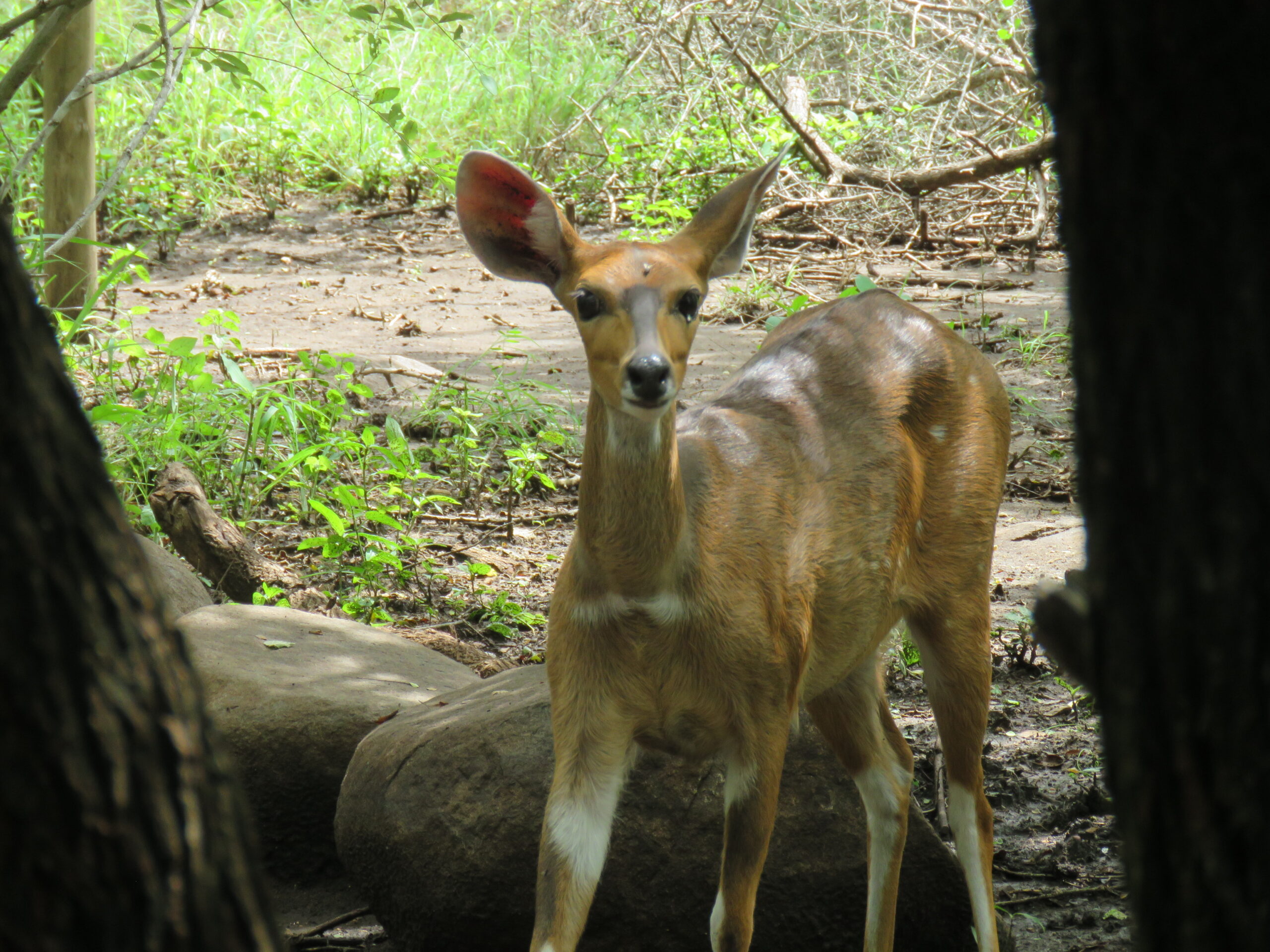
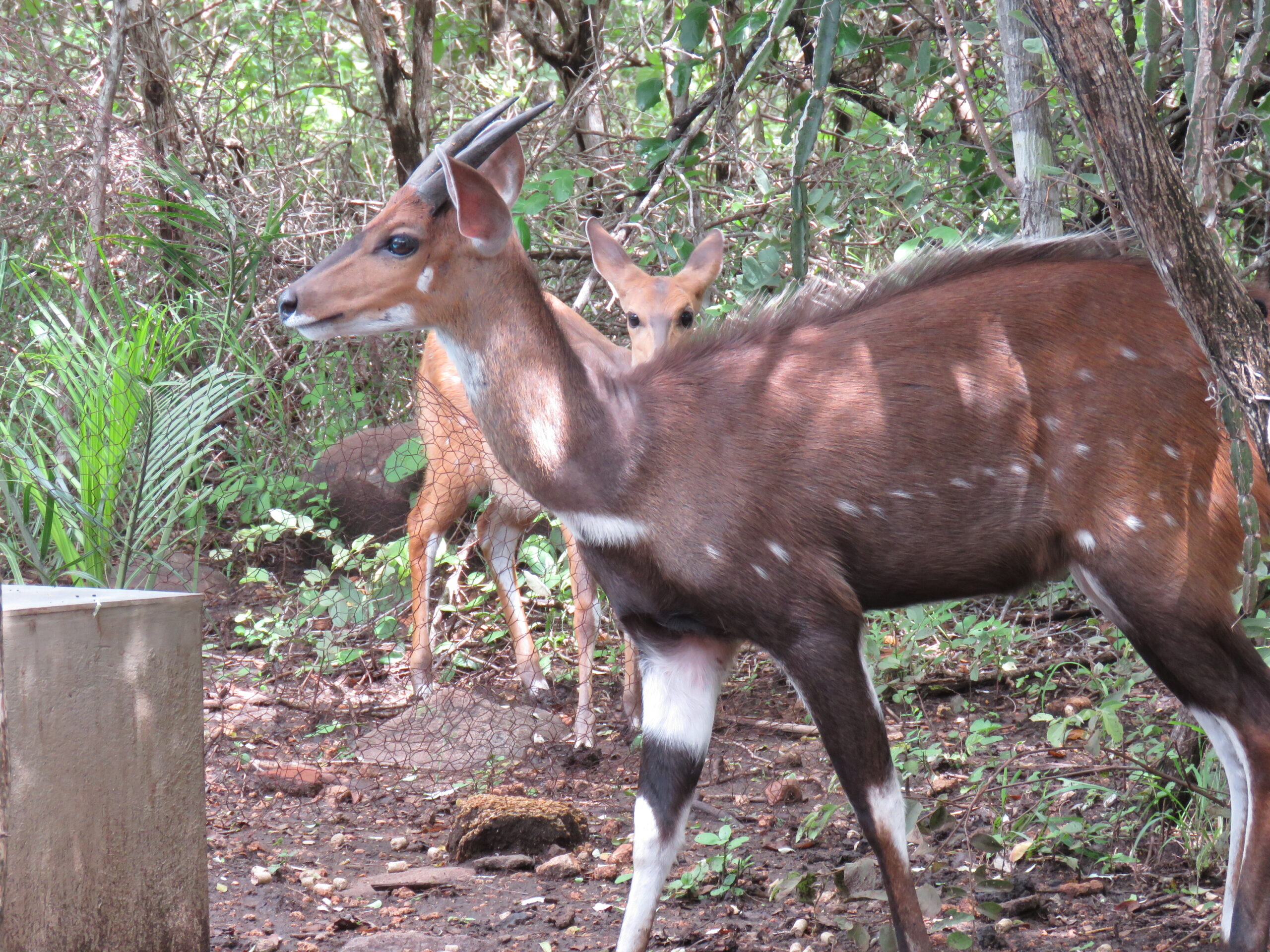
  • Adorable female bushbuck.

Yesterday, while I was indoors, a persistent pig, albeit a warthog, identity unknown at this point, came up onto the veranda and tore a sizable hole in the sliding screen door. I was indoors at the time, but Tom caught the tail-end of his persistence. Was he looking for me or merely looking for me to offer him some pellets? Pigs are clever and, by some scientific observers, purported to be the 5th or 6th most intelligent animal on the planet. But, most likely, he was looking for pellets. I flatter myself in thinking it was otherwise.

We were disappointed to see the damage to the screen but relieved to know that Vusi will repair it soon using a roll of screening material Louise and Danie have on hand. Whew! If I were a warthog and wanted something, surely I’d forge ahead, using my most valuable weapon, the sharp-razor blade-like tusks nature provided to use for protection against apex predators and for digging up roots for food.

Handsome Mr. Bushbuck, maybe her mate.

A few minutes ago, when I got up to get more coffee, Frank (Francolin) followed me into the house. I had to shoo him out since birds can panic when they feel trapped in a house. Of course, this was another laugh-fest for us. It’s surprising how quickly the wildlife feels comfortable enough with us to be so persistent.

Of course, immediately, I gathered up a container of seeds for him and The Misses and placed them on the cement edge of the veranda instead of on the muddy dirt in the garden. They didn’t flinch when I was right next to them. It’s so endearing, even though their acceptance of us took over a month to achieve.

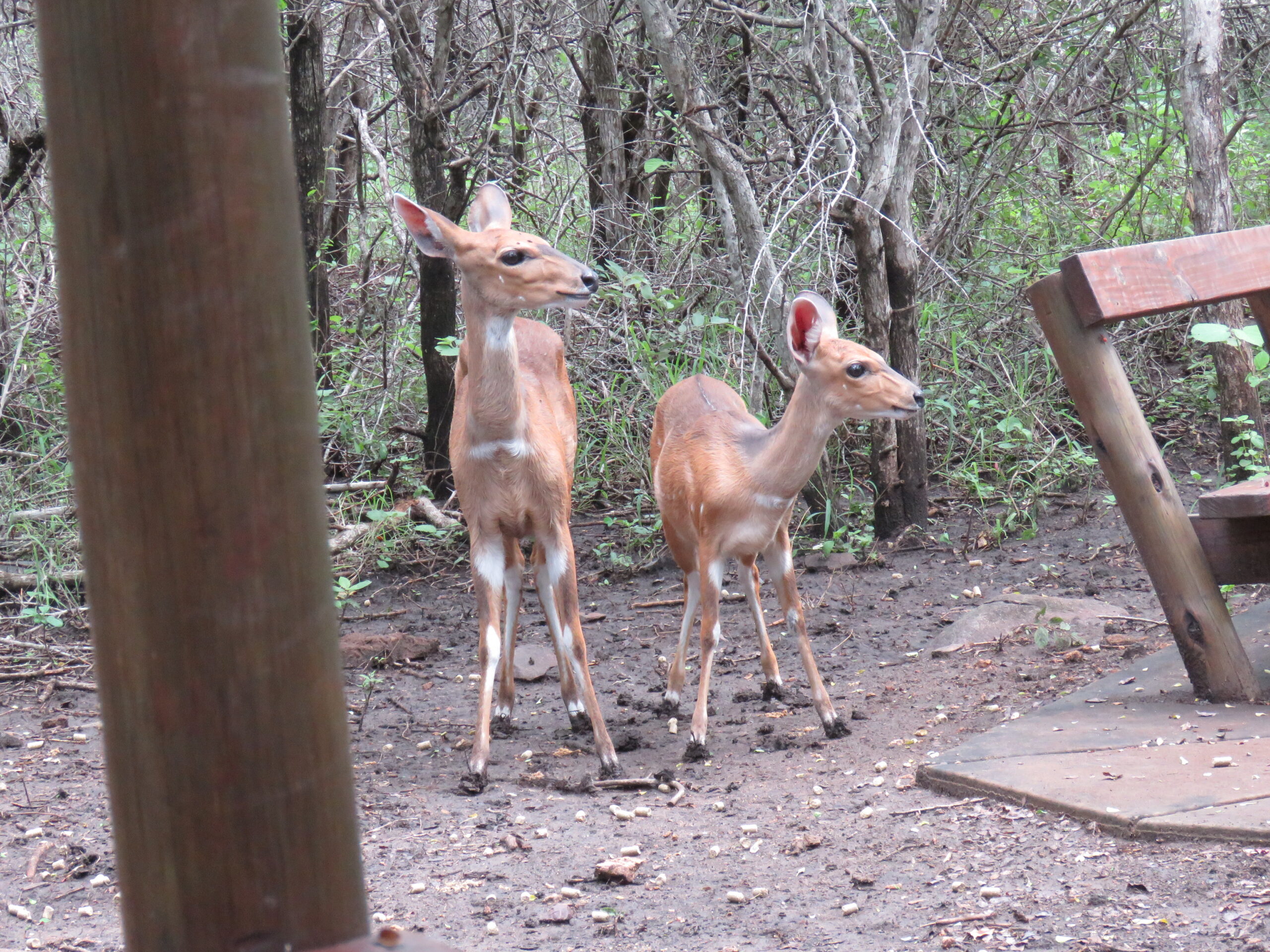
Mom and Baby Bushbuck strike a pose.

When I put seeds down for Frank and his various family members, if any are left after they are done eating, once the warthogs arrive, they immediately go after the seeds, the minute they’ve cleaned out the supply of pellets we’ve provided. In every case, I put up my hand in a “no” signal and say, in a high-pitched voice, “Don’t eat the seeds.” They’ve already learned the hand signal, and I no longer need to say a thing, just put up my hand. With their little beady eyes, they know what I mean. It’s not unlike training a dog, whose intellect ranks in the following position of intelligent animals, behind all pig breeds.

Kudus are also known to eat bird seeds at our old house in Marloth Park in 2018/2019. We’d placed a bird feeder in a tree. Invariably certain kudus would practically stand on their tiptoes to eat the seeds out of the feeder. Now, they seem less interested in the sources on the ground that Frank leaves behind. Pellets are their priority.

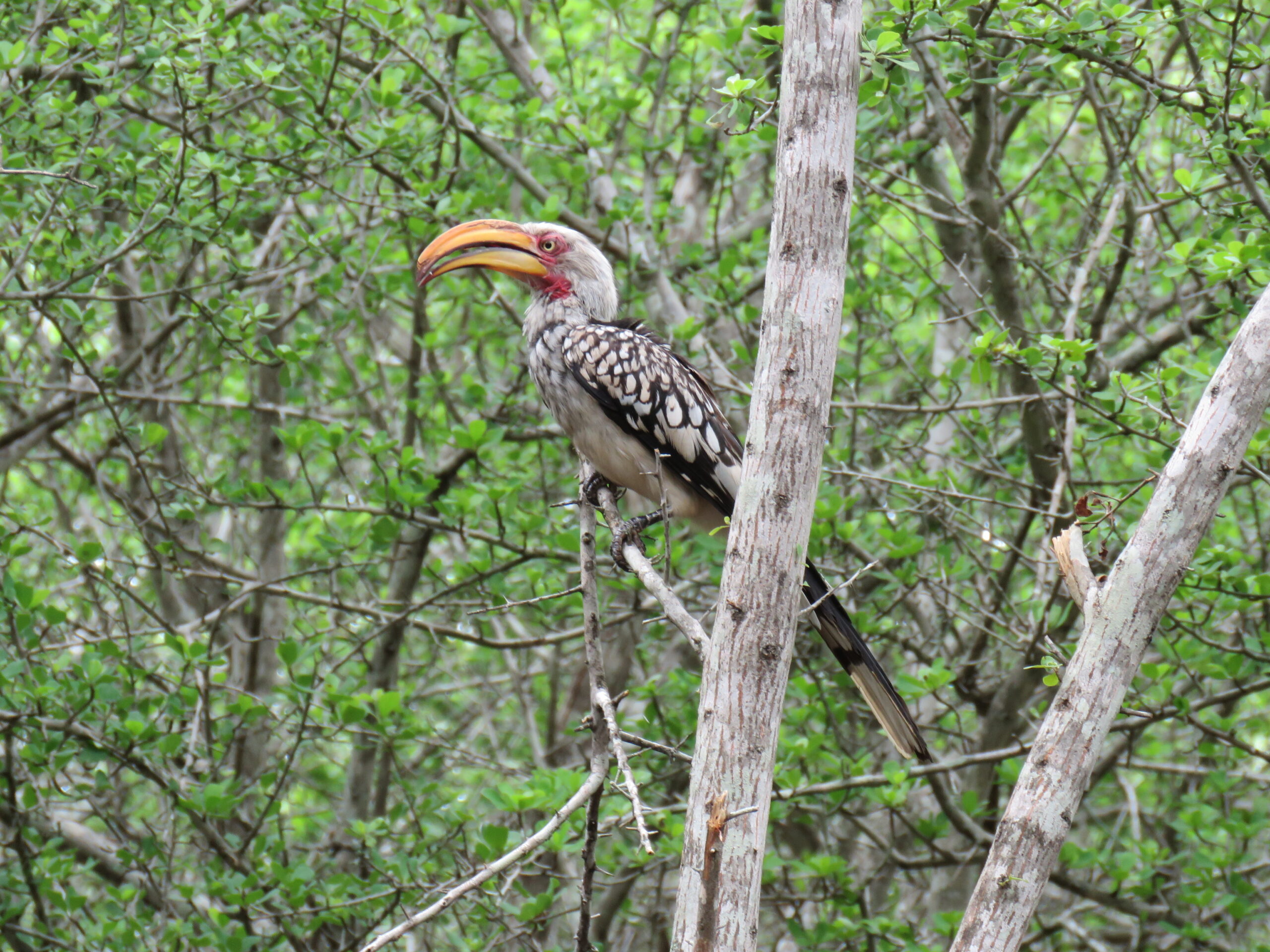
We can always count on Mr. Hornbill making an appearance.

By nature, kudus, wildebeest, zebras, and others are inclined to be “reaching up”  to eat greenery on trees and plants.  Giraffes don’t bend down to eat the pellets but will do so to drink water. Thus, there is no food source the residents of Marloth Park can provide for the giraffes.

Over the years, these other species in Marloth Park have learned that pellets placed on the ground are also a good and tasty source of nutrition. Now, after all the rains, with the lush greenery in the bush providing them with abundant food sources, they still like the ease and convenience of eating pellets off the ground from any sources offered.

Wildebeest Willie, always available for a photo op.

By far, pellets are healthier than “fast food,” but, maybe in a sense, they are the fast food savored by the various wildlife, particularly zebras, kudus, warthogs, and wildebeest. If no pellets are available, they will consume the leaves on the trees. However, in most cases, when pellets are available, they’ll eat them first and then go after the vegetation.

Thus, not offering them pellets doesn’t cause them to starve, except in times of severe drought during which periods, the homeowners and residents ramp up in offering pellets, carrots, apples, sweet potatoes, and Lucerne (hay). It is this effort that has ultimately saved many of the animals in Marloth Park over the years.

Warthogs and kudus were generally getting along while eating pellets.

Of course, there is the controversial theory that when there is a drought, let “nature takes its course” and let starvation prevail. This is what happens in Kruger National Park during a drought. Many animals die from starvation and lack of water. But, it’s just about impossible for us animal-lovers in Marloth Park to sit back and let this happen. After all, isn’t that why we’re here in this hot, humid, insect, and snake-infested area with some of the worst dirt roads on the planet?  It is.

So, folks, that’s it for today. Enjoy our new photos. We’ll be back with more tomorrow!

Photo from one year ago today, February 18, 2020:

A lovely Indian couple we met at the airport on our way to Varanasi. For more, please click here.

The wind was roaring…The power and WiFi were out!…What a day and night!…Covered in bites…Chicks.

Helmeted Guinea-fowl and their four chicks stop by daily for seeds. They are so shy it’s difficult to take a good photo when they don’t stay still for a moment.

Africa has its challenges. As is the case in most countries with extreme humidity, when it rains for days, weeks, or months, the mosquitoes breed in standing water as follows:

“10 to 14 days
How Long Does It Take for Mosquitoes to Breed on Standing Water? The length of the mosquito breeding cycle varies by species, but mosquitoes generally need 10 to 14 days to develop in standing water. Insect control authorities often recommend dumping any standing water at least once a week.”
Of course, we are well aware of the malaria risks when being bitten. Our friend Alan lost his dear wife and nearly died from a rare form of malaria, which they both contracted while living in Marloth Park in 2019. People who live here regularly don’t take malaria tablets. The side effects are too dangerous for long-term prevention. Instead, like me, they use the dreaded DEET, the only chemical that has the potential to work.
Mom and Dad and four chicks, of which only two are shown in this photo.
But, even so, we all still get bites. It’s easy to miss a spot when applying the product or be an hour late in re-applying the next round, usually every six hours. There’s no easy answer.
There is a pond with vegetation growing outside our bedroom window. It’s no wonder we are being bombarded day and night. Then again, Tom rarely is bitten and doesn’t wear repellent, except when we’re outside at night. At this point, after weeks of non-stop rain and humidity, I have no less than 50 bites.
Although I cover myself with Tabard Repellent, popular in South Africa, specific to its types of mosquitoes, a DEET-containing product, every six hours, I don’t protect my eyes, face, and head, but now, they are biting me on my eyelids in a desperate search for some exposed skin. Finally, I’m starting to feel better from being off of those strong antibiotics, and now I am constantly itching.
Two Ms. Bushbucks were looking for pellets.
Last night was when I could finally savor a glass of wine with the required eight days passing since I started the antibiotics. There was nothing for us to do indoors with the WiFi and power out in the inclement weather. We decided to “rough it” in the bad weather, and we spent the evening on the veranda to have our first sundowners in a while. I loaded up on repellent from head to toe to ensure I wouldn’t be stricken with one more mosquito bite. It worked out.
It appears that about half of my “bites” are reactions from dust mites to which I am allergic. Oh, good grief. I inherited most of these medical issues (allergies, heart disease, diabetes, hypertension, joint problems, and on and on), and I was a bit fed up yesterday but feeling better today after a good night’s sleep.
With the power out and no idea when it would be restored, we decided to make the best of the evening. We’d never experienced such high winds in South Africa during the 19 months we’ve spent in this country in the past eight years. Yesterday’s midday meal required the use of the electric stove, which, when the power wasn’t restored, we had no choice but to cook on the braai. We managed to figure it out, although our meal wasn’t as good as it would have been cooked on the stovetop. The power and WiFi both came back on during the night.
Mom and maturing baby bushbuck.
Whew! I’m not particularly eager to whinge in our posts, nor do I care to complain much to Tom. He’s so accepting of my various health issues, but only because I spend as little time as possible talking about them. He’s well aware of my problems and is entirely supportive. I can only imagine what a mess I’d be if I didn’t work hard as possible to be healthy.
But, these are the realities of living in South Africa and other parts of Africa with the heat and humidity due to the unpredictable weather. The insects are another thing.
While in the hotel room in Mumbai, India, I promised myself that no matter how bad the weather, the insects, and the bites, I’d still be grateful to be here, and I am. Only moments ago, Tom came in to tell me that Frank and The Misses were on the veranda, looking for me. When these situations occur, I forget all about the inconveniences and revel in the joys of why we are here.
Once again, Wildebeest Willie poses for a photo.
Yes, I could avoid mentioning any of my woes on our site. But, we always promised to “tell it like it is.” By no means am I a “Pollyanna” pretending that all is sweetness and light. Once, while living in Minnesota, we lost power for five days due to a severe summer storm. That was a tough five days. Nowhere in the world is exempt from issues of daily life, and here is no exception. Right now, the power outages in the US are equally challenging for many citizens to tolerate.
Last night in the wind and rain, we sat on the veranda while I was sipping on my glass of wine and  Tom, on his cocktail, reveling in the joys the bush has to offer. We were pleasantly surprised when it proved to be the most prolific night of visitors we’ve had since we arrived over a month ago. We were thrilled! Photos will follow tomorrow.
Stay safe. Stay healthy.
Photo from one year ago today, February 17, 2020:
The soldier prepared for the big event, the nightly ceremony closing the borders between India and Pakistan. For more, please click here.

Out and about in the park…Fabulous sightings, even on a rainy day…Odd ossicones…

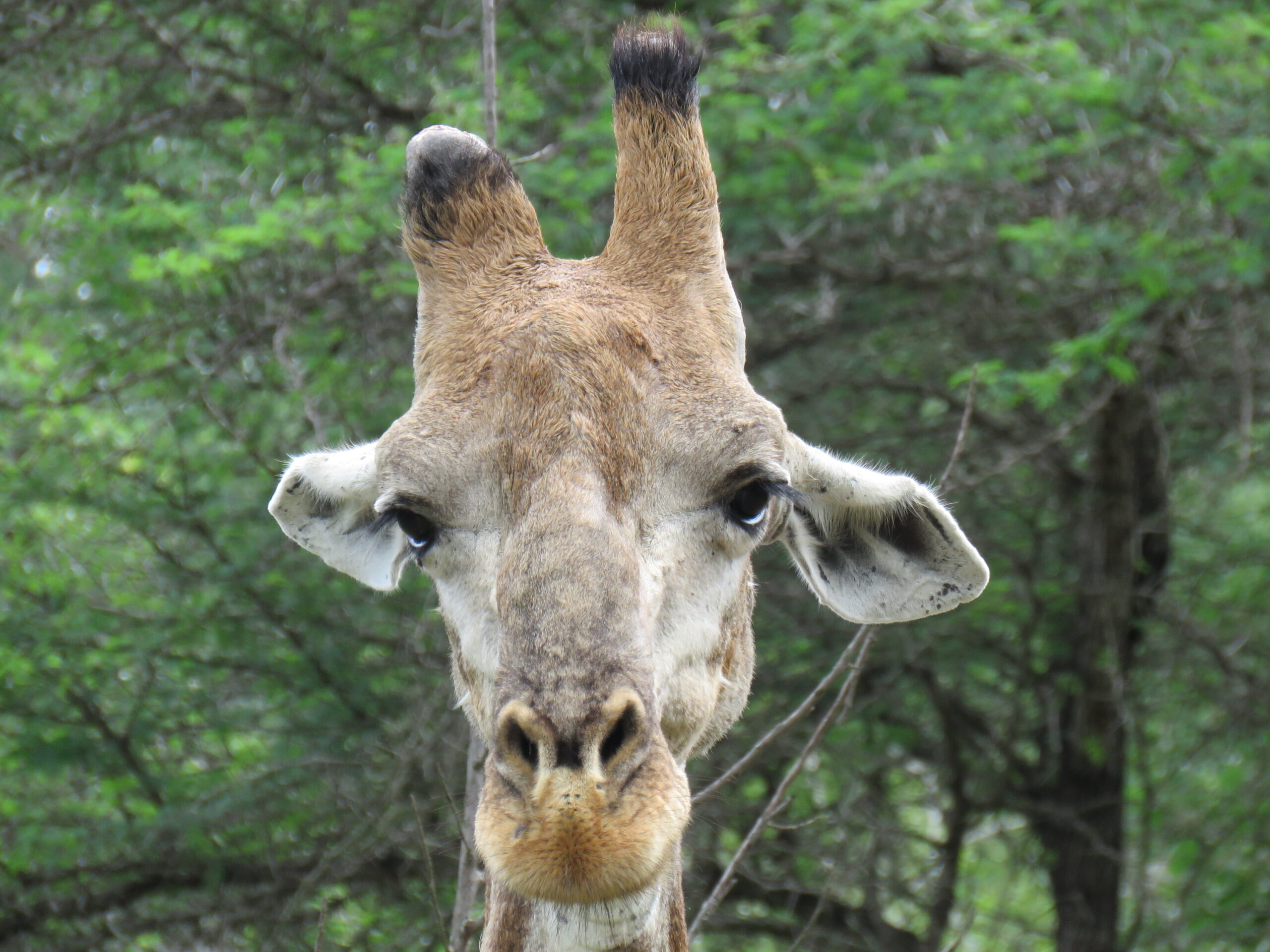
What’s with the uneven ossicones? We couldn’t stop laughing!

It’s been a week since we shopped, and as much as we preferred to wait until the following Monday with the roads so bad, we needed a few vital ingredients. Instead of driving to Komatipoort in the rain, we decided to stop at one of the two local markets for the items we needed now, including eggs, cheese, tea bags, and sparkling water.

As has been the case every night over the past many weeks, it rained all night long and is pouring now as I write this, only minutes after our return from the trip to the local market. Our garden is still muddy, but it rained so hard, the uneven clumps of mud have smoothed out, creating a better base for the wildlife.

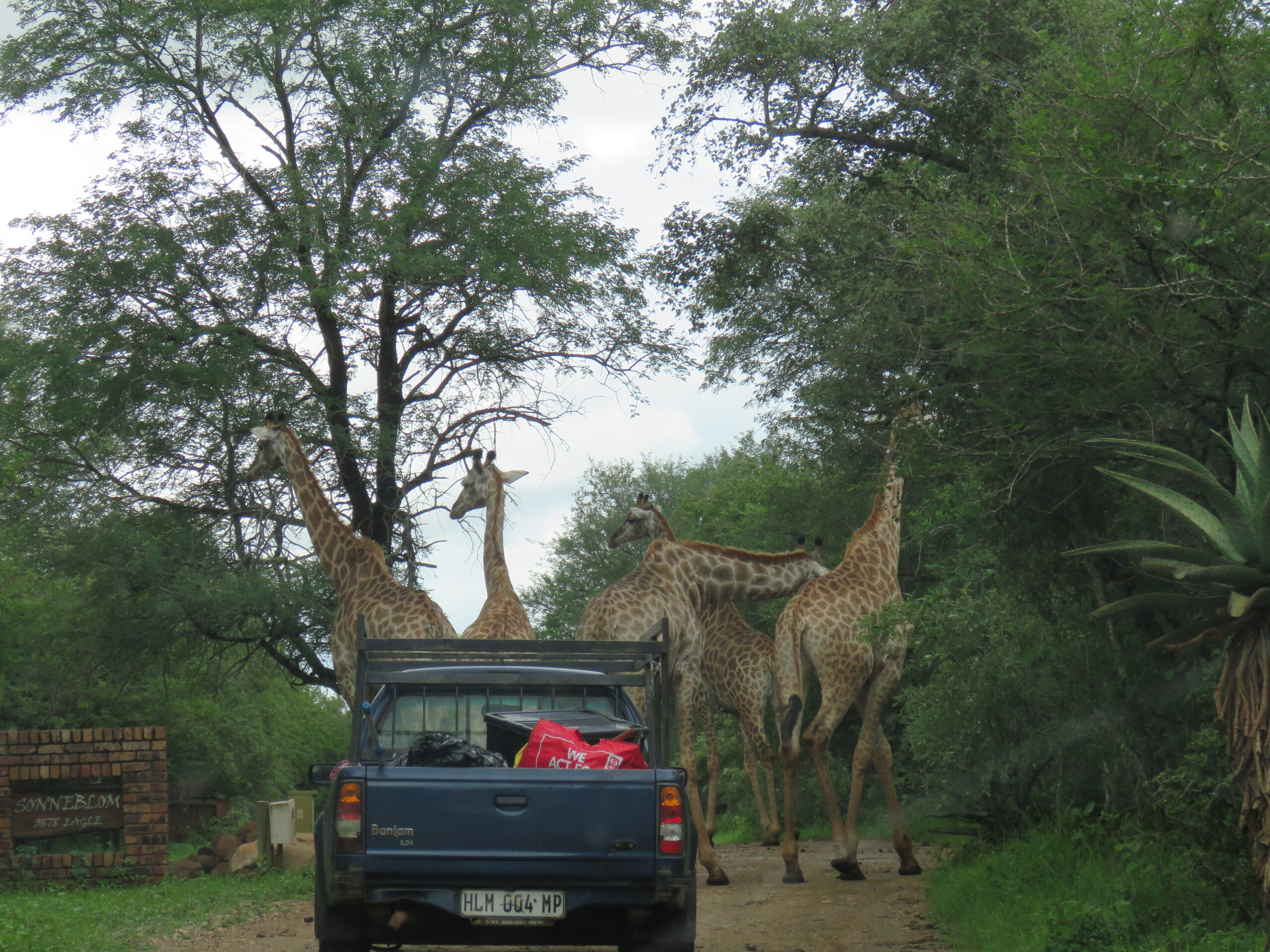
While returning to our house, we spotted Vusi’s truck trying to maneuver his way past the giraffes on the way to our house!

Yesterday, while peering out the kitchen window to the end of our long driveway, for the first time, we saw the ostrich family walking past, and an hour later, four or five giraffes. There was no way we could have put on our shoes and made it down the muddy driveway in time for photos. Nor could we have driven the car down there in time, scaring them off in the process.

Regardless of what some naysayers may acknowledge about Marloth Park’s wildlife being tame, they are ill-advised. Although an animal may tentatively engage with a human in the park, they are still wild, and when we are not there to feed them, they care for themselves, foraging for food, shelter, and comfort in this wild bush environment.

Lounging in the grass. I’d imagine giraffe’s joints might be painful in such awful humidity.

The fear that many homeowners and park enthusiasts like us possess is that, eventually, all the empty stands (lots) will be built upon, leaving fewer wildlife areas for the animals to forage and live in the actual wild freely. That could transpire in the next 10 to 20 years or even sooner.

The reality for us is that most likely in the years to come, should we be fortunate to live long lives, we may not be able to return to the park for the enjoyment we are deriving at this time.  Only the unknown future will present such options as time goes by.

Safari luck! Love seeing the giraffes!

No one knows what the future holds once they reach 80 years old or older (or any age for that matter). We can only hope to maintain a level of fitness, health, and well-being that will allow us to continue to travel as far out as seven years from now when I reach 80. Gosh, I have a hard time digesting this reality when in a mere five days, on February 20th, I’ll reach my 73rd birthday.

The past 30 years seem to have flown by. That in itself is mind-boggling. Only yesterday, I was 30 years old, or even 43 years old, when I met Tom in 1991. In June, we’ll have been together for 30 years. In itself, that’s hard to wrap our brains around. But, regardless of how much time any of us may have left on this earth, we still strive to make each day meaningful and worthwhile.

Could giraffes be any more adorable?

I know it may seem easy for us to say about living enriched lives when all we do is continue to travel and immerse ourselves in our immediate surroundings. But, even in that hotel room for ten months in Mumbai, India, we had many moments of meaning and purpose. And, of course, even our old lives were rich in experiences, love, and purpose from which we derived great joy.

Why did we choose to change it? And, why don’t we return to that life?

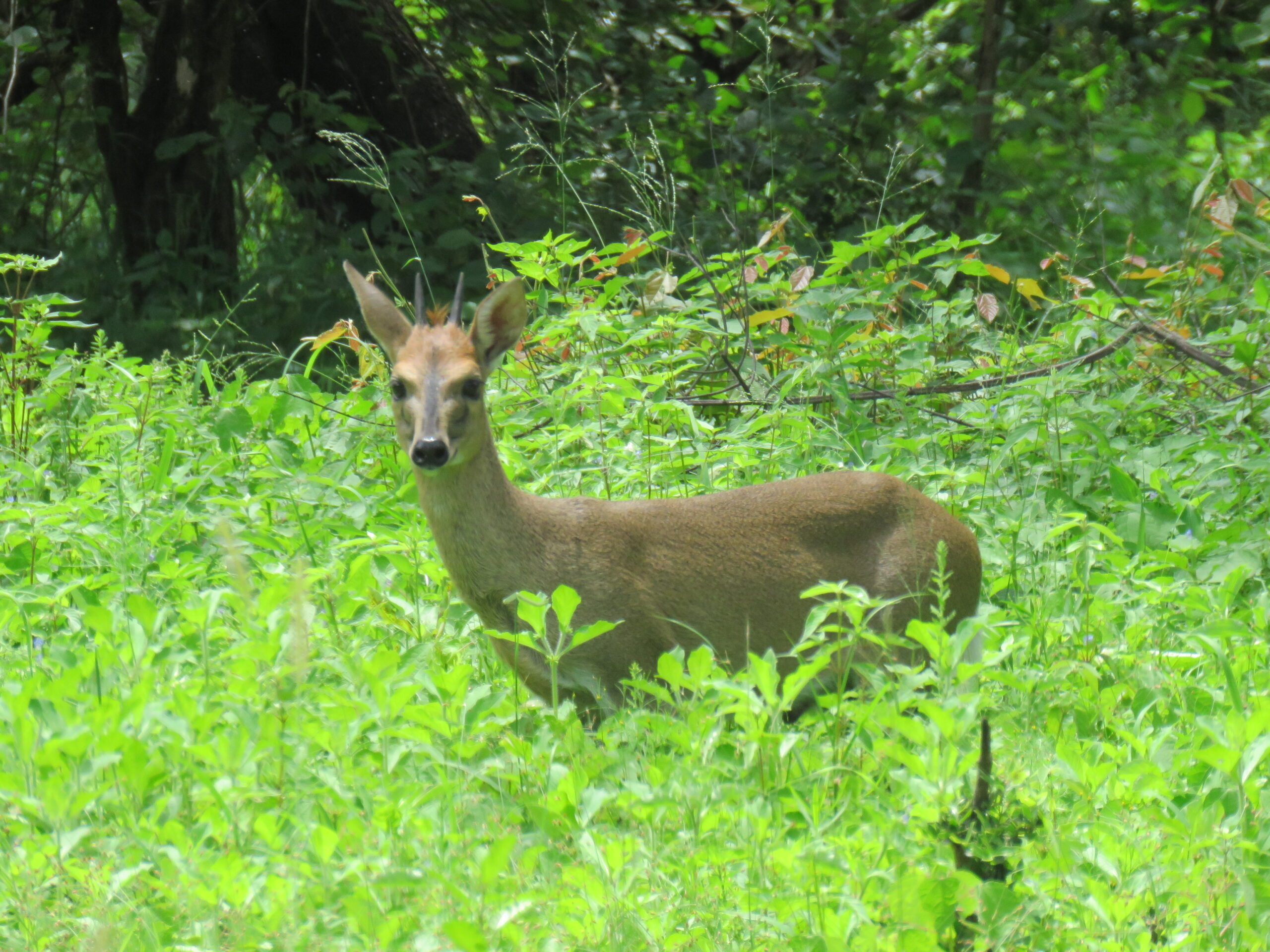
Handsome male duiker in the bush this morning.

We chose to travel the world for two simple reasons: that we could and wanted to. We could step outside the box of the  “expected” lifestyle for most seniors to embrace a lifestyle so far removed from our familiar reality, with adventure, excitement and challenge, all the while sharing the story with readers throughout the world.

The second question, “Why don’t we return to that life?” We don’t want to return to the hustle and bustle of a busy life in the US, the traffic, the cold weather and snow, the negativity in the news, the constant pressure of having to live a life commensurate with what is “expected of us.” This way, we live life on our terms, all the while sharing our story, exciting or mundane, with all of you.

Bending down for a morsel.

If and when we return to that life, based on who we know we are, we will make the best of it and once again find joy, love, and purpose in whatever may come our way. The tricky part would be continuing to write here, with content that would appeal to our worldwide readers. That, dear friends, will always be the dilemma. I don’t want this part to end.
Happy day!

Photo from one year ago today, February 15, 2020:

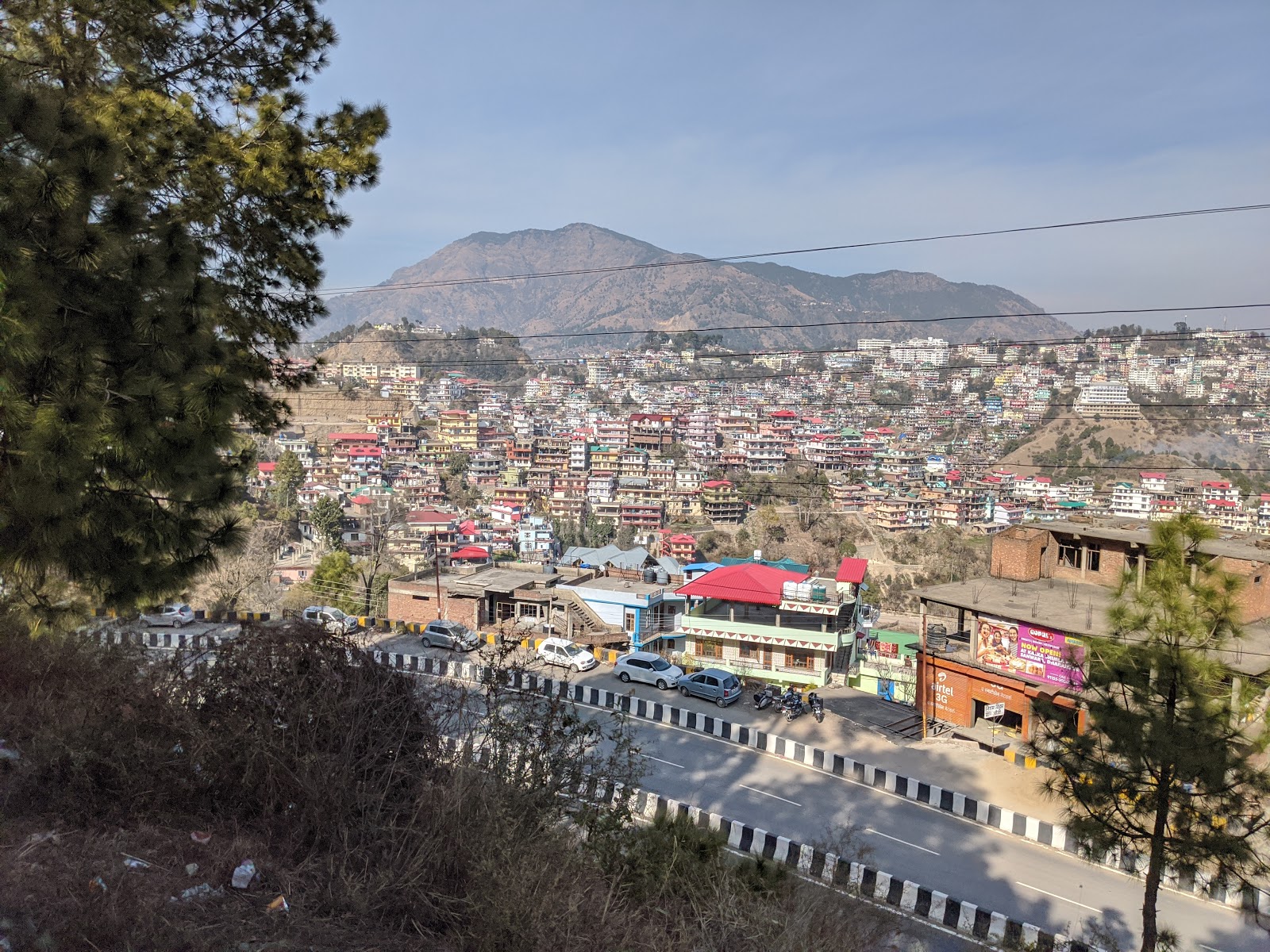
This giant 108-feet-high idol of Hanuman was unveiled at Jakhoo Hanuman temple in Shimla on November 4, 2010. For more, please click here.

Nearly landlocked due to storms and road washouts…Stunning photos of our area…Happy Valentine’s Day!…

First, I’d like to thank Marlothian, Thea Sander, for sharing today’s photos with us, which she took yesterday after the constant rains resulted in washouts on several roads in our area. If it weren’t for one short stretch of another road, we’d be landlocked until everything dries out. Road maintenance in Marloth Park is minimal at best.

With the bit of car we rented a month ago, there is no way we’d attempt to get out right now. With rain forecast through Monday with a short reprieve midweek, it appears it will pick up again next Saturday. We may not be going anywhere for days. After raining for at least three of the past four weeks, the ground and the roads are soaked and may not become passable again for weeks to come.

In any case, it’s certainly better than sitting in a hotel room in Mumbai, India, for months. We can cook, do laundry, feed a few determined wildlife that comes to call when the rain stops in short bursts, and move about freely. This is quite an improvement. Hopefully, by following Monday, the 22nd, we’ll be able to drive to Komati for my next dentist appointment to see if the tooth abscess is gone. Hoping.

Marloth Park doesn’t have a stable infrastructure for utility services and road maintenance, although their emergency services, including fire, rescue, snake removal, rangers, security, and wildlife control, are exemplary. Cost is the determining factor as it is in most municipalities. The citizens and powers-that-be of Marloth Park chose correctly when they had to “pick and choose” their priorities.

Of course, the reliability of electrical services is predicated by the poorly managed national electric company, Eskom. This is the case throughout the entire country when load shedding is an ongoing fact of life in South Africa.  It’s impossible to determine when and if this will ever change. However, often their staff is quick to respond when there is damage to the lines, usually coming out in inclement weather and the middle of the night.

Many, if not most, African countries struggle with their infrastructure, resulting in many observers describing them as “third world countries.” In our travels, we often hear other travelers describe parts of the world as “third world.” But, this phrase has become derogatory and outdated in today’s modern world. We kindly offer a more appropriate phrase for such a country as a “developing nation.”  See more on this topic here at this link.

Without question, poverty, wars, unrest, and corruption are instrumental in a country’s slow progress in building a more robust infrastructure. But, as we scour the world, we see these factors play out and are prevalent in many countries, at times even in more modern countries like our own USA and many countries in Europe and other continents.

We live in difficult times, only made more so, due to the pandemic of the past year. Will we ever come out from the ravages and rubble that have ravaged the world during these challenging times? It’s hard to say. As much as we want to believe, we will, with this belief keeping us hopeful and sane as we struggle with “pandemic fatigue,” as described in part in this article.

“Humans have a remarkable capacity to conceive of a task they have never done before and plan and execute the actions needed to do it. For example, most of us probably didn’t have a routine of wearing a mask around other people before this year. But, once we understood that it stemmed from the spread of COVID-19, many of us started doing so. It didn’t take hundreds of trials of training to learn this behavior, or indeed, thousands of years of evolution. Rather, we incorporated mask-wearing into our daily lives almost immediately. Humans can link our abstract goals, ideas, rules, and knowledge to our behavior at speed and on a scale that no other species can match and no AI yet built can emulate. We can do this because of a class of function scientists term cognitive control, a function that is supported by several interacting systems and mechanisms that are uniquely elaborated in the human brain, including the prefrontal cortex.”

There’s no easy answer as to how we humans will get through this difficult time. Now, as I am situated in the bedroom since it’s raining too hard to be outdoors, we even question our ability to get through lesser times such as this on a much smaller scale.

But, as I learned decades ago in a Tony Robbins seminar, we must utilize our human ability to “reframe” a situation to enable ourselves to cope in the best possible manner with the best possible outcome. Here are a few of Tony’s quotes that have lingered in my mind over the years. See his link here.

The power of positive thinking is the ability to generate a feeling of certainty in yourself when nothing in the environment supports you.”


“Knowing you have failed to live up to your standards is the ultimate pain; knowing that you have fulfilled your highest vision is the ultimate pleasure.”


There is a powerful driving force inside every human being that, once unleashed, can make any vision, dream, or desire a reality.”


What we can or cannot do, what we consider possible or impossible, is rarely a function of our true capability. It is more likely a function of our beliefs about who we are.”

That’s it for today, folks. May your Valentine’s Day be filled with love and hope for the future…

Photo from one year ago today,  February 14, 2020:

A gaur is crossing the road. “The gaur (/ɡaʊər/, Bos gaurus), also called the Indian bison, is the largest extant bovine. It is native to South and Southeast Asia and has been listed as Vulnerable on the IUCN Red List since 1986. The global population has been estimated at a maximum of 21,000 mature individuals by 2016. It declined by more than 70% during the last three generations and is extinct in Sri Lanka and Bangladesh. In a well-protected area, it is stable and rebuilding.” For more, please click here.

Game count, Marloth Park…My two year “heartaversary”…The beat goes on…Thank goodness…

    Bossy, reaching onto the veranda for pellets I dropped.
Every year the Marloth Park Honorary Rangers conduct a count of all the game in Marloth Park. With 3000 hectares, 7413 acres, this is quite a daunting task for the hard-working Honorary Rangers volunteers. How this is managed is tricky with all the vegetation in which the wildlife can hide.
They’ve broken up the entirety of Marloth Park into sections and the Rangers are assigned sections to conduct the count by vehicle. Of course, this is an estimate and subsequently, they speculate the actual count is approximately 60% of the actual count.
Since we left Marloth Park in May 2019, as mentioned in a prior post,  a number of animals have been “culled” or relocated to other areas, including Lionspruit, a game conservancy within Marloth Park. See the map below:
Image result for map of marloth park
Map of Maroth Park, including Lionspruit, where two lions, Fluffy and Dezi reside, along with other wild animals, providing food for them to hunt.

The game count was conducted yesterday as shown in this report below.

“THE GAME COUNT RESULTS – 11 February 2021
These are the results of the game count this morning. Six vehicles and 23 spotters went out at 06.30 this morning. Thanks to everyone that participated. We appreciate your help!
Impala 493
Warthog 95
Wildebeest 12
Kudu 106
Zebra 44
Giraffe 36
Bushbuck 41
Duiker 23
Waterbuck 6
Ostrich 14
Baboon Groups 1
Monkey Groups 6
Mongoose Groups 2
Please keep in mind that this is a road count, which means that roughly only 60% of the game was counted.”
This information, posted by Honorary Ranger, and friend Uschi was all the more special for us when she and her husband Evan, also an Honorary Ranger, stopped by last night for a very pleasant visit. They live within walking distance from us, but drove here based on the fact there may be lions and leopards wandering in the park in the dark.
This was a rare scene, Helmeted Guinea-Fowl and Franks dining on seed together. This was the dad to a mating pair of guinea-fowls, who collected some seeds to bring back to his partner and chicks. These birds aren’t as gregarious as the francolins and seldom get close to humans.
In a perfect world, there would only be enough animals that this 3000 hectares of land and vegetation could sustain. But, a reality of this special area is there are more animals that nature can provide for, resulting in many homeowners and visitors feeding them.
Feeding the wildlife is an accepted practice, although controversial, which includes game pellets, Lucerne (hay), and certain “safe-for-them” vegetables and fruits such as sweet potatoes, bananas, carrots, and apples which many of us purchase to feed them on a regular basis, especially during the “lean times,” during droughts and dry weather when the vegetation they need is less prolific.
Kudu and warthog dining in unison.

What’s the controversy? Many of the homes in Marloth Park are rented at certain points to tourists. Let’s face it, they, like us, come here to interact with the wildlife, generally around food which brings them back to our gardens, over and over again. Some feel that by feeding them, we are preventing them from foraging for their own food sources in the vegetation.

We understand this fully. But, after spending a total of 19 months in Marloth Park, over the years, we have seen starving and malnourished animals. If we can supplement their diet to keep them healthy, it is nearly impossible for us animal lovers to resist.

Reaching for a morsel in a tree.

Another question that arises, is, what happens when tourists or homeowners leave the property, the animals return and no one is there any longer to feed them? We worried about this very fact when we left the Orange house in 2019 after 15 months of feeding the wildlife. But, these marvelous creatures aren’t dumb, by any means, and they’ll seek out other tourists and homeowners for food, as well as continuing to forage.

Few of the animals in Marloth Park are carnivores or omnivores and hunt other wildlife for food. An example of this is the mongoose, who will kill and eat snakes when they are resistant to the venom, Ironically, on February 22, 2018, we did a story about carnivores, omnivores, and herbivores found in Marloth Park. Please click this link for details. Also, it’s imperative NOT to feed the animals “people food.” They are unable to digest food other than the pellets and appropriate vegetation, and offering them the equivalent of “junk food” can make them sick or even kill them.

Such an adorable female kudu.

It rained in buckets last night and continues to rain today. Storms are brewing in the Indian Ocean and heading this way. Our garden is a muddy mess. We doubt we’ll see much wildlife until this passes. In the meantime, Tom is outside on the veranda and I am indoors in the bedroom, staying cool and comfortable until this bad weather passes.

It was two years ago today that I had open-heart surgery here in Nelspruit, South Africa. Although I still bear some of the lingering effects of this life-changing, life-saving surgery, I am grateful for the medical care I received in helping me come out on the other side. And, of course, I am grateful to my husband Tom, who provided the best possible care, love, and attention possible, along with our many friends in Marloth Park.

Another adorable face, that of a male impala. These animals rarely come close to humans, so we were pleasantly surprised to see him in the garden.

Have a great day! Stay safe, wear a mask, wash your hands, and social distance. Let’s put this dreadful pandemic behind us!

Photo from one year ago today, February 12, 2020.

The city of Shimla, India as seen from the Himalayan Queen Toy Train. For more photos, please click here.