Part 5…Jackal Day!…If you think the Big Five is something…How about the “Ridiculous Nine!!!…Day spent in Kruger with friends!

“Black-backed jackals are closely related, both genetically and physically, to side-striped jackals. They are leanly built and quite hard to spot in the wilderness as they swiftly move through the terrain into areas of thicker vegetation, with their long, bushy tails bouncing behind them. They are a ginger color below the middle of their sides and shoulders and a mixture of black and grey above this line on their backs (the origin of their name). They are generally smaller than they appear in photographs and weigh only six to13 kg (13 to 29 lb), the same approximate size as most species of dwarf antelope.”

“Sighting of the Day in the Bush”

Tom was scanning the view of the Crocodile River at Ngwenya Restaurant.

The captions under today’s jackal photos are from this site.

The sighting of the jackal in Kruger National Park on Friday was so fleeting that we could only take a few photos, which are shown above. The middle photo was taken by Tom, our visiting friend. Thanks, Tom, for the contribution!

We were so excited to see the jackal when they are elusive animals as well as the wild dogs and hyenas, as we explained over the past few day’s posts. Please see those posts here and here.

With so few photos and the information we gathered frothis site, we decided to include the balance of the facts regarding jackals as shown below:

Status

Black-backed jackals have shown substantial consistency in their population over the past decades, something that other carnivores like wild dogs would very much envy. They are classified as ‘of least concern’ and carry no current threat, nor are there specific populations within South Africa that are endangered. They are prevalent across several countries, which protects them from diseases or over-hunting in many aspects. Population densities vary drastically but are at a relative constant of 2 to 3 individuals per square kilometer within the areas of South Africa where they occur.

Habitat

Over most of the land they occupy, they can be found alongside another jackal species, whether it be the side-striped or golden jackal. They are, however, most common within acacia woodland areas or grasslands, with some of these same trees scattered, which provides some shade from the scorching sun. Oddly enough, they are carnivorous and sometimes forage for food such as insects and are thus not as dependent on the supply of catchable prey like wild dogs, scavenging spotted hyenas, or cheetahs are. When there is prey to be caught, they do, however, take the opportunity and are also regular scavengers alongside vultures and hyenas.

Social Organization

Black-backed jackals are another species that mates for life or is referred to as a monogamous animal. Pairs observed for several years in the Serengeti stayed together for more than two years, with the longest being eight years, and were thought to be divided only by the death of one of them. When this happened, the other would not find a mate. They are also territorial creatures with average territory sizes encompassing an average of close to 2.5 square kilometers. Older young or offspring of previous seasons play an essential role in the caring and survival of new litters and stay on the same territory until they can find or compete for their permanent piece of land.

Social Behavior

Black-backed jackals are one of the three main species of jackal found in Africa, usually patrolling the landscape to scavenge on a kill or find small enough prey to hunt themselves. Lion trails are often followed by the fresh trails of black-backed jackals who pursue them in an attempt to make ends meet by scavenging, something its fellow jackal species are not as profoundly good at. They produce a variety of calls through which they convey messages to one another. They also howl like golden jackals and most wolf species. They are very aggressive animals, and an estimated 38% of their interactions with one another are thought to be of a defensive or aggressive nature.

Reproduction

When the time of the year comes when a pair must or are instinctively ordered to reproduce, they often discourage current pups or young from following them by scolding them or even biting them when they do so. When courtship begins, they go through three stages, starting with scent marking the area. Next, they show very distinct signs of sexual behavior where females lift their tails to reveal a part of their genitals, and males typically rub against them or wag their tails. Other ritualistic behavior also happens at this stage. Genital licking follows along with a few mounts for the next few days, but no complete copulation only follows after this and is repeated daily and frequently. After this, the female finally conceives and will give birth to 3 or 4 pups after 60 to 65 days.

Anti-Predator Behavior

Jackals are not immune to predators and are threatened by several species. Pups are particularly vulnerable and are considered prey to almost any species of eagle, along with sub-adults. Leopards are the primary foes adult jackals look out for. Their only defense or survival option is to run and try to find a decent enough place to shield themselves from danger when a leopard comes around the corner. Still, eagles can generally be chased away by adults when the survival of their young is called into question. There is a fine line between predator and prey in nature, and jackals can be found on either side of that line depending on the conditions.”

“Black-backed jackals are closely related, both genetically and physically, to side-striped jackals. They are leanly built and quite hard to spot in the wilderness as they swiftly move through the terrain into areas of thicker vegetation, with their long, bushy tails bouncing behind them. They are a ginger color below the middle of their sides and shoulders and a mixture of black and grey above this line on their backs (the origin of their name). They are generally smaller than they appear in photographs and weigh only six to13 kg (13 to 29 lb), the same approximate size as most species of dwarf antelope.”

We just returned from an almost three-hour drive in Marloth Park and saw the following:

  • Kudu
  • Elephant
  • Giraffe
  • Impala 
  • Lion
  • Ostrich
  • Cape buffalo
  • Waterbuck
  • Zebra
“In Southern Africa, they range from southern Angola, throughout Botswana, Zimbabwe, and Mozambique as well as most of Namibia and the whole of South Africa. Another sub-species of black-backed jackal occurs in parts of Eastern Africa near Ethiopia and Kenya. They are absent from the barren coastline and mainland parts of the Namib Desert mainly due to the insufficient supply of prey. They are, however, very adaptive to human-developed stretches of land and occur close to many rural towns surrounded by farms. They are regular victims of the rifles of livestock farmers because of the way they pester their animals, most often sheep and chickens.”

No words can express how enthused Tom and Lois are over these daily outings where we see so much wildlife, let alone the excitement right here at our holiday home as visitors come in a steady stream.

Tonight, we’re headed to Aamazing River View restaurant for more Crocodile River viewing.  A short time ago, we stopped by the restaurant to make our reservation and select the best table in the house for viewing the action-packed river.

Tomorrow morning, we’re off to Kruger for a self-drive, and depending on whether I have time in the morning, the post will be uploaded a little later than it is today.

Please check back for more on our fun-fill adventures with friends Tom and Lois.

Be well. Be happy.

Photo from one year ago today, October 16, 2018:

This is the video we took yesterday when a little Flycatcher hit the glass wall, was knocked unconscientious, and made every attempt to recover. This video is 16 minutes and 42 seconds, so you may want to scroll through it to see the best parts.  For more photos, please click here.


Part 4…Cheetah Day!…If you think the Big Five is something…How about the “Ridiculous Nine!!!…Day spent in Kruger with friends!

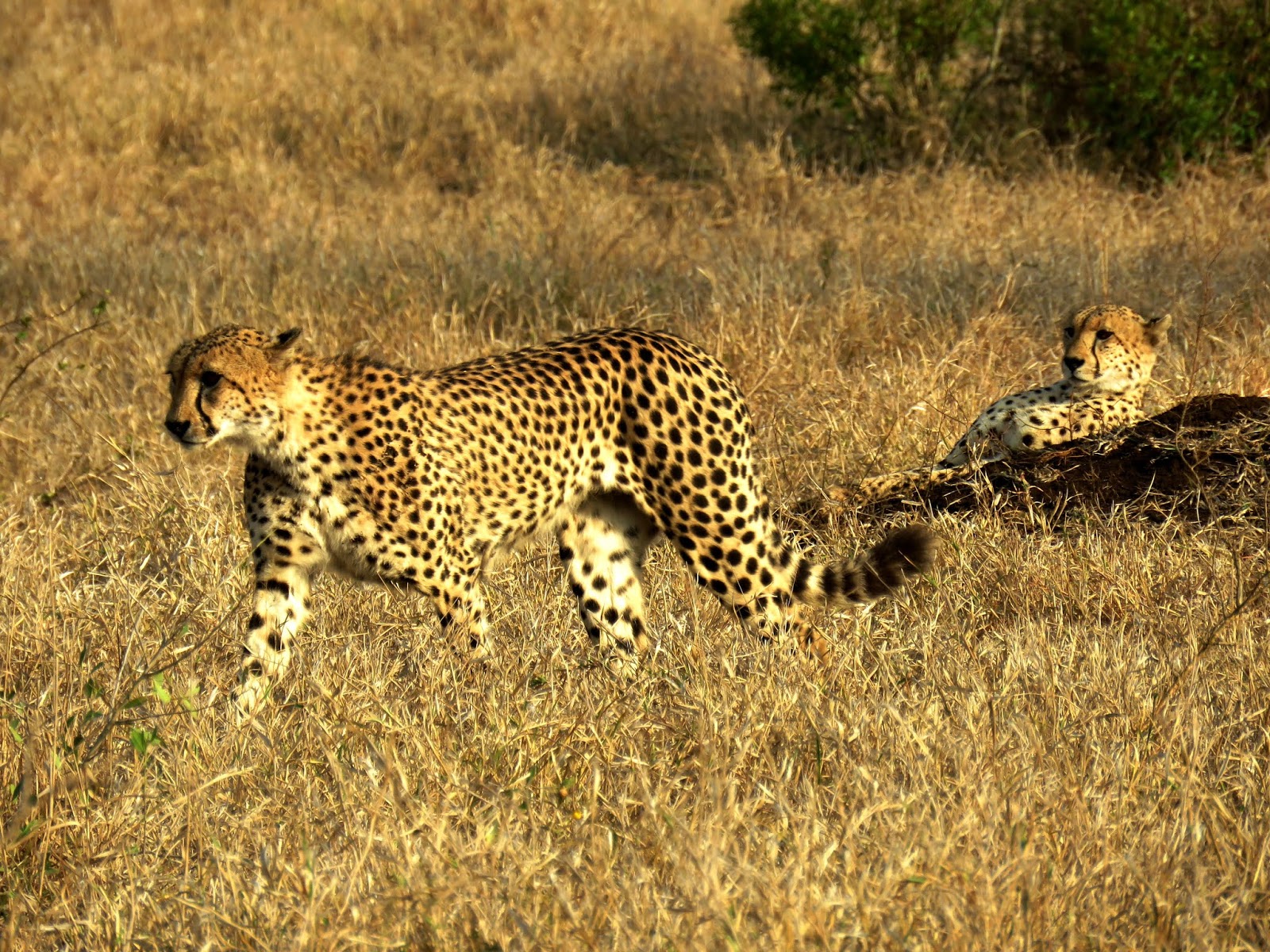
“A cheetah’s food tastes are not as broad as that of the leopard, and it concentrates mostly on small and medium antelope. The cheetah’s diet comprises of the young of larger animals, as well as warthog, ground birds, porcupines, and hares, as well as the smaller antelope.”

“Sighting of the Day in the Bush”

Stretching cheetah!  

Note:  Most of today’s captions have been taken from this site.

It’s almost 1600 hours (4:00 pm), and I’ve just begun to write the text for today’s post. We’ve had a hectic day. This morning after the four of us was showered and dressed for the day, we jumped into the little car and headed to Komatipoort and Lebombo to shop and have breakfast at Stoep Cafe.
“While the lion and the leopard rely on getting close to their intended prey before breaking cover, the cheetah’s speed gives it an advantage in the more open savanna. Cheetahs are slightly taller than leopards but not as bulky, probably weighing between 40kg and 60kg. Although cheetahs are members of the cat family, they have dog-like non-retractable claws. This limits their tree-climbing ability but gives them a speed advantage when charging.”
We were excited to share the great experience and good dining at this special little place located shortly upon entering the town of Komatipoort. Plus, the trip down the road to Lebombo is culturally enjoyable, as is Komatipoort, jammed with locals, mulling about their day.
“Typically, a cheetah will start a charge 60m to 100m from an antelope and, within seconds, will be racing at full tilt. If the buck is alerted in time, it will attempt to throw the cheetah off its trail by zigzagging and dodging between trees and shrubs. Using its long, heavy tail as a stabilizer, the cheetah will single-mindedly pursue its intended prey, trying to anticipate which way it will turn.”
It appears that most of the local’s activities center around selling and purchasing various foodstuffs, including that which may consist of bartering, negotiating and generally striving to make their purchases affordable.
“At the right moment, it will knock the antelope off balance and grab it by the throat as it falls. Because of the relatively small jaws and teeth, cheetahs are not as effective in killing their prey as quickly as lions or leopards, and it can take between five and 25 minutes for its prey to die.
After the excellent breakfast, we drove to Lebombo to purchase carrots, apples, pears, and eggs for the wildlife. We didn’t have room in the car to acquire more pellets, and with almost two 40 kg bags left, we could have enough to get us through the next several days.
“The element of surprise in hunting is as important for cheetahs as it is for other big predators. While its speed gives it an edge, the cheetah’s vulnerable point is its stamina. It will manage to run at top speed for only about 250m before it needs to catch its breath.”
Tom and Lois appear to be having the time of their lives. It couldn’t be going any better. These past few days, we had the most wildlife visits on the weekend than we’ve had on any weekend since we arrived in Marloth Park last February.
“After a high-speed chase, the cheetah desperately needs to rest for about half an hour – even before it eats its prey. This is when cheetahs are at their most vulnerable. They are often robbed of their kill by lions or hyaenas during this recovery spell. If the cheetah is unmolested, it normally devours its prey at the kill site.”
The animals have been coming in droves in the most literal sense, one delicate species after another. We only need to wait for a short period, and another herd, dazzle, band, flock, harem, etc., will magically appear, leaving us all squealing with delight, cameras in hand as we make the sightings memorable.
“The cheetah’s body is built for speed. Its legs are relatively long compared to its greyhound-like body; it has a big heart and lungs and wide nasal passages. It is the fastest land animal, timed running at speeds of up to 114km/hour.”
Besides all the fantastic companionship, conversation, and laughter, part of the fun of having them here with us is the unmistakable joy of seeing their delight and enthusiasm in having these exceptional experiences one after another.  
“The cheetah’s kill rate is hard to determine, but the consensus is that each cheetah kills between 30 and 150 animals a year, depending on its size, hunting frequency, and the condition of the area. Experts believe a single cheetah ideally needs between one and three kilograms of meat a day to stay in shape.”
We’ve yet to be disappointed in anything we’ve done, except one unpleasant dining experience in a local restaurant/bar on Friday night after our perfect day in Kruger National Park, where we sighted the “Ridiculous Nine.”
“There has been some scientific discussion as to whether they should be classified as part of the dog family because of their non-retractable claws, but they exhibit too many cat-like features, including the ability to purr loudly. Cheetahs cannot roar but growl and spit like a cat, and sometimes they make a peculiar chirping noise.” 
And now, as we continue sharing photos from our outrageous safari, today we focus on Friday’s sighting of two cheetahs that added so much to our breathtaking game drive.  
“Unlike lions and leopards, cheetah don’t define a territory to defend. They have a home range that they mark with urine but will not actively fight off other cheetahs. Socially, cheetahs are somewhere on the scale between lions and leopards. They do not form prides as lions do, but small groups of between four and six cheetahs can be common, particularly groupings of brothers. Cheetah probably lives for between 12 and 15 years in the wild. Unlike most other major carnivores, they hunt during the day.”
This week, we plan to do a self-drive in Kruger, most likely on Wednesday, with a relatively early start to the day once again. This time with no time constraints, we’ll be able to spend more time dining at the Mugg & Bean in Lower Sabie and focusing on the wildlife we find most interesting.
“Despite their speed, cheetahs still rely heavily on the element of surprise. Experts believe that a cheetah has a one-in-10 chance of catching an animal that isn’t taken by surprise and that this rises to a one-in-two chance if the quarry is caught off-guard. Cheetahs are the timidest of the big cats, and there is no record in southern Africa of a cheetah ever having attacked a human.”
After we returned to the house after today’s outing and putting everything away, we parked ourselves at the big table on the veranda. At the same time, each of us focused on our photos and documenting our experiences.

Tonight, we’ll dine in, having pizza and salad one more night, a dinner everyone thoroughly enjoyed. Of course, I can no longer eat pizza due to lactose intolerance, so I’d made myself a big mackerel salad consisting of canned mackerel, chopped hard-boiled eggs, onions, celery, red and yellow bell peppers with a homemade dressing. It was delicious enough to keep me from drooling over the smell of the pizza.

May you have a pleasant evening!
Photo from one year ago today, October 15, 2017:
The hydrangeas in the courtyard of the Costa Rica property were gorgeous. For more photos, please click here.

Part 3…African Wild Dog Day!…If you think the Big Five is something…How about the “Ridiculous Nine!!!…Day spent in Kruger with friends!

“The African wild dog is an endangered species, with only four remaining populations in Africa, one of which is Kruger. Their survival is dependent on the pack. A wild dog by itself is not that much of a threat to other animals, but a pack is a different story.”

“Sighting of the Day in the Bush”

Not all “Sightings of the Day in the Bush” are heartwarming and happy. See below for details.

Today, this very ill male kudu stopped by for pellets. His legs are deformed, and he’s very ill-looking and undernourished. Most likely, he has contracted bovine tuberculosis.  

“Wild dogs have the most structured social order of the carnivores, living in packs led by a dominant male and female. All other members of the pack play a subordinate role to the alpha pair.”

Immediately we contacted one the Marloth Park Rangers and within minutes a ranger pulled into the driveway.  We were relieved to have a professional come to investigate.

“Wild dogs tend to shy away from areas dominated by lion and hyaena. There are an estimated 200 wild dogs in Kruger, so seeing them is a matter of luck. They can roam over long distances – up to 250 square kilometers – and may travel over 50km in a single day looking for food. They are most commonly seen in the Chobe, Moremi, and some in Central Kalahari Game Reserve and the Kgalagadi.”

Once the ranger arrived at our property, Tom and I escorted him to the area where we believe he wandered off.  Through a stroke of pure luck, we spotted him limping through the bush.  

“Wild dogs are masters of the collective approach to hunting. A hunt begins at sunrise or sunset when the dogs perform an elaborate greeting ceremony, sniffing and licking each other, wagging their tails and twittering aloud.”

Fortunately, kudus tend to stay in one general area, so the ranger is confident they will find him. Tomorrow, Monday, the vet will come, and he may be euthanized based on this kudu’s poor condition. It’s sad and heartbreaking but a reality of living among wildlife. 

“They make a range of chattering sounds and have a distinctive long-distance greeting call – a sharp Hoo – that can be heard up to four kilometers away. Occasionally, they hunt at the full moon.’ during the hunt itself. However, they are silent. It reminded us of Scar Face, who we haven’t seen in months. It would be surprising if the injury to his face resulted in his eventual demise. Although we do not touch the wildlife, they become very special to us, each in their unique and special way.
“Wild dogs will fan through the bush looking for a herd of antelope. More often than not, this will be an impala. Once they have located a herd, the most vulnerable member is singled out – usually a female and young antelope.”

As I attempt to complete today’s post (sorry for the delay), Mr. Bushbuck is back here for the third or fourth time today. At one point, he could barely walk, and again we reported it to the rangers.  

“A subordinate male wild dog usually starts the hunt by trying to isolate the animal from the rest of the herd. Once the target has been identified and separated, the alpha male takes over the lead of the hunt, and the deadly endurance race begins.’

They suggested giving this handsome boy time to recover, and now, weeks later, he limps but doesn’t seem to be in as much pain. These amazing animals have an uncanny ability to heal themselves, more than humans seem able to do on their own.

“If this fails, they press on with determination, taking it in relays to increase the pace, nipping and tearing at the fleeing victim each time it slows down. They literally run their quarry to exhaustion. Once the animal collapses, the dogs immediately begin feeding, even before their prey has died from loss of blood.”

Now, we’re back to Part 3 of our “Ridiculous Nine” sighting in Kruger Park on Friday. The four of us are still reeling over our mind-boggling half day on a game drive in Kruger.

“Unlike hyena, which feasts noisily and chaotically, wild dogs are restrained and orderly at the kill. The young feed first, followed by the subordinate males and females, with the alpha pair eating at any time. Each dog awaits its turn, and if there is not enough food to go round, the hunt begins again.

Today, we chose to share the African wild dog story. With a dwindling population of wild dogs throughout the world with an estimated 450 worldwide and approximately 200 in Kruger National Park, it was pure “safari luck” that enabled us to see these endangered animals.

“Subordinate females support nursing wild dog females who remain at the den. They will stuff themselves with food and then go back to the den to regurgitate the remains for the mother and her young to eat.”

The captions we’ve included under the photos are information we gleaned from Kruger National Park’s website.  See here for their link. We feel so fortunate to have spotted these endangered dogs on our special safari day.

As for last night, we all went to Jabula for a fantastic meal, running into friends we’ve made in the park. As always, the conversation, food, service, and ambiance were beyond reproach. Of course, not surprisingly, Tom and Lois loved it. We’ll certainly be returning several times during their three-week stay.

“The average litter size for the wild dog is between four and eight puppies. They suckle for the first three months of their lives before being taught to hunt.”

Tonight we’re staying in on a very cool evening and enjoying our low-carb homemade pizza with a salad and yet another surely delightful evening on the veranda.

“Wild dogs hunt every day as they require more meat relative to their size than lions do. Eighty percent of their diet consists of impala, but they do attack bigger game as well, including wildebeest, kudu, waterbuck, reedbuck, and sometimes zebra.”

With the holidaymakers gone from the bush, we’ve experienced the biggest influx of wildlife visitors we’ve ever seen on the weekend. Tom and Lois love every moment as we are as well.

“Wild dogs have often been regarded with horror by humans because of their seemingly cruel hunting techniques – death does not come quickly to the victim, which will first be run to exhaustion and then die from a loss of blood while being devoured.”

Tomorrow, we’ll all head to Komtipoort for breakfast at Stoep Cafe, shopping and showing Tom and Lois around the town and surrounding areas. No doubt, it will be another wonderful day!

May your day be equally wonderful!

Photo from one year ago today, October 14, 2017:
This is a Clay Colored Robin, the national bird of Costa Rica. For more photos, please click here.

Part 2…Hyena Day!…If you think the Big Five is something…How about the “Ridiculous Nine!!!…Day spent in Kruger with friends!

“Hyaenas are mostly social, living in clans of between 10 and 40 animals, led by a dominant female. However, social structures can be quite loose with clan members shifting allegiances, breaking up, and reforming. They are territorial, marking their hunting ground through communal defecation. Their territories vary in size depending on the amount of prey in the vicinity and the number of competing clans. The territory itself is not vigorously defended, but hyaena clans will respond aggressively to other predators moving into their area.”

“Sighting of the Day in the Bush”

A white-backed vulture.

Each day, over the next week or so, we’ll be highlighting the fabulous sightings of the “Ridiculous Nine” we spotted on safari yesterday in Kruger National Park. Yesterday, we posted photos of the nine beautiful animals, and now, beginning today, we’ll be sharing our photos of the wildlife, one by one, day by day.  

“Hyaenas are capable of short charges of up to 50km/h and can maintain a steady, fast pace in pursuing prey over several kilometers. Their prey usually succumbs to exhaustion and is pulled down and disemboweled by the pack. Hyaena goes for the big game in packs – wildebeest, zebra, kudu, and, very occasionally, buffalo. When they hunt alone, they go for smaller animals such as baboons, guinea fowls, ostriches, snakes, and tortoises.”

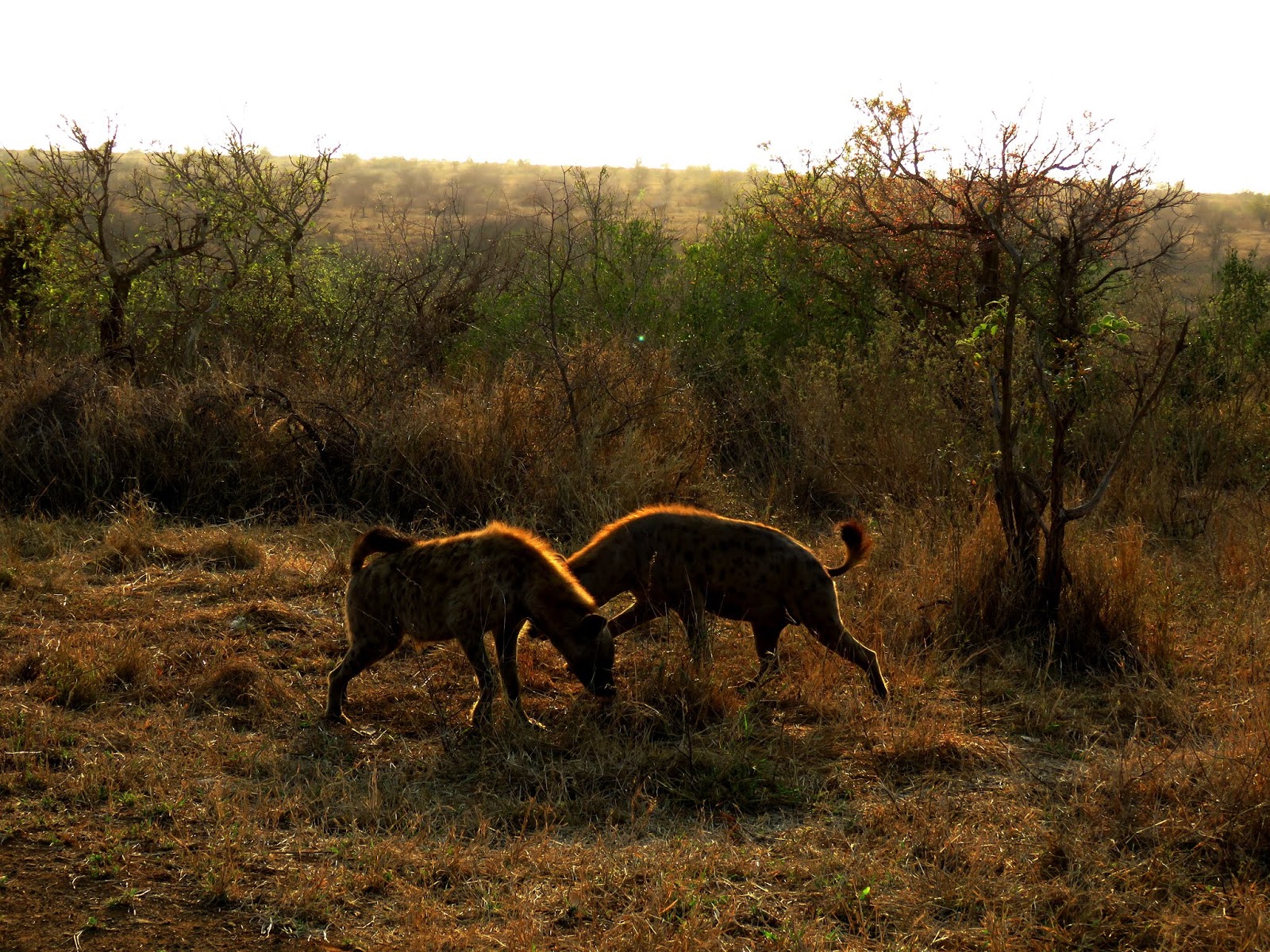
As shown, today is hyena day (spelled “hyaenas” in Afrikaans), and these photos are a combination of both mine and Tom’s photos. He took many of today’s great shots.

“The spotted hyaena hunts and scavenges by night and is closely connected in African folklore with the supernatural world. Anyone who has heard the sound of hyaenas in full cry around midnight would understand the animal’s association with the dark arts.”

We’d never seen a hyena in Kruger before yesterday, although they are relatively prolific in the national park.  Undoubtedly, we were all very excited when we spotted them and spent a reasonable period taking many photos. 

“There is no love lost between lions and hyaenas. Each will attack and kill the other’s cubs or elderly or sick individuals. Hyaenas seem far less intimidated by lionesses than by lions and are occasionally bold enough to try to bully lionesses off a kill if there are no males around.”

We found them shortly after we’d completed finding The Big Five, which in itself was quite an accomplishment.  But, from there, magic happened, and over the next few hours, we completed what the rangers and guides call the “Ridiculous Nine.”

“Unlike the honest, authoritarian roar of the lion, which resonates with purity and strength, the “laughing” hyaena’s utterances are hysterical and mocking, an eerie human-like giggling shriek that would not be out of place in a mental asylum. Its body parts command a premium price on the local muthi market, particularly the tail, ears, whiskers, lip, and genitals.”

The name is appropriate in describing how utterly ridiculous the prospect of sighting these nine magnificent animals in one day:

Most of today’s hyena captions are from this site.

The Big Five:  Lion, leopard, elephant, rhino, and Cape buffalo
The Ridiculous Nine: Lion, leopard, elephant, rhino and cape buffalo and cheetah, wild dogs, hyena, and the jackal for a total of nine.

“As a general rule, hyaenas hunt more when they are the dominant carnivores in any particular habitat and tend towards scavenging when there are lots of other predators around. They are chancers of note, often taking great risks to snatch meat away from lions and often being mauled to death in the process.”

We were giddy from there when in actuality, we also spotted hippos, crocodiles, wildebeest, giraffes, kudus, impalas, zebras, and many birds included the southern ground hornbill.

“Almost all hyaenas in Kruger are the spotted hyaena. They are found throughout Kruger, and the best places to see them are southwest Okavango, Savuti, and Linyanti. The brown hyaena found in southern Africa’s more arid environments.”

Today is a cloudy day and very cool. However, at the moment, the four of us are seated at the big table on the veranda, everyone chatting endlessly while we wait for one species after another to stop by.  

“Hyaenas are known for their cunning. They reputedly watch the skies for circling vultures to help them locate kills.  They follow the path of least resistance in getting food and, as a result, have become quite ingenious – they’ve been seen trying to scoop out fish at drying water holes during times of drought.”

So far today, we’ve had the following visitors: mongooses, kudu, bushbucks, wildebeests, warthogs, helmeted guineafowl, Frank and The Misses (who, much to our delight, has since reappeared), along with many other birds.

“Spotted hyaenas have the reputation of being scavengers, but studies have shown that, in Kruger, they tend to hunt more than they steal. Indeed, they are the second major group of predators in the Park after the lion, probably accounting for more animal kills than leopard and cheetah combined.”

As for the remainder of the day, it looks as if everyone is entirely content spending the rest of the day on the veranda until around 1700 hours (5:00 pm), when we’ll be getting changed for the evening to head to Jabula for dinner.  

“Although hyaenas sometimes hunt alone, they mostly hunt in packs. They have an almost uncanny ability to seek out the most vulnerable animal in a herd and isolate it from the others. Hyaenas are designed for the long haul, and, as Kruger mammal expert Heike Schutze says, “they are high-stamina hunters relentless in the pursuit of their prey once they have tasted blood.”

We made an early reservation, knowing we’ll enjoy time spent in Jabula’s fantastic bar, mingling with owners Dawn and Leon and any other friendly people we may meet along the way.

“Hyaenas have tremendously powerful jaws, capable of crushing the thigh bone of a buffalo in one movement. If they are hungry, they will gorge themselves, eating up to a third of their weight (15kg) at a single sitting!”

None of the four of us can stop talking about our phenomenal experience on our game drive yesterday. None of us will ever forget this most remarkable experience and having had the opportunity for a once-in-a-lifetime game viewing safari.

Two hyenas were howling in the wind.

In the future, has this experience spoiled us for future visits to Kruger National Park or even safaris in other countries? Perhaps, a little. Our expectations in the future could easily be tarnished after such a spectacular day.

They were sniffing the ground when they’ve picked up a scent.

But, when the visitors came to call this morning, we were no less enthused to see every one of them than we’d ever been in the past. It’s all magical, it’s all breathtaking, and for our visiting friends, Tom and Lois, it’s the stuff great memories are made of.

From this site“The hyaena is a shaggy, untidy and opportunistic carnivore with a distinctive, sloping back. It is a dog family member, weighing around 60 kg (males can be heavier) and standing at about 80 cm at the shoulder.”

Have a memorable day!

Photo from one year ago today, October 13, 2017:
Handmade masks for Halloween and other festivities at the railway museum in Costa Rica. For more photos, please click here.

Part 1…If you think the Big Five is something…How about the “Ridiculous Nine!!!…Day spent in Kruger with friends!

Stunning female lion – #3 (second lion photo in today’s post)

“Sighting of the Day in the Bush”

Spoon-billed storks, our first-time sighting in Kruger National Park.

It was 5:00 am this morning and the four of us, (including friends Tom and Lois) were dressed, lathered up in insect repellent, with cameras and binoculars in hand, and ready to head out the door.

#1 – Elephants

Louise and Danie had bid and won an auction for a six-hour morning safari with a guide in a traditional nine-seat safari vehicle to Kruger National Park and they insisted the four of us take it when they didn’t have time to use it due to their busy schedule. Part of the safari included breakfast at the Mugg & Bean (at our own expense).  

#2 – Rhino
Yesterday, we had a fantastic day at the fence between Marloth Park and Kruger National Park overlooking the Crocodile River. Photos will follow from that exceptional experience sometime over the next few weeks.

It was definitely an early start to the day for us but fortunately, after retiring early, we all had a good enough night’s sleep to make awakening so early easier than anticipated.
#3 – Lion

Another couple staying in Marloth Park was already situated in the furthest back and highest situated seat of the vehicle when Kerry from Kruger Pride Safaris arrived in our driveway. We all hopped in, with Tom and I in the front seat behind our guide with Tom and Lois behind us.

#4 – Leopard

As always, our expectations were low. If we didn’t see much, we’d accept it and enjoy the good time we knew we’d be spending together. By 5:30 am, we entered the park as Kruger opened its gates to visitors.

#5 – Cape buffalo

No more than 10 minutes into the drive, we spotted a rhino. We hadn’t seen a rhino in the past few months when they appeared at the loop close to the Verhami Dam. Please click this link for the most recent rhino post.

We weren’t able to get a perfect photo of the rhino based on her/his position but we were content to have seen one of The Big Five and wondered if somehow the day would bring us sightings of the remaining four animals: lion, leopard, cape buffalo and elephants.

#6 – Jackal

The day continued blissfully. We couldn’t have planned it more perfectly. Within the first few hours, we’d accomplished The Big Five. We were all giddy with excitement.

#7 – Hyena

From there, magic happened, one sighting after another, far surpassing any sightings we could have ever imagined. Our adrenalin was pumping while our expressions of sheer delight sent each of us into a frenzied level of enthusiasm.

#8 – Cheetah

Charles, in the way-back, had an eagle’s eye and was able to spot the wildlife we were searching for when Kerry was notified by other guides using the app, Whatsapp, informing her of sightings they’d encountered along the way.

Kerry was masterful at quickly getting us to the relevant locations and maneuvering the vehicle in such a way we were able to take the best possible photos. Although many of the animals were at quite a distance, we were thrilled to get those we did.

#9 – Wild dogs

As we saw more, Kerry informed us of other categories beyond “The Big Five” all the way from the “Sensational Seven” to the “Ridiculous Nine.” In fact, if there had been a category referred to as the “Exception Eleven” we could have easily included it after the “Ridiculous Nine” which would have included, beyond the nine…hippos and crocs.

And even further we could have included giraffes, impalas, kudu, wildebeest, warthogs, and an endless variety of birds, one species of which is included in today’s “Sighting of the Day in the Bush.”

Tom, Lois, Kerry (our guide) me and Tom.

“Pinch me,” I asked.  Is this really happening? Is this the epitome of “safari luck” perhaps inspired by the attendance of our friends Tom and Lois who may also be recipients of safari luck as well?

Over the next several days we’ll be adding Part 2, Part 3, and so on as we’ll continue to share many more photos of the above shown “nine” while we revel in the excitement of this very special day.

Sorry for the late post.  But as you can see, it was quite a spectacular day!

Be well.

Photo from one year ago today, October 12, 2017:

Puente Ferrocarril Rio Grande Museum in Atenas, Costa Rica. or more details, please click here.

Fabulous time with friends…

Ms. Warthog’s pose #1.

“Sighting of the Day in Bush”

The hornbills are trying to reclaim the use of the bushbaby house from the blue starlings who’ve already built a nest inside.

It must admit I’m having trouble preparing today’s post due to the fact that Tom and Lois are here. Having guests at our temporary bush home is indescribably wonderful.  

Ms. Warthog’s pose #2..

The lively conversation, the laughter, the interactions, the wildlife watching, and delicious mealtimes together are beyond all of our expectations. To see how much they’re enjoying seeing our wildlife friends is such a joy as we describe what we’ve learned along the way.

Egyptian geese on the river at sunset.

We asked if they wanted us to give commentary on the wildlife as we see them and they enthusiastically encouraged us to do so. They want to absorb everything they can during the three weeks they’ll spend with us.

Their visit here is ending on November 1st when they fly back to the US to continue on their extensive touring of the USA on a Harley Davidson motorcycle.  Such adventurers!

View of the Crocodile River from the veranda at Aamazing River View restaurant.

After traveling for over 29 hours from the time you left their home in New Jersey, they finally arrived here at almost 1400 hours (2:00 pm). Of course, they were exhausted but have since recovered after a good night’s rest.

Egyptian geese preening by the river.

This morning we gathered around the big table on the veranda with coffee and tea and again, the lively conversation ensued. A few minutes ago we finished breakfast which included a flourless quiche, leftover slices of filet mignon (from last night’s dinner), and our popular broccoli salad. 

Once our food settles we’re taking off for the Crocodile River where we’ll spend a few hours watching for wildlife. Louise loaned us four portable chairs we’ll keep in the car so we can stop and relax while focusing on searching for good sightings along the way.

Cattle egret standing on a rock in the river.

Need I say, we’re confident we’ll have plenty of fun with Tom and Lois over these next three weeks, ensuring they have an opportunity to experience many of the wonders in this part of the country.

Pretty little bird on the river.

Between the time I wrote the above and this moment, we went out and did our usual drive in Marloth Park. At first, we were concerned we wouldn’t see much and they’d be disappointed.

Sunset over the Crocodile River.

But “safari luck” prevailed once again and we saw more than we ever anticipated. If nothing else, Tom and Lois added some of their own first-time safari luck and we had a fantastic time.

Hadeda birds make a loud noise as they fly overhead at dusk.

Tomorrow, we’ll be posting many of our exciting photos which we’re looking to posting. We’re wrapping it up here for today since we’re heading out to Ngwenya Lodge and Restaurant for more river viewing and their delicious Thursday night buffet.

Have a memorable evening!

Photo from one year ago today, October 11, 2017:

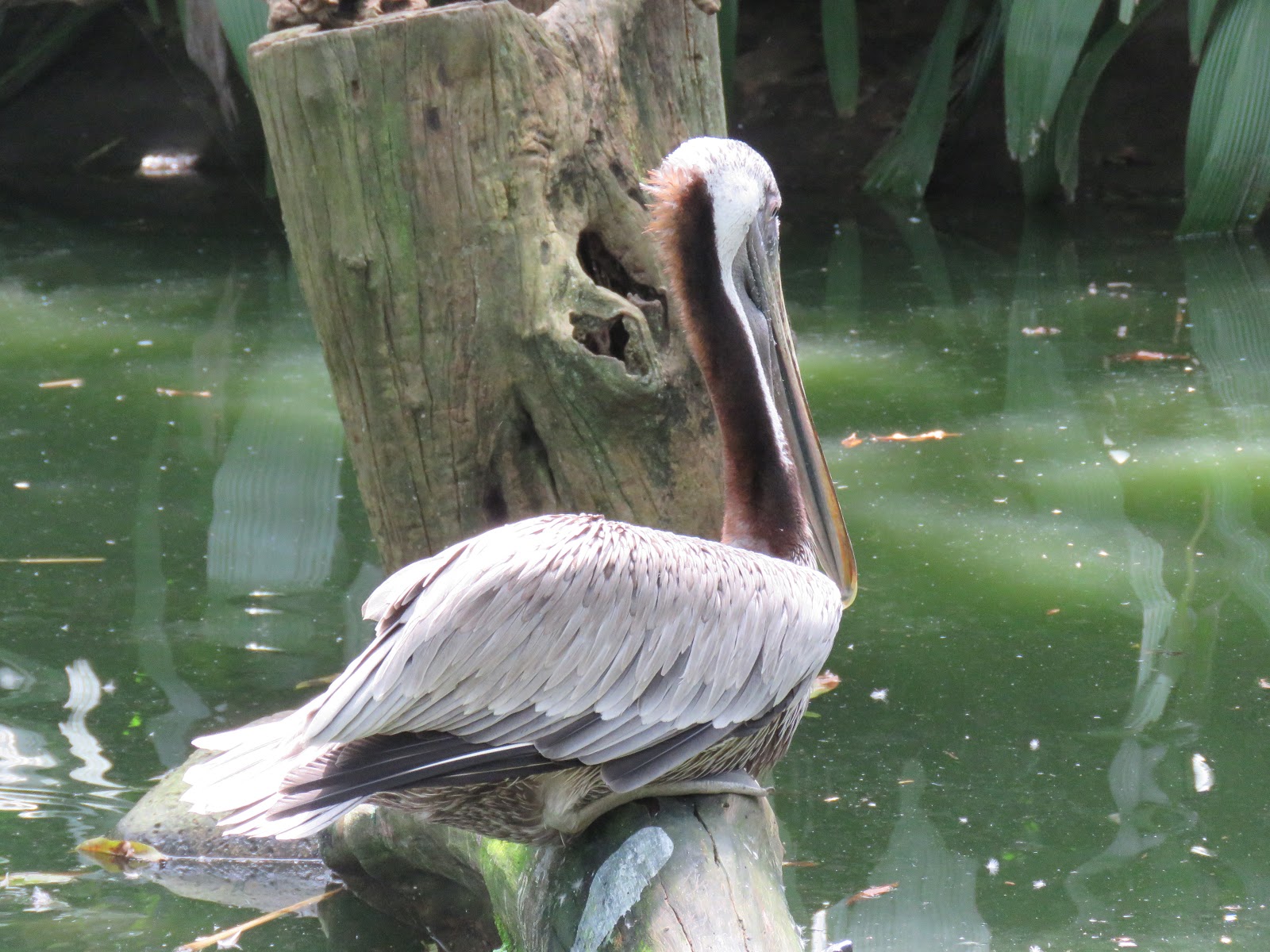
Pelican resting on a log on a pond at Zoo Ave, the bird sanctuary. For more details, please click here.

Today’s the day!…Our guests arrive this afternoon…Breakfast in town…Tom’s short haircut…

It was a good idea to set up this bar and get the clutter off of the kitchen counter.

“Sighting of the Day in the Bush”

This dead beetle was lying on her back on the veranda.
We flipped it over for this photo. This is an African Black Beetle. We swept it over the edge of the veranda.  A few minutes later, a band of mongooses stopped by, and one of them immediately started devouring the beetle, savoring it so much, he made funny noises while crunching on its hard shell. Mongooses are carnivores. They don’t sting but have a powerful toxin they release when agitated that can feel like a sting and cause irritation.

A part of the fun of entertaining guests is the preparations to make their stay as pleasant as possible. We ran around the house, organizing and de-cluttering in an attempt to make everything as pleasant as possible. We outfitted their rooms and bath with soaps, towels, insect repellents, toilet paper, and tissues.

Our friend Kathy recommended this quaint café in Komatipoort, which we finally visited for the first yesterday.  We had a fantastic breakfast of bacon, eggs, veggies (Tom splurged on toast and jam, hot tea, and bottled water).  The total bill was a paltry ZAR 170 (US $11.61), including tax and tip.

We loved creating a nice bar area, as shown in today’s main photo, using everything we had on hand and adding some new items Tom and Lois indicated they liked to drink, and the result was quite pleasing.

Tom’s eggs and bacon.  He ate his two pieces of toast and mine also.

It’s not that we drink that much. But, we entertain fairly often. Tom likes a one-shot brandy and Sprite, while I occasionally have a sugar-free gin and tonic. But, more often, I drink low-alcohol wine, which has 30% less alcohol.  

I ordered this spinach omelet only to discover it had creamed spinach inside. I have to learn how to order better for my further restricted lactose-free diet. Next time, I’ll ask for plain spinach. This time I scraped off all of the spinach and ate the egg part. There was no way I would ask them to take it back when I failed to order properly.

Luckily, low alcohol wine is available, made by South African wineries, and is quite good. When we dine out as we did last night for an excellent dinner at Aamazing (spelled correctly) River View overlooking the Crocodile River, I was able to order Four Cousins Skinny White wine. I had two glasses during the evening while Tom had two-one shot glasses of Klipdrift brandy with Sprite Zero.

There is both indoor and outdoor dining at this delightful spot.

I ordered the grilled calamari steaks with salad (no dressing) while Tom had chicken Corden Bleu, rice, and salad. Our total bill, including the drinks, tax, and tip, was ZAR 414 (US $28.36). It’s almost more cost-effective to dine out than cook!

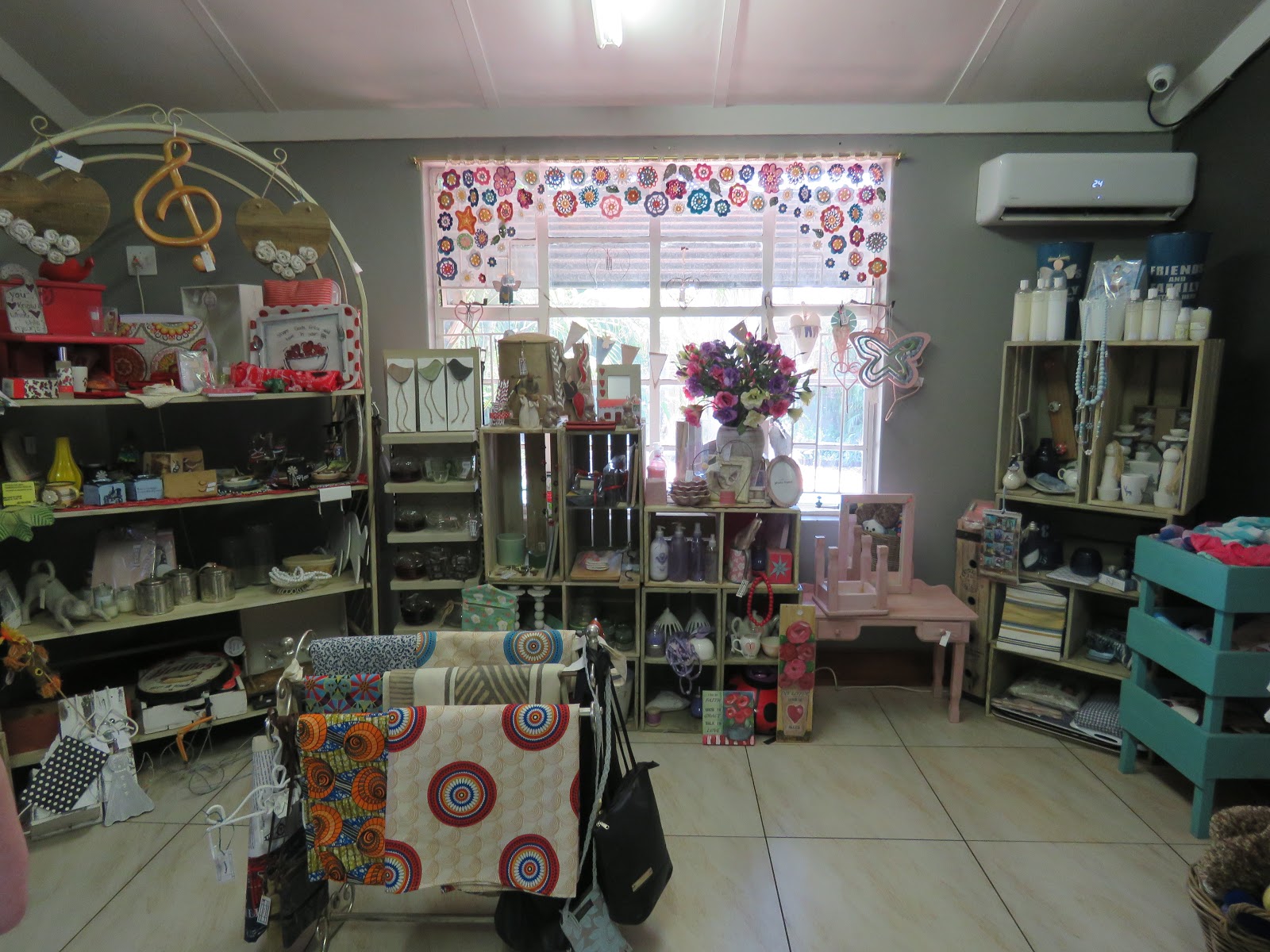
Many lovely gifts can be purchased here.

It was unusual for us to eat out twice in one day, but I didn’t want to make a mess after the house was cleaned so perfectly by Zef and Vusi. This morning I started the food prep for today’s lunch and dinner. 

A few minutes ago, they were both here, cleaning the floors, making the bed, taking out the trash, and cleaning the veranda, which must be cleaned daily with all the dust kicked up from the wildlife and the soot from the sugar cane fires.

The charming gift shop at the Stoep Café.

Josiah is now emptying, cleaning, and refilling the cement pond so the wildlife can have fresh water to drink. Plus, recently, Little Wart Face sat in the pond.  It is a good idea to keep this clean.

After breakfast at the Stoep Cafe, we headed to the dentist’s office. As it turned out, they’d moved to the same building as Dr. Theo at the Trio Centre. Tom has a sore spot on his gums that needs to be checked. He couldn’t get an appointment until next Tuesday, so he’s using warm salt water rinses in the interim.  We’ll see how that goes.

Bottles are used decoratively in the stone walkway at the Stoep Café.

At the dentist’s office, which shares the space with an optometrist, I purchased a really nice pair of sunglasses since those I’d purchased in Zambia fell apart a few days ago.  

From there, we headed to the pharmacy for a few toiletries and then off to Spar for a few more groceries items. We weren’t planning to return to the house until around 1400 hours (2:00 pm), but we’d purchased meat and needed to put it into the freezer. Fortunately, the boys were wrapping up the cleaning, and it all worked out well.

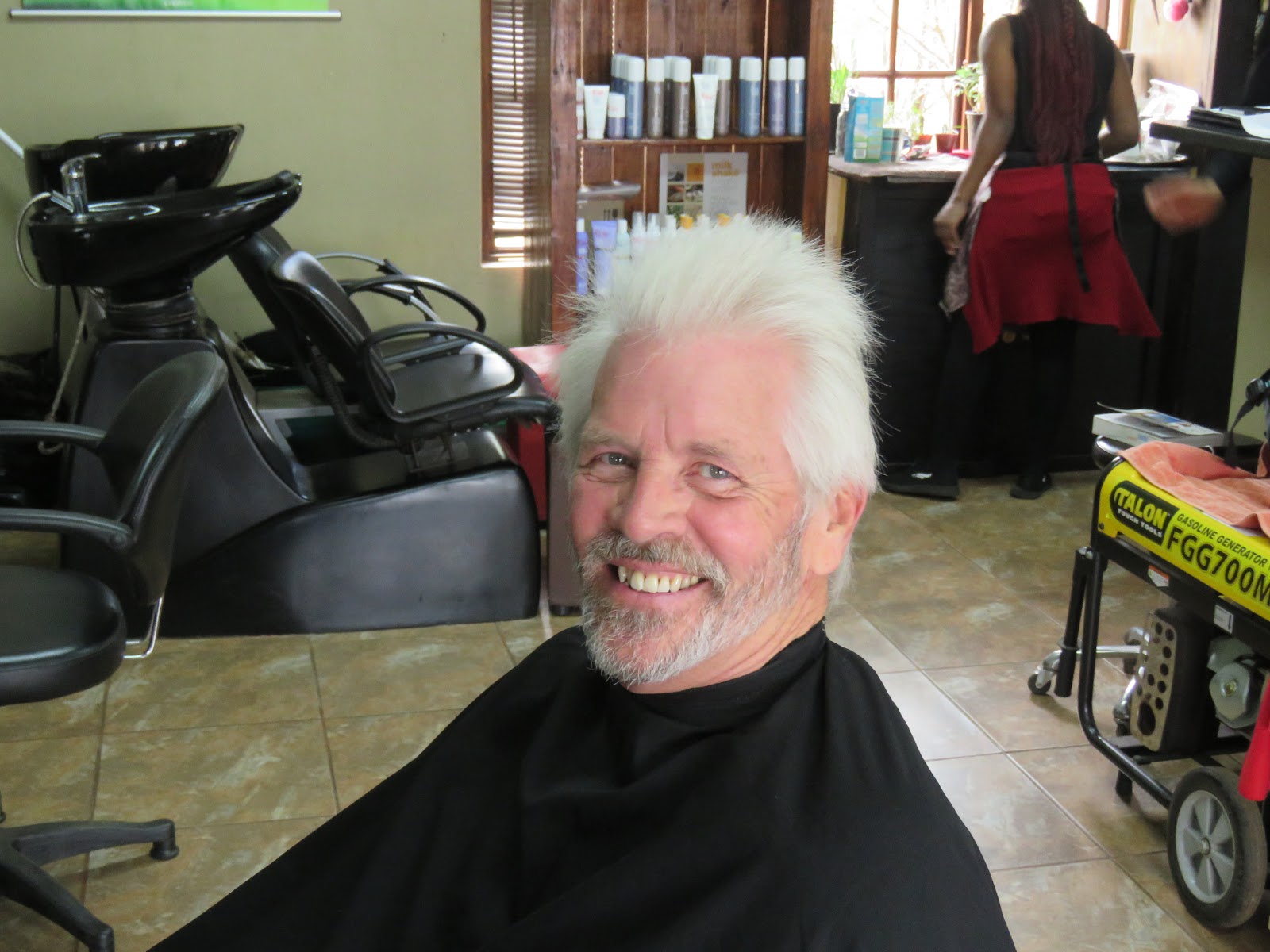
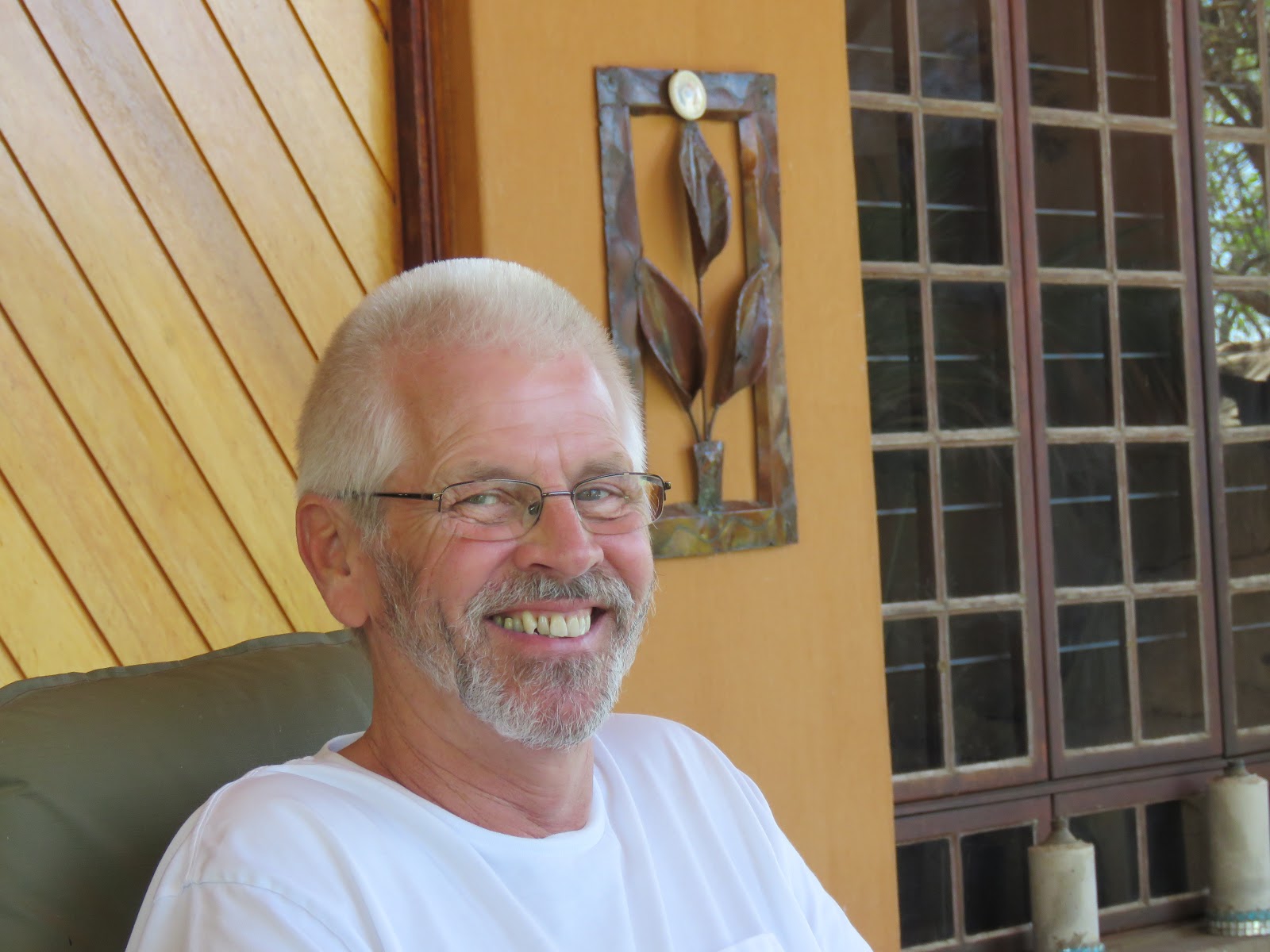
Tom before his haircut.  Scary!

A few hours later, we headed to the Aamazing River View in time to watch the sunset. We enjoyed a leisurely wait until our fresh, hot, and delicious food arrived. The wait was worth it.

Back home by 2100 hours (9:00 pm), we decided to watch the finale of Master Chef on my laptop. I fell asleep on the sofa for almost two hours and missed the finale. Once I got up and was ready for bed, I had an awful time falling back to sleep after the two-hour nap. Today, we’re both a little sluggish, but surely when our guests arrive, we’ll both become energized.

Tom, after his short haircut, is trim and neat.  A great improvement!

Over the next three weeks, our posting times will vary depending on the plans we’ve made with Tom and Lois. However, we will continue to post each day! We’ll keep you updated on the plans and experiences during this busy time for us in Marloth Park with friends! 

Have a spectacular day!

Photo from one year ago today, October 10, 2017:

Tom took this beautiful photo in the early morning in Costa Rica as the moon was setting. Nice job! For more photos, please click here.

Getting outside of our heads in this chaotic world we live in…Distractions…More lions..Giant lizard!…More, more, more!…

Traffic jam on the way to the river.

“Sighting of the Day in the Bush”

Monitor lizard breezing through the garden yesterday afternoon.

For those of our readers who may have missed yesterday’s post please click here regarding our goof-up on the arrival date of our friends who actually will be here tomorrow around 1300 HOURS (1:00 PM) not today as we’d originally thought.

Then there were two more, both youngsters.

We certainly do become distracted from time to time. It’s hard to avoid becoming doing so when there are so many distractions around us at any given moment. 

A bloat of hippos.

Last evening while still light, Tom spotted a monitor lizard in the garden and we both went into action taking the above photo we’re sharing here today. Whether it’s a lizard, a frog, a wildebeest, or a pair of duikers, it’s all worthy of our undivided attention.

As I prepared this post there were four bushbucks, two duikers, eight helmeted guineafowls, dozens of birds hovering by the birdfeeder waiting their turn, and a handful of mongooses wondering if they’ll get eggs. They will. They always do.

A hippo plowing through the vegetation in the river.

Much to our relief, yesterday we heard both Frank and the Mrs. making their noise. She’s been incognito for the past week and we were worried something had happened to her. Alas, she’s been off with her eggs, soon to be hatched into adorable little francolin chicks. And yes, we do get attached to birds.

Lately, there have been countless cape buffalo on the river.

Before too long the chicks will magically appear and we’ll have to keep a close watch each day to make sure the mongooses don’t go after their eggs or eventually the little chicks. This could be challenging. Talk about distractions.

Yesterday afternoon after getting many tasks completed, we jumped in the little car and once again headed to the Crocodile River. To get there, we choose a fairly long route that takes us through areas on or near the river that often results in some spectacular sightings. Yesterday was certainly no exception!

What a face!

We saw it all; elephants, hippos, cape buffalos, giraffes, zebras, warthogs, and lions. What an adventure! What a fantastic distraction from thoughts that occasionally flutter through our minds on the horrible news we read online about what’s transpiring in our own country, here in South Africa, and many other countries throughout the world.

Female lion checking out the territory.  Earlier in the day, two females killed a warthog, the males took it from them but eventually, they all feasted.

Did we run away to escape it? In part yes, we did. Unfortunately, with the internet before our eyes, several times a day, there is no escaping the harsh reality. We’d love to be able to ignore it but it doesn’t seem possible when it’s smack-dab in our faces everywhere we turn.

Marloth Park and Kruger National Park have become our ideal distractions pumping our bodies and our minds with feel-good hormones released each time we see something that piques our interest. 

Two males with full bellies.

Whether it’s that same frog that comes to call every night, sitting atop the outdoor light fixture snapping at insects, a monitor lizard slowly wandering through the garden, or lions at a distance in Kruger Park, we love it all and, indeed it does take us outside the noise inside our heads.

Contemplating a nap after a big meal.

And soon more distractions will come our way when our friends come to visit for three weeks, where we’ll surely have some great times together.

Tonight, to make it easy, we’re heading to Aamazing (yes, spelled correctly) River View Restuarant located on the Crocodile River where we’ll have more distractions, along with sundowners and a good meal.

Yep, a nap definitely is in order.  Lions tend to hunt during the mornings and late afternoons after it cools down.

Have a fantastic day and evening, finding distractions that take you away to a wonderful place.

Photo from one year ago today, October 9, 2017:

Sinkhole as a result of flooding from Hurricane Nate, courtesy of the Costa Rica Post.  For more photos, please click here.

Oops, we goofed…Go figure!…Talk about preoccupied!…

The elephants walk by in single file with many cape buffalos in the background.

“Sighting of the Day in the Bush”
The lioness picked up her head long enough for us to capture this distant photo.

When friends Tom and Lois gave us their flight information several months ago, somehow it stuck in our brains that they were arriving on October 9th when that was their departure date.  

When we read on Facebook at the Marloth Park Sighting Page that lions had been sighted, we dashed to the river to see if we could get some good photos. Unfortunately, the lions were hard to see when hidden behind a tree.

Dumb us, we didn’t stop to think that they’re coming from the US and won’t arrive until October 10th. You’d think we’d know this by now after all these years of travel. But, in our enthusiasm, October 9th went on our calendar.

We were sitting on a bench watching the cape buffalo, and suddenly these elephants walked past us.

Last night when sending email messages back and forth to confirm their estimated arrival time, we realized they wouldn’t be here until October 10th, most likely reaching Marloth Park by around 1:00 pm.

We were surprised to see so many cape buffalos along the river.

Louise had planned for Zef and Vusi to do the “spring clean” today, but once we realized this, we suggested they come tomorrow, which worked out better for her after all.  

With school holiday guests leaving many of her rental properties yesterday and today, having the boys available today to clean the houses made lots more sense today than tomorrow.

They were scattered along a one-kilometer stretch of the river bank.

As a result, the boys will be here tomorrow, and we’ve changed our plans to return to Komatipoort for more shopping until tomorrow so we can be gone while they’re here.

In one 45-minute period, we saw three of the Big Five on the Crocodile River.

We can only recall how much work it was preparing for houseguests in our old lives when we wanted everything to be as perfect as possible. Now, with perfectionist Zef and Vusi, there’s little for us to do other than clean up some clutter and coordinate plans and upcoming meals.

As I write this text, the company that provides WiFi is here upgrading something in the system. The WiFi will be down for an hour at most, but we’ve decided to stay put and wait for the work to be completed. In the interim, I’ve completed the post-offline using a special blog posting page in Microsoft Word, a solution I’ve used when we don’t have a working connection.
We were able to zoom in to see a youngster grazing.
With the change in plans and Tom and Lois’s expected arrival time, we’re taking advantage of the extra day to complete some organizing and reduce some of the clutter. Although we’re relatively tidy day-to-day, with limited cupboard space, closets, and drawers, as is typical in many holiday homes, we’ve created some clutter in a few areas and today is the perfect day to address this. 
Most tourists only stay for short periods and often don’t even unpack their bags.  We carry literally “everything we own” with us everywhere we go. We prefer not to “live out of a suitcase” and find space for all of our stuff.  
They aren’t particularly handsome animals, but they are an important part of the animal kingdom.
Keeping in mind, we don’t necessarily have that much stuff, but being here for this extended period, we’ve found ourselves accumulating more than usual. It’s easy to do without realizing it. I guess by nature, we humans really are packrats and have a hard time avoiding collecting “stuff.” 
With only four months (visa extension providing) until we depart South Africa, we need to begin thinking of what we need to donate and clear out before our departure. Since I’ve recently lost a lot of weight (more on that later), most of my clothes no longer fit and will be donated before we leave. Once we arrive in the US in April, I’ll have to replace any items, as will Tom, who’s also losing weight. 
More elephants on the river.
Of course, the reality always remains that our limited wardrobes wear out after washing the same items over and over again. For the first time in years, I actually have holes in my jeans and shirts.  
 
I see that holey jeans are fashionable in the US, but I’m too old to wear that style, although I do see some old-timers at my age wearing them. I don’t get that. But, who cares? To each their own.
Today, we plan to head out for another search for wildlife to see what more we can find. 
Have a fulfilling day!
Photo from one year ago today, October 8, 2017:
In Costa Rica, a pair of Inca Doves landed on the veranda railing and posed. These pretty birds mate for life and spend considerable time preening one another’s gorgeous feathers that appear to be small scales. For more photos, please click here.

Lifestyle changes…Two days and counting…

Mom and baby are enjoying the river.

“Sighting of the Day in the Bush”

Cape buffalos sure know how to cuddle. Note the bird on his head.

Our friends will arrive in Marloth Park in less than 48 hours. Tomorrow, Vusi and Zef will come and do a central spring cleaning of the entire house, including the upstairs guest area, which will be for Tom and Lois’s exclusive use, two nice sized bedrooms (one to store their clothes and bags), and a good-sized bathroom.  

It looks as if the elephant on the right has been splashing water on herself.

There’s a full-sized sofa in the spacious hallway if either of them prefers some quiet time to nap or read. Closet space and shelves to store toiletries are at a minimum in Africa (from what we’ve seen), but there’s a table they can use in the same hallway for such items.

Cattle egrets are constant companions of the elephant, particularly near water.

Of course, we’ll insist they have full access to enjoy the living areas with us and help themselves to anything their hearts desire in the bar and the kitchen.  Hopefully, they enjoy sitting outdoors with us when they aren’t busy, but we’re not making any “rules” other than to insist they do exactly what suits them and that they have a good time.

I chuckled when Tom wrote and asked we had a TV. We have a flatscreen TV, but the channels are not quite what we were used to in our old lives. We’ve yet to watch a single show since we arrived.  

None of the channels are from the US, nor is there any US news.  We watch all of that on our laptops. Many channels are in other languages, and shows are unfamiliar and of little interest to our tastes.  

This little one could be as young as a few days old.

However, we use our HDMI cord to watch Minnesota Vikings football games or other streaming or downloaded shows from our laptops.  We still use the Graboid.com app, where for a monthly fee of ZAR 295 (US $19.95), we can watch many recent US TV shows and movies.


On average, including the football game, we don’t spend more than an hour a day watching shows. In our old lives, every night, after dinner, we’d park ourselves in front of the TV, and there we’d stay until bedtime, often enjoying a homemade dessert (before my diet change in 2011).  

The youngster was enthralled with swinging his trunk around.  What a fun discovery!

Instead of escaping into a mystery TV series or two each night, we’re entrenched in the mysteries Mother Nature presents every evening in a “live show.” There are no commercials in the bush! That’s no longer our lifestyle, and for us, we’re much happier this way.

Our friends, although experienced world travelers, have never lived in the bush in Africa. No doubt, there will be a bit of “culture shock” when they arrive on Tuesday, even as they drive in their rental car from the airport through the many small towns along the way.  

It was time to venture back up the embankment, a long hike for this little one.

We’ve sent them excellent directions as to how to get here, and as motorcycles enthusiasts traveling all over the US, we have no doubt they make their way to our front door on Tuesday morning without a problem.

They’ll undoubtedly be exhausted after traveling for over a day and may need to rest before we bombard them with the wonders of the bush. Most of the holidaymakers (the school holiday ends today) will have left, and once again, the bush will be quiet and more wildlife will visit us. 

When sugar cane is harvested, the leaves are burned, making a mess for miles around. We often find the veranda covered in soot.

This afternoon we’re visiting friends for sundowners (the happy hour in the bush) and will return home by dinnertime for a lovely Sunday dinner I prepared today.  

Last night, we had another delicious and fun-filled evening at Jabula Lodge and Restaurant. There’s never been a time we haven’t had a fabulous evening in a friendly and appealing environment.  

Four male ostriches were fluffing their feathers. 

Last night was a rugby playoff game between South Africa and New Zealand. It was easy for us to get into the exciting tempo in the bar, enjoying the game along with all the locals. The conversations were lively and animated, the food was over-the-top, and Dawn and Leon, the owners, always make us feel welcomed and included.

May your day be filled with beautiful surprises!

Photo from one year ago today, October 7, 2017:

This was the first sighting we’ve had of a Toucan in the yard.  Once the downed tree was removed, it opened up an area where Ulysses spotted the two birds and came to tell us. Notice the piece of fruit in their beak.  For more photos, please click here.