Antarctica – February 1, 2018…Wow!…Rough night at sea…St. Andrews, South Georgia landing…So

It’s a “sea of penguins” along the strip of beach in Saint Andrews Bay.

We knew the risk of missing many planned landings was high when we booked this cruise. Inclement weather would undoubtedly be the cause. Although I remained optimistic and perhaps a little “overly bubbly” on the topic, Tom was less so in his usual practicality. He was certain we’d miss several planned landings and once again, he was right. 

As we approached Saint Andrews Bay of South Georgia Island.

So far, due to bad weather, we’ve missed five planned “ports of call” so to speak and possibly more is on the horizon. We are amidst a storm at sea and feel fortunate this smaller ship (200 passengers) has managed to avoid damage in the raging seas we’ve encountered these past few days, especially in the past 24 hours.

The King Penguin didn’t like all the attention.

Last evening during happy hour from the bar on deck six, we all took videos, stunned how the waves slammed against the windows and topped over the highest points of the ship. It was astounding, and I must admit, somewhat daunting in this smaller ship. Most cruise ships have the capacity for 2000 to 6000 passengers and crew. We can walk from bow to aft in a minute or two.

Penguins with an Elephant Seal lounging in the background.
Last night the buffet restaurant where we usually dine with all of our friends, closed when they couldn’t keep glasses, plates and various dishes from propelling to the floor when a massive swell sent everything flying.   
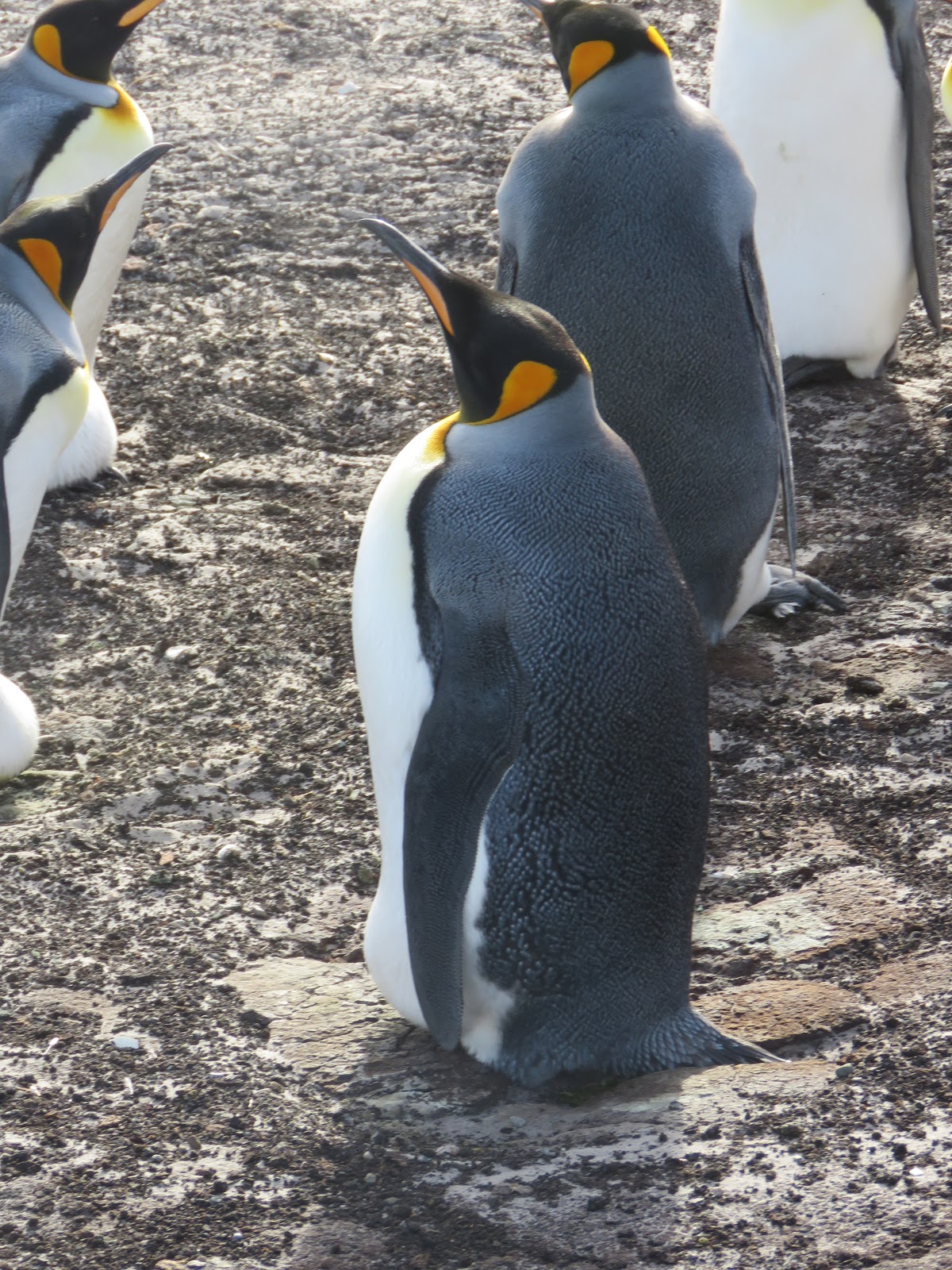
The back of the head of a King Penguin.
Instead, we dined with Marg and Steve on deck two in the formal dining room while we frequently peered out the windows at the outrageous swells, often coming up and over the top deck of the ship. Was that ever spectacular?
Penguins will often lay down on the pebbles, like this, to stay cool on a warm day.
Do we worry during rough seas, primarily when we’ve heard stories from several passengers regarding incidents on these smaller ships? Many momentarily when we hear a loud crash that sounds as if the ship is breaking apart.  But, other than those situations, we don’t give it much thought.
Penguins frequently preen to ensure the oil they get from their oil glands is evenly distributed to ensure they’re waterproof.

Fortunately, as we’ve mentioned in the past neither of us suffers from seasickness and have never used any medication or worn any type of a patch to prevent the awful malady.

The little dots are King Penguins.  It’s hard to believe there are so many.
Today is my last day on the antibiotics for my knee (much better now), and I’ve yet to have a glass of red wine as suggested by the ship’s doctor…no alcohol during the treatment. Had I imbibe, I think I would have abstained last night, knowing alcohol could contribute to a bout of seasickness. Why take the risk?
Two large Petrol Birds spreading their wings on the beach.
After a fitful night of intermittent sleep, awakened numerous times by uproarious swells, banging everything around in the cabin, we both feeling relatively chipper and excited for what is yet to come…hopefully, not more bad weather.
Penguins and seals seem to cohabitate well together.
The captain decided we’d have to forgo a landing at Elephant Island due to the weather and we’ve continued on to other stopping points, two of which we are scheduled to visit today, two small islands in the Antarctic Peninsula.
However, neither are optimistic that such a landing will be possible based on the rocking and rolling we’re doing at present. 
This massive King Penguin colony is at the base of a glacier.

Taking passengers out on the Zodiac boats in highs seas is definitely out of the question. Gee…we haven’t even done the Drake Passage yet, which we’ll sail through on our return route to Ushuaia toward the end of the cruise. 

Supposedly, this area where the Pacific and the Atlantic Oceans meet in Antarctica are the roughest waters in the world. If it’s as rough as it can be, at least all of us passengers have “got our sea legs” and are mentally and physically prepared for this eventuality. 

A pup seal sleeping while sitting up.

We’ve made a few videos of the rough seas but won’t be able to upload them until we return to Buenos Aires next week which we hope to do. The Wi-Fi signal isn’t good enough to upload videos. So stay tuned for them in a week or so.

Also, we’ve made a big decision these past few days. We aren’t going to keep the parkas and the waterproof clothing we purchased and ship them back to the US. My pants were too big and although the parkas the ship gave us, are of great quality, it makes no sense to pay hundreds of dollars to have them sent to the US. 
Standing among the King Penguins was an experience we’ll never forget.
We may never decide to embark on a cold-weather journey in the future and most likely, if we did, we’d purchase what we’d need for that expedition. As a result, we’ll leave here considerably “lighter” and won’t have to pay for excess baggage when we head from Ushuaia to Buenos Aires, as we did on the flight to Ushuaia from Buenos Aires. 
Leaving these items behind will also save us considerable time while in Buenos Aires when we have to repack all the things they’ve stored for us at the hotel.
With warmer temperatures, penguins congregate in the shallow water to stay calm.
We’ll be keeping a few sweatshirts and sweaters and each of the under layers similar to workout pants, since they’ll be days it will be very cool in South Africa during their winter months (opposite from US summer) over the next year. We’ll undoubtedly be able to wear those items there, disposing of them once we are done in Africa.
There are several Elephant Seals in Saint Andrews Bay, primarily females, since the males, after breeding, head back out to sea. The males aren’t involved in the care of the pups.
Today’s photos are from Saint Andrews Bay, South Georgia Island, one of the most exciting landings we made. Here’s some information about Saint Andrews from this site:
“Saint Andrews Bay is a bight 2 miles (3.2 km) wide, indenting the north coast of South Georgia immediately south of Mount Skittle. Probably first sighted by the British expedition under Cook which explored the north coast of South Georgia in 1775. The name dates back to at least 1920 and is now well established. On charts where abbreviations are used, the name may be abbreviated to St. Andrews Bay.
King penguins from huge breeding colonies – and the one at St Andrews Bay has 200,000 birds. Because of the long breeding cycle, territories are continuously occupied. Ross Glacier which is nearby is retreating and leaving a gravel beach in its wake. Heaney Glacier and Cook Glacier also are in the vicinity.”
Once again, me and lots of penguins.
Initially, the above site listed the bay as having about 175,000 King Penguins, but the naturalists onboard the ship have informed us its now over 200,000 as the colonies continue to grow.
It took our breath away to see the vast expanse of King Penguins on this narrow strip of beach. This is precisely what we’d hoped to see when we booked this cruise so many moons ago.
Female Elephant Seal was lounging in the warmth of the sun.
As I attempt to finish today’s post while Tom is at a seminar, we’re supposed to arrive at our next landing in less than three hours. With the rockin’ and rollin’, we’re amid now, it doesn’t seem possible, we’ll be able to get off the ship.
Tomorrow, we’ll be back with what has transpired during this massive storm.
Have a warm and safe day, wherever you may be! 

Photo from one year ago today, February 1, 2017:

Sunny day scene overlooking the Huon River in Tasmania.  For more details, please click here.

Antarctica – January 30, 2018…Grytviken, South Georgia…An abandoned whaling town…Sailing around the storm…

This group of Elephant Seals found comfort in sleeping together in a ditch.

The world…it baffles, it entices, it enlightens, and it surprises in one way or another almost every day. It spares nothing in attempting to capture our attention while we, in our amateurish or professional manner, attempt to capture it in photos in hopes of retaining memories to last a lifetime. 

Some of the King Penguins were molting while others were not.

Antarctica keeps “giving and giving.” this trip to Antarctica has been at the top of our list for photo ops (along with our upcoming adventures in Africa). And, in our less-than-professional photo-taking manner, we thrive on these opportunities with such enthusiasm we can hardly contain ourselves. 

We walked along this beach in the rain to the small settlement ahead.

Taking photos is important to us to share them with all of our worldwide readers and maintain them for our reference, our family, and generations yet to come.

Tom, with an iceberg in the background.
The younger seals seem eager to pose for a photo, but the older males chase after us, prepared to attack if necessary.  We had to scare a few off by clapping our hands and yelling.

Above all, standing on the very ground where so much is happening takes our breath away as we live in the magic of the moment, anticipating nothing more than what is before our eyes. With heart-pounding enthusiasm, we embrace every moment, later reviewing our photos, hoping to find those fantastic captures that genuinely tell the story of our current experiences.

A young seal was sleeping atop a plant with a grouping of Elephant Seals in the background.

Sure, an expedition cruise is not expected to be perfect. We’ve had to forgo three landings due to bad weather, which we’d looked forward to on the itinerary. Last night, we had to sail away with bad weather on the horizon, missing two landings scheduled for today. 

A lone Fur Seal was posing for a photo.

Instead, the captain decided we’d sail directly to the Antarctic Peninsula, where we’ll spend the next several days, finally amid the massive icy environment we’ve so longed to see.  As a result, we’re at sea today.

She was so relaxed, a bit of drool dripped from her mouth. A bath would be nice.

Yesterday morning, we embarked on the Zodiac boats to Grytviken, South Georgia, an old whaling village since gone to ruin. As we wandered through the historic town, we couldn’t help but feel sorrowful for the millions of whales slaughtered for financial gain. 

This is the first of a few icebergs we spotted in Grytviken and the first so far on the cruise.  Guaranteed, more will follow.

This Elephant Seal was sleeping in the ditch without his friends.

Evidence of this travesty is readily evidenced in this small settlement with the remnants of the storage tanks and processing machines and equipment. 

Among the ruins were multiple shipwrecks photos of which we’ve included here today. A small group of 10 to 20 people occupies the location during the summer months (less in the winter months) to facilitate ship passengers stopping to inspect the settlement. 

We were served a shot glass of Irish whiskey with the suggestion to take a sip and pour the remainder over Shackleton’s grave, a local tradition.

There’s a shop, a church, a post office, and a few museums, all of which we visited during our few hours at the location. It was exciting and quite unusual, especially the many Fur Seals and Elephant Seals that live amongst the ruins of a long-abandoned business.

No sip of Irish whiskey for me, but I poured mine over Shackleton’s gravesite.
Here is information about Grytviken, South Georgia Island, from this site:
Grytviken is a settlement on the island of South Georgia, part of a British Overseas Territory in the South Atlantic. The settlement’s name is Swedish in origin, meaning “the Pot Bay.” The name was coined in 1902 by the Swedish Antarctic Expedition and documented by the Swedish surveyor Johan Gunnar Andersson, after the expedition found old English try pots used to render seal oil at the site.
It is the harbor’s best harbor, consisting of a bay (King Edward Cove) within a bay (Cumberland East Bay). The site is relatively sheltered, provides a substantial area of flat land suitable for building, and has an excellent freshwater supply.
Her companion is fanning her with widespread fins and tail.

The settlement at Grytviken was established on 16 November 1904 by the Norwegian sea captain Carl Anton Larsen as a whaling station for his Compañía Argentina de Pesca (Argentine Fishing Company).  

It was phenomenally successful, with 195 whales taken in the first season alone. The whalers used every part of the animals – the blubber, meat, bones, and viscera were rendered to extract the oil, and the bones and meat were turned into fertilizer and fodder. Elephant seals were also hunted for their blubber.

The following year the Argentine Government established a meteorological station. Around 300 men worked at the station during its heyday, operating during the southern summer from October to March. A few remained over the winter to maintain the boats and factory. A transport ship would bring essential supplies to the station every few months and take away the oil and other produce.

An adorable seal climbed a wall to see what the commotion was all about.
Carl Anton Larsen, the founder of Grytviken, was a naturalized Briton born in Sandefjord, Norway. His family in Grytviken included his wife, three daughters, and two sons. In his application for British citizenship, filed with the magistrate of South Georgia and granted in 1910, Captain Larsen wrote: “I have given up my Norwegian citizen’s rights and have resided here since I started whaling in this colony on the 16 November 1904 and have no reason to be of any other citizenship than British, as I have had and intend to have my residence here still for a long time.”
The first iceberg we’d seen since leaving Ushuaia a week ago today.  More will surely follow as we head to the Antarctica Peninsula.
As the manager of Compañía Argentina de Pesca, Larsen organized the construction of Grytviken, a remarkable undertaking accomplished by a team of sixty Norwegians between their arrival on 16 November and commencement of production at the newly built whale-oil factory on 24 December 1904. Larsen chose the whaling station’s site during his 1902 visit while in command of the ship Antarctic of the Swedish Antarctic Expedition (1901–03) led by Otto Nordenskjöld.
On that occasion, the name Grytviken (“The Pot Cove”) was given by the Swedish archaeologist and geologist Johan Gunnar Andersson. They surveyed part of Thatcher Peninsula and found numerous artifacts and features from sealers’ habitation and industry, including a shallop (a type of small boat) and several try-pots used to boil seal oil. One of those try-pots, having the inscription ‘Johnson and Sons, Wapping Dock, London’, is preserved at the South Georgia Museum in Grytviken.
Me, with an iceberg in the background.
Managers and other senior officers of the whaling stations often had their families living together with them. Among them was Fridthjof Jacobsen, whose wife Klara Olette Jacobsen gave birth to two of their children in Grytviken; their daughter Solveig Gunbjørg Jacobsen was the first child ever born south of the Antarctic Convergence, on 8 October 1913. Several more children have been born in South Georgia: recently even aboard visiting private yachts.

The whale population in the seas around the island was substantially reduced over the following sixty years until the station closed in December 1966. By that time, the whale stocks were so low that their continued exploitation was unviable. Even now, the shore around Grytviken is littered with whale bones and the rusting remains of whale oil processing plants and abandoned whaling ships. 

A big male Fur Seal and perhaps his offspring who he was training to be growly at visitors.

Ernest Shackleton Grytviken is closely associated with the explorer Sir Ernest Shackleton. Shackleton’s Imperial Trans-Antarctic Expedition set out from London on 1 August 1914 to reach the Weddell Sea on 10 January 1915, where the pack ice closed in on their ship, Endurance. The ship was broken by the ice on 27 October 1915. The 28 crew members fled to Elephant Island off Antarctica, bringing three small boats 

Shackleton and five other men managed to reach the southern coast of South Georgia in the James Caird. They arrived at Cave Cove and camped at Peggotty Bluff, from where they trekked to Stromness on the northeast coast. From Grytviken, Shackleton organized a rescue operation to bring home the remaining men.

An iceberg with our ship in the background.

In 1922 he had died unexpectedly from a heart attack at the beginning of another Antarctic expedition. He again returned to Grytviken, but posthumously, his widow chose South Georgia as his final resting place. His grave is located south of Grytviken, alongside those of whalers who had died on the island.

On 27 November 2011, the ashes of Frank Wild, Shackleton’s ‘right-hand man, were interred on the right side of Shackleton’s gravesite. The inscription on the rough-hewn granite block set to mark the spot reads “Frank Wild 1873–1939, Shackleton’s right-hand man.” Wild’s relatives and Shackleton’s only granddaughter, the Hon Alexandra Shackleton, attended a Rev Dr. Richard Hines service, rector of the Falkland Islands.
A whaling boat shipwreck.
The writer Angie Butler discovered the ashes in the vault of Braamfontein Cemetery, Johannesburg, while researching her book The Quest For Frank Wild. She said, “His ashes will now be where they were always supposed to be. It just took them a long time getting there.”

Update on my knee: It’s certainly not 100% yet. I visited the doctor a second time for another round of a different antibiotic and more anti-inflammatory meds. It’s improving, albeit slowly. 

Another sad reminder is that life for wildlife is not easy.

I can’t wait for this to be healed so I can stop thinking about it and, good grief, have a glass of wine! But, I’ve only missed one outing (out of many more), which required a five km walk, and Tom went ahead without me taking amazing photos.

As for today, right now, I’m in the lounge on deck three while Tom is taking a much-needed nap. It’s nearly 3:00 pm. Since we’re at sea today, little is required other than to enjoy our new friends, which is relatively easy to do in this beautiful environment.

The small Lutheran church in Grytviken, South Georgia.

Update on the pending rough seas: The captain made a good decision when we forfeited two planned landings to instead sail directly to Elephant Island, which we should reach sometime tomorrow. The waters are rough, and walking around the ship requires some holding on one another, walls, and railings. 

But, in our usual way, neither of us are seasick, but we suspect that some passengers may be feeling it when I’m only one of about eight passengers in the usually packed deck three lounges.  Due to the weakening Wi-Fi signal, I’m unable to enlarge a number of our photos to the size we always post. 

Whaling oil processing equipment.

Have a great day! And again, no worries if we aren’t here over the next few days. Likely, we won’t have a signal the further south we sail.

     Photo from one year ago today, January 30, 2017:

Wood handled tools for the “barbie” we spotted at an outdoor flea market in Franklin, Tasmania.  For more photos, please click here.

Antarctica – January 29, 2018…Stromness, South Georgia Island…Rainy expedition…Bad weather on its way!!!

At lunch today, one of the chefs was preparing a beef and vegetable stir-fry outdoors. We all partook of the delicious offering but decided to dine indoors.  It was a little too cold to eat outside for our liking.

It’s Monday, and we recently returned from our first expedition of the day.  Later today, around 5:30 pm, we’re heading out for a second expedition returning around 7:30 pm. 

Today’s view from the aft of the ship as we prepared to sail away from Grytvenik (more on that tomorrow).

Dinner will be late tonight, but we don’t mind. Dining is of less importance to us on this cruise, and although the food is fine, it isn’t as high caliber as we may have expected. 

It’s heartwarming to see how close they hang to one another.

The schedule seems to change daily due to weather conditions, and to date, we’ve stopped at two unexpected locations and moved around the disembarking hours on many occasions.

Macaroni Penguins in Stromness, South Georgia, are known for the pasta-like plumage atop their heads.

Regardless of where we land with the Zodiac boats, we’re sharing the stories and photos in the order of the expeditions to maintain the flow of activities. Still, not necessarily on the specific day, they occur. 

Two Macaroni Penguins were keeping watch. Too cute!

When not out to sea, we make two expeditions each day, ending up with an entirely different experience on each occasion. 

Fur Seals enjoying a swim in the sea, hoping to find lunch.

With several sea days upcoming in the next week, we should be close to “caught up” by the end of the cruise, depending on the Wi-Fi connection, which so far has been much better than we’d expected. 

There were many of this and last year’s offspring on the beach.

If we aren’t caught up, we’ll continue to post during the two days we’ll be back in Buenos Aires between February 8th and February 10th. It should all work well. 

Seals on the beach close to the old ruins of buildings from the whaling days of decades past.

If we aren’t done, we will continue to complete the cruise photos and stories once we arrive in South Africa for the required number of days to complete the cruise photos. 

We were warned to stay away from the larger males.  They can be nasty if they’re crowded and feel they or the pups are in danger.
Although, once we arrive in “the bush,” a whole new world of photos and stories will be stockpiling that surely we’ll be anxious to share. What an excellent problem to have facing us!
King Penguins with fluffed up feathers after time spent in the cold sea.

The biggest issue has had the time to prepare the posts when we just so darned busy, heading out on the Zodiac boats twice a day along with dining and socializing, which now has become a regular part of our routine, having found wonderful people as part of our select group.

Mating calls coupled with sounds of pure joy by King Penguins.

That’s how it goes when cruising, meeting people that share some common interests with whom we spend most of our free time. Need I say? It’s quite fun. 

King Penguins are second in size to Emperor Penguins, whom we won’t see this time of year. They mate later in the summer season, long after we’ll be gone.

As for the cruise, we’re enjoying the luxury ship and the superb service. We find that the ship’s only 194 passengers are extra pleasant in its small size.  

We were free to wander about the grass with the many seals and birds.

There are no long queues for meals and only short waiting times to disembark for activities, get beverages, or any other attention provided by the well-trained and sophisticated staff.

Again, as shown in prior posts, not all survive the harsh conditions and possible predators.

For us, this cruise wasn’t about luxurious cruising. It is entirely about the opportunity to see this magical place. Only so many cruise lines offer the chance to get off the ship via Zodiac boats to explore the various points of interest up close and personal. 

Many cruise lines offer a “cruising only” Antarctica experience which wasn’t all-encompassing and exceptional for our desires. So, we bit the bullet and paid the “big bucks” to sail on Ponant Le Soleal for the comprehensive Antarctic adventure. 

The landscape is littered with remnants of the whaling history in the area.

Often, I find myself practically squealing with delight over the sights before our eyes, wondering how did we get so lucky to be a part of this once-in-a-lifetime experience?

Propellers from an era long past.

Today’s photos are from yesterday afternoon’s visit to Stromness, South Georgia, another stunning area of this majestic island filled with wildlife numbers beyond our wildest imagination. Here’s a bit of information about Stromness from this site:

“Stromness is a former whaling station on the northern coast of South Georgia Island in the South Atlantic. It was the destination of Ernest Shackleton‘s rescue journey in 1916.

The name Stromness comes from the town of that name in Orkney, Scotland. It is the central of three harbours on the west side of Stromness Bay, South Georgia. The term “Fridtjof Nansen” or Nansen appeared for this harbour on some early charts, but since about 1920, the name Stromness has been consistently used.

In 1907 a “floating factory” was erected in Stromness Harbour, the land station being built in 1912. From 1912 until 1931, Stromness operated as a whaling station, the first manager of which was Petter Sørlle. In 1931 it was converted into a ship repair yard with a machine shop and a foundry. It remained operational until 1961, when the site was abandoned.

In 1916, Ernest Shackleton and a small crew landed on the unpopulated southern coast of South Georgia at King Haakon Bay after an arduous sea voyage from Elephant Island in the 22-foot (6.7 m) lifeboat James Caird. Shackleton, along with Tom Crean and Frank Worsley, trekked across South Georgia’s mountainous and glaciated interior to reach help on the populated northern shore of the island.

All men were rescued from Elephant Island. After 36 hours of crossing the interior, they arrived at the Stromness administration center, which also was the home of the Norwegian whaling station’s manager. This building has been dubbed the “Villa at Stromness” because it represents relative luxury compared to its surroundings.

In the decades following its closure, Stromness has been subject to damage from the elements, and many of its buildings have been reduced to ruins. However, recent efforts have been made to restore the “Villa” and clean up debris from the rest of the site to make it safe for visitors. Outside of Stromness is a small whalers’ cemetery with 14 grave markers.”

A Zodiac boat, after dropping us off back at the ship it heads out to collect more passengers after the expedition ends.

Now, as I finish today’s post, mid-afternoon, hopefully, able to upload it within the next hour or so, we’re back out to sea and will share this morning’s visit to one of my favorite spots so far, Grytvenik, South Georgia. I can’t wait to share those stunning photos!

Thanks, Honey! This is one of the disinfecting solutions we must use to clean our ship-provided rubber boots to clean off any debris that may contaminate other areas.  There are also rectangular buckets with long handles scrub brushes we use to scrub the boots before walking through this solution.  Tom continually cleanses my boots for me.

Tom just returned from an informational update on what is yet to come, to discover we’re in for some seriously rough seas (over 16 meters, 53.49 feet), and our itinerary is changing. We’re fast heading south to Antarctica. Suppose you don’t hear from us for a few days, no worries. Bad weather could impact our satellite service.

Enjoy your day, dear readers, and thank you for sharing this adventure with us.

Photo from one year ago today, January 29, 2017:

Much to our pleasure, we engaged in a lengthy conversation with Miffy and Don, the owners and creators of this unique product, Smoked Salt Tasmania. For more photos of the fair, please click here. They may be reached at Facebook: Smoked Salt Tasmania.

Antarctic – Sunday, January 28, 2018…Elsehul, South Georgia…Morning cruise on Zodiac boats…

This elephant seal on Steeple Jason Island didn’t care for our photo-taking antics.

It was an early start to the day when we had to be dressed in our heavy gear to embark upon a 75 minute Zodiac boat cruise of Elsehul Island located on South Georgia Island. Initially, the plan had been to leave a little later in the morning, but the captain decided it was best to go out earlier rather than later with bad weather on the horizon.

About one in 1000 seal births results in this light color resulting from low melanin production. Although not albino, the offspring of these seals may also be the light color or not.

Awakening at 5:15 am, we showered and dressed in our multiple layers to keep us warm in the potentially high winds and colder temperatures than we’d experienced in over five years. We had no trouble getting up and ready, heading to deck three lounge to wait for our designated color “blue” t0 be called to board the boats.

A male fur seal keeping watch.  We were warned not to get too close to the males. They can readily become agitated and can attack.  Their bite can be dangerous.

One of our readers wrote asking how hard it is to board the somewhat wobbly Zodiac boats, especially in rough weather. As part of our safety procedures during an expedition cruise, one section consisted of getting on and off the ships and ensuring we don’t tip overboard on the fast bouncy rides if we’re in rough seas. 

This Elephant Seal didn’t look so happy.

Thick ropes are surrounding the perimeter of the Zodiac we can hang onto in rough seas. But, as shown in our photos, sitting on the outside edge of the boats doesn’t feel exceptionally stable. It would be awful to plunge into the ice-cold seas in this part of the world. Getting off and on has now become second nature, even with my injured knee.

Lounging fur seals, adults, and pups.

In addition, we’ve continued to go through a series of decontamination procedures each time we board and disembark the 10-person boats. Keeping Antarctica free of germs and contamination from outside areas is vital to the preservation of wildlife and vegetation in this protected area.

Basking in the warmth of the sun.

Prior to boarding the boats, while wearing our boots (provided by Ponant) we are required to walk through a disinfectant liquid that clears any bacteria or organisms we may have picked aboard the ship. 

A watchful eye for the family…

After our expedition, we not only walk through the liquid again, but we stop at a station where there are large pans of disinfectant and long-handled scrub brushes in order to clean the boots from any residual guano or vegetation. 

King Penguins were standing by the shore at Steeple Jason Island.

In addition to the above, yesterday afternoon, each deck was scheduled at a specific time to bring their parkas, boots, gloves, scarves, and hat to the third deck lounge to vacuum each item to remove any residual items that may have become attached to our outerwear.  

An affectionate family interaction.

We appreciate and respect the diligence with which the cruise line honors these actual eco and conservation laws as a part of the honor of being a visitor to this majestic place.

Four King Penguins were contemplating their next move.

Over these past five days, since we’ve boarded the ship, we’ve become a part of a 10-person group of passengers with whom we hang out, meet for happy hour and dine each evening.  

We observed a total of three of these rare light-colored fur seals.

The instigators of these great group of people have been perpetrated by new friends and US citizens Marg and Steve with homes in Montana and Arizona. Marg’s bubbly and charming personality certainly designate her as the most competent of social directors.

Penguins were lining the shore.

Our group consists of five couples; two from Australia and three from the US. It’s a perfect mix of varying ages (from 30’s to 70’s) and lifestyles, making the conversations and laughter flow with ease.  On most cruises, we tend to single out English speaking people (duh, makes sense, right?) and as always, we’re having a great time with our new friends.

It was a pretty scene in Steeple Jason Island.
I asked guest services to print a copy of the countries from which the 194 passengers hail, and it reads as follows:
Australia               37

Canada                 29

China                    2France                  55
Germany               3Hong Kong            12
Luxembourg          3New Zealand          1
Spain                    2Switzerland            23
United Kingdom     11USA                      16
Total                    194
King Penguins were hanging out on a hill.

Most of the passengers from Canada, Luxembourg, and Switzerland speak French. Adding those citizens to the French group accounts for 110 passengers who speak French. This French ship starts all announcements in French but is accommodating in providing information shortly after that in English.  It’s working out fine for those of us English-speaking passengers.

Tom noticed a “face” formation in these rocks.  Do you see this too?

I have to rush and wrap this up.  In less than 40 minutes, we have to be dressed in the warm weather gear and ready to go for our next excursion in Stromness in South Georgia. Due to bad weather conditions, the actual “port of call” has been changed to a small historical town with plenty of wildlife. We’ll be back with more soon. Stay warm. Stay well.

Closeup of King Penguins.

Photo from one year ago today, January 28, 2017:

Many carved statues were overlooking the Huon River in Tasmania. We stopped to read about each of them. For more photos, please click here.

Antarctica- Saturday, January 27, 2018…Tom’s photos…

Tom certainly got it right when he captured this Black Browed Albatross chick with what appears to be a smile. 

Today, we’re heading to South Georgia Island, a popular stopping point on the route toward the Antarctic Circle. We’ve yet to see snow-covered islands and glaciers. Soon enough, that will come. But, it’s a long way from Ushuaia, and today is the only day five of the 17-day cruise.

The beautiful scenery in the Falkland Islands.  Notice the birds flying above.

Many of our readers have written asking about the status of my injured knee. As it turned out, yesterday at 5:00 pm, I visited the ship’s doctor, fearful that the infection wasn’t improving after four full days of antibiotics. Thank you all for your thoughtful concern. 

Penguins fill the hills.

Bound and determined, I wasn’t about to be missing out on any of the many upcoming Zodiac boat excursions, and with another sea day to recoup, I felt I had no choice to see what was going on.

It’s fascinating to see how penguins love to stay close to their family members and friends.

My leg was turning red further up my thigh, several inches from the original site of the infection. It wasn’t in a specific line creeping up my leg, as one might expect from “blood poisoning.” Instead, it was in bright red blotches, each of which was tender to the touch. This was worrisome. I had no idea what was going on or how to treat it.

They’re never far from easy access to the sea.

This is cruise number 22 for us in the past over five years, during which neither of us had ever visited a ship doctor, not even when we contracted awful coughs, colds, and cases of flu. Fortunately, we’ve never had norovirus or seasickness requiring medication from the doctor.

A lone Caracara.

After a comprehensive exam of my knee, my leg, my groin, and mid-section, he determined I have the equivalent of phlebitis, inflammation in the vein in my leg, and lymphatic system, which, if left untreated, could be a disaster. He determined it hadn’t spread to any other parts of my body and was localized in my leg. 

Black Browed Albatross in a massive colony.

He prescribed a strong prescription anti-inflammatory drug that must be taken with food three times a day and continuing the antibiotic for at least four more days. Although concerned with the diagnosis, I was especially relieved when he said I could keep walking as long as I can tolerate it. 

A lone little bird.

Even with the pain these past many days, I’ve participated in the long walks on the excursions, although I continue to walk gingerly due to the pain. Tom has been patient and helpful as always, hanging on to me as we’ve navigated our way over the rough, rocky, and uneven terrain. 

Here’s a young chick making a little noise while atop their elevated nest. That’s amazing! This is unreal…the Black Browed Albatross on Steeple Jason Island remove tall grass from these massive “pod-like” structures, adding mud and vegetation to make it a free-standing pod on which they can nest. 

I’m scheduled to return to the doctor tomorrow at 5:00 pm to decide the next course of treatment if there has been a sufficient improvement. We’re hopeful when this morning I noticed the redness and tenderness had improved about 20%, not a significant amount but enough to make us feel optimistic.

More chicks and parents sitting atop their raised pods.

During this last outing on Steeple Jason Island in the Falkland Islands, he took all of the photos while I watched my footing using the walking sticks that the ship recommended we all bring with us. Tom, as sure-footed, as one can be, hasn’t needed to use them. Hence we only brought along one pair.

It was stunning to see all these Albatross atop these pods in their massive nesting grounds.

We failed to mention any information about the Falkland Islands in our enthusiasm to present our photos and with the sketchy Wi-Fi signal. Here’s a bit of data from the ship’s newsletter, to fill in the blanks:

The varying species can easily hang out together, as shown in these photos of Penguins and Albatross.

“The Falkland Islands have a rich history embracing maritime trade, sealing, whaling, as well as cattle and sheep farming. The English navigator, John Davis, aboard the “Desire,” made the first confirmed sighting of the islands in 1592. 

The first landing is attributed to the British Captain, John Strong, in 1690 at Bold Cove, Port Howard on West Falkland. Early visitors were sealers, whalers, and penguin hunters from different corners of the world. Many imported, domestic animals were left at various locations as a food source for future voyages.

A preening chick on the nest.

Cattle spread rapidly throughout the islands. Travel was on horseback and South American gauchos made their mark. Stone and turf corrals were constructed, and remains of these can be seen scattered across the islands. particularly on East Falkland.

It is “wildly” congested in spots!

The year 1833 saw the re-assertion by British for its sovereignty. By 1845 the capital had been moved to its present site and was named Stanley, after the Colonel Secretary, Geoffrey Smith Stanley. 

A bird of prey, the Caracara awaits the next opportunity for a meal.

Stanley became an important port for vessels involved in whaling and rounding Cape Horn.  Settlements and farms were built across the islands, and sheep farming took over from cattle ranching as a mainstay.

The ship’s naturalists set up a perimeter of flags for us to walk. This curious Caracara had to investigte the flagpole.

Falkland Islanders participated in both World Wars. The World War I Battle of the Falklands has commemorated the monument on Ross Road, while the Cross of Sacrifice commemorates World War II.  For 74 days in 1982, Argentine troops occupied the Falkland Islands. 

There are over one half million Albatrosses on this island.

A British Task Force was sent to recover the islands. Fierce fighting took place on land, at sea, and in the air, with several Islanders aiding the British military. Ultimately, Argentine Forces surrendered to the British Forces.”

As mentioned above, today’s photos were taken by Tom while we were at Steeple Jason Island in the Falkland Islands. He’s becoming quite the photographer!  For more information on this island, please click here.

They seem to go on forever.  What a sight!

Tomorrow’s post will be arriving later in the day since we’re heading out again, in the early morning, on the Zodiac boats to South Georgia, where we’ll certainly be in for quite a surprise which we can’t wait to share with all of you.

Have a fabulous day filled with many wonders!
Photo from one year ago today, January 27, 2017:
This fish mascot wandered about the Australia Day celebration for photo ops. For more photos, please click here.

Antarctica- Friday, January 26, 2018…More from the Falkland Islands…Saunders Island…

A small group of Gentoo Penguins heading out to sea for a morning swim and hopefully a bite to eat.
Each day, during this exciting Antarctica cruise, we’ll be attempting to post activities from the previous day’s expeditions, including wildlife, scenery, and ship photos. 
The temperature was above freezing, but the heavy gear kept us warm and protected from the harsh winds. Like all of us, Tom was wearing a life vest which is mandatory while riding on the Zodiac boats. There are two Gentoo Penguins by the shoreline.
Soon, we’ll start posting some food photos, but right now, we’re thinking less about our luxurious cabin and meal and more about nature is sharing with us in this stunning winter-like wonderland, so far removed from any world we’ve ever known.
Me and a few Gentoo Penguins on Saunders Island in the Falkland Islands.

Currently, our world revolves around getting outside on the Zodiac boats to see the treasures of this most unusual place on the planet, leaving us with memories we’ll treasure until the end of our days.  Getting enough rest to partake in all of the activities has been a bit of a challenge with my still recovering infected knee, not yet 100%.

We enjoyed seeing the interesting markings on the Magellanic Penguins.

Although, my FitBit has been smoking as we’ve managed to do over 10,000 steps a day over some rough terrain; hills, rocky patches amid steep climbs and inclines. No doubt, the knee is sore, but I’m hopeful it will continue to improve now that we’ll have two days at sea to rest and recoup.

Two Gentoo Penguins were figuring out how they’ll spend their morning.

This cruise is less social for us than many other cruises. Half the passengers don’t speak English. Many came together in groups, leaving but a handful with whom we can engage. As it turns out, this cruise is less about socialization and more about learning about this majestic environment. We’re doing fine amid this social structure.

Two Gentoo Penguins were rushing along the shore, deciding if they’ll head into the sea for breakfast.

We’ll have plenty of time for socialization upcoming in South Africa when invitations for social events have already started rolling in. In the interim, Tom and I, in our usual manner, are having lots of fun together every moment of the day and evening. Even the setback of my knee hasn’t hindered the quality of the time we’re spending together.

A King Penguin parent was feeding its newborn chick.
Closer view of the newly hatched chick.
This small ship, Ponant Le Soleal (Soleal, meaning “the ship that shows the way), is bright white and varying shades of grey in a calming and pleasing contemporary design. Only five years old, it sails along with the greatest of ease. 
This photo, if carefully examined, illustrates a King Penguin, near the center of the group (slightly to the left) with a newborn chick which they were feeding from time to time, next to another penguin whose chick had died.
Every so often, the mom/dad with the live chick gets into a scuffle with the parent with the dead chick.  So sad to see.

Of course, we’ve yet to experience the Drake Passage in its entirety, where the Pacific and Atlantic Oceans meet for the roughest waters in the world. We’ll see how that goes on this tiny vessel.

Finally, the frantic parent with the dead chick turned away.

The fact that we’ve been able to post a few times has given us great hope that we’ll be able to stay in and out of touch as we continue for the two remaining weeks until we disembark in Ushuaia to fly back to Buenos Aires for two nights before we make the two-day flight to South Africa. We’ll need to be rested for that.

King Penguin parents overseeing the feeding and safety of their chicks.

The ship’s Wi-Fi is very expensive at US $250 for 18 hours, giving us approximately one hour a day of use. Tom has stayed offline except to send his blind brother Jerome the daily post as they occur minus the photos. 

This is a Brown Skua.

The remainder of the metered Wi-Fi time consists of preparing posts as quickly and as error-free as possible offline, then uploading them with photos and with as many corrections as possible. 

These Magellanic Penguins were headed out for breakfast.

Unfortunately, I don’t have enough time online to conduct research and provide links (other than our own) to share with you, as we often do. Half of the 17-day cruise will be spent visiting islands, glaciers, and ice floes, while the remainder will be out to seas, such as today and tomorrow. 

A well-padded King Penguin.

We intend to share every aspect of this cruise, including photos from every outing on the Zodiac boats, the essence of this type of expedition cruise. We’ll make every effort to ensure all of our readers will share in this adventure with us from their armchairs at home or desks at their office, minus the cold, minus the rocky ground, and; minus the steep inclines. 

A Gentoo Penguin swooning toward the sky.

For us to be able to do this with all of you means so much to both of us, adding an element to our experiences that feels as if you are right beside us.

Due to the cold climate, plants such as this may take decades to grow to this size.

Last night was a formal night, and as always, we did our best to fit in with dressing appropriately. Some women wore evening gowns, but only a few men wore tuxedos. There was a fixed menu in the dining room, which the chef accommodated my diet, which worked well and was the best meal we’d had on the ship to date. 

More beautiful slow-growing vegetation. Humans mustn’t touch or disturb any plants of vegetation in Antarctica, which may take decades or even centuries to grow.

After dinner, we headed to deck three to watch the most lively group of dancing passengers we’ve seen to date. What an enthusiastic group! Most were French, and they sure knew how to “boogie” to the music.

Many seabirds are killed as a result of humans fishing in their waters.

Tom and I love to dance together. Last night we danced a few times, with me dancing while standing in place. One can do a lot while wildly flailing their arms on a dance floor.

A hard reality in the animal kingdom…they don’t always survive the elements.

I appreciate your patience as we stumbled through the at-times-challenging Wi-Fi connection, which we anticipate will only get worse as we sail further south to the “real” bottom of the world. Stay tuned, folks. We’ll be back with more.

Photo from one year ago today, January 26, 2017:
Tom is standing next to the Australian flag at the entrance to the Australia Day festivities in Franklin, Tasmania. For more photos, please click here.

Antarctica- Thursday, January 25, 2018…Our first penguin photos…The Falkland Islands…Aaaamazing!!!

A one or two-year-old Rock Hopper Penguin on New Island in the Falkland Islands has yet to grow his full plumage.

As we expected, the Wi-Fi signal on the ship is touchy. On our first full day out to sea, we anticipate arriving at our first so-called “port of call” at the Falkland Islands, one day earlier than scheduled.  

Rock Hopper Penguins.  Pinch me…is this happening?

Tuesday night, after an enjoyable dinner (fully accommodating my dietary restriction) in the main dining room with two good Aussie couples, we tried on the complimentary red parkas, which we’ll take with us when the cruise ends.  

A colony of penguins.
A family gathering.Rock Hopper penguins with one of their offspring.
Most likely, we’ll add them to the other winter clothing we’ll be shipping back to our mailing service in Nevada to store until another cold-weather adventure in years to come.
There are thousands of Rock Hopper and Imperial Shags penguins on New Island.

The crowd on this 200 passenger ship, Ponant Le Soleal, are mostly seniors like us although many, based on the outrageous fares we all paid, are much more “financially possessed” than our middle-income selves. But, like most people we met, we all seem to blend well, mainly based on our mutual world travel experiences.  

Rock Hopper and Imperial Shags.

Of course, we never meet anyone that “does it” quite like us, although we’ve found many of the passengers are traveling more than they’re staying “home.”

About half of the 200 passengers hail from France or other French-speaking countries.

A Zodiak boat is bringing passengers back to the ship after they explore the island.

The remainder is from Australia, the US, the UK, and various parts of Europe. Many speak no English or very little. Why should we expect them to speak English when we don’t speak their language. I’m having a hard time not saying “hola” when people walk past. After all, we’ve spent the last six months in Spanish-speaking countries.

A female Uplander Goose.

The staff is perfect at arranging like-language speaking seminars and dining tables, allowing for free-flowing conversations. I’m finding I understand a great deal of the French language, more than I’d expected, from my four years of studying French 55 years ago in high school. I always say our brains are like computers storing information that may be retrieved decades later if we try hard enough. 

A male Uplander Goose is wandering about.

Jumping back for a moment: Once we arrived in Ushuaia, our bags were whisked away to be placed in our cabins. An English-speaking 30-minute city tour ensued as we headed to an Accora Hotel located at about 2100 feet in the Andes Mountains, surrounding the historic and beautiful city, for a fabulous buffet lunch.  

Another male Uplander Goose.

Having been in Ushuaia in mid-December on the South American cruise, we found ourselves reveling in the beauty of this remote location. Details of this lunch and time in Ushuaia are described in more detail in yesterday’s post.

Me in front of the museum on the Falklands Island of New Island.

By 4:15, we began the quickest boarding process of our past 21 cruises in the past five years.  Within minutes, we were escorted to our cabin by sophisticated English speaker porters who handled our carry-on bags. 

Tom, in front of The Museum on New Island in the Falkland Island.

Once in our luxurious cabin, which was only about 200 square feet, we were pleased with our fourth deck (out of six decks) choice. With tons of closet and drawer space, we were utterly unpacked with our bags neatly tucked under the king-sized bed by dinner time and after the mandatory muster drill.

A shipwreck on the shore at New Island in the Falkland Islands.

The first night we sailed away by 6:00 pm, arriving the following day at New Island of the Falkland Islands, which are the photos we’re sharing today. We are both wildly in awe of being in this part of the world, never taking a single moment for granted.

An old stone stove in the museum.

This is one of those times we keep pinching ourselves, asking, “How did we get so lucky to be here?  How did we ever manage to save enough to pay this outrageous cruise fare? I guess we can say we bit the bullet and sacrificed many amenities and extras we may have included in our lives in the past.

This bird, a female Kelp Goose, found a bit of kelp to nibble on.

Soon, when we arrive in Africa, we’ll tighten our budgets to afford the many tours we’re hoping to embark on while on the continent.


For now, we’re reveling in this experience, wrapped up in every luxurious moment, every bit of wildlife and scenery we’re gifted with the opportunity to behold.
Our first trip on a Zodiac boat. A maximum of 10 passengers is allowed on the Zodiac boats. The boat ride is bouncy, windy, and wet, but our waterproof clothing protected us from the elements.

Above all, we’re incredibly grateful to be sharing this and then, of course, with all of you, our dear readers/friends. As mentioned earlier, if you don’t see a new post, keep an eye out. We’re making every effort to stay in close touch with new photos each day. We can’t wait to share more penguin photos!!!

We’ll be back soon! Stay warm!

Photo from one year ago today, January 25, 2017:
This Tasmania Devil posed for our photo while at Wild Wings Wildlife Farm in Gunns Plains, Tasmania, the first we’d seen. For more photos, please click here.

Part 2…Challenges along the way…New cruise bookings…Changes in tipping on cruises…

Celebrity Eclipse - Wikipedia
Celebrity Eclipse.

San Antonio, Chile to San Diego, California
15 nights departing March 24, 2019, on Celebrity’s Celebrity Eclipse
Our price:  $3,885.68 (we included tips on this cruise) (ARS 73,349.98)
(Prices listed here are for both of us included taxes and port fees)

Date Port Arrive Depart
Sunday, March 24 Santiago (San Antonio), Chile 9:00 pm

Monday, March 25 La Serena, Chile 10:00am 6:00 pm

Tuesday, March 26 At Sea

Wednesday, March 27 At Sea

Thursday, March 28 Lima (Callao), Peru 7:00 am 5:00 pm

Friday, March 29 At Sea

Saturday, March 30 Manta, Ecuador 10:00am 6:00 pm

Sunday, March 31 At Sea

Monday, April 1 Puntarenas, Costa Rica 7:00 am 4:00 pm

Tuesday, April 2 At Sea

Wednesday, April 3 Huatulco, Mexico 10:00am 8:00 pm

Thursday, April 4 At Sea

Friday, April 5 Puerto Vallarta, Mexico 9:00 am 5:00 pm

Saturday, April 6 Cabo San Lucas, Mexico 9:00 am 5:00 pm

Sunday, April 7 At Sea

Monday, April 8 San Diego, CA 7:00 am


In reviewing our upcoming itinerary for 2018-2020 for 852 days (see this link), we realized we’d yet to post any information for the cruises we’ve already booked. 

We’ve yet to book the Zambezi River cruise in Africa, which we’ll do once we arrive on the continent, and also the sails for the Pantanal and Amazon River since they’re both far into the future.

Otherwise, at this point, we have a total of five cruises booked which includes the upcoming Antarctica cruise sailing in 17 days.  Based on the fact we’ll be spending a full year in Africa, other than the Zambezi River cruise, these four cruises are booked as shown, including pricing.

Fort Lauderdale, Florida to Dublin, Ireland
14 nights departing April 22, 2019, on Celebrity’s Celebrity Reflection
Our price:  $4,497.10 (tips not included) (ARS 84,891.76)
(Prices listed here are for both of us included taxes and port fees)

Date Port Arrive Depart
Monday, April 22 Fort Lauderdale, FL 5:00 pm

Tuesday, April 23 At Sea

Wednesday, April 24 At Sea

Thursday, April 25 At Sea

Friday, April 26 At Sea

Saturday, April 27 At Sea

Sunday, April 28 At Sea

Monday, April 29 At Sea

Tuesday, April 30 Ponta Delgada, Portugal 7:00 am

Wednesday, May 1 Ponta Delgada, Portugal 3:00 pm

Thursday, May 2 At Sea

Friday, May 3 At Sea

Saturday, May 4 Cork (Cobh), Ireland 10:00am 8:00 pm

Sunday, May 5 Waterford (Dunmore East), Ireland 7:00 am 7:00 pm

Monday, May 6 Dublin, Ireland 4:30 am

Tom suggested I mention that the pricing in Vacations to Go is not necessarily the price we paid.  Usually, they list the costs for the lowest valued cabin in the category mentioned. 

Based on our Captain’s Club member status, we often get an upgrade and also choose a more conveniently located cabin suitable for our needs that may be priced slightly higher than listed.  Thus, the prices listed here today may be different than those listed on the VTG site.

There are various perks listed from time to time, but few are included on the cruises listed here due to their excellent overall pricing based on “six of one, half dozen of another.”

Note: No map was provided for this itinerary.
Amsterdam to Amsterdam, The Netherlands
12 nights departing August 11, 2019, on
Royal Caribbean’s Brilliance of the Seas
Our price:  $4,313,18 (tips not included) (ARS 81,419.90)
(Prices listed here are for both of us included taxes and port fees)

Date Port Arrive Depart
Sunday, August 11 Amsterdam, Holland 5:00 pm

Monday, August 12 At Sea

Tuesday, August 13 Copenhagen, Denmark 8:00 am 5:00 pm

Wednesday, August 14 At Sea

Thursday, August 15 Tallinn, Estonia 11:00am 6:00 pm

Friday, August 16 St. Petersburg, Russia 7:00 am

Saturday, August 17 St. Petersburg, Russia 6:00 pm

Sunday, August 18 Helsinki, Finland 7:00 am 3:00 pm

Monday, August 19 Stockholm, Sweden 7:00 am 4:00 pm

Tuesday, August 20 At Sea

Wednesday, August 21 Skagen, Denmark 8:00 am 6:00 pm

Thursday, August 22 At Sea

Friday, August 23 Amsterdam, Holland 6:00 am

Often, cruise passengers prefer the perception of getting a great deal with several perks provided.  After all these years of cruising, we’re well beyond the concept of perception and choose an exact price.

Recently both Royal Caribbean and Celebrity (owned by the same parent company) have upped the daily tips from US $13.50 (ARS 254.84) per day per person for US $14.50 (ARS 273.72).  That results in an amount of US $29 (ARS 547.43) per day added to our cruise bill.  For a 15-night cruise, there’s a total of US $435 (ARS 8,211.49) added to the account.

These tips can be reversed by passengers when on the ship, and they can do whatever they’d like regarding tipping their favorite staff members.  However, we’ve never changed the daily tips and always include extra tips for cabin stewards and others.

London, England to Fort Lauderdale, Florida
15 nights departing on October 24, 2019, on
Celebrity’s Celebrity Silhouette
Our price:  $4,304.40 (tips not included) (ARS 81,254.16)
(Prices listed here are for both of us included taxes and port fees

Date Port Arrive Depart
Thursday, October 24 London (Southampton), England 4:30 pm

Friday, October 25 At Sea

Saturday, October 26 At Sea

Sunday, October 27 At Sea

Monday, October 28 At Sea

Tuesday, October 29 At Sea

Wednesday, October 30 At Sea

Thursday, October 31 Boston, MA 7:00 am 5:00 pm

Friday, November 1 New York (Any Port), NY 3:00pm

Saturday, November 2 New York (Any Port), NY 5:00 pm

Sunday, November 3 At Sea

Monday, November 4 King’s Wharf, Bermuda 10:30 am

Tuesday, November 5 King’s Wharf, Bermuda Noon

Wednesday, November 6 At Sea

Thursday, November 7 Nassau, Bahamas 10:00am 6:00 pm

Friday, November 8 Fort Lauderdale, FL 5:00 am

We discovered from a former cruise employee that removing tips is noted in the passenger’s computer file and visible by all serving staff members.  This could indeed hurt the quality of service. 

Like us, many passengers prefer to show an extra token of gratitude for exceptional service, especially for their cabin steward, bartenders, and other service staff one may frequent.  After all, these workers leave their homes and families and live in not-so-ideal conditions while aboard ship for many months at a time.

When we first began booking cruises in 2012, tips were often included in the price.  But, this was merely a case of convenience.  With price increases, these cruise lines decided to leave them out for passengers to pay separately, allowing them to raise introductory pricing, which would provide the perception of somewhat lowered pricing on many sailings. 

Artistic painting on a wall in Palermo.

Trickery.  It’s the nature of the beast.  We love cruising in between our land-stays, using cruises as much as possible for us to get from one location to another, as illustrated in our newly posted itinerary.

With the sun shining again, after last night’s rainy walk to dinner (the Prodeo Hotel staff provided us with an umbrella), we’re looking forward to getting out today for a bit of sightseeing, now that we’ve completed so much planning for the future.

We’re both feeling well, optimistic, and refreshed as we’re almost halfway through our extended stay in Buenos Aires, enjoying every day’s insight into life in this big city in Argentina.

Be well and happy!

___________________________________________________

Photo from one year ago today, January 6, 2017:

Joey’s head and legs were hanging out of the pouch in Tasmania last year.  It looks as if it’s time to stop living in there!  For more photos, please click here.

Part 1…Challenges along the way…Comments on new cruise bookings…Lost a loved one…

La Panera Rosa, deli market, is similar to Panera in the US. “Bebidas con alcohol,” translates to
drinks with alcohol.”  Tom had a beer while I had a glass of red wine. 

We apologize for today’s late posting and other day’s late postings since we arrived in Buenos Aires. Today, as it turned out, I spent most of the morning trying to purchase a Visa gift card for our granddaughter Maisie’s upcoming birthday but could not do so.

The deli was packed with patrons, and the only available table for us was in a highly trafficked area by the front door. Yesterday’s temps were well into the 90’s, and it was hot where we were seated.

There is some block preventing online purchases of Visa gift cards in Argentina, perhaps a result of fraud. We’ve experienced this a few times in our travels, even while using our VPN, Hotspot Shield. It still picks up that we’re in this country.

Complimentary bread is served with a pink-colored, beet flavored “butter,” which is, in fact, fake margarine.  Tom passed on it, asking for real butter he didn’t receive instead of getting some gummy concoction.

With no other alternative, I’ve asked our daughter-in-law Camille if I can send her a Bill-Pay check which she’ll cash, placing the money into the online card we’ll send Maisie. The challenges of traveling the world can easily present these types of issues. However, there’s always a workaround.

Instead of butter, he was served this margarine which he didn’t use.  We’ve yet to see real butter since we arrived in Buenos Aires, except at La Cabrera, a high-end restaurant.

Today, we planned to mention new cruises we’ve listed in our recent upcoming 852-day itinerary in this post.  None of these particular cruises have been described in prior posts yet were all a driving force in determining our lengthy itinerary. Tomorrow, we’ll post the cost and itinerary for a few of these cruises.

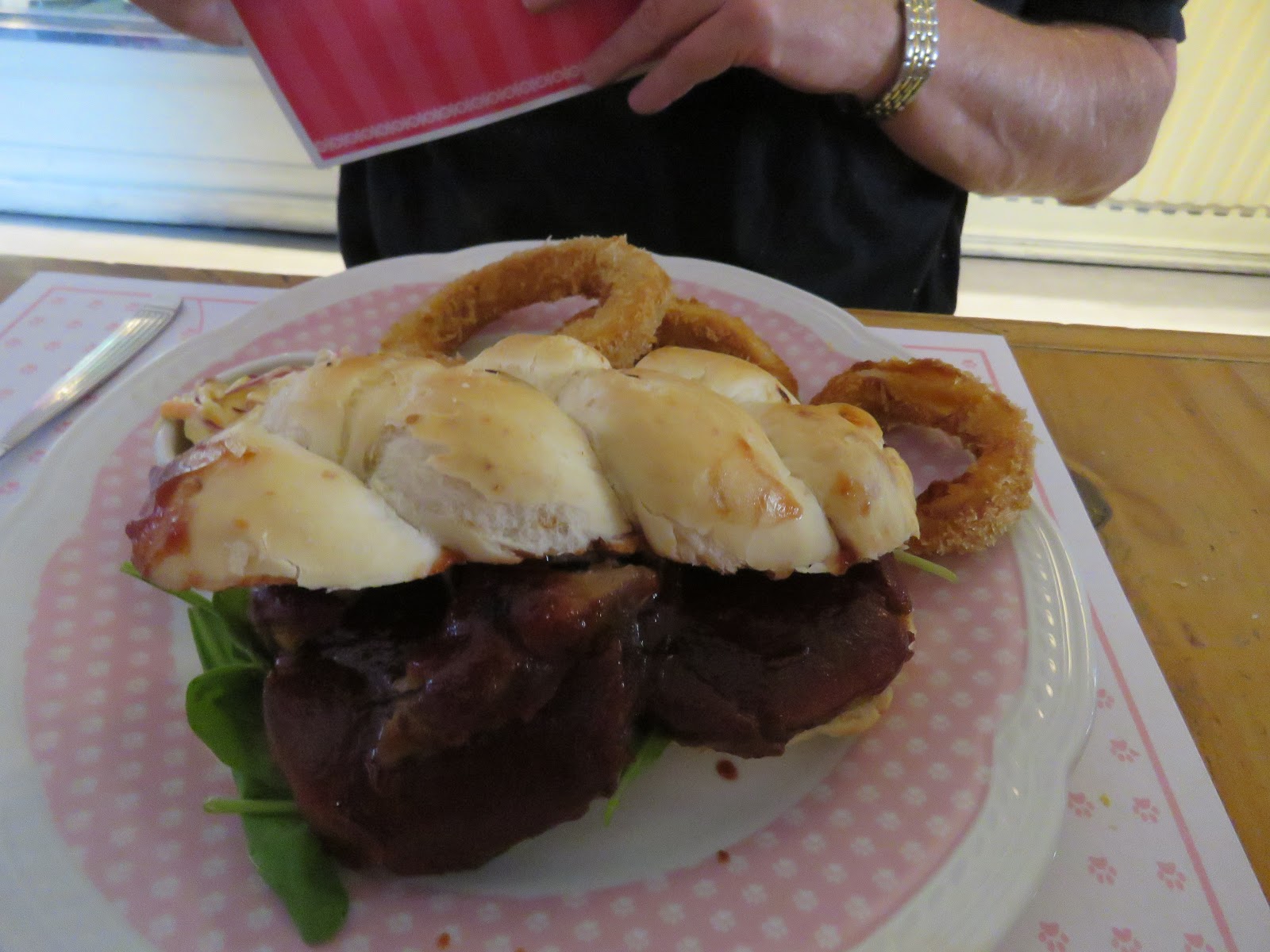
Tom ordered a barbecue pork sandwich which came with three onion rings.

One of these cruises listed in the itinerary embarks from Southampton, England, on October 24, 2019, with a port of call in Boston, Massachusetts, on October 31, 2019 (the seventh anniversary of our world travel). We’d hoped we’d be able to visit beloved Uncle Bernie, my father’s brother, in the 100th year of his life.

In September 2014, we purposely selected a cruise from Harwich, England, which ended in Boston to see Uncle Bernie and my dear cousin Phyllis. Sadly, a few days ago, Uncle Bernie, 98 years old, passed away, and our hearts are broken. We won’t get to see him one more time. 

I ordered gluten, sugar, and starch-free salad.  When it arrived, it was topped with these breadsticks. I sent it back, explaining I needed an entirely new salad due to the contamination from the flour.  We saw some appealing plates being served. Had we ordered differently, we may have had an altogether different experience.

Of course, when we left after a three-day visit, we were realistic in understanding we may never see him again. My father passed away in a tragic work accident in 1960 (see the story here), and Uncle Bernie was his last remaining brother. Our dream of one more visit with him was dashed when he passed away on January 2nd.  

We’ve decided to keep the cruise booking with Boston as a port of call, hoping we’ll see cousin Phyllis for a few hours when we’re in port that day. That cruise ends in Fort Lauderdale on November 8, 2019, at which point we’ll fly to Nevada for a few weeks stay to visit my son Richard and renew our driver’s licenses; visit my sister Julie in California and also visit Tom’s sisters and their husbands in Arizona. 

Decorated shelves in the restaurant.

Our upcoming itinerary will keep us very busy over the next two years. It will be a busy few weeks until we depart for South America for more sites we’d like to see. Now, as we busily work on bookings for these upcoming dates, we’re comfortable and content to do so while here in Buenos Aires.

Tomorrow, weather providing (it’s raining today), we plan to head out sightseeing after uploading the day’s post. After so much sightseeing on the recent 30-night cruise, we’ve been content to stay in the hotel lobby during the days and head out on foot each night to peruse the lovely Palermo area and find a new spot for dinner. 

A refrigerated case was filled with yummy-looking desserts.

So far, we haven’t dined at the same restaurant twice.  We’ll begin returning to favorites in a week or sooner as the time quickly winds down until the Antarctica cruise. 

Today’s photos include a restaurant we visited last night with a few disappointing results, which may have been an entirely different experience during a less busy time and in ordering additional menu items.

A tower of pancakes for dessert for other patrons, not us.

Have a blissful day, rain or shine!

Photo from one year ago today, January 5, 2017:

Tasmanian Devils aren’t as ugly we’d expected, except when showing their teeth when threatened. The photos we took of the rescued animals, the intent of Wing’s Wildlife Park, left them little reason to feel threatened in the spacious habitat in which they comfortably live among other animals. For more details, please click here.

Cruise to South America comes to an end – Final expenses and favorite photos…Tom’s 65th birthday…

Manta, Ecuador.

“Sightings from the Veranda while Cruising”

Torre De Las Couminicaciones or Antel Tower is a 157 tall meter building on the bay’s shore in Montevideo, Uruguay.


We apologize for today’s late posting. Disembarking the ship and getting settled in the hotel in Buenos Aires kept us busy all morning.  Tom is currently taking a short nap while I tackle today’s story. Here we go!

Here’s our final expenses for the 30-night cruise to South America:

Expense US Dollar Notes
Cruise Fare  $                  8,388.32
Airfare   $                     246.42  Costa Rica to Miami 
Hotel in Miami  $                        18.46  Used credits Hotels.com 
Taxi   $                     130.00
Cabin Credit  $                   (550.00)
Wi-Fi  $                     430.00  inc. on second leg 
Gratuities  $                     405.00  inc. on second leg 
Tours & Restaurant  $                    351.86  inc dining  Miami & Cayman  
Additional Gratuities  $                     255.00
Cruise Bill for Purchases  $                     678.13  inc. camera 
Total  $                10,353.19
Avg Daily Cost – 31 days  $                     333.97  inc. one night in the hotel in FL 

Feeling festive on the final night of the 30-night cruise, we stayed up way too late.  From the Cáptain’s Club happy hour party from 5:00 t0 7:00 pm to the delightful dinner table of eight at the Trellis Restaurant to the fun chatting with our favorite bartender Kadak (from Bali) to visiting with more new friends in the Constellation Bar for the final “silent disco” the evening couldn’t have been more varied and fun.

Panama Canal.

At midnight we fell into bed exhausted. Hours earlier, our packed and tagged bags had been taken from outside our cabin door to be stored overnight for morning pickup after the shuttle bus ride at 7:30 am to the port building.

Pisco, Peru.

We were up and about by 6:00 am, a little worn for the wear but anxious to get on our way to the Prodeo Hotel in the famous Palermo district of Buenos Aires. It proved to be the quickest and most efficient debarkation we’ve had to date after 21 cruises in the past five years.

Arica, Chile.

Then, of course, today is Tom’s 65th birthday which, with little merriment on the agenda, we reached the boutique hotel by 8:30 after a 30-minute taxi ride through the busy city. Luckily, it was Saturday, and the traffic was considerably lighter than we heard it could be.

Where the Atlantic and Pacific Oceans meet in Cape Horn, the end of the world.

Buenos Aires is a city of over 12,000,000 people with some of the world’s most harrowing and dangerous traffic. As a result, we plan to do most of our sightseeing on the weekends, when it’s not quite as wild.

The Chilean Fiords.

In an attempt to keep costs to a minimum and to avoid staying in a less-than-desirable neighborhood, we chose this small hotel in the popular and more upscale Palermo district where we should be able to walk or take a short taxi ride for most of our needs.

Glaciers in the Straits of Magellan.

The hotelier has booked a dinner reservation for Tom’s birthday tonight at 6:00 pm, not the later seatings at 10:00 or 11:00 pm. We’ve heard so much about it as typical in Buenos Aires. As tired as we are, an early evening will be in order.

Huge statue in Puerto Montt, Chile.

As I finally write here now, sitting in our somewhat stylish room, we’re in a quandary about a few things. The water isn’t potable, so we’ll have to go out and purchase bottled water.

The Chilean Fiords.

There’s a virtual laundry list of items we’ll need to be a little more at ease, but we’ll report back on these tomorrow once we have a chance to speak to the person in charge, Alessandro, whom we’ll meet with as soon as I upload this post. 

A lizard was eating vegetation at the park in Manta, Ecuador.

Tom watched the first of five Minnesota Vikings games he missed while on the cruise, while I unpacked as best as I could with no available drawers and little closet space. We have a few ideas we’ll run by Alessandro, hoping for a viable solution.

The sun setting, while at sea.

We loved the cruise, the beautiful friends we made, the ports of call, and the many days at sea. Sure, there are always a few areas one could complain about, but we seldom care to spend time whinging about what is wrong when so much is right, the same of which is true here at this affordable hotel.

We were with new friends, Lisa and Barry, whom we’ll see again in June.

We’ll be back tomorrow with Buenos Aires photos, our dinner out tonight for Tom’s birthday, and more.

Barry, Lisa, me, and Tom at dinner in the private wine room at Tuscan Grill specialty restaurant.

Thanks to all of our dear readers for staying with us during the lengthy cruise, including the quiet seas days when we had less to share. We appreciate every one of you.

Typical street with historic buildings in Montevideo, Uruguay,

And, happy birthday to the man of my dreams, who provides me with a life of joyful splendor and perpetual playful anticipation. I love you with all of my heart.

Produce stand in Montevideo, Uruguay.

Photo from one year ago today, December 23, 2016:

Mersey Beach bluff in Tasmania, where we dined for Tom’s birthday. For more details, please click here.