|
| It was a dreary and cloud-covered day, not the best day for entering a rainforest-like environment. We entered anyway. |
Years ago, I watched an excellent movie entitled, The Accidental Tourist with William Hurt, Geena Davis, and Kathleen Turner. It was a quirky movie adapted from the book of the same name by Anne Tyler.The movie, produced in 1988, generated rave reviews for which Geena Davis received an Academy Award
 |
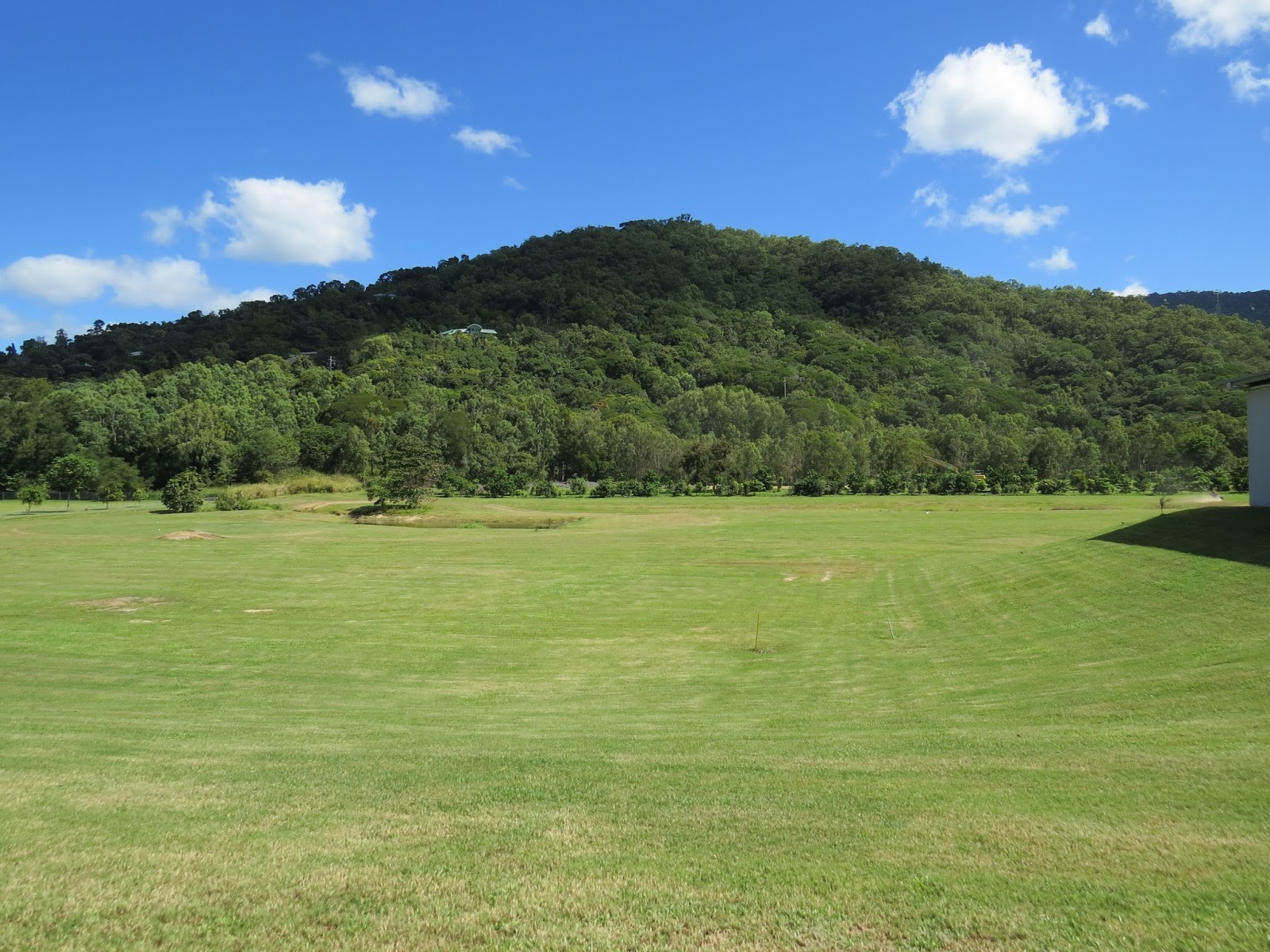
| The vast marsh area was relatively barren before entering the boardwalk. |
The name of the movie has stuck in my brain over the years and surfaced when we began sightseeing throughout the world over these past almost three years. The accidental tourist…that’s us. Why is that so?
 |
| We never saw another person the entire time we walked through the salt marsh. It was a little eerie entering on this dreary day. |
As it turns out, our favorite sightseeing experiences are those we stumble upon as opposed to planning in advance. Whether it’s a beach, a desert, a flock of birds or an interesting neighborhood, when we happen to encounter a photo-worthy scene, it’s often by “accident.”
 |
| You can zoom in to read any of these signs. |
So was the case a few days ago when returning from the Cairns Central mall when Tom unintentionally turned down a road leading to the airport where a sign prohibited him from making a left turn to the main highway back to Trinity Beach.
 |
| Once inside the long, narrow boardwalk took us deeper and deeper into the marsh. |
This happens from time to time. How can we possibly anticipate every left or right turn as being accepted on an unknown road when we don’t have wifi on our phones with no cell contracts?
 |
| As it turned out, low tide gave us an opportunity to see the unusual tree roots which at times are under water. |
We map ourselves the old way. We either take a photo of a map with turn by turn directions before we leave home or commit the directions to memory which here in the Cairns area is easy to do. There are only a few main roads leading to everything.
 |
| Notice these little holes that creatures quickly ran in and out of as we passed. |
Thus, if we explore without a plan in mind and most often we do, we’re “winging it.” Thus, the term accidental tourist certainly comes into play when we frequently discover an area we may never have found otherwise. Tom’s superb sense of direction always, prevents us from getting lost.
 |
| When we lived in Belize, we toured a mangrove area by boat and explored the rainforest. |
Plus, a person could drive the entire perimeter of the continent of Australia without a map and never get lost. Following the coastline itself continues for an estimated over 12,700 kilometers, 7891 miles. Click here to see a video by a scientist explaining how difficult it is to determine Australia’s or any other coastline’s measurements.
 |
| In certain spots, the holes were larger. |
As a result, whenever we drive to a specific location, we find ourselves veering off the beaten path on the return drive hoping to stumble upon something amazing we may have never planned and mapped to see. That’s the essence of what makes our travels all the more exciting.
 |
| The more we continued on the boardwalk, the denser the tree became. |
If any of our readers review our previous over 1000 posts, it would be apparent that many of the highlights of our experiences have been as a result of being the “accidental tourist,” perhaps not in the manner as implied by the book and subsequent movie but, instead, by the interpretation of the words in themselves.
 |
| The fact that these trees survive living in saltwater for part of the season is interesting to us. |
As Tom turned down the above-mentioned road that led to the airport with no apparent exit for turning around, we both expected that in moments we’d arrive at either the departure or arrivals levels.
 |
| Tangled root systems proliferate in this environment. |
Of course, I never complain about Tom having to make such an unexpected turn. I don’t drive the car leaving me with little right to comment about possible wrong turns. Nor would I want to when I, too, am scanning the area for potential points of interest we may have otherwise missed.
 |
| We never thought much about these types of areas. Seeing this firsthand gave us a new perspective. |
There we were on the airport road and suddenly a small parking lot appeared to the right, a spot where we could possibly turn around to avoid driving into the airport complex. As we pulled into the “car park” a sign read, “Parking for Mangrove Boardwalk, visitors only.” Our interest was peaked. What’s a Mangrove Boardwalk?
 |
| Wouldn’t this be a logical spot for crocs to hang out? If one appeared, we were up high enough to avoid being eaten (after I’d take a photo, of course). |
Getting out of the car we moved to read the posted signs to discover that the Jack Barnes Bicentennial Mangrove Boardwalk is a scenic, easy to navigate path through a dense saltmarsh and marshlands. To quote from the site:
 |
| We scoured the banks of the creek hoping to spot wildlife. |
“The Jack Barnes Bicentennial Mangrove Boardwalk is a special place to learn about tropical Australian mangroves and saltmarsh. Visitors can learn about a broad range of species, and some of the key functional attributes of these tidal wetland systems. The walk has two distinct parts, heading either north or south into closed mangrove forests from the carpark situated adjacent to a small saltmarsh and saltpan area.
 |
| Water from the creeks remained in some areas of the saltmarsh. |
The northern boardwalk extends to Little Barron Creek where viewing platforms are provided at the creekside. About half way along the walk, a canopy tower offers a view across the tree tops. This section of the walk returns in a circuit to the carpark. Signs are placed along the boardwalk to provide information on the many ways that plants and animals have adapted to this interesting environment.
The southern boardwalk offers a slightly different experience and explores a number of different types of mangrove forests. This section terminates at a canopy tower near the mouth of Swampy Creek. Signs along this section provide information on the productivity of mangrove forests.
 |
| It was odd and somewhat eerie, never seeing other people. |
The boardwalk was opened on 27 February 1988 by Dr. JT Baker, OBE, Ph.D., FRACI, Director of the Australian Institute of Marine Science. It was constructed by the Cairns City Council on land made available by the Cairns Port Authority. Construction was supported by the Cairns Bicentennial Community Committee, with the assistance of dedicated employees who constructed the boardwalk, working closely with the Cairns Port Authority, the Queensland National Parks and Wildlife Service, and the Australian Institute of Marine Science.
Location Details
-
- Distance/length: Two sections: north 0.8 km, and south 1.2 km
-
- Location: Just off the road to Cairns Airport.
-
- Walking Time: 30 and 40 mins, respectively.
-
- Address: Airport Avenue, Cairns.
-
- Directions: Directions as if going to the Cairns International Airport, look for signs to Mangrove Boardwalk when nearing the airport.
Contact: For more information: Cairns City Council, Cairns
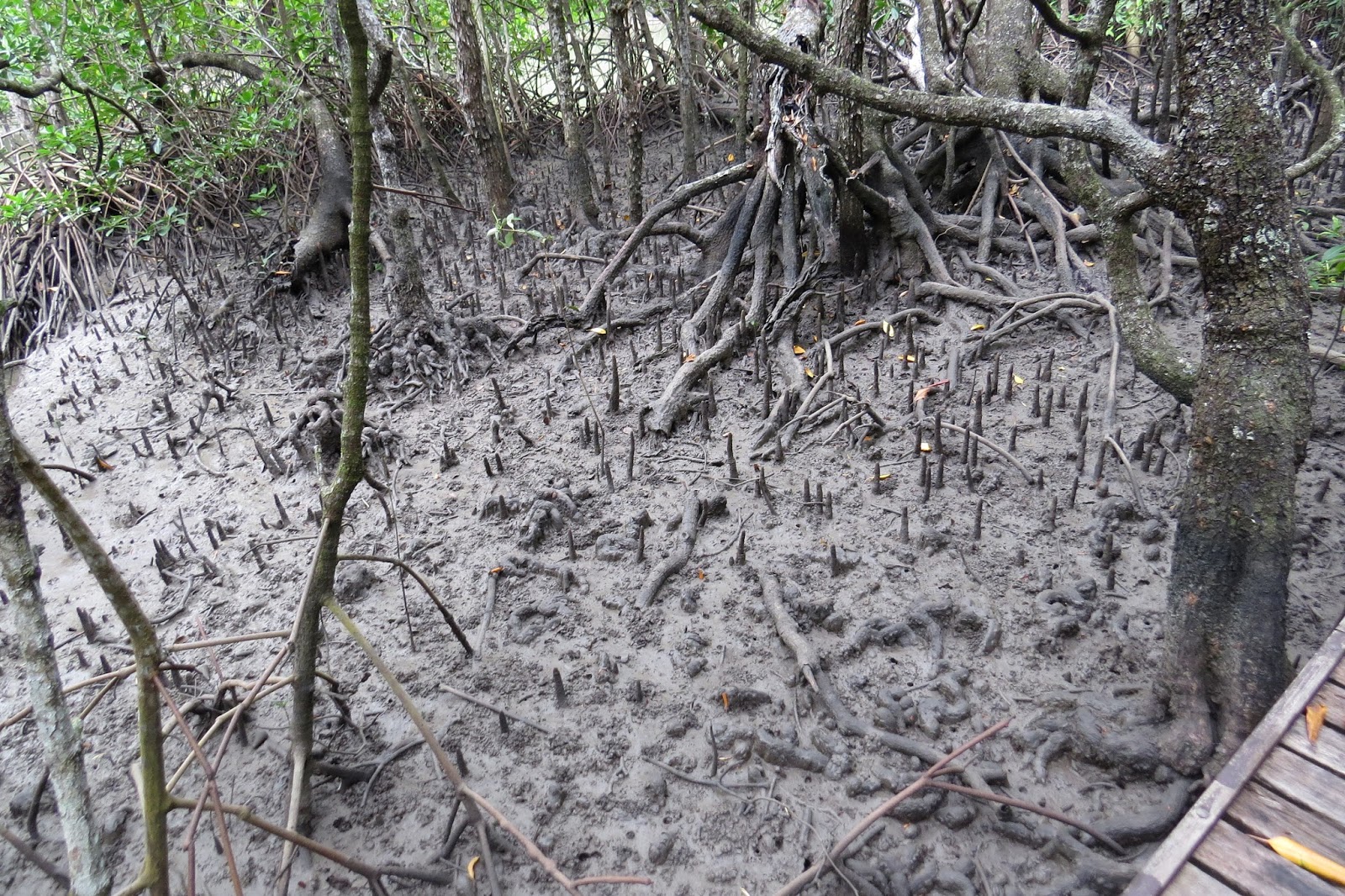 |
| We wondered if these little sticks popping out of the ground were remains of downed trees or future trees growing in the salty ground. |
Walking through this unusual area was both eerie and interesting at the same time. The raised wooden walkway was in excellent condition and easy to walk, although too narrow for us to walk side by side. I led the way while Tom followed behind reminding me not to fall off a few times. I never felt as if I’d fall off the one-meter wide boardwalk without a railing. Then again, he’s always looking out for me.
 |
| It wasn’t far down to the ground from the boardwalk. |
As we continued on, the mosquitos started to congregate around my repellent free legs causing me to stop on occasion to swat them off. It wasn’t until the next morning that the bites began to itch which still continues today. Alas, I could have refused to enter this heavily forested area. But, being who I am, I was determined to go and never complain.
 |
| This complex cluster of tree roots was hard to miss. |
At one point, it felts as if the boardwalk would never end and perhaps we’d get lost. I suggested to Tom that we may have to turn around and go back the way we came when there were no signs posted with map of the boardwalk once inside the path.
 |
| We stopped to read each sign along the way. |
Tom said, “Let’s keep going. The path will come back around to the beginning.”
 |
| I didn’t take the time to read this sign when close to the water, the mosquitos were in a frenzy. |
We continued on and alas, in time, we eventually found the path that circled around the entire perimeter returning us to the beginning. It was quite an interesting and unusual walk unlike any other than we’d done in the past, except for a few tours on which we embarked into various rainforests in a few countries.
 |
| Another large muddy creek, a habitat for wildlife. |
The only wildlife we encountered was birds none of which we were able to take photos of and also, the most peculiar little creatures that rapidly ran in and out the holes in the ground at low tide when they heard us coming, again never able to get a good look at them, let alone take a photo. We assumed they must have been some miniature type of marine life.
 |
| Finally, we were back at the beginning. Although I enjoyed seeing this most peculiar area, I was thrilled to get back into the car away from the mosquitos. Once inside I noticed a stick roll-on repellent I’d left in the car. Next time we explore, I’ll bring it along, using it as needed. |
When the walk ended, we commented on how often we find such interesting spots to explore and that truly our favorite experiences are often those we encounter as “accidental tourists.”
 |
| The scenery over the island of Madeira was breathtaking every day. Our time was winding down and we began to think ahead in this year ago post.Please click here for details. |