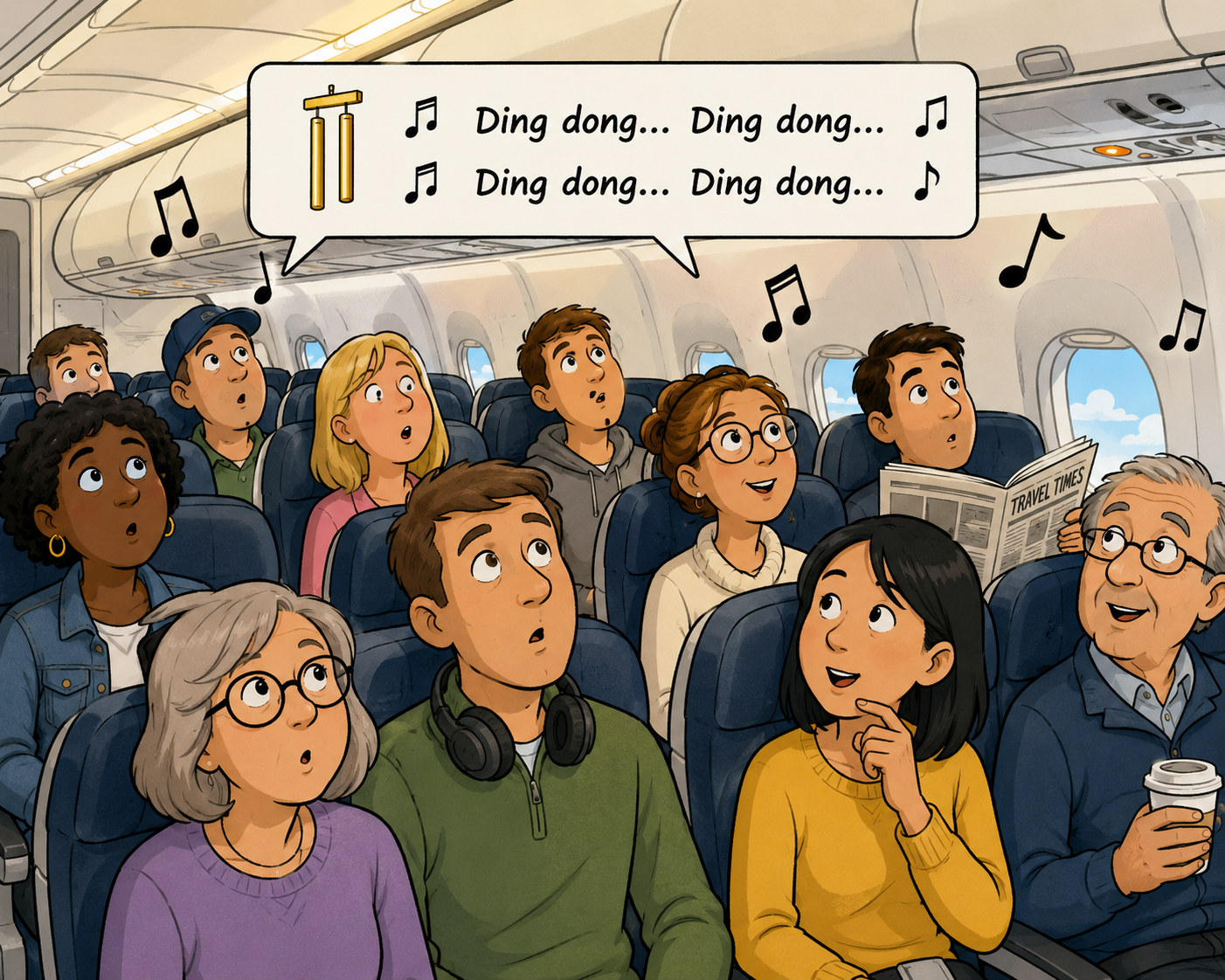
From Travel + Leisure online magazine, found here.
“Those Beeps You Hear on a Flight Actually Mean Something—Here’s What Airplane Chimes Signal
A pilot weighs in on what one, two, and three chimes mean on a plane. By Lydia Mansel Published on May 4, 2026
The more often you fly, the more the entire process starts to feel routine. It becomes second nature to scan your boarding pass, settle into your row, buckle your seatbelt, and zone out—whether that means getting some work done or listening to your music—until it’s time to deplane. But if you take a moment to actually look at (and listen to) what’s going on around you, you may start to notice the subtle details that ensure your entire in-air experience runs seamlessly. One of those details is the beeps, or chimes, you hear during a flight.
To the untrained ear, these chimes are easy to ignore; they don’t register as anything urgent or noteworthy. And that’s precisely the point—they aren’t intended for passengers. “These sounds are meant for the flight crew (pilots and flight attendants) in order to keep everyone informed [and] standardize the flying experience, and [they] are standard operating procedures,” says Kolin Jones, a pilot and the founder and CEO of the private aviation company Amalfi Jets.
You’ll likely hear a few different versions of the dings or chimes. “Individual dings while at cruising altitude are the noises of another passenger ringing their flight attendant call button,” says Jones. They may be in need of a drink, assistance with their entertainment system, or something else that requires direct interaction with the crew.
Now what if you hear two chimes? “The double chimes you hear… indicate to the cabin crew that the aircraft is passing through 10,000 feet, which is usually when they will start to prepare the cabin for service, and enable passengers to get up and walk around,” says Jones. At the same time, you might also hear an announcement that you’re now able to use your electronic devices.
There may also come a time when you hear three chimes, although this tends to be rare. “Hearing three chimes is ‘priority communication,’ so usually the flight deck is calling the flight attendants with an urgent message or an emergency situation,” says Jones. Still, as a passenger, it’s important to remain calm and stay in your seat. If there is anything that needs to be communicated to you and your fellow passengers following the three chimes, the air crew will make an announcement.
While Jones says these sounds are “usually standard across all airlines/aircraft (commercially),” they can “vary per each individual airline’s standard operating procedures (SOPs).”
Continuing on…In just forty eight hours, this chapter of our sea journey to the US will come to a close. It’s hard to believe how quickly the days at sea have slipped through our fingers, each one filled with new faces, routines, and the comfort of life afloat. Soon, we’ll disembark, stepping off the ship with our luggage in hand and hearts full of memories we didn’t even know we were collecting.
Waiting for us will be our dear friends Rita and Gerhard, whose familiar smiles will mark the beginning of our next adventure. There’s something deeply comforting about being greeted by people who know you well, especially after weeks surrounded by strangers who, in their own way, became part of the story too.
The drive to Vancouver, Washington will feel like a transition between worlds. From the vast openness of the ocean to the beauty of the Pacific Northwest, it’s a shift we welcome with curiosity and gratitude. Four nights there lie ahead, offering us time to settle, reflect, and simply be before we begin our next journey across the northern states of the US, on our way to Minnesota.
As always, we move forward with open hearts, never quite knowing what each new place will bring, but trusting it will be exactly as expected.
Be well.
Photo from ten years ago today, May 6, 2016:

