Another outstanding photo for “Sightings from the Veranda”…Holy Moly!…Five days and counting…

White cows were grazing in a pasture.

“Sightings from the Veranda in Costa Rica”

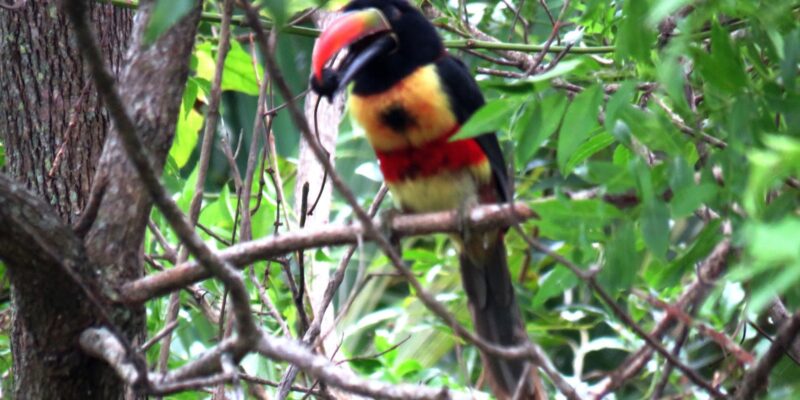
Tom Lyman, you never cease to amaze me!  What a shot of the classic “Froot Loops” cereal (per Tom) Toucan, technically known as the Rainbow-billed Toucan, aka the Keel-billed Toucan (different than the Toucan in our previous post with the Fiery-billed Aracari Toucan as shown here) taken in our yard in Atenas, Costa Rica. The veranda never disappoints as we wind down our time in this tropical country.

As Tom listened to his favorite podcast while sitting on the veranda in the late afternoon, “safari luck” prevailed once again as a stunning bird stopped by a distant tree. Tom has a good eye and keen vision with his glasses on, often observing a sighting long before me.

We were both pleased and surprised at how steady he was in taking this ideal shot of the colorful species, different from the Fiery-billed Aracari Toucan he’d captured a few weeks ago.

Here’s some information on this stunning bird from this site:

“Anatomy – Best known for its large bill, the keel-billed toucan is a large and colorful bird with black plumage, a bright yellow throat and cheeks, vibrant red feathers under its tail, and a yellow-green face. Its light green, the banana-shaped bill is splashed with orange and tipped with red and blue and can grow to be a third of the size of the toucan’s 20-inch body. Though cumbersome looking, the bill is relatively light because it is made of protein and supported by hollow bones. The toucan’s vast wings, however, are heavy and make flight laborious.
View over the valley as the clouds roll in.
Habitat – These unique birds are found in tropical and sub-tropical rainforests from southern Mexico to Venezuela and Colombia. The keel-billed toucan is crepuscular, meaning that it is most active during dawn and dusk. It lives in groups of six to twelve birds and rarely flies long distances because of its heavy wings — it is, however, quite agile hopping from branch to branch. The monogamous pairs make their nests in natural or wood-pecker created tree holes, taking turns incubating their eggs.
Diet – Keel-billed toucans feed primarily on fruits and eat insects, lizards, tree frogs, and even eggs. They consume their food by grasping it with their bill and quickly flipping it up into the air, and catching it in their mouths. They swallow their fruit whole and regurgitate the larger seeds while the smaller ones pass through their digestive systems. This method means that toucans play an essential role in reproducing the fruit trees they depend on. These beautiful birds are almost always seen feeding on fruits high up in the canopy; however, they will occasionally fly down to feed on the shrubs or catch a lizard from the undergrowth.
Threats – The species is not currently listed as endangered, but it is threatened by human activity. Habitat loss is a constant menace to the species’ populations. They are sometimes still hunted for their meat and ornamental feathers. At one time, they were prevalent in the pet trade, but it has since been revealed that their poor disposition makes them destructive pets. They’re valuable to Belize — where they are the national bird — bringing tourists who hope to catch a glimpse of their stunning plumage.”
Part of the road heading to downtown Atenas is closed due to the re-paving of the road.

This is the first photo we’ve captured in the wild of this particular Toucan. However, we’d seen several at the rescue facility, Zoo Ave, which we visited early in our stay, posting many photos over these past months.

Spotting this beautiful bird on the villa grounds only added to our exquisite experiences of spending most of our days outdoors in the pool area and lounging on the veranda. At the same time, we chatted, continued our continuing online research, and stayed in touch with family and friends.  It’s genuinely been blissful.

With relatively low taxi fares in town, locals and ex-pats often use taxi services to get around with the high cost of cars and trucks in Costa Rica. Each time we went into town, a 10-minute drive, the round trip taxi fare with a tip has been US $7.05 (CRC 4,000). 
We didn’t get out much in Costa Rica, mainly due to a lack of a rental car (costly here) and high costs for chartered tours at distant locations (we’ve “tightened our belts” for upcoming adventures). 

We arrived in Costa Rica during the rainy season, which also made sightseeing tricky when, at times when roads were washed out, and there were landslides and road closings. However, we’ve easily stayed well engaged and entertained during this past three months, reveling in the lush surroundings and vegetation, an ideal haven for birds and wildlife…equivalent to a rainforest in our yard.
We were surprised to find this vacant lot in town without a “for sale” sign (in Spanish, “en vente”).
As the time approaches for departure in five days, we feel a bit nostalgic. Last night, at dark, we sat on the veranda watching the village’s lights below in the valley and listening to the sounds of music and festivities that seem to permeate the air most nights. 

Now, with the weekend upon us, we’ll hear even more music well into the wee hours of the morning, pleasant Spanish dance music, as the little town of Atenas celebrates life.  We’re humbled and grateful to have been a part of it over this extended period while we anticipate what is yet to come…
Happy day!
              Photo from one year ago today, November 17, 2016:
Carlo, Michelle, friends we made on a prior cruise picked us up at the cruise terminal building in Fremantle, Australia, for a day of sightseeing in Perth and Freemantle. It was a memorable day. For more, please click here.

Wow!…Safari luck as we wind down our time in Costa Rica…Six days and counting…

The colorful entrance to an art store in Atenas.

“Sightings on the Veranda in Costa Rica”

Once again, Tom’s been able to capture another fabulous bird from the veranda while I was busy indoors making dinner. This Yellow-tailed Oriole, although at quite a distance, was a treasure to behold. More photos will photo with his mate! 

Each afternoon, after we’re done in the pool, usually around 3:00 pm, Tom takes his computer to the veranda to listen to his favorite podcasts. At the same time, I’ll busy myself indoors, preparing dinner, downloading shows on Graboid, working on photos for future posts, or returning email messages.

Eating only one meal a day, by 5:00 pm, we’re ready for dinner, and we both get into a full-on mode to get everything to the dining room table, hot and prepared for an enjoyable meal.

A cafe along the boulevard.

Yesterday, after spending time in the pool’s cool water, which hadn’t heated up by its solar power during the overcast day, we turned on the jacuzzi to let it warm. The air was cool and windy, and the thought of the warmth of the jacuzzi was rather appealing.

Stepping into the warm water of the hot tub was delightful. We stayed for over an hour, chatting endlessly as usual. We hadn’t used the jacuzzi much (this was only the second time) since we arrived over three and a half months ago in an attempt to keep the costs down for the owners. 

Bev and Sam had kindly given us an excellent rental rate for our extended stay. As always, in all vacation homes, we’ve been mindful of our use of the utilities, turning off lights, fans, and appliances when not in use.

Side entrance to Catholic Church in Atenas, Iglesia Catolica Atenas, located in the center of town.

These two-hour afternoon “breaks” from each other are by no means “needed” to be away from each other.  But, somehow, we’ve just gravitated toward this time apart to engage in activities that may not appeal to one another.

While I’m bustling indoors, Tom has the camera close at hand during these periods and has been fortunate to capture several outstanding bird photos, especially over several weeks.

Cafe and bakeshop.

Perhaps it’s the time of day or weather conditions that bring more birds to the grounds than other times of the day.  It’s been the rainy season in the Alajuela Valley over the past months. Each day, we see more birds shortly before the deluge begins each afternoon. 

Yesterday was no exception when Tom called out to me to also take photos of stunning birds resting in the various trees on the grounds, sometimes in flocks or pairs and with many singles on their own.

We squeal with delight when we see less common varieties, often colorful and bespeaking one’s perception of wildlife in Costa Rica. Over the past five years, we’ve become more and more interested in birds, as shown in our many posts. 

Our final walk through Central Park in Atenas.

We’re certainly not birding experts, and at times, we struggle to identify specific species when we can’t readily find information online. Thanks to the assistance of many of our regular readers, we often receive an identification 24-hours after we’ve uploaded a post after mentioning we’re seeking the identity.

Recently, our most avid participants in providing information have been our friends Louise in Kauai, Hawaii, where we spent four months in 2015, and here in Atenas in our neighborhood, Charlie, who’d be also quite a bird enthusiast. Thanks to both of you!

Each week we’ve had the taxi driver drop us off at this location so we can walk through the town on our way to the Supermercado Coopeatenas, the grocery store where we’ve shopped during this past many months.

Throughout the world, we’ve been able to ask our readers for assistance. Invariably, we receive a response, after which we edit the specific post to reflect the name of the bird as opposed to my inquiry in the caption. Thanks to all of our worldwide readers for your assistance.

While we were there for almost a year, from 2013 to 2014, we were so busy observing and photographing large and small creatures. We failed to spend much time on birds. Now, as we contemplate our upcoming stay in Africa in less than three months, we do so with added enthusiasm.

This trip to Africa will be different from our enhanced interest in birds. For us, when no “big game” is handy for observation, birds are an equally fascinating alternative. We commend avid bird watchers for their patience in getting the perfect shot.

A famous pizza shop, Pizza Olivera, is often attended by ex-pats.

With the planned purchase of a new longer-range camera soon, we look forward to enhanced shots of birds and other creatures we find in the wild before the Antarctica cruise.

There will be no shortage of photos for the “Sightings on the Veranda in Costa Rica” we’re wrapping up at the end of our remaining six nights in Atenas. Soon, we’ll be posting our “favorite photos” of Costa Rica, and next Tuesday, we’ll share our final expenses on our last post before heading to Florida for the South America cruise.

Have a blissful day.

Photo from one year ago today, November 16, 2016:

One year ago, our friends Michelle and Carlo, whom we’d met on a prior Australian cruise, picked us up at the port in Perth while we were on another Australian cruise. We had a fabulous day. Michelle and I shopped while Tom went with Carlo to his office nearby. This is CJ (for Carlo Junior), the family’s Char Pei, who took a liking to Tom. For more photos, please click here.

Surcharges are a necessary evil we chose while traveling the world…More wildlife photos from Costa Rica…

Look closely to see the face, only a mother could love, of a live crocodile behind a chain-link fence at Zoo Ave.

“Sightings from the Veranda in Costa Rica”

Tom’s photo, early this morning, of a cute dog that stopped by to say “hola.”

Definition of “surcharge:”

noun

1.
an additional charge, tax, or cost.
2.
an excessive sum or price charged.
3.   an extra or unreasonable load or burden.

Word Origin and History for a surcharge:

v. early 15c., from middle French surchargerfrom Old French sur- “over”
(see surchargier “to load” (see charge ). The noun is also first attested early 15c.

When most of us think of a surcharge, we believe in terms of an automatically imposed fee or tax added to a purchase over which we have little choice to accept as “the cost of doing business.”
Here’s a longer view of the above crocodile.

As world travelers these past five years, we find that we must bear the cost of a wide variety of surcharges that we chose to impart generally for the usual benefit of convenience.

Convenience is a huge factor in our financial lives. We choose convenience when we pay more than preferred or expected prices for many items, in an effort to ensure a better experience.
Let’s review some of these self-imposed surcharges, we encounter as a result of traveling the world:
1.  Baggage fees: Sure, we could travel “very light” hauling only backpacks and carry-on luggage. However, for the sake of having enough clothing, supplies, and digital equipment in our possession, we often pay excess baggage or baggage weight fees, depending on the airlines.
A curious turtle scurried quickly toward us.
2.  ATM fees: We do not go into banks or currency stores, paying exchange rate fees and credit card fees to obtain cash. More economically, we use ATMs to save money using our debit cards and thus incur only two fees; one, the cost of using the machine; two, the charge from our bank when using an ATM at an international ATM facility.
3.  Rental cars: At times, we pay higher fees for rental cars when we need a large enough vehicle to accommodate all of our bags; three checked bags and three carry-on bags.
4.  Medical costs: Recently, we incurred added medical fees to acquire a medical certification enabling us to board the upcoming Antarctica cruise, beyond the cost of the cruise itself. Soon, when we arrive in Buenos Aires, we’ll make an appointment at a travel clinic to update our vaccinations and get prescriptions for malaria pills prior to returning to Africa. We pay a premium for the few medications I use that aren’t covered by insurance and must be shipped to our location at any given time.
Turtles tucked away under the bushes.
5.  Tips: Particularly on cruises, we choose to add tips to the cost of the cruise at the time of booking which at this point, is running US $27 (CRC 15,372) per day. While on the ship, we may choose to pay additional tips for enhanced services and attention to detail befitting our convenience and experience.  In addition, for convenience, we may pay porter and bellman fees, depending on the circumstances.
6.  Flights:  On many airlines, they are now added extra fees for specific seats on the plane in the “coach” or economy section. At times, since we’re taller than the average passenger, we may choose a bulkhead seat or other seat with more legroom.
7.  Vacation Homes with added amenities: We prefer to rent a vacation/holiday home that includes Wi-Fi and all utilities paid, a pool, an upgraded kitchen with modern appliances and ample kitchen utensils, although we’ve had many exceptions. Of course, we always pay a premium for good views, which we’ve found is ultimately important to the our level of enjoyment.
8.  Mail and shipping fees: Since we’re unable to receive mail, piece by piece, in most countries, we often make purchases for clothing and supplies, accumulating them along with any snail mail that may arrive, placing them in one large box to be shipped. Most products we purchase include free shipping, but we must pay exorbitant fees to have all of the items sent to us at specific locations. For example, the box being shipped today which includes all the clothing we had to purchase for Antarctica, my new laptop and other supplies, we’re incurring a US $450 (CRC 256,199) shipping fee for the items to be shipped FedEx from Nevada to our upcoming hotel in Fort Lauderdale. This requires our mailing service to open all the arriving packages and boxes, toss the paper and packing materials and neatly place all the items in one box. Their fees imposed for this process are included in the above price.
A leopard atop a high perch.

9.  Internet/Wi-Fi/SIM card fees: We cannot travel without regular access to Wi-Fi; not at hotels, airports, and vacation homes. With our daily posts, photos and research, we chose not to be without Internet services for even a day. Ensuring a connection is always readily available often results in us paying added fees, including SIM cards for phone and data, when we chose not to pay the outrageous costs for roaming cell service in the US.

10. Visas – entering and exiting fees: Upon entering and exiting some countries, an arbitrary fee is charged for visiting their country. This is not the case in every country, but when we encounter such situations we may pay as much as US $40 (CRC 22,7773) at each immigration stop.
All of the above fees and more quickly add up to thousands of dollars each year. Although under many circumstances, we’ve opted for the lowest possible costs for each of the above, willing to forgo some conveniences, we’ve found paying these fees, although often begrudgingly, make life just a whole lot easier.
Sloths, known to by shy, are not easy to photograph when they tend to stay well hidden and out of sight.
We’re not backpackers. We don’t live in hostels. We don’t always use public transportation, preferring taxis and rental cars as an alternative. We aren’t 25 years old with minimal requirements. Nor, are we “high maintenance” always requiring the “best” of everything. Most likely, we fall somewhere in the middle, seeking a somewhat comfortable and somewhat convenient life as nomads.
May your life be comfortable and convenient.
Photo from one year ago today, November 14, 2016:
Tom’s shot of the sunset as we set sailed to our next destination. For more details, please click here.

Tom correcting me when I’m wrong…

Pigs were cuddling while snoozing in pen.

“Sightings from the Veranda in Costa Rica”

Tom took another excellent distant shot of a bird we couldn’t identify online. Costa Rica neighbor and bird enthusiast Charlie identified this bird as a Clay-colored Thrush or Yigüirro in Spanish.  Thanks, Charlie!

After reading yesterday’s post, Tom corrected me on a few items, which is often the case when I make an incorrect or inconsistent statement. After 1,935 posts in five years, I’m bound to be inconsistent from time to time. 

In this post dated June 17, 2013, I referred to our “bucket list” upon visiting Venice, Italy. In yesterday’s post, as shown here, I stated we don’t use the phrase “bucket list” so much anymore.

I can justify my inaccuracy by saying that we’ve changed our views on specific topics or phrases over these years, one being “bucket list.” It had become too repetitive and overused in travel circles, and I became tired of using the phrase. 

In searching our site for how many times I referenced this phrase, it appears it may have been dozens of times dwindling as time passed, as it became apparent to me that it may not necessarily apply to us.

Squirrel Monkeys in pen.

If our travel lives consisted of a “bucket list,” we may have felt restricted to fulfilling each item on the arbitrary list.  Instead, our curiosity and desires have been fluid, changing from time to time. As a result, I dispensed with using the expression overtime during the past five years.

When meeting ambitious travelers throughout the world, I often chuckle to myself when I hear the phrase repeated repeatedly. In essence, for most travelers, it clearly defines an objective…see these places while we can.

Secondly, Tom reminded me of yesterday’s post when I went on and on about what Tom had envisioned for his retirement years, failing to mention what I’d imagined for myself.

“Oh, good grief,” I spewed. “Haven’t our readers heard enough of what I think and what I imagined?  Surely, after 1,935 posts, don’t our regular readers see me like an open book and easily recite my opinions and perceptions with an uncomplicated sense of fluidity?

Two parrots who refused to turn around for a photo op.

Tom reminded me that at any given moment, don’t we have hundreds of new readers stopping by to grab a snippet of that which we espouse in our endless ramblings? They may not as yet have grasped the flow of opinions and ideas that fly off these pages day after day.

To satisfy Tom over my supposed incomplete post yesterday, I agreed, albeit tentatively, to share what I had imagined my retirement years long before we decided to travel the world. After all, we decided in January 2012 and left Minnesota on October 31, 2102, less than 10 months later.

I began contemplating my retirement years after I turned 50, which was long before I changed my way of eating to achieve pain-free living, which transpired in August 2011 from a hereditary spinal condition.

By the end of November, I awoke one morning, and for the first time in decades, I could stand, walk and maneuver without pain in my back and legs. It was indeed a miracle. Only a few months later, Tom asked me if I’d like to travel the world now that I was pain-free, and we, unsure as to how long that would last, began planning the adventure.

Easy walking path in Zoo Ave.

At that time, little did we imagine we’d last this long. We thought, two or three years tops and we’ll lose interest after tiring of moving around. It hasn’t happened. 

However, before that recovery in 2011, always in chronic pain, preferring not to complain to family and friends, I imagined my “elder years” would be wrought with the painful condition while continuing to attempt to live as normal a life as possible.

My life would have consisted of spending time with family and friends, cooking and entertaining, keeping a tidy and organized household, and attending an endless array of activities, functions, parties, and events. 

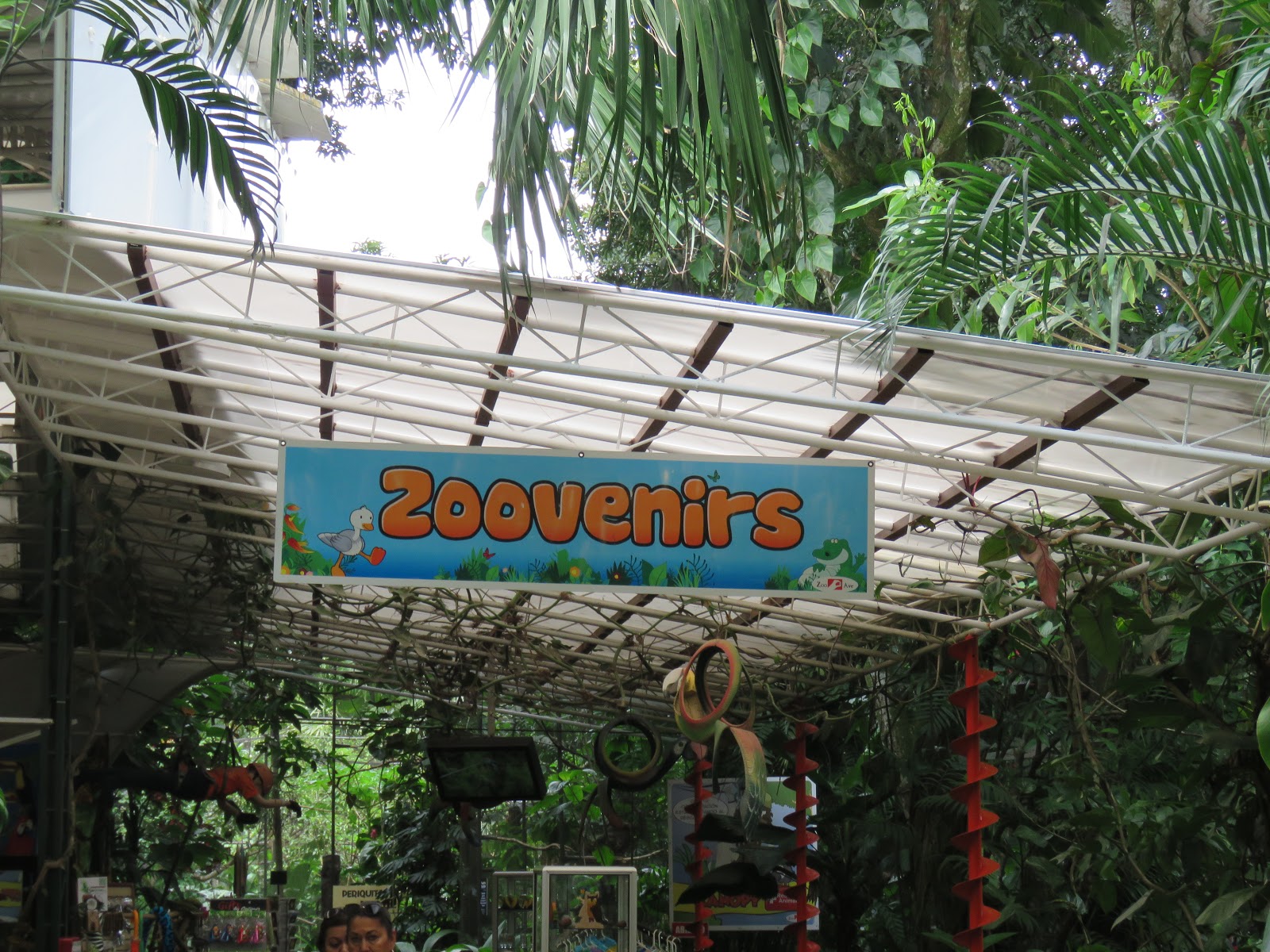
Cute sign, Zoovenirs as opposed to souvenirs.

It would have been a relatively simple life comparable to that of many retirees, which was highly enjoyable when I could mentally put the pain aside.

That’s it. But now, my imaginings are very different…in 82 days from today (February 2, 2018), we’ll be standing on Astrolabe Island, Antarctica, with 100,000 Chinstrap penguins.

In approximately 90 days, we’ll be living in the bush in South Africa, surrounded by wildlife with a camera in hand, reveling in the wonders of nature and wildlife far beyond any dreams we may have had in the past. Pinch me. Is this really our lives?

Am I going to awaken one day to be pushing the grocery cart at the Cub Foods store in Minnesota or…awakening in Buenos Aires beginning in 41 days staying in a lovely hotel in the hub of the fascinating city for an entire month? 

Variegated Squirrel at the rescue facility, Zoo Ave in Costa Rica, comparable to those we’ve seen at the villa.

We made a choice. It wasn’t an easy or flippant decision. We have no regrets. Life is good. We’re grateful, we’re humbled, and we’re at peace.

Thanks to all of our readers for sharing this life with us.

Photo from one year ago today, November 12, 2016:

We dined almost every night during the 33-night cruise circumventing Australia, with new friends from the top, left to right, John and Kat from Australia, Cheryl and Stan and Lois and Tom from the US and us. (Not our photo). For more details, please click here.

Fiery-billed Aracari…Three gorgeous birds in the yard…The story continues…

“I’ve got mine!”
“Sighting from the Veranda in Costa Rica”
Sadly, another bird hit the glass wall and failed to recover.
“The Fiery-billed Aracari (Pteroglossus frantzii) is a species of toucan that is found on the Pacific slopes of southern Costa Rica and western Panama. Its binomial name commemorates the German naturalist Alexander von Frantzius. Its habitat is lowland forests and clearings.

The Fiery-billed Aracari has bright markings and a large bill, like other toucans. The adult is about 17 inches long and weighs 8.8 ounces. The sexes are similar in appearance. The head and chest are black and the upper parts are dark olive-green. The rump and under tail are reddish. The collar on the rear of the neck is also reddish. The underparts are bright yellow.

There is a round black spot in the center of the breast and a red band appears across the belly. The thighs are chestnut colored. There is bare black facial skin. The upper mandible of the bill is bright orange. The lower mandible is black. The legs are green. The young are duller in color, with a dirty-black head and brown-green upper parts. The breast spot and belly band are unnoticeable in juveniles. The call is a loud, sharp peek or keeseek.

This species is mostly a fruit-eater, but will also eat insects, lizards, bird eggs, and other small prey. They are seen in small flocks of up to 10 birds. They have a rapid and direct flight pattern. They nest 20 – 100 feet high in a tree. The female lays two white eggs that are incubated for 16 days by both parents. 

The chicks are blind and naked when hatched. Both parents feed the young, which leave the nest after about 6 weeks. The adults feed the young chicks for another several week after they leave the nest. The Aracaris roost socially throughout the year, which is unusual among toucans.”

After groundskeeper, Ulysses alerted us to the sighting, we were thrilled to see three of these outstanding birds on the grounds of the villa while standing on the driveway. The fallen trees from Hurricane Nate were being removed by local workers opening up an area where the birds were able to be seen eating fruit from the remaining trees. See our post on that date here.

Unfortunately, our photos weren’t as clear as the above main photo with our less-than-professional camera and our long distance from the birds.

In the previous post about this sighting, we failed to mention much about these stunning birds due to writing about the storm and the effect on the property after the high winds and pounding rains lasting for days.

Also, we had today’s photos of the Fiery-billed Aracari we’d yet to post and in reviewing our remaining photos to get us through the next 13 days until we depart (two of which will be spent re-posting some of our favorite Costa Rica photos), we decided today was the perfect day to post these photos and description from this site so kindly sent to us by our friend Louise in Kauai, Hawaii.

Louise has been an avid supporter of identifying birds and vegetation when we’ve often been unable to find answers online. Often, we have a less-than-ideal Internet connection which makes research cumbersome and time-consuming. 

“I can’t find one!  What’s the deal?”

Thanks to Louise and many other friends and readers, we’ve been able to update a prior post with the new information properly identifying the animal, bird, plant, flower, or a tree.

As much as we’d like to be able to spend hours in research identifying photos of interesting creatures and vegetation, the fact that we post 365 days a year spent as much as the entire morning in preparation, by the time we get done, we’re ready for a break, especially when we’ll be spending the rest of the day searching for additional photo ops and story content.

No, we’re not tired or bored with posting daily nor do we expect we’ll ever be in such a position. In fact, as we look forward to our next adventures, our interest in posting escalates to an indescribable level, especially when we’re easily able to take photos of a plethora of outstanding sightings in nature. 

“I’d better not drop this!”

With the massive cash outlays we’ve faced while here in Costa Rica, as mentioned many times in past posts, we’ve really had to “tighten our belts” and not spend money on rental cars and tours. We’ve gone over our budget in a few categories.

Surprisingly, groceries have been high for us in Costa Rica. We’ve spent around US $1,000 (CRC 569,713) per month, especially when we only eat one meal a day, don’t snack, or purchase any type of bottled beverages or alcohol. (We’ll be sharing our total expenses for Costa Rica on our final day’s post on November 22nd). 

“Finally, I’ve got one!”

Today, I’ll begin working on our clothing, to be packed before too long, all of which need a wash and dry due to the high humidity.  They actually feel damp and dusty after hanging in the closet for over three months. The end result may require I do some ironing for the first time in so long I can’t recall. I don’t like to iron, but then, who does?

May your day find you engaged in projects you hopefully enjoy!

Photo from one year ago today, November 9, 2016:

A small rescue boat anchored to the side of the ship. For more photos, please click here.

Coincidental dates…Last night’s weird event on the veranda…Small things…

Last night’s video illustrates how bats are consuming all the
sugar water in the hummingbird feeder at night.

“Sightings on the Veranda in Costa Rica”

This style of feeder attracts more hummingbirds than the new style we purchased.
This morning Tom mentioned coincidental facts about our upcoming travels that made me laugh.  Here they are about today’s date of October 23, 2017:
  • One month from today, on Thanksgiving Day, November 23, 2017, we’ll board Celebrity Infinity in Fort Lauderdale, Florida, for a 30-night cruise.
  • Two months from today, on December 23, 2017, on Tom’s 65th birthday, we disembark the ship in Buenos Aires Argentina.
  • Three months from today, on January 23, 2018, we fly from Buenos Aires to Ushuaia, Argentina, to board Ponant Le Soleil for the expedition cruise to Antarctica for 17 days.

This is odd, isn’t it? We certainly didn’t plan for these dates to coincide on the 23rd of any given month. It’s purely a coincidence.

Now, on to our “small things story” occurring last night on the veranda but having begun several weeks ago.

When we rented this lovely property beginning on August 1, 2017, we noticed a hummingbird feeder hanging from a hook on the veranda after settling in for a few days. Of course, with no syrup contained therein, no hummingbirds stop by for a sip.

After a week or so of noticing this, we decided to give it a try. In our old lives, we had the typical red hummingbird feeder filling it from time to time with homemade syrup (1 cup white sugar to 4 cups plain water, cooked or well mixed to dissolve the sugar) during the short summer months in Minnesota.

As the sun went down, the hummingbirds continued to feed on the sugary syrup.  After dark, it was an entirely different story.

We rarely saw any hummingbirds sipping the sugary syrup and didn’t give the feeder much of a thought. Living on a lake in Minnesota, we busied ourselves observing many other types of wildlife:  bald eagles, wild turkeys, beavers, geese, loons, coyotes, owls, foxes, and many other types of birds and wildlife. 

At the time, we weren’t interested in taking the time for photos.  Our lives were full, leaving us constantly busy keeping up with daily life; work, home upkeep, family, and friends. We didn’t have time to wait for wildlife to appear magically. When there was a sighting, it was merely the result of being in the right place at the right time. 

We were thrilled to see or hear any wildlife, including the neighborhood’s albino squirrel, the raccoon climbing the tree, the wood duck tossing her chicks to the ground from the wood duck house high in a tree, and the loon’s heartwarming fluttery call.

As we’ve traveled the world with plenty of time on our hands, we can easily spend hours searching and reveling in the treasures Mother Nature has to offer wherever we may go.  Here in Costa Rica, as we’ve mentioned in previous posts, we’ve been enthralled with various birds. This vegetation-rich country has to offer, which is without a doubt a haven for our aviary friends. 

Certainly no birding experts by any means, we’re easily able to find great pleasure in spotting and hopefully identifying birds as we see them taking photos when we can.  

Sadly, many we’ve actually seen have moved so quickly we haven’t been able to take that treasured photo. We’d have to have the camera close at hand every moment of every day and, although generally, it’s at our side, it takes a moment to turn it on and focus on a photo when the sighting is long gone. It’s the way it is.

It took several hours for the hummingbirds to flock to this new style of feeder.

Back to the hummingbird feeder… Once we made the first batch of syrup, we were hooked.  All-day, as we sat outside on the veranda, the hummingbirds came poking their sharp little beaks into the four tiny holes from which they could extract a sip. Some were so ambitious they make partake as many as a dozen times during one visit.

On a few occasions, we accidentally left the feeder outside at night only to find it was empty in the morning regardless of how much it contained at the end of the prior day. Did the hummingbirds flock to the feeder at night, taking every last sip?

Then, a few weeks ago, the feeder starting leaking. The liquid was dripping, attracting ants and bees to the area. We tried everything to create a tight seal, but alas, it was worn out from all the activity.  

When in town to shop, we walked throughout Atenas, trying to find another feeder to no avail. While grocery shopping, I found what appeared to be a birdseed feeder and purchased it for US $1.75 (CRC 1,000). If it didn’t work, we wouldn’t be out much.

A few days ago, we made a fresh batch of syrup, loaded the new feeder, and placed it in the same spot as the former feeder. The hummingbirds didn’t seem interested for several hours, but finally, they were sipping from this different style of feeder.

Then, it happened again…we left the feeder out one night to find it empty in the morning. How does this happen?  A four-cup batch of syrup usually lasts for three or four days.

Last night in the dark, we set up the camera on the tripod, waiting to see what would transpire.  Did hundreds of hummingbirds come to guzzle the entire batch?  As we watched, we were shocked by what we witnessed. It was bats.

This explains today’s video we took while we sat outside on the veranda in the dark, the bats paying no attention to our presence. As frequently as they sipped, it was easy to see how they’d consume the entire container in one night.

In years passed, I was terrified of bats. Not so much anymore. Many of my fears have long disappeared since the onset of our travels. Bats are everywhere, and besides, they eat mozzies that love to feast on me.

Recently, while dining in the formal dining room each evening, we’ve noticed hundreds of bats in the yard at night. Little did we connect the disappearance of the syrup in the hummingbird feeder with the bats. We learned our lesson to bring the feeder indoors each evening, leaving it in the kitchen sink after rinsing the exterior with water to ensure we don’t get ants in the sink overnight. So far, so good.

Here again, an example of how the “small things” occurring in our lives of travel finds us intrigued and fascinated with the miracles of nature. We hope our readers enjoy our small experiences as well as those of a more significant variety.

May your day find you enthralled with small things, whatever they may be. Please feel free to comment at the end of this post to share some of your “small things” experiences!

Photo from one year ago today, October 23, 2016:

In Bali, nature at its finest on the edge of the infinity pool.  We spent hours watching this praying mantis. For more favorite Bali photos as we prepared to depart, plus the final expenses, please click here.

A special story about a precious little life…”Small Things”…

This is the video we took yesterday when a little Flycatcher hit the glass wall, was knocked unconscientious, and made every attempt to recover. This video is 16 minutes and 42 seconds, so you may want to scroll through it to see the best parts.

“Sightings from the Veranda in Costa Rica

Many times, the simplest acts of nature astounds us.

While we lived in the bush in South Africa, we did a series of stories on “Small Things,” adding additional stories with new photos as time passed. This topic could be relevant anywhere globally but seems to be of most interest to us when wildlife and vegetation are abundant.

Check out our first story from December 2013 about “Small Things…A world of small wildlife and vegetation for some fantastic photos of small things we discovered while living in Marloth Park game reserve.

In less than four months, when we return to South Africa, instead of our current feature, “Sightings from the Veranda…” we’ll create a new feature, entitled “Small Things…” since Africa is abundant in fascinating small creatures and miracles of nature.

It would be a moot point to include “Sightings from the Veranda…” when many of the photos we’ll post while in South Africa will be taken directly from the veranda when we aren’t out on safari or visiting other countries for additional exotic exploration.

Here in Costa Rica, from our high vantage point, the likelihood of small things has been limited. Instead, we’ve focused on those sightings we gleaned while spending the majority of our days outside on the veranda or near or in the pool on sunny days.

There are many varieties of the Flycatcher. This little bird flew into the glass wall, was knocked unconscious, standing in this position for some time as it tried to recover.

Yesterday was such a day. Earlier in the day, we walked through the town of Atenas, stopping for photos and a bit of shopping along the way, with images we’ll share in tomorrow’s post. 

When we returned to the villa, we quickly put away the groceries. With the sun miraculously still shining at 1:30 pm and with both of us hot from walking in the hot sun, we decided to get directly into the pool, sidestepping any time in the chaise lounges.

The pool water was warmer than ever. There had been three or four partial days of sunshine, leaving the water almost too warm since the pool is already heated. 

One might think it not necessary to heat a pool here during this time of year. But, it gets very cool at night and during the many hours of rain and clouds occurring most afternoons. After a loss of power due to the recent storms, we could hardly stand to stay in the water for more than a few minutes when it was so cold.

Yesterday, when we entered the pool feeling the ultra-warm water surrounding us, we figured we’d stay for some time, swimming, talking, and laughing over the trivialities of our day. No more than 10 minutes after we entered the pool, we heard a ‘thump” against the glass wall in the living room.

A tiny green bird had hit the glass and was knocked unconscious onto the tile floor next to the pool only a few feet from us. As we moved closer, watching intently, it started to move into an upright position after a few minutes.

Their eyes opened and closed periodically while attempting to recover.

Tom jumped out of the pool, grabbing the beach towel to grab the camera from the kitchen counter. Drying my hands on his towel while still in the collection, I positioned the camera to take a few photos and, moments later, a video. 

What if this precious little bird fully came back to life and flew away, and we’d have it all on video? This may not sound like much of an event to most people. But to us, with our passion for even the tiniest of creatures, our hearts were pounding, hoping for its recovery and the opportunity to film the entire event.

Thus, was born the most extended video we’ve ever taken, 16 minutes and 42 seconds. We don’t expect our readers to watch the entire video. There are moments when nothing is happening.  However, other moments that those who love nature and particularly birds will find sweet and heartwarming.  Feel free to scroll through the video for some favorite scenes.

Last night, we played the video with the HDMI cord plugged into the TV, watching every moment with sheer delight. Bear with us, dear readers. It’s these types of “small things” that make our lives of world travel all the more meaningful.

May your day bring you a “small things” treasure to enjoy!

Photo from one year ago today, October 17, 2016:

In Bali, we worried this package was lost. Finally, it appeared after many weeks when shipped three-day international priority. This is a common occurrence for international shipping.  For more details, please click here.

A stunning experience in the yard….Check out these photos!…

This was the first sighting we’ve had of a Toucan in the yard. Once the downed tree was removed, it opened up an area where Ulysses spotted the two birds and came to tell us. Notice the piece of fruit in their beak.

“Sightings from the Veranda in Costa Rica”

A butterfly landed on this metal clip in the tile on the veranda. (The clip is used to anchor the hooks on the pull-down shades). Tom took these two photos.
Although not a perfect shot, Tom took this closeup of the beautiful coloration of this butterfly.

This morning’s late start resulted from us both staying busy in the kitchen cleaning and cutting vegetables and some fruit for Tom. He’s gained weight eating fruit and peanuts while here and will return to a low-carb diet a month before we depart for the cruise. 

With a 30-night cruise ahead of us and many tempting foods for Tom, starting a little lighter is always good. For me, it’s no difference one way or another. I eat the same foods at “home” as I do on a cruise. 

The Toucans were very high up in the tree, making it difficult to get a clear shot with our camera.  Soon, we’ll be purchasing a new camera for Antarctica and Africa. Keep this less expensive model so we can both take photos simultaneously. 

With the “feria” (farmers market) closed yesterday due to the storms, we purchased all of our groceries and produced them at the market, enough to last at least a week.

The taxi driver picked us up at the villa and dropped us off at the “barberia’ owned by a Columbian family, a popular spot for haircuts for the roughly 1500 ex-pats in Atenas. He paid CRC 4,000 (USD 6.97), which included a 25% tip!  Photos will follow in tomorrow’s post.  We’re both thrilled with the results.

The workers arrived in the morning and continued to remove the downed tree, as shown on the right in this photo.

We’d brought the golf umbrella with us anticipating more rain. Instead, the storm has moved toward the US, with Costa Rica no longer under “red alert.” But, it’s still the rainy season, and it can be sunny with a clear sky one moment and be raining in buckets 10 minutes later. 

Today at 10:30 am, the sky is blue and clear with hardly a white fluffy surge on the horizon.  Hopefully, we’ll be able to do our 30-minute dose of Vitamin D and also swim in the pool once we’re done with this post. Unfortunately, there have only been one or two afternoons since we arrived on August 1st that it hasn’t rained in the afternoon, generally by 1:00 pm. 

It took most of the day to remove the tree and debris.

After his haircut, we walked to the central park in Atenas when we’d heard that colorful birds may be seen in tall trees at certain times. We walked through the park with camera in hand, only seeing a few blackbirds pecking on the lawn. We assumed the birds may still have been undercover due to the recent inclement weather.

From the park, we walked to the “farmacia” (the pharmacy) to see if they may carry any of the few prescriptions I’ll be running out of before departing Costa Rica.  (Lesson learned…I hadn’t checked before we arrived to discover it’s against the law in Costa Rica to receive any shipped prescription drugs. This hasn’t been an issue in other countries where we’ve lived and purchased necessary prescriptions online).

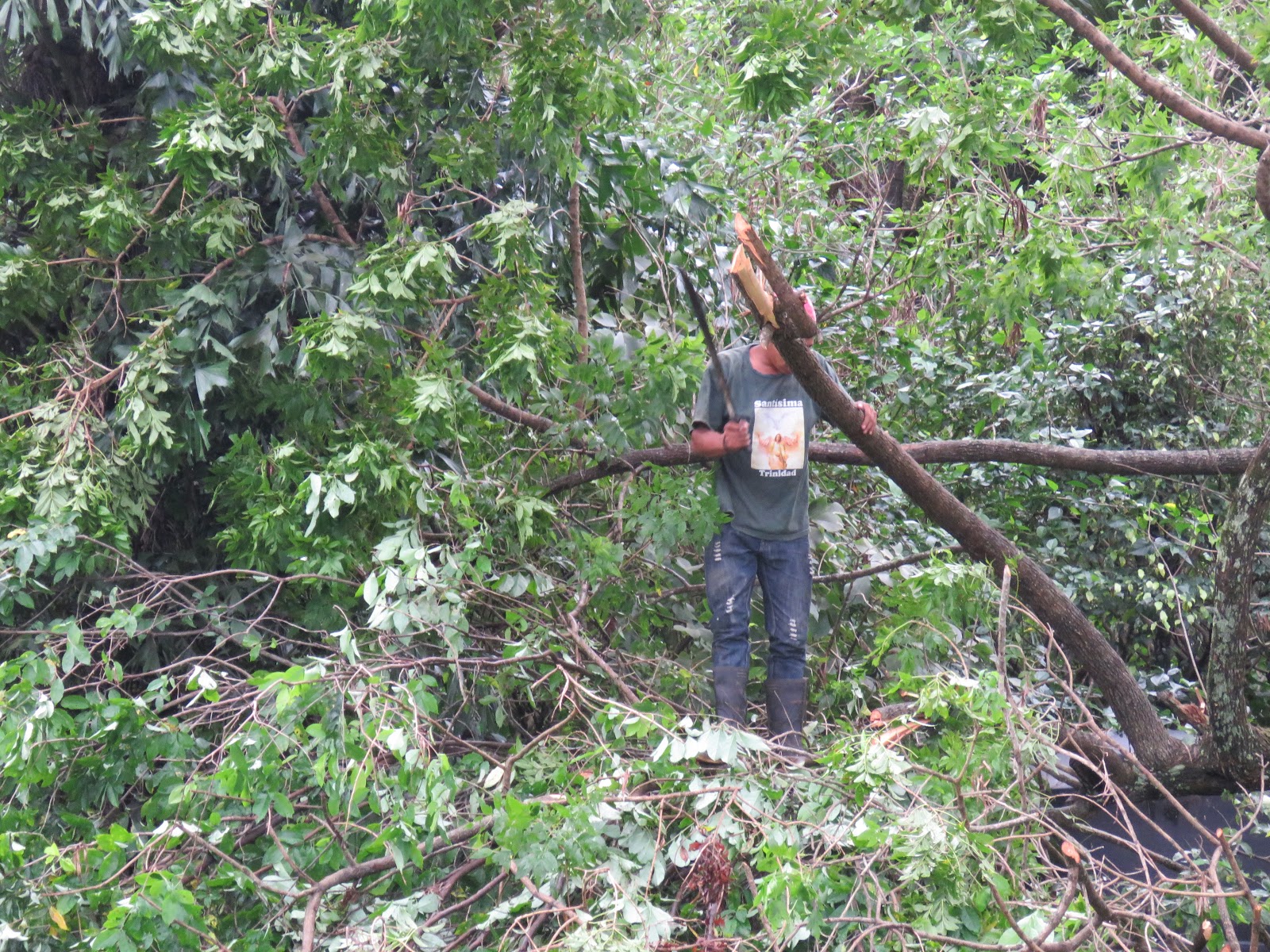
Several workers came to remove the fallen tree due to Hurricane Nate that hit Costa Rica while it was a tropical depression.

The pharmacist said she’d check and see if she could get the correct dosage (very low) for the medication I’m most concerned about. Unfortunately, it wasn’t looking good. While there, I purchased more Omeprazole (it’s working!) to ensure I have enough on hand for the upcoming cruise. Running out of necessary meds on a cruise isn’t a good idea when cruise ships have a very limited pharmacy.

From the farmacia we headed to Coopeatenas to grocery shop. Tom waited in the cafe while I took my time searching for the items on the app on my phone. Then, in no time at all, he spotted me approaching the register and gently moved me out of the way so he could load the many items on the counter for checkout.

The workers were high in the trees clearing the debris.

A security guard called a taxi for us for the short ride back to the villa for CRC 2,000, USD 3.49, which included a 25% tip. Once back at the villa, the driveway was blocked with the tree removal guy’s truck and equipment, and Ulysses insisted on helping us carry the bags into the house.

Shortly after we put everything away, Ulysses came to the door in an uproar, waving his arms and rapidly speaking in Spanish. I will admit, I’m quickly learning Spanish, much to my surprise. I certainly can’t speak fluently in this short time, but when someone is speaking to us, I can pick up enough keywords to grasp the intent of the content. 

Tom was watching the tree removal while carrying bags for the market.

Tom is learning a few words here and there but often mispronounces them while I practically roll on the floor in laughter. But he’s a good sport and laughs right along with me.

Ulysses was trying to tell us a pair of Toucans in the trees behind the spot where the tree had since been removed. Tom ran out with the camera taking the first few photos while I excitedly took the rest. The thrill of it all was enhanced because one of the birds had a piece of fruit in his beak, as shown in the above photos. 

A water storage tank and shed are behind the fallen tree.

For hours, we were reeling with the excitement of seeing the birds. Today, Tom continues to head to the driveway every hour or so to see if they’d back. We may never see them again during our remaining time in Costa Rica. But, having seen and photographed them once was fulfilling. 

May you have a sunny and fulfilling day!

Photo from one year ago today, October 7, 2016:

This was a first sighting for us, a local taking a “bath” on the beach by tossing the sand all over his body. An unusual practice that may be utilized by many without access to a shower or running water. He later “rinsed off” in the ocean. Click here for more details.

Feeding hummingbirds…A simple syrup…a simple task…for simply wonderful bird watching…

It’s fun to watch the hummingbirds stab their delicate pointed beaks into the tiny holes of the feeder. See below for our easy recipe for the syrup.

“Sightings from the Veranda in Costa Rica”

This is a brown recluse spider we found on the veranda near our bedroom. Yikes. This morning Tom found a can of spray and sprayed it around the doorway and bedroom. Most insects don’t bother us, but anything venomous like this makes us take action.

When we arrived in Atenas, Costa Rica, 44 days ago, we noticed a hummingbird feeder hanging from a hook under the veranda roof. We had a red plastic feeder hanging from a tree in our old lives, but it was often blown to the ground in the spring and summer winds and storms.

Besides, no sooner than I’d make the sweet solution and refill the container, it was empty. Our lives were action-packed with work and responsibilities, and keeping this up was hardly a priority.

It’s rare to see more than one bird feeding at a time. They noisily fight with one another for dominance.

When we contemplated filling the feeder here in Atenas over these past weeks, we decided we’d give this a try and see if we could attract hummingbirds after spotting many beautiful and unique birds. 

At this point in our lives, we certainly can’t say we don’t have time, especially when we don’t have a rental car every other week during which we spend most of our time at the villa.

I looked up my old simple hummingbird feeder recipe to find this easy to make the concoction which the birds always seemed to love:

Hummingbird Feeder Syrup
4 cups water
1 cup granulated white sugar

Place water and sugar in a saucepan. Stir well. Bring to a boil, reduce heat and let simmer for about 10 minutes. Cool thoroughly.  Pour into the feeder. Any leftovers may be kept in a glass jar in the refrigerator for a week.

Soon, I’ll get a better photo.  Some of these hummingbirds are colorful.

Since neither Tom nor I consume any sugar, finding a good-sized container in the cupboard for guests to use certainly was an inspiration. In the past week, we’ve made three batches. Now for the first time in years, granulated sugar is on our grocery list app on my phone.

As we watched the feeder, which is in plain view as we’re seated on the veranda most days, until the rain and the wind make it impossible in the late afternoon, we’ve been thrilled to see dozens of hummingbird hits a day. They love it.

Over the first few days of filling the container, Tom stood on a wooden chair from the outdoor dining table, carefully reaching up to avoid dropping the feeder and maintaining sturdy footing on the chair. 

Yesterday, (duh) we decided he could avoid the risk of standing on the chair. As it turned out, the feeder is hanging from a hook attached to an outdoor rolling shade. 

If he rolls down the shade to eye level, he can avoid standing on the chair to take the feeder down to refill it over the sink in the kitchen. His fact is a huge motivator in keeping us interested in keeping up this refilling process. The below photo illustrates what we mean by lowering the rolling shade.

Tom was rolling down the veranda shade for easy access to the hummingbird feeder.

Speaking of photos, I’ve yet to take a decent photo of the hummingbirds partaking of the sugary syrup. The timing is crucial, and each time I attempt to take a photo, I’m either in the wrong spot with too bright a background or too dark and rainy. I’ll continue to work on this.

Over these past few days, something was baffling us. We could see a slight reduction in the amount of syrup in the feeder at the end of each day, perhaps down an inch or so, but most, if not all, of the syrup was gone in the mornings. Again, we’d make a new batch and refill the container, only to awaken the next day for the same scenario.

Last night, we decided to keep watch in the dark to see precisely what was happening. Much to our surprise, about a dozen hummingbirds were swarming around the feeder, fighting with one another for dominance and access to the sugar water. We laughed. Who knew they’d come at night in the dark.

At this point, we decided we’d bring the feeder inside at night to return it to its usual spot first thing in the morning. After all, isn’t the feeder intended to satisfy our greedy observation…as well as provide sustenance for the birds? This way, it’s a win-win.

The bright background makes photo-taking tricky.  I’ll keep trying.

This makes us laugh. “Just think,” I told Tom yesterday while we kept a watchful eye on the feeder while we lounged in the pool, “In only five months, we’ll be busy dropping pellets in the bush to attract 350 pounds (159 kg) warthogs to stop by for a visit.

From a tiny hummingbird to a giant pig…hmm…life is good.

Photo from one year ago today, September 13, 2016:

Upon further inspection at this restroom stop on the five-hour harrowing drive in Bali, we realized the narrow trough was the toilet. The bucket of water and scoop was for tidying up, not washing hands. Luckily, we always keep antibacterial wipes on hand. This facility was clean compared to others we encountered.  For more details, please click here.

Driving in the mountains in Costa Rica…Not for the queasy…

Tom spotted this waterfall and turned around so I could take a photo.

“Sightings from the Veranda in Costa Rica”

Yesterday’s clouds and rain as it made its way toward us. It proved to be one of the most severe rainstorms we’ve had since our arrival.

Yesterday about 15 minutes before heading out the door to a famous sightseeing venue where we’d arranged to do an interview and tour for an upcoming story, we received an email from the owner kindly asking if we could visit on Thursday at 2:00 pm when he’d have more time to spend with us while giving us the entire tour.

This worn old property is currently occupied.

That was fine with us since we’ll have the little gray rental car until Saturday morning. Dressed and ready to go (in something besides a swimsuit), we decided to head out anyway and drive through back roads exploring, an activity we both thoroughly enjoy more than any activity.

Exploring our own without time constraints, crowds, or traffic always gives us a more expansive view of country life than being a part of the crowds in a typical tourist venue.

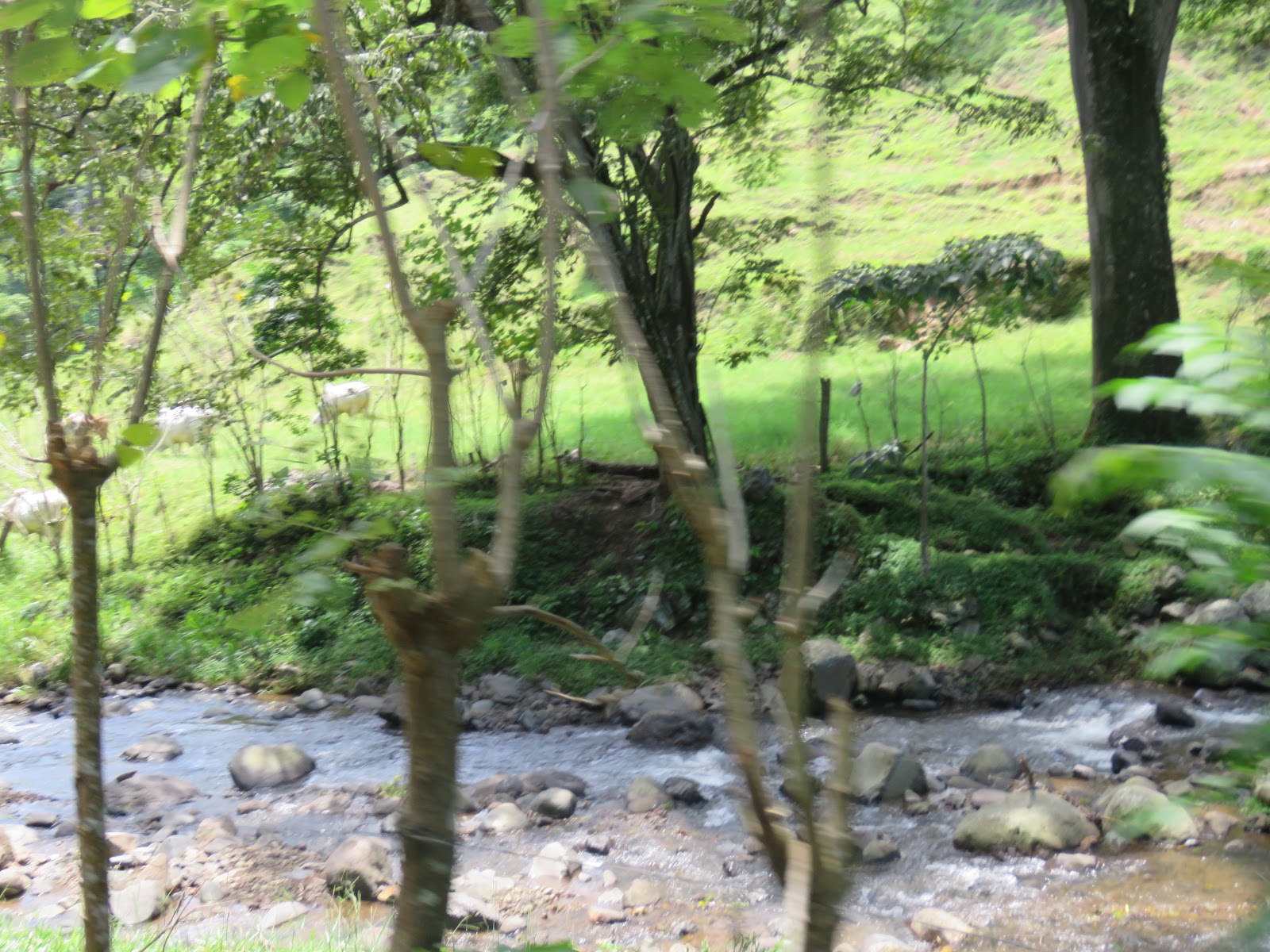
Further down the road, we encountered a continuation of the creek we’d seen earlier.

Surrounding by mountains, what may appear on “maps” to be a 30-minute drive easily turns into several hours while driving through the winding mountainous roads of Costa Rica. In many ways, it reminds us of the winding mountain roads in Tuscany, Italy, which at that time left me white-knuckling each road trip in 2013.

Scene along the waterway.

Now, four years later, I’m practically hanging out the window with my camera in hand, hoping to take illustrative photos of the steep, winding roads and the resulting exquisite scenery. There’s nothing comparable to mountains to create some spectacular views.

No longer finding myself car sick or queasy from such unpredictable terrain, I’m able to relax and fully embrace our surroundings. Tom, the sound driver that he is, makes me feel incredibly at ease with his eyes on the road. Although he’s quick to spot a good photo opportunity in his range of vision, he never hesitates to stop or turn around for a good shot.

So far, all the cattle we’ve seen have been grazing and skinny, usually indicating they’re not fed grains and chemicals.

Yesterday was no exception while we both reveled in the tiny mountain villages we encountered, the homes tucked away in the trees, and a first-hand look at how many Costa Ricans live in the mountains under the canopy of vegetation and trees of all types and sizes.

Grass-fed cattle’s ribs are readily evident.

The sounds of roosters crowing, cows mooing with wild bulls snorting, along with an occasional sheep or lamb’s warbling baa wafting through the air like music to our ears. Gosh, we love this part of our travels.

Sure, the famous tourist spots are often worth checking out. After all, they are the draw for many travelers to this country and others.  In Costa Rica, many of the most popular sites requiring a degree of hiking. As I slowly recover from this frustrating gastrointestinal thing, hiking has not been on my radar.

A brown calf among the all-white cattle.

Having started a new treatment regime two weeks ago by giving in and taking PPIs which I should have done for a more extended period last March, slowly, I’m finding some relief. It could easily take two to three months until I’m feeling well again. 

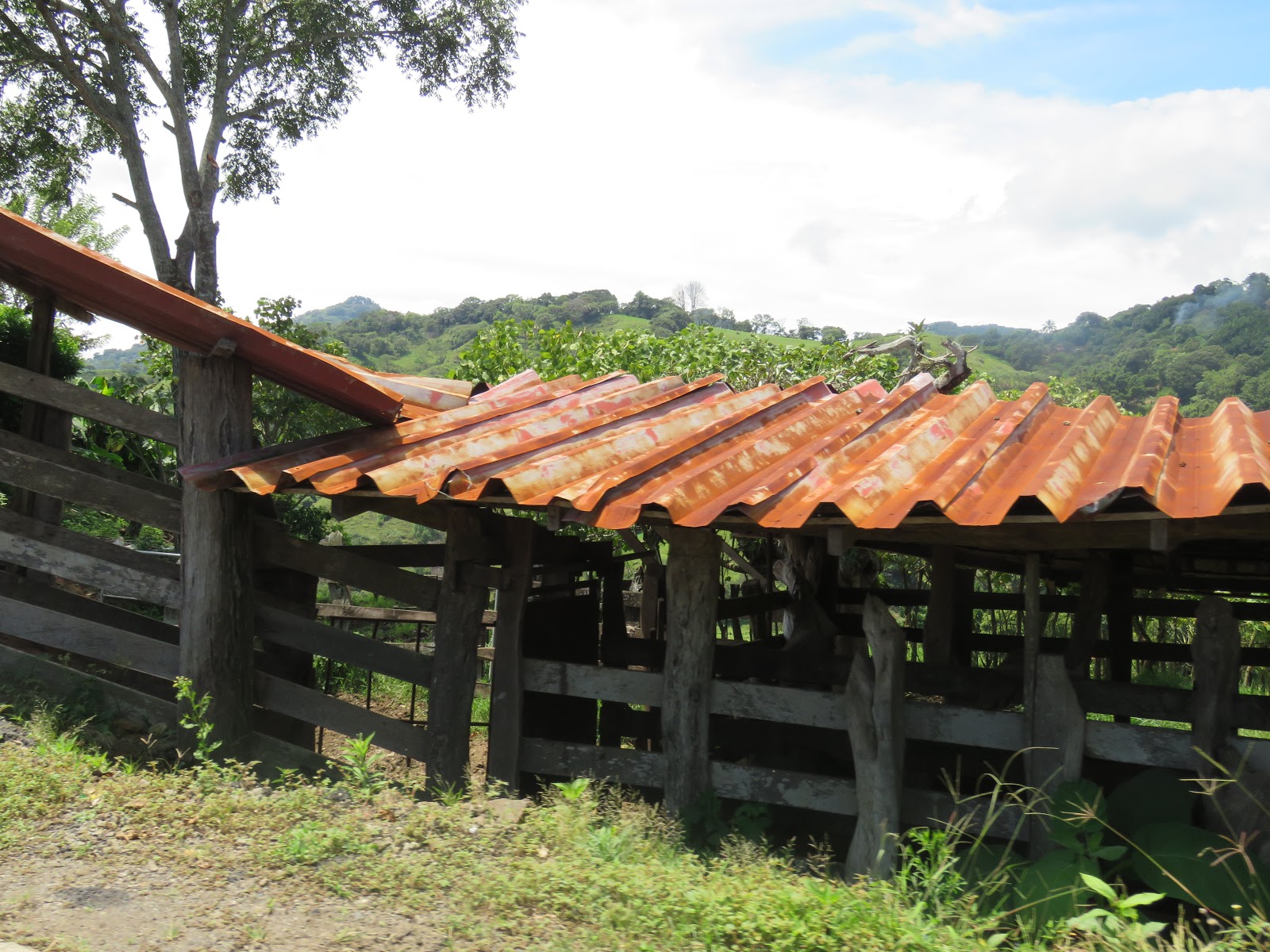
Rough lean-to, which may have been used for livestock at one time.

Hopefully, by the time we leave Costa Rica in November, I’ll be free of the lingering effects of the formerly diagnosed and vigorously treated Helicobacter Pylori, known to go its victims with many months required to recover. 

Finally, I’m able to eat without discomfort. But I still have a way to eliminate the frequent bouts of discomfort, during which I never feel up to going on a long hike. But, we both try to stay active and fit. I continually keep an eye on my FitBit to ensure I’m moving about enough as I strive to keep close to my daily goal of 10,000 steps.

A babbling brook in the mountains of Costa Rica.

Soon, we off on another outing to a site of particular interest to Tom. Back at you soon with more new photos!

Photo from one year ago today, September 6, 2016:

Offerings are placed in these cubicles for the upcoming Hindu holiday,  as shown in more photos over several days. Please click here for more.