Party planning in the bush…More new exciting photos…Hot today!…

As the sun was waning during our evening drive. Sunsets in Africa seem to be the most spectacular we’ve seen in our travels.

The last time I planned a party was when we were about to leave Marloth Park on February 28, 2014. It’s customary when someone is leaving South Africa to host their going-away party. 

As darkness began to fall, we squealed with delight when we had to slow down for this ostrich walking down the center of the road. Could it have been Clive or Clove or one of her offspring from our four-year-ago visit?

We invited a small group for dinner shortly before we left. The friends we’d made were in two groups, one related to our rental in one way or another and other friends we’d met along the way. 

We dared to get a little closer to take this shot through the windshield. We didn’t want to scare her away.

At one point or another, we’d had everyone over for dinner, and now as we plan my birthday in five days, I realized we hadn’t planned a party anywhere in the world since that time, and this time, we include both groups. We’re so excited.

Finally, she moved over so we could pass, but we watched her in the rearview mirror, stay on the road for quite some time. What a treat!

This morning, we ordered a regular birthday cake from Jannine (correct spelling), the Marloth Park “cake lady.” I’ll bake a small coconut flour cake for me, and we’ll be able to celebrate eating cake together. 

I’m so excited to be celebrating this milestone birthday with these fine friends. Turning 70 can be daunting, but I’m looking at it as a celebration of life, love, friendship, and the non-stop joy of experiencing the world every day of this unusual lifestyle we’ve chosen to live,

Mr. Kudu was on the side of the road as we passed on the way to the little market in Marloth Park. Now, these stunning males are visiting us in the yard. Photos will follow!

Last night we went to Jabula Restaurant & Lodge to see our old friends, Dawn and Leon, restaurant owners and had a fabulous time. They’d set up beautiful outdoor tables with Valentine decorations, reserving one for us. 

After wine and beer at the bar, we took our table and chatted with a party of three sitting next to us, after our exceptional dinner, which including two red wines for me and four beers for Tom (little lushes we are when out, not at “home”) our total bill including tip was US $47.82 (ZAR 586).

We spotted three wildebeests when we went for our evening drive in the park.

Of course, I ordered “my usual” (from four years ago) peri-peri chicken livers and a substantial grilled Greek chicken salad. Tom ordered barbecue ribs, chips (fries), and salad. We couldn’t have enjoyed it more.

Today, I’m busy cooking one of our favorite homemade recipes, the first full meal I will have prepared in 85 days. We both longed for our favorite low-carb dish, Chicken Pot Pie to which we’ll add a green salad. 

A thought-provoking pose with a bot of vegetation in her mouth.

Although this seems like a cold-weather dish, when we spend most of our lives in warm or hot weather, we don’t let the weather dictate what we’d like to eat. This dish could be classified as comfort food and most certainly, we don’t require much more comfort than we’re feeling now, but it will be fun to sit down with this fine meal tonight.

Wildebeests are commonly seen in Marloth Park and neighboring Kruger National Park.

Once we’re done posting today, and I finish chopping and dicing, we’ll head back to Komatipoort to purchase a few more items we hadn’t been able to find on Monday and hopefully find an HDMI cable.  Like many cables, eventually, they wear out, as was the case with ours. 

Impalas are often referred to a “MacDonalds” when they are the chosen meal for many predators.

We’re thrilled to be getting visitors several times a day, feeding them the nourishing pellets, and talking to them in my usual high-pitched voice. Hopefully, soon, some of the regulars will recognize my voice. So far, no warthogs. I wait patiently.

Today’s high temperature is expected to be 97F (36C), and yet we still sit all day outdoors, sweating up a storm, content as we can be. 

Be content today and always!

Photo from one year ago today, February 15, 2017:

In the Huon Valley in Tasmania, we enjoyed the fresh-picked organic vegetables from owners Anne and Rob’s garden. For more photos, please click here.

Hansel and Gretel style…Dropping pellets in the yard…Visitors have arrived….Happy Valentine’s Day

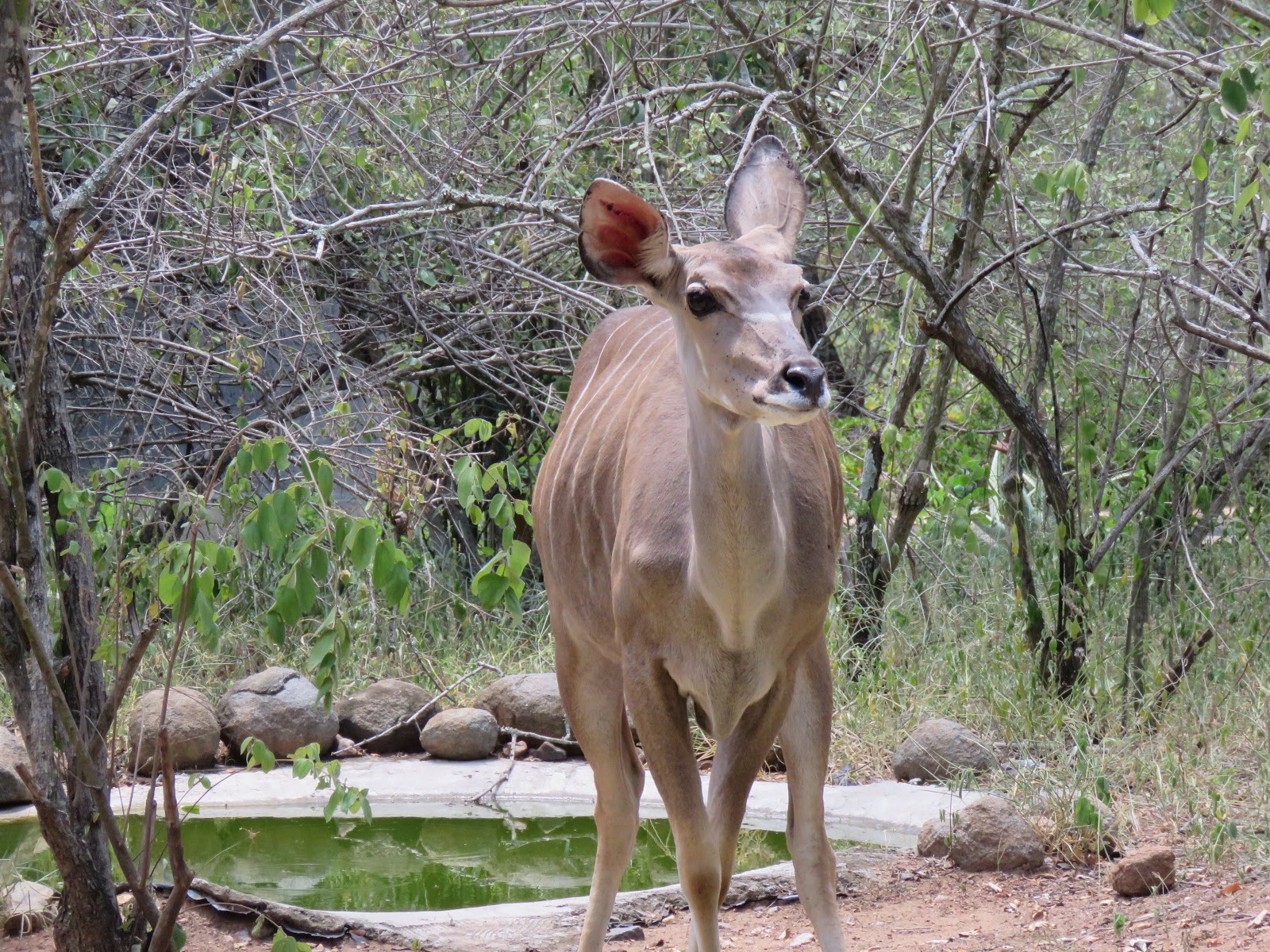
There she was yesterday,  a pretty kudu, standing by the watering hole in the yard of our holiday home. She nibbled on pellets and hung around for some time. Female kudus usually weigh about 463 pounds (210 kg), while male bulls may be well over 661 pounds (300 kg).  Only the males have long spiral horns. Tomorrow, we’ll share male kudus we spotted while out on our nightly drive.

Over four years ago, when we lived in Marloth Park, we purchased the approved pellets residents can feed the wild animals.  With the recent drought resulting in less vegetation for the wildlife to eat, the pellets are a nutritious food source.

Kudus are muscular, agile, and strong.

Louise had picked up a 50 pound (23 kg) bag of pellets, which were waiting for us when we arrived.  She dumped them into a giant trash bin with locking handles which we’ll keep indoors to avoid the baboons from getting into them. 

The baboons are very crafty and could quickly figure out how to unlock the interlocking handles.  Although many tourists “get a kick” out of seeing the baboons, they are an awful hazard and can tear up the interior (and exterior) of a house in minutes if they manage to get inside or on the veranda.

She was enjoying the pellets we’d left on the grounds surrounding the property.

It’s our responsibility to ensure they don’t get close to the house by not eating outdoors, feeding them pellets, or making them welcome in any manner. They are the only animals we’ll avoid in this Conservancy.  The others are more than welcome to stop by.

And stop by they have, especially after we began dropping the pellets, Hansel and Gretel style, while walking up and down the dirt driveway and around the house, scattering the pellets as we go. 

This was one view of her from the table and chairs on the veranda. As shown, we have two grills, one gas and another wood burning which we’ll take advantage of soon. Notice the chairs made of tires encircling the fire pit on the ground.

Well, wouldn’t you know, no more than an hour after we laid down the first batch of pellets, we had our first visitor, shown here today in our photos, a lovely female kudu?

Kudus may travel in groups referred to as a “forkl” or herd, particularly the females. The males are often loners, although they may be seen in herds of two, three, or more. We’ll share all of these instances as we move along.

At times, she stopped nibbling pellets and looked directly into our eyes.  What a sweet experience!

This morning as soon as we got situated at the long table on the veranda, I loaded up a plastic container with pellets to begin my twice daily “pellet dropping,” once upon awakening and another around 2:00 pm. 

Doing so should keep the visitors coming. Of course, we’re thrilled to be able to provide them with a bit of sustenance. Once they become used to our offering, they come by regularly during our three months in this house. Most likely, during our second three-month stint and beyond, we’ll repeat the same process, regardless of which holiday house we occupy in Marloth Park.

Although a little cautious near us, she wasn’t intimidated by the little rental car parked in the driveway.

We’d mentioned discussing our recent grocery shopping trip at the Spar Supermarket in Komatipoort. Not unusual in Africa, we had trouble finding some everyday items (to us) such as celery and Parmesan cheese. 

We spent US $317.08 (ZAR 3,760.88) at Spar plus, after the meat market, the biltong shop, a 12-pack of beer, three bottles of wine, and the total grocery bill to get us started was US $401.46 (ZAR 4,761.71). 

She was a lot bigger than she appears in this photo, although we suspected this female might be only one or two years of age.

We have enough beef, chicken, pork, and lamb on hand to last for the next two weeks, and we’ll only need to return to Komatipoort for vegetables and incidentals. We plan to return tomorrow to check out the Shoprite store to see if we can fill in the blanks for our upcoming planned recipes. 

Tonight, we’re planning dinner to celebrate Valentine’s Day at Jabula Restaurant and to arrange for my birthday party next week on Tuesday. It will be fun to return and see owners Dawn and Leon and get the party planning underway. I don’t want a big fuss. We’ll be hosting several appetizers and cake and utilize a cash bar for the drinks.

Our first helmeted guinea hen (take from afar, resulting in a little blur).

As for Valentine’s Day, we wish all of our family, friends/readers a very loving day filled with reminders about how to share this special day with those you love. We won’t have any trouble figuring that out around here!

Photo from one year ago today, February 14, 2017:

Cute restaurant in Franklin, Tasmania. For more photos, please click here.

Settling in…Settling down…Adapting to the heat and other little challenges…Biltong…


This is a typical street scene, with lots of trucks parked on the side of the road while the locals people stop in the various shops along the route.

Gosh, we’re happy here. The house is exceptional, perfect for us, with a plunge pool, a pool table, a comfortable bed and bedding, and the living room where we’ll spend most of our evenings nestled in the comfortable furnishings with the availability of a flat-screen TV (to which we can plug in our HDMI cord) to watch our favorite shows.

We couldn’t wait to buy “biltong” (jerky) in Komatipoort. It’s by far the best jerky we’ve ever had.  We purchased a bag of pork on the far left and a large bag of the traditional biltong, as shown in the center, for a total cost of US $17.29 (ZAR 206.23).  We don’t care for the greasy sausage sticks on the far right. There’s a shop owned by the Butchery, right here in Marloth Park, if we run out before heading back to Komatipoort.

There’s no dining room or dining table (space is taken up by the pool table), but we moved around a few side tables to make an ideal dining spot in the living room. This way, we can watch episodes of Shark Tank during dinner, if we’d like.

After selecting the type of biltong, we’d like the store clerk to grind it into bite-sized pieces making it easy to eat. Otherwise, the enormous amounts are too large to chew.

Louise and Danie, our friends and property managers, oversee the operations of many properties in the Conservancy and are on the ball for anything we may need. This morning we mentioned we needed an extension cord to be outside all day with our laptops. 

Within 20 minutes, they drove up to the house with a new, never-used outdoor reel extension cord. We couldn’t appreciate their thoughtfulness more, a scenario all of their holiday renters have enjoyed with the utmost in service and attention to detail.

Biltong hanging from a rack in the shop.

Now, as we sit at the long handmade wooden table on the veranda in the most comfortable padded chairs, we can relax, work on posts, future travel plans, and stay in touch with family and friends as we wait for Mother Nature’s African treasures to arrive.

If none come by today, before dinner tonight, we’ll take a drive around the park to see what we can find, a relatively easy task in the early evening, when wildlife come out from the shelter during the heat of the midday sun.

This batch is venison biltong which we don’t care for.

And hot it is…Today’s temperature is expected to be around 90F, 32C, and in the upcoming days, we could be looking at much higher temps. With air con units in the living room and bedrooms, we still prefer to be outdoors all day. So what if we’re hot and dripping sweat? 

It seems as if we’re already used to the heat, which we thought would be much harder to do after coming out of Antarctica.  Ah, Antarctica…we’re still reeling from experience and will for a very long time.

Next door to the biltong shop is the Butchery, where the finest cuts of meat are available at fabulous prices. We purchased six considerable pork chops, five large lamb chops, 4.4 pounds (2 kg) mince (grass-fed ground beef), and 6.6 pounds (3 kg) cheese sausages for a total of only US $55.30 (ZAR 660.14). In the future, we’ll purchase all our meat, pork, and chicken at the Butchery.

Sure, living in the bush in Africa has its challenges. Last night, we spent an hour dealing with ants in the kitchen after we’d prepared a simple meal of pre-cooked roasted chicken, green beans, and salad which we’ll repeat for one more night. 

Our way to shop in Komatipooert was reminiscent of seeing banana trees with blue plastic bags covering the growing bunches to keep the bugs and birds away.

Someone, perhaps a previous renter, had left a sugar bowl filled with sugar in the cabinet where dishes are kept. After dinner, I cringed when I saw zillions of ants scurrying about,  on all the dishes and all over the granite countertops.  

A small market where many of the local people shop.

We sprayed everything, and today Martha (pronounced Marta) washed all the dishes and the inside of the cabinet. Last night, I cleaned the countertops, sprayed the counters, and then rewashed the counters with water we boiled and soap to remove the residue from the insect spray. 

We are confident the ants will return, dealing with them as it occurs. Louise suggested we leave our dinner dishes for Martha to wash, but that’s not possible with the ants. Tom will continue to do the dishes while I do the cooking.

Tom, like me, was exhausted on the day we arrived, but we managed to unpack and go out to dinner.

And yes, we’ve found things that need to be repaired in the house; no hot water since we arrived; microwave not working; ice dispenser on freezer door not working, and items we regularly used not available in the kitchen cupboards. This is Africa, after all, not Scottsdale, Arizona. 

Phumula, the bush restaurant where we dined on Sunday evening.

Louise and Danie are so “on the ball” we have no doubt everything will be in working order within 24 hours. Danie came early this morning, after I was up and dressed, while Tom slept in and got the hot water working. Not that we minded taking cold showers these past two days as we adjust to the temperature differences.

My dinner of steak and prawns.  Grass-fed steak is often challenging. The price one pays for choosing this option. There were three prawns on my plate with heads still on. I had chilled white wine with my meal.

The water here comes from the Crocodile River, which is purified at a processing plant.  The locals are used to drinking it, but we won’t take a chance. Thus, the water dispenser in the fridge makes purified water, and we were provided with a large water dispenser. As soon as we run out of water, we’ll take the empties to the “water store” in Marloth Park to have them refilled for a nominal cost.

Tom had a side of mashed potatoes and gravy with this chicken schnitzel and for two beers. Our total bill was US $38.98 (ZAR 465), which we felt was reasonable.

As always, we’ll be back with more on life, living in the bush in South Africa, sharing the costs and details of grocery shopping, which presents particular challenges for my way of eating.

Have a glorious day! We plan on it.

P.S. As we’re about to upload this post, we have our first visitor. Photos were coming!

                Photo from one year ago today, February 13, 2017:

In Geeveston, Tasmania, We took this photo through the water-stained window to find this Black Faced Cormorant at the end of the dock. They stayed for a few hours in the rain. In Antarctica, we also saw these penguin-like birds. For more photos, please click here.

We made it to Marloth Park, South Africa!…Long travel day..Do we get jetlag?…

From the window of the small airplane on our flight to Nelspruit/Mpumalanga/Kruger. We’re excited to be back in South Africa.

We weren’t able to post yesterday when there wasn’t ample time between the three flights, taking us from Buenos Aires, Argentina to Sao Paulo, Brazil to Johannesburg, South Africa to Nelspruit/Mpumalanga.

Beautifully aligned farms are scattered throughout the savannah.

It was an arduous day, and by the time we made the hour-long drive in the little rental car from the airport to the holiday home in Marloth Park, we were both feeling like zombies. Neither of us had slept more than 20 minutes total during the flights and 24 hours.

When our plane landed at the tiny airport, we immediately headed to baggage, hoping our bags had arrived from Buenos Aires. When the last bag came through, we stayed calm and surprisingly unworried with no sight of ours. Asking the solitary baggage handler, we were told they’d arrive on another flight arriving in 30 minutes.

The time difference between Buenos Aires and South Africa is only five hours, but that’s enough to throw one’s biological clock into a frenzy of confusion. Once we arrived at the house, we unpacked a little, and both napped for 90 minutes. We decided to pay special attention to the time here, attempting to avoid jet lag.

The bags arrived on the next plane a short time later. In the interim, we picked up the tiny rental car. We barely fit all of our worldly goods into the little vehicle and were finally on our way.

It worked. Today, we’re fine, rested after sleeping over eight hours last night, and happy to be here in this beautiful home in this exceptional conservancy. After four years away from South Africa with many varied experiences in our wake, we’re indescribably content to be here.

The nicely paved two-lane highway made for a pleasant and scenic one-hour ride.

After awakening from our naps, we unpacked everything. By 5:30 pm, showered and finally wearing clean clothes, we headed out the door for dinner to the bush restaurant Phumula for dinner where we’d dined on a few occasions some four years ago.

Bird of Paradise, a commonly found flower in Africa.

The meal was fine, although not exceptional. But, we were still reeling from our drive through Marloth Park on the way to the restaurant, able to take many photos before the sun finally set, which we’re sharing with you today.

Our first wildlife sighting, last night around 6:00 pm on our way to dinner.

Based on the placement of the holiday home, the driveway, the lack of greenery due to lack of rain, we weren’t expecting a lot of wildlife at this time particular time. If not many come to call, we only need to take a two-minute drive to find wild animals that we’d come to love only a short four years ago.

We’d heard that there isn’t as much wildlife in Marloth Park as there was when we were here in 2013. They (the officials) had culled several breeds due to the drought. This morning our hosts, Louise and Danie, assured us that plenty of animals would visit us here. We must wait and be patient, and there’s no doubt they will come to visit us.

Impalas are rarely alone, and in the near dark, we spotted these two youngsters.

The last time we were here, it took a few days to see many visitors as if they knew humans were finally staying in the holiday home. In the interim, we’re content to continue to work on getting settled, cooking our meals, and driving through the park each day while sharing new stories and photos with you each day.

This morning, it was beautiful to see Louise and Danie once again. They are very special people, and we are grateful to have them among the other fine friends we’ve made here in Marloth Park. Their visit this morning meant the world to us. 

A male impala.

We all have so much to share about our lives, and we look forward to many get-togethers with them and all of our other friends over this next year we’ll be in Africa, living in and out of Marloth Park to satisfy visa requirements.

After they left to get back to work, Louise, a highly sought-after property manager/owner, and Danie, a home builder and renovation expert, headed to Komatipoort to grocery shop. Tomorrow, we’ll share details of our shopping experience, costs, and more new exciting photos of South Africa.

A burly wildebeest, the animals we saw in the Masia Mara in 2013 make up a large portion of the Great Migration. There are many of these large animals in Marloth Park.

When we returned from Komatipoort today, we were both shocked to see it was 5:00 pm. Tom hadn’t worn his watch, and my FitBit’s time has been wrong for months. With the many hour’s time change, it will take a little time to adjust our appetites to the usual dinner hours. Then again, each time we reach a new location, it takes a few days to adapt to the surroundings.

Be well. We’ll be back with more soon!

Photo from one year ago today, February 12, 2017:

Since we missed posting yesterday on February 11th, here’s the year-ago post from that date.  Below is the February 12th, the year-ago photo enabling us to be caught up. Here’s a meal we made in Tasmania which we’re looking forward to making again:  bacon-wrapped, hard-boiled egg stuffed meatloaf made with grass-fed meat; salads with red romaine (cos), celery, carrot, and homemade salad dressing; sliced cucumber sprinkled with Himalayan salt; steamed green beans and broccolini;  oven-roasted zucchini; good-for-gut-bacteria probiotic sauerkraut; and my favorite…No carb flaxseed and almond flour muffins topped with grass-fed organic butter.  Who says “low carb” dining isn’t healthy?  (The red bottle in the center of the table contains homemade ketchup). For more details, please click here.
 When we toured a winery in Tasmania, we noticed the chubby cheeks on this well-fed alpaca, who tend to store the grazed grass in their cheeks for a while. For more photos from today’s date, one year ago, please click here.

Antarctica – January 30, 2018…Grytviken, South Georgia…An abandoned whaling town…Sailing around the storm…

This group of Elephant Seals found comfort in sleeping together in a ditch.

The world…it baffles, it entices, it enlightens, and it surprises in one way or another almost every day. It spares nothing in attempting to capture our attention while we, in our amateurish or professional manner, attempt to capture it in photos in hopes of retaining memories to last a lifetime. 

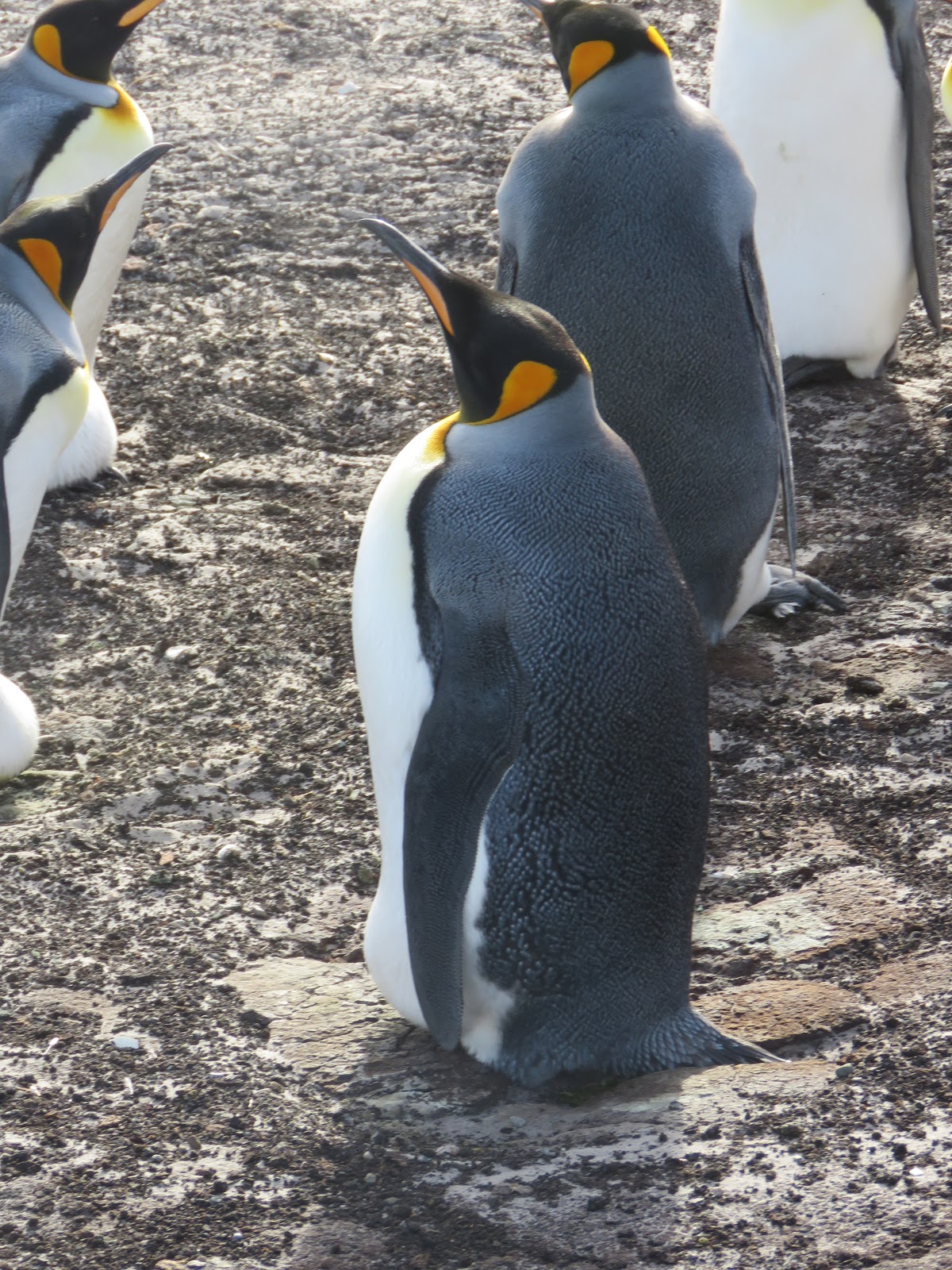
Some of the King Penguins were molting while others were not.

Antarctica keeps “giving and giving.” this trip to Antarctica has been at the top of our list for photo ops (along with our upcoming adventures in Africa). And, in our less-than-professional photo-taking manner, we thrive on these opportunities with such enthusiasm we can hardly contain ourselves. 

We walked along this beach in the rain to the small settlement ahead.

Taking photos is important to us to share them with all of our worldwide readers and maintain them for our reference, our family, and generations yet to come.

Tom, with an iceberg in the background.
The younger seals seem eager to pose for a photo, but the older males chase after us, prepared to attack if necessary.  We had to scare a few off by clapping our hands and yelling.

Above all, standing on the very ground where so much is happening takes our breath away as we live in the magic of the moment, anticipating nothing more than what is before our eyes. With heart-pounding enthusiasm, we embrace every moment, later reviewing our photos, hoping to find those fantastic captures that genuinely tell the story of our current experiences.

A young seal was sleeping atop a plant with a grouping of Elephant Seals in the background.

Sure, an expedition cruise is not expected to be perfect. We’ve had to forgo three landings due to bad weather, which we’d looked forward to on the itinerary. Last night, we had to sail away with bad weather on the horizon, missing two landings scheduled for today. 

A lone Fur Seal was posing for a photo.

Instead, the captain decided we’d sail directly to the Antarctic Peninsula, where we’ll spend the next several days, finally amid the massive icy environment we’ve so longed to see.  As a result, we’re at sea today.

She was so relaxed, a bit of drool dripped from her mouth. A bath would be nice.

Yesterday morning, we embarked on the Zodiac boats to Grytviken, South Georgia, an old whaling village since gone to ruin. As we wandered through the historic town, we couldn’t help but feel sorrowful for the millions of whales slaughtered for financial gain. 

This is the first of a few icebergs we spotted in Grytviken and the first so far on the cruise.  Guaranteed, more will follow.

This Elephant Seal was sleeping in the ditch without his friends.

Evidence of this travesty is readily evidenced in this small settlement with the remnants of the storage tanks and processing machines and equipment. 

Among the ruins were multiple shipwrecks photos of which we’ve included here today. A small group of 10 to 20 people occupies the location during the summer months (less in the winter months) to facilitate ship passengers stopping to inspect the settlement. 

We were served a shot glass of Irish whiskey with the suggestion to take a sip and pour the remainder over Shackleton’s grave, a local tradition.

There’s a shop, a church, a post office, and a few museums, all of which we visited during our few hours at the location. It was exciting and quite unusual, especially the many Fur Seals and Elephant Seals that live amongst the ruins of a long-abandoned business.

No sip of Irish whiskey for me, but I poured mine over Shackleton’s gravesite.
Here is information about Grytviken, South Georgia Island, from this site:
Grytviken is a settlement on the island of South Georgia, part of a British Overseas Territory in the South Atlantic. The settlement’s name is Swedish in origin, meaning “the Pot Bay.” The name was coined in 1902 by the Swedish Antarctic Expedition and documented by the Swedish surveyor Johan Gunnar Andersson, after the expedition found old English try pots used to render seal oil at the site.
It is the harbor’s best harbor, consisting of a bay (King Edward Cove) within a bay (Cumberland East Bay). The site is relatively sheltered, provides a substantial area of flat land suitable for building, and has an excellent freshwater supply.
Her companion is fanning her with widespread fins and tail.

The settlement at Grytviken was established on 16 November 1904 by the Norwegian sea captain Carl Anton Larsen as a whaling station for his Compañía Argentina de Pesca (Argentine Fishing Company).  

It was phenomenally successful, with 195 whales taken in the first season alone. The whalers used every part of the animals – the blubber, meat, bones, and viscera were rendered to extract the oil, and the bones and meat were turned into fertilizer and fodder. Elephant seals were also hunted for their blubber.

The following year the Argentine Government established a meteorological station. Around 300 men worked at the station during its heyday, operating during the southern summer from October to March. A few remained over the winter to maintain the boats and factory. A transport ship would bring essential supplies to the station every few months and take away the oil and other produce.

An adorable seal climbed a wall to see what the commotion was all about.
Carl Anton Larsen, the founder of Grytviken, was a naturalized Briton born in Sandefjord, Norway. His family in Grytviken included his wife, three daughters, and two sons. In his application for British citizenship, filed with the magistrate of South Georgia and granted in 1910, Captain Larsen wrote: “I have given up my Norwegian citizen’s rights and have resided here since I started whaling in this colony on the 16 November 1904 and have no reason to be of any other citizenship than British, as I have had and intend to have my residence here still for a long time.”
The first iceberg we’d seen since leaving Ushuaia a week ago today.  More will surely follow as we head to the Antarctica Peninsula.
As the manager of Compañía Argentina de Pesca, Larsen organized the construction of Grytviken, a remarkable undertaking accomplished by a team of sixty Norwegians between their arrival on 16 November and commencement of production at the newly built whale-oil factory on 24 December 1904. Larsen chose the whaling station’s site during his 1902 visit while in command of the ship Antarctic of the Swedish Antarctic Expedition (1901–03) led by Otto Nordenskjöld.
On that occasion, the name Grytviken (“The Pot Cove”) was given by the Swedish archaeologist and geologist Johan Gunnar Andersson. They surveyed part of Thatcher Peninsula and found numerous artifacts and features from sealers’ habitation and industry, including a shallop (a type of small boat) and several try-pots used to boil seal oil. One of those try-pots, having the inscription ‘Johnson and Sons, Wapping Dock, London’, is preserved at the South Georgia Museum in Grytviken.
Me, with an iceberg in the background.
Managers and other senior officers of the whaling stations often had their families living together with them. Among them was Fridthjof Jacobsen, whose wife Klara Olette Jacobsen gave birth to two of their children in Grytviken; their daughter Solveig Gunbjørg Jacobsen was the first child ever born south of the Antarctic Convergence, on 8 October 1913. Several more children have been born in South Georgia: recently even aboard visiting private yachts.

The whale population in the seas around the island was substantially reduced over the following sixty years until the station closed in December 1966. By that time, the whale stocks were so low that their continued exploitation was unviable. Even now, the shore around Grytviken is littered with whale bones and the rusting remains of whale oil processing plants and abandoned whaling ships. 

A big male Fur Seal and perhaps his offspring who he was training to be growly at visitors.

Ernest Shackleton Grytviken is closely associated with the explorer Sir Ernest Shackleton. Shackleton’s Imperial Trans-Antarctic Expedition set out from London on 1 August 1914 to reach the Weddell Sea on 10 January 1915, where the pack ice closed in on their ship, Endurance. The ship was broken by the ice on 27 October 1915. The 28 crew members fled to Elephant Island off Antarctica, bringing three small boats 

Shackleton and five other men managed to reach the southern coast of South Georgia in the James Caird. They arrived at Cave Cove and camped at Peggotty Bluff, from where they trekked to Stromness on the northeast coast. From Grytviken, Shackleton organized a rescue operation to bring home the remaining men.

An iceberg with our ship in the background.

In 1922 he had died unexpectedly from a heart attack at the beginning of another Antarctic expedition. He again returned to Grytviken, but posthumously, his widow chose South Georgia as his final resting place. His grave is located south of Grytviken, alongside those of whalers who had died on the island.

On 27 November 2011, the ashes of Frank Wild, Shackleton’s ‘right-hand man, were interred on the right side of Shackleton’s gravesite. The inscription on the rough-hewn granite block set to mark the spot reads “Frank Wild 1873–1939, Shackleton’s right-hand man.” Wild’s relatives and Shackleton’s only granddaughter, the Hon Alexandra Shackleton, attended a Rev Dr. Richard Hines service, rector of the Falkland Islands.
A whaling boat shipwreck.
The writer Angie Butler discovered the ashes in the vault of Braamfontein Cemetery, Johannesburg, while researching her book The Quest For Frank Wild. She said, “His ashes will now be where they were always supposed to be. It just took them a long time getting there.”

Update on my knee: It’s certainly not 100% yet. I visited the doctor a second time for another round of a different antibiotic and more anti-inflammatory meds. It’s improving, albeit slowly. 

Another sad reminder is that life for wildlife is not easy.

I can’t wait for this to be healed so I can stop thinking about it and, good grief, have a glass of wine! But, I’ve only missed one outing (out of many more), which required a five km walk, and Tom went ahead without me taking amazing photos.

As for today, right now, I’m in the lounge on deck three while Tom is taking a much-needed nap. It’s nearly 3:00 pm. Since we’re at sea today, little is required other than to enjoy our new friends, which is relatively easy to do in this beautiful environment.

The small Lutheran church in Grytviken, South Georgia.

Update on the pending rough seas: The captain made a good decision when we forfeited two planned landings to instead sail directly to Elephant Island, which we should reach sometime tomorrow. The waters are rough, and walking around the ship requires some holding on one another, walls, and railings. 

But, in our usual way, neither of us are seasick, but we suspect that some passengers may be feeling it when I’m only one of about eight passengers in the usually packed deck three lounges.  Due to the weakening Wi-Fi signal, I’m unable to enlarge a number of our photos to the size we always post. 

Whaling oil processing equipment.

Have a great day! And again, no worries if we aren’t here over the next few days. Likely, we won’t have a signal the further south we sail.

     Photo from one year ago today, January 30, 2017:

Wood handled tools for the “barbie” we spotted at an outdoor flea market in Franklin, Tasmania.  For more photos, please click here.

Antarctic – Sunday, January 28, 2018…Elsehul, South Georgia…Morning cruise on Zodiac boats…

This elephant seal on Steeple Jason Island didn’t care for our photo-taking antics.

It was an early start to the day when we had to be dressed in our heavy gear to embark upon a 75 minute Zodiac boat cruise of Elsehul Island located on South Georgia Island. Initially, the plan had been to leave a little later in the morning, but the captain decided it was best to go out earlier rather than later with bad weather on the horizon.

About one in 1000 seal births results in this light color resulting from low melanin production. Although not albino, the offspring of these seals may also be the light color or not.

Awakening at 5:15 am, we showered and dressed in our multiple layers to keep us warm in the potentially high winds and colder temperatures than we’d experienced in over five years. We had no trouble getting up and ready, heading to deck three lounge to wait for our designated color “blue” t0 be called to board the boats.

A male fur seal keeping watch.  We were warned not to get too close to the males. They can readily become agitated and can attack.  Their bite can be dangerous.

One of our readers wrote asking how hard it is to board the somewhat wobbly Zodiac boats, especially in rough weather. As part of our safety procedures during an expedition cruise, one section consisted of getting on and off the ships and ensuring we don’t tip overboard on the fast bouncy rides if we’re in rough seas. 

This Elephant Seal didn’t look so happy.

Thick ropes are surrounding the perimeter of the Zodiac we can hang onto in rough seas. But, as shown in our photos, sitting on the outside edge of the boats doesn’t feel exceptionally stable. It would be awful to plunge into the ice-cold seas in this part of the world. Getting off and on has now become second nature, even with my injured knee.

Lounging fur seals, adults, and pups.

In addition, we’ve continued to go through a series of decontamination procedures each time we board and disembark the 10-person boats. Keeping Antarctica free of germs and contamination from outside areas is vital to the preservation of wildlife and vegetation in this protected area.

Basking in the warmth of the sun.

Prior to boarding the boats, while wearing our boots (provided by Ponant) we are required to walk through a disinfectant liquid that clears any bacteria or organisms we may have picked aboard the ship. 

A watchful eye for the family…

After our expedition, we not only walk through the liquid again, but we stop at a station where there are large pans of disinfectant and long-handled scrub brushes in order to clean the boots from any residual guano or vegetation. 

King Penguins were standing by the shore at Steeple Jason Island.

In addition to the above, yesterday afternoon, each deck was scheduled at a specific time to bring their parkas, boots, gloves, scarves, and hat to the third deck lounge to vacuum each item to remove any residual items that may have become attached to our outerwear.  

An affectionate family interaction.

We appreciate and respect the diligence with which the cruise line honors these actual eco and conservation laws as a part of the honor of being a visitor to this majestic place.

Four King Penguins were contemplating their next move.

Over these past five days, since we’ve boarded the ship, we’ve become a part of a 10-person group of passengers with whom we hang out, meet for happy hour and dine each evening.  

We observed a total of three of these rare light-colored fur seals.

The instigators of these great group of people have been perpetrated by new friends and US citizens Marg and Steve with homes in Montana and Arizona. Marg’s bubbly and charming personality certainly designate her as the most competent of social directors.

Penguins were lining the shore.

Our group consists of five couples; two from Australia and three from the US. It’s a perfect mix of varying ages (from 30’s to 70’s) and lifestyles, making the conversations and laughter flow with ease.  On most cruises, we tend to single out English speaking people (duh, makes sense, right?) and as always, we’re having a great time with our new friends.

It was a pretty scene in Steeple Jason Island.
I asked guest services to print a copy of the countries from which the 194 passengers hail, and it reads as follows:
Australia               37

Canada                 29

China                    2France                  55
Germany               3Hong Kong            12
Luxembourg          3New Zealand          1
Spain                    2Switzerland            23
United Kingdom     11USA                      16
Total                    194
King Penguins were hanging out on a hill.

Most of the passengers from Canada, Luxembourg, and Switzerland speak French. Adding those citizens to the French group accounts for 110 passengers who speak French. This French ship starts all announcements in French but is accommodating in providing information shortly after that in English.  It’s working out fine for those of us English-speaking passengers.

Tom noticed a “face” formation in these rocks.  Do you see this too?

I have to rush and wrap this up.  In less than 40 minutes, we have to be dressed in the warm weather gear and ready to go for our next excursion in Stromness in South Georgia. Due to bad weather conditions, the actual “port of call” has been changed to a small historical town with plenty of wildlife. We’ll be back with more soon. Stay warm. Stay well.

Closeup of King Penguins.

Photo from one year ago today, January 28, 2017:

Many carved statues were overlooking the Huon River in Tasmania. We stopped to read about each of them. For more photos, please click here.

Antarctica- Friday, January 26, 2018…More from the Falkland Islands…Saunders Island…

A small group of Gentoo Penguins heading out to sea for a morning swim and hopefully a bite to eat.
Each day, during this exciting Antarctica cruise, we’ll be attempting to post activities from the previous day’s expeditions, including wildlife, scenery, and ship photos. 
The temperature was above freezing, but the heavy gear kept us warm and protected from the harsh winds. Like all of us, Tom was wearing a life vest which is mandatory while riding on the Zodiac boats. There are two Gentoo Penguins by the shoreline.
Soon, we’ll start posting some food photos, but right now, we’re thinking less about our luxurious cabin and meal and more about nature is sharing with us in this stunning winter-like wonderland, so far removed from any world we’ve ever known.
Me and a few Gentoo Penguins on Saunders Island in the Falkland Islands.

Currently, our world revolves around getting outside on the Zodiac boats to see the treasures of this most unusual place on the planet, leaving us with memories we’ll treasure until the end of our days.  Getting enough rest to partake in all of the activities has been a bit of a challenge with my still recovering infected knee, not yet 100%.

We enjoyed seeing the interesting markings on the Magellanic Penguins.

Although, my FitBit has been smoking as we’ve managed to do over 10,000 steps a day over some rough terrain; hills, rocky patches amid steep climbs and inclines. No doubt, the knee is sore, but I’m hopeful it will continue to improve now that we’ll have two days at sea to rest and recoup.

Two Gentoo Penguins were figuring out how they’ll spend their morning.

This cruise is less social for us than many other cruises. Half the passengers don’t speak English. Many came together in groups, leaving but a handful with whom we can engage. As it turns out, this cruise is less about socialization and more about learning about this majestic environment. We’re doing fine amid this social structure.

Two Gentoo Penguins were rushing along the shore, deciding if they’ll head into the sea for breakfast.

We’ll have plenty of time for socialization upcoming in South Africa when invitations for social events have already started rolling in. In the interim, Tom and I, in our usual manner, are having lots of fun together every moment of the day and evening. Even the setback of my knee hasn’t hindered the quality of the time we’re spending together.

A King Penguin parent was feeding its newborn chick.
Closer view of the newly hatched chick.
This small ship, Ponant Le Soleal (Soleal, meaning “the ship that shows the way), is bright white and varying shades of grey in a calming and pleasing contemporary design. Only five years old, it sails along with the greatest of ease. 
This photo, if carefully examined, illustrates a King Penguin, near the center of the group (slightly to the left) with a newborn chick which they were feeding from time to time, next to another penguin whose chick had died.
Every so often, the mom/dad with the live chick gets into a scuffle with the parent with the dead chick.  So sad to see.

Of course, we’ve yet to experience the Drake Passage in its entirety, where the Pacific and Atlantic Oceans meet for the roughest waters in the world. We’ll see how that goes on this tiny vessel.

Finally, the frantic parent with the dead chick turned away.

The fact that we’ve been able to post a few times has given us great hope that we’ll be able to stay in and out of touch as we continue for the two remaining weeks until we disembark in Ushuaia to fly back to Buenos Aires for two nights before we make the two-day flight to South Africa. We’ll need to be rested for that.

King Penguin parents overseeing the feeding and safety of their chicks.

The ship’s Wi-Fi is very expensive at US $250 for 18 hours, giving us approximately one hour a day of use. Tom has stayed offline except to send his blind brother Jerome the daily post as they occur minus the photos. 

This is a Brown Skua.

The remainder of the metered Wi-Fi time consists of preparing posts as quickly and as error-free as possible offline, then uploading them with photos and with as many corrections as possible. 

These Magellanic Penguins were headed out for breakfast.

Unfortunately, I don’t have enough time online to conduct research and provide links (other than our own) to share with you, as we often do. Half of the 17-day cruise will be spent visiting islands, glaciers, and ice floes, while the remainder will be out to seas, such as today and tomorrow. 

A well-padded King Penguin.

We intend to share every aspect of this cruise, including photos from every outing on the Zodiac boats, the essence of this type of expedition cruise. We’ll make every effort to ensure all of our readers will share in this adventure with us from their armchairs at home or desks at their office, minus the cold, minus the rocky ground, and; minus the steep inclines. 

A Gentoo Penguin swooning toward the sky.

For us to be able to do this with all of you means so much to both of us, adding an element to our experiences that feels as if you are right beside us.

Due to the cold climate, plants such as this may take decades to grow to this size.

Last night was a formal night, and as always, we did our best to fit in with dressing appropriately. Some women wore evening gowns, but only a few men wore tuxedos. There was a fixed menu in the dining room, which the chef accommodated my diet, which worked well and was the best meal we’d had on the ship to date. 

More beautiful slow-growing vegetation. Humans mustn’t touch or disturb any plants of vegetation in Antarctica, which may take decades or even centuries to grow.

After dinner, we headed to deck three to watch the most lively group of dancing passengers we’ve seen to date. What an enthusiastic group! Most were French, and they sure knew how to “boogie” to the music.

Many seabirds are killed as a result of humans fishing in their waters.

Tom and I love to dance together. Last night we danced a few times, with me dancing while standing in place. One can do a lot while wildly flailing their arms on a dance floor.

A hard reality in the animal kingdom…they don’t always survive the elements.

I appreciate your patience as we stumbled through the at-times-challenging Wi-Fi connection, which we anticipate will only get worse as we sail further south to the “real” bottom of the world. Stay tuned, folks. We’ll be back with more.

Photo from one year ago today, January 26, 2017:
Tom is standing next to the Australian flag at the entrance to the Australia Day festivities in Franklin, Tasmania. For more photos, please click here.

Another outstanding photo for “Sightings from the Veranda”…Holy Moly!…Five days and counting…

White cows were grazing in a pasture.

“Sightings from the Veranda in Costa Rica”

Tom Lyman, you never cease to amaze me!  What a shot of the classic “Froot Loops” cereal (per Tom) Toucan, technically known as the Rainbow-billed Toucan, aka the Keel-billed Toucan (different than the Toucan in our previous post with the Fiery-billed Aracari Toucan as shown here) taken in our yard in Atenas, Costa Rica. The veranda never disappoints as we wind down our time in this tropical country.

As Tom listened to his favorite podcast while sitting on the veranda in the late afternoon, “safari luck” prevailed once again as a stunning bird stopped by a distant tree. Tom has a good eye and keen vision with his glasses on, often observing a sighting long before me.

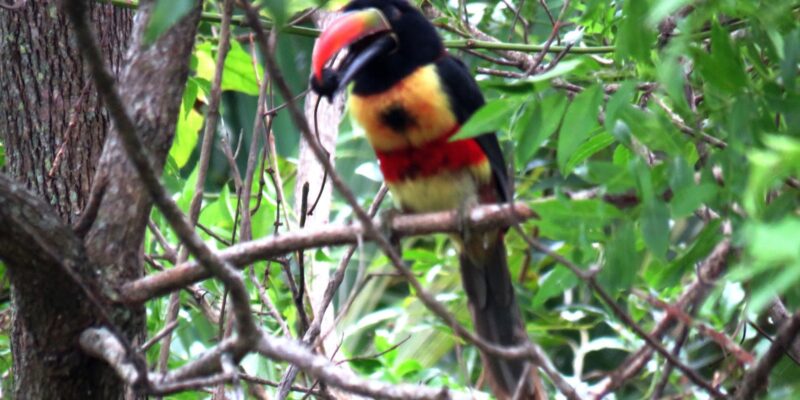
We were both pleased and surprised at how steady he was in taking this ideal shot of the colorful species, different from the Fiery-billed Aracari Toucan he’d captured a few weeks ago.

Here’s some information on this stunning bird from this site:

“Anatomy – Best known for its large bill, the keel-billed toucan is a large and colorful bird with black plumage, a bright yellow throat and cheeks, vibrant red feathers under its tail, and a yellow-green face. Its light green, the banana-shaped bill is splashed with orange and tipped with red and blue and can grow to be a third of the size of the toucan’s 20-inch body. Though cumbersome looking, the bill is relatively light because it is made of protein and supported by hollow bones. The toucan’s vast wings, however, are heavy and make flight laborious.
View over the valley as the clouds roll in.
Habitat – These unique birds are found in tropical and sub-tropical rainforests from southern Mexico to Venezuela and Colombia. The keel-billed toucan is crepuscular, meaning that it is most active during dawn and dusk. It lives in groups of six to twelve birds and rarely flies long distances because of its heavy wings — it is, however, quite agile hopping from branch to branch. The monogamous pairs make their nests in natural or wood-pecker created tree holes, taking turns incubating their eggs.
Diet – Keel-billed toucans feed primarily on fruits and eat insects, lizards, tree frogs, and even eggs. They consume their food by grasping it with their bill and quickly flipping it up into the air, and catching it in their mouths. They swallow their fruit whole and regurgitate the larger seeds while the smaller ones pass through their digestive systems. This method means that toucans play an essential role in reproducing the fruit trees they depend on. These beautiful birds are almost always seen feeding on fruits high up in the canopy; however, they will occasionally fly down to feed on the shrubs or catch a lizard from the undergrowth.
Threats – The species is not currently listed as endangered, but it is threatened by human activity. Habitat loss is a constant menace to the species’ populations. They are sometimes still hunted for their meat and ornamental feathers. At one time, they were prevalent in the pet trade, but it has since been revealed that their poor disposition makes them destructive pets. They’re valuable to Belize — where they are the national bird — bringing tourists who hope to catch a glimpse of their stunning plumage.”
Part of the road heading to downtown Atenas is closed due to the re-paving of the road.

This is the first photo we’ve captured in the wild of this particular Toucan. However, we’d seen several at the rescue facility, Zoo Ave, which we visited early in our stay, posting many photos over these past months.

Spotting this beautiful bird on the villa grounds only added to our exquisite experiences of spending most of our days outdoors in the pool area and lounging on the veranda. At the same time, we chatted, continued our continuing online research, and stayed in touch with family and friends.  It’s genuinely been blissful.

With relatively low taxi fares in town, locals and ex-pats often use taxi services to get around with the high cost of cars and trucks in Costa Rica. Each time we went into town, a 10-minute drive, the round trip taxi fare with a tip has been US $7.05 (CRC 4,000). 
We didn’t get out much in Costa Rica, mainly due to a lack of a rental car (costly here) and high costs for chartered tours at distant locations (we’ve “tightened our belts” for upcoming adventures). 

We arrived in Costa Rica during the rainy season, which also made sightseeing tricky when, at times when roads were washed out, and there were landslides and road closings. However, we’ve easily stayed well engaged and entertained during this past three months, reveling in the lush surroundings and vegetation, an ideal haven for birds and wildlife…equivalent to a rainforest in our yard.
We were surprised to find this vacant lot in town without a “for sale” sign (in Spanish, “en vente”).
As the time approaches for departure in five days, we feel a bit nostalgic. Last night, at dark, we sat on the veranda watching the village’s lights below in the valley and listening to the sounds of music and festivities that seem to permeate the air most nights. 

Now, with the weekend upon us, we’ll hear even more music well into the wee hours of the morning, pleasant Spanish dance music, as the little town of Atenas celebrates life.  We’re humbled and grateful to have been a part of it over this extended period while we anticipate what is yet to come…
Happy day!
              Photo from one year ago today, November 17, 2016:
Carlo, Michelle, friends we made on a prior cruise picked us up at the cruise terminal building in Fremantle, Australia, for a day of sightseeing in Perth and Freemantle. It was a memorable day. For more, please click here.

Surcharges are a necessary evil we chose while traveling the world…More wildlife photos from Costa Rica…

Look closely to see the face, only a mother could love, of a live crocodile behind a chain-link fence at Zoo Ave.

“Sightings from the Veranda in Costa Rica”

Tom’s photo, early this morning, of a cute dog that stopped by to say “hola.”

Definition of “surcharge:”

noun

1.
an additional charge, tax, or cost.
2.
an excessive sum or price charged.
3.   an extra or unreasonable load or burden.

Word Origin and History for a surcharge:

v. early 15c., from middle French surchargerfrom Old French sur- “over”
(see surchargier “to load” (see charge ). The noun is also first attested early 15c.

When most of us think of a surcharge, we believe in terms of an automatically imposed fee or tax added to a purchase over which we have little choice to accept as “the cost of doing business.”
Here’s a longer view of the above crocodile.

As world travelers these past five years, we find that we must bear the cost of a wide variety of surcharges that we chose to impart generally for the usual benefit of convenience.

Convenience is a huge factor in our financial lives. We choose convenience when we pay more than preferred or expected prices for many items, in an effort to ensure a better experience.
Let’s review some of these self-imposed surcharges, we encounter as a result of traveling the world:
1.  Baggage fees: Sure, we could travel “very light” hauling only backpacks and carry-on luggage. However, for the sake of having enough clothing, supplies, and digital equipment in our possession, we often pay excess baggage or baggage weight fees, depending on the airlines.
A curious turtle scurried quickly toward us.
2.  ATM fees: We do not go into banks or currency stores, paying exchange rate fees and credit card fees to obtain cash. More economically, we use ATMs to save money using our debit cards and thus incur only two fees; one, the cost of using the machine; two, the charge from our bank when using an ATM at an international ATM facility.
3.  Rental cars: At times, we pay higher fees for rental cars when we need a large enough vehicle to accommodate all of our bags; three checked bags and three carry-on bags.
4.  Medical costs: Recently, we incurred added medical fees to acquire a medical certification enabling us to board the upcoming Antarctica cruise, beyond the cost of the cruise itself. Soon, when we arrive in Buenos Aires, we’ll make an appointment at a travel clinic to update our vaccinations and get prescriptions for malaria pills prior to returning to Africa. We pay a premium for the few medications I use that aren’t covered by insurance and must be shipped to our location at any given time.
Turtles tucked away under the bushes.
5.  Tips: Particularly on cruises, we choose to add tips to the cost of the cruise at the time of booking which at this point, is running US $27 (CRC 15,372) per day. While on the ship, we may choose to pay additional tips for enhanced services and attention to detail befitting our convenience and experience.  In addition, for convenience, we may pay porter and bellman fees, depending on the circumstances.
6.  Flights:  On many airlines, they are now added extra fees for specific seats on the plane in the “coach” or economy section. At times, since we’re taller than the average passenger, we may choose a bulkhead seat or other seat with more legroom.
7.  Vacation Homes with added amenities: We prefer to rent a vacation/holiday home that includes Wi-Fi and all utilities paid, a pool, an upgraded kitchen with modern appliances and ample kitchen utensils, although we’ve had many exceptions. Of course, we always pay a premium for good views, which we’ve found is ultimately important to the our level of enjoyment.
8.  Mail and shipping fees: Since we’re unable to receive mail, piece by piece, in most countries, we often make purchases for clothing and supplies, accumulating them along with any snail mail that may arrive, placing them in one large box to be shipped. Most products we purchase include free shipping, but we must pay exorbitant fees to have all of the items sent to us at specific locations. For example, the box being shipped today which includes all the clothing we had to purchase for Antarctica, my new laptop and other supplies, we’re incurring a US $450 (CRC 256,199) shipping fee for the items to be shipped FedEx from Nevada to our upcoming hotel in Fort Lauderdale. This requires our mailing service to open all the arriving packages and boxes, toss the paper and packing materials and neatly place all the items in one box. Their fees imposed for this process are included in the above price.
A leopard atop a high perch.

9.  Internet/Wi-Fi/SIM card fees: We cannot travel without regular access to Wi-Fi; not at hotels, airports, and vacation homes. With our daily posts, photos and research, we chose not to be without Internet services for even a day. Ensuring a connection is always readily available often results in us paying added fees, including SIM cards for phone and data, when we chose not to pay the outrageous costs for roaming cell service in the US.

10. Visas – entering and exiting fees: Upon entering and exiting some countries, an arbitrary fee is charged for visiting their country. This is not the case in every country, but when we encounter such situations we may pay as much as US $40 (CRC 22,7773) at each immigration stop.
All of the above fees and more quickly add up to thousands of dollars each year. Although under many circumstances, we’ve opted for the lowest possible costs for each of the above, willing to forgo some conveniences, we’ve found paying these fees, although often begrudgingly, make life just a whole lot easier.
Sloths, known to by shy, are not easy to photograph when they tend to stay well hidden and out of sight.
We’re not backpackers. We don’t live in hostels. We don’t always use public transportation, preferring taxis and rental cars as an alternative. We aren’t 25 years old with minimal requirements. Nor, are we “high maintenance” always requiring the “best” of everything. Most likely, we fall somewhere in the middle, seeking a somewhat comfortable and somewhat convenient life as nomads.
May your life be comfortable and convenient.
Photo from one year ago today, November 14, 2016:
Tom’s shot of the sunset as we set sailed to our next destination. For more details, please click here.

Fiery-billed Aracari…Three gorgeous birds in the yard…The story continues…

“I’ve got mine!”
“Sighting from the Veranda in Costa Rica”
Sadly, another bird hit the glass wall and failed to recover.
“The Fiery-billed Aracari (Pteroglossus frantzii) is a species of toucan that is found on the Pacific slopes of southern Costa Rica and western Panama. Its binomial name commemorates the German naturalist Alexander von Frantzius. Its habitat is lowland forests and clearings.

The Fiery-billed Aracari has bright markings and a large bill, like other toucans. The adult is about 17 inches long and weighs 8.8 ounces. The sexes are similar in appearance. The head and chest are black and the upper parts are dark olive-green. The rump and under tail are reddish. The collar on the rear of the neck is also reddish. The underparts are bright yellow.

There is a round black spot in the center of the breast and a red band appears across the belly. The thighs are chestnut colored. There is bare black facial skin. The upper mandible of the bill is bright orange. The lower mandible is black. The legs are green. The young are duller in color, with a dirty-black head and brown-green upper parts. The breast spot and belly band are unnoticeable in juveniles. The call is a loud, sharp peek or keeseek.

This species is mostly a fruit-eater, but will also eat insects, lizards, bird eggs, and other small prey. They are seen in small flocks of up to 10 birds. They have a rapid and direct flight pattern. They nest 20 – 100 feet high in a tree. The female lays two white eggs that are incubated for 16 days by both parents. 

The chicks are blind and naked when hatched. Both parents feed the young, which leave the nest after about 6 weeks. The adults feed the young chicks for another several week after they leave the nest. The Aracaris roost socially throughout the year, which is unusual among toucans.”

After groundskeeper, Ulysses alerted us to the sighting, we were thrilled to see three of these outstanding birds on the grounds of the villa while standing on the driveway. The fallen trees from Hurricane Nate were being removed by local workers opening up an area where the birds were able to be seen eating fruit from the remaining trees. See our post on that date here.

Unfortunately, our photos weren’t as clear as the above main photo with our less-than-professional camera and our long distance from the birds.

In the previous post about this sighting, we failed to mention much about these stunning birds due to writing about the storm and the effect on the property after the high winds and pounding rains lasting for days.

Also, we had today’s photos of the Fiery-billed Aracari we’d yet to post and in reviewing our remaining photos to get us through the next 13 days until we depart (two of which will be spent re-posting some of our favorite Costa Rica photos), we decided today was the perfect day to post these photos and description from this site so kindly sent to us by our friend Louise in Kauai, Hawaii.

Louise has been an avid supporter of identifying birds and vegetation when we’ve often been unable to find answers online. Often, we have a less-than-ideal Internet connection which makes research cumbersome and time-consuming. 

“I can’t find one!  What’s the deal?”

Thanks to Louise and many other friends and readers, we’ve been able to update a prior post with the new information properly identifying the animal, bird, plant, flower, or a tree.

As much as we’d like to be able to spend hours in research identifying photos of interesting creatures and vegetation, the fact that we post 365 days a year spent as much as the entire morning in preparation, by the time we get done, we’re ready for a break, especially when we’ll be spending the rest of the day searching for additional photo ops and story content.

No, we’re not tired or bored with posting daily nor do we expect we’ll ever be in such a position. In fact, as we look forward to our next adventures, our interest in posting escalates to an indescribable level, especially when we’re easily able to take photos of a plethora of outstanding sightings in nature. 

“I’d better not drop this!”

With the massive cash outlays we’ve faced while here in Costa Rica, as mentioned many times in past posts, we’ve really had to “tighten our belts” and not spend money on rental cars and tours. We’ve gone over our budget in a few categories.

Surprisingly, groceries have been high for us in Costa Rica. We’ve spent around US $1,000 (CRC 569,713) per month, especially when we only eat one meal a day, don’t snack, or purchase any type of bottled beverages or alcohol. (We’ll be sharing our total expenses for Costa Rica on our final day’s post on November 22nd). 

“Finally, I’ve got one!”

Today, I’ll begin working on our clothing, to be packed before too long, all of which need a wash and dry due to the high humidity.  They actually feel damp and dusty after hanging in the closet for over three months. The end result may require I do some ironing for the first time in so long I can’t recall. I don’t like to iron, but then, who does?

May your day find you engaged in projects you hopefully enjoy!

Photo from one year ago today, November 9, 2016:

A small rescue boat anchored to the side of the ship. For more photos, please click here.