What a morning!…Many species came to call within a two-hour time frame…Is this real?

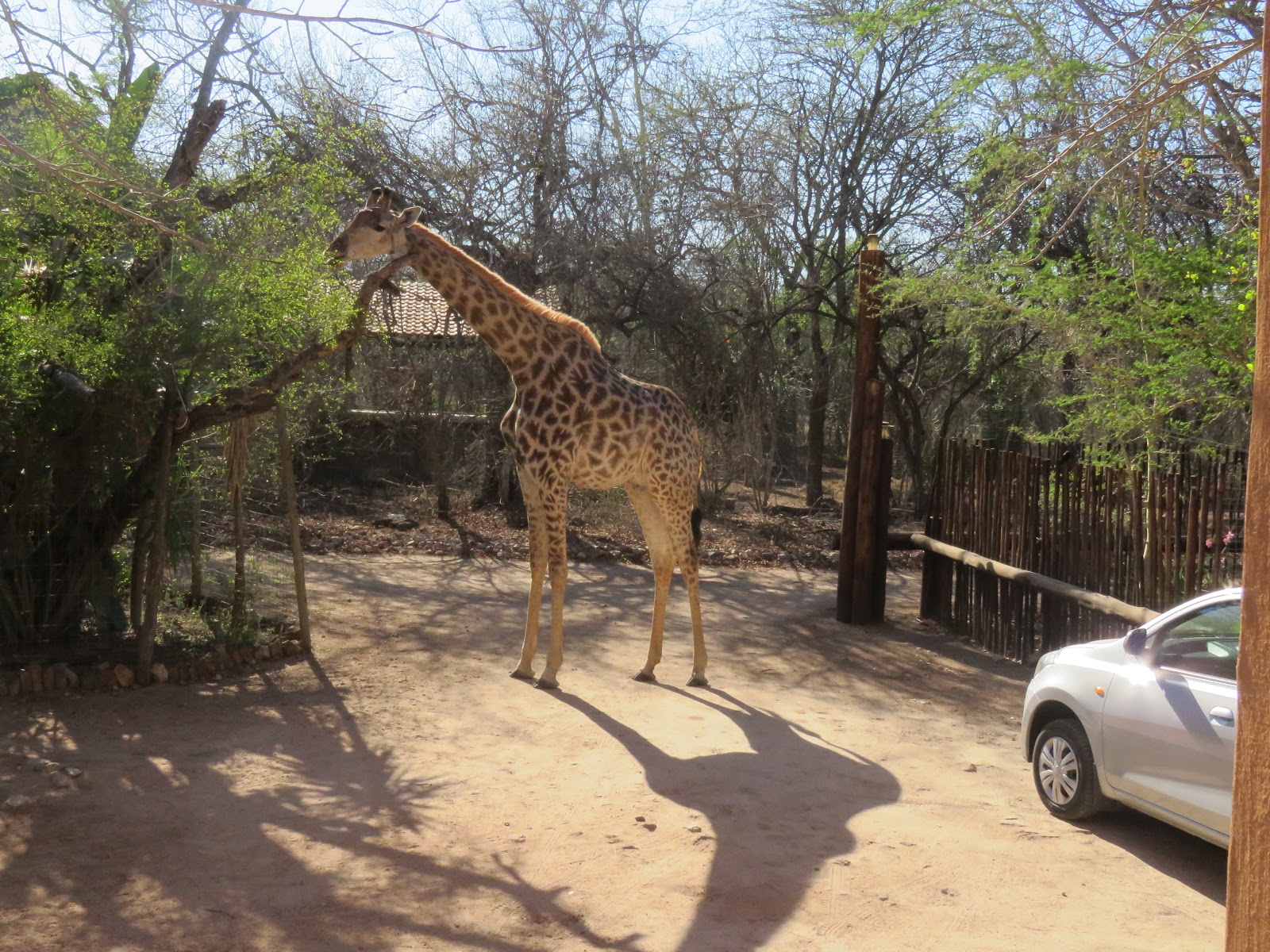
This was our first daytime giraffe visit at this house.

“Sighting of the Day in the Bush”

Zebras, helmeted guinea fowl, and of course our boy Tusker, whose quite a regular.

This morning we heard helicopters flying overhead heading to Kruger National Park in search of poachers. A considerable effort is being made to preserve the integrity of our endangered species who are being slaughtered for their horns, tusks, and even the scales of the quickly becoming extinct pangolin (an animal we’ve yet to see and would love to).

Within minutes a second giraffe arrived, and we excitedly photographed them both.

The sun is shining. The temperature is a comfortable 20C (68F) with a mild breeze. Endless varieties of birds are singing, and we even can hear the gurgling sounds of hippos a short distance away on the Crocodile River. .TIt couldn’t be a perfect morning…so we thought.

Giraffes have little competition for food in the treetops other than other giraffes.

Awakening earlier than usual after a good night’s sleep, while Tom was watching the Minnesota Vikings final pre-season game, I interrupted him to ask if he’d like to go to Kruger once I completed the post and he finished watching the game.

We couldn’t have been more thrilled to see them in our garden at long last.

In most cases, he enthusiastically agrees, but this time, he hesitated to state the weekend was here, and the crowds would be overwhelming in the national park during this busy holiday season.  

This more miniature giraffe may have been the offspring of the visiting female.

I was slightly disappointed but shrugged and went about my day, doing some laundry, chopping and dicing for tonight’s dinner, and reviewing the photos we had on hand for today’s post. Next week, we’ll surely head to Kruger, having been away for at least three weeks with our recent time out of the country.

Zebras are pretty rowdy with one another when competing for pellets. They don’t hesitate to kick and bite one another.

Little did I know that within a matter of minutes, magic would happen, and visitors came, one species after another, including the very first visit to our grounds by giraffes, who we’d longed to see since our arrival over six months ago.

And then, a band of mongoose suddenly appeared, hoping for raw eggs.  Tom mixed up a bowl full and placed it on the ground.

We’d seen a few giraffes in neighboring properties and taken a few photos, mainly at night and once, several weeks ago, saw one giraffe lingering in our driveway late at night. But, never had any giraffes come to call during the day.

I couldn’t grab the camera quickly enough, especially when all at once we had the following:  giraffes, zebras, warthogs, mongoose, and helmeted guinea fowl.  We had visits from bushbucks, hornbills, duikers, and a wide array of bird species throughout the morning.

They are used to Tom bringing out the bowl of raw scrambled eggs and wouldn’t back off while he placed it on the ground.

Tom didn’t hesitate to pause the football game to come outside to revel in the menagerie gracing us with their presence, each on their mission for some treats. Whether pellets, carrots, apples, eggs, or bird seeds, we joyfully shared our recently purchased inventory of things they love.

Unfortunately, giraffes don’t eat any foods we may offer when their goal and physical abilities only allow them to eat from the treetops or vegetation slightly below.  They only bend to the ground when drinking.

They pile atop one another to get a lick out of the bowl of eggs.  It’s hysterical to watch the action.

The morning continued magically, reminding us of how grateful and humbled we are to be in this amazing place, unlike anywhere else in the world, for whatever time we have left to be in South Africa.

Tom finished watching the game; Minnesota won, he was happy. I stayed busy with my various projects, online research, and managing the morning’s photos.  It’s been a great day so far.  Let’s see what rolls out for the remainder of the day.

Be well.  Be happy.

Photo from one year ago today, August 31, 2017:

Tom captured this unusual cloud formation in Costa Rica. For more, please click here.

A trip to Komatipoort first thing today…Out of pellets, carrots and apples!!!…A familiar drive reaps rewards…

That littlest one could not have been more than a week or two old.

“Sighting of the Day in the Bush”

This male ostrich appeared comfortably seated in the middle of a driveway of a bush home.

Busy since we returned from Zambia and Botswana one week ago, neither had any interest in grocery shopping. We hurriedly purchased enough to last several days. We stopped for some meat and vegetables in Melalane on the return drive from the airport.

Spotting elephants and lions are the most exciting when we make our usual drive in Marloth Park. Yesterday, we didn’t see lions but were thrilled to see elephants again on our first drive in Marloth in over two weeks, after our time away in Zambia and Botswana.
After dining out on Saturday night with Kathy and Don and eating light on Sunday after the braai at Frikkees Dam with Louise and Danie and friends, we made it with the few items we had on hand.
 
But, when we ran out of apples and carrots on Wednesday, and the pellet supply dwindled to only enough for this morning, we knew it was time to head to Komatipoort to shop for pellets and groceries. 
It was a perfect sunny day, and the elephants graced us on our side of the Crocodile River.
This would include Tom’s usual trip to Lebombo for the carrots and apples for the wildlife, along with eggs for the mongoose who’ve also been stopping by each day.  It’s been rather busy here.
It’s always special to see the babies and how lovingly they are cared for by the entire parade.
We’ve been preoccupied with the immigration thing hanging over our heads, which is yet to be resolved, with only 83 days remaining until our current visas expire.  
 
We wanted to move it along a little further before we started posting details. We’re almost at that point. We’ll share some other options we’ve been working on in the next few days that may or may not provide a solution.
We spotted around 20 elephants in this sighting.
Restocking food for the wildlife and ourselves made us both feel a little more settled. Lately, everything feels a little “up in the air,” with so little time remaining until we have to leave.
As summer nears in the next few months, everything will be lush and green, providing excellent food sources for the wildlife.
I must admit I’ve struggled to do the posts for the first time since we began posting in March 2012 while so entrenched in the current situation. Usually, we take things in our stride and are easily able to maintain an upbeat attitude.  
 
If anything, we work on solutions and resolutions that generally only take a day or two at most. But, here we are a week later, without a sense of assuredness as to what will transpire next.
We stayed watching them for quite a while.  It’s not easy to walk away.
Rather than sitting around mopping and worrying, we decided to allocate so much time a day to finding a solution, spending the remainder of our days and evenings doing exactly what has made our past six-plus months in Marloth Park so extraordinary…time with the wildlife and our friends. It helps.
At a distance, we spotted a dazzle of zebras climbing back up the steep embankment by the Crocodile River.
We took off in the newest “little car,” and I mean “little.” It’s a Datsun Go if you know what that is. No offense to any Datsun Go owners out there. It’s an economical and fuel-efficient small car that we have no doubt owners appreciate.  
There are often a few cattle egrets near elephants.
For the entire three-month rental of the little car, it was only slightly over ZAR 14,614 (US $1000), the lowest price we’ve paid anywhere in the world.  The tradeoff is that we bounce around like crazy on these rough dirt roads in Marloth and Kruger Parks.
 
With the upcoming uncertainty and the expensive Kenya tour in February, for which we’ll be paying the second of three installments tomorrow at ZAR 78,431 (US $5360), we’ve had to tighten our belts over something we could control, the cost of the rental car.
They often stay close to one another for safety reasons, especially when youngsters are in the herd.
Thus, when we took off in search of even more wildlife, we knew it was going to be one bumpy ride, and, indeed, it was.  Thank goodness my back doesn’t hurt anymore.  These rides would be unbearable for anyone suffering from any painful condition.
 
With much anticipation and enthusiasm, we bounced around Marloth Park, never to be disappointed, as shown in today’s photos.  No, it wasn’t as exciting as a game drive in Chobe or Kruger National Parks, but it certainly was memorable and worthwhile.
A solitary male impala by the river.  Most often, impalas are found in herds.
Now back at the house with everything put away, a new 40 kg bag of pellets filling the big trash bin we keep in the corner of the living room, using the little yellow Tupperware container to scoop out and toss the pellets to the visitors, we feel somewhat back to our enjoyable routine.
 
Soon, I’ll start cutting apples and carrots for the visitors and begin preparing our dinner for tonight, roast beef on the braai, roasted vegetables, and a green salad with homemade dressing.  Simple. Predictable.  And delicious.
 
Life is still good.  It’s just a little complicated right now.  We’ll make it right soon.
 
Happy day!


Photo from one year ago today, August 30, 2017:

A winking barn owl at a rescue center in Costa Rica.  For more photos, please click here.

Social times in the bush…Certain visitors return for a visit…

When it took a few minutes for Tom to mix up the bowl of raw scrambled eggs, they began walking up the steps to the veranda.

“Sighting of the Day in the Bush”

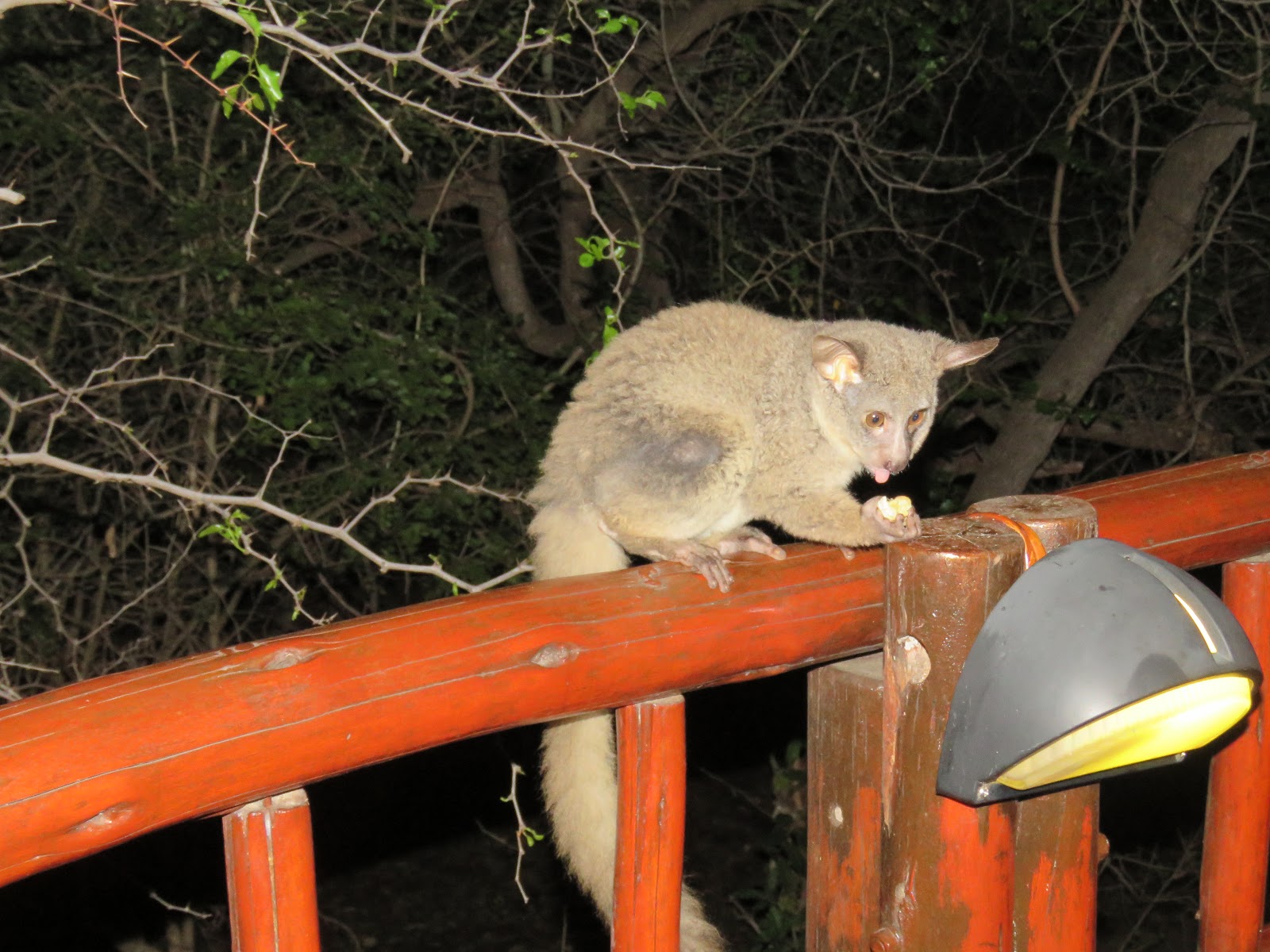
While at Jabula Lodge & Restaurant for dinner last night with Kathy and Don, this bushy-tailed bushbaby appeared to eat the bananas they’d left out. This type of bushbaby is approximately ten times the size of the bushbabies we see each night. 

Last night’s get-together with Kathy and Don started at AAmazing River View Restaurant and Bar for “sundowners’ while overlooking the Crocodile River. There’s no better way to see the sunset than this type of setting which never disappoints.  

We didn’t see much wildlife and were so busy catching up with Kathy and Don we never took a single sunset or wildlife photo. Need I say we had an excellent start to the evening.
Yesterday afternoon, shortly prior to leaving for dinner, a band of mongooses suddenly appeared in the garden. They were making their cute little noises, letting us know they were looking for eggs. 

A short time later, we drove our respective vehicles to Jabula Lodge and Restaurant for what proved to be yet another exceptional evening and meal while warmly greeted by owners Dawn and Leon.

Dining outdoors at this great restaurant is always a very special experience. Spending time with Kathy and Don only added to the enjoyment of the evening. Dawn always arranges food befitting my way of eating and yet, I always end up with a totally delicious and appealing meal.

It’s good to feed eggs to mongooses.  As carnivores, they kill snakes and venomous other creatures as their primary source of food.

Plus, last night, two bushy-tailed bushbabies made an appearance when bananas had been placed on the railing to the veranda. Of course, all the diners were on their feet taking photos with their smartphones, oohing and aahing, all the while.

As always, the conversation was lively and animated. It’s a tradition in South Africa when a visitor’s holiday stay is coming to a close, for the travelers to host a “going-away” party for themselves and their close friends.  

Lots of squeaking while waiting for Tom to appear.

Since we’ll be leaving in November, Kathy and I discussed that we host a Thanksgiving-type dinner. Kathy will help with finding some of the necessary ingredients in the bigger city of Pretoria when another of their holiday homes is located.

I’ve never seen a turkey at any of the markets but in the past, she’s been able to order them while in Pretoria and bring it here in time for the upcoming party. They don’t have canned pumpkin here but I’ve been able to purchase frozen pumpkin chunks that once partially cooked and thoroughly drained, will work for us to make traditional pumpkin pies.

Finally, they saw him coming with the big green bowl and began to scatter for their treat.

Finding the rest of the traditional items may be somewhat tricky but here in Africa, we foreigners always find a way to swap ingredients to make recipes work.  We’ll see how it goes.

This morning, I jumped out of bed early to begin making our usual egg casserole to bring to the party beginning at 11:00 am at Frikkies Dam in Lionspruit, an enclosed wildlife area within Marloth Park where a few lions reside. Louise and Danie are organizing and hosting as always.  

Check out that tongue sticking out, poised for more bananas.

We can bring our own food and cook on the braai in the enclosed area or, as we’re doing along with others, bringing a dish to share. It’s an easy-going fun experience we’ll certainly enjoy once again as we did several months ago.

Today’s post is a little rushed and I apologize for the lack of more interesting content. But, tomorrow is another day and we still have many more great photos to share. Please check back!

Happy, sunny day to all!

Photo from one year ago today, August 26, 2017:

These red hairy-looking fruits are rambutan. Atop the rambutan is an adorably decorated squash. For more farmers’ market photos in Costa Rica, please click here.

Immigration realities…Chobe saga continues…More exciting photos…Guest photos…

Holiday home on stilts on the bank of the Chobe River, suitable for the rainy season when the water level rises.

“Sighting of the Day in Chobe National Park”

An old massive elephant resting his trunk on his tusk. We saw this only one other time in the Maasiai Mara in 2013. Here’s the link to that post where there are some shocking photos we’d taken at that time including lions! 

Much to our sadness and dismay, we have to leave South Africa in 88 days on November 21, 2018, unable to complete the remaining time we’d hoped we could stay until February 21, 2019. We’re so disappointed.

Skilled birders, Lynne and Mick, identified this bird as an emerald spotted dove.Thanks, you two, for once again assisting us!

Here’s how it rolled out when we arrived at the airport two days ago and went through the immigration line:

It’s unusual to see a giraffe grazing on the ground.  Also, in this photo are two white cattle egret and a few Egyptian geese.

The immigration officer flipped through our passports and kept saying, “No, no, no. You cannot do this.”  Technically a traveler can only stay one 90-day period in 12 months, not for a full 12 months, as we’d hoped.

Another stunning croc on the Chobe River.

The laws were vague and confusing when we read them. We knew this risk existed but we decided to take the risk anyway. Having made that decision to “wing it” when we first arrived in February, we’re grateful we’ll have had the nine months we managed to stay when all is said and done.  

We’re unable to identify this type of antelope in Chobe.  Any ideas what this may be?

We talked her into giving us one more 90-day period which ends on November 21, 2018. She noted our status on the computer. There is nothing we can do. If we tried one more time, we could immediately be sent out of the country without an opportunity to pack up our stuff and find a place to go. That’s way too risky for us.

A parade of elephants staying cool under the shade of a tree.

Instead, we’ve accepted this reality and last night when Louise and Danie stopped by for sundowners and to say hello, we told them the bad news. They were sad along with us, trying to think of solutions. We appreciate their love and concern. There are no alternatives. We must go.

This monstrous male came out of the bush to check us out.

We have to be in Nairobi, Kenya on February 22, 2019, for our upcoming photo safari adventure which won’t begin until 92 days after we exit South Africa in November. Where are we going to go for 92 days? 

This elephant was not happy this boat was blocking her way to get onto the shore of an island.

Of course, we can always go to Kenya a few days earlier to leave us to spend 90 days in some other African country which we’ll have to do. Most countries we’re considering have 30, 60, or 90 visa limitations. We’d prefer to stay in one country for the entire 90 days.  

Hazy morning view of the Chobe River.

Hopping around in Africa is difficult due to flight hubs requiring many extra hours of travel time, often as long as 24 to 30 hours. There are many countries we won’t consider for this extended period due to political unrest, Ebola, and other risks for travelers, one can only imagine.

Enormous bird nest.

We’ve already visited eight African countries out of 54. You’d think we’d have lots of options. But with our desire to stay 90 days, and find suitable housing to actually enjoy the 90-day time period, it’s not as easy as one might think. 

Hippos napping in shallow water to keep their sensitive skin cool and protected from sunburn.
Hippos grazing close to the shore of the Chobe River.

Thus, fast and furiously we’re researching, narrowing down our options to those that will fulfill our goals while providing us with a great experience to boot. It’s not easy.

Guest photo #1 from Beth Schroeder, a US citizen, working in Dubai who, like us had visited Chobe in May and then again in August.
Guest photo #2 from Beth Schroeder. Thanks for sharing Beth. It was great spending time with you during our game drive in Chobe National Park and on the Chobe River safari.  Great shots of elephants!

Yes, we’re disappointed. We had looked forward to spending Christmas and New Year in the bush with our human and animal friends. We looked forward to seeing the newborns scurrying around the park with their doting mothers (and sometimes dads) on the perpetual search for food, safety, and shelter during the hot days of summer.

To travel from Zambia to Botswana we had to go across the Zambezi River in a small boat. Four countries meet at this exact location: Botswana, Namibia, Zambia, and Zimbabwe. The bridge is still under construction and isn’t expected to be completed for 18 months or more.

But, in the realm of things we’ve had our fair share…more than we could have ever dreamed possible. And for that, we are humbled and grateful, leaving here in 88 days with our hearts filled with love and our minds drenched in memories.

Be well. Be happy. Be fulfilled.

Photo from one year ago today, August 25, 2017:

We were in awe of this view from the veranda in Atenas, Costa Rica, when the afternoon clouds roll in each day.For more photos, please click here.

The Chobe saga continues…Angry elephant and scary looking others…Issues with malaria pills…

This short video clearly illustrates how dangerous an annoyed elephant can be 
when their territory is not respected.

“Sighting of the Day in Chobe National Park”

We’ve rarely been this close to a waterbuck since they remain close to the river, impossible for us to access. What a handsome animal!

Those who have been following us for some time know that we hesitate to mention every little ache and pain or discomfort we encounter in our lives of world travel. We all have some degree of a medical issue on occasion, some noteworthy required medical intervention, and others we can manage on our own.

This elephant was not happy to see ours and another safari vehicle on the road. He started flapping his ears and swinging his trunk, tossing sand. See the above video for details.

Today, I share this with our readers as informational only and do not, under any circumstances, suggest our experience is common, nor are we suggesting any medical treatment or advice. This is an FYI only.

The other safari vehicle was much closer to him than ours. 

Upon the recommendation of a local doctor in Komatipoort with whom we recently updated our vaccinations, we began taking malaria prophylaxis medication one day before departure to Zambia on both this trip and the past three months ago.

And then, it happened.  He approached the safari vehicle, ready to charge. See the above video for more.

We were prescribed to take one tablet daily of the generic equivalent of Malarone (Atovaquone Proguanil), known in South Africa, purchased over the counter at any local pharmacy at the cost of about ZAR 14.35 (US $1) per tablet.

Three giraffes along the bank of the Chobe River.

We started taking the pills last Wednesday, with food, one day before we departed Marloth Park continuing daily during the week in Zambia and Botswana, never giving it another thought with a plan to take them seven days after our return.

We’ve never seen so many impalas on any other safaris in the world.

While in Africa for almost a year in 2013/2014, we took the pills continuously, never experiencing any major issues. While in Zambia for a week in May 2018, we followed the same regimen, never giving it much thought.

Our guide Sampson explained that the only animal that can cause a self-induced abortion by eating a certain poisonous plant does so when conditions are poor, and her calf wouldn’t survive.

(We continued to use insect repellent while taking the pills, which is always a must-do while in Africa and certain other parts of the world).  

Hippo with oxpecker, cape buffalo, and impala all in one photo.

The last time I took the first pill, a few hours later, I had a headache.  I never get headaches. I brushed it off and continued with the pills. While on our first safari in Chobe a few days later, I noticed I had a weird headache-like sensation in my jaw for most of the day. I’d taken the pill on an empty stomach and attributed it to that.

Yellow-billed stork.

After lunch, the headache went away. Thus, it obviously made sense to take the pills with food which we’ve done since. But then again, on Monday morning, while in Chobe National Park on a game drive once again, after taking the pill with food, I noticed that same jaw pain. I reached into the backpack and pulled out a Tylenol, and chugged it down.  

Lilac-breasted roller.

An hour later, the pain was considerably less but not totally gone. At that point, I’d never mentioned it to Tom, not wanting to worry him. We continued and had a great few days in Chobe.

Such a sweet face. Check out those eyelashes!

The second day in Chobe, I noticed my balance was off. I kept bumping into things, not outrageously so but enough to make me notice. On Wednesday night, when we returned to the Livingstone Protea Hotel, I could hardly walk straight. I felt nauseous and horribly dizzy.  

Each day before commencing the game drives, tea, coffee, and muffins were served in the bush.

I didn’t feel like having dinner, but to “tough it out,” I didn’t complain, and we ate in the hotel’s restaurant. I ordered a bit of fish and steamed vegetables, hot tea and drank lots of water.  

The beautiful fish eagle.

By yesterday morning, I struggled to do the post, more than I’ve ever struggled in the past when not feeling well. How I got through it, I’ll never know. By noon with the post uploaded, I was in bed, under the covers with the room spinning, and I couldn’t walk across the room. A few hours later, diarrhea hit hard.

Crocs don’t have sweat glands. If a Crocodile gets too warm, it can only reduce its temperature in three ways: get in the shade, get in the water, or sit quietly with its mouth wide open. This one opted for the latter.

I’d stop taking the pills 24 hours earlier. I knew the pills were making me sick and didn’t think it was something else when I’d read that these two symptoms were common side effects of Malarone and its equivalent.  

A face only a mother could love.

By 1600 hours (4:00 pm), I knew there was no way I could go to the restaurant for dinner, and I knew I had to drink lots of water and should have some easy-to-digest dinner although I wasn’t hungry. Not eating would only make me feel weaker and dizzier.

We watched the sunset from the veranda at the Chobe Safari Lodge.

By 1900 hours (7:00 pm), Tom delivered my plate of grilled chicken breast and a few steamed vegetables. I encouraged Tom to relax and enjoy dinner in the restaurant while I ate half-sitting up in bed.  

Neither of us slept well as typical on the night before we fly away. Fortunately, this morning I’m much better although, still feeling a little dizzy. I’ll be OK to travel today. 

African sunsets are memorable.

After searching online, I found this article from the USFDA on the potential side effects of taking malaria pills. Please click here for details on that report. After reading this and other such articles, I’ve decided not to take malaria pills in our remaining seven months in Africa.  

Here’s an excerpt from that report:
“The U.S. Food and Drug Administration (FDA) is advising the public about strengthened and updated warnings regarding neurologic and psychiatric side effects associated with the antimalarial drug mefloquine hydrochloride. A boxed warning, the most serious kind of warning about these potential problems, has been added to the drug label.  FDA has revised the patient Medication Guide dispensed with each prescription and wallet card to include this information and the possibility that the neurologic side effects may persist or become permanent. The neurologic side effects can include dizziness, loss of balance, or ringing in the ears. The psychiatric side effects can include feeling anxious, mistrustful, depressed, or having hallucinations. (For a complete list of potential side effects, see Additional Information for Patients).”

I’ll continue as I have all along, using copious amounts of insect repellent every six to eight hours and keep my arms and legs covered as much as possible. Most often, I get bit by mosquitos on exposed skin, not under my shirt and pants.  

Moments later, the sun disappeared, and we walked to the restaurant across the road for a gourmet meal, as shown in yesterday’s post here.

If I wear my insect repellent clothing all summer long in Marloth Park, I will see when we’re in Kenya at the end of February and early March. This time while staying in Marloth Park, neither of us have taken malaria pills. The stay was just too long to continue taking these drugs safely.

Do we worry about getting malaria? We hardly ever give it a thought when taking sensible precautions, but this is up to you, and your doctor should you visit a malaria-prone zone anywhere in the world. This was the last time we’ll take them.  

Tom’s had no issues and will complete his regime for the seven days once we’re back in Marloth Park, but he too says they present too many risks to our liking. We wouldn’t have taken them to Zambia, Botswana, and Zimbabwe had the doctor not insisted it was imperative for these regions.

On the first safari, when we went through the border between Zambia and Botswana, we had to drive through a chemical that cleans the tires to prevent the spread of hoof and mouth disease.

Today, we share more of our photos from this week’s four safari adventures: two game drives and two boat rides in Chobe National Park and on the Chobe River.  As you can see, we were hardly disappointed. Many more photos will follow.

Tomorrow, we’ll post our final expenses for this one week in Zambia and Botswana. I wasn’t up to putting them together these past few days, but once we’re back in Marloth Park, I’ll tackle the numbers and share them with all of you.

Soon, we’re off for the airport, and by 1730 hours (5:30 pm), we’ll be back in our own little paradise. We’re keeping our fingers crossed for an easy immigration transition in Kruger/Nelspruit/Mpumalanga!

We’ll be back with you soon. Have a great day!

Photo from one year ago today, August 23, 2017:

Statue in a roundabout on our way toward San Jose, Costa Rica, known as Rotondo de las Garantias Sociales Zapote. For more photos, please click here.

The Chobe saga begins…Good food for the carnivores…

We were excited to get a view of the leopard’s face after waiting for a considerable period while Samson, our guide kept moving the vehicle for better shots.  Upon careful inspection of this photo, you can see the pads of the feet of her kill in the tree near her head.

“Sighting of the Day in Chobe National Park”

Cape Buffalo have a symbiotic relationship with cattle egrets who eat the ticks and other insects off their bodies preventing illness and infections.  Cape buffalo are well aware of this benefit and do not object to their presence. 

With literally hundreds of photos from four safaris in Chobe National Park, two each on land and the river, we almost don’t know where to begin.  Do we share our favorites first and wind down over a number of days to those of wildlife our readers have seen over and over again?  

When our guide maneuvered the safari vehicle for our photos, it was tricky getting into a good position.  There were nine of us in the vehicle and several other nearby vehicles with equal numbers of tourists, we were all jockeying for positions.

Or, do we spill “the best of the best” first and dwindle down to those animals and scenes which may have become familiar to all of you over the years of our wildlife adventures throughout the world?

The leopard was well aware of our presence and kept turning her back to us.

For expediency and perhaps a bit of laziness on my part, we’d decided to attempt to balance it out over this next week (or more, if necessary) with some of our favorites and others we look forward to posting which may not be as spectacular.

Of course, we would have preferred full-on face shots but it just wasn’t going to happen.

Dealing with hundreds of photos to pick and choose is a monumental task in itself.  Writing the text is easy comparatively.  Editing the post with a less than ideal Wi-Fi signal is challenging as well.  So bear with us.  

From time to time, she’d allow us a glimpse of her profile.

We’ll do our best to share our experience with all of you, our loyal reader, our new readers “getting their feet wet” in beginning to read our over 2200 posts and our occasional readers who may attempt to pick up where they left off or not.

But then, she’d put her head back down to nap after her tasty breakfast.

A person asked me, “If you go on safari over and over again, seeing the same animals, don’t you get bored?”

I answered, “If you watch football over and over again, seeing the same players, do you get bored?”

There are many islands in the Chobe River during this dry season.  The elephants swim back and forth from the land to the islands to partake of its rich vegetation.  Elephants are excellent swimmers.

Every time is different.  At this point, we couldn’t count how many times we’ve been on a game drive, either driving ourselves or being driven in a safari vehicle.  It doesn’t matter.  The fact remains, we aren’t bored.

In no time at all, she made her way to the island in the deep water.

No sooner than we climbed up into the safari vehicle or boat over these past days, the adrenaline rush flushed our minds and bodies with feel-good hormones as the sense of anticipation washed over us.

Once on the island, she joined the other members of her family.

A few times over these past few days, I described it to Tom like fishing…the anticipation is 75% of the excitement.  We get that same feeling when searching for wildlife scenes.  

There is varying speculation on how many elephants there are in Chobe National Park.  It ranges from 50,000 to 65,000.  During our four safaris, we saw no less than a thousand elephants.

For us, after many such experiences, the sighting of an impala or kudu may not be earth shattering but an impala attempting to mate or a kudu playfully dancing about is all new and elicits great feelings of pure joy and elation.

This was one of many crocs we spotted on the banks and in the water of the Chobe River.

In essence, that’s what we’re searching for, the unusual and less often sightings but all the while thoroughly enjoying the parade of elephants on an island in the crocodile-infested river or a dazzle of galloping zebras on the savanna.  It’s all quite exciting for us.

Tom’s fantastic dinner at the gourmet restaurant at Chobe Safari Lodge, located in a separate building we walked to in the dark with the sounds of wildlife around us.  There are no fences around Chobe National Park as there are in Kruger National Park.  One could easily encounter wildlife while out at night.

Of course, if you aren’t interested in wildlife, one way or another, none of our recent or upcoming posts over these next seven months will hold must interest for you.  Sorry about that.  As our longtime readers know, our posts aren’t always about wildlife and nature.  A year from now we’ll be at the end of our Baltic cruise…hardly a wildlife-rich experience.

This was the best-roasted leg of lamb in au jus that I’d ever had, moist, tender and delicious.

For now, we’re chomping at the bit to share nature’s bounty over these past several days.  And yes, once we’ve shared all we can, we’ll be back to posting our ongoing day to day adventures in Marloth Park. 

We made new friends while on safari, including Jean-Pierre and Patricia a wonderful couple from Nice, France.  

No words can describe how excited we are to return tomorrow to see all of our friends, both human and animal and to settle back into our lovely holiday bush home, “Orange…More than Just a Colour.”

Yumm…life is good.

________________________________________

Photo from one year ago today, August 22, 2017:

Tom, walking toward the dental clinic in Costa Rica.  It didn’t seem to be in a great neighborhood with bars on windows and doors but we felt comfortable.  For more photos, please click here.

Annoying noise and big concerns in the park…A little complaining on this end…Three days and counting to trip…

From this site:  “Zebras as very social animals and live in large groups called ‘harems.’ Plains and mountain zebras live in harems that are made up of one stallion and up to six mares, and they’re young, while Grevy’s zebras come together as groups for short periods of time.” The type of zebras in the South African savanna is Burchell’s Zebra [Equus burchelli].

“Sighting of the Day in the Bush”

Moms and babies…what a sight to see!

It’s been an unusual weekend. With few wildlife visitors stopping by due to the holidaymakers and the noisy construction next door, which occurred all day Saturday and Sunday, beginning again with hammering at 6:17 this morning, our days and nights were quite different than usual. 

The work continued each day until darkness fell that impacted our enjoyment of setting up for wildlife visits in the early evening. No one came to call.

Zebras can be pushy when it comes to getting their share of pellets and vegetables both with their harem mates and with us.

At a few points over these past days, the pounding was so annoying we went inside, shut the door, and watched a few episodes of shows on my computer. This is very unusual for us. We rarely watch anything other than the Minnesota Vikings game during daylight hours.

There are rules in Marloth Park as to which hours and days of the week construction can be in process.  Obviously, the neighbors had little regard for these rules. But, who are we to report them. We’re only renters.

This zebra started climbing up the veranda steps to let us know he was hungry.

We can only imagine the frustration tourists who’d come for a long weekend would feel if they’d come for a four or five-day stay and they had to put up with the noise and lack of wildlife visiting. People come to Marloth Park for the wildlife and a sense of peace.

Unfortunately, some homeowners and holiday renters aren’t respectful of the laws, spoiling it for everyone else.  Actually, we’re thrilled to be leaving in three days to head back to Livingstone, Zambia, and Chobe National Park in Botswana for a week.

It’s not unusual to see altercations among the zebras when they’re competing for food.

Hopefully, by the time we return on August 23rd, the construction will be completed, and the noisy and disrespectful holidaymakers will be gone. In the past several weeks, we’ve seen no less than a half dozen children driving 4×4’s and SUVs in the park, some as young as eight or nine years old, either sitting on the parent’s lap or some type of booster seat.

It’s no wonder 12 or 13 animals were killed on the roads over these past few school holiday months. Some people come here, not all, with little regard for laws and safety, many speeding on the roads with the potential to kill both animals and humans innocently walking or biking to their destinations.

The symmetry of their stripes is different on each zebra, such as in a fingerprint. From this site: “Body stripes are less numerous and broader than the Cape Mountain Zebra, whereas body stripes extend around the belly. Leg striping is less prominent. Measures 1.3 to 1.4 meters (51-55 inches) at the shoulder and weighs 300-320 kg (661-704 pounds). They have rounded ears approximately 160-170 mm (6.3-6.7 inches) long. The front portion of the mane forms a black tuft between the ears. Diet: Predominantly a grazer, feeding in areas with short grass. Zebra has a strong, sensitive upper lip with which it gathers herbage by collecting the grass between the lip and the lower incisors before plucking the harvest.”

A few weeks ago, we saw a lit cigarette being tossed from a moving vehicle.  We were aghast!  Marloth Park is all bush and this time of year extremely dry. The entire municipality could ignite in minutes from one single careless act.  

Plus, the invasive alien plants, of which there are many, brought in by homeowners desiring a “fancy” garden tend to burn higher and more intensely than the indigenous plants. This isn’t very comforting.

The type of giraffes found in South Africa from this site “Giraffe camelopardarlis giraffe – South African giraffe found in South Africa, southern Botswana, southern Zimbabwe, and Mozambique.”

As all of our readers know, it is not our intention to be “negative” in our posts. Still, we’re hoping both locals and visitors will stumble upon this post and realize how serious some of these infractions are to the safety and well-being of everyone in this magical place.

We apologize to our worldwide readers, far removed from this area, to be reading this bit of negativity. But, we do not doubt that there are similarly thoughtless people who upset the balance of peace and harmony in some of your neighborhoods, towns, and villages.

From this site: “Receptive cows are continuously courted by adult bulls. They have a gestation period of 457 days. Whereafter a single calf is born. At birth, a calf weighs about 100 kg (220 pounds), and they are weaned between six to eight months, but only about 52 percent of the calves ever reach maturity since the young are preyed upon by lions hyenas, and leopards. Sexual maturity is reached after four or five years. The reproductive receptiveness of cows is checked upon by adult bulls moving from group to group.” The calves are more likely to reach maturity for giraffes in Marloth Park since there are fewer predators in the park than in Kruger National Park.

I’m planning to pack today for our upcoming trip.  It always gives me peace of mind to be packed a few days earlier than necessary. We’ve found it’s harder to pack for short trips while living in a holiday home than it is for us to leave a location permanently.  In those cases, we pack everything we own.

For short trips, it’s a pick-and-choose process that takes more time and effort.  The last time we made this trip, I brought along 50% more than I needed. This time, I’ll cut back considerably, lightening the load.  

Ms. Kudu and a friend visited us a few weeks ago. Only one kudu came to call over the past many days.

Plus, we’ll be taking a “trip within a trip” when we stay overnight at the Chobe Safari Lodge midway through the week. During this one-night, two-day period, we’ll mostly be wearing our ‘bugs away” clothing, making those decisions a little easier.

Today, we’ll embark on our usual drive in Marloth Park since getting into Kruger is still almost impossible with the tourist crowds. We’ll wait to visit Kruger after we return from Zambia.

Have a spectacular day!

Photo from one year ago today, August 13, 2017:

View from the chaise lounges of the pool, the Jacuzzi to the left and beyond it, the cold plunge pool at the house in Atenas, Costa Rica. For more photos, please click here.

Reasonable prices in South Africa…What are we spending here?…All new photos from yesterday’s drive…

The ostrich on the left, who may be the dad, says to the ostrich on the right, which may be his son, “Dad, I appreciate the good advice.”

“Sighting of the Day in the Bush”

Baby elephant walking with mom, holding onto her tail for emotional security.

When we’d made a mistake in the date, we needed to leave South Africa for another visa stamp. This had an impact on our car rental by one day. Yesterday, we called the rental car company using the phone number on the documents to ask for a one-day extension.  

Although not visible in this photo, once again, we spotted the mom, dad, and seven chicks who were scattered in this home’s garden, close to the dad at a distance. Dad watched the chicks while mom stayed on the lookout for predators.
We were quoted only ZAR 225 (US $15.97) for the extra day, and we were pleasantly surprised. When we’d previously inquired about a one or two-day extension on a rental car contract in other countries, in most cases, the daily rate was an additional ZAR 705 (US $50) with little regard to the daily rate we were paying in the contract.  
Once again, we spotted ostriches on Vostruis Road (volstruis means ostrich in Afrikaans) next to this same vehicle where we’d seen them almost five years ago. Click this link here to see the post from December 7, 2013.  Funny, eh?

Although we’d never actually used an extension in this past almost six years, we didn’t hesitate to accept the above rate offered by Hertz (via their booking service Firefly).  

A casual stroll down Volstruis Road on a Saturday afternoon.

We’ve found many costs to be reasonable in South Africa, lower-priced than in many other countries, which were one of the many reasons we decided to spend a year in Marloth Park. We’ve been here six months with six months to go when we’re leaving as of yesterday.

The only area we found to be a little higher than in some countries is the cost of groceries, based on the types of foods we eat, high-quality meats and vegetables. Tom continues to eat some dairy while I gave it up a few months ago. Quality imported cheeses are expensive here.

Recently, we’ve seen elephants at the river every time we’ve gone for a drive as we carefully peruse the long span of the river from Marloth Park.

We’ve been shocked at the low prices on Tom’s brandy at ZAR 120 (US $8.52) per liter and my low-alcohol red wine priced at the grocery store at ZAR 49.99 (US $3.55) per bottle, the going rate for most bottles of wine. A similar wine in the US would easily be ZAR 169 (the US $12).  

This male elephant looks skinny and somewhat unhealthy.  Life is not easy for these majestic beasts when they are off their own, ostracized from the family structure. Male elephants spend their formative years with the herd leaving at around age 13 to 14 when puberty sets in. The male elephant will roam the savanna alone or team up with other males in a loose bachelor herd.

Dining out is inexpensive. We’ve paid the most at any local restaurant, ordering any main dish, drinks, and tips, ZAR 500 (US $35.49). Our dinner bill at Jabula is often around ZAR 450 (US $31.94), with drinks, tips, and taxes included.

This female was surrounded by her parade of perhaps 50 others.

So far, during these first six months, including holiday home rental, car rental, groceries, dining out, trips to Kruger, and miscellaneous shopping, our monthly living expenses are slightly under ZAR 56,340 (US $4,000), considerably less than in other countries.

Even with the requirement of us leaving every three months for visa purposes and the cost of flights, activities, tours, hotel, taxi, food, and tips, it adds an average additional monthly cost of ZAR 14,090 (US $1,000), still leaving us at an average of ZAR 70,450 (US $5,000) per month.

I am at a loss as to the black band around this elephant.  Any ideas out there?

We’ll be posting the actual expenses at the end of our 12-month stay in South Africa.  Daily, we keep track of every expense, making it relatively easy to compile the data to post here.

As I write today’s post, Tom is watching the Minnesota Vikings’ first pre-season football game using NFL Game Pass, which he signed up for yet another year.  

Another lone elephant.

After last year’s excitement when the Vikings made it to the playoffs, finally, after all these years, I’ve developed an interest in watching football. So I’m looking forward to the new season along with Tom.

Currently, he plugged the HDMI cord into the hi-def flat-screen TV, and we’re watching with the clearest picture possible. See, even living halfway around the world we can enjoy some familiar activities enjoyed by others in many parts of the world.

We always swoon when we see the youngsters.

Still, animal visits are at a minimum with construction next door and the added tourist traffic during this holiday weekend. We didn’t have one visitor all day yesterday until last night when Little Wart Face showed up with Mr. Duiker. We were thrilled to see them and promptly tossed large handfuls of pellets.

Today, a tasty Sunday dinner is on the menu and dining outdoors on the veranda, a must. Hopefully, as some tourists head back to their homes today, the traffic will thin out, and more wildlife visitors will arrive.

Yesterday, we heard that the Crocodile Gate to Kruger was closed to anyone that didn’t have a reservation. Only so many cars are allowed into the park at any time if that’s any indication of how busy it is here.

May your day be rich in experience and fulfilling in love.

Photo from one year ago today, August 12, 2017:

Sunset from the veranda in Costa Rica was always stunning. For more photos, please click here.

In an attempt to avoid “tooting one’s horn”…Kindness means so much…

A lone giraffe in the bush.

“Sighting of the Day in the Bush”

A croc was making an appearance in the river.  From this site: “Crocodiles can submerge and remain underwater for a variety of reasons. In most voluntary dives, crocodiles stay underwater for between 10 to 15 minutes. If the crocodile tries to hide from a threat, dive length may be longer, up to 30 minutes or more. Most crocodiles can remain underwater for up to 2 hours if pressed.”

Our world travels aren’t always about “us.” As we meet and engage with the locals, we often find opportunities to “do good works” for those in need. It isn’t always about handing over money, although when circumstances are correct, we do.  

At times, it’s about doing something special for an individual and their family. At other times, it’s about generosity and kindness in varying forms and degrees. We choose not to write about these occasions. Doing so would merely be in an attempt to gain recognition or accolades for “doing good works.”

What a lovely scene on the Crocodile River, as seen from Marloth Park.

When wealthy celebrities donate money to various situations and causes, there are many forms of media covering the exchange to make the donor “look good” and enhance their public image.  

No doubt, it’s done with good intentions to provide funds and foundations for many causes, disaster relief, and poverty. But, strip away the ability to do it anonymously, and one wonders among them would still contribute.

This elephant climbed the big rocks for a better view.

But, for the “small folks” like us with limited resources and a fixed income, we don’t have the luxury of donating the more significant share of our income. We give as we can when circumstances are right.

Long ago, when we encountered such situations that felt right for us, we decided we had no need or desire to write about them here in an attempt to “toot our own horn” or “make us look good.”  

Crossing the shallow river…

In our hearts and minds, we are at peace with the fact that our travels are not entirely about our pleasure and enrichment. It’s about somehow, in some way, giving back something of ourselves that matters to someone we meet along the way. That’s all we need.

Gee, I don’t want to sound like we’re looking for accolades for our philosophy.  We’re not. We’re mentioning this as a preface to a bit of story we’re sharing today that didn’t include generosity on our part but was merely a matter of circumstance, perhaps somewhat serendipitously, more than anything.

The Crocodile River views vary depending on the banks from which we’re shooting photos. The amount of water varies from day today.

When the screen on my still-working cellphone cracked, which wasn’t noticeable when used in a darkened room, and I’d run out of storage space with too many apps, we decided I’d get a new phone that we shared yesterday’s post here.

We decided we’d drop off the old phone at an electronics recycle facility once we reset the phone to delete all of my content. This is what we usually do with obsolete digital equipment in most countries. But, it was a shame to get rid of an otherwise well-operating smartphone.

This elephant appears almost black after being in the water.

We decided we’d ask Martha, our housekeeper, if she could use the phone after I wiped out all my data. Keeping in mind she doesn’t speak English very well, when we showed her the phone asking if she likes it, her response was priceless. She enthusiastically hugged us both. What a coincidence! Her old phone had stopped working for calling.

Martha has a large family, and being unable to stay in touch was hard for her, as one would imagine. She lives in a tiny house on the grounds of this house and visits family on her days off. She doesn’t do Facebook, email, or any other forms of social media. She likes to make calls and play games. This we could accomplish for her.

These orange blooms on aloe bushes are commonly seen during the winter months in the bush.

We all giggled over the irony of me buying a new phone and needing to dispose of an old phone, which ultimately meant so much to her.  We didn’t do anything special other than avoiding a trip to a recycling store. It only took moments of our time to set it up for her, certainly less than we’d have spent driving to a recycling facility.

The quality of our lives is often about the little kindnesses we receive, ultimately striving to pay it forward. Kindnesses include dining at Uschi and Evan’s fabulous home in the bush last night with Evan’s mom Ester joining us,  a delicious meal perfect for my way of eating with some of the best conversations in the land.

Recently on a scorching day, we spotted dozens of elephants by the river.

Kindness means Louise and Danie were bringing us knives, a cutting board, and a food processor, and many more endless generosities they provide day after day. Kindness means the workers who came to our house to help when Martha was away, graciously greeted us each day, and did a fine job fulfilling our expectations. 

A Big Daddy (kudu) crossing the road in Marloth Park.

Kindness means our beautiful friends in Marloth Park, including Kathy and Don (and many more) who introduced us to their friends who have included us in their lives, inviting us to their homes and social events, always making us feel welcomed and special.

It goes on and on, and we are grateful for every gesture, big and small, that we are gifted with day after day and for the opportunity to bestow kindness in return.

One of our favorites, Mom and Baby Bushbuck. We place their pellets on the bottom step to keep guinea fowls away.

As for kindness, we want to thank all of our readers for their thoughtful email messages, for continuing to “travel” on this journey with us, making every day more precious and meaningful.

May kindness come your way today and always!

Photo from one year ago today, August 11, 2017:

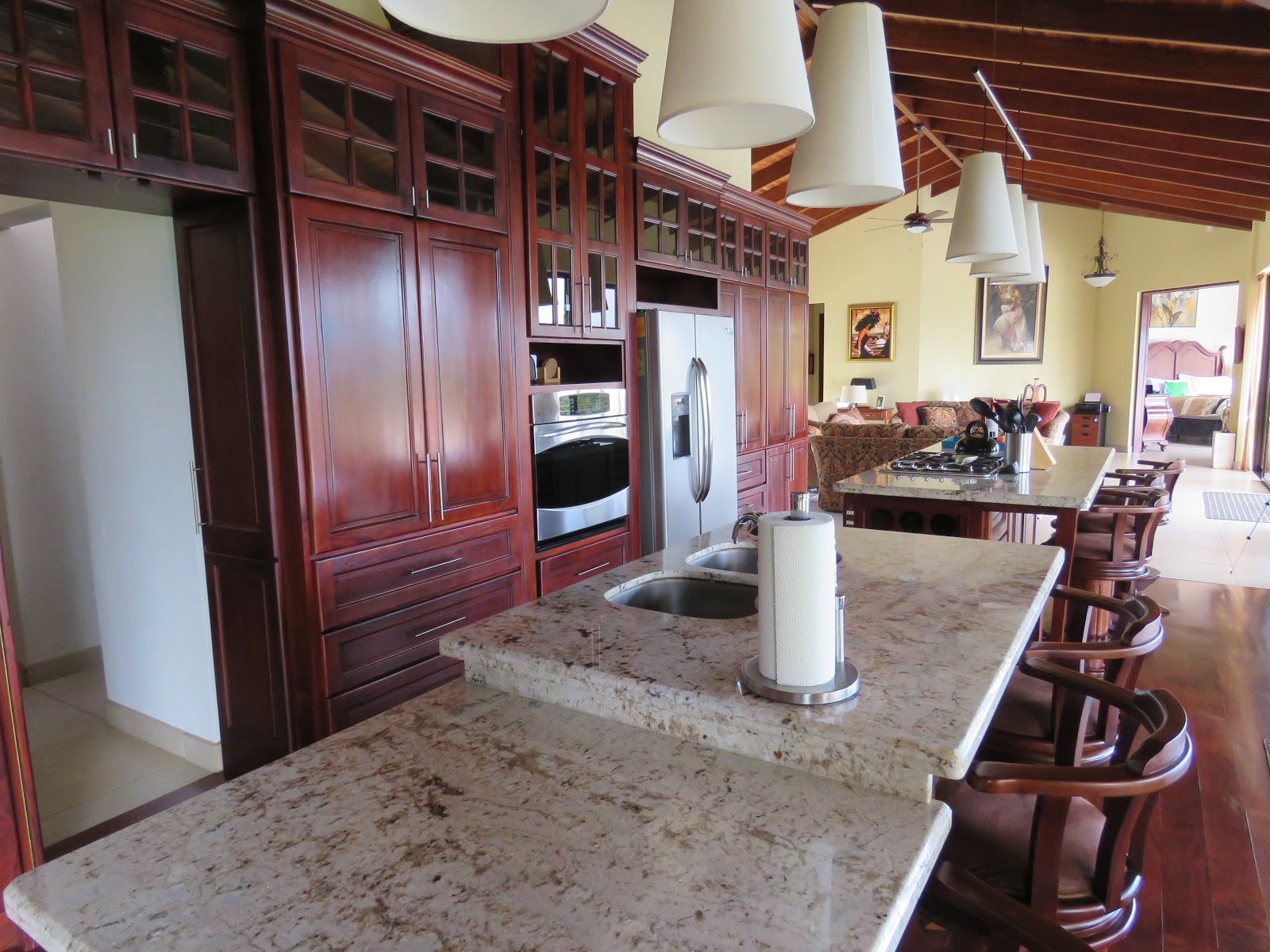
In the villa in Atenas, Costa Rica, the end of the kitchen island with the sinks had a stepped-down countertop with a shorter barstool. This spot was ideal for sitting and chopping, and dicing. For more photos, please click here.

Bird lover’s paradise…Animal lover’s paradise…

This morning’s four hornbills love our birdfeeder.

“Sightings of the Day in the Bush”

A typical day at “home,” drying a little laundry in the sun, and a zebra stops by.

We can hardly describe ourselves as expert bird watchers. But as enthusiastic animal watchers, birds certainly provide us with considerable entertainment, as witnessed in many of our posts over the years.

Whether it was hand-feeding kookaburras in Fairlight Australia, setting out seeds for our all-time favorite singing red cardinal in Hawaii, or observing the nesting and hatching of albatross chicks in Kauai, we never failed to take the time to watch and enjoy our feathered friends.
Laughing doves are frequent visitors to our feeder.

Here in Marloth Park, we can enjoy a wide array of birds in our garden or when out on frequent drives through the park or during any foray to Kruger National Park for the day.

Louise recently loaned us a bird book for common South Africa’s birds arranged by color, but I continue to struggle to find the names of birds we’ve seen in the garden and when out.  

This is a streaky-headed seedeater, aptly named, who loves the birdfeeder.

I partly blame myself for becoming frustrated when I don’t correctly pin down the bird’s features efficiently enough to find the photo in the book. At that point, I’ll look online and then, as a last resort, pester our bird-enthusiast friends Lynne and Mick, who live in the UK and part-time in Marloth Park, and friend Louise in Kauai, Hawaii.

When they go to Kruger, they’re searching for birds while reveling in spotting other wildlife. For us, it’s the other way around. We’re looking for other wildlife and happen to come across birds in the process.

Ostriches tend to hang around a specific territory in Marloth Park.  We’ve yet to have any in our garden this time.  However, when we were here in 2013, we had an enthusiastic visitor. To see those photos, please click here.

I suppose it’s a matter of personal preference. Also, it’s not as if one can’t be enthusiastic and expert in both areas. For us, it’s a matter of where our attention is focused at any given time, and although we aren’t experts in either aspect of wildlife viewing, we quickly can wrap our minds around appreciating both.

In other words, it revolves around the lyrics from the old song, “Love the One You’re With,” which I guess applies to many areas of life, including wherever we happen to be at any given moment, loving the one you’re with, the place we’re living at the time, the scenery we’re embracing, and the wildlife we’re incorporating into our daily lives.

Early morning dewdrops on the back of the head of a helmeted guinea fowl, permanent residents in our garden.  Typically, dozens of these birds hovering in the bush, waiting for us to toss pellets to other animals.  They peck at the pellets to break them up into bite-sized pieces.

Perhaps, that’s what travel is all about, getting outside your comfort zone, seeking the unusual, the new, the unique, and the enchanting to expand one’s horizons and furthers our personal growth.

The difference for our way of life, essentially as homeless drifters, nomads, or wanderers, we’re always seeking to learn and grow through our surroundings, whether it’s rich with birds or other wildlife or exquisite scenery and vegetation.

On any given day, there may be as many as 60 of these turkey-like birds hanging out in our garden. They wait underneath the birdfeeder for other birds to drop seeds while they eat.

The world is a magical place, filled with rife, worry, war, and disharmony. One day it could all be gone. We can only pray and play whatever role possible in striving to keep our exquisite surroundings intact. 

Photo from one year ago today, August 7, 2017:

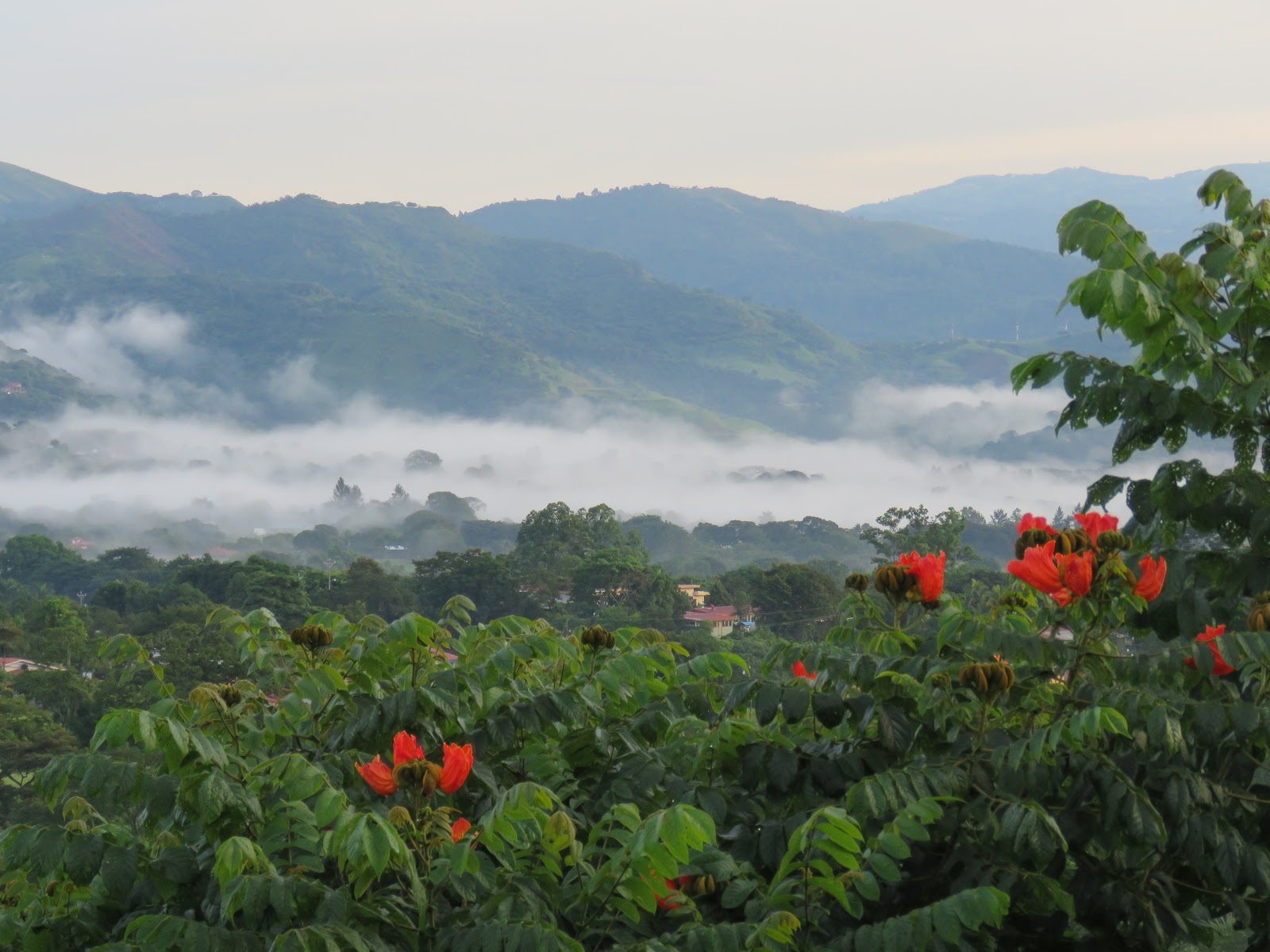
Early morning view of low-lying clouds in Atenas, Costa Rica.  For more photos, please click here.