Elephant Day!…Never cease to amaze us!….

This may have been the huge matriarch.

“Sighting of the Day in the Bush”

This zebra posed for a photo between the fronds of a plant on the veranda.

Driving through Marloth Park is almost as exciting as driving through Kruger National Park. Knowing we can drive less than 10 minutes on the bumpy dirt roads, which if on smooth surfaces would take only a few minutes, inspires us to venture out as often as possible.

We’re seldom disappointed. With sheer determination and patience, we have the opportunity to see a side of the river that visitors to Kruger can’t access from the roads, a bird’s eye view of what transpires on the wildlife-rich Crocodile River.
As usual, we were quite a distance from them, doing our best to get decent photos.
I can’t begin to describe the bumpiness of the roads in Marloth Park. It’s almost as if you’re on the ride at a carnival called the “tilt-a-whirl,” except it’s even more of a wild ride with all the ruts, potholes, hills, and ridges, like none other we’ve seen anywhere.
The attention and care adult elephants provide for their young, and each other is breathtaking.
Thank goodness my spine doesn’t cause pain anymore after changing my diet seven years ago this month. Otherwise, the ride would be unbearable for a person with back pain of any type. The degree of bouncing in a little car would be a disaster.
 
Using the tripometer, we’ve found we don’t travel more than 20 kilometers (12.4 miles) during a two-hour drive. But, what we witness most days during this two-hour stint is satisfying and breathtaking.  
The parade of elephants spending time in the Crocodile River, as seen through the fence between Marloth and Kruger Parks.
By including a day in Kruger once a week plus relishing in the wildlife we see in our garden, we certainly get end up with an exciting wildlife experience in one way or another each day.
A youngster is rarely allowed to wander off without adult supervision.
Last night, on the veranda, with the weekend holidaymakers diminishing on a Sunday as usual, the animals began to return to the garden after a very sparse weekend. At most, a few warthogs and bushbucks came to call on Friday, Saturday, and Sunday.
 
We often wonder where they go when the tourists fill the park. Do they head to the surrounding parklands out of sight and the sounds of all the noisy tourists? I don’t think so. Tom seems to think the tourists are feeding them so not-so-healthy foods that keep them hanging around with them instead of us.
Four youngsters with a babysitter!
Oh, no doubt some tourists feed the wildlife “bad-for-them” foods such as chips, leftover bread, sweets, and other items. But I’m convinced they aren’t around when we don’t see them wandering around the park on holiday weekends.
It’s impossible to avoid a view of the fence in some of the photos.
Instead, on weekends, we find considerable numbers of wildlife at the Crocodile River who aren’t influenced by holidaymakers’ presence in the wild areas of Kruger National Park.
 
Not only is discovering wildlife while on the drive special in each case, but we also enjoy the idle chatter between the two of us and even the quiet periods when we’re both lost in looking through the lens of the binoculars (Tom) and the camera for me.
We’ve zoomed in between the narrow fence wires for most of these photos.
We both rely upon our instincts as to which path to take, especially when one of us senses we’ll have safari luck by taking a certain road or trail. Sometimes, we’re right, and other times, we’re not, but the harmony in which we make these simple decisions is part of the joy of the experiences.
 
Today, we’re staying in, catching up on more research for future travels. In 10 days, we leave for our “visa stamp” trip back to Zambia and Botswana for yet another week.  
The interaction between the adults and calves is both loving and educational.
Having had the experience almost three months ago and knowing what to expect puts our minds at ease, and we’re looking forward to going back to Chobe National Park for more adventures.
 
We’ll be back with more tomorrow. Thanks, dear readers, for taking the journey along with us!
Photo from one year ago today, August 6, 2017:
Before sunrise, we captured this cloudy scene over Atenas, Costa Rica. For more photos, please click here.

A date night at our favorite spot in the bush…Fish finds…

Impalas (male is shown here) and warthogs seem to get along well.

“Sighting of the Day in the Bush”

Mongooses are very clever in cracking eggs. They hold them in their front paws, bang them on a root or rock, and then suck out the contents.

Without a doubt, our favorite restaurant in Marloth Park or anywhere nearby is Jabula Lodge & Restaurant, about a 10-minute drive on Oliphant, the tar road.

Last night we arrived at Jabula at 1700 hours (5:00 pm) to enjoy happy hour while seated at the inviting bar in the highly appealing establishment. Four and a half years ago, we frequently dined at Jabula based on the excellent food, great prices, and good service, all provided by Dawn and Leon and their staff.

Rushing water over rocks at the Crocodile River.

This time it’s been no different other than the addition of Lyn, their assistant, who is also conscientious in providing all customers a seamless and pleasant experience.

Not only is the food excellent, but the extensive menu provides many options that work for me. When we make a reservation, I email Dawn a few days earlier. She ensures there are non-starchy, lactose-free vegetables and meat for me when many popular South African vegetable and meat dishes include dairy and starch in one form or another.

No boating or humans are allowed on the Crocodile River based on dangerous wildlife that lurks therein, including crocs, hippos, snakes, cape buffalo, elephants, and others.

Last night Tom “pigged out” and order chicken schnitzel, chips (fries), and onion rings. I cringed when I saw his huge plate of fried foods but kept my mouth shut.  

After diligently eating “my way” each day, he tends to order carb-rich foods when we dine out. He didn’t eat breakfast this morning when he still felt full. Hopefully, he’ll be hungry after I make a fabulous low-carb dinner tonight.

Warthogs spending a little time near the water at Sunset Dam.

Above all, the pleasures of dining at Jabula Lodge & Restaurant is the magical way Dawn and Leon always make us and all their customers feel welcomed and special.  Not all owners/managers have the personalities and attentiveness that Dawn and Leon bestow upon each of their guests.

Back home by 2000 hours (8:00 pm), we spend the remainder of the evening researching plans for the future. At the moment, we’re on a mission to fill in some gaps in our itinerary (last posted here), which, once accomplished, we’ll share here.

Giraffe crossing the tar road in Kruger National Park.

After chopping and dicing for tonight’s dinner and vegetables for the wildlife, this morning, we headed to two of the three shopping centers in Marloth Park for a few grocery items, the Bush Centre and Marlothi.  

Upon pulling into the Marlothi center, we noticed a refrigerated truck. I was so excited to see it was the “fish guy” we’d heard so much about. Keeping in mind, Tom doesn’t eat fish. I had to consider a few factors when deciding on what I’d purchase; one, I’d be eating it alone, and two, that the power could go out while we’re gone beginning in 12 days.

Many different species do well together while grazing.

Power outages are common in Africa, and if one occurs for more than a few hours while we’re gone, the contents of our freezer could be lost. As a result, I only purchased two boxes of frozen fish; Norwegian salmon and the popular South Africa kingklip.

Kingklip is described as follows from this website: “The Kingklip is one of many eel-like fishes enjoyed around the globe. It is endemic to the whole Southern Hemisphere and is, predictably, one of the most important commercial fish in South Africa. They are fished from deep ocean waters, up to 1000 meters deep, and can grow to be as long as two meters.”

This elephant was moving toward us, so we backed away.

Although I’d never tried this fish since it is often breaded in restaurants, I decided to give it a try after hearing many great comments about it. I’m sure I’ll like the well-filleted boneless fish since I like almost all varieties of wild-caught fish.  

Although I’d already prepared my dinner for tonight consisting of a seafood stew with mussels, prawn tails, hake, and vegetables, I’ll be having the kingklip tomorrow night while Tom has leftover short ribs pot roast with carrots, whole mushrooms, and onions. We’ll both have a side salad with homemade dressing.

Each time we visit Kruger, we’re gifted with spotting elephants.

Let’s face it, many of our lives are about food, whether we like that fact or not.  Planning, prepping, and preparing good meals is an integral part of our lives, especially when we get the opportunity to try some local favorites from time to time.

Today, it’s outrageously windy. We’re outside on the veranda, but it’s tempting to spend the remainder of the day indoors, something we rarely have done. The animals don’t like the wind, so we’ve only had one visitor so far today, a lone female bushbuck who we enthusiastically fed lettuce, carrots, apples, and pellets.

We take a few photos through the car’s windscreen (windshield) when other options are possible. Tom washes all the car’s windows before we explore Marloth and Kruger Parks.

Tomorrow, we have some new and exciting photos to share. Please stop back and share the day with us! Happy day to all!

Photo from one year ago today, August 4, 2017:

A church across the valley in Atenas, Costa Rica, where we stayed for almost four months. For more photos, please click here.

Togetherness….Are we telepathic after all these years?…Kruger photos continue…

Friends Lynne and Mick confirmed this is a juvenile Bateleur.

“Sighting of the Day in the Bush”

Persistent zebras will occasionally start climbing the veranda steps to “request” more pellets. During last night’s dinner, a female warthog came up the steps looking for pellets.  Unfortunately, we didn’t have the camera ready for a photo.

This morning we had a huge laugh (a common occurrence several times a day) when we lounged in bed after awakening around 6:00 is discussing last night’s dreams. (For once, I had a good night’s sleep).

Hippos spend about 16 hours a day in the water. While they sleep in the water, they surface automatically and breathe without waking up. While awake, they can hold their breath for up to five minutes.

Tom rarely remembers his dreams, so he went first while it was fresh in his mind.  He had a dream we purchased a house. As soon as he started spewing the details, I started laughing out loud.

From this site: “Buffalo are reported to kill more hunters in Africa than any other animal. They are known to ambush hunters that have wounded or injured them.”

He stated, “It’s not that funny, although it won’t ever happen!”

I added, “I had the same dream! We were in the process of buying a house!”

From this site:  “If a buffalo herd comes under threat from a predator, they form a circle around their young. All of the adults face outwards to hide the vulnerable. The adults actually lower their heads and form a protective barrier with their horns.”

We won’t bore you with all the details, but the irony is apparent. We both had similar dreams. Nor will we get too analytical as to why we had these dreams. It’s pretty obvious. We both have no interest or desire to ever “settle down” if we can help it.  

Some goose?

In reality, it may be somewhat of a fear that precipitated this topic in our dreams. We know someday we’ll have to stop traveling due to advanced age and health, and, in itself, that eventuality is a nightmare.   

Gee…who looks forward to old age and poor health, and why should any of us have to accept this as our eventuality? We’ve met people on cruises, well into their 90’s, with good health who continue to travel the world.

Hippos across the lake at the Sunset Dam.

Wouldn’t our eventual demise best come uneventfully during sleep when our bodies and minds are made with this life as we know it?  Unfortunately, that’s not always the case.

Anyway, back to the irony of our mutual dreams. Did we both have these dreams based on something we discussed, read, or thought about yesterday? Most likely, that’s the case. It’s not unusual for us to discuss how we never want to settle down to help it.

The closest living relatives of hippos are porpoises and whales.

Why you may ask, are we so adamantly opposed to settling down? Based on our exceptional relationship, couldn’t we still be happy? But, in the same vein, many of you are so glad to be settled, finding great comfort and joy in doing so. It’s simply a matter of what appeals to each individual, each couple.

For us, the biggest irony of all is that we both thrive in the uncertainty of a nomadic lifestyle. Each new continent, country, village, and town presents us with an opportunity to embrace new surroundings, new cultures, and new ways of life.

From this site: “Buffaloes need a good freshwater supply as they love to cool down and also drink water daily. Bulls especially like to lie in water and mud hollows where they can roll in the mud and take mud baths to rid themselves of flies, horseflies, and ticks. Buffaloes are gregarious, and in South Africa (Kruger National Park), herds of up to 500 and more can congregate, consisting of dominant bulls and cows. In other parts of Africa, herds of more than 1000 animals can gather. Bulls are often found alone or form small bachelor herds, consisting of older and younger animals and varying in number from a few animals to about ten and more.”

Are we antsy being in this same house, in this same place, Marloth Park, for an entire year?  The answer is clear and consistent between us. It’s a long time to stay in one place, especially for us. In the future, we’ll never stay anywhere for so long unless required by a medical condition.

We’d be ready for a change if it weren’t for the wildlife and our many beautiful friends. But, these two vital factors of living in Marloth Park have allayed any possible boredom or disinterest.  

We’re continually entertained by an exciting insect, noisy frog, or unusual plant, even in the most mundane scenarios. Sightings of elephants, lions, hippos, and others are the frosting on the cake.  

Because giraffes are the only herbivores that graze on treetops, there is a more readily available food source for them during the dry season.

If all we had was “visitors” and friends, we could be equally content as we are now.  Visiting Kruger is comparable to visiting a state fair or Disneyland. Every sight our eyes behold spirals us into a realm of sheer awe and wonder.

Being with our friends is equally vital to our well-being. The lively and opinionated conversations, especially about nature and wildlife, are unlike any conversations we’ve had anywhere else in the world.

We always stop to admire elephants.

The commonality we all share in appreciating and living within the throes of the animal kingdom can’t be conveyed while in many other parts of the world. It’s unique, as are these special people.

We both shrugged off any potential significance of our mutually shared dream, meaning anything more than sharing the same beliefs, hopes, and dreams for the future.

From this site:  A natural process is quite vague: it is a natural process, but it’s not related to the elephant’s aging. Neither is it (typically) related to fighting.  Those notches and tears are caused by the daily activities of elephants feeding in the bushes. The longer the ear, the more prone it is to damage. On the other hand, thicker ears are less prone to damage.  Day by day, the number and pattern of tears/notches/holes change.  Curiously, this pattern of tears/notches/holes is used by researchers to identify individuals. Not only that but also in the way of the veins in the ears.”  We had mistakenly assumed the notches were a result of age.

Plus, being together, day and night, day after day, year after year, has only made us stronger as a couple and more in tune with each other’s wants and desires in all areas of life.  

Whether it’s telepathic or not is irrelevant. The fact remains, this life is possible for us because we get along so well and, let’s face it, we’re “glued at the hip.”

Sweet dreams to all!

Photo from one year ago today, August 3, 2017:

This is the parrot after they were knocked unconscientious after hitting the glass wall of the veranda in Costa Rica.  There was a bird deterrent on the glass, but this poor bird slammed so hard into the glass we assumed it was dead.  It was sad to see this happen. After about 20 minutes, it awakened and eventually flew away. We were thrilled. For more, please click here.

Lion Day!!!…Finally!…

What an animal! We feel fortunate to have been able to get today’s photos of lions.

“Sighting of the Day in the Bush”

This baboon seemed happy with a piece of fruit she’d foraged.

When we spent three months in Marloth Park four and a half years ago, visiting Kruger National Park on many occasions, we never saw a lion. DWe’dyet to see a single lion on our self-drive safaris. during our almost six months here and after almost weekly trips to Kruger

There was a total of six lions but we weren’t able to capture all of them together in one photo.

On several occasions, we’ve seen lions from the fence in Marloth Park at the “Two Trees” overlook across the Crocodile River. However, getting good photos from almost a kilometer away has been tricky.

Lion lounging on the rocks.

Without special camera lenses and with our somewhat modest cameras and camera skills, we’ve been disappointed with the shots we’ve had so far. Instead, each week when we venture into Kruger, we have a glimmer of hope we may get lucky.

Young male sprouting the beginnings of a mane.  From this site: “The mane has many hypothetical purposes and some reasonable explanations. It is supposed to make the male lion look bigger to an adversary and, therefore, more intimidating. It is supposed to protect the male lion from being bitten and clawed by other male lions. Some researchers have proposed it is a handicap in hot climates and therefore the male lions in Tsavo, Kenya are “maneless”. 

I don’t know what it is about lions that make safari enthusiasts feel great satisfaction when they see them but it seems to be the general consensus in everyone we meet here. We weren’t the only people driving around in Marloth Park for days looking for the lions who’d entered the park through an opening in the fence between the two parks.

Now and then, he opened his eyes to scope the area.

Perhaps, it’s their fearsome nature, majestic beauty and a degree of mystery surrounding their demeanor that makes us literally foam at the mouth when there’s a lion nearby. Maybe for some of us, the excitement of potential danger sends us into an adrenaline rush.  

After all, we don’t bungee or skydive.  How else do we get our adventuresome natures fulfilled in the wild? Lions, hippos (the most dangerous animals on the planet), and other big game can send us into a frenzy of adrenaline pumping through our veins. What a thrill!

A pair on the move.

It’s imperative to stress that after each expedition in Kruger, we are not disappointed or frustrated for not seeing lions up until this point. We’ve had our share of “safari luck” in countless ways in our world travels. No complaining here.

Yawning…

Yesterday morning, no more than 20 minutes into our drive on the tar road in Kruger, as we approached one of our favorite spots, the Vurhami Dam, we saw about a dozen cars stopped facing in all directions with many passengers and drivers hanging out the windows (a no-no in the park) attempting to take photos with phones, cameras, and tablets.

Wishing I’d have taken a better shot. It still was great to see those teeth.  From this site:  Like all other mammals, the African lion has a fixed arrangement of teeth which can be generalized into a dental formula. This formula can only be effectively applied to adults. Like all other cats, the permanent teeth only begin to erupt at around three months of age, pushing the deciduous teeth up and eventually causing them to fall out. The complete set of adult teeth are gained between the period of 13 and 15 months. The front canine teeth are spaced such that they can slip between the cervical vertebrae of their prey severing the spinal cord and also to rip chunks of meat away from the bone.”

The expert driver that Tom is he eventually managed to maneuver us into a spot where we’d have a clear sight of the lions although they were still at quite a distance. As amateur photographers well know, those with primary digital cameras, the more we zoom, the less clear the shot primarily due to our own movements.

Back to sleep.

I’ve yet to master holding perfectly still while shooting and doubt I ever will. This isn’t something that improves as we age. Even taking a breath can upset what could have been a decent photo. I’ve noticed that even Tom’s slightest movement in the little car while I’m shooting has an impact on the photos.

Another young male with a mane in its early stages.

We must have stayed in that ideal position for about 45 minutes, waiting for the lion’s next move or change in position or expression. We were thrilled with the results, as shown in today’s photos.

The lions have excellent vision. From this site: Lion’s eyes have two kinds of receptor cells, called rods and cones because of their structure. Rods are mainly responsible for black and white vision, and cones do the color bit. Human eyes have a predominance of cones – we see colors very well, especially in the red spectrum of light, but consequently, we have a problem with night vision no matter how many carrots we eat. Lions have fewer cones, so they see less color but have great night vision, especially since their eyes also have a membrane that concentrates weak light back to the retina. Their pupils can enlarge to an extent much more significant than ours.” 

When the lions began to scatter and walk away, we took off, still giddy over the experience. We continued on with little to no expectations of seeing much else the rest of the day but the adventures continued.

From this site: “Lions are supposed to be nocturnal, and there is a popular misconception promoted by guidebooks that lions sleep about 20 hours per day. Lions are very opportunistic in terms of when they are active. For sure, most lions will probably wake from their daily slumber and begin to get active at dusk, but this is not always so. If lions have water within their territory that attracts prey animals in the daytime, the lions will be active in the day.”

At one point, Tom spotted a leopard, but it happened too quickly for a photo. Thus, our day consisted of seeing four of the Big Five, lion, leopard, elephant, and Cape buffalo, although we never spotted a rhino all day. (As a side note, seeing the Big Five in a day is not necessarily that important to us which had transpired many times in the Masaai Mara in Kenya in 2013, to which we’ll soon return). 

Over the next few days, we’ll post the remainder of our photos including a few more lion shots not included today and a few new bird sightings that were quite exciting.

May your day bring you joy!

Photo from one year ago today, August 2, 2017:

Tom is as content as he could be at La Perla de Atenas in Costa Rica, one year ago today. For more details, please click here.

Kruger never disappoints…Tomorrow’s post is special…Its a dusty life!…

Mom and baby and auntie bushbucks visit each day.

“Sighting of the Day in the Bush”

We’d never seen an all-grey hornbill. 

For some odd reason, this morning upon awakening, it felt like Sunday when in fact, it is Wednesday, a perfect day to head to Kruger. There’s always less traffic mid-week when many holidaymakers have left the area to return to their homes after a long weekend.

Our living-on-the-premises housekeeper, Martha, is off for a week to see her family, and this morning Vusi, another of Louise and Danie’s trustworthy employees, arrived to clean the house and veranda.
Occasionally, they groom one another.

There are no words to describe how much dust enters the house daily. The entire garden area consists of dry, dusty soil with no grass, no shrubs, and no vegetation other than the property’s bush.

Every animal’s activities, from guinea fowls scratching the ground to zebra’s heavy-footed hooves, resulting in layers upon layers of dust covering every floor, counter, and surface on the veranda and inside the house.

Our favorite bushbucks come to call each day, standing at the bottom of the steps waiting for pellets, carrots, and apples.

Yesterday, before she left, Martha cleaned and dusted the entire house. Once again, all the tabletops and surfaces were covered with a visible layer of dust this morning. This is “the bush.” This is what it’s like.

We decided not to have breakfast this morning in order to head out earlier than usual. If we were hungry at some point along the way, we could always stop at the Mug & Bean in Lower Sabie for a bite to eat. 

The baby has grown considerably over these past few months. On occasion, she’ll rest in the bush with her mom and auntie forage for food.

As it turned out, we were so preoccupied searching for wildlife that food was the last thing on our minds. Instead, we were interested in what the wildlife was eating, grazing and hunting today.

Any ideas on the identity of this bird?

It proved to be a highly successful day. I’d hoped to post a few of the photos today, but after downloading the few hundreds on my laptop, I realized it would take hours to go through them, picking and choosing which we’d want to post. 

Tomorrow is another day, and first thing in the morning, I’ll begin working on the photos before I even start the new post. If all goes well, I should get the latest post uploaded close to our usual time, before noon in this part of the world.

The bird feeder is often surrounded by hornbills.

As we often do together at the end of the day when we set up the veranda for the evening’s festivities, we make a beverage, whether it’s iced tea, wine, or a cocktail, for Tom. Together we review the day’s photos deciding which to keep, which to delete.

I’m especially looking forward to tonight’s photos review when we encountered many notable sightings during our five hours in Kruger National Park.  Back “home” by 1400 hours (2:00 pm), there was ample time to do a quick wrap-up of today’s post with some less significant photos than we’ll share tomorrow.

Any suggestions on the identity of this bird?

As soon as we walked in the door, we changed into cooler clothing. The outdoor thermometer currently reads 36C (96.8F). Gee, is winter already over here in South Africa? Luckily, there’s a nice breeze, and we’re pretty comfortable outdoors where we’re situated at the moment.

Once I’m done here, I’ll head indoors to wrap up the prep for tonight’s dinner. I’d already cut the carrots and apples for the visitors, and yesterday we purchased three 40 kg (88 pounds) bags of pellets from Obaro in Komatipoort, which should be enough to get us through until we leave the 16th for our next visa run. 

Please check back tomorrow for our memorable day, one we’ve never posted while living in South Africa.

Enjoy your evening!

Photo from one year ago today, August 1, 2017:

Cloudy day, water and mountain scene in Las Vegas, Nevada, as we ended 67 days in the USA. For more details, please click here.

For adults only, please…Mature theme…Plus, a little of this and that…

Little Wart Face gave it an honest effort, but he couldn’t get it quite right.

“Sighting of the Day in the Bush”

Although Tom has to take down and refill the bird feeder several times a day due to the monkeys eating the seeds, we thoroughly enjoy watching the birds partaking.

We’d hoped to head to Kruger today but have decided to go another day. The sky is cloudy and doesn’t appear it will clear in time for us to go. Instead, today, we’ll make our usual run to Komatipoort and Lebombo for groceries and carrots and apples for the wildlife and head to Kruger on the next sunny day.

Yesterday, I called Obaro, and it appears they now have pellets in stock, and we’ll load up enough for the next few weeks until it’s time to go to Zambia and Botswana on August 16th.

Little Wart Face attempting to mate with this young female.

Although neither of us particularly loves to shop, we find the weekly trips interesting and diverse. The townspeople are friendly, the culture fascinating, and generally, we can find most of the items we need to purchase, forgoing thoughts of those items we can’t find.

Since I’m no longer eating dairy, my options for meals are limited.  Most of our favorite dishes include dairy in one form or another. It appears I have no trouble with butter, but all other dairy products must be excluded from my diet to maintain this high level of feeling so well.

This occurred after dusk, and thus, the photos aren’t as straightforward as we’d hoped.

Day after day, I’m aware of how great I’m feeling for the first time in over two years. From the time I contracted the bacterial infection in Fiji and later the injury in the pool in Bali, I was plagued with constant pain and discomfort.

To be free of pain is such a blessing, and I never forget how important it is I don’t consume a slice of cheese, a dollop of cream, or a smear of cream cheese on a celery stick. It takes no willpower whatsoever. The excellent end result of feeling good keeps me highly motivated.

Snack options are limited so I avoid snacking. I’m slowly losing weight and will share details when I reach my goal in the next few months. Surprisingly, it hasn’t been that difficult. 

He’d been making the train-like noise up until he actually tried to make contact. The bowl in the dirt was left after we’d fed eggs to the mongooses a few minutes earlier.

We now have a hearty breakfast each morning, with two eggs and sardines, which are high in calcium to compensate for my lack of dairy products, while Tom has three eggs and bacon. We don’t eat again until dinner on the veranda around 7:00 pm. This schedule provides us with approximately 11 hours of intermittent fasting which works well for both of us.

As for today’s warthog mating photos, I’d like to stress, we do not include these or other mating photos for any shock value. Our intent is purely to illustrate the magic and mystery of nature at its finest. Having the opportunity to observe the “cycle of life” in nature is truly a gift.

It’s evident in this photo that contact wasn’t fully executed.

In many months to come, we’ll see the park filled with babies from this mating season. For an interesting article in Africa Geographic regarding warthog mating, please click here.

The gestation period for warthogs is 152 to 183 days. Generally, piglets are born between October and February. It won’t be long before we see entirely new batches of youngsters coming to call with their moms (occasionally dads), aunts, and siblings from past litters. 

It’s a rare opportunity to see mating in the wild, but this appeared more to be “practice” than anything.

Warthogs may stay with their family group, a sounder, for a few years, eventually finding their burrows for rest at night. However, they often stay in the same general territory as other family members.

When we see them at night, they tend to wander off by 2100 hours (9:00 pm) to return to their burrow for the night. Moms will place their offspring in the burrow first and follow behind facing the opening to guard the family unit.

Not a night passes without an opportunity to watch these adorable bushbabies enjoy the yogurt we place on their little stand.

Intelligent animals, pigs of all breeds are rated #2 of the top 25 most intelligent animals on earth. See this list for details. This is clearly evidenced to us daily as we carefully observe their behavior. Dogs are rated #6.

That’s it for today folks! Have a fabulous day! We’ll be back with more tomorrow.

Photo from one year ago today, July 31, 2017:
Here were our total expenses for the 25 nights we spent in Henderson Nevada.  Please click here for more details.

 Expense   US Dollar 
Housing (Richard’s home)   $                         
 Gifts & Misc.   $                  299.00
 Airfare    $               1,137.00
 Rental Car & Fuel  $                  926.00
 Groceries   $               1,245.30
 Dining Out   $                  402.52
 Supplies & Pharmacy   $                  609.32
 Entertainment   $                  310.25
 Total   $               4,929.39
 Avg Daily Cost 25 days   $                  197.18

Power outage today…

A Great White Heron was standing in the water at Sunset Dam in Kruger National Park.

“Sighting of the Day in the Bush”

This is our friend Tusker.  He is the sweetest guy who comes to visit several times each day, particularly after 1600 hours (4:00 pm).  He’s so comfortable here he often lies down for a short nap.

While midway through making one of our favorite low-carb meals, and before I started working on today’s post, the power went out at 0945 hours (9:45 am). We weren’t too concerned when most often, it comes back on within a few hours. 

Tom read a “paper” book we borrowed from friends Lynne and Mick about the history of Marloth Park while I’m typed the text on the offline app for our site on my phone, which I often use during power outages.

We never get tired of seeing these wondrous animals, both in Kruger and in Marloth Parks.
Unfortunately, I’d forgotten to plug in my phone when I got up this morning, and the battery was almost dead. I typed fast and furiously to be prepared when and if the power came back on today.

Power outages are common in Africa, as are other areas of the infrastructure. For example, we had a package shipped from the US on May 28th, almost two months.  Due to a strike, it’s been stuck in Pretoria since June 6th.
Zebras were crossing the road in Kruger.

We check package tracking and often call to no avail. Yesterday, I was told the “network was down” and to call back again. I called again, and there was no answer.

But, as everyone always says…this is Africa, and we can’t expect such services to be comparable to that in the US and other more developed countries in the world.

A bloat of hippos at Sunset Dam.
Expectations must be kept in check. Our friend Kathy (and Don), while home alone at one of their other homes in Pretoria, South Africa, was without power from last Friday until late Sunday. She couldn’t leave when the electronic gate wouldn’t open without power. We could only hope that type of scenario doesn’t happen here. 
From this site: “Hippos can stay underwater for up to 5 minutes without coming up for air, according to National Geographic. When they sleep in the water, their bodies automatically bob up to the top of the water so that they can take a breath, and then they sink back to the bottom. Hippos’ eyes and nostrils are on top of their head. This allows them to breathe and look around while the rest of their body is submerged. “

We’d grocery shopped yesterday, and the extra freezer is full of meats and other items. The refrigerator is all fully stocked. If the power didn’t come back on, we’d be out a lot of money.

OK, folks, here’s a new one for you…This is a “bask” of crocodiles!

I finished making most of the meal and quickly opened and closed the refrigerator door putting everything perishable inside. We decided the best course of action was to embark on one of our usual drives through Marloth Park, hoping the power would come back on while we were gone. 

We returned several hours later, and we have power. That’s why today’s post is so late. We had an eventful drive, including spotting two lions on the river and other wildlife, and yet, we’re happy to be back at the house with power.
Another “bask” of crocs at Sunset Dam.

No doubt, we’ll have another good night in our blissful surroundings, grateful for even the little things; a good home-cooked meal, lots of visitors to the garden, and of course, having power back on.

Three giraffes at a distance in Kruger National Park.

Tonight, clear skies providing, we’ll be able to see the entire total eclipse of the “blood moon,” which is only fully viewable in certain parts of the world,  South Africa included. It should be a good night!

As winter continues, there’s less and less green vegetation for the wildlife in Kruger and Marloth Park.

Hopefully, wherever you may be, tonight, you’ll get a glimpse of this special moon!

Photo from one year ago today, July 27, 2017:

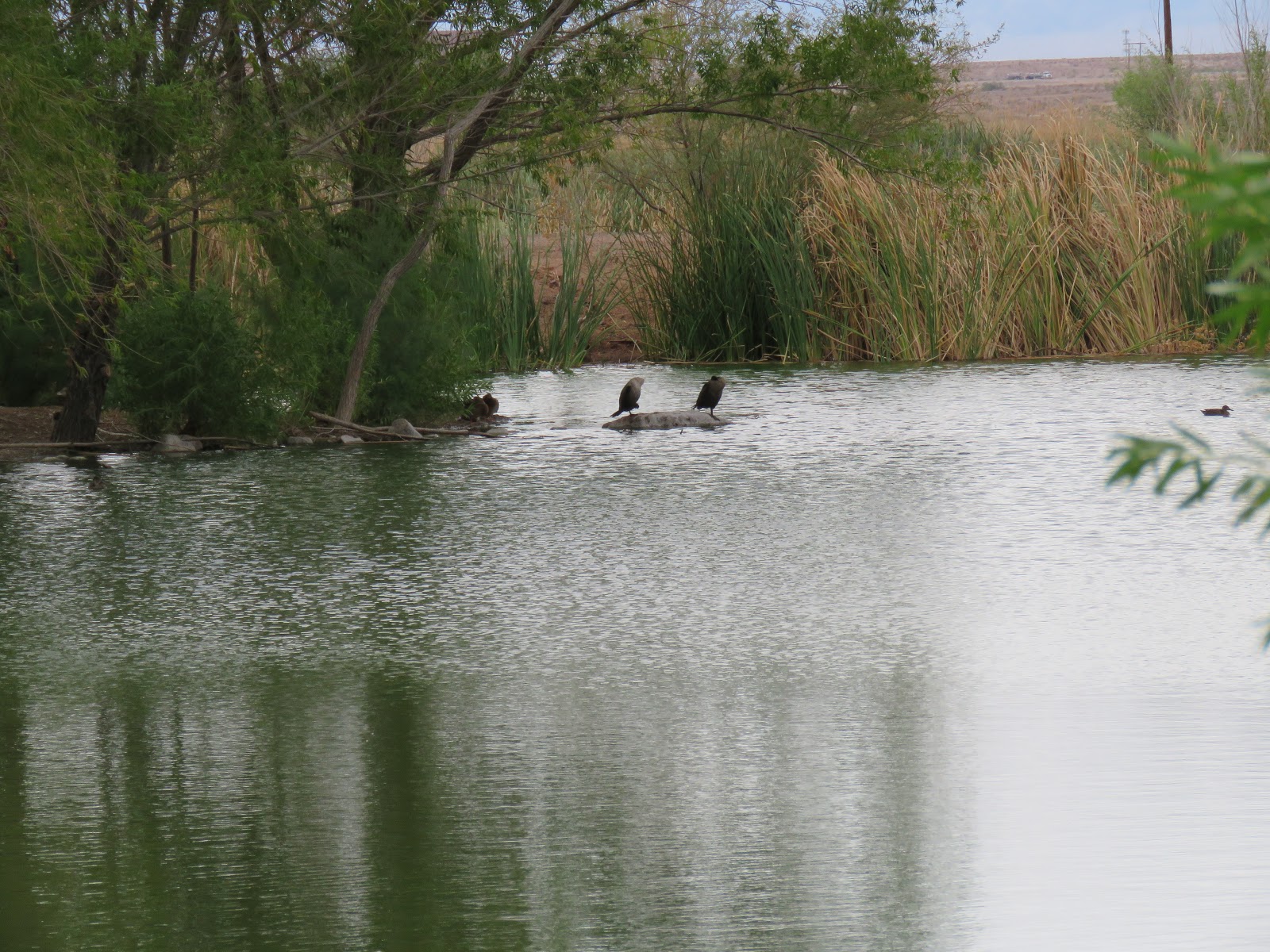
Too distant for close-up photos, we spotted these two Cormorants sitting on a rock in a pond at the Henderson (Nevada) Bird Viewing Preserve. For more photos, please click here.

What’s it really like?…

This giraffe was having a “bad hair day!” The hair on the female giraffe’s ossicones is usually short and straight up. 

“Sighting of the Day in the Bush”

Cape buffaloes on the Sabie River in Kruger.

In 2012, when we booked our first holiday home in Kenya and then Marloth Park, it was hard for us even to imagine what it would be like living in this type of environment. 

Unaware at the time as to the degree of potential risks, inconveniences, and challenges we might face spending three months in the bush, we forged ahead tentatively optimistic, hoping to fulfill my lifelong dream of visiting Africa. 

A dazzle of zebras hanging out near the road in Kruger.

Although Tom was somewhat skeptical and fearful of the unknown, he willingly agreed to visit the mysterious continent. We spent almost nine months on the continent living in three countries; Kenya, South Africa, and Morocco.

Many travelers never consider visiting Africa due to their fears. The distance is also a factor, along with the high airfare costs from many parts of the world. But, fear seems to be the most significant deterrent based on conversations we’ve had with travelers from all over the world.

And yet, millions of tourists visit Africa each year, statistics for which may be found here. Tom had never known anyone who’d visited Africa in our old lives, and I only knew a handful, all of whom had an extraordinary experience.

A crocodile was lounging on the bank of Sunset Dam.

And now, almost six years have passed since we arrived in Kenya in September 2013, which we’ll soon visit again in less than seven months. It feels as natural for us to be in Africa as anywhere else in the world, if not even more.

Over and over, we’ve mentioned the challenges and inconveniences; the insects; mosquitoes; malaria, and other disease risks; rampant crime in specific areas; the excessive heat in the summer months; and a small but realistic risk of injury from wildlife (snake bites, insects bites. poisonous vegetation and close encounters with dangerous animals).

Yellow-billed storks and other birds are not easily identifiable due to the distance when taking this photo across the lake at Sunset Dam.

We’ve even heard local stories of residents in Marloth Park unwittingly being “stabbed” by the horns of male kudus, male bushbucks, and wildebeest when they got too close. These animals generally don’t attack humans unless injured or provoked.

Then, of course, we all proceed with caution when lions or leopards have been spotted in the park, which poses the most risk at night in the dark. There are curfews imposed against walking on the roads at night. Logical, eh?

We surmised this elephant might have been ancient based on its size and its bright white tusks.  Scientists can better gauge the age of an elephant by its teeth, as described on this site.

All of these aside, we do not live in fear under any circumstances, although we use reason, caution, and care in many situations that could pose a problem. 

Yes, when walking through the heavy bush on our perpetual search for photo ops, we watch where we’re walking not only to avoid spraining an ankle from the uneven terrain but always on the lookout for snakes.

Hippos on the bank of the Sabie River.

On the positive side, nothing, anywhere in the world, can compare to the joy we experience every day. From watching the birds enjoy our bird feeder to the nine kudus who visited first thing this morning to the many trips to Kruger as shown in today’s photos.

This morning while we had breakfast on the veranda (which we now do each morning), we delighted in the kudu’s presence, totally entertained by their interactions and gentle antics. I stand at the edge of the veranda, and my favorite kudu licks the toes of my stocking feet.

This was the first time we’d seen giraffes at the Vurhami Dam, located about 10 minutes on the paved road from the entrance to the park at Crocodile Bridge.

It’s cool here now in winter. Most days are sunny and comfortably warm, not hot. There aren’t many insects buzzing around our heads in the winter months, which will end in September. 

We aren’t dreading the onset of the hot and humid summer. We experienced it in 2013/2014 and knew what to expect.  

Wildebeest lounging in the savannah.

Soon, we off to the hustle and bustle of busy, cultural Komatipoort and Lebombo, the streets packed with locals selling their wares and others buying them. Even shopping day is an adventure unto itself.

We continue to be grateful and humbled by this life. We pray good health will keep us traveling for as long as possible.

Several giraffes attempting to drink at the Vurhami Dam.

May each of you have good health and fulfillment!

Photo from one year ago today, July 26, 2017:

Two Mallards sitting on rocks in one of the eight ponds in the Henderson Bird Viewing Preserve in Nevada. For more photos, please click here.

A Sunday drive in the neighborhood…Pinch me, am I dreaming?…

This was one of our favorite sightings of the day, three giraffes drinking together on the Crocodile River.

“Sighting of the Day in the Bush”

We’ve posted other photos of hornbills in our bird feeder, but we can’t ever get enough of these pretty birds.

After uploading the day’s post and busying myself making a special Sunday dinner, I suggested we go for our drive…in this case, a “Sunday drive.” I recall as a kid going for a drive on Sunday afternoons, and it was extraordinary. 

I grew up in Long Beach, California (except for two years in Boston). A Sunday drive usually consisted of visiting one of many exceptional beaches on the Pacific Coast Highway.

The above main photo is from a distance. 

When Tom was a child, typically, his family would drive from Minneapolis to Winsted, Minnesota (72 km, 45 miles) to visit family. It was often too cool to swim in the ocean in the winter months, but the drive and a stop for an ice cream cone were all it took to make the day special. He, too, had some great memories of those days.

Now, as we’ve aged and are “relatively” retired as world travelers, Sundays are just another pleasant day of the week, especially since we’ve re-instituted our old-fashioned Sunday drive.

Giraffes rarely bend over to the ground other than for drinking. They are highly vulnerable to predators in this position.

However, a Sunday drive in Marloth Park is like none other anywhere else in the world. As always, Tom washed the little car’s windows since, at times, sightings occur in front of us on the road, and we have no choice but to take photos through the windscreen (windshield in the US).

A wildlife wonderland.

We load a newly charged battery in the camera, clean the camera lens with a soft cloth and pack an extra battery in Tom’s pants pocket. We fill our mugs with iced tea, Crystal Lite for Tom, and green tea with cinnamon for me, and we’re off.

Over the past 5½ months, we’ve learned to keep our expectations in check. On occasion, we may see little more than helmeted guinea fowls (of which we have dozens in our garden), impalas, and a variety of baboons and Vervet monkeys.

Zooming in on this “obstinancy” of cape buffaloes, we see where they got this plural name. They certainly do appear obstinate and, in fact, are referred to as the “Black Death” based on the number of people they kill each year.

For first-time visitors seeing the above could be most satisfying. But, now, after a total of 8½ months in Marloth Park, including our prior three months in 2013/2014, impalas, although adorable, guinea fowls and monkeys are seldom subjects of photos unless something is exciting transpiring.

As for baboons, which are destructive and may be dangerous, we have no interest in them at all, preferring to stay away as much as possible. The exception may be if a large troupe came to the garden for a possible photo op. Of course, it’s imperative not to feed them, or they’ll never go away.

In this distant photo, it appeared the many cape buffaloes were piled atop one another.  They do stay close to one another when lounging…safety in numbers.

As for the rest of the wildlife, we’re interested in it all, from the unusual insects to tiny frogs to the massive elephants. I suppose most of the residents in Marloth Park feel the same, except we noticed the next-door neighbors feeding the Vervet monkeys over the weekend. 

They leave for their other home, and then we’re left with the monkeys pestering us. We cannot stress enough how destructive they can be. They can literally destroy every item on a veranda or the inside a house in a matter of minutes.

Elephants are always an exciting sighting.

Side note:  a few minutes ago, a hornbill was sitting on a tree limb squawking at us.  Tom checked and found the birdfeeder almost empty of bird seeds. He refilled it, and moments later, the hornbill was back inside the feeder as content as she could be, with several following her. That precipitated today’s “sighting of the day” photo above.

We began the Sunday drive around 1330 hours (1:30 pm) and never made it back “home” until almost 1600 hours (4:00 pm).  What a day we had while merely on a Sunday drive through Marloth Park, mainly focusing on activity on the river.

As we ended our drive along the river road, we spotted elephants close to the fence between Marloth Park and Kruger National Park. This was a first for us, but Kathy and Don’s friends who live on the river road told us this occurs occasionally.

The areas around the bush houses had few animals since many holidaymakers were still here spending a long weekend or more. But, once we reached the river, the sightings were over-the-top. 

We’d drive a short distance with our eyes peeled toward the river, see something, park the little car on the road to walk through the dense bush at times. I was wearing jeans and socks, but Tom was in shorts, scratching up his legs in the process. 

Wildebeests and zebras visiting holidaymakers. They had a small bag of pellets that tourists often buy when they are here for a weekend or longer stay. 

Some indigenous and invasive plants can cause a nasty rash, infection, or even serious injury, so I always make sure my legs are covered. We’d recently read of a woman who died (in another area in South Africa) by a neurotoxin in a plant that had scratched her leg while walking in the bush. 

One can’t be too careful. Next time, he’ll wear long pants. Also, it’s important to wear insect repellent since we aren’t taking malaria pills this year in Africa except for our visa trips to Zambia, Botswana, and Zimbabwe.

There were giraffes munching on trees in Marloth Park and more drinking on the river.

Anyway, the day was outstanding! We spotted more wildlife in this short period of time than we’d ever seen in Kruger during the same period. It kept coming and coming. Each time we thought we were done for the day, we encountered more sightings. 

Back at our holiday home, a few animals were waiting for us, Ms. Bushbuck and Little Wart Face. We gave them each a little pile of pellets and vegetables in separate areas so LWF wouldn’t chase her away. They happily munch on their treats, both returning in the evening for yet another round.

Yesterday, we saw no less than 100 cape buffaloes at the Crocodile River.

Today, we’ll lay low, enjoying yet another hot and sunny day at 25C (77F) while situated on the veranda, as usual, contemplating our next trip to Kruger and drive in Marloth Park. Of course, we won’t be waiting until next Sunday for either.

Have a warm and sunny day!

Photo from one year ago today, July 23, 2017:

The lights on the Strip at night are always impressive. It’s hard to believe it was a year ago we were in Las Vegas spending this fun evening, among many others, with son Richard and friends. For more photos, please click here.

Lions lounging…Anticipation…Dangerous small antelope…

Difficult to distinguish in this photo. Two male lions are sleeping.

“Sighting of the Day in the Bush”

With the male bushbuck in the yard munching on pellets, this female hid in the bush until he left.

After a pleasant evening out to dinner with friends, we were home shortly after 2200 hours (10:00 pm). I couldn’t fall asleep when I went to bed at least an hour before Tom for some odd reason.

Tom spotted this lion napping across the Crocodile River as we peered through the fence between Marloth Park and Kruger.

Finally, by midnight, I dozed off, only to awaken every hour or so. By morning, I hadn’t slept for more than three or four hours, asking myself what possibly could have caused the poor night’s sleep. Nothing had changed. I hadn’t had any caffeine or eaten anything that would precipitate such a stormy night.

He was at quiet a distance, making me struggle to hold the camera steady for these shots.

Subsequently, I was relatively pooped when I began today’s post, a little later than usual after I’d made breakfast (Tom did the dishes), did laundry (Tom hung it on the clothesline), and prepared the majority of tonight’s dinner. 

I was dozing off sitting at the big table on the veranda on a gorgeous warm sunny day. By 10:30 am, I headed back to bed (an infrequent occurrence for me) to try for a short nap.

Male bushbuck can be dangerous with their sharp horns.  See this article where a farmer was gored to death by a male bushbuck.

After spending an hour and a half in the bedroom, sleeping only about 20 minutes, I felt considerably better and returned outdoors to Tom, who’d stayed in place at the table while I was trying to nap.

Somewhat refreshed, I knew I’d better get going on today’s post, or I’d be sitting here all day. On this gorgeous day, we’d like to do our usual drive in the park, especially after what we’d seen two days ago when we stopped along the river road and walked through the dense bush to get to the fence between Marloth Park and Kruger National Park.

Tourists should not hand feed any animals with horns. 

We’d spotted several vehicles parked on the narrow road and a dozen or so people armed with binoculars and cameras looking across the Crocodile River. We love it when others find incredible sightings, and we follow suit.

The sky changed dramatically while we were in Kruger a few days ago.

But, this is not as easy as you’d think. The terrain and the color of the lions are an identical match, and bringing them into view on a camera is often tricky. Others who’ve spotted them will often say, “Oh, they are near that big bush, next to the tree.”

There are dozens of big bushes and trees on the opposite side of the distant bank of the river. We’ve often seen people leaving in total frustration when they couldn’t see them after trying for an hour or more.

Female bushbuck were preparing for a drink in the cement pond.

As all of our readers so well know, we’re stubborn and determined and will try and try until we get it right. Why is it worth it to go through the angst of trying to get the wildlife in the camera’s lens for such a distant shot?

Tom says it’s like fishing. You sit. You wait. Nothing happens. Time passes slowly. Finally, you catch a fish, only to take a photo, carefully remove the hook from the fish’s mouth and toss it back in the lake, the river, or the sea.

Sugar cane burning at a distance.

Go figure. What’s with us humans? Why do we get such pleasure out of this? The only answer we can come up with is this: ANTICIPATION! It’s a magical thing.

The burning of sugar cane fields is almost daily, often leaving our white tiled veranda covered in soot based on wind conditions.

We’re reminded of Carly Simon’s famous song, found here as we say this word aloud. Yes, it’s anticipation that drives us to make the weekly run to Kruger, the almost daily drive in Marloth Park, and to sit on the veranda when we’re not doing either and wait, morning, noon and night.

A bloat of hippos.

The funny thing about anticipation is that one must occasionally experience “results,” or the interest would fade away in time. Here, in South Africa, in this unusual place, we’re rewarded with results over and over again.

May anticipation bring you the results you’re seeking today and always!  

Photo from one year ago today, July 22, 2017:

As always, we had a great evening at The Elephant Bar with friends while we were in Las Vegas, Nevada, last year at this time. For more photos, please click here.