Trying to settle in and adapt…

Look carefully at this photo of the gizzards and livers inside the two chickens. Notice the two chicken heads, one with eyes open. Oh, dear. We’d never made a chicken with heads and feet included, but I guess the Ecuadorian people use everything.

Note: Right now, with things getting done around the house and us getting organized, I haven’t taken any photos yet but will do so soon. Thanks for your patience.

As each day passes, we get a little more settled in. I’ve unpacked everything I need to use while here and left the remainder in the bags sitting open on the beds in both guest rooms. When it’s time to go, it will be easy to pack. Tom has done the same, only wearing a few different shirts and pants.

We haven’t been able to use the pool yet since it’s been cloudy and rainy. But once the sun appears, we certainly will. Start using it. The pool guy has been here twice since we arrived, and it looks cool and refreshing. It’s been warm and humid most days, and we’ve certainly used the aircon in the bedroom at night and the living room. We are conscientious about turning it off when we leave the room or go out and about.

Yesterday, the little store here in the gated community was open. It’s only open Monday, Thursday, and Friday, so we jumped in the car and stopped there to see about buying jugs of bottled water and to check out their inventory. We purchased a one-pound filet mignon that would be enough for one meal, a giant jug of water, and a few odds and ends. A small box of Kleenex was $4.50. The filet was $10, and the big 19-liter water jug was $1.40.

The owner of the store, Gilles, from Ontario, Canada now, after eight years living here, has a strong Spanish accent but speaks English, and we were able to ask him many questions about the area. He was very kind, and indeed, we’ll continue to stop there for eggs, water, and possibly meat since he has a small inventory.

Anything to avoid making that long drive to Manta for groceries, including the difficulty finding a parking spot and the commotion in the market. We were able to purchase most of the items we needed and may never be able to find them here. We’ll continue to stop at the little markets we encounter.

It was wonderful having a nice dinner last night. Without vegetables, I ate just the chicken. Tom had chicken and rice. When we head to Puerto Cayo in the next few days, we’ll look for the farm stand I read about online in the famous expat town. There’s no significant market there, but perhaps we can find a few things we’d like, such as green beans, broccoli, asparagus, and cauliflower.

I have four avocadoes sitting on the kitchen window sill to ripen, but it could be a week before they are ready to eat. A half of a sliced avo is an excellent addition to any meal for me. Tom, not so much. I don’t enjoy just eating meat and no sides, and Tom always enjoys rice on the side.

Last night, we enjoyed speaking to our friends, Kathy and Don, in Hawaii. We are planning to meet up in Marloth Park next year. They have been such wonderful friends, as have many others, and we always feel blessed for our friends and family members. It was great spending so much time with everyone in Nevada and Minnesota.

Now that we’re in the same time zone as Minnesota, we’ll easily be able to talk to family members anytime. What a treat that is!

As for the house, we don’t have any hot water. I reported this to Igor, the property owner, and hope to hear back soon. It’s been challenging taking showers and doing dishes in cold water. We are still waiting for the WiFi solution for the upper level. We gave up trying to get the electric kettle to work, and I am using a small pot to boil water for my decaf coffee and tea. Adaptation always prevails. But, the cold showers and dishwater aren’t something we feel we can adapt to.

I still have Afib. Even taking the potent drug. In the next few days, we’ll head to a pharmacy to buy more of the drug in case I need to up the dose. At this point, I am at a moderate dose with an option to increase the dose if necessary. It makes me feel shaky and out of sorts, but it’s what I have to do now during this period. It was prescribed for me last April when I was in hospital for Afib, but I’d never taken it until now when I had fewer symptoms.

It is estimated that the prevalence of Afib in the US ranges from 2.7 million to 6.1 million. This number is expected to rise to 12.1 million by 2030. It’s become more prevalent since people have discovered it using their fitness watches when they get an alert on their device that it detects Afib. My Fitbit does this, but I can feel it when my sinus rhythm is abnormal. Some people don’t feel any symptoms at all. I am not unique with these symptoms, but I’d like to learn how to manage it better.

That’s it for today, folks. Have a fantastic Friday.

Be well.

Photo from ten years ago today. October 27, 2013:

This photo was taken at Tom’s retirement party on October 27, 2012. At this point, we only used our smartphones to take photos. Little did we know then how much would change, how much we would change, how important clear photos would mean, and how much we had ahead of us. How does one unload their entire lives and travel the world for years to come? Now we know. For more photos, please click here.

I don’t know where to begin…It wasn’t an easy transition….

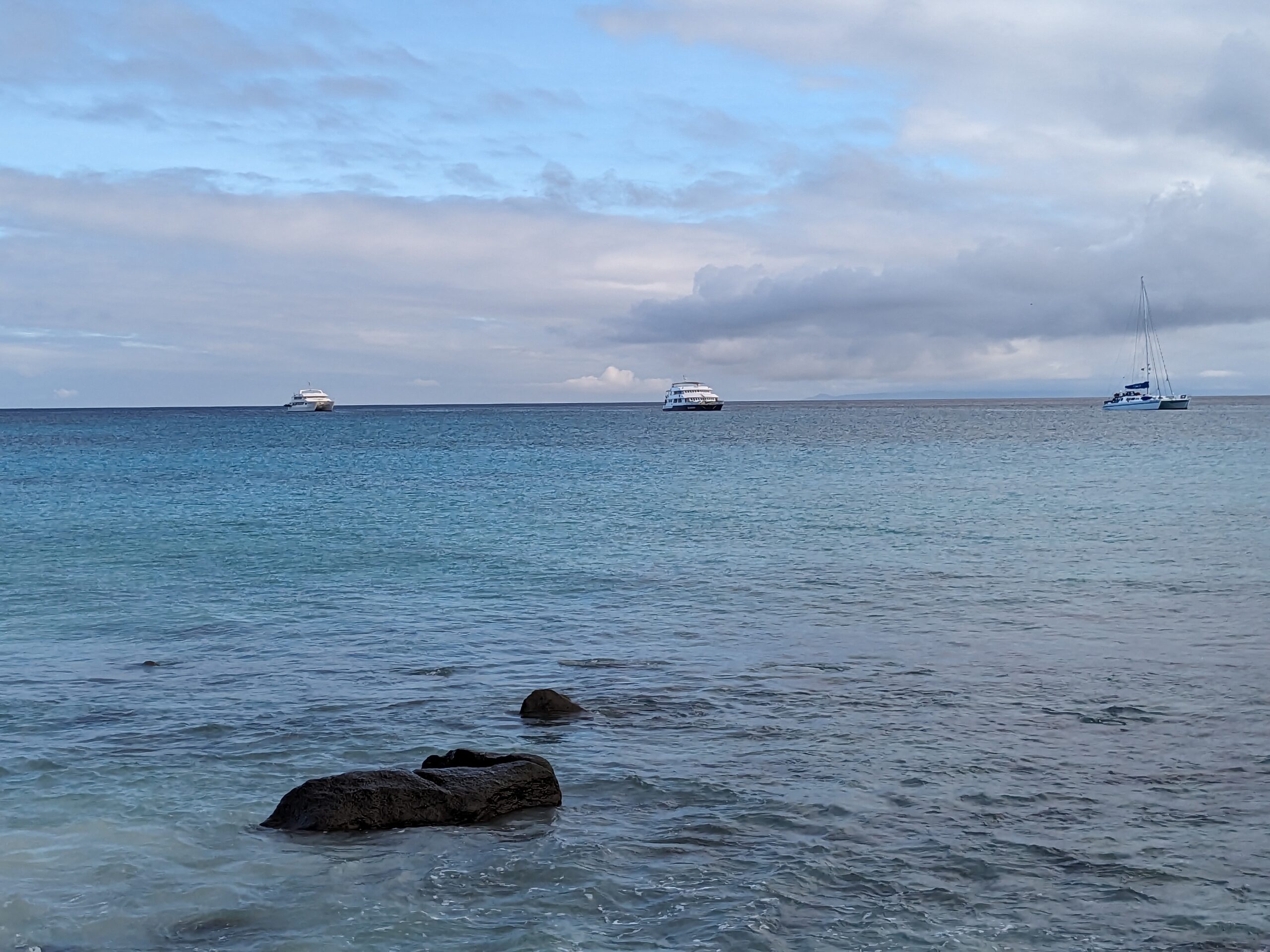
Boats tied up on the shoreline.

Sorry, there was no post yesterday. I had run out of steam and simply couldn’t muster the energy to get it done by the time we returned from Manta. We had no groceries when we arrived on Tuesday, and for the second night in a row, we didn’t have anything for dinner.

There was no supermarket, open shop, or restaurant nearby, but we made it through the night without a bite to eat since breakfast. The prior night we arrived in Manta too late to eat, and that’s when the lovely young daughter of the hotel owners went to a little local market to get me some cheese.

I don’t know how to start this post. Shall I minimize the ordeal of the past 48 hours to indicate we are less adaptable than usual? Or shall I, in our usual way, tell it like it is, causing our readers to perceive we aren’t as tough as we used to be? I’ll opt for the latter and tell you exactly what happened.

Sure, we may not be as tough as we were years ago. We’re getting older and have various medical issues, typical for our ages, that impact how well we tolerate certain situations. But the fact remains, regardless of our ages, we still don’t whine and complain during difficult times and forge ahead, doing the very best we can with a good attitude, however difficult it may be at any given time.

Boats along the highway from Manta to San Jose.

Yesterday was one of those times. I don’t know how we got through it, but we did. And now, here we are in our oceanfront holiday home, not quite unpacked but with laundry done, groceries purchased, and a roasted chicken dinner on the menu for tonight.

First, before I go on, I want to preface that the property owner, Igor, who lives in Montenegro (formerly Yugoslavia), is a fantastic guy. Had he known what would transpire on Tuesday, he would have gone to any lengths to avoid the frustration we experienced. He’s making everything right over the next few days.

Properties on the ocean road.

So here’s how it rolled out. As mentioned in Tuesday’s post, we had a long wait at the gate to Mirador San Jose for Igor’s house manager to arrive. We arrived at 10:45 and ended up sitting in the car with nothing to drink, no bathroom, and turning the car off and on to cool us down in the warm, humid weather on a cloudy day.

At 1:10 pm, I walked up to the guard gate building and explained our plight to the guard. He raised a piece of paper showing our names, that we were expected to arrive, and that Sylvie, Igor’s property manager, was supposed to come at 11:00 am to let us into the property.

Although the guard and I somehow managed to communicate, he even had Sylvie’s phone number programmed into his phone. Immediately, he called her, and she acted as if she didn’t know we’d been waiting there for 2½ hours. Igor had told her we’d be arriving at 11:00, but she didn’t bother to show up.

Flowers at the entrance gate at Mirador San Jose, where we waited for over two hours on Tuesday.

After the guard called her, apparently she lives nearby, she didn’t arrive until 15 minutes later, acting as if nothing was wrong. We both surmised she had forgotten we would be at the gate at 11:00. She spoke no English other than a few words. But we don’t expect people to speak English in other countries. It’s us who has to figure it out.

When we finally got to the property, she handed us a pass to enter and exit through the gate. I asked her many using my choppy Spanish language skills, but she didn’t seem to know the answers to many of the questions, even when I used the translator on my phone.

The entrance gate to Mirador San Jose, where our holiday home is located.

After she left, we were at a loss  as to how to handle the following comments and questions, which I later posed to Igor on a WhatsApp call:

Sylvie didn’t know anything…if we hadn’t had the gate people call her, she wouldn’t have shown up. Please see the bold print after each issue to see what has been done

  1. Where does the trash go? There’s a bin down the road, and we can dump our bagged trash in the bin any day of the week.
  2. We couldn’t find any of the restaurants or grocery stores Sylvie mentioned. None of the restaurants she mentioned were open, or after reading the menus for the few that were open, we realized most likely we wouldn’t be able to dine out here. All of the food is deep-fried.
  3. The pass to the guard gate wasn’t working. Igor contacted the gate people and got our gate pass activated. It’s working now.
  4. Who will provide more gas tanks when the stove runs out? Igor contacted a guy who will deliver extra gas tanks, and when we run out, he will get him to install the new tank.
  5. The towels in the bathrooms are threadbare. Igor instructed Sylvie to purchase quality towels, which she delivered yesterday.
  6. There were minimal supplies at the house when we arrived…toilet paper…soap….trash bags. Without cash to shop at the area’s tiny shops, we had to drive back to Manta (one hour each way) to find an ATM for cash (they use American dollars here). Then, we found a grocery store and purchased about 80% of the items on our list. The larger grocery store in Manta accepted credit cards.
  7. The water machine wasn’t working. What do we do about bottled water? Igor said we have to leave the big bottle on the sidewalk with $1.25 underneath the bottle, and once a week, the water guy will come by and refill the bottle. What day? No one knows.
  8. Who do we contact for maintenance? We will contact Igor.
  9. There were several bulbs burnt out. Today, a guy came and replaced all the bulbs except one he needed to purchase and then returned in the next few days to install it. 
  10. WiFi doesn’t work upstairs. We need WiFi on both levels. Igor is working with the WiFi service providers to install an additional router upstairs.
  11. I would like to have known we needed to bring a lot of cash when most small-town shops and restaurants don’t take credit cards. Most guests stay a few days. We are staying 79 days, and our need for cash is much greater.
  12. There is no book in the house on handling any of these issues. With these questions answered and mostly resolved, we won’t need a book of instructions. But we always appreciate these books.

    The beach along the road to Manta, taken on our second trip in two days.

Of course, after all these issues arose, I contacted Igor, asking him to call me on WhatsApp, and he quickly responded as usual. He’d since addressed each of the above issues, and they are getting accomplished one by one. Igor has been responsive and supportive and shocked we had to deal with many of these issues. Igor informed us that good help is hard to find in Ecuador.

Once in the house, after doing considerable research, we concluded we had no choice but to drive back to Manta for the cash and to the supermarket. All the local markets are like “Quick and Easy” type stores, carrying soda, snacks, rice, and beans. There’s such a little shop here in the gated community, which we’ll check out today, but I doubt it will carry anything we use.

Large black bird at the edge of the pool at our holiday rental.I will continue researching to find what type of birds these are.

We’ll have to drive back to Manta every few weeks to buy groceries. We purchased as much as would fit in the freezer and only a little bit of fresh produce when they don’t carry what we typically use. Most vegetables were starchy, like peas, squash, and corn. There were no frozen vegetables we would use.

Before dinner last night, we had no water. We contacted Igor, and he said to leave the faucets open to clear the lines of air. We did this, and it worked.

An iguana we spotted at the airport in Quito.

I think we’ll be OK from here. We don’t like the prospect of driving to Manta every few weeks, but we will go check out a meat market in Puerto Cayo, about 30 minutes down the highway. If we can purchase meat, we can go to the supermarket once a month for staples at the same time as returning the rental car once a month. They wouldn’t allow us to keep the car for more than 30 days and put a hold on a credit card for $5,000, the most we’ve ever seen. It’s Avis, so we felt it would be OK, and most likely, they’ll release the hold in a timely manner.

We’re feeling better now that most of these issues are being resolved. Right now, I am having lots of Afib bouts and, fortunately, have medication with me for such an occasion. The side effects make me feel awful, but it’s what I have to do right now.

Last night, we were so exhausted that we made scrambled eggs for dinner. Bacon is basically unheard of in Ecuador. Tonight, we’re roasting two chickens for dinner with rice for Tom. We won’t be eating salads while here or any raw vegetables due to a high risk of illness from the impure tap water. I didn’t even buy celery, one of my favorite additions to various dishes.

I will try taking photos, but it’s been raining since we arrived. Once we have a sunny day and I feel better, I will be motivated to take photos. More on this story in tomorrow’s post.

Be well.

Photo from ten years ago today, October 25, 2013:

Who can be bored in Kenya when the playful antics of our temporary dogs, Jessie and Gucci, never fail to entertain us? For more photos, please click here.

Yeah, to sea level!…Instantly, feeling better…Now the interesting part begins…

The pool at Pikiera Hotel in Manta a quaint little cultural hotel owned by a most charming couple and their daughter, Crystal.

Right now, as I write this, we have been sitting in the little rental car, packed to the roof with our bags, outside the entrance gate to Mirador San Jose. We are waiting for Sylvie, the property manager, to arrive to let us into the gate and then to the house. Beyond these gates is our home for the next 79 days, which we hope has good WiFi and is as nice as the photos as represented in VRBO.

Early in our travels, we were sorely disappointed by a beach house in Placencia, Belize, with fraudulent reviews and no running water. We left in a week and never got our money back. In those days, the holiday rental business was different than it is now.

The bar is to the left of the kitchen, where the owners cooked our breakfast of scrambled eggs and ham.

Our only recourse at that time would have been to sue the owners, and we didn’t want the beginnings of our travels to revolve around dealing with a lawsuit. But now, as we are sitting at the entrance gate, Sylvie hadn’t shown up at 12:45 pm when the plan was 11:00 am, two hours earlier than our original arrival time of 1:00 pm.

This morning at the hotel in Manta, I contacted Igor, the owner, who lives out of the country, and he arranged for her to arrive at 11:00 instead. Sure, she may have had other plans, causing her only to be able to come at 1:00. We shall wait and see. At this point, we have no other option but to wait.

As for yesterday, our travel day, we were able to stay in our hotel room in Quito until 2:00 pm and then spent three hours waiting in the lobby for a Celebrity escort to the airport. We’d prepaid $60 for two extra bags and seamlessly moved toward our gate.

We encountered several roundabouts on the drive from Manta.

I felt so awful from altitude sickness after the second 48 hours in Quito that I couldn’t wait to get on the pressurized airplane. The wait at the gate was short, and the flight was even shorter at only 35 minutes to touchdown.

We ordered a wheelchair for me. In my weakened condition, my legs felt like lead, and I was short of breath, sitting and doing nothing. Within minutes of the airplane doors closing, I felt a wave of calm wash over me. I could breathe, and the lightheadedness immediately dissipated. What a relief!

Parts of the road were barren and desolate and other parts were like a rain forest. As always, taking photos in the fast-moving car wasn’t easy.

When we arrived at the small airport in Manta (population 300,000) in minutes, we had our luggage and exited the area where, for the first time ever, a man stood with an Avis sign waiting to escort us to the little rental car in the parking lot.

Moments later, we were on the road to the quaint Ecuadorian little hotel, Pikeiro Blue, where we have ever stayed, at a rate of $45 a night, cash only. We just needed a place to sleep. But, minimal, it was charming nonetheless. The owner sent his daughter to a little market to buy us two sodas and some cheese.

We hadn’t eaten since breakfast, and I was hungry, but Tom wasn’t. The lovely English-speaking daughter returned with the sodas and cheese in no time. We tipped her with gratitude. Her parents were so sweet and kind, and we conversed on Google Translate.

It was a joy to see the ocean about halfway through the drive.

The room was spotless, with only bright overhead lighting (no lamps) and two double beds perfectly made. But, the beds were comfortable, the WiFi excellent, and the aircon chilled as we needed.

After a fitful night’s sleep this morning, we showered (cold water only) and dressed to head down to the pool level while the hosts made us breakfast, which was included in the $45. It couldn’t have been a more pleasing cultural experience.

The one-hour drive from Manta was interesting and also cultural. Once we reached the ocean along the highway, we were in awe of the massive waves, ideal for the most experienced surfer, but no surfers were to be seen on the pristine beaches.

A little church along the way.

Today’s photos are from the above-described experiences. Tomorrow, we hope to be back with photos of the house, finding ourselves unpacked and with some groceries on hand.

Hmmm ..we have yet to see a market…what will transpire there? Again, we shall see and report back tomorrow.

Be well.

Photo from ten years ago today, October 24, 2013:

Last week in Diani Beach, Kenya, when dining at Sails Restaurant, the moon was in its full glory. A few months after we left Kenya, this restaurant where we ate most Saturday nights was bombed by terrorists on a Saturday evening. For more photos, please click here.

Flying away tonight…Can’t wait to get down to sea level…Final photos from Galapagos Islands…

Blue-footed booby on a walk, although they are excellent flyers.

Note: Our naturalist, Orlando, took today’s photos, which he sent me daily via WhatsApp. Thanks, Orlando!

Shockingly, I haven’t suffered with Afib while we’ve spent five days total at an altitude of 9350″, as I’ve mentioned repeatedly since we arrived in Quito on October 11, 12 days ago. During the five nights we’ve spent at the JW Marriott in Quito, Ecuador, we’ve both felt the effects of the altitude in many ways, more for me than for Tom.

Tom gets out of breath during exertion, and my heart races when I walk or move about the hotel room. Fortunately, once I rest, it goes back down to normal. However, when we got off the boat on Saturday, my heart rate hovered between 85 and 100 all night, high for me. Last night, for the first time in 12 nights, we both slept well.

Salted lagoon, Floreana Island.

For the first of the five nights in Quito, my heart rate was normal, which allowed me to sleep. My Fitbit says I slept for a much-needed eight hours. But now, at noon, almost two full days since we returned from the boat and its frequent seasickness, I must admit, I am looking forward to getting down to sea level and situated in our new holiday home on the sea.

The smell of the fresh ocean air and the use of the infinity pool will be such a welcome relief which I hope to do daily, weather permitting, for exercising my legs, hoping for some improvement in walking. All of my whining is related to having had open heart surgery in 2019 and the lingering effects that have impacted my (our) lifestyle to a great degree. If I walk too much, I get Afib. If I don’t walk enough, you know what I mean.

Gorgeous scenery at Floreana Island, a millions-of-years-old volcano.

I apologize for whining. Once we get settled, I will be a new person. In 24 hours, we will go to Mirador San Jose, Manabi Province in Ecuador, a gated community with a beautiful property. Many photos will follow. It will be delightful to grocery shop at the nearby supermarket (supermercado) after we’ve seen how much space there is in the refrigerator and freezer.

Often, refrigerators in holiday homes are small. But, if so, we will manage and simply shop more frequently—no big deal. Also, there is often a lack of storage space for non-perishable food items, but here again, we’ll make do. We’ve hired a three-hour cleaning person every Tuesday morning at 8:00 for $20 per week. In the US a year ago, we paid $25 an hour, as we did when we had the cleaner once a month when we stayed in The Villages in Florida three months ago.

 A Galapagos flycatcher. Adorable.

Gee, I haven’t cooked a meal since then, and I look forward to making a special home-cooked meal at least five nights a week after we investigate to determine if dining out is a good option in that area. If so, we’ll dine out every Friday and Saturday night, which might allow us to socialize with locals and tourists.

It’s funny how I remember several Spanish words we learned when we spent four months in Costa Rica. I can easily read a menu and road signs and understand short sentences. I can’t necessarily speak it well in sentences, but with the help of Google Translate on my phone, we’ll be fine.

Speaking of my phone, I couldn’t get into our Google Fi account to access WiFi once we left the hotel after using their WiFi for five days, which was very good. I tried everything I could to get it to work, to no avail. I had no choice but to call Google Fi, which quickly responded, but when we were halfway through the troubleshooting process, the call dropped. I called back and again, and a rep responded quickly.

A wave albatross flying back to Espanola Island, the oldest island in The Galapagos.

We resolved the issue quickly when I had to select an arbitrary network Google Fi uses in Ecuador, Claro. I’d never have known this if I hadn’t called. Good thing I called, or we’d had a nightmare on our hands tonight when driving in the dark to the hotel and tomorrow, driving to the house without the ability to use Maps. Any time we’ve tried to use “Maps” in many countries without being able to connect to Google Fi,  depending on satellite conditions, we often hear “her’ say, “Make a U-turn,” over and over again. This drives us crazy.

Well, enough about all of that. In less than seven hours, we’ll be on the plane, pressurized for easy breathing, and God willing, all will be well. It’s only a 50-minute flight. We’ll most likely miss dinner again tonight since last night, I wasn’t feeling well enough to go to the restaurant and couldn’t find anything on the room service menu. It will be close to 10 00 pm by the time we get to the hotel in Manta. So, well miss two dinners, two nights in a row. That’s no big deal, either.

After grocery shopping and unpacking a bit tomorrow afternoon, we’ll be back with a new post with some photos of our new home. Stay tuned for more.

Be well.

Photo from ten years ago today, October 23, 2013:

A bushbaby with a banana was next to us last night as we dined outdoors at the Leopard Beach Resort in Diani Beach, Kenya. A small platform was set up for the bushbabies, loaded with bananas to encourage them to visit the guests while dining. For more photos, please click here.

We’re back in Quito…Good to be back on land, but again we’re high in altitude…Whew!…Wrapping up The Galapagos photos…

Giant tortoises at Isabela Island Breeding Center.

Note: our naturalist, Orlando, took all of today’s photos, which he sent to me each day via WhatsApp. Thanks, Orlando, for thinking of me!

The two-hour flight from Baltra, The Galapagos Islands, was almost a full-day journey. We disembarked the ship at 11:30 am and didn’t arrive at the JW Marriott Hotel in Quito until after 5:30 pm. We collected our stored luggage from the bellman and headed to a different room than we’d had over a week ago when we stayed here two nights before the cruise.

Tom was looking into the mailbox at Post Office Bay, where he found a postcard left by a visitor from South Africa, which he took, and we’ll ensure they receive it once we return to Marloth Park.

The only flight we could get to Manta was on Monday, so this time, we’ll spend another two nights at this high altitude. So far today, 18 hours after our arrival, we’re holding up OK in the 9350′ altitude. Our legs feel like lead when we walk, and my heart rate is 10 to 15 beats faster per minute than at sea level. The heart compensates for lack of oxygen at high elevations, and thus, one’s heart rate may increase until adapted two to three days after arrival. We will only be here for two days and won’t be adapted by then.

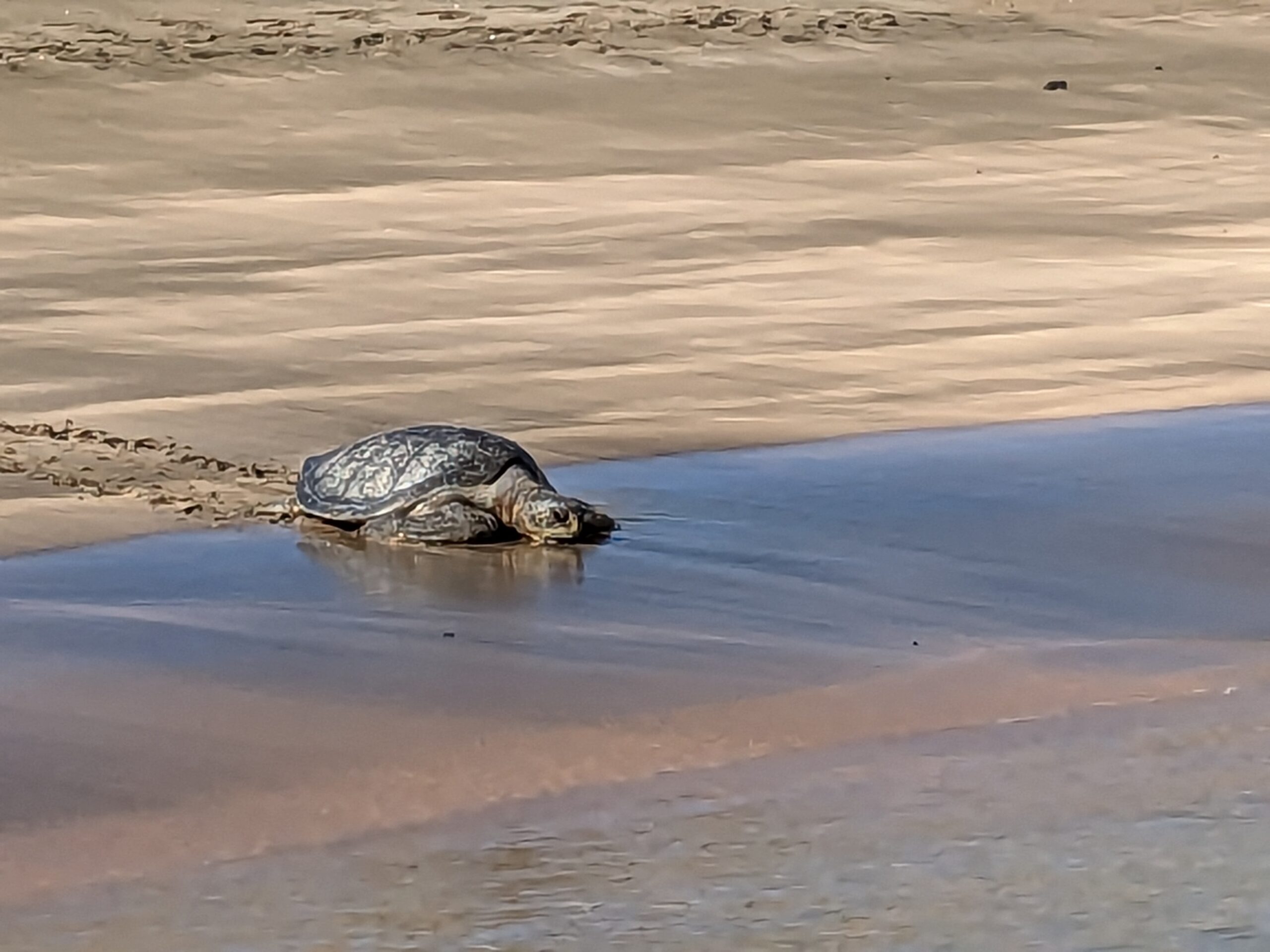
Tortoise heading out to sea.

But, in one way, the altitude right now is more tolerable than the seasickness we suffered on the ship, a 98′ long catamaran with eight passenger cabins for 16 guests. Feeling nauseous is worse than feeling out of breath and tired. I look forward to returning to sea level by tomorrow night after our 50-minute flight to Manta, leaving Quito at 7:25 pm.

Another green tortoise was heading out to sea.

Once in our room, we unpacked what we needed for the night and this morning and didn’t bother to unpack anything more. We never unpacked while on the cruise, making packing much easier when it was time to go, as will be the case here. When we were in lockdown in India in the Marriott Hotel for ten months, we never unpacked there either. We pulled out the three outfits we wore repeatedly and never touched anything.

A sea lion at the beach.

While staying in Nevada and Minnesota in the past few months, we never unpacked in either hotel. With 11 years of travel experience, we’ve gotten pretty good at “living out of a suitcase.” However, when we arrive in Ecuador for 79 days, we’ll unpack and wash everything since we’ll have a washer and a dryer. How unusual!

Sea turtles mating.

After we got situated in our room, we rested for a few minutes, never napping. At 7:30, we headed downstairs for dinner in the Botanica Restaurant, which cost was included in our cruise, along with this morning’s and tomorrow morning’s breakfast. Our hotel for the two nights was also included. But we’re on our own for dinner tonight.

A blue heron.

Most likely, after having a big breakfast, Tom won’t be hungry by dinner, so we’ll head down to Fogo De Chao, where, once again, I’ll have their salad bar with a vast array of foods I can eat. There’s no way I could eat the classic meats served tableside that they are known for. It’s just too much food.

A blue-footed booby and an iguana.

We have no plans for the next day and a half. We’ll have to sit in the lobby tomorrow afternoon when checkout is noon. But it’s more comfortable to sit in the lobby than get comfortable in the room. We could get a late checkout as VIP members with Expedia on our site here. But those few extra hours in the room make no difference to us.

Hood or espanola mockingbird, the largest on the island.

In 48 hours, we’ll be at our holiday home in Mirador, San Jose. I found a nearby market online, so we can bring our bags into the house and head to the market to shop. That’s quite fun for us since we love being able to check out local foods befitting our way of eating. Plus, we’ll need to stock up on bottled water since the tap water in Ecuador is not potable.

Floreana daisy.

That’s it for today, dear readers. We hope you’ve enjoyed our Galapagos photos and Tom’s adventures. No doubt it would have been a lot more fun for him if we’d been able to experience the excursions together. In the future, we’ll keep this new adaptation in mind when we are booking plans for the future.

A yellow warbler.

Be well.

Photo from ten years ago today, October 22, 2013:

Due to a WiFi issue, we cannot post a photo from ten years ago. For the story, please click here.

Day 8…Celebrity Xploration…The Galapagos Islands…Disembarking day…Back up to Quito for two more nights!…

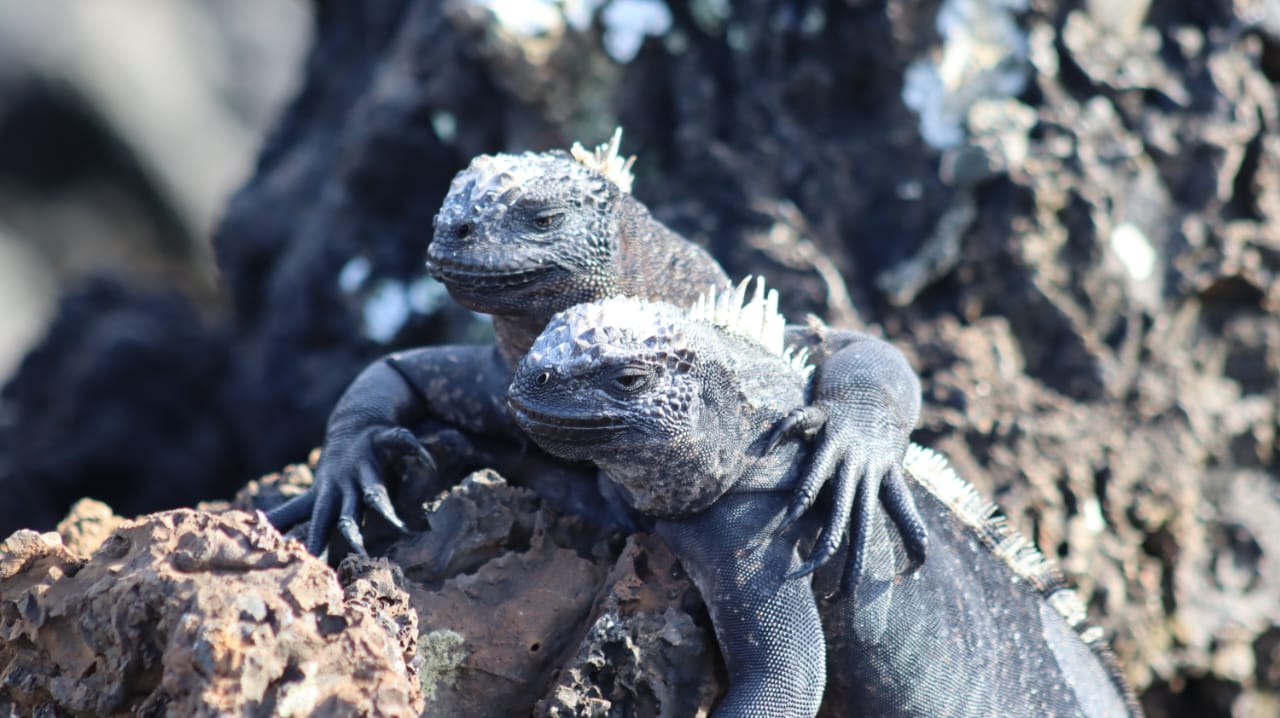
A pair of iguanas sharing a little love.

Note: our naturalist, Orlando, took all of today’s photos, which he sent to me each day via WhatsApp. Thanks, Orlando, for thinking of me!

In one hour, we are heading out on the Zodiac boat (the panga) to return to the pier in The Galapagos Islands. Our cruise has ended, and by 2:00 pm this afternoon, we’ll be on the return flight to Quito, where we’ll spend two more nights, and then fly to Manta, where we’ll spend one night to avoid driving in the dark.

From there, as mentioned, we’ll drive to the holiday home in Mirador, San Jose, in Manabi Province, on Tuesday. We’ll stop for groceries on the way, considering how much room we have in the rental car. By early afternoon on Tuesday, we’ll enter the gated community to make our way to the holiday home.

Black naked stil at Dragon Hill, Santa Cruz Island.

As much as we’ve enjoyed this spectacular cruise, even considering my limitations, we’re looking forward to the next step in our journey, spending 76 nights at the oceanfront property with a large pool and modern property. It even has a washer and dryer, which we desperately need to use at this point, after two weeks away from laundry facilities.

At the moment, all of us, 14 passengers, are waiting in the lounge after watching the fantastic video naturalists Juan Carlos and Orlanda made for us, handing out flash drives for all of us to keep as a memory. It may be too large to post on our site, but I will try to create a link we can use for those interested in watching it.

A great blue heron at Dragon Hill, Santa Cruz Island.

We still have photos from this journey and will post them over several days. With little time until we depart for the airport, we only upload a few photos today.

Although our flight back to Quito is only two hours long, we likely won’t get back to the hotel in Quito until about 5:30 tonight. Tonight’s dinner and tomorrow’s breakfast are included in our cruise package, along with the one night in the hotel, and the following night, we’re on our own for dinner and breakfast the next day.

Fur seal at Rabida Island.

Our fight to Manta isn’t until Tuesday at 7:24 pm. We will make arrangements with the hotel for a late checkout, a benefit of being an Expedia VIP member, and then spend the remaining time in the hotel lobby awaiting our ride to the airport, arranged through the cruise line.

Last night was extraordinary when the 12 staff members arranged a special toast and presentation before our final dinner of giant prawns with many side dishes with wine flowing as it always has each evening since we boarded this ship a week ago. But, last night, when the seas got rough again, I headed off to bed, never finishing my glass of wine when the rocking and rolling made me queasy.

Baby flamingo at Rabida Island.

Most nights, I suffered from seasickness, which neither of us had ever had after 34 cruises until this one. We can only attribute it to the fact that a catamaran is known to cause seasickness in the most sturdy of sailors unused to this means of sailing in the ocean.

I’m looking forward to being on dry land, but hopefully, I won’t face much upset with the high altitude again. It hit me when we were there a week ago, improving after the second day. Surely, we’ll look forward to returning to sea level again by Tuesday night. Whew! Some of the ups and downs required on this cruise may not be suitable for some. I barely squeaked by.

Lava heron waiting for a little fish.

That’s it for today, dear readers. Thank you for your thoughtful and supportive comments, most recently and always. You all mean the world to us.

Be well.

Photo from ten years ago today, October 21, 2013:

No, this was not a creature we found in our bathroom at night. It was my delectable entrée, delicately grilled calamari with an octopus topper at dinner a week ago Saturday at the divine The Sands at Nomad in Diani Beach, Kenya. For more photos, please click here.

Day 7…Celebrity Xploration…The Galapagos Islands…Avian flu kills three birds in Galapagos….Tom stayed on the ship with me today…

Tom took one of my favorite photos: a pelican with a pouch filled with fish. The brown Galapagos pelican has a thick layer of skin located on the lower mandible and connected to the throat – this is a gular pouch. The bird uses this flap of skin to scoop fish out of the water, to hold its catch like a dinner plate of regurgitated fish for its chicks, and even to cool itself on a hot day!

In the past week on this ship, Celebrity Xploration, there were islands we didn’t visit that may have been included in past cruises due to the incidence of avian flu discovered in three dead birds. See the article below from this site:

Another pelican in rough seas.

“Catastrophic avian influenza reaches the Galapagos for the first time

Almost 200 years on, when Charles Darwin observed his Galapagos Islands finches, which became the emblems of his theory of evolution, birds in the region are again in the news for what many scientists warn could be the source of the next pandemic.

A lovely photo of a pelican, taken by Tom, is in rough seas.

Three out of five dead birds have tested positive for avian influenza (H5N1), according to the Galapagos National Park Directorate (GNPD), which is the first time the deadly virus has made it to the Archipelago. It’s a worrying sign for scientists, who have sounded alarms since the pathogen moved from a seasonal concern to a potential pandemic spillover in 2021.

Notice the frigate with the red pouch…Males have a bright red pouch on the throat, inflating like a balloon to attract females. Females, unlike most other seabirds, look different than males with their white chests.

In the last two years, more than half a billion farmed birds have died or been culled due to the virus, and conservative estimates suggest hundreds of thousands of wild birds across the globe have died. It’s also killed thousands of sea lions in South America. Skunks, mink, dogs, and some humans have also been infected.

On a tour of the bridge with Captain Marcos.
Ship captains often still use handwritten logs, although they have plenty of computers they could use.

While H5N1 has now spanned the globe, its presence in the Galapagos highlights how difficult this virus is to contain, mainly since it is so prevalent in shorebirds and migratory birds. In the Galapagos Islands, 80% of birds are endemic. The arrival of H5N1 makes all bird species incredibly vulnerable.

There are cameras throughout the ship, which the captain and his staff observe throughout the cruise.

While avian influenza has been circulating for decades, intensive farming and virus mutations have seen it spread in novel ways, and scientists have sounded the alarm it’s the most likely source of a new pandemic.

More equipment on the bridge.

To date, Antarctica and Australia are the only continents without reported avian influenza outbreaks among wild birds.

This is known as Leon Dormido (Kicker Rock), which we sailed around in the ship at happy hour.

Source: Galapagos Conservation Trust”

Sure, three birds dying from this flu doesn’t sound like much, but three birds could have eventually impacted the entire bird population, which could have entirely affected the ecosystem of these fantastic islands. Hopefully, they’ve caught it in time to save the birds that have been such an integral aspect of our time spent here on the islands.

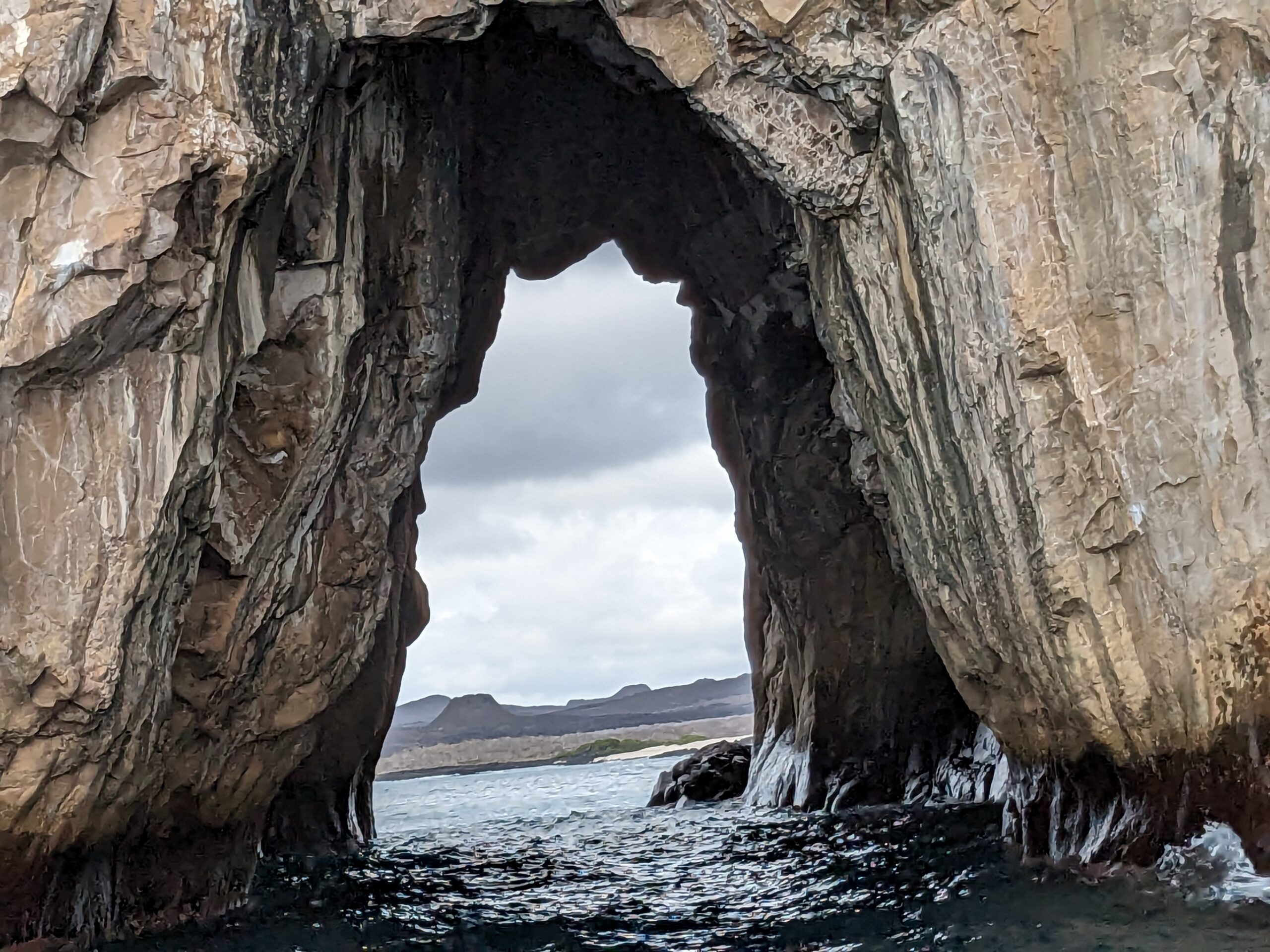
Amazing rock formations.

Today was a hectic day planned for the passengers, starting at 8:45 am and returning at 6:00 pm, which would include hours of walking while visiting a village on Santa Cruz island, the most populated of the islands in the Archipelago. A lunch at a local restaurant and a visit to a farm with lots of giant tortoises were planned. The remainder of the day would be spent shopping in the village, a favorite pastime of many travelers.

An alternate view of the rock formation

Unbeknownst to me, last night, Tom decided he was going to stay on board with me. There was no way I could have walked about for nine hours. Last night, when he chose to stay with me today,  he didn’t tell me until this morning since he didn’t want me to worry about him staying behind while I was trying to sleep on yet another night of rough seas and seasickness. Surely, I would have attempted to talk him out of staying behind, but he insisted he wanted to be with me. What a guy! I am so lucky.

Another view of Kicker Rock at sunset. Beautiful!

After dinner and conversation, I headed to bed when I became seasick and couldn’t keep my head up. Anticipating rough seas, I didn’t eat or drink much at dinner, and just like that, at 8:30, it hit me like a ton of bricks. Tom had to hold onto me to escort me to our cabin and help me get into my pajamas. Once my head hit the pillow, I felt better and could eventually fall asleep for an hour.

Kicker Rock at sunset.

But, when the rocking and rollin’ became worse, I awoke and never went back to sleep until around 3:30 am. During that time, I was going back and forth with my web guy and our hosting company while they were attempting to fix some issues on our site that I’d been dealing with for the past five days. They were in a different time zone, and it was daytime where they were.

Last night’s sunset.

After dozens of email messages back and forth, by about 3:00 am, they resolved the issues. Most likely, few of our readers would notice any of the issues, but they were evident to me while I was trying to upload posts daily. Then, a few nights ago, when we put our laptops on the floor during brought seas, as recommended by staff, somehow my laptop got banged around on the floor, and the screen came loose from the base of the laptop.

Sea lions love to sleep on rocky surfaces as well as soft sand.

It appeared that it could be fixed when plastic pieces had broken off. Wouldn’t you know, four staff members gathered around my laptop while I tried fixing it and offered to help? It was Agustin, the hotel manager, and Christopher, the cabin attendant, who performed a miracle getting it entirely fixed. They even fashioned some new parts from bits of metal they had on the boat.

Alternate view of last night’s sunset.

Not only will we be tipping the 12 members of the crew in the passenger’s collective tip basket, but we’ll be giving extra tips to Agustin, Christopher, Jonathan (the superb chef), and the two naturalists, Juan Carlo and Orlando, who fussed over me every chance they got, sharing tidbits of information about the wildlife that I have presented here in the posts.

Sailing away from Kicker Rock.

We’ll have to share many more photos and continue to post them until we feel we’ve shared the bulk of them. It may take a few days or even a week until we’ve exhausted the supply of photos and videos from this exciting experience.

What a unique sight to see here in The Galapagos Islands.

Tomorrow, Saturday, we’ll disembark the ship and fly back to Quito, where we’ll again stay at the gorgeous Marriott Quito until Sunday, when we’ll fly to Manta, where we’ll stay overnight for one night to begin our drive to our new home on the sea on Monday morning, making a quick stop at a market for some groceries along the way.

From left to right, starting with Alexis in the wedding dress and her new husband Seth. Then, continuing to the right are Emmanuel and Ann, Anthony and Colleen, and Jackie and Michael.
Last night at dinner, our group of eight sat at one of two tables in the dining room. From left, with her back to us, Gill, her husband John, Jeff, Nadine, Tom and I, Karin and Stephen.
Us, last night at happy hour on the upper deck.

Although the boat is anchored right now, we’re still rocking back and forth, making me queasy, but Tom is fine. Go figure. Jonathan will have some lunch at noon since I haven’t eaten anything yet today. Tom didn’t want lunch when he’d had a big breakfast this morning. When the passengers return tonight, we’ll celebrate our final night with the crew over another spectacular dinner. I hope the seas aren’t rough tonight.

Be well.

Photo from ten years ago today, October 20, 2013:

We are babysitting their two little dogs with Hans and Jeri gone for the Kenyan holiday this weekend. This is Jessie, whom they inherited when a nearby homeowner didn’t want her. She is an entirely outdoor dog, never sleeping indoors and spending all her days and nights outside. It was hard to close the doors on her last night when we went to bed, leaving her looking at us. I wanted to pick her up and put her in the bed with us, but we knew not to upset her routine. She’s a sturdy little dog and an excellent watchdog. For those who knew us in our old lives, does this remind you of anyone? For more photos, please click here.

Day 6…Celebrity Xploration…The Galapagos Islands…Charles Darwin’s influence on The Galapagos Islands…A reader writes, asking a valid question…

Charles Darwin.

In yesterday’s post, we mentioned we’d be sharing information about Charles Darwin and his impact on The Galapagos Islands, emblazoned in the public’s minds for past and future generations. After reviewing the description of his life from many sources, I found this source to be most informative. I have edited it in part to fit the size and nature of our posts.

“Charles Darwin: History’s most famous biologist…

Charles Robert Darwin (1809-1882) transformed the way we understand the natural world with ideas that, in his day, were nothing short of revolutionary. He and his fellow pioneers in the field of biology gave us insight into the fantastic diversity of life on Earth and its origins, including our own as a species.

Data has revealed that they can dive down to 200 meters and hold their breath for more than 20 minutes. Their natural predators are sharks and orcas; whales very rarely fish sea lions in the Galapagos. The biggest colony of sea lions in the archipelago is in Puerto Baquerizo Moreno and San Cristobal.

Charles Darwin is celebrated as one of the greatest British scientists who ever lived, but in his time, his radical theories brought him into conflict with members of the Church of England.

Young Charles Darwin

Born in 1809 in Shrewsbury, Shropshire, Darwin was fascinated by the natural world from a young age. Growing up, he was an avid reader of nature books and devoted his spare time to exploring the fields and woodlands around his home, collecting plants and insects. In 1825 Darwin enrolled in medical school at the University of Edinburgh, where he witnessed surgery on a child.

Seals and sea lions are marine mammals called ‘pinnipeds’ that differ in physical characteristics and adaptations. Sea lions (left) are brown, bark loudly, “walk” on land using their large flippers, and have visible ear flaps. Seals have small flippers, wriggle on their bellies on land, and lack visible ear flaps.

Surgeries at the time would have been carried out without the use of anesthetic or antiseptics, and fatalities were common. Watching this procedure left Darwin so traumatized that he gave up his studies without completing the course.

During his time in Edinburgh, Darwin also paid for lessons in taxidermy from John Edmonstone, a former enslaved man from Guyana. The skills Edmonstone taught Darwin became crucial just a few years further into his career. After his time in Scotland, Darwin went to Cambridge University to study theology.

These sea lions have gone without many predators because of their isolated location. The only predators they have are sharks, killer whales, and dogs. So, like most Galapagos animals, they have no reason to fear people.

The voyage of HMS Beagle

In no rush to take holy orders in 1831, Darwin accepted an offer to embark on a five-year voyage aboard HMS Beagle. One of his Cambridge professors recommended him for the role of naturalist and companion to the ship’s captain, Robert FitzRoy.The journey would change both his life and the trajectory of Western scientific thinking.

Most other marine mammals in the Galapagos cannot be considered residents because they are migratory. There are only two species of seals (including the Galapagos sea lion), two whales, and two dolphins that are true Galapagos residents.

Darwin explored remote regions and marveled at a world so different from the one he knew. He encountered birds with bright blue feet, sharks with T-shaped heads, and giant tortoises. Darwin collected plants, animals, and fossils on his travels and took copious field notes. These collections and records provided the evidence he needed to develop his remarkable theory.

The Galápagos mockingbird (Mimus parvulus) is a species of bird in the family Mimidae. It is endemic to the Galápagos Islands, Ecuador. This bird had no fear of Tom, standing quite close to him.

Darwin returned to England in 1836. A highly methodical scholar, constantly collecting and observing, he spent many years comparing and analyzing specimens before finally declaring that evolution occurs by a process of natural selection.

What is the theory of natural selection?

To this day, the theory of evolution by natural selection is accepted by the scientific community as the best evidence-based explanation for the diversity and complexity of life on Earth. The theory proposes that the ‘fittest’ individual organisms – those with the characteristics best suited to their environment – are more likely to survive and reproduce. They pass on these desirable characteristics to their offspring.

There were many other boats in the area.

Gradually, these features may become more common in a population, so species change over time. If the changes are great enough, they could produce a new species altogether. On his travels, Darwin had collected finches from many of the Galápagos Islands – off the coast of Ecuador – which helped him to formulate his idea.

The waved albatross, also known as The Galapagos albatross, is one of three species of the family Diomedeidae that occur in the tropics. When they forage, they follow a straight path to a single site off the coast of Peru, about 1,000 km to the east.

Some of these finches had stout beaks for eating seeds, and others were insect specialists. But Darwin realized that they were all descendants of a single ancestor. As they dispersed to different islands, the birds adapted to eat the various foods available. Natural selection has produced 13 different species of finch.

Darwin’s pigeons

From his travels on HMS Beagle, Darwin suspected that the environment might naturally manipulate species, causing them to change over time – but he couldn’t find a means to explore this effectively in the wild. Experimenting with artificial selection in pigeons gave him a way to study how far a species could change. By artificially selecting features – crossing birds with particular characteristics to generate different offspring – he gathered valuable evidence for evolution by natural selection.

These sea lions may look like the California sea lion (Zalophus californianus) but are different. They are smaller and breed primarily on the Galapagos Islands.

To illustrate his theory, Darwin bred the birds to have exaggerated features. The similarity between artificial selection and natural selection is at the heart of his explanation of evolution in his revolutionary book On the Origin of Species. After completing his experiments, he gave all 120 of his pigeon specimens to the Museum. They are currently part of our bird collections kept at Tring, Hertfordshire. 

The adult males are larger than the females. When dry, they are usually dark brown or varying shades of gray. The adult males have a pronounced bump on their foreheads. Adult females are light brown or tan with a smaller forehead. All sea lion pups are dark brown when born, and as they mature, they change to light brown or tan. Young Galapagos sea lions have a nearly flat head.

A shared discovery

Darwin knew his radical ideas would be met with stiff opposition. Even after 20 years of research, he worried about how his theory of evolution would be received as it challenged widely held religious beliefs of the time. 

He delayed publishing on the topic for a great number of years while he assembled a mountain of evidence. Darwin volunteered to send Wallace’s ideas to a journal for immediate publication when he learned that the young naturalist Alfred Russel Wallace had developed similar ideas.

While larger animals in the Galapagos (like cows, goats, and horses) exist, sea lions are the largest endemic land animal. These islands are 1000 kilometers (600 miles) from the mainland – that’s a long swim for a land animal.

On advice from friends, the two scientists organized a joint announcement. Their theory of evolution by natural selection was presented at the Linnean Society in London. Both had studied the natural world extensively and made several observations critical to the development of the theory. The following year, Darwin published the contentious but now-celebrated book, ‘On the Origin of Species.’

The American Oystercatcher is found in the intertidal zone of most Galapagos Islands. Their population is small; around 400 birds live in the archipelago.

On the Origin of Species

Published in 1859, On the Origin of Species provoked outrage from some members of the Church of England as it implicitly contradicted the belief in divine creation. Despite accusations of blasphemy, the book quickly became a bestseller.

Great apes

The Descent of Man and Selection in Relation to Sex – which Darwin published in 1871 – fuelled even greater debate as it suggested that humans descended from apes. The Bishop of Oxford famously asked Thomas Huxley, one of Darwin’s most enthusiastic supporters, whether it was through his grandfather or grandmother that he claimed descent from a monkey.

This is something many people want to experience when they visit the Galapagos, and it’s definitely a thrill. The young pups stay in shallow waters until they are around five months old. During that time, they don’t even fish for themselves. They have no reason to be territorial or aggressive. Even at 12 to 24 months, they are only partially independent; they will continue to nurse until their mother has another pup. And even then, she may continue to nurse the older pup. They don’t mature until they are around 4 to 5 years old.

Despite the attacks, Darwin’s conviction in the scientific explanation that best fits the available evidence remained unshaken. He was keen for his ideas to reach as many people as possible and for his books to be read in many different languages. Part of his success has been attributed to his conversational and approachable writing style.

Since Galapagos sea lions don’t migrate outside the archipelago, their breeding season isn’t dependent on migration patterns. And while their breeding season may vary from year to year, it normally lasts 16 to 40 weeks between the months of May through January. For that reason, you might see pups throughout the year.

The Origin of Species was so influential that within a year, it had been published in German. In Darwin’s lifetime, his book was translated into German, Danish, Dutch, French, Hungarian, Italian, Polish, Russian, Serbian, Spanish and Swedish. Our Library has 478 editions of On the Origin of Species in 38 languages and in Braille.

Darwin and the Tree of Life

Charles Darwin used the concept of a Tree of Life in the context of the theory of evolution to illustrate that all species on Earth are related and evolved from a common ancestor.

Darwin”s theory of the Tree of Life. Darwin’s first sketch of the Tree of Life, was found in one of his notebooks from 1837. Image reproduced with kind permission of the Syndics of Cambridge University Library.

The tips of the branches show the species that are still alive today. The tree also shows those that are now extinct. Darwin explained:

‘From the first growth of the tree, many a limb and branch has decayed and dropped off; and these fallen branches of various sizes may represent those whole orders, families, and genera which have now no living representatives, and which are known to us only in a fossil state.’

Orders, families, and genera are all groups that can be used to classify organisms. The lines on the tree show evolutionary relationships between species. For example, a recent version of the Tree of Life would show a line between some types of dinosaurs and the earliest birds, as scientists reason that birds evolved from a particular lineage of dinosaurs.

This means that closely related species are found close together, stemming from the same branch. For example, humans, chimpanzees, gorillas, and orangutans are all great apes, so they all belong to the same branch of the tree of life.

Darwin’s legacy

Although Darwin’s theory of evolution has been modified over time, it remains fundamental to the study of the natural world. Darwin changed not only how we see all organisms but also how we see ourselves.”

 Darwin was, without a doubt, a pioneer in his time. Some may not believe the extent of his theory, but if you are interested in learning more, you can read his book and many other publications written about his life and theory. How exciting for us to be in this magical place in our lives.
We are grateful for this experience, however, limited it may be for me right now since I am learning so much from the daily talks by the two naturalists, Juan Carlos and Orlando, the wonderful photos Tom is taking on each excursion, and my research in the process of it all. I am not disappointed at all.
Now, on to another topic…Last night, I received a private email from a reader (one of many we receive each day) whose name I won’t disclose to protect his privacy that read as follows:

“Hi,

I have been reading your blog for years and was sorry to read you could not accompany Tom on the excursions. I would appreciate it, and I believe many of your readers would too if you could describe in detail with pictures the environment and obstacles one might encounter on these types of excursions. I have a bad knee and can not walk long distances so I would like to know the details. Things include getting in and out of the zodiacs, terrain encountered, wet/dry conditions, etc.  

Thank you so much, and I wish you continued enjoyment in your travels.”
I wish we had thought of taking photos of the walking and hiking environment sooner. Unfortunately, we were so focused on the wildlife and scenery that we didn’t center our attention on the terrain specifically. However, I borrowed the following three photos from other passengers, as shown below.
Shipmates Karin and Stephen took this photo of the rocks to navigate at another location.
Tom says, “There are times when paths consist of small pebbles and other times when there are large lava rocks and boulders that are hard to navigate. Sometimes, it’s just a walk on a smooth sandy beach.”
A photo of a lot easier trail shipmates Karin and Stephen took on a walk.
Each evening, either of the two naturalists at a nightly briefing session describes in detail the excursion for the next day, including some photos of the terrain and any potential walking hazards. Many of the walks were shorter, but some were as long as 1½ hours. At times, there were options to embark on the long or short walk, which could be beneficial in your case.
It’s hard for us to determine if you’d be able to tackle these excursions based on the severity of your knee condition. Even getting on and off the panga boat (the Zodiac boat) was too difficult for me to participate in any of the activities. The boat ride may be smooth or choppy, during which one has to use one’s legs to support oneself since there are no specific seats on these boats. One must use their legs to hold themselves up while sitting on the inflated rubber sides of the boat.
Shipmate John took this photo of the rocks the passengers have to navigate on an excursion. It’s not too easy for those with walking disabilities.
We probably wouldn’t have booked this cruise if we knew how difficult these excursions would be based on my unsteadiness. However, as it turns out, we made the best of it and have enjoyed ourselves and learned a lot. Only you can decide if this would work for you.
That’s it for today, folks.
Be well.

Photo from ten years ago today, October 19, 2013:

Out to dinner in Diani Beach, Kenya, this adorable guy, a part-time resort resident belonging to one of the windsurfing trainers, hung around with us during our dinner, looking for morsels. Once we gave him several bites and he saw our plates were clean, he moved over to the table of other diners with full plates. For more photos, please click here.

Day 5, Celebrity Xploration…The Galapagos Islands…A funny post office…

In Hawaii, we saw blue-footed boobies, as well, but with darker blue feet.
  • Galapagos Facts: 
  • “Hunted as food by pirates, whalers, and traders from the 17th through the 19th centuries, between 100,000 and 200,000 Galápagos tortoises are estimated to have been killed off. Tortoises were also hunted for their oil, which was used to power lamps.”
  • Fray Tomás de Berlanga – The world first heard about Galapagos more than 470 years ago. The Dominican friar, Fray Tomás de Berlanga, Bishop of Panama, was the official discoverer, arriving on March 10, 1535. Currents inadvertently drove Fray Tomás towards Galapagos after he had set out from Panama on his way to Peru.”
An endearing phenomenon in The Galapagos at Post Office Bay is described in the text below.

“This Is the World’s Most Unusual Post Office

On a remote island in the Galápagos, tourists become mail carriers.

The Galápagos are better known for their sea lions and penguins than postal service. But the island of Floreana operates a unique stampless system of sending mail from one of the world’s most diverse, uninhabited areas.

Blue-footed boobies atop the lava rock formations.

Long before ecotourists annexed the remote islands off Ecuador’s coast, it was a pit stop for 18th-century whalers traversing the oceans. After months or even years on the job, the homesick seamen came up with an ingenious system of getting letters to their families. They erected a barrel on Floreana Island and left their mail for sailors on passing ships to deliver.

More endemic cacti on Floreana Island. Notice the little tubes.
Tom didn’t go kayaking without me but enjoyed himself nonetheless.

The first mention of the post office appears in the Journal of a Cruise, Captain David Porter’s account of his 1813 trip to the Galápagos, according to a timeline crafted by John Woram, author of Charles Darwin Slept Here. In his book, Porter recalls a crew member returning with papers “taken from a box which he found nailed to a pot, over which was a black sign, on which was painted Hathaway’s Postoffice.”

A tortoise making her way to the sea.
Was she considering digging a hole to bury her eggs?

Twenty-five years later, another explorer documented the practice of bottling notes and leaving them to be taken back to America by fishing vessels. Those same fishermen “would never fail, before their departure, to touch at this island to take on a supply of tortoises.” The consumption of giant sea tortoises during this period is one of the reasons why Charles Darwin found none left on Floreana Island when he arrived in 1835.

Another view of the post office.

This unconventional system has persisted into the 21st century. Today, thousands of letters pass through Post Office Bay. Tour groups often stop at the island to explore the ancient lava caves and to pick up and drop off postcards.

A cameraman is in the process of making a documentary about The Galapagos Islands.

The simple wooden barrel is covered in notes and keepsakes from travelers passing through in what resembles a glorified birdhouse. The origins of the first barrel are opaque, but it may have come from a crew in the 1890s. Since then, the barrel has been replaced by visiting vessels from around the world. Over the years, driftwood bearing painted names and dates has been piled around the site to commemorate long-ago letter deliveries.

These two are red-billed tropic birds, commonly seen in The Galapagos. The red-billed tropic bird is one of three closely related species of seabirds of tropical oceans. Superficially resembling a tern in appearance, it has mostly white plumage with some black markings on the wings and back, a black mask, and, as its common name suggests, a red bill.

After visitors sift through the mail and collect letters going to a home near their final destination, they can mail or, preferably, hand-deliver letters to the recipients. Tour guides are known to say that slapping a stamp on the letter and dropping it in a mailbox is cheating—though the 18th-century whalers likely wouldn’t object to any method that saw their letters delivered.”

Swallowtail seagulls are beautiful nocturnal birds.

Thus, when Tom rifled through the postcards waiting to be picked up and delivered, he found one from Port Elizabeth, South Africa. He took the card, and we plan to mail it to the recipient when we get to Marloth Park, including a card with our information in case people who receive it would like to chat. That will be fun! We’ll report the results here at the time.

A seal lion snoozing on the rocks.
Playful sea lions.

Although I haven’t been on one excursion since we started this cruise, I am having a good time. Each time the 15 passengers, including Tom, return to the boar from the two to three excursions daily, I am thrilled to see them and love hearing their adventures and stories.

An unusual cactus formation.

And, of course, Tom is bursting with enthusiasm each time over what he’s seen and taken photos of for me to see and share. There are only so many animals on these unique islands, and repetition is unavoidable, but each shot holds its intrigue and interest, particularly to the animal love that I am.

Swooning sea lion.

Once they go out again for a few hours, I find myself totally at ease, enjoying the gentle rocking of the boat and the visits from any of the 12 staff members who stop to chat and say hello. One of the two naturalists, Orlando, has been sending his unique photos of the day to my WhatsApp account, which I will share in one fell swoop toward the end of the cruise. There’s certainly no shortage of photos around here.

Yesterday’s lunch of seabass and baked chicken, avocado, asparagus, and tomatoes. Note the photo of the fantastic seviche below.
Not necessarily a fan of seviche; this cold dish made by Chef Jonathan was the best. Tom didn’t like it, so I ate both of ours. What a treat!

Today, Wednesday is the halfway point of this cruise, and it will end on Saturday when we fly back to Quito for two more days and one more night. But we have so much to look forward to our upcoming stay in Mirador San Jose Province, Manabi, Ecuador, until January 8, 2024.

Tomorrow, we’ll share details of Charles Darwin and his worldwide influence on The Galapagos Islands, one of the planet’s most exciting and wildlife-rich spots.

Be well.

Photo from ten years ago today, October 18, 2013:

The cockpit of the small plane, flown by Edwin, will return us to the Maasai Mara. For more photos, please click here.