Tomorrow, we’ll drive to a location with a stronger signal, allowing us to upload the photos and stories of an extraordinary road trip through Kruger National Park and up to the Blyde River Canyon.
Sorry for the delay! Back in touch tomorrow!


 |
| These yellow lines were from the portable clothesline located in the corner of the veranda where the Mozambique Spitting Cobra was heading. Little did I know that this snake has the ability to spit venom as far as 10 feet, 3 meters into the eyes of its victim. Hands shaking, I took this blurry photo standing only 3 feet, 1 meter, from the snake. |
No words can express the look of terror on Tom’s face when this Mozambique Spitting Cobra, shown in these photos, slithered toward his bare feet as we sat on the veranda yesterday around noon. I was sitting at the table approximately three feet, about one meter, from where Tom spotted the dangerous snake.
 |
| This is the corner where the snake headed to hide. |
Where did that come from? Were we so busy looking for animals in the yard that we failed to look down near our own feet?
It had come within inches (centimeters) of his bare feet. Later, we discovered that this type of snake presented less of a risk of biting than “spitting into one’s eyes” possibly blinding or killing the victim.
Without a moment to think he bolted out of his chair while warning me of the location of the snake, so close to his bare feet. Looking in the wrong direction, I had trouble spotting it for a few seconds. Immediately, I reminded Tom to put on his shoes. At that point, neither of us realized what type of snake it was.
 |
| When it comes to Mozambique Spitting Cobras, their size was insignificant compared to the dangerous, life-threatening venom they inflict upon their victim. This snake was approximately 1.5 to 2 feet long, 45 to 60 cm. |
As it hissed and raised it’s suddenly wide face at us, we instantly knew it was a Cobra, unsure if it was a Spitting Cobra. A few nights ago, we’d watched an episode of The Amazing Race showing the participants eating cooked Cobra as one of their challenges, while traveling through Indonesia.
During the show, there was a live cobra on display in a glassed enclosed box. Neither of us gave it much of a thought while watching the show, except to observe the shape of the head when half of its body was raised in defense mode, ready to strike.
 |
| The head of the snake was in the grabbers, not in the hand of the security guy. He was very cautious and had obviously handled these snakes in the past. |
We’ve all seen photos, watched TV shows and movies, or caged cobras in a zoo. But in person? Not so much.
Well, folks, there we were on the veranda as an angry Mozambique (the country only a short drive from here) Spitting Cobra slithered its way to a corner near the house, not toward the driveway or garden. Tom grabbed the long-handled pool net in an effort to steer it away from the house. How horrifying it would be if it somehow got inside! But how much more horrifying it would be if it attacked Tom!
My biggest fear was Tom getting bit so I kept warning him to stay away. You know how guys like to take charge in a crisis, right? This was no time for heroism, my dear husband.
The snake was close to the door to enter the house. I was determined to get inside to call Field Security, whom we were instructed to call for any type of emergency, including snakes. Gingerly, I maneuvered inside the house while Tom managed the snake. This was definitely one of those emergencies worthy of calling Field Security!
 |
| The snake wrapped itself around the grabber while its head was still clamped. I cringed when the security guy got his hand this close. By no means, was he careless, but even he was surprised and jumped back when the snake jumped out of the bucket after it was placed inside. |
Digging through the instruction notebook Louise and Danie left for us, it took only a few seconds to find the phone number and place the call. Giving them our address, they explained that they were on their way.
We could have gone inside the house and let the snake maneuver to his liking, but we wanted it GONE! GONE! GONE!
Using the pole and net, Tom kept it cornered while we waited. It was curled up ready to strike, laying underneath a stringy mop. The pole Tom was using was no less than 10 feet long, three-plus meters, which he carefully managed as we waited long 10 minutes for Field Security to arrive.
Carrying a “snake grabber,” one of the two security guys arrived ready to remove the snake. Moving the mop off the snake in the corner, the security guy jumped back stating loudly, “That’s a Mozambique Spitting Cobra! It’s very dangerous!”
We both stepped back while he and his co-worker (who was carrying a large plastic bucket with a lid) readied themselves to grab the snake. Of course, I mentioned, “Please let me take a photo once you have it secured.” My camera was already in hand. They also proceeded to take a photo with their phones.
As soon as they placed the snake into the bucket, it jumped back out! We all let out a spontaneous, “Oooh!” Luckily, their reflexes were quick. After a few more attempts they got the snake back into the bucket with the lid firmly in place.
I asked them some questions, such as, “Where the snake will be deposited and how many of these snakes have they removed lately?” The snake would be deposited near the Crocodile River. (Oh. We’re going there again tonight)! This was the second Mozambique Spitting Cobra they’d removed from a house in Marloth Park so far this week! That wasn’t very comforting.
In addition, they answered a few more of my questions regarding how likely it is this type of snake would enter the house? Answer: very likely. And also, how far can this snake “spit?” Answer: up to 10 feet, three meters.
Then the scarier questions came, such as: How likely is this snake to blind a person. He answered, “If you’re lucky!” That wasn’t very comforting either.
After they left, Tom, who’d put on his shoes, stated, “That was the biggest scare of my life.” It hadn’t scared me as much as the black Centipede that he found a few weeks ago on the wall near the bathroom, only feet from our bed. That really freaked me out. None the less, the snake was scary.
Then again, we are in Africa, in the bush. Wildlife is all around us. Whoever said “safari luck” was only for the animals we love to see. Perhaps “safari luck” includes the scary ones too!
At least now, when I walk down the long driveway each morning to leave a trail of pellets for the warthogs (it works), I won’t be thinking of the lion that’s loose in the neighborhood. Instead, I’ll be watching more diligently for snakes!
 |
| On a more cheerful note, this baby tree frog stopped by today, one of several we’ve seen the past few days. Is it possible these are the product of the earlier of the two white foam nests hanging over our pool? More on that later as we continue to watch. |
Note: Today, we’d intended to share the fun zebra video and story which now will be posted tomorrow, Saturday, January 11th.

 |
| Not all wildlife requires a daily supply of water, but the zebra does, never staying further away than 10 meters from a safe water supply, Picky drinkers, they taste the chlorinated pool water, only taking a sip, detecting the chemicals. |
Nothing can compare to the appearance of multiple visitors of a species. The excitement of watching them approach our veranda is indescribable. This isn’t to say that we don’t enjoy the “onesies” although it appears that a single animal is more hesitant to approach than several, based on “safety in numbers.”
Please click this link for more interesting zebra facts.
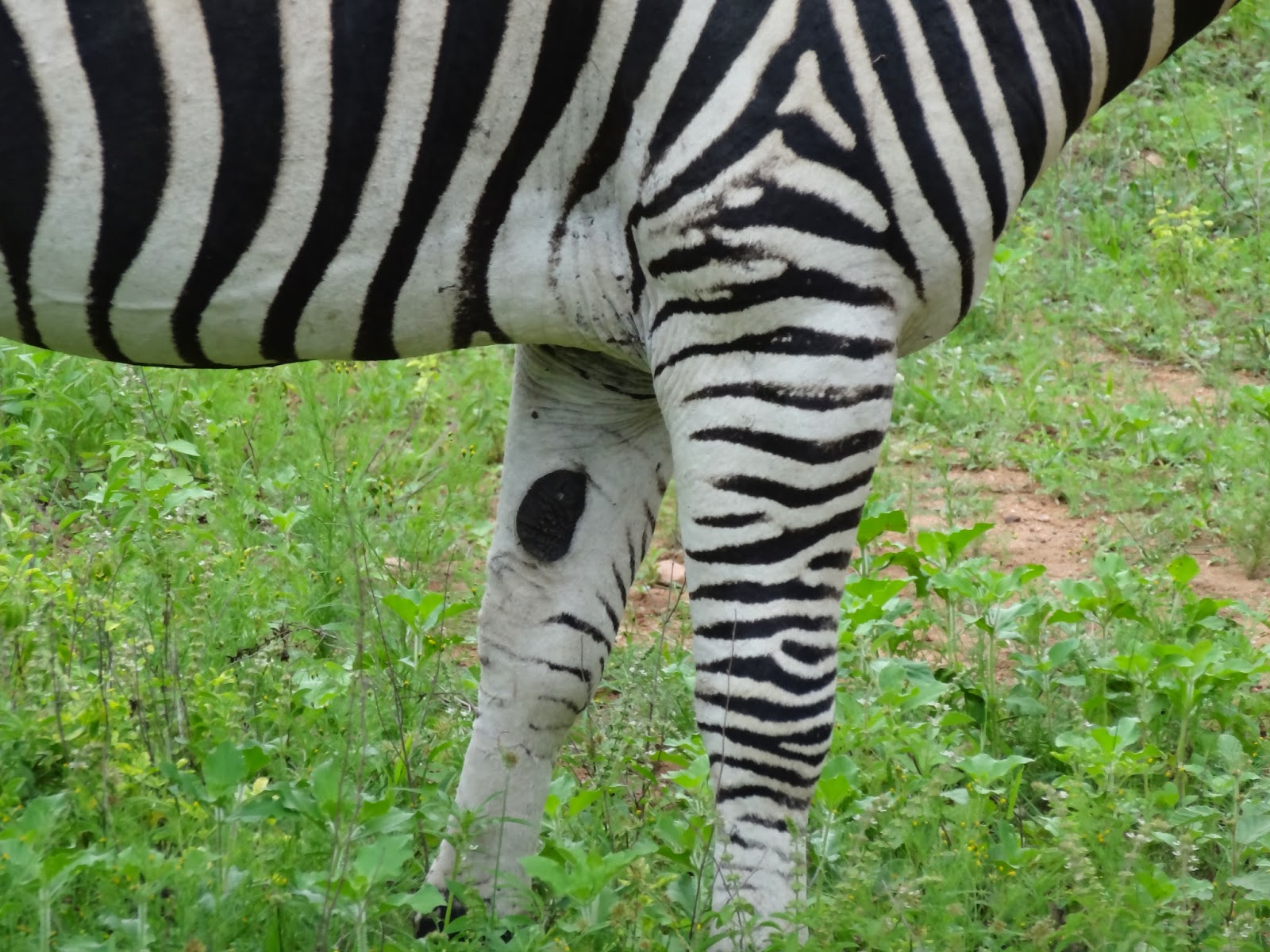 |
| Having never been so close to zebras in the past, we were curious as to these black spots on the interior of their front legs. |
 |
| The zebra’s unique stripes are comparable to an individual’s unique fingerprint. The black spots, protecting the legs from injury when at rest are equally as unique. |
 |
| The mineral lick has been appealing to the zebras and Kudu, so far. Warthogs and other smaller animals have little interest in it. |
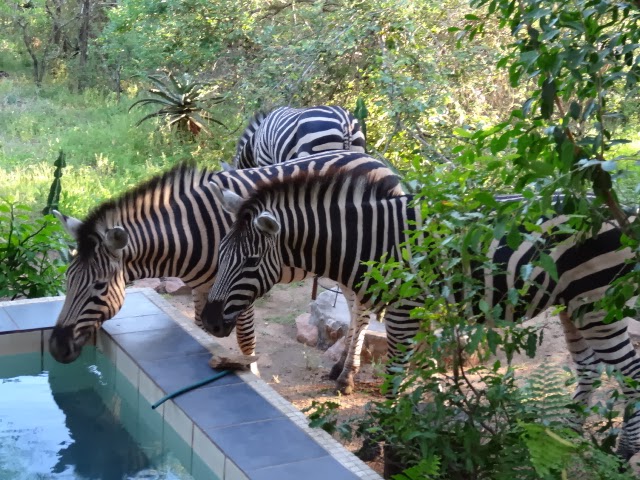 |
| Waiting their turn for a sip of water from the pool, occasionally kicking each other for dominance. All of the zebra visitors we’ve had thus far have been males. |
 |
| “My turn!” |
 |
| They couldn’t be more adorable. |
 |
| The Zebras seem to like munching on the greenery around this little tree. We’ve learned that wildlife doesn’t graze an area with the intent to “clean it out.” Instead, their instincts guide them to forage in an area for a short period and then move on to another area. Doing so, provides a continuous supply of food, especially during these rainy summer months. In the sparse winter months, the Zebras will dig up the roots of vegetation. |
Note: Typically, the holiday tourists begin leaving the area by January 10th at which point we’ll begin visiting some of the sites in the area. All the sites we’d like to visit are still swarming with tourists.
Also, it was one year ago today that we left the US (although we did return to various ports in Florida to wait to change ships to continue on our multiple cruises). Click here for the post from the day we left on January 3, 2013, writing about it on January 4, 2013.

 |
| This baby Mongoose is sticking close to Mom, who has an egg we left for her, in her mouth as they scurry across the yard. |
It’s ironic how our daily lives revolve around the arrival of visitors. Will we ever be able to stop scanning our surroundings every few minutes with the hope of spotting movement in the bush coming our way?
 |
| The baby Mongoose completely tucked under the mom to ensure safety. |
Staying as quiet and still as possible, I carefully reach for the camera with the least amount of movement, and we wait. Most often we’re seated, Tom in his usual pillowed Adirondack chair and me, in my usual equally padded plastic molded chair at the table. Standing up as we wait is usually not an option.
 |
| Louise and Danie suggested that we hold up an egg and show it to the Mongoose which Tom did, placing it on the ground nearby. Very shy, jerky motion must be avoided to prevent the Mongoose from running off. As soon as the Mongoose saw him put it down on the ground she immediately approached the egg. |
With baited breath we wait, when at a distance we spot the most subtle movement, asking ourselves if its only a wisp of a breeze or the guarded movement of an animal on its approach.
 |
| Within seconds of placing the egg on the ground, the mongoose went to work on cracking the shell. |
 |
| She managed to crack the remainder of the egg by banging it on the ground. She ate the entire contents including the spilled portion, leaving the shell behind. Later in day, the monitor lizard slithered by in a flash grabbing the empty shell but it moved too quickly to allow me to take a photo. |
With the protective railing around the veranda partially blocking the view, it’s necessary for me to stand to take most photos. Gingerly, I move one limb at a time in an attempt to stand, almost as if playing “pick up sticks” to avoid a sound or a single jerky motion which could easily scare off the least shy of the visitors.
With the two of us constantly on the lookout, it’s unlikely that we’ll miss an opportunity to view any wildlife in our extensive yard. When one of us goes inside the house for a few minutes, the other remains outdoors continuing the search.
 |
| This Pied Crow stopped by to check out a second, yet untouched egg we’d left in the driveway for the mongoose family, cracking it open with his beak. |
We never fail to quietly alert each other of an animal on the move, from the largest Kudu weighing 700 pounds, 318 kg, to the tiniest unusual insect. I must admit that it’s hard to leave during the day, fearful that the yet to visit wildebeest (other than a fast dash through the yard) or a much longed for a second visit from the giraffe which may occur in our absence.
 |
| A second Pied Crow appeared to keep watch while the first ate the egg. |
Silly, perhaps. But then, living in the bush with the animals is a once-in-a-lifetime opportunity, unless of course, that someday we’ll return. I can only hope that we will. I know that memories of this experience will loom in my mind with much longing for years to come.
 |
| Suddenly, a flock of persistent small birds started dive bombing the Pied Crow forcing his friend to fly off to chase the little birds and for him to move to another spot in the yard. In a state of anger or frustration the Pied Crow “fluffed” the feathers on his chest while making loud noises. A short time later, he was able to return to the partially eaten egg to finish his lunch. |
As I sit here now, Tom only feet from me, our favorite warthog family of nne has just departed after yet another laugh inspiring visit. Each time they arrive, we immediately take a head count to ensure that the seven babies have avoided the interests of a predator. With a sigh of relief, we chatter at them with our high pitched voices and toss a few pellets their way, both of which they readily respond.
 |
| The monitor lizard wanted in on the egg action. Elusive, fast moving and difficult to photograph, we’re always thrilled to see her. Check out that tongue. |
Surely, as the day wears on, we’ll continue to revel in the wonders of this magical place. The temperature is climbing and at some point we may be driven indoors to escape the summer heat and humidity. If so, we’ll continue to check the outdoors as often as every 15 minutes to see who has graced us with their presence.
Oops, I’ve got to go! There are zebras coming this way!

 |
| Mr. Kudu came to call! |
We’ve never intended to imply that living in the bush is easy amid all of our nearly constant entertainment from the wildlife and with the people we meet. In many ways, it’s definitely not for the faint at heart.
 |
| Giraffe in the neighborhood that we spotted on the way out of the driveway to go to the store. |
Perhaps living in the mountains of Italy in the summer and then Kenya in their late spring for three months toughened us. I assure you, had we gone directly from Minnesota to either of these locations, we may have turned around and gone back to the US.
 |
| Notice the Kudu’s head tipped up to grab a leaf from the tree near our carport. |
Perhaps it was our good fortune to have “worked our way” into tougher living conditions that brought us to where we are now, at peace and at home in the bush, but mindful of potential risks facing all visitors to this rough terrain.
 |
| This is the mineral lick we purchased for visitors that is recommended by the rangers as an excellent adjunct to the visitor’s natural diet of greenery. So far, the kudus are the only visitors that have tried it. The others sniff and walk away. We’d hoped this would attract wildebeests, yet to spend time in our yard, only running through on one occasion. |
Below are the adjustments that we have freely become accustomed to living in Marloth Park that others may find uncomfortable and unbearable. For us and many other tourists, the choice to visit Africa comes with the acceptance of challenges that one can choose to accept for the joy that Africa can bring in so many ways.
 |
| Kudu closeup was taken while I stood directly in front of him, behind the veranda railing. |
1. Gecko poop – It’s everywhere, including in the house. The thatched roof provides easy access for the Geckos to enter. Although harmless, they can be annoying, when last night one ran across the kitchen counter during the preparation of dinner. We see no less than six of them a day inside the house. Outside on the veranda, they are everywhere. We don’t care.
 |
| Our warthog friends visit frequently, now so, at ease, they’ve started napping in our yard. |
 |
| In the same manner, as beloved pets do, even warthogs tuck their chins onto their front “paws” when resting. |
2. Heat – It’s summer in South Africa. It’s not uncommon for the temperature to be as high as 100 F, 37.78C or more and humidity to be in the 80% range. In this house, there is AC in both bedrooms and the upstairs living room/loft. There’s no AC in the kitchen or main floor living room. We spend most of the day outside and only come inside to the loft when we need to cool off.
 |
| The family of nine still stops by almost every day. The other mom and one more baby were off to the side when taking this photo. The babies love looking at us almost as much as the moms. Each time they arrive, we take a headcount ensuring all nine are still there. |
3. Rain – It’s the rainy season now. Since we’ve been here it’s been cloudy five out of seven days a week. For those that require lots of sunshine, this may be an issue in the summer. We no longer have a tan or bother to try. The sun when it does shine is so hot it’s unbearable to lounge in a lawn chair. This is of little concern to us when neither of us bothered by rain or cloudy days. We do miss the visitors who seem to stay away on rainy days.
 |
| Upstairs in the loft with AC, in the awful heat a few days ago, we took kudu photos from the second-floor veranda as they looked up at us. Kudus can weigh 700 lbs., 317.5 kg, or more. |
4. Insects – They’re everywhere, zillions of them, though not inside the house as much as they were in Kenya. With no screens here, we keep the doors and windows shut constantly and keep our bedroom door closed at all times. With no mosquito nets here (Louise offered but we declined) we’ve found keeping the door shut helps. It’s still necessary to inspect shoes and clothing before dressing to ensure nothing lurks inside.
 |
| Kudus never seem to miss a photo op. |
5. Power outages – Although not as frequent as in Kenya, it does occur for short periods an average of once a week. We’ve learned to keep all of our equipment charged at all times allowing us to watch movies during a power outage.
 |
| The pink inside their ears, the one line across the bridge of their nose, the white mustache, and the white stripes on their bodies, make the kudu a particularly beautiful animal. Females kudus don’t have horns, the mustache, or the white stripe on the bridge of the nose. |
6. Bumpy roads – If a person had a medical issue that made driving on bumpy roads a concern, this environment would not be appropriate. Few roads are paved in Marloth Park. Driving around looking for wildlife is one seriously bouncy experience. We don’t give it a thought other than possible damage to the tiny pink car. Had we been willing to spend four times more than we paid, a 4 x 4, would have been a better option.
 |
| Zebra by the local watering hole. Others were nearby as we observed on our way to the store. |
7. Wild animals – The very essence of the joy of Marloth Park is the wildlife over which one must exercise consideration and caution around them. They are wild after all and could carry disease, attack if provoked or in the case of a few snakes and other creatures could inflict life-threatening bites and injuries. The closest medical clinic is a 30-minute drive.
Had we not experienced the four-hour rough and dangerous road in Belize, the hairpin turn roads in Tuscany, the bumpy roads in Kenya, we may have been less tolerant. Had we not been exposed to the endless noisy geckos in Belize, batted off the flies and bees in Tuscany, danced around the centipedes and other insects in Kenya, or experienced day-long power outages, we’d be less tolerant.
But, experience is a powerful teacher and by learning, we continue to glean something new and meaningful each and every day in one manner or another.Each day brings new challenges but with it, comes the exquisite opportunity to embrace life in the bush, so far removed from the life we lived only a short time ago. For this, we are eternally grateful. For this, we will never forget.

Yesterday morning, after getting comfortably situated on the veranda, coffee in hand, we were stunned as we noticed a new white foam ball on the tree above the pool, a few limbs from the now dissipating former white foam ball, that apparently failed to produce live offspring, much to our disappointment.
The following photos are shown in progression as they occurred beginning at 7:58 am, Saturday morning.
 |
| Look carefully to see the first foam nest on the left, and the new foam nest on the right. |
Excited to see this again, (click here to see our prior post on December 20th when we discovered the first white foam ball) I grabbed the camera trying to get as close as possible as we positioned ourselves on the edges of the pool. Before our eyes, the foam nest was being made as we watched it grow, totally in awe of this miracle of life.
 |
| This must have been one of the Tree Frogs that fell off of the small branch supporting the white foam nest into the pool, quickly working his way up the pool and then the tree, seemingly in a hurry to join in on the mating activities.
|
At the same time, we’d noticed a frog on the edge of the pool, making its way up out of the water, jumping in the tree, and quickly climbing to the nest. Within a matter of a few minutes, the nest was covered with Tree Frogs, no less than five males participating! It could have been more than the five, but their camouflage like appearance makes it difficult to see.

 |
| “Now we’re talking! Foam me up, Scotty!” |
 |
| An hour later, they started climbing off the foam nest, which appeared to have been well fertilized! |
With the mating process of the African Tree Frog lasting only a matter of minutes, it is indeed miraculous that we happened to be outside at precisely the correct time to witness the entire event from the veranda.
Good grief. May I say this yet another time? “Safari luck” once again kicked in. Will this batch of tadpoles survive? We don’t know. Most likely they won’t, with the chlorine in the pool plus the use of the pool filter, which we can’t turn off for the week it will take for them to mature. The pool could turn to green slime in a week’s time. After all, this isn’t “our” house.
So, we’ll wait and see what transpires once again and of course, report any results here. And, if we get lucky and mama tree frog gets lucky, her babies will survive, and her two attempts will not have been in vain.
Ah, nature, what a treasure! Keep it comin‘!
Yesterday morning, Danie stopped by to give us a list or more fabulous things to see in this astounding area. As if we haven’t been busy enough! We’ve had more activity in the four weeks in Marloth Park than we’ve had combined everywhere else we’ve visited so far.
 |
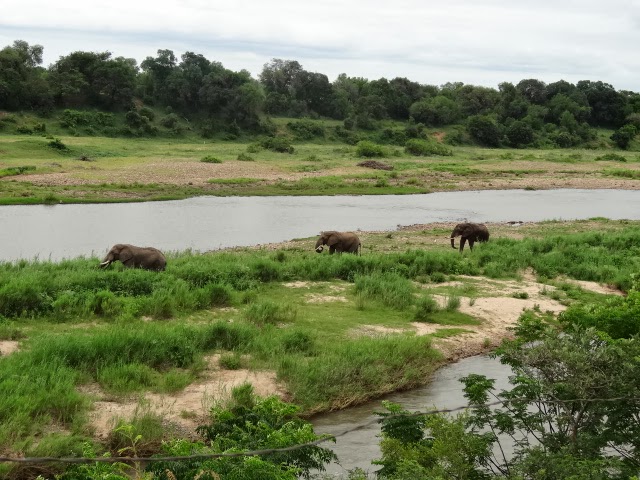
| The three elephants began their walk closer to where we were standing at the railing and the fence at the Marloth Park township public park where the viewing of the Crocodile River was stupendous. |
Keeping in mind that if we just stay home, the action often comes to us as it has this morning and it’s only 8:30 am as I write this. We’ll share that story tomorrow with some exciting photos and another of my shaky videos. (Bear with me folks. I’ll get better at this. That darned shoulder of mine makes it hard to hold the camera steady).
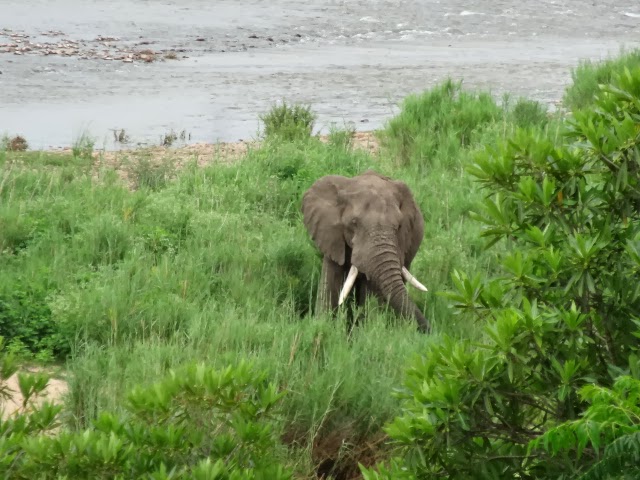 |
| Within a short period, they were in front of our lookout spot and we could easily enjoy their munching on the vegetation, often putting whole bushes into their mouths. elephants, herbivores, eat 100 to 200 kg, 220 to 440 pounds of vegetation per day. |
I know some may say, “Get a tripod!” I agree a tripod would be a nice tool, but we’re already at the edge of the luggage being overweight and plus, the action here happens so quickly there’s no time to set it up or manage a tripod when the action here requires much moving around to get good photos.
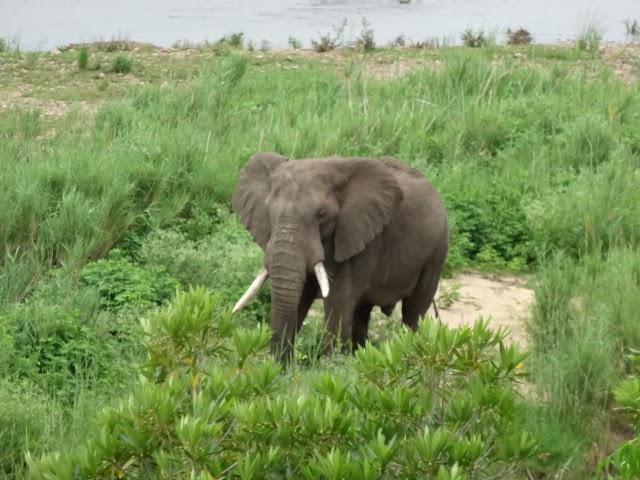 |
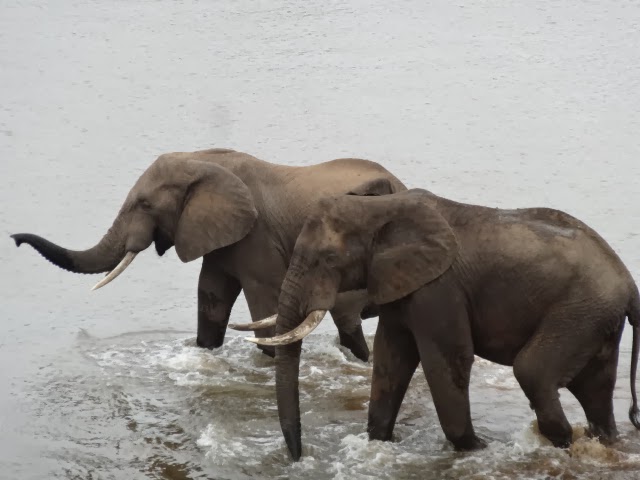
| After careful observation, we noticed that the leader of the herd was a female (cow) and the other two (clearly visible) were males (bull), one being younger, maybe her offspring. |
What transpired yesterday is that which we’re sharing today, another wondrous event.
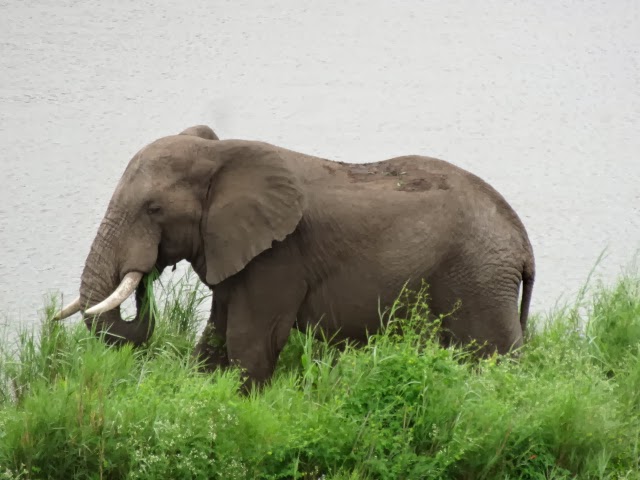 |
| This was the female leader. Normally, the dad doesn’t stay with the herd, instead, gathering into a herd with other males. We assumed the smaller male was her offspring based on the way she kept an eye on him from time to time. We were uncertain as to the role of the larger male, but we were certain there that they were two males. When they entered the water we were undoubtedly able to ascertain that they were both males, as their male organs were clearly visible sloshing in the water. |
Back to Danie. During his visit, he told us of a nearby campground that has an amazing lookout point, closer to the Crocodile River than the lookout we’ve visited twice in these past weeks.
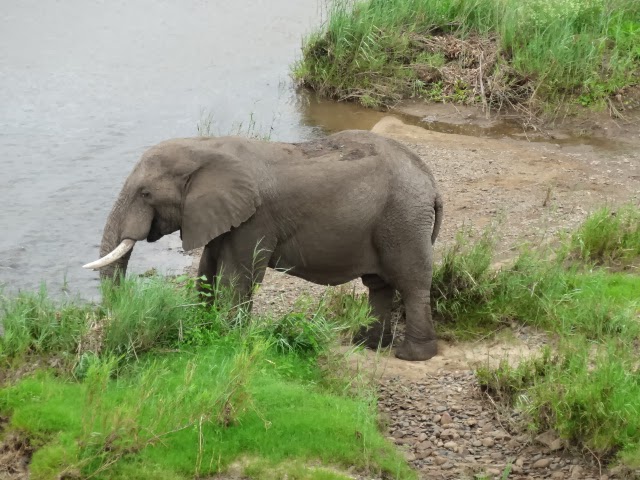 |
| Thirsty after consuming a considerable amount of food, the baby wandered to the shore for a drink. This is shown in the included videos. |
Shortly after he left, we jumped in the little pink car with an empty water bottle to refill at Credence Clearwater, a mile away on the paved road. After having the 20 liter bottle refilled at the cost of ZAR $18, US $1.76, we decided to check out the campground.
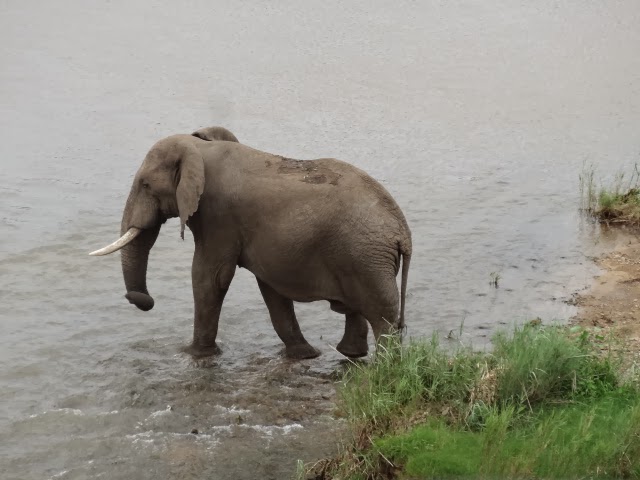 |
| Without drinking, suddenly the mom, the largest of the three elephants, entered the water, walking past the baby, and began walking to a nearby island. |
Marloth Park is not huge. It’s only 3000 hectares, 11.58 square miles. We had no trouble finding the township-owned campground, Tom having remembered seeing it on one of our many driving expeditions around the area.
 |
| Taking this photo without zoom gives a perspective of the small size of this island, somehow appealing to her for its varied vegetation. |
In a matter of six minutes, we entered the security gates of the public park, were stopped and asked why we were there, after explaining “to see the overlook,” we freely pulled inside to a veritable wonderland of meticulous grounds.
 |
| As soon as the two males noticed the female had moved over to the tiny island, they took off following her. At this point, we speculated that this larger male was perhaps an older offspring, yet to leave the safety of his mother. |
With the holiday season, the park (within a park) was filled with tourists. Many languished by the huge, clean swimming pool while others gathered at the outdoor pub with pool tables, bar stools and a casual burger and chips (fries) fast-food type restaurant. Others played games with their children or had picnics at the many picnic tables.
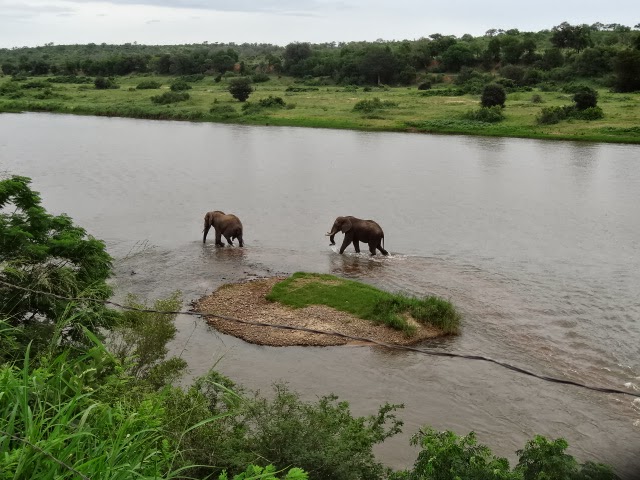 |
| When a group of tourists blocked my view, I was unable to get the photo of the mom leaving ahead of the males. |
We were excited to see that we could order an entire grilled chicken with chips to-go, if we’d like, for ZAR $70, US $6.86. Taking it home, Tom could eat the chips while we would add coleslaw and veggies for an easy dinner suitable for both of us. Most likely, we’ll return for this purpose on a night we don’t want to dine out or cook dinner which happens fro time to time.
After checking out the facilities, amid maneuvering past tourists soon to depart after the holidays, we made our way to the most appealing aspects of the park, the close-to-the-river overlook.
Within a few minutes, our “safari luck” kicked in and the action began as depicted in today’s videos and photos. How did we get so lucky? One can wait for hours at an overlook only to see a distant elephant, an occasional hippo head bobbing in the water, a slithering croc, or a cape buffalo along the Kruger Park side of the river.
These three videos say it all. Once again, we couldn’t stop smiling, having witnessed the behavior of these magnificent animals, the largest to roam the earth.
We’ll be back tomorrow with more, more and more. Gee, will we ever have a dull day in Marloth Park? We hope not. But if we do, we can always go back to playing Gin.

 |
| Not wanting to alarm this visiting kudu when we left the house to get into the car to go out for Christmas dinner, we interpreted this as a Reindeer visitor. Practically, holding our breath, we took this photo with the carport support post in the way in the hopes of not scaring him off. |
With no Christmas tree, no decorations, no gifts to unwrap, no big dinner to cook and no friends and family stopping by, it was a different kind of Christmas for us, living in the bush in South Africa.
The temperature in the steamy low 90’s F, 33’s C, it hardly felt like the Christmases we once knew and loved. We’re not complaining. It was different.
 |
| The kudu’s neck will enlarge during the mating season. From the looks of our visitor, mating season must be imminent. Look at the muscles on this big guy, males can weigh as much or more than 700 pounds, 318 kg. This one was smaller than many we’ve seen weighing perhaps in the 500 pounds, 227 kg range. Kudus can easily scale a 5 foot, 1.5 meter wall. |
And, different can be good, if one can find alternate means of enjoying the holiday season. Fortunately, thrown into our laps were two situations that proved to make both Christmas Eve and Christmas day special in a manner we never imagined.
Call it “serendipitous” if you will, or merely our good fortune. By Monday morning, we had no plans other than attending a midday buffet at Jabula Lodge, which was fine with us. By Monday afternoon, it all began to change.
 |
| View from Kathy and Don’s third floor veranda, overlooking the Crocodile River. |
Little did we know, we’d be invited for Christmas Eve to the home of Kathy and Don, people we’d never met, long time homeowners in Marloth Park, who’s gorgeous home overlooks the scenic Crocodile River for a fabulous evening of laughter and story telling of mutual world travels and more.
Little did we know, that as we walked out the door at noon to drive to Jabula Lodge for Christmas dinner, that a giant kudu would be standing at the edge of our carport staring at us, reminding us of a reindeer, it’s massive antlers swirling high into the air.
 |
| Kathy suggested we start putting food out for the bush babies whom we’ve yet to see in our yard at night. We’ve feared doing so may attract the destructive baboons, who love hanging out on our veranda when we’re not home. |
Stopping dead in our tracks, I slowly reached into my handbag to grab the camera. I was so excited, I could barely take a good photo. Nonetheless, albeit less than ideal, with the pole in the middle of the shot, we got a few. For 15 minutes, we watched him as he lumbered about our yard, nibbling on the lush vegetation, finally taking off into the deep bush and no longer visible.
As we drove off Tom claimed, “Oh, I arranged that for your Christmas gift.” I chuckled, saying, “There’s no gift that I’d have enjoyed more.”
Little did we know, a short time later when we arrived for the buffet at Jabula Lodge that we’d be seated with yet another fabulous couple, Piet and Hettie, also Marloth Park homeowners, with whom we spent the better part of the day enjoying fabulous conversation. Later, we hugged goodbye, with hopes of getting together again before they leave to depart for their second home, a three hour drive from Marloth Park.
 |
| We’ll never tire of the adorable face of a giraffe with its cheeks stuffed with greenery, this one captured in our neighborhood. |
As we returned home, we couldn’t wipe the smiles off of our faces. In awe, not only in the wildlife visitors in Marloth Park, but also in the realization that people in Marloth Park are unlike any we’ve met anywhere, friendly and open to making new friends.
After returning home, we watched a movie from Graboid, “Captain Phillips, a story about pirates boarding and taking over a cargo/container ship out to sea in the Gulf of Aden.
It was in this exact location that we’d sailed on May 17, 2013 with the necessity of sharp shooters boarding our ship with automatic weapons to secure our sailing through the Gulf of Aden, as told in our story at this link. Watching this movie brought it all back for us, an adventure we’ll never forget.
Little did we know, that traveling the world would present situations, people, culture, wildlife and nature to us in a manner we could never have anticipated. For us, this has been the gift that “keeps giving” for which we are eternally grateful and for which, we promise ourselves, that we’ll never stop appreciating. Little did we know

 |
| Not quite a reindeer! This duiker tentatively looked at us through the bush. They are “very shy, elusive creatures with a fondness of dense covers” most often traveling alone. |
Merry Christmas to all of our readers, the actual day of our 500th post!
It’s hard for us to believe that it was on March 15, 2012, when we wrote our first post. Here’s the link to that first entry which seems so very long ago. Much has changed for us; our circumstances, our priorities, our resilience, and our tolerance for discomfort.
We’ve learned more during this period of time than either of us had learned since our school days. We’ve taken risks that we’d never imagined possible. We’ve witnessed events, we’d never imagined we would see. We’ve learned to remain calm when in the past, we’d have run around in circles, frantically and unfocused.
We’ve learned the value of patience, the avoidance of preconceived notions, and the ability to be more tolerant of others. We’ve learned to communicate when we don’t understand the language, knowing that kindness goes a long way in any language.
 |
| A lone giraffe on a walk along a road in Kruger Park. Our guide, waited patiently for him while he took his time moving out of the way of our vehicle. |
We’ve learned to “go without,” to make use of what we have on hand, and oddly, we’ve learned to become minimalists, reveling in “less is more.” Letting go of the need for “stuff” has reshaped our lives.
We’ve found ways to entertain ourselves without TV, although we both thrive on keeping our brains active with some favorite interesting shows as well as the profound absorption of science, geology, history, biology, and more as we research any morsel that piques our interest.
Yet, through all of this time, since the first day that we wrote here, we’ve been humbled by how much more we have yet to learn, to experience, and to explore.
In the process, we’ve accepted that we have some limitations due to our age and condition and the fact that there are certain creature comforts we’re not willing to forgo, such as sleeping in a bed, being able to shower each day, eating, and drinking safe and healthful food and water.
We’ve never been interested in staying in hostels, sleeping in ordinary tents, carrying backpacks, and trekking through mountainous terrain. We don’t do zip lines, bungee jump, or white water rafting or take unnecessary risks that could potentially put an end to our travels.
We continually strive to protect our health, our well-being, and our emotional strength and resiliency. And above all, we treat our relationship with one another with great respect, consideration, kindness, and love. Without that, we couldn’t go on.
We continue to write and post photos almost every day. In the beginning, we wrote every few days. Since leaving the US, we’ve posted almost every day with no plans to change that in the near future.
Although few of our readers have officially “joined” our site to receive an automatic email each time we post, our readership is now in the 130,000 range with this month of December being our highest readership ever. Most of our readers prefer to click the link or their bookmarks to find us each day at their leisure.
We thank each and every one of you for sharing this journey with us. As we approach the New Year, we hope you’ll continue to read our posts as more and more diverse experiences unroll in our path.
No words of mine can better express our intentions than those of poet Robert Frost in his poem, “Stopping by Woods on a Snowy Evening” and in his words, “And miles to go before I sleep.”

Merry Christmas to all.

 |
| In our travels, we’ve found that “two heads are better than one!” We were so close to these rhinos that it took our breath away. |
Without a card to give to him, a gift for him to unwrap, Tom’s 61st birthday could potentially be a letdown. But, it won’t, if I can help it.
 |
| Only minutes after commencing the game drive, we drove over the Crocodile River to spot these Hippos. |
 |
| Although we were facing the bright afternoon sun, we were grateful to get the Hippos photos. |
 |
| One last shot as we pulled away. |
Yesterday afternoon’s game drive in Kruger Park fulfilled our now deep-rooted expectations after the hard-to-match experience we had in the Masai Mara only a few short months ago. The photos we’ll share today will show why.
 |
| A small crocodile in the Crocodile River where no boating is allowed due to the viscous predators. |
 |
Throughout the game drive, we saw many wildebeests. This was the first time we’d seen baby wildebeest. |
 |
| An hour into the game drive, we spotted rhinos. |
 |
| Thanks for turning our way rhino. |
 |
| The situation with rhino poaching is a serious issue worldwide. In Kruger Park alone, there were 425 killed in 2012 with 2013 stats coming out soon. When a mother Rhino is slaughtered, the babies are left to die. We’ve seen armed guards moving quickly along the roads in the park, on their way to a possible poacher being sighted. They are shot on site, hoping to deter future poachers. It’s been proven that the horn of the Rhino has virtually no medicinal benefit and yet millions worldwide believe otherwise. These amazing animals will be extinct in the near future if their senseless slaughter isn’t stopped. |
Our first time in Kruger Park a few weeks ago was disappointing, as we’d posted here a few weeks ago. Expectations were high when sightings were mostly birds. Don’t get me wrong. We like birds.
 |
| She’s got something in her mouth. |
Yesterday, once again, “safari luck” kicked in!
Nothing flips our hearts over in our chests more than the sighting of an animal in the wild and the opportunity to take a photo in order to recall the experience at any time in the future. As we began to tour the park in the huge game vehicle loaded with 19 participants and an excellent driver/guide, Dion, we were surprised how few participants were taking photos.
 |
| Next game drive we’ll go in a smaller group, allowing ample time to wait for the best photos. I would have waited for this ostrich to pick up its head, but the others preferred to move along. |
 |
| We never tire of seeing giraffes and look forward to them visiting our house again after the tourists leave Marloth Park after the holidays. It’s apparent the increased traffic and people have had a bearing on the number of visitors to the houses. |
 |
| Our guide, Dion, explained that this giraffe was no more than three or four months old. The oxpecker birds take up residence on the youngsters as well. |
 |
| This female, evidenced by the hair on the little horns, had three oxpecker occupants. |
 |
| The giraffes graceful legs are surprisingly powerful. |
 |
| From afar, a lone giraffe against the backdrop of the African bush. |
The elegant “bush braai” hosted again by Louise and Dani was as equally enjoyable as the last experience, the food hot and delicious, the wine and beer freely flowing and the service was impeccable. Our table mates were fun and the conversation and laughter never ceased.
 |
| As the sun began to set, it became difficult to spot any wildlife. Dion handed out three torches or spotlights handing them to participants who wanted to scan the surroundings for wildlife in the dark. |
 |
| The setting sun in Kruger Park. |
 |
| These Citronella filled lanterns at the bush braai kept the insects off of our plates and out of our food. |
This morning we headed to the Farmer’s Market to pick up our cabbage and carrots, but they hadn’t yet arrived from the farm. This afternoon, we’ll return, hoping they’ll be available.
 |
| Check out this creature that joined us for the bush braai. |
 |
| Closeup, taken in the dark. |
With too many photos from yesterday to post in one day due to the Internet traffic, we’ll spread them out over the next several days.
Hope you’re all enjoying the holiday festivities as we rapidly approach Christmas. Stay safe, stay warm, be healthy, let happiness and love envelop your hearts, now and always.

