Part 2…Irish history…Connemara Heritage and History Centre…Marconi and the first telegraph station…

From this site: “In 1896, Marconi, just 21, left Italy for England, where he hoped to drum up interest in a contraption he had invented: a box that could send Morse code signals across a room without any connecting wires. This was, quite simply, the first transmission of information by radio waves. Marconi called it “wireless telegraphy” — an improvement on the dominant technology of the day, the telegraph.”

“Fascinating Fact of the Day About Ireland”
“Irish
weddings are elegant and large celebrations. Grooms dress in kilts that signify
their family’s clan, while brides dress in white to signify their purity.
Family members travel far and wide to attend weddings, and the receptions are
always massive celebrations involving beer and music.”

                 
Today, we’ve included several photos of historical items we discovered at the Connemara Heritage and History Centre. The rich history of Ireland will continue during our remaining time on the island. Yes, Ireland is an island. At times we can imagine it is connected to other European countries: “Ireland is an island in the North Atlantic with Just under 4.8 million living in the Republic of Ireland and just over 1.8 million live in Northern Ireland.

The small theatre at the Connemara Heritage and History Centre where we watched a movie about Connemara.

Northern Ireland and the Republic of Ireland are two distinct countries: “Ireland or the Republic of Ireland as it is officially named is now a completely independent country and has no longer any formal bond to the UK. On the other hand, Northern Ireland is still a part of the UK (the United Kingdom of Great Britain and Northern Ireland), together with England, Scotland and Wales.”

Items used in distilling.

Ireland became part of the United Kingdom in 1801. The British government was forced to partition the six most northeastern counties of the new Irish state to form Northern Ireland in fear that Protestant civil unrest in Ulster would otherwise turn into a civil war against the new state.

These two glass cases contained a variety of items used in daily life in Ireland, many from centuries ago.

Ninety years ago, Ireland was split in two after people living there went to war against their British rulers. The south became a separate state, now called the Republic of Ireland. But the break-up led to decades of unrest and violence in Northern Ireland, which remained part of the UK.
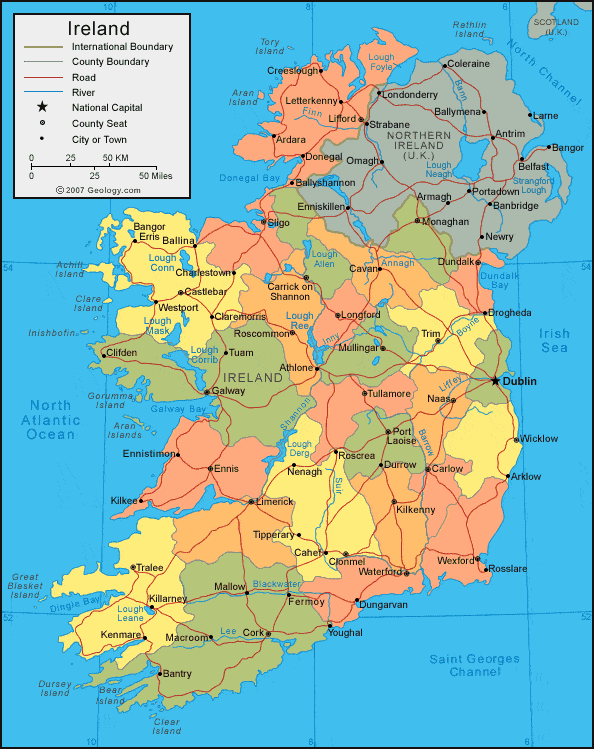
Ireland Map and Satellite Image

I must admit I was ignorant of some of these facts. I had no Irish heritage; I paid little attention to its history, battles, and lifestyle. Now, living here I’ve taken an interest in learning as much as I can, as often is the case as we travel from country to country.
Ireland has quite a history of uprisings beginning in 1534 as listed at this link.
Tom, on the other hand, is a wealth of information based on his interests in history and Irish ancestry. After taking a DNA test a few years ago, it was determined he was nearly 100% Irish which is more than many who’ve lived their lives on the island.

Fortunately, I can readily ask him questions that arise in our day-to-day lives and gather more detailed information through online research. We both share our curiosity and desire to learn something new each day we are here.

A variety of pots, trunks, and utensils used in Irelands over the centuries.
With only 76 days remaining in our time here, we hope to get out more and more as I continue to heal. Several of our devoted readers, including loyal reader Adele, whom we met with her husband, Wally, in May 21013 at a hotel in Barcelona as we all waited for an upcoming cruise to the Middle East, wrote to me last night inquiring as to how I am doing.
Connemara marble is described as follows from this site: “Connemara is bounded on three sides by the Atlantic Ocean and encompasses a wide variety of natural and semi-natural habitats, reflecting its great geomorphologic and geological complexity. It also has diverse economic resources. Among the more unusual are extensive deposits of soapstone and veins of green marble and vivid white quartz. In Neolithic times, the green marble was traded as far away as Lough Gur, County Limerick, and possibly to the Boyne Valley. ‘Connemara Marble’ is a serpentine-rich rock, popular since ancient times as a decorative facing stone. With its ‘forty shades of green’ and its wild patterns, it perfectly represents the Emerald Isle’s landscapes. Connemara Marble inspired artists, architects, and artisans throughout the world. Jewelry and other small objects such as key rings, coasters, and crosses are also made with this unique stone.”
I hadn’t mentioned anything for several days, assuming our readers were tired of reading about my health. I’m tired of my health as well! For an update…we continue to treat the remaining open wound on my left leg every two days. It is healing albeit slowly. As mentioned earlier, it could be a few months until it fully heals.
The first commercial telegraph station was in Ireland.
In the interim, I am feeling relatively well, continuing to walk daily but have yet to reach my goal of 10,000 steps in one day. A few days ago, I made it to 9500 degrees, but my legs felt heavy and weak the next day.
Various tools used in fishing and farming.
When we visited the Connemara Heritage and History Centre, we ended up walking up a few steep hills. I paid dearly for that, not with my heart racing which handled it fine but with my legs. After all, it was only 56 days ago. I had a second surgery on both of my legs.  

Generally, one is expected to be ambulatory after any surgery within eight weeks. I hope by continuing improving by walking which will aid in escalating the healing process.

An old sewing machine and statue of an Irish woman.
Many have commented I’m pushing it too hard this early on. But, forcing oneself to exercise regularly requires discipline and determination, and pushing ahead, works best for me. I’m not hurting anything in doing so, just occasionally having to step it back a little.
 
I am now able to cook and perform most household tasks. I no longer have to rely on Tom to do everything for me other than help with the continuing treatment on my left leg every other day.  
Note the date of this poster, June 15, 1728, offering a reward for capturing two “highwaymen,” robbers who stole from travelers.
Tom carries items upstairs to leave my hands free to maneuver the steep spiral staircase when going up and down.  Of course, he helps with meals, does all the dishes, and participates in various household tasks.
 
Hopefully, soon we’ll get out more often. For now, I am pacing myself as I continue to recover.
 
Thanks, Adele and all of our other readers who’ve inquired and continue to read my endless descriptions of this difficult and challenging healing process. We’ll stay in today.  The wind is blowing fiercely and its raining. 
 

Have a fantastic day and above all, be well. 

Photo from one year ago today, May 27, 2018:

Frank and Mrs. Frank had been busy working at building a nest in the bush in our yard. But, they never had a single chick while we were there.  For more photos, please click here.

Part 1…Irish history…Connemara Heritage and History Centre…

The entrance to the Connemara Heritage and History Centre is located near Clifden.

“Fascinating Fact of the Day About Ireland”
When children are little, each birthday, it is traditional to pick up the child, turn
them over, and bump their head gently on their birthday cake. The child’s head
is bumped once for each year they have lived. It is believed that partaking in
this tradition brings good luck and good fortune to the child.”

Yesterday, upon arrival at the Connemara Heritage and History Centre, we took photos of the exterior. It was a rainy and misty day prompting up to visit an indoor venue, but we weren’t disappointed when we entered the gardens, which we had no idea were so lovely and worthy of photos, rain or shine.

Beautiful flowers lined the parking area.

A sunny day would have been ideal for many of the photos we’ll share here over the next few days. But, we decided we won’t keep the weather from preventing us from getting out and about unless it’s raining heavily.  The narrow winding roads are dangerous enough on sunny days.

A tractor pulling a trolley car is used for tours to the center.

Once we paid the senior discounted entrance fee of Euro 7.5, US $8.40, and walked through the shops, we were escorted to a small movie theatre where we watched a 20-minute video on the history of Connemara, including the sorrowful story of Dan O’Hara, a local man, and his family who’s life story is heartbreaking.

Numerous streams are running through the scenic grounds of the center.

Many farmers and families enjoyed a good life, although not easy, in Connemara up until the Great Famine, as described below from this site:

“The Great Famine, or the Great Hunger, was a period in Ireland between 1845 and 1849 of mass starvation, disease, and emigration. Wikipedia
Start date: September 13, 1845
End date1849
Impact on demographics: Population fell by 20–25% due to mortality and emigration
Did you know: Great Irish Famine is the second-deadliest disaster in Great Britain and Ireland by death toll (1,000,000 to 1,500,000).”
We were overlooking a stream.

In part, the video we watched focused on the Dan O’Hara family, the history of which must have been passed down over the generations. The Connemara Heritage and History Centre dedicated the facility to his and his family’s memory with grace and dignity.

The center is located within a 20-minute uphill walk on a rocky road to the remainder of the homestead and barn of Dan O’Hara.  Fortunately, we were able to drive to the historic home and grounds.

Once indoors, we paid the entrance fee of Euro 7.5, US $8.40, the senior rate.

Over the years, private and well-known public figures from around the world have dedicated the planting of a tree to the grounds, as stated here from the center’s website:

“Plant Your Roots in Ireland

Dan O’ Hara’s Homestead, the award-winning Connemara Heritage & History Centre, has been welcoming visitors from all over the world for many years. Situated in the Gaeltacht and dedicated to the memory of the immortalized Dan O’ Hara. They and his wife and seven children were evicted from this homestead by his landlord in 1845. Along with so many more people from Connemara and Ireland during this era, he was forced to immigrate on the coffin ships to the US.”
The restaurant was quiet at 10:30 am. Indeed during tours, this facility would have been busy.

“Unfortunately, his wife and 3 of his children did not survive the journey, and needless to say, he arrived in New York, a very broken man. Dan O’ Hara’s homestead offers a unique insight into the life and times of Connemara during the 19th Century along with the history of the region, not to mention a verse of the renowned Ballad Dan O’ Hara.

As part of our commitment to the continued and sensitive development of the Connemara Heritage & History Centre and Dan O’ Hara’s memory and those of the many Irish who were forced to leave their homesteads for America, we have developed “A Roots from Ireland Park.”

The Irish wear sweaters, flannel shirts, and fleece-lined jackets to stay warm in the cool summer months and snowy winters.  We have sufficient warm clothing with us and didn’t make a purchase.

“Here, we will plant indigenous Irish Trees, Ash, Alder, Hawthorn, and Sycamore Trees which can be dedicated to your ancestors, a family member, or a good friend. A personalized plaque at the foot of the tree will accompany each tree planted, and the person for whom it is chosen will receive a Certificate of Ownership for their home or office wall.”

Ironically, the song mentioned above, Dan O’Hara, was sung by Finbar Furey at the Minnesota Irish Fair on August 8th, 2015.  The link for the song may be found here at this link.

More in the gift shop, filled with Irish memorabilia and trinkets of high quality.

Both of us were touched by this sad story, and when we left the center’s main building and gardens to visit Dan O’Hara’s home and grounds, it all had a special meaning, especially to Tom.  

As we’ve mentioned in the past, Tom’s ancestors are from Ireland, many from nearby counties, and many who immigrated to the US from the 1830s to the 1850s as they escaped the devastating famine and sailed across the sea after considerable loss of loved ones and a life of hard work on the land.
These 30 breeds of sheep may be found in Ireland.  We’ve already encountered several.

Tomorrow, we’ll return with more photos and a history of the life of the people of Connemara. It is indeed remarkable to learn about the island of Ireland and its rich history and determined people.

For our loved ones and friends in the USA, have a safe and meaningful Memorial Day weekend. For our friends throughout the world, enjoy the weekend and holidays in your countries at this time.


Photo from one year ago today, May 25, 2018:

A face of a cape buffalo only a mother could love spotted in Kruger National Park. For more photos, please click here.

First “out of the car” sightseeing outing in over three months…”Cruising on down the road”…

Cashel Catholic church, not far from us.

“Fascinating Fact of the Day About Ireland” 
The Irish drinking song “The Hills of Connemara” has been recorded and performed by several Irish and Celtic-themed bands.

Today was the first time in over three months that we went out on a sightseeing tour. I haven’t felt motivated or energetic enough to engage in the walking often required on such tours during my recovery period.

Low rocks walls line most of the properties in Connemara.

In this past week, as I’ve worked toward my goal of walking 10,000 steps a day (the highest day was 9500. I’m working on the rest!) while doing a series of circuit training type exercises in the process using household items as props.

As it turns out, there isn’t a fitness center nearby, not within an hour’s drive. There’s no way it makes sense to drive two hours a day to go to a fitness facility when I can exercise at “home.”
Cattle on the side of the road.

Thank goodness for this past week’s exercise. Had I not done it, there’s no way I’d ever have been able to participate in any self-tour. Not only was there a lot of walking and standing within the facility, but with many outbuildings, a garden, steep rocky walks, and hills to navigate, it would have been impossible.

Most patients three months after cardiac bypass surgery can engage in such activities since they began walking right after surgery. For me, the leg infections and two additional surgeries prevented me from walking and exercising up until a little over two weeks ago.

Chaiseal describes a “stone fort” in the Irish language.

One of our kindly readers/friends wrote to me concerned I am too hard on myself by attempting to catch up so quickly. But, I decided if I could do without strain, to proceed without fear and excess caution.  

A few days ago, when I managed the 9500 steps in one day, I was elated but exhausted. Never during the walking itself did I struggle. I only had to ease back a little the next day to 7500 steps when my legs were tired.  Today, with our outing and the climbing up and down hills, I should accomplish around 8000 steps, again striving for the higher number.

View across the bay.

I have to remind myself that walking the 10,000 steps is equivalent to walking over eight km, or approximately five miles. A little over two weeks ago, I gave up using a walker and had trouble easily walking across a room without holding on.

Our bodies are amazing. They so much strive to homeostasis, described as: “The tendency towards a relatively stable equilibrium between interdependent elements, especially as maintained by physiological processes.”  Our bodies strive to be well. We need only to pay attention to this process.

View across an inlet, a bit tilted to avoid the car’s side-view mirror.

I don’t have all the answers. I only know my situation, and it may be entirely different from others in a similar position. All I know is I am bound and determined to be as healthy as I can be based on the fact I still have bad arteries throughout my body, a genetic condition over which I have little control.

When we returned to the house after the tour, this late in the afternoon, I wasn’t up to preparing a detailed story about the history of Connemara, its people, and its heritage. Tomorrow is another day, and after a good night’s rest, I’ll be looking forward to sharing our photos (of which we took many) and the exciting history of this area.

We’ll be back tomorrow with much more…

Happy day!

Photo from one year ago today, May 24, 2018:

This warthog we spotted in Kruger had tusks that were almost a full circle. For more Kruger National Park photos, please click here.

The simple life…Ireland elicits a slower pace…

This morning’s catch when John stopped by with fresh-caught Atlantic salmon, a container of crabmeat, and another container of prawns. The cost for the above was Euro 25, US $27.85. There’s enough salmon for three meals and a fourth meal with the crab and prawns on a lettuce salad. The average cost per serving is Euro 6.26, US $6.97. We paid John the Euro 14, US $15.60. We owed him from last week’s fish. I asked if he could bring salmon each week. Tom doesn’t care for fish, so I’ll happily enjoy every morsel.

“Fascinating Fact of the Day About Ireland” 
“Northern Ireland is governed by the United Kingdom, while the rest of Ireland is an
independent nation.”

Living in Ireland is very different from anywhere we’ve lived after over 6½ years of world travel. The environment, the people, the chosen pace of peace, calm and good humor is present in every situation we encounter.

Today’s mist and clouds over the sea.

This is appealing. Thank goodness we have this website requiring new photos daily and a goal to research Tom’s ancestry. Otherwise, we’d be so content. We’d hardly go out other than to shop and dine out on occasion.

We’re far from many restaurants, but we’ll go out to dinner more often now that I’m beginning to feel better. Since our arrival on May 12th, we’ve only dined out once.

A gate to a private drive or boat launch.

We’ve so enjoyed the wide array of fantastic food products from the SuperValu supermarket in Clifden that cooking has become such a treat. We can now find ingredients we like to use that we never could find in the Spar Market in Komatipoort.

Now that I can cook again, we’re making a few more interesting dishes I didn’t burden Tom with when cooking all the meals by himself. That’s not to say he’s not helping.  

Many homes in the countryside have a similar look and are very old.

He’s right beside me in the kitchen doing all the “heavy lifting,” including washing dishes, hauling food and pots back and forth to the laundry room where the second refrigerator and another bigger sink are located.

This morning feels like a typical Irish day. Ann, the lovely house cleaner, arrived at 9:30 am informing me that she’d lit a candle at her church for my continuing recovery. How sweet is that?

Fishing boat in the bay.

Moments later, Eileen, the house owner who lives in the house next door, also stopped by. They both possess a wealth of fascinating information about Connemara and Ireland in general. We love their accents, warmth, easy smiles, and enthusiasm.

We’d planned to head out today, but it’s raining, not uncommon for Ireland. Also, Eileen called the fish guy, John, to determine if he was coming by today. He stopped by before noon. Note the above photo and caption for further explanation.

We paid John the Euro 14, US $15.59, from last week when he’d insisted we took some fish when the package had yet to arrive containing our new debit cards, leaving us with no cash (euros in Ireland).

A boat at the organic salmon station.

After the ATM cards had arrived, we immediately drove to Clifden to an ATM to get enough cash to last for quite a while. Weekly, we pay Ann Euro 60, US $66.82 for three hours of housecleaning, the highest we’ve ever paid. That’s not to say she isn’t worth it. She does a meticulous job.  

We’ve been spoiled. Housekeeping wasn’t included in the rent as it was in South Africa, where we had two cleaners, Zef and Vusi, each day of the week. But, knowing we have a cleaner only once a week, we’re diligent about keeping the house tidy and organized between Ann’s visits.

No, we don’t have a social life here yet and may not be able to make lifelong friends here as we did in Marloth Park, many of whom we are staying in touch, particularly Kathy and Don, Linda, and Ken (we spoke on the phone yesterday) and Louise and Danie.

Now that I’m beginning to feel better, we’re planning on getting out more. In the interim, this simple life is suiting us just fine.

Happy day!

                            Photo from one year ago today, May 23, 2018:

This was our first sighting of a good-sized herd of cape buffalo we spotted from Marloth Park yesterday on the banks of the Crocodile River. There were from 24 to 30 in the herd. For more photos, please click here.

The scenic beauty continues as we get out more and more…

At every turn, the scenery is breathtaking.

“Fascinating Fact of the Day About Ireland” 
“Most Irish people believe that fairies exist. In their culture, fairies have magical
powers and bring happiness and great things to families.”

The scenery from every turn in the road, let alone the views from the windows in our holiday home, are nothing short of spectacular. This morning overcast and cloudy with rain predicted, is still gorgeous as the clouds gather around the mountains known as the “Twelve Bens.”

Wildflowers are often found blooming on the side of the road, especially this time of year as summer nears.

From this site:
The Twelve Bens or Twelve Pins (Irish: Na Beanna Beola; the peaks of Beola) is a mountain range of sharp-peaked quartzite summits and ridges located in the Connemara National Park in County Galway, in the west of Ireland.

Topographically, the range is partnered with the Maumturks range on the other side of the Glen Inagh valley (a Western Way route). The highest point is Benbaun at 729 meters (2,392 ft). The range is popular with hill walkers, rock climbers, and fell runners. The 15–kilometer “Glencoaghan Horseshoe” (Irish: Gleann Chóchan) is noted as providing some of the “most exhilarating mountaineering in Ireland” and “a true classic.” A more severe undertaking is the 28–kilometer “Twelve Bens Challenge,” climbing all bens in a single day.”

The plural word for a group of sheep is flock, dove, or herd.  An extensive group of sheep is a band of the mob.

Now, as I write here, I can see the “Twelve Bens” from the house as we gaze across the Bertraghboy Bay. On any cloudy day, we can peer out the window to see the fluffy clouds leaving trails of mist over the mountains.

Views are even more spectacular on sunny days as soon as in a few of today’s photos.  We often choose to take a drive when it’s a sunny day to enhance the quality of our photos. But, still, there remains the magic and mystery of clouds filling the skies on days of predicted rain, such as today.

An abandoned boat in part covered in vegetation creates this classic scene.

Tomorrow, when lovely Ann, our house cleaner, arrives at 9:00 am, we’ll let her inside and take off to explore areas of Connemara we’ve yet to see, of which there are many. Connemara is described as follows:

From this site: “Connemara (Irish: Conamara; pronounced [ˈkʊnˠəmˠəɾˠə]) is a cultural region in County Galway, Ireland. The area has a strong association with traditional Irish culture. It contains a major part of the Connacht Irish-speaking Gaeltacht, which is a key part of the region’s identity and the country’s largest Gaeltacht.”

Rocks are seen everywhere in Ireland.  From this site:  “The geological map of Ireland displays a wide variety of rock types which have originated at different periods of geological time. The oldest rocks are metamorphic gneisses which are to be found on Inishtrahull, several miles off Malin Head in Co. Donegal, and elsewhere in the north-west. They originally formed as igneous rocks 1750-1780 million years ago.”

“One common definition of the area is that it consists of most of West Galway, that is to say, the part of the county west of Lough Corrib and Galway city, contained by Killary Harbour, Galway Bay and, the Atlantic Ocean

Some more restrictive definitions of Connemara define it as the historical territory of Conmhaícne Mara, i.e., just the far northwest of County Galway, bordering County Mayo. The name is also used to describe the Gaeltacht (Irish-speaking areas) of western County Galway. However, it is argued that this too is inaccurate as some of these areas lie outside of the traditional boundary of Connemara.”

Ireland consists of many boggy areas, which are prevalent here in Connemara.

There are arguments about where Connemara ends as it approaches Galway city, which is not in Connemara — some argue for Barna, on the outskirts of Galway City, some for a line from Oughterard to Maam Cross, and then diagonally down to the coast, all within rural lands.

The broader area of what is today known as Connemara was previously a sovereign kingdom known as Iar Connacht, under the kingship of the Ó Flaithbertaigh, until it became part of the English-administered Kingdom of Ireland in the 16th century.”

Clouds reflecting on a lake.

The population of Connemara is 32,000. There are between 20,000–24,000 native Irish speakers in the region, making it the largest Irish-speaking Gaeltacht. The Enumeration Districts with the most Irish speakers in Ireland as a percentage of the population can be seen in the South Connemara area. Most Irish speakers are of school age (5–19 years old).”

There is so much for us to learn about Ireland, the birthplace of Tom’s ancestry.  Soon, we’ll begin visiting some of the towns/counties from which they originated.

In the meanwhile, we’re so much enjoying our sunny day drives through the winding, hilly roads, occasionally encountering a one-car road or bridge.  One must be extra careful driving through the area with many blind spots and farm animals standing, walking, or sleeping on the road.

Today, we’ll stay in.  We’re making mozzarella-ball stuffed meatballs with a red sauce and sprinkled with parmesan cheese, along with grilled vegetables on the side.  Lately, both of us have become tired of eating side salads and are taking a break for a while, having more cooked or raw vegetables as an alternative.

We hope each of you has a peaceful and pleasant day!             

Photo from one year ago today, May 22, 2018:
Although it’s impossible to conquer all of the alien plants in Marloth Park to protect wildlife and humans, the dedicated Marloth Park Honorary Rangers spend considerable time (their own free time) pulling out invasive plants. In the case of “Mother of Thousands,” every last bit must be pulled since it will regrow from even the most minuscule portion left behind. This morning, we met friends Uschi and Evan (not in this photo), with whom we’ve since become great friends. They are leaders in Honorary Rangers in Marloth Park. For more details, please click here.

Weakness…Working my way toward familiar every day life…

Donkeys are highly regarded in Ireland to the point there are special programs available to adopt and a specialized Donkey Sanctuary in Cork.

“Fascinating Fact of the Day About Ireland” 
“Irish people speak English, but Irish schoolchildren are still taught Irish, which
is the Gaelic language
.”

It doesn’t happen overnight. The past challenging three months have left me longing for our form of normalcy, by our standards, which includes getting out, exploring an unfamiliar country, learning about its people, customs, and culture.

Yellow irises were growing wild in the countryside. Please click here for information on the wild yellow irises in Ireland that often grow along the road. 

Now that the withdrawal has decreased, I’m back to walking today, adding some lunges and arm exercises to the mix. However, after lying down for almost three months with my feet up, I am weak, unconditioned, and every movement requires a concerted effort. It’s slow going.  

Many patients, after cardiac surgery, go through a rehabilitation program for a few months. With my legs being infected, leaving me unable to walk, and with the program only available in distant Nelspruit, that option wasn’t available to me. Nor could I have handled the 90-minute drive every other day.

We love the reflection of clouds in the water as we drive through the countryside.

Instead, I have researched typical exercises suitable for my situation and am determined to rebuild my strength and flexibility. I worked out for most of my life. I am very familiar with different modalities helpful in rebuilding muscle and mobility.  

The doctors informed us that the strength of my heart kept me alive with my outrageously bad arteries. Through years of intense exercise, I was able to keep my heart strong enough to keep beating while its arteries collapsed.  And now, I refer back to my years of exercise experience for this important task ahead of me.

A little sheep family was resting near the road.

The keyword here is “motivation.” Mentally, I am highly motivated, but my weak muscles and body defy me. I must work past this feeling of being somewhat “feeble” to move about freely and with confidence.  

I only started walking again two weeks ago. And yes, there’s been some improvement within the past two weeks with the walking I’ve done each day, but it simply hasn’t been aggressive enough to affect the type of change I need to stop feeling so weak.

As we approached the town of Clifden, we noticed several apartments and townhouses on the inlet.  Clifden, our area to shop, only has a population of 1,597.  “Clifden is a coastal town in County Galway, Ireland, in the region of Connemara, located on the Owenglin River where it flows into Clifden Bay. As the largest town in the region, it is often referred to as “the Capital of Connemara.” Frequented by tourists, Clifden is linked to Galway city by the N59.”

Today, I decided to step it up, literally and figuratively, as hard as it is to muster the energy, to become more aggressive. I’ve managed 7000 to 8000 steps a day on my fitness device, but sadly, this is not enough. Strength building is a vital part of the equation.

This precious photo was my favorite of the day.

Last night, I slept poorly. Without the pain meds, my leg was painful and woke me several times during the night. I don’t think I slept more than three or four hours.  

I’m exhausted, but still, during the day, every hour, I will get up and walk at least 1000 steps, make a few lunges at the kitchen counter and use the spring water-filled plastic one-liter bottles of Pellegrino as hand and arm weights, performing a variety of movements. I’ll add repetitions and other exercises as I become more robust.

A dark brown ram along the side of the road.

The amount of discipline I’ll need today is over the top. Perhaps after a better night’s sleep tonight, it will be easier tomorrow. But, I’ve resigned myself to this hard reality: no excuses and no rationalizations. It’s a “must do.”

It’s necessary to keep reminding myself. I don’t want to continue to be unfit and feeble with a likelihood of falling that I’ve been over these past many months. Perhaps, I was in this state, justifiably so, but no longer. The time has come for change.

Yesterday, we crossed this single-lane bridge on the way to Clifden. We can take a few different routes from here to Clifden and will change it up each week.

I write this here to enhance my commitment and declare to our readers that a better and more healthy life is awaiting me as I continue on this mission. Are you experiencing a similar state of being? If so, join me in this process, and let’s get up and get moving!
Happy, healthy day to all!
                

Photo from one year ago today, May 21, 2018:

After dark, “Mom, Two Piglets and Auntie” came back to see us along with another male group of four zebras. For more photos, please click here.

It’s over…

Appealing view of clouds reflecting into the body of water.

“Fascinating Fact of the Day About Ireland”
The country’s major exports include food products such as potatoes, lamb and beef. They also export a large amount of zinc, lead, machinery, and pharmaceuticals. Their
imports include oil, aircraft parts, vehicles, and petroleum gases.”

Finally, the withdrawal is over. It took one more night’s sleep and three full days to recover. Yesterday was a nightmare. I was lethargic, agitated, and anxious. I couldn’t find a comfortable position as I lounged on the sofa all day and evening.  

Flowers are beginning to bloom all over Ireland as the temperatures are warm.

I ate more than I usually do in an effort to not only distract myself from my state of malaise but in an attempt to nourish myself with healthy foods. I drank no less than a gallon of liquids including herbal teas, spring water and two full mugs of my usual protein smoothie.

At least twice during the day, I fell asleep on the sofa and then in the evening when we attempted to watch the show “Victoria” using the HDMI cord from my laptop to the TV but I kept falling asleep.  It was only 20:00 hrs., 8:00 pm.

Taken through the dirty windshield glass, a family of sheep “movin’ on down the road.”

Off to bed by two hours later, I slept another eight hours awakening at 5:30 am. It was light when I went to bed and then again when I awoke. The curtains in the bedroom are thin and light-colored, and the morning sun easily awakens us each day.  

Oddly, there are 17 hours of daylight in Ireland which will only increase as we get closer to the summer solstice. From this site: “What is the Summer Solstice? IThe summer Solstice in Ireland and Britain– also known as Midsummer – traditionally takes falls on June 21 each year. It is the longest day of the year, i.e. when the sun reaches its highest position in the sky in the Northern Hemisphere.”

The colors on their fleece are meant to identify them from farm to farm. A post a few days ago mentioned: Set against backdrops of rolling green hills and mountains, farmers often paint their sheep. Besides pure identification of the sheep in Ireland, rams spread some color of their own during mating season. With a bag of dye tied around their neck, they leave their mark on the upper back of any ewe they mount.
As I lie in bed contemplating arising, I wondered how I’d feel when I stood up. The withdrawal symptoms after three months of painkillers, although considered relatively mild, were disabling for three days. I didn’t expect to feel better until five to seven days had passed.
 
As I stood up and made the bed (Tom was already up and about) I knew I was better. I’d done the same each of the past three days forcing myself to perform small tasks and it took everything I had. This morning, for the first time in over three months I could do so with ease.
Mom, dad, and the babies were sticking together. In some breeds, both the male and females have horns.

Of course, in Marloth Park, we never had to make the bed with the boys coming six or seven days a week to clean the house. It’s a big adjustment now without all this help.  The biggest issue is keeping the kitchen floor clean until Thursday when lovely Ann, our cleaner comes for three hours to do the entire house.

We were desperately needing to grocery shop today. We had no idea what we’d have for dinner when we’d depleted all the main dish items we’d purchased a week ago.  With the small freezer, most of which is taken up by our ice cube trays, we have little room to store meats for future meals.
This sheep was fascinated with us until we made a noise and then he ran off.

Subsequently, each week we’ll purchase two roasted chickens, one for shopping night and the other for the next night. Then, if we dine out once a week, we only need freezer space to store meats and chicken for the remaining four evenings.  

The fish guy comes once a week and most likely I’ll have the fresh fish that day for at least one night, while Tom has whatever we’ve made to last two nights. The food storage situation is merely one of those adjustments we need to make as we travel the world.

We’ve postponed our trip out of town that we’d mentioned a week ago. With the challenge of the past three days and our need to purchase groceries, we’ll save that for another day. Today, while out and about we’ll be able to take photos to share.  

Have a spectacular day!

Photo from one year ago today, May 20, 2018:

I sat at this table with Gail, Leslie, Pat, and Jeanine while we participated in the Royal Wedding Watch Party. There were others that attended the party but aren’t in the photo. It was a fun day! For more photos, please click here.

Pain killer issues…More discomfort…

This morning view!

“Fascinating Fact of the Day About Ireland”
“Northern Ireland is governed by the United Kingdom, while the rest of Ireland is an independent nation.”

I deliberated over writing about today’s topic. There’s a certain amount of embarrassment and shame associated with withdrawal from necessary pain medication. We are not talking about non-medically prescribed addiction to opiates which is rampant in today’s world.

Patients often take opiates for medical issues, and when it’s time to stop, they cannot do so or choose not to do so and end up spending months, years, or a lifetime drug-seeking. In a desperate need to acquire more medication, crimes may be committed, relationships destroyed, and even death from overdoses. For more information, please click here for the Mayo Clinic in the US.

That’s not what we’re talking about today. Today, we’re sharing my personal experience over the past three months of taking a prescribed combination drug, Ultracet, which is described as follows: This product is used to treat moderate to moderately severe pain. It contains two medications: Tramadol (37.5 mg.) and acetaminophens (325 mg.), such as Tylenol or Paracetamol.

Although the dose of Tramadol is low, it is a scheduled substance* and considered to be an opiate, a class of drugs described as follows: “Opiate is a term classically used in pharmacology to mean a drug derived from opium. Opioid, a more modern term, is used to designate all-natural and synthetic substances that bind to opioid receptors in the brain. Opiates are alkaloid compounds naturally found in the opium poppy plant Papaver somniferum.”

*Scheduled medications are described as follows from this site. Please remember that we don’t profess to have any special education or knowledge on this topic. Please see your physician for assistance in this manner. However, I do have a story to tell with the hope it creates awareness and support for those who may have experienced similar issues. You are not alone.

Three months and one week ago, as most of you are aware, I had emergency triple coronary bypass surgery on February 12, 2019. Three of the four of my cardiac arteries were 100% blocked. Angioplasty was not an option.

With the necessity of taking veins from the legs with long incisions, inserting chest tubes and neck IV (PICC line), and opening the chest via another 30.5 cm, (12-inch incision) and then cutting through the strong breastbone. No ribs are broken during this procedure.

After surgery, upon awakening and discovering a tube in my throat (intubation), I was in agonizing pain in each area of my body involved in the surgery. At that point, I was given morphine to reduce pain, cause sleep and reduce the memory of the experience.  

No doubt, the morphine worked when it was added to my IV. Upon waking, hours earlier than expected, I remember asking using hand signals for pen and paper to write, “Take out the tube!  It’s hurting my throat.”  

They didn’t remove the tube. They gave me more morphine, and I slept for several more hours. This next time I awakened, the tube was painfully removed while I was awake. More pain.

Over the eight days in ICU, I was given pain medication via the IV in my hand, morphine for the first day and Tramadol, for the remaining time. By the time we went back to Marloth Park, 11 days post-surgery, I was still in an enormous amount of pain.  

In the first 24 hours back in Marloth Park, I pulled a muscle in my right chest in the middle of the night, and the overall pain was exacerbated by 100%. Although Tom provided professional caregiver attention, the pain was unbearable.  

I was sent home with a box of 60 Ultracet tablets with instructions “not to worry” about the drug since the low dose wasn’t addictive and wouldn’t cause any issues upon stopping.  

The doctor suggested I take two tablets every four hours or as needed.  I chose to take one tablet every six hours. It helped make me more comfortable but didn’t relieve the pain. I decided to “suffer it out” with this lower dose preferring not to take any pain medication if I could avoid it.

Then, less than a month after the bypass surgery, both of my legs became infected. After two surgeries, more morphine and IV Tramadol during the five days, I returned to the hospital for two surgeries, three days apart, on both of my legs. I was sent “home” with another 60 mg box of Ultracet tablets.

The pain in my legs proved to be more painful than the recovery from the bypass surgery, although it was a close second. I continued to take the tablets every six hours as I’d done previously. The pain continued, if not fiercely, even when I was instructed to be on total bed rest for almost a month. Walking was limited, using a walker from the bed to the bathroom or from the sofa.

Less than two weeks ago, we returned the walker to a kindly Marloth Park resident who loaned it to us. Thanks to Louise for posting a notice on the Marloth Park website and getting several kindly responses in minutes. I was instructed to start walking.

The pain continued since I still had a massive open wound in my left leg, which required debridement at the doctor’s office every other day, and I continued to take the Ultracet, never more than three tablets a day, one upon awakening, )

The pain continued on the long 26-hour travel day and for the next several days since we arrived in Ireland. Then, a miracle of all miracles, the leg began to improve. On Friday at 6:00 am, I took the last pain pill, knowing the pain remaining until the wound closes would be manageable. I still have two almost full boxes of Ultracet.

By Friday evening, something was wrong. I had the chills, my hands were shaking, I bordered on nausea although I could eat, and I had such a degree of malaise I could hardly move from place to place. It hurts to raise my arms. Walking up and down the steps took everything I had. I knew what it was after considerable research on reputable medical sites.  

I was in withdrawal, not unusual after such a long run of pain medications, including four surgeries, two hospital stays, and a long, difficult recovery. So what am I doing to get through this?

1.  First and foremost: Not taking more tablets to alleviate the symptoms. This would be the worse thing I could do. I put all the tablets away, knowing full well, I wouldn’t be tempted to take more. I want this over with, not prolonging it by taking more pills.
2.  Stay hydrated and eat – Somehow, drinking non-caffeinated herbal tea is comforting and an easy way to consume fluids.  Plus, it’s cool here, and the tea helps me warm up. We made a great dinner last night…yes, I obliged, and I had seconds a few hours later.
3.  Sleep – I wish I could sleep straight through until this goes away. But that’s not possible. Although I had two good night’s sleep on both Friday and Saturday nights and dozed off and on all day on the sofa, I still feel extremely tired and listless.
4.  Keep active – This sounds like an oxymoron when I mention sleep above. But, I’ve found doing light household tasks, cooking, laundry, and continuing the walking seems to help.  
5.  Keep a positive frame of mind – Easy to say, hard to do. But, this will be over before too long.  Based on the length of time I was on the medication and the dose, I expect the withdrawal to last about five or six more days. Today, it’s better than yesterday, which is encouraging.
6.  Tell loved ones about the withdrawal – For some reason, there is shame associated with the word “withdrawal.” There is nothing to be ashamed of for those who’ve taken the appropriate pain killers for medical reasons under the care of a physician. If I’d continued the meds when I no longer needed them, started “doctor shopping” for more, lying to family and friends, and many more damaging forms of behavior, this could be construed as addiction. Tom is supportive, as always, and will do anything to help me get through it, although I am forging ahead trying to stay active.

Why did I write about the personal situation? Take away the “shame” as mentioned above, and we’re hoping this post, even if it only inspires one person, will make it all worthwhile. We are all in this world, in this life together. Reaching out, regardless of the cause, may open our eyes to new possibilities.

Based on the worsening of the symptoms, we decided not to go out last night to the pub in Carna for drinks at the bar and dinner. Once I’m over this period, I’ll be ready to start “kicking up my heels” once again.  

Be well.
             
                             Photo from one year ago today, May 19, 2018:

There were many rainbows at the falls. For more photos, please click here.

Uncertainty…Where’s next?…Is it coming to an end?…

A cow in a field with her two white calves.

“Fascinating Fact of the Day About Ireland” 

“Ireland is known throughout the world for its vast amount of castles. Ireland’s history is dotted with wars and violence, so castles were built to protect families from invaders. Today, most
of the castles are still standing, and some can even be visited by tourists.”

On November 8, 2019, we’ll arrive in the US via a cruise from Southampton, England, to Fort Lauderdale, Florida. From there, we’ll head to Minnesota to spend time with family, staying a few weeks, and then off to Nevada and Arizona to see more family members.  

From this site:  “Livestock ear tags were developed in 1799 under the direction of Sir Joseph Banks, President of the Royal Society, for identification of Merino sheep in the flock established for King George IIIMatthew Boulton designed and produced the first batch of sheep ear tags and produced subsequent batches, modified according to suggestions received from Banks. The first tags were made of tin.  Ear tags were incorporated as breed identification in the United States, forming the International Ohio Improved Chester Association as early as 1895 and stipulated in the Articles of Incorporation as an association animal and breed identification of the improved Chester White. However, ear tags were developed in Canada as early as 1913 to identify cattle when testing for tuberculosis. A significant increase in the use of ear tags appeared with the outbreak of BSE in the UK. Today, ear tags in a variety of designs are used throughout the world on many species of animal to ensure traceability, to help prevent theft[citation needed] and to control disease outbreaks.”

Currently, we aren’t sure how long we’ll stay in the US but anticipate it will be for 60 days total. Our following booked venues are for two upcoming cruises. At this point, we don’t have any holiday homes or hotels booked in between.

Another cow on a hill.

We have no intention of stopping our worldwide travels. These gaps in our itinerary are merely a result of the challenges we’ve faced over my health in the past three months, which prevented us from taking the time to conduct research and book future venues.

In addition, the precarious nature of my long recovery caused us to wait to arrange further bookings with a fear we’d pay deposits, and my recovery would result in further delays with travel becoming an issue.

Although they all may look alike, we only share one photo of each of the ruins we encounter while driving through the countryside.

After our 25 hour travel day between last Saturday, May 11th, and Sunday, May 12th, we knew we’d be able to continue. How I managed the long trip (especially with a wheelchair) made it all possible. We won’t need to book Business Class on our next flight to Amsterdam on August 9th, when it’s a short flight only lasting for a few hours.

A red door on the ruins of a barn or outbuilding.

Our next flight from there will be on August 23rd, the day the Baltic cruise ends. We’ll fly from Amsterdam, The Netherlands, to Exeter, England, which is a less than a two-hour flight. Soon we’ll be booking a holiday home in the UK for a total of 60 days ending on October 24, 2019, when we’ve booked a cruise from South Hampton, England, to Fort Lauderdale, Florida.

There doesn’t appear to be any information about the various ruins of houses, barns, and outbuildings in Ireland.  Although, data may be found regarding the castles and larger structures.

When staying in holiday homes, medical issues become less of a burden when close to quality medical care. Recovery can easily transpire in any location like Marloth Park, South Africa, and continues now in Connemara, Ireland.

Am I fully recovered now while here in Ireland?  No. My left leg continues to be painful and requires sterile care every 48 hours. Tom does this for me, and it’s working out well. We continue to see some improvement and, as I walk several times a day, the progress has accelerated.

In Connemara, with many sea inlets, we often see bogs and waterways during low tide.

In the next few weeks, we’ll begin research for the next leg of a journey as indicated above for the 40 days in the UK and consider where we’ll be going after we wrap up the time in the USA.  

There’s no doubt there’s a degree of uncertainty about where we’d like to go after our time in the US ends. We considered many remote locations before my heart issues, but now, we’ve begun to rethink some of these.  

This could have been a house and a barn, all constructed using readily available stones on this rocky island.

There’s no certainty regarding our health or the increased potential of sustaining a debilitating injury as we age. We have no idea what the future holds, but then again, neither does anyone else. My objective now is to continue to regain strength and stability, which will take time and patience.

Tonight, we’re heading to a popular pub/restaurant in Carna, which has live Irish music. We’ll be back tomorrow with photos of our evening “on the town.”

Photo from one year ago today, May 18, 2018:

Three Egyptian geese on the shore of the Chobe River. For more photos of Chobe, please click here.

Loving the countryside…Ruins…The Belted Galloway…

From this site:  “In 1842, a German writer and geographer called Johann Georg Kohl traveled around Ireland, publishing an account of his journey the following year. “Of all the countries in the world,” he observed, “Ireland is the country for ruins. Here you have ruins of every period of history, from the time of the Phoenicians down to the present day… each century has marked its progress by the ruins it has left. Nay, every decade, one might almost say, has set its sign up on Ireland, for in all directions, you see several dilapidated buildings, ruins of yesterday’s erection.”

“Fascinating Fact of the Day About Ireland” 
“Ireland has made many trading partners over the last few decades. Today, the United States accounts for 20% of Ireland’s exports, while the United Kingdom accounts for 38% of the country’s imports.”

We’ve been out each day since we arrived in awe of the wonders surrounding us.  From the ruins of various buildings to cattle, sheep, donkeys, and horses along the road in our “neighborhood” (so to speak), any drive on which we embark provides a plethora of photo-worthy scenes.

This area of Connemara is not necessarily a hot summer vacation/holiday spot compared to many other European locations. We’ve seen several B & Bs and a few hotels, resorts, and holiday designated areas. Based on its online booking calendar, this holiday home is almost totally booked for the remainder of the year.  

A Belted Galloway cow. From this site:  “Belted Galloway cattle originated from western Scotland, a region whose weather is strikingly similar to Ireland’s damp climate! This makes Belted Galloways perfectly suitable for the wet, cold winters and the soft boggy terrain of Irish farms. Their long, curly outer coat is ideal for rainy weather, as its coarseness deflects moisture from the animal’s skin. They also have a soft undercoat to keep them warm in colder temperatures. The head of the Belted Galloway has long hair around its ears, preventing frostbite in a case of an extreme Irish freeze. Common nicknames for these cattle are ‘Belties’ or even ‘Oreo Cows’ due to their peculiar resemblance to the popular treat!”

Whether tourists have come here to do something comparable to our plans, sightseeing or visiting relatives, they come to this area and love it.

The rough and uneven terrain and the boggy landscape aren’t ideal for walks on the beach or gaining access to the ocean for swimming or snorkeling.  However, several beaches are within a two-hour drive for swimming and enjoying the ocean-related activities, although the cool weather may easily be a deterrent.  

We spotted several Belted Galloway cattle in the country.  The last time we’d seen this breed of cattle was while living in New Zealand in March 2016.  See our link here.

Perhaps when it’s officially summer here in June, it will warm up a bit.  The average summer temperature is between 17.7 C, 64F and 20C, 68F, still very cool. This morning upon awakening, it was only 9.4C, 49F, and now at 10:00 am, it’s a paltry 12.7C, 55F, not necessarily good weather for swimming, snorkeling, or boating.

For us, this isn’t an issue. I must admit I am thoroughly enjoying the cool weather after the heat during our 15 months in Africa. We’re more interested in the historical aspects, researching Tom’s ancestry, and, as typical for us, immersing ourselves in local culture while we make every effort to blend in.

As we drove through the countryside in Connemara, we were amazed by the number of ruins.

The kindly people we’ve met thus far seem delighted with the fact that Tom is almost 100% Irish based on a DNA test he did a few years ago through Ancestry.com, where he’ll spend hours each week in research and building his family tree.

In US records, he hit a wall. His ancestors immigrated to the US from Ireland from the 1830s, and he’s updated his family tree to the best of his ability and the availability of records available to him.  

To go further back to continue building the family tree, it’s necessary to research records from right here in Ireland that may not have been uploaded to the Internet and stay as paper files in churches, governmental buildings, and public record-keeping facilities.

From this site In Ireland, large-scale domestic and industrial peat usage is widespread. In the Republic of Ireland, a state-owned company called Bord na Móna is responsible for managing peat extraction. It processes the extracted peat into milled peat used in power stations and sells processed peat fuel in peat briquettes used for domestic heating. These are oblong bars of densely compressed, dried, and shredded peat. Peat moss is a manufactured product for use in garden cultivation. Turf (dried out peat sods) is also commonly used in rural areas.”

Fortunately, through years of research, he’s been able to determine many of the towns and counties where his ancestors lived and worked. It is some of these locations we’ll visit in our time here. 

He’s beginning to research the possible locations where such records may be found. We hope to travel to one new place each week, giving us a further opportunity to explore this scenic country while stopping along the way to go through various records at specific facilities.

Depending on the weather and how I’m feeling, we plan to go on our first exploration next week, having left this week to get settled, grocery shopping, and get into a somewhat familiar and comfortable routine.

A handsome horse at a pasture with other horses a few doors from our house.

A part of the joy of living in various countries throughout the world is when the time comes that we feel we fit in, especially when we have the opportunity to socialize with locals. As always, it’s entirely up to us to create a social life of some semblance.

There are numerous popular pubs we’ll visit in the town of Clifden, where we grocery shopped at the fabulous SuperValu market, purchased SIM cards, and walked up and down the busy streets. There were numerous pubs and restaurants we’d visit during our time here.

We’re looking forward to sharing more and more with our loyal readers, again, whom we thank again for staying with us during the trying past three months. May your lives be filled with exceptional experiences. 

Photo from one year ago today, May 17, 2019

It was surprising how many boats were on the Zambezi River at sunset.  For more photos of the river cruise, please click here.