Continued…Life on a farm…An experience like none other…

John was excited to share details of this rare tree with us. “It is a Wollemia Nobilis. Wollemia is a genus of coniferous tree in the family Araucariaceae. Wollemia was only known through fossil records until the Australian species Wollemia Nobilis was discovered in 1994 in a temperate rainforest wilderness area of the Wollemi National Park in New South Wales, in a remote series of narrow, steep-sided sandstone gorges 150 km north-west of Sydney. The genus is named for the National Park.”

Fascinating Fact of the Day about Devon, Cornwall:
Devon has the country’s oldest bakery (from this site):
It isn’t only pasties we’ve been making forever. We’ve also been making bread and biscuits since before America was born. How do we know? Jacka Bakery on the Barbican made biscuits that went onto The Mayflower for the sailing of the Pilgrim Fathers. It is the oldest bakery in the country, even older than those sandwiches you get in South West Train buffet cars. Just think, if Jacka hadn’t been there all those years ago, we might not have the USA today. You’re welcome. We also used to have the oldest hotel in the country, the Royal Clarence in Exeter, but that is temporarily burnt to the ground.

Yesterday morning, we jumped into the car and took off for Exeter Airport to return the vehicle and get another car. Having decided we’d only rent cars for one month because our credit card insures the car for 30 days only.
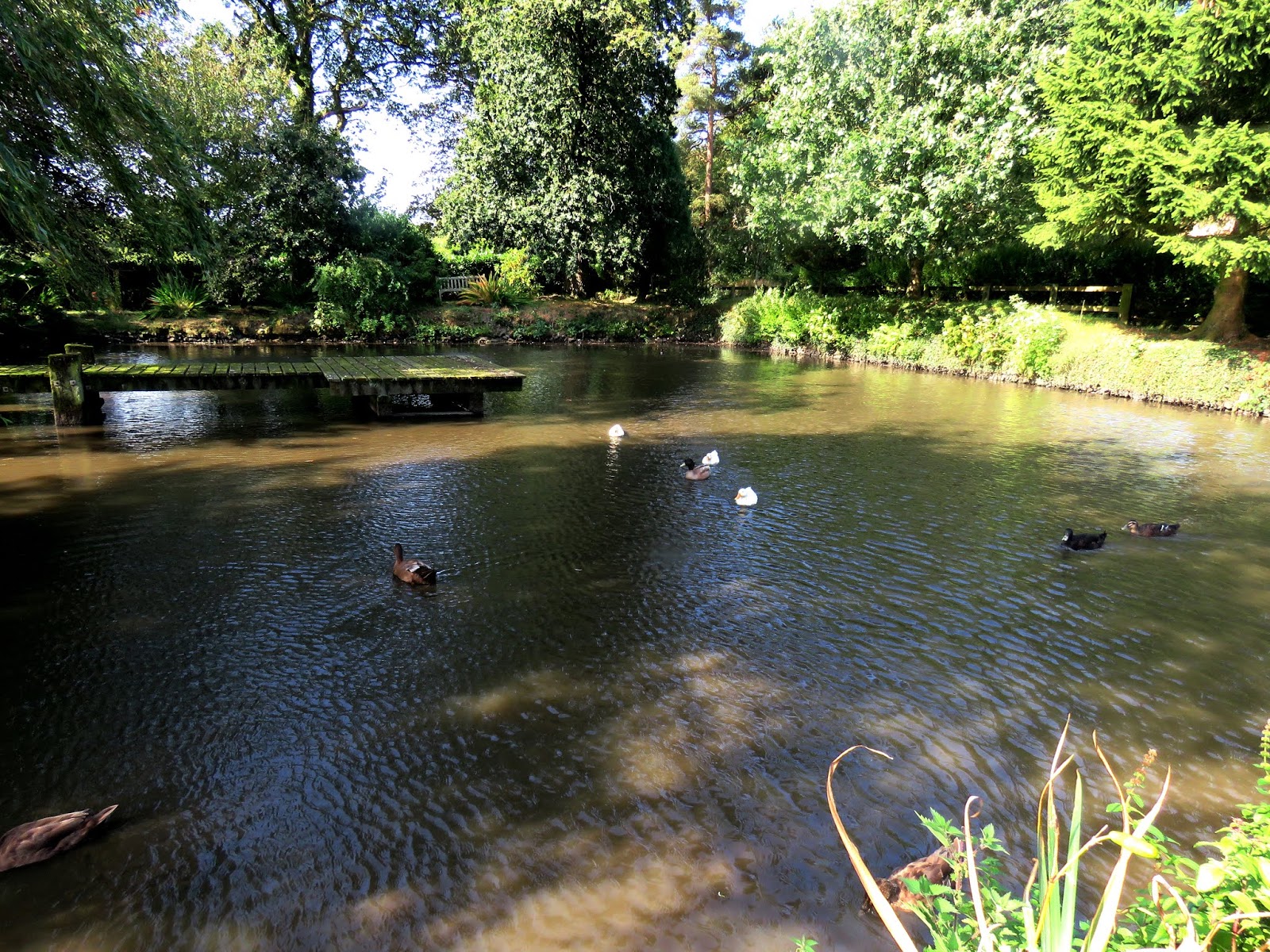
The pond next to our house, Pond Cottage with a few ducks and geese.
Since we have no home or car in the US (or anywhere else in the world), we can’t use those policies to cover rental cars. Over the past few years, we’ve taken a chance to arrange 90-day rentals without added insurance, although the rental agreements cover a portion of the loss if the car is damaged.

There’s no way we’d be interested in paying an extra GBP 10 (US $12.43) or GBP 15 (US $ 18.65) a day for added insurance when we often don’t pay those amounts for the rental itself.  Also, I don’t drive in foreign countries when the stick shifts in on the left and driving is on the left side of the road. I’m not a good enough driver for that level of coordination!
Wet logs on the bottom, dry logs for our use in the fireplace, at the top of this pile.
Nor do we want to pay equal amounts per day by adding me to the policy. When we go to the US in 46 days, we’ll most likely rent two cars, enabling us the freedom to visit with the family at our leisure.

As a rarity, we’re staying at my friend Karen’s home in Eden Prairie, which she kindly offered.  We’d stayed with Karen during our last few weeks in Minnesota before leaving to begin our travels.  
There are numerous barns and paddocks on the 150-acre farm.
We kindly refuse most offers to stay in the homes of others throughout the world when we have our routine, which may not work well for our hosts. Having remained with Karen in the past and the ease we felt in doing so, we’re comfortable staying with her again.

Of course, we’ll be busy with family most days and evenings and plan to eat most of our meals out to ensure we don’t impose on Karen, family, or friends. With my restricted way of eating, it’s too much to expect hosts to figure it out. I’m sure we’ll have a few meals with Karen and her significant other.
Lush greenery is prevalent on the 150 acres.
Anyway, back to the car rental… With heavy rain and an inconsistent GPS signal, it took much longer than we’d anticipated to make our way to Exeter Airport and then, once there, to find a petrol station. Sure, I asked my phone for assistance. With the poor signal, each time indicated the closest was 10 or 12 miles from our current location.  

We continued to drive around the area of the airport until we finally found one five miles away.  We’ve never had such problems getting from one location to another in any part of the world due to the lack of a consistent internet signal. 
Renate, the owner, suggested we keep the gate closed and the front doors.  Otherwise. The ducks and geese will enter the house.
However, we chose to live in the country, and it’s a small price to pay for the beauty of the area and our joy in living on a farm. We have good WiFi (although slow) at the cottage, for which we are grateful.

We stayed calm. We finally headed back to the airport to return the car and collect another. We asked for the exact vehicle with the new contract, and this was accomplished at ease. We’ve had great rentals and customer service at a company we’ve used time and again, Europcar.
A handy feeder for sheep and other barnyard animals.
At last, we were back on the road. We decided to shop yesterday when we realized how far it is to get to Tiverton from the farm to the grocery shop, which we’d planned to do today. We easily found the Tesco Superstore, comparable in size to a Walmart of Costco.  

We’d planned a couple of favorite recipes to make during the week. Still, we could not find the ingredients, including Italian sausages or any well-seasoned sausage without wheat or sugar.  
This is the area where the sheep are sheared once a year.  John and Renate have a company with workers from Australia or New Zealand in their “off-season” (Southern Hemisphere) that shear their sheep.
One of the second recipes required coconut flour, almond flour, and flaxseed. When we saw the sizes of the bags of each, we decided it made no sense to have leftover ingredients we’d have to dispose of when we leave England in 31 days.  

Instead, we revised our grocery list on the app on my phone. We decided on preparing easy dinners for this remaining month in the country: a protein source, a variety of vegetables, and a salad (and rice for Tom). 
There are acres of orchards on the property.  Over this hill is a garden from which we can pick whatever we’d like that’s remaining from the growing season.
We didn’t return to the Pond Cottage until 4:30 pm, put away the groceries, prepared an excellent dinner, and settled in for a quiet evening. It’s cloudy and rainy again today. Should the sun come out, we’ll get out to further explore the farm to take more photos.
We want to thank our readers for the kind and thoughtful messages we often receive by email from many of you. Rather than use the “comment feature,” many prefer to share their stories via email to maintain a level of anonymity. We never post the contents of any email we receive without the authorization of the sender. We love hearing from YOU!

Have a great week ahead!

Photo from one year ago today, September 23, 2018:

It was hard to believe we captured this scene close to sunset at the Crocodile River. For more photos, please click here.

Life on a farm…An experience like none other…Once again, adapting…

John, our exciting and attentive host farmer, has beautiful stories to tell. A former physician and world traveler, he’s a wealth of information. He took us on a partial tour of the 150 acres farm. On another day, we’ll see more.

Fascinating Fact of the Day about Devon, Cornwall:
Devon County Council is responsible for 8,000 miles of road – the longest network in the country. The county is home to everything from single track rural lanes across Dartmoor and Exmoor to major highways like the A38 and A30 – as well as the M5.”

There are chickens, ducks, and geese on the property, along with many Dorset sheep.  (Photos coming soon of these adorable sheep which are kept for their wool, not for slaughter.

Many of us have ancestors that farmed. In Tom’s case, it’s undoubtedly true when both of his parents, grandparents, and some of his siblings were born on a farm. I would have no idea if any of my ancestors were farmers.

We both love living on a farm. It must be in our DNA. It’s hard to imagine living in a typical city when over the past weeks, we’ve lived on two farms, reveling in every aspect. Of course, part of the enjoyment is based on the fact that we don’t do any of the work.

The acreage is diverse and beautiful.

People we’ve met along the way have asked if we “house sit” or work on farms as compensation for living quarters. As much as they may be appropriate for some travelers, it is just not quite our thing.  

We travel as retirees, although we spend hours preparing and working on our posts, taking photos, and conducting research. As we mentioned many times in past posts, we don’t feel our site is a “job” based on the enjoyment and benefit we derive from writing our stories each day.  

If the weather were warm, we’d certainly use this pool, but it is very calm and frequent rains, as it is today.

Should our level of enthusiasm or interest in continuing to post each day ever changes, we may have to reconsider. But, for now, we can no more imagine ending this process than we can in ending our world travels. 

We can only strive to be healthy, diligently watch our budget and be adaptable to the many nuances properties and locations present to us along the way. Nonetheless, we’ll always encounter situations that aren’t ideal.

A small pond near their house and the barns.  Soon, we’ll share photos of the pond outside our door of the “Pond Cottage.”

In this new location, a well-built former barn renovated to perfection still has some nuances which we must adjust to, primarily small things such as a difficult-to-navigate stairway to the second floor where the bedrooms and bathrooms are located.

There’s a tiny under-counter refrigerator that requires bending over to access (although there is, much to our delight, a separate under-counter freezer). The bed is somewhat low and not as comfortable as we’d like. To avoid being nitpicky, there are other small things not worthy of mentioning here.

John planted 600 sequoia seeds many years ago, and now there are over 400 trees.

But, we’re living on a gorgeous farm and in a beautiful house, and we appreciate being here more than we can say. The owners are over-the-top wonderful, and the nearby villagers are kind, welcoming, and friendly. We couldn’t ask for more.

Funnily, neither of us feel compelled to get out sightseeing right now as we’re immersed in the quiet solitude on this gorgeous property. Tomorrow we’ll head to Tiverton to check out the bigger of the villages in the area.

No doubt during our three weeks here, we’ll get out to see the local points of interest, most of which is beautiful scenery. There is so much to explore here at the farm that we can stay busy for days. Also, the hills and rolling terrain are ideal for me to build strength in my legs.

This is a young sequoia tree, but it may become as massive as many seen in Northern California in generations to come.  

Yesterday, our tour with John was exciting and informational. His and his lovely wife’s love of their farm is evident in every acre of land, the well-kept nature of every building, and the loving care of their barnyard animals. We’re honored to have the opportunity to be here, with them only a short distance away and all the beauty and wonder surrounding us.

Soon, we’re off to Exeter Airport to return the rental car and get another. We’re hoping the rain stops and the sun comes out so we can explore on the return drive.

May your Sunday be blessed with joy and wonder!

Photo from one year ago today, September 22, 2018:
“Gee…the eggs are all gone, but I think I’ll lay in the bowl to let them know we want more.” Bands of mongooses came to see us almost every day. Tom would scramble raw eggs for them and serve them in this bowl. When the eggs were gone, lying in the bowl was an excellent way to express their enthusiasm. For more details, please click here.


We’ve arrived in Tiverton, Witheridge, Devon…Another beautiful farm…Balance of Bodmin Moor photos…

An otter was lounging in the sun.

Fascinating Fact of the Day about Devon, Cornwall:
Devon is a county in southwest England. It encompasses sandy beaches, fossil cliffs, medieval towns, and moorland national parks. The English Riviera is a series of picturesque, south-coast harbor towns, including Torquay, Paignton, and Brixham. The South West Coast Path follows the coastline, taking in the towering cliffs of the northern Exmoor Coast and rock formations on the fossil-rich southern Jurassic Coast.”

The drive from Treveighan to Witheridge consisted of narrow roads requiring 30 turns, according to Maps. We only made one wrong turn when we encountered a detour and had to get back on track without a signal.
Although this bridge looks wide in the photo, it is only the width of one car.
Of course, I’d saved the directions on Maps, but with 70% of the country, roads unmarked, it was a guessing game. However, it’s a small price to pay for the opportunity to live in these four country homes in Cornwall, England, and the last, in Wales.
As we drove toward Witheridge, we encountered many historic stone houses.
When we arrived at Pond Cottage in Witheridge, the treat awaiting us was reminiscent of our arrival only two weeks ago at the Tredarupp farm after our fantastic two weeks overlooking the sea in Falmouth.
St Petrock & St Keri Church in Egloskerry, Launceston.
This visit to Cornwall, England, consisting of these shorter stays than we’ve been used to in many other countries throughout the world, may have sparked a new level of enthusiasm for both of us. Could this be our unique way of traveling the world, shorter stays but more locations to explore? We’re beginning to reframe our thinking.
On a narrow road, we carefully passed a woman on a horse.
As we further research our upcoming two-month trip to India in a little over four months, we’ve decided India will undoubtedly be an ideal location to live in four different areas giving us a broader view of the world than staying in one location for three months.
Bodmin Moor is a 208 square mile area.  Many farms adjoin the area.
This is not to say we’re sorry we’ve stayed three months (or more in a couple of cases) in various holiday homes. We were blissfully able to immerse ourselves in the culture and the community while gaining a sense of “belonging.” We have no regrets.
These birds remind us of the Helmeted Guineafowl we had in our garden in Marloth Park.
However, with the current reality of my ongoing heart condition, it makes sense to expand our horizons and see all that we can over the next few years until we can’t carry on, which is inevitable, based on our ages.
A common Fallow deer, often seen in the wild in the UK.
We haven’t unpacked. We took out the single plastic bag with the bare minimum of toiletries and could riffle through the blue bag if we needed something additional. The bulk of our clothing remains in our luggage after we’ve dug out the few items we’ll wear in the three weeks we’ll spend here.
The grounds at Tamar Wildlife Centre are tree-lined with lush vegetation.
The most significant part of the unpacking here was putting away the foodstuffs we brought with us, both perishable and non-perishable. But, this was no more time-consuming than a return trip from the supermarket.  
Not indigenous to the UK, there are several wallabies in the open wildlife area.
We won’t have to shop over the weekend based on what we have on hand, although I’m looking forward to doing so by Monday when we’ll have a chance to explore further in Tiverton, one of the larger villages in the area.
A wallaby and possibly here, joey.
In tomorrow’s post, we’ll share photos of our new location. We’ll travel to Exeter Airport at noon to drop off the current rental car and execute a new one-month agreement.  We’re planning to keep the exact vehicle, if possible since it easily holds our bags.

This morning we awoke to the sounds of the ducks and geese and roosters crowing in the pond the house overlooks. Soon, we’ll tour the property with the owner taking photos to share tomorrow.

Enjoy your Saturday!
Photo from one year ago today, September 21, 2018:
No expression on this cape buffalo’s face can more clearly illustrate his disdain over the hot weather and lack of water nearby. For more photos, please click here.

The Bodmin Moor…Exciting place to visit…

The Daphne du Maurier room is on display at the Smugglers Museum at the Jamaica Inn & Restaurant site.

Fascinating Fact of the Day Bodmin Moor, Cornwall:
Bodmin Moor, one of Cornwall’s designated Areas of Outstanding Natural Beauty, is a remote, bleak heather-covered upland granite moorland still grazed by moorland ponies and bisected by the main A30 road.”

An under-glass display of Daphne du Maurier’s many novels. From this site: “Dame Daphne du Maurier, Lady Browning, DBE was an English author and playwright. Although she is classed as a romantic novelist, her stories have been described as “moody and resonant” with overtones of the paranormal.”
As it turned out, we discovered that Bodmin Moor was not an area that could be thoroughly appreciated in a one-day drive. Travelers can easily plan four of five days of jaw-dropping experiences in this majestic area in Cornwall.
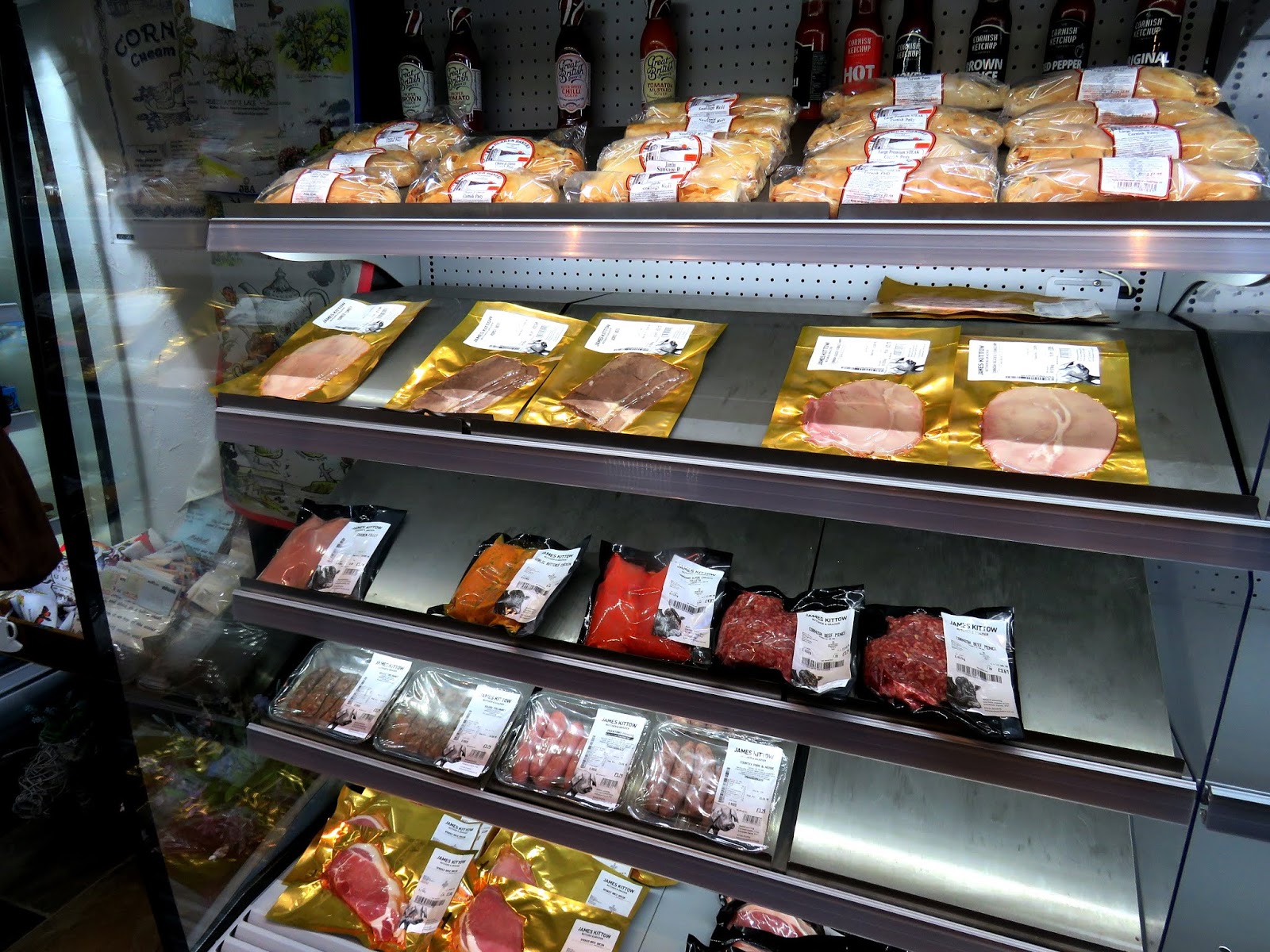
The Farm Shop at Jamaica Inn and Restaurant.
Yes, it requires a fair amount of planning, which we unfortunately did not do, which we later regretted. Also, the satellite signal was poor and unavailable for a better portion of today’s drive. It’s easy to get lost with all the narrow roads with hedgerows impeding the view in many areas.
Locally grown fruits and vegetables.
It definitely would be advisable to take a paper map and carefully outline the areas you’d like to explore. We failed to do this, reliant upon a Maps signal which no doubt prevented us from the whole experience.  
Locally raised grass-fed meats.

You know how frustrating it is to get lost when using Maps with the voice continually saving, “Signal lost,” or in a more frustrating tone, “Make a legal u-turn,” when a u-turn isn’t necessary. We’d saved the directions on my phone, but with so many unmarked narrow roads, it was easy to miss a turn.

A wide array of English wines, liqueurs, and liquors.

Tom, the sound driver, stayed calm and drove cautiously around the endless array of single-lane roads and quickly adapted to direction changes. I appreciated his calm when I was repeatedly trying to get a signal to keep him on the right track. We both persevered.

Antique English porcelain figurines.

As mentioned above, with poor planning, we missed a lot and ended up seeing very little as compared to what we could have seen in one afternoon. At the same time, we had lunch at the popular Jamaica Inn Restaurant, including museums and shops. Located in Bolventor, Launceston, we did our best to decide what appealed to us the most while enjoying the scenic drive. We opted for Tamar Otter & Wildlife Centre located in North Petherwin, Launceston, Cornwall.

These pipes were used in England for smoking cocaine and other drugs in the 1920s and 1930s.
For us, this wasn’t a good decision. The center was beautiful and well designed with various indigenous and non-indigenous wildlife, but essentially, it was a zoo with an open wildlife area contained therein.  This is an excellent place to start for children and those who’ve had little exposure to nature.
Women and men’s historical pieces are displayed in the glass cabinet.

After over two years in Africa, we love what wildlife is all about and…their freedom in the savannah, and we have a hard time enjoying zoos where animals are confined. It breaks our hearts to see them in pens and cages, unable to live the life they are meant to live.

Representation of certain characters from the 1700s.

There is an open and wild area where many birds, deer, and oddly, wallaby’s life. We agree that such a facility benefits those who may never have an opportunity to see animals in the wild, which is probably the majority of the population in many countries.

Articles of shoes and clothing from the 1700 and 1800s.
We decided to make the best of it, wandering through the lush surroundings and stopping to appreciate every living being along the way while we took many photos. The park wasn’t crowded, but we did see several other visitors along the way.
The front garden of the Jamaica Restaurant and Inn where visitors languished over beer and other beverages.

As mentioned above, before we visited the wildlife center, we stopped for lunch at the Jamaica Inn Restaurant, we took advantage of the many sites to see right on the property, such as the Smuggler’s Museum, the Farm Shop. The well-known Daphne du Maurier room was which packed with fascinating period pieces reminding me of her many popular books, some of which I’d read years ago.

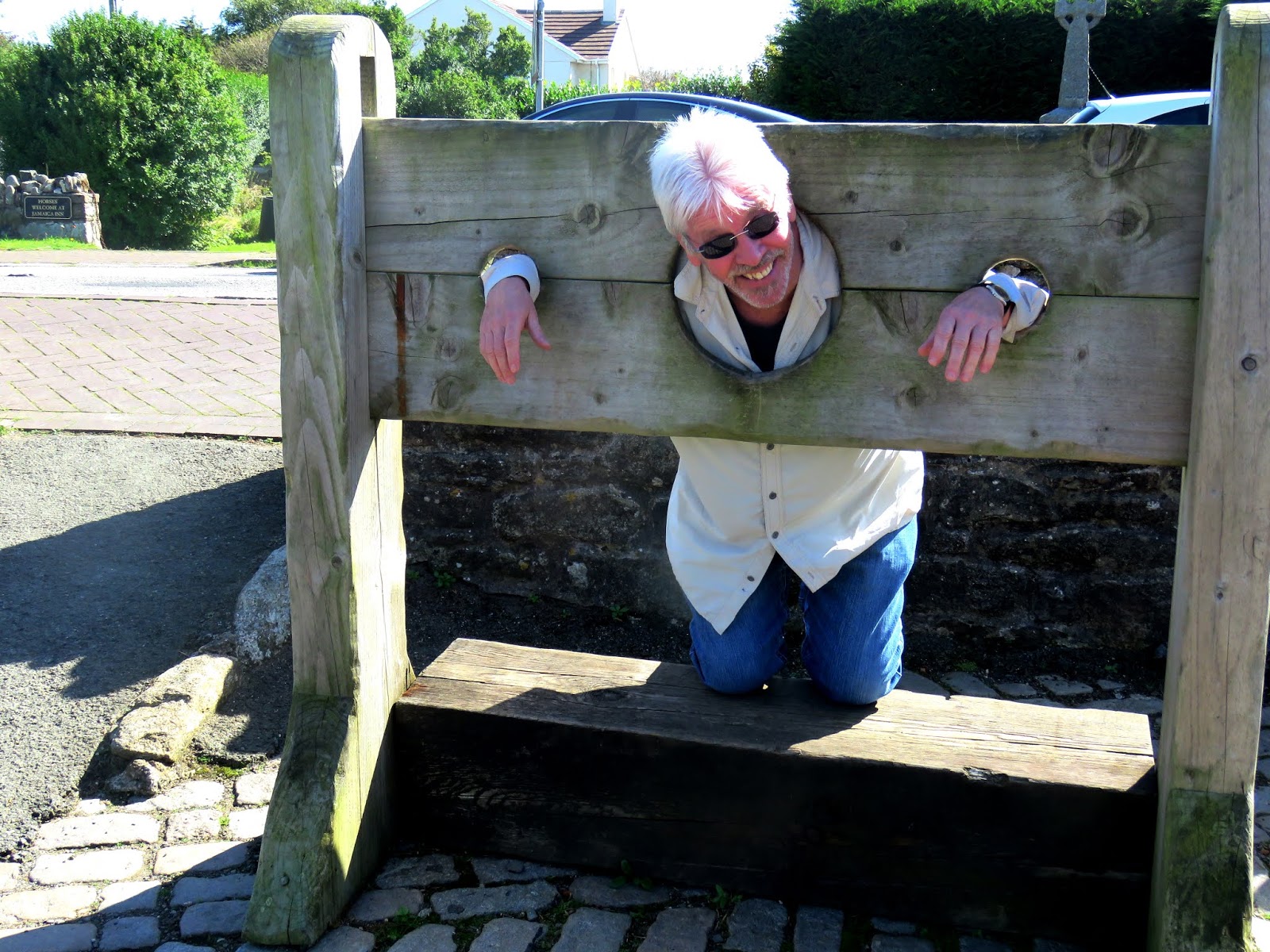
Tom wasn’t comfortable in this position for long.  From this site: “The pillory is a device made of a wooden or metal framework erected on a post, with holes for securing the head and hands, formerly used for punishment by public humiliation and often further physical abuse.”
We took many photos, more than we can share here in one post. Since we’re leaving here today to head to our following location, we’ll be posting the favorite of our photos over the next few days while we get settled in our new site.
Traditional red phone booths found in the UK. There are currently 5,023 red phone boxes, or kiosks as they’re officially known, up for grabs across the UK, including 970 in the South West, 741 in Scotland, 555 in London, and 419 in Wales.
A few days later, we’ll begin posting stories and photos of the new location In Devon, Cornwall, including the property, the grounds, and much more. Please check back for more. We love the beauty of Cornwall and can’t wait to see more.
May your day be rich with new experiences!
Photo from one year ago today, September 20, 2018:
A yellow-billed heron was sitting atop the back of a hippo at Sunset Dam in Kruger National Park. For more photos, please click here.

So you want National Healthcare???…Humm…Prescription hell..

Poldark Locations
A map illustrating the various locations in Cornwall where the TV series Poldark is filmed.

Fascinating Fact of the Day Bodmin Moor, Cornwall:
The Moor contains about 500 farm holdings with around 10,000 beef cows, 55,000 breeding ewes and 1,000 horses and ponies. Most of the moor is a Site of Special Scientific Interest (SSSI) and has been officially designated an Area of Outstanding Natural Beauty (AONB), as part of Cornwall AONB.”

Soon, once the laundry is done and we’re done here, we’re heading to Bodmin Moor to check out the scenery, which we’ve heard about over and over again. Also, we’ve been aware that some of the scenes from the British TV series Poldark (another favorite of ours) were filmed in the Bodmin Moors. Tomorrow, our final day in St. Teath, Bodmin, we’ll post photos from the moor.

We’d hoped to have gone to Bodmin Moor yesterday, but with other immediate tasks on hand, as you’ll see below, we postponed it until today. Fortunately, it’s sunny again today, which motivates us to continue with our plans.

In the interim, we have an important story to share, especially for those readers who have desired a national healthcare service in their country. It may not be all that it’s “cracked up” to be, after all, based on comments we’ve heard over the years from our British friends and others.
A little love among the pygmy goats.
 Many have the perception that such a national service is “free.” That’s hardly the case.  The citizens pay for the cost via taxes imposed on many products, services, and daily living expenses.  Tourists pay VAT taxes and taxes on food, dining out, tours, housing, and more.
“The National Health Service is the publicly funded national healthcare system for England and one of the four National Health Services for each constituent country of the United Kingdom. It is the largest single-payer healthcare system in the world.”
Now, we have a personal example of sharing about the National Healthcare Service in England. Recently, I noticed that one of the two medications I take for hypertension is running low. I thought I had plenty more in our luggage, but alas, I searched through everything and couldn’t find it.
The goats get along well with the chickens that wander into their paddock.
I wouldn’t doubt that I made an error and missed refilling the one during the worst of my recovery when I wasn’t thinking as clearly as I am now. I surprised myself that I didn’t screw up more during that period!  

In looking back at prior posts, I realized I started up again precisely two weeks after the cardiac bypass surgery. Here’s the link to that day. And, I didn’t miss a beat (no pun intended) when I returned to the hospital for the two-leg surgeries a few days apart. Here’s the link to the story I wrote when I returned to the hospital for five days for the leg surgeries.

As a result, I’m not beating myself up for missing the refilling of the one prescription. I just needed to figure out how to get it filled at a local pharmacy without going through a big hassle. I was overly optimistic.
Goat love standing on the highest structure wherever they may be.
First, we tried several pharmacies in several small villages. Pharmacists can sell a one or two-month dose of any non-narcotic medication to a customer on an emergency basis. The drug I needed was non-narcotic.  
I had enough medication to last 14 days, so I assumed I had plenty of time to figure this out.  The first pharmacist in the town of Camelford agreed to refill it on an emergency basis if I could provide proof that the medication was prescribed for me.Since I had enough to last two weeks, I returned with “the proof” a week later, and he flat out refused to refill the medication! He said if it were an emergency, I wouldn’t have waited a week to bring him the proof. He stated I needed to see a doctor for a new prescription. Oh, good grief. I must admit I stormed out the door in a huff, totally unlike me to do.
This cutie posed for a photo.
I didn’t want to see a doctor. We’d heard how hard it was to get an appointment with a GP and, I didn’t want to have to go through everything with a doctor I’d never see again. We tried a few more pharmacies to no avail, even with the proof in hand.

From there, we tried a few more pharmacies again without any luck. Then, the fun began! We resigned ourselves to the reality that a doctor’s appointment was necessary.

There are several doctors in the various small towns around us. I called every one of these and was told they had no openings, now or shortly.  There was nothing they could do.  

My only solution would be to go to the hospital, which would take hours and cost quite a bit for a US $20 prescription.  In doing so, they may have required me to go through several unnecessary tests to be given the prescription.
The next day I asked property owner Lorraine what she’d suggest I do. She proceeded to tell me about dialing 111, not 999 (an emergency number comparable to 911 in the US). She felt by calling this “helpline,” they’d figure out a solution.
Immediately, I called 111, and after a barrage of questions, they gave me two numbers to reach the following day at 8:30 am and explained I had registered my request with 111 and I’d be given priority consideration in getting a 5-minute doctor appointment.

At 8:30 yesterday morning, I called the numbers I was given and still was given the run around that no appointment was available. I persisted, explaining I only needed a five-minute appointment, and I didn’t want to re-contact 111 for further instructions.  

As it turns out, patients are required to be given priority treatment when they’ve gone through 111. Finally, one of two receptionists relented and booked me in for a 3:50 pm appointment yesterday, requiring us to arrive at 3:30 to complete the paperwork. No problem.  

We were there 30 minutes earlier than required, and after the five-minute appointment with an elderly doctor, we walked out the door with the prescription in hand.

We wondered what would have transpired if I hadn’t been so persistent. We’ve heard stories of citizens dying from their inability in getting urgent doctor appointments as explained in this article as shown below:

“Patients were dying on NHS waiting lists ‘surges by 10,000.’

The number of patients dying while waiting for treatment has increased by over 10,000, according to reports.

A freedom of information request to NHS Trusts, carried out by the Express, revealed that the number of patients dying while on a waiting list rose from 18,876 in 2012/13 to 29,553 in 2017/18.

The information request also saw that there was an increase of more than 50% across dozens of NHS Trusts. But this number could be higher, as only half (67 of 135) of the NHS Trusts responded, the paper reported.

One NHS trust in the South-west saw that the number of people who died on a waiting list rose by 250% – from 652 in 2012/13 to 2,289 in 2017/18.

At the same time, a North-west NHS Trust reported that its figure had doubled from 147 to 305, while one in the East of England found it had increased from 392 to 577.  This comes as the latest figures from NHS England saw that only 87.8% of patients are seen within 18 weeks, below the 92% target.

And as of June this year, there were 4.11m people on waiting lists, 280,000 more than in June last year, representing a 60% increase since June 2010.

Having seen this situation first hand and having heard about it from many UK residents, we are convinced this type of system is seriously flawed both in the UK, Canada, and many other countries.  


No, we weren’t charged for the doctor’s appointment, which we happily offered to pay but were refused. Why are taxpayers paying for tourist’s medical needs?  Are tourists coming here and staying a few months to jump on the “free service?”

When we get the prescription filled in the next few days, we will be charged but were told the price will be five times more than we’ve paid in the past. Maybe, in essence, we’re paying after all with the outrageous cost of the prescriptions themselves.

Of course, we’re no experts on healthcare, and the US system is also seriously flawed as it is in many countries throughout the world. We continue to live with the reality that our international insurance failed us in South Africa, and we had to pay the enormous bill out of pocket.


We learn as we go.  

Tomorrow, we’ll be back with our final post from the Tredarupp Holiday Cottages and begin making our way toward Witheridge, a two-hour drive.

May today be a learning day for you, with a good outcome. Be well.
Photo from one year ago today, September 19, 2018:
Based on our position in the line-up of vehicles, our photo-taking advantage was limited. For more photos, please click here.

Back at the farm…Pygora goats…Nutrients

Posing for a photo atop the picnic table. “The pygora goat is a cross between the pygmy goat and the angora goat that produces three distinct kinds of fleece and has the smaller size of the pygmy.”

Fascinating Fact of the Day St. Teath, Cornwall:
“The first recorded mention of cricket in Cornwall is an advertisement in the Sherborne Mercury on 18 June 1781 for the sale of cattle at St Teath, near Camelford. The advertisement was dated 14 June 1781 and signed by Nathaniel Long.  Whereas the annual sale for cattle at St Teath, near Camelford, Cornwall held on the first Tuesday in July had for several years feeling rather neglected. This is to inform the public that the Gentlemen farmers, etc., of the neighborhood, will produce a large show of cattle of the said day being the 3rd day of July next.”

Yesterday afternoon, farm owner Lorraine walked with me out to the paddock to see the pygmy goats and take better photos than I’d taken from a distance. It was a pleasure to get up close and personal with these adorable animals.

They had no fear of me. Lorraine and Graham acquired them at an early age, and not unusual for goats. They are friendly, playful, and hilarious in their antics. They plan to keep them as pets rather than for any other purpose.

I was able to pet them, unlike the wildlife in Marloth Park, and then even nudged me for more when I stopped. Below is additional information on these adorable animals:
The four of them continually hang out together.
From this site:
“They are generally quiet and docile, but there is some variation, as one would expect with goats. Housing requirements are less demanding than for the dairy breeds since the goats are so much smaller. Kids are reared on the dams, so milking is only rarely necessary. 
Castrated males (wethers) make ideal pets, but entire males should not be kept unless separate accommodation can be provided for them. The goats like company, so keeping single Pygmies should be avoided.
Pygmies need a high proportion of dietary fiber daily (80% by weight of the diet is a guide), hay being the main feature; they also need small amounts of low protein goat mix twice a day. They graze and browse well, but tethering Pygmies should be avoided.
Each of them has a name, taken from the TV series Poldark. “The Pygmy Goat Club has set breed standards regarding size and type and organizes show classes for Pygmy goats. It has its registration and pedigree system aimed at improvement by selective breeding. The adult Pygmy has a maximum height at the withers of approximately 56 cm for males, less for females, short legs, and cobby bodies that give an impression of perpetual pregnancy. They can be any color except completely white, with white Swiss markings on the face not allowed.”
The Pygmy Goat Club publishes an excellent booklet, “Pygmy Goats,” that describes all aspects of housing, feeding, breeding, and general welfare of these goats. It is recommended that this booklet is purchased and read before deciding to go ahead with keeping Pygmies. The P.G.C. has a website: http://www.pygmygoatclub.org, where further details can be obtained about the Club. There is also a network of P.G.C. Regional Advisers.”

Lorraine and I chatted about the farm, wildlife, and our travels as we stood in the bright sunshine. I loved the feel of the warmth from the sun, which has been a rarity of late, with the typical cloudy, rainy English weather.

After the walk on the farm, I returned to the house to prepare dinner. I’d sauteed mushrooms, garlic, onions, and aged white cheddar cheese to stuff the cut and flatten chicken breasts which I neatly wrapped in bacon and baked in the oven for 45 – 60 minutes at 190C, 375F, depending on how hot the oven cooks.
They approached me without hesitation.  “Pygmy goats are miniatures, genetically dwarfed; they are kept mainly for enjoyment, interest, and companionship.”
With rice and salad for Tom and salad and cooked watercress for me, we had another great meal. I’m rarely able to find watercress in markets throughout the world but found it here. It’s a nutrient-rich “superfood” described as follows: 
One cup (34 grams) of watercress contains the following:
  • Calories: 4
  • Carbs: 0.4 grams
  • Protein: 0.8 grams
  • Fat: 0 grams
  • Fiber: 0.2 grams
  • Vitamin A: 22% of the Reference Daily Intake (RDI)
  • Vitamin C: 24% of the RDI
  • Vitamin K: 106% of the RDI
  • Calcium: 4% of the RDI
  • Manganese: 4% of the RDI

It’s not that I regard the RDI (the British version of the US RDA) in the highest regard for its recommended daily allowances. We need a higher amount of nutrients than they suggest as a minimum. 

As for watercress, it is not the most delicious vegetable eaten raw but cooked for a few minutes; adding a little butter and salt makes it quite tolerable, if not delicious. Once cooked, one large bag results in two servings. It’s like spinach…cooked down. There’s not much there.

In the evening, we watched the final episodes of season 2 of Seal Team on CBS All Access on Amazon Prime, which is GBP 2.37, US $2.95 a month with commercials, or GBP 4.78, US $5.95 without commercials. It was an excellent series that we hope returns for another season.

“The pygmy goat, also known as the miniature goat, and African pygmy goat, is a breed of miniature domestic goat. The pygmy goat is quite a hardy animal and can adapt to virtually all climates.”

Today, we’d planned to head to Bodmin Moor but have decided to go tomorrow instead. We’re caught up in handling some financial tasks and resulting “paperwork.”

We’ll be back with more tomorrow with two days and counting…


Be well. Be happy.
Photo from one year ago today, September 18, 2018:
When the hornbills were satisfied with their day’s work, they headed back to the birdfeeder for a bit of sustenance. For more photos, please click here.

Part 2…A Sunday morning drive in Cornwall didn’t disappoint…Three days and counting…

The side of the Parish Church of St. Tudy. We walked on a narrow stone rain gully on the side of the church to reach the cemetery.

Fascinating Fact of the Day About St. Tudy, Cornwall:
St. Tudy is a picturesque village and parish located close to the western edge of Bodmin Moor, five miles northeast of Wadebridge. The village grew around an original Celtic graveyard still referred to as ‘God’s Acre.”

Sunday morning’s visit to two churches was not only exciting but highly entertaining when we entered the Parish Church of St. Tudy to find several parishioners and Reverend David Seymour sipping on coffee and tea with what appeared to be homemade biscuits.

We wandered into the church a short time after the service ended when several parishioners had coffee, tea, and biscuits.

The moment we tucked our heads to enter the short door to the historic 17th-century church, we were welcomed with open arms, offered to partake of the drinks and biscuits, and immediately engaged in lively chatter.

The cemetery was filled with history.

Whenever Brits hear our American accents, they can’t help but share stories of beautiful experiences they had visiting the US, most often to New York, Las Vegas, and various parts of California.

Birds are nesting in this louvered window.

One of the parishioners was excited to share his story of having his wedding vows renewed several years ago performed by an Elvis Presley impersonator at a chapel in Las Vegas.  

Others inquired about our travels, but we didn’t share as much as usual, preferring to hear their stories about their lives in St. Tudy and their love of Cornwall.

The church’s bell tower is similar to those in the “Game of Thrones” series and other historical movies and TV shows.

The pride the English express about living in Cornwall, is evidenced in each person we’ve met. One of the gentlemen, a gentleman indeed, walked me over to the plaque on the wall commemorating Captain William Bligh, proud of the bit of history bestowed upon this community and church.

A stone plaque on an interior wall in the church to commemorate Admiral William Bligh, 1754 -1817 depicted in the movie “Mutiny on the Bounty.”  The original movie was filmed in 1935 (see here). Vice-Admiral William Bligh FRS was an officer of the Royal Navy and a colonial administrator. The Mutiny on the Bounty occurred during his command of HMS Bounty in 1789; after being set adrift in Bounty’s launch by the mutineers, Bligh and his loyal men reached Timor, a journey of 3,618 nautical miles.”

He explained that the famous Captain was buried in the church’s cemetery, but he wasn’t exactly sure where the headstone was placed in his honor. We’d have loved to read his tombstone, but there were hundreds of headstones, and it would have taken hours for us to find it.

Simple yet beautiful pipe organ.

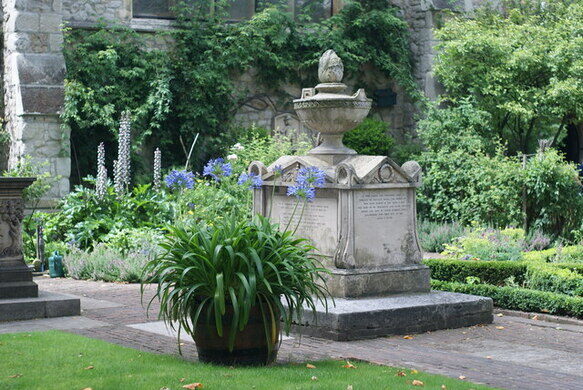
The grass in the cemetery was thick, and the underlying soil was uneven, making such a trek a tripping hazard. However, Bligh died in London, where his official burial monument is located. Below is a photo of his tomb.

Captain William Bligh’s tomb is located in London. (not our photo)

From this site:
“Bligh died in London in December 1817 and was buried at what was then St. Mary’s Church, his family’s local parish church. It is now the Garden Museum, and Bligh’s tomb is surrounded by lovely plantings.”  


He wrote the following to his wife, exactly as it was written (including typos):  “Know then my own Dear Betsy, that I have lost the Bounty…on the 28 April at daylight in the morning Christian having the morning watch. He and several others came into my Cabin while I was a Sleep, seizing me, holding naked Bayonets at my Breast, tied my hands behind my back, and threatened instant destruction if I uttered a word… -William Bligh to his wife, c. June 1791″

It has stained glass windows at the altar.

Again, for more on this story about William Bligh, please click here.

Once the conversations ended and the parishioners began to leave to continue their day, the Reverend welcomed us to stay and take as many photos as we’d like. All of a sudden, this church had a special meaning to both of us.

Cushions for the parishioners.

We were anxious to learn more details about the church and were able to find some morsels, as we’ve included today.


From this site:
“The parish church is dedicated to St Tudius, a sixth-century monk and missionary who has a strong association with Brittany and may even have been the important Breton Saint Tugdual. The church, whose graveyard contains an interesting ‘clink’ building and a pre-Norman carved stone, dates back to the fifteenth century.

The side altar with a square baptismal font.

The family of Captain William Bligh, of “Mutiny on the Bounty” fame, lived in St. Tudy for many generations at Tinten Manor. Captain Bligh was born here in 1754, the fateful voyage of the HMS Bounty took place in 1787. The church town is the only village in St Tudy parish, characterized by rolling farmland and woods.

The village of St Tudy is just two miles from the start of the Camel Trail and within easy walking distance of Bodmin Moor.”
Tom next to the main door of the church, the only entrance we could find.  “In some churches in the UK, the “Devil’s Door” is a small side door, a structural feature found in the north wall of certain medieval and older churches in the United Kingdom. They are widespread in the historic county of Sussex, where more than 40 extant churches have one.  They have their origins in the early Christian era when pre-Christian worship was still popular and were often merely symbolic structures—although they were sometimes used as genuine entrances. Before and during the Middle Ages, the north face of a church was considered to belong to the Devil and to people considered heathen. Churches were invariably built to the north of roads and tracks, to ensure their main entrance was on the south side.”
Speaking of the Bodmin Moor, tomorrow, on a predicted sunny day, we’ll be heading there to explore the many sites in the area, which will be our final outing in this area of Cornwall. Tomorrow’s post will be several hours late.
More stained glass windows.
On Thursday, we’ll pack and get ready for our following location in Witheridge, Devon, Cornwall, and on Friday, we’ll make the two-hour drive to our next new home. We love these short stays in England!

May your day bring you joy and fulfillment!

Photo from one year ago today, September 17, 2018:

This toad spent months with us.  Some nights, she faced this way, and other nights, she faced the wall. A male joined her months later, and days later, they were both gone to make a family.  For more photos, please click here.

Part 1…A Sunday morning drive in Cornwall didn’t disappoint…

As we approached St, Michaels and All Angels, Church of England, we were awe of its beauty.

Fascinating Fact of the Day About Michaelstow, Cornwall:

“Michaelstow is an attractive village and parish located about three miles south of Camelford in North Cornwall. The name means ‘St Michael’s Holy Place,’ and the parish church is dedicated to ‘St Michael and All Angels.’ The River Camel runs along the eastern edge of the parish. Helsbury Castle, an ancient, circular Iron Age hill fort, lies half a mile to the north on Michaelstow Beacon.”

Yesterday morning, we were entirely out of photos. We haven’t been out as much as we would have liked with all the rainy days lately. Although it was dark and dreary with rain on the horizon, we decided to get out anyway.

A sign identifying this particular Church of England.

The goal was to explore a few nearby villages taking as many photos as possible before the rain started again. Today, we’re experiencing the same kind of weather with rain expected at any moment.

As I write here now, Tom is watching yesterday’s Minnesota Viking game online. For some reason, this morning, the WiFi signal was too weak to allow him to stream the game. Finally, he’s been able to get it to work. 

The baptismal font.

The only reason we could think of this difficulty was the Monday morning surge in the use of the internet and the clouds affecting the satellite signal. In our travels, he experiences the same issues resulting in watching the game being frustrating and time-consuming.

I postponed starting today’s post to avoid using the WiFi, perhaps providing him with a better signal. But, this rarely provides much improvement when writing on this template doesn’t use much bandwidth (until I load photos).

Ornate wood carvings at the ends of the pews. 

Tom had seen an exciting photo online of a historic church in the nearby village of Michaelstow and searched for directions online. But it didn’t take more than a few seconds upon entering the tiny village of Michaelstow to see the impressive church’s historical tower, a true reflection of English history.


St. Michael and All Angels, Church of England, were truly breathtaking. Unfortunately, we can’t find the exact date the church was built at any of the few online mentions of this particular church. We suspect it may have been in the 13th century, but we did find the following information from this site.

Pipe organ.

“Michaelstow (Cornish: Logmighal (village) and Cornish: Pluwvighal in Trygordh (parish)is a civil parish and village in north Cornwall, England, United Kingdom. The village is about three miles (5 km) south of Camelford. The hamlets of Fentonadle, Trevenning, and Treveighan are in the parish.

The civil parish of Michaelstow is in the deanery of Trigg Minor and Hundred of Lesnewth. It is named after ‘St Michael’s holy place,’ and the parish church is dedicated to St Michael and All Angels. There is a fine tall Cornish cross in the churchyard. Its original location is unknown; until it was removed in 1883, it formed part of a series of steps up to the churchyard. Three more crosses are at Trevenning. The River Camel runs along its eastern edge, and the surrounding parishes are Lanteglos-by-Camelford to the north, St Breward to the east, St Tudy to the south, and St Teath to the west.

A side alter.

Helsbury Castle (Cornish: Kastel Bre Henlys, a castle on the hill of the old court’), an Iron Age hill fort, stands on Michaelstow Beacon half a mile north of the village.”

Upon arrival at the church, we checked the vestibule to find the front door locked. As we wandered about the property, we found a side door opened (referred to as the transept) and entered.  

The pipe organ is located at the end of this aisle.

Although it was Sunday morning, we didn’t see any visitors or parishioners. Nonetheless, we entered, finding the interior not only historical but exciting in several ways.


No, it wasn’t an elaborate decor as we often see in historic churches, but it had several features that caught our eye, which inspired us to take photos to share here today. We weren’t disappointed and soon forgot about the cloudy day.
Stained glass windows at the alter.
We wandered through the cemetery, reading headstones and searching for any relevant historical facts and dates.  In many countries, especially in small towns and villages, we’ve found ourselves wandering through cemeteries, searching for the unique and the unusual.

As for the church’s build date, Tom found this information this morning to explain it further. Click here for more details:
 

MICHAELSTOW MICHAELSTOW SX 07 NE 6/113 Church of St Michael – 17.12.62 GV I“Parish church. Possibly C13 origins enlarged in C15. They were restored in 1826, in 1870-1889 by Messrs Hine and Odgers, and 1982. Stone rubble with granite quoins and molded granite plinth and strings to west tower. Slate roofs, nave, and chancel in one. Plan: Nave and chancel possibly with C13 origins with four-bay north aisle and 5-bay south aisle added in C15. Circa C15 south porch and west tower. Exterior: Unbuttressed west tower of 3 stages with rectangular stair turret on the north. Battlemented parapets with crocketed pinnacles surmounted by crosses. Molded stilted arch to the west door. C19 3 light west window and 2-light belfry openings with slate louvers. C19 tracery in the south aisle, simple 3-light Perpendicular tracery in chancel window, and circa C15 3-light Perpendicular window with cusped heads at the east end of the north aisle. Piscina on the exterior of the north wall of the chancel. 3 C15 Perpendicular windows in the north aisle and blocked 4-centred molded arch to the north door. South porch has a 2-centered hollow-chamfered arch with a sundial of 1684, C15 wagon roof, and molded basket arch of Catacleuse stone with hollow chamfer and carved with floral motifs. Interior: Plaster walls. Unceiled C15 wagon roofs in nave and north and south aisles with carved ribs and wall plate partly restored. Particularly high-quality carving in the north aisle with evidence of pendants at the east end. C19 roof to chancel. 5-bay arcade to south aisle and 4-bay arcade to north aisle with granite type A (Pevsner) piers, molded bases, molded 4-centered arches, and carved capitals of Caen stone and Polyphant stone. Piscina and credence in the chancel, circa C15 font and Royal Arms dated 1727, painted on timber board. Circa C15 bench ends rescued from Church of St Tudius, St Tudy. Other benches 1882. 2 commandment boards dated 1803 and signed Henry Hocken and Wm Symons, Churchwardens. Bell dated 1550. C16 and C17 memorials. Maclean, Sir John Parochial and Family History of the Deanery of Trigg Minor in the County of Cornwall 1879 Pevsner, N, and Radcliffe, E The Buildings of England, Cornwall 2nd edition, 1970 Church guide.”

The side view of the historic church in Michaelstow, Cornwall.
We’re looking forward to tomorrow’s post when we happened upon a fantastic social experience during Sunday’s explorations.  More will follow!

Happy day!

Photo from one year ago today, September 16, 2018:

Kudus are usually early morning visitors, although we’ll occasionally see them during the day and evening. For more photos, please click here.

Coffee or tea…What is the favorite beverage in the UK…a “cuppa” what?…

The driveway from our house to the narrow road.

Fascinating Fact of the Day About St. Teath, Cornwall*:

From this site: “The village sports an old clock tower in the center near the church. It dated back to 1920 and was erected in memory of those who lost their lives in the First World War. The clock was built from Delabole slate donated by the quarry and constructed by volunteers to a plan by local mine manager, Mr. Oswald Swete. The four clock faces are driven by a weight-powered mechanism that needs ‘rewinding’ every six days. The village has an interesting history. St Teath (from whom this village acquired its name) came over from Wales, with her sisters, to this area of Cornwall to bring Christianity to those living here. Since then, the village has seen much change with the rise and fall of both mining and the railway. There is plenty of evidence of both around the area.  The oldest part of the village surrounds the village square – the focal point of the annual summer carnival, Remembrance day, Christmas lights, and New Year Celebrations.”
 

We often assume that the people of the United Kingdom are avid tea drinkers and, although they’ve heartily adopted coffee consumption, making it more prevalent than tea, they are still big tea drinkers.

There’s a ticker running at this site illustrating how many cups of tea are consumed in the UK each day. It’s shocking to see how fast the ticker runs into the millions of cups each day.  

Storage building on the farm.
Coffee consumption has grown in the UK over the years. Here’s an article described here:

“Stereotypes suggest that Brits favor a builder’s brew over any other beverage, but new figures released by the British Coffee Association (BCA) tell a different story.

Reliant on the caffeine spike a morning brew offers to face the day ahead, the BCA has revealed that the UK’s coffee consumption soared to 95 million cups a day in 2018, up from 70 million in 2008. That’s an increase of 25 million over the last ten years.”

The exact stats on coffee versus tea consumption in the UK is confusing and elusive. Some say coffee is more prevalent, while others claim tea is the preferred beverage of choice.

Pygmy goats were checking me out.  Next sunny day, Lorraine will take me out to meet them inside the fences.  Photos will follow.
“Part of the research, conducted by the Centre for Economics and Business Research (CEBR), included a survey of 2,000 adults in the UK. It found that nearly a third of those surveyed said they didn’t drink coffee at all, while at the other end of the scale, six percent admitted to drinking six cups or more a day, with the average person consuming around two cups a day.

“Interestingly, it also revealed that 65 percent of coffee is drunk at home, 25 percent at work or while studying, and the rest is consumed in shops, bars, and restaurants. “In the last decade, we’ve gone from a country of tea-sippers who enjoy the occasional instant coffee to a nation of seasoned coffee connoisseurs exploring a large variety of roast and ground blends,” said Chris Stemman, Executive Director of the BCA.”
Pretty house in Michaelstow.

In our experience while in the frequent presence of Brits over the years of world travel, we’ve seen tea as the preferred beverage.  But then, many of our British friends are regular coffee drinkers.  So, who’s to say they haven’t adopted the passion for coffee drinking so common in the US and many other countries worldwide?


Tea’s illustrious influence in the UK has led to various teas worldwide, but there are certain teas the British favor.  Favorite teas include: 
Most Popular Type of Tea in England
  • Black Tea. Black Tea, of course, tops the list, mostly taken with milk, mostly in teabag form.
  • Earl Grey. Earl Grey was believed to be named after a gift of tea from China was presented to the then UK Prime Minister Charles Grey in 1830
  • Green tea
  • Herbal teas
  • Oolong
  • Others
Cornfield in the neighborhood.

Surprisingly, we don’t see a wide variety of teas at the supermarkets, not nearly as many as I’d seen in the US many moons ago. As for coffee, many Brits drink instant coffee.

Over the past seven months, since I had open-heart surgery, I’ve avoided drinking coffee. I found the caffeine seemed to make my heart race. Instead, I’ve been drinking one cup of green tea (includes caffeine) each morning, followed by herbal teas later in the day. I’ve yet to find a herbal tea that I love.


But, then again I was always both a tea and coffee drinker starting with coffee in the morning and having tea in the afternoon, caffeine never seeming to be an issue. Tom began drinking coffee only in 2004. He now drinks it without sugar and uses coconut cream instead of milk or cream.
Old building/barn converted to a house with solar panels.
Speaking of milk, here’s a morsel:
“The research celebrates Britain as a nation of tea drinkers, with a few surprising results like almost one in five putting the milk in first,” said Emma Stanbury from Arla B.O.B milk which commissioned the study. “And with more than fifty shades of tea, everyone’s favorite is a little different.”

When we grocery shopped a few days ago, I decided to try something I’d never considered in the past…make instant caffeine-free coffee adding “double cream.” Much to my surprise, it tastes delicious, and I believe this will be my new morning beverage.  I’m very enthused about being able to have coffee in the mornings when Tom’s coffee always smells so good.

Later in the day, I’ll have a few cups of green tea, including each day around 4 pm, tea time minus the biscuits. It’s not quite “high tea” but a treat at that time of day, now that we’re no longer doing “happy hour.” 

This morning, we took on a fantastic drive in the area and came across some excellent sites and a “people” experience we can’t wait to share tomorrow with many photos. Please check back. 
Enjoy your Sunday!  Have a “cuppa,” as the British say!

Photo from one year ago today, September 15, 2018:

This is the same family with seven chicks we’d seen a few months ago. For more photos, please click here.

A day at the movies…The Downton Abbey movie…No spoilers…

In August 2014, we held our breath as we approached Highclare Castle, home of the famed BBC Downton Abbey TV series. No interior photos were allowed.

Fascinating Fact of the Day About Wadebridge: “Wadebridge is a popular town in north Cornwall, very well situated for visitors intending to walk the Camel Trail. The most notable historical building in Wadebridge is not a building. It’s the remarkable Old Bridge built by Reverend Thomas Lovibond in 1460. The bridge stretches 320 feet across the Camel, with a total of 17 arches supporting it.”

Image result for the downton abbey movie
The poster for the movie.

With numerous trailers shown online and promoted throughout England, we thought it would be befitting for us to go to the movies to see yesterday’s first release of the classic movie TV show Downton Abbey.

The Towne Centre in Wakebridge.

While living in many countries throughout the world, we’ll find a movie made locally and make a point of downloading and watching it, including those with subtitles.  

It was captured on a walk on the boulevard.

Primarily, our objective is to see authentic scenes of places we may like to visit while there or to get a greater understanding of history and culture. Many well-made movies seem capable of accomplishing this to some degree.

The 89-year-old Regal Cinema in downtown Wakebridgde.

Having watched all 52 episodes of Downton Abbey over six seasons, all of which were since we began traveling the world. An attack would air, and a few days later, we could download it, saving it to our hard drive and watching it at our convenience, always in the evenings after dinner, as a special treat.

The cost for one adult ticket is GBP 7.30, US $9.13, about the same price or slightly less than in the US from what we recall.

The series was so inspiring in 2014, we booked a tour to the filming location for the series, the Highclere Castle, which is shown today as our main photo, which we’d taken on that particular day. Click here to see our post from August 21, 2014.

The concession stand.  There wasn’t anything I could order, as usual.

When we’d heard so much about the movie being released, we thought it would be a treat to see it on its opening day while in England on Friday, September 13, 2019. (The US and other country’s releases are on September 20, 2019, one week later).

Tom purchased a bottle of soda and popcorn, as shown below.

We searched online to see if there was a movie theatre in this part of Cornwall where we could see the movie. The Regal Theatre in Wadebridge, a 30-minute drive which was the most convenient location. 

The 89-year-old movie theatre was a site to see in itself with a bit of its history as follows:
The Regal, situated at the end of The Platt in Wadebridge Cornwall, was built by the Pope family of Padstow and opened its doors for the first time in January 1931. Several local owners operated the cinema under its initial name of the “Cinedrome.”

Our view of the screen from our good seats.
When we arrived an hour earlier than the start of the movie to ensure we’d get tickets and good seats to find the ticket office closed until 1:30 pm, we wandered about the cozy village, packed with tourists and locals.  
 
As it turned out, we were the first to buy tickets and find great seats, smack dab in the middle several rows back from the screen.  In no time at all, move moviegoers arrived but hardly filled in the good-sized theatre. We’d expected the 2 pm matinee would attract a number of the locals, but it didn’t.
Tom had to order his popcorn in a  bag.  The only freshly popped corn they had was “sweet popcorn,” which he doesn’t like.  The only unsweetened popcorn offered is in a bag, as shown.
Need I say, we loved the movie and giggled over having seen the magnificent castle on the big screen, five years later from our face-to-face viewing. We won’t share any details about the movie.  All we can say is if you liked the TV series, most likely you’ll enjoy the movie as well.
When we left the theatre, we walked past a creek with ducks.
After the movie ended, we walked the short distance to the Co-Op Supermarket to shop for the final upcoming week in St. Teath, Cornwall. We leave here in six days and have loved every moment in this scenic part of the country. Cornwall has genuinely pleased and surprised us.
 
May your Saturday be as pleasant as ours, on a sunny day in the countryside.

Photo from one year ago today, September 14, 2018:

This a white-crested seedeater.  For more photos, please click here.