Part 1…What is a coolcation?…

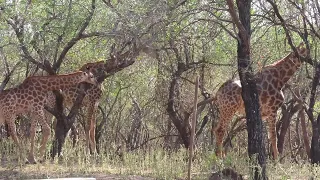
Another giraffe comes to call.

Over the years of travel, we’ve noticed that trends come and go. Words appear in glossy travel magazines, only to be forgotten by the time the next season rolls around. Yet every so often, a term emerges that really makes sense in today’s world. Right now, that word is coolcation. At first glance, it sounds almost playful, as though someone took “vacation” and added a bit of breeze. And in many ways, that’s precisely what it is, a journey into cooler places, away from the heat, the sweat, and the relentless sun that so many travelers have grown weary of.

For decades, the great escape was always toward warmth. People dreamed of sandy beaches, sun loungers, and turquoise waters. Travel posters lured us in with images of palm trees swaying under endless summer skies. But times are changing, and with the rise of climate shifts, extreme heatwaves, and wildfires scorching places once thought of as idyllic paradises, more and more travelers are deciding that it’s not the sun they crave anymore. It’s a relief. It’s comfort. It’s cool air on their cheeks instead of blistering rays on their shoulders.

A coolcation is precisely that…a holiday deliberately spent in a cooler climate. Instead of rushing to Spain’s Costa del Sol in August, travelers are now looking north to the fjords of Norway or the mountains of Scotland. Instead of sweating it out in crowded city streets in midsummer, they are wandering along Iceland’s black sand beaches or sitting beside a misty Irish loch with a hot mug of tea. The appeal is obvious: less sunburn, fewer crowds, and a gentler pace that comes with breathing crisp, fresh air.

For full-time nomads like us, the idea of a coolcation resonates on an even deeper level. We’ve experienced both extremes—days when the sun felt like a punishment, and others when the sharp bite of winter made us long for a sweater pulled tight around our shoulders. What we’ve come to realize is that “perfect weather” doesn’t always mean sunshine. Sometimes, perfection is stepping outside without being knocked back by oppressive heat. Sometimes, it’s being able to walk without constantly searching for shade or gulping down bottles of water. A coolcation, at its heart, is about restoring that balance between adventure and comfort.

Nathan, Nina, Natalie, Nola, and Nora are shown in this photo.

There’s also a psychological shift at play here. Traditionally, vacations were sold as escapes from cold, dreary winters. But summers are no longer always the reward they used to be. They can be dangerous, stifling, and overwhelming. For many, the thought of taking precious holiday time only to swelter in 40°C (104°F) heat is no longer appealing. A coolcation becomes less of a luxury and more of a survival tactic by choosing destinations where relaxation is possible, where nights are restful, and where sightseeing isn’t dictated by the need to avoid the hottest part of the day.

I think what makes the concept even more beautiful is how it reintroduces travelers to places often overlooked. The Arctic Circle, once reserved for the most adventurous explorers, is now becoming a summer retreat for those wanting a reprieve from soaring temperatures. The highlands of Europe, whether in Switzerland, Austria, or even the Pyrenees, are seeing renewed interest. Rural Canada, the rugged coastlines of New Zealand, and even Alaska are drawing travelers in not just for their scenery but for their cool, breathable air. Suddenly, the world’s “edges” are being celebrated as sanctuaries.

Of course, it’s not only about the weather. Coolcations often bring with them a different rhythm. Instead of lying by a pool, travelers are hiking, cycling, and exploring landscapes where the very air feels restorative. Meals are heartier, not rushed in search of relief from the heat. Fireside evenings, even in summer, add a layer of coziness that sun-soaked resorts can’t replicate. There’s a slower intimacy in these trips when conversations linger longer, books are read without distraction, and time feels stretched, not squeezed.

There’s also a growing sense of responsibility tied to coolcations. With rising awareness of sustainability, many people are questioning the environmental impact of flying halfway across the world for a suntan. Shorter flights northward or inland, closer to home, are becoming more attractive…not just for the lower temperatures but for the smaller carbon footprint. A coolcation doesn’t have to mean crossing an ocean; it can be as simple as trading in a beach town for a nearby mountain cabin.

When I think of the best memories we’ve gathered from our years of travel, many of them weren’t formed in the blazing sun. They were shaped in the coolness of misty mornings, wrapped in sweaters, sipping coffee on a veranda where the mountains hid behind soft clouds. In Antarctica, the cool weather, familiar to us from living in Minnesota, wasn’t unpleasant but rather refreshing.

So while the word itself may be new, the idea has always been there…an instinctive pull toward cooler climates when life gets too hot to handle. Perhaps the rise of the coolcation is less about trends and more about common sense, a return to balance in how we travel and how we care for ourselves.

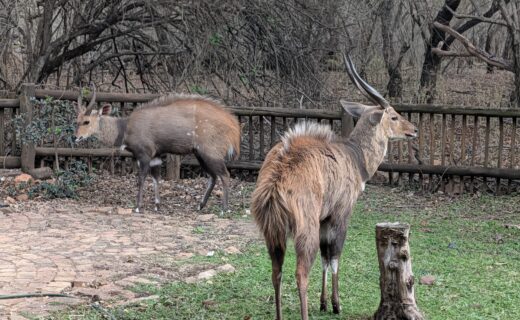
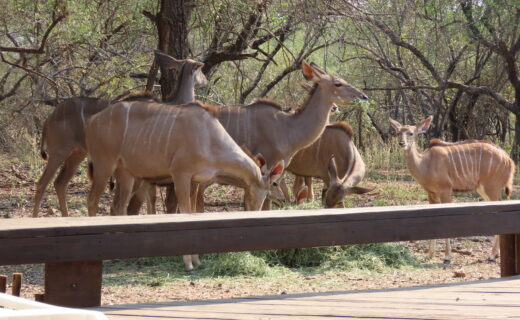
My favorite kudu, Bossy, stops by with family members.

And maybe, just maybe, it’s a reminder that joy doesn’t always need to be baked in sunshine. Sometimes, happiness is found in the shiver of a breeze, the comfort of a blanket, and the quiet thrill of discovering that the world is just as beautiful—if not more so when it’s cool.

The cool winter in South Africa these past few months was delightful, and now, once again, we are experiencing the familiar heat of South Africa’s often high temperatures in spring, fall, and summer.

Tomorrow, we’ll share where to travel for your coolcation. See you then.

Be well.

Photo from ten years ago today, August 25, 2015:

From Rusty’s Market in Cairns, Australia: fresh greens appear to be a little higher priced than the grocery stores, but they are primarily organic. For more photos, please click here.

Best credit cards for travel…Fabulous braai and house party last night!…

A francolin (Frank) came to call, and he didn’t run away when we tossed him seeds. We’ve never had a resident Frank at this house.

From Travel & Leisure online magazine here:

This Is the No. 1 Travel Credit Card for 2025, According to a New Report

From no-fee favorites to premium perks, J.D. Power’s latest study reveals the cards cardholders love and which ones fall short. By Michael Cappetta, published on August 18, 2025

Rewards credit cards can lead to points for things like free airline tickets or hotel stays, and a new report reveals the ones that travelers love most.

American Express ranked as the top issuer in overall customer satisfaction, according to J.D. Power’s 2025 U.S. Credit Card Satisfaction Study. That was followed by Bank of America and Capital One. Chase Bank—which is known for its popular Chase Sapphire Reserve card—along with Discover and Wells Fargo, ranked as the next three. Each of the top six came in above the industry average.

John Cabell, the managing director of payments intelligence at J.D. Power, said in a statement increases in overall satisfaction are being driven by “cardholders with higher financial health scores and no revolving debt—especially those using cards with points/miles rewards programs and annual fee cards.”

We hope he’ll return and stay with us for a while.

On the opposite end of the spectrum were Credit One Bank, Premier Bankcard, and FNBO, which ranked as the lowest in overall customer satisfaction.

To determine its rankings, J.D. Power surveyed more than 37,000 credit card customers between June 2024 and June 2025.

When it comes to the best rewards credit cards without annual fees, the Capital One Savor Rewards Card, the Citi Double Cash card, and the Discover It Student Cash Credit Card ranked as the highest.

Among co-branded cards without an annual fee, the Hilton Honors American Express card, the Costco Anywhere Visa by Citi card, and the Apple Card took the top three spots in overall customer satisfaction.

Many travel and rewards credit cards have annual fees to help offset the numerous perks and opportunities they provide to customers. Within this category, The Platinum Card from American Express took the top spot, followed by the Bank of America Premium Rewards Elite card, the American Express Gold Card, and the Chase Sapphire Reserve.

The cards may be costly (Chase just raised its annual fee on the Reserve card to $795), but the perks can also be lucrative for travelers and shoppers. American Express Platinum cardholders, for example, receive access to more than 1,400 airport lounges, $200 in annual Uber credits, and a $300 credit to Equinox gyms, among other things.

For frequent flyers, American Airlines’ Citi/AAdvantage Executive World Elite Mastercard was the top-ranked airline co-branded card.

But all these rewards did come at a cost: more than half of survey respondents were described as “financially unhealthy” and carried credit card balances.

“There was a significant increase in the number of financially unhealthy cardholders and those carrying revolving debt in early fielding of the study,” Cabell said in the statement.

Norman’s horns became tangled in some branches. He carried them around for one day, but on the second day, they were gone..He didn’t need any more stress while recovering from his broken leg.

Beyond credit cards, J.D. Power also looks at other travel-related industries, including the top travel apps and websites. In that 2023 ranking, the company found Alaska Airlines, Southwest Airlines, and JetBlue had the highest customer satisfaction for airlines, while World of Hyatt, Choice Hotels, and Hilton Honors took the top spots for hotels.”

We have some of the cards as mentioned above, but we’ve avoided American Express since we’ve found it is not accepted in many instances due to vendors’ higher processing fees. In some cases, the processing fees are charged back to us at the time of purchase, and we’re not willing to pay those fees.

On another note, last night we attended an enjoyable braai/house party at Daphne and Neville’s lovely home, not far from us. The ambiance, the food, the dart games, and the musical entertainment were over the top. We couldn’t have had more fun! Thanks to our great hosts for this fantastic and memorable event at their home in the bush!

Be well.

Photo from ten years ago today, August 24, 2015:

From Rusty’s Market in Cairns, Australia:  Pandan leaves from the Pandan Plant are used to make these beautiful, fragrant bouquets. As quoted from the owner’s written material: “The leaves are used in Southeast Asian cooking as well in making th “flowers” which act as a repellent to roaches. In addition, Pandan leaves are said to possess medicinal benefits containing tannin, glycosides, and alkaloids. The scents emitting from the flowers last a week and may be used as a freshener in cars, homes, or washrooms.” For more photos, please click here.

Oh, what a night!…

When we walked into Jabula last night, we were thrilled to see friend Lee, whom we met through Rita and Gerhard. It was great to see him. We invited him to dinner on Wednesday night.

Gerhard and Rita, dear friends whom we met years ago through our site, have visited Marloth Park many times. We became fast friends and have stayed in close touch regularly. They visited us a few times while we were in Lake Las Vegas, including surprising me on my birthday a few years ago.

We have it on our itinerary to see them when our fourth cruise ends in Seattle in May 2026. They live nearby in Vancouver, Washington, USA.

Soot from the sugarcane burning often flies through the air and lands on all outdoor surfaces in Marloth Park. Sugarcane burning is a common pre-harvest practice, particularly in regions like South Africa and parts of the US, where it’s done to remove excess leaves and trash, making manual or mechanical harvesting easier. While this practice improves harvest efficiency, it also has drawbacks, including environmental and health concerns.

We met Lee several years ago when he visited Marloth Park to see Rita and Gerhard and experience the bush with us. He has returned several times since. We’ve spent several social events with Lee over the years, and we were thrilled last night when we walked into Jabula and he was waiting for us. He’s here for one month.

While the conversation was lively and animated, Lee explained that he’d gone to Bali and stayed at the same holiday house we stayed in for four months in 2016. He chose that house after Rita and Gerhard stayed there, following our example. We are always thrilled when our readers follow our lead and share the great experiences we’ve had and shared online in our posts.

But the best part is making dear friends from our readership, many of whom we’ve stayed in close touch with. Without a doubt, we’ve continued to see Rita and Gerhard more than any others, and our mutual bond is close and meaningful.

There was a little more water in the Crocodile River after a few hours of light rain.

When Lee told us he bought the house next door to the house we rented (and Rita and Gerhard also rented), and invited us to come stay at any time. We’ve often talked about returning to Bali, and this may be the perfect opportunity.

While we were giddy from the exciting conversation, I had a great idea. What if Rita and Gerhard could join us in 2026, and we all could stay at Lee’s house, which has three bedrooms and a guest cottage, plenty of room for all of us!

A few years ago, during dinner at friends Kathy and Don’s house in Marloth Park, Rita and Gerhard shared their experiences of attending Oktoberfest in Germany in considerable detail. At that time, I told Tom I’d love to have that experience someday, attending the event with Rita and Gerhard, who are from Germany but are now both US citizens. The prospect of going to Ocktobefest has been on my mind since then.

A Big Daddy kudu was standing on a hill in Kruger. We don’t see many kudus when we drive through Kruger National Park. But we see plenty in our garden.

AS it turned out, Lee explained he purchased a “table for ten” for Oktoberfest, and we can join him anytime. We all agreed how fun it would be to attend this exciting event together in October 2026, and also visit Bali. Within minutes, we had Rita and Gerhard on the phone on WhatsApp while we simultaneously agreed that these are “must-dos” for the five of us.

Then, the surprise of all surprises, Rita and Gerhard, known for their surprises, confessed they are coming to Marloth Park on September 3, bringing Rita’s mom from Germany, putting aside their desire to surprise us this time. We are so excited. They rented a house from Louise and made her promise to keep the secret, which she did!

Gosh, these upcoming three weeks in Marloth Park will be exciting! Lee wil join us on Tuesday night for Quiz Night, as well as coming to dinner on Wednesday, and we’ll see Rita and Gerhard soon. On top of that, another of our readers, Christine, and her partner will be joining us at Jabula on September 12, which will likely bring the total number of attendees to more than just the four of us. We leave Marloth Park for Spain on September 14.

Wow! What an exciting night!

Today at 2:00 pm, we are heading to Daphne and Neville’s home for a braai and the South African Springboks rugby game, another fun event in the bush.

Be well.

Photo from ten years ago today, August 23, 2015:

Not the most flattering photo of us. But, we couldn’t resist including a photo of us while in Australia, tasting the Mimolette cheese we’ve written about today, known for its “mites’ that live on the outside of the cheese as it ferments. The US has concerns over “bugs” on cheese. See the post here.

A delightful evening with old friends…An amazing escape for a beloved wild animal…

When Lisa put a plate of yogurt on the perch in her veanda, six bushbabies came to enjoy the treat. It was a treat for me to see them.

It had been quite a few years since I got together with Deidre, the director of Wild & Free Rehabilitation Centre, with Lisa, formerly referred to as the bushbaby caregiver. at Lisa’s home, a few kilometers from here.

Arriving at 4:30 pm as planned, Lisa and I had a few minutes to catch up while we waited for Deidre to arrive, after finishing her busy workload, caring for lost, injured, or ill wild animals in and around Marloth Park with a passion and dedication hard to match.

As the sun was setting at Ngwenya.

Deidre arrived with friend Karin, and the four of us enjoyed beverages and an endless stream of fascinating discussions about Marloth Park and its amazing wildlife, and the issues faced by the rescue center treating old, injured, and sick animals.

Of course, we discussed Norman at length, and when Deidre credited us for “saving Norman’s life” based on the video Tom took about ten days ago, which we sent to her. She and the vets had determined that Norman would be euthanized the next day. After reviewing our video, they determined he was doing better and appeared to be improving on his own, and the next day’s euthanasia was off!

The sunsets over the Crocodile River are always stunning.

Whew! We were both so happy to hear this. When Tom returned to pick me up, he joined the four of us on the veranda, and Deidre told him this story. He was also thrilled to hear that his video saved Norman’s life.

We also discussed Nathan’s injury to his horn, and with so many animals in the bush with horns, apparently, this is a common injury. Deidre and the vets agreed Nathan should heal without incident. That was a huge relief to hear as well. Tom enjoyed the lively conversation with the women, and then we headed home for dinner.

Deidre invited us to visit the rescue center next week, and we’ll write a comprehensive story with photos of the animals in her care afterward. We can hardly wait. The centre is not open to the general public due to the risk of diseases carried by humans. Without a doubt, we’ll be wearing face masks.

A kudu mom and youngster, of course, are looking for pellets.

Back at the house, we sat indoors to have a nice dinner I’d prepared in the morning, and before we knew it, it was time to wander off to bed, to stream one episode of a series, and eventually nod off for a good night’s sleep, which we both accomplished.

At 4:00 pm today, we’ll head to Jabula but stop at the Marloth Park Info Centre to see Louise and Danie for a few minutes. We won’t be going to Jabula on Saturday night since we’re invited to a braai at Daphne and Neville’s home, our teammates on Tuesday’s Quiz Nights. It will be another fun weekend.

Be well.

Photo from ten years ago today, August 22, 2015:

As we approached Rusty’s Market in Cairns, Australia, we knew we were in for a treat. The counter at Fetish for Food is one of many international markets within the vast farmers’ market. For more photos, please click here.

The dentist performed a miracle!..No crowns needed…Fantastic evening with dinner guests!…

Our boy, Chewy, is hanging out in the garden, as usual, even in the middle of the night.

Yesterday, I had a dental appointment to prepare two molars for crowns, both of which broke in the same week. I was fully prepared for the process and the subsequent cost of about ZAR 8000, USD $451. Knowing this was a bargain compared to what we’d pay in the US next May or June, and annoyed with the feeling of the broken teeth in my mouth, I’d decided to get this done before we leave in a little over three weeks with no qualms about the cost.

When Dr. Jones, a highly experienced woman dentist, checked my two teeth again, she suggested repairing them instead of going through the process of a crown, based on my age, heart condition, and use of blood thinners. She’d try to accomplish such a lofty goal, and if she ran into problems, she’d revert to the original plan of two new crowns.

Since I am allergic to some anesthetics used in dentistry and unfamiliar with the one she uses, I opted to go without the injection and tough it out. At times, it was painful, but she was careful and made every effort to make it comfortable for me. It took 90 minutes of lying in the chair with my mouth open. Finally, when she was done, we were pleased with the result, paid the bill, and headed back to Marloth Park, relieved it was done.

Bossy, my favorite female kudu, also visits during the night, lucky to find a few pellets. That is Norman in the background.

However, what shocked us the most was the bill, as shown below:

The above bill for the repair of both of my broken teeth was ZAR 973.90, USD $55.03! In referencing different options for broken teeth, Dr. Jones opted for #4 below. My newly repaired teeth feel normal and comfortable.

There are a few alternatives to getting a crown, depending on why your dentist recommended one (to strengthen a weak tooth, cover a damaged one, or improve appearance). Some of the main alternatives include:

1. Dental Filling (Composite or Amalgam)

  • Best for: Smaller cavities or areas of decay.

  • Instead of covering the whole tooth, the dentist removes the decayed part and fills it with composite resin (tooth-colored) or amalgam (metal).

  • Limitation: Not strong enough if the tooth is severely weakened or cracked.

    Giraffes visiting before sunrise.

2. Inlays and Onlays (Partial Crowns)

  • Best for: Moderate decay or damage, where a filling isn’t enough but a full crown may be too much.

  • These are custom-made pieces (usually porcelain or composite) bonded into the tooth.

  • They preserve more of your natural tooth than a crown.

3. Veneers

  • Best for: Front teeth that are chipped, slightly damaged, or discolored.

  • A thin porcelain or composite layer is placed on the front surface of the tooth.

  • Not as strong as a crown—mainly cosmetic.

4. Tooth Bonding

  • Best for: Small chips, cracks, or minor cosmetic fixes.

  • A tooth-colored resin is sculpted onto the tooth and hardened with a light.

  • Quick and less invasive than a crown, but less durable.

    Zebras were hoping for some pellets. We complied.

5. Extraction + Replacement

  • If the tooth is too damaged, sometimes it’s removed and replaced with:

    • Dental Implant (very durable, feels like a natural tooth)

    • Bridge (uses surrounding teeth for support)

    • Partial denture

6. No Treatment (Monitoring)

  • Sometimes, if the damage is minor or only cosmetic, a dentist may suggest simply monitoring the tooth until intervention is necessary.

After three hours, we returned to the house and got to work prepping for last night’s dinner guests, Carol and Colin, arriving at 4:00 pm. It was a lovely evening with lively conversation, commiserating on our love of the bush, the wildlife, and the scenery, and tidbits of our mutual world travel experiences.

An elephant is searching for food on the dry riverbed.

This afternoon at 4:30, Tom will drop me off at our old friend Lisa’s house, the official injured bushbaby caregiver and host of “Movie Night in the Bush,” joined by our friend and director of Wild & Free Rehabilitation Centre. Several times, in years past, the three of us got together to share wildlife stories and enjoy sundowners. I’m bringing a nice bottle of white wine to share.

Tom will pick me up around 6:00 or 6:30 pm. We already made tonight’s dinner, and it will only take a few minutes to get it ready when we get back to the house.

Be well.

Photo from ten years ago today, August 21, 2015:

In Australia, we spotted many parasitic plants growing on trees, which is a fascinating way nature provides for a plant that must “borrow” nutrients from thriving trees of many varieties. For more photos, please click here.

Now, Nathan is injured…Winter is ending…The heat is on!…Insects and snakes returning!…

When Norman’s family stopped by yesterday afternoon, we noticed that Norman and Nina’s son, Nathan, had a horn injury. We took today’s photos and sent them to Deidre at Wild & Free Rehabilitation Centre to check him.

It was sad to see that now Nathan, Norman’s son, also has a serious injury. Here’s what happens when this type of injury occurs:

Of course, the outcome depends a bit on the species of antelope and the extent of the injury.

  • Horn anatomy: Antelope horns (unlike deer antlers) are permanent structures. They are made of a bony core that is an outgrowth of the skull, covered by a keratin sheath (similar to our fingernails).

  • If the horn sheath breaks off: Sometimes, the keratin sheath can be knocked loose or cracked. This can be painful, but if the bony core remains intact, the sheath may regrow or heal over time.

    It surely must be painful.

  If the horn separates from the skull (the bony core breaks): This is far more serious. Since the bony core is part of the skull, damage usually exposes living bone and blood vessels. The animal can suffer from:

    • Heavy bleeding (the base of the horn is well supplied with blood).

    • Risk of infection (flies and bacteria can quickly invade exposed bone tissue).

    • Chronic pain or weakness in the horn structure.

    • In severe cases, the animal might not survive if infection or blood loss is extensive.

      There’s no way to determine how this happened to Nathan. It’s so sad to see him this way.

  • Wild antelopes: In nature, such injuries often become fatal if severe, since the animal is weakened and vulnerable to predators. However, minor cracks or partial separations might heal on their own, though the horn could grow misshapen.

  • In managed reserves or farms, A veterinarian may trim away damaged horn, clean the wound, and apply antibiotics. Some horns can continue to grow normally after partial loss if the growth tissue at the base isn’t destroyed.

We can only wait and see what the vets decide to do, if anything. We have seen these types of injuries on other wild animals, and they’ve fully recovered in time. We will report here when we have an update.

On another note, it appears that winter is over in South Africa, although it doesn’t officially end until September 21. I’ve started wearing insect repellent again now that it’s warming up, after noticing a few mosquitoes. Also, soon, we’ll be on the lookout for snakes, which are plentiful in Marloth Park.

For the first time in several months, when we left Jabula on Friday night, we heard the loud sounds from tree frogs in the pond on our walk to the parking lot, reminding us of summers in the bush.

At first glance, we thought he had dirt and mud on his face. Upon closer inspection and through the photos, we could see he definitely was injured. His right horn looks as if it is partially detached from the base.

This coming Saturday, the weather forecast predicts highs of 102°F, 39°C. With the humidity here, it will be uncomfortable, but we’re used to it, as we are used to the vast array of insects and the prospect of slithering snakes. We’ve spent more time in Marloth Park in hot weather than we have in the short, cool winters.

The timing has worked well for us to depart in mid-September. In future visits, we’ll strive to be here in the cool winter months. With the flexibility we enjoy as home-free world travelers, this is easy for us to arrange.

Tonight is Quiz Night, and our friends Carol and Colin, whom we visited last evening for sundowners at their lovely home overlooking the Crocodile River, are joining our group of four. It will be a lot easier for us when we have the help of four others to achieve a higher score than we’ve had the past two weeks, when it was only the two of us. Six brains are certainly better than two!

Be well.

Photo from ten years ago today, August 19, 2015:

The most venomous Australian snake: the Inland Taipan or Fierce Snake
(Not our photo). The Inland Taipan or Fierce Snake is reported as the most venomous snake in Australia. For more photos, please click here.

Do you dread Monday mornings?…Does retirement alleviate this familiar dread?…Norman is on the mend!…

Norman is improving and is now able to lie down to rest his broken leg. He’s able to put a little weight on it. We feed him a voracious amount of healthy fruit and vegetables to help him recover. He often spends several hours a day with us.

There’s something almost universal about the dread of Monday mornings. No matter what corner of the world we live in, no matter what stage of life we’ve reached, Monday seems to carry with it a shadow that hangs over Sunday evenings like a looming cloud. It doesn’t matter if one works in an office, teaches in a school, or even enjoys the so-called freedom of retirement and even a joyful life of world travel; Mondays have a reputation, and not a good one. They are the gatekeepers of responsibility, the unwelcome reminder that another week must be faced, whether we feel ready for it or not.

For so many people, Monday mornings are synonymous with alarm clocks ringing too soon. That piercing sound is rarely kind, interrupting dreams that seemed sweeter than the reality of another commute, another round of meetings, another set of deadlines. The weekend, with its promise of leisure and choice, is cut short by the inescapable reality that we must show up. Monday never negotiates—it demands, it insists. We can bargain with ourselves, press the snooze button once or twice, but in the end, Monday wins.

Part of the dread comes from contrast. Saturdays and Sundays often carry a lighter rhythm, even if they are filled with errands and chores. There’s a psychological difference in knowing those days belong to us, however briefly. We can choose when to wake up, what to do with our time, and how to order our day. But Monday steals that choice away. Suddenly, the hours are structured around commitments we did not freely design. There is a rigidity to the schedule, a narrowing of freedom. Monday reminds us that our lives are, in many ways, not entirely our own.

Norman loves carrots, apples, pears, and cabbage. His left broken leg’s swelling has gone down about 50% in the past week.

The dread is also tied to anticipation. Human beings have an uncanny ability to live inside their thoughts, and Mondays often trigger the mental checklist of everything waiting for us. Emails left unanswered on Friday afternoon suddenly stare back from our inboxes. Projects that seemed distant last week are suddenly due. Even before our feet hit the floor, our minds are already racing through tasks, obligations, and responsibilities. It’s not just the weight of Monday we carry, but the whole week stretching ahead like a steep climb.

There is also something about Monday that magnifies fatigue. No matter how much rest we get, it rarely feels like enough to reset from the demands of modern life. Many people spend the weekend trying to cram in recovery—sleeping late, socializing, catching up on housework—only to find themselves more tired when Monday arrives. It feels as though we are starting a marathon with legs that haven’t quite healed from the last one. No wonder Monday feels heavier than it should.

But not all of the dread is physical or practical. There’s a psychological layer as well. Mondays remind us of routine, of sameness. The novelty of a new week rarely sparks excitement—it signals repetition. For those in jobs that lack fulfillment or joy, Monday can feel like stepping back onto a treadmill that leads nowhere. Even for those who enjoy their work, Mondays still carry the pressure of performance, of having to prove ourselves again, week after week. That pressure can be exhausting in its own right.

What makes this dread so peculiar is that it affects people who technically have no reason to fear Mondays. Retirees often confess they still feel that twinge of anxiety when Sunday evening rolls around. Old habits linger in the body. After years of waking up early, dressing for work, and showing up on time, the mind can’t fully shake the association. Monday is etched into our cultural rhythm as the day of seriousness, of responsibility, of effort. Even without a boss waiting or a desk piled high, the feeling lingers. It is as though Monday has imprinted itself on our collective psyche.

Yet, when we strip away the reputation Monday carries, it is still just another day. The sun rises the same way. Birds still sing. The world does not change its rhythm because the calendar has turned. What changes is us—our anticipation, our dread, our expectations. We project onto Monday the weight of obligation, and in doing so, we give it power. Perhaps that’s why Fridays are celebrated and Mondays are mourned. We’ve collectively decided to honor one and curse the other.

Of course, not everyone feels this way. There are people who look forward to Monday as a fresh start, a clean slate. They welcome the routine, the structure, the chance to begin again. But they are often the exception. For most, Monday signifies the loss of freedom, the beginning of effort, and the burden of another cycle. The dread, then, is less about the day itself and more about what it represents in the story of our lives.

Maybe the challenge lies in reframing Monday, not as a punishment, but as an opportunity. Easier said than done, of course. But when we see Monday as inevitable suffering, it becomes just that. When we see it as a chance to begin anew, to reset intentions, to step into possibility, it can take on a softer tone. The day itself doesn’t change, but our relationship to it can.

Still, the cultural weight of Monday is hard to shake. For many, the dread will always creep in on Sunday night, a familiar visitor knocking at the door. And maybe that’s not entirely bad. Perhaps it’s a reminder that we crave balance, that we long for more freedom, more rest, more joy in our everyday lives. If nothing else, Monday makes us aware of what we’re missing, and perhaps that awareness can push us to shape our lives in ways that feel lighter, not just on weekends, but every day of the week.

Sure, we’ve lightened the load of dreading Monday morning, considering our fulfilling lives of non-stop world travel, but, even so, on Monday mornings, for a few minutes, that feeling washes over me, after which I shake myself loose and remind myself of this extraordinary life we lead. Grateful. Very grateful.

Be well.

Photo from ten years ago today,  August 18, 2015:

The drive to Smithfield Regional Park in Carins, Australia, was pleasant. The day started sunny, quickly changing to clouds and sprinkles. For more photos, please click here.

New CDC health warnings…

Poliomyelitis virus vaccine.

From Travel & Leisure online magazine here:

“CDC Warns Travelers About Rising Global Risk in New Health Advisory—What to Know

The agency urges updated vaccinations and enhanced precautions for trips to Europe, Africa, and beyond. By Michael Cappetta, published on August 7, 2025

The Centers for Disease Control and Prevention (CDC) updated its global travel alert for polio, warning Americans against the spread of the disease.

The advisory, which was last updated this week, classifies the polio virus as “Level 2,” encouraging Americans to “practice enhanced precautions” when traveling internationally. Countries with circulating poliovirus include popular destinations like Finland, Germany, Spain, the United Kingdom, and Kenya.

“Before any international travel, make sure you are up to date on your polio vaccines,” the CDC wrote in its advisory. “Before traveling to any destination listed below, adults who previously completed the full, routine polio vaccine series may receive a single, lifetime booster dose of polio vaccine.”

Most people who contract polio don’t feel sick and experience minor symptoms like fever, tiredness, nausea, headache, nasal congestion, a sore throat, a cough, stiffness in their neck and back, and pain in their arms and legs. However, polio could cause more serious symptoms in rare cases, including permanent loss of muscle function, which the CDC said could be “fatal if the muscles used for breathing are paralyzed or if there is an infection of the brain.”

Beyond just getting vaccinated, the CDC recommends travelers practice good hand washing and take precautions to drink non-contaminated water.

In addition to polio, the CDC issued a warning for the chikungunya virus in both China’s Guangdong Province (which was updated last week) and in Bolivia. Mosquitoes spread the virus, and while the most common symptoms are fever and joint pain, the CDC said travelers are “at risk for more severe disease, including newborns infected around the time of birth, older adults (65 years or older), and people with medical conditions such as diabetes or heart disease.” The agency recommended pregnant people avoid traveling to affected areas, especially if they are close to delivering, since the virus can be passed to the baby if the parent becomes infected.

The CDC said travelers heading to these areas should get vaccinated, use insect repellent, wear long-sleeved shirts and pants, and stay in places with air conditioning or with screens on the windows and doors.

The CDC also monitors other global diseases like dengue fever, which is currently classified as “Level 1” concern, along with measlesyellow fever, and more. Currently, the CDC has not issued any “Level 3” or “Level 4″ advisories, which recommend travelers reconsider nonessential travel or avoid all travel to the destination, respectively.”

When we see Doc Theo for prescriptions before we leave South Africa in September, we each will get polio vaccine boosters, which we haven’t had since before we left for our world travels in October 2012.

Be well.

Photo from ten years ago today, August 17, 2015:

The side yard off the kitchen in Trinity Beach, Australia. Many of the huge plants in Australia are used as small houseplants in the US and other countries. For more photos, please click here.

Why are lightning rods necessary in Marloth Park?…We’re leaving one month from today…

Some tree branches had to be trimmed to accommodate the longer pole. Chris’s helper was busy cutting the top branches. Shortly after they left, animals came to eat the leaves they hadn’t been able to reach. When Louise let us know that Chris, the lightning rod guy, was going to spend the better part of a day in our garden extending the existing too-short lightning rod on the property, we were curious as to what this was all about. While he and his helper were working outdoors, I talked to him, asking many questions as to why the extension was necessary.

Lightning rods are important in Marloth Park, South Africa, because the area is prone to intense summer thunderstorms, often accompanied by frequent lightning strikes. Here’s why they’re particularly necessary there:

1. High frequency of lightning in the Lowveld
Marloth Park sits in the Mpumalanga Lowveld, which is one of South Africa’s high-risk lightning zones. Warm, humid summer air colliding with cooler fronts creates powerful thunderstorms, especially between November and March. The combination of open savannah and scattered tall structures (like roofs, trees, and water towers) makes buildings vulnerable to direct strikes.

The lightning rod was lying in the garden while Chris and his worker extended it.

2. Thatched roofs are standard – and flammable
Many homes in Marloth Park have thatched roofs, which, while beautiful and fitting for the bush aesthetic, are highly flammable. A single lightning strike can ignite a thatch roof almost instantly, and because Marloth Park has no municipal fire brigade in town, response times can be slow, increasing the risk of losing the entire structure.

3. Isolated buildings and tall trees attract strikes
Houses in Marloth Park are often surrounded by open bushveld with few other tall structures nearby. This makes them natural lightning targets, especially if they have tall thatch peaks, metal chimney caps, or nearby large trees.

4. Wildlife and human safety
Lightning can also pose a risk to people and even large animals. A strike on a building or fence could cause injury or death to anyone nearby, including residents, visitors, or animals seeking shelter under a roof or tree during a storm.

5. Insurance requirements
Many South African insurers require lightning protection on thatched-roof properties in high-risk areas like Marloth Park. Without it, claims for fire damage caused by lightning might be denied.

In short, Lightning rods in Marloth Park aren’t just a precaution — they’re a necessity because of the high lightning strike rate, flammable roofing materials, isolated structures, and limited firefighting resources. They act as a safe path for lightning to travel into the ground, protecting both property and lives.

We’d never given lightning rods a thought while here in Marloth Park. However, after a discussion with Chris, he clarified why they are necessary in Marloth Park, as well as in many locations throughout South Africa and other countries.

We’ve decided to dine in tonight after many evenings spent out with friends and activities. It’s a beautiful day to cook on the braai and dine outdoors while our wildlife friends stop by.

As always, the time here has flown by, and one month from today, we head for Spain.

Be well.

Photo from ten years ago today, August 14, 2015:

Nothing is more exciting for us than spotting wildlife in its natural habitat, as was the case here when we spotted this pelican. For more photos, please click here.

It wasn’t a bad experience at all…

(This is the wrong address for us but no need to change it since we don’t get a bill sent to us.) The total bill for yesterday’s tooth repair, x-rays, and cleaning came to ZAR 1557.30, US $88.79.

Tom just threw a ripe banana to the male bushbuck, Chewy, and the mongoose came running and grabbed it. As carnivores, we didn’t expect them to eat it, but the lucky thief is devouring it. The bush is dry, and even the carnivores are varying from their usual diets.

Moving right along, my anxiety about visiting the dentist has been completely obliterated. Sadly, the dentist I expected to see wasn’t there. She has cancer and is off for many months for treatment. We wish her well.

Instead, the lovely dentist, Dr. Jones, from a village near Johannesburg, has been working in her place while she’s away, and I love her. She gave me the best cleaning I’ve ever had and repaired one of my two broken teeth. Next Wednesday, I have an appointment for her to do the crown prep on the bigger broken tooth.

After that, I will return with Tom in early September to have the crown “seated,” when he gets his teeth cleaned. Most likely, we won’t see a dentist again until next March, six months later, while we’re still in Tasmania.

Today, I’ve attached a copy of the bill for yesterday’s 90-minute appointment, including the cleaning, X-rays, and the repair of the one broken tooth. This appointment could easily have cost eight to ten times more in the US. The upcoming cost of the crown will be under ZAR 4000, US $228, again, eight to ten less than in the US.

These dental prices in South Africa are even less than those in Mexico, where many seniors travel for dental care, especially those living in bordering states. That wouldn’t ever be convenient or likely for us to do when visiting the US.

Back at the house by 1:00 pm, Tom took his daily short nap while I relaxed and did a little reading. By 4:30, we were out the door and on our way to Giraffe Pub and Grill for dinner and Quiz Night.

With our teammate Daphne as Quiz Master, and her husband Neville having to work as manager of Giraffe, and Marlize still in Durban, once again, there were only the two of us. We tried our best, but struggled when we lacked a South African to answer questions that only South Africans would know.

Also, since both Tom and I had children at young ages, 17 and 19, respectively, we missed out on a lot of experience with pop culture, including that from music and movies. Speaking of our old lives, today, if still married to my first husband, the father of my two sons, I’d have been married for 60 years.

Also, on today’s date, August 13, it was 55 years ago that Tom began working on the railroad. Every year on August 13, we wish each other, “Happy Anniversary,” (tongue in cheek). Gosh, we’re grateful for this life, and no, we still don’t pay attention to current movies, music, and pop culture. We’re more wrapped up in the world around us.

Time to wrap this up. We’re heading to Komatipoort tomorrow for another appointment and will share details in tomorrow’s post.

Be well.

Photo from ten years ago today, August 13, 2015:

As we made our way through a portion of the triple canopy rainforest, we encountered two lakes, a creek, and a river in Cairns, Australia. This is the saltwater lake. Tomorrow, we’ll be posting photos of the freshwater lake, the river, and the creek, which includes a wildlife surprise. For more photos, please click here.