Yesterday’s extraordinary visit to Cairns …A full afternoon…A great day…

The colors in this bloom were unlike any we’ve seen.

We apologize for today’s late posting. It was time for me to workout and the fitness center is only open from 8:00 am to 11:00 am on Saturdays and we needed to get on the road. Plus, I was behind managing the many photos from yesterday’s outing. 

Bright yellow and brown blooming flower. We’ve seldom seen so much brown in flowers.

With the sun shining when we returned it was also time to soak up 30 minutes of Vitamin D. I had started the post as soon as I was up and dressed, but left it unfinished with so many photos to download from yesterday’s outing.

We can’t quite reads the name of this on the included sign.

After completing yesterday’s post, we decided to head out on a sunny day to check out the Cairns Botanic Garden. In most countries such garden are named “botanical” gardens. In Australia, like many other countries/continents we find that many words and expressions are different than our familiar US words and expressions. 

These red berries accompany a dark, almost blackberry.

Not surprisingly, I’ve found myself using some of the Australian words and expressions. How quickly one could change their manner of the use of their native language. In many ways, the easy to understand words and expressions are rather logical here in Australia, even the shortened words such as “veg” for veggies or vegetables.

These were common in Hawaii.

In a future post, we’ll share some of these words and manners of speech. At the moment, I’m accumulating a list that we’ll share most of which are charming and humorous. 

Part of the grounds were blocked off for the construction of a new conservatory.

Whether its named botanic or botanical, we decided to visit the venue in Cairns we’d read so much about these past seven weeks. Easy to find with well marked signs on Highway 1 in the city of Cairns, past the airport, we were a little confused as to which “car park” we’d take. 

The Silk Floss tree we’d seen in Kauai.

As we drove along the huge expanse of the grounds which includes: Flecker Garden, Visitor Centre, Centenary Lakes, Rainforest Boardwalk, Australia’s Gondwanan Heritage Garden and Mount Whitfield Conservation Park, we managed to snag a free street parking spot close to the entrance of Flecker Garden.

The purpose of these spikes is to protect the tree from destruction by possible intruders. These has gorgeous blooms during the summer months.  Its winter here now.

For most tourists and local visitors, Flecker Garden holds the majority of the interest. Many other areas are designated for serious hikers with steep trails and mountains not intended for those less than experienced and fit hikers. 

However, Flecker Garden provided us with a perfect perspective of Australian vegetation and even a bit of wildlife we’ll share here over the next few days as we post some of our best photos.

Although many of these plants and trees grow in Hawaii as well as Australia, most of them originated on other islands throughout the world.

When we visit an attraction such as this, we’re always torn over whether it’s necessary to identify each of the items in each photo we post. Often, we’re able to name most of the subjects of our photos. However, yesterday’s tour of Flecker Garden made it difficult.

The bright orange of these vines stood out among the greenery.

With the growth of many of the wide variety of plants and trees, the originally placed signs with were often ambiguous as to which plant or tree the sign was intended to identify.

Heliconia. Wow!

As a result, only some of our photos will be identified. Otherwise, we’d be spending days searching online for the names of each plant.  With the high cost of wifi at this time, it makes little sense. If any of our readers would like to provide input, feel free to do so via email or a comment at the end of the post and we’ll happily update the photo with the proper name.

Snake Cactus.

We often wonder if the technical names of plants and scrubs really matter to our readers when in essence, we’re not a botanical website. We are world travelers sharing our wide array of experiences of many aspects in a certain area and by no mean profess to be an expert in any of these areas.

Close up, Snake Cactus.


As we wandered about the vast grounds of Flecker Garden, we found ourselves reveling in the many new and unusual plants and also smiling over others we’d seen in other tropical areas of the world, primarily in Hawaii on the four islands in which we lived over a period of eight months.

Once we entered the main entrance to Flecker Garden we were reminded that there was no entrance fee (we’d seen this fact online). This was a first. Of the many botanical gardens we’ve visited throughout the world, there was always an entrance fee which we’d gladly have paid. 

Unusual red bloom without a sign identifying it.

In some areas of the world, our visit to gardens has been “hosted” based on the fact that we’d be providing additional marketing exposure via our online photos and promotion. Not having the responsibility of creating stories as a more professional piece, we were more at ease as we wandered through the gardens, thinking only of what would appeal to our garden enthusiast readers and our own personal tastes.

Cascading pale yellow flowers.

Tom doesn’t love visiting gardens. As a matter of fact, he’d just as soon not visit them at all. However, as shown a week or so ago of us visiting a military museum, we compromise, attempting to show tolerance along with a degree of enthusiasm when we’re dragged along on a less than interesting sightseeing expedition.

Extra-long stamen of a lily.

Considering that 80% of our sightseeing appeals to both of our tastes and interests, these compromises are merely an exercise in attempting to offer ourselves and our readers a wide array of what each country has to offer. 

This flower was blooming on the Flame Tree.

We realize that we tend to stay away from many of the most popular tourist attractions when crowds, traffic, parking issues, and expense are factors for us. Plus, out intent in traveling the world was never about hitting all of the “hot spots” but, instead about immersing ourselves in “living” in an area and experiencing life as close as possible to that of the locals.

The Australian Brushturkey, also called the Scrub Turkey or Bush Turkey freely roamed around the gardens. These turkeys are not closely related to American turkeys. Click here for more details.

It is this type of experience that brings us the most joy and fulfillment in our travels as explained in the post a few days ago when we discussed living life as the “accidental tourist” as shown in this post, in case you missed it.

Over the next few days, we’ll continue sharing many of the exquisite discoveries we made at the Cairns Botanic Garden and hope that you too will find them interesting and worthy of a peek.

May your weekend be filled with that which brings you much joy!

                                              Photo from one year ago today, July 25, 2014:
One year ago, it was only five days until departure from the island of Madeira after a highly enjoyable two and a half months in the lovely home in Canmpanario overlooking the sea in an ideal contemporary house. Although little English was spoken in our area we found a way to communicate with the locals. For details as we wound down the last few days in Madeira, please click here.

An accidental tourist…The key to our best adventures…Mangrove Boardwalk…

It was a dreary and cloud-covered day, not the best day for entering a rainforest-like environment. We entered anyway.

Years ago, I watched an excellent movie entitled, The Accidental Tourist with William Hurt, Geena Davis, and Kathleen Turner. It was a quirky movie adapted from the book of the same name by Anne Tyler.The movie, produced in 1988, generated rave reviews for which Geena Davis received an Academy Award

The vast marsh area was relatively barren before entering the boardwalk.

The name of the movie has stuck in my brain over the years and surfaced when we began sightseeing throughout the world over these past almost three years. The accidental tourist…that’s us. Why is that so?

We never saw another person the entire time we walked through the salt marsh. It was a little eerie entering on this dreary day.

As it turns out, our favorite sightseeing experiences are those we stumble upon as opposed to planning in advance. Whether it’s a beach, a desert, a flock of birds or an interesting neighborhood, when we happen to encounter a photo-worthy scene, it’s often by “accident.”

You can zoom in to read any of these signs.

So was the case a few days ago when returning from the Cairns Central mall when Tom unintentionally turned down a road leading to the airport where a sign prohibited him from making a left turn to the main highway back to Trinity Beach.

Once inside the long, narrow boardwalk took us deeper and deeper into the marsh.

This happens from time to time. How can we possibly anticipate every left or right turn as being accepted on an unknown road when we don’t have wifi on our phones with no cell contracts?

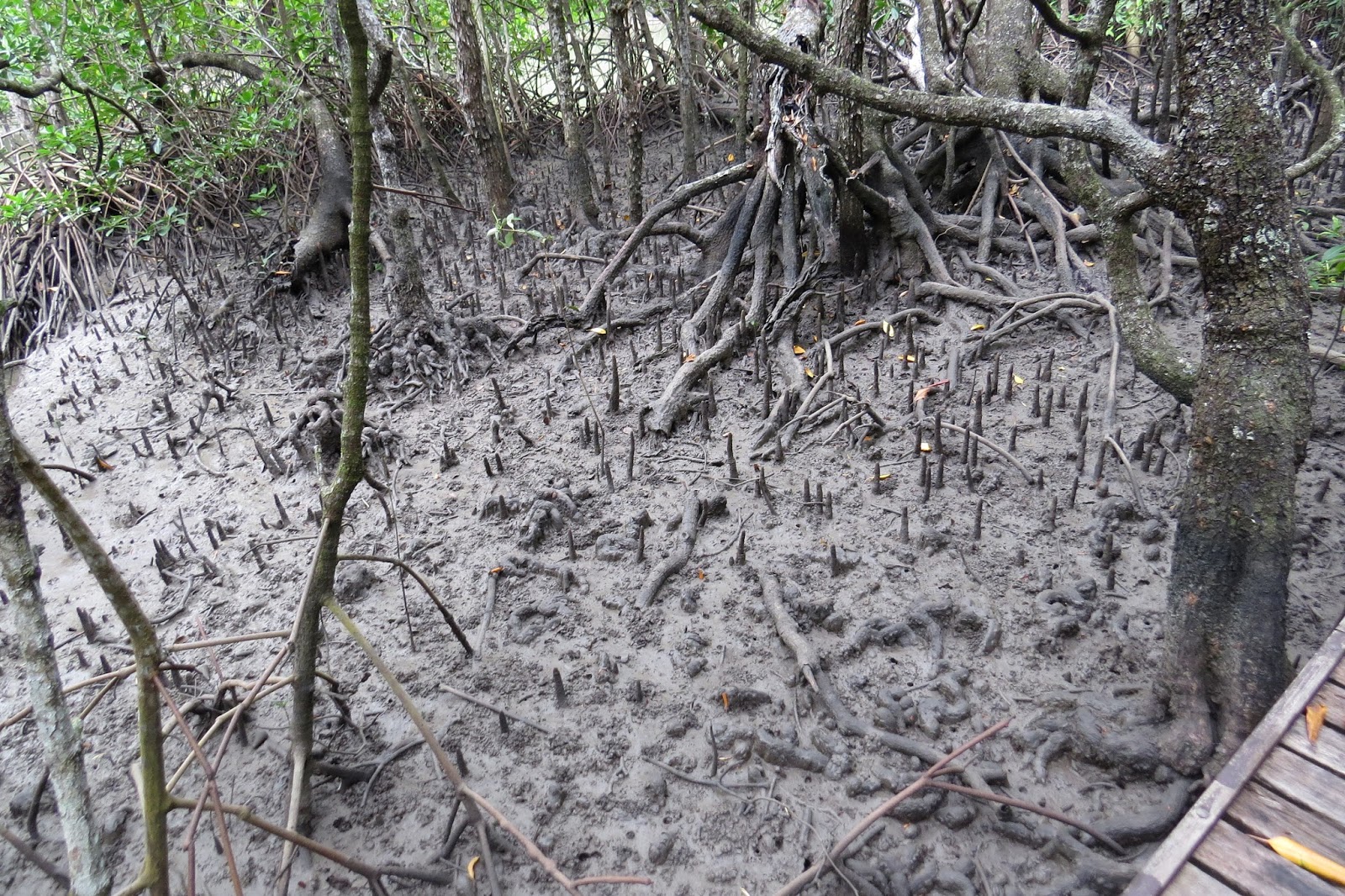
As it turned out, low tide gave us an opportunity to see the unusual tree roots which at times are under water.

We map ourselves the old way. We either take a photo of a map with turn by turn directions before we leave home or commit the directions to memory which here in the Cairns area is easy to do. There are only a few main roads leading to everything.

Notice these little holes that creatures quickly ran in and out of as we passed.

Thus, if we explore without a plan in mind and most often we do, we’re “winging it.” Thus, the term accidental tourist certainly comes into play when we frequently discover an area we may never have found otherwise.  Tom’s superb sense of direction always, prevents us from getting lost.

When we lived in Belize, we toured a mangrove area by boat and explored the rainforest.

Plus, a person could drive the entire perimeter of the continent of Australia without a map and never get lost. Following the coastline itself continues for an estimated over 12,700 kilometers, 7891 miles. Click here to see a video by a scientist explaining how difficult it is to determine Australia’s or any other coastline’s measurements. 

In certain spots, the holes were larger.

As a result, whenever we drive to a specific location, we find ourselves veering off the beaten path on the return drive hoping to stumble upon something amazing we may have never planned and mapped to see. That’s the essence of what makes our travels all the more exciting.

The more we continued on the boardwalk, the denser the tree became.

If any of our readers review our previous over 1000 posts, it would be apparent that many of the highlights of our experiences have been as a result of being the “accidental tourist,” perhaps not in the manner as implied by the book and subsequent movie but, instead, by the interpretation of the words in themselves.

The fact that these trees survive living in saltwater for part of the season is interesting to us.

As Tom turned down the above-mentioned road that led to the airport with no apparent exit for turning around, we both expected that in moments we’d arrive at either the departure or arrivals levels. 

Tangled root systems proliferate in this environment.

Of course, I never complain about Tom having to make such an unexpected turn. I don’t drive the car leaving me with little right to comment about possible wrong turns. Nor would I want to when I, too, am scanning the area for potential points of interest we may have otherwise missed.

We never thought much about these types of areas.  Seeing this firsthand gave us a new perspective.

There we were on the airport road and suddenly a small parking lot appeared to the right, a spot where we could possibly turn around to avoid driving into the airport complex. As we pulled into the “car park” a sign read, “Parking for Mangrove Boardwalk, visitors only.” Our interest was peaked. What’s a Mangrove Boardwalk?

Wouldn’t this be a logical spot for crocs to hang out? If one appeared, we were up high enough to avoid being eaten (after I’d take a photo, of course).

Getting out of the car we moved to read the posted signs to discover that the Jack Barnes Bicentennial Mangrove Boardwalk is a scenic, easy to navigate path through a dense saltmarsh and marshlands.  To quote from the site:

We scoured the banks of the creek hoping to spot wildlife.

“The Jack Barnes Bicentennial Mangrove Boardwalk is a special place to learn about tropical Australian mangroves and saltmarsh. Visitors can learn about a broad range of species, and some of the key functional attributes of these tidal wetland systems. The walk has two distinct parts, heading either north or south into closed mangrove forests from the carpark situated adjacent to a small saltmarsh and saltpan area.

Water from the creeks remained in some areas of the saltmarsh.

The northern boardwalk extends to Little Barron Creek where viewing platforms are provided at the creekside. About half way along the walk, a canopy tower offers a view across the tree tops. This section of the walk returns in a circuit to the carpark. Signs are placed along the boardwalk to provide information on the many ways that plants and animals have adapted to this interesting environment.

The southern boardwalk offers a slightly different experience and explores a number of different types of mangrove forests. This section terminates at a canopy tower near the mouth of Swampy Creek. Signs along this section provide information on the productivity of mangrove forests.

It was odd and somewhat eerie, never seeing other people.

The boardwalk was opened on 27 February 1988 by Dr. JT Baker, OBE, Ph.D., FRACI, Director of the Australian Institute of Marine Science. It was constructed by the Cairns City Council on land made available by the Cairns Port Authority. Construction was supported by the Cairns Bicentennial Community Committee, with the assistance of dedicated employees who constructed the boardwalk, working closely with the Cairns Port Authority, the Queensland National Parks and Wildlife Service, and the Australian Institute of Marine Science.

Location Details

    • Distance/length: Two sections: north 0.8 km, and south 1.2 km
    • Location: Just off the road to Cairns Airport.
    • Walking Time: 30 and 40 mins, respectively.
    • Address: Airport Avenue, Cairns.
    • Directions: Directions as if going to the Cairns International Airport, look for signs to Mangrove Boardwalk when nearing the airport.

Contact: For more information: Cairns City Council, Cairns

We wondered if these little sticks popping out of the ground were remains of downed trees or future trees growing in the salty ground.

Walking through this unusual area was both eerie and interesting at the same time. The raised wooden walkway was in excellent condition and easy to walk, although too narrow for us to walk side by side. I led the way while Tom followed behind reminding me not to fall off a few times. I never felt as if I’d fall off the one-meter wide boardwalk without a railing. Then again, he’s always looking out for me.

It wasn’t far down to the ground from the boardwalk.

As we continued on, the mosquitos started to congregate around my repellent free legs causing me to stop on occasion to swat them off. It wasn’t until the next morning that the bites began to itch which still continues today. Alas, I could have refused to enter this heavily forested area. But, being who I am, I was determined to go and never complain.

This complex cluster of tree roots was hard to miss.

At one point, it felts as if the boardwalk would never end and perhaps we’d get lost. I suggested to Tom that we may have to turn around and go back the way we came when there were no signs posted with map of the boardwalk once inside the path.

We stopped to read each sign along the way.

Tom said, “Let’s keep going.  The path will come back around to the beginning.”

I didn’t take the time to read this sign when close to the water, the mosquitos were in a frenzy.

We continued on and alas, in time, we eventually found the path that circled around the entire perimeter returning us to the beginning. It was quite an interesting and unusual walk unlike any other than we’d done in the past, except for a few tours on which we embarked into various rainforests in a few countries.

Another large muddy creek, a habitat for wildlife.

The only wildlife we encountered was birds none of which we were able to take photos of and also, the most peculiar little creatures that rapidly ran in and out the holes in the ground at low tide when they heard us coming, again never able to get a good look at them, let alone take a photo. We assumed they must have been some miniature type of marine life.

Finally, we were back at the beginning. Although I enjoyed seeing this most peculiar area, I was thrilled to get back into the car away from the mosquitos.  Once inside I noticed a stick roll-on repellent I’d left in the car. Next time we explore, I’ll bring it along, using it as needed.

When the walk ended, we commented on how often we find such interesting spots to explore and that truly our favorite experiences are often those we encounter as “accidental tourists.”

                                                  Photo from one year ago today, July 23, 2014:
The scenery over the island of Madeira was breathtaking every day.  Our time was winding down and we began to think ahead in this year ago post.Please click here for details.

The progression of a sunrise over the Coral Sea…Pinching ourselves…Not used to it yet! TV in Australia…

Tom’s first photo of sunrise over the Coral Sea at 6 am this morning. 

A few days ago while we were busy with our record-keeping flipping between screens on both of our laptops, a wildlife show flashed on the TV. Australian TV offers a constant stream of interesting documentaries of both its own continent and that of other continents which when we staying in we often keep running in the background.

Quickly, the scene began to change.

It was from watching documentaries that we’ve been inspired to visit many parts of the world. It was in 2004 that we watched a documentary on the Great Migration that stuck in our brains. It was nine years later that we found ourselves in the great Serengeti and the Maasai Mara in Kenya. 

He said it changed in seconds, not minutes.

We must admit that while I’m preparing the daily posts and Tom’s busy searching for future travels we keep the TV turned on to Australian news and documentary type shows. Without cable TV and only an antenna at our rental, there’s no BBC, US news, or world news on any of the channels here, although on occasion the US Today Show will pop up for no reason at all. 

TV programming by antenna only is lacking, to say the least except for the few treasures we’ve stumbled up. We were warned about this by our shipmates on the last cruise.  Most often one can only find “footy” (football/soccer in Australian talk), old reruns of MASH, and a few tiring game shows. 

Tom doesn’t usually capture amazing shots such as these.  I’m impressed!

We seldom, if ever, sit down to watch the TV itself. It’s only at night after dinner that we watch a few of our favorite shows. Instead, as we’ve mentioned in the past, we feel lucky when there is a flat-screen TV into which we can plug my laptop via an HDMI cable to watch a few favorite downloaded shows. In a few past vacation homes, we had no TV at all and we were content to watch the laptop’s 15.6″ monitor.

At present, we’re watching “Breaking Bad” (starting season three tonight) having recently completed the fabulous seven seasons of Sons of Anarchy, an all-time favorite. Also, we love BBC shows, recently completing Poldark and Crimson Fields, both amazing shows recommended by our friend Liz in Bristol, UK.

By the time I walked out the door, it had already changed this much.

Let’s face it, we’re just like most people who wind down at night to engage in a number of favorite pastime activities such as read, listen to music, drink wine and/or watch a few shows. We all need some “downtime” and the fact that we live a life of travel doesn’t change that fact. 

He handed me the camera, but at that point, the magical scene was nearly gone.

By evening, especially after a good meal and cleanup, we have no interest in searching for new places to visit in the future and our brains aren’t working well enough to maintain record keeping or handle financial matters.  Those tasks are best served during the day when we’re most alert.

What we’ve found most peculiar about Aussie TV programming is the fact that shows don’t necessarily start “on the hour or half-hour” and aren’t necessarily on at the same time each day or week or, on at the time listed on the online guide. One can easily miss a favorite program if counting on the next episode occurring on the same day and time a week later. 

Tom had already captured the very best of it.

As a result, we’ve made little effort to watch any Aussie produced shows other than documentaries that pop up on occasion when we happen to take notice. As mentioned a few days ago, we’ve loved David Attenborough’s documentaries but, there are numerous documentaries about life in Australia, the Outback, and travel around the continent.

Many of these shows we’ve stumbled upon have inspired us to visit various beaches, book more Australian cruises, and consider returning to Australia during the gaps in our itinerary as shown in yesterday’s post. 

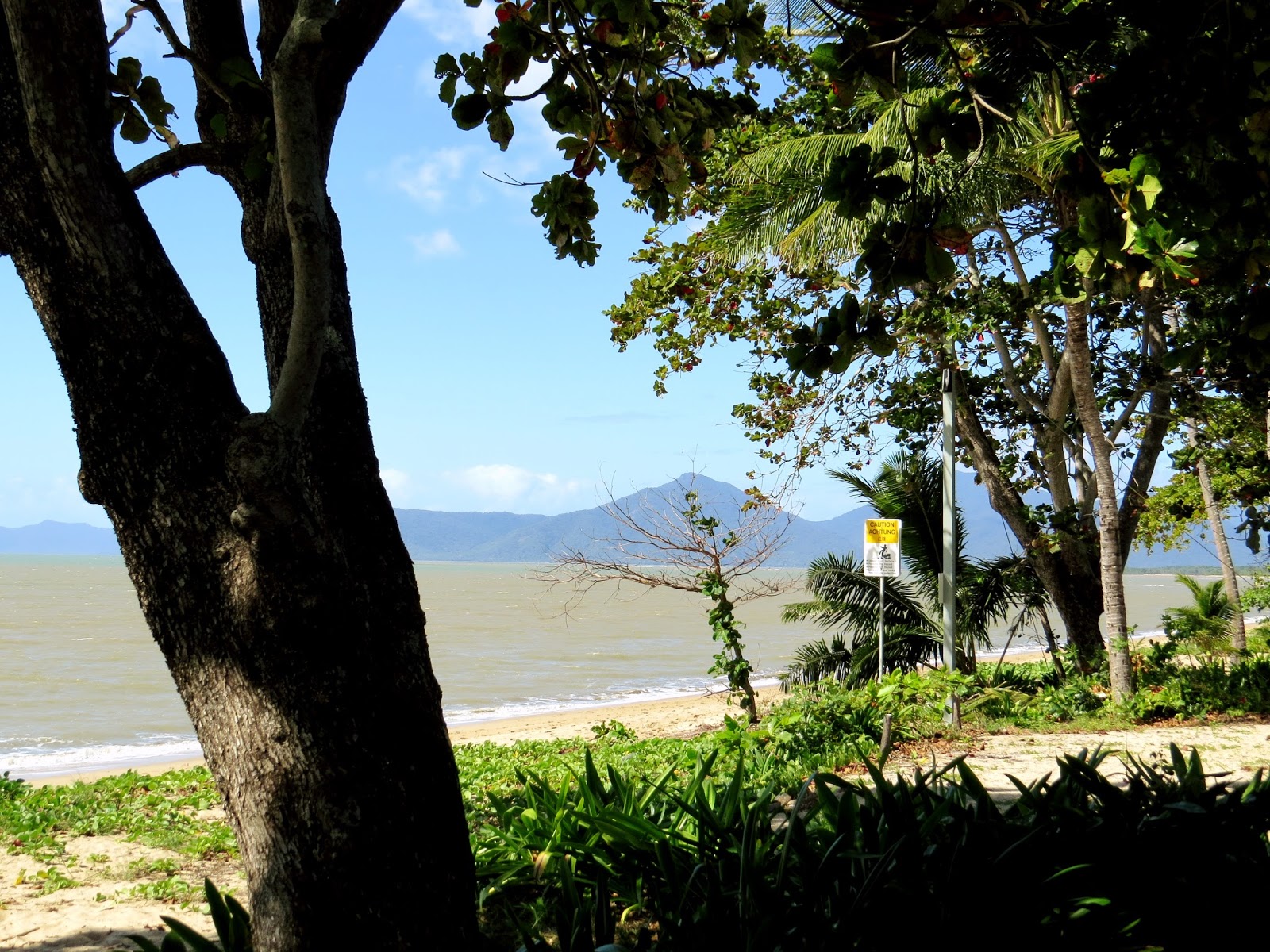
Mountains and the sea are a perfect combination here in Trinity Beach.

The Australian documentaries are beautifully produced and give the viewer an appealing perspective of this vast relatively low populated continent. With its 23.5 million residents (2014) and size comparable to the US with its 319 million (2014), Australia relatively unpopulated for its size with most of the population residing near the perimeters closest to the sea.

Watching an occasional documentary has inspired us in many ways to further appreciate this unique continent.  I supposed we could say that most continents we’ve visited thus far are unique in their own ways for their terrain, lifestyle, and of course, their people. 

The beauty of the sunrise wafts away.  The beauty of a new day just begins.

Yesterday, we took a drive with more good photos to share over the next few days. Tomorrow morning, we’re off to Tom’s medical appointment and my final test results. Since he won’t be able to have breakfast before we leave due to upcoming blood tests, we plan to go out for coffee and breakfast in Trinity Beach by the sea, weather permitting. Photos will follow.

The dawn of a new day.  We’re grateful for every day we’ve been given.

For today, we couldn’t resist posting these sunrise photos Tom took this morning when getting up before 6 am.  I heard him go outdoors and I followed shortly but by the time I got outside, the amazing sky had begun to wane. The more intense photos shown here today are his and mine are the less than vibrant batch. 

Have a lovely Saturday or Sunday, wherever you may be!

                                              Photo from one year ago today, July 19, 2014:

While in Madeira one year ago, we visited one of the other rental homes owned by our landlords, Gina and Carlos. As we toured the beautiful house, our eyes were glued to the many works of art on the walls including this above needlepoint made by Gina’s mother and aunt. As a result, we posted photos of many of these works which can be found by clicking here.

Part 2…An environment of dedication, compassion and love at the Cairns Tropical Zoo…

We fell in love with the Pelicans for their beauty, grace and movement.

The Freeman family, locals in the Cairns area, have been instrumental in developing an extraordinary wildlife experience since 1980 with a goal of providing the utmost in conservation and species preservation.

A Pelican show of wingspan.

With a wide array of educational and highly entertaining presentations available that enable visitors to participate in many hands-on and up-close and personal interactions with appropriate wildlife, those visiting the Cairns Tropical Zoo will find themselves enriched from a unique zoo experience.

Peacocks were freely roaming the grounds of the zoo.

In addition, the Freeman family established the private North Queensland Wildlife Trust, which includes not only the Cairns Tropical Zoo but also, Hartley’s Crocodile Adventures and Kuranda Koala Gardens. By the development of the trust, funds are raised for the conservation of native species and their habitat.

Even these less than attractive Lizards can be cute in repose.

It is this kind of passion and dedication to wildlife that is exhibited throughout the zoo as Jasmine toured us through many of the areas to see wildlife we’d never seen face to face in any environment throughout our world travels.

Mom or dad makes a comfortable pillow.
A pile of Turtles.

To be able to take numerous photos as shown here without placing our camera into the holes into a tight chain-link fence gave us a feeling of openness and space, certainly enjoyed and appreciated by all of the various wildlife.

Spoonbill, rightfully so named.

Of course, the dangerous animals such as the massive crocodiles that caught our breath, the design of their habitat provided total safety and security while allowing the photo enthusiast full access to those much revered perfect shots as we’re sharing here in both Parts 1 and 2 of the two-day story.

A Wallaby is a small or mid-sized macropod found in Australia and New Zealand. appears to be a miniature Kangaroo.

The snakes including some of the most venomous in the world were safely behind full glass enclosures that still allowed a relatively clear shot as shown in our photos.

When mom got busy in a bit of a scuffle with another Koala, joey, Violet, decided to high tail away from the action.
Of course, not surprisingly, the Koalas captured our hearts. Jasmine was able to take us inside the  “nursery” of the Koala House. For the first time, seeing baby Koalas inside the pouches of their loving mothers was a sight we’d long desired to see. 
Curious as we approached.

The “joey-in-the-pouch” sighting warmed our hearts as well as the other visitors happily snapping photos in the Koala House. Buttercup, an adult Koala, one of Jasmine’s favorites, who’d been rescued by the zoo after losing a leg after being hit by a car, sleepily cuddling in her eucalyptus tree.

It wasn’t unusual to see a variety of species sharing an area as is common in the wild.

Much to our surprise, Koalas can consume as many as 1000 eucalyptus leaves per day. With conservation in mind, the Cairns Tropical Zoo has managed to utilize a means of harvesting leaves from downed branches from the electric company’s clearing underneath power lines and from three dedicated eucalyptus plantations, rather than destroying trees in the forest. 

The Emu is the largest bird native to Australia. We couldn’t seem to get her/his attention when she was busy looking through the fence.

In addition, considerations are made for wildlife that may have originated from a more distinct winter/summer season with seasonal dietary needs. These facts only added to our respect for the zoo’s philosophy of creating a safe, healthy, and comfortable environment for all of its inhabitants.

With the bright sun reflecting on the Komoda Dragon house which is encased in glass for safety, we had a difficult time taking a photo through the glass, this being our best shot.

With our interest in a wide variety of birds throughout the world, we were particularly fascinated with the graceful and majestic pelicans, again with incredibly easy access for our photo taking. 

The Cassowary is the third tallest flightless bird in the world. A relatively shy bird that can be dangerous in the wild when provoked.

It would only be under these special circumstances that we’d have been able to capture such shots as those we’ve included in both yesterday’s and today’s post for which we are very grateful.

After recently posting distant photos of Cockatoos we spotted in Holloways Beach, it was fun to up close and personal in one of the aviaries in the zoo.

We express our heartfelt thanks to the staff at the Cairns Tropical Zoo for “handling” our visit with the same attention to detail and care as they provide for each and every creature habituating in their creative and loving environment including at times, some not-so-invited fly-ins.

The entrance to the zoo and gift shop. 

                                                Photo from one year ago today, July 12, 2014:

It was one year ago today that Tom had a haircut at a salon in Ribeira Brava, Madeira. For more photos and details from that date, please click here.

Part 1…An environment of dedication, compassion and love at the Cairns Tropical Zoo…

It’s ironic that one of our favorite wild animals at the Cairns Tropical Zoo was the Dingo, looking familiar to us as a domesticated dog. However, Dingos are wild animals, and many attempts to domesticate them have failed. 

With expectations in check, we met Jasmine, the Mammal Department Supervisor at the Cairns Tropical Zoo on Tuesday morning. When neither of us has visited a zoo in many years, we found ourselves with mouths agape as Jasmine gave us a private tour that will remain a treasured memory for years to come.

Binturongs are closely related to the mongoose and distantly related to skunks and weasels. They have a distinct odor common in both males and females, similar to that of popcorn which is produced when scent marking for territorial rights and mating. This fellow is named Sari. Binturongs are on the endangered species list.

For world travelers, having spent nine months in Africa, having been on safari on many occasions, we had no idea how much pleasure and joy we’d experience seeing wildlife in a confined environment. With our previous lack of zoo experiences in the past 30 years, we had no idea how times have changed in the zoo industry.

The Wildlife Wedding Chapel on the ground of the zoo is a popular venue for weddings. Please click here for details.

Cairns Tropical Zoo depicts the epitome of progression resulting in the nurturing, love, and compassion of the preservation of many species we’d seldom, if ever, see in the wild during our time in Australia, on and off over a period of almost two years. 

The Koala, Phascolarctos cinereus, or, inaccurately, koala bear, is an arboreal herbivorous marsupial native to Australia. It is the only extant representative of the family Phascolarctidae, and its closest living relatives are the wombats.  In most cases, we don’t take photos of the wildlife from behind, but this scene made us smile when we visited the Koala nursery.

Jasmine spent considerable time as the three of us gathered in the Koala Cafe, answering our seemingly endless questions about the zoo, its management, feeding, and care of the vast array of wildlife. 

Check out this Koala face!  Could it be any more adorable?

Afterward, we were all anxious to continue on as she personally escorted us on a tour to see many of the zoo’s precious inhabitants. As a dedicated 10 plus year employee, Jasmine exhibits an enthusiasm one would never expect upon such employment longevity.

This scene took our breath away. This is a mother Koala with her “Joey” which is the name for all marsupial offspring. A Koala Joey is the size of a jelly bean, with no hair, no ears, and is blind at birth. Joeys crawl into the mother’s pouch immediately after birth, staying there until about six months old.

Throughout the tour, we never felt a sense of bored animals confined in small spaces with little to do but sit and watch annoying visitors. Instead, the expertly designed and maintained environments befitting each animal’s natural habitat, created a feeling of openness and freedom, enabling each species to thrive, propagate and live long, healthy lives, enhanced by the constant love and care of the many employees.

The natural bond between moms and their offspring is always precious to observe. Many visitors gathered around this area in awe of the experience.

Such was apparent in Jasmine’s description of each aspect of the zoo, as her eyes twinkled with sheer delight as she introduced us with pride to many of the species from the Komodo Dragons to the wide array of birds in the various aviaries. 

Jasmine, Tom, and Koala mom and Joey, who was named Violet after 10-year, devoted employee Jasmine’s daughter. 

What particularly appeals to us is the fact that the Cairns Tropical Zoo has rescued many wild animals bringing them back to health after severe injuries and illness that would prevent them from safely returning to the wild. Those deemed fit for released is returned to a safe wild environment. 

They were both checking out the action. Koalas eat as much as 1000 eucalyptus leaves per day. 

In addition, the zoo has taken the responsibility to include many endangered species, as well as those that may have been cast aside from private citizens hoping to domesticate an animal such as a Dingo, an animal never intended to be kept as a pet. 

This young Koala ventures away from mom for a moment.

As we often hear, wild animals are just that.  hey aren’t intended to become pets and the cast-offs of irresponsible owners often end up in zoos. Cairns Tropical Zoo welcomes such animals, anxious to provide them with a rich life they so well deserve since most often they cannot be returned to the wild and survive.

Boa Constrictor, safely behind the glass enclosure. There was a Reticulated Boa in the background which was difficult to see in the darkened area.

Much to our delight and good humor, Jasmine explained that oftentimes, a variety of birds and wildfowl including the Pacific Black Duck fly into the zoo’s habitat of other birds deciding on a free meal and “easy ride’’ often staying at their leisure. Nonetheless, these wild birds are fed.

The massive size of numerous Crocodiles in their well secured, but the viewable area is difficult to describe here. Their weight is estimated when it’s impossible to ever get them on a scale. They may weigh upwards of 1000 kg, 2205 pounds. 

The Cairns Tropical Zoo is located only 20 minutes north of Cairns, and 35 minutes south of Port Douglas at Palm Cove on the Captain Cook Highway. With easy free parking and reasonable entrance fees, it’s the perfect venue for both children and adults, tourists, and locals alike. 

It isn’t often we could get quite this close to a Crocodile to have a close-up view of the complex tail and hide.

The wildlife areas are easy to navigate with only a few gradual inclines making it possible for many with limitations to enjoy full access to most areas. For the times of operation, entrance fees, and extensive information about the Cairns Tropical Zoo, please click the links provided.

A smaller female Crocodile sunning with her mouth within close proximity to a larger male.

Tomorrow, we’ll return with Part 2, more photos and information about our visit to the zoo and our many new experiences with the wildlife we’ve never seen in our past worldwide travels.

Like us, Crocs have five digits but, that’s where the similarities end!


Photo from one year ago to July 11, 2014:
The fuzzy green buds on this exquisite orchid were quite a joy to see while on a flower hunt in Madeira. For details, please click here.

Pure joy!…Photos of two of the fledging Laysan Albatross chicks in Kauai…Vinny and Nash…The culmination to our passionate observation…

For the purposes of illustration and the difficulty of determining which bird is Vinny and the other Nash, we’ve taken the liberty of speculating which of the two birds are shown in these photos, although each photo is one of the two. Also, due to the poor internet connection and the number of photos our line spacing may appear inaccurate.
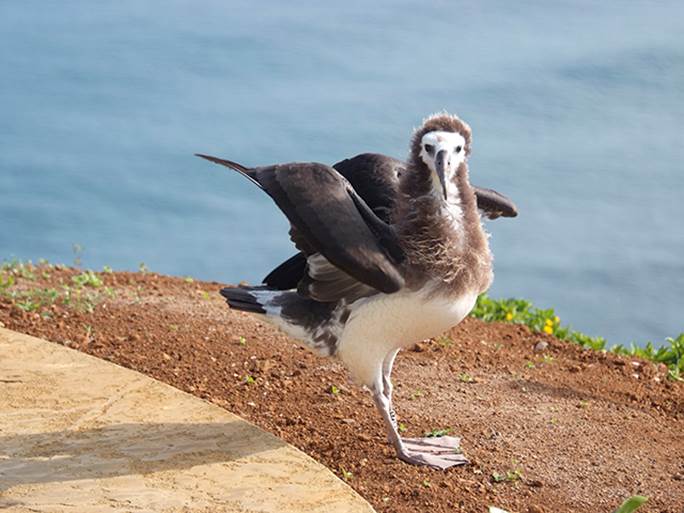
The remaining fuzz doesn’t deter Nash from being ready to go. Only five months old, he’d yet to shed his chick fluff, but the dark lined eyes are very grown-up.
On Saturday morning as we began our day, sipping coffee and getting online Tom asked if I’d seen my email yet. I hadn’t. Instead, I was busy checking photos for the day’s post and contemplating the storyline. 
Vinny awoke this morning and decided, “Today’s the day,” and begins the long walk to the edge of the cliff.

Most days, I have no idea as to our story instead, using the most recent photos to lead the way into the day’s story. Posting with photos each day can be rather challenging at times, especially when we don’t always have enough good photos on file to share.

It’s a long walk for Vinny from the nest to the edge of the cliff.

With today’s scheduled appointment for an interview at the Cairns Tropical Zoo (see this post for details on why we’re going to a zoo) after which we’ll tour the zoo to take many photos of Australian wildlife which we’ll share here in the days to come, we thought having a story and photos to post early in the day would get us out the door on time.

Nash begins to hike from the nest to the cliff’s edge.

At times, we plan ahead by preparing a post a day or two early when we have something specific scheduled in the morning when I usually prepare the post. Luckily, we’re able to schedule the post to automatically upload at a designated time making it possible for it to upload while we’re away.

“This looks scary,” says Nash. “It’s a shame I’m having a bad hair day!”

Today’s story is such the case when Saturday morning’s email from our dear friend Richard in Kauai, sent both of us these awe-inspiring photos of Vinny and Nash as they fledge the nest and head out to sea to fen for themselves.

“So what if I don’t look very grown up! I can do this!”

These amazing photos were taken in the past few days by Bob Waid, albatross expert and photographer, who lives in the special neighborhood in Kauai (along with Richard) which we frequently visited to see the progression of the life cycle of the Laysan Albatross.

“I’m almost there.”

Somehow, from years of experience and sheer luck, Bob was able to take these photos that brought tears to my eyes. Bob Waid wrote the wonderful book on the life cycle and nesting habits of the intriguing Laysan Albatross which we read shortly after our arrival, relishing every photo included in the beautiful story. 

It’s a big commitment, worthy of contemplation.
“I can do this,” says Vinny.

While we lived in Kauai, Hawaii, USA for over four months before taking the cruise to Australia, we had the exquisite opportunity to visit the albatross, often several times each week, from the incubation stage when the many sets of parents were taking turns sitting on their solitary eggs, through the date in early February when the chicks finally hatched.

“Hey Ma, hey Pa! Look what I can do!”

From there, we had the joy of watching the chicks mature as they sat on their nests growing plumper and plumper each day as the parents took turns flying out to sea to feed. 

It’s a whole new world for Vinny and Nash

The parents were often gone for many days, leaving the chick returning to regurgitate the seafood to feed their precious chick. Watching the feeding in itself was a mind-boggling experience, one we treasured along with each step in the growth cycle. 

What a gorgeous young Laysan Albatross, minutes before fledging!
Having had the opportunity to meet both Bob Waid and later, Cathy Granholm, a docent with the Los Angeles Zoo (see this link for some photos, a video, and our story) both of whom live in the neighborhood only added to our extraordinary and memorable experience.
Vinny leaping off the cliff to a new life.

Cathy is the record keeper for the progression and growth of the Laysan Albatross chicks and families.  Tirelessly, she’s wandered through the neighborhood twice daily, spending hours recording the growth and behavior of the chicks, their parents, and yet to mature offspring many of whom return to this magical neighborhood year after year.  

A running start for Nash.
Cathy has managed this daunting task for the past 10 years, making it her way of life for seven to eight months of the year.  What dedication!

On Saturday morning when Tom suggested I immediately check my email with a huge smile on his face, I knew it was something wonderful as opposed to disturbing news of any type.

Almost over the edge!

Opening the message from Richard, my breath caught in my throat and I loudly gasped when I saw the photos as Tom spewed out the words, “It’s the chick named Vinny who is fledging.” 

“Hmm… It looks like I need to try again.”

Then again yesterday morning we found the second batch of photos of Nash fledging sent to us once again by Richard. I’d contacted Bob by email to ask him if he’d give us permission to post his photos. He was thrilled to share them with us and our worldwide readers.

Finally Nash is on his way.

After over four months, (nothing compared to Bob or Cathy’s commitment) of following the growth and progression of the chicks and taking endless photos and videos, the experience had finally come to fruition, even with us now living so very far away.

“Finally, I’m free!”

Having the opportunity to see these photos sent me over the moon in a swoon of joy. For those of our readers who followed the albatross journey with us, who perhaps tired of our constant comments, and photos, humor me one more time and check out these photos knowing they are posted with a love of wildlife and a passion for the mystery of life itself.

Vinny takes flight!

We both want to thank Bob, Cathy, and our friend Richard for introducing us to this extraordinary annual event that magically worked out perfectly during the time of our lengthy stay in Kauai. 

“Weee… This is fun!”

By the time you see this post, we’ll be on our way to see the wildlife of Australia. Although, we’d have preferred for the opportunity to see the animals in their natural habitat, as we’d watched the Laysan Albatross for months and as we experienced in both Kenya and South Africa, we’re grateful for this inside look into life in this environment.

Vinny’s off to his new life at sea.

Although the Cairns Tropical Zoo may be a controlled  environment, we have no doubt that the wildlife is nurtured with the care, compassion, and expertise of many dedicated individuals who appreciate each and every creature

Check out that wingspan on a five-month-old Laysan Albatross chick Nash as heads out to sea.

Most of all, as we wind down our story of this memorable experience, we want to express our love for the Laysan Albatross parents and chicks for giving us the glorious experience of witnessing a vital part of your life that in essence, has changed ours.

Off to the sea, perhaps to return to the neighborhood when they mature in four to five years to have their own chicks to nurture and love.

The last video we took of the albatross before we left Princeville, Kauai.

                                               Photo from one year ago today, July 7, 2014:

One year ago today, we’d booked an Australian cruise on the Celebrity Solstice, a ship on which we’ve sailed in the past on January 5, 2016, a mere six months away. How the time flies! For more details on this cruise, please click here.

Breathtaking Cattana Wetlands…Exciting news on the horizon…Stepping outside the box on Tuesday…

The Cattana Wetlands offered excellent expansive views.
Vegetation growing in the lake at the Cattana Wetlands created this view.

Our sense of relief is totally wrapped around a high degree of excitement. We’ve filled the gap in our schedule for next June, July and August and couldn’t be more thrilled with the bookings we’ve finalized as of late last night.

There were numerous signs warning of the possibility of crocodiles as we entered the Cattana Wetlands, none of which we’ve seen as yet.

In tomorrow’s post, we share the first half of the details with the balance the next day, each warranting their own post with the amount of information and photos we have to share.

As it turns out, we have an upcoming appointment on Tuesday morning at the Cairns Tropical Zoo to interview the Mammal Department Supervisor to learn about the zoo, the care, and preservation of the wildlife, and to take photos of the wildlife indigenous to Australia. 

Who knows what creatures may lurk beyond the vegetation?

OK, I get it. We’re hypocrites. We said that we “don’t do zoos” and normally we don’t. The reason we haven’t done so in the past is due to our love and respect for the preservation of animals in the wild. After all, we did go on many photo safaris in Africa in both Kenya and South Africa. 

The sun reflected in the wetlands creating this orange glow in the water.

However, we feel we could justify, rationalize or in less severe terms, simply explain, why we’re visiting a zoo on Tuesday to write a story about the facility, its operation, and the care for its vast array of Australian wildlife.

The Cattana Wetlands are well arranged with paved walking paths and clearly marked areas.

Many moons ago, we spent days researching possible “safari-type” adventures in Australia, contacting many potential resources to get the same answer each time, “We don’t do safaris in Australia. You can drive to the Outback to possibly see some wildlife on your own.” 

The various ponds and lakes were clearly marked.

Frustrated that such a safari wasn’t realistic we gave up searching only to begin again once we arrived in Trinity Beach. After using no less than two gig of data searching online, again I came to the realization that its is not going to happen unless we rent an RV to make the trip on our own. 

Peeking through the trees to the main lake in the Cattana Wetlands.

Now, don’t get me wrong, we seriously considered touring the Outback on our own without fear or apprehension. We’d considered using the gap in our itinerary that we’ve since otherwise booked that we’ll present tomorrow and the following day. 

Areas were clearly marked with maps and descriptions.

The problem in touring the Outback on our own is the cost of the rental of an appropriate vehicle, preferably an RV with four-wheel drive (although not necessarily required) when hotels and RV parks, although available, aren’t as readily available as one may think. 

We expected a beaver to pop up at any moment. 

The bottom line for us is the cost. A moderately sized and priced RV with toilet, shower, kitchen, etc. would cost in the range of US $15,000, AUD $19,954 a month when adding RV rental fees, fuel, groceries and RV park fees. The price of fuel alone would be outrageous when the cost here in Australia is twice as much, if not more, than the cost in the US.

This small island was located in the middle of the lake.

In addition to the cost, we wouldn’t be able to get online and, most importantly, we may seldom find wildlife.  The Outback is a vast desolate desert. One can drive for hours and hours to never see another vehicle. 

 A close up of lily pads on which some creature enjoyed lunch.

Here’s an interesting article regarding some of the potential challenges of driving through the Outback.

The lakes were covered in parts in lily pads.

Believe me, this has been a tempting prospect. But, reality prevails, and incurring this type of expense for that which may prove to be a very long drive in a vehicle with little to see, we decided against the possibility. 

One of many paths we’ll explore when we return in the future.

Instead, in this almost month we’ve been in Australia, we’ve wandered through many rainforest areas looking for wildlife including the Cattana Wetlands for over an hour (we’ll return again with insect repellent and proper clothing) we only saw a few birds, none of which we were able to get a photo.

It was especially appealing on a sunny day. 

As a result of this long and convoluted situation, we decided that the only way we’d see a large amount of indigenous wildlife would be to visit a zoo, one of which, The Cairns Tropical Zoo, is located near the Palm Cove area we visited a week or so ago.

Leave that have changed color.

Contacting the Manager of Wildlife and Operations, we’ve been able to secure an appointment to interview a zoo supervisor to learn what we can about Australian wildlife which we’ll share here with photos and descriptions over a period of several days.

From a distance, we thought these were flowers when in fact, they were colorful leaves.

Sure, we hesitated at this prospect based on our passion for animals in the wild. But, we both feel a tremendous desire to learn more about the exquisite and unusual inhabitants in the wild in this amazingly diverse continent.  The only logical means of doing so with the least amount of expense and time is to take the path we’ve chosen, albeit with a bit of trepidation. Hypocrites? Perhaps. Wildlife enthusiasts? To a high degree!

As we entered the wetlands, this was the first path we took toward the lake.

Today, we’re sharing the photos we took a few days ago at the Cattana Wetlands. Here’s a blurb of the story of the wetlands from this site:

“Originally a sugarcane farm owned by Franco Cattana, the site was used as a sand mining quarry resulting in several fresh and saltwater man-made lakes. The land was purchased by the then Mulgrave Shire Council in 1993, primarily to protect the 30 hectares of lowland rainforest on the western end of the site. This forest, described as the Feather Palm Forest, is a remnant of a once extensive forest type that is now confined to only a few remnant patches in the Cairns region. Council has planted over 70,000 native plants and undertaken extensive weed removal enabling existing water bird populations to flourish. As part of the 150th anniversary of Queensland celebrations, Council and the Queensland State Government each committed $1.5 million to the rehabilitation of the site. The works program included the construction of boardwalks, walking tracks, bird hides, and viewing platforms, picnic areas, interpretative signs, car parks, access roads, and toilet facilities. In addition to the amazing wetland habitat, Cattana Wetlands also harbours an impressive range of north Queensland wildlife and significant plant communities.”

Tomorrow, as stated above, we’ll be sharing our new bookings. Please stay tuned for much more to come!

Again, to our family and friends in the US, have a safe and memorable Fourth of July celebration.

                                                Photo from one year ago today, July 4, 2014:

There are many tunnels on the island of Madeira, Portugal, located off the coast of Morocco in Africa. We enjoyed every day of the two and a half months we spent in a gorgeous house overlooking the hills and the sea. Also, on this date, one year ago, we posted our upcoming itinerary available at that time.  Soon, we’ll be posting an updated itinerary, including the booking we’ll be sharing in the next few days. For more details, please click here.

Further explorations of this amazing area…Holloways Beach…An exciting sighting…

Finally, we were able to take photos of Cockatoos.

Yesterday, we took off after I worked out at the local fitness center. From now on, I’ll leave a pair of shorts in the car when my spandex workout pants are too hot to wear while walking outdoors.

Strait on the Beach, a café and store on the beach.

We started our tour for the day at Holloways Beach which is very close to Cairns, the big city where the airport is located. Having heard there was a cute café on the beach, it was worth checking out. 

The quaint outdoor setting at the café.

Perhaps, we’d stop for a beverage while overlooking the ocean or return at another time for a meal. We’d had breakfast before we left the house in the morning and wouldn’t be hungry again until dinnertime.

The interior of the café in Holloways Beach.

Unfortunately, the quaint café didn’t have anything on the menu that would work for me so we continued on, knowing that we had our iced tea in the car and a home-cooked meal ahead of us in the evening.

Few visitors were on the beach.

The restaurant required visitors to stand in line, place their orders, and then pay. With as seldom as we dine out, we prefer to have a server take our food orders deliver the food, and subsequently the bill. 

We checked out the neighborhood, the beach, and the rainforested areas and didn’t spot a thing until Tom immediately pulled to the curb when he spotted something exciting in a park and playground area as we drove through a quiet neighborhood.

There were no less than a dozen what is referred to as Sulphur-crested Cockatoos. Here’s some information on these popular local birds, at times known to be pests:

“In Australia, sulfur-crested cockatoos can be found widely in the north and east, ranging as far south as Tasmania, but avoiding arid inland areas with few trees. They are numerous in suburban habitats in cities such as Adelaide, Melbourne, Canberra, Sydney, and Brisbane. Except for highland areas, they occur throughout most of New Guinea and on nearby smaller islands such as Waigeo, Misool, and Aru, and various islands in the Cenderawasih Bay and Milne Bay.

Within Australia, sulfur-crested cockatoos of the nominate race have also been introduced to Perth, which is far outside the natural range. Outside Australia, they have been introduced to Singapore, where their numbers have been estimated to be between 500 and 2000. They have also been introduced to Palau and New Zealand.

In New Zealand, the introduced populations may number less than 1000. This species has also been recorded as established in Hawaii and from various islands in Wallacea (e.g. Kai Islands and Ambon), but it is unclear if it has managed to become established there.

Holloways Beach in Cairns.

Their distinctive raucous call can be very loud; it is adapted to travel through the forest environments in which they live, including tropical and subtropical rainforests. These birds are naturally curious, as well as very intelligent. They have adapted very well to European settlement in Australia and live in many urban areas.

The flock of Cockatoos was busy foraging for food.

These birds are very long-lived and can live upwards of 70 years in captivity, although they only live to about 20–40 years in the wild. They have been known to engage in geophagy, the process of eating clay to detoxify their food. These birds produce a very fine powder to waterproof themselves instead of oil as many other birds do.

The sulfur-crested cockatoo is a seasonal breeder in Australia, little is known about its breeding behaviour in New Guinea. In southern Australia, the breeding season is from August to January, whereas in northern Australia the season is from May to September. The nest is a bed of wood chips in a hollow in a tree. Like many other parrots it competes with others of its species and with other species for nesting sites. Two to three eggs are laid and incubation lasts between 25–27 days. Both parents incubate the eggs and raise the nestlings. The nestling period is between 9 to 12 weeks, and the young fledglings remain with their parents for a number of months after fledging.

It was interesting to see how adept Cockatoos are with their claws.

A 2009 study involving an Eleonora cockatoo (the subspecies Cacatua galerita Eleonora) named Snowball found that sulfur-crested cockatoos are capable of synchronizing movements to a musical beat.

Species that feed on the ground are very vulnerable to predator attack. The cockatoo has evolved a behavioural adaptation to protect against this: whenever there is a flock on the ground, there is at least one high up in a tree (usually a dead tree), keeping guard. This is so well known that it has even entered Australian slang: a person keeping guard for sudden police raids on illegal gambling gatherings is referred to as a cockatoo or cocky for short.”

Stopping again to check the surroundings.

On numerous occasions, we’ve spotted cockatoos flying in the yard. By the time I’d grab the camera, they would be long gone. Cockatoos seem to alight in the trees for only seconds, but yesterday’s flock was busy foraging for food on the ground although they were well aware of us watching them at a distance. We never got out of the car to avoid disturbing them. As a result, our photos aren’t ideal, all taken from quite a distance.

This one stopped looking for food to look at us wondering if we were a threat.

After leaving Holloways Beach we headed to the Cattana Wetlands, a location we’ll soon visit again. Wearing those spandex pants on the hot sunny day, I felt as if I was encased in a plastic bag, sweating like a fool as we walked. However, we walked for about an hour, taking a number of exquisite photos which we’re excited to share tomorrow. 

Holloways Beach wasn’t quite as scenic as some of the other beaches we’ve visited in Cairns.

Upon leaving the Cattana Wetlands we returned to the fish market near Yorkeys Knob. We’d already run out of the fabulous smoked fish we’d purchased several days ago which had been a perfect accompaniment to cheesy scrambled eggs and bacon.

There were no less than 18 Cockatoos in the flock.

Today, we’re heading back to the travel agency to pick up the paperwork for the airline tickets we purchased on Monday and grab a few items from the market. Who knows what the remainder of the day holds for us? 

For our friends and family in the US…have a safe and enjoyable Fourth of July weekend!

                                               Photo from one year ago today, July 3, 2014:

One year ago today, we booked our upcoming stay in January in New Zealand, living on an Alpaca Farm while we tour the country by car. Of course, we won’t have to do any work on the farm with the owners living in another house on the property. For more details, please click here.

Yorkeys Knob…An interesting visit provided a wide array of experiences…A few new favorite photos…

After leaving the beach we drove to a high point in the area with this expansive view.

The Cairns area of Queensland has so much to offer. It’s highly unlikely we’ll ever run out of places to explore during our remaining few months in Trinity Beach. Sure, at some point we’ll drive further away. For now, we’re soaking in everything we can in the wide-area surrounding us that is jammed packed with interesting spots to visit.

We walked past a grove of palm trees and evergreens as we made our way to the beach.

Yesterday’s outing after my workout was no exception. Having heard about Yorkeys Knob as a community rich in history and diversity, we decided to check it out and by no means were we disappointed.

As we walked toward this crest which after crossing dipped down to the beach, wondering if any cross may be lying in wait. 

We found an enormous stretch of beach that was pure paradise. We met people along the beach with whom we talked for some time, we drove along the many streets and beach boulevard enjoying the differences of other beach roads we’d seen thus far. We gathered shells on the beach which we’ll share in photos soon. 

Yorkeys Beach was serene and pristine.

And, much to our delight, we purchased fish and seafood at a fabulous wholesale fish warehouse on the remote drive back to Trinity Beach. We timed the return drive from the fish market to our house to discover it’s a mere five minutes away. Of course, we’ll return in the future.

At certain points, it felt more like the desert than the beach with various vegetation shooting up through the sand.

That five-minute drive confirmed how close we actually are to getting away from the more populated, somewhat traffic-congested areas in the popular Trinity Beach. 

This view was to our left as we faced the ocean.

It’s the unexpected experiences that we stumble upon that make our travels all the more exciting, those we’d never know about had we not driven to an area that may not particularly be on “tourist’s radar.” Visiting many of the typical tourist venues may not appeal to us due to the commercialism, impatient crowds, excess fees for entry, and of course, the long lines. 

To our right, this was the view we stumbled upon.

Nothing about yesterday’s outing reminded us of the above. Quiet, uncrowded, vast expanses of unspoiled beaches brought us the kind of joy that makes our travels meaningful and memorable.

We spoke with this woman who is from Sydney and travels throughout the continent with her husband in their “caravan.” She, like us, was enthralled with the number of shells on the beach, not often found on many beaches that we’ve walked throughout the world.

Today, we’re quoting from a book on Yorkeys Know written by Mary T. Williams which was published in 1960 entitled, “The Know, A History of Yorkeys Knob” as follows:

“Behind the naming of any village, township, city, state or country lies a story. Some names are bland, negating any curiosity to pursue the derivation. Conversely, names can be provocative instantly stirring the imagination.
 
Yorkeys Knob on the eastern coast of Australia in the northern part of the State of Queensland is such a name. Westing from the Coral Sea – approaching land from the east, Yorkeys Knob sits very prettily on the hem of the Great Barrier Reef. To further enhance a natural beauty it edges into rich coastal flatland running from the foot of a marvelous range straight into the illimitable sea.

The Knob itself is the first headland north of the Harbour of Cairns, a cheeky headland layered in rock with a fuzz of timber. Its boulders tumble into the sea in arrow fashion forming a calm bay on its northern side and giving the surf full play to the south. The bay is called Half Moon Bay because of its crescent-shaped white beach and cradles a tidal river running up to and fed by the massive range. On earth level at any angle or off-shore, the lumpy and picturesque Knob invites an explanation why a man nicknamed Yorkey gave to this Knob a meaning.

It might be assumed that amongst the cosmopolitan insurgence of gold-diggers into Northern Australia during the mid-1800’s was a Yorkshireman called George Lawson. There is no factual information to support this assumption. It was only in the 1880’s that an adventurous hard-living beche-de-mer fisherman nicknamed `Yorkie’ was, by a series of incidents emerging as an identity in the northern waters off the harbour of Cairns.

On 10th May 1883 issued the first copy of a newspaper “The Cairns Post”. Thereafter this newspaper was published weekly until 1888 then bi-weekly until 1893. Despite disruptions, changes and upheavals to this date, the newspaper flourishes on a daily circulation. But it is to its romantic and uncertain first decade that we owe a faithful recording of time, date and incident relevant to the man George Lawson nicknamed Yorkie.

In early records Yorkey is referred to as `Yorkie’ or ‘Yorky’ and in one instance as being a Norwegian fisherman who lived on the ‘hill’ called the Knob. However, in all traceable registers the man Yorkey and the headland Yorkeys Knob rise unmistakably and territorially rock-like from misty legends of an extensive region strongly linked to the sea. The same registers disclose the man Yorkey’s great respect for life in a time of lust and survival, more impressive when human life weighed little in value.”

Today, we’re sharing some of our photos from yesterday’s visit to Yorkeys Knob and more will follow in days to come.  And tomorrow, we’ll be back with photos and the “steal” we got on the seafood we purchased. 

Another view of the barren beach.

A few days ago, when we posted photos of the pier in Palm Cove and the limitations on fishing for the popular local fish, Barramundi, we were intrigued by this fish. 

We drove up the hills toward this resort, a distance from which we shot today’s main photo, looking back down at the beach.

As it turned out, we were able to purchase a fresh-caught over .5 kilo, 1.1 pounds, Barramundi filet which we’re having for tonight’s dinner, dipped in egg and dusted in almond flour to be sautéed in grass-fed butter and locally made extra virgin olive oil. 

We met this sweet puppy , Abby, on the beach as her parents took her for a walk without a leash. She playfully jumped up and down in the sand.

Of course, we’ll take photos of tonight’s dinner and share them tomorrow with our opinion on the firm fleshy fish. Even Tom, who doesn’t usually eat fish, agreed to give it a try.

Tiny wildflower growing on the beach.

Thanks for stopping by! We always appreciate your readership.

                                                Photo from one year ago today, June 30, 2014:

Unsure of why the village of Campanario was decorated and with the language barrier we could only guess at the purpose of the hoopla that many residents were busy preparing. As it turned out, it was a church festival that lit up the village that night. For more details from that date, please click here.

We hit the road and found another fabulous area…The scenery never ends in Australia…

One of many quaint outdoor/indoor restaurants along Williams Esplanade In Palm Cove beach. More photos of the boulevard will follow tomorrow.

Midday yesterday after my stint at the fitness center, we decided to drive until we found more amazing scenery we’d yet to see. It wasn’t a difficult task to accomplish as we headed north on the Captain Cook Highway, beyond a point which we’d driven in the past.

A boat launch near the Palm Cove pier.
The beach with a few adventurous sunbathers.

At a long distance from our area, we’d seen a pier that piqued our curiosity. After asking Sylvie and Andy about it, they suggested it was definitely worth a visit.

When the sun peeked through the clouds, the views were especially appealing.

We couldn’t have been more pleased after we turned east down the road we’d guessed it might be to find the beautiful Palm Cove, a fabulous beach and resort area with restaurant-lined streets, shops, and tourist attractions.

The pier had been designed with various levels to allow those fishing to be out of the way of the walking visitors.

Surprisingly, on a busy Friday, we managed to snag a parking spot and were able to walk up and down the beach along Williams Esplanade soaking in all the quaint and interesting buildings. 

The view of Palm Cove beach from the pier.

Too close to the buildings and with the street crowded with tourists, it was difficult to take good photos from the sidewalk. After our walk, we slowly drove along the boulevard enabling us to get some decent shots to share here over the next few days.

Notice the white plastic holders on the posts. These holders are for the purpose of holding the fishing rods while those fishing can take a break from holding their rods.

The walk on the pier was pleasant on a sunny day and we were able to watch fishing enthusiasts avidly perusing a fine catch of the day. In our old lives, we enjoyed fishing but now without equipment of our own and prohibitive costs to buy or rent equipment, it’s not something we need to do. 

The long, fairly wide pier is a commonly visited spot for tourists.

The pier was packed with tourists armed with cameras, like us, along with families and kids enjoying the beautiful, albeit windy day. There were a few sunbathers lounging on the beach and a few in the water, oblivious to the danger signs posted everywhere in regard to the stingers and crocodiles.

A brave kayaker in the ocean with sharks, stingers, and crocs in these waters.

Palm Cove has numerous hotels and resorts and interesting history:

“The history of Palm Cove dates back to over 60,000 years ago when the Aborigines became the first settlers. The most famous landing at Palm Cove happened in 1873 when G.E. Dalrymple’s Northeast Coast Expedition landed to explore the beach. The expedition was met with hostility by the indigenous people and they opened a violent assault on the exploring crew which led to one of the largest beachfront invasions in Australian history. Shortly before World War I in 1918, the land that is today Palm Cove was bought by Albert Veivers from Archdeacon Campbell. Archdeacon Campbell had been known as a priest at Cairns church who experimented with bringing different agricultural crops to the Cairns region. Veivers was important in the advancement of Palm Cove by having the first road built. The creation of the road led property values in Palm Cove to increase dramatically, leading to more prosperity for the community. Shortly after World War II, in which Palm Cove was used as a training base for Australian soldiers, the number of people traveling to Palm Cove greatly increased. The opening of the Ramada Reef Resort in 1986 marked the first international hotel chain to be located in Palm Cove and the town has continued to increase in national and international recognition ever since.

Palm Cove is located in Far North Queensland and is on the coast of Australia. It is guarded against the South Pacific Ocean by the Great Barrier Reef. Palm Cove is completely surrounded by the Daintree Tropical Rainforest and is close to Daintree National Park. Since Palm Cove is located in a tropical climate, the average summer temperature is between 24 and 33 degrees Celsius; the average winter temperature is between 14 and 26 degrees Celsius.

On our walk back to the beach.

Palm Cove proved to be an interesting and enjoyable spot for us to visit. Later, on our return drive to Trinity Beach, we discussed how different our lives may be then for those of tourists. Most tourists visiting this area would have stopped for a meal and/or drinks in one of the many dining establishments along the way. 

Catching Tom off guard on the Palm Cove pier.

Instead, we read and take photos of the posted menus for the restaurants we may return to down the road when the mood hits us. Dining out is less enjoyable for us when my restricted way of eating makes doing so complicated at many restaurants. But, we’re not complaining.  

The sand on the beach in Palm Cove is known not to be as fine sand as other beaches in the area.

Checking out the various locations is satisfying enough for us. It’s just not worth my ordering a steak for AUD $35, USD $26.80 when it’s being cooked on a grill where foods with gluten, starch, or sugar may have been cooked. We can easily purchase and cook fabulous grass-fed steaks for AUD $15, USD $11.49 each, with side dished we know I can have.

The sixth fish down in the left column on this list is the popular local Barramundi Cod, often found on menus in local restaurants. Apparently, according to this list (see photo below), the sign says, “No take,” perhaps indicating they cannot be kept if caught.

 Barramundi Cod as indicated on the fish identification sign in the above photo.

Neither of us feels any resentment even in the slightest manner by the virtue of the fact that “Hey…we’re traveling the world and we’re healthy. What more could we ask for?  Nothing, absolutely nothing!”

                                                Photo from one year ago today, June 27, 2014:

Ironically, it was one year ago that we booked our next location in our travels in Savusavu, Fiji as shown on the map of the smaller island in Fiji.  For more details, please click here.