Cooking in the boiling waters of the Savusavu Hot Springs?…Couldn’t get there fast enough….Videos and photos…

Here’s yesterday’s video of the boiling hot springs in Savusavu, Fiji. The locals cook in these springs!

Yesterday morning when Shalote (Fijian version of Charlotte) stopped by to clean the house I asked her to tell me about her favorite place on the island.

When she described the Savusavu Hot Springs I nearly jumped for joy anxious to visit the site as soon as possible. She explained that the locals bring vegetables to cook in the boiling water of the springs, placing them into bags that can withstand the boiling water. This fascinated us!

The sign at the entrance to the Savusavu Hot Springs area.

As soon as driver Ratnesh arrived at noon to take us into town, we asked him to take us directly to the hot springs to see what this was all about. I was tempted to bring along some carrots to try our hand at cooking in the springs!

With little geological information online other than this technical PDF document posted from the Geothermal Institute at the University of Auckland, NZ, we only found a few short blurbs.

The main area of the hot springs didn’t occupy a large space. Please see the above video for more detail.

We were stymied over why so little has been written about this natural phenomenon and its unique use by residents of the village with its population near 5000. No doubt, in centuries past, locals took advantage of this ready source of cooking their root vegetables when no other resources but the fire was used in cooking.

While focusing on the uniqueness of the hot springs, a hotel was built opposite the area often attracting visitors from all over the world:

“Savusavu is famous for its hot springs located mostly opposite the Hot Springs Hotel – although at low tide you can see the steam from numerous smaller outlets all along the foreshore. In the late 19th century, these hot springs for a period of two months turned into 12 – 18 m tall geysers.”

This is a separate miniature boiling hot spring. The boiling water is hard to see in these photos.

Ratnesh, having lived on this island all of his life, didn’t hesitate when we mentioned we wanted to see the Savusavu Hot Springs. A 15-minute drive to the village with a few turns brought us directly to the designated spot, a relatively small area with the above-shown signs upon entrance to the area which was no larger than a good-sized vacant lot suitable for building a house.

We drove to what appeared to be somewhat of a residential area where the hot springs are located which is walking distance to the center of town and Savusavu Bay. A short distance from the car we followed an unpaved pebbly path to an open area where the active hot springs are located.

Obviously, there’s no bathing in these hot springs. The water is definitely boiling, literally bubbling and steaming, comparable to a roaring boil one would have in a pot on the stove. Contemplating what lies beneath the surface, we found ourselves in awe of the unusual scene.

The above video will give a clearer perspective of the boiling water from the hot springs.

Throughout our travels, we’ve seen many geysers and hot springs, especially a year ago in Iceland, known for being a “geothermal hotbed.” Driving along the mountainous roads in Iceland, there was spout after spout of steam spewing from the earth.

The fascinating aspect of this type of geothermal activity indicates a tremendous amount of geological activity below the surface. Other than the above-mentioned highly technical report we haven’t been able to find much more on this topic for the hot springs in Savusavu.

Taking the above-posted video was a concern. With the weak wifi signal to the house with the hotspot/SIM card signal slower yet, we wondered if we’d be able to upload the video on YouTube to share with our readers.  Hopefully, what we’ve posted today will be watchable to readers throughout the world. 
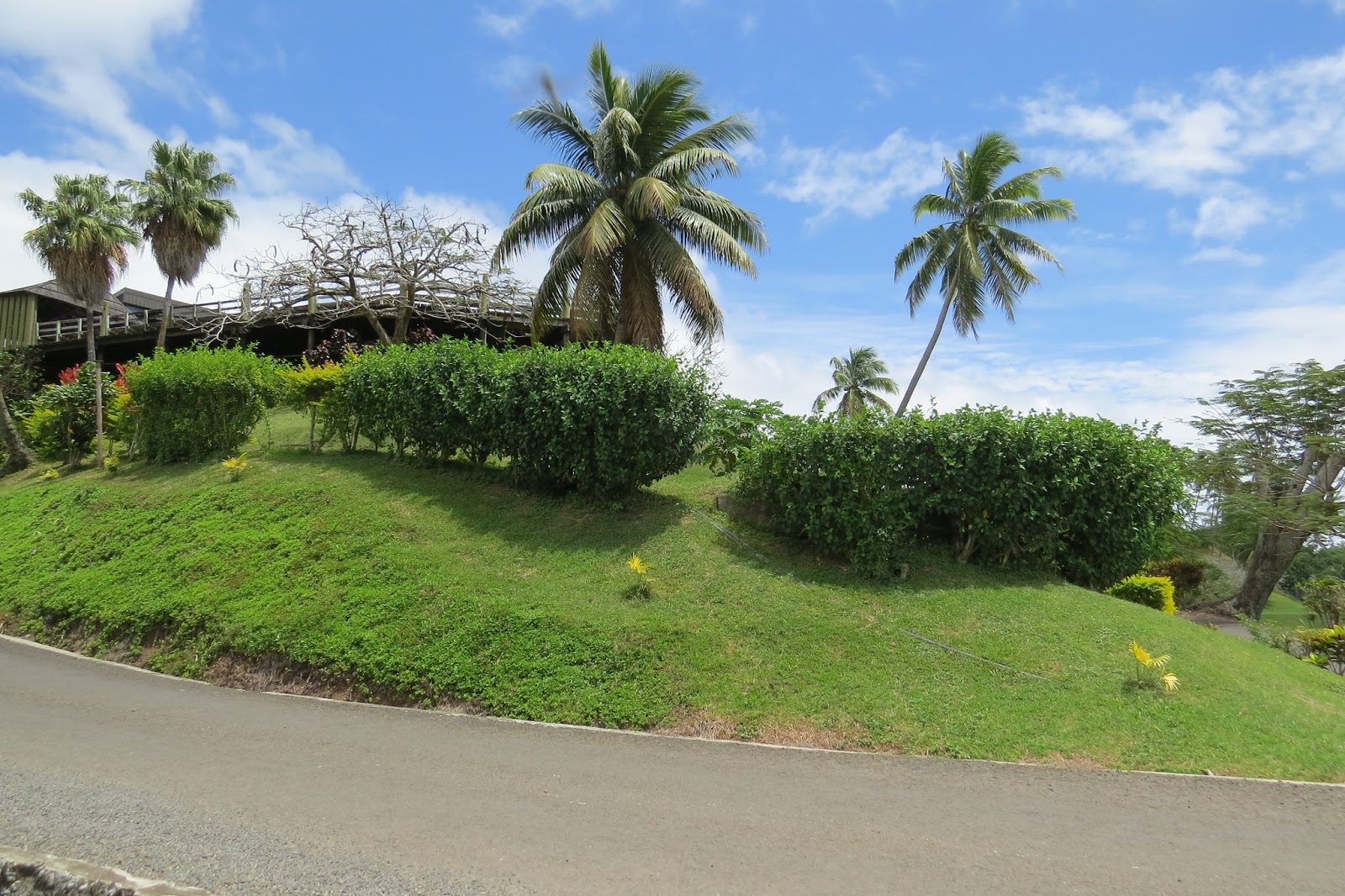
At the top of this hill is the Hot Springs Hotel, a popular spot for tourists.

After our time at the hot springs, Ratnesh drove us to see one of the most magnificent views we’ve ever seen which we’ll share over the next few days with many breathtaking photos (No braggadocio intended. The photo taking wasn’t created “breathtaking.” It was the scenery)!

Later, we spent a few hours in the village, taking more photos while we wandered up and down the main boulevard, also walking along what appeared to be an “esplanade” comparable to those we walked in Australia.  We investigated shop after shop looking for items could use. 

The sky cleared for a while while we were in the village. Today, it’s pouring rain again.

So far, we can’t find a metal “turner” used for flipping eggs or other foods cooking in a pan. Nor, can we find a “scraper” for scraping a bowl to remove food around the edges. Hopefully, soon the package will arrive from Australia. I think I may have included those items in the box of supplies.

Perhaps, one day over these remaining 81 days, we’ll find an appropriate bag or container and cook some vegetables in the hot springs!

Photo from one year ago today, September 15, 2014:
Our last day at sea, we arrived in Boston for a three-day stay to visit my 95-year-old uncle and a cousin. For more details, please click here.

A sheepish story on the news…Shocking photo…Three days and counting…

An overgrown sheep found by the RSPCA outside of Canberra on September 2 2015
This is a photo (not ours) of previously long lost sheep, now named Chris, who was lost for years to be found in this dreadful condition. With the help of professional shearers, Chris has been relieved of his mass of wool and is doing well. Stories such as this are newsworthy in Australia. See a portion of the story below and a link to the full story.

With a population of over 23 million throughout the entirety of the massive continent of Australia (as large as the US), there if often news broadcast via TV that is horrific and heartbreaking. Sadly, we watch this news along with the lighter versions presented on the many news broadcasting TV stations.

The passion of its people for “footy,” Australia’s version of football and other sports news occupies a portion of each day’s broadcasts as does local and political news.

An important element in the news in this country is surrounding the indigenous people’s lives, programs including both government and volunteer involvement in the betterment of the Aboriginals who occupy 3% of the entire population. 

Aboriginal selected statistics

“3%  Percentage of Aboriginal people in Australia’s population
93,200  Approximate Aboriginal population in 1900
670,000  Number of Aboriginal and Torres Strait Islander people in 2011
721,000  Estimated Aboriginal and Torres Strait Islander population in Australia in 2021
2.2%  Annual growth rate of the Aboriginal population. Same rate for non-Aboriginal population: 1.2 to 1.7%

Aboriginal population figures

Experts estimate the number of Aboriginal and Torres Strait Islanders at 700,000 at the time of the invasion in 1788 [3]. It fell to its low of around 93,000 people in 1900, a decrease of almost 87%.

At present, 3% of Australia’s population identify as Aboriginal.

It will take until 2021 for population figures to recover. If the current annual growth rate of 2.2% remains stable Aboriginal people can be as many as 721,000 by 2021 and more than 900,000 by 2026.

The faster growth in the Aboriginal population (compared to 1.6% for the general Australian population) is the result of higher levels of fertility and better life expectancy. More Aboriginal people move into peak child-bearing age between now and 2026.

The median age for Aboriginal people, currently 22, is projected to reach 25 by 2026. But this remains much younger than the median age in the general population, which is currently 37 and is expected to rise above 40 by 2026.

A problem is though how many people identify themselves as Aboriginal. “There are a large number of people who don’t answer the Indigenous question in the Census,” explains Patrick Corr, Director of Demography with the Australian Bureau of Statistics (ABS).

“We have approximately 1.1 million people whose Indigenous status, we don’t know, so we have made some assumptions.” This uncertainty lets the ABS tag some figures as experimental estimates.”

Along with the above ongoing news, updates on local, national, and international affairs, crime stories, accidents, injuries, shark encounters, including any natural disasters, a substantial portion of Australian news centers around human interest stories. 

Tongue-in-cheek, Australians share many newsworthy stories with a sense of humor that is unstoppable. The news commentators spend little time hiding their perceptions and holding back comments they feel appropriate to express. In doing so, many human interest stories precipitate fits of laughter by them and by those watching, often including ourselves

We’ve loved their news. Knowing we won’t be able to watch the news in Fiji for four months without a TV, we’ll be reliant upon online news with apps we’ve already been using made into tiles on our Windows 8  laptops. A single click and we’re updated.

With Australia’s extensive animal population, we often watch stories regarding farm animals, wild animals, and domesticated animals, all of which appear to hold a special place in the hearts of most Aussies.

Yesterday, a story caught our attention, repeated again this morning that found us smiling from ear to ear from a great outcome about a stray Merino sheep lost in the wild near Canberra for years who suddenly appeared desperately needing to be shorn.

(Click here for full story)

Very woolly sheep before and after shearing
Chris, before and after his shearing (not our photo). The pink stain is not blood. It’s an antiseptic. He’s doing well now.

See a portion of the story here:

“Wool shorn off an overgrown sheep found near Canberra on Wednesday has set an “unofficial” world record for the heaviest fleece removed in one shearing, the RSPCA says.  The sheep, dubbed Chris, underwent a risky shearing operation to remove 40.45 kilograms of wool.

It smashed the previous world record held by a sheep in New Zealand called Shrek, whose fleece weighed 27 kilograms. ”  Click here for the balance of the story.

It is these types of stories that we’ve found clearly illustrate the compassion and love for animals so typical in Australia. That’s not to say that other country’s people are less compassionate. However, in Australia, we’ve found a greater focus on the love of animals frequently expressed in detail on the news.

We’ll miss these types of stories. From time to time, we’ll check on Australian news and those human interest stories will surely bring a smile to our faces. Most likely, while living in Fiji, we’ll seek and discover heartwarming stories as once again we embrace our surroundings.

This morning we headed to the Trinity Beach post office sending two packages; one to our mailing service with my boots, medical paperwork, and receipts which won’t arrive for up to three months (lowest rate), and two, a 16 kilo (35 pound) box of food and supplies to Fiji, which should arrive within 10 days. Total cost for both packages: AUD $269.70, USD $188.97.

With the flight to Sydney at 5:30 pm on Monday, we’ll wrap up the final packing during the day, heading to the airport by around 3:30 pm. It’s a domestic flight and all we’ll have to do is pay for the extra bag and check-in. 

As we wind down over the next few days, we’ll be preparing and posting the final expenses for the time we spent in Australia, almost 90 days. You just may be surprised!

Photo from one year ago today, September 4, 2014:
DSC03394
Tom at Stonehenge.  Story and photos here.

DSC03395

Me, at Stonehenge.  We were both wearing headsets for listening to the history of this renowned site.  For details and more photos, please click here.

The Great Barrier Reef…Green Island history and tour…

The Great Barrier Reef covers 344,400 square kilometers (132,972 square miles) in area.
The Great Barrier Reef is considered one of the world’s greatest treasures and is a vital aspect to the world’s eco system. Yesterday, having an opportunity to see a portion of this vast natural icon that can be seen from outer space, was rewarding and memorable.
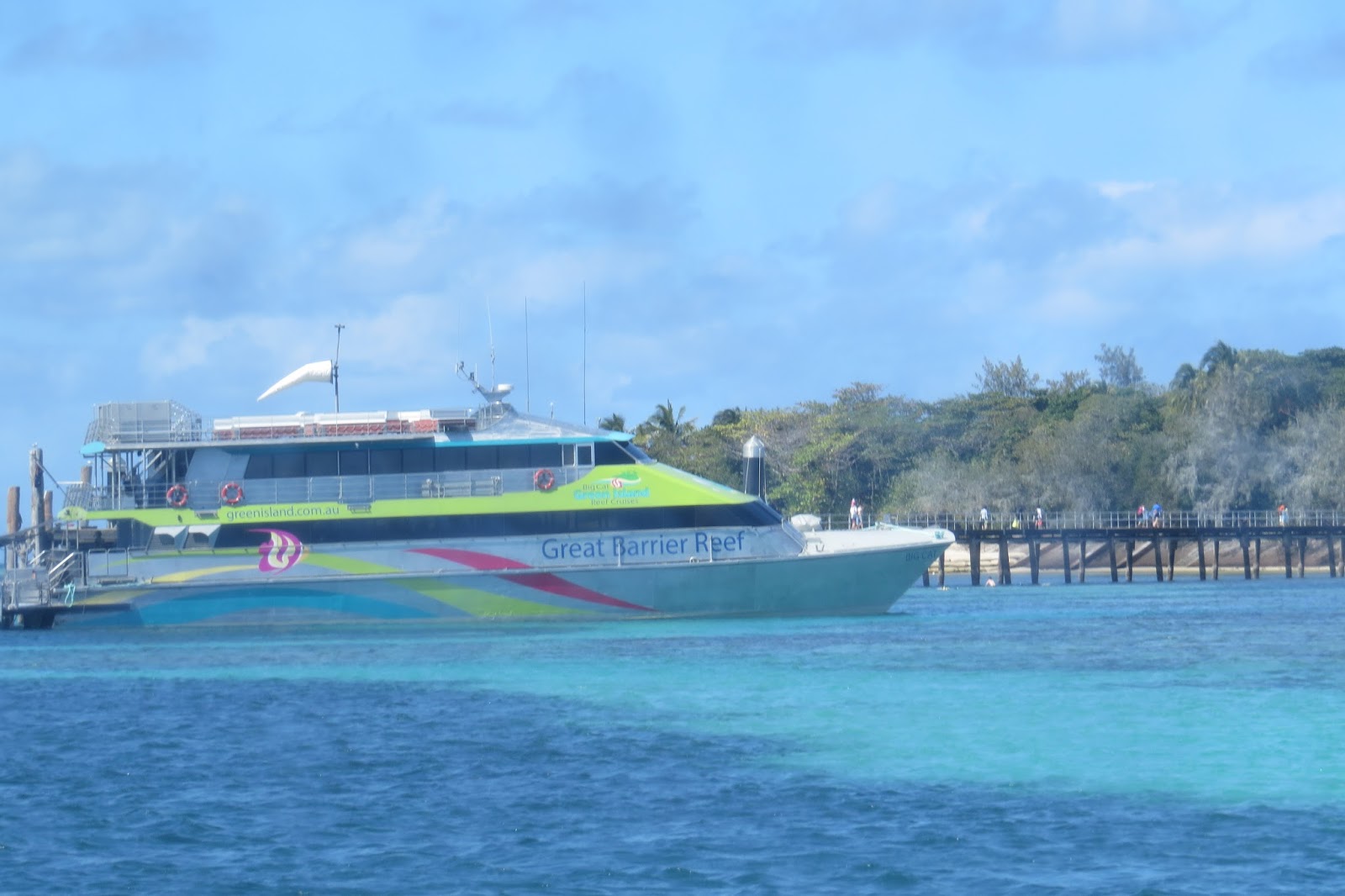
We waitied on a curb for the boat to arrive at the pier for our 45-minute ride to Green Island.

For reasons we posted two days ago, we choose not to snorkel. However, I can’t say that had we been able to snorkel, our experience would have been a lot different.

We weren’t able to get a spot in the bow for photo-taking during the ride to Green Island.  We remained inside in air-conditioned comfort, although I was anxious to take photos of outdoor photos. Our boat, Big Cat’s Reef Rocket, was modern with free wifi, restrooms, beverages, and snacks.

What lies beneath the sea is undoubtedly awe-inspiring. It appeared that scuba diving would be more rewarding, as opposed to snorkeling, being able to maneuver more freely over the endless coral reefs. Actually, we saw few people snorkeling and less scuba diving.

Snorkelers were able to purchase their snorkel gear and wetsuits from this bar inside the boat.

In all, there are 3000 coral reefs, 600 continental islands, 300 coral cays, and approximately 150 inshore mangrove islands. We visited Green Island, only one of those many islands that have been built into a tourist ready environment, enabling visitors from around the world to see this natural phenomenon.

With ocean spray on the windows, I shot this photo of the massive pier at Green Island which accommodates several companies providing a variety of activities including windsurfing, scuba diving, and tours on semi-submersible and glass-bottom boats. 

Australia, from what we’ve seen thus far, is a continent highly in tune with its rich natural resources. When a venue is created, it’s done so with respect for those resources with the intent of ensuring as natural an experience as possible when sharing those resources with the public.

Another of the charter boats heading to the Great Barrier Reef. Not all boats go to Green Island with numerous other charters available for different prices and arrival times.

Green Island is no exception. Every consideration was made over the years to develop a significant space where the visitor would feel in-one with the environment. In doing so, a little of the magic is taken away, but what is left is a fair representation of what explorers may have discovered centuries ago.

The colorful views around us were only a small section of the Great Barrier Reef.

Nothing was spared in providing safety and convenience and in allowing visitors the optimum experience, savoring the beauty of the island while respectfully representing the significance of the surrounding treasures only a short distance below the water’s surface. 

Green Island, as we approached (through the glass).

Over and again, visitors are reminded to treat the coral reef with reverence and respect to avoid upsetting the ecosystem and habitats for thousands of creatures.

This parasailing equipment included a chair for two at a cost of  AUD $280, USD $200 per couple. Although some of these types of activities may appeal to us, we have to pick and choose what is most important to us for the long term

Green Island has a rich history dating back to the 1770s as shown in this chart below:

Significant Historical Dates for Green Island

Green Island has an amazing history! Even though Green Island is a very small island, it has played an important role in the history of Tropical North Queensland and the Great Barrier Reef region.

When on Green Island, take some time to visit the colorful Interpretive Boardwalk. Designed in 6 languages, it showcases the island’s European and Aboriginal histories as well as its outstanding natural values.

Pre 1770 Local Aboriginal tribes (Gungandji and Mandingalbay) used Green Island and its reef for fishing, hunting, and manhood initiation ceremonies.
1770 Captain Cook first marked Green Island on the navigational charts and named it after the astronomer onboard, Charles Green.
1857 A bech-de-mer (sea cucumber) smoking station was established on Green Island. It was operated by a fisherman called JSV Mein, and operated for several decades before closing down.
1863 A ship called the ‘Antagonist’ shipwrecked on Green Island reef while carrying horses to India (14 May 1863).
1889
  • Coconuts were planted to provide shelter, food and drink for shipwrecked sailors.
  • Grass hut accommodation was constructed for fishing and hunting parties.
1890 The first organised pleasure cruises to Green Island commenced on a local coaster called ‘Zeus’.
1906
  • Green Island was declared a Recreational Reserve under the Cairns Council.
  • The first public jetty was constructed.
1924 Hayles commenced fortnightly passenger service from Cairns to Green Island.
1930 Kitty & Noel Monkman, pioneers in underwater photography and videography, moved to Green Island. During WW II they acted as volunteer air observers.
1931 The replacement jetty was constructed by Cairns Town Council.
1932 Cairns Town Council was granted a license to remove coral from the Green Island reef flat to make lime for mainland cane fields (operated until 1945).
1934 Green Island declared a Fauna Sanctuary
1936 Management control of Green Island changed from Cairns Town Council to the Queensland State.
1937
  • Green Island was declared a National Park.
  • World’s first glassbottom boat launched.
  • Research facility built (now Dept. of Primary Industry Research Laboratory).
  • Hayles was granted the first 20-year lease to develop a hotel with tourism activities
1939 First groyne was built to protect the foreshore.
1942 The first hotel, Coral Cay Hotel, was constructed by Hayles.
1946 Jetty was reconstructed after being destroyed by cyclone.
1954 World’s first underwater observatory opened.
1958 Island camping permits no longer issued.
1960 Present jetty constructed.
1961 Great Barrier Reef Theatre constructed.
1963 Redeveloped hotel, the Green Island Reef Resort, opens.
1964 Crocodile Farm opens – the first ever on an island. Renamed Marineland Melanesia in 1972
1970
  • Queen Elizabeth II visits Green Island on her 44th birthday – as part of her tour that followed in Captain Cook’s footsteps.
  • Sandbag retaining wall built near jetty to protect resort land from erosion.
1974 Green Island Reef declared a Marine National Park by the Queensland Government.
1978 Seaplane access to Green Island permitted.
1981 Green Island Reef zoned a Marine National Park ‘B’ with a Buffer Zone under the Great Barrier Reef Marine Park Act (extending 500m out from edge of reef).
1982 Daily fast catamaran service from Cairns commenced by Hayles Pty Ltd.
1988 Dreamworld Corporation purchased Green Island Reef Resort and ferry services from Hayles Pty Ltd and renamed the company Great Adventures.
1989 Green Island Reef Resort closed due to disrepair.
1991 Daikyo Pty Ltd purchased the resort and ferry service on Green Island from Dreamworld Corporation
1992 Redevelopment of Green Island Resort and day facilities commenced.
1993 Redeveloped day facilities opened to the public.
1994 The Green Island Resort luxury accommodation opened.
2001 Green Island Resort desalination plant operational – producing over 55,000 litres of freshwater daily.
2005 Quicksilver Connections acquires Great Adventures and Green Island Resort from Daikyo Pty Ltd
As shown in the above chart, Green Island has grown as a popular tourist attraction over the years. From this perspective, we accept the commercialism required to make Green Island a viable location to which visitors will flock after writing good reviews all over the web. 
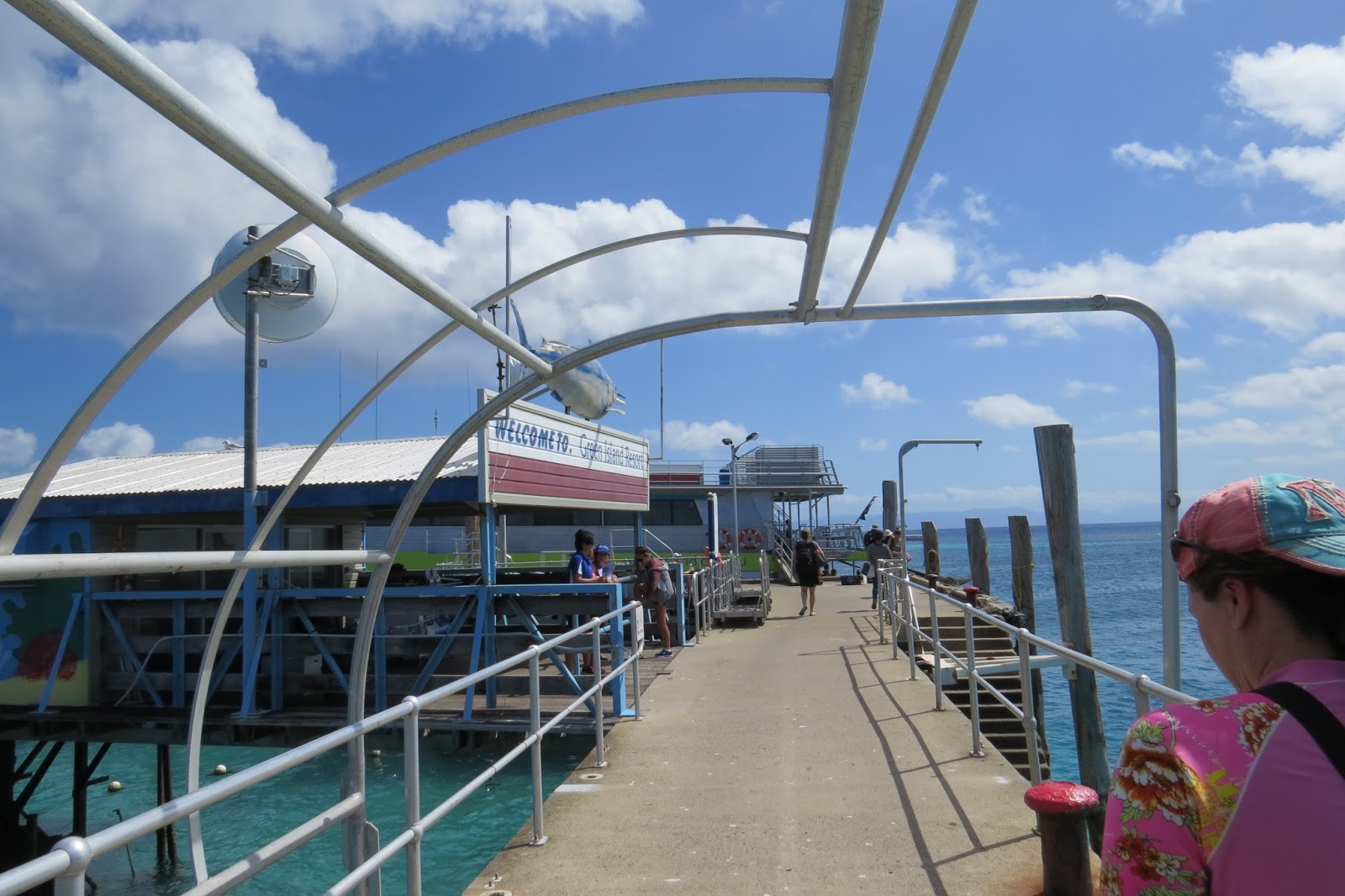
After disembarking the Reef Rocket, we walked along the pier heading to the boat at the end of the pier, the Big Cat, where tourists are to wait to gain access to the semi-submersible submarine and the glass-bottom boat. The pier was high above the water but we did our best to take a few photos of the colorful fish.
Blue fish!  Wow!

Did we have a great time at the Great Barrier Reef? We had a good time, very grateful for the experience. Who visits Queensland and doesn’t see the Great Barrier Reef? 

It’s never easy to take photos from above water. We did our best, hoping to capture these colorful blue fish. There are hundreds of identifyable specific species.

Back home by 5:30 pm, with everything for dinner chopped, diced, and relatively ready to cook, by 6:45 we sat down to dine, smiles on our faces for having taken the time and expense to visit the Great Barrier Reef.

The walk down the long pier to the Big Cat, a huge air-conditioned boat that stays anchored for most of the day used as a lounge and rest area and loading area for glass-bottomed boats and semi-submersibles.

Tomorrow and over the next several days, we’ll share our photos both underwater and above water, describing the tours on both the glass bottom boat and the semi-submersible submarine and, how we spent our remaining time on Green Island

                                            Photo from one year ago today, August 27, 2014:
It was one year ago today that our dear new friend Liz from Bristol, England took the train to South Kensington to visit us for the day. It couldn’t have been a more wonderful day the two of us sharing girl talk at lunch and later the three of us at dinner. At the end of the evening, we walked Liz to the train station, said our goodbyes, and have stayed in touch since. We miss and love you, Liz! For details from that date, please click here.

We’re off to the Great Barrier Reef on a perfectly sunny day…

We were shocked to see the reasonable price on this exquisite arrangement at only AUD $20, USD $14.20. Our daughter and family had sent us a similar bouquet sent to us in Hawaii, most likely at 10 times this price.

With bad weather heading to Queensland, we were concerned we’d go on yet another long boat ride only to be sitting drenched in our rain jackets. To date, we’ve had numerous less-than-successful boating excursions throughout the world.

On whale watching expeditions, we’d yet to see a whale within photo taking distance. On sunset cruises, its rained such as was the case one year ago on the Seine River in Paris.

There is a wide array of both common and less common fruits and vegetables at Rusty’s Market.

On other boat tours we’ve been disappointed with rough seas so bad we could easily have booked a ride on a roller coaster for an equal amount of rattling and commotion. Also, we seldom sighted the marine life we’ve anticipated during a boat tour, unable to take good photos as the boat rocked to and fro.

Hopefully, today’s excursion to Green Island in the Great Barrier Reef will prove to be more fulfilling and less about a crazy boat ride and more about the scenery that awaiting us. 

The sign is marked, “spray free, custard apples” priced at AUD $4.50, USD $3.19 per kilo (2.2 pounds)

With all the cruises we’ve taken with many more to come, it’s obvious we enjoy being on (as opposed to in) the ocean. In our past lives, we both were avid boaters owning boats for a majority of our adult lives.

As a single mom at 29 years old I purchased my first boat which I kept docked in St. Albans Bay on Lake Minnetonka in Minnesota USA. It was called the Tootsie Roll Boat due to it brown, orange and white colors. 

More traditional fruits and vegetables including corn, oranges, tomatoes, zucchini and cucumbers.

Tom purchased his first boat at 29, an Alumacraft fishing boat and later purchased a ski and fishing boat, a Fisher Sweet 16, when he was around 30 years old. 

Some of the vendor’s displays occupied huge areas in the market while others are as tiny as a card table.

As a result of our past experiences, we both generally have enjoyed being on the water and thus have booked some type of boating tour in most countries where we’ve been close to water.

What? Chocolate pudding fruit? Sounds interesting. Priced at AUD $3.50, USD $2.48 per kilo.

As a result of the past boat tours in our world travels, our expectations are in check, hoping for a good experience. Realizing that most of our upcoming photos of marine life in the Great Barrier Reef will be taken through glass we don’t expect perfect representations of what lies below. We’ll definitely do our best to take good photos.

Another equally affordable bouquet of locally grown flowers.

This morning we awakened to a bright sunny day adding to our mutual enthusiasm to finally see one of the world’s greatest treasures. In posts over the next few days, we’ll be included historic and geographical information on the Great Barrier Reef with facts nature lovers may find interesting.

Fresh flowers are scattered throughout the market, adding to a colorful visual.

Our beach bag is packed and we’re set to go other than a necessary stop along the way to the pier in Cairns to purchase bottled water. Much to our delight, we’ve been able to drink tap water in Trinity Beach without any intestinal problems. 

At only AUD $3, USD $2.31 each, a gorgeous bouquet could be put together for a reasonable price.

Its the container for our iced tea that we’re lacking that a large bottle of plain water will provide. Once in hand, we’ll add the packets of iced tea we’ve been hauling around the world with us and be set for beverages for the entire trip.

Today, we’re posting the final photos of our visit to Rusty’s Market and look forward to posting our photos and stories of our tour to Australia’s Great Barrier Reef. 

                                            Photo from one year ago today, August 26, 2014:

The Regency Hotel, Queen’s Gate, where we stayed for two weeks while in South Kensington, London, UK was under construction. Noise with a cluttered entrance at times didn’t bother us at all. What we found most inconvenient was their wifi policy charging huge daily fees for a poor connection. Later in our stay, we were able to get the hotel manager to waive all of our wifi fees for the 16 nights. For more details, please click here.

Exciting tour tomorrow…A must do in this area of Australia…Why we don’t snorkel…

For those shoppers interested in having their fortune told, Rusty’s Markets has it all.

As our long term readers are well aware, we try to avoid some of the typical activities that drives floods of tourists to a particular area, often waiting in long queues  (“lines” is US speak) for hours at a time.

Orchids and other flowers are for sale at reasonable prices throughout Rusty’s Markets.

At times, visitors are scrambling for tickets to book dates and times that fit their short-stay schedules with the intent of getting one more attraction they’ve longed to see knocked off their endless “must do” list during a relatively short holiday. For most, this is the highlight of their trip.

Fresh greens appear to be a little higher priced than the grocery stores but mostly are organic.

We’ve observed there are many types of tourists which often include; those who are constantly busy seeing the sites, filling each day with a constant stream of activities and; others who perceive a holiday as a time to relax, unwind, read a book while occasionally visiting a point of interest.

These are the biggest fennel bulbs we’ve seen.

We fall somewhere in the middle of these two generalities.  Throw in the fact that we often stay in a location for months at a time, on certain days we’re in the middle and on other days, totally zoned out of our surroundings living in the comfortable familiar routine we enthusiastically embrace as a part of our daily lives.

Locally grown chestnuts and walnuts.  See photo below for prices.

Over these past few months while living in Australia writing each day, on numerous occasions we’ve mentioned a need to tighten our belts while here to play a little “catch up” for recent huge outlays of cash for future travels.  In doing so, we’ve accomplished two things. 

When figuring that a kilogram is 2.2 pounds, these prices for walnuts and chestnuts is a bargain at USD $9.33 (per kilo).

One, we’ve been able to comfortably “catch up” and two, we haven’t felt an sense of self imposed pressure to go sightseeing more than we’ve done thus far, visiting the equally enriching multitude of “free” things to see in this lovely area.  We haven’t been disappointed at all, thoroughly relishing in all that we’ve seen to date.

However, one thing we’ve yet to do has gently nagged at us day after day knowing in our hearts and minds at some point, we’d sign up to visit…the Great Barrier Reef.

A shopper at Rusty’s Markets can stop for a Thai massage while shopping.

From Cairns,  a short 25 minute drive from our house to the port, followed by a 45 minute boat ride and we’ll arrive at the world’s largest coral reef.  How could we not?  For tomorrow, Wednesday, we booked a half day tour of the Great Barrier Reef consisting of several activities that fully meet our preferred types of activities.

These red peppers, called Capsicums in Australia are only USD $1.08 each, a fair price.

Bear with us, dear readers, once again we’ll reiterate…we don’t snorkel, never plan to snorkel and spend little if any time, swimming in the ocean.  Its not our “thing.” 

A few of our Facebook friends have nagged us to “give it a try.” Even our grown kids, most of whom snorkel have given us a certain amount of heat that we don’t engage in this activity, especially based on our world travel and exposure to some of the best coral reefs and beaches in the world.


We didn’t recognize these cassava.  From online research we discovered these can be dangerous to one’s health since some imported varieties contain dangerous levels of cyanide.  Read here for details.

Why don’t we snorkel?  There are several reasons, important to us, that deters us from interest in this activity which include:

1.  Tom sunburns easily. Since beginning our travels, neither of us has) had a single sunburn when we’ve exercised great caution.  We seldom spend more than 20 minutes on each side to ensure an adequate safe dose of Vitamin D.  He can’t stand the feel of sunscreen on his skin.  It makes him cringe.  Sure, he could wear a wetsuit, available for rental for reasonable fees.  He doesn’t want to. 


Tom pointed out this sign. 

2.  We both have vision correction.  Tom’s has a complicated correction making rental goggles unlikely to provide him with a good view without his glasses.  I have mono vision, different correction in each eye wearing contacts to see. They can’t be worn in water. Neither of us would have a good experience based on this fact alone.


An whole fried fish.

3.  Photo taking:  We don’t want to purchase an underwater camera at this point. As picky as I am over equipment, I’d require many accessories to have a good experience with a camera such as a “Go Pro.” We haven’t an inch of space for one more piece of equipment in our carry on bags.  When we noticed our kids huge bag of “Go Pro” equipment, we knew it wasn’t for us.  Bottom line:  If we can’t take photos its just not as much fun for us.  Plain and simple. 

When we visited Highclere Castle (Downton Abbey) in the UK last year, I was  disappointed to be unable to take interior photos although we decided to visit anyway taking many photos of the exterior.  We always check every venue before booking to ensure we’ll be allowed to take photos. 

We found one store that carries grass fed meat.  If we’d had room in the freezer, we’d have purchased a few items.  Instead, we buy our grass fed meat at a great little shop, Smithfield Choice Cuts

Our journey revolves around our ability to document our experiences in photos.  Although I’m certainly not a professional, I see myself as more of a photographer than any other skills I may possess. 

It would have been fun to purchase these truffles for sale at Fetish for Food but based on our remaining short period in Australia, we had to pass.

Sure, I have a lot to learn about photography and eventually will purchase and learn to use a higher quality professional camera when technology advances to make them lighter in weight.  Would a photographer visit a site where she/he wasn’t allowed to take photos?  Hardly. 

These sarongs looked appealing but not room in bags and I’ve never been good at making these work.

4.  Health reasons:  We both have difficulty with our right shoulders.  Most people would have had surgery by now to correct them.  Instead, we’ve found ways with our diet and utilizing caution to keep the pain at bay. 

Kiffler potatoes, so says the sign when its actually “Kipfler.”

Currently, neither of us are experiencing any pain.  This could easily change by a sudden motion.  In addition, although I no longer have back pain due to a strict anti-inflammation way of eating, my spine remains comparable to a house of cards.  Any sudden or startled motion could result in a disaster, putting a fast end to our travels.  Our insurance plan excluded any injury to my spine in our health insurance policy.  Why would we take the risk? 

Clothing racks are scattered about Rusty’s Markets.

It’s for these reasons we don’t zip lines or participate in certain activities potentially putting our current good health at risk.  Snorkeling which I’d done years ago, can easily result in being startled and requires an amount of jumping in and out of boats, at times in countries with less precautionary measures, we opted out of snorkeling.

Rows of handmade jewelry lines a wall.

Why visit the Great Barrier Reef if we don’t snorkel?  Here again, because we want to.  We’ll be able to tour the Great Barrier Reef in a glass bottom boat and we hope to go on the mini submarine that will give us another perspective, all the while taking photos. 

We’ll also enjoy the boat ride each way meeting people and listening to the marine biologist on board the boat.  With many more activities in the Green Island in the Great Barrier Reef area, we’ll surely have a good time.  We always do.

Various vegetables for cooking Asian food.

We chose to live our lives with a sense of reality.  Who are we kidding?  We have some issues we carefully protect. Who doesn’t? Ultimately, continuing on in our travels, having all of the extraordinary experiences we’ve had and will continue to have is more important to us than a few activities we choose not to do from time to time. 

Now, I have to get back to searching for a cruise to Antarctica to fulfill our dream of standing on an ice floe with Emperor Penguins.  Life is good whether we snorkel or not.

(Tomorrow, a new post will be uploaded with photos before we depart for the Great Barrier Reef).

_______________________________________
 

Photo from one year ago today, August 25, 2014:


Tom was smiling while we relaxed while we dined in London, a restaurant we found on foot.  For more details of our lengthy walks in South Kensington, please click here.

Rainforests continue…Wildlife along the way…What’s next for us in Australia?

Nothing is more exciting for us than spotting wildlife in its natural habitat as was the case here when we spotted this pelican.

At this point, we’ve decided not to make any long road trips. The little car has trouble on mountainous roads and that’s the only direction we haven’t headed since we arrived in the Cairns area over two months ago.

Exiting a portion of the rainforest we encountered this park-like setting.

Also, we aren’t excited to do a road trip especially when the areas we’ve yet to visit require an overnight stay based on the distance. Perhaps, when our cruise makes a stop in Cairns in November 2016, if there’s anything more we’d like to see here, we’ll arrange a tour at that time.

After exiting the wooden boardwalk through the densest area of the rainforest, we found dirt paths that lead in either direction to the two nearby lakes, saltwater, and freshwater. 

In the interim, we continue to scour the Cairns area and can’t imagine running out of sites to see in our remaining slightly over three weeks in Australia. We’ve tightened our budget to prepare for expenses required to fill in the gaps in our itinerary and also to pay for upcoming vacation rentals and cruises. 

A footbridge over the saltwater creek.

At this point, we have little interest in spending money on overnight stays or sightseeing. It’s the “nature of the beast” if we want to live only on the amounts we’ve delegated from our monthly income, avoiding the necessity of tapping other less liquid resources. Isn’t that what most retirees do anyway, managing a budget to avoid creating stress?

The saltwater creek.

Not surprisingly, we’ve had little trouble finding interesting sites to visit on a budget. Early on, we’d considered the train and Skyrail up to the rainforests, but after hiking through several rainforests we both agree that seeing them on the ground has more appeal to us and provides a better photo-taking opportunity with our interest in “small things.”

Peeking through the vegetation to the saltwater lake.

Some may say there’s nothing comparable to seeing the rainforest from high above the treetops but, considering how many sites we’ve seen worldwide these past three years, we’ve learned to carefully pick and choose that which appeals to us the most.

We’re always drawn to the water.

After all, as much as posting each day means to us and believe me, it does more than our readers can imagine, we’ve chosen our activities based on what we prefer to do as our first priority. We’ve chosen a life centered around our own interests and hope our readers understand and appreciate the path we’ve chosen. 

This palm tree appeared to have been trimmed to result in this peculiar trunk.

Based on our ongoing, continually growing worldwide readership, for which we are very grateful, we make the assumption our readers are OK with our stories and photos. However, we’re always open to suggestions if you’d like to share your thoughts and ideas via comments or email.

Let’s face it until we’re in the rainforests of the Amazon (on our “to do” list) we may not be witness to the degree of wildlife that fulfills us the most in our travels. 

We didn’t spot any wildlife in the saltwater lake although we heard the songs of many birds.

Foolishly, we’d expected Australia to be comparable to Africa in its available abundance of wildlife. In some areas, this may be the case. Here in this beautiful area of Cairns, Queensland we’ve seen few animals in the wild other than birds, kangaroos, and wallabies. Had we not been to Africa, this would be all we’d expect or want to see.

We traversed back over the bridge to the creek to head in another direction.

Ah, Africa…it nags at my heart for the day we return. If it was my choice alone, we’d be returning after we’ve completed our time in the South Pacific. But, this isn’t a one-person operation. And, as much as Tom loved Africa, and believe me he did, he encourages me to have an open heart and mind to explore other parts of the world while we can.

My logical nature totally agrees with him. Don’t get me wrong…I’m loving Australia, the most friendly continent in the world. It’s beautiful, tropical (particularly where we are now), and consists of one exquisite sandy beach after another. 

I literally squealed when we spotted this pelican in the freshwater lake along with a few duck species we’d yet to see. 

Who could ask for more?  Australia is a great place to live. Housing prices may be on the higher side but the cost of products and services seems reasonable to us. We’ll easily stay within our shopping budget while here which will prove to be about 35% less than it was in Hawaii (not surprisingly). 

Probably, one of the most delightful aspects of Australia is its people. Their tongue-in-cheek humor, their ease with voicing their thoughts and opinions, and their easy way of laughing and loving is heartwarming.   

Pelicans are graceful and elegant.

Lately, two evenings a week, we’ve been watching Australia’s version of “The Bachelor,” one of my favorites in the US. Even Tom got on board with this show over the years. Seeing the way the girls interact with one another in a loving and affectionate way is so typical Aussie style. 

We observe this same warmth on the news shows and when we’re out and about finding ourselves laughing over their playful nature. We’ve never experienced such ease and vulnerability of people anywhere in the world. It’s refreshing and, if we leave here with only that in mind, we’ve learned a valuable lesson from its warm, kindly people.

Every so often she scoops up a tasty morsel from the water.

With six Australia based cruises in the future, we have plenty of opportunities to interact with more of these unique people. Without a doubt, we’ll enjoy every moment.

Have a wonderful weekend as summer begins to wind down for those in the uppermost northern hemisphere and for us, winter in Queensland is perfect every day at a sunny 82F, 28C.

                                             Photo from one year ago today, August 14, 2014:

With little humility, I patted myself on the back for managing to take this photo of Venus de Milo at Le Louvre without a crowd hovering around her. Visiting the world-famous museum will remain as a highlight of our travels.  For more photos, please click here.

The rainforest…Where are they?…We hiked in a triple canopy rainforest…One year ago, a favorite photo from Le Louvre…

As we made our way through a portion of the triple canopy rainforest we encountered two lakes, a creek, and a river. This is the saltwater lake. Tomorrow, we’ll be posting photos of the freshwater lake, the river, and the creek which included a wildlife surprise.

Many of us have the perception is that there is only one major rainforest in the world, the largest in the Amazon River Basin in South America. And yet, there are rainforests throughout the world.

The sign at the entrance to the rainforest boardwalk.

“The largest rainforests are in the Amazon River Basin (South America), the Congo River Basin (western Africa), and throughout much of southeast Asia. Smaller rainforests are located in Central America, Madagascar, Australia and nearby islands, India, and other locations in the tropics.

For more information on rainforests throughout the world, please click here.

As shown in the above map, we’ve already visited rainforests in Central America while we lived in Belize, formerly British Honduras and also as we’ve visited many islands on various cruises and now in our backyard.  If we could climb the steep hill behind the house, we’d be in the rainforest.

Leaves changing color in the rainforest.

As with most forests, walking through a rainforest isn’t easy unless one carries a  machete if the trails aren’t available. Australia, in its infinite wisdom and devoted to its natural resources, makes hiking through many of their rainforests relatively easy.

Spindly tree.

At least on four prior occasions since our arrival over two months ago we’ve had an opportunity to enter rainforests located in Queensland. Yesterday, was no exception when we headed back to the area of the Cairns Botanic Gardens where across the road is the entrance to an extensive trail through an area of rainforest we’d yet to explore.

Sunlight filtering into the dense triple canopy rainforest, which connotes dense vegetation on the ground, the center and the treetops blocking out sunlight.  An occasional opening allowed for sunlight to filter through.
As for the Australian rainforests:

“Millions of years ago, Australia, New Zealand and the island of New Guinea formed part of a great forested southern continent, isolated from the rest of the world. Today these countries contain many different species of animal that occur nowhere else.  Undergrowth in Australia’s tropical forests is dense and lush. The forests lie in the path of wet winds blowing in from the Pacific.

We made the trek around noontime, when we had an opportunity to see the most with the sun directly overhead. The wooden boardwalk was a little wobbly and unstable at the point but overall safe.

While living on tropical islands in our immediate future, there will be many more rainforests to explore. As we visited several thus far in Australia and other parts of the world we find each to have its own personality, many with considerable wildlife lurking within the canopy and others, such as here in Australia with less visible wildlife as we walked the trail.

Sun filtering through to standing water in an otherwise dry creek bed.

And we stress, “visible,” when much of the rainforests consist of “small things” not necessarily easy to spot with the naked eye. Lately, we’ve been watching episode after episode of David Attenborough’s amazing stories of life on our planet.

A visitor at a distance which illustrates the narrowness of the boardwalk. At times, we had to use our arms to get through heavy vegetation overtaking the boardwalk.

Watching these fabulous documentaries has aided us in the further realization of how small many creatures are in the rainforests, often difficult to spot as we traverse our way through dense vegetation, the narrow manmade path leading the way.

Tom stopping to admire a huge tree.

For our exploration, we revel in spotting unique vegetation and occasional signs of life, other than the occasional hiker walking by us. Oh, I need to mention a fact about Australia that intrigues us. Australians walk on the same side of a path as cars drive on the road. 

Occasionally, a sign was posted naming a particular tree.

As we encountered others on the narrow path, my inclination had been to move to the right to make room for them to pass when in fact, I’ve needed to move to the left. Tom reminded me to avoid making a fool of myself. Duly noted.

This tree was huge, much wider than it appears in this photo. See the above photo for Tom standing next to it.

The wood boardwalk running through a large portion of the rainforest we toured was too narrow for us to walk side by side. As a result, when exploring rainforests Tom walks in front of me stopping when he spots a point of interest.

Vines accumulating on the ground from the tree above.

His eyes are quicker than mine and we often stop when he sees a photo-worthy opportunity. He rarely disappoints. I’m more inclined to spot a more “romantic” sighting than an object of interest. As a result, we’re a perfect match (in more than one way).

We spotted several trees with vines wrapped around the trunk.

The value of maintaining the integrity of rainforests has definitely become known to most of the world although certain factions prefer to ignore the importance of these magical forests for the future of humanity in many ways.  

We wandered through the Lowland Paperbark Forest.
The destruction of rainforests is both political and money-driven and I prefer not to get into that discussion here. However, any of our long term readers easily surmise our stance on the preservation of our natural resources both in wildlife and vegetation, the most important aspects of our travels, that which brings us the most joy.
It was easy to see why the bark of certain trees is referred to as paperbark.

It’s sad that any of us on a smaller scale can only take a stance and have little impact on that preservation. On a larger scale? It’s another matter. Yes, in our selfish existence, we admire, we enjoy, we take photos and we write. 

Fine, flaky bark on this tree.

Perhaps, somewhere along the way, our constant mumblings may have even a tiny effect in some way if only one person who is involved in the depletion of our natural resources is inspired to consider an alternative.

This tree has an usual base of the trunk.

For the rest of us, we can only consider and implement means of reducing our “ecological footprint” by using methods easily incorporated into our lives

This sign introduced us to the Pandanus Swamp Forest.
Today and over the next few days, we’ll be sharing more of our rainforest photos. It was a warm, sunny day with a slight breeze, keeping the mozzies at bay. Neither of us was bitten once as we made our way through the “triple canopy” which proved to be an interesting and rewarding experience.

                                             Photo from one year ago today, August 12, 2014:

We took this photo from inside Le Louvre from an open window. What a scene! What an experience! For many more Louvre photos, please click here.

Deadman’s Gully…Aptly named?…A visit to check it out…

In checking out the photo below of the woman who encountered the crocs it appears to have been in this area we visited at Deadman’s Gully.

A month from today we’ll be waking up in a hotel in Sydney to catch a very early flight to Fiji. It’s hard to believe how quickly the time in Trinity Beach has passed. Last night, Tom mentioned how 90 days is the perfect amount of time to spend living in any one area and I wholeheartedly agree.

We could easily envision a croc coming up and over this hill from the ocean to Deadman’s Gully.

As time winds down, we begin to think of places we’d like to visit or perhaps revisit during our last month in the Cairns area. With a few spots in mind, yesterday we decided to return to Clifton Beach, an area we’d only driven by on a rainy day shortly after we arrived two months ago.

There are several signs noting Deadman’s Gully.

As always, before heading out we began reviewing online information about Deadman’s Gully. Curious as to the origin of its name, we stumbled across this story in the Cairns Post and on the news a year ago:

“Cairns teacher almost snapped by 3m crocodile at Deadman’s Gully near Cairns

A woman who came within 1 cm of a crocodile’s jaws after the reptile lunged at her and her dog at a Northern Beaches creek has called for the immediate removal of the dangerous creature.

Clifton Beach resident Belinda Marsh, 50, was walking her German shepherd Nharla at Deadman’s Gully on Sunday night.  Two saltwater crocodiles have been spotted several times by locals in the waterway in recent weeks, the last sighting reported on Thursday.”

We followed this path in the Deadman’s Gully.

For the remainder of this news story, please click here.

Well, of course, reading this story made us all the more interested in checking out Deadman’s Gully hoping to take photos of where these two crocs were sighted and to investigate the type of habitat that appeals to them. We didn’t expect that we’d see any crocs, nor did we want to be in a position of having to run from them. 

The area adjoining Deadman’s Gully.

But, I did mention to Tom that maybe “safari luck” would kick in and we’d see a croc in the wild enabling us to take a photo from the safety of the car. No such luck.

Adding to our peace of mind, before we headed out the door, we noticed one additional story online:

“Elusive 3m croc caught at Deadman’s Gully in Cairns

By Sharnie Kim

Updated
“Government contractors have captured a crocodile that is believed to have lunged at a Cairns resident and her pet dog. The three-meter reptile, at Deadman’s Gully on the city’s northern beaches, has eluded capture since about November last year when residents reported several sightings. Its mate was captured that month. Aboriginal contractors harpooned the larger crocodile late on Tuesday night and authorities are finding it a new home. Meanwhile, the state Environment Department said it was investigating after a one-meter crocodile was found dead at Deep Creek on Cairns’ northern beaches earlier this week.”
There was barely a cloud in the sky.
The fact that these particular crocs had been captured didn’t necessarily mean that no other crocs would be in this area. With a plan to proceed with caution as do many bikers and joggers who fancy this particular area, clearly marked with numerous warning signs, we ventured out with enthusiasm.
Again, another relatively unoccupied beach on a perfectly sunny day around noon.
Once in a while, we miss an opportunity to capture a video. Such was the case as we exited the car when we parked in one of the few available parking spots in the area. A noisy flock of birds stopped us in our tracks as we were shocked by the loud sounds coming from the trees overhead. Unfortunately, by the time the camera loaded the sounds stopped, most likely due to our arrival.
Pretty view at Clifton Beach where Deadman’s Gully is located.
We were reminded of the sounds of the Howler Monkeys when we visited a rainforest in Belize, many moons ago. Bringing up this memory we both giggled over how I’ve combated so many fears over these past three years.
The Clifton Beach neighborhood and esplanade is lined with lovely homes.
Now, I’ll wander through a rainforest without hesitation as long as I’m lathered up with repellent. In Belize, I was a wreck, trying to be brave and failing poorly. It seems so long ago, that any insect sent me reeling which now I flick away with only a tinge of annoyance.
Some type of fungus growing on the side of this tree.
When an insect is large and/or interesting I’ll often manage a quick jump to grab the camera as is evidenced in our stream of photos of insects, snakes, and other creatures. Although, I must admit we both remain hesitant when spotting venomous centipedes, spiders, and snakes.
Unusual tree trunk at Clifton Beach
As for crocs, fear is a good thing. One must stay on alert. Fear in itself should be used as a trigger for extreme caution. Those crazy folks who put their heads into the mouths of crocs make no sense at all.
The vegetation is dense along the beach in certain areas along Deadman’s Gully.
There’s no doubt that as we neared the gully and river that our eyes carefully scanned the area as we listened for sounds of movement in the dense and often tall vegetation.
It was these murky waters that appeared to be a possible haven for crocs.
With no obvious croc in the area, we took our photos while fascinated with the scenery before us.  We walked the paved path and perused the narrow unpaved pathways over rocks, tree roots, and fallen vegetation often keeping one eye on the ground with the other on our surroundings.
There are narrow walkways to the ocean as shown in the openings in the railing.
We hope you’ll enjoy our photos over the next few days as we continue to share the sights in the area of Deadman’s Gully. By the way, we never found how the name of this area originated but, it’s easy to imagine.
With many German tourists visiting Australia the German word “actung” is often listed on warning signs at the beach. There also appears to be a warning in Chinese and/or Japanese.
                                                              Photo from one year ago today, August 8, 2014:
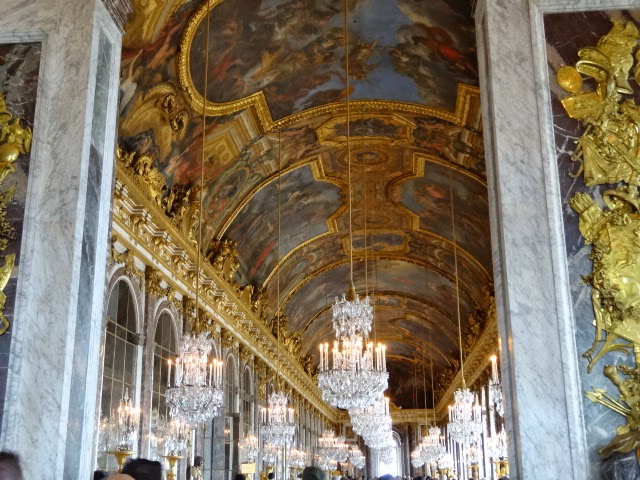
The famous Hall of Mirrors in Versailles. It was hard to believe we were actually there seeing first hand that which we’d only seen in movies and photos. Still soaked from standing in the gardens for 90 minutes in the pelting rain without an umbrella, we hardly noticed our clothes as we wandered through the amazing property. For more photos and details, please click here.

Part 2…Road trip…Port Douglas…Lots to share after a perfect day…Photos shown in progression…Cecil, the slaughtered lion…One of our lion photos..

A number of visitors were lounging in this beach park in Port Douglas.

As we toured the town of Port Douglas we were amazed at how easy is was to navigate the many points of interest. Although the downtown area was packed with tourists it had a laid back, unhurried feel uncommon in tourist beach towns.

The main street, Macrossan Street, in Port Douglas consisted of one store, shop, and restaurant after another.

Whether we wandered the quaint streets or walked the Four Mile Beach we always felt safe and comfortable.  The only fear was going into the water where stingers lurked in abundance awaiting their next brush against human skin to leave their indelible mark. 

Taking photos was easy on a sunny day.

We surmised that the possibility of being stung by one of many of a variety of stingers keeps swimmers out of the water at all of the pristine beaches we’ve visited over these many weeks. 

More shopping continued on Wharf Street.

We noticed that there are no vendors lining the beaches in Queensland scrambling in an attempt to sell their wares. Either there are laws regarding this or, we are in an area of less poverty than many other areas of the world we’ve visited in the past. 

There are almost 100 restaurants in Port Douglas.

Its become familiar to us to being approached by locals trying to encourage us to purchase their handmade crafts and local trinkets. With no room in our luggage and no home to eventually use or store such products, buying anything doesn’t fit into the realm of our lives. 

Many of the restaurants are huge and elaborate attracting the most finicky of diners.

Without question, we certainly appreciate the diligence and hard work of those vendors throughout the world.  But, for us, practicality must prevail.

As we wandered on foot a beach area, we spotted the historic Court House and museum. Unfortunately, it was closed or we’d have loved to go inside.

As we wandered the main streets in Port Douglas, we realized that no matter how much “sightseeing” we do, we don’t fit into the typical tourist category. Walking past the shops we chuckled over how unlikely it is that we’d purchase any of the clothing, bags, shoes, and household goods.

Tom was admiring the trees at the beach park.

And, the many charming beachfront restaurants didn’t appeal to our senses either when we’ve resigned ourselves to the fact that dining in restaurants in Australia may not be possible for me. 

An unusual tree with a portion of its root system above ground.

Checking out every posted menu as we walked, we further confirmed this fact. Most of the meats offered on the menus are coated in sauces and battered in a manner that doesn’t work for me. The side dishes are starchy and often tinged with sugar. 

It’s winter in Australia and we don’t see as many of flowers as there are in the spring.

The thought of spending US $22, AUD $30 for a unseasoned slab of barramundi and a plain lettuce salad doesn’t appeal to me when we can go to our favorite fish market and purchase barramundi for under US $5, AUD $9 a serving, seasoned by us to perfection, with a side of sautéed veggies, a salad with homemade dressing and a coconut flour muffin slathered with grass-fed butter.

We wandered about this beautiful beach park.
When dining in restaurants we have the concern of the food having been cooked in the same pan as those items I cannot have. The risk of contamination is high. Nor do we expect restaurant cooks and chefs to make special accommodations for me with the use of their cookware.
The views from every direction were breathtaking.

Sure, we’d love to visit a fabulous beach area and sit down for meal.  But, we always remember that we wouldn’t be traveling the world if it weren’t for my strict low carb, grain free, starch free, sugar free and chemical free way of eating that brought me to exquisite good health after years of suffering. 

A buoy to mark low water.

If Tom would like to dine out, I’m happy to join him and order that plain steak or fish and plain salad with nary a complaint. Surprisingly, after all of this time, Tom doesn’t feel shortchanged. Perhaps, that is why he loves cruising. 

The tide was low giving us an entirely different perspective of the beach.

While on a cruise, Tom can order anything he wants without concern or worry when the ship’s chefs manage to make everything work for me as they do for many other passengers with special diets.

There are many beaches that are covered with rock but, overall the beaches we’ve seen are sandy.

Without shopping, without dining out, without spending on pricey tourist attractions we happily find an entire world of wonder that we easily appreciate and cherish for its natural and unique beauty. 

This enormous Banyan Tree reminded us of the tree across the street from our condo in Honolulu.

In our old lives of seldom traveling, we’d often spend considerable time at the hotel, the pool, the hotel’s beach, a wide array of local restaurants, and visiting a few choice attractions popular in the area. This gave us a limited perspective of the area.

Possibly, a memorial for a beloved individual lost to the sea in this location.

Now, we live in an area shopping in their shops, cooking their locally grown foods, meeting the locals, wandering through their farmer’s markets, and most of all visiting those special places that Mother Nature created for us to respect and, for us to appreciate with love and care.

For this, we are grateful and for this, Port Douglas never let us down. 

From this view, we were seated in white chairs facing the ocean, left from a recent wedding. It was a perfect spot for a wedding.
It was these rose petals on the ground that made us realize that a recent wedding had been held in this spot.

On Cecil the lion: We can’t avoid addressing the recent heartbreaking slaughter of Cecil, the lion, in Zimbabwe, Africa.  Rather than rant our personal views which our many worldwide readers can easily imagine, we share this well-written tribute by Simon Espley to Cecil on my personal favorite website, Africa Geographic:

“While that rich American dentist and the hunting industry at large, scramble for excuses and justifications for their actions, your rivals will already have killed your cubs and settled into your territory. Yes, those weak ones who could not challenge you now run your kingdom. See more at http://africageographic.com/blog/rip-cecil-lion-king/#sthash.KHlfCBVR.dpuf

You, Cecil, are the reason I am a proud African. Your spirit, your grace, and your courage epitomize my Africa. You are the reason my team and I do what we do. I am so sorry that you had to endure 40 painful hours with an arrow lodged in your body, that you were then shot, beheaded, and skinned – turned into a trophy for a man whose only understanding of Africa is that our laws cannot protect you from his money.

 I am sorry that more was not done to protect you and I am outraged that you and your kind are seen not as kings, but as commodities. On a selfish level, I am sorry because I will never see you with my own eyes.

RIP big guy, and know that many of us humans DO care, and we are trying, desperately, to fight for you and yours. A luta continua!”  (translated:  the fight goes on)

Last photograph of Cecil with his pack friend Jericho (standing) a month before he was killed
Last known photo of Cecil (lying down) and Jericho who both protected their 25 cubs. Now, with Cecil gone, Jericho may not be able to protect those cubs on his own, resulting in their death. (We borrowed this photo from the UK Telegraph).
We took this photo as one of many lion photos that we had the gift of seeing in the Masai Mara in October 2013 while on a photo safari. This experience forever changed our hearts and minds with love and appreciation of these magnificent beings. For more photos and details of our safari which we spread over many posts, please begin by clicking here and continuing on from there.

                                              Photo from one year ago today, July 30, 2014:

Our last night in Madeira, Portugal as we’d begin the trip to Paris in the morning. It was a memorable two and a half months but, as always, we were ready to continue on.  For that final post with some of our favorite photos, please click here.

Wrapping up the Cairns Botanic Garden…What shall we share next?..A long ago host and hostess…

We’d seen these gorgeous orchids in our neighborhood in Kauai, Hawaii, and found them equally breathtaking in Australia. Many of the plants, trees, and flowers are similar in both areas due to the tropical climate.

We’re always amazed by the number of readers that visit us each day. Who are you? How did you find us? We don’t do a lot of outside advertising and promotion other than an occasional blurb or story on another site that may also have a fair share of readers.

We’re hoping that the technical names of all of these flowers weren’t as important as seeing their beauty in our photos. Our slow and costly wifi connection doesn’t allow for intense data hogging searches.

We both wondered if the readers of the past 24 hours, a 25% increase was due to our multi-day story about the Cairns Botanic Gardens which may have attracted a few more readers our way. But after typing a search in Google we didn’t pop up on the first page.

Tom loves to read signs wherever we may visit.

Who knows what brings all of you here? In reality 1118 in 24 hours is nothing compared to millions that view an entertaining video in one day. Then again, we’re not a one-shot wonder. We’re the steady, dependable blog writers who appear each day, rain or shine, in sickness and in health, and even on the often painstaking travel days.

Roundabouts are popular on the roads here in Australia. We didn’t expect to find one in the Cairns Botanic Gardens.

All we can say is that we appreciate the consistent readership, comments, and email, all of which makes the what-could-be a lonely trail of traveling without our thousands and thousands of readers from all over the world traveling with us each and every year, especially now as we’ll soon enter our fourth year on the move. 

Many areas in the gardens were wild and seeming to be unattended, letting nature take its course.  This creek bed was dry.

If Tom and I were bored with one another, which we’re not (emphatically), the audience would be a desperate means of communication with the outside world. The fact that we adore each other’s companionship only adds to the joy of our daily experiences from the adventurous to the mundane. 

We’ve yet to see a Cassowary in the wild.  But, when we do, we now feel more educated based on reading this sign, which Tom drew to my attention.

It feels as if we’re having one fabulous dinner party minus all the cooking and cleanup. The expense, on the other hand, we bear with what we hope is aplomb. 

Our self-tour ended at the visitors center, which was an interesting architectural design series of buildings with a gift shop, various displays, and a restaurant.

In our old lives, for those of you who aren’t aware, we were the proverbial host and hostess, often having “company” for dinners, brunches, and barbecues on the lawn. Those days are long behind us now, but we remember them fondly for all the fun and laughter.

The buildings were designed with lots of glass creating an unusual look.

After all of our guests went home, we both stayed up into the wee hours of the morning, washing and drying every last dish and glass we couldn’t fit into the two dishwashers which even those, we emptied before heading to bed. We washed the floors and often started a load of laundry filled with linen napkins and tablecloths. No, we didn’t stay up to dry and later iron the napkins.

As we entered the visitors center we spotted this python under glass.

To make a point, we were somewhat focused on being the efficient and yet playful host and hostess having a good time from the first slice of shallot to begin the cooking, to the moment we finally wandered off to bed, smiles on our faces for an enjoyable time seemingly had by all.

Close up of grouchy looking python face.

Do we miss that life? Of course, we miss the people, the family gatherings, and the multitude of friends from many walks of life that magically seemed to get along marvelously when we entertained the larger groups. 

Pretty in pink.

In the same way, one may have an amazing memory of a wild roller coaster ride, one doesn’t long to ride a roller coaster every day. It’s the multitude of memories we hold close to our hearts. But, that doesn’t mean we’re hankering for 100 people to come for dinner…or for the more difficult, dinner party at the holidays for 12 guests which inspired us to a more complex menu and table setting.

This brown and yellow flower caught our eye once again as we neared the exit. This is an Acanthaceae from Central America. We don’t recall seeing these in Central America. 

Life is full of trade-offs. We traded one life for this life. Is this a better life? For both of us, it is. We certainly don’t miss working every day (duh!) or the many responsibilities of the life we lived, that most people live, many happy and fulfilled. And, it’s not to say we weren’t happy and fulfilled. We were like most of you…somedays? yes…somedays? no. That how life is. 

Sure, we miss the people. That’s the only price we’ve paid. But they, like us, have adjusted to our being gone and hopefully, love us anyway. People retire and move away. 

What an interesting and comprehensive experience at the Cairns Botanic Gardens.  It was well worth the visit with a surprising free admission.

Other retirees that have moved from the frozen tundra of Minnesota moved to a warmer climate may see their families once a year. We see them every two years. We are readily available by phone and Skype (free for them, mostly free for us) and love speaking to them and seeing their faces. We chat with them via Facebook and email. Communication is not lost by distance. It’s only lost by the heart.

Here we are. It’s Monday near noon in Trinity Beach, Australia. It’s about 80F, 27C, the humidity is 68%. The sun is shining. We’re healthy. Our house is clean. We have a fabulous dinner planned. And later today, we’ll head out for more photos ops to share here with all of you, our readers, our friends.

Thank you. Thank you so much for traveling along with us. You mean the world to us!

                                              Photo from one year ago today, July 27, 2014:

This was my entire pile of clothes to be packed one year ago which remains about )the same size today. Although I’ve purchased a number of items this past year, I tossed all the old worn clothing to replace the weight of the new items. For details as we prepared to depart the island of Madeira, Portugal, please click here.