How we’re spending the two month gap between two visits to Bali…Partial Itinerary…Moo…baa…neigh…

This is our favorite cow to visit when we’re on a walk.  She always sticks out her tongue and does a little dance when she see us.

When preparing yesterday’s post, we realized it may sound a bit confusing regarding our back and forth for two trips to Bali. The bulk of the decision to go back and forth revolved around the fact that Indonesia has strict visa regulations with stays only allowing for 30 days (with 60 days possible). We’ll figure that out soon.

Recently, these fillies/colts were born.

As a result, we thought it might clarify the plans we made for the almost two-month gap in between the two separate bookings for the same property. In part, the owners gave us an excellent price on the villa with a full staff but preferred to get more for the high season. 

The walk in the area is always lovely.

If we’d leave and return, they could get higher rates than we’re paying during the peak season, resulting in excellent pricing for us during the two separate visits on either end of the peak season.

Also, during this two-month gap, we found a two for one special on a Viking Mekong River cruise, providing we paid the cruise fare in full at the time of the booking which we were happy to do for the savings.

Cattle seem interested in humans as we’ve found on walks and drives through the countryside.

In these two transactions, we saved several thousand dollars for venues we may not have found affordable at the full rates and fares. The more countries we can visit at the best possible prices and terms the greater our worldwide experience. 

There are numerous varieties of long-horned cattle in New Zealand.

It’s not that we’re on a mission to visit every country in the world. It’s not practical in today’s world of war and terror.But, we are on a mission of visiting the countries we find interesting and enriching as we continue on our world journey.

The gap between the two Bali stays made sense when by coincidence and admittedly diligent planning and research, we’re not only excited about the time we’ll spend in Bali but also the two months in between and shortly thereafter, as shown below:
                                                                                         # days                        Dates


 Sydney Hotel 1  4/15/2016 – 4/16/2016 
Cruise –  Sydney to Singapore  14  RC Voyager of Seas   4/16/2016 – 4/30/2016 
 Bali House  59  4/30/2016 – 6/28/2016 
 Hotel Singapore 7  6/28/2016 – 7/5/2016 
 Hanoi Hotel 3  7/5/2016 – 7/8/2016 
 Cruise –  Hanoi to Ho Chi Min City  15  Viking Mekong    7/8/2016 –
7/22/2016 
 Phuket House  41  7/22/2016 –
9/1/2016 
 Bali House  59  9/1/2016 –
10/30/2016 
 Sydney Hotel  1  10/30/2016 –
10/31/2016 
 Cruise – Sydney to Perth  16  RC Radiance of the Seas   10/31/2016 – 11/16/2016 
 Cruise – Perth to Sydney  17  RC Radiance of the Seas   11/16/2016 – 12/3/2016 

Luckily, the time in Bali will be low-key and relaxing while the interim period will be a whirlwind of flights, hotels, cruises, and comings and goings. Having this hectic schedule is good for us when at times, we can easily fall into the “homebody” mode staying put in one spot for a while. 
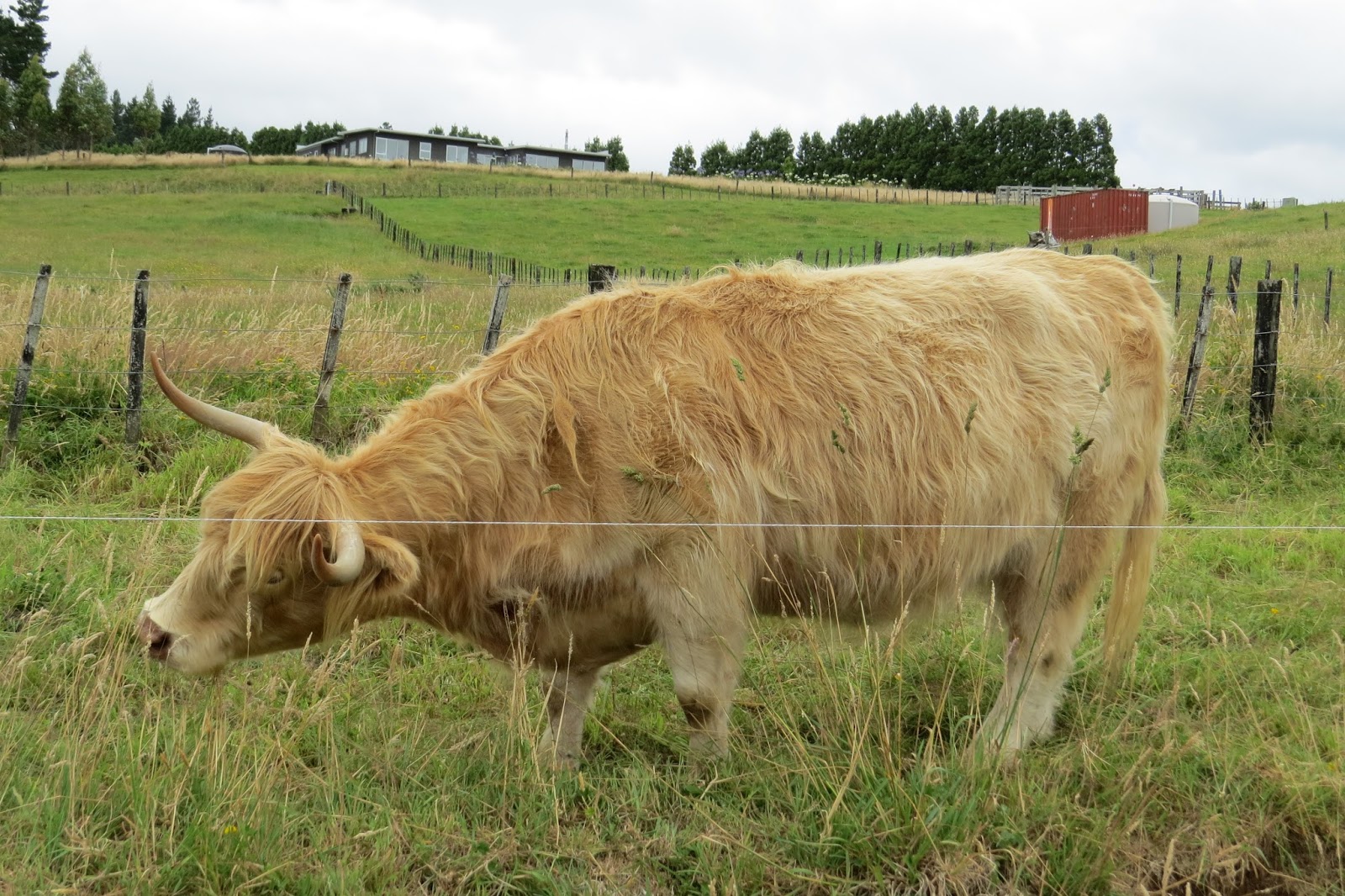
Discovering these horned cattle was a first for us in New Zealand.

The above itinerary over a period of seven months requires seven flights, four of which we’ve yet to book. We have plenty of time to book the remaining flights.

Don’t get me wrong…we love quiet times in the country. Without a lazy bone in our bodies, we keep our days full of activities we love to do, ultimately highly fulfilling. 

Many cattle are dehorned.   But, we don’t believe that process is done on this breed.

Although it may appear we’re occasionally “couch potatoes” which on occasion we are, we’re actually quite active most days of the week, not unlike many of our readers, who say they’re busier in retirement than when they were working.

Young bulls down the road from our house.

Of course, living on this farm in itself provides enough daily stimulation, activity, and entertainment as we spend considerable time outdoors enjoying every single moment. 

They often approach to check us out.

With the diligent use of repellent I’m able to spend all the time I’d like outdoors, as was the case when we lived in South Africa, Kenya, and other parts of the world where mosquitoes, biting flies, and sandflies are an issue.

On our usual walk, Mount Taranaki with our favorite cow on the right and a few sheep who often baa at us.

Today, it’s raining with heavy winds with more rain in the forecast. As summer winds down in New Zealand, apparently the much-needed rains have arrived. Knowing this is good for all the grazing animals in the countryside, we’re happy to see the rain, greening their pastures.

Tomorrow, on the day of my birthday we have a planned evening out and a special story with new photos we hope our readers will find entertaining. Happy day to all!

Photo from one year ago today, February 19, 2015:

It was one year ago today, we made the treacherous trek to the Queen’s Bath in Kauai, a known dangerous place to visit. Making our way down this area was challenging. Had we known how dangerous it was, we’d probably wouldn’t have done it. At times I grabbed any sturdy branch I could hold onto and when possible hung onto Tom to keep from falling. When we were done, I was glad to have challenged myself but also realized the practicality of such risky treks makes no sense at this age.  For more photos of Part 1 of this story, please click here.

Its a lot of bull…

“Ah, I’m so happy they stopped by to see us!”

There’s talk on the local news of a possible upcoming tropical cyclone. High above the town and relatively far from the ocean with the property situated in the hills, we have no concerns over flooding in this area. 

Winds, on the other hand, are another matter as well as the possibility of losing power. We’re not worrying about any of it at this point. We’ll keep our readers updated.  If at any point, we lose power and/or wifi signal, we’ll be back, with updates as soon as possible. 

Soon, two cleaners are coming to work together for an hour and a half. With as tidy as we are, the equivalent of three total hours of cleaning is all we ever need. 

“Hurry, take the darned photo already!  We can’t stand like this forever!” says the four bulls.

Sure, the cost of the two cleaners, Ra and Isabel, is somewhat of a luxury at NZ $60, US $39.14 compared to what we’ve paid in other countries. But it’s something we’d prefer to arrange when house cleaners aren’t included in the rent. Long ago in the US,  we paid almost twice this amount for one cleaner for three hours. We aren’t complaining.

Yesterday, we stopped at multiple markets, including the Kiwi Butcher, Pak & Save, New World, and Countdown (another regular grocery store) where we found everything on our list.

Pak n Save is similar to Costco or Sam’s Club in the US without a required membership. When I looked at our full “trundler” (aka grocery cart in the US or trolley in many other countries) as we approached the register, I’d expected our total bill to be NZ $196, US $300.

We always attempt to refer to items using the popularly used words.  In NZ a grocery cart is referred to as a “trundler.”

When the total was slightly under NZ $153, US $100, I was shocked, causing me to look in the cart wondering if something hadn’t been charged. In reviewing the receipt, I confirmed the total.  

With four packs of toilet paper and paper towels and, two boxes of tissue at NZ $2, US $1.30 each, locally grown organic produce priced at half as much as in the regular market, it’s no wonder our bill was reasonable. 

Once at home I was busy putting everything away for over an hour with all the veggies to wash before putting them in the fridge. As expected I found numerous insects, making me feel at ease that no pesticides had been used on the “locally grown produce.” 

He poses coyly for the camera.

In all, we spent NZ $342, US $223, but that included a trip to the local health food store spending NZ $75, US $49 for a variety of specialty items that are always more costly. Later, we realized we could have purchased many of the same or similar items at the Pak & Save at considerably lower prices. 

Next time we shop, we’ll begin the shopping at the Pak n Save, leaving any items we can’t find for the “regular” market. We expect to easily be able to continue to keep the total under NZ $306, US $200 buying all grass-fed meat, free-range chickens and organic produce. 

The above totals include two cooked free-range organic chickens, and a cooked free-range pork loin roast we’ll continue to purchase each week to cover a few dinners with the addition of a variety of homemade side dishes.  The amazing eggs from the weekly farmer’s market will be an added cost at NZ $24, US $16 which we’ll happily add to the total.

Neil explained that sheep seem less interested in humans than alpacas. Although, these two couldn’t get to the fence fast enough to see us.

In Fiji, we may have spent approximately 25% less on groceries but weren’t able to find many items readily available in NZ. It proved to us how easily we’re able to adapt without many items when other options aren’t available. When items are available we opt on the side of enhancing our dining experience by willingly paying the added costs. 

While in the Pak n Save, a lovely retiree we met, June, had asked Tom to reach a six-pack of bottled beer from a high shelf. A lengthy conversation ensued resulting in her inviting us to visit for tea and to tour her historic home located in the downtown area. 

We exchanged business cards planning to visit her and her husband Simon once the bad weather passes. In our old lives, I can’t recall ever making new friends while shopping at the market. 

“Don’t go,” he says as we begin to walk away.

The warmth and friendliness of the New Zealand people further confirm our perception that most people throughout the world are kind and welcoming to foreigners who visit their homeland.

Today’s photos of bulls are our new local animal friends who welcome us by approaching the fence each time we walk down the road which has been almost every day. That is, if one can make friends with cows and bulls based on their response to us, we have no doubt it’s entirely possible.

No doubt, we’re enjoying our bull friends and other local friends we meet along the way, human and otherwise.

Photo from one year ago today, January 28, 2015:
  It is hard to believe it was one year ago that we took this video of the albatross we followed while spending four months in Kauai. Click here for photos.

The miracle of life unfolds before our eyes…The progression of a tender event…

The mom, Gypsy Rose, had just given birth when we arrived only minutes later.As shown, she’d yet to pass the afterbirth. She didn’t seem to mind we were there.
A snow-capped mountain view with a fluffy cloud crown, an expanse of calm seas sprinkled with sunlight, or a blazing orange and pink-streaked sky at dusk, all represent jaw-dropping beauty.
Only moments after birth the cria lay in the tall grass coming to life with the aid of its mother.

We’ve captured such scenes throughout the world with my amateurish, albeit enthusiastic, photography skills leaving us reeling with joy over having fallen witness to such pristine visions of nature.

A curly-haired dark brown cria lying in the tall grass shortly after coming into the world.

But, nothing, dear readers, is capable of moving us more in our travels, stirring the deepest recesses of our hearts and minds, than the miracle of Life, in the finite proposition our higher power has made with humanity and wildlife to continue to propagate and perpetuate the species. 

The cria opens its eyes.

Last night, after dinner and dishes, as we hunkered down for a quiet evening, we heard a rambunctious knock at the door. Tom dashed to the door to find Trish excitedly explaining to “hurry and come outside.” An alpaca was about to give birth.

As the minutes passed, the baby struggled to stand.  Trish and Neil explained it’s best if they stand within 20 minutes after birth to get their “muscular neurons working.”

In my knee-length nightshirt, I ran upstairs to grab the bottle of insect repellent, a paper towel to apply the messy liquid, flying back down the steps to slip on my shoes. Tom was ready to go. Within 90 seconds we were racing out the door to the paddock closest to the access road.

With a little help from Neil, the baby stands tentatively.

Running on the gravel driveway as quickly as we could, we saw Trish and Neil attending to the mom. From the time Trish came to our door and we arrived at the scene of the birth, in a matter of two or three minutes the cria was born, lying in the tall grass where the mom had chosen to deliver.

“Hello, world!” Sitting is preferred at this point but I’ll keep trying.”

Missing the exact moment of the “plop” to the ground of the dark brown, curly-haired, disproportionately long-legged cria wasn’t disappointing when we’d arrived so quickly after the big moment as shown in today’s photos.

Mom continues to fuss over the tiny long-legged cria.

I know I said I wouldn’t focus all of our posts on the alpacas, nor will we over the long haul but for now, after here only eight days, the novelty hasn’t worn off. Then again, I doubt it will, when we never grew tired of a visiting zebra, giraffe, or warthog in South Africa or, a little red bird we aptly named “Birdie” in Kauai. 

As we watched the process of the mom tending to her baby, after having lost her first baby last year, a stillborn, we had no doubt her loving devotion would make this precious cria thrive. 

This morning, only minutes ago, mom and baby.

As we watched the seeming helpless spindly creature lying on the ground struggling to “come to life” we couldn’t imagine that in a week or two it will be running up and down the paddock with the other youngsters in the cooler evening as the sun goes down, a common occurrence we giggle over each night.

Standing to feed is a good motivator for the cria, as seen this morning.

So today, we “speak” less and “show” more with our photos which truly speak for themselves. We’re off soon to shop on a cooler, cloudy day always anxious to return “home” to see the latest “adventure of the day.”

Have a glorious day filled with Life’s wonders…

Photo from one year ago today, January 27, 2016:

New Kauai friend Richard had invited us to his and his wife Elaine’s lovely home. A retired attorney, Richard sat behind his impressive magistrate’s desk which he’d set up in his garage, giving us a feel as to how a visit to his office in St. Louis might have been. Meeting him was instrumental in our experiencing a busy social life in Kauai and in making this lifelong friend. For more details and photos of their home, please click here.

Worrisome event at the Alpaca Farm Retreat…Late posting…Too many delightful distractions…

Although a little tough to see with the long lashes, Mont Blanc has blue eyes and was the “cria’ that escaped the paddock yesterday, leaving us in quite a quandary.

As simple as farm life may seem for us casual observers for which no work on the farm is required or expected, it can have a few challenges from time to time. We’re observant guests here for three months to revel in the panoramic scenery and to be close at hand to the alpacas.

Recently moved to one of the two paddocks closest to the house the adorable alpacas are within 20 feet, 6 meters, from the house. As I sit here now, I can see them standing at the short fence. At the moment, a brown mom and brown baby are looking at me through the glass.

The mom, Gizelle, to the left in this photo is worried along with the aunties that the “cria,” Mont Blanc, had escaped the paddock by crawling under the fence.

Getting up to look outside, more often than one would imagine, we’re able to see the approximately 30 alpacas (out of 90) in this side paddock happily grazing on the thick grass, scrubs, and trees. We couldn’t enjoy this any more than we do.

They’ve become used to us now and don’t move away as we approach. This was a gradual process escalating when they were moved to this closer proximity to the house. 

Baby Mont Blanc worried while standing outside the paddock after he’d escaped under the fence. We don’t think he’ll try that again! Mom is looking on along with all the other moms and babies worried as well.

Early this morning Trish and Neil stopped by to drop off an umbrella for the outdoor table and extra linen, pick up our garbage and let us know that there are alpaca treats in a bin outdoors. Pellets? Sound familiar to our long-time readers? In checking it this morning, it wasn’t pellets but a chopped grass mix. Later, we’ll give this a try.

Although at this point we may not need to entice the alpacas with food when they already seem interested and curious about us. Especially…after yesterday’s unusual event (unusual to us, in any case).

After uploading the post, I couldn’t get outside quickly enough to spend time with them. Tom was wrapped up in the NFL football games which were broadcast live on ESPN at 9:00 am Monday (Sunday afternoon in the US). 

He darted about our patio trying to find a way back inside. the paddock.

As soon as I headed out the door, I spotted a new baby, born less than a week ago, had escaped the paddock by crawling under a wire mesh area of the paddock closest to the house. The baby was running back and forth along the fence line crying in a sound I’d never heard before, as the mother stood helplessly behind the paddock also crying her heart out.

My first instinct was to help. What could I do? The babies are sensitive and emotional. Would lifting it up over the fence be too stressful? Would handling it be detrimental to its relationship with its mother?  I just didn’t know enough to make a good decision.
Tom came running outside as I called out. He’d been wrapped up in the football and although sympathetic he wasn’t particularly interested in getting involved in finding a solution. I was on my own.
I’d hoped the baby would see where it had escaped but good grief, its only a week old today. Could an animal of such a young age be resourceful enough to figure this out? The mom and baby continued to race back and forth along the fence line crying and trying to figure out a solution.
Mom is on the other side of the fence hoping Tom will lift the baby over the fence.  Uncertain as to what to do and concerned over a possible injury, we decided to try to find an alternative plan.

No matter how hard I looked I couldn’t find a way to get the baby back inside the paddock. Everything was entirely secure with no unlocked gate or access point anywhere. Plus, there’s an electric fence in areas that Trish explained may be turned on from time to time. Was it on or off?  How would I check without getting shocked?

I’m fairly resourceful. I knew the backup plan would be to call Trish on the number she’d provided (using Skype). She and Neil both work in town. I didn’t want to disturb them requiring a 45 minute round trip drive if the baby found its way back inside while they were on their way. 

The mom was looking at me as if to ask for help. The other moms also cried out loudly along with the mom and baby. They were all obviously distressed. To see the love and concern of these long-necked somewhat odd-looking animals was heartwarming reminded me of the love the warthogs moms expressed for their young.   

Another week-old baby worried about Mont Blanc when he couldn’t get back inside the paddock.

The baby, although shy, approached me several times as if it too knew I could do something. At halftime, Tom came outdoors to see what he could do. Immediately, he noticed the escaped baby was in fact the one the owners had told us has blue eyes, an oddity in alpacas. Looking more carefully, we confirmed it. Its pale blue eyes looked into our faces asking for help.

Short of trying to corner the baby and pick it up placing it back over the fence there were no other options. Lifting an alpaca may be dangerous when on occasion they’re known to bite with their sharp teeth and  also have very sharp hooves. (Neil had mentioned he’d recently been bitten by one of the alpacas).

The moment they were reunited, hard to see but heartwarming.

There was no way we’d risk an injury as opposed to making a phone call. After about an hour with no remedy in sight, I called Trish. I sighed with relief when she explained they were both already on their way home to check on the farm and would soon arrive.

I was relieved and waited outside keeping a close eye on the whereabouts of the baby in fear it could run off to be gone forever. The mom ran back and forth about the paddock, crying loudly while attempting to stay focused on the baby as well.

While the others were busy dining on the green grasses, Gizelle and Mont Blanc lay together like this for hours after he was returned to the paddock.

Finally, Trish and Neil arrived and within minutes, together they lifted the baby over the fence while we watched him, named Mont Blanc, practically leap through the air toward his mother, Gizelle.  Although they were hidden behind a post during the emotional reunion, I made every effort to take a photo.

Only minutes later, I captured several shots of the two of them huddled together where they stayed for hours as I often checked on their wellbeing. They seemed content and at ease to be reunited.

Hours later, when the others had wandered to another paddock where they sleep at night, Gizelle and Mont Blanc remained close to one another. 

It was a hot day hovering around nearly 90F, 32C with high humidity. With no overhead fans, we decided to open all the doors for cross ventilation. By the end of the day, there were no less than 50 big noisy flies in the house. Before dinner, Tom swatted them with a cruise documents filled envelope killing all of them on the glass of the windows and doors.

While he did the dishes, I scrapped the fly guts off the windows and doors, spraying with window cleaner and picking up the dead flies from the slider grooves below,  gagging all the while. 

Another mom kissing her baby.

Afterward, we both agreed that leaving the doors open all day wasn’t a good option. We’d bring down the bedroom table fan for use during hot days, only opening the doors for a few minutes on windy days to cool down the inside air which always seems hotter than outside. After all, it’s midsummer here now and New Zealand isn’t exempt from high temps and humidity.

After hanging clothes on the line this morning, many of the alpacas approached me, now realizing that we mean no harm and that they and their babies are safe in our presence. Baby Mont Blanc approached me as did mom Gizelle, making eye contact with that adorable little smirk they appear to have on their funny little faces. Gee…


Photo from one year ago today, January 26, 2015:

Cloudy skies are not unusual in Kauai, known as the “garden island” where it can rain daily, clearing later. This view was from our veranda.  For more details, please click here.

Heavenly…Comfortable living spoiling us…Interior photos of our new temporary home…

This modern kitchen has everything we need including a dishwasher, food processor, stainless steel appliances and pots and pans, convection oven, microwave and quality dinnerware.

The bed is outrageously comfortable.  It has a mattress and a box spring.  The duvet cover, comforter and pillows are luxurious and inviting.  With the fan Neil (Trish’s hubby) brought over last night (along with a laundry basket, extension cord and power strip), we slept like babies.

Awakening refreshed to the cool air in the house from the mild temperature overnight and the possibility of a sunny day, we couldn’t be more comfortable or more content. 

We were thrilled when we spotted these two fluffy robes in the master bedroom closet.

There were two fluffy robes as shown above in the master bedroom closet we’re both wearing now as I write this.  We haven’t been able to travel with robes for the bulk they take in the luggage.  I can’t express how comfortable it feels wearing a fluffy robe until soon we’ll dress for the day.  The robes on the ship were flimsy at best and seemingly made for “munchkins.”  These are lush and roomy.

Today, after posting and finishing our final two loads of laundry, we’ll head to New Plymouth to further explore the town, the beach and restaurants with a quick trip to the market for a few items I’d forgotten to put on the list.

The master bed is a treat.  We haven’t slept in such a comfortable bed since we spent four months in Kauai, one year ago.

Yesterday was a glorious day, although the clouds and light rain remained throughout the day.  We walked on the beautiful road with one breathtaking scene after another, flowers blooming along the road, with the sounds of an occasional mooing cow, sheep baaing or the gentle humming/chirping sounds made by the alpacas as they interact with their babies and one another.

A baby was born a day ago in the pregnant mom’s paddock which we saw lying in the grass near her, not moving.  We worried it hadn’t survived the birth when we watched it for some time noticing it wasn’t moving. 

There are two bathrooms with showers, one on each floor. 

Finally, a tiny ear flickered and we sighed with relief.  A few hours later we returned to see the precious white baby alpaca attempt to stand on its wobbly legs.  This is farm living.  We love it.

No, we won’t make the next three months all about the alpacas.  We’ve discovered many of our readers may not be interested in animals as much as we tend to be.  We’ll continue to present a wide array of stories about life in this uncomplicated area, rich in its beauty and simplicity.

We sit at this table when dining as opposed to the kitchen counter with barstools as shown on the right.  We can see the alpacas from this view.

New Zealand has so much to offer that we’ll be able to share many scenic photos of the country, the city and the sea along with a variety of tourist venues we’ll visit from time to time.

It would be easy to stay close to our new home and not explore the island when we’re so content, so comfortable.  After all, this is temporarily our home and when we lived “at home” we never went sightseeing, per se, to many of the tourist attractions in Minnesota which instead on occasion, by chance, presented themselves through a variety of social activities with family and friends. 


The living room is bigger than it appears in this photo with a newer flat screen TV on the wall and a gas fireplace.

If we were to live in this area long enough, a similar scenario would prevail as we made friends and attended a variety of venues over the years.  But, we don’t have years to wait for such activities and relationships.  Its the nature of our lives, a life on the move, a life of exploration of a way of life, outside the confines of a life we knew so long ago.

As time has marched on, we’ve come to realize and more clearly define what we really want out of our worldwide travels.  It’s not about seeing every popular tourist attraction as we’ve mentioned many times in the past. 

An additional seating are we’re unlikely to use.

Its about immersing ourselves into the life of the locals, experiencing their familiar activities, reveling in the unique beauty of the surroundings, embracing their wildlife and capturing their scenery.

Eventually we leave with a taste of their homeland, understanding their dedication, commitment and loyalty to that which has become familiar and comfortable often over a lifetime. 

Photo taken from the en suite master bath window on the second floor.  Both bedrooms are upstairs.  Tom is using one to store his clothing and our luggage and we’re sleeping in the less cluttered master bedroom.

We always detect a sense of pride, one which we respect with a deep compassion, to ensure we embrace every aspect of their lives, however foreign it may seem to us when we’ve first arrive.

And yet, when its time to go, we carry the experience with us in our hearts and minds forever, grateful for the experience, grateful that we’re in the unique position to be able to continue on.  We have no doubt, as early on as it is in this visit, that we’ll leave New Zealand with memories we’ll treasure forever.

____________________________________________________

Photos from one year ago today, January 21. 2015:

Tom was rounding out his tan lying on his stomach on the chaise lounge by the pool at the golf club we joined one year ago today.  For more details, please click here.

Waiting for the power to go out soon…Spending money of what?…A heartbreaking event in Marloth Park…

While our driver, Okee Dokee was away for part of December, 2013, we rented this pink car.  Parked in the driveway of our vacation home in Marloth Park it didn’t deter the “visitors” from stopping by each day.  Warthogs were my favorite visitors especially when two moms (the second mom and one other baby is not shown here in this photo) and seven baby warthogs came to call every day.  For more details, please click here.

With “Fiji time” the power could go out sooner or later.  One never knows.  The scheduled shut down is expected at 8 am, ending at 6 pm.  We’re as prepared as we can be. 

We have plenty of ice to soon place into plastic bags which will go inside two insulated bags and extra ice to place in the refrigerator hoping to keep those items cool after the fridge portion was out of commission for 24 hours a few days ago.

I slept fitfully.  After “refreshing” my Windows 8.1 laptop a few days ago, there were over 300 updates that came through from Microsoft which took hours to upload.  When I saw the message come up as I began to shut down last night, I decided I’d better let them run rather than wait until today when they’d use up power once the electricity is out. 

Wanting to ensure they uploaded correctly, I wasn’t able to fall asleep until it was done and I could shut it off.  My “shut down” is still having issues which requires two restarts. 

I’ve tried everything to correct it but it won’t resolve, even with software fixes I downloaded in the past few days specifically for this problem.  I guess I’ll live with it when everything else is running smoothly now after the refresh.  Before we know it, as always, we’ll end up purchasing new laptops when traveling as we do seems to have an impact on their survival.

As the prices have reduced considerably for touchscreen technology which we both like to use, we don’t flinch at the prospect of purchasing new equipment every few years, especially as the features and technology continues to change. 

Photo from our yard in December, 2013.  Hundreds of these beautiful impalas are being culled in Marloth Patk at this time.

We don’t flinch at the cost for replacement supplies including cameras, laptops, Internet devices, and other digital equipment when we don’t spend money on gardening, household maintenance, clothes shopping, dining out and other “living in one place” related expenses.

At the present we have items accumulating at our mailing service with supplies we need to replenish to arrive in our next shipment in New Zealand sometime in January. 

These items include any digital equipment we’d like to replace (still deciding), underwear, a few favorite toiletry items we can’t find outside the US; tee shirts; liquid sweetener for my coffee, hot tea and muffins; Crystal Light ice tea packets (enough to last for a year) and a few other items that surely will come to mind over the next month as we accumulate the upcoming shipment.

Another item that kept my mind spinning overnight was an article I stumbled upon last night about the culling of 487 wildlife in Marloth Park due to a lack of adequate vegetation in the “veld” (the bush) to sustain the animals.  We can only imagine the heartbreak of our friends and other residents in Marloth Park as they await this sorrowful process to be end.

Here’s an article from a local newspaper in Mpumalanga, South Africa:

“Culling in Marloth Park, Mpumalanga, resumed on Monday night after recent attempts to have the game captured and relocated failed.

The majority of residents say they are happy possible inconveniences to residents and disruption to animals are being kept to a minimum. The operations are carried out after 6pm to restrict exposure to both residents and holiday goers, Lowvelder reported.

“The poor state of Marloth Park’s veld is sufficient reason for property owners to realise that there is no other option than to cull the animals. However, most of these concerns have been put to rest since the culling is taking place at night,” a property owner remarked.

The planned total of animals to be culled is 487 for impala, eight for wildebeest and 10 for warthog.

Time is an issue, as the permit to conduct this is only valid for 30 days. In addition, only 35 animals can be culled at a time, this being the quota the abattoir can handle a day.

The office of the provincial State Veterinary Services confirmed that carcasses had been transported to the Morrisdale Abattoir, which is located out of the red-line area on the Jeppe’s Reef road.

The former contract holder of culling in Marloth Park, Jasper Aitcheson, said: “Since Marloth Park is situated within the red-line area, the threat of TB is high and strict protocols need to be followed.”

An animal is shot in the head and bled out before attempting to transport the carcass to the abattoir. The feet and head are checked at the abattoir, and depending on ailments, a strict protocol will be followed, as per health regulations. After this, the meat is cut off the bone. The feet, head, intestines as well as the bones are to be sent back to Marloth Park, where it is taken to the so-called Vultures Restaurant in Lionspruit for scavengers to consume it.”

Photo take from our second floor veranda in Marloth Park.  The thought of giraffes being culled in heartbreaking.  Note the full cheeks from munching on the trees.  Now with vegetation at a minimum culling was the chosen option.

My heart especially hurts for the 10 warthogs who especially became our friends and frequent visitors while we spent three months living in the amazing wildlife reserve.  Upon reading further I discovered that even giraffes would be included in this sad event. 

I realize culling is a part of life required to leave food sources for those that remain.  But, it’s sad nonetheless.  Today, I’ll write to several of our friends in the park. Many of the animals have become an integral part of living in Marloth Park and the loss will be dearly felt.

All of God’s creatures, both human and animal, are treasured gifts to our planet and as world events unfold the loss of human life remains heartbreaking. For those of us deeply connected to the animal kingdom we only add the sorrow of loss of wildlife as well, to our already aching hearts.

The inconvenience we experience without power for one day is nothing.  The loss of food in our refrigerator is nothing.  A remedied toothache or aching neck is nothing. 

We strive to continually remain grateful and fulfilled for the gift of each day we’ve been given, for each experience we gather along the way, both past and present, as we continue on in this journey.

Two weeks from today, we’ll fly in the little plane once again to make our way to 28 more days on the main island of Fiji, viti Luvu.  Beyond that, a new adventure begins as we make our way to New Zealand, Singapore, Bali, Vietnam, Cambodia, Thailand and many more over the next 12 months.

All of our love to our friends in Marloth Park and throughout the world!

__________________________________________


Photo from one year ago today, November 22, 2014:

One year ago while living in Maalea Beach, Maui, we took a few videos of professional coconut tree trimmers climbing up coconut palms to remove excess leaves and coconuts to prevent injury to the residents below.  For photos and details, please click here.

A sheepish story on the news…Shocking photo…Three days and counting…

An overgrown sheep found by the RSPCA outside of Canberra on September 2 2015
This is a photo (not ours) of previously long lost sheep, now named Chris, who was lost for years to be found in this dreadful condition. With the help of professional shearers, Chris has been relieved of his mass of wool and is doing well. Stories such as this are newsworthy in Australia. See a portion of the story below and a link to the full story.

With a population of over 23 million throughout the entirety of the massive continent of Australia (as large as the US), there if often news broadcast via TV that is horrific and heartbreaking. Sadly, we watch this news along with the lighter versions presented on the many news broadcasting TV stations.

The passion of its people for “footy,” Australia’s version of football and other sports news occupies a portion of each day’s broadcasts as does local and political news.

An important element in the news in this country is surrounding the indigenous people’s lives, programs including both government and volunteer involvement in the betterment of the Aboriginals who occupy 3% of the entire population. 

Aboriginal selected statistics

“3%  Percentage of Aboriginal people in Australia’s population
93,200  Approximate Aboriginal population in 1900
670,000  Number of Aboriginal and Torres Strait Islander people in 2011
721,000  Estimated Aboriginal and Torres Strait Islander population in Australia in 2021
2.2%  Annual growth rate of the Aboriginal population. Same rate for non-Aboriginal population: 1.2 to 1.7%

Aboriginal population figures

Experts estimate the number of Aboriginal and Torres Strait Islanders at 700,000 at the time of the invasion in 1788 [3]. It fell to its low of around 93,000 people in 1900, a decrease of almost 87%.

At present, 3% of Australia’s population identify as Aboriginal.

It will take until 2021 for population figures to recover. If the current annual growth rate of 2.2% remains stable Aboriginal people can be as many as 721,000 by 2021 and more than 900,000 by 2026.

The faster growth in the Aboriginal population (compared to 1.6% for the general Australian population) is the result of higher levels of fertility and better life expectancy. More Aboriginal people move into peak child-bearing age between now and 2026.

The median age for Aboriginal people, currently 22, is projected to reach 25 by 2026. But this remains much younger than the median age in the general population, which is currently 37 and is expected to rise above 40 by 2026.

A problem is though how many people identify themselves as Aboriginal. “There are a large number of people who don’t answer the Indigenous question in the Census,” explains Patrick Corr, Director of Demography with the Australian Bureau of Statistics (ABS).

“We have approximately 1.1 million people whose Indigenous status, we don’t know, so we have made some assumptions.” This uncertainty lets the ABS tag some figures as experimental estimates.”

Along with the above ongoing news, updates on local, national, and international affairs, crime stories, accidents, injuries, shark encounters, including any natural disasters, a substantial portion of Australian news centers around human interest stories. 

Tongue-in-cheek, Australians share many newsworthy stories with a sense of humor that is unstoppable. The news commentators spend little time hiding their perceptions and holding back comments they feel appropriate to express. In doing so, many human interest stories precipitate fits of laughter by them and by those watching, often including ourselves

We’ve loved their news. Knowing we won’t be able to watch the news in Fiji for four months without a TV, we’ll be reliant upon online news with apps we’ve already been using made into tiles on our Windows 8  laptops. A single click and we’re updated.

With Australia’s extensive animal population, we often watch stories regarding farm animals, wild animals, and domesticated animals, all of which appear to hold a special place in the hearts of most Aussies.

Yesterday, a story caught our attention, repeated again this morning that found us smiling from ear to ear from a great outcome about a stray Merino sheep lost in the wild near Canberra for years who suddenly appeared desperately needing to be shorn.

(Click here for full story)

Very woolly sheep before and after shearing
Chris, before and after his shearing (not our photo). The pink stain is not blood. It’s an antiseptic. He’s doing well now.

See a portion of the story here:

“Wool shorn off an overgrown sheep found near Canberra on Wednesday has set an “unofficial” world record for the heaviest fleece removed in one shearing, the RSPCA says.  The sheep, dubbed Chris, underwent a risky shearing operation to remove 40.45 kilograms of wool.

It smashed the previous world record held by a sheep in New Zealand called Shrek, whose fleece weighed 27 kilograms. ”  Click here for the balance of the story.

It is these types of stories that we’ve found clearly illustrate the compassion and love for animals so typical in Australia. That’s not to say that other country’s people are less compassionate. However, in Australia, we’ve found a greater focus on the love of animals frequently expressed in detail on the news.

We’ll miss these types of stories. From time to time, we’ll check on Australian news and those human interest stories will surely bring a smile to our faces. Most likely, while living in Fiji, we’ll seek and discover heartwarming stories as once again we embrace our surroundings.

This morning we headed to the Trinity Beach post office sending two packages; one to our mailing service with my boots, medical paperwork, and receipts which won’t arrive for up to three months (lowest rate), and two, a 16 kilo (35 pound) box of food and supplies to Fiji, which should arrive within 10 days. Total cost for both packages: AUD $269.70, USD $188.97.

With the flight to Sydney at 5:30 pm on Monday, we’ll wrap up the final packing during the day, heading to the airport by around 3:30 pm. It’s a domestic flight and all we’ll have to do is pay for the extra bag and check-in. 

As we wind down over the next few days, we’ll be preparing and posting the final expenses for the time we spent in Australia, almost 90 days. You just may be surprised!

Photo from one year ago today, September 4, 2014:
DSC03394
Tom at Stonehenge.  Story and photos here.

DSC03395

Me, at Stonehenge.  We were both wearing headsets for listening to the history of this renowned site.  For details and more photos, please click here.

Rainforests continue…Wildlife along the way…What’s next for us in Australia?

Nothing is more exciting for us than spotting wildlife in its natural habitat as was the case here when we spotted this pelican.

At this point, we’ve decided not to make any long road trips. The little car has trouble on mountainous roads and that’s the only direction we haven’t headed since we arrived in the Cairns area over two months ago.

Exiting a portion of the rainforest we encountered this park-like setting.

Also, we aren’t excited to do a road trip especially when the areas we’ve yet to visit require an overnight stay based on the distance. Perhaps, when our cruise makes a stop in Cairns in November 2016, if there’s anything more we’d like to see here, we’ll arrange a tour at that time.

After exiting the wooden boardwalk through the densest area of the rainforest, we found dirt paths that lead in either direction to the two nearby lakes, saltwater, and freshwater. 

In the interim, we continue to scour the Cairns area and can’t imagine running out of sites to see in our remaining slightly over three weeks in Australia. We’ve tightened our budget to prepare for expenses required to fill in the gaps in our itinerary and also to pay for upcoming vacation rentals and cruises. 

A footbridge over the saltwater creek.

At this point, we have little interest in spending money on overnight stays or sightseeing. It’s the “nature of the beast” if we want to live only on the amounts we’ve delegated from our monthly income, avoiding the necessity of tapping other less liquid resources. Isn’t that what most retirees do anyway, managing a budget to avoid creating stress?

The saltwater creek.

Not surprisingly, we’ve had little trouble finding interesting sites to visit on a budget. Early on, we’d considered the train and Skyrail up to the rainforests, but after hiking through several rainforests we both agree that seeing them on the ground has more appeal to us and provides a better photo-taking opportunity with our interest in “small things.”

Peeking through the vegetation to the saltwater lake.

Some may say there’s nothing comparable to seeing the rainforest from high above the treetops but, considering how many sites we’ve seen worldwide these past three years, we’ve learned to carefully pick and choose that which appeals to us the most.

We’re always drawn to the water.

After all, as much as posting each day means to us and believe me, it does more than our readers can imagine, we’ve chosen our activities based on what we prefer to do as our first priority. We’ve chosen a life centered around our own interests and hope our readers understand and appreciate the path we’ve chosen. 

This palm tree appeared to have been trimmed to result in this peculiar trunk.

Based on our ongoing, continually growing worldwide readership, for which we are very grateful, we make the assumption our readers are OK with our stories and photos. However, we’re always open to suggestions if you’d like to share your thoughts and ideas via comments or email.

Let’s face it until we’re in the rainforests of the Amazon (on our “to do” list) we may not be witness to the degree of wildlife that fulfills us the most in our travels. 

We didn’t spot any wildlife in the saltwater lake although we heard the songs of many birds.

Foolishly, we’d expected Australia to be comparable to Africa in its available abundance of wildlife. In some areas, this may be the case. Here in this beautiful area of Cairns, Queensland we’ve seen few animals in the wild other than birds, kangaroos, and wallabies. Had we not been to Africa, this would be all we’d expect or want to see.

We traversed back over the bridge to the creek to head in another direction.

Ah, Africa…it nags at my heart for the day we return. If it was my choice alone, we’d be returning after we’ve completed our time in the South Pacific. But, this isn’t a one-person operation. And, as much as Tom loved Africa, and believe me he did, he encourages me to have an open heart and mind to explore other parts of the world while we can.

My logical nature totally agrees with him. Don’t get me wrong…I’m loving Australia, the most friendly continent in the world. It’s beautiful, tropical (particularly where we are now), and consists of one exquisite sandy beach after another. 

I literally squealed when we spotted this pelican in the freshwater lake along with a few duck species we’d yet to see. 

Who could ask for more?  Australia is a great place to live. Housing prices may be on the higher side but the cost of products and services seems reasonable to us. We’ll easily stay within our shopping budget while here which will prove to be about 35% less than it was in Hawaii (not surprisingly). 

Probably, one of the most delightful aspects of Australia is its people. Their tongue-in-cheek humor, their ease with voicing their thoughts and opinions, and their easy way of laughing and loving is heartwarming.   

Pelicans are graceful and elegant.

Lately, two evenings a week, we’ve been watching Australia’s version of “The Bachelor,” one of my favorites in the US. Even Tom got on board with this show over the years. Seeing the way the girls interact with one another in a loving and affectionate way is so typical Aussie style. 

We observe this same warmth on the news shows and when we’re out and about finding ourselves laughing over their playful nature. We’ve never experienced such ease and vulnerability of people anywhere in the world. It’s refreshing and, if we leave here with only that in mind, we’ve learned a valuable lesson from its warm, kindly people.

Every so often she scoops up a tasty morsel from the water.

With six Australia based cruises in the future, we have plenty of opportunities to interact with more of these unique people. Without a doubt, we’ll enjoy every moment.

Have a wonderful weekend as summer begins to wind down for those in the uppermost northern hemisphere and for us, winter in Queensland is perfect every day at a sunny 82F, 28C.

                                             Photo from one year ago today, August 14, 2014:

With little humility, I patted myself on the back for managing to take this photo of Venus de Milo at Le Louvre without a crowd hovering around her. Visiting the world-famous museum will remain as a highlight of our travels.  For more photos, please click here.

Yesterday’s extraordinary visit to Cairns …A full afternoon…A great day…

The colors in this bloom were unlike any we’ve seen.

We apologize for today’s late posting. It was time for me to workout and the fitness center is only open from 8:00 am to 11:00 am on Saturdays and we needed to get on the road. Plus, I was behind managing the many photos from yesterday’s outing. 

Bright yellow and brown blooming flower. We’ve seldom seen so much brown in flowers.

With the sun shining when we returned it was also time to soak up 30 minutes of Vitamin D. I had started the post as soon as I was up and dressed, but left it unfinished with so many photos to download from yesterday’s outing.

We can’t quite reads the name of this on the included sign.

After completing yesterday’s post, we decided to head out on a sunny day to check out the Cairns Botanic Garden. In most countries such garden are named “botanical” gardens. In Australia, like many other countries/continents we find that many words and expressions are different than our familiar US words and expressions. 

These red berries accompany a dark, almost blackberry.

Not surprisingly, I’ve found myself using some of the Australian words and expressions. How quickly one could change their manner of the use of their native language. In many ways, the easy to understand words and expressions are rather logical here in Australia, even the shortened words such as “veg” for veggies or vegetables.

These were common in Hawaii.

In a future post, we’ll share some of these words and manners of speech. At the moment, I’m accumulating a list that we’ll share most of which are charming and humorous. 

Part of the grounds were blocked off for the construction of a new conservatory.

Whether its named botanic or botanical, we decided to visit the venue in Cairns we’d read so much about these past seven weeks. Easy to find with well marked signs on Highway 1 in the city of Cairns, past the airport, we were a little confused as to which “car park” we’d take. 

The Silk Floss tree we’d seen in Kauai.

As we drove along the huge expanse of the grounds which includes: Flecker Garden, Visitor Centre, Centenary Lakes, Rainforest Boardwalk, Australia’s Gondwanan Heritage Garden and Mount Whitfield Conservation Park, we managed to snag a free street parking spot close to the entrance of Flecker Garden.

The purpose of these spikes is to protect the tree from destruction by possible intruders. These has gorgeous blooms during the summer months.  Its winter here now.

For most tourists and local visitors, Flecker Garden holds the majority of the interest. Many other areas are designated for serious hikers with steep trails and mountains not intended for those less than experienced and fit hikers. 

However, Flecker Garden provided us with a perfect perspective of Australian vegetation and even a bit of wildlife we’ll share here over the next few days as we post some of our best photos.

Although many of these plants and trees grow in Hawaii as well as Australia, most of them originated on other islands throughout the world.

When we visit an attraction such as this, we’re always torn over whether it’s necessary to identify each of the items in each photo we post. Often, we’re able to name most of the subjects of our photos. However, yesterday’s tour of Flecker Garden made it difficult.

The bright orange of these vines stood out among the greenery.

With the growth of many of the wide variety of plants and trees, the originally placed signs with were often ambiguous as to which plant or tree the sign was intended to identify.

Heliconia. Wow!

As a result, only some of our photos will be identified. Otherwise, we’d be spending days searching online for the names of each plant.  With the high cost of wifi at this time, it makes little sense. If any of our readers would like to provide input, feel free to do so via email or a comment at the end of the post and we’ll happily update the photo with the proper name.

Snake Cactus.

We often wonder if the technical names of plants and scrubs really matter to our readers when in essence, we’re not a botanical website. We are world travelers sharing our wide array of experiences of many aspects in a certain area and by no mean profess to be an expert in any of these areas.

Close up, Snake Cactus.


As we wandered about the vast grounds of Flecker Garden, we found ourselves reveling in the many new and unusual plants and also smiling over others we’d seen in other tropical areas of the world, primarily in Hawaii on the four islands in which we lived over a period of eight months.

Once we entered the main entrance to Flecker Garden we were reminded that there was no entrance fee (we’d seen this fact online). This was a first. Of the many botanical gardens we’ve visited throughout the world, there was always an entrance fee which we’d gladly have paid. 

Unusual red bloom without a sign identifying it.

In some areas of the world, our visit to gardens has been “hosted” based on the fact that we’d be providing additional marketing exposure via our online photos and promotion. Not having the responsibility of creating stories as a more professional piece, we were more at ease as we wandered through the gardens, thinking only of what would appeal to our garden enthusiast readers and our own personal tastes.

Cascading pale yellow flowers.

Tom doesn’t love visiting gardens. As a matter of fact, he’d just as soon not visit them at all. However, as shown a week or so ago of us visiting a military museum, we compromise, attempting to show tolerance along with a degree of enthusiasm when we’re dragged along on a less than interesting sightseeing expedition.

Extra-long stamen of a lily.

Considering that 80% of our sightseeing appeals to both of our tastes and interests, these compromises are merely an exercise in attempting to offer ourselves and our readers a wide array of what each country has to offer. 

This flower was blooming on the Flame Tree.

We realize that we tend to stay away from many of the most popular tourist attractions when crowds, traffic, parking issues, and expense are factors for us. Plus, out intent in traveling the world was never about hitting all of the “hot spots” but, instead about immersing ourselves in “living” in an area and experiencing life as close as possible to that of the locals.

The Australian Brushturkey, also called the Scrub Turkey or Bush Turkey freely roamed around the gardens. These turkeys are not closely related to American turkeys. Click here for more details.

It is this type of experience that brings us the most joy and fulfillment in our travels as explained in the post a few days ago when we discussed living life as the “accidental tourist” as shown in this post, in case you missed it.

Over the next few days, we’ll continue sharing many of the exquisite discoveries we made at the Cairns Botanic Garden and hope that you too will find them interesting and worthy of a peek.

May your weekend be filled with that which brings you much joy!

                                              Photo from one year ago today, July 25, 2014:
One year ago, it was only five days until departure from the island of Madeira after a highly enjoyable two and a half months in the lovely home in Canmpanario overlooking the sea in an ideal contemporary house. Although little English was spoken in our area we found a way to communicate with the locals. For details as we wound down the last few days in Madeira, please click here.

Part 2…An environment of dedication, compassion and love at the Cairns Tropical Zoo…

We fell in love with the Pelicans for their beauty, grace and movement.

The Freeman family, locals in the Cairns area, have been instrumental in developing an extraordinary wildlife experience since 1980 with a goal of providing the utmost in conservation and species preservation.

A Pelican show of wingspan.

With a wide array of educational and highly entertaining presentations available that enable visitors to participate in many hands-on and up-close and personal interactions with appropriate wildlife, those visiting the Cairns Tropical Zoo will find themselves enriched from a unique zoo experience.

Peacocks were freely roaming the grounds of the zoo.

In addition, the Freeman family established the private North Queensland Wildlife Trust, which includes not only the Cairns Tropical Zoo but also, Hartley’s Crocodile Adventures and Kuranda Koala Gardens. By the development of the trust, funds are raised for the conservation of native species and their habitat.

Even these less than attractive Lizards can be cute in repose.

It is this kind of passion and dedication to wildlife that is exhibited throughout the zoo as Jasmine toured us through many of the areas to see wildlife we’d never seen face to face in any environment throughout our world travels.

Mom or dad makes a comfortable pillow.
A pile of Turtles.

To be able to take numerous photos as shown here without placing our camera into the holes into a tight chain-link fence gave us a feeling of openness and space, certainly enjoyed and appreciated by all of the various wildlife.

Spoonbill, rightfully so named.

Of course, the dangerous animals such as the massive crocodiles that caught our breath, the design of their habitat provided total safety and security while allowing the photo enthusiast full access to those much revered perfect shots as we’re sharing here in both Parts 1 and 2 of the two-day story.

A Wallaby is a small or mid-sized macropod found in Australia and New Zealand. appears to be a miniature Kangaroo.

The snakes including some of the most venomous in the world were safely behind full glass enclosures that still allowed a relatively clear shot as shown in our photos.

When mom got busy in a bit of a scuffle with another Koala, joey, Violet, decided to high tail away from the action.
Of course, not surprisingly, the Koalas captured our hearts. Jasmine was able to take us inside the  “nursery” of the Koala House. For the first time, seeing baby Koalas inside the pouches of their loving mothers was a sight we’d long desired to see. 
Curious as we approached.

The “joey-in-the-pouch” sighting warmed our hearts as well as the other visitors happily snapping photos in the Koala House. Buttercup, an adult Koala, one of Jasmine’s favorites, who’d been rescued by the zoo after losing a leg after being hit by a car, sleepily cuddling in her eucalyptus tree.

It wasn’t unusual to see a variety of species sharing an area as is common in the wild.

Much to our surprise, Koalas can consume as many as 1000 eucalyptus leaves per day. With conservation in mind, the Cairns Tropical Zoo has managed to utilize a means of harvesting leaves from downed branches from the electric company’s clearing underneath power lines and from three dedicated eucalyptus plantations, rather than destroying trees in the forest. 

The Emu is the largest bird native to Australia. We couldn’t seem to get her/his attention when she was busy looking through the fence.

In addition, considerations are made for wildlife that may have originated from a more distinct winter/summer season with seasonal dietary needs. These facts only added to our respect for the zoo’s philosophy of creating a safe, healthy, and comfortable environment for all of its inhabitants.

With the bright sun reflecting on the Komoda Dragon house which is encased in glass for safety, we had a difficult time taking a photo through the glass, this being our best shot.

With our interest in a wide variety of birds throughout the world, we were particularly fascinated with the graceful and majestic pelicans, again with incredibly easy access for our photo taking. 

The Cassowary is the third tallest flightless bird in the world. A relatively shy bird that can be dangerous in the wild when provoked.

It would only be under these special circumstances that we’d have been able to capture such shots as those we’ve included in both yesterday’s and today’s post for which we are very grateful.

After recently posting distant photos of Cockatoos we spotted in Holloways Beach, it was fun to up close and personal in one of the aviaries in the zoo.

We express our heartfelt thanks to the staff at the Cairns Tropical Zoo for “handling” our visit with the same attention to detail and care as they provide for each and every creature habituating in their creative and loving environment including at times, some not-so-invited fly-ins.

The entrance to the zoo and gift shop. 

                                                Photo from one year ago today, July 12, 2014:

It was one year ago today that Tom had a haircut at a salon in Ribeira Brava, Madeira. For more photos and details from that date, please click here.