Pretty, funny, yummy and cute…Do we always have exceptional views?

Cute. Last evening I took this photo through the glass of the window in our living room when we happened to see this rabbit on the shore of the Huon River.

Our reading for today’s post certainly connotes the theme of most of our desired photos; pretty, funny, yummy, and cute. But, on occasion, we get lucky and acquire a shot of a scene or situation even we consider acceptable.

Both of us are always on the lookout for photo ops not only when we’re out exploring but also on days when we’re staying in, frequently looking out the window for possibilities. 

Cute, boys and their cars!  Tom and a 1962 Ford Galaxy 500.

Unfortunately, the setup of this otherwise ideal vacation home isn’t perfect for photo taking when indoors. Views of the Huon River in front of us are somewhat impeded by the glass of the windows, which don’t open adequately for photo taking.

The main floor of this upper-level unit (in a two-unit house) has a door to a small veranda, but most of the river views are blocked by trees and vegetation.  However, we can capture a stunning scene through the glass of the windows, which don’t open adequately for a glass-free shot.

Funny. Extra-large calf nursing from almost same-sized mom.

As a result, the above photo of the rabbit was taken last evening around 7:00 pm through the glass of the windows. I didn’t expect it to be as clear as it was due to the distance and the watermarks on the glass after many rainy days.  

Tom always calls it “safari luck” when I get a good shot, while I tend to fluff my feathers a bit over, finally learning to get it right after all these years. But, with a less-than-professional camera and my amateurish skills, I suppose that on occasion, I’m lucky under the right circumstances.

Yummy apples.

While researching vacation homes, we don’t necessarily list an easily accessible, view-rich veranda criterion. However, when we discover it’s available, it’s a definite bonus.

As most of our long-term readers have observed, in most cases, we have some view in itself, an important criterion which we’ve learned from experience. Only in a few cases over these past 51 months have we lived in properties without a view.

Pretty scene.

In only four of our past vacation homes were we dealing with a lack of an astounding view, including Kenya (a basic backyard view), Morocco (living in the souk with no exterior view except the difficult-to-access rooftop), the second house in Fiji (a backyard pool view only) and Phuket, Thailand (a backyard pool view only).

As we continue, we find ourselves fine-tuning our criteria, but cost and availability are often factors determining the prospect of achieving such a finite expectation.

Yummy-looking baked goods.

When booking hotels for only one or two nights, we’re seldom willing to pay extra for a view. Although in many hotels, we’ve been fortunate to have stunning city views, bodies of water, or mountain views. Without a doubt, views have the potential to make or break the quality of the experience.

In Morocco, living in a riad (a two-story house with an open-air center courtyard), we didn’t have a single-window looking outdoors. So instead, we’d look up to the sky, as shown in this photo below:

Looking up at the sky, day and night, is a rare treat, from inside the riad, defined as a traditional Moroccan house with an interior garden or courtyard. (This huge house was for the two of us only). For more photos of this property, please click here.

Don’t get me wrong, the house in Morocco was amazing. However, the lack of a view had a definite impact on the quality of our experience. After a while, one can feel a little trapped especially, as was the case in that particular location, it was impossible to rent a car with no parking available in the souks. 

In any case, it was a good experience from which we gleaned a lot of knowledge, adding to our repertoire of interesting (to us) times in our world travels. We’ve accepted that location is not always perfect for the nuances that work best for our needs.

Pretty scene of the Huon River near our vacation homes in Castle Forbes Bay.

As for this location, the property, the views, the landlords, and the people in the area, we couldn’t ask for more. Comparable to Penguin, some of the most friendly people on the planet live here.

Already, after only a little over two weeks since we arrived in the Huon Valley, we’ve been sending emails back and forth to people we’ve met along the way. Of course, meeting locals requires a diligent effort to get out to locations that attract locals to ensure face-to-face encounters. We’re always seeking such opportunities, as evidenced by our photos.

Pretty roses growing in the yard.

Today, rain or shine, we’re heading out to another of those events where locals may be found mulling around, photos of which we hope to share over the next several days.

Rain or shine, snow, sleet, or hail, have a safe day!

Photo from one year ago today, February 1, 2016:

Cloudy, rainy view of Mount Taranaki in New Plymouth, New Zealand. For more details, please click here.

Mother Nature’s bountiful offerings never fail to amaze us…It may not be what you think…

An exquisite pink rose on the grounds of the vacation home.

In a world filled with war, strife, terrorism, turbulence and heartbreaking news, we’ve found it important to take plenty of time away from often what’s transpiring worldwide to revel in Mother Nature’s endless offerings surrounding us.

More perfectly shaped  pink roses.

One may imagine that living in Australia results in a continual viewing of kangaroos, wallabies and koala bears but it’s just not the case. Although we’ve spent many months in Australia, mostly the only kangaroos we’ve seen, sadly, has been road kill.

A single dahlia.

Eighteen months ago, while living in Trinity Beach (near Cairns), we frequently visited a open vacant field inhabited by many kangaroos and wallabies. Please see this link for more photos. On a few other occasions we’ve visited rehab facilities where we were able to interact with them.

Our second kangaroo sighting at a nearby field in Trinity Beach, Australia in 2015. The first, we’d seen, dashed through a rainforest, unable to take a photo in time.

Arriving in Tasmania on December 3rd, we finally had an opportunity to meet the notorious Tasmanian Devils when we visited Wing’s Wildlife Park and rehab center in Gunns Plains, outside of Penguin on January 6th. Please see this link for more of our photos one of which is shown below.

This Tasmania Devil posed for our photo while at Wild Wings Wildlife Farm in Gunns Plains, Tasmania, the first we’d seen.

It’s funny how we all have perceptions of what we’ll see and experience in various countries throughout the world. Typically, it’s very different than we imagined. We must admit that we’d expected to see indigenous wildlife running around in the remote areas in which we’ve lived in Australia over this extended period.

These flowers grow from the fluffy looking blooms shown here and in the photo below.  Thanks to reader Annie is Florida, this flower is a Clematis.  Thanks, Annie!

Also, surprising at times, is the similar vegetation we’ve seen from country to country. There are flowers growing in Tasmania that were also growing in Hawaii, Kenya, Europe, the US and more, all which countries have entirely unique climates.

Now in Tasmania for a total of 53 days, we’re reveling in being situated directly on the Huon River where each day we observe a wide array of birds pecking at the green grass on the grounds of this lovely property. No kangaroos. No wallabies. No Tasmanian Devils. No koalas hanging onto a tree.

This will eventually become the above flower as shown.  Isn’t nature amazing?

Tasmanian Devils are only seen as road kill during daylight hours based on their nocturnal feeding preferences as indicated here:

“A nocturnal scavenger and sometime hunter, the Tasmanian devil can travel long distances while looking for food. It will eat whatever is available, usually carrion (dead animals), sometimes eating spoiled or rotting meat. It will also eat fur and bones, which it crushes in its powerful jaws.”

Based on its habits, it’s no wonder we often see them as road kill when most of the narrow highways aren’t well lit at night making it difficult for cars and trucks to stop in time to avoid hitting them and other wildlife.

These pods will soon bloom to become the flower shown (near the center).

Tomorrow is Australia Day which we’ll explain further in tomorrow’s post. Once we’ve uploaded that post, we’ll be heading the town of Franklin where a huge annual celebration is planned.

Of course, we’ll be back with many photos from the event in two days. Please check back!

Have a lovely day! 

Photo from one year ago today, January 24, 2016:

This pregnant alpaca with an adorable unusual white marking on her face on the day prior to giving birth. We were living in New Plymouth, New Zealand, one year ago. For more photos, please click here.

Final photos from Mount Gnomon Farm…Four days and counting…

A pond located on Mount Gnomon Farm.

Yesterday, we had a most interesting tour of a Penguin resident’s home which we’re excited to share in tomorrow’s post. You won’t believe our photos of one of the most unusual collections we’ve ever seen. Please check back!

A variety of flowers are grown throughout the farm.

Today will be a laid-back day to include a walk down Main Road to the local market for roasted chicken, washing and hanging a few loads of laundry, and preparing the final expenses for our six weeks in Penguin, sadly ending in a mere four days.

Mount Gnomon Farm is surrounded by lush green hills.

There’s no doubt in our minds that our stay in Penguin has been abundant in experience and fulfilling in so many ways some of which is shown in today’s photos from our recent visit to Mount Gnomon Farm. Tom has said that of all the places we’ve lived, Penguin would be the first he’d consider if we ever decided to settle for an extended period.

A spot to relax and enjoy the views.

That’s not to say we’re considering “settling down.” We’re not.  Early on in our travels, we promised ourselves and each other to keep an open mind for possibilities when we either can’t continue to travel due to health concerns or, in the unthinkable prospect of us tiring of living this life.

The entrance to the restaurant where seasonal dining is open to the public. Click here for dates and details.

Tiring of living this life? How could we when we’re “living a dream,” a dream neither of us ever knew we had until it actually began and it became a reality? Now, as we look back we realize why neither of us had ever imagined such a life in our retirement years.

 A pond on the farm.

Prior to commencing on my way of eating five and a half years ago, the chronic pain I suffered from a horrible spinal condition prevented us from traveling much at all. As a result, when we considered retirement options, it never included world travel. 

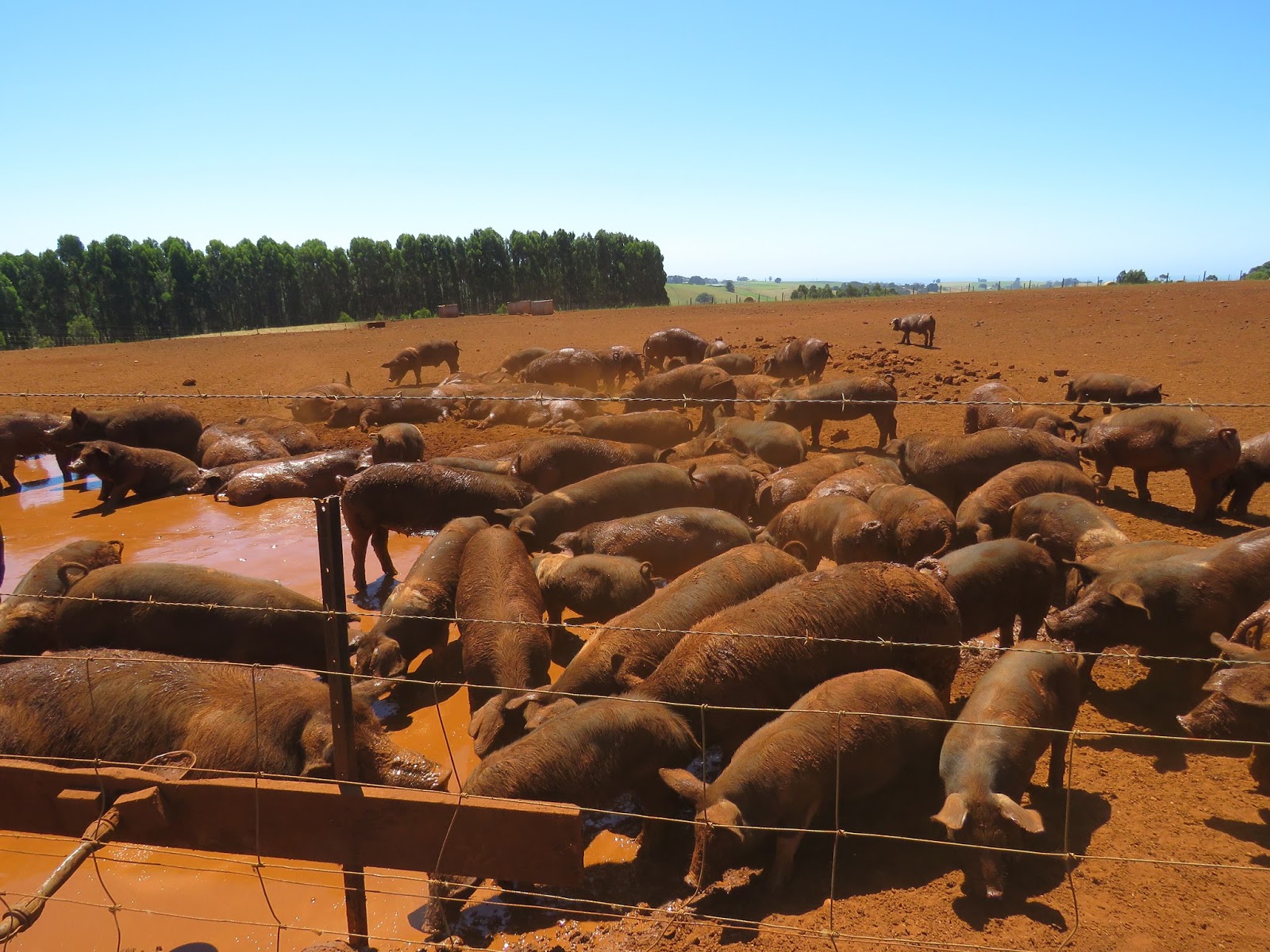
One had to look carefully to find this pig in the mud.

During those many years, it was a challenge for me to fly on a plane for a few hours, let alone for the day-long (or longer) flights, layovers, and excessive periods of time we’ve spent in airports over these past four-plus years.

A duck tucked away in her nest.

For us, my recovery was nothing short of a miracle.  Only three months after drastically changing my diet in 2011, I was pain-free, albeit shocked that what I’d previously considered a healthy diet was leaving me in a constant state of pain. 

Note the recently birthed piglets white bands like their mom. There are several breeds of pigs at the farm.

Don’t get me wrong…eliminating most of the foods I loved along with my then passion for cooking, wasn’t an easy undertaking. The concept of never again having a breakfast including a toasted whole wheat bagel with jelly, a bowl of steel-cut oatmeal with raisins along a small plate of fresh fruit was beyond my realm of reality. 

We arrived at Mount Gnomon Farm on a perfect day as piglets were born such as these, only in the past hour.

Five and a half years later, I haven’t as much as taking a spoonful of any of the above while I continue to reap the benefits of a sugar-free, grain-free, starch-free, and chemical-free way of eating. 

Various breeds of grass-fed cattle lounged comfortably on a sunny day.

Now, it’s easy when I consider what we have (and I mean “we”) in place of those types of food, in place of my former passion for cooking… a life rich in experience, adventure, and mobility. Sure, from time to time, we fall prey to setbacks, such as the injury to my spine in June in the pool in Bali which took five months to heal. No diet will make one exempt from the pain of an injury.

Cattle and sheep are rotated to other paddocks as the grass regenerates.

However, it did heal and I’ve returned to my former state of zero back pain. And, on occasion, like most of the over 60-year-old population, we have illnesses, aches and pains, toothaches, and other medical maladies that may or may not require medical care. 

Regardless of how hard one may try to maintain a degree of good health with appropriate food, plenty of movement and exercise, restful sleep, and a positive and enriching state of mind with as little stress as possible, we still may have periods of time when we aren’t at our best. 

The sheep were so friendly they approached the fence to be petted.

In a few days, we continue on to the next leg in our journey. Our goal is to never feel a sense of urgency to see more of the world.  Instead, we choose to travel at a pace that provides us with the optimum of joy, purpose, and pleasure while sharing it with special people we meet along the way, in special places along our path.

Thanks to all of our friends/readers who “travel” this journey with us. You mean the world to us!

Photo from one year ago today, January 12, 2016:

It was cold one year ago when our shop sailed through Milford Sound in New Zealand, prompting us to wear long-sleeve safari shirts with jeans, the warmest we’d dressed since  Vancouver in September 2014. It was a cloudy, hazy day but the scenery was beautiful. For more photos, please click here.

A visit to a pig farm and seasonal gourmet restaurant in the Penguin countryside…Pigs in the mud video…Mount Gnomon Farm…

Pigs doing their thing at Mount Gnomon Farm…in the mud!
I’ve often used the expression, “Happy as a pig in the mud.” Now I grasp the full significance of this expression!

We’d contacted Guy Robinson, owner of Mount Gnomon Farm, in December, hoping to have an opportunity to visit his farm during our six weeks in Penguin. We’d yet to visit a pig farm, and with our curiosity about pigs, this seemed like a perfect day’s outing.

Mount Gnomon Farm is located less than a 15-minute drive from the center of Penguin.

Communicating back and forth on Facebook chat over the holidays, Guy suggested we come by after the first year when things settled down during their busy holiday season.

During certain periods of the year, Mount Gnomon Restaurant serves gourmet meals. Check their website here for dates and special events. In addition, a highly skilled chef will often stay at the farm to cook for special events and during the holiday season.

Not only is the farm’s restaurant opened on weekends and for special events over the holiday season, but often, throughout the year, it’s opened for special events, music festivals, and the opportunity for the public to purchase bacon, pork, lamb, beef, and produce. Please check their Facebook page for events by searching: Mount Gnomon Farm.

Volunteers, often animal studies students, come from all over the world to assist at the farm through various international work/visa programs. The temporary caravans are available in a pinch when there is an overflow volunteer on site. The owner, Guy Robertson, works hard to ensure the flow of volunteers and the overall management of the farm.

The magic of this special agricultural environment was evident in the time we spent speaking to Guy and later on during a lengthy tour with his volunteers. His goal is to create a sustainable, environmentally friendly, and thought-provoking farm for the public’s enjoyment, including children who can learn so much from the nuances of farm life.

This sow was in labor in a small shed of which there are many for the birthing process. Seeing these piglets only minutes after birth was quite an experience.

With many plans and dreams for the future, Guy’s compassion and interest for his animals, volunteers, paid workers, and visitors is evident in everything he does. 

Born only minutes earlier, it was interesting to see this piglet looking at us. We were among the first humans he/she may have seen.

Coming off a hectic holiday season and a recent trip out of town, it was obvious Guy needed some quiet time to relax and unwind. So his considerate and fast learning volunteers took over after we chatted with Guy when Sam and Danielle, both students, took us on the tour of the farm.

He/she still had remnants of afterbirth on his/her little face.

With plenty of flies, bees, and dust surrounding us, added to the pungent smells one encounters at a farm, we felt right at home. In our almost 51 months of world travel, we’ve had plenty of opportunities to interact with animals in their habitat when in the wild, in our own backyard, or such facilities as a farm.

More piglet born in the past few hours.

We managed just fine, feeling more at ease in this type of environment than we do in a shopping mall. I often joke that both of us must have “agricultural genes” in our respective DNA, inspiring our interest in barnyard animals and farming.

This huge male was watching over the activities in the mud hole.

Tom’s mother and father grew up on farms that perhaps have influenced him. And for me and the rest of us, surely many of our ancestors lived on and worked on farms for their own sustenance if not with the intent of earning a living.

Not only are there pigs at Mount Gnomon but also sheep and cattle.

Mount Gnomon Farm sells a portion of their products to some restaurants, with the remainder being sold to customers who either call to place orders or visit the farm during their “open” dates throughout the year. 

To place an order or inquire:

Phone:  0448 067 779

Email – info@mountgnomonfarm.com.au (please note sometimes it takes us a few days to respond to emails)

Snail mail – PO Box 320, Penguin, Tasmania, 7316

Farm address – 886 Ironcliffe Rd, Penguin, Tasmania, 7316

A mom and her growing young lounging in the shade on a warm sunny day.

As we wandered through the often muddy clay soil through the farm, we had the opportunity to see the birthing sheds with laboring sows under cover from the heat of the sun. 

Even a small mud hole gathers a crowd.

Under their own volition, the sows enter the sheds when delivery is imminent. The hay bed and enclosed space provide the perfect environment for giving birth. 

These cattle are friendly, allowing us to enter the paddock.

To be able to witness this firsthand gave us the same sense of joy and wonder we’d experienced only a year ago while living on the alpaca farm in New Plymouth, New Zealand. Please click here for details. (If you scroll through our archives for February 2016, numerous posts on alpacas give birth).

These scenes made us “squeal” with delight, especially when we heard the pigs squealing over their individual right to occupy the mud hole. Check our video above to see and hear!

As we walked through the farm, we observed sheep, pigs, and cattle in any of the 15 paddocks with various chickens and ducks wandering about near the houses, barns, and sheds at various points on the almost 100-acre farm.

More cattle checking us out.

From Guy’s website:
“I am a passionate Tasmanian farmer who wants to share a love of farming, food, music, and our region with you. We want to reconnect families with their food and local producers.

In 2009, I bought 35 hectares of beautiful red dirt behind the seaside village of Penguin in northwest Tasmania.  (Continued below).

A lot of pigs.  There can be as many as 400 pigs at any given time at Mount Gnomon Farm.

It was just going to be a hobby farm, but somehow, it became a pretty serious free-range pig farm over a couple of years. Finally, the cows and sheep arrived, and now a restaurant and butchery are sitting in our front paddock overlooking 1,000 cider trees.

We’re on the menu of some of Australia’s and Tassie’s best restaurants. We visit farmers’ markets across Tasmania, selling our fresh pork, beef, lamb, and hand-crafted small. If you go to a food, art, or music festival, you’ll see us there serving flavorsome, meaty dishes. (Continued below).

Sam, a student volunteer, working at the farm, and another student Danielle, provided us with quite a tour. Thanks to both of them for their assistance!

We run the farm with the help of a fabulous team of locals and international volunteers. We hope you really enjoy your Mount Gnomon Farm experience – whether it’s eating our food at a festival or spending time at the farm.”

Raspberries growing in the extensive garden. Many other crops. are grown in fields.

When the tour ended, we began the dusty long walk back to the car. Our shoes were covered in dust, manure, and mud. When we returned to our vacation home, we shook and cleaned them off with paper towels and threw both pairs in the washer, leaving them to dry outdoors.

The farm has an enormous garden with produce and flowers in abundance.

Visiting Mount Gnomon Farm will surely remain in our repertoire of worthwhile and memorable experiences for many years to come.  Over the next few days, we’ll be posting additional scenery photos from the farm we wouldn’t want our readers to miss.

Thanks to Guy Robinson and his staff for the fabulous tour!

May you have a day filled with wonderful adventures!

Photo from one year ago today, January 11, 2016:

This is my entrée for four nights aboard the ship, seafood on a bed of cooked cabbage and vegetables. The chef is always willing to accommodate my way of eating. For more details, please click here.

More amazing Tasmanian wildlife…US football on Tasmanian TV today!…Meerkats and more…

Meerkat are marsupials of the mongoose family. For more information on meerkat, see the quote below.

Although the Vikings lost too many games to participate in the NFL Playoffs, Tom is still interested in watching the games to see how the teams will be determined for the upcoming Super Bowl on February 5th, February 6th, in this part of the world.

This was the best shot we could get of the koala who was sound asleep, as usual. These laid back marsupials move slowly and sleep most of the day.

Based on the fact that the playoffs are on TV here at Penguin, we’re anticipating the Super Bowl will be shown in Hobart and its surrounding areas where we’ll soon be moving. In fact, we leave Penguin a week from now.

Koala’s nose pressed against the tree as he slept.

As we begin to wind down for our next location in the Huon Valley, we’ve started using all of our perishable foods and gathering items throughout the house. This particular move will be easy since we don’t have to concern ourselves with baggage weight. 

This photo taken in July, 2015 took our breathe away.  This is a mother Koala with her joey in the pouch (which is the name for all marsupial offspring). A koala joey is the size of a jelly bean with no hair, no ears and is blind at birth. Joeys crawl into the mother’s pocket immediately after birth, staying there until about six months.  To see the post from this date, please click here.

Next Sunday, we can pack. I will prepare the final expenses for the six weeks we will have spent at Penguin to be downloaded next Monday before we depart. In looking at the preliminary expenditures, it seems we spent a little more on Penguin than we did on other islands.  

Meerkats stand on their hind legs to be on the lookout for predators and a possible meal.

Meerkats (from this site)

“These gregarious animals are often seen in groups, and several families may live together in a large community. Squirrel-sized meerkats are mongooses famed for their upright posture. They often stand on their rear legs and gaze alertly over the southern African plains where they live. Mothers can even nurse their young while standing.

Meerkats (also called suricates) work together in numbers. A few will typically serve as lookouts, watching the skies for birds of prey, such as hawks and eagles, that can snatch them from the ground. A sharp, shrill call is the signal for all to take cover.

While a few individuals guard the group, the rest busy themselves foraging for the foods that make up their varied diet. Meerkats will eat insects, lizards, birds, and fruit. When hunting small game, they work together and communicate with purring sounds. Meerkats are good hunters and are sometimes tamed for use as rodent-catchers.”
Few perceive living in Australia as “cheap” especially compared to the low cost we incurred living in both Fiji and Bali for a total of eight months over these past twelve months.

Aside from an upcoming three and a half months we’ll be living in Costa Rica beginning on August 1st,  at this point we don’t have specific plans to stay in the same property for longer than two to three months. 

I missed the shot of this goat atop this fence. Moments after she jumped off, she let us take a photo.

Although we’ve loved Penguin, we’ve particularly found six weeks to be a good period of time to stay in most places, as in Phuket, Thailand in 2016. That’s not to say we’d have been disappointed to stay in Penguin a full three months. We’ve loved every single day and will be sad to leave.

When we noticed this Billy goat, we waited a few moments for a better pose.

But, a world journey is just that, a world journey, and our goal is to stay on the move. Of course, there’s the financial considerations.  Staying put three months or more ultimately reduces the overall costs. 

Baby goat posing for a photo.

With all the cruises we’ve embarked upon with much higher “daily rates,” from time to time, it makes sense to stay put long enough to average out the costs. In a mere 12 months, we’ll be taking the cruise to Antarctica, the most expensive of all of our cruises in the past and booked into the future.

Today, with football games on TV, it appears we’ll be staying put.  Its a beautiful sunny day. Maybe when the games end, I’ll be able to talk Tom into a walk to the gorgeous park down the beach.

At last the above Billy goat complied, moving closer to us for a better photo. 

Lately, on sunny days, I’ve been sitting outside on the front veranda for 20 minutes of Vitamin D which I’ve missed since we left Bali on October 30th. The sun and warmth feels fabulous after a number of cloudy, cool and rainy days since we arrived in Tasmania on December 3rd.

For those of you in the “frozen tundra” we wish you safety and well being. For those in blissfully warm climates, we wish you sunshine!

Photo from one year ago today, January 8, 2016:

The ship docked at the Port of Melbourne, one year ago today. For more details, please click here.

Tasmanian wildlife…Amazing surprises! Kangaroos and wombats!

Joey head and legs hanging out of the pouch.

When we arrived in Australia 19 months ago (after a cruise from Hawaii to Sydney), we flew in Trinity Beach which is located 20 minutes from Cairns in the northern territory/state of Queensland. 

He was an enormous male.    If he’d been standing, he’d be as tall as Tom. His musculature was impressive.

We lived in a nice property with stunning views of the ocean, mountains and hills anticipating that we would see a lot of wildlife. Not surprisingly, there was little wildlife in the residential area in which we lived.    We were more than interested in exploring. After those first days, we were looking forward to seeing our first kangaroo. 

This made us laugh. Only the joey’s legs were sticking out of the pouch.

Our landlord directed us to a nearby field close to the highway where both kangaroos and wallabies resided, relatively easy to spot. We couldn’t have driven there quickly enough.

Mom and joey enjoying the sunny day anticipating treats from visitors.

Once we arrived, we realized we were too far from the kangaroos and wallabies to be able to take good photos. Over those three months in Trinity Beach we returned to that field many times hoping for a better photo, a few of which may be found in this post.

This mom didn’t hesitate to put her joey in a downward position for a handout.

From this site:

“Unlike the young of most other mammals, baby kangaroos are highly underdeveloped and embryo-like at birth. After a gestation of up to 34 days, the jellybean-sized youngster makes the journey from birth canal to pouch by clambering up through its mother’s fur. Once safely in the pouch, the joey suckles solidly for just over two months. 

At around six months, once the youngster is sufficiently well developed, it will leave the pouch for short periods, returning when it needs to feed. Red kangaroos leave the pouch for good at around eight months and continue to suckle for another three to four months; gray kangaroos leave at about 11 months, continuing to suckle until they are as old as 18 months.

Interestingly, female kangaroos are able to suckle two youngsters simultaneously – one in the pouch and one outside, offering two different types of milk, as well as having an egg ready for implantation.”

We made a lot of noise in an attempt to get this wombat to look up for a photo.  It was chow time. Note how he’s  more interested in eating the starchy pellets instead of the slice of pumpkin and the apple, somewhat like humans.

Eventually, after driving through more remote areas and not spotting any wildlife, we decided we couldn’t live in Australia for these extended periods and fail to see its wildlife, unique to the continent. As a result, we contacted the Cairns Tropical Zoo (a rescue facility) to ask if they’d host our visit, give us a tour and share details we could publish for our readers. They were delighted to assist.

Finally, he picked up his head for a side view, immediately returning to his food.

Here’s the link to one of the zoo posts we published at that time. This particular visit in the Cairns area was a little more expansive than our recent visit to Wings Wildlife Park which had a few less species.

Too big for the pouch, but still nursing. As stated above in quotes, joeys can nurse up to 18 months after leaving the pouch.

Regardless, we thoroughly enjoyed visiting Wings Wildlife Park, which provides for a few more hands-on experiences than in Cairns. Each facility of this type, including many others, we’ve visited in various parts of the world, have their own unique offerings, providing the visitor an opportunity to appreciate the wildlife more commonly found in each country.

This young kangaroo was relaxed, hoping for a handout.

The kangaroos, seen up close and personal, were a particular highlight of our recent visit, especially seeing the not-so-shy guys firmly enclosed in the safety and comfort of their mom’s pouches.

Scratching.

As we wandered the facility up and down a number of steep inclines and hills, we took dozens of photos many which we’ll continue to share over these next several days, even with new topics we’ll post unrelated to the zoo.

The kangaroos have a huge natural habitat in Wild’s Wildlife Park, which is obviously conducive to procreating successfully in captivity. These two moms both have joeys in their pouches.

The only disappointment in visiting these types of facilities is the difficulty in taking photos of some amazing birds and small creatures enclosed in tightly woven mesh/fences. We’ll include the few good shots we managed along the way.

This joey looked somewhat large to still live in her mom’s pouch.

We hope you all have a lovely weekend engaged in activities that bring you joy and fulfillment as we’ve found in this wonderful place, this Tasmania.

Photo from one year ago today, January 7, 2016:

Tom, for the first time ever, ordered a Caramel Macchiato on the Celebrity Solstice one year ago today. It became his “go to” coffee drink at the Café el Bacio, where each morning we prepared the post. For more details, please click here.

Finally, we saw the notorious Tasmanian Devils..A video!….Fabulous day out!

In fact, the devils of Tasmania are not as ugly as expected, except when they show their teeth when threatened. The photos we’d taken of the rescued animals, the intent of Wing’s Wildlife Park, left them little reason for them to feel threatened in the spacious habitat in which they comfortably live in the park among other like animals.

Our short video about the Tasmanian Devils.

We didn’t know quite where to begin sharing our photos from yesterday’s visit to Wing’s Wildlife Park in Gunns Plains, Tasmania. There was a wide range of native wildlife only to Australia inspiring us to take many photographs that we were excited to share.

Over the coming days, we will publish photos in groups of animal types based on the fact that we have too many to publish in a day. For those of our readers less interested in wildlife, please “bear” with us. 

The natural habitat included hollowed out tree trunks, stumps and isolated areas to comply with their natural instinct to burrow at certain times.

Then again, when we’ll be in Antarctica in 12 months and Africa in 13 months, neither of which will be able to resist posting wildlife to the point of being ridiculous. For us, as we’ve mentioned many times, the greatest joys in our travels are surrounding wildlife, vegetation, scenery and culture.

Yesterday’s visit to Wing’s Wildlife Park especially appealed to us based on the facility’s goal of presenting rescued animals. We have little interest in regular zoos when animals are purchased, kidnapped and taken with the intent to be trained for show’s to satisfy the public’s curiosity. 

Posing for a photo.

Over these past few years we’ve visited a few such places that were indeed rescue facilities, but the animals “performed” or were ridden by visitors. Such was the case when we visited Moholololo Elephant Rescue facility in Hedspruit, South Africa three years ago this month.

We’d heard that the elephants were rescued and care for by some the finest rescue people and support staff in Africa as outlined in the story we posted here. At that time, we passed on the elephant ride uncomfortable with the concept. Instead, we each did a short walk with an elephant holding our hands with their trunks a shown in the photos from that post.  

I tried to get a teeth baring photo when three Tasmanian Devils were playing a bit, but it happened so quickly, I missed the shot.

In a seminar we attended upon our arrival the presenters explained that the elephants were treated with loving care and were unable to be returned to the wild due to injuries and disabilities preventing them from being able to sustain life. 

As a result and due to a lack of funds, donations from the public and fees to enter the facility helped offset the cost of the elephant’s care and quality of life.

Taking a sip in the pond.

Its under these types of circumstances that we appreciate and understand the intent of wildlife rescue facilities, especially when we’ve witnessed their loving care.

On the other hand, a regular zoo, has little appeal to either of us with this one caveat… when we visit Minnesota and if, our grandchildren want  us to go with them to visit the popular Minnesota Zoo, we won’t say no. 

They almost looked quite huggable.

Sometimes, we have to put aside our principals for a short period in special circumstances. A day later, we can return to our beliefs and ethics, especially knowing we’ll be back in Africa a mere six months after leaving the US for the family visit. 

Visiting Wing’s Wildlife Park left us with a good feeling. The public is allowed to feed and pet many of the animals who seemed to enjoy the attention and of course, the food. 

A warm sunny day kept this little fellow lounging in the sun for a nap.

Their areas were clean with plenty of appropriate food and vegetation befitting the nature of their species.  When the staff entered the various habitats, the keepers voices expressed loving and gentle tones that the animals seemed to respond to with enthusiasm.

The fees to visit the facility was a little high for this area at AU 23, US $16.89 per person. We hadn’t called in advance requesting they waive the fees for our story which occurs in many instances. In this particular case, we chose to keep it low key and simply enjoy ourselves at our leisure.

On the road to Gunns Plain we stopped for photos at an overlook. Sadly, this Tasmania Devil was lying dead in the grass, most likely hit by a car. We’ve seen considerable road kill in Tasmania. The roads have no shoulder and many nocturnal animals are killed at night when motorists aren’t able to stop in time to avoid hitting them.

Tomorrow, we’ll be back with other wildlife photos and look forward to “seeing” you then! Thanks for being an integral part of our life of world travel!

Photo from one year ago today, January 6, 2016:

As we boarded the ship one year ago, we noticed it was still decorated for Christmas. For details of a medical emergency prior to boarding the ship and how we handled it, please click here.

A sunny day drive through the country…Nature at its finest…For the less experienced reader, how to use our archives…

This was our favorite photo of the day, a huge Billy Goat with quite the beard and defined facial marks.

Even today the weather is cloudy and overcast, but that does not bother us. We’ve been fortunate to have a lot of sunny days since we arrived in Tasmania more than three weeks ago.

By car across the countryside, you can see the ocean in the distance.

Each sunny day, we head out to take photos as shown in today’s post, photos from the countryside, the quaint towns, the ocean and the points of interest we’ve found to be most appealing.

Cattle are funny when humans come by.

In many locations around the world, living in more remote regions often leaves us looking for photo opportunities. We had assumed this would be a dilemma over the four months we spent in Bali (with a two-month break in between) as of April 30, 2016. 

Nice country sign, by the way.

But, the photo opportunities in Bali kept coming and coming as evidenced in our posts, easily reviewed if you missed them, by researching our archives located on the right side of this page below our advertisers.

Cattle on a hill.

As a matter of fact, here are the step by step instructions for using our archives.  For our more experienced readers, please bear with us as we review these instructions:

  • Scroll down the day’s home page, below our advertisers, to PREVIOUS POSTS 
  • Note the list of years since we began posting beginning in 2012
  • Click on the little black triangle of the year you’d like to research, that looks like this:   
  • Once you click on this ► the entire year’s posts, month by month, will be displayed.
  • Select the month and search for headings, you like to see. If you’re looking for something in particular and are unable to find it, please don’t hesitate to send me or Tom an email and we’ll send you the link by email.
Highland Breed cattle.  See this link for details on this breed.

Many of our new readers find they are more easily able to grasp the nature of our continuing story by reading the posts from the beginning. Our story is a a continuing day to day journal of the lives of two retirees with no home, no storage and only a few bags in our possession, traveling the world for years to come. It’s less of a “travel and sightseeing” log one may find elsewhere and more of a personal account about living all over the world.

This annoyed male approached the fence when we stopped for photos.

Many have written to us explaining how they began reading our posts from the beginning to grasp the full intent and meaning of why we do what we do and how it impacts our daily lives. Could YOU do this? Some could, some actually do what we do, although few would choose this odd life.

Although this one mooed at us, she/he didn’t bother to get up.

Yesterday, we loved speaking to our family members on Christmas Day (in the US) and were reminded of how much we left behind. Any yet, after hanging up, we giggled with delight over the prospect of seeing them in a mere five months, spending six weeks in Minnesota and three weeks in Nevada.

The countryside in Tasmania certainly reminds us of New Zealand.

Will we run out of photo ops while in these two locations in the US? Hardly. We’ll be busy in our “home town” looking at it through new eyes and a new perspective. We’ll share the nuances of living in the US for our readers in other countries (and in the US) and perhaps a different perspective after having been away for almost five years at that point.

Old log house seen along the country road.

And, for now? We have hundreds of photos we’ve yet to share and the stories surrounding them.  There’s no doubt we’ll leave Penguin having many photos we’ll never have had the opportunity to post. In the interim, we’ll share our favorites, which we hope our readers find interesting.

The hills, the trees, the vegetation and the sea create a breathtaking scene.

Today, while the house is being cleaned, we’ll head to Ulverstone to shop for groceries. After discovering pesticides are used on most of the produce at Woolie’s we no longer buy their produce. Instead, we now purchase organic produce at the local Fruit & Veg market, a delightful five minute walk down the road. 

The views of farm fields, bodies of water and the sea is always stunning.

There’s nothing quite like a walk down the road to the veggie mart. Then again, there’s nothing quite like Penguin. Leaving in three weeks leaves us with a twinge of disappointment. It won’t be easy to say goodbye.

We hope all of you who celebrate had a fulfilling Christmas as we anticipate the New Year rolling in.

Photo from one year ago today, December 27, 2015:

During a period of many cloudy and rainy days in Fiji, we visited the capital city of Suva. This photo is the top of the President’s house located in Suva. For more Suva photos, please click here.

Boxing Day situation with a seal…What?…Plus, what is Boxing Day, for those who may not know?


Members of the public should not approach the seal. Pictures: Tasmania Police
Photo taken by the Tasmanian Police of a seal sitting atop a car.  The area has been secured to prevent the public from getting too close. For details on the story, please click here.

After yesterday’s perfectly sunny Christmas Day, today is Boxing Day and its overcast and cloudy.  We’re staying in other than a possible walk if it doesn’t rain.


Our Christmas Day meal.  The filet mignon was tender as it could be, the prawns sweet and delicious and the plate of bacon and sautéed mushrooms, salad and green beans were added treats.

We’ve always assumed Boxing Day had something to do with the sport of boxing.  This is the first country in which we’ve lived that was celebrating this special day prompting us to research what Boxing Day really is about.


Pedal kayaking on Christmas Day.

In Australia and other British Commonwealth nations, Boxing Day is a day for many shoppers to line up during the night, to take advantage of the continent wide sales on new and leftover holiday merchandise.  They take this very seriously and many stores had long queues since the middle of the night.


These are the same purple flowers that bloom this time of year in New Zealand.

What is Boxing Day?  From this site, here’s some speculation as to its origins:

“Boxing Day is a holiday celebrated on the day following Christmas Day  in the United Kingdom and Commonwealth nations. Boxing Day occurs on 26 December, although the attached bank holiday or public holiday may take place either on that day or a day later.

In the liturgical calendar of Western Christianity, Boxing Day is the second day of Christmastide,[ and also St. Stephen’s Day.  In some European countries, notably Germany, Poland, the Netherlands and the Nordic countries, 26 December is celebrated as a Second Christmas Day.

There are competing theories for the origins of the term, none of which are definitive. The Oxford English Dictionary gives the earliest attestations from England in the 1830s, defining it as “the first week-day after Christmas-day, observed as a holiday on which post-men, errand-boys, and servants of various kinds expect to receive a Christmas-box”. (Continued below).


Sunny day view of a portion of Penguin.

The term “Christmas-box” dates back to the 17th century, and among other things meant:

A present or gratuity given at Christmas: in Great Britain, usually confined to gratuities given to those who are supposed to have a vague claim upon the donor for services rendered to him as one of the general public by whom they are employed and paid, or as a customer of their legal employer; the undefined theory being that as they have done offices for this person, for which he has not directly paid them, some direct acknowledgement is becoming at Christmas.

In Britain, it was a custom for tradespeople to collect “Christmas boxes” of money or presents on the first weekday after Christmas as thanks for good service throughout the year.  This is mentioned in Samuel Pepys‘ diary entry for 19 December 1663.  This custom is linked to an older English tradition: since they would have to wait on their masters on Christmas Day, the servants of the wealthy were allowed the next day to visit their families. The employers would give each servant a box to take home containing gifts, bonuses and sometimes leftover food.

The European tradition, which has long included giving money and other gifts to those who were needy and in service positions, has been dated to the Middle Ages, but the exact origin is unknown. It is believed to be in reference to the Alms Box placed in areas of worship to collect donations to the poor. Also, it may come from a custom in the late Roman/early Christian era, wherein metal boxes placed outside churches were used to collect special offerings tied to the Feast of Saint Stephen,which in the Western Church falls on the same day as Boxing Day.”


During our walk on Christmas Day, we noticed many mailboxes say, “No junk mail.  Thank you.”

As we sit here now with TV on in the background with coffee  mugs in hand, the conversations on the various news shows are all discussing the exciting sales throughout Australia.  This is a favorite day for many Aussies.

For us, with no interest in shopping we won’t even notice the shopping frenzy in quiet, laidback Penguin.  With only a handful of shops not related to dining and food shopping, we don’t expect the Penguin shops to be open.  We’ll know more later when we go for a walk.


B&B in the neighborhood.

We had a pleasant, albeit quiet Christmas Day, with a great midday meal with a light snack later in the evening followed by a lovely walk in the neighborhood.  Later, we lounged on the front veranda exchanging “Merry Christmas” to one passerby after another.


With summer starting on December 21st and temperatures warming flowers are blooming.

Talking to some family members  on Skype and sharing wishes in Facebook via chat and posting kept us busy for part of the day.  Tom spent hours on Ancestry.com piecing together more of his family connections while I busied myself reading and writing to family and friends.


With most islands formed from volcanos an amount of lava rock remains on the beaches in Tasmania, along with a tremendous amount of white sand beaches.

For those on the opposite side of the International Dateline who celebrate ,we wish you a very Merry Christmas and for those on this side,  located in British Commonwealth nations, we wish you a Happy Boxing Day, and shopping experience as well!

___________________________________________

 Photo from one year ago today, December 26, 2015:
 

What a great meal we had dining out on Christmas Day last year in Fiji.  I ate four of these octopus!  For more food photo, please click here.  See Tom’s meal below.
Check out the size of those slabs of prime rib and prawns on Tom’s plate last year.  It was the most tender beef we’d had in months

Ah…at last…We made it to the villa…It feels good to be here…All new photos going forward…

The Chicken Run fast food restaurant on the highway in Denpasar. Fast food is common in most major cities around the globe, including many popular chains in the US.

“Sightings on the Beach in Bali”

We were thrilled to see the buffaloes strolling along the beach soon after we arrived. 
Two separate sets of two occurred a few minutes apart.

At 10:00 am, after the buffet breakfast at the hotel drinking very few liquids to reduce the necessity of stopping, we loaded the van and were on our way, first to the market and at some point, an ATM. 

Our regular Butu wasn’t our chauffeur this time. We got another Butu for the long journey to the villa. During our last stay in Bali, we wrote that children born of Balinese have only one of the four possible names. 

Here’s the link to the post with a further explanation about the four names including mention of why we included the above “Sightings on the Beach in Bali” for each post during our stay, repeated daily during these two remaining months of this stay.

Butu couldn’t speak much English. Gede had explained where we needed to shop, a small well stocked grocer that sells “mince” (ground beef). For the period of two months, we had hoped to buy again 10kg, 22.2 lbs.    When we approached the meat counter, the butcher explained he only had 5 kg available. 

As we drove away from the hotel to begin the harrowing four or five hour drive to the villa.

I asked if they could grind another 5 kg. The manager of the meat service came out of the back room smiling and bowing, happy to do pleasure.  That’s the Balinese people for you, always happy to please.

After an hour in the market, finding most of the products on our list and while waiting for the meat, Butu carried the cool box (cooler) inside the store from the van after which Tom packed the meat, streaky bacon and dairy products with ice for the long road trip ahead of us. 

The ground beef was a whopping US $97, IDR 1,278,250, translating to US $4.37 a pound for freshly, ground grass fed sirloin steak! Our total grocery bill was US $420.94, IDR 5,557,058, including most of the other grocery items we’ll use during the two month period.

Our total grocery bill was US$420.94, IDR 5,557,058, including most of the other grocery items we will use over the two month period. 

Note the number of air con units atop this building.    Many of our photographs will feature power lines that are seen everywhere.    I’m sorry I didn’t take the time to remove those. I have software to that effect, but it is a tedious process that I would prefer to avoid. 

Most of the meals they prepare for us average at US $10, IDR 132,015 making our total daily food cost around US $17.52, IDR 231,290, quite the bargain considering we don’t do any of the cooking or cleanup. Having them cook and clean spoiled us so much that it was painstaking cooking in Phuket. 

Anyway, once on the road on a beautiful sunny day, I decided I could distract myself taking as many photos as possible. With the massive amount of traffic, stopping frequently, I was able to open the van window to take shots while we weren’t in motion creating clearer photos. 

On April 30th, when we made the first trip from the airport to the villa the long drive occurred later on a cloudy, rainy day, dark before we arrived. Taking photos during that drive was pointless.

Yesterday was heavenly, perfectly sunny with stunning clear skies. Figuring that searching for photo ops during the entire drive would keep me preoccupied, the time went more quickly than I imagined possible. 

Internet cafes in other parts of the world may be referred to as “chat cafes” as is the case in Denpasar.

Even Tom, who wasn’t happy about the long drive, spent time searching for photo ops distracting him for a while. By 3:30 pm, five and a half hours after we began, we arrived at the villa.

Ribud greeted us upon our arrival with two frosty glasses of fresh squeezed orange juice (none for me, thanks). Shortly later, Gede arrived to welcome us  to see if we needed anything. Of course, we each shared how we’d spent the past two months. In the early evening, he returned, bringing us a loaded SIM card for my phone.

By the time the two Katuks arrived at 5 pm, we’d put all the groceries away, unpacked everything we’d use while here, leaving most of our clothing folded in our individual suitcases.Wearing swimsuits, all day, an occasional tee shirt and shorts, we put a few items in the closets and drawers.

The Ketuts prepared a lovely chicken satay dish with a peanut sauce (no sugar added), the stir fried vegetables we like so much, our usual salad and a serving of white rice for Tom. We were content. 

There was no shortage of elaborate Hindu statues in front of and atop a building in Denpasar, the capital of Bali. It takes a full two hours to drive through the city.

Again, we suggested they have dinner ready each evening at 5:00 pm allowing them to get home earlier to their families.

When we dine at 5:00 pm, they can be out the door by 6:00 pm leaving us to enjoy the remainder of the evening to ourselves. 

Arriving each morning at 8:00 am, after shopping at the open markets, they clean  the villa and do some prep for dinner. That leaves us with the middle of the day to ourselves.

As for my ongoing recovery, the flight day was easy. The four or five hour harrowing drive was tough. At this point, I just can’t sit for long periods in any type of seat. Even after a good night’s sleep, I’m still feeling the consequences of the long drive. 

This morning once the girls arrived, we went for our first walk of the day with a plan to walk the roads in the mornings, the beach in the afternoon when they return. This prevents us from the necessity of closing the big doors and locking the house, especially when we have our digital equipment sitting out.

Apartments and houses line the highways.

Also, it’s cooler during these two periods of the day, making the walk all the more enjoyable without the scorching sun beating down on us. Today, we’ll commence 20 minutes of basking in the sun for a much needed dose of Vitamin D and a little color to our now pale skin after a two month hiatus.

Then, each day we’ll spend time in the pool while I’m especially careful to avoid re-injuring my spine on that same sharp edge as I’d done on June 1st, a full three months ago. It’s been a long and painful period and I’m anxious to have it all behind me.

With the slow Wi-Fi connection here, we won’t be able to post lots of photos each day, but we’ll do what we can. No more than 45 minutes after we arrived, four buffaloes made their daily trek along the beach as shown in the above photos.

We laughed heartily watching the buffaloes, then looked at one another, smiles on our faces to be back in Bali.

For those in the US, have a safe and enjoyable Labor Day weekend.

                                Photo from one year ago today, September 3, 2015:

People, young and old, walk along the esplanade, the walkway along a beach in Australia.  For more photos, please click here.