The Crocodile River rarely disappoints spectators but, may disappoint wildlife…

Four waterbucks are sunning on sandbars.

“Sighting of the Day in the Bush”

Big Daddy Kudu was resting in the shade on a hot day.

Every few days, we jump into the little car to drive to the Crocodile River. Along Seekoei Street ( I dare you to try to pronounce that street name), several stopping points offer views of the Crocodile River, which separates Marloth Park from Kruger National Park.

The river is a lifeline for wildlife that needs to drink and cool off in the often low water riverless rainy. Now, still in the rainy season, it isn’t nearly as prolific as we’d seen when we were here for years ago.

Here’s a photo we took yesterday of the Crocodile River (below). It’s been scorched these past few weeks:

In a good rainy season, these sandbars may be covered and the river may be flowing. We took this photo yesterday from a sheltered brick overlook on Seekeoi Street. Now it stands almost entirely still awaiting the next rains.

Here’s a photo we took four years ago of the Crocodile River from a similar location shown on our link here:

 We took this photo on December 28, 2012. Note how much more water there was in the Crocodile River than in yesterday’s picture above.

From this site“The Crocodile river is 1000km long and it spans over 4 provinces and through Botswana & Mozambique. It originates north of Dullstroom, Mpumalanga, in the Steenkampsberg Mountains Downstream of Kwena Dam, the Crocodile River winds through the Schoemanskloof and down the Montrose Falls. It then flows eastwards past Nelspruit and joins the Komati River at Komatipoort.The Crocodile River in Mpumalanga has a catchment area of 10,446 km2. Upstream it is a popular trout fishing place. It flows through the Nelspruit industrial area, the Lowveld agricultural area and borders the Kruger National Park. The decrease in the flow of the river is probably due to water abstractions for irrigated fruit farming.”

One male and two female waterbucks resting on a sandbar.
Before we know it we’ll be rolling into fall and winter here when it rains even less than in the current-soon-to-be-ending summer months. We can only pray for rain to keep the wildlife thriving and in good health. That’s why, here in Marloth Park and Kruger National Park (and other parts of Africa) locals rejoice when it rains.
Of course, tourists may be disappointed when they come here in the summer months for a mere three or four days to discover it raining almost every day. Fortunately, for us, we jump for joy along with the locals during a fruitful soaking rain.
Several oxpeckers are nearby as she lounges on the sandbar.

With the rains, comes the most valuable benefit of all…the growth and proliferation of green grasses, plants, and trees that many animals in this environment require for the sustenance of life itself.

For the first time, we’ll be in Marloth Park during the dry season which we hear can be devastating for the wildlife. Many homeowners in the area make a point of trying to feed the wildlife as much as possible during this period.  This is both good and bad.

A lone elephant at quite a distance.

Many homeowners in Marloth Park have homes in other parts of South Africa or other parts of the world. If they come for a few week holiday, feed the animals and then are gone for many months to come, the wildlife who’ve become accustomed to their generosity while they’re here, are left confused and deprived when their “supply” is no longer available.

With the best of intentions, we’ll be gone a year from now and hope there will have been plenty of rain for those dear creatures we also favored with food while we were here. There’s no perfect solution.

The elephant is eating the lush green vegetation on the sandbar.

Most animals here in the park are omnivores thriving on the vegetation of one sort or another. It’s with this knowledge that all of us provide some nourishment when we can. But, sadly its never enough and culling becomes a disheartening reality when there isn’t enough to go around.

Yesterday, as mentioned above, we made our usual jaunt to the Crocodile Rive every other day, always hopeful we’ll get a glimpse of the magnificent visitors to this scenic environment.

We always feel fortunate to see one of these stunning animals.

We stopped along the Seekeoi Street many times ending up at the brick lookout and for the first time since our return to Marloth, there were tourists there enjoying the scenery. It isn’t long before most visitors hear of this particular spot, and we’ve been surprised not to see others there before us, most recently.

A group of perhaps a total of 12 people, with iPads, tablets, phones, and binoculars in hand, busily took photos of the scenic surroundings which included a lone elephant and several waterbucks, who seem to frequent the river more regularly than many other species.

A female waterbuck stands to check her surroundings.

We stayed for awhile, chatting with the others people while taking several photos of our own. No doubt, we were at quite a distance from the wildlife but made every effort to keep a steady hand while shooting the images.

Back on the road, we spotted more wildlife, surprisingly out from under-cover on the extremely hot and humid day. Overall, as usual, it was a good outing in Marloth Park. 

A type of goose we spotted, too far to identify.  Any comments from our bird enthusiast friends?

Soon, we’ll be heading to Kruger again but we’re hoping to do so after this extreme heat passes. The AC in the little car isn’t that good and we’re more likely to see more wildlife on a day with more moderate temperatures.

Soon, we’re off to Komatipoort to shop which will require five stops at various shops; the Spar Market, the pharmacy, the biltong shop, the meat market and the liquor store. 

May YOU have a stupendous day!

Photo from one year ago today, March 15, 2017:One

e year ago today, we got together with dear friends Linda and Ken, from the UK and whom we met four years ago in Marloth Park. We’ve since seen them here again, much to our delight and will see them again when they return from a cruise and other travel. For more details, please click here.

Marloth Park man is attacked by lion while riding his bike…A stick and flashing lights…

Jonas, a youthful-looking 40-year old owns several businesses and has done well in his life considering many hardships.

“Sighting of the Day in the Bush”

Blue-eared starling sitting atop fence post between Kruger National Park and Marloth Park.

It was no coincidence that Jonas was biking down the then-unpaved Olifant road in Marloth Park late at night, after spending time at the “farm” where many young men played soccer in the early evening. It’s was March 11, 1999, 19 years ago today.

Many young men worked and lived on the farm, and other locals were allowed to visit the privately-owned farm to play soccer, who’d leave at night to return to their respective homes located in Marloth Park.

In 1999, as few as 100 residents lived in Marloth Park and considerably more wildlife than is seen today, 19 years later. The now-electrified fence that generally keeps out the “big five” and more was then an easier-to-pass shorter fence with many of the more dangerous wildlife entering the park from time to time.

While at the farm, Jonas decided to grab a burning piece of food from an open fire. Realizing it was so dark, the firestick would help light his way home to his modest hut in the park. 

At one point, during his bicycle ride, he’d considered dropping the burning stick, thinking he may not need it. But, something inside of him inspired him to hang onto it. The stick wasn’t specifically “on fire” but consisted of burning embers, and who knows, it may become handy after all. He continued on his way, blissfully unaware or concerned about what lay ahead.

As Jonas told his story in Afrikaans, Danie translated it into English. 

Jonas grew up on a farm outside of Marloth Park and had learned to speak Afrikaans from other kids on the farm, who typically spoke both Swazi and Afrikaans. The ability to speak two languages is widespread in this part of the world, and often, many can speak English as well.

When Jonas visited us a few days ago, Danie came along as an “interpreter” since English is not his primary language, although he’s fluent in both Swazi and Afrikaans.

It was interesting to hear him tell his story of 19 years ago today, as he easily recalled details, speaking freely in the Afrikaans language. (There are over 3 million people who speak Swazi in South Africa, and 6 million speak Afrikaans, a language brought over to southern Africa, derived from the form of Dutch brought to the Cape by Protestant settlers in the 17th century).

Although we asked several questions during Jonas’s visit, Danie was an expert at maintaining the flow of pertinent questions that enabled us to grasp Jonas’s power and the significance of Jonas’s story.

In 1986, Jonas attended school in Hectorspruit. By the time he was in 10th grade, his parents had divorced, and he felt he had to leave school to earn a living to help out the family and perhaps someday return to school. His uncle offered him a job in Komatipoort as an assistant to his gardening business. 

He has scars all over his body from the attack.

Once he became adept at gardening, his uncle got him a job at a neighboring property where he worked as a gardener for ZAR 120 per month (in today’s US dollars, it would be US $10.16). After he saved his wages for a period, he decided returning to further his education would be most beneficial for his future.

He packed a bag, and while heading away from the property, a neighbor offered him ZAR 180 a month to work for her, now equivalent to US $15.23. He couldn’t refuse and immediately began his new employment. During this period, he returned each night to sleep at his uncle’s house in Marloth Park.

There were warnings about being out at night in Marloth Park during this period, but there was no means of enforcing such a restriction. Even today, with the giant game occasionally entering the park through openings in the fence, there’s no enforcement, and some locals freely wander about the garden in the dark.

The only other previously documented lion attack in Marloth was in 1997 at the local “caravan park” located near the Marlothi shopping center. A local ranger, Sydney, was attacked by four lions in this area while on his bike but was rescued by a man with a torch, ultimately saving his life after being severely injured.

Jonas and his uncle worked together on many smaller building jobs learning how to become a quality builder. By the time he was 20 years old, he was qualified to build houses and continues in his craft, yet today has attained quite a level of success with a family of his own, a huge home, and several businesses.

Little did he know that on today’s date, 19 years ago, the path for his life would be defined by a single incident that occurred on the road that night. As he continued on his bike ride on Olifant Street to his home, suddenly, he felt the fierce grip of a lion on his back as his bike toppled to the ground. 

He showed us a few of his scars from the attack, which had faded over these past 19 years.

He knew he was in grave danger of losing his life. With the firestick still in his hand, he used it as a weapon to fend off the determined lion, as he was clawed from head to toe by the vicious female.

What goes through a person’s mind during such a horrific event? Is it true one life flashes before them? In Jonas’s situation, his only thoughts centered around how he could maneuver the firestick to save his life hopefully.

However, the lion weighing from 112.5 kg to 136 kg (248 to 300 pounds) was winning the battle as Jonas wildly flailed the firestick, all the while fearing his life was about to end. The battle continued for what seemed like 10 to 15 minutes. However, in such a state, it’s nearly impossible to estimate an accurate time frame.

Jonas was tiring.  During this period, he noted another more miniature lion on the side of the road. Could it get any worse than it was?  In a mere flash of time, Jonas noticed the lights of a vehicle approaching.  Perhaps, his life wasn’t over after all.

In a state of hope, he was downtrodden when the vehicle turned off to a side road. When the headlights approached, the lion withdrew momentarily. A moment later, another set of headlights appeared, renewing Jonas’s hope.

As it turned out, it was a police truck (a truck known as a “bakkie” in South Africa), appearing suddenly from distant Komatipoort, a rare occurrence in this remote location. Upon exiting his vehicle seeing and seeing the lions, the officer fired a single shot into the air.

Tom, Jonas, and Danie.

The loud sound sent the lions scurrying off into the dense brush. Immediately, the police officer loaded Jonas into his vehicle and rushed off to the nearest hospital, Shongwe, in the neighboring town of Malelane, a 30-minute drive.

Jonas’s injuries, although severe, could have been much worse, had not used that firestick so desperately in an attempt to fend off the vicious lion. He stayed in the hospital for seven days as his wounds and tremendous loss of blood were attended to while he was placed on massive doses of antibiotics to avoid infection.

Jonas resisted returning to Marloth Park for many years, but his desire to become successful and accomplished brought him back. Today, he lives in a nearby town and works with his many customers in the area.

Although now 40 years old, Jonas appears youthful, fit, and full of life and energy. His passion for his life, family, work, and past experiences drive him to fulfill an essential role in his community.

May this date, 19 years later, serve as a reminder of the life of a brave young man, coupled with this simple fact…his time on this earth wasn’t up, and he was bound and determined to make the most of his life…and he has.

Thanks to Danie for his thoughtful interpretation and Jonas’s willingness to openly and willingly share his essential story of survival.

Photo from one year ago today, March 11, 2017:

Mystery Island, a tourists-only uninhabited island staffed by sellers and servers when cruise ships arrive in the area. For more photos, please click here.

Part 2…It’s a flexible life…

I squealed with delight when we got this photo.  Love that face!

“Sighting of the Day in the Bush”

It was dark when we took this photo of a bushbuck mom, dad, and baby. The calf couldn’t have been born more than a week or two ago.

The flexibility continued last night after we’d decided to have dinner at Jabula, our favorite restaurant in Marloth Park, or even in Komatipoort, which is a 25-minute drive.

We can count on the food and the service and, since we’d yet to go out to celebrate our 23rd anniversary on March 7th, Friday night at Jabula sounded incredibly appealing.

Female waterbuck are scrounging for food in the dry riverbed.

We love the casual bar where one can be a true bar-fly or not, where conversation flows easily between customers and staff. The bush location with outdoor dining is a treasured experience for most who stop by, including us.

Our plans to head to Ingwenya had passed with two power outages, a massive downpour, and cloudy nights which would make river and sunset viewing more appropriate for another evening.

Two waterbucks with large antlers on the Crocodile River bed, parts of which have no water, creating a hardship for wildlife.

We’ve been preparing many delicious meals at “home,” but getting out once or twice a week is appealing, not only for a change of pace but also for the social interaction and the festive bar environment.

Last night, we weren’t disappointed. We got exactly what we anticipated; the excellent food and service and, of course, the playful atmosphere and friendly chatter one can expect on a Friday night at the popular lodge, restaurant, and pub.

A waterbuck were resting on a sandbar in the river.

Knowing we had to be out the door early this morning for our “mysterious-yet-to-be-revealed all-day event, which we’ll share in 48 hours with scream-worthy photos, prompted us to dine by 7:00 pm and be on our way “home” by 9:00 pm, hoping to get a good night’s sleep.

Yesterday, the morning was delightfully cool and dry, and we couldn’t have been more thrilled after several days of scorching heat. It’s still summer here in this part of the world, and the heat and humidity can be relentless. 

We stopped at a covered brick structure overlooking the Crocodile River with bleacher-type tiered seating, perfect for viewing wildlife.

We’re looking forward to the cooler fall and winter, soon on the horizon and hopefully with cooler temperatures. But, with that reality comes the dreadful fact that the wildlife suffers dearly during the winter months when leaves have fallen off the trees, and most vegetation has turned from bright green to stark brown, leaving little to nothing for the constantly grazing wildlife.

It is during this time, more than ever, that we’ll see even more wildlife, in part from the wide-open bushland without the greenery and also them visiting in hopes of food. Many residents of Marloth Park make every effort to help provide some sustenance for the wildlife, but many won’t make it through the barren season. 

Due to recent rains, some areas of the river contained shallow water.

This is a heartbreaking reality and the first experience for us.  We were here from December 1st to February 28th, four years ago, still during the rainy season. The river ran deep from the summer rains, and trees and shrubs were abundant in lush greenery. 

As I’m writing here now, Louise has sent me a text (on FB) that there’s been another sighting of “lion on the loose” in Marloth Park. No walking in the early morning or after dark. We certainly will stay diligent. We’ve heard the lion’s roar a few times but haven’t seen it. 

While driving down a road we’d never seen, we spotted this sole giraffe nibbling on treetops.

We don’t expect “safari luck” to prevail on our almost daily car trips enabling us to see and take a photo of the lion. But one never knows. Of course, safety supersedes one’s photo-taking obsession above all else.

Anyway, back to the culling of wildlife in Marloth Park…I found this article that explains it further. There’s no doubt it’s heartbreaking to know that the beloved nature of Marloth Park must be culled. My heart wrenches, thinking of what may transpire again while we’re here. We’ll keep our readers informed as time passes.

On the return drive to our holiday home, we spotted this woman carrying perfectly
balanced laundry on her head. Little did we know, until we got closer, it was Martha (pronounced Mar-ta), our housekeeper, returning with laundry from another holiday home where she works in the neighborhood for Louise and Danie. We offered her a ride back, and she was thrilled to be able to return to the property in a vehicle on a scorching day.

Tomorrow, we’ll be back with one of two wild stories we’re sharing over two days. Please check back for some serious storytelling with photos you may not believe.

Have a safe and peaceful day!

Photo from one year ago today, March 10, 2017:

There was nothing, in this case, I wouldn’t have loved in my old life. Now, they’re only for viewing and drooling.  For more photos, please click here.

Part 1… It’s a flexible life…

Whoa!  Dad has quite an adorable head, doesn’t he? Can you tell from this photo what type of bird this is?

“Sighting of the Day in the Bush”

This is one of our frequent visitors, Ms. Bushbuck, who stops by several times a day, never failing to let us know a few pellets would be in order.

With our interview scheduled for yesterday at 9:00 am, we awoke and were situated on the veranda a little earlier than usual to have the post uploaded before our guest arrived with Danie.

Mom and baby were staying close to one another.

Both Louise and Danie had warned us that a 9:00 am scheduled meeting doesn’t necessarily mean a 9:00 am meeting in these parts of the world. In our usual easy-going manner, we weren’t concerned a bit when they hadn’t arrived by 10:30.

Mom and Baby, both with their mouths agape, a reaction that may indicate protectiveness.  We were pretty far away, but they have good vision with the most enormous eyes of any land animal on the planet.

Louise sent a text alerting us that it may be closer to 2:00 pm, which was fine. We had no specific plans for the day other than leaving for sunset views, river views, and dinner at Ngwenya around 5:00 pm.

Baby hiding behind mom’s fluffiness.

With the post uploaded earlier and after the notification from Louise, by 10:30 am, we decided to take off in the little car to drive around Marloth Park and see what we could find. The temperature was in the 100F’s (38C) with excessive humidity. 

Ostriches are the largest and tallest bird on the planet.  Due to their size:  females weigh up to 232 pounds (110 kg) and males up to 287 pounds (130 kg). They don’t fly due to their massive size.  Females’ height may be up to 6’2″ (1.9 meters) while males can reach 6’9″ (2.7 meters).

As mentioned in a prior post, the little car’s AC system is somewhat primitive based on the car’s small engine and operating system. But, that fact wasn’t about to keep us from heading out to see what we could find.

Mom and the baby tend to hide behind her feathers.

Besides, while we’re “searching,” we often have the car’s windows wide open to avoid taking photos through the glass.  We’re usually so preoccupied with the scenes before our eyes. We pay little attention to the heat and the insects that have managed to fly into the car. This car, not unlike others we’ve rented in many countries, doesn’t have power windows. (Nor does it have power locks)

Dad stood off to the side, guarding against any possible predators.

With few expectations, as usual, we drove around for hours, ending up enthralled by the sights we discovered along the way.  Who knew that on this hot and humid day, we’d stumble across the variety of wildlife we were fortunate enough to encounter?

The baby appears bowlegged at this point but won’t after the feathers fill in as they mature.

We keep a map of Marloth Park in the glove box that we frequently refer to. Our goal is to scour as many roads as possible in the park to become as familiar with our surroundings as possible. 

Dad kept a keen eye on the road. We were in a secluded area near the Crocodile River with few cars passing while parked in front of this house.

This doesn’t provide any assurances we’ll spot wildlife, but it’s interesting to get to know this unique area inside and out.  We’re continually surprised by what we find.

By 1:00 pm, we were back at the house, and by 2:15, Danie and our guest Jonas (pronounced Yan-us) arrived, with whom we spent a few valuable hours, hearing an unbelievable story we’ll be sharing (with photos) in two days. Please check back for that astounding story!

They moved a bit, enabling us to get a few photos of the three of them together.

Today and tomorrow, we’ll be sharing all new photos of what we discovered on Thursday’s local road trip.  Today, we’ll be preparing tomorrow’s post in advance since we’ll be gone all day tomorrow, experiencing an event we never expected we’d ever considered, way outside of our “comfort zone.” But, we’re on an “adventure” and “adventuresome” we will be! We’ll post that incredible (hopefully) story with photos in three days on Monday.

Shortly after our guests left, the power went out for the second evening in a row. We decided to change our plans once again and stay in when most likely, the power would be out at local restaurants. In a short time, the power outage was resolved, and we proceeded to prepare a great dinner, again dining outdoors on the veranda.

The final photo of the family of three as we drove away.

Many visitors came to call during the early evening and after the short downpour. We even had an opportunity to see the tiniest bushbuck baby (with mom and dad) we’ve seen to date. Photos will follow soon.

May you have an incredible day!

Photo from one year ago today, March 9, 2017:

Freighter beyond a peninsula while docked in Lautoka, Fiji, one year ago today. For more details, please click here.

Change in plans…Social calendar filling up!…Power outage on 100F, 38C day!…Hot, hot, hot!

Vervet monkeys aren’t as destructive as baboons, which we’ll send on their way
while Tom stands tall while holding up a big stick. 

“Sighting of the Day in the Bush”

This handsome male bushbuck rested in the yard for quite a while as the sun was setting.  He was still there after dark, as far as we could tell.

Last night, we changed our plans for our anniversary night.  We intended to go to Ngwenya overlooking the Crocodile River for Kruger Park and sunset views. 

As it turned out, a few times during the day, Danie stopped by, once bringing us a bottle of wine. I couldn’t wait to try last night and loved it, and another time, he suggested we go to Ngwenya tonight instead of last night. 

Thursdays at Ngwenya are weighed-by-the-plate buffet, which is a great deal and offers a wide variety of options suitable for my way of eating. Both Louise and Danie eat like we do and have done so for many years.

In the yard, there’s a fenced-in garden intended to protect the vegetation.  Ha!  the monkeys have no trouble crawling inside and making a mess. These vervet monkeys are fun to watch with their playful antics.

Since it was so hot at 100F (38C), it made sense not to have to put on nicer clothes than my braless tank top and baggy Capri jeans, so we decided to dine at “home” rather than head out on a sweltering evening.

Even the little rental car’s AC can’t keep up with its miniature engine and low AC output. Staying in, cooking on the grill, and eating outdoors made a lot of sense to us. Plus, I could sample that bottle of wine Tom chilled in the freezer long before “happy hour.” 

We cooked the two pork chops for Tom with a lamb chop for me, along with a side of mushroom casserole, fresh green beans, and a crispy chilled salad, perfect for the hot and humid evening.

Little did we expect the power would go out just before we sat down to eat at 6:30. Of course, it would. With power limitations in Marloth Park and with many tourists here for spring break (started in some parts of the world), everyone runs their AC on the ultra-hot day.

There was a troop of about 20 vervet monkeys in our yard.

We only use AC when we go to bed. With no screens on the windows, it gets scorching indoors. We don’t use the AC in the central part of the house when it can’t cool enough with the two-story-high ceilings. Plus, we’re in Africa. What did we expect? Cool comfort and ease of living?  Hardly.

After a rash of visitors early in the day, we were content to sit back and relax for dinner. I needed to get an early start on today’s post since we have company this morning, initiated by Danie, bringing us a heart-stopping story we can’t wait to share tomorrow.

Wow!  Will the action-packed adventures and stories ever settle down?  We don’t think so…not in Marloth Park. Our Cozi calendar is smoking with scary and exciting daytime plans on Saturday (you won’t believe what we’re doing!!!) and many upcoming social events.

They move so quickly, and it’s tricky getting good photos.

Also, we have fun social plans for Sunday night with lovely couple Janet and Steve, whom we met at Kathy and Don’s party a few weeks ago and enjoyed great conversation. It is thoughtful of them to invite us!

Also invited to dinner on Sunday are friends Lynne and Mick, who came for dinner last Saturday night at our “house.”  (Kathy and Don are at their other house near Pretoria right now, returning around April 1st with more social events on the horizon). 

This valuable time in Marloth Park is an easy reminder of why we longed to return to this magical place. Sure, it’s hot, sticky, and uncomfortable at times. The mozzies and insects can be downright annoying at times. 

Seldom do they stop playing long enough for a photo.

The dusty unpaved roads bring up allergy symptoms from watery eyes, itching, and runny noses. After all, this is Africa, not Scottsdale, Arizona, or Boca Raton, Florida. 

We can’t jump in the car and head to a modern mall to replace all the swimsuits we accidentally left on one of our last cruises. At the moment, I don’t own a single swimsuit. Tom has one.

There’s a plunge pool here, but we don’t use it. It’s too risky to go without with no swimsuit and too many support staff stopping by each day. After the magnificent pool in Atenas, Costa Rica, we’re kind of spoiled anyway. How could anything compare to that pool? 

These two vervet monkeys were playing in the sideyard.

Living in the dense bush doesn’t allow for most pools to be in the sunlight. Neither of us cares to swim or lounge in an undercover or indoor pool. So no swimming here, but swimming isn’t why we’re here. 

It’s the wildlife, the ambiance of this tucked-away place, and it’s the people who add so much to the charm and magic of this unusual wildlife-rich location.

We dined outdoors by candlelight during the power outage, and when the bugs got too pesky, we wandered into the bedroom with a candle and watched a few shows on my laptop to keep us entertained. By around 11:00 pm, the power came back on, and we were able to get a good night’s sleep. Today’s temps will be comparable to yesterday.

Please watch today’s video to see their playfulness and how easily they fly from tree to tree. 

What can I say? We couldn’t be happier and more fulfilled. Regardless of any minor inconveniences, we couldn’t be enjoying ourselves more. Our daily lives are rich, with each day manifesting into another special day, entrenched in beautiful memories we’ll carry with us forever.

Thank you, dear readers, for sharing it all with us.

Photo from one year ago today, March 8, 2017:

Each night on most cruises, my meals consist of salmon or chicken breast with prawns and a side of spinach and mashed cauliflower. For more cruise food photos, please click here.

Early morning visitors come by to celebrate our anniversary…Not the humankind…


This enormous male kudu visited last night.  Check out this 
video to appreciate his size.
“Sighting of the Day in the Bush”
This morning’s first-time visitor to the yard, a wildebeest. Never once did he look at us or pick up his head for a face photo. But, we were happy to see him anyway!
No more than minutes after we awoke this morning, we had visitors galore on this day of our 23rd wedding anniversary. First, we had a herd of kudu consisting of two males and six females.  Then, shortly afterward, we had another herd stop by consisting of one male and six females.

A short time later, the solitary wildebeest  appeared as shown above in the “Sighting of the Day in the Bush.” Unfortunately, he never looked up at us, keeping his head down during his entire visit of about 10 minutes. He ate a few pellets and was on his way.

Yesterday, we had no less than a total of five species of visitors in the yard, one batch after another. Every time we sat down at the table, someone was there, and we jumped up again with camera and pellets in hand. 
There are two types of kudus, the “Lesser” with 4 to 12 white stripes running down its the torso and the “Greater” with 10 stripes running down its torso. This massive kudu appears to be a “Greater.” Otherwise, it’s difficult to tell the difference.
The various species included mongoose, vervet monkey, kudu, warthogs, bushbuck. It was quite a busy day. Midday, we headed to Komatipoort for a few items, including purchasing another massive bag of pellets, 40kg (88 pounds), at a farm store. The cost of the huge bag is ZAR 188 (US $15.90), which will last about two to three weeks.

We try not to be gone long when we shop in town, fearful we’ll miss something back at the house. But, it’s good to be out and about in the town steeping in culture and diversity. As much as we’d like to take photos of the people, we hesitate to avoid making anyone feel uncomfortable.

Here we are, white people in a primarily black town, shopping in many markets and shops they frequent. How intrusive it would be for us to be taking photos of its citizens. 
Got milk?  The intense look from a kudu appears to come from interest and curiosity and less from fear or intimidation.
Instead, we comfortably blend in, as we have all over the world instead, focusing on our tasks at hand. Yesterday’s outing included a trip to the Spar Supermarket for a few items, the pharmacy for repellent and saline, the liquor store for Castle beer, a can “huggie” for Tom, along with a few bottles of wine for me.
Then, we headed to the Butchery for chicken breasts and Boerwars; sausages described as follows from this site:
“Boerewors ([ˈbuːrəvors]), a type of sausage which originated in South Africa, is an important part of South African cuisine and is popular across Southern Africa. The name is derived from the Afrikaans words boer (“farmer”) and wors (“sausage”).
Boerewors must contain at least 90 percent meat and always include beef and lamb, pork, or a mixture of lamb and pork. Not more than 30% of the meat content may be fat. The other 10% is made up of spices and other ingredients. Boerewors may not contain any “mechanically recovered” meat (meat derived through a process where meat and bone are mechanically separated).”
He meandered through the yard, interested in the pellets but seemed more interested in strutting his big “rack” and stature.

As for the beer and wine, some evenings around 5:00 pm, we have “happy hour.” I usually have a maximum of two small glasses of dry white or red wine, and Tom will have a few beers.

By the time we have dinner around 6:30, we no longer imbibe, instead of loading our insulated mugs with iced tea for the remainder of the evening. This ritual is new for us since I hadn’t consumed any alcohol for over 20 years.

As mentioned before, I’ve found that I can consume a small amount of wine with no ill effects. Lately, we’re thoroughly enjoying hanging out on the veranda, without our laptops or phones nearby, chatting and watching nature unfold before our eyes.

To avoid mosquito bites and the fact that we aren’t taking malaria pills this time, we’ve dined indoors in the past weeks. But now, after dining outdoors (a tradition most locals prefer), when company came for dinner, we’ve found the local repellent good enough to keep from getting bit, and we’ve had our dinner outdoors even after dark, loving every moment.

As he walked to the side yard, where he stayed for some time, he seemed relaxed and at ease.

We’ve found we’re more easily adapting this time around than four years ago.  Today, the temperature is expected to be around 100F (38C), and still, we’ll be outdoors all day.  There’s no point in running AC when we prefer to be outside anyway.

Also, we’ve both become even more tolerant of insects and give little thought to them, other than avoiding bees and wasps, which we’re both allergic to. Last night, during night, I awoke to a bug in the bed. Yep, I turned on the light, waking Tom so I can shoo it away. 

There’s no degree of adaptation that would make a person comfortable with a bug in the bed. But, I suppose it’s how one reacts to the inconvenience which determines their degree of adaptability.

Four years ago, we’d seen a larger kudu than this, but so far this time, he’s the biggest we’ve spotted.

Tonight, on our 23rd wedding anniversary (we’ve been together almost 27 years), we plan to dine at Ngwenya, a restaurant located about 10 minutes from here situated on the Crocodile River with opportunities to see stunning wildlife sunsets.

After sunset, we’ll dine, surely reveling in how fortunate we’ve been to not only experience the joys of being together all of these years but also these past almost five and a half years of living this dream lifestyle.
We’ll be back with photos from tonight’s visit to Ngwenya, hopefully with many more photos.
Have a blissful day!  
Photo from one year ago today, March 7, 2017:
During the “silent disco” aboard the ship, we both had messy hair from taking the headsets on and off throughout the night. Tom was incredibly confused from sweating. His shirt was soaked by the end of the evening.  We had a blast.  For more photos, please click here.

Perseverance and passion determine good photo ops…We’ve got plenty of both!…

This was a “tower” or “journey” of the eight giraffes who made their way to the only paved road in Marloth. Note the eighth giraffe is to the far right in this photo.
“Sighting of the Day in the Bush”
This little mongoose was the lucky one of many and got to eat the raw eggs. Notice egg dripping off their mouth. 

Based on the number of new photos we post each day, it may appear all we have to do is sit back and wait for wildlife to come to us. Sometimes, it’s that easy for many of us in Marloth Park and visiting wildlife-rich national parks.

This was the scene that frightened Ms. Kudu while standing in our yard, causing her to thunder off.

However, photos such as those we’ve recently posted from Kruger National Park and through the electrified fence between Marloth Park and Kruger required an eagle’s eye and the patience to wait for the exact right moment. It’s not as if the wildlife is waiting there for our arrival. 

They make their way through a path they’d used in the past. There are countless such paths in the bush that many animals use.

Most animals are continually on the move, foraging and hunting for their next meal. They rarely remain in one location for any time as the resources become scarce after a while.  Hunger (and thirst) is a huge motivator for them to move along.

They moved so rapidly we’d never been able to keep up on foot.

Speaking of thirst, we’ve discovered many animals only need water from time to time while others must find water almost daily. Those that consume a considerable portion of their diet from consuming leaves on trees and plants generally receive a good portion of their water needs from that vegetation.

This fact is not unlike humans. We’ve been “told” by the media that we must drink eight glasses of water a day to stay hydrated. But, this doesn’t consider the water we derive from eating vegetables, fruits, and other sources in our diet. The same is true for most wildlife.

With a person walking along the road, this giraffe ran for the safety of the tower and the trees.

Thus, as we sit here each day, waiting for visitors, part of the process is beyond our control…if they come, they come. But, the other part is enticing them to visit by dropping pellets in the yard and, most of all, continually scanning the bush every hour of the day to see if any animals are nearby.

Some will come near with the most gentle of sounds from our voices, while others prefer we stand perfectly still and quiet, allowing them to decide their next move. That move is to walk away at times, and no voice or pellet offering will draw them near.

These two stopped for a few minutes to nibble on the treetops.

As for Kruger and the fence, there’s no enticing we can do.  It’s all a matter of luck (safari luck in our case) that allows the diligent scanning of our eyes, that we see a tail, hear a sound or spot a massive creature at rest.

Last week when we spotted the rhinos sleeping under trees, they easily appeared to be large dark rocks. But, we’ll chase down a rock if there’s even a remote possibility it might be something more interesting, and that’s exactly what we did a week ago when we captured the rhino photos.

A few of the eight giraffes were stragglers, but eventually, all caught up.

As for elephants, they move more quickly than one perceives, as shown here from this site:

LENGTH WEIGHT TOP SPEED (RUNNING) FEELS LIKE
6.9m 8t 40km/h 10.4km/h
Elephants swim well but cannot trot, jump, or gallop. They do have two gaits: a walk; and a faster gait that is similar to running. In walking, the legs act as pendulums, with the hips and shoulders rising and falling while the foot is planted on the ground. With no “aerial phase,” the faster gait does not meet all the running criteria, as elephants always have at least one foot on the ground.
However, an elephant moving fast uses its legs much like a running animal, with the hips and shoulders falling and then rising while the feet are on the ground. In this gait, an elephant will have three feet off the ground at one time. As both of the hind feet and both of the front feet are off the ground simultaneously, this gait has been likened to the hind legs and the front legs taking turns running. Although they start this “run” at only 8 km/h, elephants can reach speeds up to 40 km/h (25 mph), all the while using the same gait. Most other four-legged creatures are well into a gallop at this speed, even accounting for leg length. Spring-like kinetics could explain the difference between the motion of elephants and other animals.”
It’s astounding how these stunning animals came to be with their usual features. The soft tissue horns on the top of their heads are ossicones.

As a result, spotting elephants is one thing…being able to get close enough for decent photos is another. Oh, don’t get me wrong. As I’ve mentioned many times, I am just a mediocre amateur photographer who gets lucky from time to time to capture a near-perfect shot.

In our perseverance and sheer determination, we continually scan our environment, looking for movement in the bush, an unusual shape at a distance, or tails swishing amongst the trees and bush. 

Whenever we take photos of larger wildlife, there’s always a warthog in the photo, as was the case yesterday as we followed the giraffes.
Yesterday, we had the most unusual opportunity for a sighting than we’ve ever had in the past, not in these past 23 days since our arrival, nor in the three months we spent here in 2013/2014.

It was around 11:00 am. As usual, we were seated at the big wooden table on the veranda, fan whirring in the background. It was a very cloudy, hot, and humid day. Tom was researching Ancestry.com while I was busy preparing the day’s post.
They were on the dirt road near our house.
A lovely female kudu, a regular as shown below, had stopped by for her usual visit, often eating out of my hand and staring at us when we stopped offering the pellets. We’ve thoroughly enjoyed her almost daily visits, especially when she’ll hang around for an hour or more, often foraging on nearby vegetation.
Ms. Kudu stops by almost every day.  It was her that alerted us to the nearby giraffes. We’d have missed it without her warning.

Yesterday, after nibbling on the pellets, she sharply turned her attention to the left side of the house, where there are more open spaces that giraffes prefer as opposed to the dense bush. The look in our visiting kudu’s eyes was one of sheer terror. 

In a flash, she took off in the opposite direction at a pace we’d yet to see a kudu run, who can run at 70 km (43 miles) per hour, the sound of her thundering hoofs practically shaking the ground.

This road is very near our house.
Immediately, we both jumped up and headed on foot to that side of the yard to see, at a distance, the long legs of many giraffes.  We had to make a quick decision. Do we run on foot with the camera in hand, hoping to catch up with them or, do we jump in the car and follow them?
They were dashing through the trees to make their way to the open road.
Giraffes can run at 60 km (37 miles) per hour. And, although it was possible they were coming our way, we didn’t want to take a chance. We jumped in the car, knowing we’d never be able to keep up on foot. It proved to be a wise decision.
Once they reached Olifant, the paved road, they stayed together while a few others caught up with the tower.
Over the next 30 minutes, we followed them. They seem oblivious to our presence since we kept our distance and stayed in the car. Once they reached Olifant, the only paved road in Marloth Park, we weren’t the only ones watching them, but none stayed as long as us.

We did our best to get photos, and with considerable enthusiasm, we share them with our readers today. If we hadn’t picked our heads up at the exact moment Ms. Kudu reacted, we’d have never seen them.
Traffic jam on Olifant Road.

Serendipity?  Perhaps. May it also come your way! Toss in a bit of perseverance, patience, and passion, and as always, “safari luck” prevails.

Photo from one year ago, March 6, 2017:

Do you see the rainbow in the background in this shot of New Caledonia? Our ship had spent the day in this port, but we had to tender to the shore.  For more photos, please click here

Exciting first time visitors!!!…Both human and animal…Quite the day and evening…

While we were attending to the warthogs, these two first-time visitors to our yard stopped by.  Moments later, there were more.

“Sighting of the Day in the Bush”

After the zebras left, the warthogs drank from the pond and went back to looking for pellets.

It would be easy to assume that spending most days on the veranda in this holiday home in the bush, that boredom would eventually set in at some point. After all, how many animals can we watch and photograph day after day? 

A new warthog family stopped by, one mom and five babies.  It doesn’t take too many handfuls of pellets to get mom to stare at me for more.

For us, it’s never enough. We consider our passion and enthusiasm, not unlike a sports fan which can easily spend free time watching sporting events on TV. Is it a hobby? Perhaps, to some degree.

Four boys had stopped by for some pellets and fawning.  They loved it all.

But, it feels more profound than a hobby would be for us. When the zebras showed up in the yard yesterday afternoon, neither of us could wipe the smiles off our faces or deny the rush of feel-good hormones coursing through our veins. It’s indescribable.

The warthogs weren’t happy to see the zebras since they’d have to share the pellets. On a few occasions, there was a scuffle, but no one was injured.

We easily recall the excitement we felt in our old lives when we spotted a coyote, a moose, a deer, a heron, or even a bald eagle in our yard on the lake. Oddly, at that time, we weren’t into taking photos. Who’d want to see them anyway?

Although there are only a few big cats in Marloth, there’s little risk of danger for most animals.  And yet, they are always on the lookout.

No one ever enjoys feeling obligated to watch a friend or family member’s slideshow with photos from their yard or a recent vacation/holiday. We all recall being stuck in this uncomfortable position at different times in our lives.

These magnificent animals don’t hesitate to make eye contact, nor do we.

For us, there’s a certain irony that we ended up with this well-read blog that draws readers from all over the world, day after day, anxious to see what photos we’re posting for the day. We’re amazed by this!

I was contemplating the steps to the veranda.

You may wonder, why are we so fascinated with warthogs? Their looks are not necessarily a big draw, although I find them quite adorable, mainly due to the knowing look in their eyes. They’re smart, like most members of the boar and pig family.

Munching on the pellets, we placed them on the edge of the veranda.

That intelligence and ability to communicate with each other and, with us, is astounding. In a short time (three weeks since we arrived), those that regularly visit already know the sound of our voices and respond when I call them from afar. It’s magical, for sure.

During most of their visit, they stayed close to one another and not too far from us.

And the rest? The zebras? They, too, are intelligent animals, and we have no doubt they’ll return soon after the pleasure time they spent in the yard with us, not only from the pellets they consumed but the keen attention we paid to their playful antics.

This guy walked along the bottom step.

At 5:00 pm, friends Lynne and Mick arrived for dinner. We started our evening with a few light snacks and drinks at the big table on the veranda. When we’ve had company for dinner, we dine outdoors, which most residents of Marloth Park seem to prefer over dining indoors.

Tom said, “Please don’t kick that little car!”  They didn’t.

Like us, everyone wears repellent after dusk when the mozzies are most active. As a mosquito magnet, I have to wear it day and night. We keep the bedroom door shut at all times to reduce the number of insects in the bedroom at night. Nothing is more annoying than the sound of a mosquito buzzing around one’s head at night.

We roasted two whole chickens on the braai, and by 7:30, dinner was served with sides and salad.  The conversation was splendid. Although our lives are very different, we share in the passion of our love for wildlife. Lynne and Mick are huge bird enthusiasts. 

Each zebra has its distinct stripe pattern, not unlike a human fingerprint.

You can find Lynne and Mick’s website here. They are amazing photographers, and their birding skills have been helpful for us in identifying birds throughout the world, along with our friend Louise in Kauai, Hawaii. They have both been excellent resources for us when we’re unable to locate a species we discover along the way.

They were done in our yard and decided to move on.  It seems there’s always a warthog in the photo!

When the evening ended, we all hugged goodbye, appreciating the quality time we spent together. Tom had left a massive pile of dishes and pots and pans in the separate out-of-the-way service kitchen. I insisted on helping him with the dishes, but he wasn’t having any of that. A half-hour later, he was done, everything was clean, and we headed off to bed.

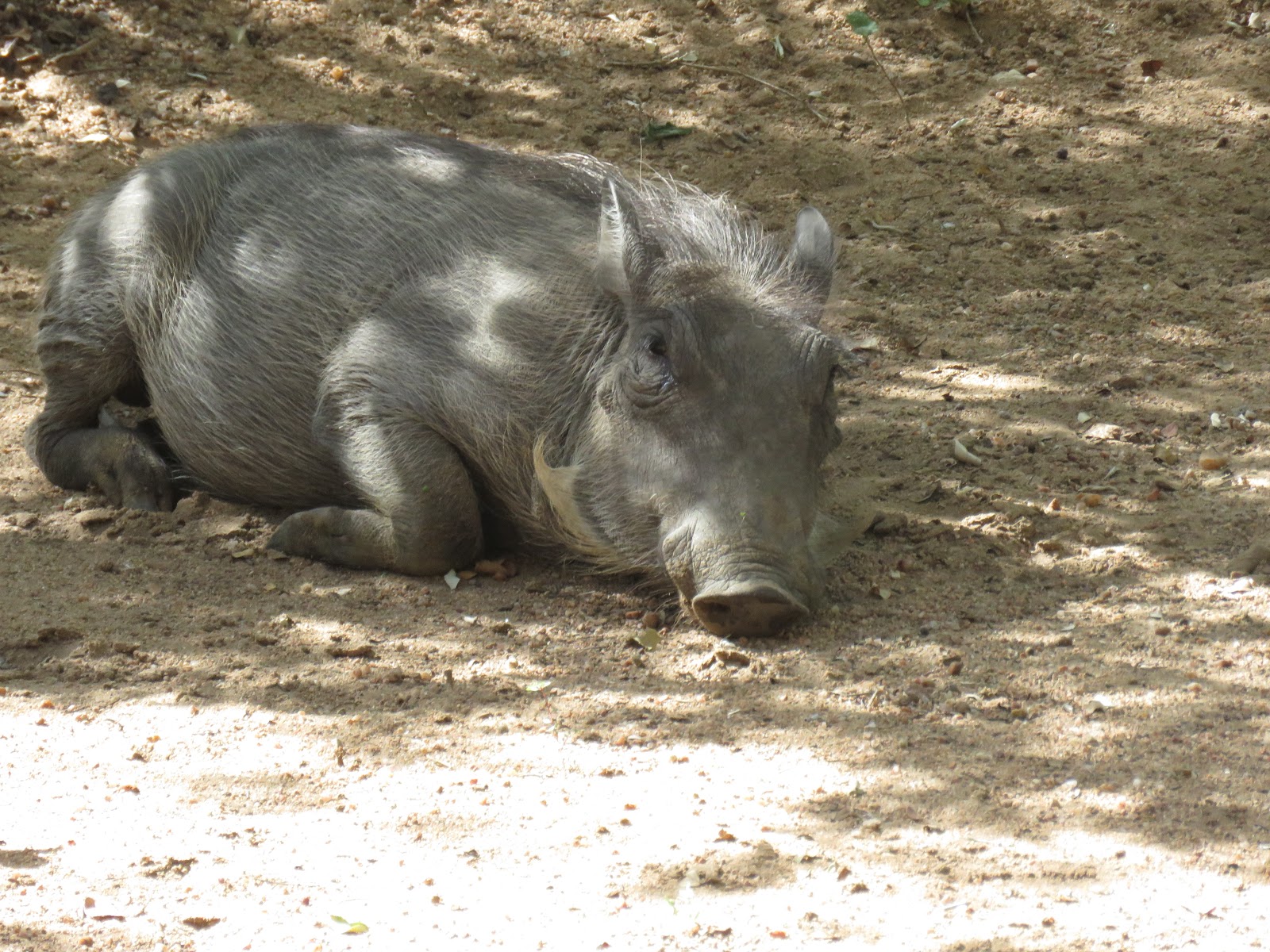
This pudgy baby warthog, now about six months old, was exhausted after the day’s events and rested in the shade.  Yesterday the temperature was over 90F, 32C.

As usual, this morning, while outdoors, we experienced a new sighting we can’t wait to share tomorrow! Soon, we’re heading to Komatipoort for a few items. Oops, I must go! I just heard the sound of hooves on the dirt road. I wonder who that might be?

Happy day!

Photo from one year ago today, March 5, 2017:

Two newly born bush babies peering out at the world awaiting them In Marloth Park, South Africa. This photo was taken by friend Mick Dryden (wife, Lynne), with whom we had dinner last night, who are both extraordinary photographers and birders. Ironically, Mick and Lynne were our dinner guests last night!  Click here for more.

Yesterday’s wondrous adventure…In a span of one month…From elephant seals and elephants…Who would have thunk?…

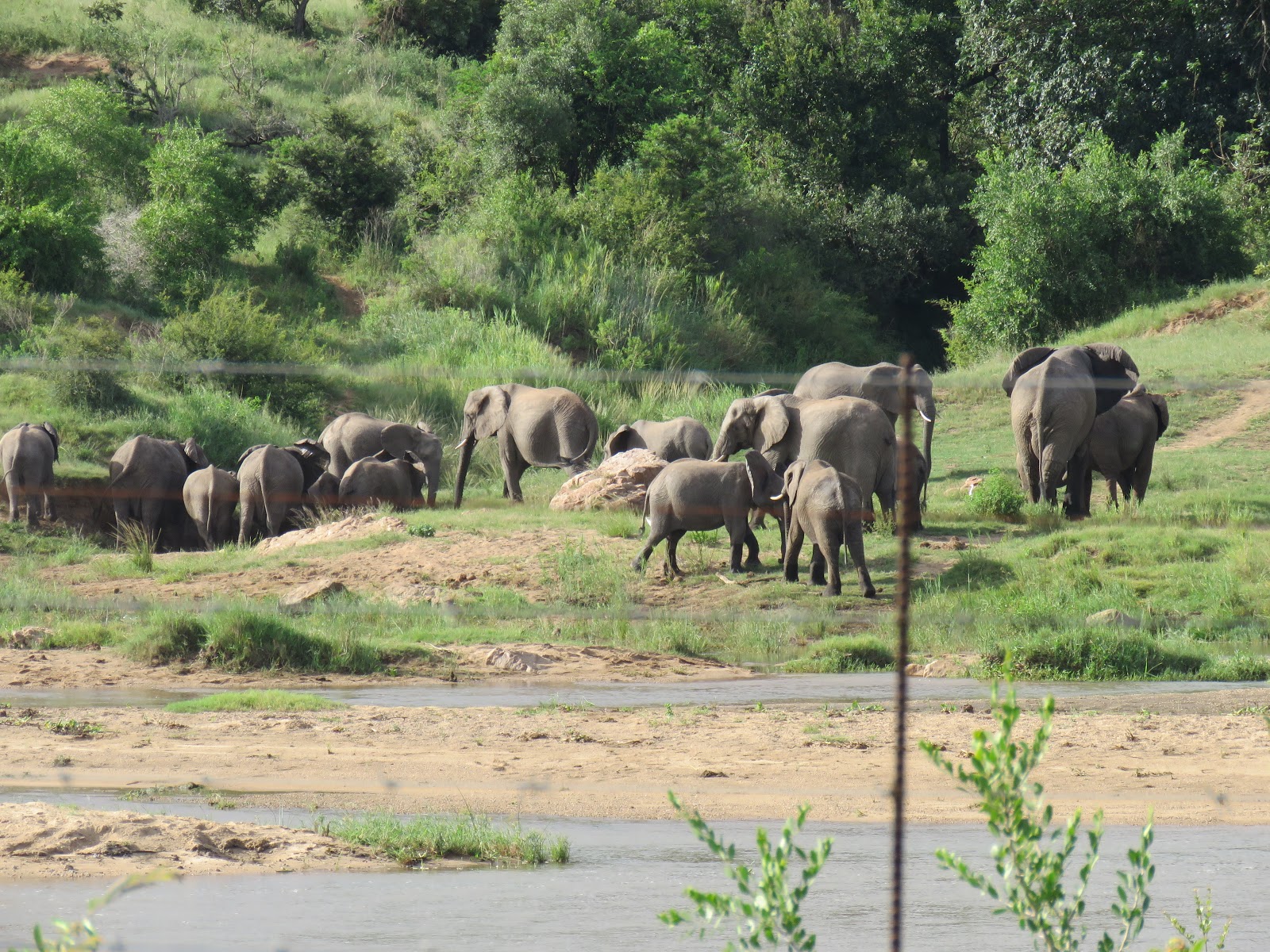
The lines in this photo are the electrified cables separating Marloth Park Conservancy and Kruger National Park. There were 17 in this photo, but later we counted 20, including a male clearly “told” by the matriarch that he couldn’t stay with the herd. See the photo below as he wanders off.
Part 1 video.
Part 2 video.
“Sighting of the Day in the Bush”
Yesterday, another “band” of mongooses stopped by looking for eggs.  Of course, we complied. This mongoose decided to rest their chin on a log to take a break from the frenzy of activity.
Yesterday afternoon as we stood at the electrified fence in Marloth Park delightfully watching a 20 member “parade” (another word for a herd of elephants) at the Crocodile River, an interesting thought popped into Tom’s head…we went from observing elephant seals in Antarctica to observing elephants in South Africa in a month.
In Antarctica, one month ago, this “arrangement” of elephant seals found comfort sleeping together in a ditch. Now, here in South Africa, we are blessed to see elephants. Here’s the post from that date.
Not only did we ooh and aah over the scene before our eyes when we were out on one of our almost daily drives through the Conservancy, but we were also totally awestruck by “safari luck’s” continuing presence in our lives.
In ones and twos, they meandered down the hill to the Crocodile River.
Tom often mentions how humbled and blessed we are, not only to live this peculiar and amazing life on the move but also in the heart-pounding experiences we encounter along the way that continues to surprise us daily.
Most likely, the majority of the elephants were females.  Males are kicked out of the herd by their 12th birthday when puberty sets in.

Perhaps our enthusiasm is slightly higher than some in our attentiveness as we always strive to get the very most out of every day of our world travels, knowing full-well that someday it will end.

Female elephants stay together for life.
This may prove to be the last period we’ll spend in Africa, and of course, Antarctica was indeed a once-in-a-lifetime experience. Comparing the two experiences is tricky when they each are unique in their particular way. 
Three elephants of varying ages drinking from the river.  Check out the baby in the background!
But the reality remains, they’re very similar in producing a surge in the feel-good hormones that course through our bodies day after day. Perhaps, we’ve both become addicted to this feeling coupled with a sense of adventure we never imagined possible during these senior years of our lives. 
Perhaps, for us, it’s not unlike the surge of adrenalin that those who seek high adventure sports and activities. They don’t do it just because it “sounds fun.” They do it for the “rush.”
A youngster stopped to nurse.
We don’t need to climb Mount Everest or bungee jump for the rush. We need only to stand at the electrified fence between Marloth Park and Kruger National Park, as we did yesterday, fully engaged in the scene before our eye, unable to wipe the smiles off our faces. At the same time, we took distant photos and videos.
As they began to make their way back up the hill. 
No, our photos aren’t as clear as we’d like, but we were no less than 800 meters (2625 feet) from the magnificent animals, and our paltry little camera did its best to capture as much as we could, albeit shakily at times while making the two videos, we’re posting today.
After spending about an hour at the river, they began the trek back up the hill as soon as the matriarch trumpeted a loud sound.  Seeing and hearing this was beyond description.
Sure, it would be great if we had a more sophisticated camera and if I were a better photographer, but we have what we have. We are what we are, content with the small size and weight of our two identical cameras and our abilities as amateur photographers.
For short periods, smaller groups would wander off, only to connect with the more significant herd moment later.
So, today, we share what we captured yesterday with such enthusiasm and joy, hoping those of our readers who embrace wildlife and nature will find this interesting along with us.
This male was pushed aside by the others since most likely the time had come for him to go off on his own, now that he’s reached puberty.  He may find other males he’ll join or may stay alone seeking to mate. Elephant parents typically don’t stay together with their offspring. The babies stay with the moms, sisters, aunts, and matriarch.
If not, bear with us. We’ll have many more stories to tell during our extended period in Africa over this next year, with our plans to leave by next March. During this year, we’ll be moving to other properties in Marloth, visiting other countries in Africa, and continuing to meet new people and see more wildlife.
The others followed suit and make their way back up the hill.

Today, we’ll stay put during the day.  Tonight, we’re off to Jabula for dinner and easy socializing when other patrons are outrageously friendly. Tomorrow night, friends Lynne and Mick are coming for dinner. It will undoubtedly be a great weekend.  

May you have a great weekend as well!

P.S. Today, March 3rd, is World Wildlife Day. For more information, please click here.

Photo from one year ago today, March 3, 2017:
Baby Grand player piano in the living area of the Penthouse Suite on Celebrity Solstice.  The lovely couple who had booked this suite invited the two of us for a private dinner, served by the shop’s “butlers.” It was a sensational evening. Please click here for details.

Visiting the bushbaby rehab centre here in Marloth Park…The cutest little creatures in the world…

What a face!  Lisa and Doc, the tiniest of the rescue bushbabies.

 “Sighting of the Day in the Bush”

Sweet Ms. Bushbuck stops by every day for a warm welcome and pellets eaten from my hand.  Its a treat for her and a bigger treat for us.

This morning awakening by 4:30 am, we were determined to get up and out the door early to head to Kruger National Park where we’d purchase an annual pass, called a “Wild Card” allowing us access at any time for a one-time annual fee.

Although we’d been to Kruger many times in the past, each occasion presented us with a wide array of new and unique experiences we’ve both longed to see once again; elephants on the road, crocs in the river; rhinos grazing in the savanna, giraffes lumbering through the trees, herds of cape buffalo and of course, the much sought after lion or leopard sighting and so much more.

Lisa makes little plates of food for the bushbabies which they nibble on for hours.  One of the less-well babies must be fed every three hours including during the night which Lisa doesn’t hesitate to do with unselfish love and concern.

A sighting of any one of the above and any others would provide for a highly successful day and we don’t hesitate in our desire to see these majestic animals in the wild.  But, after getting up and dressed and throwing open the massive wooden doors to the veranda, we found ourselves in a quandary…there were countless wild animals in our yard.  Should we stay or go?

Bushbabies like worms as well as soft foods.

Quickly, we loaded the yellow plastic container with pellets and grabbed a camera, finding ourselves entrenched in the scene before our eyes, we decided to wait until another day to visit Kruger National Park.

After taking countless photos and tossing and hand-feeding pellets to the many visitors that gradually wandered off to their next stop, we grabbed our coffee and tea sitting down at the big table on the veranda, ready to begin telling the story of last night’s visit to Lisa’s home a few kilometers from here.

The four bushbabies spend their quiet time together (they are nocturnal) inside this flannel bags in Lisa’s closet.  When we arrived, all four were awake and ready to see who’d arrived for a visit.

We’d heard so much about the tiny bushbabies Lisa’s been nursing to health as a part of hers and Deidre’s non-profit organization, Wild & Free Rehabilitation Centre based in Marloth Park and Hoedspruit.  We were anxious to see Lisa’s rescued bushbabies that she handles with the ultimate of love and care until they’re ready to be released into the wild.

This up close and personal experience was a treat!

Well, wouldn’t you know, no more than 10 minutes after we finally sat down to begin today’s post, the Internet went down.  After waiting 15 minutes, the message was clear, this would be a perfect time to head to Kruger, sign up for the Wild Card and spend a few hours driving through the park. 

Tomorrow, we’ll share our totally unexpected “safari luck” experience with some amazing photos we can hardly wait to post.  Who knew that late morning and midday self-drive photo safari would prove to be so exciting?  Perhaps, this purported morning window of opportunity doesn’t hold much water after all.

They are shy and yet curious little animals.

Anyway, back to the heartwarming visit to see the bushbabies and spend time with Lisa who graciously welcomed us into their home, serving snacks and wine. (Wow!  We’re always impressed with the hospitality of South Africans!!!)

They love for Lisa to massage and tickle them, moving around to accommodate her gentle touch.

As soon as we arrived at Lisa’s home (the same site where the bush movie and fundraiser for Wild & Free was held on Saturday night) she escorted us to her bedroom where she cares for four bushbabies who happen to reside in her bedroom closet, which by the way, was meticulously clean and tidy.

We simply could not believe our eyes!  We’ve seen bushbabies in both Kenya and South Africa, usually adults but never quite so close up.  With their big eyes, adorable faces and fluffy hair, they are quite a sight to behold.

The tiniest of the four needs a special tonic several times a day.

Watching Lisa interact with them while caring for their needs with special foods and medicines was indeed precious.  The dedication she has to this four little creatures is beyond reproach. 

Unfortunately, one of the bushbabies, aptly named, Special Needs,” suffers from a brain injury he received when negligently kept as a “pet” and later rescued by Lisa.  Sadly, he isn’t expected to survive much longer but Lisa is making his quality of life meaningful and loving in the interim.

Lisa shared a photo of this baby when he was the size of the end of her finger which may be found here on their Facebook page.

But, the remaining three are thriving and growing and, when fully prepared they will gradually be returned to the wild. There are few people who could so lovingly care for these tiny and magical creatures and Lisa, undoubtedly fits the bill.

They enjoy maneuvering around the various clothes in the closet.

After I fed Doc, the smallest of the three remaining (along with Apple and Bubba) I felt a unique affinity for these little creatures and plan to buy some bananas and yogurt for those that live in the trees near our veranda.

I had the opportunity to feed tiny Doc who slowly nibbled on the teaspoon.

Deidre, from Wild & Free whom we also met on Saturday night, stopped by last night while we all sipped on wine and snacked on biltong and chips while savoring the steady stream of visitors that freely come to their yard.  It was indeed magical.  Thanks to both Lisa and Deidre for making these past few evenings extra special for both of us.

We look forward to seeing them again in the near future and hearing when those precious bushbabies are able to fulfill their innate goals of living free in the wild in fabulous Marloth Park.  Who knows?  Maybe we’ll all see them again peeking out from their den in a tree on a warm and balmy night.

What a special experience!

Please stop back tomorrow for more breathtaking photos and our visit to Kruger National Park!

 _________________________________________________________

Photo from one year ago today, February 27, 2017:

Could it be more beautiful in Tasmania?  For more favorite photos of Tasmania as we wound down to our last day, please click here.