Yikes!!!…A snake in the bedroom???…Or, what?…Adults only photo today.

A waterbuck with it’s circular-shaped marking on its rear end.

“Sighting of the Day in the Bush”

Only 3% of birds on the planet have penises. For a scientific perspective, in an article entitled “Ostrich penis clears up an evolutionary mystery,” please click here.

Yesterday on the N4 Highway not far from the entrance to Marloth Park, a male lion was spotted on the highway and reported as follows:

A lion spotted by motorists along the N4 near Marloth Park in Mpumalanga is thought to have escaped from the Kruger National Park.
A lion spotted by motorists along the N4 near Marloth Park in Mpumalanga has escaped from the Kruger National Park.
A lion spotted by motorists along the N4 near Marloth Park in Mpumalanga has been darted and captured.
A spokesperson for the Mpumalanga Tourism and Parks Agency, Kholofelo Nkambule, told SowetanLIVE that the lion would be returned to the Kruger National Park from which it is understood to have escaped.
“The lion has been found and darted. It is ready to be sent back to the park where it escaped from‚” said Nkambule.
The lion was sighted in the early hours of Sunday by motorists who posted a video and pictures on Facebook.”

This story created quite a flurry of activity on the various Marloth Park pages on Facebook. We followed throughout the situation, pleased to discover the lion had been darted and returned to Kruger National Park by helicopter. Thanks to all the local people, including Marloth Park rangers, for participating in this successful recovery. 

Ostriches strutting their stuff!
Our friends Lois and Tom will be arriving here in 15 days traveling on that same road from the airport. We didn’t send them this link to avoid any concerns before arriving here and becoming more informed and familiar with such occurrences.
Crossing the road…

None the less the situation caused quite a stir on social media in Marloth Park, and of course, we enjoyed reading about it throughout the day.

Also, yesterday a Marloth Park resident posted the above photo of a venomous boomslang snake devouring a lizard from her veranda. Quite an interesting sight to see. 

This morning when the power had been out for several hours, and we weren’t able to finish the post, we jumped in the little car for a drive through the park.

Giraffes, like most animals in the wild, are always on the lookout for food.  From this site:  “In Africa, there is a rainy season which allows giraffes to feed on fruits, leaves, twigs, and water, but there is also a drought season when they will try to forage for all that they can, mainly acacia trees and bushes. During these rainy months, they eat deciduous plants, and during the dry season, the evergreen plants are more consumed. They eat between 34 and 75 kg of vegetation every day.”

At the Crocodile River, we spotted five lions, but we were too far away for good photos. Now back at the house at almost 1:00 pm, we’re settled in for the remainder of the day and evening.

From this site“The giraffe’s main predator is the lion, which can accelerate to almost 50 miles per hour. His second worst enemy, the hyena, can reach 35 mph. If a lion and a giraffe ran a race side by side, the lion would beat the giraffe to the finish line. However, the giraffe is not about to give a predator an even start. He uses his great height and excellent eyesight to spot a pride of lions as far as half a mile away and gets a head start. Lions can sustain their top speed for only about a hundred yards, so they run out of gas before the giraffe does. Hyenas can be more dangerous because they hunt cooperatively. They can take turns sprinting to keep the giraffe from slowing down to catch his breath.”

It’s not as hot today as it had been several days last week. It’s a paltry 30C (86F), but oddly, with no rain for months, it’s humid today. The holidaymakers are beginning to leave after the long weekend, but many remain.
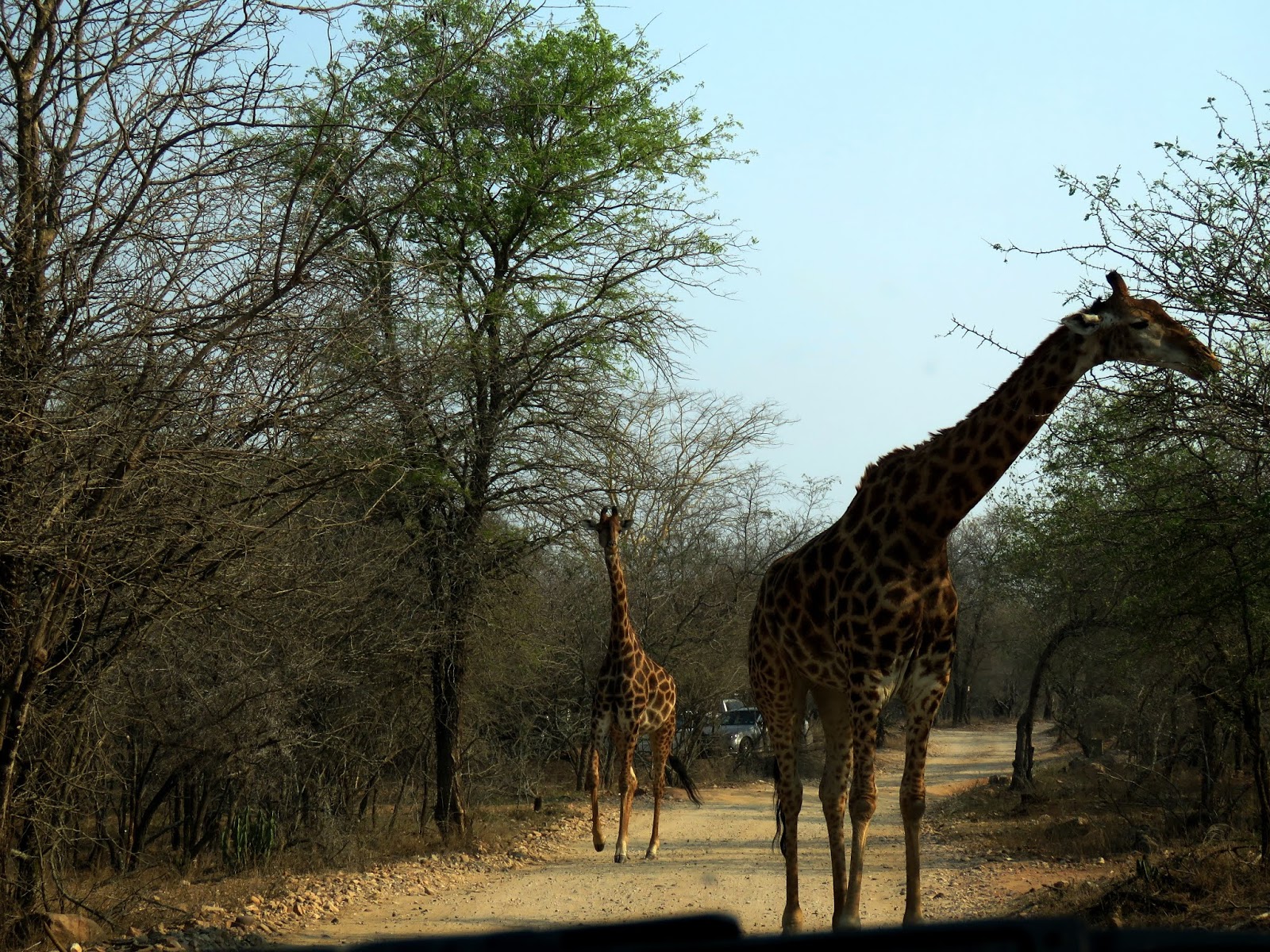
Giraffes move quickly, so when we spot them, we always stop for photos and observe their fascinating behavior.

There are many cars on the road, and more will come when the school holidays begin this week. As a result, we’re hardly seeing any visitors other than bushbucks, helmeted guineafowl, mongooses, and a few warthogs.  
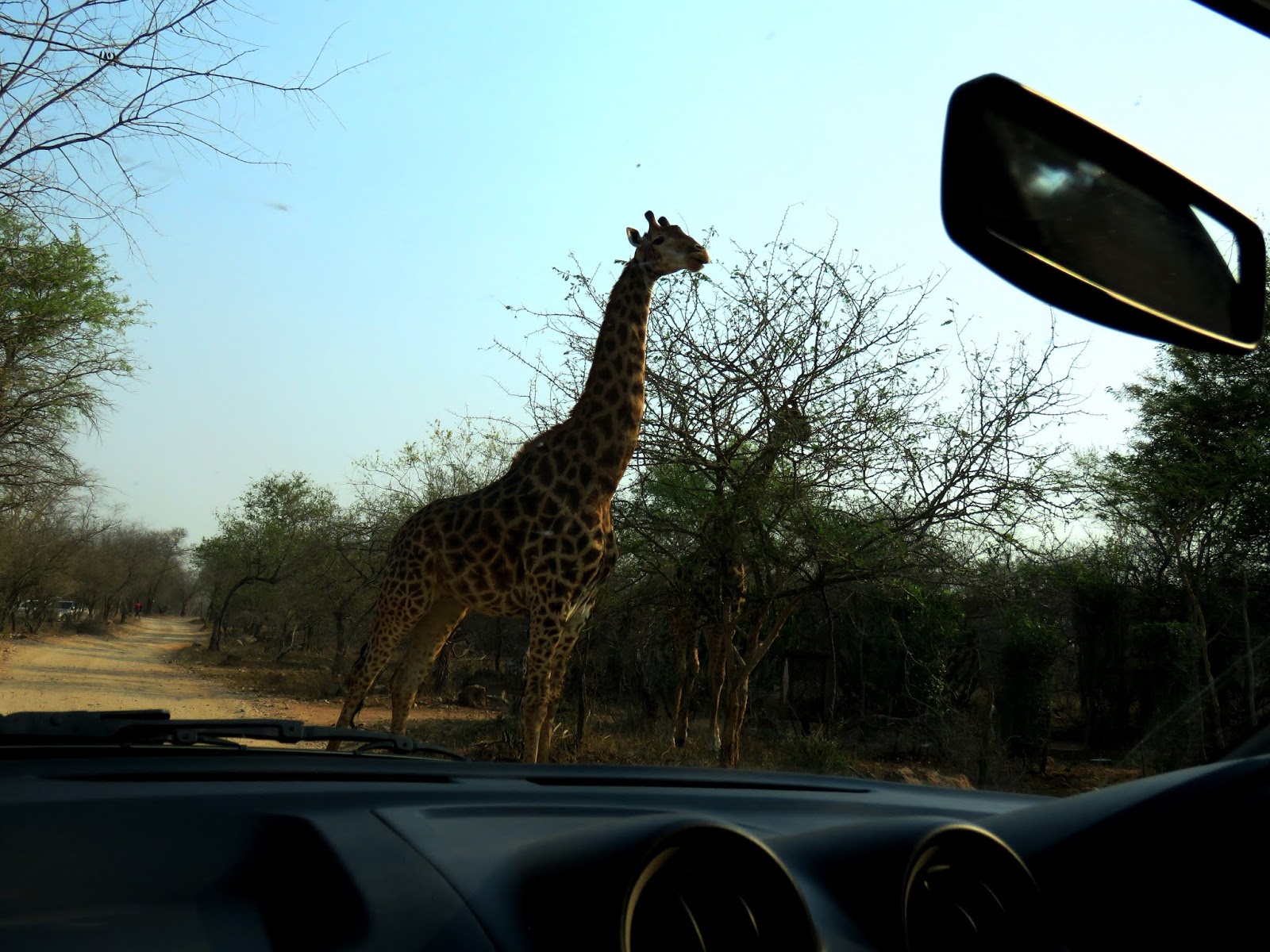
Giraffes crossing a dirt road in Marloth Park.

Once the commotion thins out in a few weeks, it will be quiet and peaceful, with visitors clamoring in our garden for pellets, carrots, apples, and eggs. We’ll stay busy in the interim doing our favorite pleasurable activities; daily drives to the river; dinner out each week at Jabula Lodge & Restaurant where the food and companionship are divine; socializing and entertaining friends for dinner (this coming Saturday); and continuing to post stories and photos every day.

It’s dark in our bedroom. Upon awakening, with Tom already outside on the veranda, I looked out the window to see if we had visitors. Then I noticed this and backed up slowly and calmly.

As for the above photos of what, at first, appeared to be a snake, I called Tom into the bedroom, and he grabbed the huge telescopic pole he uses to chase off monkeys and baboons and carefully approached the scene.  

When Tom grabbed the telescopic pole to pull this out from behind the wooden chest, he discovered this. See the story below.

Oh, good grief. It was his belt that had fallen behind the wooden chest. We couldn’t help but laugh out loud, especially as we’ve recalled the situation several times since that morning.

Do we ever get bored? Never. Certainly not in this environment. But, like many other retirees throughout the world, we occasionally conjure up some added activity to keep us enthused and thoroughly entertained.

Oops, gotta go! Ms. Bushbuck just arrived. The pellets are ready for her, along with some iced cold carrots, apples, and lettuce…her favorites.

Have a spectacular day!

Photo from one year ago today, September 24, 2017:

Elephant topiary on the church’s grounds and topiary in Costa Rica. For more photos, please click here.

Exquisite scenery from the Marloth Park side of the Crocodile River…Staying healthy, a must for this life!…

It was hard to believe we captured this scene close to sunset.

“Sighting of the Day in the Bush”

Notice the appearance of a face in the rocks near the top center of this photo.

It’s almost noon on Sunday and I’m getting a late start to today’s post. Recently, on a relatively strict diet to lose the weight I’d gained these past few years since my gastrointestinal problems began, I’m only 2.5 kg (5.5 pounds) away from my goal.  

A pair of retired generals, perhaps?

Once I reach that goal, I will post the details here including what I’ve been doing to lose weight which is difficult with my already strict way of eating, what I did and didn’t give up, my weight at the start, and the final total weight loss.

Zebras were standing in a waterhole drinking and cooling off.

It’s been slow, averaging only a .45 kg (one pound) loss per week but I’m thrilled to be able to fit back into clothes I’ve dragged around the world for a few years hoping I’d fit in them once again.  

A mom and youngster grazing near the water’s edge.

Of course, now I’m stuck with many items that are way too big, which I’ll donate before we leave South Africa, whenever that may be. In the interim Tom who’d also gained a few kilos is now gradually returning to his lowest weight which was when we were in Belize almost six years ago.

This elephant was trying to figure out how to climb these steep rocks. Eventually, she turned and took a different route.

We’re hell-bent on not carrying excess weight when our goal is to stay fit and healthy so we can continue traveling. We’ve both found we feel our very best at the lower end of our weight ranges which like everyone, fluctuates from time to time.

Five giraffes at the river’s edge.

No, we’re not obsessed with the “numbers’ but we’re definitely determined to keep our lipids, blood pressure, blood sugar levels, and weight at a level of optimum wellness for our ages.

Zebras coming down the steep hill to the Crocodile River.

No doubt, I’d had my share of medical ups and downs these past several years.  But, now I see I need to pay more attention to wellness and less attention to the vulnerability of advancing age.  

The hot weather brought many animals down to the Crocodile River.

Fortunately, none of my issues had left me wanting to stop traveling. At times, it was difficult to carry on but the sheer love of our lifestyle has kept me motivated to forging ahead. Now that I’m feeling so well I never forget to be grateful each and every day while continuing on the mission to maintain good health.

Giraffes rarely bend to the ground other than to drink.  They are vulnerable to predators in this position.

One’s mental health is equally important in this process and nothing could bring us more joy than the amazing relationship we share as we travel the world.  This extended stay in South Africa, hopefully lasting until February 20, 2019, when we fly to Kenya (providing we are able to get visa extensions) means we only have 150 days remaining until we leave.

A few male impalas and two giraffes could be mom and youngster.

The remaining 150 days constitute a total of four months and 28 days. We both want to thank all of our worldwide readers for staying with us as we’ve continued to write and post photos of some fairly repetitive scenarios.

Giraffes heading back up the embankment while zebras languished in the water.

We present today’s photos with a little different perspective, not just animal photos per se but scenes with the wildlife we’ve been fortunate to see while on the Marloth Park side of the fence, overlooking the Crocodile River, taken on the two outrageously hot days this past week.

A few of the zebras began to wander off while the others stayed behind.

Enjoy our photos and especially, enjoy YOUR day!

Photo from one year ago today, September 23, 2017:

Much of the produce at the Central Market in Atenas appears to be imported when it’s perfectly shaped and mostly clean. At the feria, the Friday Atenas Farmer’s Market, the vegetables appear to have been “just picked” with excess leaves and insects still on them. That’s the type of produce we prefer to buy.  For more photos, please click here.

Loving elephants assisting a downed baby…A beautiful story unravels before our eyes….

 Although we missed the actual birth of the calf, we were thrilled to have seen this important process…getting the baby on her feet for the very first time. Amazing! See the photos below for the outcome.

“Sighting of the Day in the Bush”

A yellow-billed heron sitting atop the back of a hippo at Sunset Dam in Kruger National Park.

Our trip to Kruger National Park a few days ago left us in a state of awe and wonder. Not only did “safari luck” befall us in several instances such as in the case of yesterday’s post highlighting a gorgeous cheetah but also in many other scenes we encountered that day.  

If you missed yesterday’s post, please click here to see the stunning cheetah.

When we came upon this scene which was blocked by numerous vehicles we jockeyed for position to get a good enough spot for taking the above videos and sequential photos below.

On the outrageously hot day with temps in the 42C (108F) range, nothing seemed more appealing than spending the better part of the day in airconditioned comfort in the little car. As long as we didn’t get a flat tire on the bumpy dirt roads, we’d be good for the day.

At first, we thought the baby was injured or ill but after reviewing our photos, taken in bright sun, we could see it was a newborn calf.

By the way, we should mention here that other than stopping at various camps or restaurants nestled in guarded areas of the park, visitors are not allowed out of their vehicles. The exception would be of course, if one ran into mechanical difficulties with their mode of transportation.  

However, in these cases, its required that the emergency number listed on the entrance-to-the-park-documents must be called promptly to gain assistance in any such occurrence. One doesn’t want to be outside their vehicle replacing a tire in the park.

The baby elephant, lying on the sand unable to stand.

Actually, it’s dangerous to even have a hand, arm, or leg outside the vehicle for any reason. We are often shocked when we see self-driven vehicles with a passenger hanging outside the windows or sunroof. This is definitely the type of scenario that could attract a hungry lion, an angry cape buffalo, or a determined bull elephant.

Gently nudging and pushing the others assisted in getting the calf on her feet.

Speaking of elephants, today’s story and photos are about an encounter we had on Tuesday at the Verhami Dam while heading to the park’s exit at the Crocodile Bridge. We’d already had a good day and weren’t expecting to see much more during the 4 kilometers (2.5 miles) return drive to the gate.  

In the past Verhami Dam when it was less dry, this dam was an excellent location to spot considerable species. The fresh water in the dam was a huge attraction for elephants, giraffes, cape buffalos, and impalas.  

The baby is finally on her feet with the help of the family.

But now, almost completely dry for lack of rain over these past many months, we hadn’t seen a thing at the dam in our past several visits. As we approached the dam, we couldn’t help but become enthused when we noticed several cars lined up on one side of the road with passengers “hanging out windows” to get a better view.

The sun was bright and it was so hot, it was a challenge turning off the car and opening the windows. Shooting through glass is never our preference and we do so only when there’s a possible danger in opening the windows.  

Female elephants don’t usually reproduce until they are 14 or 15 years old.

But, we remained diligent awaiting the perfect opportunity to get into a good position to make a video and take photos as vehicles in front of us finally drifted away.  

The intensity of the sun made it difficult to see what we were shooting but we fired away not knowing exactly what we were seeing until we returned to our holiday home in Marloth Park, uploaded the photos and video, and finally, it was clear…it was a newborn being assisted in standing for the very first time!

We couldn’t have been more thrilled to have witnessed this magical occurrence with the most loving and emotional animals on the planet..majestic elephants.  

The baby isn’t quite sure where to nurse but she’s trying to figure it out.

Yes, over and over again, on YouTube videos we’ve watched stunning scenes of elephants interacting with one another during times of crisis. But, to see it live firsthand was precious and we’re delighted to share it with our readers today.

Please, I implore you, watch the video. It will give you, as it did us, a chance to see a little further into the love and caring nature of these wild beasts. Enjoy, along with us!

More will follow tomorrow as we continued on our exceptional visit to Kruger National Park to which we’ll return again soon. We can’t ever seem to get enough!

Happy day to all!

Photo from one year ago today, September 20, 2017:

I walked through the archways in the topiary garden at Senor Scissorhands Topiary Garden in the small town of Zarcero, Costa Rica. For more of these photos, please click here.

Thinking of future plans for visiting family in the US…Giraffe attack in South Africa…

Kudus are usually early morning visitors, although we’ll occasionally see them during the day and evening. 

“Sighting of the Day in the Bush”

Guess who always has the right of way?  He stopped traffic while leisurely meandering across Oliphant Drive, the paved road in Marloth Park.

As much as we strive to live in the moment, it’s hard not to think about plans, mainly when they include returning to the US to see family. With our current itinerary, we’ll land in Minnesota on April 8, 2019, staying until April 25, 2019, for a total of 17 nights.

It’s always exciting to see hippos by the river. Hippos are the most dangerous land animals on the planet, killing more humans than any other: “The hippopotamus is often cited as the most dangerous large animal in the world, killing an estimated 500 people a year in Africa.

As it turns out, we’ll be returning to Minnesota again 17 months later (in September 2020) for daughter Tammy’s 50th birthday boating trip, which Tom will attend while I spend time with son Greg and his family.

In between these two planned trips, we’ll be returning to the US again to visit son Richard in Henderson, Nevada, and sister Susan in Las Vegas, Nevada, where we’ll spend Thanksgiving 2019. It looks like I’ll be cooking the Thanksgiving dinner since Richard also follows a low-carb way of eating, and it’s fun to adapt the traditional menu items accordingly.

They all get along well when there’s plenty of food on the ground. They start pushing, shoving, and kicking one another as soon as it gets low, although not with much vigor.

After Thanksgiving, we’ll head to Apache Junction, Arizona, to see Tom’s three sisters (and two spouses) who spend their winters in the warmer weather, as opposed to “roughing it” in frigid Minnesota. We may stay a few weeks, depending on available accommodations, which are pricey in Arizona.

Female zebras often stop by with their young, all looking for pellets, carrots, and apples.

From there, we’ll be heading back to South America, which is an easy flight from the US. We’re still up in the air as to which countries we’ll visit and in which order, but we’ll decide over this next year. We’d like to see several sites we missed last time we were there.

It will be great to see family during these three US visits, which will occur between April 8, 2019, and around September 25, 2020. In total, we’ll be spending approximately 53 days in the US during this time frame. Then, we’ll be off for the next chapter of our world journey.

A new mom and baby bushbuck stopped by the first time. Bushbuck moms hide their young for the first few months while she forages during the day enabling the baby to nurse freely at night. The mom eats the baby’s feces to deter predators.  After a few months, the youngster joins the mom in her daily grazing. This was the tiniest bushbuck we’ve seen, who may have been out with mom for the first few times. 

Other than staying at son Richard’s home in Henderson, we’ll be staying in hotels for the remainder of these periods. We don’t want our grandchildren in Minnesota giving up their bedrooms for our visits and, I’m allergic to cats which two of our three kids have as pets. It will all work out.

“Elephants may spend 12-18 hours a day feeding. Adult elephants can eat between 91 kg – 272 kg (200-600 pounds) of food daily. As herbivores, elephants consume grasses, tree foliage, bark, twigs, and other vegetation daily. Elephants can also drink up to 189 liters (50 gallons) of water a day, about as much as a standard bathtub holds.”

For now, our top priority is reveling in whatever time we have left in Marloth Park, South Africa. And celebrate, we do! Again, last night we had a spectacular time at Jabula Lodge & Restaurant, constantly being made to feel so welcomed by our hosts, Dawn and Leon.  

The food, as always, is fresh, hot, and delicious, cooked perfectly for my diet. It couldn’t have been any more enjoyable, except, when we pulled out of the parking lot at the end of the evening, four giraffes were blocking the road. I tried to take a photo in the dark, but their placement made it impossible.  

During the dry season, the elephants can sustain themselves, grazing on surrounding greenery.

It’s foolhardy to get out of the car around giraffes. Only recently, we’d read a new story of a giraffe with her calf who attacked a woman and her three-year-old son while at a game reserve. Click here for the news article on this dreadful situation.  

During the upcoming rainy season, this entire area will be covered in water, providing a rich source of water and surrounding vegetation for wildlife to thrive.

The giant animals are very protective of their young, and one swift kick could be deadly. Apparently, according to this article, the giraffe and her calf are being relocated to another reserve.  

This is why when we spot giraffes on our daily drives through Marloth Park, we stay in our little car, regardless of how motivated we are for good photos.  Otherwise, locals and visitors may be on foot, on bikes, and on paths staying mindful to remain at a reasonable distance when encountering large animals.

With no rain to speak of for many months, the elephants take advantage of any water they can find on the Crocodile River.

After all, these are wild animals regardless of how attached we become to them in their frequent visits and how generously we feed them pellets, carrots, and apples.

Today, we’ll head out on yet another drive. It’s cool and cloudy and a perfect day for a drive. A pleasant Sunday dinner has been prepped to be cooked when we return, a beef roast for Tom and a chicken “flattie’ for me. It will be another good day.

May your day be good as well!

Photo from one year ago today, September 16, 2017:

We didn’t see any reason to walk on the rickety old railroad bridge in Costa Rica. For more photos of the railway station, please click here.

Recalling a post from six years ago today, September 15, 2012…Wow! Life has changed so much but have we?

This is the same family with seven chicks we’d seen a few months ago. See how the chicks have grown by clicking here at our earlier post.

“Sighting of the Day in the Bush”

A muddy ostrich meandering down Volstruis St.  In Afrikaans, Volstruis means “Ostrich.” There are usually ostriches on this road.  Go figure.

Today, we include photos from yesterday’s two-hour drive through Marloth Park, some close to the river, others in the bush. We have many more to share over these next few days. We’ve had safari luck each time we’ve gone out, often more here by the fence than on those days we’ve visited Kruger for a self-drive photo safari.

This time we counted only six chicks, one less than our earlier sighting. Could this be a different family, or did one of the chicks not make it?

For clarification’s sake for our newer readers, whenever we use the word “safari,” it’s always about “photo safaris.” Under no circumstances would we ever participate in a safari intended to kill wild game for “trophies.” I won’t get into the politics on this topic, but it simply does not fall within the realm of our beliefs about wildlife.

Another holiday weekend has begun, and the pounding next door is earsplitting.  Often part-time Marloth Park owners/dwellers come here during the short or long holiday periods to work on their houses.  

It is pretty interesting to us as to why ostriches always hang around at this particular bush house. Nine of out ten times we drive by, there are ostriches there, including when we were here in 2013/2014.

There are specific rules in Marloth Park stipulating that no building work with any noise can be conducted after 1700 hours (5:00 pm) on weekdays or after 1300 hours (1:00 pm) on Saturdays and not at all on Sundays.

A Big Daddy and his harem on the side of the road.

Last night as we set up the veranda for the evening after 5:00 pm, Tom walked next door to ask the workers to cease working for the evening kindly. If we don’t ask, we have the option of “reporting” them anonymously to Field Security, who will send a security officer to the property to tell them to stop. Fines are possible if work doesn’t cease within the specified timeframes.

Marloth Park is intended to be a quiet and peaceful place without blaring music, loud talking, and rowdy social interactions. Unfortunately, not all holidaymakers and residents appreciate this concept.  

It’s always a joy to see elephants along the Crocodile River from the fence between Marloth Park and Kruger National Park.

The wildlife is often frightened off by human noises, as evidenced by the fact that we haven’t had a single visitor this morning other than much-appreciated and admired birds who are currently clamoring around our birdfeeder. Yesterday, when the holidaymakers moved in, the wildlife visits diminished exponentially.

This big girl was quietly enjoying time by the water.

We took off for our usual two-hour drive in the afternoon and found many beautiful sightings by the river, a few on the bumpy dirt roads, and in the bush. Those incredible, almost daily drives provide us with our wildlife fix during these busy weekends when few visitors make an appearance.

Last night after dark, we did see a few of our “regulars,” including Tusker and his new girlfriend; Mr. Duiker; Wildebeest Dad and Son; and our most frequent visitors, Ms. Buchbucks and Babies. Of course, Frank and The Misses. stopped by for seeds before they went off to “make their noise” at dusk.  
The elephants were many, but they were scattered about the river bank.

As we continue to write post after post, adding new photos each day, we revel in how much it means to us to share the morsels of our daily lives with all of our worldwide readers. In doing so, we are gifted with something we’ll treasure for years to come, such as being able to look at old posts from years past.

One hippo was within range for a photo.

This morning I looked up the post from the first year we’d begun to post in 2012, specifically the post from September 15, 2012, six years ago today. Looking back at these older posts certainly puts big smiles on our faces as we often read aloud to one another.

What a wonder it is that in two clicks, we can reread a story and see its photos from years past, just like that. Neatly organized in our archives on the right side of the page, you can do the same if you’ve missed older posts having joined us a few years into this journey.

There’s often a cattle egret near the elephants, partaking of their insects and scraps.

Here’s an excerpt from that September 15th post from six years ago:

“As a person entrenched in the details, it’s not unusual to me that I have six tools one could use to crack crab legs: two types of crackers, two types of crab scissors, a pick, and a small fork, service for eight. It’s not coincidental that I have service for eight. Who would want to “shell out” (couldn’t resist) enough crab legs for more than eight people? 

This came to mind yesterday when I recklessly spent $48 for two bags of king crab legs plus $28 for the accompanying grass-fed New York strip steaks.  

This is for three of us for Sunday night’s dinner; Tom and I and our friend Sue, who comes for dinner every Sunday night since the passing of her dear husband and our beloved friend Chip. She’s a trooper. Our hearts break for her. They were our role models as a happily retired couple. Now, we witness the depth of the loss of a beloved partner, excruciatingly sorrowful, a double whammy.

We laugh, cry, and tell endless stories of our 26 years here on the point. (You can read about Chip in my post on June 1, 2012, found here in the archives). We three deserve steak and crab.”

A mom and her growing calf.

If you’d like to read the balance of this old post, please click here. We still talk about our friend Chip and have seen Sue each time we’ve returned to the US for a visit. We relive beautiful memories we all shared over many years as great friends and neighbors.

Hmmm…life was good then, and life is good now, just very different.  No more do we have kitchen gadgets for eating crab. No more do we eat crab legs. We don’t see them in Africa. No longer am I so “detail orientated” or…do you look up a photo of Martha Stewart and see me (an expression used by a friend in Minnesota). That life is no more and most likely will never be the same again.

This is our “new normal.” Tonight, we’ll head out to Jabula Lodge and Restaurant for yet another fine dinner, often running into friends we’ve made in this magical place. We’ll sit at the bar and commiserate with owners Dawn and Leon and chat endlessly with other friendly Marlotians.

I don’t know if we’ve earned the right to call ourselves Malothians, but for now, we’ll afford ourselves this luxury, as opposed to others.

Have a very happy weekend, wherever you may be!

Photo from one year ago today, September 15, 2017:

The blue locomotive at the train depot with a dual cab, Puente Ferrocarril Rio Grande Atenas in Costa Rica. For more photos, please click here.

Stuff happens…The cost of medical care and prescriptions in South Africa…Astounding facts…

In South Africa, prescriptions are dispensed in plastic packs in these boxes, not in bottles.

“Sighting of the Day in the Bush”

Is this a white-crested seedeater?  Please correct me if wrong.

Over the past week, I had an odd discomfort in the front of my right shin, but I didn’t notice any insect bites or injuries. It wasn’t itchy, just painful when I wore anything touching it.

Yesterday morning I awoke to added pain and noticed a raised red circle-like bump the size of a small lemon. I wondered if it was an infection or, more problematic, some blood clot. One can’t be too careful when finding such a thing.
 
I didn’t give it much more thought until we were on our way to the grocery store in Komtipoort while wearing shorts and noticed the redness had increased in a few hours. Since we were heading to Komatipoort anyway, Tom suggested we stop at Dr. Theo’s office and see if he could see me without an appointment. It was close to noon.
This is the receipt for yesterday’s doctor appointment, total cost ZAR (rand) 565 (US $38.24).

After waiting about only 20 minutes at most, Dr. Theo brought me into the exam room. I so appreciated him squeezing me in. Their office with several physicians is bustling, with appointments booked as tight as possible. These quality physicians have quite a following.

After carefully and diligently checking my leg, he assured me it was definitely not a blood clot and most likely an infection. If treated early enough, it could avoid the necessity of taking antibiotics. He prescribed a cream that was to be applied twice daily.  

In the past 24 hours, after only three applications of the cream, its already begun to improve, although there still is some redness. If it doesn’t continue to improve over the weekend, antibiotics may be necessary.

It’s dirty here…lots of dirt and dust constantly flying through the air, especially when the wildlife kick up more and more land from the garden when they visit.  Even the slightest scratch could become infected under these conditions.

The ZAR 49.95 (US $3.38) listed on this receipt was for the two tubes of cortisone cream the doctor prescribed.  The ZAR 1224.49 (US $82,68) balance was for the entire batch of prescriptions, enough to last for four months.

While visiting with Dr. Theo, I asked for prescriptions for the three medications I take and have for years. Here in South Africa, many drugs can be purchased over the counter in small amounts. But, for a several-month supply, a prescription from a local doctor must accompany the purchase.

None of my three medications are narcotic, thus making it relatively easy for a doctor to write a prescription. As mentioned in yesterday’s post describing “what to bring for an African safari,” we breezed over drugs. If you missed that post, please click here.

We were both thrilled over the low cost of the doctor’s appointment and the costs of the prescriptions. Next week we’ll return to the pharmacy for two more month’s supply for the three medications. They had to order them. Then, I’ll have enough for six months.  

Itemization for the three prescriptions, sufficient for four months.

Before we leave South Africa, either in November or February (depending on our immigration status), we’ll try for another six-month supply even if we have to go back to the doctor for the required appointment. At only ZAR 565 (US $38.24) for the appointment, it’s undoubtedly worthwhile.

I become frustrated when medical issues arise and sometimes hesitate to mention them here. But I do. Many of our worldwide readers are traveling or contemplating traveling, and any information we can provide when “things go wrong” may be helpful.  

It’s all a part of our continuing transparency and commitment to our readers to “tell it like it is” with no fluff, no minimizing, no exaggerating…plain and simple, the facts, keeping in mind we do tend to get excited when nature unfolds before our eyes.

Speaking of nature unfolding before our eyes, I need to wrap this up. We’re getting ready to head out for our daily drive to see what more treasures we can encounter in this magical place.

May events in your life bring you excitement and enthusiasm.

Photo from one year ago today, September 14, 2017:

This mom and her calf are our neighbors in this gated community of Roco Verde in Costa Rica. For more photos, please click here.

“It’s all a part of nature,” they say…It still hurts…More Kruger photos…

Check out those long eyelashes.
“Sighting of the Day in the Bush”
A vulture is on the lookout for a meal.

We often see videos on YouTube, at Marloth Park’s and Kruger National Park’s websites and Facebook pages and other locations that depict horrific photos of wildlife being captured and subsequently eaten by apex predators.

Their graceful beauty is breathtaking.
Often comments are made by viewers after such postings stating, “It’s all a part of nature.” Recently on the Marloth Park Sighting page on Facebook, there was a photo of a still-living young bushbuck being strangled by a massive python preparing to consume it. 

The little bushbuck’s legs were kicking at its last moments of life. Sure, the person who’d found this sighting surely was pleased to have witnessed such a scenario first hand, right here in Marloth Park.
She noticed us watching her from the dirt road.

There’s no doubt had we encountered such a sighting, we’d also have taken photos and posted them. And, yes, it is a part of life worthy of sharing with others who appreciate and love nature including the good and bad it has to offer.  

Giraffe mom and baby.

Most assuredly, some who see such a photo would find it “cool” with no emotion attached to their response. It all depends on one’s attachment and love of nature that precipitates a human response.

Oftentimes, I’ve shed tears watching the brutal slaughter of animals for human consumption. My life-saving diet requires I consume meat, fish, chicken, and other animals (I refuse to eat any of the animals we see in Marloth Park or on safari). Otherwise, I’d only be able to eat eggs and non-starchy vegetables, not providing sufficient nutrition for survival.

Generally, giraffes don’t bend much to eat although they must in order to drink. On occasion, they find certain bushes appealing requiring them to bend to graze.

The reality for those with religious or scientific beliefs is the fact that animals, by our higher power or other beliefs, were placed on this earth to provide sustenance for other carnivorous creatures including humans.  Otherwise, why would ours and their bodies have been designed to consume food as a herbivore, omnivore, or carnivore?

For example, cows have four stomachs as described here: “The cow has four stomachs and undergoes a special digestive process to break down the tough and coarse food it eats. When the cow first eats, it chews the food just enough to swallow it. The unchewed food travels to the first two stomachs, the rumen, and the reticulum, where it is stored until later.”

Another bird of prey on a search for a meal.
Cows are herbivores only meant to consume plants and grasses.  In this world today, for pure greed, cows are often fed animal by-products as described here:
“The advent of “mad cow” disease (also known as bovine spongiform encephalopathy or BSE) raised international concern about the safety of feeding rendered cattle to cattle. Feed for any food animal can contain cattle manure, swine waste, and poultry litter.” This goes against nature.
 
I’m not on a “political soapbox” on this topic. I’m simply stating that yes, animals and humans may be intended to eat according to their status as a herbivore, omnivore or carnivore.  
Wildebeest grazing in the bush.
Although the sighting of the python and the bushbuck shook us to the core, this is the reality of being a part of this magical wildlife environment. With it comes the fact that we’ll be witnessing, from time to time, a sad scene such as this. How we respond to it is entirely up to the individual, their level of compassion, and their core beliefs.  
 
For us, we don’t simply brush it off as “nature at its finest.”  In essence, we humans could say when an elder passes away, “It’s the way nature intended it to be.” But this doesn’t diminish nor negate the fact that we loved that person and our hearts are broken over losing them.  
 
If all of us could embrace life, whether human or animal, with compassion and love we wouldn’t be facing the extinction of many animals in the wild or the inhumane treatment of those that are a part of the food chain, the harsh reality of the sustenance of life itself.
A vulture spreading its wings in the treetop.
Now that I have this off my chest, on to other topics of discussion. Please feel free to write in our comments section your views. We’ll happily respond and share them with our worldwide readers.
 
Last night’s dinner with friend Don and his kindly brother Kieth, proved to be a stupendous evening. Having prepared much of the meal in advance, we had considerable time to spend with our guests and it was purely delightful.
Tonight, we’ll be dining on great leftovers, and on the veranda for another fine evening in the bush. By the way, I just got an email from our friend Don that one of the two lionesses we spotted at “Two Trees” today, (coincidentally running into Don and Keith there) killed an impala and are dining in the sand. Hmmm…
 
Have a beautiful day!


Photo from one year ago today, September 10, 2017:

From Part 2 of Toledo Coffee tour in Costa Rica: These dark beans were as a result of the end of the roasting cycle, created the darkest roast which much to our surprise contained the least caffeine. The light roast, produced at the beginning of the roasting cycle contains the highest levels of caffeine. (See our above video) Who knew?  For more details, please click here.

Kruger was on fire…Charred bush on both sides of the tar road …What’s going on?…

Upon entering Kruger National Park from the Crocodile Bridge, we encounter the devastation from fires on both sides of the tar road for many kilometers. Many downed trees were still smoking, as shown in this photo.

“Sighting of the Day in the Bush”

Vervet monkey drinking water off the roadway.

To provide our readers with new photos in each day’s post, we often have to consider our inventory of new images. Posting each day usually leaves us short of new and different photos. When this happens every so often, we make a special effort, rain or shine, to get out in search of more shots.

Yesterday was such a day. We were recently preoccupied with immigration issues and hadn’t taken the time to go into Kruger since we returned from Zambia and Botswana on August 23rd.  

We hadn’t been to Kruger since August 1st, based on crowds during the holiday season. Plus, we were away, and when we returned, we were preoccupied with the visa situation. Finally, we went to the park to find this burnt bush along both sides of the road during a one-hour drive along the tar road.

We hadn’t been to Kruger since August 1st due to the crowds during the holiday season, which continues, although less at the moment. It will begin to ramp up again by September 21st, the first spring day in this part of the world.  Also, school holidays start on September 24th and will continue well into October.

The peace we’re enjoying now will change entirely during the above period. We must remain patient while we focus on enjoying the wild animals that visit during this time and the exquisite scenes that will continue on the Crocodile River, which we can see from the Marloth Park side of the fence between the two parks. The crowds have no bearing on wildlife visiting the river.

The terrain was now hostile for wildlife, and there had been reports from tourists seeing dead animals burned to death in the fires. Heartbreaking.

Our expectations weren’t high when we crossed the Crocodile Bridge into the park, where there was no wait at the entrance gate. We showed our passports, the completed entry form, and our WildCard (yearlong) pass to gain entrance.

It was raining when we entered. In essence, we were happy it was raining when it’s so good for the wildlife to have better water sources and the greening of the vegetation providing abundant food sources.  

Baboons are drinking and playing in the rainwater on the tar road in Kruger.

As dry as it has been these past months, rain is undoubtedly welcomed as a valuable regeneration resource for the bushveld and its wildlife. We’ve never heard any locals complaining about any rainy weather, nor do we. And soon, the rainy season will begin in full force, the closer we get to spring.

As we began the drive along the tar road, our preferred route in the little cars, knowing full well wildlife can be anywhere whether it’s on the tar road or the many dirt roads since they are always on the move regardless of the road surface, we couldn’t help but notice the bush looking more and more charred as we continued on.

Bird of prey in a tree.

Within about 10 minutes, we were surrounded by smoldering trees with smoke wafting through the air on both sides of the road. It even smelled of smoke in the car with the windows closed, and I found myself choking from time to time. Tom, a former smoker, and fireman didn’t seem to notice it as much as I did. For more information on fires in Kruger National Park, please click here.

After the sad drive along the tar road and choking from the smoke, we decided to take the dirt road loop back to the Crocodile Bridge, another hour-long drive.  

The further we drove, the worse it became. We spotted a few animals drinking rainwater out of the puddles and ruts in the road and none in the bush. 

After driving for over an hour, shocked by what we were seeing and anxious to see at least a little wildlife, we took the loop turnoff back to the Crocodile Bridge.  There was no way we were interested in seeing more of the burnt bush.

Once we took the turnoff onto the dirt road, we no longer were driving through the burnt area of the bush and were able to spot a few animals.

After some online research and asking friends, we discovered most likely it was a controlled burn meant to ultimately replenish the vegetation for the benefit of the park and its wildlife.

We couldn’t help but wonder how many animals may have died during the controlled fires. Most animals would flee to safer areas during a fire regardless of its source or intention. From time to time, there are fires during the dry season from human carelessness and lightning.

We were thrilled to see a few giraffes wandering through the bush.

The Rangers set this recent vast fire on both sides of Gomondwane Road (the paved road) and burned for many, many days and kilometers. Since we hadn’t been to Kruger in over a month, we had no idea.

Once on the dirt road, we encountered wildlife but in the rain, very little.  For the first time, we didn’t see a single elephant, a rarity. Next time we go to Kruger, we won’t bother to travel along the tar road once the holidaymakers are reduced in numbers. Instead, we’ll follow other routes, of which there are many in the enormous national park.

Generally, when it’s raining, the animals take cover in dense bush and under trees. As a result, we only spotted a few animals even after we left the burnt area.

Over the next few days, we will share more photos. Today, we’re busy getting ready for tonight’s small dinner party with friend Don (of Kathy and Don…she’s in California right now) and his visiting brother Keith. No doubt, as always, it will be an enjoyable evening.

Last night we had a fabulous evening at Jabula Lodge & Restaurant.  The food was superb, the ambiance ideal, and we had an opportunity to meet new people, two of whom joined us at our table for four during dinner. The place is lively and often filled with friendly South Africans who never fail to engage in great conversation.

Male impala drinking rainwater from the road during the downpour.

The same theme reverberates through the restaurant each time we visit.  Whether tourists or locals, everyone in attendance is enthralled to be among the divine abundance of nature and wildlife in the bush.

Enjoy the day!

Photo from one year ago today, September 9, 2017:

Gabriel, the owner of El Toledo Coffee Factory in Costa Rica, explained the different roasts attributed to the varying degrees of flavor and caffeine.  Again, we were shocked to discover that dark roast, although possessing a more pungent taste, has the least caffeine, contrary to what most believe. For more on the coffee factory, please click here.

Not knowing the immediate future…A little unsettling…Off to Kruger today for a special reason…

This baby elephant appeared to be no more than a month old.

“Sighting of the Day in the Bush”

Frank and the Mrs. eating seeds we placed on the ground for them. They often wait in this spot until we see them hoping we’ll drop some seeds. We always comply. Frank chirps with happiness when he eats the seeds.  

After almost six years of world travel as a result of plenty of advance planning, it’s an oddity for us to live in a state of uncertainty. It’s possible that on November 21st, we may have to leave the country.

We decided to stop looking for a place to stay. Why? When we can’t commit to a booking, paying a deposit, and booking airline tickets, there’s little reason to continue researching.
Elephants as seen through the fence between Marloth and Kruger parks.

In the worst-case scenario, we can find a few hotels where we can stay if necessary, although it’s not the most ideal scenario. The longest we’ve stayed in a hotel was in Minnesota for six weeks in 2017 when we visited the family.

Again, when we return to Minnesota in April, we’ll stay at the same conveniently located hotel where we received an excellent “corporate” rate to offset (to some degree) the high cost of living in expensive Minnesota and dining out for most meals.  

A male impala by the Crocodile River.

Breakfast was included and since we don’t care to eat lunch, this keeps our dining out costs subject to the evening meal only. Thus, if we are forced to leave South Africa in November, losing the non-refundable airline tickets we had to purchase in order to apply for the visa extension, we’ll have to tighten our belts and find hotels that at least include breakfast, free wi-fi, and access to self-serve laundry.

Three months would be a long time to spend in a hotel. Finding a holiday home with less than one week’s notice is unlikely unless there had been a last-minute cancellation. Otherwise, all the good properties, albeit affordable, would be long gone.

It’s a rare occasion that we don’t see elephants when we drive along the river.

Are we losing sleep over this? Surprisingly, no. Nor are we “down in the dumps” worrying day after day. One thing we do know for sure, whatever transpires, we’ll figure it out.

Instead, we’ve decided to continue to embrace this paradise-like environment filled with wildlife, unusual adventures, and of course, our many fine friends. Speaking of fine friends, last night Louise and Danie stopped by for sundowners around 5.  

As spring arrives and temperatures climb, more and more wildlife make their way to the river to cool off and drink

We served a few low carb snacky-type things (they do low carb also, called the Banting diet here in South Africa) such as raw zucchini strips, yellow peppers, and celery sticks with a mayonnaise-based dipping sauce and fresh cheddar cheese sticks. As always, the conversation was lively and animated.  

After they left, we had a light dinner as we welcomed more wildlife into the garden, mostly warthogs, as many as a dozen and three bushbucks, one male duiker, and Loud Mouth the frog. After another very hot day, the evening cool-down was a pleasant relief.

Today, it’s cool and cloudy but we’ve decided to head to Kruger as soon as we upload this post. Next week beginning on Monday and ending Friday entrance into Kruger is free to South African citizens with proper government-issued IDs.

Soon, when the rains come, all of the bush will be green once again.

Surely, the park will be jammed next week so today, although Saturday, it shouldn’t be too crowded. As soon as we upload this post, we’ll be on our way, and tomorrow, we’ll share what we’ve discovered on yet another anticipatory journey through the park.

We’re hoping that tomorrow when we return, we’ll do so with lots of exciting photos. A sunny day would have been preferred but sometimes, regardless of the situation, we have to “go with the flow.”

Have a fantastic day.  

Photo from one year ago today, September 8, 2017:

During this rainy season in Costa Rica, every blue sky was a treat. For more photos, please click here.

Lions biting tires in Kruger National Park…Spotting lions near the Crocodile River…A day in the life…

The lions were very far from us and thus, these photos aren’t as clear as we’d have liked.

“Sighting of the Day in the Bush”

This wildebeest wanted in on whatever was is this bowl.  But, when he smelled the eggs, he left the mongoose alone to enjoy their treat. Wildebeests are herbivores dining on vegetation whereas mongoose are carnivores, especially thriving on snakes, rodents, insects and eggs.

This morning Tom forwarded this news story to my email thinking it was definitely of interest to us and hopefully many of our readers. The article in its entirety may be found at this link.

Here is a quote from the article for those of you who prefer not to click links:

“Visitors to the Kruger National Park’s (KNP) are urged to be on the lookout for a pride of ‘tyre-biting’ lions on the prowl.
KNP management said it has received reports of a large pride of lions north of Satara, which are showing abnormal behaviour* around vehicles such as the biting of tyres.* 
Although we’re always excited to see lions from Marloth Park into Kruger, we’re always reminded of the limitations of our lightweight cameras.

Visitors who come across this pride are urged to keep their windows closed. Those traveling in open safari vehicles have been told to remain silent and keep all limbs within the structure of the vehicle

“We would like to appeal to the open safari vehicle operators specifically to be on the lookout as the behaviour of the pride is of concern and might pose danger to occupants,” KNP Managing Executive Glenn Phillips said in a statement.

Tom walking down the steps with the eggs for the mongoose, in a different spot than usual since he didn’t want to disturb the wildebeest in the garden.
Veterinary Wildlife Services will be collaring one of the lions to monitor its movements and will also mark all members of the pride to allow for identification.
According to park management, if this unlikely scenario should happen to you, don’t try and change the tyre yourself. Instead call the park administration to send a breakdown service. If you aren’t within cellphone range, get a passing vehicle to do so once it is in cellphone range.  
(*Many English words are spelled differently in South Africa and other parts of the world).
That could be interesting and certainly an opportunity for quite a story to tell, especially if the people in the vehicles were able to take videos of the occurrence. The above link does include a video for your viewing (not ours).
Coincidentally, yesterday, we saw lions under a little unusual circumstance. Here’s how it transpired: In the morning while on our way to shop in Komatipoort and Lebombo, we decided to stop at friend’s Kathy and Don’s bush house. Don and his brother Keith are there for a week while Kathy has gone to California and then Hawaii where Don will meet her soon.
We were certain this wasn’t Wildebeest Willie, although they all look alike.
We knew Don would be returning for a week and we thought is would be nice to invite him and his brother for dinner.  Kathy had explained that Don isn’t always easy to reach on his cellphone (like us) and stopping by was a better option.
His brother Keith greeted us at the door, inviting us in, explaining that Don was out for a run/walk along the river. Fortunately, Don had his phone with him and answered when Keith called and handed the phone over to us. We chatted momentarily, deciding Sunday night would be ideal for their visit to our bush house and a meal on the braai.
No more than a minute after we hung up, he called right back to let us know there were lions on the banks of the Crocodile River and if we’d drive down the road, we’d see him and he’d drive with us to the location where he spotted them. We were thrilled about this opportunity!
When we tossed pellets a few landed on the edge of the veranda.  This guy didn’t waste any time gobbling them up.
Driving on Seekoei as Don directed, we found him on the side of the road waiting for us. He jumped into the backseat of the little car and we were off further down the road, a kilometer or two.
We parked the car and walked down a narrow dirt wildlife path to the fence separating Marloth Park and Kruger National Park. The lions were far away, hard to see with the naked eye and difficult to pick up through the camera’s viewfinder.
I did my best to to get these few photos we’ve posted today of the lions. There were actually four of them but I couldn’t get the other two in my sight. We hung around the fence for awhile with others equally interested and drove Don home when we were done.
This morning’s visit of four zebras, all males and of course, there’s always a few helmeted guinea fowl.
With our dinner plans set for Sunday at 1730 hours (5:30 pm) we said our goodbyes and headed to Komatipoort to shop. As always Tom dropped me off at the shopping center while he doubled back to Obaro to buy more pellets and then headed to Lebombo for carrots and apples for the wildlife.
A few hours later we were back at the house, unloaded the groceries and supplies. We were hot and thirsty. It had been another brutally hot day with an equally hot dusty breeze. We’re living in the bush.  
Everyday is dusty and each new day brings more dust-covered tabletops, counters, and floors. Each day, Martha, Zef, or Vusi washes the floors. The bottom of our feet are always dirty and we wash them before going to bed.  
The zebras don’t hesitate to stare at us, in hopes we’ll provide some food.  We always do.
If just a dribble of water hits the tile floors and we walk through it, we’ll track muddy footprints across the floor.  Each day we have to clean our laptop screen that end up covered in dust since we spend most of each day and night outdoors.
Soon, as this heat continues and the rains begin, the insects will be rampant. I’m not as freaked out by insects as I was in our old lives. After all, at this point between our visit in 2013/2014 and now, we’ve lived in Africa for almost a year and a half. Mostly, its the upcoming mosquito season that’s most worrisome since we don’t take malaria pills anymore.  
Two to three times a day, we cover ourselves with repellent. DEET is the only repellent that works. We’ve tried all the holistic and “healthy” repellents and none, and I mean none, will keep them from biting me. We use a local brand with less than 35% DEET, the maximum one should use. Its the way it is. Malaria is scarier than DEET.
This friendly fellow hung around for quite some time.
Currently, I’m outside on the veranda. Tom is inside taking a short nap. He didn’t sleep well last night nor did I.  The wind is blowing so hard, I may have to go inside soon. My eyes are burning from the sand billowing around my head.
This is Africa and I wouldn’t change it for anything. All of our friends here are strong and sturdy, resilient and adaptive. They make it work. We have as well. When we’re all together we don’t discuss the sand in our eyes, the dust in our houses, the things we wish we could buy here, the insects, or even the often unbearable heat.
Instead we share the unbelievable sightings, the endless stream of visitors, the gorgeous sunsets and our hopes and dreams for today and into the future. It’s a good life. We’re grateful.
May your life bring you gratefulness.

Photo from one year ago today, September 7, 2017:
Due to a power outage in Atenas, Costa Rica one year ago, there was no post on this date.