Yesterday’s pumpkin pie hell!….Thanksgiving celebration today…Pie photo below…

There is nothing that makes me laugh more…”Little” swimming in the cement pond!

“Sighting of the Day in the Bush”

Bottlebrush flowers, along with others have begun to bloom in the park.

To name yesterday’s making and baking of eight pumpkin pies, “pumpkin pie hell” is putting it lightly. The temp was as high as 40C (102F) for most of the day and one thing after another went wrong in making the pies.

Egyptian goose standing in shallow water at the river.

First, I must preface, I haven’t made a pumpkin pie since 2011, for our last Thanksgiving dinner in the US (except for last week’s “test pie”). I didn’t have the proper kitchen equipment to make the beautiful-looking pies I’d always made in the past.

In our old lives, we had 14 deep dish Pyrex glass pie pans which I’d collected over a number of years. But, when sending family and friends home with their individual pie, I warned them if they didn’t return the glass pie pan, there’d be no “pie for them” in the future. This worked.

Big Daddies, sharing pellets with each other and the zebras.

Since it makes no sense for us to invest in bakeware, instead we purchased the only pie pans we could find, the tin foil disposable variety. I’d never made a pumpkin pie in one of these except for a few low-carb cheesecakes a few months ago which didn’t present a problem.

The other issue was the Spar market ran out of frozen pumpkin, the only source available. We’d purchased all they had the prior week and they promised more would arrive this past week. Didn’t happen. This is Africa, after all. We get it.  
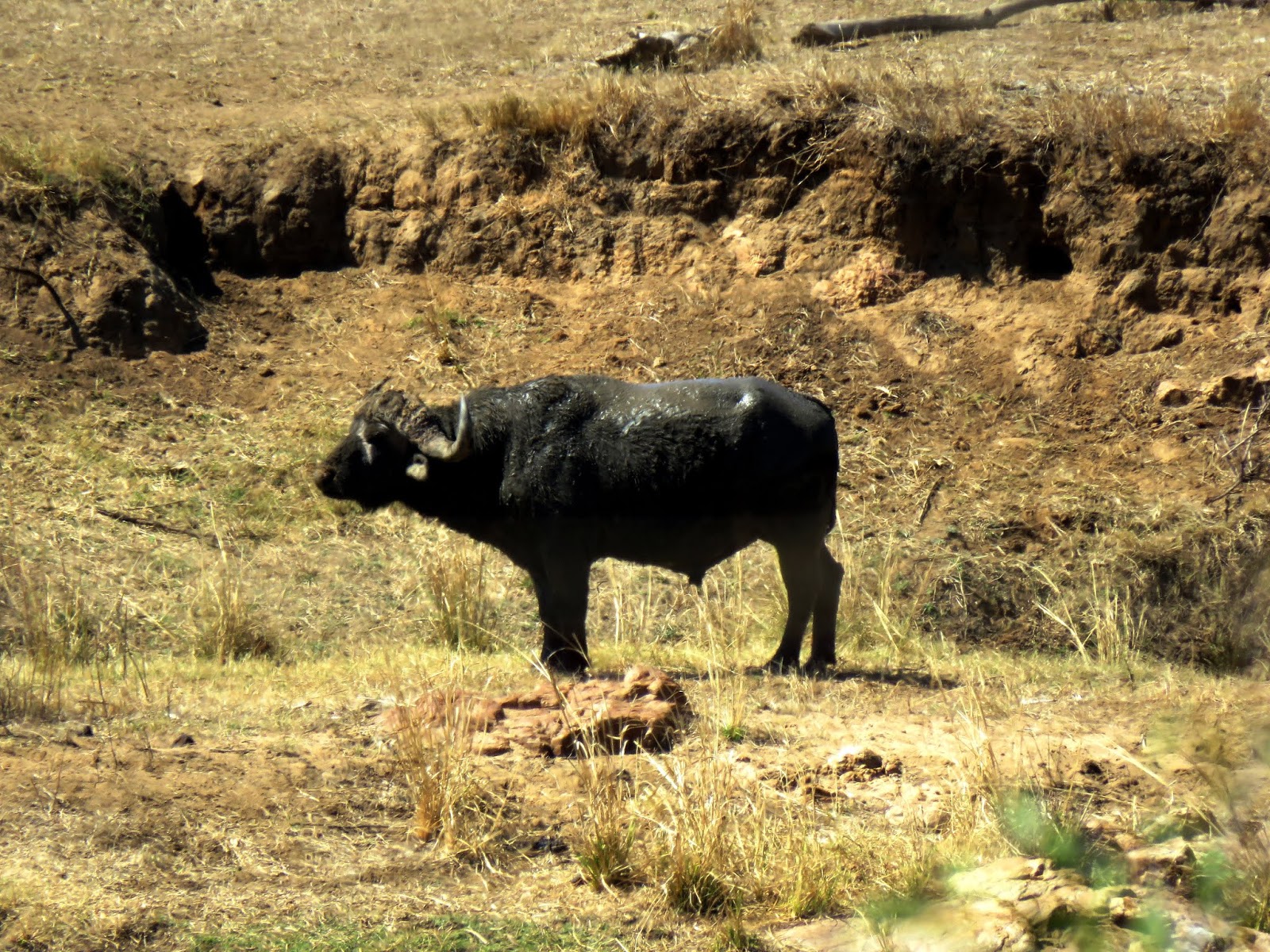
A very muddy cape buffalo.

We tried a few other markets to no avail. Pumpkin isn’t readily available in South Africa.  Why would it be?  Pumpkin pie is a US thing and it’s not as if there are lots of Americans around here, making Thanksgiving dinner.  

As a matter of fact, the only Americans we know or even talked to in the past nine months are friends Kathy and Don and long-term US residents Rita and Gerhard.

A big male lion a few days ago.

I decided to cook all the frozen pumpkin we had, measure the number of cups, figuring .41 liters (14 oz) per pie. Fortunately, I had a one-cup measure on hand and calculated I could make a total of eight pies. We needed one for each of the other couples (four pies), two to serve after the meal, and two leftovers for Tom. Whew! That part worked out.

But, what a messy operation measuring from a big plastic container filled with mashed pumpkin. Next was the making of the pies. Having no experience with tin foil pie pans, I made all the pie crusts from scratch, eight of them, one at a time, rolled the dough with a giant rolling pin Louise loaned me, and prepared each of the crusts in the tin foil pans.

I believe this is an orange-breasted bush shrike.  Please correct me if I’m wrong.

Well, let’s get back to the weather for a moment. It was a hot 40C (102F) and the pie crust dough was tricky to handle and get into each of the pie tins. Plus, the usually easy part of neatly crimping the edges of the pie crust became nearly impossible. I did the best I could.

Cape buffalo faces.

Once the crusts were prepared I lined them all on the counter and carefully and evenly filled each of the prepared pie crusts with the typically runny pumpkin pie filling I’d made. The problem was when we attempted to lift the filled pies off the countertop to put them into the oven, the flimsy pie tins caused the liquid the spill out.

Mom and baby at the river’s edge.

With Tom helping, with his frustration level as high as the temperature, he devised a transfer system where we could add extras tins to the bottom of the pies, to increase the stability of the pan.  From there, it was a slow and laborious process, I spilled several cups of the filling as a result of my usual clumsiness.

The oven cooks unevenly and without the metal crust edge protectors I usually used, the pie crust edges are uneven and overcooked in parts. But, that’s the way it is in this life, a lack of perfection but an abundance of joyfulness. Not a bad trade-off, eh?

Here are my eight less-than-perfect pumpkin pies for tonight’s Thanksgiving dinner. The pit in the bottom right is low carb with an almond flour crust for Louise and Danie. They also loaned us the collection of serving pieces which will surely come to good use tonight.

Here is the photo of my pies, less than pretty, but hopefully will taste as good as the test pie a few days ago.  We’ll be back tomorrow with more food photos from our “Thanksgiving Dinner in the Bush.”

Here is the giant rolling pin I borrowed from Louise and Danie, previously used for rolling pizza crusts. It’s weighted and very heavy, ideal for rolling pie crusts.  Also, in this photo are the takeaway containers Dawn and Leon provided, who’ll join us tonight, from Jabula Lodge & Restaurant where we had another fantastic dinner last night.

Have a fabulous weekend!

Photo from one year ago today, November 17, 2017:

Tom Lyman, you never cease to amaze me!  What a shot of the classic “Froot Loops” cereal (per Tom) Toucan, technically known as the Rainbow-billed Toucan, aka the Keel-billed Toucan (different than the Toucan in our previous post with the Fiery-billed Aracari Toucan as shown here) taken in our yard in Atenas, Costa Rica. For more photos, please click here.

Preparing for the upcoming Thanksgiving dinner…A black mamba story unfolds…

 Here’s our previously shown video from the snake-handling school 
we attended last March.
“Sighting of the Day in the Bush”
Our resident monitor lizard came out of his hovel for a drink from the cement pond.

Today is a hectic day. I started making the eight pumpkin pies early this morning, and as I write, we’re just about ready to put the first few in the oven. The oven only has one rack, so I won’t be able to bake more than two or three pies at a time.

I made one low-carb pie for Danie and Louise, who generally follow the banting (low-carb) way of eating, as do many South Africans for various health reasons.  I didn’t make a low-carb pie for me. This time I will pass on a pie for myself based on the fact I’m still trying to lose the last few pounds on my diet and pumpkin pie. Oh my, I could eat an entire pie in a day. But, not these days.
 
There are many other items to prepare today, with the balance to be completed tomorrow. Although easy to prepare with recipes in my head, Thanksgiving dinner requires a tremendous amount of time to prepare.  

Also, Dawn and Leon (owners of Jabula Lodge & Restaurant) are coming for dinner and bringing “take-away” containers to provide all of our guests with containers of leftovers for the next day along with their own pumpkin pie, another one of our traditions.  Everyone always enjoys leftover Thanksgiving dishes!

Unfortunately, we couldn’t find a turkey anywhere in this area.  Instead, we’re making one roasted stuffed chicken for each couple to enjoy as they’d like during the meal, taking home the remainder along with side dishes and their full-sized pumpkin pie.

Although there will only be 10 of us dining tomorrow evening, I’m making enough for the equivalent of 20 people. Then again, many of us Americans have made the festive meal for 20 or more people.

It would be a lot easier cooking today and tomorrow if it weren’t so hot.  Temperatures are expected to be a high of 38C (101F) or more, including tomorrow.  With no AC in the kitchen area and having the oven on most of the day, it will surely be one hot, sweaty day.
In March, Chris, the snake-handling trainer, held this black mamba while Tom looked o at the snake-handling school.  For that post, please click here.

But I’m not complaining. This is a great group of people, and we’re delighted to make this special traditional US meal which is actually celebrated in the US next Thursday, November 22.

We’d planned this date quite a while ago when we anticipated it might actually be the traditional “good-bye” party. One way or another, we’re hoping to stay until our scheduled flight to Kenya on February 20th if all goes well. No word so far.

OK, enough about cooking. On to our story about a black mamba that Louise shared with us a few days ago. As for today’s photos (except for the “Sighting of the Day in the Bush” photo, we’d previously posted them in March.

However, based on today’s black mamba story and my shortage of time, we thought we’d repost these few previously shown photos and the links for these specific posts.

We’ve frequently mentioned our new friends, Rita and Gerhard, with whom we’ve been spending a lot of quality time. World travelers themselves, we find we have so much in common, and we continually share our varied and interesting travel stories and more.

On Monday, this week, they left for a two-week visit to Germany to attend Gerhard’s brother’s 60th birthday party. They’ll be returning before the end of this month.

Tom was handling a black mamba and did an excellent job, although he’s not certain he’d want to do this in a real-life situation.

As mentioned in an earlier post, they’ve been living in the same house we rented when we first came to Marloth Park in December 2013, the house on Hornbill St., the house where a Mozambique spitting cobra fell from the ceiling of the veranda and landed within a few feet of Tom.  

He’s always classified that experience as the scariest of his life. If you’d like to read that post, please click here for the photos of the venomous snake and the story of what transpired on that fateful and memorable day.  

On Sunday, the day before their departure, Rita and Gerhard heard a plop on the floor of the veranda as we had on that fateful day in January 2014,  when they were sitting outside, as they do all day too, like us, waiting for wildlife to stop by. This time the “plop” was a mouse perhaps being caught by the snake.

Although a black mamba doesn’t look scary, a single bite can result in death within an hour if not treated.

Rita and Gerhard were sitting on the veranda at that same Hornbill house where we’d lived, quietly enjoying the bush while reading, sipping cold beverages, without a care in the world.

Suddenly, they saw the snake, a black mamba. Louise had given them a sheet with photos of various snakes in the event they’d have to identify one. Here was their opportunity. They grabbed the sheet and were certain it was the outrageously venomous black mamba.


Rita couldn’t resist taking photos until the snake disappeared near the chimney as I had done years ago. What would be the point of calling the rangers if the snake was nowhere to be found? They went about their day with a watchful eye, knowing they were leaving the next morning for Germany.  

A video that Rita and Gerhard took of black mamba on the veranda.


On Tuesday, determined to get the darned thing out of that house, Louise contacted snake handler, Jaun (20 something), who’d attended snake school with us. He’s very active in the park, conducting many services as an Honorary Ranger and all-around caring and good guy.

On Tuesday, he and Louise sat on the veranda waiting for the snake to appear so Jaun would capture it to return it to the wild. By a stroke of luck, after only a 10-minute wait, the black mamba made an appearance.

It was only 15 minutes later than Juan had captured the snake with his trusty snake grabber and expert skill and placed it safely in a bucket with a lid. The intent in capturing snakes is always to return them to the wild where they belong. Mission accomplished, thanks to Louise‘s boundless determination and Juan’s excellent skills.

It sounded as if Rita and Gerhard stayed calm and under control when they spotted the snake, which is vital to avoid agitating it, resulting in an attack. Black mambas can be very aggressive if provoked.

For residents of Marloth Park, here is Juan’s contact information.

So, there’s the snake story. Most likely, we won’t see too many snakes in this house.  Snakes generally don’t care to climb stairs up to a veranda when there’s plenty of fodder for them on ground level. But, we always keep an eye out now that snake season has arrived with the warmer weather, especially at night when out and about.

We’d mentioned in yesterday’s post that we’d share the costs for the dentist and eye doctor appointments, but we don’t have the final figures yet since Tom will choose his new eyeglasses next Thursday. The optometrist didn’t have the style Tom prefer, but he’ll be bringing several pairs from his other distant location for Tom to try. Next Friday, we’ll update this information.

Tonight, hot as it is and as busy as we’ve been, we’re heading to Jabula Lodge & Restaurant for dinner and relaxation. Tomorrow will be another busy day, but we’ll still be back with more.


Photo from one year ago today, November 16, 2017:

Once again, Tom captured another fabulous bird from the veranda in Costa Rica while I was busy indoors making dinner. This Yellow-tailed Oriole, although at quite a distance, was a treasure to behold. For more photos, please click here.

A dreamy drive in the neighborhood…Teeth and eyes…

Mr. & Mrs. Ostrich trotting down the road.  Moments later they took off on a fast run into the bush.  Ostriches can run up to 70 km (45 miles) per hour.

“Sighting of the Day in the Bush”

Tom found this small gecko in the guest bathroom.  We didn’t have a strainer so I fished it out with my hand where it promptly jumped to the floor and took off.  We often see geckos in the house.  They eat insects. 

Today, we’re off to the dentist to have our teeth cleaned followed by eye exams by the local optometrist.  Neither of us has had an eye exam in the past six years since we began traveling.  

Afterward, we’re returning to Spar for a few grocery items to fill in the blanks for Saturday’s Thanksgiving dinner party.  Once back at the house, I’ll begin preparing the pie crusts for the eight pumpkin pies I’ll be making.  

An ostrich in front of the house where we always find them.

Why make so many pies?  In our old lives, it was our tradition to give each couple who came for Thanksgiving dinner a pie to take home.  It’s fun to relive this tradition here in the bush.

A pair of giraffes, each munching on opposite sides of the road.

I’d started today’s post before we left for our two appointments each and additional grocery shopping.  We just returned and I’m rushing to get today’s post uploaded so late in the day.

“In the wild, giraffes almost never lie down because of vulnerability to predators. They usually sleep standing, sometimes sitting, and they give birth standing up. When giraffes sleep, they curl their necks and sleep for about five minutes at a time, sleeping no more than 30 minutes a day.”

We had such a great experience at our two appointments we’ll be sharing details in tomorrow’s post.  The costs for services and products in South Africa are astoundingly lower than what we’d paid in the US.  We’ll post details tomorrow.

The photos we’re posting today are a result of yesterday’s drive in Marloth Park.  With fewer holidaymakers in the park right now, we anticipated we’d see plenty of wildlife and we were right. 

This giraffe was sitting a short distance from the other giraffe as shown in the above photo.

Before we reached our favorite river viewing overlook areas we were lucky to encounter many of the animals shown in today’s photos except the waterbuck (take at the river) and the few photos from our garden.

This baby zebra was so young its coat still looked fluffy and wrinkly.

Generally, our almost daily drives last about two hours.  With the upcoming busy dinner party, we knew we wouldn’t have time to make the drive over the next several days. Yesterday, we took our time, enjoying every sighting along the way.

Taking our time, we chat along the way as we peruse street after street searching for something unique or even slightly out of the ordinary. Seeing giraffes lying down isn’t necessarily the most unusual sighting in nature but we were taken by the beauty of these two magnificent animals at rest.

“The waterbuck’s body odor is so bad that it deters predators.”  A male can weigh up to 260 kg (573 pounds).

Although we frequently see ostriches, we’re always in awe of the way they walk with their heads held high and their confident and prideful demeanor. We often wonder how Mother Nature (or God or whatever higher power you may believe) created this magnificent earth would have decided ostriches held a significant purpose in the ecosystem.

Mom and baby bushbuck by the pond and another baby standing in the garden.  Bushbucks only have one offspring per season.

Somehow each creature, whether venomous or not, whether seemingly useful or not or, if merely food in the food chain, holds a meaningful purpose in their lives, the lives of others, and ultimately in our lives.

For that very reason, is what inspired me to stick my hand into the toilet bowl to rescue the gecko and let her be free.  After a few minutes of vigorous hand washing, I was content to have saved the life of even one of the most common creatures in this land.

This young bushbuck always stays very close to her mom while others we’ve seen will wander off but not too far away.

Also, tomorrow we’ll share an exciting story about a black mamba snake, one of the most venomous snakes on the African continent.  Please check back.

Enjoy your day and evening!

______________________________________


Photo from one year ago today, November 15, 2017:

Three in one…Green Parrots…Tom’s photo.  Love it!  For more photos please click here.

Tender moment in the morning…Plus, the harsh realities of the bush…

This morning Tom noticed Ms. Bushbuck climbing the steps to the veranda.

“Sighting of the Day in the Bush”

Amaryllis blooming in the garden. With summer approaching and hopefully more rain, we’ll see more flowers blooming in Marloth Park.

A week ago a resident of Marloth Park posted a comment about Scar Face, the injured warthog we’d been watching and feeding for several months. He was stopping by each day for pellets and to drink from the cement pond.

We found it worthwhile to feed her on the steps after she’d climbed up since the other animals won’t be able to chase her away while she eats pellets. Her idea, not ours.

After we left and returned from Zambia in August, we never saw him again. We’d become attached to him and were fearful he may have been “put down” by the rangers or died from infections due to his injuries.

This morning, Tom stood next to Ms. Bushbuck to prevent kudus from stealing her share of pellets.

As much as we’d all like to believe the animals become “attached to us,” and will always return to see us, in reality, that’s not always the case. Often, in their world, finding food is their number one purpose in life (along with procreating), especially during this long dry season.

While we were gone for a week Scar Face may have decided to pursue another area in the bush and become comfortable finding available food sources, never returning to us.

Kudus were staring at Tom hoping for more pellets.  He’d already given them several of the yellow containers filled with pellets.

When the resident posted his photo and comments, we were relieved to discover that he, in fact, had survived his massive injury and was still thriving in the bush. The fact that we couldn’t see him become less important in discovering he was still alive.

A pretty girl kudu with an oxpecker looking for more pellets.

We’re hoping for the same outcome for Wounded who visits frequently with his horrific injury to his eye and eye socket. Most likely this injury was incurred in the past week or two as the wound appears relatively fresh.

A face like this is hard to resist.

This morning when he stopped by we immediately fed him all the pellets he could eat, one little yellow container at a time. After all, he is a pig and he needs to pace himself. He is very shy although he’ll approach the veranda letting us know exactly what he needs. He’s impossible to resist. 

This morning Wounded appeared in the garden looking for food.

We may never see Scar Face again or perhaps in our (hopefully) remaining three months in Marloth Park, we may see him again someday. Know these injured animals often possess the strength and resilience to heal themselves is comforting.

It appears he may have lost his left eye in the battle.  Heartbreaking.

Yes, some injured animals in Marloth Park “qualify” to be rescued and healed for example by Wild & Free Rehabilitation who may be found at this link. The costs for such medical care are managed through donations through the facility.  

While we were watching him, an oxpecker appeared and started pecking at his wound.

However, some animals, such as warthogs and impalas, don’t necessarily fall into the category of endangered status or are in reduced numbers in Marloth Park. Sadly, when they are ill or injured they’re on their own.

After the oxpecker pecked at his wound, it started to bleed.

As we roll further into the week, I’ve begun carefully planning details for our upcoming Thanksgiving dinner party on Saturday. It’s one of those types of meals that not much can be prepared more than a day in advance.

Sadly, there is nothing that can be done.  It’s evident he’s been working on it by using mud to hopefully aid in the healing.  

At this point, I’ve begun working on cooking and processing the frozen pumpkin into the equivalent of canned pumpkin. This is a slow process but by the end of today, I’ll have it all done. We plan to make 10 pies, one per couple to take home, a few for dessert on Saturday and a few to have left for Tom.

I believe this is an invasive alien plant.

If time allows, I may make a few low-carb pumpkin pies as well. But, there’s plenty to do with our extensive menu which we’ll post on the day of the event. Tomorrow morning we each have dental and eye exam appointments, after which we’ll head back to Spar to wrap up the final shopping for a few items we still need for Saturday.

We’ll be back tomorrow with more. Please check back!

Photo from one year ago today, November 14, 2017:

A curious turtle scurried quickly toward us in Costa Rica. For more photos, please click here.

Utility outages…The return of visitors to the garden…More stunning river sightings…

This is “Little” (short for “Little Wart Face”).  He visits almost daily. That’s why he has grass all over his snout. He likes to cool off in the cement pond, sleep under the shade of a tree in our garden and climb the veranda steps seeking pellets. What a guy! He’d just returned from eating from the bale of hay left in the neighbor’s driveway when they departed after the weekend.

“Sighting of the Day in the Bush”

Mr. Frog has been enjoying an array of insects most nights which are attracted to the light.  He appears to be getting rather plump.

Yesterday afternoon, a water main broke close to Gate 2 in Marloth Park.  Subsequently, we had no water for about 12 hours. Service returned in the middle of the night.

This morning we had a power outage, but fortunately, it only lasted about 10 minutes. When the power goes out, the wi-fi also goes out. As always, we shut down our laptops and phones, hoping for a return to service before too long.

We were so busy feeding the visitors last night, and we hardly had time to make our dinner. We couldn’t stop smiling.

When the power returned, we were relieved. I hope neither of these is an issue with our upcoming dinner party in four days. It would be difficult to cook a big meal without water or power.

Yesterday, we read a post on Facebook by a homeowner that an area of Marloth Park was without water last December for 21 days. That would certainly be inconvenient.  

Often warthogs from different “sounders” get into a scuffle over the pellets.

Last night we used a bucket of water from the swimming pool to flush the toilet. This would get old after a day or two. Of course, the worst part would be when unable to take a shower. It’s not as if there’s a local health club where one could go to take a shower.

After all, we’re in the bush in Africa, and things aren’t the same as in many countries throughout the world. And, although there are several adaptations one must make, coming from other countries, it isn’t really that rough.

There were one male and three female zebras in this “dazzle.”

Last night while brushing my teeth, a large black bug fell off my head when I bent down to rinse my mouth (using bottled water, as always). I didn’t scream or flinch. I gently picked it up with a tissue and took it outside to deposit it into the garden.  Years ago, I would have called Tom to help and did a bit of screaming.  No longer.

A young Big Daddy attempting to eat some greenery inside the fenced area in the garden.

It must have fallen into my hair while we sat outdoors last night reveling in the numbers of wildlife that came to call. It wasn’t as if we had more than a dozen at any given time but more so that they kept coming and coming, hour after hour.

Recently, I ran into local friend Gail at the market, and we giggled over how we never tire of the wildlife. If anything, as time goes on, we become more and more interested in them, as we learn about them, and as time goes by, we learn more about the nuances of certain animals.

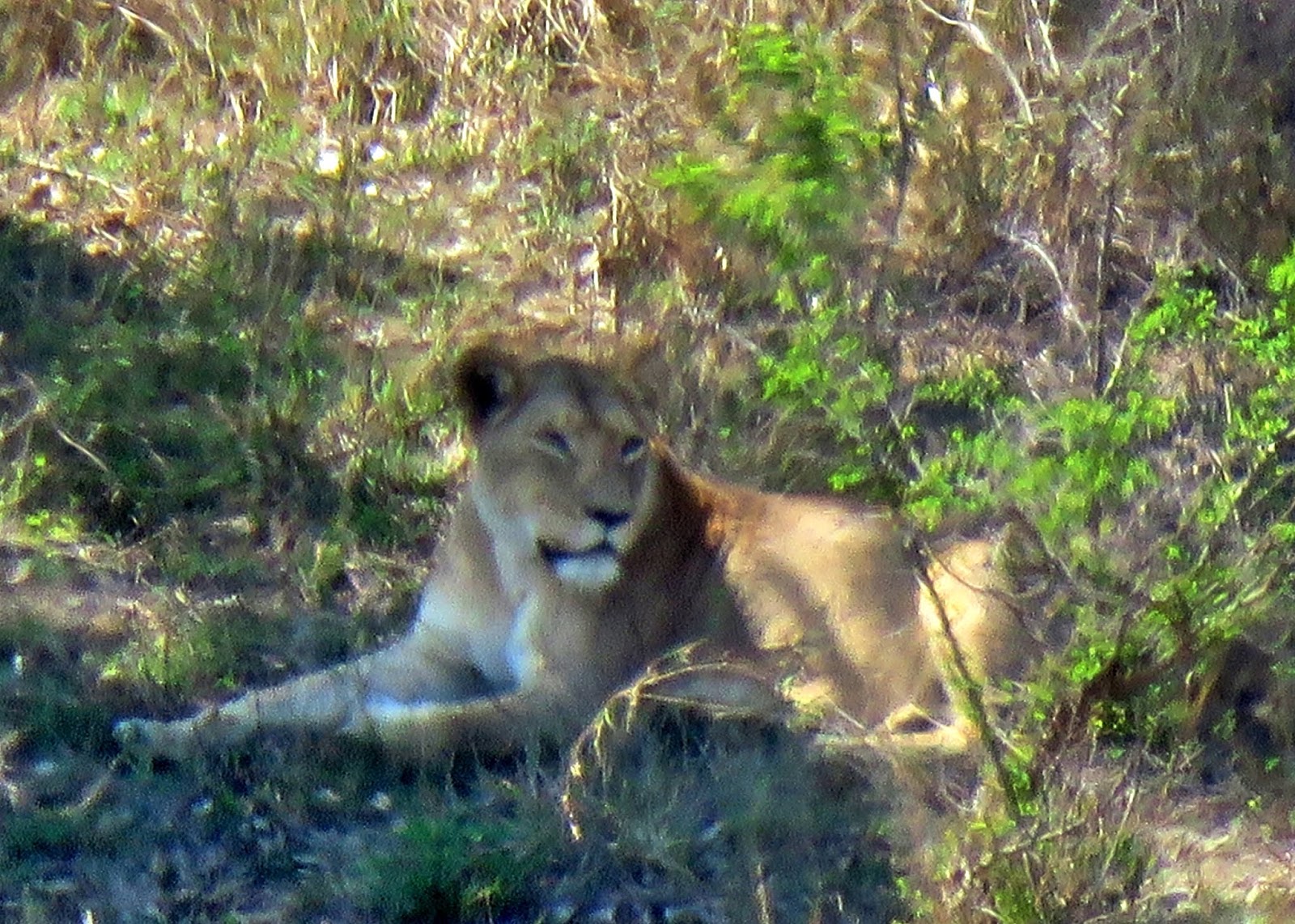
With just the two of us at Two Trees, Tom spotted this female lion.

As shown above, in our main photo, coming to know the peculiarities and habits of certain visitors only adds to the pleasure and significance of seeing them time after time.

Most days, we see at least one animal that is new to us. Over this past nine months, we’ve been able to identify frequent visitors by certain markings, size of tusks, horns, and variations in stripe patterns. It’s now become easy for us to realize someone is new to us.

She may have been perusing the area for her next meal.

We welcome them all, familiar and new, with open arms to partake of our seemingly endless supply of pellets, carrots, apples, and pears, all suitable foods for them.

A large bull elephant on the river bank.  Check out those tusks!

Today, after friend Kathy stops by and drops off some much-needed ingredients she picked up in the big city for the upcoming Thanksgiving dinner party on Saturday (thank you, Kathy!), we’ll head out for our usual drive in the park to see what wonders Mother Nature may have in store for us.

It will be another good day in the neighborhood! I hope you all experience the same!

Photo from one year ago today, November 13, 2017:

Another of Tom’s excellent bird photos, two Green Parrots admiring each other. For more photos, please click here.

What???…A leopard sighting on the Crocodile River?…Giraffes stopping for a drink…

Giraffes are constantly on guard for predators, especially when it’s time to drink when they become vulnerable in a bending position.

“Sighting of the Day in the Bush”

The convoluted photo is difficult to decipher at first.  Note the one kudu attempting to eat the seeds in the birdfeeder, which she eventually accomplished.

While Tom was taking a short nap while I stayed at the table on the veranda finishing the daily post, I took a peek at the Marloth Park River Sightings page on Facebook to see if anyone had posted information regarding exciting sightings.

Alas, a frequent FB poster mentioned a leopard had been sighted 90 minutes earlier at the end of Swartwitpens, where it meets the river road. Such a sighting may result in disappointment if too much time has passed and the animal has moved on.

Giraffes often head to the river to drink.

I deliberated if I should awaken Tom, but he never sleeps more than 20 minutes, so I waited until he exited the bedroom to mention the sighting. Within two minutes, we were in the little car and on our way.

Once we arrived at the location, we noticed only one other car, which could indicate the leopard was gone from view. Fortunately, we met a lovely couple from Nelspruit who lives part-time in Marloth Park, Estelle, and Johan.  

We’d never have been able to spot the leopard without their help. It’s funny how people try to explain where to look to spot the animal of interest at the moment.  

Giraffes adopt a variety of stances to gain access to the water.

Nature has provided the ideal camouflage for wildlife, often making it nearly impossible to see certain animals lying under trees or bushes from the distant fence at Marloth Park across to the opposite side of the Crocodile River.

Rarely, when there is any sighting, friendly observers often assist others in finding the animal’s location. It goes like this, “See the two green trees over there with a dry bush between them? The lion is lying at the base of the tree on the left.” This is usually what seems to be an accurate description.

There were four giraffes in this tower.

However, there are dozens of green trees and dry bushes across the river, and even if one points in the correct direction carefully, the animal is often challenging to see.

Both Tom and I have noticed a difference in the way men describe where the animal is located instead of women. When Tom and Lois were here, my Tom would provide a lengthy description explaining where the lion was found.  

On the other hand, when Lois described it, she did so with few words, and often, I was more easily able to comprehend the few words as opposed to the lengthy, detailed description.  

They were stopping to check their surroundings.

We’ve noticed this phenomenon on other occasions when asking for assistance; regardless of what many people want to believe about the sexes thinking alike, it’s natural for women and men to have different perceptions and responses.


We see this in nature by the erratic behaviors of female and male animals that stop by.  For example, the male bushbucks are shy and constantly on guard, whereby the females easily approach us without hesitation.

A lone hippo grazing by the river.

The male kudus with their big horns are bossy and determined, whereby the females are more docile and quick to approach us. I could go on and on regarding the erratic behaviors of the sexes of wildlife after we’ve spent the past nine months observing them every day.

It’s always a challenge, regardless of who is describing where the animal is located, to find it, focus the camera for such a long distance resulting in a good photo.

Yesterday, at the river, I couldn’t spot the leopard, but Tom did so in minutes after Johan described the location to him in several paragraphs. I was stymied.  Nonetheless, Tom was able to take the two very distant photos we’re sharing here today.  

Only the spots confirmed this was a leopard lounging under a tree a long distance from the fence between Marloth Park and Kruger.

We’re disappointed in the lack of clarity in the photo, but this leopard may easily have been a good kilometer from us. Our skill nor our cameras were capable of obtaining better shots.

The more explicit photos we’ve seen on Facebook of yesterday’s leopard sighting were acquired with long-range lenses, which are too heavy and we’ll never be able to carry throughout the world with us.  

We waited patiently while chatting with a lovely couple we met at the fence, Johan and Estelle, who said they’ve been reading our site.

It’s one thing to have such a camera set up at home and use it now and then for special shots.  It’s another thing to have the heavy beast everywhere we go…totally impractical.

This morning we headed to Komatipoort to shop for Saturday’s upcoming Thanksgiving dinner party.  On the way to Spar, we stopped for breakfast at Stoep Cafe for another fine breakfast and idle chatter.

Now back at the house, everything is put away, and we almost have everything we’ll need.  On Thursday, we’ll return to complete the shopping balance after our teeth cleaning and eye doctor appointments.

Have a spectacular day!

Photo from one year ago today, November 12, 2017:

Tom took another excellent distant shot of a bird we couldn’t identify online. Costa Rica neighbor and bird enthusiast Charlie identified this bird as a Clay-colored Thrush or Yigüirro in Spanish.  For more photos, please click here.

Our social life continues…A friendly visitor in the restaurant…Nature can be both heartwarming and heartbreaking at the same time…

Tom at sunset as we dined with Rita and Gerhard at Ngwenya on buffet night. Rita took this great photo so indicative of the peaceful and views from this excellent location.

“Sighting of the Day in the Bush”

Rita and I were captivated by a visitor who entered the restaurant, a friendly little dung beetle. We both held him and felt the ticklish feel of his spiny legs moving rapidly in our hands.

Last night, Rita and Gerhard picked us up at 1630 hrs (4:30 pm) for sundowners on the veranda at Ngwenya overlooking the Crocodile River to be followed by the buffet dinner inside the restaurant after darkness fell.

We’ve so enjoyed spending time with new friends Rita and Gerhard who came to Marloth Park after reading our posts years ago. Through our site, they found the holiday home they’ve rented and also found Louise to help them get situated.  They’ll be here in Marloth until February. Hopefully, we’ll be here as well for more fun times together.

We have a lot in common with this lovely couple and the conversation flowed with ease, animation, and enthusiasm.  They, too, have traveled all over the world and have great stories to tell. Our mutual love of nature and wildlife precipitates an endless flow of interesting conversation.

From quite a distance Tom spotted this elephant with an obvious problem with his left tusk.

This Sunday friends Kathy and Don return to Marloth Park and more social activities will ensue over these next few weeks. Next Saturday is our Thanksgiving dinner celebration here at the orange house.

It was apparent this elephant’s left tusk has been damaged affecting the muscles, ligaments, and tendons that hold it in place. We hoped he wasn’t in pain.

Today, I’m working on making the equivalent of canned pumpkin using lumpy frozen pumpkin. I’ve processed the first two bags and I think it’s going to work well. 

Another view of the elephant with a damaged tusk.

As soon as I upload today’s post, I’ll prepare the homemade pumpkin pie spices using multiple spices. There’s certainly no prepared pumpkin pie spice to be found anywhere in South Africa or even on the continent. It’s a USA thing used for a specific USA holiday.  

From there, I’ll make the from-scratch pie crust, a favorite recipe from Martha Stewart, the best pie crust in the land.  If you’d like the recipe, please click here.  It’s a little time-consuming but worth the extra effort.  

A black-winged stilt we spotted at Sunset Dam in Kruger.

For the first time in seven years, I purchased a bag of white flour and another bag of sugar. I won’t be even tasting the pie so Tom will be on his own to determine if this pie will be worthy of making in number for our guests arriving for dinner on the 17th.

Tonight, Tom will dine on marinated pork chops on the braai while I have salmon steaks, along with roasted vegetables, mashed cauliflower, and salad. And then, for dessert (a rare treat in this household) Tom will have a piece of the pumpkin pie.  He doesn’t care for Cool Whip (which isn’t available here) or whipped cream atop his pie. Plain and simple, that’s how my guy likes it.

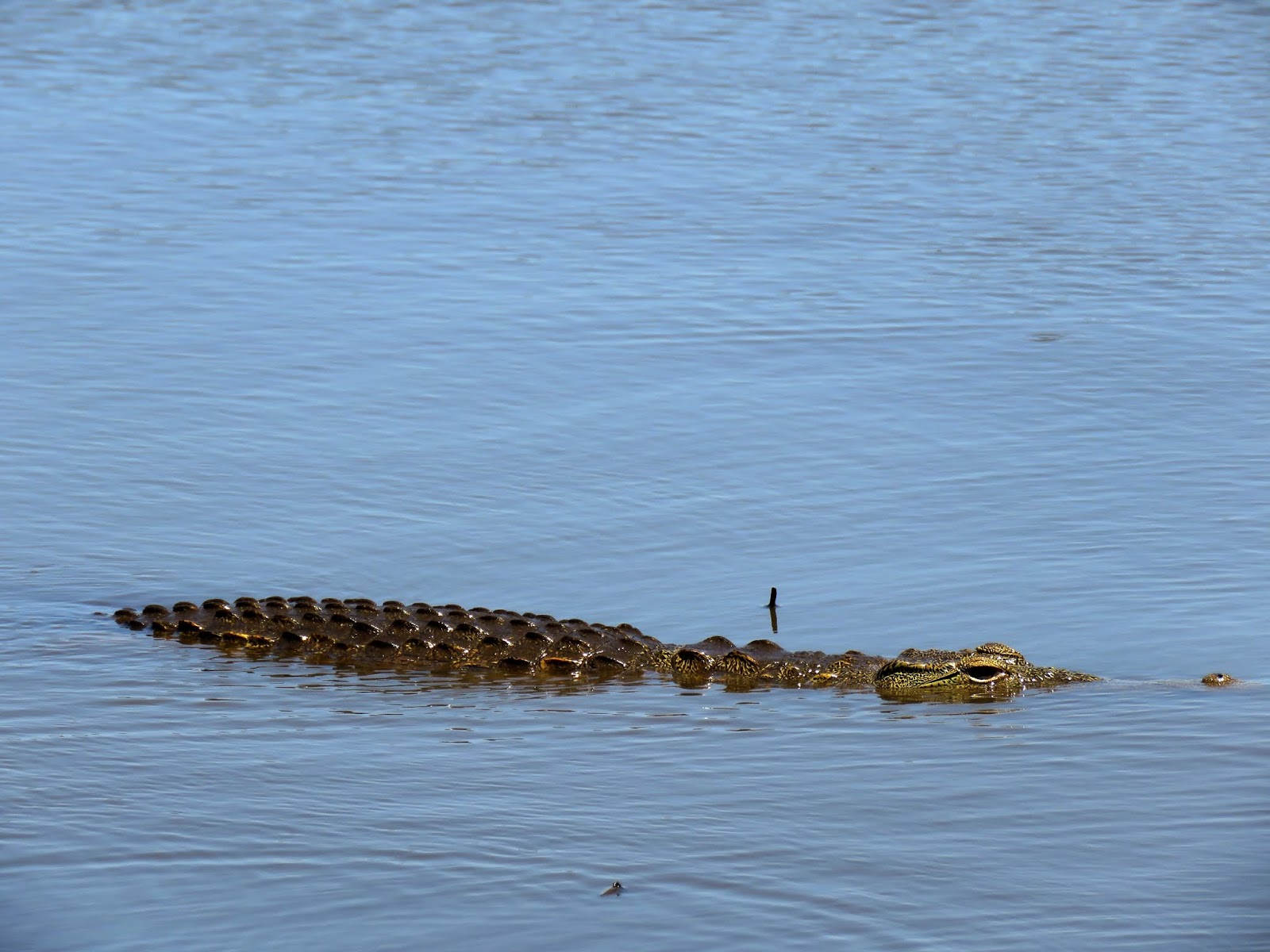
A crocodile made an appearance to check out his surroundings and possible food sources.

Back to last night, after our fine buffet dinner, a “visitor” walked into the main door of the restaurant, my favorite “bug” of all time, the fascinating dung beetle.  

He didn’t have his ball of dung with him or had yet to prepare it but as summer approaches, we’ll surely find plenty of these interesting creatures with their ball of dung in tow. More on that later when we see one with his perfectly shaped ball and perhaps a wife running atop it as he pushes it along with his bag legs.

While I was indoors preparing dinner, Tom called me to hurry and come outside. He’d taken these photos of Wounded with an oxpecker “working on” the severe injury near his left eye.

Rita and I held him in our hands. I was so excited I could hardly hold the camera straight to take a decent photo. That happens to me sometimes…my enthusiasm supersedes my ability to hold the camera steady.  

As I always say, I’m not a professional photographer. I’m an enthusiastic photographer which sometimes results in my emotions getting in the way of the perfect shot.

Here again, is another example of the symbiosis between certain animals. The oxpecker eats the maggots and decaying debris from his injury while he cooperates with the intrusion.

Also, included today are several photos took of our new friend and now frequent visitor “Wounded” who showed up about a week ago and now visits every day. His obvious facial injury is heartbreaking but he wastes no time eating plenty of pellets and vegetables.

Wounded is very shy around other warthogs so we imagine he may have been wounded by another warthog in a fight for dominance or food. We make a point of fussing over him whenever he arrives, hoping in time his injury will heal. It’s too soon to tell if he was blinded in his eye from the injury.

Nature can be both heartwarming and heartbreaking at the same time.

What astounded us about yesterday’s visit by Wounded was when he walked into the garden he had an oxpecker, as shown in the photos, working on “cleaning out his wound.”  

The oxpecker may or may not be helpful when they may become too aggressive in clearing an injury from maggots or other insects, only making matters worse. We can only hope Wounded starts to heal at some point soon. Such a grievous injury can result in a long and painful death.

Three giraffes stopping for a drink in the river.

Today is a warm sunny day, not too cool, not too hot. It’s comparable to what one may experience on a tropical island.  But, the bush is no tropical island.  And life happens for these creatures as shown in the above photo of an elephant with an injured tusk. There’s nothing we can do but let nature take its course.

So for today, we’ll let nature take its course as we’re delighting in a number of visitors stopping by on this perfect day. The pellets and veg are plentiful as is our enthusiasm in sharing it all.

Happy day!

Photo from one year ago today, November 9, 2017:

A fiery-billed acara in Costa Rica says, “I’ve got mine!” For more photos, please click here.

Kruger never disappoints…It isn’t always about the Big Five or even the Ridiculous Nine…All of it is special to us!…

A pair of elephants affectionately playing in the mud and water at Sunset Dam 
in Kruger National Park.

“Sighting of the Day in the Bush”

A pair of barn owls in the rafters at Mugg & Bean restaurant looking down at all the crazy humans trying to take a photo.

Early this morning, we took off for the river when we’d seen lions had been spotted a few hours earlier. We must have missed them when we arrived at least two hours after Tom had seen the Facebook announcement indicating where they could be found.

A Southern Ground Hornbill in the bush.

But, as always, our trip to the Crocodile River, a 10-minute drive on the bumpy dirt roads, wasn’t a bust. We saw so much more, which we’ll share in days to come.

This appears to be a mating pair of vultures tending to their nest.

Afterward, we made a quick trip to the Marlothi shopping center for a few items, and by 11:30 am, we were back home. The boys had come to clean while we were gone, and the house was spotless and even smelled so.  

A hippo near the shore of the Sabie River.

The constant dust was wafting indoors from the garden when “visitors” come to call leaves every surface covered in dust daily. It takes considerable attention to detail to keep the level of dust indoors to a minimum, and Zef and Vusi are masterful at this.

A hippo and an oxpecker.

Before we left this morning, I’d gone through the hundreds of photos I’d taken in Kruger yesterday, narrowing them down to a possible good 50 shots, many of which we’ll share over the next several days along with others we’ve taken at the fence and of course, in the garden.

A giraffe side-face view.  The hair atop the ossicones indicates this is most likely a female.  Males wear off the hair due to fighting for dominance.

Last night, after holidaymakers left the park, all of our favorite animals returned to see us beginning at about 1700 hrs (5:00 pm). We were so busy with them we hardly had time to get our dinner and beverages ready for the evening ahead.

A giraffe was contemplating a drink.

At one point, we counted eight species in the garden simultaneously: kudus, bushbucks, wildebeest, warthog, duikers, mongoose, helmeted guinea fowl, and bushbabies. We hardly stopped for a moment when finally, we managed to get dinner on the table a few hours later. We couldn’t stop smiling.

A little bird was going after a breadcrumb at the Mugg & Bean restaurant in Lower Sabie, where we had lunch.

As for yesterday’s visit to Kruger, although not earth-shattering, we were content with our varied sightings as shown in today’s and future day’s photos. When we don’t readily spot all the animals considered as the Big Five (lion, leopard, rhino, Cape buffalo, and elephant), we tend to focus our attention on those we do find.

This couple fed the starlings based on how they gathered at their table, staring at them for more.

Yesterday was undoubtedly a busy elephant and hippo day, as evidenced in our photos and included video. We know many of our readers don’t care to watch videos, but we invite you to do so.  

Elephant families on the Sabie River.

We don’t post our videos unless we find something special contained therein. Of course, that’s based on our personal opinion, which may not necessarily appeal to you. Typically, they are only one to three minutes long.

A mom and two offspring from different birth years.

We drove through Kruger on our preferred route, where we’d enjoyed considerable success. But, the sightings weren’t as prevalent along the paved road as we’ve seen in the past.  

It was a hot but gorgeous day, perfect for spotting elephants on the river.

The paved road leads to the Lower Sabie and the Mugg and Bean, where we stopped for lunch to see once again its expansive river views from the restaurant’s veranda.

The little one was enjoying the water too.

As mentioned in an earlier post, recently, I’d accidentally broken a bottle of red wine on one of our two cameras. The SD card was destroyed but ultimately not the camera itself after letting it dry out for a week.

The young elephant was playing in the water.

I hadn’t been able to find another SD card in Komatipoort and didn’t want to wait until we returned to Nelspruit to the immigration office in the next few weeks. I thought the gift shop at the Mugg & Bean might carry them.

They did much to my delight, and I was able to purchase a 16 gig card for ZAR 220 (US $15.43), a reasonable price for such a card. When we returned to the house, I placed the card in the camera, and all is working well.  

Mom elephant fussing over her youngsters.

We’re both relieved that once again, we have two working cameras, especially needed for our upcoming photography tour in Kenya in about three and a half months. I guess I won’t spill red wine on a camera again.

Anyway, the day in Kruger continued with some excellent sightings, some of which we’re sharing here today.  As for the rest of today, we’re hanging out at the house. We’ve had a relatively steady stream of frequent visitors, which we expect to pick up in about four hours for another spectacular evening in the bush!

May your day and evening be spectacular as well!

Photo from one year ago today, November 6, 2017:

We wrote one year ago…”Today’s flowers from the grounds of La Perla in Atenas Costa Rica are a token of our sorrowful expression for the loss of life and injury of the victims in the Texas mass shooting.” For more, please click here.

The Cape Buffalo…Interesting river sightings of this mystical beasts…we’re off to Kruger this morning…

 Check out our video of a large obstinacy of cape buffalo we spotted on the Crocodile River.

“Sighting of the Day in the Bush”

This is the youngest giraffe in Marloth Park from what we’ve seen recently. Check out those knobby knees that will eventually result in some very long legs.

We’re rushing to get today’s post uploaded. Today is a warm sunny day, and we’re heading to Kruger as soon as we complete the post. We have great leftovers for dinner and won’t need to be concerned as to when we return.  

A few days ago, we spotted this excellent size herd of buffalos.

A leisurely drive in the park without time constraints makes the experience all the more exciting. When we spot a scene that piques our interest, we can wait as long as we’d like for the perfect opportunity for good photos.

It was a dark and cloudy day, cool for the buffalos as they gathered by the Crocodile River.

Last night, we had the fewest numbers of visitors than we’d had in a long time. We’re attributing it to being Sunday with many holidaymakers in the park based on the numbers of cars we’d seen on the roads over the weekend.

It usually takes a day or two for the wildlife to begin visiting us after the crowds dissipate. Generally, we see some action on Tuesday or Wednesday. With rain predicted for Wednesday, we decided going to Kruger today was our safest bet.

There were over 100 buffalos on the river at this sighting.

Today, we’re sharing several cape buffalo photos we’ve taken in the past several days. They are such fascinating and unusual animals, often thought to be slow and lazy. But this is hardly the case, as indicated in the following from Kruger’s site here:

“A large and powerful bovine, the African Buffalo reaches shoulder heights of up to 1.5 m and a mass of 750 kg. Both sexes have horns. Those of the bulls are characterized by a heavy boss and upward curved horns.

Cape buffalo, also known as African buffalo, are often seen in herds.  

Mating occurs between March and May. The gestation period is 330 days. Single calves are born between January and April, with a distinct peak in February. African Buffalo are strongly gregarious. Stable herds of up to several hundred are often observed but fragment into smaller herds in times of drought.

They are mainly preyed upon by lions. When a herd member is attacked, others will rush to its defense. Collectively several buffalo are more than capable of staving off an attack by an entire pride of lions. A wounded buffalo bull is regarded as most dangerous by hunters and is one of the reasons why this animal is included in the so-called “the big five.” This trait is the origin of many hunting adventures, myths, and legends.

They are often accompanied by cattle egrets and oxpeckers.

It is said that Buffalo looks at you as if you owe them money, and this is an appropriate description if you should ever come across them on foot in the bush. Buffalo are inherent carriers of viruses fatal to domestic stock. For this reason, disease-free Buffalo are bred explicitly in areas such as the Eastern Cape in South Africa and fetch very high prices.”

Here are “10 Wacky Facts about the Cape Buffalo” from this site:

  • Buffalos are fantastic swimmers. They will swim through deep waters to find better grazing areas.
  • We refer to them as the mafia, not only because of their strong character but because they never forgive and almost always seek revenge. They have been recorded seeking revenge on someone years after being threatened by them.
  • They are one of the most dangerous of the big five because they simply ambush their prey without giving any warning signal.
    This cape buffalo seems to have a few resident oxpeckers who control the ticks and other insects.
  • The birds you see sitting on the hide of a cape buffalo are called oxpeckers. They have a symbiotic relationship with the Cape buffalo and remove ticks/insects embedded in their skin.
  • The most experienced cows are known as pathfinders. They are responsible for taking the herd to the most beneficial area for grazing and water.
  • If you see a lone buffalo bull, it is probably a “dagga boy.” Dagga boys are older bulls who have passed their prime and have separated from their herd. They generally spend their days wallowing in the mud either alone or with other dagga boys.
    On occasion, we’ll see a buffalo alone, usually close to the river.
  • Buffalo cows have their first calves at age 4 or 5, and they become entirely reliant on their mothers, right up until a year old.
  • If a buffalo herd comes under threat from a predator, they form a circle around their young. All of the adults face outwards to hide the vulnerable. The adults lower their heads and form a protective barrier with their horns.
  • The Cape buffalo is a grazer and prefers tall grasses to short shrubs. They are nature’s lawnmowers and thin out the dense grasses, exposing more foliage.
  • The collective noun for buffalo is “herd,” but other terms include “gang” and “obstinacy.” 
Another symbiotic relationship, the buffalo and cattle egret who hover around buffalos for their scraps.

So there it is folks, lots of facts on the cape buffalo, which, if safari luck is on our side, we’ll see more of today during our foray into Kruger National Park.

Hopefully, tomorrow, we’ll have some exciting new photos to share on whatever “safari luck” comes our way today. 

May your day bring you wonderful surprises!

Photo from one year ago today, November 5, 2017:

Another visit from one of our little furry friends, the Variegated Squirrel, commonly found in Costa Rica. For more photos, please click here.

Four big boys near the river…Safari luck prevails…

The four lions had a destination in mind…a recent kill.

“Sighting of the Day in the Bush”

This kudu had an anomaly in the markings of dark circles around her eyes.

Having an opportunity to take photos of lions out in the open is rare and unexpected. Yesterday morning on a whim, we took off for the river road overlooking Crocodile River between Marloth Park and Kruger National Park.

They walked along the river embankment, single file but not too close to one another.

As we approached the “Two Trees” overlook, a regular spot for sighting lions and other giant beasts across the river, we knew we were going to see lions as we approached several vehicles in the parking lot.

Each of the four male lions was obviously on a mission.

Prepared to stretch ourselves to spot a lion or two, often hidden under trees or between craggy rocks and ravines, we were shocked to easily see the four lions with the naked eye walking on the embankment out in the open.

It was a rarity to see them out in the open like this.

We squealed with delight. This easy sighting was truly a first. Weather conditions were right, overcast and dark, and the lions weren’t hiding in the shade as we often discover.

They were moving at a good clip.  We had to change our location to continue seeing them.

Keeping in mind, it’s quite a distance from the fence to their location. I maneuvered my way down a ridge to get as close as possible to the fence. As mentioned in earlier posts, there are two fences one must navigate to get a clear shot into the park.

Finally, they reached the kill, perhaps left behind by another lion.

One of the fences has barbed wire every 15 cm (6 inches), which requires caution when using the wire as a guide to steady the camera for the distant shot. Set further out from the barbed wire is the electrified fence which doesn’t present any risks based on its distance from the barbed wire.

It was difficult to ascertain exactly what animals had been killed.

I commend whoever designed the layout of the two fences. It certainly allows amateur photographers like me to use the barbed wire fence as temporary support to steady the camera.

We, amateur photographers, need all the help we can get in shooting distant photos, especially in cases like ours with less than ideal cameras and lenses.

The four lions didn’t stay at the kill for long.  It could have been decayed or already eaten.

As we took photo after photo, we were in awe of what lies before our eyes once again. But, this time was special. This time was unique. We thought about Tom and Lois and how much they’d have loved seeing these four male lions in plain sight. Hopefully, they’ve recovered from their long travel day(s) and will see this post sometime today.

Last night we had another delightful evening at Jabula Lodge, this time dining with new friends/readers Rita and Gerhard.  The conversation was lively and animated as Rita and I chatted like long-lost friends, and Gerhard and Tom did the same.
One by one, they wandered off, searching for other opportunities.

We’re excited they’ll be staying in Marloth until February, minus a few weeks away for other plans and, we look forward to many more get-togethers with them.

This morning we’d hope to have breakfast at Steop Cafe when we had a few grocery items to pick up for tonight’s dinner at Spar in Komatipoort. Alas, Steop Cafe is closed on Sunday, much to our surprise so we hurried through the market and returned home.

We couldn’t have been more thrilled for these out-in-the-open photo ops.

I’ve already prepared the dinner, which only requires oven time an hour before we dine. Tonight now that it’s clear and sunny again, should be a fantastic night on the veranda.  

Hopefully, many of our wildlife friends will stop by. So far today, we’ve had visits from female and male bushbucks and some exciting birds but no one else. The park is packed with visitors this weekend which once they begin to leave, will increase the number of visitors we see in the garden.

May you have an excellent day and evening!

Photo from one year ago today, November 4, 2017:

Tom’s early morning view of the moon setting on the horizon on Costa Rica, taken from the veranda. For more photos, please click here.