Handling business matters from afar…Not always easy…

A single beautiful lily in the lily pad pot in the yard.

Today, we had to make several business calls and had set aside our early morning, during which we can only reach some of the companies due to time differences between the US and New Zealand.

Thank goodness for Skype. Otherwise, such calls would incur monstrous charges. With our Skype phone account any call we make to the US is only NZ $.03, US $.023 per minute plus data charges which add up quickly.

We’ve discovered using Skype with video for an approximate 30 minutes results in a cost of one gig. Of course, when we’re calling a phone number without the recipient using Skype on their end, there’s no possibility of video.

Beach on a cloudy evening.

A few of our readers and Facebook friends have suggested we use “What’s App” for making face-time calls.  Doing so requires a phone with a capacity for making calls and using data. Using only Skype for phone calls with no data connection on our phones, using such an app isn’t possible.

If we needed to use the phone, we could swap out the SIM card, we have on the Spark hot spot from which both calls and data could be used. However, using that NZ SIM card would incur expensive charges when calling anywhere outside of New Zealand.

One of our business accounts requires a few signed documents in order to make changes requiring an original ink signed document. In today’s day and age, this concept of signing in ink is becoming obsolete with the availability of documents easily be signed online. 

Lots of seagulls at the beach in New Plymouth on the Coastal Walkway.

When we have to send a signed document we run into the problem that we no longer have a portable printer when ours quit working over a year ago. It wasn’t worth replacing it when we seldom need to print anything. 

We still have our portable Doxie scanner which continues to work quite well when we use it for saving tax-deductible receipts. Scanning the receipts prevents us from hauling paper receipts all over the world.

We’ve been unable to access one of our business accounts online since we arrived in New Zealand, one we easily accessed in Fiji and all other countries in the past. We’ve contacted the company by Skype and apparently, there’s nothing wrong on their end. 

Similar to Australia, many of the beaches are uneven and rocky.

We can only assume there’s an issue with the Internet here in NZ blocking our ability to access that account for some reason or another. This is a unique situation we’ve never experienced in other countries.

With our good knowledge of the use of the Internet, we can’t find any other reason that particular account is blocked. We’ve spent considerable time working on a solution only to discover after calling, there’s nothing we can do.

These types of scenarios are a part of traveling the world over which on occasion, we have no control in creating a solution. But, we’ve found a “workaround” as is always the case…today’s phone call on Skype answered all of our questions.

We often stop at this favorite spot for photos of Mount Taranaki.

Another issue we had today, is regarding a new credit card we received over six months ago. It’s a card that provides “extra perks” for grocery shopping and fuel, a great adjunct to the cards we already use. 

When the card arrived in one of our “mailed-from-the-US” shipments, we immediately attempted to use it only to discover it was declined. How embarrassing! Immediately upon returning home (we’d just arrived in Fiji and had picked up the shipment from customs at a local post office) we called the credit card company asking, “What’s the deal?”

They explained that the US-generated card had to be used in the US for six months before it would be released for use in other countries due to fraud guidelines when many credit card thefts transpire outside the US.

Frustrated by the inconvenience, I marked my online calendar to remind us to call in six months to “request that the card be made available for use outside the US” per their requirements. The only way to do this was to make the call as required this morning. In 24 hours, the card will be available for use outside the US. 

These noisy pesky birds are magpies, which tend to keep other birds away.

We’re required to call back to list the countries in which we’ll be using the card again in another six months, after listing today each country where we may use it in the upcoming six months. 

This company requires a phone call whereby our other cards are available by entering “travel notifications” online which we’ll be updating today, again noting on the calendar to do these again in another 60 days as required.

Often, many assume that handling one’s personal business can be relatively easy while traveling the world.  For short periods, that may be the case. For us, traveling for the “long haul” we must stay in touch and in tune with changes, updates, and processes required for banking, investments, and other “paperwork” related transactions.

View of cattle from the highway.

At this time, we’re also working with our accountant in Nevada, US, to complete our 2015 tax filing, due by April 15th. We had all the necessary paperwork sent directly to her from our mailing service in Nevada. Once she received the docs she scanned everything sending us (by email) copies for our records.  We’ve already sent her all of our calculations. Filing taxes is another one of those tasks that must be done from afar.

With both of us sharing in these tasks; Tom the investments; me the banking, payments, and taxes, we manage to get it all done in a timely fashion. Once we have these types of responsibilities behind us, we can return to our relatively carefree lifestyle of enjoying our world travels.

Today it’s very windy here in the Taranaki Region, not uncommon this time of year. After I’d hung one load of laundry this morning, I went outside to find that one of the clotheslines had broke in the wind and our laundry was lying on the ground. We brought everything inside to finish drying. With all these other tasks behind us today, that’s the extent of today’s concern. We love that!

Happy day!

Photo from one year ago today, March 11, 2015:

One year ago, we attending a senior event in Princeville, Kauai for food, fun, and bingo. We actually had a great time. For more details, please click here.

Change in plans…Appointments?…What’s the deal?…New Plymouth city photos…

Colorful apartment building.

When we arrived in New Plymouth 15 days ago, we’d expected wifi to be available when we arrived. This wasn’t the case and we had no choice but to head to a local phone store, purchase a device and load lots of expensive data.

To date, we’ve spent NZ $593, US $388 in fees in order to have access to the Internet, an expense we hadn’t anticipated. Don’t get me wrong…the owners are very kind, caring people and we’ve greatly appreciated their efforts and attention to detail.

They had no idea it would take so long to get service, assuming only a day or two. They’d tried arranging it over the holidays but couldn’t get a date pinned down. We have no doubt they tried. But, like many areas of the world, not everything happens according to a schedule one would prefer.

Ornate house on a corner.

Actually, we feel bad as to how much pressure we’ve placed on them as the WiFi bill continues to rack up expense day after day. Yesterday, I paid the bill when Spark had set up an account for us to be paid on a monthly basis, not requiring a 12-month contract.

Yesterday, Trish stopped by with an extra fan (without our asking) since we’ve been hauling the one fan we had up and down the stairs every day. Although the air is relatively cool here during these summer months, the roof is metal making the interior of the house very hot on sunny days.

St. Andrews Presbyterian Church in downtown New Plymouth, another historic building.

We’ve decided to keep the doors open welcoming the cool breezes most days and deal with the flies. They aren’t biting flies and seem fairly easy to swat with the flyswatter we purchased. They are considerably less prevalent on cooler windy days. By dinner time, we close the doors, kill the flies and have dinner, preferring no flies are buzzing our food. This plan seems to be working. 

After handing me the fan, Trish explained she’d heard from Vodafone who are to arrive today. We had an appointment with June for today and had planned to grocery shop after we were done.  We immediately contacted June apologizing and kindly asking we change the date. She was happy to make a change.

Contemporary houses overlooking the ocean.

In the process, we decided to postpone the grocery shopping until Thursday, after Tom’s 10:15 dentist appointment. We have enough food on hand for Wednesday’s meals. Goodness, we haven’t had “appointments” to speak of other than our medical exams while in Australia.

We’ve loved having a simple life with the avoidance of planning instead, waiting until we “feel like” doing something. Now, we have three dinner reservations looming for Valentine’s Day, my birthday, and our anniversary, Tom’s dental appointments, and the meeting with June. 

Has our free-spirited lifestyle taken a break while we’re here in convenient New Zealand with everything we could possibly need or want at our fingertips? There’s even a movie theatre here playing current US movies at NZ $10, US $6.55 for seniors. Perhaps, we’ll give it a try on a rainy day.

Modern-style houses and apartments.

The last time Tom and I attended a movie together was in the theatres on cruise ships or watching on the huge screen out by the pool. But attending an actual movie theatre?

The last time I attended a movie, Interstellar, was with my son Greg in December 2014 in Hawaii when the family visited us on the Big Island. Both of my sons and I always enjoyed attending movies together, especially back in my popcorn eating days, long since passed.

Seldom, do we have access to an English-speaking movie theatre. Seldom, do we make appointments, locking ourselves into dates and times for specific events, other than on travel days. 

The main thoroughfare, Eliot St., in downtown New Plymouth heads out to the ocean.

As much as parts of our lives may require an abundance of planning and preparation for the next leg of the journey, the next year and oftentimes, two years out, our daily lives are simple and uncomplicated. Somehow, it all works. 

When all is said and done, we’re blissfully happy. Having accomplished that single feat in life is more than either of us ever expected during these “golden years” of our lives. 

On Valentine’s night, we have a dinner reservation at Table Restaurant as shown on the right of this photo.

Isn’t that our ultimate desire…happiness, seemingly elusive and yet once a decision is made to become happy…we often find the opportunities to do so right at our fingertips? We’re truly blessed and grateful for finding it and will continue to hang on tight for as long as we can.

May your day bring you happiness.

Photo from one year ago today, February 3, 2015:

We attended the Super Bowl party at the Makai Golf Club in Kauai last year having a great time meeting more friendly people and enjoying a Mexican buffet. For more photos and details, please click here.

Final expenses for cruise on the Celebrity Solstice from Sydney, Australia to Auckland, NZ for 14 nights…A few photos…

Tom is the king of cruising.  He loves every moment and I love every moment with him. We were walking in the rain in Sydney when I took this photo.

It’s been a fabulous cruise. With only a few days of not feeling up to par with colds, we both enjoyed every single day and night. The social life was exceptional, the other passengers friendly and welcoming and we spent every meal except a few reveling in mutual travel experiences throughout the world.

The Celebrity Solstice is a meticulous ship, well maintained and easy to manage when walking from one area to another. The staff is thoughtful, helpful and welcomes each passenger they encounter in all venues and decks. 

All activities were organized, well advertised, and promoted with plenty of opportunities for even the single traveler to participate. Surprisingly, the WiFi, although slow preventing more than a few photos to be posted daily was relatively reliable with only a few occasions when we couldn’t connect.

As for the food, by far, this ship above any other previous cruises provided me with the best attention to detail for my special dietary needs preparing beautiful plates with careful consideration of my list of restrictions. Never once, did I have to send back a plate that wasn’t properly prepared. Only once, was it necessary for me to wait for my meal after others at our table were served. 

Every night I was served a perfect avocado, sliced and served with my nightly salad and cup of full-fat sour cream which I used as a salad dressing when none of their prepared dressings were befitting my way of eating.  I sweetened the sour cream with a few drops of my liquid Stevia making a tasty dressing which we often use when preparing our own salads.

It was pouring in Sydney the day we boarded the ship, but it didn’t prevent us from getting out and exploring.

Apparently, a server had given my dinner to another guest and they had to start over, to prepare a complex plate of seafood and vegetables. 

I maintained a level of calm while waiting and once the food arrived, I’d forgotten about it.  Otherwise, the dinner service was always exemplary.

Tom also enjoyed the diverse nightly menu trying many new foods and always finding them not only palatable with his somewhat picky taste buds but overall quite delicious. 

Sure, some passengers complained about being “nickeled and dimed” but we never felt that way.  Our final bill was an acceptable amount lower than we’ve experienced on any of our past 11 cruises.  Then again, we don’t gamble, buy much if anything in the shops, and this time, never felt a need or desire to dine in any of the specialty restaurants.

With the “drink packages” included for both of us in the fare as a “perk” never once did we purchase a beverage not included in the package. Although I don’t drink alcohol, I enjoyed the free-flowing specialty teas, whole cream in Americana coffee with an occasional small shot of sugar-free vanilla syrup, making for a rare special treat.

The cabin, a 2B class which we were upgraded from a 2C class due to our current Captain’s Club standing was ideal for us. We continue to accumulate more points which will enable further upgrades on future cruises.

This photo was taken on the aft of the ship as we sailed through Milford Sound in New Zealand.

The bed, king-sized, was very comfortable with equally good pillows and bedding. The bath had all the space we needed with lots of storage and many amenities. The cabin was 194 square feet, 18 square meters, a size we always find more than adequate. We had a full-sized sofa and coffee table, an extra we often enjoy more for providing extra storage space than actually for lounging. 

The balcony was 54 square feet, 5 square meters, which on this ship we didn’t use often due to inclement weather, was suitable with two lounge chairs and a small table. To date, we’ve always selected a balcony cabin knowing we’d feel cramped and uncomfortable without access to the outdoors from the cabin.

Here are our total expenses for this cruise including the conversion to New Zealand dollars for which, going forward over these next three months, we’ll be stating along with US dollars. 

Cruise fare for the above cabin as stated:
USD $4,771.32, NZD $7,393.85 (Beverage package included for two, valued at USD $1,652, NZD $2,560)

Total excess bill for internet and a few small purchases:
USD $412, NZD $638.45 after the onboard credit of USD $100 , NZD $154.96)

Grand total: USD $5,182.32, NZD $8,032.45
Average cost per day for two: USD $370.24, NZD $573.24

Our ship, the Celebrity Solstice, docked at the port of Tauranga a few days ago.

Having paid the cruise fare in full 75 days before the sail date, the only portion we had to pay now was the USD $412, NZD $638.45 which was charged to the credit card we left on file on the day we boarded the cruise. I’ve already verified the payment online for accuracy without issue.

By the time this post is automatically uploaded this morning, we’ll be well on our way by rental car to our new home in the Taranaki region, close to New Plymouth, New Zealand. 

It’s a five-plus-hour drive which most likely will stretch to six or seven hours with multiple photo stops along the way, including an additional stop for groceries in New Plymouth. We’ll be back tomorrow with all new photos of our journey through the countryside which we’re anticipating with considerable excitement. 

Once again, dear readers, we’ll be “home.” Please stayed tuned.

Photos from one year ago, January 19, 2015:

The area of Princeville where we lived for four months beginning one year ago, was named in honor of an 1860 visit by Prince Albert Kamehameha, son of King Kamehameha IV and Queen Emma. It was then a plantation owned by Robert Crichton Wyllie. He named another part of the plantation Emmaville, but that name never stuck. Originally the land was planted with coffee which was not suited to the wet lowlands. Later sugar cane was planted with some success. Wyllie’s nephew inherited the land but committed suicide in 1866. In 1867 it was purchased by Elisha Hunt Allen to later become a cattle ranch. It was sold for development in 1968 and became a golf course and resort called Princeville at Hanalei. For more details, please click here.

Another cultural story of life for Fijian people as shared by our driver…

Often houses are tightly packed onto a smaller plot of land.

Spending the better part of a day with Alfaan proved to be a perfect opportunity to hear about life for many locals of both Fijian and Indo-Fijian descent on the island of Viti Levu, the largest island in the Fijian chain.

Although Alfaan is quite shy, he readily responded to my endless inquiry of his lifestyle after receiving his permission to ask him questions that may be construed of a personal nature. 

Fijians are a humble people, never to brag or to seek acceptance or popularity in their daily lives other than the joy derived from family life and the exquisite nature surrounding them, provided by the Almighty per their personal belief system.

For our previous story of life for the local Fijian people, please click here.

His ancestors immigrated from India to Fiji in the 1800s, not by choice, but by force of British rule to live as indentured laborers, in essence slaves, mainly to farm sugar cane and also as laborers in other fields. 

Fruit is readily available for picking in most villages saving the locals the cost of purchasing fruit.

“The contracts of the indentured labourers, which they called girmit (agreements), required them to work in Fiji for a period of five years. Living conditions on the sugar cane plantations, on which most of the girmityas (indentured labourers) worked, were often squalid, degrading and brutal. Hovels known as “coolie lines” dotted the landscape.

Public outrage in the United Kingdom at such abuses was a factor in the decision to halt the scheme in 1916. All existing indenture was cancelled on January 1,
1920.”

His family has passed down sorrowful stories through the generations of the difficult lives they’d lived, the horrors they experienced without freedom which didn’t fully occur until Fiji gained its independence in 1970, a great day of celebration in Fiji during which this year we were living in Savusavu, Vanua Levu.

Alfaan never knew his great-grandparents although he heard their stories from his grandparents who were born in Fiji.  To say the Fijians are “a proud people” is a misnomer. The intense humility they possess has made them “grateful people.” Above all, they value family, friendships, caring for one another, and hard work.

As mentioned in our above previous post (see the link), there are no governmental subsidies or handouts in this country. One must earn a living and in doing so, at minimal wages are able to care for those who cannot work.

(Some of our photos are blurry, taken from the fast-moving car through the windshield). Locals waiting for at the bus stop.

Alfaan has a wife and two boys, ages 4 and 7. He lives in a small house he owns, passed down through generations.  His income is minimal working for the tour company as a taxi driver, using company-owned vehicles.

He doesn’t own a car and walks 20 minutes each way to catch a bus to the tour company to pick up a vehicle for the day and returns home, often after 12 to 16 hour days, by bus and another 20 minute walk..  He lives in a neighboring village approximately 9 kg, 5.7 miles, from Pacific Harbour.

He’s paid FJD $21, USD $9.75 per day, six days a week. He’s allowed to keep tips he earned, turning in all the taxi fares at the end of the day. His tips may be minimal on many days when few tourists tip generously in Fiji, especially when they’ve read online on numerous websites that Fijians don’t expect tips. 

Goodness. Their humility keeps them from “expecting” tips, but they certainly need them and in most cases deserve them. We’ve made every effort to be generous with this in mind, not only in Fiji but in many other poverty-stricken countries.

An upcoming round trip taxi fare to the Pearl for Tom’s birthday on the 23rd only requires a taxi fare of FJD $6, USD $2.79. Would a meager 10% tip, the maximum most tourists pay, be of any benefit on top of his FJD $21, USD $9.75? Hardly. 

Rarely, do native Fijians live in houses such as these with pools, manicured lawns, and a variety of amenities? Most of these homes are owned by foreigners from the US, Asia, and Europe,

An extremely frugal and modest life is the only option. To accomplish this Alfaan has a garden which he maintains daily able to harvest all the produce needs of the family of four.  There are multiple fruit trees offering luscious fruit year-round which his children, particularly love, often walking about with a slice of fresh-picked pineapple or mango in their sticky little hands.

Alfaan has 10 egg-producing free-roaming chickens plus an additional four roosters. They are able to collect 10 eggs per day. They don’t slaughter their chickens. Occasionally, a wild dog will kill one of their chickens, which is disheartening for the entire family.  They purchase chicken and beef from other locals. 

Each week, early in the morning he goes fishing, often able to catch ample fish to feed the family for many meals. Having a refrigerator enables him to freeze fish for future meals when he’s been able to catch larger species. Sadly, the reef fish may contain toxic chemicals and bacteria which has prevented our purchase of local fish while in Fiji.   
 
For one another, the locals offer affordable prices on other meat which allows them to include a variety of protein sources. With four grass-fed only milk-producing cows on their land, they’re able to acquire enough milk for the family with his wife making other simple dairy products for the family. Alfaan arises at 5:00 am each morning to milk the cows and tend to the garden. 

Here again, he never slaughters their cows instead appreciating their ability to provide their children with nourishing fresh milk without chemicals, preservatives and processing.

Local successful business owners may own modest homes on land such as this.

They rarely go to a grocery store other than for rice, sugar, flour, and a few household goods and never frequent a farmers market. With this type of income it’s impossible to indulge in grocery shopping.

Diabetes and obesity are rampant in Fiji. Why? Flour, sugar, and rice are cheap and the Fijian people eat considerable amounts of home baked bread and baked goods to offset hunger and supplement meals. 

“The rate of diabetes in Fiji is among the highest in the world. Estimates range between one in five and one in four people are affected by the disease. A diabetes-related amputation is carried out by surgeons in Fiji every 12 hours. It is estimated also that 33% of patients on the surgical wards are people with diabetes.”

These statistic are frightening for these hard-working people and easily understood when the one major benefit provided by the government, free medical care, has multitudes of Fijian people heading to the hospital for their free medication and insulin injections.

When asking Fijians about diabetes, they easily acknowledge the prevalence relaying horrific stories of amputations and ancillary disease as a result of diabetes in their family members and friends. The natural solution for remedying this fast-growing worldwide disease through diet is costly and impractical for those living in poverty.

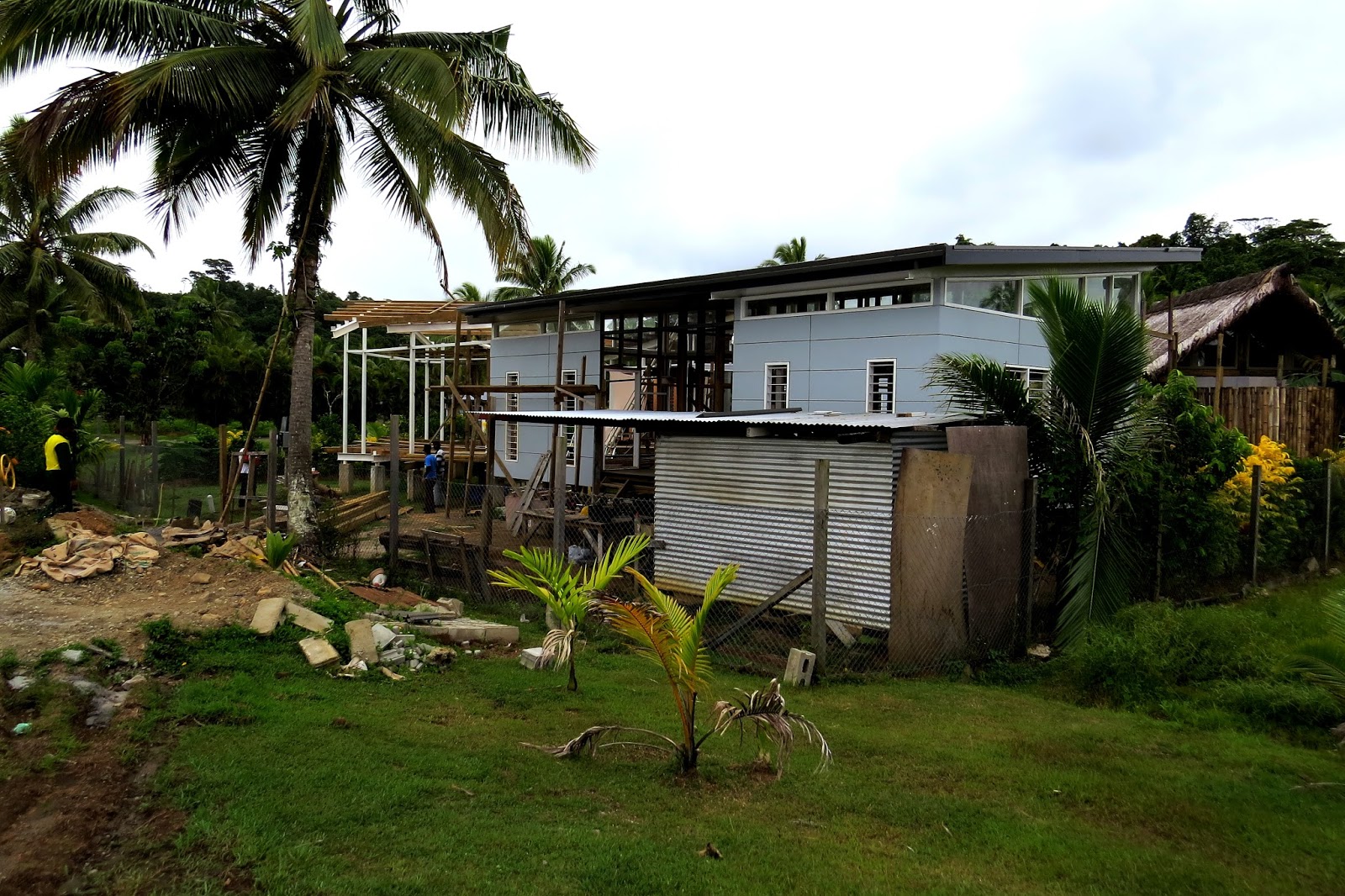
Building and renovated homes in Fiji provides work opportunities for the locals.

They can hardly afford a diet of fresh meats, low starch vegetables, no sugar and grains, comparable to my way of eating. This problem only continues to grow in poverty-stricken countries such as Fiji. And yet, a lucky few, somehow are immune to the ravages of diabetes living well into old age. 

Smoking is common in Fiji with the cost of making cigarettes relatively inexpensive. Kava, the intoxicating beverage, is also popular among locals often provided among family and friends who are able to harvest the kava plant readily grown in these parts.

Alfaan explained he does have a TV, stove, refrigerator, and washing machine all of which he purchased second hand by saving his meager tips over a period of a year. He happily shared this story and if for only a glimmer, I saw a sense of pride, it was over this fact…making life a little easier for his wife and family bringing him great joy and happiness. 

Of course, he has no computer, no smartphone, and only a flip-type phone provided by the taxi company. He’s been able to browse online on a few occasions through public services and friends.  Surprisingly, he has a good understanding of the Internet.

He watches world news on TV and is well versed on local and world affairs as well as customs in some other countries, much of which he derives from tourists who share their stories with him. He’s never traveled outside the island but has experienced flying in a four-seat prop plane with a friend a few years ago. He loved being able to see his homeland from above although he was terrified during the one-time experience.

The Fijian people appreciate the sea and lush vegetation in their homeland, welcoming rain for enhancing the water supply and growing their produce. 

Many make assumptions that local workers are unkempt with little regard for personal hygiene. We’ve yet to notice a single Fijian worker smelling of body odor or shabbily dressed.  Even the outdoor workers appear in tidy clothing which most often is old, maybe worn, or recycled which doesn’t prevent any locals from a keen desire for cleanliness. They may have access to a makeshift outdoor shower or a simple shower inside their homes.

Alfaan explained how grateful he is to have electricity and running water, neither he had growing up. Evenings were spent reading by candlelight, telling stories, and playing simple games. Today, when time allows they watch TV, play games, and read. There are no iPads for children in Fiji. 

Alfaan’s story is different than the last cultural story we posted while living in Savusavu for three months. He earns over three times (with tips) the monthly income of the household help in Savusavu, FJD $200, USD $93. 

His meager monthly income of roughly FJD $525, USD $248 (plus tips) is hardly sufficient income to support a family of four. And yet, his joy and appreciation for his life are evident in his demeanor and kindness. His eyes twinkle when he speaks of his family and his lifestyle.

Crab holes are commonly seen close to the beach. Alfaan explained he fishes for crab often able to bring dozens home for his family and friends.

How fortunate we are to have the opportunity to interact with these gracious people. We treat them with equality, kindness, and patience, even if on a rare off-day when we may have a less than ideal experience.

Alfaan hesitated when I asked him how he is treated by most tourists. After careful thought, he finally shared that many tourists, not all, will complain about a variety of things most of which he can do little, if anything, to remedy; the weather, the heat, the bugs, the occasional delay for a pickup (Fiji time), a disappointing trip or venue and on and on.

Long ago, we decided not to be “those tourists” which has become easy for us. Then again, we’re often in a location for an extended period, not on an expensive one week vacation where a sense of urgency may prevail for some tourists.

Now, as our time in Fiji winds down, we relish in the gift we’ve acquired over this past almost four months offering us a greater understanding of life among the Fijian people. 

Once again, we’re in awe of our surroundings and its people, even with the unimportant nuances we encounter each day; extreme heat and humidity, power outages (yesterday), ants, mozzies, limited products at the market, and of course, “Fiji time.”

We have all the time in the world for these special people.

Photo from one year ago today, December 19, 2014:

This is a news-generated photo from the lava crossing Apa’a Street (in our neighborhood) taken on October 25, 2014, shortly before our arrival. Visitors were prevented from getting close to the lava although we were able to do so on a few occasions during our stay on the Big Island. Please click here for details. 

Tricky aspects of booking flights and cars…Favorite Fiji photos begin today…

Savusavu Bay and Nawi Island, a site atop a hill in the village.

Generally, we book flights using the Expedia link on our website. It doesn’t know us from anyone else and with prices no more or less than using Expedia through the web, it puts a few extra pennies in our coffers in the small amount of commissions we may earn on some bookings.

Many travelers use the various flight booking apps offered online many that bring up multiple web pages at a time with a wide array of quotes for the flights. After trying many of these over the past years, we’ve found the pricing we get through Expedia is no different than anywhere else. 

The hot springs where many locals cook their potatoes and root vegetables.

The airlines will charge the highest possible fares and although rates can change by the hour/day/month, with all the flights we booked we prefer not to spend days researching to save only a few dollars, if anything at all.  

Saving USD $10, FJD $21 for a flight is nowhere near as important to us as in savings the $1000’s we can often save on vacation home rentals or for cruises by spending hours on that type of research and subsequent negotiations.

The view from our veranda in Korovesi, Savusavu, Fiji.

It’s an entirely different scenario for the average traveler when booking hotels and airfare. Most hotels don’t negotiate and airfare is their only way of saving a few dollars, resulting in the fervent desire to save on the airfare.

Unless we’re staying for an extended period in a boutique hotel, we seldom ask for special pricing other than those offered via promotions, coupons, corporate discounts, and senior citizen pricing. 

The bay where many sailors moor their sailboats.

We’re thrifty but we don’t embarrass ourselves in asking and asking for special treatment and pricing when none is necessarily warranted.  Of course, when we write stories and do reviews about a particular property arranged in advance, we may ask for special room and meal rates or comps which are generally provided based on their desire for the additional publicity. 

In most cases, it’s happily provided once they have an opportunity to investigate our site to see how serious we are in documenting our experiences available to our vast numbers of readers worldwide (for which we’re very grateful).

The busy village hops with business most days.

When a few days ago, we were in a booking frenzy, not to be picked back up until we’re situated at our next location, we not only booked the hotels in Singapore and Hanoi but we also booked the flights from Singapore to Bali on April 30th after our cruise ship arrives. 

Then we booked the return back to Singapore from Bali on June 28th at which point we’ll be staying in Singapore for a week. This was not accomplished as easily as one may think with many airlines with poor ratings as indicated on this site which we check each time our flight options include airlines we don’t know as safe.

Tom, in front of a giant palm frond on the property.

In today’s world, no air travel is entirely safe. Choosing an airline with good ratings for maintenance and no recent disasters at least provides an added layer of peace of mind. Also, reading reviews from travelers on the more obscure airlines can add another layer of comfort.

Bail is an Indonesian island that has many fewer unregulated airlines prompting us to be especially careful. It’s easy to take for granted that most country’s airlines are managed and inspected regularly when this is not always the case. Of course, there are always exceptions.

View of the coral reef from the highest point in the neighborhood.

With the airline rating site opened as an additional page on our laptops, we both went to work with safety as the priority, as well as price. Non-stop flights are always a top criterion when possible. We’ve already spent endless hours waiting for connecting flights in less than ideal airports and prefer to minimize this necessity when possible.

If we had our way, we’d cruise everywhere. Unfortunately, geographically, this just isn’t possible. As a result, getting to and from Bali on two separate occasions is tricky. 

Badal joined us when we took photos from atop the highest point in Korovesi and continues to visit us each night during dinner.

We spent hours researching and finally, when we found a good airline, Jetstar Asia (with the highest rating of 7) at a reasonable price for the round trip fare (for our first of two visits to Bali) we quickly booked it. Prices can change on a dime. We’ve yet to book the second trip to Bali where we’ll return two months after we leave (visa restrictions).

As we booked the round trip, it took the first leg of the flight without issue (we paid each leg separately as required by that particular airline). Then, the Internet went “limited” and the return flight showed an error. Expedia took us directly to the airline’s website per their regulations as opposed to allowing us to complete the booking at Expedia.

Taken at the chicken lady’s home which proved to be too difficult to access regularly for eggs.  Subsequently, we purchased our eggs in flats of two and a half dozen at the Farmers Market.

We had trouble booking the return flight when the signal kept slipping in and out, resulting in the necessity of us calling the airline directly. To avoid long-distance charges, we used Hotspot Shield as our VPN with an US web address and Skype avoiding any long distance charges. Thus, being on hold for 10 minutes wasn’t as annoying as it could have been.

A competent rep came onto the line with a thick accent somewhat hard to hear and decipher on Skype but we managed to book the return flight plus pay for our reserved seats at USD $10, FJD $21.  No free seats were offered. The cost of the roundtrip flight Singapore to Bali was USD $586, FJD $1251 for both of us including the costs for our seats on both legs.

Two curious baby goats checking us out. 

The rep encouraged us to pay for our luggage, movies, and other perks but we declined. We have no idea what our luggage will weigh by next June when it’s changing as we restock supplies and clothing. We can do this later either online depending on the quality of the wifi signal at the time or by phone if necessary.

After that was resolved, we decided, while we were “on a roll” we’d go ahead and book the rental car for three months in New Zealand. In a little over one month on January 5, 2017, we’ll be boarding a cruise from Sydney to New Zealand, a perfect example of “using cruising” as a means of transportation as much as we can. 

Everyone in Savusavu works. These fishermen catch fish to resell and for their families.

We were able to book a suitable rental car for the 88 days in New Zealand for a total of $1836 with the best rates from rentalcars.com, a site we frequently use. Oddly, the better-priced vehicles didn’t have air conditioning. 

In checking the weather in New Zealand during that period, it will be cool, not cold, mostly in the 60F’s, 15.6C’s and 70F’s, 21C’s. If we didn’t have a manual transmission with the car jerking around, I’d be OK without AC. 

The Blue Lagoon’s beautiful waters.

The constant jerking of a manual transmission makes me carsick and the AC helps tremendously. Thus, we opted for no AC and an automatic transmission with which I won’t get carsick.  Having not driven a manual transmission in 30 years and with the car rental company adding me as a driver at no extra charge, this works well for us. Tom won’t have to grocery shop with me each week.

Tomorrow, we’ll have another new booking to share as we work on it today. We prefer not to post information about a future booking until we’ve actually paid the deposit and wrapped up the pricing and details, thus avoiding confusion. 

The beach at the Blue Lagoon.

Of course, from time to time, we can’t help but share our “dreams” of locations for the distant future that are too far away to book. It’s nearly impossible to book anything further than two years out.

Soon, we’re heading on our final trip to the village without the necessity of a visit to the Farmers Market or the grocery store. We’ll pick up my prescriptions at the pharmacy, purchase a new phone SIM card and pick up our final two roasted chickens at Helen’s Fiji Meats. Over the next few days, we’ll continue to consume our remaining foods on hand, leaving anything new and unused for the staff.

The island with three trees.

Beginning today, we’ll be posting our favorite Fiji photos and on Sunday, our departure date, we’ll upload a short post with our expenses for the three months we’ve spent in Savusavu. Two days and counting.

Happy weekend to all wherever you may be!

Photo from one year ago today, December 4, 2014:

It was at this point one year ago that we became even more worried about the lava flow on the Big Island as it moved closer to our area of Pahoa. Would we have to move to another location to accommodate our soon to be arriving 12 family members? For more details, please click here.

Transportation…Another long day without power…VPN tip…Five days until departure…

There are many sailboats in the islands, a choice location for avid sailors.

Three months is a long time in one location without a car. Oh, I’m not complaining. We’re thrilled with the savings. Not paying upwards of USD $1500, FJD $3239 per month (as an example in Fiji), USD $4500, FJD $9719 for three months of a rental car plus fuel as opposed to the under USD $300, FJD $648 total we’ll have spent for a driver for the full three months in Fiji provides a huge savings on an annualized basis.

This amount of savings by not renting a car in Fiji was enough to pay for our upcoming cruise in January for both of us, selecting a balcony cabin (as always). Each time we opt for a driver as opposed to a rental car the savings are generally in this range ultimately paying for most upcoming cruises. 

In 2016, we’ve scheduled five cruises; four ocean going, one river cruise. With our love of cruising and the ability to see so much at one time, choosing a driver over a rental car is a small sacrifice for us.

In other countries such as upcoming New Zealand in January, a rental car is a must with our intentions to tour the two islands. We’ve found the cost in NZ is much more affordable than in Fiji as is the case in more populated countries.

A sandy beach along the quiet road we traveled.

As we move to the next island of Fiji for 28 days again we’ll use a driver. The company that we’ve arranged to pick us up at the Suva Airport will also serve as our drivers once we arrive in Pacific Harbour, an hour’s drive from the airport. 

In the new location, we’ll have the freedom (and luxury) of walking to nearby shops and restaurants according to the owner. I can hardly wait to be able to walk when there. Although lovely overall in Savusavu, it’s been impossible to go for a walk on the steep dirt road up the mountain. 

We can barely maneuver getting into Rasnesh’s vehicle, the incline is so steep. Invariably, the car door is so heavy on the incline, that in itself, it’s a challenge to close once inside, the incline creating a darned weird obstacle, dangerous and unwieldy. Level ground at this point is rather appealing.

Living in Savusavu hasn’t been easy in some ways, certainly not anyone’s fault. Mario has been the perfect host in a relatively perfect little house overlooking the sea. The support staff has been ideal; Junior, Usi and Vika, all of whom we adore. 

We highly recommend this resort if the ability to prepare one’s food and the desire to be away from the hotel environment in a more private location is on one’s radar.  In many ways, it’s been ideal for us.

As for the ants, that’s only been a result of our constant need to cook. Had we only been preparing light meals as most, shorter-term travelers do, we may not have had so many ants. It was certainly a result of the constant preparation of food that attracted them no matter how well we cleaned up after we were done. 

A canopy of trees crossed over the road creates a pretty scene.

The refrigerator handle fell prey to the ants if a smidgeon of food was on my hand when I opened the door. The next day we’d have ants on the handle and the door. In time, I learned my lesson, washing my hands every time I opened a cupboard or appliance including the microwave, portable oven, the coffee or tea pots or even the kitchen sponge which I sterilized with a minute in the microwave each day. And still, they came…just less of them for a day or two. 

I have no doubt we’ve eaten some ants regardless of how hard we’ve tried not to. Then again, there are populations throughout the world that eat ants and other insects so I guess we fit in. Not necessarily by design.

As for yesterday’s unannounced power outage, I suppose not knowing saved us a bit of anticipation, although we weren’t prepared with lots of ice on hand as we had the week earlier with advance notice. Two of out the past eight days, we’ve had no power, and a third day the refrigerator didn’t work for 24 hours. 

My biggest concern is always the food in the refrigerator. The freezer seems to stay cold for eight or nine hours without defrosting providing we don’t open the door. Yesterday’s power outage beginning at 9:17 am was a total surprise. 

Waiting 30 minutes after the power went off, I called the power company when this time the Internet still worked enabling me to look up their number online. I was told it was a result of another day’s tree trimming near the power lines as hurricane season approaches. They estimated we’d have power by 4:30 pm.

Aside from many rocky beaches, there are many sandy beaches in Fiji.

We had a decision to make; do we open the freezer, empty all four of our ice cubes trays into a container to place in the refrigerator or do we avoid opening either door?  We opted to quickly open both doors, remove the ice, fill the plastic container and our mugs with ice placing the plastic container on top of the pan of the uncooked Italian meatballs I planned to cook for dinner. 

We were concerned about meatballs made with beef and pork mince going bad in the refrigerator in seven or more hours. But our plan worked. When the power came back on at 5:30 pm, the ice was hardly melted in the fridge, the contents were cold and the meatballs were as cold as they would have been with power. 

We had a lovely dinner with the meatballs slathered in homemade red pasta sauce topped with hand-grated mozzarella cheese, a side of mushroom casserole (which stayed frozen in the freezer during the outage) and fresh steamed veggies.

The next challenge of the day was Tom’s ability to watch the Minnesota Vikings football game on his laptop.  He’s a member of NFL Game Pass, an app only available to viewers outside the US for an annual fee of USD $130, FJD $281 when Tom only watches the Vikings games. The fees are higher for full access to all games, playoff and Super Bowl games which he can add on later, if the Vikings are in the playoffs and Super Bowl. 

The games are available live with commercials or a few hours later without commercials reducing the view time to less than two hours. For some odd reason, last night, when the Internet signal was appeared strong enough to watch, Tom wasn’t able to download the game no matter how hard he tried. He’d been able to watch prior games while in Fiji. We had no idea as to the problem.

We can easily envision a life at sea, definitely not a lifestyle that would appeal to us for years.

Frustrated for him, I made what sounded like a hair-brained suggestion that he use the VPN on my computer, Hotspot Shield, to show our entry to the Internet wasn’t Fiji but another country we could select in the app. We couldn’t use the US as the selection with the Game Pass app unavailable for use while in the US.

I started the app, selected the UK as our entry point and he opened to the program for success. Immediately, the game popped up on the screen of my laptop. 

Not much of a football fan, plus with his preference of keeping the laptop on his lap during the game, I decided to head to bed at 9 pm to continue reading a good mystery novel instead of attempting to watch along with him.

By 10:30, I nodded off, loud game and all, managing eight hours of sleep, a first in many moons, only awakening a few times to the sound of pounding rain on the roof, a nightly occurrence of late.

The sun is shining at the moment. The ants are under control. I’m feeling especially good after a full night’s rest.  Tom’s still grinning from ear to ear over the Vikings win. Life is good.


Photo from one year ago today, December 1, 2014:

On our final day in Maui before heading to the Big Island for the upcoming family visit, we boarded a whale watching boat in Maalaea Bay, the harbor with some of the roughest seas in the world. (Yes, it was! rough)! We never saw a whale and once again, we were disappointed on yet another unfulfilling whale watching outing. Safari luck only seems to prevail on land.  For more details and photos of the scenery, please click here.

The nuances of managing our site…

The bright blue sea usually indicates a coral reef of which there are many in Fiji.

Having the daily responsibility of keeping a website fresh and packed with information can be a daunting task.  Never interested in learning web design and HTML, I’ve preferred to pay attention to the “content” aspect of our blog as opposed to its design, hoping it’s an easy appealing place for our worldwide readers to visit.

Over the past years, our web developers,  Smitten Blog Designs, have done a great job for us and we’ve been thrilled with their great service and ingenuity. If you’re considering a website or blog, they’re happy to assist and continue to answer questions long after the design is established and the site is live.

Brooke, our web person at Smitten Blog Designs has suggested we move over to WordPress, another blog management site, that although it may cost a little more, is easier to manipulate, correct errors, and manage day-to-day postings with photos.  (FYI, we don’t use the help of our web developer when posting each day, only when we have design changes we’d like to make).

Currently, we’re using Blogger and over these past 44 months of posting, we’ve found it tricky and frustrating at times, especially in regard to posting photos and especially in line, paragraph, and photo spacing. 
Our readers may notice that at times we have too many spaces between paragraphs and photos which is entirely a Blogger related issue. Add in a poor Internet connection and I can spend hours attempting to edit a single post.

The hard part for us is letting go of our stats and losing a few readers.  Our web address will always be www.worldwidewaftage.com. Moving to WordPress won’t change that. If you’ve bookmarked our site, it will still take you wherever we may be by using our web address regardless of which blog editing software we may use.

Sewak, our neighbor, planted this garden a few months ago.

Since the onset of our posts in 2012, there are statistics that only we have access to located in the operational “dashboard” of the editing area of the site. If we move to WordPress, those stats will start all over again from zero.  

Losing the stats and beginning again is purely psychological for us. It would have no bearing on the site itself or its readership, only in the pleasure we’ve had in watching our readership grow to over 354,000 readers. 

Each day, we watch the stats, hoping to learn which topics and photos appeal most to our readers. If we move to WordPress the stats will begin anew and we’ll continue to be able to observe the daily activity as we’ve done in the past. All archives (previous posts) and comments will remain intact.

In the realm of things, our readership is minuscule compared to the millions of hits many other sites receive in a year. Even a single YouTube video can receive millions of hits in a matter of minutes. Then again, there are millions of blogs that only receive a few hundred hits per year.

An old shed on the property further up the hill.

When we started and as we continue today, we never expected to make money from our site. To date, we’ve never made enough to cover even our blog design and maintenance expenses. 

Some may assume, we’ve earned enough revenue from our advertisers to pay for our travels. Not the case. We don’t ever expect that to occur, nor do we experience any frustration over not earning enough to offset our travel expenses. This was started as a “labor of love” and continues in that context yet today.

Sure, it would be great to earn enough from our advertisers to cover the costs of the blog itself. The only way this is possible is to substantially increase our readership and for our readers to use the links provided on our site. Doing so simply takes the reader to the main site of the advertiser. Prices and features are the same. The difference is, we may receive a tiny commission if a reader makes a purchase.

We can use your help in increasing our readership by forwarding the link to our site, www.worldwidewaftage.com to your email contacts to those who enjoy travel and of course, “armchair” readers which comprise a huge majority of our readers. 

The view from higher up the hill from our house.

Posting our link on your Facebook page is another great way to increase our readership. Many “stay-at-home” seniors and others, unable to get out, read our daily posts. As a continuing story, many get a kick out of reading the latest, as we do in reading other blogs.

Instead, we’ve used this valuable platform to reach out to friends, family, and all the wonderful people who’ve visited us online to share our story of two senior citizens traveling the world, without a home, without a car, without storage somewhere, and with only three pieces of luggage and a few carry on bags.

The feedback we continue to receive from our readers on a daily basis via email and comments on the site has nourished our souls and spurred us on when at times, we’ve experienced angst and frustration, especially on travel days.

We’ve gleaned a substantial amount of comfort after any experience, knowing we’ll be able to share the story the next day with people who care, people who take their precious time to sit down with a cup of coffee or tea to read our endless ramblings and to see our photos. We are very grateful for each and every visitor that stops by our site.

View of the color changes in the sea from atop a hill in our area.

Our web address, as mentioned above, will always be available at www.worldwidewaftage.com regardless of which blog editing software we use, Blogger or WordPress. Should we decide to switch, it won’t be until after the first of the year and everything will remain the same for our readers

In case you’ve may have wondered, each day after we’ve uploaded a new post, if you enter www.worldwidewaftage.com you will be taken to the newest post we’ve done today. Yesterday’s post will have a different address along with our address, which will include words from the heading to differentiate it from the over 1200 posts we have done to date.

You can always reference past posts from the link of “previous posts” as we mentioned a few days ago by clicking on the little black arrow to get to an older post. Also, it’s easy to search for a particular post using the “search” box on the page.

A natural spring is located on Sewak’s property providing water for all of the neighbors in Korovesi. He shares the unfiltered water at no cost to the neighbors other than the expense to bring it to their properties and store it in tanks. We began drinking the pure water the day we arrived with no ill effects.  This isn’t always possible in many countries.

In the past few days, our web designer Brooke has added a feature for translation and updated the look of our advertisers.  For now, we’re staying put since making such a change would require time spent on our part. 

With only 17 days remaining until we depart Savusavu, Vanua Levu to head to the bigger island of Pacific Harbour, Viti Levu, we’ll keep our time free to prepare for the upcoming move.

Have a meaningful day filled with thoughts that bring you peace and comfort!

Photo from one year ago today, November 19, 2014:

Tom got a kick out of this old Ford “woody” that was on display at the Maui Tropical Plantation. For more photos from the tour of this facility, please click here.

Staying abreast of the news…You can run but you can’t hide…Out and about on a cloudy day…

The Montfort Technical Institute in Savusavu assists poor children academically and economically to gain skills to prepare them for a productive adulthood.

While living in most vacation homes, in the mornings after showering and dressing for the day, we pour our coffee and sit down to work on our laptops; me, preparing the day’s post; and Tom, conducting research for future travels, communicating with friends and family and checking out what’s new at Ancestry.com, a favorite pastime.

The entrance to the Montfort Technical Institute.

Once comfortably situated, we’d turn on the TV, when we’ve had one, to check on the day’s news, during which I’d often find inspiration for the day’s story. With no TV here in Fiji, we’ve spent the past almost three months reading news online which as far as we’re concerned, is often “spun” to appear one way or another.

Online news is not much different than TV news. It too may be slanted to appeal to the provider’s and the viewer’s political and social preferences. It’s difficult to ascertain what is fact and what is exaggerated (or minimized) as truth or fiction. I suppose it’s the same for viewers all over the world.

We passed the small village of Jerusalemi.

Whether we have a TV or not, we stay well abreast of what’s transpiring throughout the world with or without “spin.” In some countries even the modest local news programs gives us a fair perspective of events occurring in the US and other countries, enough to inspire us to investigate anything that we’d like to further explore.

Many of our family and friends may think we’ve been out of touch with world affairs when in many ways we’re more aware now than we were in our old lives when the hustle and bustle of daily life kept us from watching much news. Although, Tom avidly read the Minneapolis StarTribune newspaper for years. 

Instead of suburbs small groupings of homes are in a specific area, often designated as a village.

I never took the time to read the newspaper but Tom kept me informed as to world events. It was only after we connected almost 25 years ago, that I became interested in politics, financial markets and world affairs when he often discussed these hot topics.

For a period of time after we left Minnesota, Tom subscribed to the newspaper’s online edition but, later lost interest when Minnesota news became less interesting to him the further and further away we traveled. 

As a Minnesota transplant in the late 60’s, I was less connected to Minneapolis with no childhood experiences and memories. My personal memories revolved around the life I built in Minnesota as a single mom with two sons, making it on my own, at times stressful and angst-ridden and at other times, fulfilling and successful. I guess that’s how life is anyway, isn’t it?

This area is a chicken farm with cages for the chickens.  Not all chickens in Fiji are free-range. Although they aren’t injected with drugs or fed chemicals, they may eat grains. There’s no way to be 100% certain that eggs we purchase are from free range chickens when crates aren’t labeled at the farmers market.  So far, I’ve suffered no ill effects from consuming the unknown eggs sources.

As we live on a remote island in Fiji, where peacefulness and an easy pace is the order of the day, where police officers have plenty of time to drink coffee and commiserate with their people, where crime is almost non-existent, we languish in this simple life. Since we arrived, we haven’t heard a single siren of any sort.

But, the realities of news throughout the world is never far from our range of vision. It’s easy to become wrapped up in what’s transpiring in our home state, home country and other parts of the world.

I always had a perception that living on a remote island would keep one free from the strife and horrors throughout the world but the simple saying, “You can run but you can’t hide” is more true than I ever imagined.

Savusavu has an industrial district mainly consisting of lumber yards

The very thing that makes our world travel possible…the Internet…proves to be the very thing that keeps us feeling concerned over what’s happening in the world. 

Many would think that we sit back in idle contemplation of our next photo taking opportunity, our next sightseeing expedition, our upcoming location and the locations we’re yet to see in the future.

Undoubtedly, those aspects of our lives are the forefront of our minds and will always be so as we continue to travel the world. But now, we think in terms of where it is safe to travel, how we’ll reduce the risks with wars and strife surrounding us throughout the world.  Some countries previously on our “wish list’ have now been eliminated.

A lumberyard in the industrial area of Savusavu.

No, we don’t attempt to avoid exposure to the news. No, we aren’t free of the same concerns many citizens of the world experience as they live their daily lives, listening to, watching and reading news. 

For now, the amazing Fijian people have inspired us. Few have TV’s and access to world news. Their passion for life is astounding. We try, if only for a little while, to embrace their joie de vivre, living in the moment, treasuring everything in front of us; the beauty of a country one imagines only in a dream of a tropical island. 

For us, for now, we call it home.

Photo from one year ago today, November 18, 2014:

The old Wailuku Courthouse, built in 1907, is located on the US National Register of Historic Buildings. We visited this quaint town of Wailuku one year ago today. Please click here for details.

Reflections on a life on the move…Leaving Trinity Beach tomorrow afternoon…Total expenses posted tomorrow…Favorite photos…

A dingo, a wild dog, is representative of the Australian Outback.

It’s impossible not to compare one location to another. Moving every three months or less, with only a single exception most recently in Kauai, Hawaii, where we happily lived for four months, leads us to the inevitable:  How does each location compare to another?

Love, companionship, and comfort are evident in the most unexpected species.

If it were based entirely, on the beauty of a location, our opinions would be very different. Some of the least attractive locations could be included in the most fulfilling. Were it based on the people we met and the memorable occasions associated with making new friends, it would be entirely different.

Mother koala in a tree with a view of her joey in the pouch.

As it turns out, not surprisingly, many factors enter into the equation of what proves to be the most pleasurable places we’ve experienced on earth thus far. With so more much to see, we’re premature in listing them by preference. 

Mom and Joey…precious.

If we were to say that “convenience” would be a factor in determining the quality of our experiences, we’d be kidding ourselves. Some of the most inconvenient, lackluster locations proved to be the most meaningful.

In no time at all, joeys become adept at hanging on to eucalyptus trees.

In a way, it’s similar to having a preference in the “type” of person we want as a partner. Often in life, as in mine and Tom’s case, we end up happy with the polar opposite of what either of us would’ve expected in a mate.

What a gorgeous pelican.

No more than we can control whom we fall in love with, falling in love with a location almost becomes a matter of chance provided it has the basic necessities we require in our travels: access to a grocery store, running water, electricity, an indoor working toilet, and shower, fresh air, comfortable clean property with a lounge or living room, a good bed, a kitchen, somewhat of a view, warm weather, a reasonable means of transportation and wireless Internet or the ability to buy SIM cards. On the wish list? Screens on doors and windows, a pool, an ocean view. We no longer require air conditioning even in hot climates.

Most beaches in Australia are pristine sand. Even the few locations with a rocky shore are beautiful.

Once we find we’ve accomplished the above in a new location, we settle in making adjustments and adapting as needed to best enhance the experience. Anything beyond these basic comforts is a bonus: pleasing sites to visit, great views, friendly people, convenience for shopping and entertainment, and an easy means of local transportation. 

Australia is not only abundant in unique wildlife but also in unusual vegetation. 

With all of these factors in play in varying degrees, it’s not easy to classify one location as better than another.  It all boils down to one single fact: did we have a good experience? If so, we’re content.

One of Tom’s many sunrise photos.

In Trinity Beach, we had a good experience. We saw the sites we wanted to see; we had all the “creature comforts” we needed; we had a great view and surroundings with some access to wildlife; and the people were as warm and friendly as they could be, although we never had a chance to socialize to any degree.

A flower with a face.

Would we come back to this area?  In reality, we’ll return to Cairns on a future Australian cruise next year during which we may stay aboard the ship. Why pay for a tour when we’ve already spent three months in the area? With so much world left to see, repeats aren’t on our radar right now (except for South Africa for me, for which I’m chomping at the bit to return).

Shade is common along the many beaches from many varieties of trees.

Easily, we leave Trinity Beach with a sense of comfort and accomplishment, grateful for the experience which only enhanced our love of this country which over the next 20 months we’ll further explore with six more cruises circumventing the continent. 

A huge banyan tree in Port Douglas.

By the time we’ll sail away from Australia in April 2017 to head back to the US for a short visit, we can feel confident we’ve seen as much as we wanted of this huge continent and the South Pacific, content to continue on to visit new continents, new worlds we’ve yet to explore.

Today, we share some of our favorite photos of this area, and tomorrow, the final expenses with the balance of the favorite photos.

Thanks to all of our worldwide readers for sharing our first Australian experience as we continue on to the vast South Pacific for more.

Photo from one year ago today, September 5, 2014:

DSC03532
We visited the final port of call visited by the Titanic in the town of Cobh, Ireland. As a tribute to the Titanic, each cruise ship that enters and departs the port is greeted by these ladies dressed in the era of the Titanic. For more photos of the Blarney Castle, the villages of Cork and Cobh, Ireland, and fun times out with friends we made aboard ship, please click here.