Historical carved statues along the river….Australians never forget….More new out and about photos…

The opposite side of the above carving is shown overlooking the Huon River.

Although it’s summer in Tasmania, it’s not sunny every day, nor is it warm. It seems the sunny days alternate with cloudy days with an occasional few sunny days in a row.

We were fascinated by the tree carvings along the Huon River. This particular statue is in memoriam to all who fought in the Boar Wars from 1899 to 1902.  (Zoom in to read plaque).

The locals find the sunny warm days to be “hot,” but from whence we’ve come over these past years, it’s definitely not “hot” to us. So there’s no need for air-con in Tasmania.

We walked along the shore of the Huon River, spotting this kayaker.

Recently, we’ve been using a floor fan at night we found in a closet. It was a bit warm with the heavy duvet on the bed, and the fan running on low has left us in perfect comfort. The noise from the fan is soothing as well.

Pretty scenery along the river banks.

There is an aircon/heating unit in the lounge (living room), but we’ll never use it during our remaining 31 days in Tasmania. It’s comfortable with the screened windows open during the day. By dark, we close them as it cools down considerably.

River overlook,

We’ve yet to use the pristine swimming pool. It hasn’t been warm enough to inspire us to swim. Nor have we embarked on any walks in this immediate neighborhood, although we continue to drive throughout the area to explore. 

Mother and child wood carving.

The property is tucked away from the main Highway A6, which winds through the Huon Valley.  We don’t hear traffic noise since there isn’t much traffic, but the narrow, winding two-lane road is hazardous for walking.  We’ve noticed cars and trucks zipping along at quite a pace, often locals familiars with the bends and turns.

Sign on the carving, “Timber-getting became a major industry”…

I must admit, after the busy period in Penguin, we’re enjoying some quiet time. Neither of us is feeling overly motivated to go out sightseeing, although we make a point of getting out every few days to explore and take photos.

Roses blooming in the front yard of the home across the road from the river banks.

As we’ve mentioned many times in the past…we’re just like you. We don’t always feel like sightseeing. Instead, staying “home,” cooking a nice meal, throwing in a load of laundry, working on projects (for us, future travel research and bookings) is our definition of a good day. 

We continued on the river walk for more impressive river views. 

Funnily, staying put for a few days grounds us. Without a home of our own nor a place we return to for repacking and laundry creates an environment of seeming everyday life which has proven to be an important part in preventing us from becoming “bored” or “tired” of traveling.  Does this make sense?

In reality, our style of living is exactly how we want it to be, on our terms, including when, where, and what we prefer to do with our time. So we dine when we’re hungry, sleep when we’re tired, and talk when we feel like talking.

The Huon Manor Bistro, located across the road from the river, was closed on Australia Day.

We always provide one another the space to become mindless in an online game, to browse online for hours at a time, or in saying “no” if one of us wants to do something and the other is not up to it for one reason or another.  

Perhaps, this laissez-faire attitude and easy-paced attitude is what makes this journey work for us. However, if we didn’t strive to continue our playful harmony every day, one could quickly become anxious to return to a “normal” life, living in one location, having an established home.

Gorgeous yellow roses.

Neither of us has lost one iota of enthusiasm for our nomadic lifestyle of world travel. But, sure, we discuss the future with its hard reality that someday we’ll have to stop due to health concerns. 

It was a cloudy day, but the views were good anyway.

For now, we’re happy, content, and filled with a childlike wonder of what is yet to come, whether it’s a quiet day at “home” or the excitement of a new adventure. It’s all good.

We hope your day today is good as well.

Photo from one year ago today, January 29, 2016:

The Sugarloaf Islands and Paritutu Rock, located in New Plymouth as seen from a distance from Okurukuru Winery. For more photos, please click here.

Culture in Australia…Australian diversity…Continuation of Australia Day photos…

This fish mascot wandered about the celebration for photo ops.

In June, 2015 we posted a brief history of diversity in Australia at this link while we were living in Trinity Beach during our first foray into life on the continent.  Australia has a rich indigenous history some of which may be found at this link. 

“Smallest Pancakes in Town”

Unfortunately, we’ve had little opportunity to get up close and personal with the indigenous citizens of Australia as we have in some other parts of the world.  However, we’ve had more readily available contact with the non-indigenous citizens, comprising over 90% of the population, easily encountered in day to day life.

Homemade jellies, jams and condiments.

Now in Tasmania for three months with only 3% of the population as indigenous citizens, interacting with their traditions is equally unlikely as it was when we lived in the mainland with 6% of the general population whom identify as Aboriginal and Torres Strait Islanders.

During our many months living amongst the Aussies we’ve found a unique culture that emerged over the centuries as people from many lands migrated to the continent seeking a new and better way of life.  All these cultures are revered and held in high regard. 

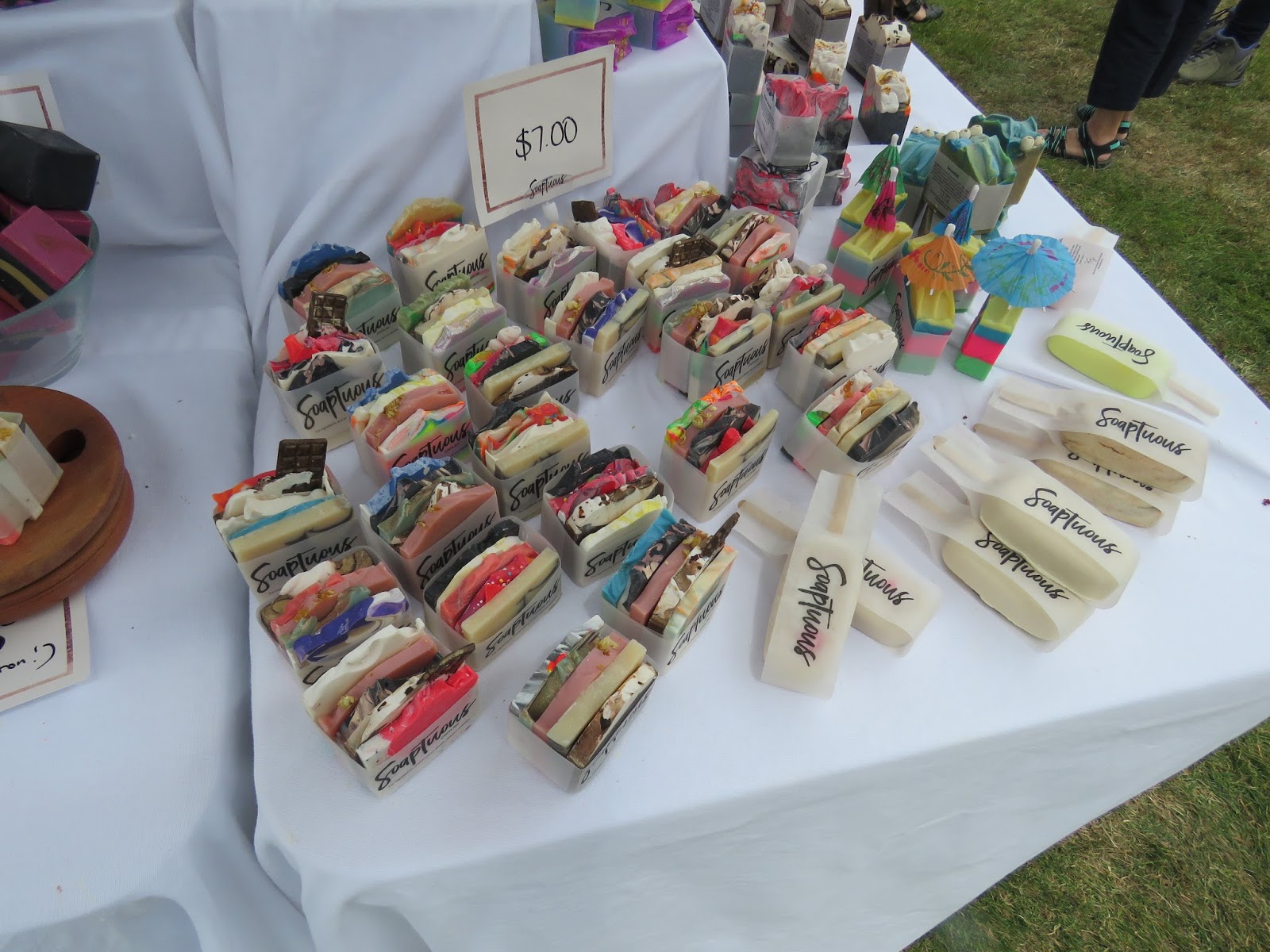
Clever and pleasing-to-the-senses soaps.

This morning,  Prime Minister Malcomb Turnbull made an eloquent speech honoring the Chinese New Year, Year of the Rooster, and the Chinese people’s influence and value to Australia.

Not unlike many western civilization, the melding of nationalities contributes to a distinct persona that may be clearly defined over the centuries.  That culture in itself is different in many ways from our experiences in our old lives in the US and in many countries in which we’ve lived over these past 51 months.

Food or soaps?  Soaps!

After living in Trinity Beach, close to Cairns, Australia for three months, spending a few months on cruises with mostly Australian passengers, we’ve come to the point of having somewhat of a grasp on Australian culture.

Whether its their easygoing style of living, ways in which they’ve embraced their love of their homeland, their penchant for humor and lightheartedness, their seriousness and determination in dealing with important issues, and their commitment to integrity and ethics, the Aussies embody a special demeanor we’ve found to be enchanting.


Tom checked out the baked goods but resisted.

From this university site, we gleaned the following description of the Australian culture which we found clear and concise:

“Australians are generally laid-back, open and direct. They say what they mean and are generally more individual and outgoing than many other cultures.  You may think that most Australians live in the ‘outback’ out in the country. In fact, more than three quarters of Australians live in cities and in urban centres, mainly along the coast.
Some key values that reflect the Australian way of life include:

  • Freedom of speech
  • Freedom of religion
  • Democracy
  • Equality regardless of sex, marital status, religion, nationality, disability or sexual preference
  • Peacefulness
  • A ‘fair go’ (equal opportunity) for all and support for the underdog.

In most practical ways, Australia is an egalitarian society in that there are no formal class distinctions. There is no segregation between people of different incomes or backgrounds and everyone is free to live where they like, attend university and follow whichever religion and occupation they choose. (Continued below).


There was a long queue at the ice cream booth.

What are Australians like?

In the workplace and among friends, Australians generally call each other by their first names. When meeting someone for the first time, it is usual to shake the person’s right hand with your right hand. People who do not know each other generally do not kiss or hug when meeting. Australians show respect by looking people in the eye, however they don’t stand as close or have as much physical contact (such as hugs and kisses) as other cultures.

You may find that your Australian friends have difficulty pronouncing your name, at first. Be patient and prepared that you may need to repeat your name or say it slowly at the beginning. As friendships develop, you may find that your friends give you a nickname, which is very common in Australia and is a form of endearment.

Sport Culture

Australians love their sport and most people watch the finals of major sporting events, even if they don’t normally have an interest in the sport. Popular events include the State of Origin and Melbourne Cup.

Men and Women

 Men and women are treated equally in Australia. Women make up nearly 50% of the workforce and most women remain in the workplace after they marry, and many after they’ve had children. Women are also free to breastfeed in public.

There are no social rules regarding friendships or dating in Australia. Friendships with members of the opposite sex, and social events with both sexes are common. It is also common for couples to live together before they are married, or for men and women to live in a share-house together.

People in Australia generally don’t have servants, and men and women equally share the cooking and domestic duties in the home. (Continued below).


The batter fried mushrooms smelled delicious.

Language

Australians often use humour and are considered to be quite sarcastic. The Australian sense of irony may be difficult for you to grasp at first but you’ll get used to it. The Australian accent and use of ‘slang’ may also be confusing, but if there is ever anything you don’t understand, just ask.

Aussie Slang

  • Arvo – afternoon
  • Aussie – Australian
  • Barbie – BBQ/barbeque
  • Bloke – man/guy
  • Boardies – board shorts
  • Brekkie – breakfast
  • Brizzie – Brisbane
  • G’day – good day/hello
  • Goldy – Gold Coast
  • Mozzie – mosquito
  • No worries – no problem/that’s OK
  • Roo – kangaroo
  • Snags – sausages
  • Sunnies – sunglasses
  • Telly – TV
  • Togs – swimsuit/bikini

Of course, there are countless Aussie expressions that are far removed from our familiar use of the language.  Its never a matter of what’s correct use of the language.  Instead, it revolves around cultural language differences from one country/continent to another.

Homemade pillows and casual furnishings.

We’ve enjoyed the Aussie’s use of the English language as unique and entertaining from our own experience such as:

  • When moving from one home to another, they say “move house.”  Whereby in the US its referred to as “moving.”  That simple difference makes us chuckle over their easy use of the language.
  • They don’t say “sports” in reference to sporting type activities.  Instead, the say “sport” in reference to any such activities. 
  • Comparable to the UK, when referring to a  person “in the hospital,” they say “in hospital” a simple dropping of the word “the” in the sentence.

Scented handmade soaps are popular in Tasmania as personal and gift items.

Its these little nuances that make us smile.  There are endless examples of these types of language differences which ultimately are easily understood by unfamiliar visitors.

Pretty bouquets.

We’ve found that Australian news, although serious when appropriate, is often hilarious over the more lighthearted storylines.  At times, they may use a swear word or slang expression we’d never heard from newscasters in our old lives. 


Handcrafter products made with wood.

On each occasion, we find ourselves laughing out loud, loving the ease and humor they include in telling a story. Even their locally produced TV drama series illicit a sense of humor and lightness.

Although we’re a bit isolated in this remote area of Castle Bay Forbes in southern Tasmania, with little interaction with locals on a day to day basis, we can’t help but grasp every moment possible to spend with these special people.

Enjoy the upcoming weekend!

_________________________________________


Photo from one year ago today, January 28, 2016:

The grapes were robust and ripe for the picking at the Okurukuru Taranaki Winery near New Plymouth, New Zealand.  For more details, please click here.

Australia Day celebrations…Many photos to share…Serendipitous meeting of a talented and creative alpaca farmer…

Tom standing next to the Australian flag at the entrance to the Australia Day festivities in the town of Franklin, Tasmania.

Australia Day as explained in yesterday’s post is celebrated with a similar enthusiasm and fervor we’d experienced on the 4th of July in the US in our old lives.  Upcoming in our visit to the US, we’ll celebrate this next 4th of July in Minnesota for the first time in five years.

It was sprinkling off and on but it didn’t keep us from checking out the activities.

As we’ve traveled throughout the world we’ve found many countries honor such a day(s) of independence and freedom or as a result of release from some form of tyrannical rule or another.

Aussies, undoubtedly, take this day very seriously in their hearts.  However, typical with their warm demeanor and outgoing nature many of the festivities are often lighthearted and humorous.

A long ago skill is utilized by Grace Hunter, a local alpaca farmer who changes the fluffy alpaca fleece into a fine yarn she uses to make many items.  We were thrilled to spend time chatting with Grace over our mutual love of alpacas and our admiration of her products.

We couldn’t resist watching Australia Day news while I prepared yesterday’s post. There were serious and inspirational talks by leaders and politicians along with recognition for “Australians of the Year” including several special individuals who are recognized each year for their accomplishments in many areas. 


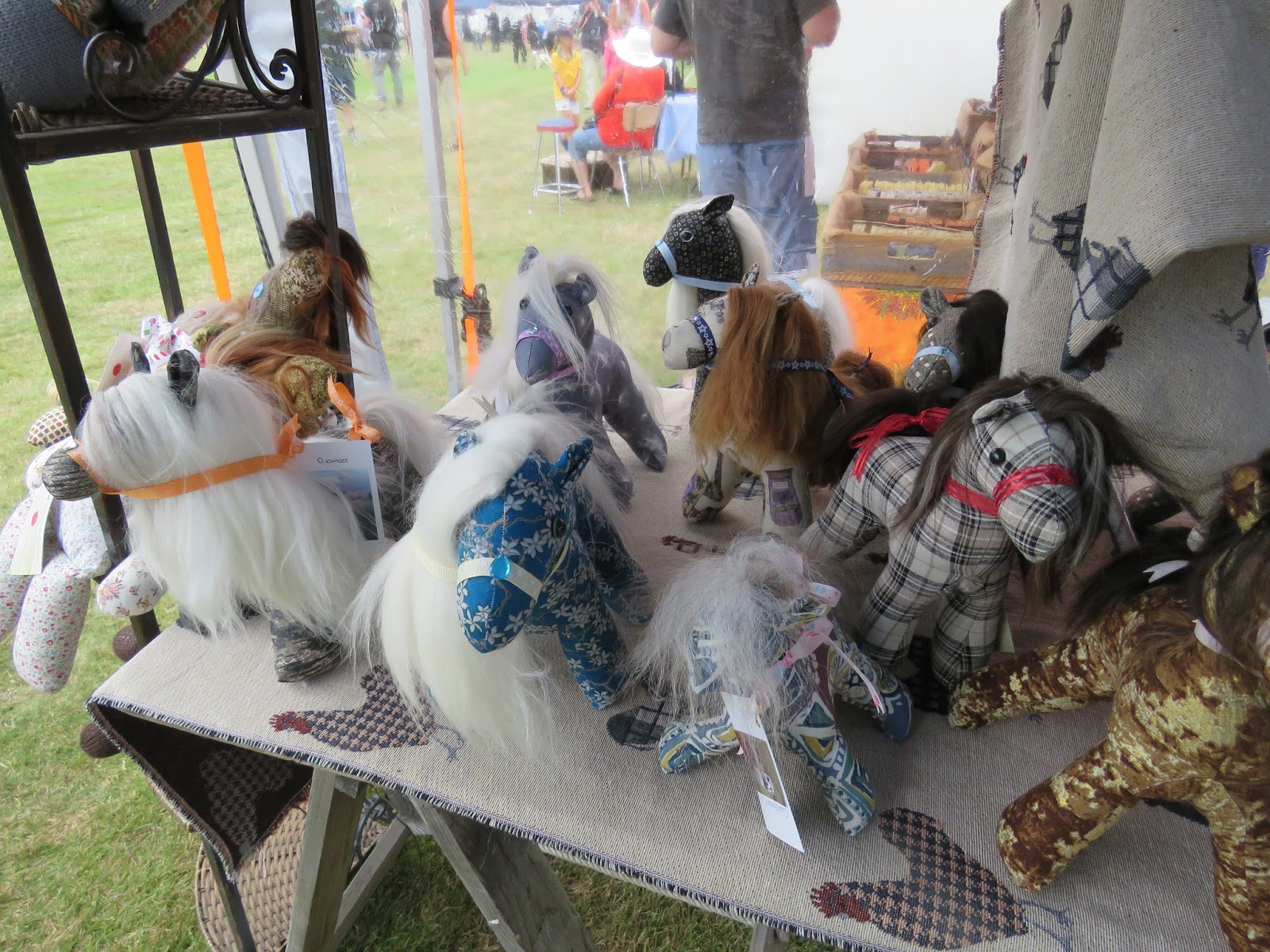
We couldn’t stop smiling over these adorable “gothic” dolls, all handmade by alpaca farm owner, Grace Hunter.

This annual event of the recognition of Australians has been a part of this annual celebration over the past 35 years.  It particularly appealed to us.  In our own country a few individuals may be recognized who receive a small number of awards with little hoopla presented to the masses. 

In the US, a few biased magazines designate their favorite “person of the year,” who may or may not be of major significance to the general population.  We’d love to see such a valuable adjunct to the US’s annual 4th of July celebration.


Tom held this adorable alpaca fleece monkey Grace designed and made, as is the case for all of her items.
Australians embrace these annual awards with the highest of regard as they’ve become an integral part of Australia Day.  This year’s first place winner, Emeritus Professor Alan Mackay-Sim was recognized, among other recipients, for his discoveries in stem cell research as described below from this site:

“Australian of the Year 2017


Emeritus Professor Alan Mackay-Sim

Biomedical scientist treating spinal cord injuries…

An inspirational scientist and international leader in stem cell research, Professor Alan Mackay-Sim has given hope to thousands of Australians with spinal cord injuries.

A global authority on the human sense of smell and the biology of nasal cells, Alan led the world’s first clinical trial using these cells in spinal cord injury. In 2014, Alan’s research helped play a central role in the world’s first successful restoration of mobility in a quadriplegic man.

As the director of the National Centre for Adult Stem Cell Research for a decade, Alan’s research has championed the use of stem cells to understand the biological bases of brain disorders and diseases such as schizophrenia, Parkinson’s disease and Hereditary Spastic Paraplegia.

Alan’s pioneering work has led to collaborations with teams of health professionals who are translating his research into clinical practice. He has laid the foundation for the next generation of researchers and demonstrated the value of inquiry, persistence and empathy.”

An alpaca fleece short cape with a poncho to the left.

After watching the news and uploading the post, we headed out to the small town of Franklin, a pleasant 15 minute drive from our vacation home.  We had no idea what to expect but were determined to partake of the festivities on Australia’s special day, rain or shine.

In many countries in which we’ve traveled, cultural differences are more pronounced than they appear in Australia.  As we traveled to many areas of the vast continent, its become clear to us the wide array of cultural difference we’ve experienced. 

Here again, Grace‘s skills came into play in making this alpaca fleece sweater. 

We’ll discuss our limited perspective of cultural differences after spending seven and a half months in Australia (and so far, spending 19 months in this general area of the South Pacific) in more detail in tomorrow’s post as we continue to share more Australia Day photos.

Upon arriving at the venue, and after finding a convenient spot in a grassy designated carpark (Aussie speak. Its called a parking lot in the US), we walked a distance to the entry to the park being used for the dozens of displays and booths highlighting various businesses throughout the area.

Grace utilized the extra soft fleece from a special breed of alpaca on her farm with hair too fine too weave.  She made every part of all of these shown items.  Very talented.

There was a variety of vendors with handmade crafts including soaps, skincare products, embroidery, jewelry and unique household furnishings.  Of course, there were numerous food booths with mouth watering treats, all of which we avoided; fried mushrooms, fried fish, cakes, pies, pastries and breads. 

Our taste buds were sent into a frenzy as we passed each food booth.  Tom, has been cutting back on food in preparation for the next cruise upcoming in 34 days.  And of course, I diligently maintain my way of eating with nary a taste of anything not included.

Closer view of the Grace‘s adorable designed and handmade gothic dolls. 

As we wandered through the stalls stopping to take photos and chat with vendors, we were delighted when we encountered alpaca farmer, Grace Hunter, with whom we engaged in lively conversation. 

Ironically, we’ve been posting “one year ago photos” at the end of each day’s post which have all been about alpacas since the middle of January, 2016 when we arrived in New Plymouth, New Zealand.

Free bouncy houses for kids.

Grace couldn’t have been more engaging.  (Click her name for her email address if interested in any of her products).  We couldn’t stop talking about the sweet nuances of the gentle animals, the birth of cria and her ability to use the shorn “fleece” to make a variety of artfully designed and handmade items, some of which we’ve shown here today.

Grace, it was a pleasure meeting you and seeing your dedication to your alpacas and the beautiful way you use their fleece to make so many adorable and enchanting products. 

Games and activities for kids.

The magic of alpacas along with sheep and other such animals, is the fact that don’t have to be slaughtered to benefit from their seasonal offerings of their fluffy fur. 

The charming animals can live long and enjoyable lives, happily humming at their leisure with owners such as Grace and the wonderful couple, Trish and Neal, with whom we shared that glorious alpaca experience one year ago. Click here for Trish and Neal’s fabulous holiday home on their farm.

I was particularly attracted to the chocolate flavored soap for sale at a stand, made by a local vendor.  There’s little room in our lives for such frivolities. 

After the event, we drove down a few country road until more rain and clouds rolled in, a common occurrence on this island of Tasmania. Back at “home” before dinner time, we were reeling over our meaningful experience on Australia Day and look forward to each and every day as meaningful over these next three months while we remain on this continent.

Happy healthy day to all!

_________________________________________


Photo from one year ago today, January 27, 2016:

The first “cria” (alpaca) birth we witnessed on the farm in New Zealand, one year ago.  Its imperative the little alpaca stand within 20 to 30 minutes after birth to fire neurons in the brain.  If they don’t stand, they need a little help from humans as was the case with this baby.  Click here for more photos.

Happy Australia Day to our Australian/Tasmanian friends and readers…Saving more of $$$$…

Our friend Terry (and past landlord in Penguin) sent us this beautiful photo of another seal on Sisters Beach, Tasmania where he and his wife Fran are spending time at their cabin. Thanks, Terry!  This is quite a gem!

Today is Australia Day, a national day of celebration. This morning while researching online for information Australia Day to share with our readers, I stumbled across this interesting article as shown below at this link (edited to fit our page):

“Australia Day 2017: What does the average Aussie really look like?

Matt Wade
        
by Matt Wade                                        

Numbers can paint a vivid picture of how a nation has changed.  A century ago the average Aussie was a 24-year-old male farmer. Fifty years ago, it was a 29-year-old male office clerk. But today, it’s a 38-year-old female sales assistant.

Australia reaches population milestone

Earlier this year, statistics confirmed what we already knew, Australia’s population is rapidly growing; but you might be surprised to learn which city will be our biggest by 2050.

Let’s call our typical Aussie Rebecca – that was the most popular name for girls born in 1979 (it was Michael for boys). She is married and lives with her husband and two children, a boy and a girl aged nine and six, in a stand-alone house with three bedrooms in a suburb of one of Australia’s capital cities. They have a pet.

Rebecca completed year 12, has a Certificate in Business and Management and is employed as a sales assistant – the nation’s most common occupation for women and men these days. She does 32 hours of paid work each week (the average is 41 hours for men) and another five hours or more unpaid work around the house. The household’s annual disposable income is $88,500 (after tax). Rebecca takes five days of sick/carers leave each year and 16 days of annual leave.

Demographer Mark McCrindle estimates that Rebecca’s family has lived in the house for five years and is paying off a mortgage. They have $427,847 equity in the property, which is the bulk of the family’s wealth. They have another $65,880 worth of household possessions such as furniture and equipment.

Rebecca was born in Australia – despite our cultural diversity the average Australian was born here, as were both of their parents. But it’s a very different story in some parts of our big cities. In Sydney’s Haymarket for instance, 88 per cent of the population were born overseas.
Rebecca’s household has two cars which each travel an average of 14,000 kilometers (8699 miles) a year. Over the past 40 years the share of households with two or more motor vehicles has doubled, from 26 per cent to around 54 per cent. Like 69 percent of all commuters, Rebecca drives to work.

Despite the growing proportion of Australians with no religion, or a non-Christian religious affiliation, Rebecca is a Catholic and speaks only English at home. She has “English, Australian, Irish, or Scottish ancestry” according to the Bureau of Statistics. Rebecca is 164cm tall (5’4″) and weighs 68kg  (150 pounds). The average man is 178cm (5’8″) and weighs 85kg (187)pounds. She exercises three times a week and gets 7.2 hours of sleep per night.

Rebecca can expect to live until 85.3 years – about four years more than her male counterparts. Mr. McCrindle said demographic averages shed light on Australia’s collective “personality”.

“These statistics show we are working hard, we are saving hard and we are juggling multiple roles,” he said.

“It points to a pretty conscientious, busy nation that is just getting on with it.”

View from the highway as we head back from Huonville.

This above article defines life for the average Australian, although the lives of many may vary substantially based on income and lifestyle. In the next few days Australia’s population will reach 24,000,000.

The significance of Australia Day, is described as follows from this site:

“On Australia Day we come together as a nation to celebrate what’s great about Australia and being Australian. It’s the day to reflect on what we have achieved and what we can be proud of in our great nation. It’s the day for us to re-commit to making Australia an even better place for the future.
 
Australia Day, 26 January, is the anniversary of the arrival of the First Fleet of 11 convict ships from Great Britain, and the raising of the Union Jack at Sydney Cove by its commander, Captain Arthur Phillip, in 1788 (you can read a comprehensive history of the evolution of Australia Day here).

Though 26 January marks this specific event, today Australia Day celebrations reflect contemporary Australia: our diverse society and landscape, our remarkable achievements and our bright future. It also is an opportunity to reflect on our nation’s history, and to consider how we can make Australia an even better place in the future.

On Australia Day, half of the nation’s population of 24 million attend either an organized community event, or get together with family and friends with the intention of celebrating our national day. Many more, spend the public holiday relaxing with family and friends.

Yet Australia Day is much more than barbeques and fireworks. It is more than another public holiday. It is more than the pride and excitement of new citizens who call themselves Australian for the first time on 26 January after being conferred citizenship.

At its core, Australia Day is a day driven by communities, and the celebrations held in each town, suburb or city – unified by the celebration of what’s great about Australia and being Australian – are the foundation of its ongoing success.”

The Huon River is very wide in this area.

We’re honored and excited to be here in Australia on this special day in history. Today, we’re off to the celebrations in the town of Franklin, returning tomorrow with photos. 

As to the mention in today’s heading regarding our “Saving more $$$$” we’re pleased that Tom’s diligence in checking daily for price reductions on our already booked cruises have benefited us to such a degree.

Over this past month, the cruise from Santiago, Chile to Buenos Aires, Argentina we’ve saved a total of AU 2,641, US $2,000.  We’d booked the cruise while aboard ship which provides an added opportunity for perks and yet, still allows our rep at Vacations to Go to receive full credit for the transaction.

The dock on the property here in Castle Bay Forbes on the Huon River.

To reap the benefits of these price drops, which in this case was a total of three price reductions, we contact Brooklyn/Shanon, our rep at Vacations to Go who immediately gets to work to confirm the price drop with the cruise line (Celebrity in this case) and then issue new documents at the lowest price which are promptly sent to us via email. 

During this particular price drop we were able to maintain the perks we received at the time of booking which included free Wi-Fi, paid gratuities and AU 396, US $300 cabin credit. We’re thrilled to say the least.

Our vacation/holiday home on the Huon River, as shown from the river side. We live on the top floor with a second bedroom and en suite bath in our lower level while the owners, Anne and Rob, live on the lower level.

The skies are cloudy now, but we expect it to clear by the time we head out for Franklin. However, rain or shine, we won’t miss this special event.

Have a sunny day wherever you may be both in your heart and in your skies!

Photo from one year ago today, January 26, 2016:

Although a little tough to see with the long lashes, Mont Blanc had blue eyes.  (We fell in love with him, but sadly, he eventually died).He was the “cria’ that had escaped the paddock leaving us in a quandary with the owners at work. For the rest of this story as to how he was returned to his mother, please click here.

Mother Nature’s bountiful offerings never fail to amaze us…It may not be what you think…

An exquisite pink rose on the grounds of the vacation home.

In a world filled with war, strife, terrorism, turbulence and heartbreaking news, we’ve found it important to take plenty of time away from often what’s transpiring worldwide to revel in Mother Nature’s endless offerings surrounding us.

More perfectly shaped  pink roses.

One may imagine that living in Australia results in a continual viewing of kangaroos, wallabies and koala bears but it’s just not the case. Although we’ve spent many months in Australia, mostly the only kangaroos we’ve seen, sadly, has been road kill.

A single dahlia.

Eighteen months ago, while living in Trinity Beach (near Cairns), we frequently visited a open vacant field inhabited by many kangaroos and wallabies. Please see this link for more photos. On a few other occasions we’ve visited rehab facilities where we were able to interact with them.

Our second kangaroo sighting at a nearby field in Trinity Beach, Australia in 2015. The first, we’d seen, dashed through a rainforest, unable to take a photo in time.

Arriving in Tasmania on December 3rd, we finally had an opportunity to meet the notorious Tasmanian Devils when we visited Wing’s Wildlife Park and rehab center in Gunns Plains, outside of Penguin on January 6th. Please see this link for more of our photos one of which is shown below.

This Tasmania Devil posed for our photo while at Wild Wings Wildlife Farm in Gunns Plains, Tasmania, the first we’d seen.

It’s funny how we all have perceptions of what we’ll see and experience in various countries throughout the world. Typically, it’s very different than we imagined. We must admit that we’d expected to see indigenous wildlife running around in the remote areas in which we’ve lived in Australia over this extended period.

These flowers grow from the fluffy looking blooms shown here and in the photo below.  Thanks to reader Annie is Florida, this flower is a Clematis.  Thanks, Annie!

Also, surprising at times, is the similar vegetation we’ve seen from country to country. There are flowers growing in Tasmania that were also growing in Hawaii, Kenya, Europe, the US and more, all which countries have entirely unique climates.

Now in Tasmania for a total of 53 days, we’re reveling in being situated directly on the Huon River where each day we observe a wide array of birds pecking at the green grass on the grounds of this lovely property. No kangaroos. No wallabies. No Tasmanian Devils. No koalas hanging onto a tree.

This will eventually become the above flower as shown.  Isn’t nature amazing?

Tasmanian Devils are only seen as road kill during daylight hours based on their nocturnal feeding preferences as indicated here:

“A nocturnal scavenger and sometime hunter, the Tasmanian devil can travel long distances while looking for food. It will eat whatever is available, usually carrion (dead animals), sometimes eating spoiled or rotting meat. It will also eat fur and bones, which it crushes in its powerful jaws.”

Based on its habits, it’s no wonder we often see them as road kill when most of the narrow highways aren’t well lit at night making it difficult for cars and trucks to stop in time to avoid hitting them and other wildlife.

These pods will soon bloom to become the flower shown (near the center).

Tomorrow is Australia Day which we’ll explain further in tomorrow’s post. Once we’ve uploaded that post, we’ll be heading the town of Franklin where a huge annual celebration is planned.

Of course, we’ll be back with many photos from the event in two days. Please check back!

Have a lovely day! 

Photo from one year ago today, January 24, 2016:

This pregnant alpaca with an adorable unusual white marking on her face on the day prior to giving birth. We were living in New Plymouth, New Zealand, one year ago. For more photos, please click here.

A visit to a fascinating Huon Valley landmark…Willie Smith’s Apple Cider House, The Apple Shed restaurant, orchard and museum…

We’d noticed Willie Smith’s Cider House and Apple Shed several times as we drove through Huonville since our arrival on January 16th.  After researching online, we were determined to visit The Apple Shed as soon as possible. 

As all of our readers are aware, we take great pleasure in sharing stories of local businesses in many parts of the globe as we continue on our year’s long worldwide journey. 


Andrew and Ian Smith, father and son and innovative owners/managers of Willie Smith Organic Apple Cider and Apple Shed, including restaurant, cider shop and museum. (Not our photo).

After 51 months of exploring in over 55 countries, we continually scour each new location for stories that may appeal to our readers. Of course, its impossible to appeal to the interests of all of our readers but, today’s story may appeal to more than we’d imagine.  Almost everyone loves apples!

The outdoor bar and dining area at the Apple Shed.
Today’s story goes well beyond the scope of a typical apple farm, shipping their apples regionally and to various parts of the world for commercial and retail processing and sales.
Willie Smith’s cider menu.
Willie Smith’s Organic Apple Cider, The Apple Shed, the restaurant and museum offers a wide range of delectable and enticing products, services and consumer delights to whet the appetite of the most enthusiastic apple cider aficionado, diner or history buff.  Willie Smith’s has it all.
Antique apple sorting machine.

Although we weren’t able to wander through the apple and cherry orchards in order to maintain the integrity and health of the organic crop, we were able to ascertain the quality of the product by visiting this special site.  (Yes, Willie Smith’s also grows cherries, a treasured commodity in Tasmania and throughout the world).

A tremendous boon and unique aspect to cider making is a result of Willie Smith’s Organic Apple Cider’s dedication and emphasis on organic farming.

With a history reaching back to 1888’s when Willie Smith and his wife Elsie, planted their first apple tree, the orchard was born.  Passionate about farming and in awe of the pristine air and water in the Huon Valley of Tasmania from there, four generations of Smith’s continued in the pursuit of creating the finest apples and apple products in the land.


Current menus in The Apple Shed where we’ll dine next month.

As an adjunct to their success, Elsie Smith, the daughter of Charles Oats, inspired Willie and Elsie to glean considerable knowledge and expertise from Charles’ innate ability to produce fine spirits.  

Many products are offered for sale in the shop including apple cider, apple and cherry based products, a wide array of condiments and teas.  The shop is perfect for purchasing gifts for all occasions.

These shared skills and sheer determination were undoubtedly a match made in heaven that has survived and thrived through the last few hundred years not only in creating a fine product but in providing and pioneering a new way of life for the community in the Huon Valley

Photo of Andrew’s great grandfather Willie Smith, attached to a pallet of apples in cardboard, appropriate for shipping.

The Apple Shed was built in 1942 with the intention of providing local farmers, growers and makers the ability to highlight their finest of products.  In creating this unique space, a piece of the passionate labor of the finest of farmers and purveyors is integrated into the Apple Shed’s offerings.


Scene in the Willie Smith’s Apple Shed Museum where we met with owner Andrew Smith for an interesting and informative discussion.

The distillery is another element of Willie Smith’s that bring visitors from all over the world.  Incorporating quality organic apples into cider and spirit making  (alcoholic beverage) is not as common as one may assume.  Few farmers are willing to spend the time, effort and expenditure required to support an organic operation. 


Antique cider making equipment.

As for the reasons the owners of Willie Smith’s decided to grow only organic apples, please see this quote below, from their website:

“We choose organic because we believe that making things the traditional way, with more care and less of the artificial bad stuff, is better for you and better for Tassie.

A study conducted by the French Agency for Food Safety concluded that organic plant products:

  • contain more dry matter and are therefore more nutrient dense
  • have higher levels of minerals
  • contain more anti-oxidants, such as phenols and salicylic acid (known to protect against cancers, heart disease and many other health problems)

Most of all, organic produce just makes us feel good!”


Antique apple hauling truck located in the museum.

Not only does the fine facility focus on the quality of its organic apples, another emphasis is on the diverse locally grown menu items offered in The Apple Shed for the consumer seeking delicious meals of locally grown products prepared with the utmost of care.


Apple varieties on display in The Apple Shed.

In addition, recently Willie Smith’s has begun the operation of their distillery their for the production of high quality organic apple brandy and spirits. 

From their website:

“Our still was commissioned in April 2016 and is located at Willie Smith’s Apple Shed. It is the first alembic copper still in Australia purpose-built for making apple brandy. We think being able to produce apple spirits from the ‘Apple Isle’ is a welcome addition to the already very exciting Tasmanian distilling scene.”
 

Beautiful display of the  copper distillery equipment.

As a brandy and cognac fan, most certainly Tom will try the brandy when we return on February 17th for our dinner.  Although, based on my restricted diet, I won’t be able to enjoy the cider or spirits (due to sugar content), I can fully embrace the concept of the care given to create these superior products. 


Antique apple processing machine.

Upon entering The Apple Shed yesterday around lunchtime, we were warmly greeted by Daniel a server behind the bar.  We inquired as to the availability of a manger or owner who could share details with us about the operation.


Andrew explained that William and Elsie Smith were his great grandparents as shown on this sign in the museum.  Zoom in for details.

Having seen their comprehensive and well done website before heading out, we knew we’d be in for a treat should we actually be able to meet with an owner.  We were in luck when Andrew Smith, fourth generation owner, joined us in the museum to enrich our story with some of the details we excitedly share today.


A variety of apple processing tools.
We couldn’t have been more thrilled to learn of the innovative concepts that have been implemented over the years with the passion and commitment to excellence that has been perpetuated in every element of the business.

Grab a case or bottle of apple cider to go!
The fascinating display of antique apple processing equipment warrant a visit to the Apple Shed Museum, home of Willie Smith’s cider, along with the opportunity for a fine meal and perusal of the shop.

From The Apple Shed, to its restaurant, the regional and international shipping operation, the outstanding transition to organic farming and the careful thought exercised in developing and maintaining the history in its superlative museum, nothing was spared in this facility.


Cider display where the customer can purchase a glass bottles to return for refills.  Excellent idea!

Rather than attempt to duplicate all the information presented in their exceptional website, we encourage our readers to take a peek at their website by clicking here.


An antique hand cranked apple processing machine.


No chemicals are used in the today’s organic farming of apples and cherries on Willie Smith’s farm.

Next time you’re in Tasmania make a point of visiting Willie Smith’s Organic Apple Cider complex, dine in The  Apple Shed, tour the museum and take home a bottle of what we have no doubt is the finest apple cider and spirits in the land.


The lunch crowd had cleared out enabling us to shoot this photo of the casual dining area.  We were so excited by the facility and the menu, we made a reservation to return on Friday, February 17th.  On Friday nights, the Apple Shed has live music and menu specials.  We look forward to participating in the activities!

Next time you bite into a cold crispy apple, think of Willie Smith!  Thanks for stopping by today and we look forward to “seeing you” again tomorrow! 


Cherries are also farmed at Willie Smith’s farm and both apple and cheery products are available along with many other products.
_________________________________________


Photo from one year ago today, January 23, 2016:

It had rained for the first several days after we arrived in New Plymouth, New Zealand.  Upon the first sunny day, we stumbled upon this view. We were both mesmerized by the beauty of Mount Taranaki.  (We were located in the Taranaki region of New Zealand).  The trek up this mountain may be dangerous, which we’d heard aboard the ship, as per this link.
For more photos, please click here.

Loss of a valued digital item…Heading out to sightseeing venue and shopping…Road trip photos…

We crossed the Bridgewater Lift Bridge on the drive from Penguin to the Huon Valley.

Its Monday morning in this part of the world. Tom is watching a US NFL playoff football game. At 10:00 am the cleaner arrives, a service which wasn’t included in the rent but we opted to pay on our own. Who wants to clear the floor and glass doors? Not us!

It’s hard to believe this was a week ago, we left Penguin to start the five-hour drive to the Huon Valley.

Prices for such a service is considerably less than in the US from what I recall which is probably much higher these days. The cleaner will stay two hours for the price of AU 50, US$37.82. 

Far from the ocean and near the center of the state, the terrain has changed drastically from lush green to a dry desert appearance.

We clean and dry the sheets in order to avoid folding.  Marguerite can put them back on the bed. Oh, yes, there’s a dryer here. That’s a first for us in the past 18 months. The washer is located in our unit. The dryer is in the garage. Easy.

At several points we drove through mountainous roads.

We’ll head out after she arrives as soon as the first of the two football games end at around 10:00 am. Once we return several hours later, Tom will watch the second game on his app, NFL Game Pass, since it will long be over on TV. It surprised us that the US games are on TV in Tasmania. Then again, Aussies love their “footy” and perhaps evens ours.

At no point did we encounter any traffic except for a construction zone and when we arrived in Hobart with 45 minutes left on the road.

After spending a hefty sum spent on groceries last week, AU 514.52, US $389.13, we have little to purchase this week. The grocery list only contains about 15 items. 

I had to take all of our photos while the car was moving due to a lack of shoulder which is always challenging.

Speaking of grocery lists, which I always keep an app on my phone, much to my disappointment my phone died a few days ago. For the first time in years, I’ve had to handwrite the grocery list. My handwriting is awful making it a laborious process to write the list and later decipher it while in the grocery store.

As we neared Hobart, once again we could see the ocean.

Tom’s phone also died several months ago, which we replaced receiving a new unlocked Windows Blu, dual SIM, we’d ordered from Amazon several months ago to arrive in a box of supplies we’d had shipped to us in Bali.

When my phone died after I’d tried every possible fix, I too placed an order from Amazon. The phone will arrive to our mailing service within a day and will be added to a variety of other items we’ve been accumulating to be shipped to us here in Tasmania. 

We made it to the Hobart city limits.

Without my phone its been a bit frustrating since I, like many others these days, spend idle time looking at my phone, reading news and books, playing games and checking Facebook and email.  Although we don’t have a phone contract we’re able to use the Wi-Fi in the house or our hotspot to be online. 

Speaking of WiFi in the house… It’s much better. Anne spent quite a bit of time working with Telstra and the new booster she’d purchased to enhance our signal. It’s not perfect, but its greatly improved, enabling us to do everything we need to do without using the pricey data for the SIM card. 

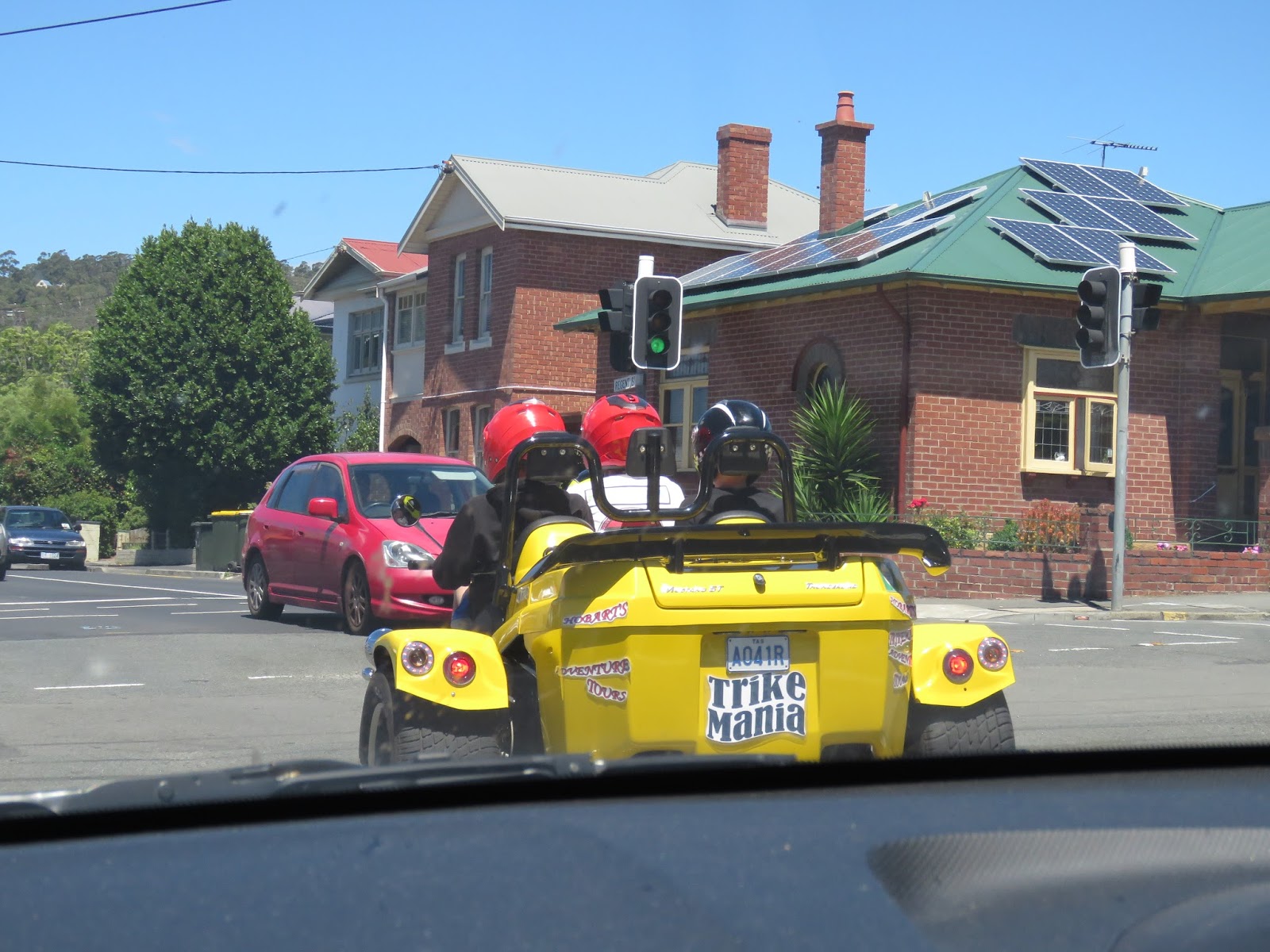
There must have been a “trike show” occurring in Hobart. Australians are quite the vehicle fans.

If we download a video or file, we have to place the laptop in the bedroom where the signal is stronger. Downloads are slow but overall its working and we’re now content.

I’m rushing today to be done with this post by 10:00 am or thereabouts (once the game ends) when we’ll head out the door to a local popular tourist attraction that’s on our way to Huonville.  Watch for photos tomorrow!

Ocean view as we made our way to Highway A6 which leads to Huon Valley.

Once in Huonville we’ll check out the meat market, drop off the dead phone at a recycle facility, visit the health food store and head to Woolies for the few grocery items.

The sun is peeking out, the clouds are wafting away and today looks like it will be another gorgeous day. We’ll make a point of cherishing every moment and sharing it all here with YOU!

Have a fabulous day of your own!

Photo from one year ago today, January 23, 2016:

One year ago, shortly after birth, this baby alpaca was nursing. This is so sweet!  For more detail, please click here.

What do cherries and helicopters have in common?…Photos close to home…

While we were preparing dinner, we heard a noise from a helicopter. 

A few nights ago, as we were preparing dinner, we heard the roar of a helicopter in the vicinity. Immediately outside, we were shocked by how close we were. 

We watched in wonder as the helicopter turned, making several swipes of the massive net.

At first, we assumed it had been dispatched to a nearby medical emergency when getting to a hospital in Hobart in a 45 minute drive from this area. 

Anne explains that the helicopter’s roaring blades, dry out the net to prevent cherries from spoiling after the rain. Who knew?

Were we surprised when we observed its intent, to dry the cherry trees located beneath a massive series of nets protecting a grove of cherry trees across the street from our vacation home.

Finally, with its task finished, the helicopter was on its way, possibly to other similar cherry trees or other fruit farms.

From this news story, it was evident this is a costly solution for farmers hoping to dry their cherry crop after heavy rains, before they’re destroyed from too much moisture as described below this photo, in part from a story published a few years ago.

A black duck on the dock.

“Helicopters are busy today in the Huon Valley helping orchardists save the remaining cherry crops after a severe rain event.

Farmers in southern Tasmania assess damage to fruit crops as a result of heavy rains and estimate that up to 70 per cent of the remaining cherry crops could be affected. Parts of the Huon Valley received more than 70 ml in the deluge on Tuesday night, which hit cherry growing areas at the wrong time. (Continued below).

This lily couldn’t be more exquisite.

Howard Hansen of Hansen Orchards was supposed to start picking fruit this week, but said the rain damaged most of his crop. This morning a helicopter was used to get water off the cherries, and down the road at Lucaston Park it was a similar story.

Matthew Griggs called in a helicopter at first light to hover above the cherry trees and keep them dry.

Park bench on the grounds for lounging while enjoying views of the Huon River.

“We still have around 80 tonnes to pick and many of the cherries left on the trees have split because of the rain,” Mr. Griggs said.

Mr Hansen said the rain was good for the upcoming apple harvest, but would not make up for the damage to the cherries.” (The remainder of the story is here).   (Continued below).

Beautiful Huon River views.

We contacted Anne to confirm our suspicions and indeed we were right, the helicopter had been hired by the cherry farm owner to make many passes over the grove after heavy rains. This must be a pricey solution, but it certainly makes sense.

Seagull on a post at the end of the dock at the property.

How little we know about farming! And yet, we’re both fascinated by farms for both their crops and livestock as we’ve shown in many of our posts. Most recently, we were in awe of a pig farm in Penguin, Tasmania. Please see this link for details on the Mount Gnomon Farm.

Tom checks out the dock.

As we travel through country after country during our worldwide journey, in this case the state of Tasmania, Australia, we feel fortunate to have an opportunity to learn about farming. How did we spend nearly a lifetime consuming produce and animal products with so little knowledge of many of the major aspects of farming?

Huge daisies growing on the grounds.

Today, with Anne’s assistance and Telstra, the provider, we’re addressing some of the Wi-Fi issues we’re experiencing. Hopefully soon, we’ll have a resolution.

Have a great day!

Photo from one year ago today, January 22, 2016:

This modern kitchen had everything we needed in New Plymouth, New Zealand when we lived on the alpaca farm. For more interior photos, please click here.

Historic site in Hobart…The “Tench,” The Penitentiary Chapel…

 Clock tower at the Penitentiary Chapel Historic Site in Hobart, Tasmania.
The concept of visiting the prison chapel based on its historical value as part of the Tasmanian National Trust challenged both of us. 
The view while driving toward Hobart from the south.

Tom, an avid history buff and I, the proverbial amateur photographer, found the prospect of visiting this facility located in downtown Hobart, the capital city of Tasmania, befitting our combined interests.

The actual penitentiary itself, the “gaol” (pronounced jail) was torn down in the 1960’s leaving only a portion of the prison, now referred to as the Campbell Street Prison and Law Court which included some cells, the law court, the gallows and the chapel. 

Living for six weeks in this somewhat remote region of the Huon Valley, in the town of Geeveston, we mentioned in an earlier post, has a population of less than 1500. Traveling the 45 minutes to Hobart makes sense given our desire to know more about this outstanding island and its treasures.

The gift shop at the entry to the historic building.

Since arriving in Tasmania on December 3rd, and after having been aware of the fact that many convicts were sent to a variety of Tasmanian prison facilities, The Tench was on our radar. Although not mentioned in the quotation below, La Chapelle du Pénitencier and its rich history fall well within the field of intrigue as explained in the quotation below.

The tour began with just us and another couple in a class setting where our guide, Merilyn, explained the history of the establishment.

From this site: 

Tasmania’s convict history tells a tale of crime, punishment, hardship and survival in some of the harshest, yet most beautiful places on earth. More than 70,000 men, women and children were transported to Van Diemens Land in the early 1800s and many of the places and elements they constructed are still standing today. (Continued below).

A replica of a punishment imposed on the disruptive prisoners by which they stood in those severed spaces turning a large barrel for hours at a time.

There is evidence of the past of Australian detainees, no matter where you go, making Tasmania the ideal place to learn about and experience first-hand the beginnings of Australia. In fact, five of Australia’s eleven World Heritage Sites are located in Tasmania.  (Continued below).

View of the external wall of the facility.

The Port Arthur Historic Site is Australia’s most famous correctional facility, while the nearby Coal Mines Historic Site was Tasmania’s first mine, operated by over 500 inmates. Mining ruins and relics can now be explored in the surrounding fields.  (Continued below).

Door knocker at the entrance to the gaol (jail) at the Campbell St. entrance.

In Hobart, the Cascades Female Factory tells of the thousands of female convicts transported to Tasmania. On Maria Island, off Tasmania’s east coast, the buildings of the Darlington Probation Station date back to the 1820s and are set in a beautiful natural environment.  In Hobart, the Cascades Female Factory recounts the thousands of detained women transported to Tasmania.

Taken from a photo of a former entrance.

And in the north, the stately Brickendon Convict Village and Woolmers Estate are extraordinary testaments to the hard work of convicts assigned to private landowners.  (Continued below).

Taken from a photo of a small portion of one of the prison yards before this area was torn down in the 1960’s.

Other convicts highlights include Sarah Island in Macquarie Harbour and the convict built bridge in Richmond.  As well as these, there are lots more convict sites across the state – in fact, a visit to just about any of our earlier towns will reveal the hard labour and skilled craftsmanship of Tasmania’s convicts.”

The historic court where accused criminals were processed.

Warmly greeted at the entrance office by Joan, a 20 year volunteer at the historic site, we appreciated being hosted with our enthusiastic intent of sharing this vastly interesting and significant piece of Tasmania and Hobart history with our worldwide readers.

A portion of the facility was designated as a residence for the magistrate (judge) which later became holding cells.
Closer view of Court One where the First Seating transpired on April 17, 1860 before His Honour Sir Valentine Fleming, Knight, Chief Justice. This was the continuation of the trial of Julius Baker, charged with four counts of shooting with intent to murder who was sentenced to death and hanged at 8 am on Thursday, May 10, 1860.

After a short wait, Merilyn, our tour guide and also an 8 year volunteer, escorted us and one other couple who joined us shortly in the presentation, on what proved to be a highly informative and professional presentation lasting for over 90 minutes.

Jury box.

We wandered from area to area at times over uneven ground, ducking under shallow ceilings and stairwells and a variety of tight spaces, all of which further fascinated our innate curiosity.

Stairway in the court that led stairway on the court that led to the tunnels where prisoners were held awaiting trial. We walked down these steps to inspect the cells below the tunnels where prisoners were held awaiting trial.

Merilyn spared nothing in sharing her knowledge of the facility coupled with a strong sense of compassion for the primitive and horrific nature of the facilities which were in use until the 1980’s.

We took this photo from a CCTV of the mechanism of the historical clock which remains functional.

The town of Hobart was determined to get such a housing of dangerous convicts away from the center of the growing metropolis. In 1960, the majority of the penitentiary was bulldozed, with only the chapel, courts, gallows and some cells remaining today as a site recognized by the National Trust of Tasmania.

Bell on display with other memorabilia from 1936.

The colonial masterpiece once consisted of most of the frontage of two city blocks between Bathurst and Brisbane Streets. Today, all that remains are the small group of buildings on the corner of Campbell and Brisbane Streets.

Organ in the chapel.

In addition, today there remains the base of the remnant of a high sandstone wall that once enclosed the Hobart Gaol on the Campbell Street side.

This bathtub was used by prisoners who bathed once a week, one after another, using the same water.
Goal cell door.

Looking back today, Hobart may have benefited by keeping the entire facility intact for its potential as a tourist attraction further enhancing the appeal as a destination site, generating more revenue for the entire area.

Seating in the chapel, built in 1831 and 1833 could accommodate 1500, was built over a variety of solitary confinement cells some of which were so small the convicts were unable to stand.

However, the remaining structures of “Tench” a nickname generated by the convicts for the Penitentiary in the 1800’s, has a considerable appeal for history buffs.

Some crumbling cells remain able to be observed by visitors.

After the tour, one feels a powerful sense and understanding of its historical significance and the treachery of life for those who were so unfortunate to have violated the laws of the period and brought harm upon others.

The small size of the cells may be determined in this photo.
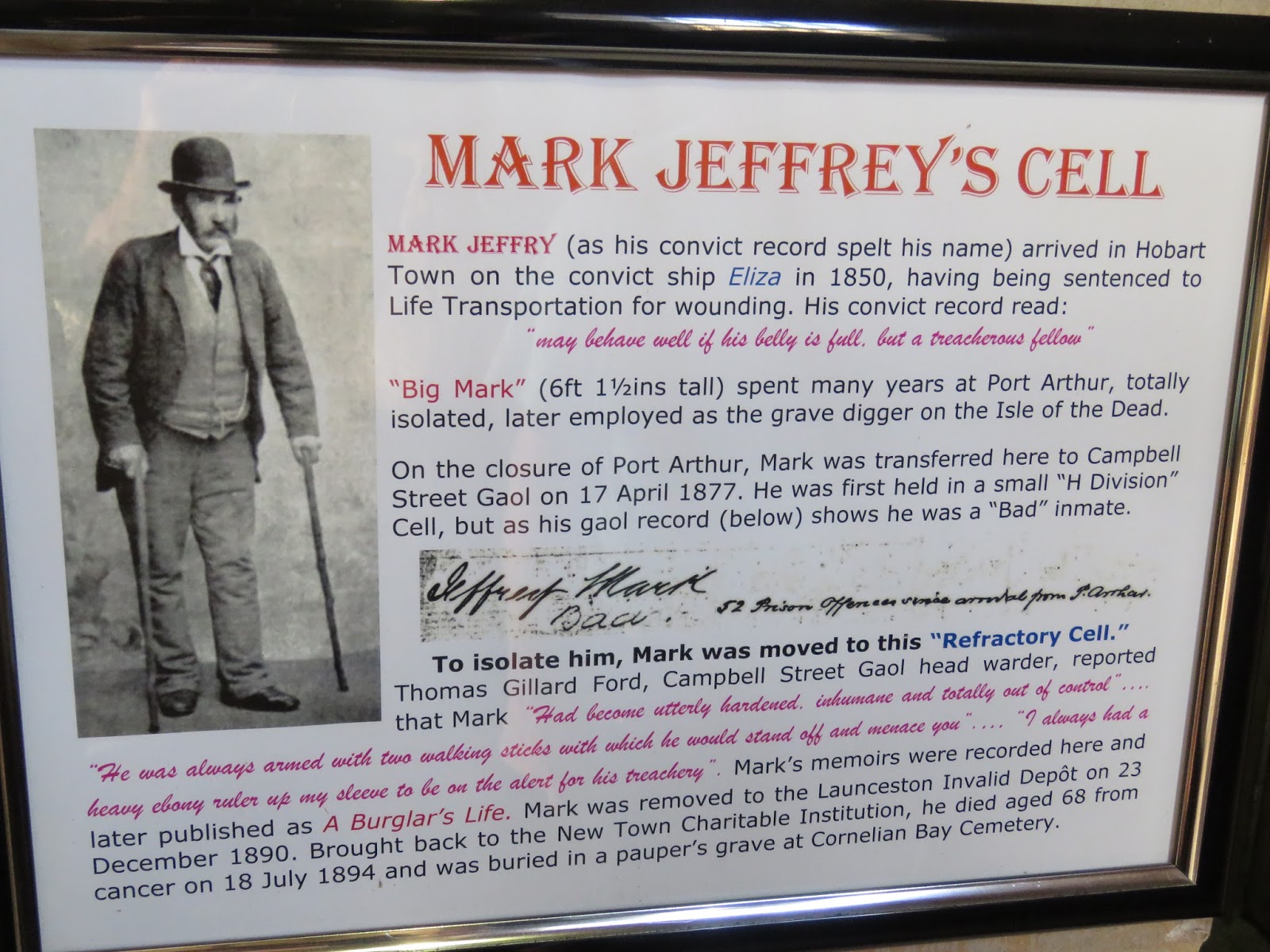
The story of a famous prisoner, Mark Jeffrey’s who’s cell was presented on the tour.

After the tour we lingered in the garden taking photos of plants and flowers which we’ll share in future posts as time and space allows.

The gallows remain today. We stood in this area with both a sense of awe and horror.
Taking a bathroom break before our tour, Tom insisted I check out the “Heritage” toilet. He always teases me that he’s “pulling my chain” to which I add, “I don’t have a chain!” This is the type of chain he’s referring to.
A special thanks to Joan and Merilyn for sharing this special site with us and for the opportunity to share it with our worldwide readers. Hopefully, next time you’re in Hobart, you’ll take the time to visit this historic site.
Photo from one year ago today, January 21, 2016:
As soon we arrived at to our new home, we began taking photos of these wonderful creatures which we thoroughly embraced over the three months we lived on the alpaca farm in the countryside in New Plymouth, New Zealand. For more details, please click here.

Trip to Hobart on a perfect day in Tasmania…Noctunal awakening…Clarification on our “one year ago posts”…

A perfect yellow rose from the flower garden in the yard.

During the night I awoke at 2:00 am, wide eyed and bushy tailed. Finally, by 4:00 am I drifted off, awakening at 6:30. As a whole, I slept about five hours. As a result, I lounged in bed this morning unable to fall back to sleep, instead reading the news on my phone. 

The main street in Huonville as we drove along our way to Hobart, approximately 45 minutes from our holiday home.

In the past year I’d read several articles stating that it’s in our human DNA to awaken during the night such as explained at this website as follows:

In the past year I have read several articles stating that it is in our human DNA to wake up during the night as explained on this website as follows: “Humans slept in two four-hour blocks, which were separated by a period of wakefulness in the middle of the night lasting an hour or more. During this time some might stay in bed, pray, think about their dreams, or talk with their spouses. Others might get up and do tasks or even visit neighbors before going back to sleep.”

While we were driving down the road to Hunonville, the scenery was exquisite.

It is heartening to know that waking up at night is neither unusual nor harmful at the end of the day. The trick is to get enough sleep to function well in the daytime. 

There is no shoulder on the road from our vacation home to Huonville. As a result, we’ve had to take photos while moving, always a tricky proposition.

Last night I didn’t get enough sleep, leaving me to lounge in bed this morning longer than I’d prefer. Subsequently, I didn’t sit down to begin today’s post until two hours after my usual starting time. 

Huon River.

Preferring to upload the day’s post prior to noon (our time) I’ve decided to postpone the time consuming story I prepared and upload tomorrow regarding yesterday’s visit to a worthwhile historical visit in Hobart where we spent most the afternoon.

Huon River through the trees.

After the enjoyable trip to Hobart we’re determined to return once a week, weather providing, to explore more of its wonders. It’s quite a city, unlike any other we’ve visited in the past. 

Cloudy and overcast views of a few boats moored on the Huon River.

As a matter of fact, Tasmania is unlike any location, we’ve visited in our 51 months of travel. It will be hard to leave in five weeks, but then, we have so much to look forward to in the future.

More sailboats moored on the river.

A point we wanted to discuss today, is the “year ago post” at the bottom of the page of each day’s post. Most of our posts reference a particular activity on which we’ve embarked as a result of an experience of a prior day. Thus, when we display the “year ago photo,” it was actually taken the prior day.

The Huon River is very wide in certain areas.

As an example, today’s “year ago photo” as shown below was taken on January 19, 2016, not on January 20th which it is today on this side of the International Dateline. This further adds to the confusion for our readers in the North America, Europe and South America where today’s date is January 19th, not the 20th as it is here.

Calla Lily grows in Anne and Rob’s flower garden.

To sum this up, the “year ago photos” are generally taken the prior day or during the prior few days. We attempt to stay as current as possible in all of our posts. If you have any questions regarding the time frame (or any other topic) for any of our posts, please feel free to contact us.

This flock of pelicans and other birds appear to be standing atop of the water when they’re actually standing in shallow water.

Today, it’s raining again and we’ll stay indoors simply enjoying this lovely property, our gorgeous surroundings and each other’s companionship. It’s a good day!

May you have a good day as well.

Photo from one year ago today, January 20, 2016:

Although far and few between, we stopped at a few scenic overlooks in the rain on the drive from Auckland to New Plymouth, New Zealand, where we stayed for three months on an alpaca farm. For more details of our arrive and a few kinks we had to adjust to, please click here.