Two weeks and counting…Preparations have begun…Another unusual item in photos…Pandan aka Fragrant Screw Pine…

Pandan leaves from the Pandan Plant are used to make these beautiful fragrant bouquets. As quoted from the owner’s written material: “The leaves are used in Southeast Asian cooking as well in making the “flowers” which act a repellent to roaches. In addition, Pandan leaves are said to possess medicinal benefits containing tannin, glycosides, and alkaloids. The scents emitting from the flowers last a week and may be used as a freshener in cars, homes, or washrooms.”

Next week, we’ll return to the travel agency, Flight Centre, at the Smithfield Mall where we’ve booked several upcoming flights with rep Helen in and out of Australia and Fiji. At that point, we’ll prepay for our baggage for these flights with both Qantas Airlines and Fiji Airways.

In order to prepay our baggage fees with tougher restrictions with Fiji Airways than Qantas, it’s important we don’t overestimate the weight of our bags. With our handy travel scale that also doubles for weighing ourselves, Tom first weighs himself while I note the readout and then he weighs himself again, holding the bag.

These handmade Pandan Plant bouquets were being made as we watched the gifted crafts woman, proud of her handiwork. The smell was exquisite.

Generally, each of our checked bags weighs under 23 kilograms, 50.7 pounds, we weren’t charged an additional fee. However, we’ll have to pay for our third bag carrying our shoes, my boots, and a wide variety of supplies which often weighs another 23 kilos.  For that extra bag, we’re often charged an outrageous fee, varies by the airline.

An instruction sheet at the Pandan table.  Interesting.

In reviewing the items in that third bag, we don’t see how we can reduce its weight. If we’d be able to replace the items elsewhere, we would. But, many can’t be found on tropical islands or at remote locations. 

What a gorgeous orchid, one amongst many offered for sale at Rusty’s Markets.

This third bag contains various power cords, power adapters suitable for many countries, power strips, a portable scanner, emergency medical and dental supplies, a few month’s supply of toiletries, a few bottles of vitamins, probiotics, business cards, and shoes, all of our shoes, with five pairs for each of us. 

We stopped to sniff the wide array of organic soaps scented with essential oils.  The smells were intoxicating and I was tempted to buy a few.  Tom reminded me that we’ll easily spot items such as this in the open markets in Fiji.  I agreed.

Recently, I rummaged through that bag, removing every last unnecessary items, any we may be able to find at a local store. While here in abundant Australia we’ve been able to restock a few items we won’t be able to find until we return to Australia next year.

A diner made from an older caravan/travel trailer selling Thai foods. Tom scoured the menus wondering what-the-heck he’s going to eat when we get to Thailand in about a year.

Feeling concerned about the weight of my one large bag, especially when I’d purchased a few items both here and which arrived in a shipped box from the US a few weeks, it was time to pack and weigh my bag.

Hot food must be popular when these bunches of chilies (note spelling above) are offered for sale.

Last week, I took all my clothes out of the cupboard, neatly folding them, tossing no less than 3.6 kilos, 8 pounds of old and worn items none of which are in good enough condition to donate. This pile easily compensates for the new items. 

Yesterday, I did a “trial run” on the weight of my bag, packing every single item except what I was wearing, later removing what I’d need over the next few weeks. Tom weighed my bag and it came in at almost 20 kilos, 44 pounds. When the time comes, I won’t have any trouble rounding it out up to the allowance.

A refrigerator case of vegetarian-only baked goods and meal.

Tom has yet to do his bag, but he will before we head back to the travel agency at the end of next week to prepay the baggage fees.  Sure, we could do this ourselves online, but Helen, the rep, has a better wifi connection and can do it more quickly. We expect the fees to run at least AUD $800, USD $584, an amount we’re prepared to pay for the five upcoming flights.

Many readers still prefer to read a “real book.”

We always recall the excess weight baggage fees we paid when we had zillions of bags at the airports in Dubai, Venice and Istanbul. Having since greatly reduced the load, we’ve been able to get by with only paying for the third checked bag, usually running at about AUD $343, USD $250.

Screen printed tee shirts or night shirts in longer lengths.

As we often say, “It’s the nature of the beast,” a reality we faced long ago. From time to time, we hear stories of world travelers managing with carry-on bags only. We admire their ability to do so. But, most of those travelers are eventually return to a home base where they can repack in order to continue on.

After we’d toured the main area of the under-cover market, we wandered the perimeters finding more products for sale.

Our needs aren’t quite as sparse as those of most travelers. When checking out my relatively small amount of clothing, all that I own, I’m pleased for having reduced it to this level. Tom has an equal amount of clothing in his bag.

The shops continued on the street side of Rusty’s Markets.

We have less clothing and bags than the average traveler on a two week holiday/vacation from what we’ve seen of other travelers on cruises, at hotels and at airports. We willingly pay the extra fees understanding that it’s our choice to remain well equipped, spending little time shopping in each locale for items we’d have difficulty finding.

Gerbera Daisies, a favorite from the old life.  We don’t purchase flowers these days.

In the next few days we’ll head to the mall to grocery shop for the second to last time and to search for a cardboard box to use for the food items we’re accumulating to ship a few days before departing for Fiji. In many cases, as we travel the world we don’t need to ship food items with health food grocers readily available in most countries. 

Although we don’t eat fruit, we’d never seen this champagne honeydew melon in our travels.

In contacting Mario, the manager of the property we’re renting, he explained that there are no health food stores in Savusavu, Vanua Levu which we further confirmed researching online. We sent him a list of the items we use and he explained what is available and what is not. 

Mario explained that organic unrefined coconut oil is available at every shop, but ground flax meal is not. We’ll be lucky to be able to replace a bottle of vitamin C while on this remote island.

We could smell the sweet scent of these tangelos as we walked by this display.

My health club membership expired yesterday making no sense to sign up for another month. I’ll do some resistance exercises at home in the interim also planning a few walks in local parks and reserves. Walking down and back up the long and steep driveway to the trash bins is a high intensity interval training (HIIT) exercise in itself which we do every few days.

There are tons of bananas and other fruit available at Rusty’s Markets in Cairns.

Today, we’re sharing another batch of some of the remaining photos from Rusty’s Markets. We’re still reeling over the fulfilling experience while I continue to savor appetizer plates of the products we purchased from Fetish for Food. Tom? Not so much with his picky taste buds.

We plan to do a little more exploring this week as we wind down our time in Trinity Beach, sharing more photos over the next few weeks. As always, on the day of our departure on September 7th, we’ll be posting the total expenses for our three-month stay in the Cairns area.

                                             Photo from one year ago today, August 24, 2014:

Our last shot of Oxford, England as we prepared to leave the area. For more Oxford photos, please click here.

Part 2…A popular tourist attraction in Cairns…Beyond expectations…Wish we’d visited sooner….

Not the most flattering photo of us. But, we couldn’t resist including a photo of us tasting the Mimolette cheese we’ve written about today, know for its “mites’ that live on the outside of the cheese as it ferments. The US has concerns over “bugs” on cheese.  See story below.

We love the unusual, the peculiar or anything that deviates from the mundane and the expected. Whether it be an animal, a plant, a sunrise or sunset that varies from that which we’ve seen in the past.

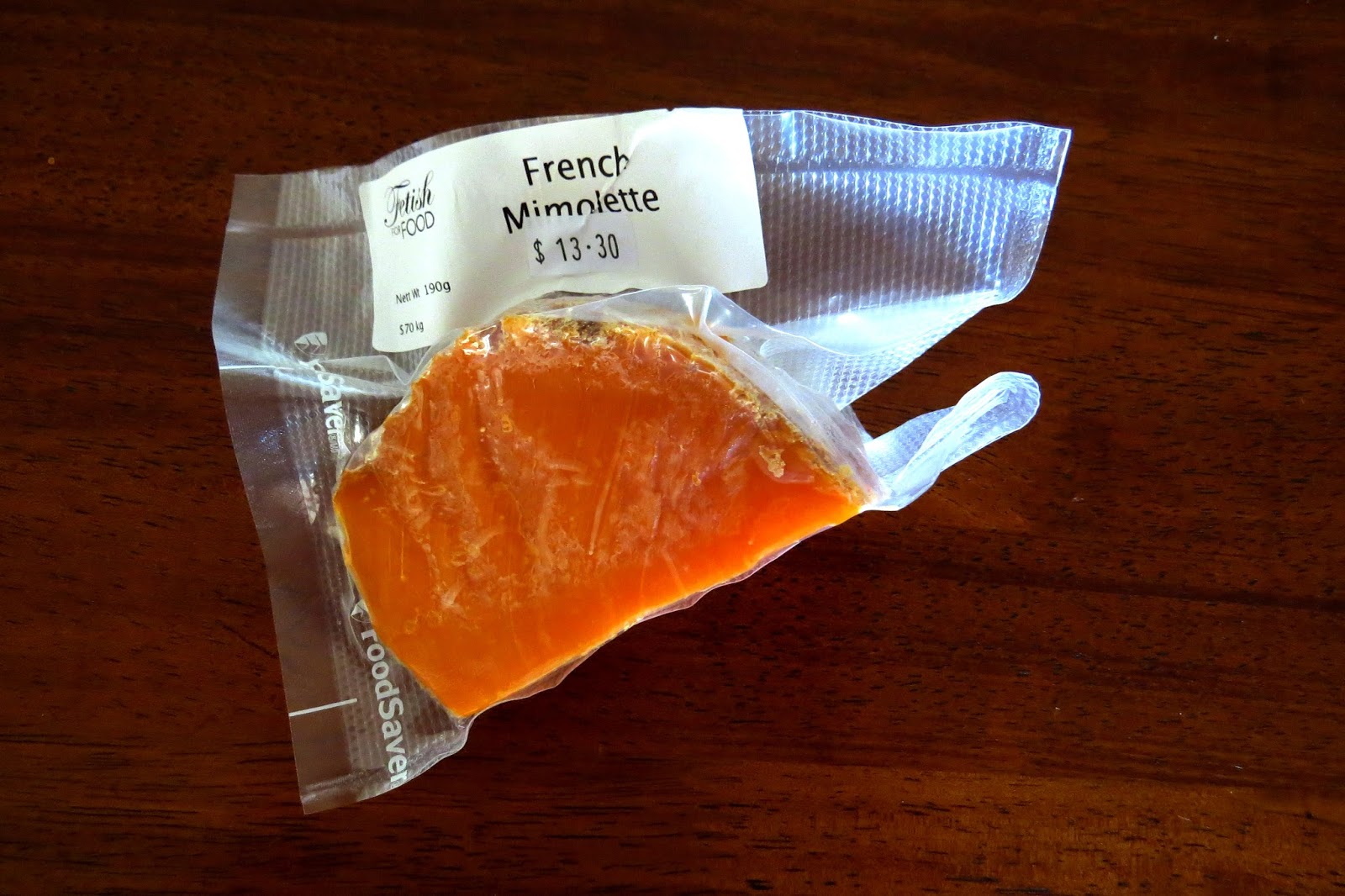
This 190 gram chunk of Mimolette Cheese was priced at AUD $13.30, USD $9.73, certainly no more expensive than a chunk of quality Parmesan.

Perhaps, that’s one of the many reasons why we decided to travel the world, a reason we’ve discovered has escalated as our journey continues. What tidbit can we discover along the way that finds us in awe of the world around us? It all boils down to the concept of “what is unique to us?”

We purchased these items at Fetish for Food at Rusty’s Markets. The total cost was AUD $77.65, USD $58.83.  In the center is a container with fresh mozzarella balls which we’ll use soon to make stuffed Italian meatballs with sugar free pasta sauce and Parmesan. After tasting the Mimolette, if we grate it, it may work perfectly to finish off the dish.

Those who know us may laugh when it comes to admiring each other. What’s so unique about each other maintaining our interest and enthusiasm in being together, day after day, year and year in such tight quarters?  It’s all a matter of perception in one’s own eyes. I find this man with an inordinate amount of willingness to adapt, of openness and of generosity of spirit at my side each day.

He may find similar types of qualities in me. But mostly, I perceive he likes that I don’t complain and I don’t do drama. Collectively, the humor, the teasing and the playful banter contribute to the ongoing pleasure of one another’s companionship. That’s unique, maybe not so much in the realm of the world, but it is to us.

Foie Gras is one of my favorite food items. This tiny piece, of which I savored half yesterday afternoon was AUD $14.30, USD $10.47, was delicious, even without crackers or bread.

Whether its in looking for and finding vacation homes, places to explore and people we meet, we naturally gravitate toward that which varies from the “norm” even if only to a miniature degree in the eyes of others.

As we wandered through Rusty’s Markets our eyes, trained to scan for unique items we stopped to investigate, inquire and take photos when possible. We’ve learned over these past years certain vendors don’t want photos taken of their products. This has been especially true in Muslim countries based on religious beliefs we respectfully honored without question.

This taste of this delightful Chicken and Black Peppercorn Pate stayed with me for hours as I often thought of going back for more, instead saving the balance to enjoy for a few days. This was priced at AUD $9.35, USD $6.84.

Many of the most unique fruits and vegetables were for sale in such owned displays causing us to proceed with our photo taking with caution. Although, without taking photos we were able to enjoy our perusal of the most unusual items. 

In our search for the most unique item we were enthralled when visiting with Nick Down at Fetish for Food. We couldn’t resist but load the counter with what appeared to be delectable choices to take home when he noticed me staring at a unique item in a display case, Mimolette Cheese.

This Brie Cheese with Truffles is a rare treat.

Nick chuckled when he saw me admiring the “unusual” color, a bright orange, when all the other cheese were varying in shades from bright whites to yellow. At first I thought it may be a type of cheese made with a pumpkin flavoring contributing to its odd color.  

Nick proceeded to explain Mimolette’s unusual story which definitely caught our attention. There was no way we were walking out of his shop without buying that chunk of Mimolette Cheese and we looked forward to conducting a bit of research on this unusual product when we returned home.

(I should mention a phenomenon here in Australia at this point; cheddar cheese here is not orange. It’s a natural off white color. They don’t use dye in their cheese to color it. When looking for grated cheddar cheese for our grain-free taco salad, I have to read labels, unable to easily spot the orange-tinged cheddar cheese).

After considerable research I found this wonderful article, although dated, from NPR detailing exactly what we wanted to learn about Mimolette Cheese:
“Tiny Mites Spike Big Battle Over Imports of French Cheese
May 11, 2013

by Deena Prechep

The Food and Drug Administration is currently embroiled in a surprisingly heated culinary standoff — pitting French cheese-makers (and American cheese-lovers) against regulators, all because of one very small problem: cheese mites. Cheese mites are microscopic little bugs that live on the surfaces of aged cheeses, munching the microscopic molds that grow there. For many aged cheeses, they’re something of an industry nuisance, gently brushed off the cheeses. But for Mimolette, a bright orange French cheese, they’re actually encouraged.

The mites munch on the rind for a few years and then are removed — usually with a blast of compressed air and a bit of hand-brushing — before Mimolette is sold. But there are always a few hiding behind. And now the FDA is cracking down.

According to the FDA’s Patricia El-Hinnawy, there’s no official limit, but the target is no more than six mites per square inch. For Mimolette, that’s a near-impossible standard.

Benoit de Vitton is the North American representative for Isigny, one of the largest producers of Mimolette. In March, de Vitton began receiving letters from each of the dozen importers he works with, saying that their Mimolette shipments had been detained.

De Vitton estimates that he now has about a ton of cheese sitting in FDA warehouses in New Jersey. “They say the product, because of the mites, it is not proper for human consumption,” de Vitton sighs.

Ironically, de Vitton notes that Mimolette itself is rumored to have been created because of import issues in the 17th century. “The French were at war with Holland, and the king didn’t want any more Dutch Gouda coming to France. So he asked to create kind of the same cheese.”

But in the 21st century, do we need a cheese ban? Microbiologist Rachel Dutton runs a cheese lab at Harvard University, and we checked in with her about the dangers of mites. Dutton notes that there have been some reports of mite allergies, but they seem to be restricted to people who have come into contact with large numbers of mites.And Dutton says that while we may not like to think about bugs, they’re a part of what makes cheese so delicious.

“Cheese is absolutely alive,” Dutton laughs. And all of that life — the molds, bacteria, yeasts and mites — help make cheese what it is. Dutton says that the mites on Mimolette can contribute flavors of their own (they have a somewhat earthy smell), and by eating into the rind, they can also increase aeration — and the surface area in which the other microbes can do their work.

Dutton understands that this doesn’t sound appealing, but implores people to realize the good work of these bugs. “There definitely are microbes that can spoil food and make either it bad for you to eat or just sort of gross. But any time you eat a piece of cheese or a bite of yogurt, have a piece of bread or a glass of wine — these are all examples of foods fermented by different types of microbes.”

Throughout France, cheese lovers have been rallying in support of Mimolette. There are radio stories, YouTube videos — there’s even an ex-pat Save the Mimolette Facebook campaign (of course).

In America, the response is a bit more subdued. Some cheesemongers are buying up the limited supply, but most are content to shrug it off. Sasha Davies, of Cyril’s cheese/wine bar in Portland, is nervous about what the mite crackdown could mean for other aged cheeses, but in general is fine reaching for an aged Gouda instead of Mimolette.

“I find I can scratch the itch I feel for Mimolette with a lot of other cheeses,” she admits.

Davies says that the fervor for Mimolette isn’t just about its caramel notes or lactic tang or bright orange color.

“There are cheeses that — even though I think they taste delicious, they tug at my heartstrings, either because I love the person that makes them, or I have this great memory of being in a special place,” she says. “Food is never really just food.”

And for many French people, Mimolette brings a taste of memory, family and home — as well as mites.”

By no means are we cheese experts and, we were aware that mites may hang out on fine cheeses based on the education we received on long ago tour of the Cheese Factory in Belize.  However, we never realized the significance of mites as described in the Mimolette Cheese.

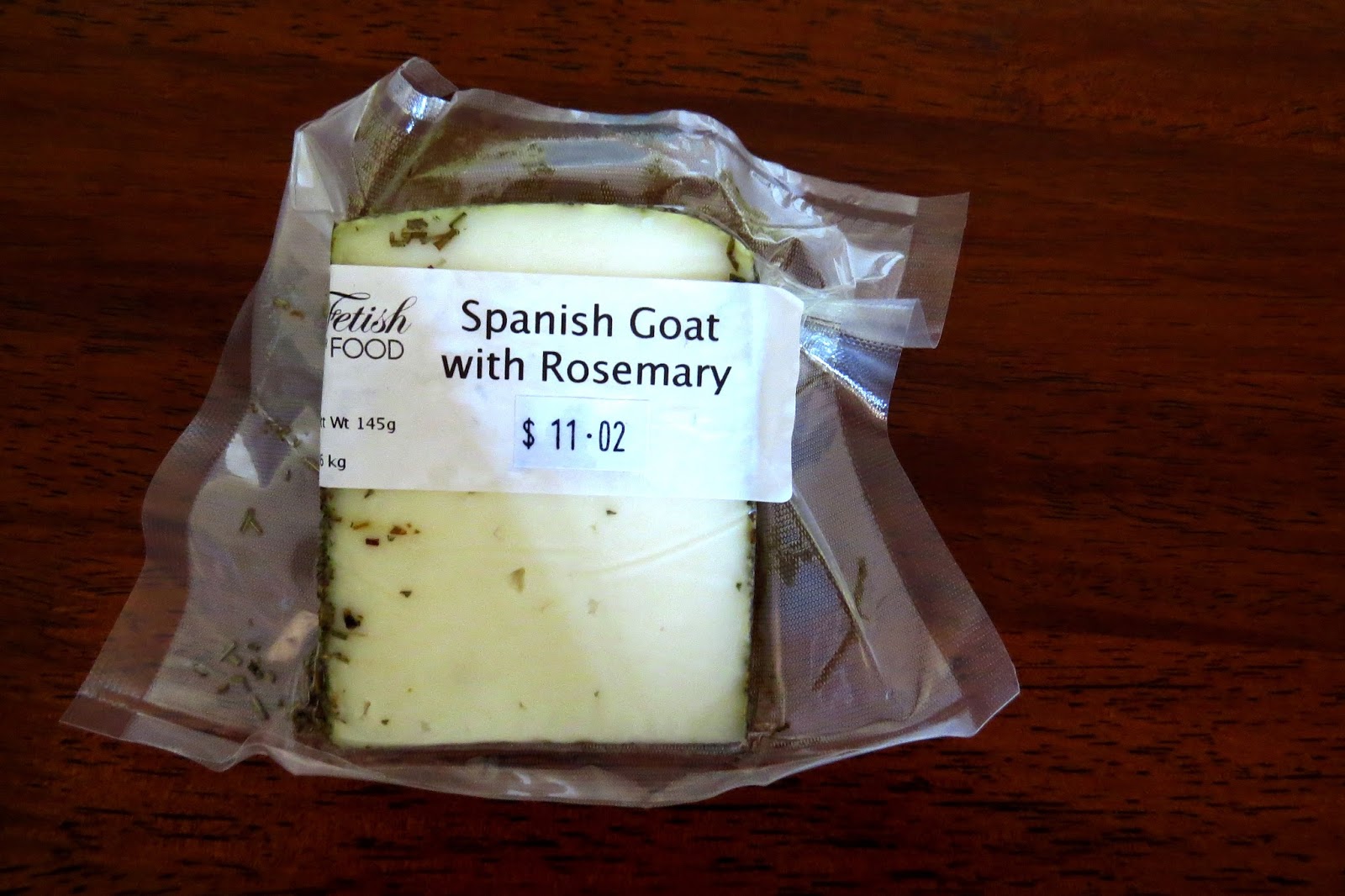
We’ve yet to unwrap and try this Spanish Goat Cheese with Rosemary saving it for another day.  It was priced at AUD $11.02, USD $8.06, another fair price.

It was irresistible. We purchased a good-sized chunk of Mimolette Cheese and this morning we tasted it for the first time. As described above, we loved its “caramel notes and lactic tang” or I should say, I loved it. Tom was less impressed when his tastes for cheese leans toward Kraft’s Individually Wrapped Slices or Velveeta.

When Tom and I first dated and on occasion I visited his home, I cringed when I noticed he kept a huge bucket of nacho dipping cheese on his kitchen counter, readily available double-dipping a tortilla  chip. On the other hand, back in 1991, I was shopping the gourmet deli counter at Byerly’s Market for fine import cheeses.

This morning Tom had a chunk of this non sugared smoked salmon with scrambled eggs, onions with his favorite local sliced cheese, Tasty brand with a side of nitrate-free “streaky”  bacon.  This price at AUD $8.95 was only USD $6.55.

As for the unusual, Mimolette Cheese was an interesting tidbit teaching us something new which ultimately is the benefit of seeking and finding those special morsels in our travels having an impact on our senses, whether its a taste, a smell, a touch, a sound or a sight. It all adds to the experience. 

Lots more new photos tomorrow!

Photos from one year ago today, August 23, 2014:

One year ago, we visited Oxford, England, the famous college town filled with one historic building after another. This is the Radcliffe Camera Building, “camera” referring to a “room” not a camera. For more Oxford photos, please click here.

Part 1…A popular tourist attraction in Cairns…Beyond expectations…Wish we’d visited sooner….

The sign outside the huge permanent farmer’s market in downtown Cairns, Rusty’s Markets, a popular tourist attraction as well as a favorite shopping site for locals.

Hindsight is 20/20. Had we visited the popular tourist attraction, Rusty’s Markets in Cairns earlier in our stay in Trinity Beach, we’d easily have returned on many occasions. (Click here for the map).

As soon as we entered Rusty’s Markets we knew we were in for a treat.

With easy to find and navigate free two-hour parking in a nearby ramp, we barely made it back to the car in time to avoid the overtime AUD $10, USD $7.73 additional hourly fee. Had we missed the two-hour window, the experience would certainly have been worth the fee.

Tropical flowers are on display in multiple locations.

Rusty’s Markets is a cacophony of mind-blowing shopping from a wide array of products including pretty summer dresses, handmade jewelry and crafts, and exquisite flower arrangements, to organic fruits and vegetables, meats, breads and desserts.

Having already purchased avos a few days ago when we grocery shopped I had to pass on these.

Countless casual restaurants with foods from around the world lined the perimeter including a makeshift food court where hungry tourists and locals gathered about sitting on uneven chairs and benches happily munching away on their favorites.

A mixed variety of goods are presented at some tables with specific items at others.

It was evident that most vendors are offering products as a result of ongoing hard work and creativity in developing their wares to perfection. With Rusty’s Markets only opened from 5:00 am to 6:00 pm on Fridays and Saturdays and 5:00 am to 3:00 pm on Sundays, it’s a full-time job for the vendors, managing their inventory and presentation of their products to ensure a seamless three days open to the public.

Fresh greens are for sale at many displays.

For the avid local shopper, leave room in your fridge and freezer and bring a small wheeling shopping cart in order to leave hands free for gathering the multitude of treasures. For the tourist, bring durable over-sized bags for other wares you may be unable to resist to bring home with lovely memories of the shopping experience.  Cloth shopping bags are available for sale.

Tom stopped and looked at the bread display. Nothing appealed to him. He hasn’t had a bite of bread in almost three months but continues to mention how much he missed toast and jelly.

Few times in our world travels have we found a market of this size and variety. Under cover of an enormous building, it’s a year-round, regardless-of-weather venue with permanent stations for its vendors. It’s clean, well lit, and relatively easy to maneuver.

Tropical fruits, roots, and greens.  Prices are reasonable for most items.

Luckily, we visited on a Friday as opposed to the most likely busier Saturdays and Sundays. We discussed how crazy it must be when cruise ships dock in the port of Cairns with 1000 or more cruisers arriving by bus to Rusty’s Markets. Cruisers notoriously are avid shoppers and Rusty’s would be pure paradise for most.

As we approached the counter at Fetish for Food we knew we were in for a treat.

Having grocery shopped only two days earlier and with our tiny fridge and freezer packed to the gills, buying vegetables were out of the question. I was so disappointed when I couldn’t purchase grass-fed meat or organic veg as I drooled over the free-range meat, free-range chicken, and organic produce lining row after row in the vast market.

Every refrigerated case is filled with food befitting our way of eating including smoked fish, sausages, nitrate-free streaky bacon, and delectable cheeses.

However, when we spotted a meticulously presented cheese and exotics foods display, aptly named, Fetish for Food, I felt like a kid in a candy store. When the owner, Nick Down, was free to spend time with us, we were delighted with not only his knowledge of every item in his inventory but his pleasant demeanor and surprisingly reasonable prices.

Nick explained interesting facts about the various cheeses one of which we’ll expound upon tomorrow with a shocking story. Who knew?

Finally, being in a shop where I could almost eat anything offered sent me to the moon. It reminded both of us of when in March 2013 we visited the Cave Branch Jungle Lodge as guests of the owner Ian’s fabulous on site Cheese Factory. Click here for the link from that day with many great photos of our memorable experience.

There are multiple cases all filled with local and imported cheeses.

At Fetish for Food, we couldn’t help but make a fair sized pile of products I couldn’t resist. Even Tom, unlikely to do more than taste these items, got into the selection process encouraging me to grab more and more.  With only a little over two weeks, until we leave Australia, it made no sense to purchase too much, a little of which I’ll have each day.

Once we arrived home, it was fun to review our purchases.  In total, we spent AUD $77.65, USD $58.83 which was less than we’d expected for these several items. Today, we’ll prepare an appetizer plate for a pre-dinner treat.

Tomorrow, we’ll be back with a story on a very unusual product we purchased at Fetish for Food regarding a type of cheese and bugs, an unlikely combination we found fascinating. The foodies out there will love this. The non-foodies…please humor me. But, even you may find it entertaining if not cringe-worthy.

Much of the cheese is imported from France, as we know, the cheese capital of the world.

Another vendor that caught our eye was Wild Nature Cairns, presented by the owner, Nicola whose gentle demeanor was surely befitting the natural skin and hair care products, natural makeup, and pure essential oil products, all organic and environmentally friendly.

In addition to meats and cheeses, Nick has a display of fancy condiments and oils.
In my old life, I’d surely have walked away with a bag of girlie treasures. In this life, I can’t purchase any of these items with a lack of space in my bag and the inability to replace the preferred items when they’re gone. 
Nicola, the owner of Wild Nature is dedicated and committed to the highest quality product she can produce, mostly made utilizing the healing and therapeutic Australian Aloe Vera plant.
These days, I purchase cosmetics in grocery stores and pharmacies. I have one drugstore night cream in my possession which I’ll replace with another when it runs out. If I need body lotion, I use coconut oil. 
Nicola’s products may be used for a variety of skin conditions. Visit her site at this link.

Finding these two wonderful vendors in the busy market among the produce, grass-fed meats, exotic pastries, and endless eateries only added to our extraordinary experience…slightly under two hours of pure delight for both of us.

Back at you soon with the unusual products, we found at Rusty’s Markets.

Photo from one year ago today, August 22, 2014:

This is the church where Matthew’s funeral was held in Bampton, England where Downton Abbey has been filmed over the years. For details on how this quaint village has been prepared for filming please click here. It was quite a story.

Thanks to many heartfelt responses from our readers via comments and email…

Parasitic plants growing on trees are a fascinating way nature provides for a plant that must “borrow” nutrients from thriving trees of many varieties.

What a pleasing response we had yesterday after our post concerning some negative comments from a reader.  We hope the many responses we received in the past 24 hours indicate a general consensus among our readers.

This is where we park the little red rental car.  The door to enter our property is slight to the right of the red car. Since we’re on ground level we have a full wall of windows overlooking the Coral Sea and the beauty of Trinity beach. Andy and Sylvie have two cars, one of which is their sports car shown here.  The open stairway to the right is access to their property above us.  (For security purposes I edited the photo removing the license plates).

If you’d like to read some of those comments, please check the end of yesterday’s post by scrolling down this page, bearing in mind that many readers prefer to remain more anonymous, preferring to send an email.  Either method of communicating with us is appreciated. 

Each day more and more of the leaves on these leaves turns orange. Although it’s winter now, the weather in Queensland is never cold enough for a feeling of a full fall season.

If at any time, you’d like to express an opinion or comment and prefer to do so privately, our email links are listed above the feature photo of the two of us at right top of the page. You can count on a response within 12 hours with the exception of our travel days.

In the US, we had houseplants of this type called Pothos, which were hearty plants that did well without much sunlight and only occasional watering.

Speaking of travel days, a few more are rapidly approaching. In a mere 17 days, we’ll be departing our comfy cocoon here in Trinity Beach to head for an overnight in Sydney, although we’ll be arriving in and out in the dark at 8 or 9 pm and flying out at 6 am with no time to revel in the beautiful city as we did when we arrived on June 11th.  Click here to see our photos of Sydney.

We aren’t disappointed to be unable to spend time in Sydney this time since, over the next 20 months, we’ll be back in Sydney seven more times! Surely, we’ll be able to see the city in more detail during a few of those between-cruises-overnight visits. Sydney is quite an exciting city and although we aren’t big city enthusiasts for the long term, it’s fun to see a big city in shorter stops.

Another tree similar to a houseplant growing on the trunk of a large tree, although the tree itself is of a different variety.

When our ship arrived in the Sydney Harbour early that morning of our arrival, we couldn’t get outside quickly enough. It was a breathtaking experience and most certainly, we won’t be able to resist posting more photos each of these upcoming seven times, the exception being this extra short eighth visit in a few weeks.

We weren’t able to get a direct flight to Vanua Levu, Fiji without waiting for many hours at a tiny airport on the mainland of Fiji.  Instead, we chose the overnight, albeit short, stay in a hotel in Sydney, located at the airport. We’ve found it less stressful and exhausting to try to sleep for a few hours in a hotel than try to sleep in a chair at the airport.

We spotted these red plants in Hawaii on all four islands called Ti Plants. From our loyal reader, Annie: “Cordyline fruticosa probably was native originally to SE Asia and Papua New Guinea, but was carried throughout much of the Pacific by early Polynesians who used the starchy rhizomes for food. Today ti occurs in eastern Australia and on many of the larger islands in the tropical Pacific, including the Hawaiian Islands. They seem to thrive in tropical climates.”  Thanks, Annie for the update!

We recall our intentions in our travels:  ease, joy, and simplicity, a part of our logo which should have included “low stress.” With all the most organized of plans, events may occur beyond our control. If the areas over which we have control are seamless, the unforeseen event will be more manageable. 

With upcoming plans to live in Bali beginning on April 30, 2016, we’ve stayed apprised of the numerous issues regarding canceled flights to and from Bali as a result of the continually erupting volcano, Mount Raung. These frequent eruptions have grounded all flights on countless occasions. 

We don’t recognize this plant with leaves green on one side, burgundy on the back of the leaf.

Should this occur when we travel to Bali, rather than spending days waiting at the airport, we’d prefer to get a hotel room wherever we may be and wait it out enjoying our time until we can board a flight avoiding feelings of stress and worry. 

That’s a luxury we’ve afforded, not due to willingness to spend the money but, more of a desire for stress avoidance which for us becomes a vital aspect of our health and well-being. Sure, there’s a price to pay for that option but we’ve budgeted for such occasions and don’t flinch when the necessity arises.

These sparse trees will be in full bloom once winter is over.

As we continue the remaining time in Trinity Beach, we’ve decided we prefer to continue to visit local sites as opposed to expensive boat trips or overnight mountain excursions. To date, we’ve seen quite a bit of the general area and would like to save a few activities for the future return to Cairns by cruise, hopefully planning an outing with other cruisers we meet aboard the ship or on cruisecritic.com.

It’s Friday here, Thursday for many parts of the world. Whatever day it is for you, may it be an excellent day that finds you well and content.

Photo from one year ago today, August 21, 2014:
Seeing this favorite photo again this morning made us smile when one year ago we visited Highclere Castle, the subject of the well-loved British TV series, Downton Abbey. Although no interior photos of the exterior were allowed with the owners still in occupancy, we took many photos of the gardens and exterior which can be found here. Tomorrow, in our one-year-ago photo, we’ll be sharing a photo and link of the quaint Bampton, the village where the in-town footage was filmed. Charming!

Negative comments from a reader…Torn about responding…

Sunrise over Trinity Beach.

It’s a rarity that a reader sends us a negative comment. When it does occur, perhaps once a year, I struggle over whether or not to post the comment or to ignore it.

Long ago, we wrote that the intention of our site is about joy and fulfilling dreams, not an arena for negative comments and bantering back and forth in disagreement over topics or comments we’ve made. That doesn’t mean we shy from a discussion. But, in doing so, kindness is always of the utmost importance.

We don’t express political or religious views or present any negative comments regarding any person’s beliefs or preferences. From time to time, I may discuss frustration over the food industry’s money orientated goals of presenting chemical-ridden foods at us in the US markets. If this offends anyone, that’s never been our intent.

Over these past 41 months, since we began posting, we often mention the recovery of health I’ve experienced from changing my diet, a choice I’ve made for life. Tom joined me in this path except when on cruise ships and dining in restaurants.

Through sharing recipes and resources through books and medical research documents, we’ve had an enormous response from readers all over the world who have chosen their own path through their own research. 

In dozens of cases, readers have written to us via private email requesting the book list we compiled that helped me discover my own path which if they choose, may prove to be beneficial for them. 

We never claim to be medical professionals or experts in any of these fields. We always encourage readers to seek professional assistance in choosing their path to improved health. 

We’re simply laypeople, literally hungry to learn ways in which we can extend the quality of life in our senior years, which ultimately adds to the joy of continuing our world travels, hopefully for years to come.

Yesterday, when I received this comment, I struggled over whether or not to upload it to the site. The reader wrote:

“Your husband is right. You obsess over food. It’s annoying and will probably mean I quit reading altogether. I read only about the first couple of paragraphs of this page, scrolling down, and when I came to the recipe, scrolling faster.”

Here is the link to the post on which the above comment was made. (Oftentimes, readers are “catching up” reading posts from months or years ago). This post was uploaded in March 2014 but the comment arrived yesterday. If you’ll click the link to this post and scroll to the bottom of the page, you’ll see comments made by other readers at that time. 

I didn’t post the above reader’s comment online in the “comments” section at the end of the post. I didn’t since it included her name and to avoid publicly using a person’s name to address an issue, I am posting it here without the name.

Now, for my response to the reader which I assure you is done so, not with the intent of criticizing the reader but to address what may in fact be an issue for some of our other readers…our ongoing discussions of food:

Undoubtedly, I make frequent references to food including the shopping, quality of products, my perceived healthfulness of products, our way of eating, recipes, and often photos of meals we’ve had in restaurants or cooked “at home.”

As all of our readers are aware, changing my diet changed my health to such a degree it allowed us to travel the world. Had this not happened, we’d never have been able to travel. I won’t go into all of that again. Most of you know the story.

But, traveling the world is often a story about food and culture. In reading many travel sites, we often find ourselves admiring food photos and stories since for many travelers, it’s all about the food, the great restaurants, the fabulous finds of the “tucked away” spot that filled their bellies and hearts with love and joy, often a treasured story they’ll tell for years to come.

For us and the limitations of my way of eating, we tend to stay away from restaurants in some countries which are more inclined to use flour, sugar, and starch in the preparation of food. 

This reality definitely hinders our experience to a degree. In a way, it’s a limitation, not unlike those that many people experience at some point in their lives. And, we chose to adapt to the best of our ability…finding homemade food, grocery shopping, and recipes bringing us that same kind of pleasure.

Yes, I’m obsessed with food. Always have been. Always was a great cook and loved to entertain. It’s a hobby. It’s a passion. Food is love. And now, for us, food is medicine. And yes, Tom occasionally reminds me about my passion, obsession, and hobby as he gobbles us the next plate of fabulous food, thanking me for a good meal.

Another important point for us, perhaps beyond our personal enjoyment of food is the hundreds that have written to us over these 41 months that have asked for booklists, information on medical research, and recipes that they may decide to peruse in their own search for renewed health. 

If in this process, only one person through gaining inspiration in reading our posts has found a solution through a diet that has improved their health, every single one of the 1112 days that we’ve sat here writing and researching will have been worth it. 

As for the recipes, there are literally hundreds of people that have written to us requesting recipes for a meal we’ve mentioned or a food photo we’ve posted. Instead of spending the recipe via email, knowing there are others less inclined to write, we post the recipe online.

If this above-mentioned one reader decides to stop reading our posts that’s a personal choice and we’re saddened by that decision. It’s easy to scroll past those points that one may find less interesting or desirable to their owns tastes and interests. 

Our goal is not singularly about food. If you’ve had an opportunity to read the posts of the last several days regarding safety it’s evident that is the case. We strive to provide a wide array of topics that may appeal to all ages, those who sit at their kitchen table each morning, a cup of coffee or tea in hand, that travel along with us. 

We feel your presence and appreciate every single one of you.

Photo from one year ago today, August 20, 2014:

We visited the Victoria and Albert Museum for an excellent educational day. For more photos, please click here.

Both of us had a great day at the museum.

Venomous snakes and snake bites in Australia…First aid for snake bites information…A personal venomous snake encounter 17 months ago…

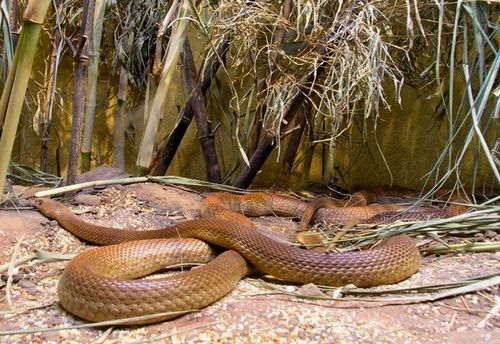
The most venomous Australian snake: the Inland Taipan or Fierce Snake
(Not our photo). The Inland Taipan or Fierce Snake reported as the most venomous snake in Australia.

Yesterday’s Sydney Herald newspaper posted this story we’d also seen on the news throughout the day about a Fremantle woman who was apparently bitten by a snake while on a walk on the beachfront esplanade, a paved boardwalk generally free of high grass and brush.

After being bit, she walked home to her husband showing him the bite, an ambulance was called. She later died at the hospital. (The hospital is yet to confirm that her death is a result of a snake bite until after an autopsy is performed).  She had a penetration mark on her foot. Had she not walked home instead, immediately calling for an ambulance, she may be alive today. We extend our deepest condolences to her family.

Then again, we don’t know all the facts and can only surmise based on what’s being reported in the news.  Apparently, from what we’ve read online snakes are often seen in the Perth metro area especially as the weather warms. 

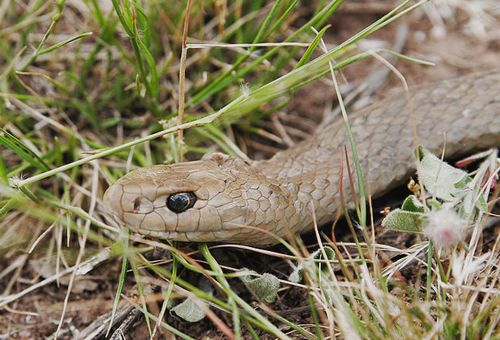
The second most venomous Australian snake: the Eastern Brown Snake
(Not our photo). Eastern Brown Snake, purported the second most venomous snake in Australia.

Paying attention by diligently watching for snakes in high-risk areas has been on our radar these past several years especially after spending so much time in Africa where 3,529 people die each year (or much more unreported) from snakebites as opposed to considerably fewer fatalities in Australia:

Australian Snake Bites

“In Australia there are about 3,000 snake bites per year, of which 200 to 500 receive anti-venom; on average one or two will prove fatal. About half the deaths are due to bites from the brown snake; the rest mostly from tiger snake, taipan and death adder. Some deaths are sudden, however in fact it is uncommon to die within four hours of a snake bite.”

From the World Health Organization (WHO):

Envenoming resulting from snake bites is a particularly important public health problem in rural areas of tropical and subtropical countries situated in Africa, Asia, Oceania, and Latin America. A recent study estimates that at least 421,000 envenomings and 20,000 deaths occur worldwide from snakebite each year, but warns that these figures may be as high as 1,841,000 envenomings and 94,000 deaths. The highest burden of snakebites is in South Asia, Southeast Asia, and sub-Saharan Africa.

Snake bite is primarily a problem of the poorer rural populations in these regions and affects mainly those involved in subsistence farming activities. Poor access to health services in these settings and, in some instances, a scarcity of antivenom, often leads to poor outcomes and considerable morbidity and mortality. Many victims fail to reach hospital in time or seek medical care after a considerable delay because they first seek treatment from traditional healers. Some even die before reaching hospital. Hospital statistics on snakebites therefore underestimate the true burden.”

With our second highest worldwide readership at this time from Australia, (the first highest from the US), we decided it was important to post this snake bite information from Dr. Struan K. Sutherland, gleaned from published university papers.  This comprehensive report appears to be the most highly informational and detailed we’ve found in Australia.

If only one Australian or citizen of other countries learns how to respond to a snake bite from reading this post, our post was well worth the time and effort. For our readers in areas with low risk of snake bites, we’ll be back tomorrow with a more generalized post.

Included in this report is first aid for snake bites as follows and also includes more photos of venomous snakes in Australia:

First Aid for Snake Bites:
“Do NOT wash the area of the bite or try to suck out the venom!

It is extremely important to retain traces of venom for use with venom identification kits.

Do NOT incise or cut the bite, or apply a high tourniquet!

Cutting or incising the bite won’t help. High tourniquets are ineffective and can be fatal if released.

Stop lymphatic spread – bandage firmly, splint and immobilise!

The “pressure-immobilisation” technique is currently recommended by the Australian Resuscitation Council, the Royal Australasian College of Surgeons, and the Australian and New Zealand College of Anaesthetists.

The lymphatic system is responsible for the systemic spread of most venoms. This can be reduced by the application of a firm bandage (as firm as you would put on a sprained ankle) over a folded pad placed over the bitten area. While firm, it should not be so tight that it stops blood flow to the limb or to congests the veins.

Start bandaging directly over the bitten area, ensuing that the pressure over the bite is firm and even. If you have enough bandage you can extend towards more central parts of the body, to delay spread of any venom that has already started to move centrally. A pressure dressing should be applied even if the bite is on the victims trunk or torso.

Immobility is best attained by application of a splint or sling, using a bandage or whatever to hand to absolutely minimise all limb movement, reassurance, and immobilisation (eg, putting the patient on a stretcher). Where possible, bring transportation to the patient (rather then vice versa). Don’t allow the victim to walk or move a limb. Walking should be prevented.

The pressure-immobilization approach is simple, safe, and will not cause iatrogenic tissue damage (ie, from the incision, injection, freezing, or arterial tourniquets – all of which are ineffective).

See the AVRU site for more details of bandaging techniques.
This poster from thefirstaidshop.com.au is worth keeping.
Bites to the head, neck, and back are a special problem – firm pressure should be applied locally if possible.

Removal of the bandage will be associated with rapid systemic spread. Hence ALWAYS wait until the patient is in a fully-equipped medical treatment area before bandage removal is attempted.

Do NOT cut or excise the area or apply an arterial torniquet! Both these measures are ineffective and may make the situation worse.
Joris Wijnker’s Snakebite Productions has more information on envenomation and he can supply a suitable first aid kit and booklet.”

Had the above mentioned woman seen this information at some point, she may be alive today. Walking home increased her heart rate and could easily have contributed to having the venom flow through her bloodstream more quickly.  The patient should be immobilized until emergency professionals arrive on the scene. 

The number to call in Australia for emergency assistance is triple zero…000
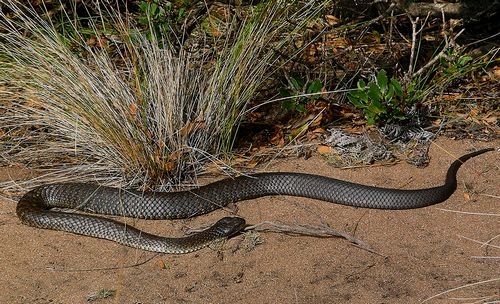
A Tiger Snake
(Not our photo).  The Tiger Snake.

While we lived in Africa for nine months, much of which was spent in areas with some of the world’s most venomous snakes are found, we made every attempt to educate ourselves immediately upon arrival. 

An important aspect of snake safety is STAY AWAY. Many snakes will not provoke an attack and often bite when aggravated or stepped on. Many reported fatalities are attributed to foolishly trying to kill or handle a snake.

The number to call in Australia if you find a snake in your yard or home is Wildcare Helpline: (08) 9474 9055

One may think we’ve had little exposure to venomous snakes. However, we actually had a personal encounter with the extremely dangerous Mozambique Spitting Cobra in South Africa that fell from the ceiling on our veranda landing next to Tom’s bare feet while we were sitting near each other busily distracted while working on our laptops.

For our personal story and photos of a Mozambique Spitting Cobra experience on our veranda, please click here.

Over these past few days, we’ve focused on recent news stories we’ve gleaned from TV news, all relevant in our travels in one way or another. Soon, in less than three weeks, we’ll be living in Fiji without a TV and be reliant upon online news. We both have auto flash messaging that pop up on our laptops from various news sources worldwide, enabling us to stay well informed.

When traveling the world, we’ve found it vital to stay informed as to world affairs, including political unrest, wars, natural disasters, health-related events, weather-related issues, and financial chaos as in what recently occurred in Greece, all of which may have a huge impact on our travel to a specific location.

We continue to exercise caution and practicality interspersed with an ongoing passion for a certain degree of excitement and adventure commensurate with our interests, abilities, and desires as we continue to explore the world.

Stay tuned for more…

Photo from one year ago today, August 19, 2014:

The busy streets in South Kensington made us thrilled that we could travel almost everywhere we wanted to go on foot. For more details, please click here.

Vacation rental horror story…More horrific news for tourists to Bangkok…

The drive to Smithfield Regional Park which we visited yesterday was pleasant. The day started out sunny quickly changing to clouds and sprinkles.

Each morning as I begin the day’s post, we turn on the news to see what’s happening in the world. This morning, we were shocked and devastated by the news of a bombing close to the Erawan Shrine in Bangkok, Thailand which was crowded with tourists at the time, killing at least 19 people and injuring more than 120. The full story and videos may be seen here.

As we discussed over the past few days, one can never be too careful. We’ll be in Thailand a year from now and since I’d been there in the past (before Tom), I felt there was no need for us to stop in Bangkok, a highly congested city plagued with crime. Instead, we’ll be flying directly to the island of Phuket.

We didn’t stop at the bungee jumping spot (spelled this way in Australia as compared to bungee in other countries). 

Sadly, Phuket wasn’t safe for tourists in 2004 when it was hit by a devastating tsunami killing over 5000 people, many of them tourists staying in oceanfront properties along the exquisite beaches.

With caution in mind, the beautiful vacation property, we selected is a few miles from the ocean. Also, with prices high close to the beach, we had two reasons to stay inland a bit. We’ll visit the beaches at our discretion. 

Many of the trails are designated for mountain bikers requiring a quick jump to the side when a biker appears.

The story Tom discovered a few days ago, spotted in the New York Times newspaper reminded us once again that the reality of booking vacation rentals online presents certain risks in itself. 

Of course, this particular story is an isolated case. A similar situation could easily occur in any apartment building complex anywhere in the world, whether it was a vacation rental or a long term apartment rental.

We stopped and talked to a pair of mountain bikers who’d stopped by the check out the trails before bringing their bikes back for the miles of trails.

Here’s a portion of the story and a link to the balance you’ll find by clicking here:

“Airbnb Horror Story Points to Need for Precautions

Early in the evening of July 4, Micaela Giles’s mobile phone started sounding alerts, and a series of messages straight out of a horror movie began scrolling down her screen.
Her 19-year-old son told her that his Airbnb host in Madrid had locked him in the fourth-floor apartment where he was supposed to be staying and removed the key. The host was still there, he said, rattling knives around in the kitchen drawer and pressing him to submit to a sexual act. He begged his mother for help.
When she called Airbnb, its employees would not give her the address and would not call the police. Instead, they gave her a number to the Madrid police and told her to ask the police to call the company for the address. But the number led to a recording in Spanish that kept disconnecting her, she said, and when she repeatedly called back her Airbnb contact, the calls went straight to voice mail.
According to her son, Jacob Lopez, he was sexually assaulted that night. Eventually, he persuaded his host to free him. He returned home to Massachusetts and is in trauma therapy.”
The remainder of this story continues here.
As shown in the remainder of this story at the above link, Airbnb was unsure as to how to handle this situation.  Hopefully, by now, some new procedures are in place that may have averted this horrible situation by prompting the police to the property immediately. This never should have happened.
We walked into the park for awhile, eventually turning back when we realized the trails weren’t as suitable for walking as opposed to mountain biking.
We’ve used Airbnb a few times, but have shied away from it since they require the full amount of the vacation rental paid at the time of the booking as opposed to paying a deposit and paying the balance at a later date. Supposedly, they are revising this policy to make it more user friendly, which would make it more appealing to us.
This is one of the reasons we don’t like renting apartments as many travelers prefer, finding the cost of an apartment less than a condo, townhouse, or single-family home. The proximity of public transportation and access to popular tourist site is highly appealing to many travelers.
The sky was overcast when we arrived at the park.

Younger travelers often prefer to be in the hubbub of the big city. For us, a suburb or the country is ideal for us, as is the case living here in Trinity Beach with a current population of under 5000. 

Even, the bigger city of  Cairns, 20 minutes south of Trinity Beach, has a population of 156,000, not a huge metropolis by any means. Tom always says, “The closer you get to tall buildings, the more likely to find crime, poverty, and increased risk.”
At points, the trail was cleared of debris, but at other points, mountain biker enthusiasts would be in for quite a ride.
Our style of living tends to keep us away from tall buildings as much as possible although we’ve encountered our fair share over these past three years. As for the above traveler’s experience, traveling alone in a big city, he fell prey to greater risk based on location and circumstances.
In reality, there are definitely certain locations and circumstances that add to the risk of crime for tourists.  With all of our precautions, we could easily be a target in the most seemingly innocuous locations.
In the US these shops are referred to as auto body shops. Here in Australia, they are called smash repairs. We love the differences!
Luckily, for us, we find the most joy in our travels in quieter less populated locations far from tall buildings.  However, exposure to increased risk may be unavoidable such as the case of our upcoming river cruise in Vietnam where we’ll be staying in hotels in big cities and dining out for a few weeks before and during the cruise/tour. We chose to take these risks although the likelihood of an incident is relatively slim.
Also, the fact that we don’t visit nightclubs and seldom visit bars added to the fact that we seldom wander dark streets at night adds another layer of safety.  Had we been younger, these types of venues may have been more desirable. We both easily recall the fun times we had “nightclubbing” in our younger years. 
I don’t drink alcohol at all (health reasons) and Tom has little interest in having a cocktail other than when we’re on a cruise (along with partaking in the vast array of foods he doesn’t otherwise enjoy). This fact alone, generally keep us out of bars and the resulting higher risk scenarios of leaving the bar and walking to one’s car or grabbing a taxi at night in the dark.
As we exited we spotted this site which appeared to be used for dumping the debris on the trail.  We’ve found parks in Australia to be well maintained.
Are we the typical overly cautious senior couple?  In some ways, we are. But in other ways, adventure which may include a certain degree of risk, is the highlight of our lives and some of our best experiences. 
As for how we’ll handle vacation rentals going forward? We’ll handle the booking process and eventual occupancy, in the same manner, we have thus far, with a degree of caution coupled with an expectation of a good outcome.
Have a good day!
Photo from one year ago, August 17, 2014:
 While in London (and Paris) we had no choice but to walk the streets at night (we were in fairly safe South Kensington) or grabbing a taxi to return to our hotel in the dark. Spending an entire month in these two large cities left us with no option other than to dine out for every meal. This photo was of a sign posted at our reserved table at Andover Arms in London, one of the best restaurants we experienced in our travels. Please click this link for more photos of our fabulous meal and evening.

Australia’s crime stats…World Crime rate stats…Travelers, please read…

View of Double Island at a distance.

With all the strife, wars, natural disasters and horrific incidents on the news each day, we’ve particularly enjoyed the Aussie TV news when the majority of it is fun and informative tinged with the typical Aussie playful sense of humor.

Of course, they do report on the heart wrenching international and local news keeping us well informed on worldwide events. A portion of the Aussie news consists of small stories, such as a biker in Brisbane falling off his bike and breaking his arm. Although we felt sorry for the biker, Brisbane is a long way from us and we chuckled over the how the national news carries such a simple news story.

Extra parking in the driveway where we live in Trinity Beach.

Australia’s entire population spread out over this vast continent is over 23 million, comparable to the population of the cities of Beijing or Karachi.

Overall, the crime rate in Australia is low:

Australia is generally a safe country with a low rate of crime. Statistics show that the homicide rate has actually decreased in almost every state since 2002. Crime statistics are monitored by the Australian Institute of Criminology and the Australian Bureau of Statistics provides comparative breakdowns for different types of crimes.

As we plan to travel to new countries we check out the crime rate (primarily the murder rate) before booking anything.  Yes, we’ve made a few exceptions when motivated by certain aspects of a country we didn’t want to miss. 

Unusual flat leaves on a bush.

In reviewing the chart below, good placement on this chart doesn’t mean one can be laissez-faire with their wallets, cameras, luggage, personal effects, and personal safety. 

(Please excuse formatting issues on this chart due to poor connection, with rankings in far-right column and #218 numbering not listed). To see more detail on this site and inclusions for lost lives as a result of wars, please click here).

UNODC murder rates most recent year
Country Rate Count Region Subregion Year
listed
Ranking
Burundi 8.0 790 Africa Eastern Africa 2012
1
Comoros 10.0 72 Africa Eastern Africa 2012
2
Djibouti 10.1 87 Africa Eastern Africa 2012
3
Eritrea 7.1 437 Africa Eastern Africa 2012 4
Ethiopia 12.0 11,048 Africa Eastern Africa 2012 5
Kenya 6.4 2,761 Africa Eastern Africa 2012 6
Madagascar 11.1 2,465 Africa Eastern Africa 2012 7
Malawi 1.8 279 Africa Eastern Africa 2012 8
Mauritius 2.8 34 Africa Eastern Africa 2011 9
Mayotte (France) 6.0 12 Africa Eastern Africa 2009 10
Mozambique 12.4 3,133 Africa Eastern Africa 2012 11
Réunion (France) 1.8 15 Africa Eastern Africa 2009 12
Rwanda 23.1 2,648 Africa Eastern Africa 2012 13
Seychelles 9.5 9 Africa Eastern Africa 2012 14
Somalia 8.0 819 Africa Eastern Africa 2012 15
South Sudan 13.9 1,504 Africa Eastern Africa 2012 16
Uganda 10.7 3,753 Africa Eastern Africa 2011 17
Tanzania 12.7 6,071 Africa Eastern Africa 2012 18
Zambia 10.7 1,501 Africa Eastern Africa 2012 19
Zimbabwe 10.6 1,450 Africa Eastern Africa 2012 20
Angola 10.0 2,079 Africa Middle Africa 2012 21
Cameroon 7.6 1,654 Africa Middle Africa 2012 22
Central African Republic 11.8 532 Africa Middle Africa 2012 23
Chad 7.3 907 Africa Middle Africa 2012 24
Congo 12.5 541 Africa Middle Africa 2012 25
Democratic Republic of the Congo 28.3 18,586 Africa Middle Africa 2012 26
Equatorial Guinea 19.3 142 Africa Middle Africa 2012 27
Gabon 9.1 148 Africa Middle Africa 2012 28
Sao Tome and Principe 3.3 6 Africa Middle Africa 2011 29
Algeria 0.7 280 Africa Northern Africa 2011 30
Egypt 3.4 2,703 Africa Northern Africa 2011 31
Libya 1.7 103 Africa Northern Africa 2012 32
Morocco 2.2 704 Africa Northern Africa 2012 33
Sudan 11.2 4,159 Africa Northern Africa 2012 34
Tunisia 2.2 235 Africa Northern Africa 2012 35
Botswana 18.4 368 Africa Southern Africa 2012 36
Lesotho 38.0 764 Africa Southern Africa 2010 37
Namibia 17.2 388 Africa Southern Africa 2012 38
South Africa 31.0 16,259 Africa Southern Africa 2012 39
Swaziland 33.8 416 Africa Southern Africa 2012 40
Benin 8.4 848 Africa Western Africa 2012 41
Burkina Faso 8.0 1,311 Africa Western Africa 2012 42
Cape Verde 10.3 51 Africa Western Africa 2012 43
Ivory Coast 13.6 2,691 Africa Western Africa 2012 44
Gambia 10.2 182 Africa Western Africa 2012 45
Ghana 6.1 1,537 Africa Western Africa 2012 46
Guinea 8.9 1,018 Africa Western Africa 2012 47
Guinea-Bissau 8.4 140 Africa Western Africa 2012 48
Liberia 3.2 135 Africa Western Africa 2012 49
Mali 7.5 1,119 Africa Western Africa 2012 50
Mauritania 5.0 191 Africa Western Africa 2012 51
Niger 4.7 803 Africa Western Africa 2012 52
Nigeria 20.0 33,817 Africa Western Africa 2012 53
Senegal 2.8 379 Africa Western Africa 2012 54
Sierra Leone 1.9 113 Africa Western Africa 2012 55
Togo 10.3 684 Africa Western Africa 2012 56
Anguilla (UK) 7.5 1 Americas Caribbean 2012 57
Antigua and Barbuda 11.2 10 Americas Caribbean 2012 58
Aruba (Netherlands) 3.9 4 Americas Caribbean 2010 59
Bahamas 29.8 111 Americas Caribbean 2012 60
Barbados 7.4 21 Americas Caribbean 2012 61
British Virgin Islands (UK) 8.4 2 Americas Caribbean 2006 62
Cayman Islands (UK) 14.7 8 Americas Caribbean 2009 63
Cuba 4.2 477 Americas Caribbean 2012 64
Dominica 21.1 15 Americas Caribbean 2010 65
Dominican Republic 22.1 2,268 Americas Caribbean 2012 66
Grenada 13.3 14 Americas Caribbean 2012 67
Guadeloupe (France) 7.9 36 Americas Caribbean 2009 68
Haiti 10.2 1,033 Americas Caribbean 2012 69
Jamaica 39.3 1,087 Americas Caribbean 2012 70
Martinique (France) 2.7 11 Americas Caribbean 2009 71
Montserrat (UK) 20.4 1 Americas Caribbean 2008 72
Puerto Rico (US) 26.5 978 Americas Caribbean 2012 73
Saint Kitts and Nevis 33.6 18 Americas Caribbean 2012 74
Saint Lucia 21.6 39 Americas Caribbean 2012 75
Saint Vincent and the Grenadines 25.6 28 Americas Caribbean 2012 76
Trinidad and Tobago 28.3 379 Americas Caribbean 2012 77
Turks and Caicos Islands (UK) 6.6 2 Americas Caribbean 2009 78
United States Virgin Islands (US) 52.6 56 Americas Caribbean 2010 79
Belize 44.7 145 Americas Central America 2012 80
Costa Rica 8.5 407 Americas Central America 2012 81
El Salvador 41.2 2,594 Americas Central America 2012 82
Guatemala 39.9 6,025 Americas Central America 2012 83
Honduras 90.4 7,172 Americas Central America 2012 84
Mexico 21.5 26,037 Americas Central America 2012 85
Nicaragua 11.3 675 Americas Central America 2012 86
Panama 17.2 654 Americas Central America 2012 87
Bermuda (UK) 7.7 5 Americas Northern America 2012 88
Canada 1.6 543 Americas Northern America 2012 89
Saint Pierre and Miquelon (France) 16.5 1 Americas Northern America 2009 90
United States 4.7 14,827 Americas Northern America 2012 91
Argentina 5.5 2,237 Americas South America 2010 92
Bolivia 12.1 1,270 Americas South America 2012 93
Brazil 25.2 50,108 Americas South America 2012 94
Chile 3.1 550 Americas South America 2012 95
Colombia 30.8 14,670 Americas South America 2012 96
Ecuador 12.4 1,924 Americas South America 2012 97
French Guiana (France) 13.3 30 Americas South America 2009 98
Guyana 17.0 135 Americas South America 2012 99
Paraguay 9.7 649 Americas South America 2012 100
Peru 9.6 2,865 Americas South America 2012 101
Suriname 6.1 33 Americas South America 2012 102
Uruguay 7.9 267 Americas South America 2012 103
Venezuela 53.7 16,072 Americas South America 2012 104
Kazakhstan 7.8 1,263 Asia Central Asia 2012 105
Kyrgyzstan 9.1 494 Asia Central Asia 2011 106
Tajikistan 1.6 126 Asia Central Asia 2011 107
Turkmenistan 12.8 660 Asia Central Asia 2012 108
Uzbekistan 3.7 1,060 Asia Central Asia 2012 109
China 1.0 13,410 Asia Eastern Asia 2010 110
Hong Kong 0.4 27 Asia Eastern Asia 2012 111
Macao 0.7 4 Asia Eastern Asia 2010 112
North Korea 5.2 1,293 Asia Eastern Asia 2012 113
Japan 0.3 442 Asia Eastern Asia 2011 114
Mongolia 9.7 266 Asia Eastern Asia 2011 115
South Korea 0.9 427 Asia Eastern Asia 2011 116
Taiwan 3.0 686 Asia Eastern Asia 2011 117
Brunei 2.0 8 Asia South-Eastern Asia 2012 118
Cambodia 6.5 964 Asia South-Eastern Asia 2012 119
Indonesia 0.6 1,456 Asia South-Eastern Asia 2012 120
Laos 5.9 392 Asia South-Eastern Asia 2012 121
Malaysia 2.3 652 Asia South-Eastern Asia 2012 123
Myanmar 15.2 8,044 Asia South-Eastern Asia 2012 124
Philippines 8.8 8,484 Asia South-Eastern Asia 2012 125
Singapore 0.2 11 Asia South-Eastern Asia 2012 126
Thailand 5.0 3,307 Asia South-Eastern Asia 2011 127
Timor-Leste 3.6 39 Asia South-Eastern Asia 2010 128
Vietnam 3.3 3,037 Asia South-Eastern Asia 2012 129
Afghanistan 6.5 1,948 Asia Southern Asia 2012 130
Bangladesh 2.7 4,169 Asia Southern Asia 2012 131
Bhutan 1.7 12 Asia Southern Asia 2012 132
India 3.5 43,355 Asia Southern Asia 2012 133
Iran 3.9 3,126 Asia Southern Asia 2012 134
Maldives 3.9 13 Asia Southern Asia 2012 135
Nepal 2.9 786 Asia Southern Asia 2011 136
Pakistan 7.7 13,846 Asia Southern Asia 2012 137
Sri Lanka 3.4 707 Asia Southern Asia 2011 138
Armenia 1.8 54 Asia Western Asia 2012 139
Azerbaijan 2.1 194 Asia Western Asia 2010 140
Bahrain 0.5 7 Asia Western Asia 2011 141
Cyprus 2.0 23 Asia Western Asia 2012 142
Georgia 4.3 187 Asia Western Asia 2010 142
Iraq 8.0 2,628 Asia Western Asia 2012 143
Israel 1.8 134 Asia Western Asia 2012 144
Jordan 2.0 133 Asia Western Asia 2011 145
Kuwait 0.4 12 Asia Western Asia 2012 146
Lebanon 2.2 95 Asia Western Asia 2010 147
Palestine 7.4 312 Asia Western Asia 2012 148
Oman 1.1 34 Asia Western Asia 2011 149
Qatar 1.1 23 Asia Western Asia 2012 150
Saudi Arabia 0.8 234 Asia Western Asia 2012 151
Syria 2.2 463 Asia Western Asia 2010 152
Turkey 2.6 1,866 Asia Western Asia 2011 153
United Arab Emirates 2.6 235 Asia Western Asia 2012 154
Yemen 4.8 1,099 Asia Western Asia 2010 155
Belarus 5.1 486 Europe Eastern Europe 2010 156
Bulgaria 1.9 141 Europe Eastern Europe 2012 157
Czech Republic 1.0 105 Europe Eastern Europe 2012 158
Hungary 1.3 132 Europe Eastern Europe 2012 159
Poland 1.2 449 Europe Eastern Europe 2011 160
Moldova 6.5 229 Europe Eastern Europe 2012 161
Romania 1.7 378 Europe Eastern Europe 2012 162
Russia 9.2 13,120 Europe Eastern Europe 2012 163
Slovakia 1.4 75 Europe Eastern Europe 2012 164
Ukraine 4.3 1,988 Europe Eastern Europe 2010 165
Denmark 0.8 47 Europe Northern Europe 2012 166
Estonia 5.0 65 Europe Northern Europe 2011 167
Finland 1.6 89 Europe Northern Europe 2012 168
Greenland (Denmark) 19.4 11 Europe Northern Europe 2009 169
Iceland 0.3 1 Europe Northern Europe 2012 170
Ireland 1.2 54 Europe Northern Europe 2012 171
Latvia 4.7 97 Europe Northern Europe 2012 172
Lithuania 6.7 202 Europe Northern Europe 2012 173
Norway 2.2 111 Europe Northern Europe 2011 174
Sweden 0.7 68 Europe Northern Europe 2012 175
United Kingdom 1.0 653 Europe Northern Europe 2011 176
Albania 5.0 157 Europe Southern Europe 2012 177
Andorra 1.3 1 Europe Southern Europe 2010 178
Bosnia and Herzegovina 1.3 51 Europe Southern Europe 2011 179
Croatia 1.2 51 Europe Southern Europe 2012 180
Greece 1.7 184 Europe Southern Europe 2011 181
Italy 0.9 530 Europe Southern Europe 2012 182
Kosovo 3.6 64 Europe Southern Europe 2010 183
Malta 2.8 12 Europe Southern Europe 2012 184
Montenegro 2.7 17 Europe Southern Europe 2012 185
Portugal 1.2 122 Europe Southern Europe 2012 186
San Marino 0.7 x Europe Southern Europe 2012 187
Serbia 1.2 111 Europe Southern Europe 2012 188
Slovenia 0.7 14 Europe Southern Europe 2012 189
Spain 0.8 364 Europe Southern Europe 2012 190
Macedonia 1.4 30 Europe Southern Europe 2011 191
Austria 0.9 77 Europe Western Europe 2012 192
Belgium 1.6 182 Europe Western Europe 2012 193
France 1.0 665 Europe Western Europe 2012 194
Germany 0.8 662 Europe Western Europe 2011 195
Liechtenstein 0.0 0 Europe Western Europe 2012 196
Luxembourg 0.8 4 Europe Western Europe 2011 197
Monaco 0.0 0 Europe Western Europe 2008 198
Netherlands 0.9 145 Europe Western Europe 2012 199
Switzerland 0.6 46 Europe Western Europe 2011 200
Australia 1.1 254 Oceania Australasia 2012 201
New Zealand 0.9 41 Oceania Australasia 2012 202
Fiji 4.0 35 Oceania Melanesia 2012 203
New Caledonia (France) 3.3 8 Oceania Melanesia 2009 204
Papua New Guinea 10.4 713 Oceania Melanesia 2010 205
Solomon Islands 4.3 24 Oceania Melanesia 2012 206
Vanuatu 2.9 7 Oceania Melanesia 2012 207
Guam (US) 2.5 4 Oceania Micronesia 2011 208
Kiribati 8.2 8 Oceania Micronesia 2011 209
Micronesia 4.6 5 Oceania Micronesia 2012 210
Nauru 1.3 x Oceania Micronesia 2012 211
Palau 3.1 x Oceania Micronesia 2012 212
Cook Islands 3.1 x Oceania Polynesia 2012 213
French Polynesia (France) 0.4 1 Oceania Polynesia 2009 214
Niue 3.6 x Oceania Polynesia 2012 215
Samoa 3.6 7 Oceania Polynesia 2012 216
Tonga 1.0 1 Oceania Polynesia 2012 217
Tuvalu 4.2 x Oceania Polynesia 2012

There is no country, city, locale, or venue that is entirely safe. We need only keep an eye on the news to discover this reality. For us, a vital aspect of travel has been being as diligent as possible in regard to our personal safety, and yet, we still run the risk of becoming victims of crime, no matter where we may travel. 

After all, our own home country, the US is ranked #91 on this list, certainly on the higher end of the scale.  Seeing Australia ranked as #201 is not surprising to us. Also, with Fiji ranked at #203, which we’d checked long ago before booking Fiji, gives us peace of mind.

The beginning of the driveway heading down the hill doesn’t look steep in this photo, but it’s very steep.

Although we don’t spend time worrying about crime, we feel that knowledge is power. Protecting our stuff has been relatively easy with all the safety measures we have in place, which we’ll be sharing in tomorrow’s post along with a horrific vacation rental story that was in the news. It’s in protecting our physical selves that leaves us at the most risk.

Traveling to relatively safe countries certainly reduces those risks and staying away from high-risk cities, especially at night reduced the risk. No matter how diligent any of us maybe we’re never exempt from risk.  We often hear of tourist attacks on the news and pay considerable attention. The fact that we seldom dine out, walking streets at night to get to our car or a taxi, also reduces the risk. 

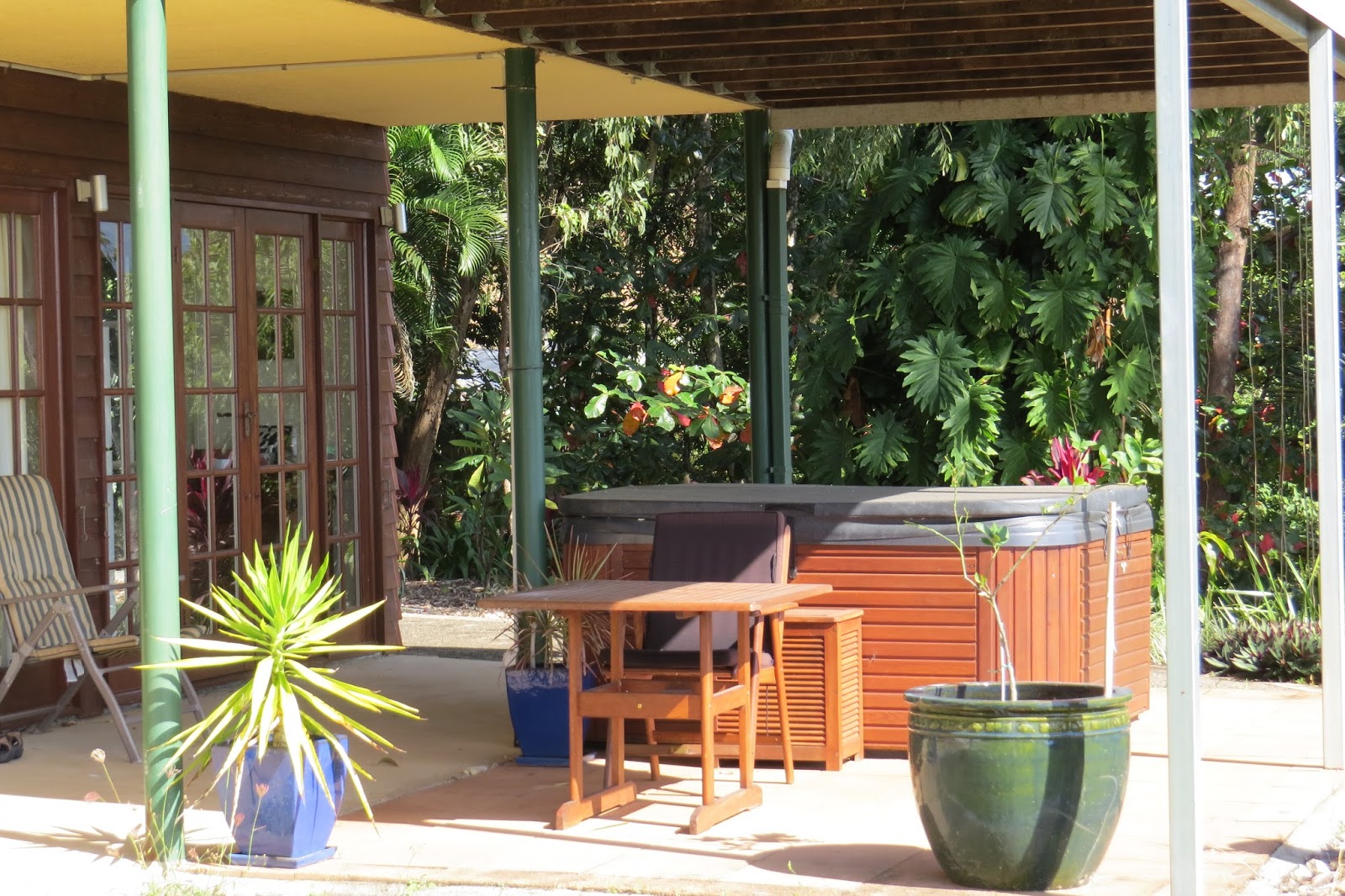
We’ve yet to use the hot tub in the yard for a few reasons, neither of us cares to use hot tubs and secondly, the cost to heat the hot tub and to keep it heated, if we used it, would be outrageous for the owner who pays all the utilities. 

We’re not implying that one shouldn’t dine-in at restaurants. (We tend to avoid restaurants when the food is a potential risk for me which varies from country to country based on how they season and add sauce to their protein sources. Australia is big on marinating and saucing their food). However, it may be safer dining out during daylight hours and avoiding dark spaces at night. 

The side yard off of the kitchen. Many of the huge plants in Australia are used as small houseplants back in the US.

Then again, we hear horrible stories of daylight hours incidences in cafes and on buses. One could make themselves crazy worrying about every potential situation. We ran some of the same safety risks in the cozy town where we lived in Minnesota, USA.

It’s difficult to climb up to the rainforest in the backyard.  Without trails, it would be tricky to explore.

For us, we choose to opt on the side of seeing that which we’d love to see, whether it’s a busy high-risk marketplace, a stroll along a potentially risky beach, or a visit to a country in which we can see wildlife. After all, we’ve already been to Kenya, South Africa, Egypt, Jordan, Tanzania, and on and on…all in the higher-risk categories.

We’ll continue to stretch ourselves to see that which appeals to us.  Last night on TV, we watched a fabulous TV show, “The Lost City of Petra (Jordan)” which seeing in person was one of the major highlights of our journey to date. We’d have missed this life-changing experience had we let fear rule our decisions.

Had we been too cautious in our travels, we’d have missed the opportunity to see this unbelievable site and to enjoy our photos for the rest of our lives of The Treasury in Petra, Jordan. For our Part 1 Petra on this memorable day, please click here. For Part 2, please click here.

If you have the opportunity to review these two above referenced posts, it becomes evident why we often choose to pull something out of the “bucket list” although there may be some risks, resulting in an extraordinary experience that we’ll never forget.

We continue on tomorrow with a scary vacation rental story, a must-see for all travelers who use online vacation rental sites.

Photo from one year ago today, August 17, 2014:

The Eurostar formerly referred to as “The Chunnel.” We were excited for a chance to travel on this train, one year ago, when we needed to get from Paris to London. Traveling on a train under the ocean was definitely a mode of transportation we anticipated with excitement. We weren’t disappointed, although many of our perceptions were dispelled.  For more details, please click here.

Nuances of vacation homes…One year ago…Total expenses for 16 nights in Paris…Check it out below!

This cockatoo settled on the fence at the pool.

Only once, since beginning our travels outside the US, did we vacate a property when we weren’t happy with the accommodations. We stayed for a painstaking week while we furiously scoured every possibility to find another affordable rental. Prices were high in Belize during the season, winter in the northern hemisphere.

Belize, located in Central America, had become popular over the prior decade with its relatively short distance from the US making it a popular mid-winter vacation destination. Availability was limited on the more affordable properties especially with our short notice request for occupancy.

We discovered a new beach on a return drive from cairns, Machans Beach which is a modest beachside community the closest beach to Cairns City. Travelers staying in Machans beach usually do so to escape the busy hustle and bustle and a large number of tourists that flock to Cairns and many of the other northern beaches each year. Due to staunch protests from the locals at Machans Beach tourist infrastructure such as hotels and resorts have remained at bay creating a tranquil and unspoiled hippie-style beachside community.
There were several issues with the property, making it inhabitable for us.  The city water was shut off most of the day (a long term, ongoing situation), on for about one hour and then off again. We were supposed to collect water to use for the toilet when the water would be off for the remainder of the day and night.  If we didn’t shower when the water magically came on at an unpredictable time to a dribble, we were out of luck. 

Doing the laundry was nearly impossible. Simple things like washing our hands become a luxury. We felt dirty and our surroundings felt unsanitary. It only took a few days for us to realize we had to leave permanently as fast as possible. 

Although Machan’s Beach has been subjected to substantial erosion that has been rectified by a rock wall and the slow but gradual return of lost sand, there is still plenty of beaches to enjoy and a lush grassy playfield by the beach that is great for playing sports, picnics or spending time with the family.

On top of it all (long term readers, please excuse the repeated story) the no-see-ums were swarming us when there were either no screens or the holes in the few screens were too large allowing the sand flies them to freely enter. It was hot, humid and we wanted the windows open which was impossible. 

I had no less than 100 inflamed sand fly bites making me miserable both during the day and at night. I was unable to sleep for more than a few hours a night for an entire week. 

It was an awful seven days until we finally found a fabulous resort to rent for the remaining two-plus months and quickly moved out, losing our first month’s rent which the owner had promised to refund.

Recently, the completion of the rock wall ended with a well deserved party for the locals who tolerated the trucks coming and going over an extended period as the wall was built.

Of course, we’d never have rented the property had we known of these issues. We weren’t naïve in assuming that living in other countries would be easy. But, we weren’t willing to risk our health as a result of improper sanitation and lack of cleanliness without water. We’d purchased several huge jugs of bottled water at times having no choice but to use it for the toilet and cleaning what we could.

We never saw a refund. What were we to do? Sue them? Did we want to start our world journey with a lawsuit in a foreign country? Hardly.

If you’re interested in reading the story about the fiasco in Belize and seeing the photos from this period, please begin by clicking here.

A lone sea bird at Machans Beach.

That was our first vacation home outside the US. At that point, it would have been easy to pack it up and head back to the US. But, that never occurred to us. We knew we’d encounter some less than desirable situations and we were committed to figuring them out along the way.

If money were no object, we’d run into less of a risk by renting only upscale properties. And, although at times we’ve been able to negotiate some upscale properties, most of our vacation rentals are in the mid-range and overall, very nice with amenities we’ve found to pleasing.

Here in Trinity Beach, Australia, this property has been much more desirable than we’d expected. We’ve learned to keep our expectations at bay and were pleasantly surprised when we arrived continuing to further appreciate it here the longer we stayed. 

Dozens of cockatoos have been swarming the yard over several of the past late afternoons, stopping to check out the pool.

The owners, Sylvie and Andy, have gone overboard to ensure we have an excellent experience and unquestionably, we have. The well equipped property; the cleanliness; their providing additional items we’ve needed; their vacuuming and washing the floors for us every two weeks (while we sweep and dust in the interim) and their warmth and friendliness, all have contributed to a highly positive experience.

When we look back at past vacation rentals, overall, we’ve had great experiences once that first week in Belize was behind us. Now, as we look to Fiji, we realize were in for a totally different way of living than we’ve experienced thus far in modern, abundant Australia.

These birds are very noisy wasting no time in announcing their arrival.

I added a measuring cup and measuring spoons to my next grocery list to include in the box of food items we’re accumulating to ship to Vanua Levu, Fiji.  People don’t bake while on vacation/holiday. We don’t expect there to be a muffin tin, baking papers or lemon extract for our Low Carb Lemon Poppy Seed Muffins, one of which we have each night with dinner as the ultimate two carb treat providing us with that sense of a small bread item with the meal.

We won’t have a clothes dryer and will hang our clothes outside to dry as we’ve done in most parts of the world. Having a dryer here has been a rare treat. We won’t have a TV and unable to hook up our HDMI to watch our shows, nor will we be able to watch news which we often have on in the background on a staying-in day. 

The biggest challenge will be not having a car. Mario, the property manager, explained that navigating the steep hill to the property requires a four-wheel-drive vehicle which to rent for three months would be outrageously expensive. He further explained that a highly competent driver will be available for our all of needs at reasonable rates. 

With the fees we’ve paid for rental cars in the past, we can easily use a driver five times a week for less than we’ve paid for the rentals. Most likely, we’ll negotiate set fees with the driver (to include a tip) to various locations avoiding the necessity of discussing the rate each time we go out.

This appears to be an agave plant. Agave sugar was the rage a few years ago. But, now its been found to cause a higher spikes in blood sugar than high fructose corn syrup causing weight gain and inflammation.

Also included in Fiji is daily maid service which is a mixed bag for us. I like running around and tidying up. I don’t even mind cleaning and making the bed, tasks we both share. With daily maid service, each day, we’ll have to get out of the way for whatever time it takes for the maid to clean up. 

Since both of us arise early and are showered and dressed by 7:30, most likely we’ll arrange a set time making it easier for all of us. While living there, my household tasks will consist of cooking and laundry while Tom will continues to do dishes.

The remainder of our time will be spent doing what we love to do; posting here, sightseeing and taking photos, searching for future travels, shopping at local markets, walking the beach and enjoying the tropical climate and the beautiful surroundings. 

Wildflowers growing in the yard.

Some have mentioned, based on personal experience, that they don’t like Fiji mainly due to the poverty. We’d decided long ago to accept the reality of poverty we’ll see throughout the world. 

Although we don’t necessarily live in the poverty-stricken areas, we often shop in the same markets and make purchases from the same vegetable stands and from the same vendors utilizing the products and services offered by these hard-working locals.

Not every vacation home has all the amenities we’d chose in a perfect world. In essence, its the imperfections in the world that ultimately we find the most interesting and its our own imperfections within that world that we strive to improve as we adapt to yet another new way of life.

Photo from one year ago today, August 16, 2014:

Tom’s last dinner out in Paris ended with this banana split. While dining out during the month we spent between Paris and London, Tom ate whatever his heart desired. It wasn’t until we settled into our next vacation home in Maui, Hawaii in October 2014,  that I started cooking again and he joined me in my way of eating.  For the final expenses for our costly 16 nights in Paris, please click here.

Hotel bookings…How to get free rooms!…Hotel nuances…One year ago, great last photo of Paris…

Note the wide beak on this beautiful duck.

There’s no magic, coupons, or complicated processes required to acquire free hotel nights when traveling. It’s a matter of a few steps to get the process rolling.

We have a link on this website to the right of what you’re reading now for Hotels.com. You may wonder why we suggest you use the link on our site. Simple answer. We receive a small commission (very small) for every one of our readers who uses the links on our site.

There were several bodies of water along the edges of the rainforest.

These small commissions help pay a tiny portion of the cost for maintaining our site on a year by year basis.  Using our links does not result in your paying higher prices for products or services than you’d pay to go directly to the web addresses for these various companies. It just helps us in a small way.

For those of you who use our links, we really appreciate you clicking on our site as opposed to clicking somewhere else. That’s all it takes. We thank our readers for participating in our links.  Also, we have multiple travel-related links on our site. For today’s purposes, we’re describing one of those which we used yesterday to book a hotel.

The most exciting aspect of our rainforest hike was spotting pelicans.

Today, we’re going to take you through the necessary steps to acquire free nights in hotels that may work for those who travel only a few times each year:

1.  Click on the hotels.com link on the right side of this page.
2.  Sign up for an account, saving your user name and password, keep in a safe place.
3.  Feel free to add a credit card to be saved for future use. This is a secure site and sure, things can happen, but we’ve felt comfortable doing so. 

If you prefer not to leave a credit card on file on the site, you can add it each time you book a reservation and you’ll still receive full credit. Suggestion for those worried about security: Talk to your credit card company asking their policy if your card number is stolen. They will explain that you are not responsible for any charges you did not make. 

A number of ducks hanging out in the freshwater lake at the edge of the rainforest.

Our credit card numbers have been stolen twice in the past three years and have been easily resolved by the credit card company canceling the old card and immediately shipping us a new card, usually overnight. We were not responsible for any of the unauthorized charges. 

We check all of our credit cards online by setting up a “favorite” with the link. Every few days we check to be assured that no charges are posted that we didn’t make. It takes less than one minute. 

Most likely, this was the mate of the pelican photos we posted today and yesterday, found in the wild.

It’s easy to set up a request with each of your credit and debit card companies to send you an email each time a charge is made if you prefer not to check it online. We live in a world that is high risk of identity theft. Taking the initiative to ensure your safety and security is entirely up to you.

4.  Once your account is set up, you can proceed to check for hotels entering your preferred dates and location.  If you choose to check at a later date, click on the link on our site to enter to check hotel prices at any time.  Once you stay 10 nights at a hotel you’ve booked through the site, you get a free night. Easy. You can easily access your Rewards status at any time by logging in and selecting the link on the site under “Your Account.”

When booking your free night, make sure, once you’ve selected the hotel and date for the free night, that you check the box that asks if you want to use the Rewards you’ve accumulated. Otherwise, your credit card will be billed.

Another unusual palm trunk.

Yesterday, we booked a hotel in Sydney on January 4, 2016, when we’ll have flown in from Fiji, spending one night in Sydney until January 5th when we leave on a cruise from Sydney Harbor.

The hotel is near the port, not quite walking distance but no more than a two-minute drive. Most likely the hotel will have a shuttle to the pier. If not, minimal taxi fare will get us there.  Our bags are too heavy to haul the several blocks.

Fallen bamboo

Hotels in Sydney are expensive. Using our Rewards credit toward a free night, which varies depending on how much you’ve paid for past reservations, required we pay a small amount as shown below in our receipt:

Hotels.com Confirmation Number : 123456789 (number changed for security)

Booked: Online – Friday, August 14, 2015 3:50:26 PM GMT+10:00

Booking Details

Guest Name:  Thomas Lyman Room Type: Standard Room, 1 Queen Bed, Non Smoking – Advance Purchase
Check-in: Monday, January 4, 2016 Check-out: Tuesday, January 5, 2016, Number of Nights:1, Number of Rooms:1
Hotel Details: Holiday Inn Old Sydney the Rocks
55 George Street
The Rocks
AU+61292520524
Charges: Monday, January 4, 2016: $248.99 (AUD $337.90)
Hotels.com® Rewards free night applied: -$202.43 (AUD $274.39)
Sub-total:$46.56 (AUD $63.11)
Total Price:$46.56
Amount paid:$46.56
Amount still due:$0.00
The sun peeking through the rainforests at certain times of the day plays an integral role in the growth and development of the forests.
Many hotels booking have the option of choosing a non-refundable rate or a fully refundable rate. If you feel there’s a possibility your plans could change, pay the slightly higher amount for the refundable rate. For us, we always choose the non-refundable rate based on our intent of getting the best rates. This fact is universal on all websites used for booking hotels. 
As shown above, yesterday we paid the excess amount, over and above our Hotels.com Rewards credit of US $202.43, AUD $274.39 which was the additional US $46.56, AUD $63.11. Had the hotel been a lower cost than the US $202.43,  AUD $274.30 we wouldn’t have had to pay anything which is usually the case.  But, as mentioned above, Sydney is more expensive than many cities, comparable to the rates we paid in Paris and London a year ago.
Soon, we’ll be booking 10 nights in a hotel in Vietnam to fill in a gap until the upcoming river cruise. Every 10 nights we book, pay for, and use, we’ve received one free night. In essence, this results in a 10% discount which may not seem like much. One doesn’t receive credit for the free night when it’s used, only for the paid in full nights.
The grounds of the swampy area were covered with fallen leaves and branches, suitable habitat for many small creatures.
However, travelers all over the world are booking hotel rooms with no credit. Of course, we always verify that this site is providing us with the best possible price plus…the accumulation of paid nights for an eventual free night.
If you have questions or need assistance with this, please comment at the end of today’s post. We will reply and share our combined comments with our other readers who may have the same questions.
We may not stay in any more hotels in a year than the average traveler. It may, in fact, be less often. We spend most of our nights in vacation homes or on cruises. 
A considerable part of rainforests consists of swampy areas.
Most years we don’t spend more than four or five nights in a hotel, usually between cruises or for long flights such as is coming up when we fly to Sydney, staying overnight in a hotel and flying to Fiji the next day.  Otherwise, we’d have had to wait at the airport for 10 hours, not our cup of tea.  
Whenever we encounter the possibility of knowingly spending more than eight hours in an airport awaiting a flight, we opt for a hotel stay, always considering our objective of reducing the possibility of travel stress. With easy hotel check-in and checkout these days, this usually makes sense for us.
The trunk of a species of a palm tree in the rainforest.
How picky are we in choosing hotels? Here are our criteria for selecting hotels:
1.  Location:  Convenient to modes of transportation, next flight, cruise pier, and activities we plan
2.  Reviews: In most cases, we don’t select anything under four stars unless it’s a short overnight stay awaiting a flight or cruise.  In these cases, we’ll consider a 3.5 star. As in the above-stated reservation, its list as a 4.5 star (out of a possible 5 stars). (Cleanliness and good repair are indicated in the star ratings).
3.  Availability of wifi: Preferably free although at times we’ve paid a fee when other good options weren’t available.
4.  Bed options: Tom and I do fine in a queen bed and for short stays that works fine. In many vacation homes, including here, we only have a double bed and somehow we make that work. However, we’d never chose that option in a hotel which may indicate a lack of replacing the beds and poor updating and maintenance. In many countries, bed size is a cultural thing. We don’t expect king beds as we travel.
Pelicans are beautiful up close.  Little do we realize their exquisite markings when seeing them at a beach.

Of course, there are many amenities we prefer such as complimentary coffee and tea service in the room, and an on-site restaurant when we’ll be dining. On a single night, hotel stay, a restaurant is less important to us when its nothing to us to miss a meal.

(I don’t eat breakfast except on cruises and when at a vacation home, Tom has a small serving of bacon and egg casserole I make and freeze in packets of three servings which we defrost one package at a time. Neither of us cares for lunch, even while cruising. Our way of eating causes a tremendous lack of appetite and we chose to eat only when hungry). 
This life of travel requires a tremendous amount of work and planning. For us, we enjoy the planning and details. If we didn’t plan well in advance life could be chaotic at times, a situation we prefer to avoid at all costs and efforts.
An ibis pecking on the grounds near the rainforest.
Neither of us succumbs to drama and chaos. Luckily, our personality types have grown to a point of avoiding confrontation, instead kindly asking for what we need and want. Complaining is not a part of who we are. 
If we book a hotel and don’t like it, we express our views in a review. If our room isn’t clean or appropriate, we’d kindly ask for another (which rarely occurs when booking 4 stars or more). If we booked a hotel for a longer-term, we explain why we don’t like it and work toward a refund after we’ve found other options. (This hasn’t happened).
Please feel free to ask any questions regarding this topic (or another topic if preferred) by commenting at the end of today’s post. You may do so anonymously if you’d prefer. We don’t see your email address and can only reply to you here. We usually respond within 12 hours.  We love hearing from our readers!Have a fun-filled weekend!
                                             Photo from one year ago today, August 15, 2014:
We both smiled when we downloaded this photo. It’s so Paris! Two weeks was a long time to spend in Paris and we were ready to head to London the next day, traveling on the Eurostar (the Chunnel train), excited for the first time experience of traveling under the English Channel on a train. For more photos, please click here.